Story and photos by Roxann Edsall Submitted photos
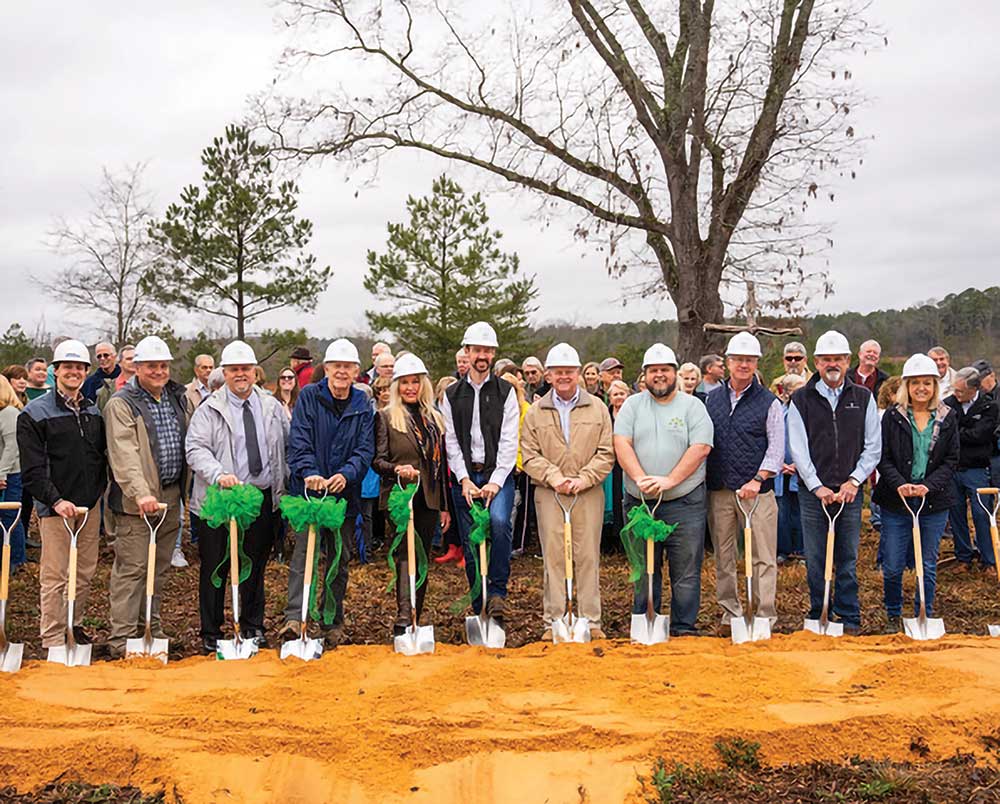
There’s been a lighted cross just off U.S. 231, south of Pell City, for over a year, marking the spot where a new church will soon stand. Shovels tipped the dirt on a drizzly February morning, signifying the beginning of construction on the $7 million New Life Church.
Site work has already begun at the property adjacent to Cosper Construction on Easonville Road in preparation for the first phase of the project, which will include the building of an outdoor chapel to accommodate 150 people.
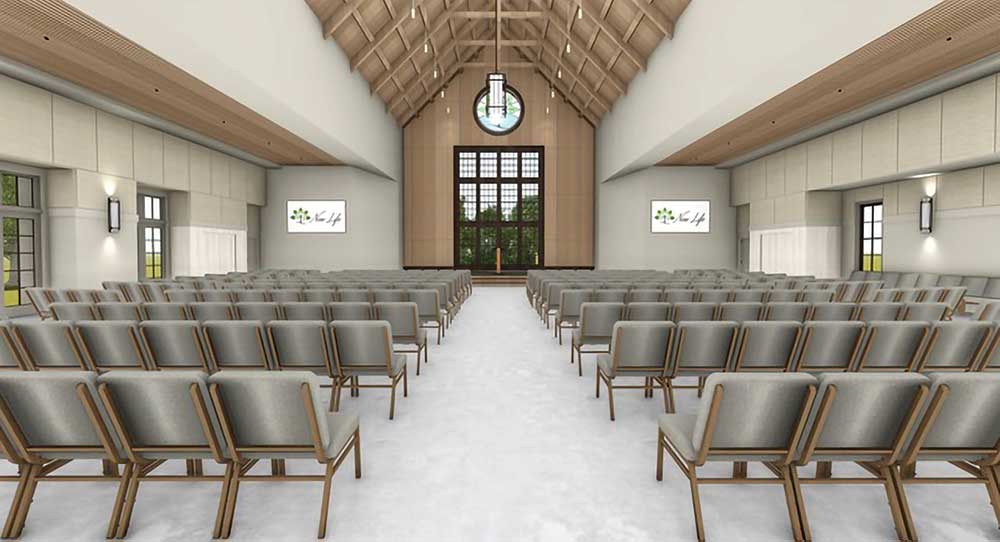
The main building will house 20,000 square feet of worship space, classrooms and offices with seating capacity for 300 in the sanctuary.
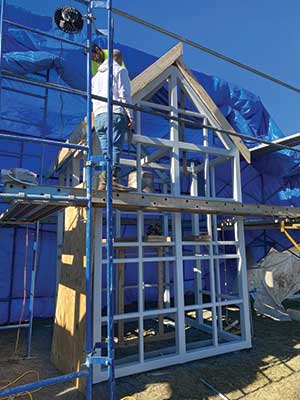
Byron Smith, owner of studiosmith Architecture, LLC in Pell City, designed the facilities with a nod to the casual “lake life” feel of the area. “In conceptual listening sessions, church members indicated that the proximity to the lake and its relaxed and informal nature was important to incorporate into the design,” said Smith. “The steeple will actually be a cupola with windows on four sides, which you might find at the peak of a home overlooking the lake.”
New Life sanctuary plans
Smith describes the style as “traditional southern vernacular with a modern edge.” “Traditional forms, soaring ceiling heights and exposed timber roof structures were important to me in designing a public building that is recognizable, like a home,” he added. “It’s a reflection of the people who will use it.”
The population of both St. Clair County and Pell City continues to grow, with more than 200 new homes being built just a stone’s throw from this new church.
“Pell City is growing, with new homes and new businesses,” said Rotunda Forman, Pell City Chamber of Commerce vice president. “Even though we do have quite a few churches in Pell City, new churches are about a new voice, a new direction. People need to find what fits them. Our younger generations are looking for that.”
Wes Savage, who serves as lead pastor of New Life Church, agrees wholeheartedly. “We believe firmly that new churches help reach new people with the Gospel of Jesus Christ,” he says. “We’ve seen increases in visitors who were ‘unchurched’ or ‘de-churched’ people coming to experience renewed faith and a passion for their personal relationship with Jesus Christ. We expect that to continue as we are able to provide new facilities for children and youth to meet the needs of families moving into the area.”
“At New Life,” adds Rev. Savage, “we are committed to raising up a new generation of believers and providing a place for families and adults to make new personal connections, find purpose, build community in a local body of Christ, and become equipped for the work Christ has called them to do for his kingdom and for his glory.”
New Life Church was planted in November of 2022 and has quickly grown to 300 members with seven staff. It is an independent church which upholds Protestant Christian beliefs as contained in the Apostles’ and Nicene Creeds.
Building committee members celebrate groundbreaking with architect and general contractor
Savage goes on to explain, “First and foremost, we are followers of Jesus Christ, grounded firmly on the unchanging word of God and guided by his eternal spirit. We believe all people should have the opportunity to hear and respond to the good news offered through Jesus. We believe God’s grace is abundant and the new life he offers is life changing.”
Helping to change lives is an important part of New Life’s mission of “glorifying God, making disciples, and blessing others in Jesus’ name.” In their first two years, a focus on missions has been in the forefront of the more than 25 projects New Life members have embraced.
From supporting the physical and spiritual needs of children in Juarez, Mexico, through Hunger House International to supporting the heroes at the Colonel Robert L. Howard State Veterans’ Home in Pell City, there is always a place to serve.
New Life members have collected food for the Christian Love Pantry and participated in distributing at the food giveaways, in addition to providing Thanksgiving dinner for inmates in St. Clair County. Other missions include Dovetail Landing, the Sheriff’s Boys’ Ranch, the Gideons and St. Clair County DHR’s Foster Children Christmas gifts.
Teams have also built solar cubes to help bring electricity to people in 18 countries through Designs for Hope.
Following the disastrous effects of flooding from Hurricane Helene in October, New Life sent a team to work with Samaritan’s Purse Disaster Relief in Boone, North Carolina. “It was such a humbling experience,” said Suzanne Freeman, chairperson of missions for New Life. “We helped three families who had extensive flood damage. We thought we’d come to help them but found ourselves even more blessed by them.”
Services on the new property will begin in the Spring. Until then, services are held each Sunday at 8:30 a.m., 9:40 a.m., and 10:30 a.m. at the Pell City Municipal Complex at 1000 Bruce Etheredge Parkway.
Story by Joe Whitten Photos by Wallace Bromberg Jr. Submitted Photos
The name Cool Springs calls to mind a wooded bower where weary wanderers of long ago found peace and rest in the springs’ restorative waters.
And when a church is named Cool Springs Missionary Baptist, it is lovelier still, for it speaks of refreshing the soul and spirit. Psalm 104:10 reads, “He sends springs into the valleys, which run among the hills.” This was the motto verse for the church’s 150th Anniversary in 2019.
The man who would establish this church, Alexander Clark Ramsey, was born in 1812 in Jackson County, Georgia, to John and Sarah Anderson Ramsey, according to Ramsey family history provided by Beth Jones and Judith Abernathy.
Their research also shows that “Sarah Anderson Ramsey was ¾ Cherokee and Creek Indian. She moved to St. Clair County, Alabama, with her children after her husband died in Rhea County, Tennessee, in 1829. The family believes that Alexander Clark also came to St. Clair County c1829 as well.”
Records show that at age 22, Alexander “entered land at Cool Springs with the government” in 1834, and by that same year, he had married Nancy Ann Ross, born in 1803 in South Carolina.
Alexander and Nancy Ann built a home in Cool Springs and reared a family of three sons. Two died during the Civil War: The first, recovering from wounds was returning home by train; however, the train crashed, and he died in the wreck. The second son died of measles.
The third son, John Washington Ramsey, returned home and lived his life in Cool Springs. Oral history states that when he returned from the war, John Washington could not embrace his family until his clothes were boiled and he had rid himself of lice.
The nearest church, Ashville Baptist, lay five miles northeast of Cool Springs. To attend this church, worshipers traveled these miles, by walking, by wagon, or by horseback. Inclement weather made this journey tedious.
We know the Ramsey family worshiped there from Mattie Lou Teague Crow’s history, Ashville Baptist Church and Its Beginnings. In her research, she discovered among Col. John Washington Inzer’s notes about the church a paper dated 1858, which listed those who pledged money toward constructing the second Ashville Baptist sanctuary. The listed names included “Clark Ramsey,” who pledged $10.00 – not a meager sum in those days.
Realizing the advantages of a local church for the Cool Springs families, Alexander Clark Ramsey and his son, John Washington, with other Baptists, organized Cool Springs Missionary Baptist Church in 1869. We do not have the names of the Charter Members other than John W. Ramsey, for the church’s earliest existing record book dates to 1883, 14 years after the organizing date.
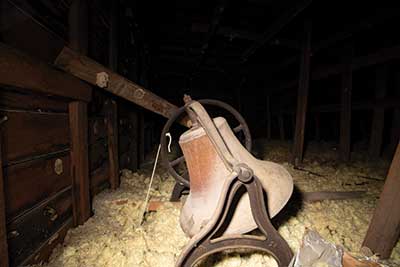
The original church bell still in attic today
These were Reconstruction years and money was scarce. The men of the church and community felled trees, notched logs and constructed a log sanctuary which stood on the same property as today’s building and near the springs’ refreshing waters. Winter heat came from a log burning fireplace.
The 1883 minutes book lists 37 male members and Rev. J.S.E. Robinson as pastor. Rev. Robinson (1849-1924) pastored St. Clair County Baptist churches for over 50 years and preached revivals almost every year. A brief history of Friendship Baptist gives an account of a revival Rev. Robinson preached there. “He was asked if it were true that he had converted 60 souls during the revival. His answer rang out, ‘I never done it. God done it!’”
The walls of the log church resounded with Gospel preaching for 22 years, until the congregation needed a more commodious sanctuary. In a transcribed talk presented by Bessie Whitfield Burttram at the church’s Centennial Anniversary, she stated that in the January1891 business meeting, “Bro. W. Johnson was endorsed to have a bill of lumber cut for the new church building.” Then in March, “… a committee of five members was appointed to ascertain the indebtedness of the new building and to assign to each male member his portion of the cost.” The dates of completion of the building and the first service are unrecorded.
The 1891 building had two front doors – one for men and boys and other for women and girls. Judith Abernathy recalls her Aunt Roberta Ramsey Ensey telling how her “best beau” would walk her to the women’s door and then he entered by the men’s door.
Although remodeled and updated over the years, that building still serves the congregation today. The two front doors are gone, and all enter to worship through the same double doors.
In January 1913, a motion was made and approved “…to sell the timber on the church lot.” The timber sale resulted in $13.58, and they “purchased new seats for the church.”
Cool Springs has always had a concern for the spiritual and physical needs of its congregation and others. Church records show that in 1925, Mr. A.L. Galbreath, a farmer, told the membership that he had planted a five-acre plot “for the Lord.” When that was harvested and sold, “He brought the money received to the church to be divided between the pastor and the orphan’s home.” In those days, pastors were often paid with farm produce. Cash would have been a Godsend in 1925.
Today, Baptist churches conduct Sunday school classes for all ages. This wasn’t always the case. Sunday schools originated outside of established churches and were interdenominational.
In a Jan. 6, 2012, online article titled, “Sunday School an Evolving Institution,” it says that denominations moved slowly in organizing Sunday school classes. The same article states that “The Southern Baptist formed its Sunday School Board, now Lifeway Resources, in 1891.” Therefore, it’s not surprising that in April 1895 a motion to organize Sunday school at Cool Spring didn’t carry. They later approved Sunday school classes, but church minutes seem not to have recorded the date.
Membership increased, and church minutes show that in1936 the congregation approved remodeling and adding Sunday school classrooms, and Alabama Power installed electricity that summer.
For classrooms, the church decided to dig a basement under the 1891 structure. In a recent interview, Beth and Ross Jones and Judith Abernathy, told the basement’s history. “In 1936, teenage boys with a short mule named Bell, a slip scrape, shovels and picks dug the basement under the supervision of the older men. Church members picked up rocks to make the basement foundation to the addition. One of the men hauled them over here on his Studebaker truck.”
The US economy had improved by 1936, but in 1937, it took a dive which lasted until late in 1938. This unexpected decline involved the church members’ finances, so, completing the remodeling and basement rooms progressed at a tortoise pace.
In speaking of this, Judith told that in a business meeting someone suggested that the ladies of the church might give their Sunday eggs to help pay off the indebtedness. “The women sold eggs gathered on Sunday and put that money in the collection.”
It took from 1936 until 1938 to complete the remodeling, “However,” Beth Jones observed, “we have a full set of Sunday School rooms still in use today under the sanctuary built 132 years ago.”
A significant 1938 event occurred when Dr. Jacob Gartenhaus, director of the Southern Baptist Home Missions Board, accepted an invitation from the Cool Springs WMU (Women’s Missionary Union) to come speak to their group. Cool Springs’ WMU invited all churches to attend his presentation but as reported in The Southern Aegis of Feb. 3, 1938, due to inclement weather, only Cool Springs folk attended. “However,” the article continued, “Dr. Gartenhaus expressed a desire and determination to visit again.”
Dr. Gartenhaus, a Jew, was born in Bukowsko, Poland, in 1896. As a young adult, he came to New York City where he converted to Christianity. He attended Moody Bible Institute and the Southern Baptist Seminary in Louisville, Kentucky. He served 27 years with the Southern Baptist Home Missions and was known as the “Southern Baptist Jew.”
Eighty-five-year-old June Smith, WMU member, recently told of WMU women quilting for the public. “We put the money in the WMU treasury,” she reminisced, “and that money went to missions. We’ve always been big on missions – and still are.” Cool Springs’ heart for mission continues strong today.
What would a Baptist worship service be without instruments to accompany the singing? However, beginning with the Reformation, protestants congregations sang acapella, for the organ represented the religion they protested. And 350 years later, most rural churches in the United States still sang without instruments.
Hymnbooks came with lyrics only. Instruments were also expensive, but the invention of the pump organ made that instrument affordable, but churches still resisted purchasing them.
We see that at Cool Springs in 1901, the motion to purchase a pump organ did not pass. Opinions changed by 1902, and the congregation approved buying an organ, and Myrtie Whitfield was organist for many years. One can only imagine the harmonious blend of voices and music the first Sunday it was played.
Today Leah Attaway plays the piano for the church. She studied piano for 10 years with Electa Stevenson, the well-respected piano teacher in Odenville, then continued music studies at Samford University. Leah’s first cousin, Kerry Montgomery, serves as song leader.
Singing schools that were held in churches became popular in the 19th Century and continued until into mid-20th Century. An announcement for one at Cool Springs appeared in the July 7, 1915, The Southern Aegis: “The Eureka Normal School of Music will hold an eighteen-day service under the direction of Homer E. Morris of Oneonta at Cool Springs five miles southwest of Ashville beginning July 12, 1915.”
The cost for 19 days’ study was $1.50, and for those coming from a distance, boarding for the duration was “very reasonable.”
All Day Singings occurred once a month in many St. Clair County churches, and singers from all over the county attended. In the Dec. 6, 1928, issue of The Southern Aegis, “Cool Springs News,” we read, “Cool Springs Singing Society attended the singing at Poplar Springs and report a good time.” Another in the April 1931 issue announced that at the All-Day Singing at Cool Springs there would be quartets from “Leeds, Acmar, and Odenville. …We are expecting a grand day. Bring well-filled baskets (of food).”
The St Clair News-Aegis of April 16, 1959, announced that “Lee Smith and the Master Workers Quartet from Akin, South Carolina, and Rick Mays and the Jubilaires Quartet of Birmingham” would be at Cool Springs, and that Ray Wyatt was the program chairman.
Beth Jones recalled that once when she was a child, she had the mumps and couldn’t attend. “Our family lived about 3/10 of a mile from the church, and that day, cars were parked all the way to our barn. I was on our front porch, and with the church windows open, I could hear the singing. We used to have big singings.”
Cool Springs Cemetery
Vacation Bible School (VBS) began at Cool Springs in 1947 under the ministry of Bro. Oscar Mitchell, and it has continued every year since then. Bro. Mitchell’s wife, Nellie, directed that first year.
Later, Peggy Jarrett directed many VBS weeks and is remembered for her concern for children. “I never will forget,” a church member said, “how when she always prayed, ‘Bless the children.’ She worried about children.”
Other VBS directors from bygone days include Margaret Sellers and Mary Ramsey.
June Smith’s family joined the church in c1950 when she was 12 years old, and she remembers well VBS time. One of her teachers, Gladys Smith, became her mother-in-law when June and Ralph Smith married.
Recently, she told how Lena Morris and Ruby Kirkland prepared cookies and juice each day for the children. “Mrs. Morris would squeeze oranges and make fresh juice for us.”
Today, Regina Ash directs VBS, and the entire church participates. Each year, between 50 and 60 children attend – Peggy Jarrett’s prayers answered. The purpose of VBS is teaching children about the Bible and God’s gift of salvation. Each year, children come to faith in Jesus Christ through this church ministry. These new converts wait until after the yearly revival to be baptized.
Until recent years, most churches held revivals every summer. Through the 1950s, the evangelist preached a morning service, had lunch with a church family, made visits in the afternoon, and preached at night services.
Churches announced revivals, as in this Aug. 8, 1917, ad in The Southern Aegis: “A series of revival services is being held at Cool Springs Church by Rev. E.P. Moore, who has many old friends in this community.”
Cool Springs scheduled revival week at the end of July. If the first week proved especially effective with many converts, a revival could continue for two or three weeks. Extended revivals were called “protracted meetings.”
The Ramsey sisters reminisced about revivals. “Ladies of the church took turns cooking for the evangelist and had the meal ready after the morning service,” Judith recalled.
Rev. Pearl Tinker was their favorite evangelist, for he brought his family and stayed with the Ramseys. “Judith was friends with the older daughter of the pastor, and I was friends with the younger daughter. We went to all the dinners!” “But,” Judith added, “we girls waited until the grownups had eaten.”
When revival ended, “Baptizing Sunday” came soon afterwards. This service occurred at the “Baptizing Hole” on Canoe Creek until the installation of the indoor baptistry in the 1980s.
Ross Jones recently reminisced, “The baptizing hole was originally a ford, so it was a rather shallow place with some areas deep enough for baptizing.” Beth joined in, “On Saturday before baptizing, some of the deacons would build steps going down from the bank into the water.
“Then on Sunday morning before the baptizing, John Ramsey, one of the deacons, would carry a long rod and go down the steps and check to make sure no holes had washed out during the night that could cause someone to fall. Then before baptizing started, a deacon would precede the pastor into the water to scare off the snakes.”
When the church added the baptistry inside the church in the 1980s, Pat Massey thought a painting of the Baptizing Hole would be a good background scene, showing “the olden days.” He commissioned Karl Scott, St. Clair Springs artist, to paint the scene, and the church paid the cost.
The most recent update to the sanctuary occurred in 2016. For 10 years the congregation had saved money to install a cupola for the original church bell. Several carpenters assessed the structure and determined the bell was too big and heavy for a cupola. Since the old Cool Springs School bell would fit, it hangs in the cupola today. The historic church bell remains in the attic and is rung on Memorial Day.
The Cool Springs School stood across the road from the church and to the left of the cemetery. Organized toward the end of the 19th Century, classes first met in the church, it seems, for church records of July 1899 state, “Permission was granted for the church building to be used as a school.” Sometime after that, the community constructed a school on land donated by the Ramseys. It stayed in use until the 1940s when Cool Springs students were sent to Ashville school.
After building a home in the area in 2010, Chuck and Regina Ash wanted to worship in a local church, and after visiting other churches, they joined Cool Springs, and they both participate in church ministries. Chuck had grown up in the Cumberland Presbyterian Church, so when he and Regina chose Cool Springs Missionary Baptist, Chuck was baptized by emersion as required by Baptist. “I had to learn how Baptist do things,” he said.
Chuck learned well, for on March 20, 2022, he was ordained as a deacon along with David Murphree, Steve Ray and Jacob George. These four serve in fellowship with the other deacons: Ross Jones, Jim Montgomery, John Ray and John McWaters Sr.
Jacob commented on how the church had influenced his life, for he had grown up being taught the Bible and the things of God. “The church family itself has played a big part in me learning how important family and good friends and fellowship are,” he said. “At Cool Springs, most of our members are older, so, for me as a young man, it’s good to be around their wisdom.”
Brother Curry Harris has pastored Cool Springs since 1989. He also refers to the congregation as family. “In my 34 years, we have laughed, wept, celebrated and mourned. We celebrate marriages and births and watch children grow up. They feel like my own children.”
Of church members’ funerals, he said, “We weep and mourn for the family and our church family, but we celebrate that because of Jesus, they are with Him and we will be together again one day.”
Of the camaraderie and fellowship of his congregation, he recalled a September 17, 2023, picnic at Camp Sumatanga. “We prayed for each other’s needs, worshiped the Lord, enjoyed His beautiful nature and studied God’s Word. We ate together – Yes, fried chicken and banana pudding because we’re Baptist! Afterwards, some played horseshoes, children rode bikes, and others enjoyed walking or just talking and fellowshipping.”
Brother Harris’ plans for Cool Springs include to continue reaching out to the community and to continue fighting the good fight.
The ministries of this church are founded on the Gospel of Jesus Christ who said, “Whoever drinks the water I give them will never thirst. Indeed, the water I give them will become in them a spring of water welling up to eternal life.” (John 4:14, NIV Translation)
Composer John Peterson used this verse when he penned the chorus of his gospel song, “Springs of Living Water.”
Drinking at the springs of living water,
Happy now am I, my soul is satisfied.
Drinking at the springs of living water,
Oh, wonderful and bountiful supply.
Cool Springs Missionary Baptist Church, a refreshing oasis in a chaotic world, invites you to come.
New community center in Springville on track to fulfill vision, needs
Story by Carol Pappas Submitted photos
Serving an entire community is a pretty tall order but when visionaries saw an opportunity to build a community center in Springville, it seems no detail of service was omitted.
The 38,000 square foot facility just off of U.S. 11 houses a church, a school, a fitness center, a health and wellness center, indoor playground, a massive common area, a chef’s operation and a coffee shop. And that’s just the first phase.
Mike Ennis, pastor of Faith Community Fellowship Church, Springville campus, says the center’s “whole goal is to serve the community.”
When the project began, Ennis explained, “We felt like rather than building a church, we’d rather build a community center – something the entire community could use, something that would hopefully improve both the economics and health of our community and provide athletic opportunities.”
It has not wavered from its original vision. At the time, Ennis described it as a center “not just for young people and not just people who are a part of our church, we really wanted to build something that would serve the community at large. That’s been the driving factor behind it from the beginning.”
To accomplish that, the church partnered with a nonprofit property management group, Surgance Inc. They wanted to create something fresh and alive with activity that would be used every day and geared toward bolstering the economy and health. “Every tenant is focused on that mission,” says Ennis.
Hayden Hornsby is the facility coordinator, and his ever-present smile as he outlines the tenant roster hints at the success story all around him.
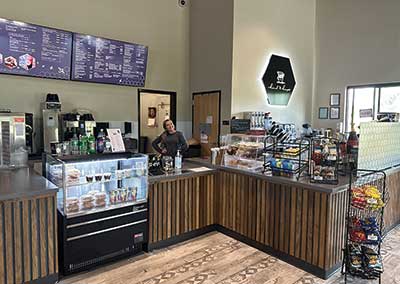
Kind Kups
Kind Kups serves great coffee drinks and is a hub of activity and a gathering spot
Kind Kups is an anchor with wide-open space in an inviting atmosphere that has become a central gathering place for meetings, conversations, Bible studies and of course, a cup of specialty coffee and dessert.
Bring your laptop, bring a friend, meet new people – all are welcome at Kind Kups.
The Depot is actually the second location for owners Kevin and April Browning, who live in Cleveland, Alabama. It began from their leadership in their church’s small group and grew into a community outreach.
Its mission is to “provide a life-giving atmosphere for community building and fellowship. To encourage our customers through acts of service and words of kindness. To impact our community by empowering self-worth and inspiring kindness, ultimately motivating them to give back.”
Springville Christian Academy
An infant through 8th grade school has a significant presence. It has grown so much that enrollment is expected to be 160 in the fall, and officials are considering adding 9th grade.
While it occupies part of the building, the school is actually separate and secure. The school keeps class sizes small so that each student feels like they have one-on-one learning opportunities. The fully staffed faculty headed by Tyra Jordan provides students with an education based on academic excellence and biblical values.
It features state-of-the-art classrooms, library, sports opportunities, music, art, Spanish and weekly chapel.
“SCA is honored to have Lacy Trull bring hot lunches into the school each day, something that most schools of this size do not have the opportunity to have,” Hornsby said.
Euvista
Euvista is a health and wellness center, offering weight loss and nutrition coaching, prescription weight loss medications, hormone testing, low-tox lifestyle coaching, Long Haul COVID treatment, bioidentical hormone replacement therapy and lipo/B12 injections.
The center focuses on the root of weight management, offering programs for nutrition, mindset and overall body transformation.
This is Euvista’s second location. The first was in Cullman. The Springville location is already busy with bookings for appointments weeks in advance.
Performfit Studios
A gym and physical fitness center, Performfit offers a fully equipped workout studio with classes available. It also offers speed and agility training.
President Chris Lynch holds a master’s degree in Occupational Therapy and is a Certified Strength and Conditioning Specialist.
Chef Margaret’s
Chef Margaret Vincent, also known as “The Chef Next Door,” offers Delicious Delivery services. She prepares gourmet, homemade meals once a week and delivers to clients on Wednesdays.
She also caters bridal and baby showers, in-home parties and open houses – events traditionally thought of as too small for a caterer. She creates charcuterie grazing boards and tables, holds cooking classes and demonstrations and does food styling for publicity shoots.
She also sells Chef Margaret’s No-Mento Cheese, described as “hand-crafted, chef-made, perfectly-southern, totally addicting creamy goodness.”
Faith Community Fellowship Church
While the church was the catalyst for the center, it, too, is a tenant like the others. The growing congregation is now 350 and growing.
Grand Central and Rental Spaces
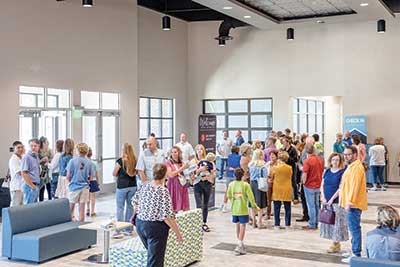
Grand Central is as the name implies – a bustle of activity
The centerpiece of the building is an expansive lobby area with high ceilings and plenty of room for all kinds of events.
Aptly named Grand Central, the entire area is a bustle of activity – the comings and goings of all the services found there in addition to the activities it provides space for. You might quote the old cliché, and say it’s a bit like Grand Central Station, and you’d be right.
The auditorium is available for rental, and it has exceeded its annual goal already. Hornsby pointed out that the auditorium hosted a theater group with a 55-member cast, a political reception and a variety of other parties and events.
An indoor playground is tucked into space at the front of the building just off Grand Central, and it is being done in a railroad motif. The windows will have locomotive faces peering out – a welcoming attraction for children.
A community Easter Egg hunt with a live band drew 1,200 people. Depot Days and Sip and Shop provide brick and mortar-type opportunities for local artisans to set up booths and sell their wares.
It’s all a part of the effort to serve all aspects of the community. Ennis motions all around him, adding, “There’s nowhere else in this end of the county that provides all this. We love this community!”
In August of 1969, there was a music festival of some note, held on a dairy farm a few hours outside of New York City. Attended by over 400,000 people, that music festival, known as Woodstock, was promoted with the slogan, “Three Days of Peace and Music.” The country was in the middle of turbulent times, and organizers thought music could bring some inner peace to festival goers.
Fast-forward 54 years to a farm in the heart of Pell City, Alabama. Hundreds of people have gathered to enjoy a free music festival. The festival is called Lovestock, a nod to the intent of the historic 1969 music mega-festival. As you walk from the parking area toward the stage, you enjoy the serene beauty of this farm, with its expansive views of gently sloping green hills and fields.
As you approach the stage, you hear the master of ceremonies tell the crowd that today there are no races, no black, no white, just love. “Today,” the voice explains, “will be all about the collective experiences of cultural and ethnic backgrounds and their expressions of love in music.” Throughout the day, the shared joy and community among the participants creates a truly palpable sense of love and unity.
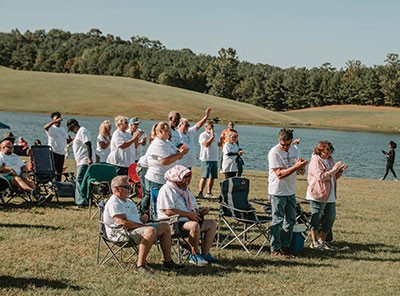
Spectators fill the fields in front of the stage
During breaks in the music, squeals of joy can be heard from the children’s inflatables play area. Groups of festival goers wander about to visit the food truck and vendor area as they wait to hear their favorite group sing. Unlike the rainy, muddy conditions that characterized the Woodstock festival site, the weather on this October day is sunny and warm, with a breeze that hints of the changing seasons.
Individuals and bands from five states share the stage at various times throughout this day-long music festival. The 17 acts will later be edited into four shows for Alabama Gospel Roots, a popular television show which airs on Saturday nights at 8 p.m. on Alabama Public TV (APT).
Al Lewis has been playing saxophone for 64 years. He’s playing with two different bands on this day. “I was around at the time of Woodstock,” he says. “Lovestock is different and so much better. No alcohol, no chemicals, just totally Christian love.” He joins the band, Lite Brigade, in the morning set and Healed by the Blood in the closing act of the day.
Rev. Dr. Renita Allen-Dixon is a popular gospel recording artist from Tallahassee, Florida, and has just finished her set on stage. She agrees with Lewis about the festival and its location. “You can feel life and the presence of God here,” she adds. “It’s an opportunity for God to bring serenity and peace and for faith to be renewed.”
The idea for Lovestock began two years ago as the brainchild of four men working on various projects in the entertainment industry in Alabama. George W. Stewart, host of the Alabama Gospel Roots television show pitched to his friend, Charlie Beavers, the idea of putting on an outdoor music festival. Beavers, a Birmingham attorney and frequent guest musician on the gospel show, agreed to help, and the idea took flight. Beavers suggested including Rodney Burrow, a friend he had worked with previously on a charity music event. Michael Sutton, who manages Iron City Collective, a pop-up worship event group which produces worship events at places like Railroad Park in downtown Birmingham, rounded out the group.
APT had been taping Alabama Gospel Roots at venues all around the state since the COVID pandemic shut down their studio in Montgomery. As they continued to talk about it, the plan began to take shape as a Christian Woodstock equivalent, with back-to-back groups playing throughout the day, but without the negative connotations and volatility that became associated with the iconic ‘60s festival.
Lovestock organizers added to their event promotion the tagline, “What the World Needs Now Is Love,” a reference to a popular 1965 song recorded by Jackie DeShannon. “That’s truly what the world needs now,” said Stewart. “There’s a lot of hurt in the world today. We’re going to show a pure expression of love for each other and love for God. We hope people leave empowered to share this example of unity with the world.”
Organizers booked Lovestock at Rodney Burrow’s 123-acre farm. Its green, rolling hills and water features project a decidedly golf course feel, with good reason. Burrow purchased the land from the estate of Charles Carter, owner of Carter Golf Company, a world-renowned company that built many famous golf courses, including the Robert Trent Jones courses in Alabama.
“Carter used his company equipment and sculpted it, I’m told, from basically swampland to the tranquil and beautiful hills and lush greenways that it is now,” tells Burrow.
Burrow had been looking for land to buy outside of Birmingham in 2012 when the property became available. He recalls the story of how he knew it was the right land for him. “A friend came out with me to look at the land. He got down on one knee and scooped up some dirt in his hand, let it sift through his fingers and told me that one day I would be able to call this land my own,” says Burrow, choking back tears.
“I came back a few days later and promised God that if he gave me this property, I would give it back to him.” Thirty days later, Burrow closed on the property, which he now calls Willow Tree Ranch.
His journey to fulfill that promise includes offering sections of the property for use for events like Lovestock and for use in his work with area youth and families. “When I bought it, I really didn’t know what that would look like. What began as a youth camp idea has expanded into something far beyond my expectations,” adds Burrow.
He has plans to develop the land further and build a conference center with lodging, and fishing and recreation areas, along with barns with horses for guests to ride.
Burrow introduces one of his volunteers at the festival. Joseph Carrion smiles as he tells his story of gratitude and the reason he is happy to help. He had been serving two life sentences plus 13 years at Donaldson Correctional Facility as a repeat offender convicted on a charge of drug possession.
After participating in a prison ministry event called Kairos in 2003, he turned his life around. Charlie Beavers was working with that ministry on that April weekend at Donaldson. “I asked him if God could really save me,” said Carrion.
“A year later, I was released on parole. The next year, Charlie and some others went with me to Montgomery to receive a full pardon. Helping with these kinds of events helps me to give back for the gift of love and salvation I didn’t deserve.”
Breaking down barriers and offering life-changing love is what has fueled the efforts of all who worked on this music festival. “Lovestock crosses all boundaries,” says Stewart. “It’s a collective of cultural and ethnic backgrounds and their expressions of love in music. It’s unfacilitated peace through all walks of life.”
A man, a parish, heavenly intervention, a community and a bell
Story Paul South Photos by Sam Marston and Graham Hadley
If Zuzu Bailey’s line in the 1946 holiday film classic, It’s A Wonderful Life is true – that “Every time a bell rings, an angel gets its wings,” a small Catholic Church in Cropwell helps get a heavenly squadron cleared for takeoff every day.
Our Lady of the Lake Catholic Church’s 750-pound bell has become not only part of a parish, but of a community. It’s much more than heavy metal.
It’s a ringing result of one man’s idea, the support of his priest and parish and a heaping helping of Divine Providence.
Just ask Sam Marston.
It may have been 2017 when Marston, a 76-year-old retired airport food service manager, got the idea for the bell at Our Lady of the Lake Catholic Church.
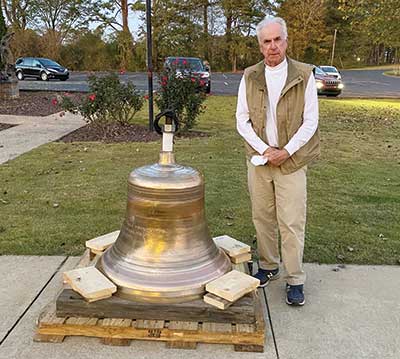
Sam Marston and the bell
“The church didn’t have a bell tower, and I like bell towers,” he says.
After meeting with the then-priest at Our Lady of the Lake, Marston pledged seed money from his 401k for the bell and its tower.
But until 2019, thoughts of the bell fell silent. The former priest retired. And what’s more, Marston’s wife, Glenda, was battling cancer.
In 2019, buoyed by an enthusiastic response from new OLL priest, the Rev. Bill Lucas, Marston began to reach out to churches in Philadelphia and Washington, looking for bells from closed parishes.
None were found. Then, he discovered Bell Castings, a firm in Loudon, Tenn., and its owner, Todd Lower.
The church found its bell – a 1934 model crafted by the Missouri-based McShane Company – in a roomful of ringers. Founded in 1856, McShane is America’s oldest church bell company.
The parish began a fundraising effort. While Marston’s pledge, funded by a government required minimum distribution was financial, both Marston and Lucas believe a higher power was at work.
“It had to be something Divine,” Marston says. “I couldn’t have come up with this. It was just something that came together. My whole thought process was to do something really, really special with this donation.
Marston, a cradle Catholic, had always loved bells. “It makes the whole church experience rich. Ringing before Mass and after Mass is like a celebration.”
Initially, donations for the belltower project came at a trickle. Rev. Lucas was not optimistic.
“We set a budget that was much higher than what we had before … So I said, we’ll leave it to the parish and if people give enough money, we’ll build the bell. But I didn’t think there was any way we would ever get to the level we needed to get to build the belltower.”
Marston confessed to doubt as well. “When the money stopped coming in, yes I did have doubts,” he says. “I tried to put it out of my mind, but I’d go out and see the bell sitting on the ground.”
Then, after one Sunday Mass, came a miracle. A donor wishing anonymity quietly handed Lucas a check for the majority of the needed funds.
“All of a sudden, there we were,” Lucas says. “We had the money for the project. Some people would say we got lucky,” he adds. “But I prefer to say Divine Providence.”
He adds, “If you believe in Divine Providence, the whole story of our parish is that way … You can see it at work. But it’s certainly true of the bell.”
Marston agrees. “I really do think it was Divine intervention, because there were so many things that could have stopped it.”
Through friend Carl Wallace, Marston connected with structural engineer Bob Barnett, and Barnett foundBirmingham architect TimLucy who had done work for other Catholic parishes in the past. It seemed a match made in heaven.
Upper framework
The link to Barnett came in true Logan Martin style, when Marston and Wallace discussed the bell project over glasses of wine during a sunset pontoon cruise.
“(Sam) was willing to make the financial commitment, but he just didn’t know how to take the next step,” Wallace, author of the popular Facebook blog, “Lake Ramblings”, says. “I’m an engineer, and I just happened to know Bob Barnett who lives on the lake … and has his own structural engineering company. My simple part was, ‘Sam, let me get you in contact with Bob Barnett and get y’all hooked up.’ And Bob jumped all over it. He hooked up Sam with the architect. He had worked with (architect Lucy) on Catholic projects before.”
Ground broke on the bell tower on Nov. 9, 2021. But it was not an easy rise to the heavens. Soft St. Clair County soil required digging deeper and reinforcing the foundation with concrete. The bell, gleaming gold against a bright blue winter sky, was raised on Jan 13, 2022.
“You talk about exciting,” Marston recalls.
The electronically programmed bell rings every hour on the hour between 9 a.m. and 6 p.m., as well as five minutes before and at the end of each Mass and at funerals. The bell, Lucas says, has impacted the parish in a positive way.
“It’s made people more reverent,” Lucas says, “because when the bell rings, then you focus on the Mass. You focus on prayer and worship. Just like during the Consecration when we ring the bells, it’s a reminder to people where we are and what we’re doing.”
Lucas adds, “I didn’t really understand that when we were going through the project. But since we’ve had it, it’s opened my mind to the benefit of having the bell and helping people’s faith.
In a small way, Wallace says, the bell project has enriched life on the Cropwell end of the lake, especially as the tower was under construction.
“It’s almost the anticipation of it was greater than the final project,” Wallace says. “It’s not real loud. You can only hear it if you’re in the area. People see it when they drive by. It has become an instant landmark, maybe more so than the church itself.”
There’s something more at work here.
“The tradition of it, I think, is noteworthy,” Wallace says. “A church bell ringing is a great thing.”
The bell is a reminder of faith for people, regardless of their spiritual persuasion, Lucas says.
“Sometimes they’re Catholic, sometimes they’re just believers. They hear the bell, and it reminds them of that,” Lucas says. “This is a very religion-friendly area, and I think the bell speaks not just to Catholics, but to everyone of faith. It gives them a reminder that God is there and to take Him more seriously.”
While Marston was the driving human force, the community, priest and parish all played a part.
“It was a relay, and there were a lot of runners,” Wallace says. “It’s a very interesting thing that just happened to happen to happen.”
While at this point, folks in Cropwell may be unsure about Hollywood’s Zuzu Bailey theory on angel wings and chiming bells, the feeling Sam Marston gets with every clang is crystal clear:
“Joy,” he says.
At the end of the day, the story of the Our Lady of the Lake belltower transcends one man’s dream, or money, a bell or bricks and mortar, Lucas says. “I think it does come back to that Divine Providence. If we’re open to that, and we’re willing to be molded by that, then God can use that for His glory and the building up of the Church and building up of faith, if we’re open to it.”
And in what some may see as another ring of Divine Providence, the bell chimed for the first time on Feb. 1, 2022.
A sweeping driveway and parking lot lead one up to Rocky Zion Missionary Baptist Church’s brick sanctuary on 16th Street South in Pell City overlooking The Legacy Center and a community of interconnecting streets.
Before integration of schools, today’s Legacy Center was the location of the St. Clair County Training School, serving Black students locally as well as those from Moody, Margaret, and Ragland.
Today, no one knows how the name “Rocky Zion” was chosen, although one can speculate. In the Old Testament, “Zion” was another name for Jerusalem, the City of God. In the Christian era, Zion referred to the New Jerusalem, Heaven.
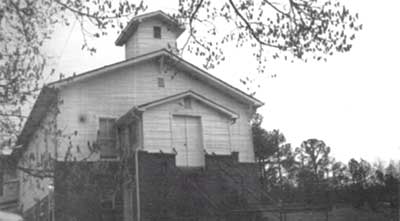
Historic church with rock foundation
The old hymn, Marching to Zion, speaks of “marching upward to Heaven, the beautiful City of God. But how does “Rocky” come in? There does not seem to be a definitive answer but considering that the church was organized by freed slaves during the last year of Reconstruction in Alabama and scarcely 11 years after The Emancipation Proclamation was signed freeing some slaves, it could refer to the difficulties slaves and freed slaves faced in worshiping together. Those were hard years, and the roadway to declared freedom was rocky.
The name of the first pastor is unrecorded, but three of the early pastors were Rev. Dave Forman, Rev. Chester Beavers and Rev. Markus.
From oral history passed down and put into writing, the church was organized in Cook Springs in 1874. At this writing, no record has been located to indicate where in Cook Spring the church met. Older people there remember that both races attended Cook Springs Baptist during the first half of the 20th Century. One of Esta McLaughlin’s sons recalled his mother’s comment when integration came, “We’ve gone to church together all our lives, what’s the problem?”
From Cook Springs, the church moved to the Whitesville-Harrisburg area. Samford University’s Davis Library has copies of the Rushing Springs Baptist Association minutes which list Rocky Zion as located in Eden in 1892, for Eden was the post office location.
The church is listed in the 1893 and 1894 minutes as well. Membership with an association has been inconsistent over the years, according to Deacon Terry Young. Therefore, historical data is rather sporadic. This Whitesville-Harrisburg building burned on an undocumented date. It is believed Rev. Conner pastored the congregation.
A third move
This tragedy resulted in the church being moved to a third location, 16th Street South, Pell City. A Mrs. Pryor and perhaps other Whitesville citizens would walk from their homes across town to the new location. During the construction, the church met for worship at First Baptist South and for Sunday School in the home of Rev. M.C. McCoy.
Written information regarding the church in Harrisburg has not been found. However, tombstones have been discovered near the church site. Some of the names that remain visible on the markers show the surnames, Willingham, Bradford, Shelton, Johnson, Murphy, Ware, Allen, Simmons and Foreman, who were possible ancestors of some members whose names are on the present church roll.
An old photograph shows this building’s foundation and basement being constructed of local rough fieldstone, perhaps in honor of the name “Rocky.” Traditionally, the stone was collected in a wagon with a loose board in the center. When the loaded wagon came up to the building site, men worked the loose board out and the rock fell to the ground. This type construction was used throughout the South in the early 20th Century.
We can perhaps establish that this third sanctuary was completed prior to 1917 because of a Birmingham News article, dateline “Pell City, Ala., June 2, [1917].” The article reports that the rally that the Pell City Black community held “…at Rocky Zion Baptist Church was a success Friday night. It was called by the Rev. A. J. Davis of the Baptist Church and supported by the Rev. L. J. Shelton, pastor of the Methodist Church. Both made addresses urging patriotic action and pledging the support in the prosecution of the war.” The United States entered World War I on April 4, 1917.
Throughout the years
When the wooden building was finished, Rocky Zion called Rev. Thomas to be the pastor. He served the church for approximately one year. After Rev. Thomas, the church called Rev. A.H. Lee, and under his 16 years of leadership, the membership increased, and the church flourished in the community.
Following Rev. Lee’s 16 years, Rev. Oscar Henry served approximately two years. However, the next pastor, Rev. S. L. Woods, served the church for 20 years. He shepherded his flock faithfully, and they responded to his leadership accordingly. The church’s brief written history states under Rev. Woods’ tenure, “The Church underwent major renovations. The membership greatly increased during this time. Members and friends enjoyed worship services on the first and third Sundays of the month.
Another brief, written history records that “Deacon Charles Crowe, Deacon Emmitt Brand, Deacon Johnnie Coleman, Deacon Roosevelt Shealey, Deacon Amos Avos and Deacon Joe Carter were ordained during Rev. Woods’ 20 years pastoring Rocky Zion Baptist Church.”
Those who remember Rev. Wood speak of him with great affection. “Rev. Woods baptized me, and he was the only pastor that I knew for years,” Peggy F. Threatt recalled. “We had an outside baptizing pool that was in the ground, and you walked down into the pool. It was made of cement blocks and painted blue.
Verhonda Embry, Peggy’s sister, added, “We all grew up under Rev. Woods – everybody 60 and older grew up under his ministry. He was from Ragland and had a big family.”
Floyd Waites was mentored by Rev. Woods who encouraged him in his piano playing. For Floyd, playing “by ear” came naturally. He would hear a tune on the radio, go to the piano and play it. Gradually, he became proficient and accompanied Rocky Zion’s Children’s Choir. “Rev. Woods,” Floyd recollected, “liked for the Junior Choir to go with him when he preached at other churches. And I would go to play for them when they sang. Rev. Wood was an inspiring minister.”
After graduating from the St. Clair County Training School, Waites moved to New York City and became an established pianist in the churches of the city. In one church there, he met gospel singer Marie Knight, who admired his piano style and hired him as her accompanist. Floyd traveled with her to Spain and other European countries, accompanying her in concert.
“However,” Floyd confessed, “my heart was always in Pell City and Rocky Zion.” When he retired from working in the education system of New York, Floyd returned to Pell City, where he and his wife had built a home for retirement. Floyd is still known for his beautiful singing voice as well as his artistry on the piano. Today, he ministers at Coosa Valley Baptist Church in Vincent and has no interest in retiring from music.
Church, school, community
During the years prior to integration, Rocky Zion had close connections with the St. Clair Training School, for church and school were community in those days. “The church stands as a beacon of light in the community,” Peggy said. “Due to overcrowding at the St. Clair County Training School, the church provided space for some classrooms during the late 1950s and the mid-1960s.”
“The St. Clair County Training School held the third grade class in the basement of our church,” Deacon Terry Young recalled. “I went to school here. My teacher was Miss Ida Wantana Baker. I never will forget her name!”
A school P.T.A. meeting was not just a school event, it was a community event with spiritual emphasis, as reported in The St. Clair News-Aegis of April 29, 1954. “The P.T.A. observed its 27th Anniversary Sunday, April 25, 1954, at the Rocky Zion Baptist Church. Rev. A. Clark, pastor of St. Peter’s Primitive Baptist Church, Bessemer, Alabama, delivered the message. A huge crowd attended. The P.T.A. and Principal are proud and grateful for the wonderful aid and co-operation the patrons have given the P.T.A.”
Mrs. Lillie B. Curry, pianist, was remembered in Rocky Zion’s 1988 Memory Booklet for their 114th anniversary: “From the early 1930s until the late 1950s, she studied and worked untiringly with the chorus (choir). When she needed assistance, she would have Prof. Banks, her instructor, come and work with the choir at her expense.”
The music program at the Training School contributed to Rocky Zion’s choir ministry. Professor Walter Kennedy is remembered as having trained a host of singers during his tenure as principal of the school. Sisters Peggy and Verhonda both recalled the fine choir of the Training School and Professor’s influence on students – especially students from the Waites family and the Moseley family. “Choir Day was a big event at Rocky Zion,” Embry added. “We had a youth choir, a male chorus, and then we had the combined choir.”
Rev. Woods enjoyed leading the singing during each summer’s Vacation Bible School week. Each church would have it a different week so that children and youth could attend all if they wished. Peggy and Verhonda especially remember his leading them in We are climbing Jacob’s ladder, and how he would gesture climbing higher and higher. “He had a very pleasant voice. Rev. Wood and his family had a special place in our hearts.”
Mrs. Mary Frances Embry, Mrs. Ora Mae Allen, Mrs. Rose Crowe and Mr. Charles Crowe were Sunday school teachers. Mr. Dave Allen was superintendent. Mrs. Crowe and Mrs. Embry instructed the Baptist Training Union. Mrs. Embry was director of the Youth Department for many years.
Peggy and Verhonda almost spoke in unison as they recalled that at her home, Mrs. Embry would have the youth over for homemade ice cream and hot dogs. “She lived right next door to the church,” said Verhonda.
Aiming for perfect attendance
As to Sunday school and church attendance, the sisters had no choice. They got up each Sunday morning, dressed in their church dresses and attended. Both sisters enjoy recalling those mornings. “We lived about three blocks from the church,” Peggy reminisced. “We had our little path up to Rocky Zion for Sunday school and church service. We had a lot of young people back then. We don’t have very many now.”
Verhonda, who was the baby of the family, added, “We knew that we had to get up and go to church and Sunday school. I tell people that on Sunday evening, we had Baptist Training Union, and I preferred being down at the park with my friends. And my Mama would ride to the park with one of our neighbors, because Mama didn’t drive, and I had to leave my friends and come to the church on Sunday evenings for BTU. It was just a part of life. We had to do it. We had no choice. But now, they let the kids make the choice.”
Deacon Young lamented the absence of youth in church today. “You know, the difference between now and then? Our parents didn’t ask us, ‘Are you going to church today?’ You knew the day was Sunday, and you knew to get up and start getting ready to go to church. My daddy got killed on his job when I was 7. My mama raised nine of us, and I was the baby of the nine, but she made sure that I had a way to Sunday school and church and BTU. She saw that I attended just about every function that went on in church. But things really changed over the years. Today, the youth are down at the park on Sunday.”
Revival Time
Summers brought revivals to Baptist churches throughout the South from the late 19th Century until about the 1970s. During revival week at Rocky Zion, there would be both morning and evening services. Recalling those days, Verhonda commented, “During the revivals, each day someone fed the pastors, and they came to your house and had dinner before revival. And so, Mother and others fed the pastors during revival.”
Peggy joined in, “You know, back in the day, I’ve often heard that when the pastors would go around to have a meal, the children couldn’t eat until the pastors ate.” She chuckled before adding, “Not at our house. Mother, Lizzie Forman, always made sure we ate first.”
Sunday preaching at Rocky Zion for many, many years was first and third Sundays of the month, for a pastor usually ministered to two congregations. On the second and fourth Sundays, Rocky Zion members would attend services at First Baptist South. The church moved to meet for worship every Sunday during the pastorate of Rev. Johnnie Whetstone, who came as pastor after Rev. Woods. For some it was difficult to adjust to that, for the fellowship between First Baptist South and Rocky Zion had existed for so long that, understandably, it left a void in some members’ lives.
When Rev. James Adams was called as pastor, he ordained as deacons, Terry Young, Harry McCoy and James Truss Sr.
During a powerful storm on March 11, 1973, lightning struck the wooden sanctuary and severely damaged it. The church members worked together to repair the building and make it usable again. During the repairs, the congregation met for worship services at the Jacob Chapel C.M.E. church on Sunday afternoons.
In June 1996, the church called Rev. John E. Herd as pastor. Under his leadership, the church flourished. Choir membership increased, and worship services were enhanced by a praise team. The pastor reactivated Wednesday night prayer meeting and Bible study, organized New Year’s Eve Watch Night services, established Easter Sunrise services, and instituted programs for Black History Month so members could learn of their history. Rev. Herd ordained Deacon Ken Sheelton.
A new sanctuary
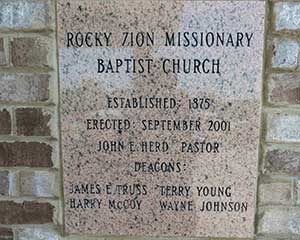
From the 2001 Church Dedication Booklet, we learn that Rev. Herd “…had a vision from the Lord,” and he “approached the congregation with the idea of building not just a fellowship hall but a church with a fellowship hall. The body agreed,” and a brick sanctuary was constructed.
In an article announcing the new sanctuary, The St. Clair Times of Sept. 13, 2001, Gary Hanner reported that to bring the wooden structure up to code would have cost more than to build a new church. He quoted Deacon Wayne Johnson, who said of the new sanctuary, “It is something that will stimulate their (the members’) spiritual growth and is something they can be proud of for years to come. … Having the new facility will be an asset to the community.”
The dedication of the new sanctuary occurred on Sept. 23, 2001, and was a gala occasion. The congregation met outside the church for responsive readings. Then the contractor presented the keys of the new building to Deacon Young, who presented them to Deacon Truss. Rev. Herd and Deacon Young cut the ribbon, and Deacon Johnson opened the doors to the sanctuary. Someone rang the old church bell, and the congregation entered the church to the processional hymn, “Alleluia.” Rev. Herd prayed the consecration prayer, and the afternoon was filled with a joyful worship/dedicatory service in the new building.
After Rev. Herd, Rev. Woodrow Johnson came as pastor, and the church continued to flourish. Rev. William O. Robinson was called as pastor after Rev. Johnson. Rev. Robinson ordained Deacon Willie J. Forman. Deacon Stanley Nobles moved back home to Pell City and rejoined Rocky Zion.
The COVID-19 pandemic, which required churches to have online services, had a lasting effect after it subsided. Rocky Zion’s Sunday attendance is low, for many still watch online, and the choir is now a praise team. “It’s only four members,” observed Young, “but they sound like a choir.”
Another milestone
In 2024, the church will observe its 150th anniversary, and with COVID causing the interruptions it did in community and church, memories have focused more on the past than on recent memories. However, throughout church history, the pendulum has swung toward “good years and lean years” of attendance, and church members hope for increased attendance in days to come.
Rev. William O. Robinson, pastor, shepherds his flock in the present and looks to the future. “I am now in my 10th year serving as pastor of Rocky Zion MBC,” he noted, “and I can honestly say it has been challenging – mainly because it’s my first pastorate. Yet through all of the tests and trials, I can truly say that I have enjoyed and continue to enjoy preaching, teaching, singing and serving in any other capacity the Lord has required and equipped me to do.”
For uncertain times in which we live, this positive attitude is a must for any pastor. Rev. Robinson observes, “I have seen spiritual growth but also recognize there’s much growth needed. I have learned as much because from my members, as I hope they have learned because of me. Being afforded the opportunity to grow together according to the guidance of the Holy Spirit is what I believe makes us more than a group of people that go to a church building. For we are truly “a family for Christ” that is dedicated to displaying the pure love, faith and obedience He has called us to do as the body of Christ.”
Rev. Robinson ascribes to the challenge of Matthew 28:19-20 to, “Go therefore and make disciples of all nations, baptizing them in the name of the Father and of the Son and of the Holy Spirit, teaching them to observe all things that I have commanded you; and lo, I am with you always, even to the end of the age. Amen.”
“Our mission is to be a Christ-centered family environment that effectively brings others into the household of faith through corporate worship and also evangelism and outreach.”
Empowerment for future
As pastor of the church, he sees his duty in preaching and teaching as building solid believers who are equipped for ministry in both church and community. From his heart, he comments, “We believe in the spiritual development and growth of the body of Christ through love, humility, unity and prayer which comes through salvation through Christ and an ever-growing relationship with Christ. I call it ‘Empowering People for Kingdom Building.’”
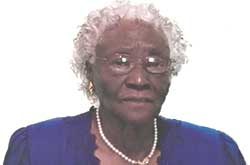
Ms. Posey, oldest member of Rocky Zion
The COVID-19 pandemic brought great changes to churches because of “sheltering in place” and not meeting together for worship along with absence of choirs and congregational singing. Rev. Robinson reflected, “Even though we have been challenged to serve and minister within our community and church in a variety of ways due to the COVID-19 pandemic, we are yet excited about the movement of God at Rocky Zion MBC.” And he asks that community and church pray “… that the Lord will look upon any and all threats designed to hinder Rocky Zion’s laboring for the kingdom of God. That He will continue to grant us all boldness to speak His Word, stretching out His hand to heal, and that signs and wonders may be done though the name of Jesus Christ.”
Rocky Zion Missionary Baptist Church has served God and community for 149 years and sits on the hill above school and community as a lighthouse of hope. Peggy F. Threatt observed that “Rocky Zion Baptist Church is definitely a foundation of faith,” and that faith gives the church’s members comfort and peace.
And as the old Isaac Watts’ hymn proclaims, may Rocky Zion MBC continue progressing and singing for another hundred years.
“We’re marching to Zion,
Beautiful, beautiful Zion,
We’re marching upward to Zion,
the beautiful City of God.”
Mrs. Rosey Posey, Rocky Zion’s most senior member at age 97, would give a witness to that with a resounding, “Amen!”