Moody, Alabama

From cattle crossing to boomtown

Story by Paul South
Photos by Wallace Bromberg Jr.

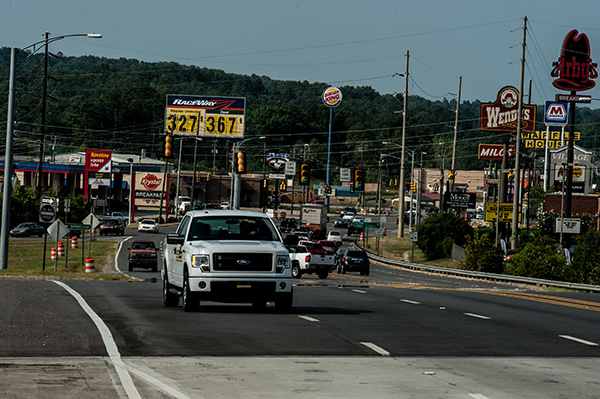
Moody Realtor Paula Krafft grew up in nearby Leeds and has a vivid, fond childhood memory of the city when it was literally a no-stoplight town.

“We used to come through Moody on the way to the lake,” Krafft said, recalling family vacations on Logan Martin. “There was no stoplight, no stop sign. The only thing that stopped the traffic was a couple of times during the day, cattle would cross the road.”

The cows wouldn’t recognize their old stomping ground today.

Moody is one of the fastest growing cities in Alabama. According to 2016 population estimates released by the U.S. Census Bureau, Moody is the 14th fastest growing city in Alabama. Estimated growth – compared to 2010 census data – is 1,097, nearly 10 percent. Average household income exceeds the national average.

At its heart, Moody’s growth can be attributed to the old real estate mantra: Location. Location. Location. With Interstate 20 and US 411 bisecting the city, as well as proximity to Birmingham (15 minutes from downtown) and the Honda plant in Lincoln (20 minutes in the opposite direction), Moody’s geography is key.

Add to the equation, good schools, low crime, a mixed economy of industry, retail and agriculture, and available land and infrastructure for family-friendly residential development, and you have a formula for success.

Moody’s history also tells a story of a city with an independent streak. North Carolinians, led by Epps Moody, began settling in the area in 1820. During the Civil War, according to Mattie Lou Teague Crowe’s History of St. Clair County, the majority of citizens, non-slaveowners, were pro-Union. Some locals were forcibly conscripted into the Confederate army, but deserted and fought on the Union side.

In the post-war period, Moody rapidly grew and was home to a gristmill and other retail establishments, a harbinger of its present-day economy. Today, because of its proximity to Birmingham and Interstate 20, Moody has experienced population and rapid economic growth, St. Clair County Economic Development Authority Executive Director Don Smith said.

 Retail has helped spark the boom. Well-known chains like Love’s Travel Stop and the regional grocer Publix, along with locally-owned concerns like Carpenetti’s Pizza, have made a difference in Moody’s bottom line.

“It absolutely makes a difference,” said Mayor Joe Lee. “The presence of one travel center here (Love’s) changed the way we do business.”

He added: “With the Love’s Travel Center coming here, we were able to tear down and revitalize a shopping center and bring Publix in; without the travel center, we wouldn’t have been able to lose that shopping center for a year while we rebuilt it.”

Growth came rapidly to Moody, Lee said, in part because of rezoning. Younger families have gravitated to the town, and the median household income is $59,000, Lee said.

Another economic driver is the proximity to the Talladega Superspeedway and Barber Motorsports Park. Moody’s hotel rooms – some 200 – fill up quickly for race weekends at the two tracks, said Andrea Machen, executive director of the Moody Chamber of Commerce.

“We’re kind of unique because we’re sandwiched in between Barber Motorsports on one side and the Honda plant and Talladega Superspeedway on the other.. Barber generates a lot of tax revenue for the city.”

A comparison of the city budget from 1992, when Lee became mayor until today is jaw-dropping.

“When I became mayor, the budget was about $900,000,” Lee said. “Today, it’s close to $11 million. It goes back to location you know; everybody wants to locate close to I-20.”

The mayor sees the growth firsthand with every new day.

“When I first moved here in 1978, there were four acres and no one around me,” Lee said. “Now I have 600 neighbors.”

Safe City

That bottom-line population and revenue growth has meant improved infrastructure for the city, meaning better fire, police and EMS protection and better parks and recreation. But with seven new subdivisions online in Moody, keeping pace with that growth is hard work.”

“That’s the biggest challenge,” Lee said. “The biggest difficulty is providing the services and staying up with the growth.”

Moody leaders are paying attention not only to the numbers, but how the city grows, with ordinances governing signage, construction standards and the like.

Growth has also impacted emergency services. The Moody Fire Department is in the process of buying a new fire truck and down the road, building a new fire station.

Chief Joe Nobles said that these improvements in the fire service may lead to a higher fire protection rating, which means lower insurance premiums for home and business owners. The size of the fire department was only two people on a shift only a decade ago. That number has doubled and there are 11 part-time firefighters available to serve. Medical response service has also grown.

“We’re trying to keep up with the growth,” Nobles said. “Hopefully, in the next couple of years we can add another station and increase personnel.”

The department offers CPR and first aid classes. The department has also placed three AEDs (Automatic Electronic Defibrillators, two at the park and one at the civic center) to respond to cardiac episodes at those popular venues.

From a law enforcement perspective, Police Chief Thomas Hunt pointed to Moody’s ranking as one of Alabama’s 10 safest cities in each of the last three years. Though the growth has meant more calls, the actual crime remains unchanged. It all goes back to Moody, its values and its people, Hunt said.

“One thing I always tell our guys is to treat people the way you would want to be treated,” Hunt said.

Over the past three years, the police department has conducted a Citizens Police Academy, aimed at maintaining positive relationships between law enforcement and the community it serves. The department is also active in developing relationships with Moody’s schools and their students

Recreation reigns

In recreation, Moody was one of the first communities in Alabama to build a Miracle League field, opening the door to playing baseball to special needs children and adults of all ages. Parks and Recreation Director Mike Staggs said that while finding space is a concern, increased population means increased participation in recreation programs. That translates to opportunities to grow revenue. A new civic center opened last fall.

“We’re able to provide our citizens with more space and more opportunities,” Staggs said. Directly, some 1,200 residents participate in programs ranging from flag football to adult softball. During peak soccer and football seasons, some 3,200 people are in the park.

The new civic center has also boosted youth basketball from about 125 participants to more than 200. Fitness classes – yoga, jazzercise, etc. – anticipated 800 participants in the first year. But more than 1,200 have registered for classes. There’s also state of the art cardio facilities.

For the future, walking trails, bike trails, Frisbee golf and other sports may be part of recreation offerings, Staggs said.

“With the growth we’ve experienced in the last couple of years, we’re getting citizens that are expecting particular services we haven’t offered in the past,” Staggs said. “They look for those hiking trails and Frisbee golf, things we hadn’t considered several years ago. We always need more athletic fields, but we want to be sensitive to what everybody else wants.”

He added, “It’s not just little boys and little girls playing baseball and softball anymore. People want a variety of options. That’s something we’re sensitive to.”

A new library is also part of the landscape.

Moody’s allure: A town for all

Along with the draw from nearby auto racing, Moody also attracts big crowds for annual events, like Oktoberfest in the fall, fireworks in July, a spring car show and the Christmas parade each December.

When visitors come to Moody, Chamber Executive Director Andrea Machen said, she wants there to be a “wow factor,” as they arrive.

Another city leader who wants to see more people fall in love with the town is Mayor Pro Tempore Linda Crowe. She was elected to the council in 1996 and mayor pro tem in 2003.

“We try to accommodate the citizens of Moody,” she said. “We strive to do that.”

A lifelong resident of Moody, Crowe has seen it move from an agricultural area to a multi-use municipality.

“My thing is planning and zoning,” she said. “We want to do that as best we can and then keep up with the growth.”

 Widening US 411 is pivotal to managing the growth, Crowe said. The towns of Moody, Odenville and Margaret are like pearls on the asphalt strand on the roadway that can see traffic tie-ups, especially during the school year.

“I just don’t want to see it become another (US) 280,” she said. “But it’s going to be another five years before we can get that done. “She added, “You’ve got to get your traffic flowing. If people are stopped, they’re not going to be happy.”

Like Machen, she wants to see more retail and restaurants.

Family is the touchstone that kept Crowe in her hometown. She taught government and economics at Moody High. Except for a few years in Washington, D.C., while her husband was in the military, Moody has always been home.

“We’re growing, but it’s still that small-town feel,” she said. “That’s what makes Moody click.”

When tragedy strikes, like when Moody Police Officer Keith Turner was killed in the line of duty, or when tornadoes struck in 2011, people come together.

“That’s what makes our town great. People just came and said, ‘What can I do?’”

 In the last century in neighboring Birmingham, four large buildings occupied the four corners at the intersection of First Avenue and 20th Street, earning it the nickname of “The Heaviest Corner in the World.”

Today, at the four corners that bound Moody Crossroads, there is a stoplight. And while it may not be a ‘heavy” corner with impressive brick and mortar buildings, Moody’s main intersection speaks volumes about its heart and spirit.

Don Smith illustrated the point, using the old Moody Crossroads.

“At the heart of their community, they have city hall, fire and police protection, he said. “In another quadrant, they have an incredible sports park with baseball, football and soccer fields … and one of the first and only “Miracle League” fields in the state. You also have small business, Carpenetti’s and a hair salon (on another quadrant). Then on another quadrant you have a church, The Gathering Place.”

He added, “If you look at (Moody) just at those four corners, it really speaks about the strength and the heart of the community: Families and children, small business, city government, police and fire protection and the church.”


Expanding LakeLife

Stickers, clothing, websites and more

Partners by Design Inc., a Pell City-based multimedia marketing company in historic downtown, has expanded its LakeLife brand with new products, an online store and retail outlets.

It started out as a way to promote Logan Martin Lake, and we did so with our website, loganmartinlakelife.com, and social media accounts. That led to the sale of vinyl, die-cut stickers, T-shirts, caps, visors and boat totes bearing our registered logo designed by Graham Hadley, our vice president for the Creative Division,” said Partners President and CEO Carol Pappas. “And more products are planned,” she added.

“We quickly saw that LakeLife, in general, is a way of life to promote as well, and we continue to build that brand on our newly launched national site, thelakelife.net,” she said, which includes information on Alabama lakes and a blog written by Pappas called LakeLife 24/7. Coincidentally, the site’s Twitter handle is lakelife247, and its Facebook page is at LakeLife.


The national site also features LakeLife Cooking, an online store, photos and other lake-related information and links, and content continues to be a work in progress. “We invite the LakeLife community – no matter where it is – to submit photos to be featured on the site,” Pappas said.

“In the meantime, Logan Martin LakeLife, continues to grow with our stickers, apparel and accessories selling well,” Pappas said. Logan Martin LakeLife products may be found in St. Clair County at Magnolia’s Gift Shop in Cropwell, The Dam Store and Country Store at Dam Road near Logan Martin Dam. In Talladega County, find them at Griffin’s Laser Engraving and in Jefferson, stickers are being sold at Rocky Ridge Hardware in Vestavia.

Logan Martin LakeLife products also are on sale in our online store at loganmartinlakelife.com, where Neely Henry stickers are also for sale. “St. Clair is blessed with two lakes,” Pappas said, “and we are hoping to expand our footprint with more Neely Henry products as well.”

Partners by Design was founded in St. Clair County in 2009 by Pappas and began official operation in 2010. Her colleagues at the time, Hadley and Brandon Wynn, have since become shareholders and partners in the organization. Wynn is vice president of Online Services for the company.

In addition to the LakeLife brand, Partners publishes Discover, The Essence of St. Clair Magazine, Chamber magazines for Leeds and Moody, Mosaic Magazine for Alabama Humanities Foundation, produces brochures, newletters, enewsletters, designs and rebuilds websites, and offers graphic design, advertising, communications consulting and photography services.

Find us online at loganmartinlakelife.com and thelakelife.net and on Facebook

Rocket Man

Hydroflying comes to Logan Martin

Story by Carol Pappas
Photos by Susan Wall

Jeremy Deason soars a good 40 feet in the air above Logan Martin Lake, and passersby can’t help but take notice. After all, his hydroflight is something to behold.

He is perfecting his hobby of hydroflying on a FlyBoard, which involves a personal watercraft he controls remotely with an 80-foot hose attached to it, propelling pressurized water through it to a pair of boots equipped with jet nozzles.

The nozzle provides the thrust. And Jeremy’s strong pair of ankles does the rest. “Holding yourself up is all in the ankles,” he explained. “It’s all within a couple of inches,” he said.  “You can either do it or you can’t. It’s not a middle kind of thing.”

Jeremy can definitely do it. He moves through the water at first, with only head and shoulders showing as the jetted water propels him. “It pushes you through the water like a boat in front of the SeaDoo.” Then, it’s up, up and away, with the pressurized water streaking beneath him like an aircraft or rocket’s contrail.

Constantly in motion, he goes straight up, darts to the left and circles to the right while the unmanned personal watercraft weaves in the water below him.

The pressure is enough to propel him 40 feet in the air. It’s also enough to provide the “dolphin dive,” where Deason dives headlong through the water as much as eight feet, emerging seconds later with head up and then submerging once again. The series of moves looks exactly like the movement of … well, a dolphin.

“If there’s anything out there, he’s going to try it,” said his grandmother, Margaret Weatherby of Leeds.

It used to be motocross. But as his buddies and he grew older, got married and “life got in the way,” he traded his dozen or so motorcycles in and “searched for something to do on my own.”

As she watched Jeremy perform his moves, his Mrs. Weatherby remarked, “He’s always been adventurous. That’s my boy,” she said, a hint of pride unmistakable in her voice.

And 30-year-old Jeremy, who owns and rents property as a career, doesn’t disappoint. He soars, he dives, he does a back flip. He even heads straight up like a rocket, thrusting both fists in the air as if he is on top of the world. From his vantage point, he probably is.

“When you’re up there, and you watch the sunset, that’s cool,” he said. It’s quite an experience to watch the fish from high above, too. Hydroflying “draws all the fish up, and you can see a bunch of fish on top of the water.”

But sunsets and fish aren’t the only things being watched. The sight of him jetting upward naturally draws onlookers from boats passing by. They tend to get a little too close, he warns, noting that the personal watercraft is unmanned, so there is no control except for his own going up and down and his speed. He doesn’t mind the attention, but for safety’s sake, he urges boaters to keep their distance.

Jeremy has no plans to try the sport competitively. It’s world cup caliber in Dubai and a huge sensation overseas.

But here at home, he is content to use it simply as a stress reliever. “I work a lot,” he explained. “I have to have something to play, relax and have a good time. This is my something.”

For more about happenings on Logan Martin, Neely Henry and other lakes, visit us at loganmartinlakelife.com and thelakelife.net and on Facebook


Alabama Bicentennial

Alabama Humanities launches Bicentennial exhibit in Moody

Story by Jackie Romine Walburn
Photos by Michael Callahan

Forward thinking and a prompt application helped St. Clair County become the first stop for the 18-month tour of Making Alabama. A Bicentennial Traveling Exhibit, an impressive blend of state history, culture and humanities.

After its debut in Montgomery in March 2018 at the state’s capitol, it begins in April of 2018 in the City of Moody and Lee and Wilcox counties and continues through November of 2019 en route to all 67 Alabama counties and the official 200th anniversary month of Alabama’s statehood.
That St. Clair County is a year older than the state – having been created as a county by the Alabama territorial general assembly on Nov. 20, 1818 – is a happy coincidence that local planners had in mind when they quickly applied to host the traveling exhibit “as early in 2018 as possible,” says St. Clair County Bicentennial chairman, District Judge Alan Furr.

The timing means that the county will be celebrating its bicentennial as it hosts the state’s first 200th birthday party. Alabama officially became a state on Dec. 4, 1819.

“Because St. Clair County was formed prior to statehood, we believe our hosting of the state exhibit as it begins its trek throughout the state is significant,” the judge says. “And, because we are celebrating our county bicentennial during 2018, being able to host the state exhibit during 2018 enhances our own local celebratory efforts.”

The new Moody Civic Complex met all the venue requirements and will be the site for the exhibit. It is being presented by the Alabama Humanities Foundation with support from the Alabama Department of Archives and History, the Alabama Bicentennial Commission, corporate sponsors, individuals and organizations across the state.

Making Alabama will travel to each of the state’s 67 counties, where local exhibits created by host communities will showcase each county’s role in their own story of Making Alabama.
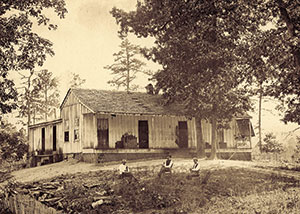
Planners in St. Clair County anticipate that the St. Clair story will include information and artifacts relating to Andrew Jackson’s residence at Ft. Strother, an 1813 fort – now a series of archeological sites west of Neely Henry Dam near the Ten Islands Historical Park in Ragland.

The fort near the banks of the Coosa River was used as a military supply depot and operations center for Andrew Jackson’s Tennessee Militia during the Creek Indian Wars and as a local theater of the War of 1812. Other aspects of the St. Clair local exhibit may include construction of the first brick courthouse in Ashville, the county’s mining operations and the importance of the Coosa River to the county and its communities.

“St. Clair County has a rich and diverse history,” Furr says. A subcommittee including Furr and Ashville Archives Director Robert Debter, representing the county, plus Councilwoman Linda Crowe of Moody, Sherry Bowers of Pell City, Dr. Robert Harris of Springville and Nancy Sansing of Ashville is already working on locating materials and artifacts to tell the story of St. Clair County, an early Alabama county named for General Arthur St. Clair, who was president of the Continental Congress.

Created from a portion of Shelby County when it was founded in 1818, St. Clair would eventually be divided several more times to create surrounding counties, first Jefferson in 1820 and Cherokee and DeKalb counties in 1836. Then Etowah County was born of a northeast section after the Civil War.

In announcing the order of the bicentennial exhibit, the Alabama Humanities Foundation noted St. Clair as the first stop, followed by Wilcox County in the Alabama Blackbelt, then Lee County in east Alabama, a triangle of counties in distinct sections of Alabama.

“These three communities stepped forward early to become part of this historic event, and we thank them for their eagerness to get involved in the celebration of our becoming a state,” said AHF Executive Director Armand DeKeyser.

As a partner in the Smithsonian Museum on Main Street Program, AHF recognizes the value of exhibits like this coming to communities in Alabama, DeKeyser says. “It’s an opportunity they and their citizens won’t soon forget.”

In addition to developing the local exhibit, the St. Clair Bicentennial committee that Judge Furr chairs has a list of tasks to make sure the exhibit’s up to three-week engagement in St. Clair runs smoothly and is staffed by local volunteers to serve as exhibit docents.

Plus, committee members – representing St. Clair’s towns and communities – have related tasks and projects to complete in the next year. These include documenting historic markers, local festivals and historic tours, developing a local speaker’s bureau and bicentennial T-shirts, planning a gospel sing and establishing and publicizing a calendar of events surrounding the county and state celebrations.

A cross section of residents in St. Clair County make up the Bicentennial Committee in addition to the subcommittee. They are: Shirley Phillips of Argo, Charlene Simpson, Rena Brown, Loretta Moore, committee secretary Elizabeth Sorrell and Eloise Williams, all of Ashville; Gaye Austin and Patsy Spradley of Moody; Joe Whitten, Brenda Riddle, Ann Coupland and Jennifer Forman, all of Odenville; Danny Stewart, Deanna Lawley, vice chair Gaston Williamson, Latoya Orr and Andy Eden, all of Pell City; Marie Manning, Pat Ford, Gerri Bunt, Sandi Maroney and Jerry Sue Brannon, all of Ragland. Gary Hanner of Riverside; Nancy Tucker and Carol Waid of Springville and Rosemary Hyatt and Sharon Ingle of Steele.

Making Alabama: A Bicentennial Traveling Exhibit will feature eight periods of history that defined Alabama as a state and the decisions and turning points that shaped what the state would become and will be, according to the websites promoting the Bicentennial celebration.

They are:

Pre-history to 1700, natural environment and an introduction to the exhibit.
1700-1815: The Creek War and Statehood
1815-1860: Settlement and Slavery
1860-1875: Secession, Civil War and Reconstruction
1875-1940: Political Power and the Constitution of 1901
1940-1965: World War and Civil Rights
1965-1990: Economic and Social Adjustment
1990-2020: Our Alabama

On May 5, the three-year Bicentennial celebration kicked off in Mobile, near the site of Alabama’s first state capital, St. Stevens, with another historic first – an introduction by Gov. Kay Ivey, Alabama’s first Republican female governor. “Why is it Alabama is sweet home?,” she asked the crowd. “Because of the innovation and fortitude of our people.”

That innovation and fortitude will be honored and celebrated throughout Alabama over the next two and half years. In 2017, the theme will be “Exploring Our Places.” In 2018, Alabama will “Honor Our People,” and in 2019, the state will “Share Our Stories.”

Alabama Humanities Foundation and St. Clair County will follow suit with celebrations of their own through this traveling exhibit.

Through interactive displays, historic photographs, art and narratives that delve deep into Alabama’s history and the people – some known, some not-so-famous – Alabamians and St. Clair Countians alike who helped shape that history.

The state exhibit is expected to tell the stories behind the stories about the people, places and cultures that made a difference in Making Alabama.

“St. Clair, a county older than the state, is an integral part of that story,” Furr said, “and we are proud to be a part of launching this historic exhibit.”

Editor’s note: For more information and resources associated with the exhibit, go to www.makingalabama.org. For more on the Bicentennial celebration activities throughout the state as well as resources, go to www.alabama200.org.

Springville Museum

Quest to Preserve Past a Labor of Love

Story by Jackie Romine Walburn
Photos by Michael Callahan

Designed and curated by history-loving volunteers, the Springville Museum takes visitors on a tour of people, events and artifacts of the St. Clair County town named for its natural springs, known for its historic downtown and a famous son who had a TV pig named Arnold.

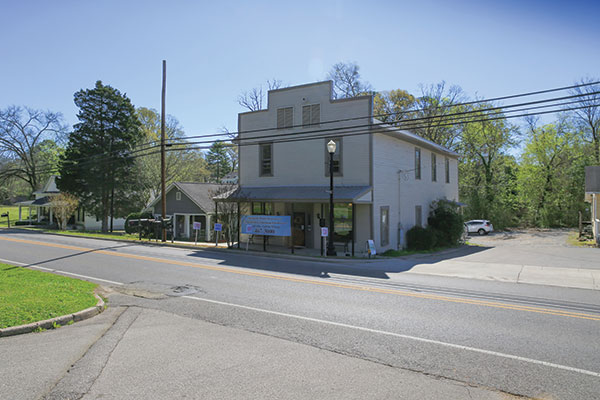
Located at the 1903 downtown building that once housed Masonic Lodge No. 280, the Springville Museum opened in the fall of 2015. Volunteers with the Springville Preservation Society staff the museum when it’s open to the public the first and third Saturdays each month and on special occasions, says Museum Director and volunteer Kathy Burttram.

“We are very proud of the museum and want everyone to come see what we’ve accomplished,” says Burttram, who adds that Springville volunteers and expert advice from the Alabama Department of Archives and History helped get the museum ready for visitors.

Two Masonic Bibles, an antique Masonic emblem and signs from the turn-of-the-century building are displayed behind the museum counter and gift section. This section also features artwork by artist Clay Allison, including intricate watercolor and line drawing prints of the town’s many historic building and homes, plus note cards and Christmas ornaments that are sold to benefit the museum and the Springville Preservation Society. Allison, a volunteer himself, also designed the exhibit signs and museum of city history signs out front on Main Street.

The society owns and operates the museum plus a recently refurbished 1800s cabin they call the White House, which will be the city’s welcome center next to city hall, and the 1921 Rock School.

Initially called Big Springs about the time the first church was built in 1817, the town’s name changed to Pinkhill in 1833, when the first post office was established, and officially became Springville in 1834 and incorporated as a town a generation later in 1880, according to the Encyclopedia of Alabama.

Museum sections include a children’s area, a vintage kitchen, a music room, plus exhibits on famous Springville folks of note, military veterans, businesses and schools, including the first grade to college academy, established in 1861 and later called Springville College, that attracted college students from throughout the southeast until it was destroyed by fire in 1912.

The CHILDREN’S exhibit is an interactive space with rotary phones and their corded touchtone cousins, plus manual typewriters, vintage board games and children’s books. The Preservation Society wanted an area where children could experience things from the past and stay busy while adults tour, Burttram says. The museum plans to continue the “Children’s Day at the Museum” program started last summer by society president Frank Waid, with interactive activities and stories on a summer date to be announced.
The KITCHEN exhibit – designed by Sally Golsby, Sandra Tucker and Carol Tucker – is centered by an antique Norge refrigerator, on loan by Frank and Janis Price. Antique dishes, a wooden ironing board and iron complete the display that looks like your grandma’s or even great-grandma’s kitchen.

A LIVING room exhibit, also called the music or church area, was developed by volunteers Gail Hammonds, Sara Trotter, Kathy Burttram and Donna Davis. They created a nostalgic music parlor highlighting an antique piano and organ, surrounded by antique velvet furniture and hymnals, song books and sheet music dating back a century or more.

The upright piano was originally in the Forman Street home of James L. Forman and his son, the late St. Clair probate judge Ward Forman, and is on loan from Forman descendant Lew Windham. Next to the piano is an ornate organ, circa late 1800s. The organ was originally in the parlor of the McGee family from Lamar County and is on loan from a descendant, Evelyn Criswell of Springville.

A CAMERA exhibit, developed by volunteers Clay Allison, Donna Davis and Ed Bruchac, includes a display case of vintage still and video cameras on loan or donated by local folks. These include 35 mm and the wider 110 mm cameras and the film and film canisters that were commonplace before the advent of digital photographs.

A 1921 one-tube radio rests on top of the camera display.

Appropriately, on the wall near the camera display case are framed play bills from the Springville Theatre, a movie theater that changed movies every two days back in its heyday in the 1950s. Donated by local resident Janet McBroom and preservation society volunteer Carol Pearson Waid, the posters show the movies that were at the downtown theater with original play bill artwork. Some posters include notations handwritten by a young Mrs. Waid, who noted who she went to the movies with. Teasing her about her teen-age record keeping on the movie posters, Burttram says, “Somebody told Carol, ‘I didn’t know you dated so many different people.’”

Carol Pearson Waid and her husband, society president and Vietnam veteran Frank Waid, helped put together the MILITARY exhibit which includes armed services uniforms dating back to World War I plus some Civil War documents. “We have been so fortunate that as word got out about the different exhibits being put together, people would just bring items to loan or donate,” said Burttram.

This was true of many exhibits, particularly the military ones, which includes a wide variety of armed services uniforms, plus battlefield letters to and from home and other sentimental items from military families.

Frank Waid, who was a helicopter pilot in Vietnam and served in combat again in the Desert Storm conflict, loaned Vietnam era items. These include a tail rotor blade, signed by servicemen, from a UH1N twin engine Huey helicopter used by special operations forces in Vietnam. Waid also loaned for exhibit his Vietnam Flying Squadron party jumpsuit worn at celebration parties after successful completion of exceptionally long or difficult missions. The unofficial jumpsuit, with its star-spangled peace sign patch, was from the 20th Special Operations Squadron at Cam Rahn Bay in South Vietnam.

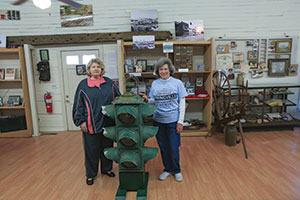
At museum center is a full-sized metal traffic light from downtown Springville, complete with bullet holes. The ragged bullet holes in the light’s thick metal frame came courtesy of a nearby resident who got frustrated with the red-yellow-green lights shining in his windows and tried to shoot them out more than once.

A BUSINESS exhibit includes an antique cash register and scales and one of the “premium” bowls customers could earn by trading at Bud’s Dollar Grocery store. The bowl was shared with the museum by the Joe and Helen Sarusce family. The Pearson sawmill, founded by Carol Waid’s grandfather, is featured as being the largest employer in Springville during its peak period prior to its closing in the 1960s. Pearson Hardware, the Simmons sawmill and an old barbershop pole, on loan from the Ricky Hill family, are highlights of the business exhibit designed by Kathy Burttram and Donna Davis.

An exhibit on the Springville Skating rink, includes a giant rotating disco light and sign from the skating rink ceiling. Skates are on loan from Carol Waid and Carol Tucker.

A MEDICAL section features Ash Drug Store, pharmacist Dr. Harold Bettis, and local physicians, Dr. Robinette Smith and Dr. James McLaughlin, and includes a syringe kit from about 1900 and other antique medical items.

The Springville Museum name drops with a FAMOUS PEOPLE exhibit. Noted Springville natives include Hank Patterson (1888-1975), an actor who portrayed Fred Ziffel on TV’s Green Acres, a character known for his pet Arnold the Pig, and had a recurring role on Gunsmoke.

There’s Margaret Byers, an actress, musician and “little person,” who starred on Broadway, including playing a munchkin in a Broadway production of The Wizard of Oz. Miss Byers later taught first grade back home in St. Clair County. And, there’s Springville-born cartoonist Milton Caniff who created the Steve Canyon comic strip.

Springville natives who made their mark in the sports world include Arthur Lee “Artie” Wilson. Wilson was a shortstop and left-handed hitter whose .402 mark with the Birmingham Black Barons in 1948 is thought to represent the last time anyone at the top level of professional baseball broke the .400 barrier.

Springville sports notables include Brandon Moore, who played baseball at Auburn University and played and coached on a number of professional baseball teams, including the Kansas City Royals and Chicago White Sox organizations. He also had a coaching stint with the Birmingham Barons.

The exhibit also includes native son Randy Howell who brought fame to St. Clair County when he became the 2014 BASSmaster fishing champion.

In politics and public service, Springville’s Marilyn Quarles was the first modern day female member of the Alabama House of Representative when she was elected as a Democrat in the 1970s. She was also a teacher, and her family owned the town’s Dairy Dip and Springville theater.

Noted among local politicians is James Clarence Inzer, an attorney who served in the state senate and board of education in the 1920s and 30s and as Alabama lieutenant governor from 1947-1951.

Also featured is current state senator for District 11, Dr. Jim McClendon, a Vietnam veteran, retired optometrist and member of an original Springville family.

The museum also recognizes Springville families with FOCUS FAMILY Tree display that rotates every three months. Recent focus families are The Charles Lovett and Mildred Terry Herring family and the James Shelby and Emma Tucker Jones family.

Another display tells the story of a train derailment in 1969 that shook the town and destroyed the depot. On January 16, 1969, a train carrying propane tanks derailed at the Springville Depot and hit additional propane gas tanks that then exploded. Firefighters from from as far away as Birmingham and the National Guard responded to help fight the blaze. Although damage to the town was considerable, and 400 people were evacuated from their homes, no one was killed.

SPRINGVILLE SCHOOLS display, designed by volunteer Donna Davis, features a 1929 yearbook for the Springville High School Tigers and pictures of classes from the 1950s and earlier.

UPSTAIRS at the museum, volunteers work organizing reference and research materials to be used for genealogy searches. New Springville resident Paulette Kelly is helping to organize materials, including ledgers and vintage books for the upstairs section. Springville native Sandy DeBerry is another volunteer helping to ready the archives and reference areas.

“It’s fun learning the history of Springville as we go along,” Paulette says

“I love history and love the small town I grew up in,” says Sandy DeBerry. “Preserving history is important work.”

A plat map cabinet upstairs, donated by the Tucker family, will be used to store maps, large ledgers and bound copies of the St. Clair Clarion, a weekly newspaper that operated through the late 1980s.

To learn more about protecting the artifacts and treasures displayed and available for reference upstairs, museum volunteers visited the state’s department of archives and history, where Museum Services Director John Hardin was particularly helpful, Burttram says. In turn, state Archives staff visited the new Springville Museum.

That relationship helped the museum volunteers know to apply for a small grant from the state archives. The grant helped purchase a dehumidifier, tinting for front windows and archive supplies to store scrapbooks, ledgers, journals and old photos.

Projects taking shape upstairs also include work on a book about veterans of St. Clair, the design of a display using the electronic bell from the Methodist Church that still chimes, and creation of a music display featuring donated albums and sheet music. Two types of pews original to the Masonic Lodge are upstairs along with a quilting frame still to be developed into a display.

Burttram says anyone interested in volunteering or helping with or participating in the St. Clair veteran booklet can contact her at kpburttram@hotmail.com.

Other Museum volunteers who have helped with bookkeeping, cleaning, remodeling, painting and more include Millicent Yeager, Glenn Miller, Crissy Sharp, Harold Riker, Tami Spires, Sandy DeBerry and Society secretary-treasurer Sean Andrews.

Workforce Development

Learning the job on the job

Story and Photos by Graham Hadley
Photos courtesy of Garrison Steel

When he was growing up, John Garrison’s greatest challenge was to work his way up from high school student to one day owning an industry-leading metal fabrication and erection company.

Today, that company, Garrison Steel, employs more than 200 people in Pell City.

Now he has a new challenge – finding skilled workers from a dwindling workforce to fill the jobs at his company, which has been responsible for the construction of buildings across the Southeastern United States.

So Garrison has come up with a plan to help his company and the workforce grow by building a training classroom at his facility.

The problem

For decades, people working in skilled trades, everything from metal fabrication to construction, plumbing to welding, were usually trained, almost apprentice style, by the previous generation.

But as the focus in secondary education turned more and more to two- and four-year college prep, fewer and fewer people were training in these essential skill areas, Garrison said.

That focus, combined with a general social impression that factory and construction jobs were dangerous and somehow less desirable than professional employment, has resulted in a serious drought of skilled workers at a time when the economy is expanding, particularly in this region, and exactly those trade skills are needed the most.

Existing skilled employees are gradually aging out of the workforce and, for the past couple of decades, few people have been stepping up to fill those positions — despite drastically improved work conditions and good pay, Garrison said.

“I am one of the last. My generation is the last of the people trained by skilled union laborers in our jobs,” he said.

Over the last few years, backed by the National Center for Construction Education and Research formed at the University of Florida, St. Clair business leaders like the Economic Development Council and education officials from Jefferson State Community College and the Pell City School System have made great strides in workforce development, offering high school and college students training in exactly those skills that are needed most.

And they did not do the work alone. Businesses across the board, from manufacturing and construction like Ford Meter Box, Goodgame Construction and WKW Automotive to medical offices and other companies have stepped into the partnership to provide the training and jobs for the students.

Taking the program in-house

From the beginning, Garrison and other industry leaders recognized they needed partnerships with local educators, both at the secondary and post-secondary levels — and they found exactly what they were looking for in Jeff State and the Pell City School System, he said.

Forming that partnership has been a struggle to get similar programs off the ground all over the country, but not in St. Clair, Garrison said.

While that partnership laid the foundation for initial job training — teaching students how to weld, construction techniques, OSHA safety standards and the like — the basic tools they would need to get their foot in the door after high school, Garrison wanted to take the process a step further.

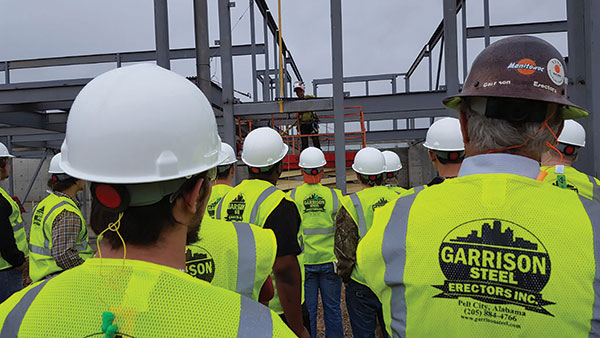
“So in June of 2016, I asked Jefferson State to meet with seven area high schools to discuss a pilot program to take up to 25 high school students in dual enrollment and begin teaching out of the NCCER Ironworking curriculum. They all agreed and in January began the first ironworker program four hours per day, five days a week for 16 weeks,” he stated in a press release.

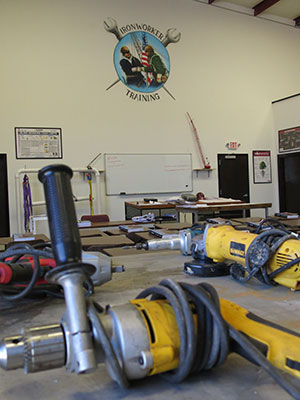
“Money for books and a classroom at Jefferson State Pell City for the first eight weeks was funded with Federal Perkins Grants, and the second eight weeks were at a newly built training center at Garrison Steel, where students learned theory and hands-on with welding, cranes, rigging, fabrication, oxygen and acetylene cutting, and much more.”

The first class finished up at the new facility at Garrison Steel as school wound down for the 2016-2017 year, and Garrison sees it as nothing but a great success and a huge step forward for the workforce development initiative he and the other business, education and industry leaders have been working toward.

“Our classroom is set up to do half theory and half practical. We integrate practical in nearly every day’s classroom experience, which breaks the monotony and adds to the connectivity in what they are reading.”

He said that appeals to students who are interested in learning the theory behind the work they are doing with their hands, but also is an ideal environment for those students who may not like a traditional classroom environment.

“Many kids don’t like book-work because they cannot see the connection between theory and practical. So, as a teacher this year, my goal was so that when they read, and there was a lot of reading, that we stopped often enough to see real-world applications and for them to connect.”

The only thing Garrison said they were not able to do this year, and that they will have next year, is a steel tower where students can practice and learn with safety and other rigging equipment in a real-world environment.

“The students will be training off the ground with safety equipment.”

What’s next

This is only the first step, for Garrison’s teaching center and for the students.

Now that they have cemented a relationship with local schools, he wants to reach out to people already in the workforce who have the skills training but not the theory behind what they are doing.

“This year our program captured those students who are available because they are in school. We have figured out how to utilize those students and train them. The next challenge for the fall classes is to figure out how to integrate what we call incumbent workers, those who are out there, already with jobs, sometimes at distant job-site locations, that have only the practical side of learning and virtually no theory to their learning.”

And those students won’t necessarily have to come to Garrison Steel or Jefferson State. Garrison has plans to use the Internet and distance learning to help train workers at their job sites.

The students have received their entry-level training this year, but there are many more classes and options available to them down the road.

“The theory is this — these guys who are going to graduate high school want to get out and get a job in the workplace, but that is just a start. In describing it, I try to play a movie in their head: ‘You get really good at what you know how to do skill-wise. Then you become capable of managing those skills of others, learning another new role in the company.’

“As the company grows, we need new managers. As time goes by, older guys like me age out, and we fill those positions from the bottom up. That is the theory, the process we tell these guys,” Garrison said. “We want them to be able to work all the way up to owning their own company one day.”

And as you learn one skill, more open up to you — in the workplace and in college.

“Just because you start out a welder does not mean you have to be a welder for the rest of your life,” he said.

“I have explained to my students that you know more technical aspects of our business than many of the people who have been working in the field for six years or more. They have a practical advantage over you, but you are learning the more challenging part, which is theory, and you will get the practical experience once you are hired.

“Now you have a distinct advantage over the incumbent workforce and have a pathway to higher positions later in your career.”

Payoff for students
and business

The move is not entirely altruistic. Garrison readily admits that having a skilled workforce at his disposal can save money and cut down drastically on job time. It also creates an overall safer work-site environment.

“The cost of labor is driving up the cost of construction. The cost of labor does not necessarily mean higher wages,” he said. The longer it takes to complete a job, the more expensive the project is.

“What a skilled workforce can do in three months might take an unskilled workforce four months to do. The problem is not a lack of workers; it is a lack of skilled workers.

Students who have enrolled in the program and are working for Garrison are similarly reaping the rewards of their efforts.

David Graves, who has previously talked about his experience at Garrison Steel soon after his graduation, has taken part in some of the classes and continues months later to move down the career path he has embraced.

“When he added the welding school, I took that. I was in processing before, now I am in welding, and that is going in the direction I want to be in,” he said.

“I want to learn more about fabrication, and welding is a step in that direction. …”

And it is the combination of classroom instruction and hands-on that is making all the difference.

“It really helps going through the class, giving you an understanding, but it won’t teach you to weld by itself. You learn that on the floor, learn from trial and error, grinding out your mistakes.”

Down the road, Graves hopes to move up to a supervisor or quality control position.

“There are classes for that at college. That opens doors like project manager.”

Matt McCrory is another employee who has benefitted from the multifaceted training program.

He has been at Garrison for two years now and has worked his way to an office position, lotting, where they break down the different design drawings into their components, which makes fabrication easier and more organized.

He originally took the welding course at Jefferson State and has continued his training at Garrison.

“That class helped me read the drawings. That is the biggest thing: Since I mostly read drawings, how things are applied, how they are used, how they are built,” McCrory said. “If I don’t know how to read the drawings, I can’t do my job.”

He plans on continuing to work at Garrison, but also sees more college in his future at Jefferson State, focusing on business administration.

“The lessons I have learned here will help in college,” he said, adding that he definitely has a better idea of what he wants his career path to be now that he has been in the workforce. Something he said was very much lacking when he was a senior in high school.

One graduate of the class, Alex Bowman of Pell City, is still in school but is already on the job.

Bowman is a 17-year-old who just finished his junior year and is working at Garrison Steel.

And he already can see his path ahead.

“I am looking at doing this for a career, definitely something as an ironworker with Garrison Steel,” he said, pointing to the owner as an example. “Seeing Mr. Garrison’s investment in us makes me want to work harder, to one day get to the level he is at. It’s very inspiring.”

Studying in the class and working at Garrison has been ideal for Bowman, who readily admits he is not a fan of traditional classroom environments.

“I am not very good in a classroom. You can learn the idea of what you want from a book, but hands-on, you actually learn how to do it,” he said.

And because he now has some certification under his belt, he has options.

“NCCER was a huge step up for us when it came to the ironworker program. It means, when you graduate, you have jobs waiting for you. Having your core training shows a lot of employers you have the ability and intentions to step up and get ahead in the game.”

Return on Investment

“I know for a fact that a one-dollar investment in training returns three in productivity. … It’s not altruism; it’s survival,” Garrison said.

He is quick to point out that he is not the only one investing in the program — support he could not have made the new classroom work without.

“Red-D-Arc Welders are a major contributor to our program with welding equipment donated. The additional supporters of our program are NUCOR Steel, Cobb Wire Rope and Sling, NEX AIR, and Lincoln Electric and Service Construction Supply (SCS),” he said.

Between that kind of support and the growing partnership with education, business and organizations like the EDC, Garrison sees a bright future for workforce development in St. Clair County.