The Old Is New Again

Vintage-touchVintage Touch Making
Furniture Into Art

Story by Graham Hadley
Photos by Mike Callahan
and Jamie Parker

Where you see junk, they see a table, a chair, a bench, a lamp, even a work of art.

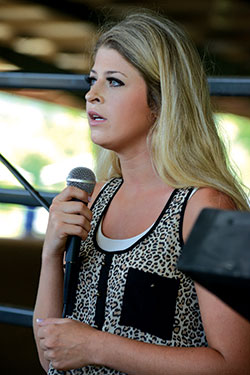
Jamie Parker and her fiancé, Travis Reed, run Vintage Touch in Pell City’s historic downtown area — a store that carries home furnishings and décor items that are truly unique.

And by “unique,” they really do mean absolutely one-of-a-kind.

“My fiancé and I create repurposed furniture. We just sold a sofa or entry table that was made out of an old porch column and part of a gate. We built around that, added some wood, made it look like old barn wood — look old and new at the same time,” Jamie said.

“We are a store of all things. You never know what you are going to find in here.”

Vintage Touch opened Dec. 21, 2014, in the building that once housed Pell City Grocery “years and years” ago.

And since then, business has been growing steadily as more people are rediscovering Pell City’s historic downtown district as a walking and shopping area.

The couple had run booths in other places around Birmingham, but picked Pell City for their first store.

“We decided to open here because we live here, and I love this downtown area,” Jamie said.

“We have truly been blessed. We were a little worried, coming from places like Vestavia to a little town, but sales have been increasing every month. Pell City has really showed us a lot of love. People are so friendly.

“Our customers want to see downtown make it; they want to see downtown rise back up, and I want to see that, too.”

That walking-and-shopping atmosphere is proving to be almost a perfect combination for the kind of business Vintage Touch does. Much of what is sold in the store is made in the store, and customers can see the process of turning junk into treasures firsthand.

“They see that we are in here doing the work. When people see you putting your time into something, it makes it that much more special to them,” she said.

Vintage-touch-1It’s a process Jamie and Travis love — all of it — from “picking” items from old barns and yards, combing flea markets and similar venues, even finding discarded furniture set by the street, to rebuilding it into something new.

Their designs cover the spread. They have an old tractor steering wheel made into a lamp hanging in the window and have made a bench they created from an old truck tailgate that was sold for more than they paid for the truck. It now sits in an office entrance at a firm in Birmingham.

“We can look at something that someone else thinks is trash and turn it into something that is so beautiful, so unique, that people just fall in love with it,” Jamie said.

“It’s something my fiancé and I can do together, he has a full time job, and this is a lot of hard work, but it is fun.”

Travis’ full-time job is as a farrier — a horseshoer — and a blacksmith (“He’s really good at it,” Jamie interjected), and along the way, working on farms, he has found all sorts of treasures for the shop, including old watering troughs that get repurposed into things like benches to chairs.

“Those are some of our most popular items. We have people waiting for furniture made from old watering troughs,” Jamie said.

The prices in the shop are as varied as their designs — you can always find something you can afford.

“We strive to be extremely affordable,” Jamie said. “We even sell to other stores to resell for more, and we all make money. We want people to be able to walk in here and see what we have that they want and be able to afford something,” Jamie said.

In addition to selling their artistic furniture, the store sells some accessories Jamie and Travis have found along the way, vintage items like lunch boxes and advertising signs and promotional materials.

The couple will also take on special-order jobs, but say things turn out the best when they still have some room to be creative with their designs.

Vintage Touch does sell merchandise for a few select vendors, but what they sell has to follow the business rules of being unique and special, just like the store.

Follow Vintage Touch on Facebook.

Northside Expanding

Northside-Medical-expanding-2Looking to create ‘Medical Home’

Story by Carol Pappas
Photos by Wallace Bromberg Jr.

In 2001, Dr. Rock Helms — not too far removed from medical school — founded a practice in his hometown of Pell City. By 2015, it is setting a new standard in health care for the entire region.

Construction crews are putting the finishing touches on Northside Medical Associates’ latest venture, a state-of-the-art imaging suite, and plans by Williams Blackstock Architects for another phase of the burgeoning practice is on the drawing board. It will be a 40,000-square-foot addition that is a joint venture with a diverse group of specialists.

The Northside partnership of Helms, Dr. Michael Dupre’ and Dr. Bob Whitmore is on the move to make Northside what Helms describes as a “medical home” for the region. The comprehensive services they offer can all be found on the same campus just south of Interstate 20 off U.S. 231.

It’s a new trend that has started in health care around the country, giving patients full access to their primary care, specialty physicians and diagnostic testing all in one place. It is spurred by a push from Medicare that has “naturally been progressing” — a concept that makes practical sense for the practice and patients alike.

Dupre’ is overseeing the imaging-suite project set to open soon. It is hard to conceal the excitement — and the pride — when he talks about it. A wide-bore, open MRI, Magnetic Resonance Imaging, is the centerpiece of it, the only one of its kind in St. Clair County. Before, Northside had to send its patients to larger, metropolitan areas to acquire these kinds of services. Now, it’s just a few steps from their doctor’s office in an 8,000-square-foot addition built by Goodgame Company.

What sets this cutting-edge diagnostic tool apart, Dupre’ explained, is not only its precise imaging capabilities but its openness, quietness and its quickness. No longer must patients endure a lengthy process in cramped and noisy conditions.

Toshiba’s unique technology puts the magnet in a vacuum container that doesn’t allow the transmission of sound. The patient and technician could carry on a conversation there is so little noise, which wasn’t possible with the old technology. “The imaging plane is wider so you don’t even have to have your head inside to get the scan most of the time,” Dupre’ said.

And it’s quicker. Most studies take 15 minutes or less. It has the ability to test 25 patients a day versus the 10 to 12 average with the older technology.

An added benefit, since it is done outside a hospital setting, is that the patient usually has much lower co-pays, similar to a doctor’s visit.

Dupre’ said the partners saw a “huge need” for this phase of their practice, especially in sports medicine, geriatrics and for the veteran population. “We want to keep our patients here. We felt like it fit well with our vision.”

The vision continues with a multi-specialty building planned for construction in the fall of 2015 with completion expected by summer 2016. While specialties are part of the practice already, this will enable specialty physicians to own part of the facility and be housed along with other physicians Northside is recruiting. Additional imaging will be included as well.

The newest phase of Northside’s medical home will include cardiology; ophthalmology; optometry; pulmonary; ear, nose and throat; orthopedic surgery; dermatology; urology and gastroenterology specialists.

Meanwhile, Northside has reached out to other areas to provide medical services in other communities where there is a need. In recent months, Northside clinics have opened in Vincent and Moody with full-time staff. The Moody location offers after care in the evenings and on Saturday as well. Northside’s main location has been offering after care for years, recognizing a need to become more accessible and more flexible in its hours of operation.

In today’s environment, it is “challenging to survive in a smaller practice,” Helms said. Demands on a one or two-doctor practice take their toll, and it gives larger practices an opportunity to look at multiple locations and expand services to areas of need.

A separate company, Northside Services, has been formed to assist other practices with tasks like billing, coding, quality measures and accounting — “all the things it takes to run a practice,” Helms said.

Its outreach has begun to focus on occupational medicine. “Employers are under pressure to keep insurance costs down,” so Northside is working with companies and industries to institute wellness programs and develop on-site clinics where the doctor conducts exams at the company, Helms said.

It is Northside’s way of seeing medical needs throughout the region and filling them, much like its in-house pharmacy, Northside Apothecary, fills prescriptions and even offers free delivery.

As Helms puts it: “We are trying to create, basically, a medical home where you can obtain all your healthcare needs in one place.”

Dancing With Our Stars 2015

dancing-candy-crushPell City charity event raises $10,000

Photos by Michael Callahan

You might call a ticket to it a hot commodity if you looked around the room with a capacity crowd of more than 500 to see the 2015 version of Dancing With Our Stars.

And you would be right.

Thirteen groups and couples danced their way into raising more than $10,000 for the American Cancer Society, an evening that featured ordinary citizens who stepped onto the dance floor and wowed the crowd with an array of moves, shimmies and surprises.

An insurance salesman donned a polka dot dress and wig to keep up with “the girls.” Police officers showed their moves to the tune of Bad Boys, and what better song for firefighters than Disco Inferno? It was all in fun and all for a good cause.

When the evening concluded and trophies awarded, the real winner was evident — the American Cancer Society — and the real hero was Pell City Line Dancers, who started the event a year ago.

Doris Munkus, who heads the group, called it “great entertainment.” The money will go toward helping cancer patients with gasoline for trips to treatments, wigs, prostheses, makeup, lodging at Hope Lodge in Birmingham and research at UAB Cancer Research.

Munkus had high praise for all the dancers who donated “time and talent” to the event, making it yet another success story for the Pell City Line Dancers’ fundraising effort for the American Cancer Society.

The support of the community has made it one of the top events of the year. “I love Pell City,” she said. “It is a great place to raise a family.”

A Free Lunch

free-lunch-programBusinesses band together to help feed children

Story by Carol Pappas
Photos by Michael Callahan

“On the count of three. One, two, three!,” beckoned Pell City Superintendent Michael Barber. Sixty young voices — in unison — rang out in an animated reply across the lunchroom of Walter M. Kennedy School.

“THANK YOU!,” they said, putting the perfect exclamation point on a good idea that has caught on across the school system.

The object of their gratitude stood in the front of the room, scarcely able to conceal their smiles. It was a group of business people who saw a need and filled it by filling the lunch plates of a school full of children — for free.

It’s a not-so-random act of kindness that plays out each week in schools throughout the school system. It’s lunch, courtesy of Town & Country Ford, Woods Surfside Marina, Tradesman Co., Robinson Law Firm and Metro Bank.

Doug Bailey, general manager of Town & Country, came up with the idea when he received an email about his own daughter’s lunch account being low. It sparked thoughts about the struggles of parents every day, trying to meet financial obligations that seemingly never end.

In turn, it became the catalyst for what Bailey called a “crazy idea” for his business to feed a school one day. The first month was in October. By November, five other businesses chipped in, and now the goal has become feeding one school one week each month en route to covering every elementary school twice per year.

Of course, if more businesses join the effort, the goal is within reach that much quicker.

“We want to support people who support us,” Bailey said of the program that helps parents with a financial obligation that really does make a difference.

Bailey said he took his inspiration of paying it forward from the late Curtis Capps, a successful businessman who was at the heart of scores of good works throughout the region. Capps had told him Pell City was a “community that takes care of its own.”

By the businesses feeding children in the school system for free, it takes that burden off of the parents. “Our families get a little reprieve at a time when there are so many demands on them financially,” Kennedy School Principal Dr. Leah Stover said. “These are hard-working families who take responsibility for their children. It really is a blessing.”

Charlie Robinson of the Robinson Law Firm couldn’t agree more. “It’s not about us. It’s about the kids and their families and giving back to a community that has been good to us. It hit home to me when I saw that a gallon of milk cost more than a gallon of gas. When parents are both working, they have bills and obligations that come along with family. That’s tough.”

Metro Bank’s vice president, Matthew Pope, talked of the relationship between good nutrition and learning. Children cannot focus when they are hungry.

“This gives them the opportunity to meet their fullest potential,” he said.

“The rewards of giving back have been so well received by the community,“ said Fred Casey of Tradesman. “We have received thank you notes from parents. I am thankful for the opportunity to give back to the community. It has just been a pleasure to us — phenomenal.”

Jerry Woods echoed the sentiment. “It is great to give back to our community,” he said. “These kids’ parents made my business the last nine years.”

“This is one of the most wonderful programs I’ve seen in my 28 years in the school business,” Barber said. “It is encouraging to see the community get behind these kids.” It forms a strong connection between business and schools. “It makes a difference. It’s good all the way around.”

Clean plates all around the lunchroom with smiles from adults and kids to match are a good indicator that Barber’s assessment is exactly right.

Handing Over the Reins

big-oak-ranch-croyleCroyle children inherit
legacy of love

Story by Leigh Pritchett
Photos by Wallace Bromberg Jr.

The house buzzed with the afternoon’s activities of five school-age girls.

Karen was learning to tune her guitar, and Rosa giggled as photos were snapped of her. Emmalee showed off her newly organized closet. Lorenza discussed her plans to build a Hobbit hole in Tennessee and work for Lifeway Christian Resources. With a big, thick book to read, Gail curled up in a comfy chair. Although time was drawing near for the group to leave for church, Tony and Rhona Osborne remained unruffled. They gently urged the girls toward the goal of getting to the Wednesday-night service on time.

The Osbornes have much experience in raising children. They have, after all, parented more than 52 children in the last 25 years.

“My wife and I feel like this is what we’re called to do — be parents,” said Tony. They have been houseparents with Big Oak Ranch for 25 years and have the same passion for it as when they first started.

The reason is “them,” Rhona said, pointing to the five young ladies growing up happy and healthy. Rhona has seen healing taking place in the girls’ lives, and it touches the mother’s heart within her.

“They, way too often, minister to me,” Rhona said.

The Osbornes are just one of the houseparent couples at Big Oak Girls’ Ranch near Springville. Theirs is one of eight homes at the ranch, situated on 325 acres of rolling hills, woodlands and pasturelands along U.S. 11.

Another house will be completed this summer, said Brodie Croyle, associate executive director of Big Oak Ranch that 64 children call home.

“We are never full,” said Reagan Phillips, Brodie’s sister and director of Big Oak Ranch’s childcare team. Big Oak will always make room for more children — always.

The Osbornes’ longevity is not unusual for Big Oak Ranch. Brodie said the Osbornes’ commitment is the kind of calling for which the administration looks when selecting houseparent couples.

Houseparents are the frontline warriors of the ranch, he said. They are with the children each and every day. These “moms” and “dads” exemplify what God intended for a husband and wife to be and the children see this consistently.

The houseparents show what “family” truly means and lovingly incorporate others into it, said Brodie and his dad, John Croyle, who is founder and executive director of Big Oak Ranch.

The family units live, work, play and worship together. They laugh together. They cry together.

The houseparents model the four promises on which Big Oak has functioned since its inception:

“I love you.”
“I’ll never lie to you.”
“I’ll stick with you until you’re grown.”
“There are boundaries; don’t cross them.”

Being in an environment where these promises are kept on a daily basis creates a sense of love, security and permanence for any child, but especially for a young person from a background of abuse, neglect or abandonment.

As further demonstration to the youths that the commitment is real and long term, Big Oak seeks custody whenever possible. This lets the children know that no one is going to send them away or walk out on them, explained John.

“They’re not bad kids,” he said. “They come from bad circumstances.”

When a need emerges, fill it

Years ago, John met a blonde-haired, green-eyed girl at a Department of Human Resources office.

Her name was Shelley, and she was 12 years old.

She was dirty and thin.

Her father had physically and sexually abused her while her mother held her down. Shelley had to undergo surgery to repair damage from the abuse.

John begged a judge to allow him and his wife, “Tee,” to adopt Shelley. The judge denied the request because Shelley would have had to live at Big Oak Boys’ Ranch, which was the only ranch in the Big Oak ministry at that time.

John told the judge that Shelley would surely be dead in six months if she were returned to her parents.

“I was wrong,” John told Discover Magazine. “It was three (months.)”

Shelley’s life story weighed on John’s heart. Then, in 1988, he was able to establish a ranch for girls needing a family and a home. It is dedicated in memory of Shelley.

Like its counterpart for boys, the girls’ ranch has multilevel homes in a secure community setting that includes a lake, pool and gym, as well as a barn for horses. Each ranch also has a “transition” home, where residents who are attending college or have entered the workforce learn to become independent.

In addition, the girls’ ranch is where Big Oak’s administrative offices are located.

The girls’ ranch is the second of three ministries for Big Oak Ranch and has been home to more than 600 girls thus far. The other two facets of Big Oak Ranch are in Etowah County – Big Oak Boys’ Ranch near Southside and Westbrook Christian School in Rainbow City.

All three grew from the calling John felt on his life as a 19-year-old.

big-oak-ranch-2That summer as a camp counselor, John met a boy whose job was to be “banker” and “timekeeper” for his mother, a prostitute. The boy listened intently to what John taught him and ultimately asked Jesus to come into his heart to be his Savior.

Through that experience, John sensed God leading him to open “a Christian home for children needing a chance.”

In college at the University of Alabama, John played defensive end under the coaching of Paul “Bear” Bryant. During John’s time at the Capstone, the football team won three Southeastern Conference championships and the 1973 National Championship. John was named to Second Team All-American.

Then, the NFL came calling.

John’s plan was to play in the NFL to earn the money needed to start a ranch.

When John told Bear Bryant his intention, the coach explained that a man does not “play” for the NFL; he “marries” it. Bryant advised John to forget the NFL and go build the home for children.

Just before the NFL draft was to take place, John was in a hallway where he was to be weighed and measured. It was there that he made his decision and told officials of an NFL team to use their draft pick on someone other than him.

People who believed in John’s mission – Bryant being one of them – gave financial assistance and, in late summer of 1974, Big Oak Boys’ Ranch was established.

Its name comes from the Bible verse Isaiah 61:3: “And they shall be called oaks of righteousness, the planting of the Lord that He may be glorified.”

John and five boys moved into a farmhouse on 120 acres near Southside.

Tee joined the family seven months later when she and John married.

During the 41 years that have followed, “2,000 children have had a chance at life that might not have had a chance,” said Brodie.

“Our first kid’s 58 now,” John added.

The boys’ ranch has since grown to nine homes. Currently, 55 children live there.

Together, the girls’ ranch and the boys’ ranch can accommodate a total of 144 children, plus 24 transitioning residents. The two ranches are supported exclusively through private donations. According to Big Oak information, about $12,000 is required to provide support for one child for one year.

In 1990, the ranch system added its third ministry – a school. For the price of $1, Big Oak purchased Westminster Christian School, renaming it Westbrook Christian School.

Approximately 700 students from 3-year-old kindergarten through 12th grade go to Westbrook. All Big Oak children attend Westbrook and account for 20 percent of the student body. Other pupils come from Marshall, Jefferson, St. Clair, Cherokee and Etowah counties. More than 500 students pay tuition to attend this private school, John said.

Tee, an educator for more than 30 years, teaches calculus there.

Westbrook has a 98-percent graduation rate, John said. Last year, the senior class garnered $2.2 million in scholarship offers.

As for Big Oak Ranch, “we’ve got 20 in college right now,” John said.

All in the family

When Brodie and Reagan came home from the hospital as newborns, they had 60 big brothers, Brodie said.

And the family progressively got bigger through the years.

“We had the perfect childhood, we think,” Reagan said.

Year after year, she and Brodie watched their parents live out their faith in Jesus and selflessly show love to hundreds of young people.

Reagan and Brodie also witnessed time and again the brokenness that had occurred in the lives of many children.

Brodie tells of a particular scene that happened when he was 5 years old.

A vehicle with a man and three boys inside pulled up at the ranch. The man explained that his girlfriend had given him an ultimatum – it was either her or his children.

The man said he was choosing his girlfriend.

The oldest of the three boys quickly decided that living at Big Oak sounded pretty good to him. The middle child bolted from the vehicle and ran away. It took ranch staff members three hours to find him.

The youngest child – a 6-year-old – clung desperately to the man. The child begged his father not to leave him like the boy’s mother had done.

Years later, Brodie would come to understand that what he saw that day as a kindergartner significantly influenced the mission he would have as an adult.

After high school, both Brodie and Reagan went to the University of Alabama on athletic scholarships. Reagan played basketball until a back injury ended her career. From 2002-2005, Brodie was starting quarterback for the Crimson Tide.

From there, Reagan became a model in Europe and Brodie an NFL player with the Kansas City Chiefs from 2006-2012.

Afterward, Brodie and wife Kelli returned to Tuscaloosa, where Brodie worked in real estate for a time.

Concluding that the “catwalk” was not the life she was called to lead, Reagan went back to Tuscaloosa to earn a master’s degree in counseling.

Brodie and Reagan grew to realize that all their earlier experiences — how they grew up, what they saw happen in the lives of broken children, how their parents cared so deeply – were molding, shaping and preparing them for a purpose.

Their parents’ ardent devotion to protecting and helping children had become Brodie and Reagan’s devotion as well.

As a result, Reagan – wife of John David Phillips and mother of three boys – came back to the ranch. She is now leading the childcare team, which is the ministry arm of the ranch.

Understanding that his heart was at Big Oak, Brodie returned there as well and assumed the leadership role of day-to-day operations of the ranch.

Brodie and Reagan say they are completely committed to carrying on the work their parents began.

“This is not a job to us,” said Brodie, father of two boys. “… We’re going to continue to do what God called our family to do 40 years ago. We will continue to be faithful.”

For more information about Big Oak Ranch, as well as the books John Croyle has authored, visit www.bigoak.org.

Wild Game Dinner

wild-game-dinnerEvent attracts
more than 350 men

Story by Elaine Hobson Miller
Photos by Jim Smothers

The menu could have come from a Montana hunting lodge: smoked venison; bacon-wrapped quail; venison cube steak; venison meatballs; elk spaghetti; wild game gumbo; brunswick stew made with moose, squirrel and wild turkey. But the Wild Game Dinner actually took place at the First Baptist Church of Ashville thanks to the contributions of several hunters from St. Clair County.

“It was a way to bring in guys in a friendly, fun atmosphere,” said Pastor Dr. Jay Stewart. “Sometimes people are not interested in going to church because of preconceived ideas, fair or unfair, but something like this, guys relate to it because of the outdoor nature of whole thing.”

The church sold 357 tickets at $10 each for the Feb. 21 evening event, which was far more than its Fellowship Hall could seat. Diners had to eat in shifts in order to accommodate the crowd. Each person got a sampler plate that included as many of the dishes as they wanted to try, plus baked beans, potato salad and pie.

Church and community volunteers began cooking at 7 that Saturday morning. By the time the event started at 6 p.m., outdoor writer and chef Mike Bolton had smoked 450 quail, and Marty Crews of Big Boyz Barbecue had cooked 500-600 pounds of venison.

“This was the brainchild of one of our members, Tom Watson, who came to me with the idea,” said Stewart, who has been at FBCA since July 2014. “We felt like men would have a chance to come with buddies, sit around and talk, swap hunting stories, laugh, eat some things we don’t ordinarily eat. We have lots of events for women, and we wanted to do something for the men in the community.”

wild-game-dinner-2Watson served as song leader, minister of music or associate pastor at seven Southern Baptist churches from Alaska to Alabama over a 42-year career. Recently retired and a relatively new member at FBCA, Watson said the dinner was designed to attract men who wouldn’t come to a Sunday church service but would come to dinner and experience wild game and try for a prize.

“We had a lot of big-time speakers, guys who had outdoor television shows, Christian guys who came in and gave their testimonies,” said Watson of the past events he organized.

Hank Hough of Texas-based Kingdom Dog Ministries was the featured speaker for the event. He used his dog, Preacher, to illustrate how God’s children should show obedience to Him.

“Our church guys didn’t know what to expect, being the first year,” said Watson. “I challenged them to make a donation, and 12 to 15 of them came through, so we had some money to buy nice prizes with. Some of the smaller prizes were donated, but we bought the four guns we gave away.” They also gave away an Auburn football helmet autographed by Pat Sullivan, a deer tree stand, deer feeder and a quail hunting trip.

“Alan Clayton, the baseball coach at St. Clair High School and an avid bird hunter, guides hunts in northeast Alabama at the Stick Lake Hunting Preserve near Fort Payne,” Watson said. Scott Duel, owner of the preserve and the physical therapist at Back in Motion in Springville, donated that hunt, according to Clayton, who will personally guide the winner with his own dogs.

Other sponsors, including businesses such as Central Seed & Supply and the St. Clair County Co-Op in Ashville, donated buck jam, deer cain, salt licks, deer sauce, T-shirts, turkey calls, a 50-pound bag of milo for deer feed plots, caps, Mike Bolton game cookbooks, BBs and targets.

Most of the men there either saw the notice about the dinner on the church’s marquee or were invited by a friend. Clint Vickery of Albertville, who attends Flow of the Spirit Church, saw the sign on the marquee. “You don’t often get to try elk,” he commented.

Ashville resident Jeremy Gidley brought his 7-year-old son, Isaac, whose favorite dish was the elk spaghetti. Mark Coupland of Odenville also saw the marquee notice. “I had deer at an Auburn game several years ago and wanted to try some more,” he said. Another Odenville resident, Jeremy Byers, was invited by a friend who attends FBCA. “I’ve been deer hunting since I was 10 years of age in Sumter County,” Byers said, but he liked the other wild offerings, too.

FBCA member Patsy Fouts, Ashville, was conspicuous as one of the few women present. Three others were in the kitchen, and one was shooting photos for the church directory. Fouts brought her two grandsons, Brett, 12, and Brady, 10.

As the diners finished their meal, they made their way to the church sanctuary, where singer and pianist Tim Lett of Chandler Mountain Baptist Church entertained with gospel songs. The sanctuary was almost packed with men of all ages, their arms around their sons, grandsons or nephews. Many were dressed in camo coats and hats. Ashville Mayor Robert McKay was there, and so was a Jefferson County game warden, Kerry Bradford, who took a lot of good-natured ribbing about the legality of the kills that furnished the meat for the menu.

After everyone was seated in the sanctuary, 13 youngsters took to the stage to participate in a coyote-call contest. Two young winners received brand new BB guns, and all contestants received hunting caps.

The dinner may become an annual event, according to Stewart, who said plans are already under way for next year. 