Return of a classic

Argo Drive-In introducing a new
generation to an American movie tradition

Story by Elaine Hobson Miller
Photos by Michael Callahan

As a child growing up in north Alabama, Faye Riggs, 65, often went to the drive-in with her parents and sisters. They paid by the carload, with some money left over for snacks and drinks.

“We’d drive around until we found a speaker that worked, then Mom and Dad would sit on the hood of the car, while we girls played on the swings in front of the screen,” recalls Riggs, who now lives in Tallahassee, Florida. “They watched the movie and kept an eye on us at the same time. We kids loved being outdoors where we could run around and not get bored.”

Those were simpler times, before shopping malls and multiplex screens, before you had to sign away your birthright to pay for a night at the movies.

It was this affordability factor that motivated Brian Skinner to build the Argo Drive-In. At a church meeting, he and friends talked about the expense of going to the movies, and how much cheaper it had been to go to a drive-in. “That’s when the idea was born,” says Skinner, 51, owner of the Crawford and Skinner Insurance agency in Springville.

He tracked down a newspaper article he had read about a new drive-in on the West Coast, contacted the owner, and asked a lot of questions. He found 3 acres of undeveloped land on Angus Street, just off U.S. 11 in Argo. He got help from an elderly gentleman in Trussville who used to build billboards. “The screen is nothing but a giant billboard anyway,” Skinner says.

His first feature, “Titanic,” drew 171 cars opening night, May 22, 1998. Back then, he showed movies seven nights a week, all year round, charging $10 per carload, except on Wednesdays, when the price dropped to $5. He was very successful. “We’d have mini-vans with five or six people in them,” Skinner recalls. “The public loved it.” The distributors didn’t. They said the carload pricing cheapened their product. So three years ago, Skinner was forced to transition to individual pricing to get the first-run movies he shows. Now open Fridays and Saturdays only, “the nights we can make some money,” he charges $5 per adult, $2 for children under 12, and nothing for children in car seats. He operates from early May through September, plus Thanksgiving and Christmas holidays, weather permitting. Sometimes, on a Thursday or Sunday night, someone will rent the theater for a church group, office party, birthday party or customer appreciation night.

Drive-ins were born 80 years ago in Camden, N.J., invented by Richard Hollingshead Jr., who capitalized on the success of drive-in restaurants. They became immensely popular because parents could take children in their pajamas and moms could leave their hair in curlers. Later, they became a hangout for teenagers, who could make out in cars without parental interference. Their popularity peaked in 1958 with almost 5,000 across the United States. Then televisions began popping up in every household, and shopping malls became teenage hangouts, throwing drive-ins into a slow, steady decline. As of March 13, 2013, there were 357 drive-ins with 604 screens (many are twinplexes) in the U.S., according to the United Drive-In Theatre Owners Association (UDITOA). The industry has seen several signs of growth over the past decade as families rediscover their affordable concessions and double-feature admissions.

Alabama has 10 drive-in sites with 16 screens, according to the UDITOA, including the three that Skinner owns — Argo, the Starlite in Anniston and a twinplex in Harpersville. The Starlite closed indefinitely when a storm flattened the screen last spring. That same storm twisted Argo’s marquee, but didn’t damage the 26-foot-by-60-foot screen. Made up of some 66 sheets of corrugated tin covered in a flat-enamel paint, it’s built tough, Skinner says.

Looking like a giant, gravel parking lot dotted with orange cones, Argo’s capacity is 175 cars if all are parked correctly, i.e., two between each set of cones. More can be accommodated if parked fender-to-fender, as they were for the theater’s 208-car viewing of “Dr. Doolittle,” starring Eddie Murphy. “That was a record-breaking night,” says Alex Bosworth, the 19-year-old Jefferson State Community College freshman who works the gate at Argo. “People were parked all along Angus Drive, up Highway 11, in the fields, everywhere. They were walking in carrying lawn chairs.”

Noticeably absent are the stands mounted with speakers that movie-goers used to pull into their cars — and often pulled off with. Gone, too, are their scratchy sounds, now that car radios and boom boxes pick up the movie’s audio from the small FM transmitter in the projection booth. “Today’s sound is as good as your radio,” says Skinner, who uses 89.1 on the FM dial.

A small, two-story cinderblock building at the back of the parking lot houses the concession stand on the first level, the projection booth on the second. Popcorn sells for $3 and $4 a bag, hot dogs for $2, soft drinks for $2 and $3. “A family of four can come in and have a good time on $20,” Skinner says.

In the projection booth, the 35 mm film whirs through the Cinemascope projector, which sends its beam through a tiny, stationary window pane toward the giant screen 275 feet away. The whirring sound comes from the fans that blow antifreeze over the 4,000-watt bulb to keep it cool. Three giant metal platters hold up to three hours of film, which comes in via UPS in 20-minute reels that must be spliced together, then taken apart before shipping out again. “One of the funniest things was when we spliced a movie out of sequence,” says Skinner. “Very few people knew it. My biggest worry was whether the credits were at the end!”

Argo caters to families, which make up 75 percent of its patrons. Looking through movie choices on his order form, perusing trade papers for ticket grosses, Skinner knows not to select anything intense. “Cartoons, comedies and action-adventure do best at a drive-in,” he says. Saturday nights draw the most cars, he adds, but people buy more food on Friday nights, when they come straight from work without dinner.

Showtime starts at dusk, usually around 8 p.m. One warm Friday night last summer, cars were backed up to Highway 11 when the gate opened at 7:30. More than 50 vehicles spread out across the lot, most parked with their rear-ends facing the screen, their tailgates down or their rear hatches propped up. Dressed in shorts and flip-flops, jeans and hospital scrubs, patrons set up lawn chairs in truck beds and on the ground, then tossed Frisbees and softballs before the movie started. These “ozoners,” as drive-in patrons were once called, came from St. Clair, Etowah, Jefferson and Shelby counties for the al-fresco viewing experience.

Nine-year-old Ashton Hutcherson, son of Cynthia and Robert Hutcherson of Argo and a student at Springville Elementary, loves propping up on pillows in the back of his family’s SUV, where he doesn’t have to peer over people’s heads to see the screen.

Karla Lowery and Kathy Arrington, sisters from Gadsden, have been to the Argo several times. They park close to the concession building to be near the bathrooms and so their smoking doesn’t bother anyone. This night, they brought along Karla’s kids,11-year-old Austin and 7-year-old Heather.

“We love it,” says Kathy. “You can have a conversation about the movie without disturbing the person next to you.” She doesn’t mind the trains that rumble through several times each night, passing so close behind the concession stand you can almost touch the box cars and tankers.

Amy Roy of Argo brought her son, Axel, 3, and daughter Chloe, 10, plus some friends from Hoover. “I had never been to a drive-in until we moved to Argo from Atlanta nine years ago,” she says. “My mom has been with us, and she went many times as a child and teen.”

After his 60-40 gate split with distributors, Skinner barely keeps his head above water at Argo. The industry is moving toward a digital format, and he prays that 35 mm film will be available for a few more years because the switch is expensive. He makes money at Harpersville, though, and reasons that Argo gives teenagers jobs and families a good time.

“It’s fun, and it gives me pleasure to see families here,” he says. “It’s very entertaining.”

Renovations by the water

Wow factor comes to life in Junkins’ lakeside home

Story by Carol Pappas
Photos by Michael Callahan

Step inside the lakeside home of Lori and John Junkins, and you immediately come face to face with the ‘Wow!’ factor. Actually, there is plenty more than one of those factors.

The three-story A-frame towers above the shoreline of Logan Martin Lake, angled toward its main channel with a wall of windows and glass doors that frame a breathtaking view.

But take a look around inside, and that same awe seems to envelop friends, family and visitors alike.

It wasn’t always this way. One thing led to another, they say. It began with the enclosure of the loft to enable a more private master suite. But no worries. The view is still there with a large picture window overlooking the main level below and a bird’s-eye vantage point of the lake just beyond. Satin curtains, warm colors and a mix of antique and contemporary furniture are the perfect complement.

For most, that would have been a major renovation. Little did the Junkins know then, that would be their ‘small’ project.

At Thanksgiving, 20 people made their way through the narrow, galley kitchen, which served as a main entrance to the house. And John said they knew it was time to re-imagine their home.

Originally, they had an architect come up with a plan to give them more usable space and design an entrance. But bedrooms for children Jake and Amelia on the main level would have been lost.

Time for Plan B, they said. Their appraiser, Jeff Jones, suggested an eat-in island for the kitchen, and Lori took the idea to the next level from there with the skill and craftsmanship of Dennis Smothers and Pell City-based Benchmark Construction.

Open space replaced a galley kitchen that was separated by a single bar with dining area on the other side. Wide-plank hardwood floors enlarged the look of the room and gave it a richer feel. Custom cabinets designed by Lee Kerr in Anniston, running along the interior wall as well as built into a sloping exterior wall of the A-frame, are a rich, dark wood.

Granite countertops, brushed-nickel fixtures, a gas range and a pendant with three lights that took Smother’s crew with a 36-foot ladder to hang from the house’s tallest point are just a few of the amenities that make this space so special. The 6-foot, 8-inch-by-5-foot island with granite top features a rounded edge that makes seating more suitable to dinnertime conversation. Leather and wood stools fit perfectly with the décor.

The main-level guest bathroom and a master bathroom underwent a major makeover as well. The original, small master bath was a formidable challenge, but Lori knew what she wanted and designed it by doing away with an original wall that separated the bath from closets. It now has a much more open space. Renee Lily of Lily Designs of Pell City consulted on the renovation of the main level bath.

The master bath is greige — a warm and inviting color cross between grey and beige. Lori designed the vanity herself with arched doors and varying counter heights to give more flat space between two basins made of green, crystalline bowls with brushed nickel fixtures.

Three 1879 lithographs of birds nests and an egg — “my favorite,” said Lori — hang above a soaking tub surrounded by greige marble backsplash cut in small rectangles, giving it a stacked stone look. The backsplash runs from the bath to the vanity to the shower, bringing the room all together.

Across is a large, glass walk-in “rain shower” with oversized shower head to give a rain effect. And the tile floor is a wide-plank, weathered wood look. It is hard to imagine it is made of tile.

The guest bath below uses the same color scheme and amenities, enhancing the natural flow from room to room.

The Junkins’ dream makeover is now a reality, and the months of work are well behind them. They have enjoyed entertaining friends and family and just hosted a post-wedding party for Lori’s nephew and bride, Clay and Rachel Craft. More than 70 attended, and space to accommodate was never a problem with the new design.

With an older home, “you have to be creative,” said Smothers. “I just followed Lori’s lead. She was great to work with.”

Lori returned the compliment. “He is a great builder and designer.”

All you have to do is take a look around at the finished product, and you know they both are right.

Sweet success

Hobby becoming backyard business for Riverside beekeepers

Story by Graham Hadley
Photos by Michael Callahan

What started with 3 pounds of bees in a mail-order kit a few years ago has become a thriving backyard business for one Riverside couple.

Nick and Lori Thomas, the husband-and-wife beekeeping team, work together to harvest honey, tend to their ever-expanding bee population and manage the sale of honey, bees and wax — and all in their spare time.

Graduates of Jacksonville State University, they both have jobs at the Anniston Army Depot and are busy raising a family, too.

While they are not ready to quit their day jobs, the demand for their products is growing almost faster than they can keep up with it.

“We actually sold too much honey last year,” Nick said. “We did not have enough left over for ourselves,” continued Lori.

This year, honey production is much higher, though, both because they have more hives and because each one is more productive.

“We are as excited as our repeat customers are to see the increase in the honey this year,” Nick said.


It started with old stories

Holding up her baby son, Ethan, Lori says he will make the third generation of beekeepers in the family. “First your Papa (Nick’s grandfather), then Nick and, one day, this one.”

Nick is quick to point out that his grandfather, Wayne Hare, was not exactly a “beekeeper” in the truest sense of the word, but it was his stories that captured Nick’s imagination and drove his interest in bees.

“He was not a beekeeper. He would go with his uncle to rob bee trees of honey. He would tell me stories of how they did it, how they would find bees and follow them,” Nick said. They would cut out the beehives and take the honey home.

“He really sparked my interest with those stories,” Nick said.

After they were married, Nick would often toy with the idea of keeping bees as a hobby.

“He had talked and talked about it. So one Valentine’s Day five years ago, he got his first hive,” Lori said.

Three pounds of worker bees and one queen came in the package — a simple wood frame with screens on both sides.

The project was a success from the word “go.” The first year, the colony swarmed — the process by which one hive has grown and splits into two. Often the old queen will take half the workers and look for a new home.

Nick saw the swarm in the air and employed what he thought was a bit of a wives’ tale from his grandfather — he threw his baseball cap into the flying bees.

“I don’t know why it works, maybe they think they are being attacked by birds, but you throw the hat and they cluster — land all in one spot. My grandfather told me about it, and it worked,” Nick said.

They quickly gathered up the swarm.

“One turned into two; two into four, and so on,” he said.

Currently, Nick and Lori have around 15 colonies of bees. They have had as many as 21 colonies, but they sell off the extra colonies to other beekeepers.

“One guy drove all the way up north with the bees in his car — he called to let us know he had arrived with no trouble,” Nick said.

Several years after that first batch arrived, Nick’s hobby is starting to make money for them and help pay for itself. They made a little profit last year and, with this year’s windfall of honey, they are expecting a much larger profit — unless they buy more equipment or expand their operation, Lori said.

“There are a lot of startup expenses. Bees are not cheap, especially professional honey-extraction equipment,” Nick said.

Handle with care

Not only are bees not inexpensive, they require special care and handling, both to make sure the bees thrive and to avoid stings — something that is not entirely possible for beekeepers (or magazine writers, apparently).

The Thomas’ operation produces honey, beeswax — which they sell in bars and as candles — and bee colonies called nucleus hives. So far this year, they have harvested 480 pounds (more than 40 gallons) of honey. That is a huge increase over last year’s 120 pounds.

And, though they can’t be certified organic because Nick and Lori have no way to control where the bees gather their nectar, they do manage their entire operation without harmful chemicals or artificial additives. Instead, they find natural ways to control pests, like using cinnamon to remove parasites.

Likewise, the Thomases double filter their honey but don’t pasteurize it like big commercial distributors do, a process which both of them say destroys many of the beneficial and homeopathic properties of the honey. They also say it is not necessary. Honey is, by its very nature, mostly sterile and has a near-infinite shelf life.

“People say our honey tastes better than the big commercial brands, which are so over filtered, over pasteurized, over processed,” Lori said.

Even their wax is just that, beeswax — no additives or scents. “It just smells like honey,” she said.

What Nick says he enjoys most are caring for the bees and making sure the colonies are healthy and watching for swarming, which is important to prevent because you not only lose bees, they eat lots of honey before leaving. He also enjoys harvesting the honey, but says that can be a lot of work, often requiring long stretches in a hot bee-suit.

Before approaching the hives stacked across the back of their property, Nick and Lori suit up in outfits that cover them head to toe, with screens around their head so they can see out, but the bees can’t get in.

Nick says stings happen, but not nearly as often as you would expect from someone who handles thousands of bees every day. Part of that is because Nick and Lori keep Italian bees, which are more docile than other breeds.

Carrying a smoker — a can with burning leaves or grass — they approach the hives, opening the sections where the bees build combs to store honey, not the areas where the bees actually build cells for breeding. Then, they remove the racks.

Each rack contains honeycomb covered in wax caps, every cell full of honey. They gently remove the bees and store the racks in a case to carry back to the garage where their equipment is kept. The whole process takes only a few minutes.

Once back in the garage, Nick or Lori quickly closes the garage door — if they did not, the bees would follow the honey inside.

“One time, I had been working in here and had left the door open after draining most of the honey out of the extractor — there was maybe an inch in the bottom. I came back down and the garage was full of bees. They were everywhere,” Nick said.

“I learned then what to do when your garage is full of bees. I left the top off the extractor and closed the garage door. The bees all went in and ate the honey left in the bottom. Once they got their fill, I opened the door and they all flew directly back to the hive. They were all gone.”

After hanging up their suits, Nick and Lori set up kind of an assembly line, with Lori removing the racks from the case and giving them to Nick, who uses a special tool to quickly scrape the caps off the honey comb, exposing the honey.

He places the racks in an extractor, a large steel centrifuge that literally spins the honey out of the racks. From there, it is poured out of a spout through the filters and into a container to be bottled.

And, though they will sell jars with the wax comb in them by special order, generally the combs stay in the racks, which are taken back out to the hives to be refilled by the bees.

It takes a lot of work and energy for the bees to rebuild the combs if they are removed, so leaving them in means more productive hives and healthier bees. And Lori and Nick both point out that, like any other animal they keep, the health of their bees is important to them.

The honey is bottled and sold, either in small parcels or in bulk, to their customers. The wax caps are melted in a double boiler and poured into molds, made into candles or just as bars of wax, and sold.

So far, they sell out to their customers and don’t have enough to put in stores, but Nick says they would like one day to have their products sold off of shelves next to other brands.

“Right now, many of our customers buy in bulk. We have one lady who bakes with it, so she buys a lot,” Nick said.


Beyond their backyard

Admittedly, Nick and Lori have almost the ideal location for beekeeping — they originally bought enough land for their horses — and have taken time to learn about the process, using that knowledge to continually improve their techniques.

Lori said one thing they had to do was dig a pond on the property. They have a fountain out in front of the house, and bees, like everything else, need water. The fountain became their favorite source.

“It was like a bee highway between the hives and the fountain. Every time you would walk out there, you were getting bumped by bees going back and forth.” It was time for Nick to dig a pond in the back, she said.

In addition to their land and the pond, Nick says they are surrounded by about a hundred acres of diverse woodland, which is the perfect environment for the bees to forage in.

Lori has a degree in chemistry, which comes in handy with the business, and Nick is continually working to broaden his knowledge — and they both want to share their knowledge and experience with others.

About a year ago, Nick and Lori formed the St. Clair County Beekeepers Association, a new organization for the county. An affiliate of the Alabama Beekeepers Association, they meet with other beekeepers from around the area to share their knowledge and experience.

And that process is a two-way street. Nick, who is the president of the association, prepares presentations for the meetings, often expanding his own information resources in the process. In return, they learn additional trade secrets from veteran beekeepers.

And, like their beekeeping operation, the association has been a success. In operation since last August, the St. Clair Beekeepers Association now boasts around 30 members.

Nick and Lori also raise and show exotic animals — everything from snakes to African pygmy hedgehogs. To learn more about the Thomas’ operation, visit their website, www.thomas-farm.com. To learn more about the St. Clair County Beekeepers Association, www.sccba.net.

Editor’s note: Michael Callahan gets a special nod for shooting these photos without a bee suit or netting.

Dolores Hydock

Master storyteller gets ‘schooled’ on Chandler Mountain

Story by Carol Pappas
Photos by Jerry Martin

In 1974, Dolores Hydock was on a hunt for folklore for an in-depth paper she was researching for a college class at Yale University.

That unlikely journey from New Haven, Conn., led her up a winding mountain road in northeast Alabama and clear up on the top, she found what she was looking for and some things she never dreamed she would find.

As a student in American Studies, this city girl born and raised in the north, set her sights on the Deep South for a paper on Alabama folklore. Recounting her early planning efforts, she said she traveled across the state and “discovered everything from Mardi Gras to snake handling.”

Alabama’s folklore was so abundant and so diverse, she faced the dilemma of having to narrow her focus. Enter Warren Musgrove, who owned Horse Pens 40 on Chandler Mountain at the time. She had been encouraged to go and see him because of his gift for storytelling and his ability to recognize where the best folklore could be found — right where she was — on Chandler Mountain.

For four months, she lived among its people, developing special relationships that would draw her back to the state after college and put her on a road that led to her life as one of Alabama’s master storytellers.

On her CD, Footprint on the Sky: Memories of a Chandler Mountain Spring, Hydock vividly recounts the people and the places atop the mountain. On the CD and in person, she talks fondly of those months, especially centering around two special friends — Hazel Coffman and Dora Gilliland.

Dwight Rogers, whose parents owned Rogers Store, happens by while Hydock is on the mountain. He points out old school pictures of people she might know.

She talks of their impact — just like people who make a difference in your life, people who are “not powerful but are strong; not wealthy but are generous; not famous but are loved.”

They are, she said, people who “work hard, live simply, love their families and make strangers feel at home.” Just like Hazel and Dora did for a college girl from up north in 1974.

Hydock traveled the snaky road leading to the top of Chandler Mountain with Discover, revisiting some of the places and remembrances that helped shape the story performer and actress she is today.

Her wit, charm and an innate ability to turn a phrase in any direction she wants it to go are simply part of her signature style on stage, much to the delight of audiences large and small.

She is the most requested Road Scholar, a program of the Alabama Humanities Foundations that provides top-notch speakers for libraries and historical groups across the state.

And she is an award winning story performer with national accolades to her credit.

She has taken many an audience back in time to her Chandler Mountain spring, a time of seemingly endless learning for this Ivy Leaguer, the kind of lessons you just can’t get from books.

With a twang in an accent familiar around these parts, she lets audiences know some of the lighter lessons learned there: “Sand Mountain tomatoes are the most famous, but anyone who knew tomatoes knew Chandler Mountain tomatoes were the best.”

If you’re mountainfolks, it’s “on the mountain and off the mountain,” no going up or down.

That spring, she stayed at the Clarence House, a place used only in the summertime for tomato growing season. It had no electricity — only a fireplace to keep her warm.

There, she learned her first lesson. Those “long pointed sticks” piled behind the house were not kindling left by a thoughtful landlady, they were tomato stakes, which she learned after burning a whole stack of them her first week on the mountain.

At Rogers Bros. Store, whose sign advertised “feed, seed, hardware, groceries and gas,” she learned a little more. She had a ringside seat, a crate bench by a wood burning stove where people gathered to “tell stories and a lie or two,” she says.

She talks of their patience when a language barrier seemed to get in her way.

“You ever warm up?,” a woman asked her. Not knowing if she was referring to the weather or her demeanor, she was rescued when Hazel Coffman sensed her panic and stepped in to save the day. “She’s asking you do you ever eat leftovers, you know, warm up? She’s inviting you to dinner, honey, if you’ll eat what she has.”

With an obvious debt of gratitude, Hydock says, “Hazel and Dora Gilliland took me in — helped me understand you might come to Alabama looking for folklore but if you give it half a chance, odds were really good you’d end up finding a home.”

And that she did, moving to Alabama that same year after graduation.

She credits Hazel with unlocking her storytelling ability in later years with an iconic image of her — one leg shorter than the other making her “tilt” when she walked. Dressed in a bonnet, galoshes and overalls, she would scatter feed through the yard for dozens of chickens, calves, cows, a dog and a one-eyed cat. “Come on babies,” Hazel would call.

It didn’t matter that it wasn’t easy to get around, there are “plenty ways of doing things if you want to,” Hazel told her.

“Come on babies,” she calls as they scurry toward her. “I hold this picture of her in my heart,” says Hydock.

In her stories, Hydock talks about the old Chandler Mountain Community Center. It’s closed now, but it once was a thriving gathering place, especially for the women who came to quilt and visit every Tuesday and Thursday.

It was there she made it over another language barrier. What is afternoon to some is strictly evening up on the mountain. “When you’re up at first light and don’t know anything after 8 when you go to bed, anything after noon is evening,” she was told.

How did they learn to quilt so well? “Grow up in a house where you can see through the cracks in the floor, and you know it gets plenty cold in the wintertime.” With five or six kids in a house, “You learn to make them pretty quick.”

Hazel’s best friend was Dora, who Hydock describes as having a high, funny laugh. “Everything just tickles her to death.”

Dora would offer tales of her Aunt Bertie who used to tell scary stories. Dora admitted they did scare her in her early years but as she grew older, she learned not to be so afraid.

One time, Dora told her, Aunt Bertie started one of her stories, saying a man without a head got in bed with her and Uncle Carl.

A sensible Dora stopped her right there. “A man with no head may have gotten in bed where I had been, but not in bed where I was. Imagine a man with no head getting in the bed with you.”

Hazel sold bonnets every year at the bluegrass and crafts festivals held at Horse Pens every fall and spring. She had the first booth next to the music stage, selling the bonnets she made. “She sold hundreds every year. Dora sold handmade quilts.” They were part of what made those festivals a featured state attraction every year.

In later years, Hazel moved to the city, Gadsden, and lived there 14 years before she passed away. Dora stayed on the mountain — “canning and quilting,” Hydock says. She was 96 when she died.

Those two special ladies, Hydock tells her audiences, may be people you know or you know someone just like them. “They live on in the memories of people whose lives they touched and the people who love them.”

And they live on in the stories Hydock tells about a spring spent on a mountaintop and a place where she found a home.

Knapping

Cultivating stone-age techniques
Story by Jerry C. Smith
Photos by Jerry Martin

Longer ago than most folks can imagine, stone crafting gave humans mastery over a world filled with physically superior creatures. It’s also one of mankind’s oldest art forms, born of a need to stay alive and often linked to religious ceremony.

Stone blades were mounted on arrows, spears, atlatl darts, harpoons, daggers, tomahawks, skinning knives, axes, hoes, war clubs, drills, even fishhooks. Decorative and ritual pieces included gorgets, sacrificial cutlery, amulets, medallions, rings and various other pieces of jewelry.

Pell City’s Roger Pate, a 30-year veteran of local artifact collecting, owns thousands of such pieces. He explains that, over the 12,000 years, countless American aboriginal tribes settled anywhere there was a reliable source of fresh water. Their very lives depended on how well they made tools and weapons.

Before mankind learned to refine metal, stone was the key element in practically every hand tool used by most primitive cultures; hence, the term Stone Age which, for isolated American Indians, lasted until they began trading with Europeans for metal goods during early colonial days.

The skill of working stone into sharp implements is called knapping. Simply put, knapping is the act of breaking and chipping away at pieces of stone to produce desirable shapes with sharp edges. It’s become a modern-day hobby among history and craft enthusiasts. Avid knappers love to compete with each other for the most beautiful and authentic pieces. New London’s Gerald Hoyle and his brother, Wayne, have become masters of the craft.

Skilled artisans like the Hoyles are notorious for having cramped, cluttered workspaces. As long as enough stuff can be pushed aside to allow room for their gifted hands and a few simple tools, a properly finished product is all that matters. And Gerald’s work is superb — remarkably so, considering he’s only been doing it for about five years.

He works seated at a waist-high bench, with the piece cushioned on a thick square of leather, and cradled in an authentic nutting stone, a rounded sandstone with a depression chiseled into its flat side. They were traditionally used by Native Americans to hold nuts for cracking.

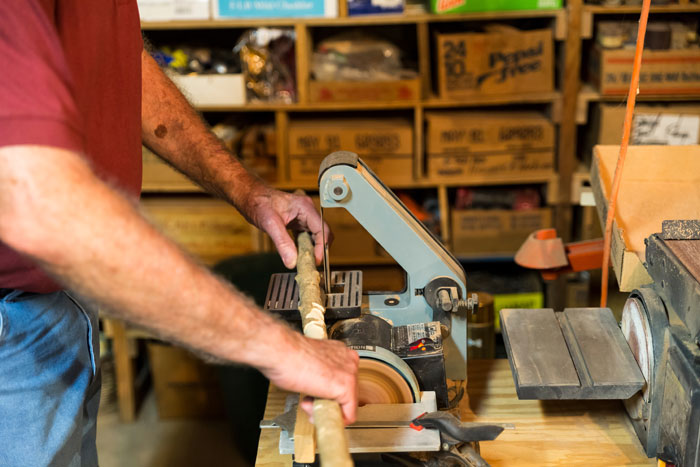
His knapping implements consist of sharpened deer antlers, rounded “hammer stones” picked up from creek bottoms, leather for protective padding, coarse sandstone blocks for treating edges, and special flaking tools he fabricates from thick copper wire and aluminum rods mounted in regular tool handles. Gerald explains that copper has exactly the same hardness as deer antler, but smells much better when he sharpens it on a grinder.

Gerald carries on a lively conversation as he deftly chips away at a chunk of black obsidian he had just hammered off the corner of a much larger piece. It was misshapen, bulged out in all the wrong places, and looked nothing like the business end of a weapon — more like something one might skip across a pond.

But Gerald’s keen eye had visualized a shape suitable for an atlatl point within this irregular hunk of shiny stone, and proceeded apace to extract it. As he worked, the piece began to take on an isosceles triangle shape with razor sharp point, serrated sides designed to slice flesh, and elegantly crafted barbs and notches at the large end. The end result was a precision, totally lethal weapon tip for hunting or warfare.

Obsidian is an extremely fine-grained form of volcanic glass, similar to quartz and can be shaped into edges sharper than the finest steel. In fact, obsidian is made into modern instruments for delicate eye surgery, with cutting edges approaching a single molecule in width. Its sharpness and crystalline nature were further evidenced by Gerald’s fingers, which began to bleed from several tiny cuts as he worked. Knapping is definitely a labor of love, reinforced with a tetanus shot and Band-Aids.

Other stones are almost as sharp as obsidian when properly tooled. Flint is actually a hard, fine-grained version of chert and was used extensively by local Indians who had no nearby source of obsidian other than trading with distant tribes. Also useful were dolomite, quartz, greenstone, jasper, quartzite, stromatolite, chalcedony, even a type of iron ore called hematite. More exotic-sounding materials include Horse Creek chert, novaculite, sugar slate, Hillabee greenstone and rainbow obsidian.

Modern hobbyists love to experiment with other materials, such as glassy slag from blast furnaces and even old drink bottles melted in trash fires. The Hoyle brothers have made scores of these experimental points, some almost indistinguishable from quartz or smoky obsidian.

Born in Pahokee, Florida, Gerald moved with his family to New London in 1952, and he’s been in the neighborhood ever since. A 1963 Pell City High graduate, he served in the Air Force for four years, then worked as a truck mechanic for 32 years at Ryder in Oxford.

Now retired and a robust 67 years of age, Gerald stays very busy. When he’s not emulating Paleo Tool-Man, he enjoys photography, paleontology, collecting rocks and artifacts from local tribal sites, demonstrating his crafts to school children and preaching the gospel at Mt. Olive Freewill Baptist in Dunnavant.

He also does volunteer work at the new State Veterans’ Home in Pell City, where he entertains residents with lively conversation, games of dominos, and reading to the visually impaired.

Gerald’s wife, Mary Margaret, tolerates his hobby because it provides so many large, multicolored stones for her flower beds. Her avocation is machine embroidery and quilting. Though not a flint-knapper herself, she often helps her husband make fine jewelry from his artifacts. However, his handiwork has caused her some concern at times.

For instance, she was not happy when a pile of flint rocks which he was trying to heat-temper in her kitchen oven, exploded, filling the whole cavity with tiny slivers of razor-sharp stone. Nor does she share his enthusiasm when he loads their car down with heavy stones he’s spotted and picked up while they travel.

It’s nothing new. The Hoyle brothers’ passion for paleo crafts goes all the way back to their childhood, when they spent countless hours searching fields and river banks for stone products. Both men have extensive collections of museum-quality goods. Before he retired, Gerald often knapped on his lunch break while others…well, napped.

Gerald explains that using primitive methods while working with stone helps him reach out and touch the past, when much hardier men depended on such skills to stay alive and prosper. He especially enjoys giving his craftworks to people he likes, free of charge, and eagerly shares his love of history with others.

Would you like to try your hand at knapping? The Hoyle brothers advise aspiring knappers to start out with good materials and tools, seek the advice of experts on basic technique, and practice, practice, practice. Because of the extreme sharpness and minute size of stone flakes, it’s also mandatory that you wear old clothes, gloves and safety glasses, and never allow bare feet anywhere near your work area.

Gerald has jump-started several local folks in this fascinating hobby, including this writer. His advice includes a warning that your first few hours of work will most likely consist of turning larger rocks into lots of smaller ones before you actually create a presentable result.

Most novices will eventually produce an acceptable piece, but it seems there are always a few who never really “get the point” of this fascinating pastime.

• For a special story on the bow and arrow precursor, the atlatl, see the digital or print edition of the June 2013 edition of Discover The Essence of St. Clair

Crazy Horse

Becoming an Argo eatery icon

Story by Elaine Miller
Photos by Jerry Martin

Butch Evans and his wife, Karen, were sitting in their den one evening, bored out of their minds, when the idea of starting a restaurant was born.

“My wife said, ‘Are we gonna sit sit here like this until we’re 80, falling asleep in the recliners?’ “I said, ‘I can fix that.’”

And that’s how Crazy Horse Restaurant was born.

“I had been in the food business all my life,” says Evans, who owns Evans Steaks and Seafood, a wholesale company, on Birmingham’s Finley Avenue. “I called on restaurants. I didn’t know whether people would accept fine dining in Argo, though.”

Apparently, he had no cause for worry. Since opening in the former Denise’s Country Diner location in October 2011, business has been steadily increasing. Hungry patrons looking for something besides meatloaf and mashed potatoes come from St. Clair, Etowah, Jefferson and Shelby Counties to sample the steak and seafood menu.

“The locals support breakfast and lunch, the dinner crowd comes from Trussville and beyond,” says Evans.

Trying to make a unique place in the middle of nowhere, Evans didn’t want a typical meat-and-three kind of place. “Anybody can slap a hamburger steak or beef tips and rice on a plate, but to have a good piece of meat is totally different,” says restaurant manager Tony Green. “Quality is the key, along with freshness.” Gulf Coast seafood is delivered daily and all steaks are cut fresh daily. “Nothing is frozen,” says Green, who is Evans’ brother-in-law.

Fried Large Buttermilk Breaded Shrimp and New Orleans-Style Shrimp & Grits are served daily, but the Catch of the Day, usually grouper, is served only on Thursday nights. Customers can get it blackened with lemon butter sauce or potato crusted. Also featured are grouper fingers. Seafood Saturday offers platters of fried oysters, grilled shrimp pasta with creme sauce and sautéed Gulf scallops in butter sauce.

On the menu Thursday, Friday and Saturday nights are the chargrilled steaks, with the 8-oz filet mignon being the most popular. It’s served with a baked sweet potato and fresh asparagus.

Dessert choices are simple. Strawberry cake (a local woman bakes and delivers) and bread pudding with whiskey sauce are the only meal-ender items on the menu. The popular orange rolls aren’t made on the premises, but customers buy them by the dozen to take home. Soup of the Day is either Beer Cheese (see recipe) or Seafood Chowder, each made fresh daily.

Breakfast consists of “just about anything a customer wants,” according to Evans. Favorites are the Crazy Horse Special and the Stable Hand Special. The former consists of two eggs, any style, with grits or gravy, hash browns or home fries, and a sampling of smoked sausage, ham and bacon, along with biscuits. The latter starts with two eggs, adding pancakes, grits and bacon or sausage. Denise Sims, former owner of Denise’s Country Diner, and Dustin Nelson prepare the breakfasts.

“Saturday morning breakfasts are packed to capacity,” says Green. Capacity is 104 seats, including the 24 on the screened-in patio added in February. Head chef Andrea Peagler, the Regions Bank chef in downtown Birmingham by day, oversees the kitchen at the Crazy Horse on Thursday, Friday and Saturday nights.

Lunch offerings include sandwiches filled with chargrilled burgers, chicken breasts and New York strip steaks, plus chicken salad, hot dogs and fried chicken tenders.

As for the name of the restaurant, that came from two sources: The Birmingham club where Butch and Karen had their first date in 1974, and the fact that Karen has horses. “I came home from work one day, and Karen said, ‘I thought of a name,’” Butch explains. “It seemed like a fit.”

Green grew up working in fast-food restaurants, but in his day job is advertising products manager at Progressive Farmer. When he started at the Crazy Horse, he was only going to be there Thursday nights, which quickly turned into a three-day weekend. “It’s tiring, but fun,” he says. “When it stops being fun, I’ll quit.”

The Crazy Horse Restaurant, located at 281 US Highway 11 in the Argo Village shopping strip, is open Tuesdays and Wednesdays from 6 a.m. until 2 p.m. On Thursdays and Fridays, it’s open from 6 a.m. until 2 p.m. and from 5:30 p.m. until 8:30 p.m. Saturday hours are 6 a.m. to 10:30 a.m. and 5:30 to 8:30 p.m. Reservations are taken only for Thursday nights. The Crazy Horse is closed Sundays and Mondays.

• For one of Crazy Horse’s recipes for their famous Beer Cheese Soup, check out the print or digital edition of the June 2013 edition of Discover The Essence of St. Clair