St. Clair Agriculture & Multi-Event Center is so much more than original rodeo venue
Story by Elaine Hobson Miller Photos by Mackenzie Free Submitted Photos
The St. Clair County Arena in Odenville has been home to rodeos and agricultural shows for many years, but today, it is so much more. Over the past 12 months, it has hosted a dog show, a vintage market, a circus and a county fair.
The Event Center next door is a pickleball mecca to rival any courts in the county.
In other words, the Arena ain’t just a place for agricultural shows anymore. The official title may give a hint to the depth of its overall scope: St. Clair Agriculture and Multi-Event Center.
“We wanted more than just an agricultural center,” says County Commissioner Jeff Brown. “And that’s what we have. We can do a dog show one day, a circus the next. I give (Arena Director) Ashley (Hay) a ton of credit. She’s easy to work with. The original board that ran it needs credit, too. It started from nothing.”
Dog agility show
The county bought the Arena, 25.6 acres of land and an office building in 2010 from Randy and Michelle Spence for $551,197. For 11 years, it was used for rodeos and other horse-related events. During COVID, the county received a $1 million federal grant to build an emergency facility, called a Pandemic Center, that they could operate from in the event of a natural disaster. That grant changed everything.
“I came aboard in 2021, and the grant had already been awarded,” says Hay.
“The county commission looked for a way to use the grant to best help the entire county. Only the Arena was here then.”
Hay says that grant required a large, unobstructed space, restrooms, as well as storage to be utilized by EMA. The county commission looked for ways that the facility could be used for more than just emergencies, though. This led to the addition of a sport-court surface, bleachers, retractable basketball goals and equipment for volleyball and pickleball in the Event Center.
“This building was attached to an existing older building that had administrative offices and the cowboy church,” says Hay. “The concession stand with restrooms and showers was built a while ago.”
Both the Arena and the indoor, 12,000-square-foot Event Center are membership facilities available to anyone. “We have a lock box for daily use, or you can sign up online. We have about 100 members right now. The cost is $100 for an annual membership, but daily memberships are obtainable, too.”
Pickleball players have five days a week to play their favorite game. “They are pretty dedicated folks,” Hay says. “And they say ours is one of the nicest facilities within 100 miles. We have pickleball classes, but we don’t have programs, so we’re able to offer more open gym time.”
The Event Center offers summer membership for kids, too. The Center’s Facebook page is the best place to check out the schedules.
“We’re the only arena in our area that I know of that allows open rides as much as we do,” Hay says. “Horseback riders can come any time between 6 a.m. and 10 p.m. When they register, they get access to opening the gates. We have 80 horse-riding members. One woman comes with her baby at 6 a.m. because it’s the only time she can.”
Early history
Originally, the county created a parks and recreation board to run the facility, appointing Lude Mashburn of Odenville, the late Hershel Walker of Argo, Don Smith of Springville, Brad Sanders of Odenville and Kenny Womack of Riverside as members. A couple of years later, Womack was replaced by Jimmy Hollander, also of Riverside. The board elected Mashburn as chairman.
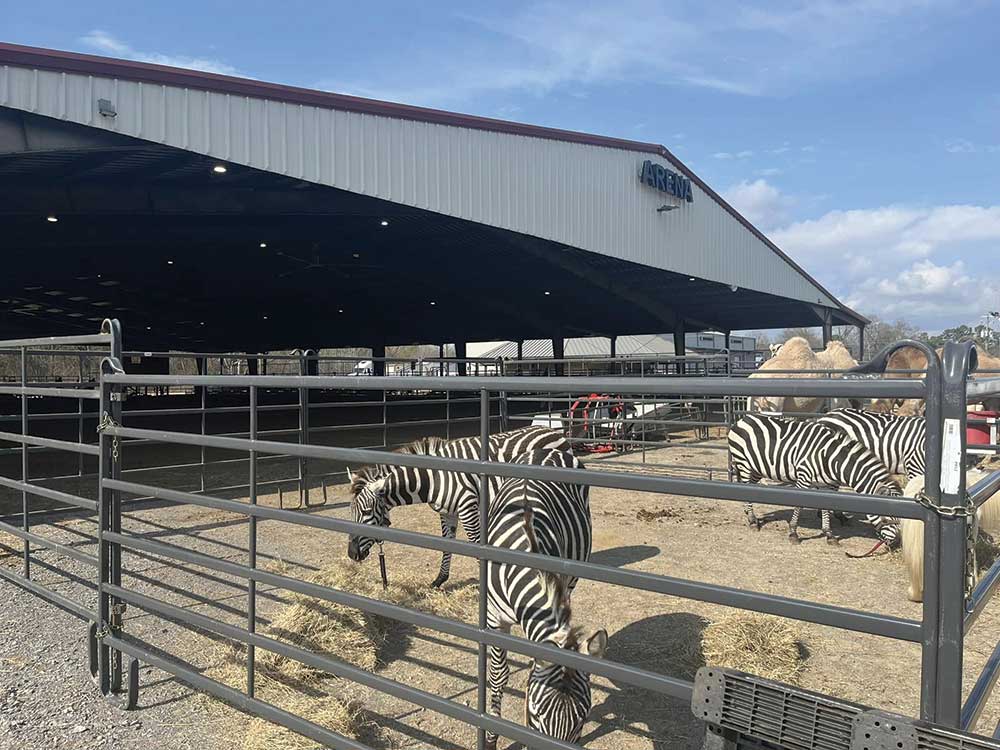
Zebras and camels visit with circus
“The county had a vision, and they appointed the board to run it,” says Mashburn, who was an agricultural science teacher at St. Clair County High School at that time. “They turned everything over to us, and we ran it. We put in the dirt for the Arena floor, bought a tractor to keep it compacted during rodeos, all that. But the county never funded it for the 10 years we had it, except for building the restrooms and the bleachers. Then things kinda changed when the county got COVID money.”
The board was officially dissolved on February 10, 2022, and the property and facility are now funded and managed by the St. Clair County Commission, according to County Administrator Tina Morgan. Board members at the time of dissolution were Chairman Lude Mashburn, Jimmy Hollander, Brad Sanders, Candi Jones and Donnie Smith.
The county covered the bleachers and Arena, added lights and industrial overhead fans. The bleachers seat 800, with extra seating brought in for rodeos, pushing that total to 1,200 seats as needed. The Arena itself is 22,000 square feet. “In March, April and May, then again in September, October and November, there’s an event every weekend,” Ashley Hay says. “We have had car shows, a community yard sale, barrel racing, ranch sorting, a pig squeal and a county fair.”
Youth timed events such as barrel and pole races and goat tying are still held there. “We have more equine events than anything else at the Arena,” Hay says. “We also have lots of banquets in the Event Center. We’re working on grants for developing the 12-15 acres at the back of the property, including a multi-use trail for walking, horseback riding and bicycles. We also want to do RV hookups so folks can park for the time they are in a show.”
Local youths take part in Pickleball Events Group clinic
Hay’s background is in parks and recreation, having worked for the city of Springville before St. Clair County. Originally from Kansas, she moved here in 2018 because her husband is from Alabama. “I was a high school volleyball and basketball coach, then got into parks and recreation after that,” she says. “I really enjoy it. I started and grew the parks and recreation program in Springville. Then they asked me to do the same here.”
Under Hay’s management, the facility has added a wash bay, industrial fans, lighting, an uncovered, warm-up pen behind the Arena, and everything inside of the Event Center. It has improved parking and upgraded the PA system, too. Hay added a Facebook page and advertisements on Radio Station 94.1. “I feel like things are running well,” she says. “We’re trying to expand the types of programs we have.”
Besides all the public functions, the Arena and Event Center are available to rent by individuals for volleyball and basketball games, for wedding receptions, banquets and other private events. “We have had a wedding, and they brought horses,” Hay says. “The wedding was in the back pasture, and the Arena was where they held the reception. It’s a $750 fee for two days’ rental, and that’s dang cheap in comparison to other facilities of similar size.”
The Arena hosted a circus in February 2025, and the Gala of World Horses in the Fall of 2024. “The Gala had never been to Alabama before,” Hay says.
At least two dozen trailers were parked outside the Arena for a recent Buckle Series, a barrel racing event. Several horses stood tied to trailers, munching hay from their hanging bags. Riders walked their horses in circles, getting them ready for the event. One of those riders was Emmaline Puckett, 9, of Ashville. She has been racing since she was five or six, and like most of the other competitors, usually comes early to put her horse through its paces.
“We’re members here, so if the weather is bad, we come over here to practice barrels,” says Emmaline’s mom, Christina Puckett. “We’re very thankful for this place.”
Tyler and Jayclyn Cobb of Blount County came to watch the barrel race, even though Jayclyn couldn’t compete as usual because her mare has been bred. “We love coming here, Jayclyn says. “It’s covered, shaded, not as hot as other places.”
“A lot of people have really done a great job with the Arena from the get-go,” says Commissioner Brown. “The board members deserve a lot of the credit. We (the county) had the ideas, and they made it happen.
“That board served for free, put in a lot of hours, even parked cars during events. They deserve all the credit.”
For many, the mention of Chandler Mountain brings to mind images of big, beautiful, savory tomatoes. But the roots of the mountain’s history run far deeper than those lovely fruits or even of those families that have farmed them for generations. Archaeologists are now calling the mountain a place of profound Native American cultural significance, having documented several sites on and around the mountain.
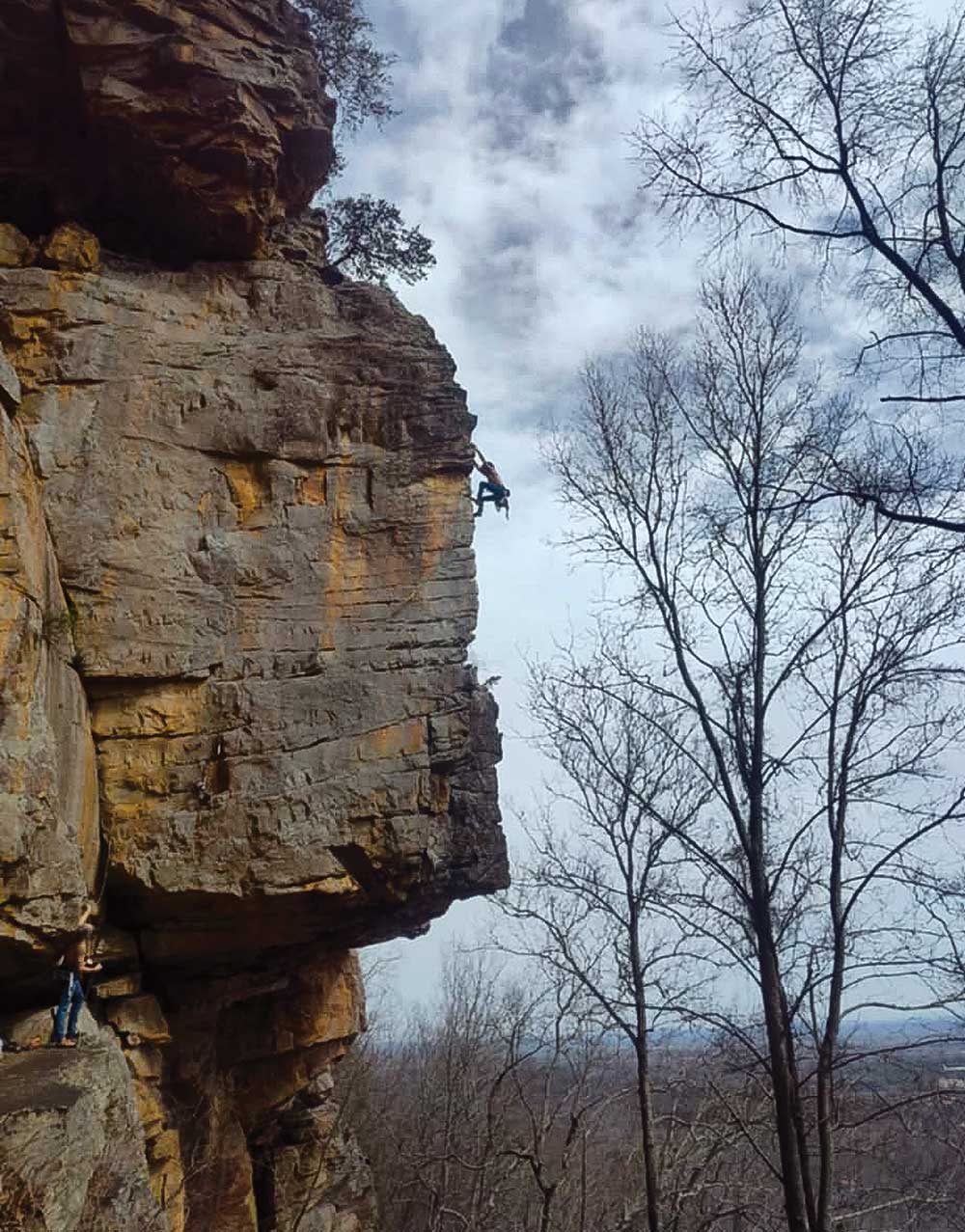
Climbing the rock face on the mountain
These sites, formally verified by archaeologists over the last two years, include pictographs, which are paintings on stone using the pigment, called red ochre, found in the dirt. There are at least eight documented sites containing pictographs, cairns, snake walls and other various rock formations attributed to the area’s Native American heritage. Next month, archaeologists are planning to visit an additional five areas that may also contain significant indigenous findings.
Those culturally significant Native American findings were instrumental in saving Chandler Mountain residents from the fallout from a proposed Alabama Power dam project. Alabama Power had planned to build a pumped storage hydroelectric facility that would have pumped water from Neely Henry Lake up the mountain to a reservoir and dam at the top, the intent of which was to created electricity by releasing water at peak use times to flow down the mountain to four dams below.
The building and operation of the project would have forever changed the landscape of the mountainside and residents banded together to fight. They created Save Chandler Mountain, a 501c3 non-profit, and began working to build a case to oppose the dam project. “The project was a net-negative program, meaning it would have used more energy than it created,” said Fran Summerlin, the organization’s president. “It was going to get rid of so much farmland and so many houses.”
Summerlin explained that the organization reached out to archaeologists and cultural heritage people and found common ground with the people who originally lived on the land, members of the Cherokee Tribe of Northeast Alabama. Both current residents and the Indigenous people of the area were desperate to save the land and protect its features.
Seth Penn is a member of the Cherokee Tribe of Northeast Alabama and was, at the time of the proposed dam project, the southeastern coordinator for the Indian Nations Conservation Alliance (INCA). Fighting to promote Native American culture and to protect sacred sites was his mission and that dovetailed well with Save Chandler Mountain’s mission. Penn, who has degrees in both cultural anthropology and natural resource conservation management, with minors in Cherokee studies and language, lives in north Alabama, but has ancestral ties to both Etowah and St. Clair counties.
“Chandler Mountain and that area was a place where multiple tribal territories came together,” Penn explains. “You had the Cherokee people, various branches of Muskogee, as well as Choctaws and Chickasaw too. This was a special place where various tribes would come together to trade and to talk through things and to try to work things out peacefully.”
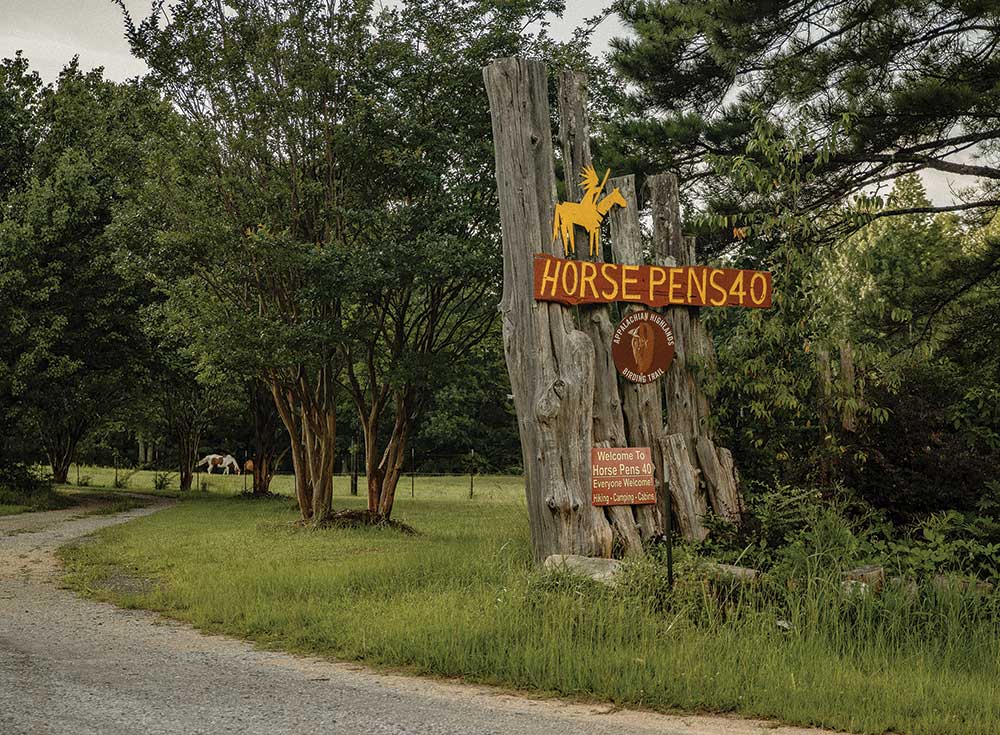
A popular destination – Horse Pens 40 – for bouldering, entertainment, festivals and views
So, their work together began by inviting noted archaeologist David Johnson to visit the mountain. Johnson, who is from Poughkeepsie, New York, had successfully documented Native American sacred and ceremonial landscapes along the lower Hudson Valley, which was instrumental in saving Split Rock Mountain, a land sacred to the Ramapo Munsee Lenape Nation. “We were having a ceremony celebrating the saving of Split Rock Mountain and Seth Penn and his mother came from northeast Alabama,” said Johnson. “I walked him around that site and showed him the stone features. He said I needed to come to Alabama.”
“I made the drive down to Huntsville and met with Seth’s tribe,” Johnson continued. “Within the first two days, we found two ceremonial landscape sites that the Cherokee Tribe of Northeast Alabama knew nothing about.” It was at the presentation he gave to the tribe about his findings that he met some visitors who came up from Chandler Mountain. “They asked me to come look and I went down for two days for a quick look. What I saw was enough that I went back and have documented eight major sites there.”
The shape of the mountain itself is unique in that, unlike typical mountains that rise to a peak, the top of Chandler Mountain is a plateau, flat at the top with a dip, or bowl in the middle. The shape is a natural occurrence, formed during the creation of the Appalachian Mountains hundreds of millions of years ago. The flat top made the mountain ideal for the ceremonial and tribal activities, according to Johnson, with plenty of room for tribes to meet, to trade, to work through disputes, and to pray.
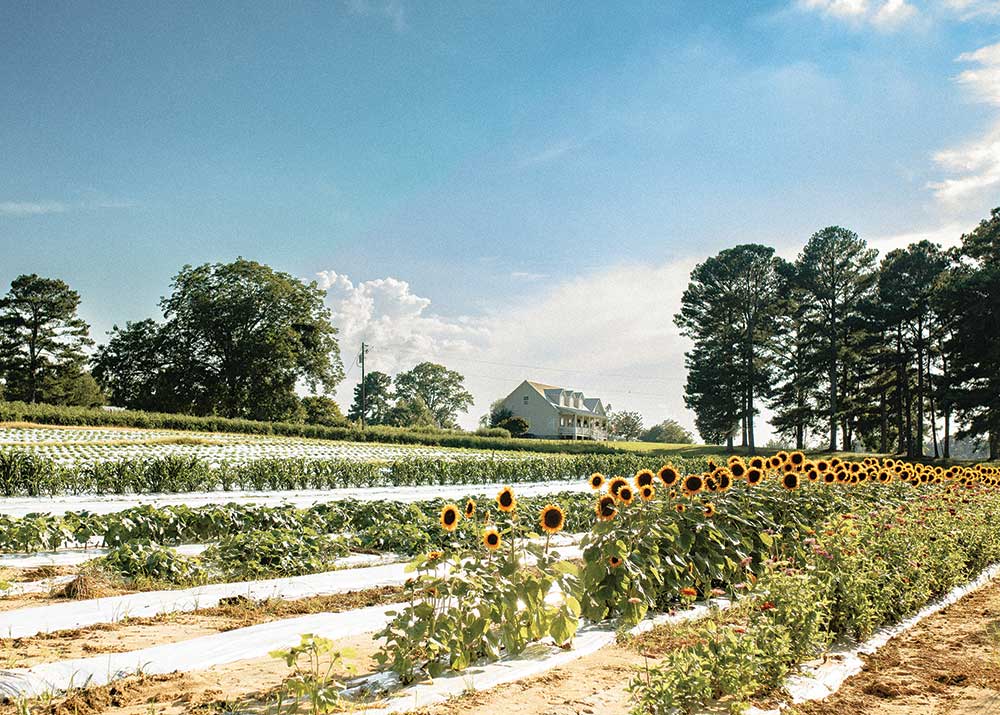
The mountain is known as the tomato capital
“You don’t usually find a lot of artifacts at this type of site,” says Johnson. “You don’t find a lot of broken arrows and firepits because that’s not what they did here. This was a special place, a sacred place.” Those types of artifacts, he explains, are found in habitation sites, archaeological sites where cultures lived and slept.
“There are ceremonially significant places on the mountain, as well as in the whole region,” Penn explains. “There are places where you see the presence of that confirmed through various rock formations, art, and things along those lines that are centuries old. It affirms the long-lasting presence of Indigenous people there.” It’s a place that local Native Americans still go to pray. “We go to these sacred places where we are able to stand in present time, but lock arms with our ancestors, the ancients, to pray.”
The land is sacred, too, to those who live and farm the land today. “There are places there with history, with stories, with blood, sweat and tears that have been poured into that land,” Penn continues. “If that dam project had happened, it would have erased the history of Indigenous people from thousands of years ago, but would also have erased a lot of history from the present inhabitants of that land and their families.”
Charles Abercrombie’s family is deeply ingrained in the history of the area. For more than 75 years, he has lived on land on the side of Chandler Mountain that was once part of the homestead of Joel Chandler, for whom the mountain is named. Chandler received the land as payment for his work as a soldier in the Creek Indian War. Abercrombie still has the land grant signed by Andrew Jackson. The land has been owned by the Abercrombie family since 1894, and Abercrombie says he would fight to protect his land from any threat. “When all this started, I went to an eminent domain attorney,” Abercrombie said. “I was willing to go to the Supreme Court, if I had to.”
He did not have to go to the Supreme Court. As a result of feedback from residents and pushback from Twinkle Cavanaugh, then Alabama Public Service Commission president, the application for the Alabama Power dam project on Chandler Mountain was withdrawn and the mountain, with its beautiful landscape and rich history was saved.
“Bringing these potential cultural losses to the forefront may have contributed to the demise of the project, but important political opposition is probably what made the difference,” says Terry Henderson. Henderson, whose family has been around the mountain and Canoe Creek since around 1850, has lived on the south brow of the mountain for two years. He is married to Linda Derry, a professional historical archaeologist, and worries as much about “unrestrained and uncontrolled visitation” in the area. “These properties, structures, and vistas should be protected through legal, enforceable, verifiable development and access restraints,” says Henderson.
Ben Lyon agrees. He was drawn to the mountain as a rock climber 20 years ago and has lived there for the past 12 years. His property contains red ochre drawings and other findings important to Native American culture. “I believe it’s as important as anything to preserve these,” says Lyons. “It’s one of the few examples of pre-Woodlands depictions in the Coosa River Valley.”
Lyon says saving the mountain and its cultural history is important for the future of the children and for the families who make their living on the land. “There’s a way of life on Chandler Mountain that would have been lost, and about a third of the mountain would have been lost,” said Lyon.
Chandler Mountain is a place of tranquil beauty, a place where families live off the land and spend time in the outdoors. It’s a land of history, of promise, and carries with it the burden of conserving it for future generations. Conservationist Aldo Leopold stressed the importance of that responsibility when he wrote, “The oldest task in human history is to live on a piece of land without spoiling it.” Together, the mountain’s current residents and those representing their Indigenous predecessors have made sure this sacred mountain will not be spoiled.
Pell City resident makes the journey of a lifetime
Story by Paul South Submitted Photos
For the pilgrims who annually flock to Spain from around the world to walk all or part of the Camino de Santiago, the reasons for their journey are as varied as they are.
For the hikers, it can be a trek of faith, fellowship, revelry, reflection, exploration or a communion with God and nature. Known as the Way of St. James, it might well be a tour mixing all of the above, ending at the Cathedral of Santiago de Compostela in northern Spain, where it is believed the remains of St. James the Great rest.
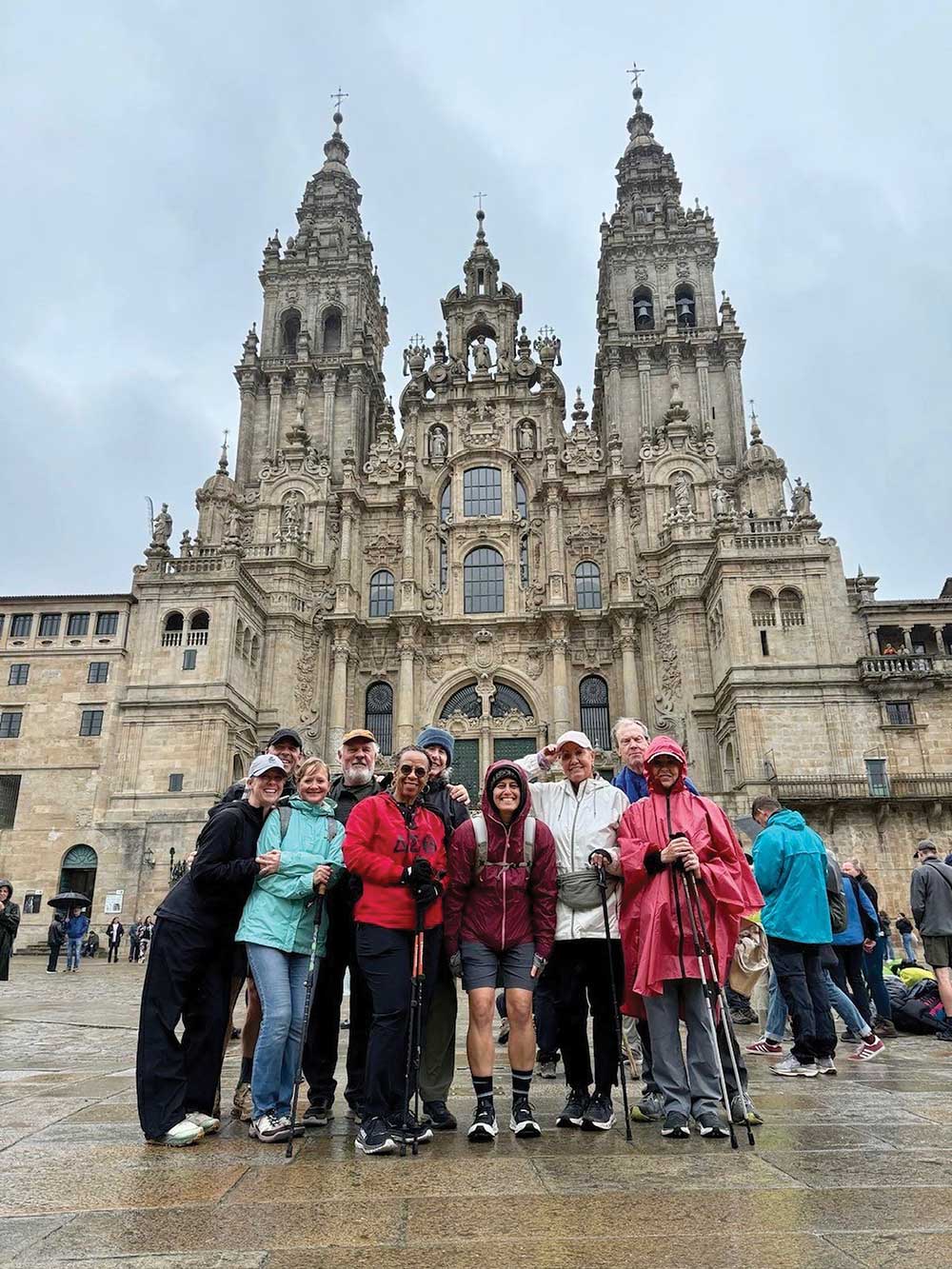
They made it! Cathedral of Santiago de Compostela
For Jean Barnett of Pell City, her 70-mile, weeklong journey on a portion of the Camino Frances or French Way, was a moveable feast of all of the above. The spark for her journey was first ignited by her yoga instructor, Terri Sellers, a five-time veteran of the journey, who was organizing a Camino trip for a small group of friends.
“I heard her talking about walking across Spain, going on this pilgrimage, and I was intrigued. I’d heard of it many years ago, and I decided if I didn’t do it now, I might never do it,” Barnett said.
Multiple reasons fueled her desire to tackle the journey.
“The challenge drew me in,” she said. “But the opportunity to do it with friends who were like minded attracted me to it.”
It came at a time, too, when she had wrestled with family health challenges.
“(The Camino) was just something I felt like I wanted to experience – to get back out and spend some time exploring and doing something that sounded challenging but was doable,” she said.
And there was the spiritual side.
“People have a lot of reasons for doing it, and mine was somewhat religious,” she said. “But being out on the trail gives you a chance to really meditate and have an opportunity to just kind of be with yourself paired with many opportunities for fellowship along the way. But I took time to pray and listen to the sounds of nature, which was one of the things I really loved – the early morning walks, listening to the bird calls, just the sounds of the world waking up.”
She added, “To be out there in a place where you could just be by yourself and think.”
And there were times of fellowship with her group and with other travelers along the road.
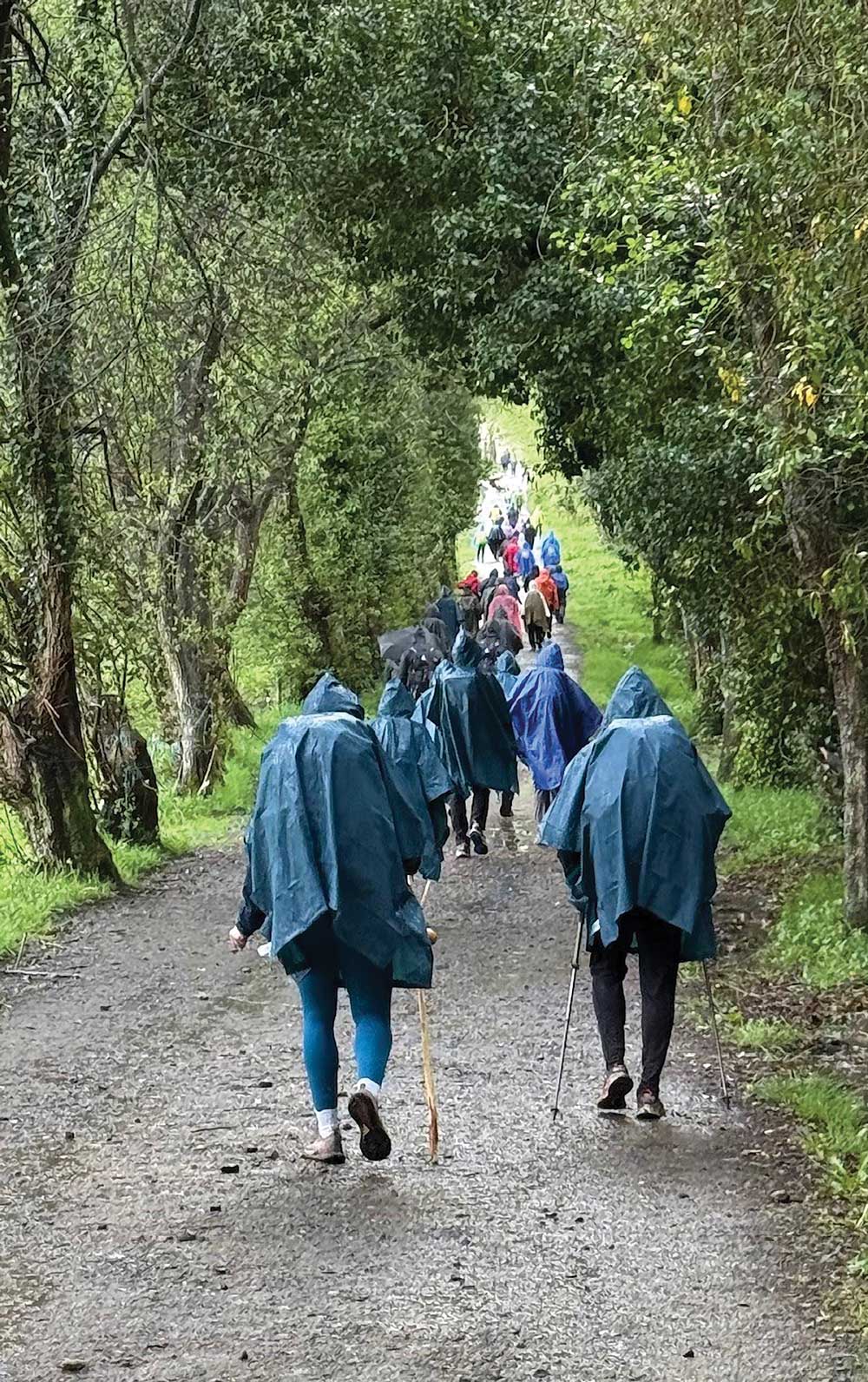
Rainy walk with crowd of Poncho-clad pilgrims nearing Santiago
“There’s a balance there,” she said.
Barnett, a former runner who competed in half-marathons, moved at a more deliberate pace in her pilgrimage. Deep reflection, introspection and fellowship don’t move at a racer’s pace. Camino de Santiago is an opportunity to escape from the daily grind.
“It’s something of a distraction that takes you out of your role in day-to-day life and the chance to just kind of contemplate the world and your purpose,” Barnett said.
Amid the deeper moments, there are the earthlier concerns, from fatigue to blisters on the trail. “You just take every day as it comes and deal with it,” she said.
What is theCamino de Santiago?
In 820, a tomb was discovered in Galicia believed to be the final resting place of St. James the Great. According to “The Camino de Santiago Survival Guide,” while the details are a bit fuzzy, the “Camino” was the beginning of Christian pilgrimages. It is believed that in 920, a Frenchman, Bretanaldo, was the first foreigner to walk the Camino. Some 438,683 people completed the Camino via a network of different routes and via different means. While nearly 95 percent of travelers walk the Camino, others travel via bicycle, horseback, sailboat, on crutches or in a wheelchair.
One interesting note: Some famous people have made the pilgrimage, including the King and Queen of Belgium, television host Jenna Bush Hagar and the acclaimed actor Martin Sheen.
There are several different routes for the Camino, all ending at the Cathedral de Santiago. As they get closer to Santiago and the Cathedral, they merge into one trail, crowded with pilgrims. Here is a glimpse of the trails, taken from The Camino De Santiago Survival Guide:
The French (Frances) Way: This is the most commonly taken route of 780 kilometers from Roncesvalles to Galicia. This route passes through Pamplona, famous for the Running of the Bulls, written about in Hemingway’s The Sun Also Rises.
Barnett and her group began their 70-mile journey in the town of Sarria.
The Northern (Norte) Way begins in Irun and passes through Bilbao, San Sebastian and other towns before entering Galicia.
The Primitive Way: Beginning in Oviedo, this 321-kilometer journey merges with the French and Northern routes near the end.
The English Way (Ingles): The route, which begins in either Coruna or Ferrol and ends in Santiago is named for the pilgrims who originally traveled from the United Kingdom. The distance from Ferrol is 110 km. From Coruna, the distance is 75 km.
The Portuguese Way begins in either Lisbon, or more commonly in Porto. The inland route from the Portuguese capital Lisbon is 600 km, 620 km by the coastal route. From Porto, the inland trek is 230 km, 260 km the coastal way.
The Via de la Plata: The 1,000 km route begins in Seville, Spain and runs inland before arriving in Galicia.
Preparation and an early challenge on the trail
While others will travel all of one of the routes and “rough it” along the way, Barnett’s group traveled with a support van. Hotel reservations along the route were made in advance.
There were checkpoints along the way offering water and snacks and stops for lunch and dinner. Their luggage was also transported. It was somewhat akin to sherpas who aid hikers on an Everest journey.
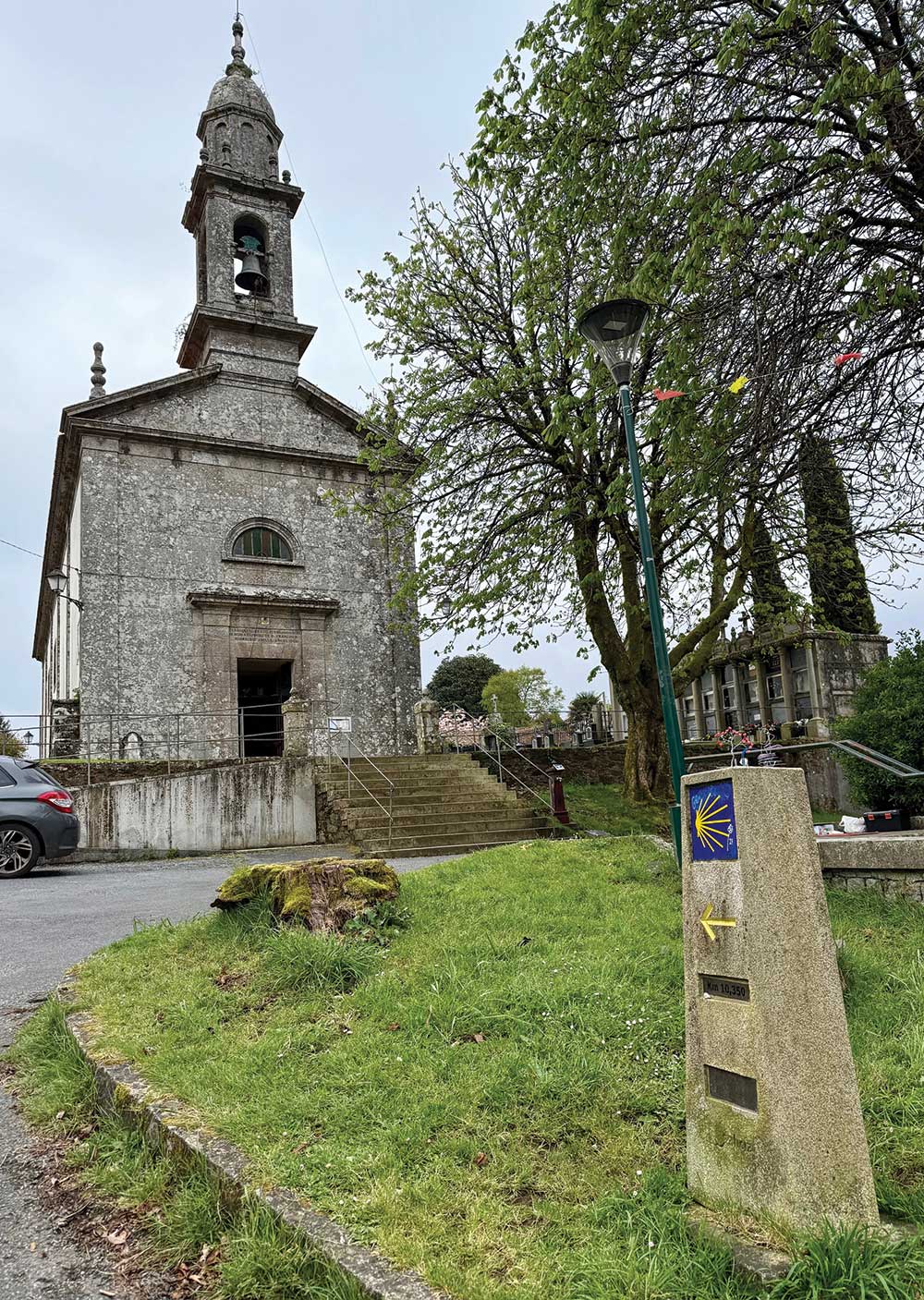
One of the path markers outside
historic church
“I’ve heard it referred to as “Pilgrim Lite,” she said. “We really did have a lot of support along the way, which made it really doable.”
The Camino requires preparation physically, mentally, spiritually and emotionally.
“You know, I don’t think I adequately prepared for it, actually. I was so busy with everyday life and the things I had to do to make sure while I was gone my family was taken care of,” she said. “There was a lot I had to take care of before I could get away.”
At home, she’s also involved at her church, Pell City First United Methodist in trying to help it grow, and she was in rehab for a back injury for six weeks before the trip.”
“I wasn’t as adequately prepared as I needed to be – spiritually, mentally, any of that,” Barnett said. “The therapists helped me get to a point where I could do it without suffering too much.”
The biggest physical challenge came shortly after the long flight from the States to Europe. “On the first day, I got scared,” she said. There was swelling in my lower legs, and the trail was hilly with long inclines and declines. I had a hard time keeping my heart rate down because the swelling was putting pressure on my heart … I wasn’t sure I was going to be able to do it. I just had to take it very slow.”
A pair of compression socks saved her journey. Asked if that first day was the hardest on her portion of the Camino Frances, Barnett said, “Absolutely, it was. After that first day, it wasn’t a problem. But it was still very challenging. That’s a lot of miles, and it was hilly.”
That first day caused her to consider giving up, but the support and advice of her group kept her going. “I was ready to try again,” she said. “I didn’t want to give up.”
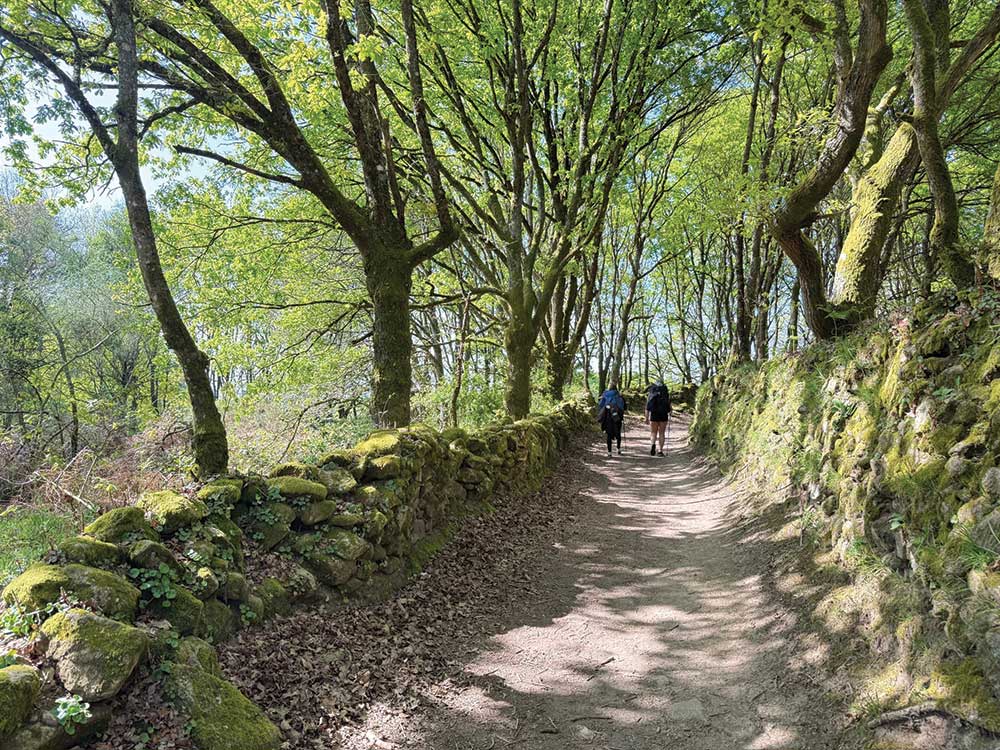
A favorite memory – moss-covered stone walls on a tree-lined path
For Barnett, the journey was part solitude, part introspection, part fellowship and more, a hybrid of all the reasons travelers make the pilgrimage. She and her group entered Santiago on the Thursday before Easter. After completing her Camino, she attended Easter Mass at the Cathedral of the Assumption of Our Lady in Porto, Portugal.
“It was amazingly beautiful and spiritual to celebrate in Porto’s majestic ancient cathedral,” she said.
While that may have been the spiritual climax of her trip, Barnett also encountered inspiration in human form. A pilgrim in front of her was walking slowly, with difficulty.
“As I got closer, I realized he was walking on crutches and carrying a backpack,” she said. “It occurred to me, that whatever issues I had or have in my life, I don’t have crutches. For him to take the journey and make it happen, it just touched me. He was my hero.”
As she came alongside the man, she spoke to him.
“He had the most joyful, radiant smile,” Barnett recalled. “He had some age on him, but here he was doing something that most people on crutches would just consider impossible. And he was happy.”
There were other surprises on the walk. Musicians, alongside the trail, buskers who would happily take a Euro or two tossed into an open cello or guitar case, serenaded pilgrims. Groups of young people sang joyfully or laughed as they walked. Barnett encountered fellow pilgrims from around the world, on the trail and in bars and cafés in the villages along the route.
Nature offered signs of spring and of renewal, a pasture full of lambs or calves.
“It gave me another thought, to take this this time and think about the future and the importance of having this life and how you spend your time,” Barnett said.
As she passed centuries-old buildings, Barnett considered the early pilgrims in ancient days who made this journey.
“They did not have the modern conveniences we have – the high-tech shoes and gear – all the things that we access so easily. What did they do when they had issues? … We have so much.”
A favorite memory for Barnett is when she walked a tree-lined path along a stone wall covered in moss. “The moss was glistening, and it looked like carpeting in the shape of the rocks of the wall,” she said. “It was leading you from where you’ve been to where you’re going. It was a gorgeous, magical fairyland.”
She also warmly recalled the fragrance of a eucalyptus forest, ancient buildings, lovely murals. The Camino experience left her forever changed.
“It gave me a chance to focus on what’s important in life. We get so tied up in the daily routine, grocery shopping and cooking meals, and (the trip) gave me a chance for an inward focus, to think about the things that are important in life and relationships and this big world. There are so many places to go and people to meet. It’s eye opening.”
It helped her realize that “being on the Camino is a lot like life. You have to do what you need to do to get from Point A to Point B each day. But in this scenario, you are in nature all the time.”
And at each day’s end, as she laid down to sleep, she remembered the people, places and things she saw – welcoming people in breathtaking, yet peaceful places.
“It was a good time to take a pause in life, even though I was in motion most of the time. It was a pause for your mind to open up more to the spiritual aspect. Being outside. Communing with nature. Thinking about this wonderful world and God and what He has created for us and the responsibility that comes with preserving it.”
The Camino also impacted her perspective on the world.
“I wasn’t bombarded with news, but staying out of the daily news was good for my soul and good for my mind. (In the news), there’s always the bad and negative things going on. The Camino forces you to focus on the good and the beautiful.”
And when she arrived with her fellow pilgrims at the Cathedral of St. James the Great, she was greeted with cheers and applause. She wept with joy at the memory. They were there with pilgrims who had trekked the entire Camino de Santiago, but that did not dampen her triumphal entry.
“Oh my gosh, that was exhilarating,” Barnett said. “It was pouring rain off and on all day, and it was raining when we got to Santiago. But we were so excited to see the cathedral, to end the journey. About 10 kilometers out you could see the spires of the cathedral. I get goosebumps just thinking about it. It put more energy into our final few steps. … The energy level was amazing.”
It impacted her relationship with God.
“When I feel close to nature, I feel close to God. It’s an opportunity for a conversation with God. It was an opportunity to pray and to meditate while listening to nature.”
She thought of nature and art and history along the way – and the pilgrim on crutches.
“I felt blessed to speak to that man who was making his way at his pace with this huge smile on his face, and it made me think how blessed I was to be able to do this with a great group of people.”
Barnett offered a quote from Sellers, the yoga instructor who in part inspired her to tackle part of the Camino, a journey of beauty, discovery and the Divine. “It’s not about what you take with you, it’s what you leave behind.”
What did Barnett leave behind?
“I tried to leave stress and worry and take (home) the joy that I experienced.”
She offered counsel to those who may be considering the Camino de Santiago or any other challenge in life. “Follow your dreams,” she said. “If there’s something you want to experience, then make it happen. It’s a great big, beautiful world. Don’t shy away from something that, though it may be challenging, is an opportunity for growth.”
The trip, simply put, was “very nourishing for my soul.”
Quoting Sellers again, she described the magical, mystical journey: “As we venture away from our everyday lives and from the script of a typical trip or vacation, we are invited to open our eyes, hearts and minds to being a stranger in a strange land and see each day as unfolding minute by minute, step by step into a journey of challenge, renewal and hope. In other words, we are off on an adventure, and while it will offer times of comfort and awe, there may be times of challenge and obstacles. It comes with the Way.”
Historic preservation and revitalization done right
Story by Paul South Photos by Graham Hadley
When Brad Waid, a Bloomfield Hills, Mich.,-based motivational speaker returns home to this St. Clair County town of Springville and pops into Nichol’s Nook Coffee Shop or Laster’s Sundries or any of the other downtown shops, the warm, comforting, kind feeling never changes.
“When my son visits, he says (Springville) is a perfect little town, right out of a Hallmark movie. You walk into Nichol’s and you could do a Hallmark movie in there.”
Frank and Carol Waid, lifelong town residents lead a small army of volunteers who want to keep things that way, preserving the landmarks that give a deep richness to Springville.
People come from all over for cool treats at Laster Sundries
The Springville Preservation Society began its work restoring the 1902 Old Rock School, the Presbyterian Church, the Springville Museum and historic homes that adorn the city’s streets.
The Society celebrates historic buildings to be sure. But it’s also about people. Springville has its share of famous folks, like Detroit Tiger pitcher Casey Mize and Pat Buttram and Hank Patterson, stars of the wacky 1960s classic comedy sitcom, Green Acres.
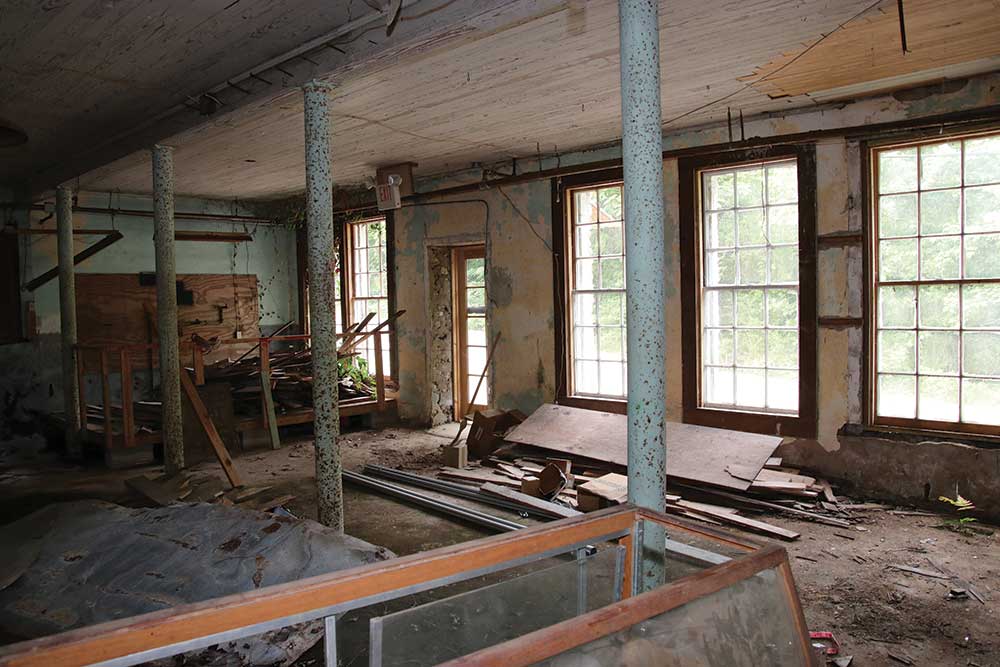
But the human story runs deeper. Families have called Springville home for generations. At the turn of the past century, ancestors hauled boulders to help build the school, now part of the National Register of Historic Places.
Work on the beloved school continues.
“The whole upstairs is completed,” Frank Waid said. “The floor’s completed. The kitchen is in. The bathrooms are in. Heating and cooling in the kitchen are in, and two of the main rooms are completed.
Close to completion is an event space made from two rooms where a wall has been knocked out.
Restored original single traffic light in the Springville History Museum
“That’s where we’ve had to stop right now because we need to put heating and cooling in those two rooms, and we just don’t have quite enough funds to do that. We’re real close to having the funds.”
The Society needs another $2,000-$3,000 dollars to add the HVAC system.
The organization is also working to repair and restore the floors and the front of Springville’s History Museum, housed in the old Masonic Lodge, which was built in 1903. The organization is seeking grants to make needed repairs.
“The whole front of the building is kind of like laying on the ground,” Waid said. “The beams have started to settle and the walls are starting to settle. That’s our big project right now.”
He added, “It’s a bigger project than we can do fundraisers for. It desperately needs to be done or otherwise, we will eventually have to close if we don’t have the funds to get it done.”
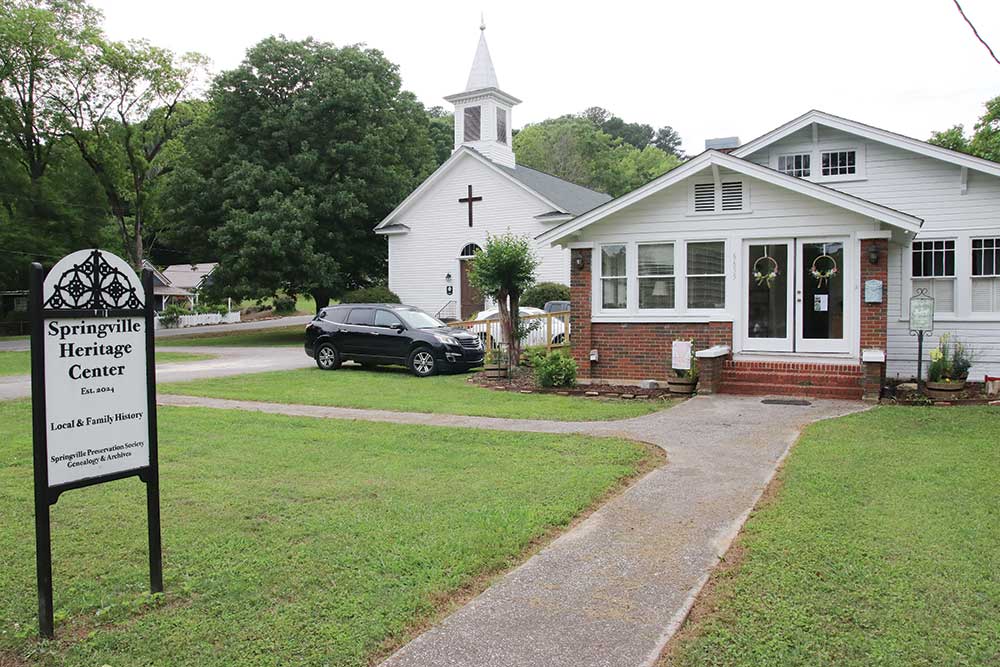
Work has also continued on the Presbyterian Church and the accompanying manse, where damaged roofs were replaced on the two buildings. The church building is being used as an event venue, and the manse is a treasure trove of information for amateur and professional researchers.
“It’s a full heritage center,” Waid said.” It’s a research center and a genealogy center. We have lots of books and records that folks can use for family research and genealogy. We have a computer and Wi-Fi for research.”
The restored Presbyterian Church and Heritage Center
Are there other projects on the Society’s plate? “That is enough,” said Waid.
“It’s about all we can handle right now.”
The Society has a schedule of events to raise funds for its many efforts and to build community and awareness. A recent yard sale raised enough money to replace the heating and cooling system at the old Presbyterian church.
Springville has rallied to support preservation efforts and with good reason. The Rock School could well be called the cornerstone of historic Springville. “It has ties to all the families, all the way back to the original settlers of the area,” Waid said.
The Society has an active membership. More than half of the 65 members are involved, not just names on a membership roll. “The people who are our members are some of the greatest in the world,” Waid said.
Along with its building and restoration efforts, Springville celebrates its storied heritage in other ways. It’s one of some 30 Alabama cities that hosts walking tours to highlight local history each April. “We get a lot of visitors,” Waid said. “And a lot of visitors tell us that they’re glad to see what we’ve done.”
If time allows, Society members are sure to take visitors, many born and reared in Springville, back to The Rock School. “It brings back so many memories. They love it,” Waid said.
Springville’s preservation push also brings repeat visitors from outside St. Clair County who are smitten with the town. Many make donations, and others even join the Society.
A section of the rock school before renovations get started
“A lot of people come to the area, and they just love the area, and they see what they are doing to protect the history and buildings so they can be maintained and used for the betterment of the community,” Waid said. “They just love what we’re doing.”
Earlier in June, the Preservation Society hosted a Tablescapes fundraiser, and representatives of the Alabama Cooperative Extension Service were expected in Springville to tour the Society’s work.
In the fall, Green Acres Day returns to celebrate Green Acres and the Hollywood careers of Buttram and Patterson.
Beyond brick and mortar, at its heart, Springville is special because of its people, who make it a place where friendship or a helping hand isn’t hard to find, Waid said.
A ramp has been added to the rock school to make it ADA compliant
“It’s just a loving, caring city. Anytime there is an event in the city, people come out to support it … Everybody just jumps in to help. It’s that small town you grew up in and even though it’s gotten bigger, it’s more family oriented.”
As for the Hallmark movie analogy, walk into Nichol’s or Laster’s for a taste of something sweet or most anywhere in the heart of Springville and Frank Waid says simply, “It fits.”
And the Springville Preservation Society fits, too.
“We’re here to preserve our heritage and our history,” Waid said. “That’s what we do through all these buildings – telling the story of our little hometown and the people in it and try to save all those memories.”
Those remembrances of days gone by, like when downtown stores used to give away $10 gold pieces, or even Frank Waid’s own father, Fred, who didn’t miss a Springville High football game for 20 years, are sweet and rich like a Laster’s sundae.
What would previous generations who built the city think of society’s work? “I think they would be pleased,” Waid said. “We support our town. If it weren’t for those little Mom and Pop stores, which was all they (our ancestors) had, we wouldn’t have been able to make ends meet.”
For the first time in a quarter of a century, the local chapter of the National Wild Turkey Federation held a Hunting Heritage Banquet in St. Clair County and marked the event as more of a success than they ever dreamed.
“Even if we had raised half of what we did, I would have considered it a success. We brought in about twice that. This was a fantastic first-time event,” said Jim Tollison, chapter president and chairperson of the fundraiser.
The local branch of the NWTF, called the Logan Martin Longbeards, recently reorganized with the help of the national organization, Tollison and some of his coworkers at Alabama Farm Credit in Talladega, where he serves as the regional vice president, and a host of others throughout the community.
“The NWTF works to protect wild turkey habitats and hunter rights,” Tollison said, pointing out that wild turkeys were all but hunted out in Alabama in the early 1900s. “For years, it was not common to see turkeys around where we live. They had to reintroduce wild turkeys to the state, or we would not have them today.”
The committee included Cameron Edge, Hanna Grogan, Logan Tucker, Karlee Tucker, Tim Smith, Brittany Smith, Jim Tollison, David Talley, Coy Holloway and Dillion Willams (Not pictured – Brooke Tollison)
Those efforts run the range from conservation to working with communities and government agencies to protect the land and the heritage of the sport.
The event organizers are still adding everything up, but the banquet, held April 3 at Celebrations in Pell City, brought in between $30,000 and $35,000 and attracted more than 150 people.
Aside from the catered dinner by Bowlings BBQ, attendees got to bid on and take part in drawings for a variety of guns and other outdoor and hunting equipment.
“People came together who like the outdoors,” Tollison said. “It was just a great group of people. The Federation had some special guns to win. Some are custom that are only available from the organization.
“It’s always fun to have a live auction – there were a couple of times I realized I was bidding against my wife, Brooke. And she was bidding on lots of stuff – it looked like she was trying to furnish our son, Jay’s, college room with NWTF stuff.
“Brian Worley helped with background checks, and GNX Guns and Bama Guns & Outfitters also were big sponsors.”
Those partners were key to the success. “Chad Camp with Lovejoy Realty really stepped up. He was eager to support the outdoors and did the premiere sponsorship,” Tollison said. Others, like Realtor Dana Ellison and Rob Knight not only sponsored the event, but they came and spent money at the auction.
Chapter president Jim Tollison and Chad Camp
Other sponsors included Cline & Co Properties; Richey, Price, Sawyer and Associates; THM Electrical and Maintenance Services; Chase Phifer; GNX Gun Exchange; Coosa Guns & Outdoors; Sen. Lance Bell; Bain & Co. CPA; Dixie Sod Farm; Alabama Farm Credit; Farm Systems Inc.; Metro Bank; Covered Bridge Timber Inc.; Rodney Bunt; Knights Plumbing; Ryan’s Hope Poultry Farm; Brooke Tollison, Alfa Insurance; Scott Tucker; and Alex Williamson
“Celebrations was great to work with. They have upgraded the venue, and everything was perfect for what we wanted to do … have a family friendly event where people could bring their kids and have a fun night.”
Tollison also wanted to thank all the help he had organizing everything, especially from the NWTF and his associates at the bank.
“I had been attending these events in other places as a way to network and build business relationships and finally said to myself, why don’t we do this here? I was sitting with NWTF regional representative Coy Holloway and Hannah Grogan (who became treasurer for the organization) at the bank, and everyone was on board.”
The previous chapter had ceased operations years ago. “When we came up with the name Logan Martin Longbeards and looked it up, turns out the old chapter had used the same name. We had no idea.”
From that group, they organized a board and then put their attention toward the banquet.
Some of the guns to be auctioned off
“It was really a small core group of people who did most of the work – people from the bank, Coy and others. Brooke was probably one of our top sellers for the event. … And Hanna did a lot of the organizing for the actual event. Representative for NWTF had high praise for her efforts.
“We were blessed this first time.”
The money raised at the event goes to the NWTF efforts, both locally and around the country, with the exception of funding set aside for a local scholarship the Logan Martin Longbeards plan to award.
After the success of this year, Tollison is already looking ahead. “We will be doing this again next year. We had people from Clay and Randolph counties who came out and supported us. I want to reach out to other neighbors, like Talladega and Calhoun counties and get their involvement.”
It was a night of “good fun,” Tollison said, “with a great crowd of quality people who came together to support the NWTF and its efforts.”
From St. Clair County, Michigan, to St. Clair County, Alabama
Story by Joe Whitten Contributed photos
For someone to live 78 years in St. Clair County without ever eating barbecue sounds like cuisine deprivation. But that was 90-year-old Les Johnson’s sad truth. He deserves compassion, however, for he grew up in St. Clair County, Michigan. “I came to Alabama for the first time in 2012, and I ate my first barbecue at Charlie’s in Odenville,” Les admitted, “and I’ve never stopped eating them since.” In St. Clair County, Alabama, he not only enjoyed barbecue but also collard greens, fried okra, butterbeans, and cobbler pie.
Les’s story starts in Canada where his father, Leslie Hontoon Johnson, was born. Leslie was awarded US citizenship for fighting for America in World War I. After the war, he worked as Chief Steward on a Great Lakes freighter. When he was on leave in Port Huron, Michigan, he became friends with Eva Fleming. They fell in love and were soon married.
Because Leslie was on the ship for months at a time, Eva moved back with her parents at the farm. Two daughters, Mary and Grace, were born there, and on July 4, 1934, Les joined them. Today he says all the 4th of July fireworks are for him.
Les enjoyed a special relationship with his grandfather. “I loved living on the farm,” he recounted. “My grandfather died when I was five, but I still remember him. He was over six feet tall, and there weren’t many men that tall then. He had huge hands, and he’d take mine and cover it with his.”
A creek flowed by their farm, and in winter he and his granddad would walk the frozen creek in the snow to the nearest town to buy supplies.
When his grandpa died, his mother ran the farm and his dad continued on the freighter.
Les spoke fondly of the farm. “We sold chickens and eggs and butter. My mother made butter with a churn. The Kroger and A&P stores would call us and tell us how many chickens they needed for the weekend, and we’d get the chickens, stick ‘em in the neck with a sharp knife, and hang ‘em on the clothesline to let the blood drip. Then we had to put them in tubs of hot and cold water and pull all the feathers out.” No automation in those days.
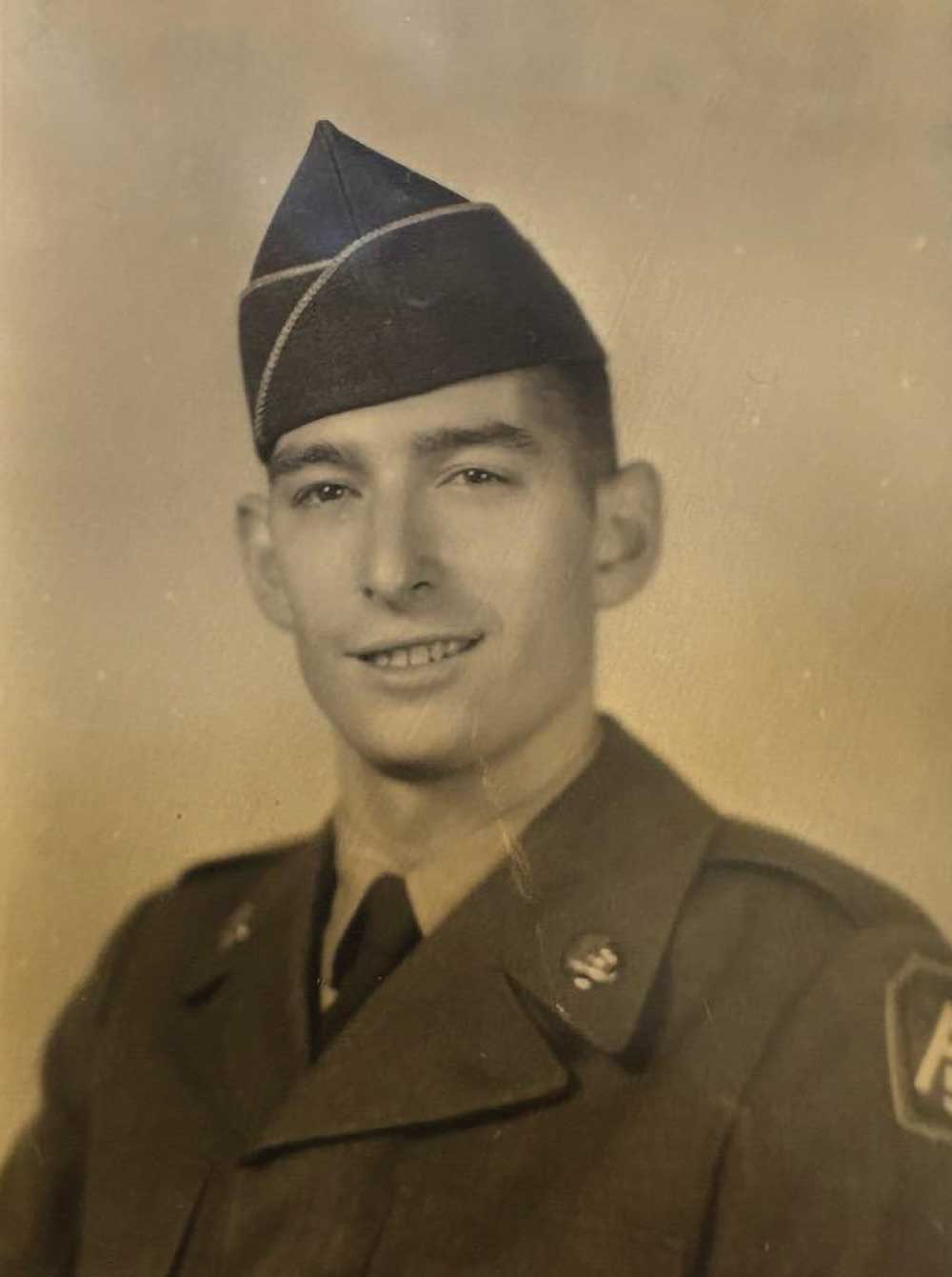
Les in uniform in his early 20s
The Johnson children peddled their products on Saturdays to regular customers in Port Huron. “We already had their orders,” Les related. “My sister would take one side of the road, and I’d take the other. We always had eggs and butter. And when strawberries were in, we sold strawberries for 25 cents a quart.”
Just like Alabama kids, Les took chances, without much consideration of consequences. He and sister Mary rode a horse that refused to cross a wooden bridge over the creek. “One day, we decided we’d get at the top of the hill and get him going as fast as we could downhill, so he’d have to cross the bridge.” However, the horse stopped stone still the second his hoofs hit the wood. “The hor se stopped, but we went across that bridge,” he laughed. “We were picking gravel out of our legs for months.”
Les got the better of his sisters many times. He would scrunch himself between his sister and her boyfriend until they paid him to leave. Sometimes he would lock a sister in a room until they paid up. But they loved him, and his 98-year-old sister, Grace, recently said of him, “Les was always so spoiled by everyone because he was so much younger and the only boy. He got away with everything! He was and is so loved by everyone.”
As the ship’s Head Stewart, Leslie Johnson could take his wife on two trips a year and young Les went with her. They would drive to Lorain, Ohio, where the ship unloaded and uploaded. “We would get onboard there,” Les said, “and we’d go through the locks at Sault Ste. Marie and get a ship load up there and come back to Lorain. We had a ’36 Chevrolet, and I’d sit on the armrest on the back seat while my mother drove us back home.”
Les with sisters Mary and Grace
Those times ended when Les’s dad had a heart attack on ship. The crew lowered him on a stretcher into a Port Huron mail boat which brought him to shore. Leslie was at home for about a month before he died.
The Johnson family continued farming for about two years, then his mother sold the property, and they moved to Port Huron where she took a job as a butcher. Sister Mary had married. Sister Grace lived with an aunt, and 12-year-old Les lived with his mother.
Les recalled having to move. “It was terrible, moving to a city—a city I’d never been to except for shopping. I had to get new friends and go to a different school. The first couple of weeks, I hated it, but then I made some friends and liked it a little bit. But I missed the farm.”
Having learned how to work at the farm, in the city, 12-year-old Les soon had a newspaper route. When he turned 14, he got a job cleaning an appliance store, and when he got his driver’s license, he began delivering appliances. “My first car,” Les laughed, “was a ’29 Model A. It cost me $30.00, and then it cost me $50.00 for insurance.”
Les and Fay Johnson at a grandson’s wedding
On June 16, 1953, Les graduated from Port Huron High School, but perhaps the more memorable event had occurred a few weeks earlier on May 21, 1953. During the afternoon of that day, an F-4 tornado, over a mile wide, wreaked destruction throughout Port Huron, then whirled across the St. Clair River into Canada. In remembering the tornado, Les told how “It blew the roof off the back of our house where my mother was sitting in the kitchen. It never touched her, but she was so frightened that her hair turned white, and it never turned back to brown. The colloquial name for this phenomenon is the Maria Antoinette Syndrome, for her hair is said to have turned white overnight from the trauma of the Reign of Terror’s’ guillotine.
Les enjoyed building and remodeling houses. When asked about this, he said, “I worked for a construction company, and I always loved building stuff. The week before I graduated from high school, I got a job with a construction company, and they said they’d try me out for two weeks. I stayed there for 25 years. When I first started working there, I was in the union, and I got $1.95 an hour. When I retired, I was getting $28.00 an hour.” That company built houses and factories, so Les developed expertise in carpentry and ironwork. He left that company in 1978, then worked for a power company until 1983.
In 1954, Les married Fay Burns, and needing a house to live in, he built it. Having learned never to waste anything, he tore down an old house for material for the new house, salvaging everything. He and Fay pulled out all the nails and filled five five-gallon buckets and sold them for scrap.
Les worked his regular job during the day and worked on their home in the evenings. He had it roughed-in when his draft notice arrived. Three weeks later he was in the army. He boarded up the windows and put tarpaper over the top, and there it sat for two years until he was discharged.
The Johnson children arrived by adoption. Fay and Les adopted Lori in 1962, Steven in 1963, and Lynette in 1968. A few years after, Les’s sister-in-law and her husband both died close together, so, the Johnsons took his niece, Michelle, into their home as their daughter.
Any time the siblings are together, they enjoy recalling good times growing up. “When I was a kid,” Lynette related, “we used to go to a campground called Pigeon River Campground in Michigan. One night when we were sitting around the fire, dad decided to do a rain dance around the fire. It worked! Not only did we have rain that night, we also had a tornado. He still performs a rain dance on occasion.”
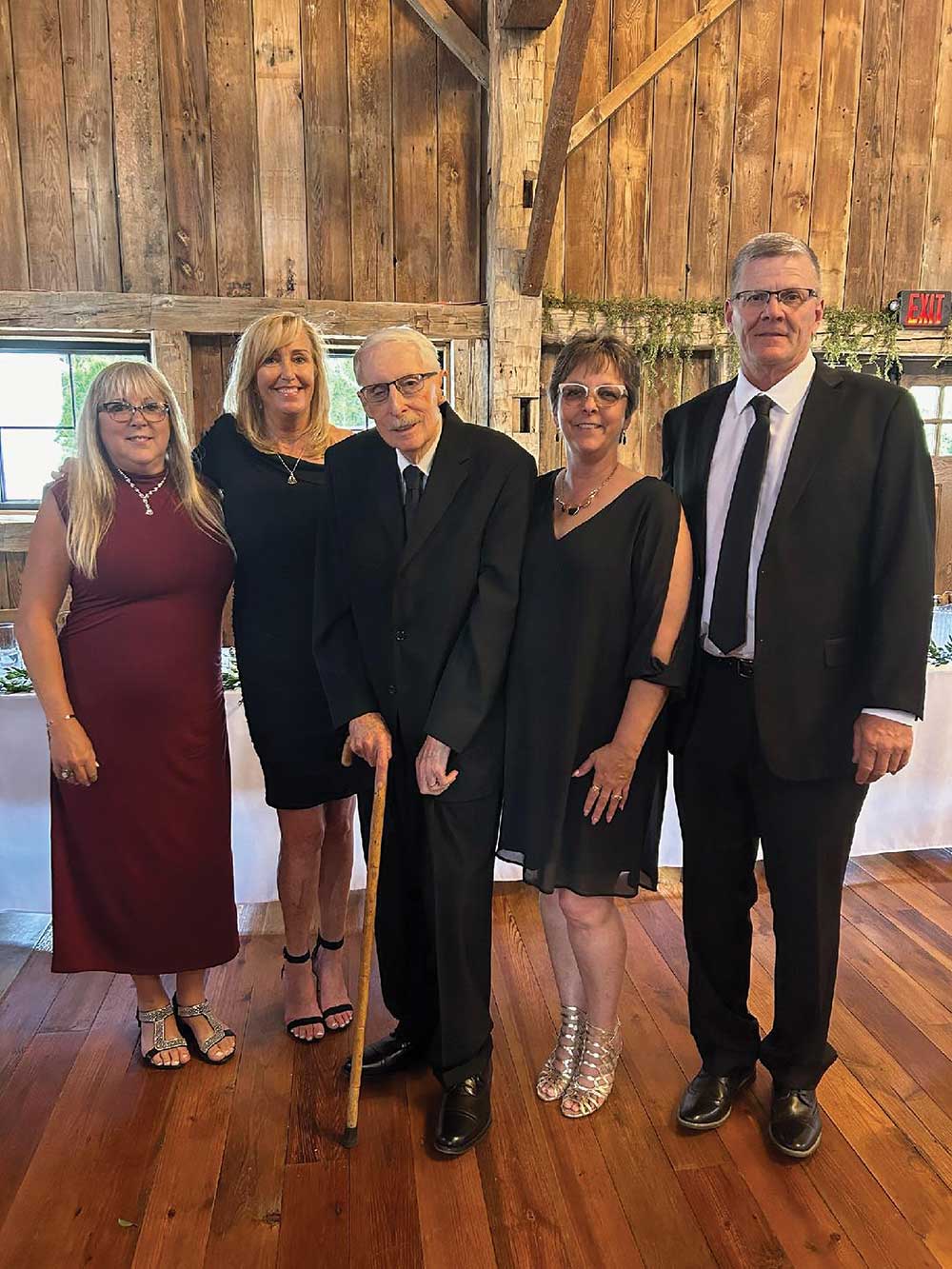
Les and his four children, Michele, Lore, Lynette and Steve
Sister Lori added hers. “When dad lost his leg from the work accident, he gave us kids a choice: either a pool or go to Florida. We got both,” she laughed. “When we wanted horses, he drove us all through the country and would say ‘How does that smell?’ We would respond with ‘That smells bad because it’s cow manure!’ Then we went by the horses and would say, ‘Humm that smells good! Must be horse manure!’ That worked too. We got our horses! He taught us a good work ethic. We couldn’t have asked for a better dad!”
Steve’s memory connects with horses. “In 1975, dad bought a frame for a one-horse sleigh at an auction, and he and I restored it in his workshop in the basement. He built the body, the seats, and everything. Some friends of his gave him the harness. We had a few horses, and one was able to pull the sleigh. So, he put bells on it, and at Christmas time he would take us for rides through the snow around the neighborhood in the sleigh. Those were extra special moments—both helping build the sleigh and riding it.”
Michelle’s memory shows Les’s ability to assess character. “I had a date, and our dates were required to come to the door. Les answered the door and told my date, ‘You have 30 seconds to get off the porch and out of the driveway—and you better move it because it’s a long driveway.’ I was so upset, and I cried and cried. But Les said, ‘That boy’s no good, I just know it.’ And low-and-behold, a couple years later that same young man went to jail! I hated to admit that my dad was right,” she laughed, “but he certainly was. He is an amazing man, and we are all blessed to have him in our lives.”
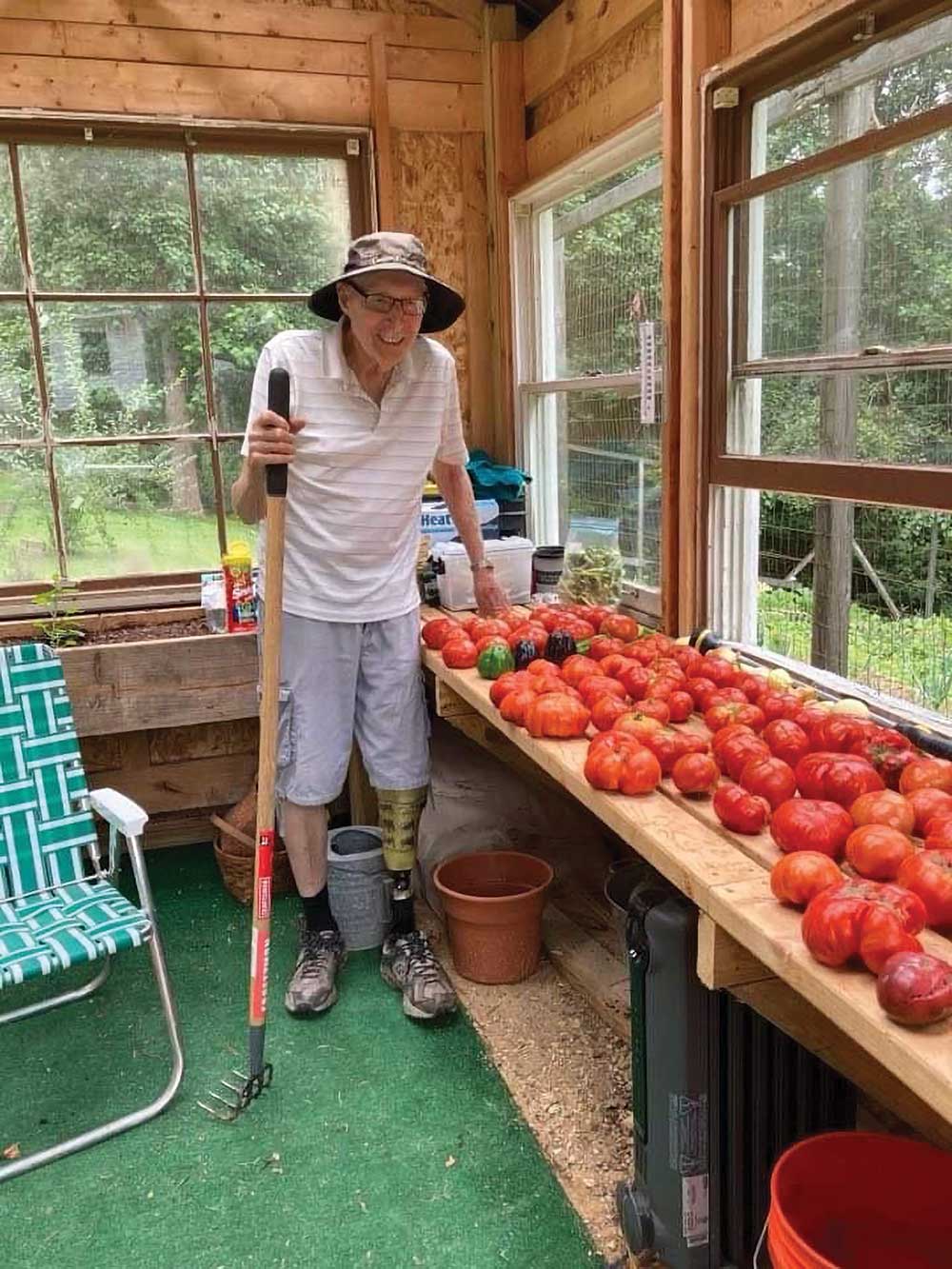
Les’ tomato harvest
The Johnsons enjoyed the outdoors, especially hunting. They owned a parcel of hunting land, but it had no cabin. Les, who never saw a job he couldn’t do, solved that problem. The Grand Trunk Railway Company’s nearby railyard refurbished boxcars, and Les bought a truckload of boxcar two-by-sixes. “They delivered them,” he said, “and I had a John Deere tractor with a 30-inch sawblade, and I sawed the two-by-sixes down to two-by-fours and framed a cabin in my back yard—bolted the sections together, numbered them, and took it down.”
A friend loaned him a truck to haul the cabin sections to the site. On Les’s brother-in-law’s trailer they put some furniture on, and the two headed out at 3:00 in the morning. They arrived onsite at 7:00 and started working. They finished at 7:00 that night and headed home.
Les enjoyed hunting even after an industrial accident cost him a leg. He and son-in-law Tim often hunted together. “We were walking out of the woods one night,” Tim laughed, “and Les fell over. He said, ‘I stepped in a hole.’ I helped him up. He took one step and fell down again. When I helped him up that time, I noticed that his foot was missing—it had broken off his artificial leg. We hobbled to the cabin and took three of his old legs and engineered a new one for him to get home.”
All of Les and Fay’s children married and raised families in Port Huron. Grandchildren came and the grandparents enjoyed being part of their lives. However, one day Tim dumbfounded everybody by announcing his family was moving to Alabama. His company had transferred him.
When asked how that news was received, Les chuckled, “Well, my wife had a fit. ‘You can’t take my grandkids and go to Alabama! I don’t know where that is.’ I wasn’t happy about it either,” he admitted, “but we helped them move. I drove the U-Haul with Tim. We came at the end of October 2012, and my wife and I stayed that winter with them.”
The tightknit Johnsons adjusted and started making the drive from Port Huron to Alabama. Les and Fay came each winter and enjoyed the warmer Alabama weather.
When Les’s wife died in 2016, he lived alone in their Michigan home for two years. Lynette and Tim encouraged him to sell his home and move to Alabama and live with them, and in 2018 he moved in with them.
Les began attending First Baptist Church Springville with the Hoffmans. He made friends easily and was soon involved with Sunday school and church, the Saints Alive senior group, and the Over the Hill Gang, men who meet at the Farmhouse Restaurant every Friday for lunch.
Desiring to join First Baptist, Les attended the New Members Class with the pastors. Having come from a Methodist and Lutheran background, he needed to be baptized by emersion. But how could a one-legged man get in and out of the baptistery? No problem for two deacons, as Les tells it. “I took my leg off, and Lee Love and Al Rayburn carried me down the steps into the baptistry, and Pastor David DuPre dunked me.”
After the baptism, Pastor Chip Thornton told his favorite story about Les. “He was put under anesthesia for surgery. When they rolled him out of the recovery room, he was flat on his back, still under the effects of anesthesia, but he had his arms in the air, and was saying, ‘Thank you, Jesus! Thank you, Jesus! Thank you, Jesus!’ The congregation loved it and applauded.
One reason Les enjoys Alabama is the long gardening season. “I can garden almost year-round,” Les comments. “Certain things I can plant in the fall, and others in the spring” For early start, he needed a greenhouse, so he and Tim built one. They bought used windows, put a skylight on the roof, and heating bars inside. “I use it to grow tomatoes, peppers, cabbage and cauliflower seedlings, then I give most of them to people in the church,” he laughed. “It’s just fun watching them grow.”
Gardeners at church gave Les hints on Southern gardening, and his grand-son-in-law, Matt Hyatt, of Chandler Mountain, gave pointers as well. Les may be 90 years old, but he still enjoys learning.
And learning more about the Bible, God, and Jesus his Savior is what he enjoys most. When asked about the difference in church and preaching in Michigan and here, he responded: “Like between night and day! I thought I was getting the Word of God,” he lamented, “but I wasn’t. It is so different. Here they go through the Bible. When I first got down here and went to Sunday school class, they could a verse—or one word–and teach on that for a whole hour—what it means and where a word came from. They never did that up north. It’s just a blessing to be down here. I love all our pastors, and I love all the people in my church.” He paused, then added, “And they love me. I couldn’t get used to that at first. When people would say, ‘I love you,’ I thought, parents and my family say that. But down here, they all say they love me!”
And they do. In the spring of 2022, Les was going through a down time resulting from events in October 2021 on a trip to Port Huron. On the first day of that trip, the airline misplaced his luggage, and someone hacked his credit card. On the second day, he stumbled and broke his hip, which resulted in hip-replacement surgery and two weeks of recuperation in a nursing home and three weeks at his daughter Lori’s home. When he finally arrived back home on Beaver Ridge Mountain, he said, “If you want to see me again, come to Alabama.” His spirits were so low that a Sunday school buddy, Chuck Whitiker, suggested to the Sunday school teacher that the class plan a surprise birthday party for Les. The class agreed and managed to keep it secret from Les.
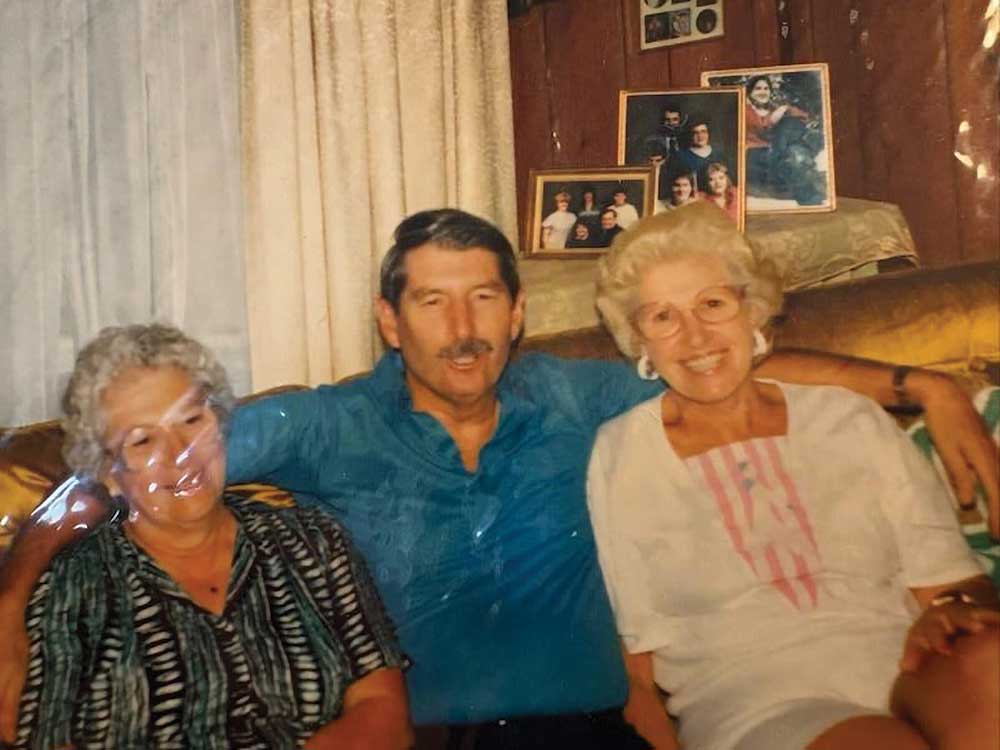
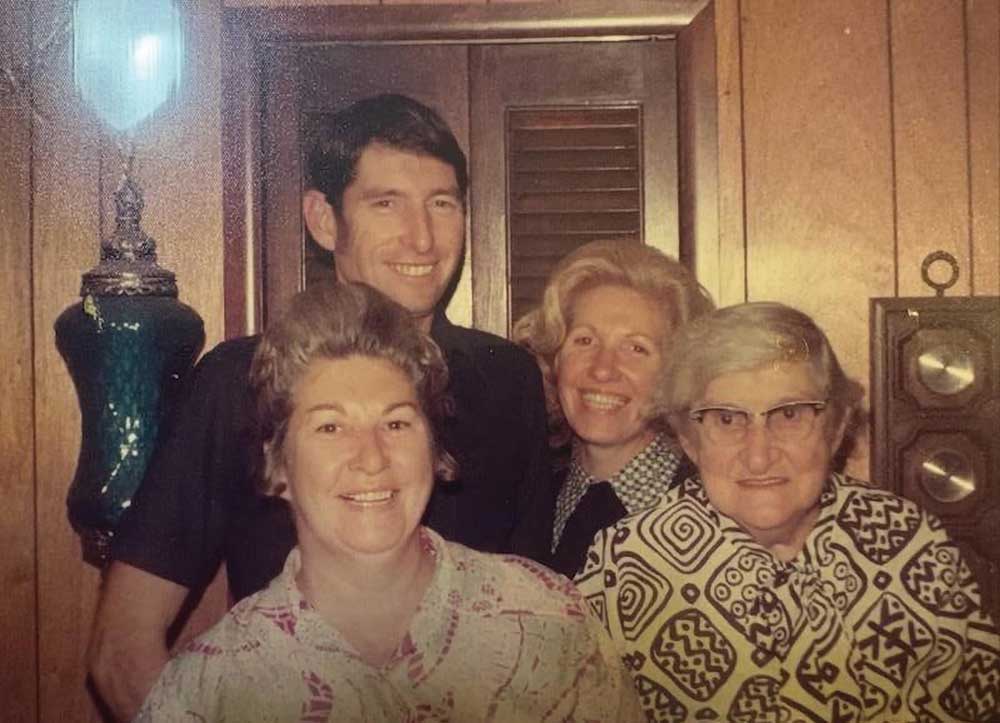
Back, Les and Grace; Front, Mary and their mother, Eva
On the day of the party, Lynette and daughter Sara decorated the church’s Family Life Center. Jeri Jenkins prepared the food. Tim’s job was to get Les to the event. By creative subterfuge concerning a church meeting that needed Les in attendance, Tim got Les in the truck; however, Les, being significantly disgruntled, grumbled his discontent all the way to the church. Tim opened the FLC door and frowning Les entered to be greeted with shouts of “Surprise! Happy Birthday!” Thus, he was shocked out of the doldrums into good spirits to enjoy the day.
Les thinks of Heaven often and that his body will be in working order—he’s had 25 plus surgeries, has one artificial leg, an artificial hip, is blind in one eye and has macular degeneration in the other, and he has scalloped edged ears from removed skin cancers. “I’ll have everything new in Heaven,” he laughed.
He recently received a hand-held gadget that allows him to read and listen to the Bible, and that makes him happy. His grandson-in-law, Matt, built a prayer bench for him which they placed in a wooded nook, and in good weather, Les spends time there praying for his family and thanking God for all his goodness and kindness to him. If one happened to be nearby and unseen, he might hear Les singing “And He walks with me and He talks with me, and He tells me I am his own. And the joy we share as we tarry there, none other has ever known,” for “In the Garden” is one of his favorite hymns. The time he has spent in God’s Garden of meditation is reflected in his life. Les Johnson is a one-of-a-kind inspiration.