Saving Chandler Mountain

Story by Paul South
Photos by Mackenzie Free and Leo Galleo

When Seth C. Penn ponders Chandler Mountain, he thinks of the Indigenous peoples who walked the mountaintop 6,000 years before Christ trod the earth.

Darrell Hyatt thinks of generations of his family, who yanked a living from the mountain’s rich soil. The Hyatts came to the area when the only way to navigate the mountain was by wagon, horseback or on foot.

And Joe Whitten, an amateur historian and retired educator who came to St. Clair County in 1961, hiked from the base to the top of the mountain at age 80 and plans to do so again, even at 85.

Their backgrounds are different, but the three men share a love for the mountain and an understanding of the importance of the successful battle to fend off an Alabama Power proposal to build dams there. It was a plan that would have flooded the valley, displaced families and damaged sacred sites and archaeological treasures.

Community comes together for common cause

While bluegrass music at Horse Pens 40 and tomatoes – the area’s iconic signature crop – sprout in the minds of most Alabamians when the name, Chandler Mountain, is mentioned, make no mistake, it is holy ground.

According to Penn, Southeastern Region coordinator for the Indian Nations Conservation Alliance and a citizen of the Cherokee Tribe of Northeast Alabama, all land is sacred for Indigenous peoples, regardless of location. But the mountain is unique.

“Chandler Mountain is an area where tribal territories met,” Penn said. “This was a place inhabited by several different tribes, Cherokee people and Muskogean people as well. This is an area where you could see different looking people, different looking tribes, different languages. That makes the mountain unique unto itself.”

There are archaeological and ecological features on the mountain sacred to the tribes.

“How the water flows, the hydrologic buildup, makeup and processes are important ecologically and also sacred, considering the values of water, plant life and animals,” he said.

Prayers and other ceremonies were conducted on the mountain. And while the story may be apocryphal, it is said that Chandler Mountain is the only place where a peace treaty was signed between the Cherokee and Creek tribes.

“I have never seen that document,” Penn said. “So as far as the credibility of that, it’s very debatable and very questionable. So, my response to that would be, I’d like to see that happen in present time, so that an actual treaty exists.”

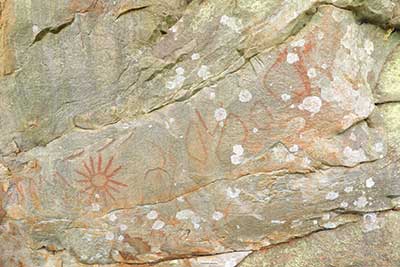
One piece of ancient history that does exist are the rock formations, stone structures and Cherokee pictographs, rock art that native peoples may have painted with their fingertips, according to a report by Dr. Harry Holstein, a professor of Chemistry and Geosciences at Jacksonville State University.

These drawings and structures, as well as the stars, all play into the ceremonial and governmental history of the mountain and its ancient inhabitants, Penn said.

“This is a place where we might go to higher ground in search of a spiritual connection. It’s a place where territories met. So, at times we might meet in council-like setting, where topics might be discussed among our tribe or with other tribes even. Trades could also take place,” Penn said.

From a spiritual perspective, he added, “The whole sacred, ceremonial prayer aspect of events that took place – with certain rock features facing certain directions, certain astrological features in line with certain features, that all plays into the ceremonial aspect of it.”

A Family’s Story

With all their earthly belongings, John Hyatt and his wife arrived on horseback from Hurt County, Ga., and settled near the Horse Pens area in 1875, where they homesteaded 120 acres.

“There have been Hyatts on that end of Chandler Mountain ever since,” said John Hyatt’s great-grandson, Darrell.

He lives near the base of the mountain. He can recite his family’s history like a precocious schoolboy. John Hyatt’s brother, Otis, was the first person to farm the tasty Chandler Mountain tomatoes.

But the mountain is about more than tomatoes. Darrell has lived in the Chandler Mountain Valley since 1969, and at his current homestead since 1981. There, he reared his children.

At one time, he pondered moving his family out west. But the tug of home was too strong, the ties too deep. In his family, Darrell has always been known as “the man who came back to the mountain.”

Artifacts found tell story of Native-Americans living on land

“I always knew this mountain was different,” he said. “We could never pull ourselves away. It’s not just the family history. It goes back thousands of years.”

He found paleo-points on the mountain, and he and his wife found the pictographs. In turn, they brought Holstein as well as a rock expert from the University of Tennessee.

“Dr. Holstein said this was the most significant archaeological find on the upper Coosa River drainage area,” Hyatt said.

That archaeological find played a significant role in the defeat of the Alabama Power project.

What would have been the impact of the project if it had moved forward? Often, before Alabama Power shelved the plan, Darrell imagined his last day in his beloved valley, where his kids grew up and where he walked the mountain, climbed its rocks and contemplated the world in solitude.

One of the dams would have been built within 1,000 feet of his home. Rocky Hollow, the Mount Lebanon Cemetery, a number of archeological treasures and dozens of families would have been washed away.

The Hiker

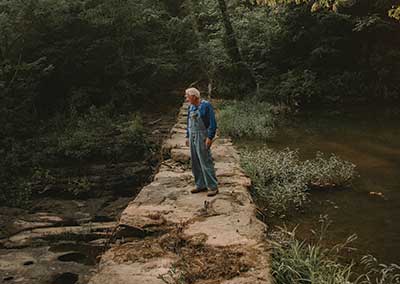
Darrell remembers the first time he and Joe Whitten hiked the mountain, following Steele Gap Road. Whitten was 80.

“Joe, are you ready to stop?,” he would ask.

“Where’s the top?,” Whitten replied. Hyatt pointed upward.

“Let’s go,” Whitten said. And they did. “I think I can do it again,” he added.

Whitten talks of the importance of Chandler Mountain to the quality of life of St. Clair County and to its economy.

“It was in a remote section of the county that the pioneers made a beautiful place of,” Whitten said. “As time progressed, they tried various fruits. They grew peaches there for a time, but the tomatoes made the mountain famous.”

The Alliance

Two groups that history saw often at odds, the Indigenous tribes and new settlers of the 19th century, joined with the City of Steele and Montgomery politicians to fight the utility. The fight continues because the utility still owns significant acreage there.

In the face of opposition from locals, as well as Public Service Commission President Twinkle Cavanaugh, Alabama Power Company scrapped its plans to build a hydroelectric storage project and remove homeowners from Chandler Mountain in August 2023. The utility withdrew its efforts to seek a license from the Federal Energy Regulatory Commission.

In these politically fractured times, is there a lesson to be learned from the alliance that fought it?

Flat top of mountain a distinctive characteristic

“Absolutely,” Darrell said. “This community in my eyes was starting to lose itself. (The dam project) pulled everybody together.”

In local folklore, it’s told that John Hyatt built the market road down the backside of the mountain near what’s now U.S. 231, in an area known as Hyatt’s Gap. And the mountain can be seen from Alabama’s highest peak, Mount Cheaha.

“It’s very distinct,” he said. “And I think the Native Americans saw that, too. It’s sacred. Very sacred to them.”

Whitten said that even in these difficult days, the successful effort to block the project, “shows there can be unity. Peoples can come together and work together on projects that are needful to the community and the county and the state.”

He added, “What is there is important to the state as well, because it’s part of our Indigenous history.”

Penn agreed. “Obviously, it’s an ancestral holy place for an Indigenous person,” he said. “But because of those thousands of years of prayers building a foundation for a sacred setting, it’s just as much a sacred place for that farmer who says a prayer while he’s out there planting or harvesting. It’s a sacred place to that family who comes together and prays before a meal every time they eat dinner. It’s a sacred place and a significant place to many people.

“While our significance to the mountain and the sacredness of the mountain predates the settlers, I don’t want to discredit that it’s important to many of them as well in present time.”

Of the alliance, Penn said, “We’re a whole lot better when we can put differences aside and find common ground and work together regardless of backgrounds, faiths or political affiliations.

“Chandler Mountain is a unique situation in that we can come together. We have done that, and I’d like to see this initiative grow. I’d like to see Alabama Power realize, ‘Look, we had wrong intentions here. This isn’t where we need to do this. We just need to pull out and let go and give this mountain back to the people who truly care about it. And that is the Indigenous people and that is the local Chandler Mountain Community. That is our mountain and should be our mountain. That’s how I feel about it.”

 “Alabama Power does not have any plans for the Chandler Mountain property,” said Alabama Power spokesperson Joey Blackwell in an email response in April.

When Alabama Power announced it had scuttled its proposal, there were celebrations on Chandler Mountain. Hyatt and his family celebrated with dinner at an area Mexican restaurant.

There was joy. “And there were tears,” he said. “More than a few tears.”

Lakeside wedding

Story by Paul South
Submitted photos

In the movies, love stories begin in glitzy spots, like the top of the Empire State Building, or with blind date jitters or online mysteries.

But Hunter and Hallie Hannah Craton’s road to romance began – as it is with many folks – over dinner. In their case, steaming plates of Mexican food – her go-to chicken enchilada with sour cream and fajita quesadilla for him – spiced up the first date.

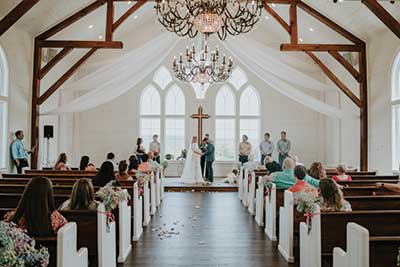
Seven years later, on Oct. 14, 2023, the two were married at a spot more beautiful than any Manhattan skyscraper, on the banks of Logan Martin Lake and in sight of the iconic Pirate Island. The wedding was celebrated at a family friend’s lakeside home, the rehearsal dinner and reception next door at Hallie’s grandfather’s home.

Trees adorned with lights and the lake teamed with an altar crafted from a gold ring of flowers.

“It was so beautiful, we didn’t have to do too much,” Hallie recalls.

The couple had become engaged almost a year to the day before, on the banks of the lake, a fitting spot for two Pell City kids. From their first date fiesta to the wedding, seven years passed. Their relationship endured being separated by college. Hunter majored in building science at Auburn, Hallie in marketing at Jacksonville State.

Hallie works in sales, while Hunter works for Goodgame Company, both in Pell City.

Again, with a touch of serendipity, they were engaged on the anniversary of their first date.  But Hunter Craton knew that she was his forever love long before the diamond ring.

“Within about a month of the first date, I pretty much knew,” Hunter says. “She’s got a great personality, and that’s pretty much what stood out to me. She was a lot of fun to be around.”

College has extinguished more than one high school flame, but not for these two. For them, love never failed. They weathered separation and a year of wedding prep. “It actually made us stronger,” Hallie says.

And there were differences in personality, Hunter is an admitted introvert, but Hallie “brought me out of my shell,” he says.

Hallie was smitten sooner. She put it this way: “When you know, you know. I fell in love with Hunter almost immediately,” she says. “Hunter is kind to all, funny, dependable and has felt like home from the moment I met him.”

She adds, “I never knew I needed someone like Hunter in my life,” she says. “He calms me.”

And while other couples fall for the trends of the day, Hallie and Hunter were traditional. Hunter, gentleman to the core, asked her parents for her hand.

“He absolutely did,” Hallie’s mother, Jennifer Hannah, says. “He texted us and wanted us to meet him for dinner and said we don’t need Hallie to know about it. We kind of knew what it was.

“They were already making life decisions and financial decisions based on what the other was doing.”

It begs a question: What took them so long?

After high school, Hunter joined the union, then toiled as an ironworker for several months before commuting for a few classes at Auburn, then transferring to campus to complete his degree.

“There was a lot of prep needed financially before we went through all this from the engagement to the wedding,” Hunter says. “We wanted to make sure we were ready for all that.”

They were ready. And while many in this part of the world choose church weddings, others courthouse nuptials, even elopement, the lake was always the place for the future Mr. and Mrs. Craton. It was a family place, a place of memories for generations of Hallie’s family.

“It was the only special place in my heart to me,” she says. “What makes it even more special was not only does my grandfather live there, my cousin lives nearby as well. My aunt lives just across the street. We’ve always been big lake people. I’ve always wanted to get married at the lake.”

Lake at sunset makes ideal backdrop for ceremony

While the actual wedding party was “very formal” – black tie and black formal dresses, the guests were allowed to be casual.

“We didn’t really care what people wore,” Hallie says. “We’re very casual people. When it came to what (guests) wore, we were more semi-formal.”

It was the wedding of Hallie’s dreams.

“I always pictured the black and white theme. We had a square black and white dance floor.

While wedding planning can sometimes deteriorate into a Jerry Springer-style throwdown, Hallie and her Mom had only one “knock down drag out in the days right before the blessed event.

Chairs.

“Back in the day, when I got married, I was not working like Hallie and Hunter. I’d just graduated from college, and I was about to start my first teaching job. So (for Hallie and Hunter’s day), I was ‘Whatever you want. Whatever you want,” except when it came to those chairs. We got in a fight about chairs.”

But the blowout eased pre-wedding nerves.

“It was a small thing. But we were stressed out,” Hallie says. “We needed to have a cry. Planning a wedding is stressful, especially when it’s just you, your Mom and the coordinator for a 300-plus person wedding on the lake.”

The couple, their parents and friends did a lot of the pre-wedding decorating themselves late into several evenings, stringing up white lights in the surrounding trees and other tasks for the wedding. Elegance carried the day.

And it seems with every wedding, something funny happens.

Hallie’s first drop at the reception did the trick.

“I tore my dress,” she says. “It ripped right below my butt, and it was a big hole in my brand new, beautiful dress.”

Humor also came from a little 1980s rock n’ roll.

Dan, Hunter’s  brother-in-law, closed the ceremony reading the lyrics from The Power of Love by Huey Lewis and the News.

“At first we had no idea where he was going,” Jennifer says. “It was sweet. It was funny. It was perfect. (Dan) was there for all of their love story, so it was perfect.”

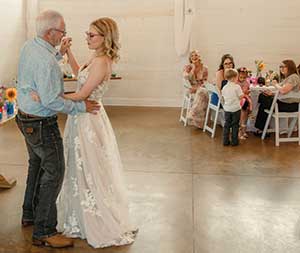
And of course, there was the father-daughter dance, a month in the making.

“Hallie is a great dancer,” Jennifer says.

And her Dad, Jason Hannah?

“He’s a Dad.”

It was a magical night.

But what advice would they give to others planning their weddings?

The mother of the bride was brief:

“Destination wedding.”

Hunter wasn’t much involved in the planning, save the two weeks prior to the big night. Then he was hard at it, stringing lights that hung like low stars on the lakeside.

“That was my time to shine.”

What advice would he give to friends and perhaps a future son?

“Get ready to work.”

As for Hallie, she says, “Don’t sweat the small stuff.

“There’s no need to worry about the small stuff, because the small stuff that I worried so much about for my wedding, I barely even recognized the day of. There’s a balance when you’re having a wedding,” Hallie says. “As long as you maintain that everything will be OK.”

The Depot

Story by Carol Pappas
Submitted photos

Serving an entire community is a pretty tall order but when visionaries saw an opportunity to build a community center in Springville, it seems no detail of service was omitted.

The 38,000 square foot facility just off of U.S. 11 houses a church, a school, a fitness center, a health and wellness center, indoor playground, a massive common area, a chef’s operation and a coffee shop. And that’s just the first phase.

Mike Ennis, pastor of Faith Community Fellowship Church, Springville campus, says the center’s “whole goal is to serve the community.”

When the project began, Ennis explained, “We felt like rather than building a church, we’d rather build a community center – something the entire community could use, something that would hopefully improve both the economics and health of our community and provide athletic opportunities.”

It has not wavered from its original vision. At the time, Ennis described it as a center “not just for young people and not just people who are a part of our church, we really wanted to build something that would serve the community at large. That’s been the driving factor behind it from the beginning.”

To accomplish that, the church partnered with a nonprofit property management group, Surgance Inc. They wanted to create something fresh and alive with activity that would be used every day and geared toward bolstering the economy and health. “Every tenant is focused on that mission,” says Ennis.

Hayden Hornsby is the facility coordinator, and his ever-present smile as he outlines the tenant roster hints at the success story all around him.

Kind Kups

Kind Kups serves great coffee drinks and is a hub of activity and a gathering spot

Kind Kups is an anchor with wide-open space in an inviting atmosphere that has become a central gathering place for meetings, conversations, Bible studies and of course, a cup of specialty coffee and dessert.

Bring your laptop, bring a friend, meet new people – all are welcome at Kind Kups.

The Depot is actually the second location for owners Kevin and April Browning, who live in Cleveland, Alabama. It began from their leadership in their church’s small group and grew into a community outreach.

Its mission is to “provide a life-giving atmosphere for community building and fellowship. To encourage our customers through acts of service and words of kindness. To impact our community by empowering self-worth and inspiring kindness, ultimately motivating them to give back.”

Springville Christian Academy

An infant through 8th grade school has a significant presence. It has grown so much that enrollment is expected to be 160 in the fall, and officials are considering adding 9th grade.

While it occupies part of the building, the school is actually separate and secure. The school keeps class sizes small so that each student feels like they have one-on-one learning opportunities. The fully staffed faculty headed by Tyra Jordan provides students with an education based on academic excellence and biblical values.

It features state-of-the-art classrooms, library, sports opportunities, music, art, Spanish and weekly chapel.

“SCA is honored to have Lacy Trull bring hot lunches into the school each day, something that most schools of this size do not have the opportunity to have,” Hornsby said.

Euvista

Euvista is a health and wellness center, offering weight loss and nutrition coaching, prescription weight loss medications, hormone testing, low-tox lifestyle coaching, Long Haul COVID treatment, bioidentical hormone replacement therapy and lipo/B12 injections.

The center focuses on the root of weight management, offering programs for nutrition, mindset and overall body transformation.

This is Euvista’s second location. The first was in Cullman. The Springville location is already busy with bookings for appointments weeks in advance.

Performfit Studios

A gym and physical fitness center, Performfit offers a fully equipped workout studio with classes available. It also offers speed and agility training.

President Chris Lynch holds a master’s degree in Occupational Therapy and is a Certified Strength and Conditioning Specialist.

Chef Margaret’s

Chef Margaret Vincent, also known as “The Chef Next Door,” offers Delicious Delivery services. She prepares gourmet, homemade meals once a week and delivers to clients on Wednesdays.

She also caters bridal and baby showers, in-home parties and open houses – events traditionally thought of as too small for a caterer. She creates charcuterie grazing boards and tables, holds cooking classes and demonstrations and does food styling for publicity shoots.

She also sells Chef Margaret’s No-Mento Cheese, described as “hand-crafted, chef-made, perfectly-southern, totally addicting creamy goodness.”

Faith Community Fellowship Church

While the church was the catalyst for the center, it, too, is a tenant like the others. The growing congregation is now 350 and growing.

Grand Central and Rental Spaces

Grand Central is as the name implies – a bustle of activity

The centerpiece of the building is an expansive lobby area with high ceilings and plenty of room for all kinds of events.

Aptly named Grand Central, the entire area is a bustle of activity – the comings and goings of all the services found there in addition to the activities it provides space for. You might quote the old cliché, and say it’s a bit like Grand Central Station, and you’d be right.

The auditorium is available for rental, and it has exceeded its annual goal already. Hornsby pointed out that the auditorium hosted a theater group with a 55-member cast, a political reception and a variety of other parties and events.

An indoor playground is tucked into space at the front of the building just off Grand Central, and it is being done in a railroad motif. The windows will have locomotive faces peering out – a welcoming attraction for children.

A community Easter Egg hunt with a live band drew 1,200 people. Depot Days and Sip and Shop provide brick and mortar-type opportunities for local artisans to set up booths and sell their wares.

It’s all a part of the effort to serve all aspects of the community. Ennis motions all around him, adding, “There’s nowhere else in this end of the county that provides all this. We love this community!”

Amen …

Sometimes the ‘Amen’ must come before the prayer.

Sometimes we must have full trust in the ending before we’ve even begun.

As in the garden, we plant and sow good seeds and then we whisper up, ‘Amen’

(which by definition, means ‘so be it’)

Our prayers come later…

Often paired with our productivity.

Our diligence, perseverance and tired bodies become a part of the prayer process.

We dirty our hands and cleanse our souls out in the garden.

And often find that forgiveness, too, can grow out there in the dirt if, like the proverb says, we try our best to “plant kindness and gather love.”

But we won’t always get it right…

…in the garden or life.

Growth isn’t always what we want it to be.

Some things suffer blight, drought or grow weak by insufficient light.

But we learn from our mistakes,

trust we must let go of what we cannot control, press on into a new season, plant again…

…and whisper, ‘Amen.’

– Mackenzie Free –

Wife, mother, photographer & current resident of the unassumingly magical town of Steele, Alabama

EDC – Chairmen of the Board

Story by Carol Pappas
Discover Photo Archives

Twenty five years. Three chairmen of the board. One goal.

In 1999, the newly formed St. Clair County Economic Development Council charted a course where no one really knew exactly where it would lead. But they had an idea that if they all worked together, good things would follow.

The sailing wasn’t always smooth, but they stayed the course – through economic good times and downturns, through political administrations and leadership changes. Through it all, their North Star was working together.

The launch

Creation of the EDC “pulled the whole county together,” said Tommy Bowers, who served as the first chairman of the board. “We worked together as a team and supported each other’s prospects.”

When there was a ribbon cutting or a groundbreaking in one area, the rest of the county’s communities showed up in support. It was the premise upon which EDC was built – what is good for one is good for all.

Tommy Bowers

Bowers recalled that the idea of a countywide economic development effort first arose out of the Pell City Industrial Development Board when members Bob Barnett and Ray Cox of Metro Bank proffered the notion that bringing the county together made sense. “They were instrumental in bringing the whole county thing in.”

Every good plan starts with an architect, so they brought former county attorney Bill Weathington in to set up the structure. “A lot of the credit goes to him,” Bowers said.

Because of the success that followed, Alabama Power, long known for its economic development prowess, “used us as an example of how industrial recruiting should work,” he said. “And it wasn’t just county cooperation, it was regional.”

Case in point: Honda Manufacturing of Alabama. Bowers, Commission Chairman Stan Batemon and EDC Board Member Lyman Lovejoy were part of the team that brought the automobile manufacturer to Lincoln in Talladega County. The team also included Calhoun, Talladega, Etowah and Jefferson counties.

In a yearlong, highly secret process under the code name, “Bingo,” the project almost went to St. Clair, but unionization concerns along the I-59 corridor in Etowah steered company officials away from the Steele site.

They considered the Pell City airport property for a time, and they put together a presentation that included relocating the airport.

Then, they looked at the Lincoln site, and a tree may have helped swing the final deal. One of the Japanese representatives “fell in love” with a tree on the property, and it helped sway the decision to that property, Bowers said. Before construction of the plant, they even built a fence around the tree and its root system to protect and preserve it.

At the time, the team didn’t know the identity of the recruiting target, although they eventually guessed it was Honda. The proposal was written in three languages and placed in a leather pouch with “Alabama” embossed on it. The team was even involved in the funding mechanism for incentives. “It’s unbelievable what goes into locating an industry,” Bowers said. “It’s a huge process.”

 And while it didn’t wind up in St. Clair, “it was good for St. Clair County and the City of Pell City. It was good for the whole area,” he said. Today, Honda is the largest employer of St. Clair County people not located in the county – over 1,500.

At the beginning of EDC, they didn’t recruit commercial businesses, but they never limited themselves either. EDC officials realized that commercial recruitment needed the same information as industry, so EDC became a “catalyst” for it, he said.

Moody Mayor Joe Lee cuts the ribbon on Kelly Creek Commerce Park, signaling a promising future for economic development

EDC began to invest in retail recruitment and hired Retail Specialist Candice Hill, who is still with the organization today. She has since expanded her role into coordinating the new countywide Grant Resource Center and Leadership St. Clair County program.

Calling the grant center a “tremendous” step in the EDC’s evolution, Bowers said it is eyed as “the biggest move in EDC history.” He views the first 25 years as phases – industry, commercial and now grants, another innovation to EDC’s credit. “It’s the only program set up like that in the state,” Bowers said.

From the smallest of towns to the entire county, they will be able to identify and effectively pursue grants to fill diverse needs with the help this program will provide.

As for the future, Bowers issued a warning. “We need to be careful we do not lose our current recruiter, Don Smith. He is one of the top professionals across the state. We need to keep him and his team in place.”

Judging by the track record and the potential the future holds, Bowers is right when he talks of continuing the momentum. “We need to be planning now what needs to be next. Things are changing. Who would have thought we would go from industry recruiting to grants?”

Smith, he said, is “forward thinking, and he has a great team.”

Looking back, “it took off up in Steele” and evolved into an economic development leader in the state, Bowers said. “It is quite rewarding to be a part of all that.”

What if?

Lyman Lovejoy served on the board at its inception and became its second chairman when Bowers was named to the county commission. In keeping with its original, guiding principle, elected officials cannot serve on the EDC board, and Bowers stepped down.

Lovejoy was in on the ground floor of plans to create the EDC, so he knew full well what to expect as chairman. He remembered the early days when the idea of the EDC was hatched. “There was not a concerted effort around the county to recruit business and industry. Everyone operated on their own.”

Lyman Lovejoy

If a prospect wanted to look at property in the county, there was not a ‘go to’ person to coordinate although Pell City Realtor Ed Ash was able to successfully locate industries in Pell City early on.

Lovejoy knew the first hire of an EDC director would perhaps be the most important decision they would make. Lovejoy knew of the reputation of Ed Gardner Sr., who served at the Alabama Department of Economic and Community Affairs as director and before that, assistant secretary of Housing and Urban Development in Washington. He was an early advocate for Gardner in the position.

The questions Lovejoy had were, “Would he come? Can we afford him?”

The answer to both were yes, and Lovejoy’s conclusion was simple: “Boy, did we hit a homerun.”

Gardner had the knowledge, expertise and the contacts that quickly moved St. Clair into a leading contender as prospects considered Alabama for new locations or expansions.

“We knew it was a good thing for St. Clair County” having two interstates, railroad spurs, industrial sites and a workforce pool, and EDC began to capitalize on the county’s assets. “We started building on that,” Lovejoy said.

The Saks Fifth Avenue distribution center came. So did Yachiyo. Red Diamond moved to Moody. Dozens more from around the region, across the state and around the world would follow over the next 25 years.

It was a success story played and replayed, just like Lovejoy’s own pitch about St. Clair County. “I love my county, and I love telling its story.”

Continuing the legacy

Joe Kelly, too, was on the ground floor of EDC’s creation, serving as a member of the charter board. “I’m the last of the originals,” he said. “I had some vision of what it could be but nothing like what’s come to pass.”

Joe Kelly

He now serves as chairman of the board, a post he has held for the past five years.

Originally, the primary focus was industrial recruitment, he said. The vision expanded with the needs, focusing on retail and quality of life issues, too. “It has evolved into how can we affect the health, wealth and quality of life in the county?”

To get to this point, they had to ask themselves, “Can cities, towns and neighborhoods work together? Is it possible? How do we go about it? It’s remarkable the way it developed into that. The quality of the directors affected that a lot. Still does today.”

The county commission, Kelly said, working with cities and towns became “the glue. Without it, I’m not sure it wouldn’t fragment.”

An important challenge was leveling the playing field, but it was critical to the triumphs over the years. EDC has a working knowledge of cities and towns across the county. “It doesn’t play one against the other,” and as a result, “St. Clair EDC is the envy of a lot of different governments in the state and frankly, nationally and internationally.”

The EDC: Don Smith, Blair Goodgame, Candice Hill, Jason Roberts

Kelly also talked of the promise of the Grant Resource Center. Grants are available, but communities must know about them and go through an often times tedious process without the expertise or manpower. “Why should towns go through all that when the EDC can be involved?,” he asked.

With guidance from the county commission, EDC has stepped up in that role. It is yet another compelling example of putting the EDC to work to fill needs in the county that have gone unmet. It’s a legacy of putting the right people in the right place at the right time and working together to make extraordinary feats happen.

“I’m proudest of helping identify and bring on board people we have had. The quality of the staff – those four people do a lot of work, good work. Our three executive directors all have been superstars. It has been an honor to serve on this board for 25 years and an honor to serve as chairman.”

Its chairmen have been another key component of this legacy of success.

EDC – Strategic success stories

Partnership for Tomorrow audience hears EDC 2024 update

Story by Carol Pappas
Discover Photo Archives

It’s an oft quoted phrase – You can’t get to where you want to be if you don’t have a plan to get you there.

From its infancy, St. Clair County Economic Development Council not only had a plan, they developed new ones every five years and executed them to perfection. They set goals. They met goals – and they exceeded them.

Today, as in years past, St. Clair County holds its familiar place as one of the fastest growing counties in Alabama. It is consistently in the top 10 fastest growing by population percentage, sometimes top 5, in the state.

In 2019, EDC put in motion its five-year plan in:

  • Education and Workforce Development
  • Job Recruitment and Retention
  • Marketing
  • Tourism
  • Leadership

Like a well-schooled student checking off homework assignments, the team at EDC went to work and by 2023, goals were completed and in many instances, the outcomes exceeded the expectations.

In Job Recruitment and Retention, an A+ would certainly be in order.

Goal – Announce $150 million in new capital investments

Goal – Announce $50 million in new payroll from new jobs created

Goal – Announce $3 million in additional tax revenue for schools

Goal – Announce 1,500 new jobs

More than a passing grade goes across the board in all areas of the plan.

In Education and Workforce Development, EDC hosted an annual meeting to create partnerships between employers and educators. That partnership ensures that the county has a trained, skilled workforce to meet available job opportunities.

They raised awareness about regional job opportunities, advocated for education courses relevant to employers’ needs and strengthened relationships and partnerships with education.

The EDC completed work to identify and market 500 acres of sites in the county, surveyed existing business to determine growth potential and needs, raised awareness about the county’s healthcare and educational assets and coordinated successful grant requests from municipalities.

EDC joins officials in Germany at the Alabama Germany Partnership event

To ensure that industries are armed with the information they need on available incentives, proper use of incentives and updates on new incentive programs, EDC held an Economic Development Summit.

In Marketing, they developed communication strategies for messaging on a wide range of subjects, working with Realtors, Chambers, educational institutions and geographical areas, like the I-59 corridor.

For Tourism, they promoted tourism events, activities and sites throughout the county, networked with state and regional tourism organizations and have developed a detailed tourism strategy.

And in Leadership, they continued to build on the strong alumni base and identified prospective leaders in each community, worked in community planning and evaluated Main Street program potential.

“It’s been a great run,” Executive Director Don Smith told a group of investors in EDC’s Partnership for Tomorrow. “We want to accelerate that going forward.”

If the past is any indicator of the future, better fasten your seatbelts.