Business booming in Springville

New growth driving local economy

Story by Katie Beth Buckner
Photos by Mike Callahan

If numbers are any indicator, Springville is in the midst of what is being called a business boom for this northeast St. Clair County city.

Five businesses have opened their doors to the community already this year, and the outlook for the future is promising, officials say.

On Saturday, May 19, the Springville Area Chamber of Commerce hosted grand openings for HBI Salon, Daylight Donuts, Laster’s Sundries and Bam’s Coin Laundry. The owners and their families and friends took part in a ribbon cutting ceremony to celebrate the opening of their new businesses.


Hair. Beauty. Inspiration

HBI Salon served Springville for many years from a location right off of Main Street, but it relocated to a larger space at 6448 US Highway 11. The new location in downtown Springville has added artistic flare to the area.

The staff is dedicated to using their knowledge, passion and experience to meet their clients’ hair care needs. To help her clients achieve their hair style goals with minimal effort, owner Jenny Ryan uses high-quality products she’s confident will keep her client’s hair healthy, yet stylish.

“We are so excited to be a part of what makes downtown Springville hop,” Ryan said. “Our clientele pulls from Springville all the way to Nashville. We love that all of our (Springville’s) unique shopping options can offer them an experience that goes beyond great hair.”


Sweets, sweets
and more sweets!

Amid the growth, Springville has gained two small businesses that cater to that sweet tooth. Daylight Donuts opened a new location at 449 Marietta Road. They serve a wide variety of donuts, croissants and coffee that are made fresh daily. The most popular treat sold is the apple fritter.

Co-Owner Vatanak Sap said he fell in love with the town and its friendly people and decided it was the perfect place to open a donut shop since there wasn’t one nearby.

“I love the support the locals have shown me. Business has been great,” Sap said. “We are very busy in the mornings. People like to stop by and grab breakfast on their way to work.”

Meanwhile, what was old has become new again. Laster’s Sundries, a historical ice-cream parlor, recently reopened under new ownership. Its lively atmosphere and central location in downtown Springville make it a great place to host a birthday party or similar event.

Their ice-cream is imported from New York and offers customers a large variety of flavors you can’t get elsewhere. They also serve shakes, floats and sundaes for customers who want a sweet treat beyond a regular ice-cream cone.

Locals have been very receptive of Laster’s reopening and wish to see their limited hours extended, according to Mayor Butch Isley.

“Business has been great and busy,” Laster’s manager Jordan Hamilton said. “People seem to really enjoy our ice cream.”


Wash, dry and fold!

A convenient new service is now available in Springville. Bam’s Coin Laundry, LLC opened a new location at 143 Marietta Road. They provide 24-hour access to large capacity washers and dryers, allowing customers to wash their clothes, comforters and blankets for a reasonable price. Bam’s is also equipped with video surveillance, free Wi-Fi and cable television.

Individuals on a tight schedule can take advantage of their newly offered wash, dry and fold service. They can coordinate a drop-off and pick-up time with an employee and have their laundry done for them at a small additional charge.

“People from Springville were coming to our laundromat in Pell City and saying that they wanted us to open one closer to them,” owner Billy Blaylock said. “We found a location and opened to meet their needs.”


First pediatric clinic comes to town.

Springville Pediatrics, located at 350 Springville Station near Walmart, opened its doors to patients on March 12. The clinic is the only one in the community tailored toward pediatric care with patients ranging in age from infants to 18 years old.

“We have new patients coming in everyday, so we are excited about being able to take care of children in Springville and the surrounding areas,” office manager Jennifer Richardson said. “We are set and ready to care for our patients in the best way possible.”


What’s Ahead?

“People have been very receptive of these new businesses,” Mayor Isely said. “They’re meeting the needs of the community.”

Looking forward, he hopes to see more development of businesses near Interstate 59. He’d like to bring a large chain restaurant and a full-service gas station to town.

Candice Hill, retail specialist for St. Clair County Economic Development Council, is working with Isely to bring more retailers to town in the shopping area near Walmart.

But while Isley likes growing big city amenities for the community, he notes that there are elements of downtown he wants to maintain. He plans to work alongside business owners to preserve the historical charm of the area by restoring some of the aging and unoccupied buildings.

Downtown revitalization is part of the plan for the future.

And while Springville has visions of continued growth, Isley said it’s vital the town doesn’t grow too rapidly and become something he and locals aren’t proud of. Growth is good, he said, but it needs to grow in the right way, filling needs while maintaining the city’s allure.


Making Alabama – Bicentennial Exhibit

Taking center stage in St. Clair County

Story by Katie Beth Buckner
Photos by Carol Pappas
Submitted photos

To celebrate the bicentennial of a county older than the state, officials in St. Clair knew the series of events they planned en route to November 2018, marking the county’s 200th year, had to be special.

At the heart of the county’s celebration was the state’s own bicentennial event – Making Alabama: A Bicentennial Traveling Exhibit presented by Alabama Humanities Foundation in partnership with Alabama Department of Archives and History and Alabama Bicentennial Commission. After all, a year later, on Dec. 14, 2019, Alabama would follow St. Clair’s move and become a state.

To commemorate, Alabama Humanities Foundation led a movement to assemble a traveling collection of interactive displays to retrace Alabama’s footsteps through eight periods of defining history. The exhibit features key events, people and cultures that played vital roles in shaping Alabama and is traveling to all 67 counties.

St. Clair County was one of the first stops on the exhibit’s journey through the state and was on display at Moody Civic Center April 9-22. Open to the public free of charge, it was an ideal time and venue to display historic moments, people and places in St. Clair County’s own history.

“That’s what makes these exhibit stops so amazing,” said AHF Executive Director Armand DeKeyser. “They each put their own one-of-a-kind signature on the state’s history and how their county fits into that larger story of Alabama becoming a state. St. Clair was no exception.”

“Hosting the bicentennial exhibit gave St. Clair County, the city of Moody and its civic center statewide recognition,” said Linda Crowe, a bicentennial committee member who serves as Moody’s mayor pro-tem. The St. Clair County Bicentennial Committee, a group of 34 appointed individuals, worked tirelessly to make the event successful. They devoted several hours of their time to plan, promote, set up and work this event.

“Putting on something like this takes the efforts of several folks. Fortunately, we had a wonderful committee that volunteered a lot of hours to put this event together and be a part of it while it was exhibited,” said St. Clair County District Judge Alan Furr, who chaired the committee.

The end result was an impressive display of the county’s history told through storyboards and artifacts from not only the county’s overall vantage point but from the angle of every community in St. Clair.

The county exhibit combined iconic photographs and brief overviews of historically significant events and people to create informative storyboards for each of the county’s 10 municipalities. Two additional storyboards were dedicated to the history of the county’s early modes of transportation and settlements that no longer exist.

Several of the locals were intrigued by the storyboards. According to Furr, they enjoyed the storyboard’s visual elements and easy to read descriptions.

“A lot of people were appreciative of the state exhibit, but they responded really well to what we did locally,” Furr said. “We saw people spend a lot more time looking at the storyboards.”

The St. Clair County storyboards sparked great conversation. A few locals recognized individuals and places pictured on the boards and were able to share memorable stories with others in attendance. For others, the storyboards served as educational tools, enabling them to learn about monumental pieces of their town’s history.

“Getting to meet and hear stories from folks who love and appreciate the history of the county was exciting,” Furr said. “We had several folks come through and share information about some of the photographs – how they came to be and the people in them.”

The traveling exhibit’s various displays kept visitors engaged while showcasing important pieces of Alabama’s history. A combination of artistic collages, an audio sound wall and interactive computer tablets that delved deeper into the history of each period provided them a rare learning experience.

Moody Civic Center proved to be a great location to host the exhibit. The newly built building offered adequate square footage for the exhibit’s vast layout and ample parking for guests. Its central location made it easily accessible as well.

“The civic center’s layout kept the flow of people moving, especially when we had large attendance from schools,” Crowe said.

“Despite all our efforts to promote and advertise it, the exhibit came and went with a relatively small part of our population getting a chance to see it,” Furr said. But they now have an opportunity to see portions of it in their own communities.

After the exhibit’s time in Moody ended, Furr distributed the storyboards to each respective municipality. They are currently on display at city halls, museums, community centers and libraries throughout the county for locals to view. Also, each courthouse has a storyboard on display highlighting its historical significance.

In addition to hosting Making Alabama: A Bicentennial Traveling Exhibit, St. Clair County has already held or will hold more celebratory events leading up to its bicentennial. The St. Clair County bicentennial hymn sing held in Ashville earlier this year had an impressive turnout. Since it was a success, a second hymn sing will be held Aug. 18 at 6 p.m. First Baptist Church in Moody. It’s a great opportunity for locals to fellowship and sing old-fashioned hymns with one another.

A St. Clair County Bicentennial calendar, full of historic anecdotes and old photographs, was published by the committee, and this keepsake is available at libraries throughout the county.

The crowning event will occur on November 20, the county’s 200th anniversary of statehood. A birthday type celebration will be held at each courthouse, complete with the unveiling of a commemorative plaque. Festivities will kick off at the Ashville courthouse at 10 a.m. and move to the Pell City courthouse at 2 p.m.

Building St. Clair’s medical community

Enhancing county’s quality of life

Story by Carol Pappas
Discover Archive photos

St. Clair Economic Development Council Executive Director Don Smith looks at the medical community landscape, and he can’t help but see it as a burgeoning medical center for the region.

“It has definitely become a medical hub from east and south of St. Clair County because of the number and quality of services provided,” he said.

Sitting in his office on the third floor of Jefferson State Community College, he doesn’t have far to look in any direction to see signs of that. Just down the hallway from his office, a new nursing and allied health wing has become part of the college’s offerings in St. Clair County, drawing nursing and medical career students to its classrooms from multiple counties.

From his office vantage point, he can see St. Vincent’s St. Clair Hospital, Physicians Plaza and the Col. Robert L. Howard State Veterans Home. Across the interstate lies a sprawling – and growing – Northside Medical Home.

“I don’t see it stopping,” Smith said. And that makes his job a little easier with growth not only in the medical arena but in industry and business as well because of it.

“With the number of medical-related companies and when you have that kind of synergy taking place on I-20 and US 231, it is very attractive to those investing in the medical sector. The community took a very proactive approach toward health care at a time when many rural hospitals were going out of business,” he said, noting that various entities worked together to build a replacement for its aging, outdated facility.

When St. Vincent’s St. Clair, a state-of-the-art hospital, opened seven years ago, it “refocused health care in the area, plus quality doctors like those at Northside and Pell City Internal and Family Medicine with their private practices accelerated the progress,” Smith said.

On the business side, Smith sees more pluses. “A company’s largest expenses are labor and payroll. With having so many services here to help with physical therapy and access to emergency care, it helps offset their potential medical-related expenses in their payroll costs.”

And the medical community itself takes a proactive approach, going into companies and helping improve procedures to help offset long term labor costs. “It’s a real asset,” Smith said. “It speaks volumes. I don’t know of any companies going outside for health care.”

Over the past decade, Smith has seen at least a $100 million investment in the county’s medical sector, much of it shouldered by St. Vincent’s and the VA home. Couple it with multiple, major expansions at Northside and key moves by PCIFM to expand its services and reach, and the medical community in St. Clair County shows no signs of slowing.

Their investment are well spent in laying a strong foundation on which to build, Smith said. “It will continue to be more important as demographics continue to shift with more folks getting older and needing quality health care. I believe that sector will continue to grow.”

And the quality of life has definitely benefitted. People looking to retire and settle into an area look at the quality of medical services available.

Job opportunities and expanded medical care for citizens are also among quality of life factors trending positively. “Jefferson State has been wonderful to respond to the growing needs in our community. Before there was a replacement hospital, the VA and Northside, there was no significant medical presence. Now, Jeff State offers a complete Registered Nursing program with 100 percent passage and placement rates.”

Citing the $.5 million investment in the nursing program, Smith said officials are hopeful the volume of graduates continues to grow.”

And as St. Clair County’s population continues to grow, Smith predicted that the medical sector will have a strong future for at least the next 20 to 30 years.

And that opens up even more opportunities. “We want to make sure our brightest young people have the opportunity to remain in the community so they can become pillars of the community. It is always good if you can retain the next generation of leaders instead of exporting them to other areas.” 

Casey Mize

Springville’s $7.5 million man

Story by Paul South
Photos by Wade Rackley – Auburn Athletics
Photos by Wallace Bromberg Jr.
Submitted photos

In more than 40 years of covering Auburn athletics, Mark Murphy has seen arguably the best pitchers in Tiger baseball history – former Los Angeles Dodger Joe Beckwith, former American League Rookie of the Year Gregg Olson, former Oakland and Atlanta star Tim Hudson.

And Springville’s Casey Mize may be the next on the list. The Detroit Tigers think he will be. As even those with a casual interest in baseball know, Mize was the first overall pick in the June baseball draft, signing a contract with the Tigers, which includes a $7.5-million signing bonus, the second-largest in the history of the game.

With apologies to Lionel Richie, Mize’s journey from Springville to Auburn to Detroit makes him once, twice, three times a Tiger.

Like Olson and Hudson, Mize is a fierce competitor with a wicked fastball and a command of pitches that makes great hitters swing, miss and return to the dugout with astonishing frequency.

Auburn’s Plainsman Park teemed with big league scouts the past two seasons, armed with hand-held radar to clock Mize’s pitches. It looked like the baseball version of troopers on the interstate on a holiday weekend

“There were more scouts than I’ve seen in a long time,” Murphy said. But as he put it, “Guys like Casey don’t come along very often.”

Baseball is a game steeped in numbers – miles per hour, earned run and batting averages, strikeout-to-walk ratios are a few. But to be the top draft pick – The Guy – how does that happen?

Talk to his parents, coaches, sportswriters and former major leaguers, three traits rise to the top when it comes to considering what makes Casey Mize tick.

Submitted for your approval, consider the three Cs of Casey: Commitment, Command. Character.


Commitment

The stories of Casey Mize’s passion for the game of baseball come from every direction – from his family, from coaches, from family friends. Here are a few:

When he was 7, Mize made an announcement to his Mom, Rhonda, that he was going to go to Auburn and play baseball when he grew up.

At 11, while most of his friends were engrossed in Xboxes and PlayStations, Mize offered another word for his mother.

“He actually told his mother, ‘Mom, I’m gonna want one, but whatever you do, don’t ever buy me a PlayStation or Xbox. That’s going to take up too much of my time.’”

And in high school summers, he and his parents often made the six-hour roundtrip for him to play travel ball for Chris McRaney and Team Georgia Baseball Academy in Alpharetta. When a Springville friend’s Mom asked why he didn’t want to play with his friends locally, Mize was respectful, but matter-of fact.

“Miss Melissa, I have to look after my future,” he said.

“We’re thinking the other parents probably think we’re crazy, that we were putting this stuff into him,” Dad Jason Mize said. “But we never did. We were just the facilitators for his dreams and his goals. That’s the way we’ve looked at it. Both of our kids, whatever their dreams were, if they put in the work toward it, we provided them whatever they needed, just to make it happen.”

In fact, like other parents who had to get their kids to power down the gaming system, the Mizes had to coax their son to take a break from ball.

“There was never that burnout or anything like that. Rhonda and I would discuss it, and we had to make him stop playing. We had to make sure he got that rest time that he needed,” Jason Mize said. “But he never wanted to stop. He was passionate about it. He was always playing it. He loved even the camaraderie of it. He loved being around those likeminded kids.”

The desire carried on to Springville High, where he played for Coach Jonathan Ford. Mize was 19-2 in his Springville Tiger career. He was the first SHS player drafted since Brandon Moore (also an Auburn alum) was drafted in the early 1990s.

Like all his coaches, Ford could not have foreseen all that would transpire for his ace. But he saw something special, including the unquenchable blue flame, a drive to be great.

“He had some of the intangibles you look for in all your players. First, he had a head for the game. He really understood how to play the game. Then, the second thing he had was a desire. I mean he had a desire to be great. Third was the ability he had. When you put the three together, understanding, desire and ability, I had that expectation wherever he went, he was going to be successful.”


Command

ESPN college baseball analyst Ben McDonald is in a unique spot in relation to Casey Mize. Like him, McDonald was the first overall pick in the draft (1989 from LSU). McDonald pitched with Olson in Baltimore and against Hudson. On a rainy day in May before Mize’s SEC Tournament start against Texas A&M, McDonald turned to some of Mize’s stats in strikeout to walk ratio.

“[F]or the last two years, he has a 13-to-1 strikeout to walk ratio. He’s walked 19 guys in two years and punched out 242. For me, that’s what separates him from most. He’s going to be a fast climber in the big leagues.”

McDonald added, “He has command of four pitches he can throw for a strike whenever he wants to throw them. That’s what separates the minor league pitchers from big league pitchers. Can you command the stuff you have? Not only can you throw a strike, but can you throw a quality strike? Casey . . . when you watch him pitch, and he’s on his game, he never throws anything in the center part of the plate. It’s a plus fastball up to 96 (mph). He’s got a good slider, a split finger fastball, and he’s got a cut fastball which is something new that he uses. That’s what I like about him, too. He keeps evolving. Last year, he was a three-pitch pitcher and didn’t have the cut fastball. This year, he’s added a cut fastball to go with the other three pitches he has. That’s what separates him from the rest. By far, he’s the best player in the country.”

Even a month before the draft, McDonald predicted Mize would be the top pick.

“He’s so advanced. What makes him advanced is that he commands his better than Olson did. I played with Olson in Baltimore and I played against Tim Hudson. This kid to me is even better. Olson had two pitches; Hudson had three. This kid has four quality pitches. And what I like about him, too, is that he calls his own game. He’s studying hitters already. He’s got a big-league approach already, and he has a big-league workout between starts, too.”

Scott Foxhall, now the pitching coach at North Carolina State, served in the same role at Auburn and recruited Mize to the Tigers. Mize’s strength as a pitcher – that earned him All-American honors and made him a finalist for college baseball’s highest individual award, the Golden Spike – is part God-given, part blue collar work ethic.

“I think its nature and nurture. You can tell he’s born with a lot of athleticism, and he’s gifted in that sense,” Foxhall said. “You can tell he’s spent an enormous amount of time paying attention to the right way to do things and just repeating them.”

The two reconnected when Auburn traveled to Raleigh for the NCAA Regionals.

“I watched him just for fun while he was here because they were here for four days. I watched him playing catch, even when it was a casual game of catch, you could tell that it was a sense of urgency with him that he was paying attention to every little thing that he was doing and paying attention to where the ball was going and going where he wanted it to go,” Foxhall said. “He was making adjustments with every throw, just when he was paying catch in the outfield. It’s all about attention to detail and God-given ability.”

Like every great ballplayer, Mize has also invested time in learning from others. Former Auburn teammate Keegan Thompson took the young hurler under his wing as workout partner and throwing partner. Baseball requires players to be human computers, processing a barrage of information and filtering what works for them. With every pitch, hurlers must process grasp of the ball, leg lift, arm motion, location, release point and on and on.

“Keegan helped him understand about pitching,” Foxhall said. “Every great pitcher is picking everyone’s brain and has to have the right filter to figure out what – of all that information – will help him. Casey’s got the right processor in his head to find out what will help him … That might be one of his strongest qualities.”

Auburn’s Butch Thompson has sent seven pitchers to the major leagues. From the first day he met Casey Mize, he saw something special.

“I knew he had talent. I knew he had a future. But I don’t think anybody would have expected this.”

As a freshman, Mize had a solid fastball and a good slider and worked out of the bullpen and as a spot starter for the Tigers. The next year, he added a split-finger changeup to his repertoire of pitches. There, the young hurler began to blossom.

“The biggest thing year two was his commitment to shove the ball into the strike zone. He was trying to end the at-bat on every pitch, so his command between his freshman and sophomore year grew like crazy, and he added a third pitch. The third thing that helped was Keegan Thompson (the Tigers Friday night starter).”

“(On Friday nights), Casey would sit, chart and watch the game that Keegan was pitching, and I think Keegan was such a professional, Casey watched, and they built an unbelievable relationship. I think Casey’s work ethic picked up, his command picked up, and he didn’t just pick up a split change, he picked up arguably the best pitch in college baseball,” Coach Thompson said. “Keegan was a huge piece.”

The sophomore season was a turning point.

“He had the opportunity to represent our country and pitched seven innings of shutout ball. I think heading into year three, he said to himself, ‘I know my body, I know how to work. I need to galvanize my own routine. I’m going to really figure out how to take care of my body and get my arm in the best shape of its life.’ He did that.”

And in January of 2018, Mize unveiled a fourth pitch, the cut fastball, that he could throw 90-plus mph.

“When he came with that fourth pitch, it scared me to death. I wondered, ‘Why does he need a fourth pitch?’, Coach Thompson said. “He just cares about his craft. He started thinking, ‘I’ve got a future at this’. . .He’s just a lifelong learner.”


Character

Mize’s first start of the 2018 SEC Tournament was tough, a 4-2 loss to Texas A&M on a sticky-humid night in Hoover. After the game, he was asked if there was anything good he could take from the game.

“Nothing,” he said, “I didn’t pitch well.”

When asked about the Tigers’ struggle to produce runs, Mize again shouldered the blame.

“They did the best they could against a great pitcher,” Mize said. “I didn’t do my job.”

Those quick quotes speak volumes. In an ESPN age that has created the “Me” athlete, Mize puts team, family and friends first.

“That’s what attracted me the most to him when I met him and during the short recruiting process – that I didn’t think I was missing on character,” Foxhall said. “I knew I couldn’t miss on character. When you have character, and you have talent, those are the guys who have a chance to be elite. That’s what he is.”

Coach Thompson agrees. He has seen that high character time and time again. And as Keegan Thompson mentored him, Mize mentored young Tiger Tanner Burns, who in early July was named to the USA Baseball Collegiate National Team, following in his mentor’s footsteps.

“You can’t be the first overall pick unless you have a certain level of skill,” Coach Thompson said. “But (Casey’s) really learned how to work. He learned how to focus on his craft. He’s a great teammate. He gives others credit. You know he told his Mom when he was seven years old he wanted to be an Auburn Tiger. And then he winds up doing everything he sought after. Casey, he’s only going to be part of our team for three years. But he’ll always be part of Auburn, he’s going to give back to Auburn, and Auburn is going to have its doors open to him for the rest of his life.”

When Coach Thompson assumed the reigns of Auburn baseball, the program was in shambles. By 2018, the Tigers were nationally ranked, within an eyelash of the College World Series

“You can have a good team when your best players have your best character, your best work ethic. That goes a long way,” he said. “You know, we have a rule: You’re not allowed to pass the buck, and when your best players have that kind of character and when your best player has an off night and doesn’t pass the buck, that resonates with the entire organization. When it comes from your best player, it means more.

“Whatever we were trying to teach, (Casey) put it into practice. That molded everybody else to be wired the same.”

Talk to those who know Casey Mize, and they talk about how he has friends from all walks of life, jocks and computer wizards, folks who eat, sleep and breathe baseball to those who don’t know how many innings are in a game. It’s been that way since Springville.

“Some people have the gift to be really likeable,” Coach Thompson said. “And when you value everybody, it doesn’t matter whether they’re at the top of the food chain or at the bottom or in the middle.

“When you respect everybody from every walk of life,” he explained, “that allows you to connect with many. Casey’s got that tool, where he values every single person he comes in contact with. That makes you pretty likeable, and that allows you to connect with a lot of people. And that means when you do something really special, that means that a lot of people are going to give you a lot of respect and are going to pull for you.”

Mark Murphy recounted a story that proves the coach’s point. In right field at Plainsman Park, there is a spot known as ‘the K-Corner.” For years, diehard Auburn baseball fans mark each Tiger pitcher’s strikeout with a bright, bold, orange “K,” scorebook language for a strikeout.

At the end of each senior pitcher’s Auburn career, he’s awarded one of the “K”s, a simple honor, but a powerful symbol of gratitude.

On a warm spring day when Casey Mize fanned school record 15 Vanderbilt hitters, the K-Corner broke with tradition.

“They gave Casey a “K”, even though he was only a junior,” Murphy said. “That was pretty cool.”

Mize’s caring for others runs deep, Coach Thompson said.

“He cares about others a ton. That’s his greatest strength and his greatest weakness. He’s going to be an unbelievable leader. He’s going to be an unbelievable teammate. I believe that’s going to make him an unbelievable husband and father, because he cares about others so much. But he takes so much on himself because he doesn’t want to disappoint his family, his coaches, teammates and friends.”

Jason Mize summed up his son’s approach to life.

“It’s simple. He’s not one of those kids who wants to be in the spotlight, or put himself out there. He loves baseball and wants to do his job. But he’s not one seeking attention. He’s a good guy, very, very humble. He’s unbelievably driven. I’ve never seen that kind of drive in a kid his age. I’ve never seen that kind of focus in a kid his age, and I know they’re out there who are right there with him at that level. It’s a rarity for me to see the kind of person he is. I don’t think we can take all credit for that as parents, a lot of that is in him.”

Murphy, the reporter who watched Tiger baseball superstars Olson, Hudson, Frank Thomas and Bo Jackson, called Mize “a superstar who doesn’t expect superstar treatment.”

At the heart of all this, beyond statistics and signing bonuses, people sometimes forget that Casey Mize is a kid, who still hangs out with his Springville pals like Nick Rayburn and likes to play “Fortnight” on the gaming system he finally got this year, as a birthday gift from his roommates. While top pro draftees in other sports may celebrate with black limousines and bottles of champagne, Mize celebrated with family, friends, teammates and coaches over burgers and pizza at Baumhower’s Victory Grille in Auburn.

Maybe a single piece of paper written in Springville years ago gives a clue to Casey Mize’s ultimate ambition.

Coach Jonathan Ford asked his players to write down their goals for the season. Some wrote they wanted to make it to the big leagues. Others wrote they wanted to hit .350.

Then, only a freshman, Mize wrote one sentence.

“I want to be a leader.”

Hangar House

‘Cool Springs International Airport’

Story by Elaine Hobson Miller
Photos by Susan Wall

Paulette Stills wanted a larger house. Jim Stills wanted a larger hangar. So, they compromised and built a house within a hangar.

“We originally lived in an apartment inside a hangar on the lake next door,” says Paulette. “I thought I wanted more space, and Jim wanted to get an airplane to go with his helicopter. So here we are.”

Where they are is, literally, in a house inside a hangar. The 60-foot-by-100-foot metal structure was erected on site, and the house sits inside of it. The interior walls are non-weight bearing, so the only physical connections between the hangar and the house are at the downstairs windows and doors. “The house could easily be moved or reconfigured,” says Paulette.

The Stillses bought their 40-acre property on County Road 31 about 30 years ago. In 2006, they started construction on their hangar-house, which they completed in 2008. She designed the 1.5-level house with its 22-foot tall ceiling, and Jim served as contractor. He did a lot of the work himself, including staining and grouting the concrete floors throughout the lower level.

He designed and built the swimming pool and hot tub in the back corner of the 2,700-square-foot wrap-around screened porch. Pool and tub are made of stone and feature four waterfalls, including one flowing from the hot tub into the six-foot-deep end of the sloped-bottom pool. “I said if I’m going to live in a metal building, I want a screened porch,” Paulette says. “I gave him the measurements, and he built it.”

Most of the 2,400 square-foot lower level of the house is one large room spanning the width of the metal building. Occupying one end of this Great Room is a fireplace made of Iranian copper that Jim had been saving since the mid-70s. At that time, he was teaching the Shah of Iran how to fly a helicopter, something Jim had been doing since his Army days in Vietnam. “I worked in the Bell Flight School’s secretarial office,” Paulette says. “He had intended to build a bar with that copper, but I wouldn’t let him.”

Their dining table sits near the center of the room, while the expansive kitchen takes up the other end. It features maple cabinets, granite countertops and Frigidaire appliances, including both gas and electric cooktops and a refrigerator almost big enough to walk in to. “All of our cabinets throughout the house are made of maple, all of the countertops are granite, and all of the trim work is made of clear pine,” says Jim.

The kitchen opens into a small pantry that opens on another side into a 30-foot long, 10-foot wide “me” room that Jim claims as his own. The mechanical portions of the house’s HVAC system are there, but so are a desk at one end and a sewing machine and antique dress pattern table at the other. The sewing end is where Jim puts together the handmade boots he’s known for. “That’s what I do in the winter months,” says Jim. Although he gives them away to friends and family, he has managed to retain three pair for himself. He has a red, white and black pair made of ostrich, a black pair made of leather and another black pair made of alligator skin. Each involved several hundred hours of work.

Jim flew helicopters for the Army in Vietnam, and for the former Carraway Hospital’s Life Saver Service for 15 years. He retired in 1994, then purchased his light-weight Bell 47G-2 helicopter from the Los Angeles Sheriff’s Department a few years after that. The walls of his “me” room are lined with flight instructor certificates, photos, his framed service medals (Purple Heart, Bronze Star and Air Medal), the Easy-Release Fork Jim invented a few years ago, along with engravings of his patents for the two versions of that fork. The invention is a grilling fork that allows its user to spear meat, then slide it off with the flick of a thumb.

The master suite takes up most of the space on the other side of the kitchen-Great Room. It begins at the kitchen end with tray-ceilinged bedroom containing a handmade, oversized headboard and queen bed, plus built-in cabinets to house Jim’s closet and a television set. “That headboard is made like a mantel,” says Paulette. “My dad and I laid the pieces out on the floor at Lowe’s, my dad built it, and I painted it.”

The master bath flows out of one end of the bedroom in a long passageway that features a counter on one side and a 4 x 8-foot stone-tiled shower on the other. “Three of our four bathrooms are 4 x 8 feet,” says Jim. His-and-hers glass sinks sit on top of the master bath’s counter. At the other end, the bath flows into a 10 x 12-foot walk-in closet. Around the corner to the right is the laundry room, which opens back into the Great Room near the elevator.

That elevator is another of Jim’s designs. “I wanted an elevator, but I wasn’t present when he installed it,” says Paulette. “I had pictured a small, enclosed one that blended with its surroundings.”

What she got was an open-air freight elevator made of gray metal with a wooden floor. A machine shop in Springville built the frame, and its owner, Mickey Dooley, helped Jim install it. Those who don’t like the loud whir of the motor or the open-air feeling while traveling upward can take the stairs, which start as a spiral staircase on one side of the elevator and end as steps on the other side.

To say Jim is a bit of a do-it-yourselfer would be an understatement. He decided the elevator’s motor was too noisy, so he set about to replace it — by himself. He used a galvanized pipe to prop the elevator up, so it wouldn’t descend while he was working. After installing the new motor, he was trying to take the old one down when the pipe gave way. The elevator descended abruptly, and so did Jim. He broke his leg in the mishap, and the old, non-functional motor remains where it was, in the overhead framework.

On the upper level, the elevator opens onto an L-shaped balcony that overlooks the kitchen and Great Room. Off the long side of the balcony, two guest rooms and two full baths mirror each other. The short end of the balcony is much narrower, and a storage area at that end runs across the width of the house. “That’s my storage area,” Paulette says. One of the guest rooms has an open cabinet Jim built to display her father’s telephone memorabilia, such as antique telephones and a toy version of a telephone company repair truck. “He was an engineer with the phone company when it was Southern Bell,” says Paulette, who retired from AT&T five years ago.

Jim’s mom’s pedal organ and an antique wooden wheelchair, which Jim used extensively while recuperating from his broken leg, occupy one corner of the long side of the balcony. A little farther down, near the narrow end of the balcony, stands a mill bin that has been in Paulette’s family for several generations. She uses it as a quilt box. “Can you imagine the worms and bugs that must have got into the meal and flour stored in these bins?,” Paulette muses. On top of the bin is a small, 1,500 year-old spinning wheel from Iran.

On the opposite side of the house walls, Jim’s hangar opens with a giant, overhead door. The hangar is also accessible through the small sitting area at the back side of the wrap-around porch, and through Jim’s “me” room on the other side of the house.

It looks like most homeowners’ garages. In other words, it’s full. “There’s no way in hell I can get all my stuff in here and make it look organized,” Jim says. “Everything’s on wheels, so I just move something out of the way to get to something else.”

A motorhome, two mattresses, furniture, a basketball goal, two zero-turn lawn mowers and stacks and stacks of Easy-Off Fork raw materials take up so much of the space it’s as if the Bell were shoved in as an afterthought, rather than being the reason for the space. The helicopter, too, is on rollers, and Jim pulls it out with one of the lawn mowers, releases the wheels and heads skyward. It has a 150-mile range, plenty for the couple’s trips to the mountains or the beach.

The Stills’ hangar-house faces the 2,200-foot-long grassy, east-west runway. As many as four or five airplanes might be on that strip any given Sunday afternoon, flown in by some of Jim’s aviation buddies. Paulette wishes she had a more formal entrance for them and other guests besides the hangar door or the one on the screened porch.

“This is the Cool Springs International Airport,” Jim quips. “Who needs a formal entrance?”

Liberty Cemetery

Storied final resting place piques interest

Story by Joe Whitten
Submitted photos

Just north of Odenville, in the sheltering earth of Liberty Cemetery, repose the remains of some of St. Clair County’s early settlers in Beaver Valley.

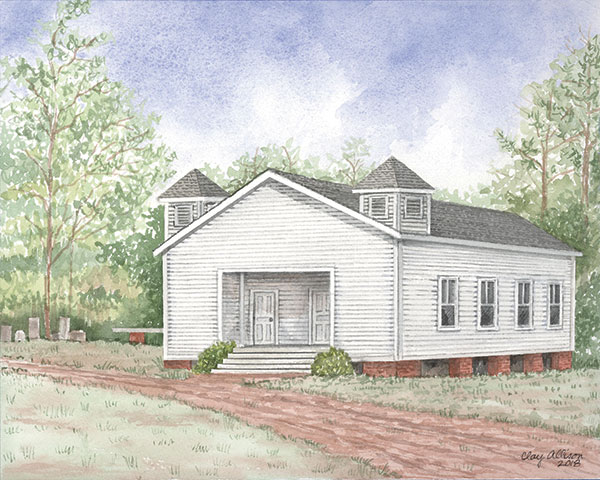
The cemetery rises in gentle slopes to the left, right and rear of the circa-1850 church building. Frank Watson’s survey of the cemetery lists the names and dates for 22 people who were born more than 200 years ago. Of those 22, nine were born in the 18th Century.

Old newspaper articles record that early in the 1820s, worship services were held on the site where Liberty Church stands today. The first building, a log structure, served as a community church. In 1835, Rev. James Guthrie organized a Cumberland Presbyterian Church there. The church remained Liberty Cumberland Presbyterian Church until near the end of the 20th Century, when it once again became a community church. Local tradition states the present building was constructed around 1850, and the style of its architecture gives credence to that date. Frank Watson’s cemetery survey shows the first burial occurred in 1833.

The earliest Beaver Valley settlers buried in Liberty Cemetery are John Ash (1783-1872) and wife, Margaret Newton Ash (1795-1855). John, Margaret and her parents, Thomas and Ann Newton, had joined a westward bound caravan that had progressed into Alabama Territory in 1817. The caravan had camped in the vicinity that would later be south of Ashville on today’s US 411.

Betsy Ann Ash was in a horse-drawn wagon when one of the men shot at a turkey. The horse bolted at the shot, causing Betsy Ann to fall from the wagon, breaking her neck. The Ash and Newton families, feeling they could not leave the grave of Betsy Ann and continue west, scouted out the valley. Finding the area a commodious land, the families bid farewell to the westward caravan, and settled in what would become St. Clair County, Alabama.

John Ash and his father-in-law, Thomas Newton, constructed, within sight of Betsy Ann’s grave, a log cabin to live in as they settled in this land. That 1817 structure remains today as the oldest house in St. Clair County. The next year, John Ash built his own home.

Written accounts state that in 1818, not too far distant from the Newton cabin, John built a log home. As years went by, John added to the home, encasing the log home within the new. He planked over the inside log walls, making the home more fashionable. Although in need of restoration today, the home still stands and is on the Alabama Register of Landmarks and Heritage and the National Register of Historic Places.

John Ash helped establish St. Clair County and participated in both local and state affairs, serving as a county judge and member of the first Alabama State Senate. The town of Ashville honors John Ash by bearing his name.

John and Margaret Ash are buried side-by-side at Liberty, but they are memorialized with modern markers. The original ledger-style stones covering the entire grave were removed to Ashville. Though broken, they survived and lie in a place of honor at Ashville City Hall.

Henry Looney (1797-1876) and his father, John, came through what would be St. Clair County in 1813 as Tennessee volunteers with Andrew Jackson, who had come to subdue Native-American uprisings. Along with Jackson and his men, they helped construct Ft. Strother and fought with Jackson at the Battle of Horseshoe Bend.

 After the Indian Wars concluded, John Looney and wife, Rebecca, moved their family to Alabama in 1817. Originally intending to settle on the east side of the Coosa River, they changed plans after learning the Creeks still controlled lands east of the Coosa and chose to settle on the west side in today’s Beaver Valley. Old record books show that John recorded two forties (40 acres), and in 1818, he and sons Henry, Jack and Asa set to work building a log home.

In a brochure titled, “The Henry Looney House,” Mattie Lou Teague Crow described the process of building: “Trees were cut, squared, notched and hauled to the building site. Stones for the foundation were quarried from the mountainside and creek bed. Bricks for chimneys were molded and baked. Shingles were rived and stacked to dry. Late in the year, the family left their wagons and lean-tos and took up residency in their new home.”

Winter moved into spring, and the rains came, swelling the creek and flooding the home. After the flood, mosquitoes invaded and several family members suffered from chills and fever. John Looney realized he’d chosen the wrong location. So, he and the boys dismantled the home and hauled the logs to higher ground and reconstructed it.

The house stands today, thanks to Mr. and Mrs. Joseph Creitz, who donated the home and plot of ground to the St. Clair Historical Society, which supervised the restoration of the home and operates it today as a museum.

 After his father’s death in 1827, Henry became head of the family. In 1838, Henry married Jane Rutherford Ash, daughter of John Ash. They continued living in the home, and it became known as the “Henry Looney Home.” It stands today as a treasure for both Alabama and St. Clair County, for it is the only surviving double-dog trot pioneer home still standing in our state.

Henry Looney died in 1876 and is buried at Liberty. After his death, his wife moved to Texas, where she died in 1901.

Settling Odenville

Methodist minister Christopher Vandegrift (1773-1844) and wife, Rebecca Amberson Vandegrift (1777-1852), left Chester County, South Carolina, in 1821 and migrated westward. While stopping for rest in Jasper County, Georgia, their daughter, Ellen (1800-1853), met a young man, Peter Hardin (1803-1887). They fell in love and wished to marry. Christopher agreed to the marriage if Peter would join their caravan. Love won, and the westward trek progressed into today’s Odenville, where the Vandegrifts and Hardins settled in December 1821. Both Christopher and Peter constructed homes where they settled.

The Vandegrifts became leaders in community and church. In 1835, Christopher served as an elder in the organization of Liberty Cumberland Presbyterian Church. In today’s Odenville Presbyterian Church, Christopher’s descendants worship and serve there, continuing the godly influence of their ancestors.

Peter Hardin constructed a log home in 1824, which was lived in by his descendants until 1975. Nell Hardin Hodges was the last Hardin to live there. The home, which had been added to over the years, remained standing until 1990. Today a church and a store now occupy the property where the cabin stood for 166 years.

The area where Peter settled came to be called Hardin’s Shop. He established two businesses, a blacksmithery and a cabinet shop. A few items from both remain in Odenville. In addition to the businesses, Peter was a Cumberland Presbyterian minister, having been ordained Jan. 3, 1850. He is on record as having preached the first sermon in the circa-1850 Liberty Church building still in use today.

Peter Hardin died in 1887. Myrtle Maddox Kinney, whose father would have known Peter, said in a 1990 interview that Peter had gone to the field to pull corn. When the wagon was loaded, he started back and “…somehow or another, the horses turned the wagon over and the load of corn fell on him and killed him. He was up there by himself.”

The Southern Aegis reported Peter’s death in the Nov. 30, 1887, issue. Then in the Aug. 9, 1888, issue it announced: “The funeral of Mr. Peter Hardin will be preached by Rev. A.B. Wilson of Branchville, assisted by Rev. G.F. Boyd, on the second Sabbath of August. …” Often in those days, a body would be buried, but the funeral not be preached until the next Sunday the circuit-riding preacher came to town, usually no more than three weeks after the burial. This was eight months after Peter’s death. The puzzle was unknotted by a descendant living in Sunflower Mississippi, who recognized the Rev. G.F. Boyd as Peter’s cousin. The family had waited until Rev. Boyd could come from another state to preach the funeral.

The first brick house in St. Clair County was constructed by Obadiah Mize (1780-1852). Obadiah and wife, Sarah Frazier Mize (1789-1855), probably came into St. Clair County shortly after the Hardins and Vandegrifts, for he settled not too far from their homes.

According to a file in the Ashville Museum and Archives, the brick house is described in some 1932 notes. “Mr. Mize built this two-story home, consisting of six rooms on the first floor and three on the second, of brick which were made there on the lot of the building.”

In a photograph belonging to Frank Watson, you can see the bricks were laid Flemish bond rather than the more ordinary American bond. In Teresa Morris’ notes from an interview conducted in the 1970s, she writes, “In 1830, Mr. Mize built a two-story brick home … on the property which fronted Old Montevallo Road, and this house, known as ‘The Old Brick’, remained a landmark until it was demolished in 1930.”

When The Old Brick was demolished, the owners constructed a wood-frame home on the stone foundation of the old house. That house remains occupied today. They used the bricks to construct a retaining wall near the highway. The Fortson Museum in Odenville displays a brick from the house.

All in the family

Israel Pickens Hardwick was born in 1813 in Jasper County, Georgia. Roland Holcomb wrote about Pickens in A Hardwick Family Tree that Pickens’ sisters, Lydia and Susan, married Vandegrift brothers, John and William. But the Vandegrift brothers had no sister for Pickens to wed. No problem – he just waited 30 years until the third brother, Jim Vandegrift, had a daughter who was old enough to marry. Therefore in 1863, at the age of 50, he married Jim’s daughter, Nancy Ellen Vandegrift, age 17. He came safely through the Civil War and outlived his wife and all his contemporaries. In 1923, at age 110, Israel Pickens Hardwick “was gathered to his fathers” and was laid to rest at Liberty.

The origin of Hardwick Tunnel

Pickens served in Company C, 18th Infantry Regiment, Confederate States of America. Roland Holcomb recounts a Pickens’ story that happened when the railroad was being put through Odenville very early in the 20th Century. He had given the Seaboard Airline the land and rights to build a tunnel through the mountain as long as the tunnel be called Hardwick and that the train would stop there. Seaboard Airline agreed.

Holcomb writes, “He (Pickens) frequently dined with the tunnel construction crews who were billeted on the right-of-way near his home. One evening, a visiting railroad supervisor from the North made some remark about the South that angered the old man.

“While he said nothing, he got up and left the table. He returned a short time later with his rifle, prepared, as he said later, to demonstrate that the Army taught him well how to shoot Yankees. Fortunately, some of the local men on the crew, who knew the old man and recognized the signs, had spirited the visitor away.” Such was Israel Pickens Hardwick.

Lost at sea, but not forgotten

One marked grave has no body buried there. The stone, for the son of Louis and Marze Forman, reads: “Forman Austen Mize / Feb 13, 1900 / Lost on USS Cyclops / March 1918 / Gone but not forgotten / Son.”

The Cyclops was launched in 1910, and when the United States entered World War I, it was commissioned in 1917 for military use. In February 1918, loaded with manganese, she departed Rio de Janeiro, Brazil, bound for Baltimore. She stopped in Barbados, then sailed on.

Her last sighting, according to accounts, was March 9, 1918. Sailing into the area known as the Bermuda Triangle, the Cyclops vanished, and as author Jerry Smith records in Uniquely St. Clair “… no distress call or other message was heard on the wireless. Nor was a single body or piece of wreckage or artifact ever found.”

By some accounts, the ship had been overloaded in Brazil and when it encountered turbulent sea weather in the Triangle, it could not survive and sank. Others propose that a German submarine torpedoed it or that Germans captured the ship. Or did the Bermuda Triangle swallow it? Some consider that theory outlandish, others not.

Family tree yields university president

The Rev. James Benjamin Stovall (1868-1917), a beloved Presbyterian minister, not only pastored churches in St. Clair County, but was also president of Spring Lake College in Springville.

In 1915, he accepted the call to pastor Brent Presbyterian Church. He died there in 1917 when, as recorded in the History of Brent Baptist Church, by Sybil McKinley, “He was standing in the back of the wagon holding on to a cabinet being moved, when the horse lurched forward throwing him off and pulling the cabinet down on top of him.” His wife, Effie Fowler Stovall (1873-1970), continued living in Brent, raising her children there and becoming a guiding light to the community.

James and Effie’s daughter, Chamintey “Mittie” Stovall, married Ralph Thomas, an educator. Their son, Joab Thomas, attended Harvard, earning undergraduate and graduate degrees in biological sciences. Well respected among colleges and universities, Dr. Joab Thomas served as chancellor of North Carolina State University and as president of the University of Alabama and of Pennsylvania State University.

The earliest Stovall date in the cemetery is that of Matriarch Sarah Stovall (1791-1858). She reposes with numerous other Stovalls in Liberty Cemetery. Sarah’s husband, Benjamin, died in Jefferson County and is buried there

Three-shot suicide?

The marker at the grave of R.M. Steed (1828-1899) causes no one to pause and ponder. However, his reported death in The Southern Aegis, Feb. 8, 1899, brings the reader to a sudden stop. It reads: “Richard M. Stead [corrected the next week to ‘Richmond Steed’], residing near Odenville, St. Clair county, on Monday the 6th inst., committed suicide by shooting himself three times.

“The deceased was well known in the county, having been born and raised here. He was about 73 years of age, was a farmer of sturdy habits and had been in a depressed state of mind for some time. During the war he had been a soldier in the federal army, and the weapon used in his own death was an army revolver he brought home at the close of the war and had preserved ever since as a relic of the war.”

In 1994, someone with Steed connections read the above and commented that the family always doubted his death to be suicide. A three-shot suicide does stretch the imagination.

Final resting place indeed

Some of those buried in Liberty Cemetery influenced the establishing of St. Clair County and have left names and influence well-etched into her history. Most lived unassuming lives, nurtured home and children, and left their names etched upon hearts and lives.

In the end, relentless Death gathers all to a final resting place—equality in mortality. Thomas Gray expressed it well in his “Elegy Written in a Country Churchyard.”

The boast of heraldry, the pomp of power
And all that beauty, all that wealth ever gave,
Awaits alike the inevitable hour,
The paths of glory lead only to the grave.