
Education Foundation picks up where budgets leave off
Story by Elaine Hobson Miller
Submitted Photos
Little girls dancing in butterfly costumes, their wings fluttering and their faces grinning. Children playing card games with their parents. High school students (boys and girls) using their new miter saw to cut lumber for a playhouse.
These are just some of the ways that grant money from the St. Clair County Education Foundation is helping school children, and in turn, their families. Established in 2003, it lay dormant for several years but has been revitalized by new management and new fundraising efforts. The Foundation tries to fill in the gaps when schools need more classroom money than their budgets provide.
“Our purpose is to make a difference for teachers so they can make a difference for their students,” says Foundation President Dr. Greg Cobb.
The Foundation was started by Marie Manning when she was superintendent of the St. Clair County School System. Manning now represents District Six on the Alabama Board of Education.
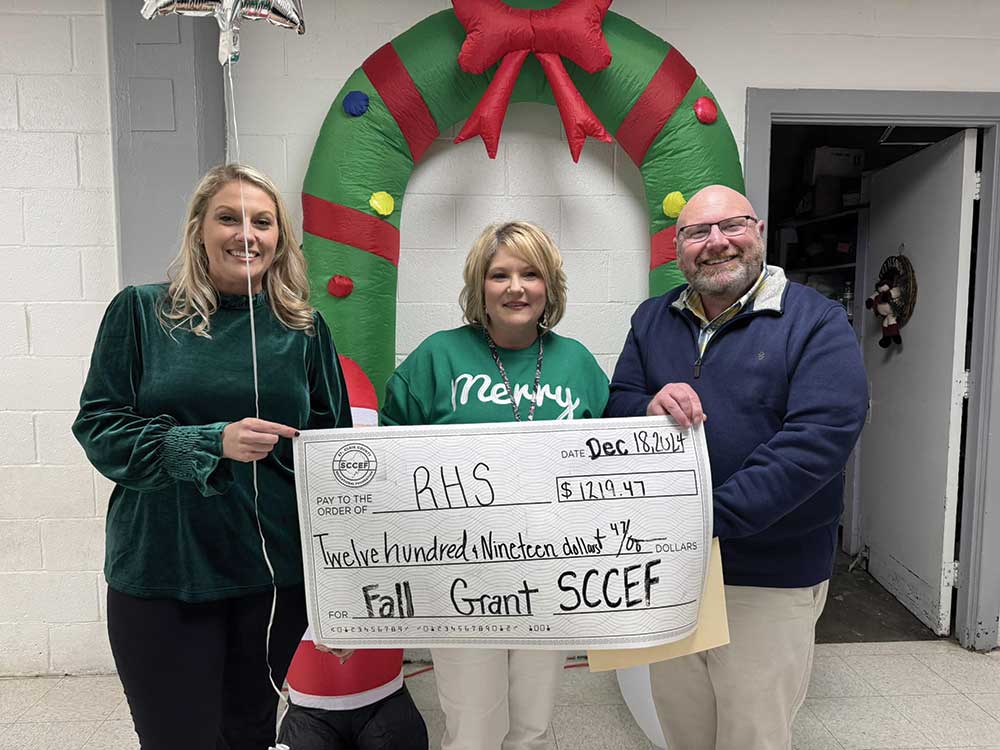
“We had a community education coordinator, Emily Davis, when I was superintendent,” recalls Manning, who also serves as president pro-tem of the state board. “When I hired her on, I asked her to get us an education foundation started, and she agreed, but it took a while.”
Manning retired in 2003 and believes the Foundation came to fruition in the fall of that year. “Emily called together a group of folks, including Joe Morton, past (state) superintendent, and Tom Sanders, who was (county) superintendent at the time. We chose a few officers and got incorporated.”
She says at that time funding for education was very low, the economy was not booming, and the group wanted to do something so classroom teachers could get much-needed materials in their classrooms.
After raising thousands of dollars and granting dozens of scholarships, the organization fizzled and lay dormant until 2024.
“It was stagnant for six or seven years, partially due to COVID and partially to people retiring or moving out of the county,” says Stephanie Deneke, vice president of the Foundation. “About two years ago, Superintendent (Justin) Burns wanted to get it going again.”
“I had a detailed list of things I wanted to accomplish as superintendent, and one was finding ways to help teachers in their classrooms and in being successful,” Dr. Burns says. “I noticed that the Foundation wasn’t active. When I started as a teacher in St. Clair County in 2005, it was flourishing. It provided an outlet for people who wanted to donate and know that their monies were going straight to the classrooms. So, I called Marie Manning and asked what’s going on with the Foundation. She said it had been dormant since 2017 or 2018.”
Manning gave Burns half a dozen names of people involved in the Foundation. She said Linda Crowe, a Moody City Council member and teacher at Moody HighSchool at that time, was a Foundation officer. So, Burns called her, too, and she told him she was still treasurer and was listed on the bank accounts. “We had a couple of meetings to change the names on accounts to access money,” Burns says. “There was $100,000 or so sitting there, so it took off from there. We’re still taking in money, and the Foundation is flourishing. It’s really an awesome thing to see it pick back up.”
When Dr. Burns and Assistant Superintendent Rusty St. John called community leaders together for that first meeting, they had about 30 people attending. That group elected four members to the board of directors, and Cobb as head of the organization. “Greg taught school in St. Clair County and was a principal here for years,” says Stephanie Deneke.
“We decided we needed to reboot the Foundation because its original mission of supporting teachers was still important,” says Cobb, who now works for HMH, a textbook company. “We started onrebranding the Foundation, recruiting more people and making it active again.”
With the seed money in the CDs and checking account, the new Foundation board was able to begin giving out grants immediately.
That was in the spring of 2024. “We did whole school or department grants,” says Cobb. “We were able to give $15,000 out that first go-around.”
Jaime Ragsdale, math coach at Margaret Elementary School, was one of the recipients of the first cycle. She used the money to buy math games for the 700-plus students in grades K-5 at her school. She bought zippered mesh bags and put math games in each one for the children to take home and play with their parents, then return to the school.
The bags contained decks of cards, six-sided and 10-sided dice, and foam “counters” or math manipulators. The latter are like bingo chips, flat, but made of foam. One side is yellow, the other red, and they can be tossed and counted according to how they fall.
“The whole purpose was for them to put away their electronic devices and have family times, and to encourage parents to get involved,” Ragsdale says. “We see lots of device time and less family time these days. Children are playing less and less games such as Candyland or card games, but playing games helps them with math skills, as well as teaches them how to win, how to lose and how to share.”
Dr. Cobb spoke to a group of teachers in August of 2024, explaining the Foundation’s purpose and goals, how it was being revived, and how all the money raised would be going back to them. “There are no overhead costs,” he says. “We’re all volunteers.”
A few teachers started setting aside money to go to the Foundation each month, usually having it taken out of their paychecks. “That’s a little bit of a revenue stream, but not enough to count on,” Cobb says. “But we had enough from the original money raised to do a Fall 2024 grant cycle, too. We gave out $12,000 to 24 individual teachers that second round. Most of the teacher grants were for $500 each.”
A team of foundation members and educators from outside the foundation read all the 70 applications and scored them on a rubric, meaning they gave points from one to five according to need. “We call this team the readers,” Cobb says. “One teacher might ask for crayons, and that need might not be as great as a microscope for someone else, for example.”
In the Spring of 2024, officers of the Foundation presented members with the idea of an annual fundraiser. That’s how the Mardi Gras Gala, held at Mathews Manors in March of 2025, came about. Officers developed teams that put together the various parts of the Gala, such as a public relations team, a decorating team and a food team.
“We raised $30,000 at the Gala through ticket sales, sponsored tables and an auction,and we’re so proud of that,” Cobb says. “We still have some money from the original investments, too.
“We feel like our job is to make the Foundation solid enough that we can fund all the grants and not have to select certain ones,” Cobb continues. “We want to be able to grant what the teachers need.”
The Gala was such a success that the Foundation plans on holding one annually. Feedback from attendees indicated they were already excited about the next one. “We want them to put the date on their calendars,” Cobb says. “As I was selling tables for the Gala, I had several corporations say to get with them during the summer, when they are doing next year’s budget. So we learned a lot from the first Gala.”
According to Stephanie Deneke, the board hasn’t decided on the exact date for the 2026 Gala, but it will be in February. And yes, there will be another auction. “There were 45 items donated for the Gala auction this year, including Pandora jewelry, gift certificates, household items, a cooler, a tool set, Taste of St. Clair gift cards good at restaurants throughout the county, handmade knives and other jewelry,” she says.
Some 250 people attended that first Gala, and the Foundation is hoping for 325 next year. “They paid roughly $90 a ticket, a little less if it was for a couple,” says Cobb. “If someone bought a table, the bottom level was $1500. We had tables with enough seats to bring whomever they wanted. For example, I bought a President’s Table, filled it up with family and my folks. A few corporations bought tables, like Doster Construction, the company that’s working on Moody High School, and invited any employee from the school to sit there. There were eight-10 seats per table.”
Deneke says the Foundation used to “sell” chairs to raise money, wherein someone could sponsor a chair and get a plaque with his/her name on it for their business. But businesses seem to like the Gala idea better. “We may revive the chair donations anyway,” she says. “Teachers can contribute through payroll deductions, too.”
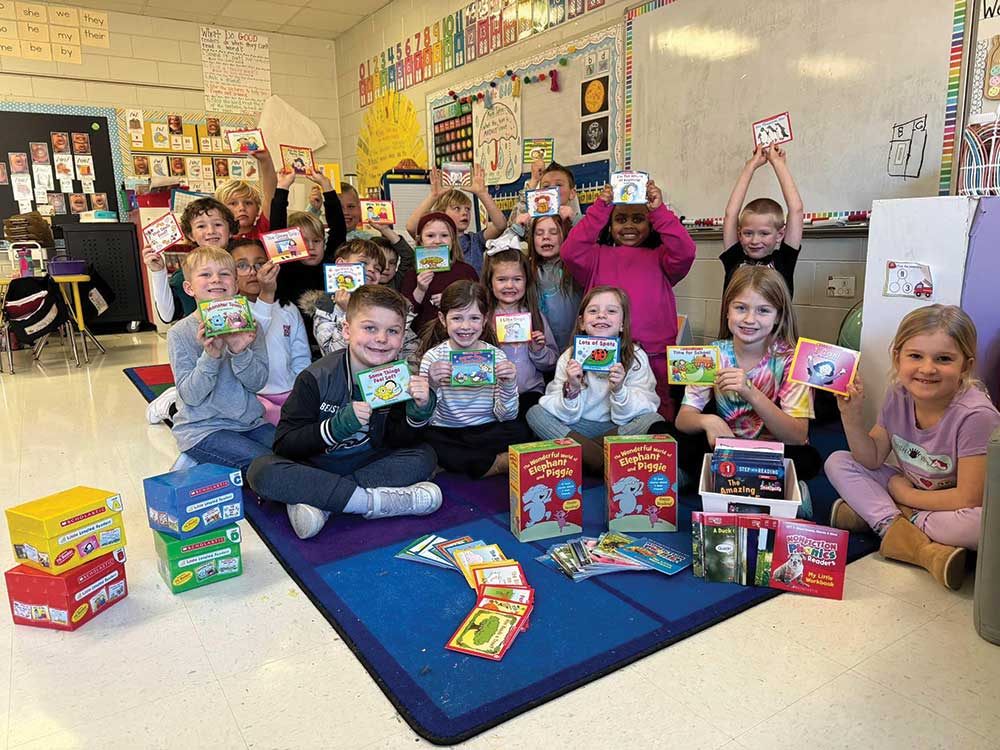
Cayla Brasher, a first-grade teacher at Springville Elementary School, received a $500 grant last Fall and used it to buy decodable readers for her class of 21 students. “A decodable reader is a phonics-based book that has words students are able to decode or sound out or figure out,” Brasher says. “It keeps them in what teachers call that ‘zone of proximal development,’ where they are having to work at reading, but don’t get so frustrated with it.”
She wanted a good variety of books that they could successfully read. “We want some times during the day when they’ll want to pick up a book and feel successful at reading it,” she says. “Decodable books follow that phonics progression. The student is able to figure out or decode words yet enjoy the reading.”
Marcus Graves, construction class instructor at Eden Career Technical Center, received a $599 grant, which he used to buy a new rigid slide miter saw with a stand. The tool is used to cut steep angles and wide boards for construction projects.
“Some of our unique projects are the oversized Adirondack chairs with multiple letters that we put on our hillside at our school,” Graves says. “The letters form words, like ‘love’ for February. We’ve turned a school bus into a camper, we’ve done a goat camper for a petting zoo at Greensport campground, tiny houses, small playhouses we’ll be selling in the Spring, and the floating duck island for Springville Park.”
Meg Lowry, of Odenville Elementary, used her Fall 2024 grant to purchase an insect unitfor her pre-K class. “The unit included live caterpillars, dress-up clothes like butterfly and bug catchers’ outfits with nets, lots of little plastic bug sets, and games like Memory, all based around the insect theme,” she says. “We actually started the unit in March, when we turned the classroom into an insect theme. We could not have done it to this extent without the grant, which was close to $700. This gave the kids hands-on activities to learn, which was very, very developmentally appropriate in pre-K.”
Deneke says the Foundation is always looking for new members from each community, especially Ashville, Springville and Ragland. “It would be great to get some members from those areas,” she says.
Editor’s Note: Anyone interested in joining the Foundation can contact them on its Facebook page. The Foundation generally meets once a month on Fridays at Odenville City Hall at 11:30 a.m. but is considering going to every other month.