Friday night hero

Honoring Pell City High School Coach Pete Rich

“Success is based upon a spiritual quality, a power to inspire others.”
— Vince Lombardi

Story by Roxann Edsall
Photos by Richard Rybka

Coach Pete Rich is one successful man. He must be; he has a stadium named after him.

The reason for that honor, though, is somewhat of an anomaly. His namesake stadium is home to the Pell City High School Panthers. He never lead his Pell City football team to the most wins of any coach. He did not even serve as head coach the longest. His fame is less about statistics and more about relationships.

His biggest victories are still being realized in the lives of the young men he inspired in his 34 years of coaching high school football. And those former football players, many whom are now retired from successful careers, say Coach Rich was a powerful force in shaping them into the people they are today.

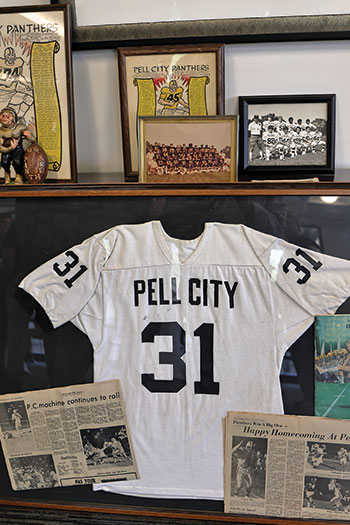
Pell City High School jerseys, jackets and other memorabilia

On a Saturday afternoon, more than 50 former players and coaches gather at the Municipal Building. They’ve come from as far away as California and New Mexico to honor their former coach and mentor on his 88th birthday. Just as they did in the lock room decades ago, the men form a huddle and Coach begins their time together by leading them in prayer.

One of those in the huddle was Alabama State Senator Lance Bell, who played nose guard from 1987 to 1989. Senator Bell read a resolution from the Alabama Legislature honoring Coach Rich for his many years of service to the people of Pell City and the astate of Alabama.

“Coach Rich was like a second father to me. He taught us about discipline and about life,” the senator remembers. He recalled a time that he suffered a significant injury to his knee during a game. “The call from Coach,” he said, “was the first phone call I received checking on me.” 

“He was a father figure for all of us,” adds former tight end Leslie Smith. “He is bigger than life. I mean, the man still lifts weights at 88 years old!” Coach Rich has had that weight room at his home since he started coaching Pell City football in 1969. And it has always been open to any of his players.

“Coach truly saved my life,” chimes in Bobby Watson, tight end and linebacker from 1975 to 1978. “He got me into weightlifting when I was 18 years old,” he tells. “That habit saved me later in life, when, in 2014, I suffered a bilateral quad rupture. I was told I’d never walk again.” Watson credits Coach Rich with teaching him the value of strength training through weightlifting. Weightlifting, rehab exercises and sheer determination, he says, helped him to regain his mobility. Not only is he walking again, he is now a strength coach and weight strength coordinator for the Trussville YMCA.

Sammy Brown, played defensive end during the ’74-’75 season and again the next year. He gets emotional talking about Coach. “He was always open to listen. I could go to his house and sit outside with him and when I left, it felt like a huge burden was lifted. He cared so much about others.” When Brown later had a wife and children of his own, he said Coach would often come to his home after his own family Christmas and share in the Brown family celebration.

A hometown boy, Pete Rich grew up in the Avondale Mill Village, played football for Pell City High School, and worked at the mill during the summers. He graduated from the University of Southern Mississippi in 1957 and immediately started coaching football, baseball and basketball at Jones Valley High School.

He started coaching at Sylacauga High School in 1961, where he stayed for eight years. He returned to Pell City as head coach in 1969. After five years as head coach, Rich stepped down from head coach to spend more time directly with his players as defensive coordinator. Rich retired from coaching in 1991, having served on the coaching staff at Pell City High School for 22 years.

In total, he coached for more than three decades.  In that time and since then, he has touched the lives of countless people, who consider him a friend and mentor.

His former players are devoted to him and, when you meet him, it’s easy to see why. When he’s involved in a conversation, he is committed to it. He does treat people as if they are the most special person in that moment. His sense of humor is part of his charm. He’ll often start a story off with “I ought not tell this …” and then chuckle as he tells it.

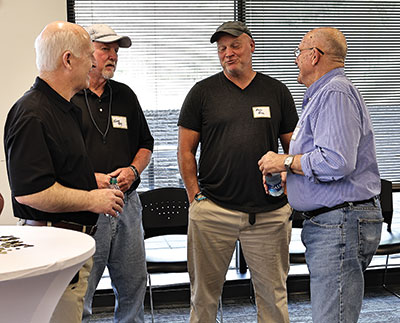
Former players talking with coach

Coach admits to working his boys hard, but it was second nature to him. “I made sure my kids worked hard. It was just the way I was raised,” he says. “My mama always made sure I worked hard as a kid. I remember coming home from school one day and mama said to get ready because I was about to be picked up to go out and help plow the fields.”

Although he had plenty of opportunities to advance in the world of coaching, he was committed to his community and remained with Pell City High School.

He and his wife, Gwen, raised their two children, Lori (Billingsley) and Brian, in Pell City. “We always had people around the house, either visiting my dad or using the weight room,” says Brian.  “It was like Grand Central Station, but it was good. Both Mom and Dad are great. I feel like I won the parent lottery with them!” Brian did play some football and basketball, but tennis turned out to be his best sport.

Former player Jerry Posey was not quite as lucky in his childhood experiences. His dad suffered from alcoholism and Post Traumatic Stress Disorder (PTSD). Coach Rich, he says, was one of the first positive influences in his life. “I was from the housing project, and he was from the mill village,” said Posey. “He treated everyone the same. He was an unbelievable influence for me.”

As the lights come on and fans file into Pete Rich Stadium for Pell City home games this fall, just maybe some will think of the lessons Coach Rich taught. “Nobody’s more special than anybody else,” he said. “I’ve just always tried to make sure everybody felt equally special.” 

That’s a win any way you look at it.

Life in Pictures

Larry Krantz reflects on storied career as photographer, video editor, teacher

Story by Paul South
Photos by Graham Hadley
Submitted Photos

Captivating photography – the elegant art of light and shadow – is also about timing. The same could be said of Lawrence Krantz’s fourscore plus one years on earth.

The Logan Martin Lake resident’s life may be the most compelling you’ve never heard of, taking him from his Atlanta hometown to Hollywood and into the eye of the righteous hurricane of the Civil Rights movement. It took him to the lightning-fast advancement of technology at Apple and making photos and films with phones.

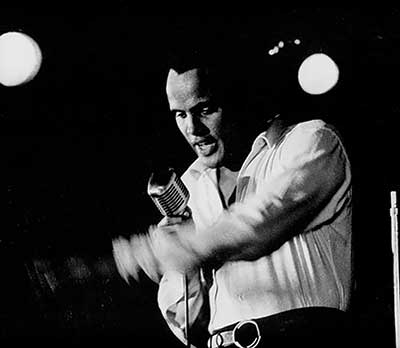
Harry Belafonte in a concert for the SCLC

He rubbed shoulders with icons – the Rev. Dr. Martin Luther King Jr. and legendary filmmaker Roger Corman. He snapped photos in the golden age of magazines for Life and Playboy, trained at Life and National Geographic and worked as a photojournalist for news agencies like the Associated Press and Black Star.

He chronicled national grief, photographing King’s 1968 funeral and influenced pop culture behind the scenes, as a film editor for a then-unknown chef, Alton Brown, on the upstart Food Network show, Good Eats.

Krantz, now 81, crossed paths with Henry Fonda on the MGM lot, came to know Richard Roundtree and worked on films like Sharky’s Machine and Blood of The Dragon.

When it comes to capturing light and shadow, Krantz, it seems, has seen it all.

“I’m just a guy who’s had some good opportunities,” he says. “And you know, I made something with it.”

Indeed, he did.

It all started with a box camera, a 13th birthday gift from an uncle and a chance encounter with a filmmaker at Isadore Krantz’s hardware store. As a kid, young Lawrence kept his ear tuned to the police radio. When a nearby house fire or other newsworthy event broke, the teen raced to the scene, snapping photos for The Atlanta Journal. Soon, with the Journal’s help, the teen was doing “ride alongs” with Atlanta police. He also shot local dances with his best friend.

“I was doing everything I could to make dollars so I could buy equipment,” he says. “My roots were photography, but I graduated to movies and television,” Krantz says.

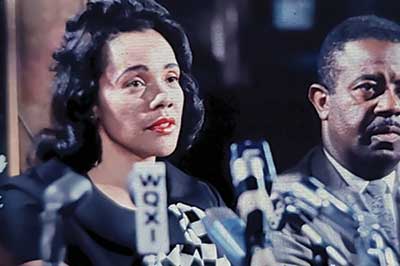
Coretta Scott King, with Ralph D. Abernathy, at press conference, Atlanta, April 7, 1968

While working in his dad’s hardware store in the early 1960s, he met the photo and magazine journalist and novelist William Diehl, eventually becoming his apprentice. The two worked together for the next two decades.

Diehl authored nine novels, including Sharky’s Machine and Primal Fear, both made into films. Krantz worked with Diehl and Burt Reynolds, the star and director of Sharky’s Machine. In fact, Krantz inspired a character called “Nosh” – Yiddish for “Eat” –  in Sharky’s Machine. “Anybody that knows me knows I like to eat,” Krantz said.

“I worked on independent movies and became an editor for Bill,” Krantz recalled. “I loved it.”

But while he shared the MGM lot with Elvis and Fonda, craning his neck to look for Fonda’s Woody station wagon in its parking space, it was not glitz and glamor.

“We were there to work,” Krantz recalls. “At lunchtime, there were people who would stop by to see Bill and meet him. He garnered the notoriety.”

Still, for Krantz, it was a heady time. The pair often ate in the MGM commissary, rubbing shoulders with veteran actor James Hong, known today to a new generation of viewers for his roles in Seinfeld and The Big Bang Theory, as well as the director Roger Corman, who influenced noted directors Martin Scorsese, Francis Ford Coppola, the late Peter Bogdanovich, Quentin Tarantino and Ron Howard.

Of Corman, Krantz says, “We knew Roger. He had this knack for making low-budget movies that made a lot of money. He was about making money.”

 We would buy footage from events like speedboat races but hire different actors for close-up scenes. With the help of James Hong, Diehl bought a martial arts film from Hong Kong, looking to cash in the on martial arts madness of the 1970s.

“That’s what Bill wanted to do,” Krantz recalls. “He wanted to ride on the coattails of Bruce Lee’s Enter the Dragon.”

The result was a Diehl film called, Return of the Dragon, an overdubbed film without Bruce Lee, but with a low budget and big box office. Call the film a mix of Shane meets martial arts.

“Bill made a lot of money on that,” Krantz says.

Diehl and Krantz first worked together in Atlanta, in the early days of Atlanta magazine, where they collaborated with the late Southern novelist and Auburn alumna, Anne Rivers Siddons.

“They were great times,” Krantz says.

 The pair’s pre-Hollywood work in the 1960s took a different path. Krantz accompanied his mentor to south Georgia for the United States Information Agency, where they photographed young civil rights workers being trained to face the crackle and spark, verbal and physical abuse they would face in the segregated South.

“It changed my life,” Krantz says.

“Bill and Dr. King took a liking to each other, and Bill volunteered our services to the Southern Christian Leadership Conference. That included all of us.”

Krantz dined twice at the King home in Atlanta. And he would walk with the famous and the everyday to King’s earthly resting place.

It was a small slice of Krantz’s remarkable career. But it was nonetheless important. The memories of “Whites Only” water fountains are burned in his memory.

“Growing up in Atlanta, it was very segregated like Birmingham. (The work) changed me.”

He remembers one meal, when he asked King why he tried so hard to achieve racial equality, when eventually it was going to happen.

“He said, ‘Larry, I would like to see it in my time and not in my grandchildren’s time.’ That I remember.”

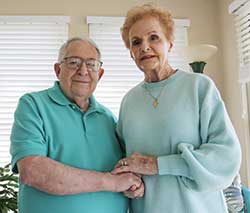
Larry and Mary Esther Krantz

Krantz has lived to see King’s dream move toward reality. “I feel very fortunate to have seen that,” he says.

Krantz and Diehl took different paths for a period, but the two would reunite in Atlanta for independent film work. He made award winning commercials at Jayan Productions with nationally known director Jimmy Collins. Later, Krantz would work for the Food Network, Turner Classic Movies and other television shows. After a four-year PBS show, Krantz joined Apple for more than a decade in the early days of digital photography and filmmaking. He still feels the excitement.

Now, even in retirement with his wife, Mary Esther, Krantz is at work, doing film editing for Dovetail Landing, a veteran residential community dedicated to transitioning veterans in Alabama located in Lincoln and for the new Museum of Pell City.

“I feel like I’ve been reawakened from my slumber. It’s exciting.” For Museum of Pell City, Krantz is helping edit interviews for its Living History program. He not only wants to celebrate the town’s past, but the present and future, training schoolchildren to become filmmakers with their seemingly ever-present Smartphone. For Krantz, there’s always another story to tell.

 And of his life in light, shadow and time, “We were learning as we were going. I didn’t learn from school. I learned being in the trenches, on the job. And everything we did had to work. I was excited by that. I’ve had a great career,” he said.

“Life gives you opportunities, and when you get them, you have to go with them.”

Celebrating Paul Manning

Crowd pays tribute to 36 years as chairman

Story and photos by Carol Pappas

It was over four decades ago when Paul Manning first answered the call for public service. As a St. Clair County commissioner and then as the governing body’s chairman, he never seemed to waver in his devotion to serving the county he calls home.

On a chilly October evening, 400 fellow citizens crowded into the St. Clair County Arena to return the favor, paying tribute to Manning’s decades of service.

At least a dozen presentations from officials from around the county and state held a common theme – Manning’s love of county and his dedication to serving it.

Former Pell City Mayor Guin Robinson welcomed the crowd, sharing his first encounters with Paul and wife, Marie, when he moved to St. Clair to take a job at Avondale Mills in Pell City. He said he was fortunate to “meet some really good people early on,” and “their friendship remains today.”

Attorney Billy Church and Realtor and developer Lyman Lovejoy shared master of ceremony duties, each expressing their appreciation for Manning’s friendship and his years of work on the county’s behalf.

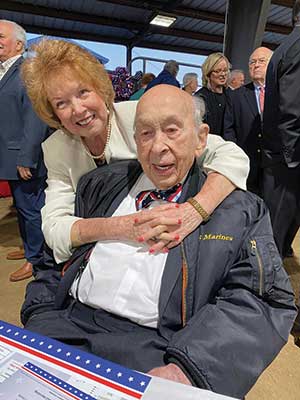
A special moment centered on Roy Drinkard, the oldest living U.S. Marine veteran in Alabama, who – at 100 years old – made his way to the stage to lead the Pledge of Allegiance.

Making official presentations were Sonny Brasfield, executive director, Alabama County Commission Association; Wayne Johnson, retired Veteran’s Outreach director; his family; State Rep. Jim Hill; Commissioners Jeff Brown, Tommy Bowers, Ricky Parker and Bob Mize; Donna Wood, retired chief financial officer for the county; Logan Glass, Young Republicans of St. Clair County; and attorney Larry Ward.

Among the gifts presented were an Alabama flag flown over the state capitol, a U.S. flag flown over the nation’s capitol, a county flag flown over both courthouses, a resolution from the state House of Representatives, letters from U.S. Senator Tommy Tuberville and Emory Cox, Tuberville’s chief financial adviser and a St. Clair native, a resolution from the county commission and a portrait of Manning that will hang in the commission chambers now named in Manning’s honor.

Manning talked of his passion for the county and why he served, noting that it was his honor to do so over the many years of progress experienced by what is now one of Alabama’s fastest-growing counties.

A standing ovation answered his comments because, as Ward put it, “You can’t stand anywhere in St. Clair County and not see something that has benefitted from his service.”

Knitted Knockers

Trudy Mayoros’ knitting gives breast cancer survivors a lift

Story by Elaine Hobson Miller
Photos by Meghan Frondorf

Mentioning “knitted knockers” usually elicits raised eyebrows, sly grins or outright snickers from people who haven’t heard the term before. Among breast cancer survivors who are familiar with the term, it elicits smiles and sighs of relief.

Knitted knockers are soft, comfortable, handmade breast prosthetics for women who have undergone mastectomies or other breast procedures. Unlike traditional prosthetics, knitted versions are lightweight and gentle on scarred or sensitive skin.

Trudy Mayoros has never had breast cancer. But she has been knitting since she was five years old. So, when she learned about the volunteer organization that provides knitted and crocheted alternatives to expensive, heavy breast prosthetics, free of charge, she was touched. She jumped on the bandwagon immediately.

Trudy makes several knitted knockers each week.

“I’ve been doing this since 2016, when Lee Ann Clark, county extension coordinator for Alabama Cooperative Extension Services for St. Clair, held a big Pink & Teal Awareness luncheon that October and introduced people in this area to Knitted Knockers,” Trudy says. “October is Breast Cancer Awareness Month, and pink is its color. Teal is for ovarian cancer, and Lee Ann’s sister died of ovarian cancer. After the luncheon, some of us formed a Knitted Knockers group.”

 Initially, several women met to knit and crochet the knockers, and their inventory grew well beyond the requests received. So, they sent their inventory to Knitted Knockers headquarters in Washington state. “Currently, we knit as we receive orders and usually specifically for the size and color requested,” Trudy says.

Since its inception in 2011, Knitted Knockers has provided 1,876 handmade knockers to registered medical providers (to give to their patients), 447,871 knitted knockers total and has 4,756 groups involved in the knitting, all on a worldwide basis.

Although her monthly numbers vary now because she makes them upon request, Trudy has knitted at least five dozen pairs, as well as singles, over the past five years.She also knits and crochets about half a dozen blankets and 10-15 hats each month for other charity organizations. Topping her list are the Warm Up America Foundation, a Texas-based organization that supplies blankets, hats and scarves to the homeless; Ann’s New Life Center for Women, located in Cropwell and Leeds, which supplies blankets, booties and caps to new mothers; a couple of Native American charities and the Jimmie Hale Mission in downtown Birmingham.

“I love doing this,” she says. “It’s my thing, my mission.”

She has been a knitter since she was five, when she made a pair of socks for her father. “He was thrilled, but I can imagine what they were like,” she says, in a voice as soft as the pima cotton with which she knits the knockers, and that retains a hint of her Swiss accent.

Born in Switzerland, it makes sense that she knits European or continental fashion. In this style, the yarn is held in the left hand and a subtle movement of the left index finger is used to help the needle pick up the yarn and form a new stitch. “American style involves holding the yarn in your right hand and ‘throwing’ it over the needle to form the stitch,” she says. She uses four needles for the knockers, knitting with two, dropping one, then picking up another as she forms the triangular shape. It takes about an hour and a half to knit one knocker.

Most of her orders come from individuals who learn of her service by word of mouth or from their oncologist. When she gets an order, she tries to turn it around in one to two days. “I let them pick the color,” she says. “Beige is the most popular choice, but pink is popular, too. It’s the only time they can pick their size! Believe it or not, most of the time they go smaller (than before surgery).”

Women to whom she has given knockers often send thank-you notes, and sometimes they include a donation. In keeping with the tenets of Knitted Knockers Foundation, she doesn’t charge a cent for her work. If she gets a donation from a grateful wearer, she turns it back into more yarn.

Knitted Knockers can be colorful or simply beige.

Commercial breast prostheses usually are made of rubber and can weigh 1.5 pounds. They cost more than $100 and make women sweaty, so some just stop wearing them. Knitted knockers, on the other hand, are made from exceptionally soft cotton stuffed with PolyFiberFil,which is non-allergenic. They can be hand or machine washed and hung to dry.

“I order the yarn from a place out West, and they get the cotton from Peru,” Trudy says. “Lion Brand now has a soft yarn called Coboo approved by the Knitted Knockers organization as soft enough for the knockers. It’s a #3 weight, and Walmart is carrying it, so it is a lot less expensive than the yarn I’ve been ordering – about a third of the price.”

She has a dedicated craft room over her garage, where she keeps several WIPs (works in progress). Baby blankets and caps are stacked next to her sewing machine, finished except for weaving in the yarn ends – a dreaded task for most knitters and crocheters.

Along one wall, a stack of plastic, see-through drawers keep her yarn organized by color and weight while also storing magazines and knitting tools. A clear bag houses large foam blocks that fit together like a puzzle. She uses those for wet blocking many of her finished pieces.

Two recliners face a small television that she often watches while knitting. The crocheted antimacassars on the backs of the recliners are her own pattern. She makes up most of her patterns as she knits or crochets, and only learned to read printed ones a few years ago.

“I probably spend two to three hours a day minimum knitting, more if I’m working on special projects,” she says. “I may go up to my craft room around 1 p.m., and work until Emery (her husband) reminds me it’s time for dinner. Then after dinner, I’ll knit while we watch TV together in our family room downstairs.”

Like the dozens of hummingbirds at the feeders on her patio, Trudy can’t sit still and do nothing. Apparently, she can’t walk and do nothing, either, as evidenced by the treadmill in her craft room. She tries to walk half an hour a day at the No. 2 speed setting and works while she walks. She knits items that involve a lot of repetition and don’t require her to count stitches.

“I feel I have a gift in serving other people,” Trudy says. “When God blesses you with so much, you don’t sit on your gifts.”

Editor’s Note: For more information on the free Knitted Knockers program, including a prosthesis pattern and list of accepted yarns, see knittedknockers.org. Trudy is on their knitter list, and you can contact her through their website.

Lawrence Fields

A servant’s heart guides leader’s legacy

Story by Scottie Vickery
Photos by Graham Hadley
Submitted Photos

When Lawrence Fields soon steps down from his role as chair of the St. Clair County Health Authority, he’ll be closing the door on more than three decades of community service.

A former two-term mayor of Pell City, his impact has been significant. Fields opened the door to economic development in a most creative way, and he was instrumental in bringing St. Vincent’s St. Clair to the area. These days, however, after a lifetime of looking out for others, he’s having to shift the focus to himself.

“I’m being treated for lung cancer,” the 80-year-old Fields said. “I’m trying to whup that, so it’s time to step aside and let someone else ride the horse for a while.”

He’s leaving a big saddle to fill. “I really believe that Lawrence’s impact on Pell City and beyond is immeasurable,” said Guin Robinson, who became mayor a few years after Fields’ last term and is now associate dean of economic development for Jefferson State Community College. “He truly has a servant’s heart. Not everyone who gets into politics has a servant’s heart, but Lawrence does.”

Finding home

Fields, the first self-described “outsider” to be elected mayor, served from 1988-1996. Born in Birmingham, he moved to Pell City in 1974 after he and his wife, Brenda, fell in love with Logan Martin Lake. “We started camping out here on the lake and on Sunday afternoon, we’d always hate to go home,” Fields said. “Finally, Brenda asked why we didn’t just move here.”

They built a home on the lake, he got a job with an insurance company, and she started substitute teaching. In 1978, Brenda got her real estate license and has been selling homes ever since. She and her partner, Bill Gossett, own Fields Gossett Realty in Pell City.

“A lot of people start out here with a weekend home, a summer home,” said Fields, who earned his real estate license and joined the company following his last term as mayor and was recently the first to be inducted into St. Clair County Association of Realtors’ Prestigious Hall of Fame. “The more they end up staying here, the more they like it, and they make it permanent. It’s convenient to Birmingham and Atlanta, but you don’t have the hustle and bustle.”

St. Vincent’s St. Clair ribbon cutting in Pell City

From the moment he made the move, Fields got busy making an impact. He decided to run for mayor because “I’ve always been the kind of person who likes to help people,” he said. “When I became the mayor, I didn’t want to be highfalutin. I just wanted to be a regular guy and have the mayor’s door open so people could just come in and talk to the mayor. I think I did a good job of that.”

State Rep. Randy Wood recently sponsored a resolution passed by the House of Representatives praising Fields for his contributions to the community. It credits Fields as “a man of steadfast selflessness and unwavering diligence who is passionate about serving others.” It also cites other accomplishments – annexing Mays Bend, Eagle Point and Stemley Bridge into Pell City and recruiting ConTel (now CenturyLink), Kmart and other businesses.

Pell City Lakeside Park opened during his administration, a sprawling destination point on Logan Martin Lake’s shoreline that now attracts thousands of visitors each year.

The resolution praises Fields for being a charter member of Lakeside Hospice, a member of the Pell City Rotary Club and for the contributions he made serving more than 20 years as president of the Athletic Booster Club. The resolution noted that Fields spearheaded the efforts to build a new field house and install a sprinkler system on the high school’s football field.

That’s all well and good, but what Fields really wants to talk about is Katie Couric.

National news

The journalist and former news anchor, who was co-host of NBC’s Today Show at the time, came to Pell City in 1996 to interview Fields when the city hosted the Bosnian Olympic team for the Olympics in Atlanta. According to The Washington Post, Pell City was one of more than 70 towns in Georgia, Alabama, Mississippi, Tennessee and Florida that hosted foreign athletes.

The late Sam Meason approached Fields with the idea, and Fields said they formed a committee, and “we put in an offer to house them and take care of them. They were here about a month,” he said. “We rolled out the red carpet for them.”

The city won high praises for its efforts. “Few communities have done more to prepare for their guests than Pell City,” the Washington Post story read. “During the past four, war-torn years, most Bosnian athletes have had to train outside of their country. The Bosnian Olympic Committee has no funds and has had to rely on the International Olympic Committee for help in qualifying athletes and paying their way. Hosting the Bosnians will cost Pell City about $150,000; all but $30,000 of that has been donated by local businesses. The rest will come from community fundraisers.”

It was enough to bring Couric calling. “Sam came to me and said, ‘Hey Mayor, we got a call from NBC, and Katie Couric wants to interview you,” Fields said and grinned. “I said, ‘Lord have mercy, here’s my chance for fame.’”

Couric had told Fields he could only tell a few people about the interview, but when “the big old black limo rolled up at the old Rexall drugstore,” a crowd of hundreds of people had gathered. “She said, ‘I thought I told you a few,’ and I said, ‘Well, this is a small town. I told a few, and they told another few,’” Fields said and laughed.

Couric was the one laughing a few minutes later after she asked Fields to identify the most exciting thing that had happened in Pell City before hosting the athletes. “I told her it probably was when Kmart came, and everybody cracked up,” Fields remembered. “Then Katie asked if we could start over so she could ask me the same question without her laughing this time.”

Recruiting practices

The fact is, when Kmart opened in Pell City, it was big news. It was the early 1990s, long before St. Clair was growing as fast as it is now, and no big-box stores had been willing to gamble. “We didn’t have anywhere people could shop,” Fields said.

When he read in the paper that Kmart CEO Joseph Antonini would be attending a ribbon cutting at a new store in Birmingham, Fields made plans to attend. “I gave him one of my cards and said, ‘I’m the mayor of Pell City, and we want a Kmart in town.’ He said to write him a letter, so I did.”

The letter wasn’t the only thing Fields sent. He and Joe Wheeler, owner of Pell City Steakhouse, wanted to give Antonini a real taste of what the city had to offer, so they started shipping him packages of some of Pell City’s finest each week.

“We shipped big old shrimp, we shipped steak, we shipped honey, we shipped all kinds of things,” Fields said. “Finally, Mr. Antonini’s secretary said we didn’t have to ship anything else. He knew where Pell City was.”

Not long after, they received official word that Kmart was coming, Winn-Dixie and other businesses soon followed. “Kmart was a turning point,” Fields said.

Robinson agreed. “It really was a big deal,” he said, adding that he believes it marked the beginning of Pell City’s economic development and ability to recruit industry. “It sent a message that we were open for business. One hallmark of a leader is finding a way, when the odds are stacked against you, of bringing a project to fruition.”

Advancing healthcare

Despite his accomplishments, Fields decided not to run for a third term because of the time it took away from Brenda and their three children. “It takes a lot of dedication and time, and your family has to make a lot of sacrifices,” Fields said of the job. “Your phone rings constantly, and normally at night. My kids asked me not to run again, so I didn’t.”

That didn’t mean he was giving up on public service, however. Fields has been a member of the St. Clair County Health Authority for more than 20 years and has served as chair for much of that time. He, along with members of the authority, the St. Clair County Commission, the City of Pell City, the St. Clair County Economic Development Council and Ascension Health, the parent company of St. Vincent’s St. Clair, worked tirelessly to bring the hospital to the area.

The state-of-the-art hospital opened in 2011 and changed the face of healthcare throughout the entire region. It also made Pell City and St. Clair County more attractive to industries, manufacturers and corporations and proved to be a major recruiting tool for economic development.

 At the time, Fields called it “one of the best economic engines to come to St. Clair in a long time” because quality healthcare is something employers want for their employees. “It was my last big accomplishment,” he said recently.

Team effort

Although Fields’ impact is evident throughout Pell City, he is quick to credit others, as well. “I didn’t do anything by myself,” he said. “I had a lot of help and a lot of people who were behind me 100 percent. These days it’s always ‘I, I, I,’ but that’s not necessary. It should be ‘we, we, we.’”

Fields has recently learned that he still has a big team that will always have his back. “A lot of people have called since they found out I had cancer, and they want to know what they can do to help me,” he said. “It’s just so good to have friends. I’d rather have friends than money.”

Rock ‘n’ roll fantasy

American Idol’s Gressett returns to Pell City, prepares for next act

Story by Loyd McIntosh
Photos by Richard Rybka

Backstage at the Pell City Center for Education and Performing Arts building on the campus of Pell City High School, Tristen Gressett is just 20 minutes away from taking the stage. In his first appearance since his meteoric rise and frankly, stunning elimination from American Idol, the 17-year-old is launching his solo career.

And he’s doing it from the very stage he has performed on dozens of times in high school theatre productions, choral presentations and events where he was part of an ensemble. On this night, not only is Gressett the featured performer, he’s the only performer – no band, no side musicians, no background singers. Just him, an acoustic guitar (augmented with a few electric effects) and a collection of classic rock songs and some original tunes. All eyes and ears will be focused on him this evening, a reality that is only just beginning to sink in.

“It really kind of hit me today when I was getting set up that I finally have my own show where I’m getting to perform for all these people,” says Gressett. Under the management of his mother, Gressett has been performing in restaurants and bars for much of his teenage years. He comes across like a grizzled vet of honky-tonks and smoke-filled juke joints, building a dedicated group of 10-12 fans who have followed him from gig to gig. “But the rest,” Gressett says, “they’re there to drink, they’re there to eat. They couldn’t care less about the entertainment. Know what I mean?”

In the dressing room, Gressett is wired – an absolute bundle of kinetic energy. Practically unable to sit down for more than five seconds, Gressett spends the last 15 minutes before the show laughing with his girlfriend Leah Love, joking with friends and well-wishers, and even cutting up and snapping a selfie or two with yours truly.

Tristen and his Mom, Missie

On display is Gressett’s ants-in-the-pants exuberance that practically exploded onto the screen and had the American Idol judges – Katy Perry, Luke Bryan and Lionel Richie – a little unnerved. “We might have to sit on top of you, man,” Richie famously said following Gressett’s rendition of Billy Joel’s Piano Man.

One could easily interpret Gressett’s animation as nervousness, and who could blame them? He has a lot riding on this homecoming. Gressett, however, says “no way!” He’s more than ready to take this next step, launching his post-American Idol career from his hometown. “All my life, I’ve always wanted to be able to perform with everybody there watching for me,” he says. “So yeah, I feel like I’m one step closer to making that dream come true.”

It may be a cliché to say someone is “born” for something. Gressett’s mother and biggest fan, Missie Gressett, says, in her son’s case, it’s pretty much the truth. “He kind of came out performing,” she says. “He has always loved being on the stage. Always.” She played music constantly for Tristen in utero, playing Johannes Brahms and Ludwig van Beethoven through listening devices placed on her stomach, which, at least in part, may account for Tristen’s abilities but also his wide range of musical interests. “He still listens to classical music all these years later, and he plays it on the piano,” his mother says.

“When we were out in Hollywood, we actually went to the Hollywood Bowl and saw Two Cellos, so that was an amazing experience,” adds Ms. Gressett, who has become quite famous in her own right having been featured often during her son’s run on American Idol.

A single mother with a vibrant, creative mind of her own – the homemade Halloween costumes she used to send Tristen to school at Eden Elementary, for instance, are legendary. She has poured much of her energy and passion into helping her only child achieve his dreams. “I am the proudest mama in the world,” she says as she works the merchandise table selling T-shirts and CDs. “We just have a special bond because it’s always just been us, and I’ve always been mama and daddy.”

The American Idol Experience

Gressett auditioned for American Idol along with more than 120,000 hopefuls, all vying for a coveted golden ticket to Los Angeles. Auditioning in Nashville, Gressett’s time in front of the judges is well documented – his aforementioned hyperactivity, the tearing up while chatting with fellow Alabamian Lionel Richie, his rendition of Piano Man and his thoughtful promotions of Pell City, just to name a few of the highlights.

Gressett seemed to devour the screen during his audition, but, he says, so much more goes into those moments than what viewers see months later. “What you’re seeing on television is what an editor sat down and was like, ‘OK, how can we turn this three-hour moment into two minutes?’ My audition on television, was about, what, 15 minutes? It actually happened over a span of three days.”

Despite some initial hesitancy among the judges, Gressett earned his golden ticket and was whisked off to La La Land – Hollywood. There, he experienced the intensity of the show’s weekly production schedule of “a ton of interviews,” walking around Los Angeles shooting b-roll footage, practicing and generally trying to survive the insanity week to week.

Autographs for the fans

Despite the show’s competition format, Gressett says he never viewed the other contestants as rivals. “These were all people with the same goals, and it was awesome being around all those people who have such a strong connection because they’re all fighting for the same thing,” Gressett says. “It just never felt like a competition to me.”

For much of Gressett’s American Idol run, he appeared to be the lead dog, leaving the pack behind. But Gressett was eliminated after the Top 11 show in late April after performing a rousing rendition of the Rolling Stones’ classic, You Can’t Always Get What You Want.

His ouster was not without controversy. Many viewers on streaming services such as Hulu and Xfinity claim technical issues caused Gressett’s performance to go missing from the broadcast. In the days that followed, several online petitions were begun to get Gressett back on the show due to the error. In the end, the results stood, and Gressett’s run came to an early end – fairly or unfairly.

American Idol tends to reward screechy divas and clean-cut young men rather than long-haired, bearded, bluesy rockers like Gressett – Alabamian Bo Bice being a notable exception – a viewpoint shared by none other than Katy Perry. “He’s a rock ‘n’ roller, and it’s really challenging for that genre sometimes to get really far because it’s not about who’s the best singer – you have to check a little bit of a lot of boxes,” said Perry in a press statement following Gressett’s final episode. “But I think that he definitely poured a lot of sauce on his performance tonight and you got to strike a balance. I wish him the best. I’m gonna be seeing him on stage. I’m gonna go to his concerts for sure.”

“Somebody like me is going to have to fight a little harder,” adds Gressett, “and I fought as hard as I could. But I’m happy to make it as far as I did because over 122,000 people auditioned to be on the show. Just to be able to say ‘hey I placed 11th’ makes me feel a lot better about my journey ending when it did. I’m just happy to be able to pursue music on my own now with a stronger head on my shoulders and with the knowledge that I learned from the show.”

It’s Show Time!

With the crowd at near capacity, Gressett hits the stage shortly after 7 p.m. and immediately launches into his version of Piano Man followed by an eclectic mix of well-known classics, Neil Young’s Heart of Gold, Chuck Berry’s Johnny B. Good – showing off his considerable guitar soloing skills in the process – and a version of the Beatles’ With A Little Help From My Friends.

The fifth song of the set was an original, titled The Road. Throughout the night, Gressett included a handful of accomplished original songs included on a six-song EP released in 2021 titled Act I: The Poet.

Gressett’s songwriting isn’t nearly celebrated as much as his skills as a singer and performer, although it’s clear that he puts much time and effort into his writing. “Sometimes it starts with the guitar and sometimes it starts with a phrase, and then I think, ‘How do I turn this into a song?’ I also use a lot of my personal experiences that I go through and stories of people that I know and love,” he explains.

A standout tune is one simply titled, Tiffany. It tells the story of a young and awkwardly inexperienced young man who finds himself attracted to a girl named Tiffany, who, though only a few years older, has a few more cynical miles under her belt than her would-be suitor. After finishing the song, Gressett said that it was one of his more humorous, jokey songs.

On the contrary,Tiffany displays a maturity in its wordsmithing.

In all, Gressett performed for around two hours, the crowd seemingly in the palm of his hand the entire night, even during a few moments that didn’t go as planned. For instance, Gressett managed his way around a pesky guitar cable that shorted out a handful of times during the night and handled a few of the rowdier fans with the humor and finesse of a seasoned pro.

One moment that particularly showed Gressett’s grace under fire occurred when he realized he left his capo (guitar geeks will know what this is) in the dressing room, leaving him unable to play his next song in the right key. Gressett walked backstage while mumbling in a high-pitch, faux-female voice, “You mean to tell me I paid $20 just so I can watch this kid look for his stuff?” to wild laughter before returning on stage to start the next song.

The show was a triumphant homecoming for Gressett, who waves his Pell City flag high and proud. While much of his talent and stage presence is natural, he says there have many people along the way who have helped him to become the person he is today.

“In eighth grade, my drama teacher, Mrs. Nixon, really encouraged me to hone in on my performance in theater. I’ve always been kind of crazy, but she got me to hone in and use it as a way of expressing myself,” says Gressett. “Mrs. Kaler at the high school has been one of my biggest supporters. She’s such a great person in general, but she has done so much when it came to getting people to vote for me. She’s been such a huge part of this for me.

“And, of course, Eden Elementary. That’s my home place over there. I love Eden. I went and sang for the kids over there recently and, man, that was such a full-circle moment for me,” Gressett add. “That was so awesome.”

What’s Up Next?

With his American Idol experience and high school graduation behind him, Gressett is focused on kick-starting his music career in a big way. Eventually, he plans to relocate to Los Angeles, but, until then, his schedule is full of appearances throughout the summer.

He performed at the Creek Bank Festival in Leeds, the Block Party in Pell City, and he opened for American Idol winner and Birmingham native Taylor Hicks at the Jazz Fest in Alexander City.

Later in June, he opened for Jefferson Starship at the Helen Keller Festival in Tuscumbia, and on July 1, Gressett performed in Canada, his first time traveling outside the U.S., at the Grand Falls Potato Festival in Grand Falls, New Brunswick. l