It was 1863, and America was imploding, ravaged by the effects of the Civil War. Brother met brother in battle, homes were burned and cities destroyed.
In Bennington County, Vermont, 46-year-old Jane A. Stickle channeled her energy, creativity and wartime grief into creating what is now one of the most famous quilts in the world. She stitched into one corner of her masterpiece the simple, yet haunting words – “In War Time 1863.”
Stickle’s quilt, now called the “Dear Jane” quilt, is a sampler, meaning that each of the squares is unique. Unlike most sampler quilts which typically use blocks created by different quilters, Stickle created each of the elements herself. She created most of the patterns for the blocks herself, utilizing established patterns for less than a third of her quilt. She also did not repeat a patterned fabric in any of the blocks.
The Dear Jane quilt has been housed in the Bennington Museum in Bennington, Vermont, for nearly seven decades. To protect the integrity of the fragile fabrics, the quilt is only displayed for one month each year, with thousands of quilters making the pilgrimage from as far away as Europe and Australia to view the piece.
County historian Joe Whitten talks history of quilts in special presentation
Rhonda Humphries has not yet been to see Stickle’s Dear Jane quilt but has spent thousands of hours on her own replica. Humphries, a member of the Friendship Quilters Guild of St. Clair County, was encouraged in the project by other guild members and her friend and mentor, Brenda Franklin.
Undaunted by the 5,602 individual pieces it takes to make the project, Humphries worked for two and a half years until the 169 five-inch blocks, 52 triangles, and four corner kites came together in her own finished masterpiece.
Humphries used Civil War era reproduction fabric and followed patterns created by Brenda Manges Papadakis, who viewed Jane’s original quilt in the museum in 1992 and meticulously traced each piece.
Papadakis so admired Stickle’s work that she was inspired to write a book published four years later called The Two Hundred Twenty-Five Patterns from the 1863 Jane A. Stickle Quilt, which included the patterns quilters could use to reproduce the quilt. Many quilters are inspired by the Dear Jane Quilt, and many bring their finished pieces when they make the trip to the Bennington Museum to view the original.
Like the Dear Jane Quilt, Humphries’ quilt is hand-pieced and hand-stitched, an effort that took incredible patience, perseverance and precision. “The most difficult part,” says Humphries, “was one block with a star inside. It’s made up of 30 pieces and, by itself, took three days to complete.” She has been quilting for eight years and has made 40-50 quilts but hadn’t done many quilts at the time she took on this challenge.
“Most people who start this quilt do not finish. It’s pretty involved,” admits Humphries. The blue ribbon and people’s choice awards from her recent entry in a quilt show pinned to the top say the effort has been well appreciated.
Humphries’ quilt was on display recently in a special exhibit at the Museum of Pell City, along with dozens of other quilts made by members of the Friendship Quilters Guild. Looking at each quilt is like looking at fine art in a gallery. Each quilt tells a story, whether one of whimsey or of more important historical matters.
Naomi Kircus is the creator of The Underground Railroad quilt. Its blocks relate the story of the freedom seekers during abolition. Created with Civil War replica fabric, the quilt is made up of 16 blocks, each a reproduction of one that would hang in the windows of safe houses. “When the slaves were running for their freedom, people would have safe places for them to stay,” explained Kircus. “They would display quilts [in the windows] where each of the squares was a message they were communicating to those they were helping.”
The personal narratives and messages communicated through quilting continue to be a source of pride and precious history for families and communities today. Quilts are handed down from generation to generation, becoming treasured heirlooms.
The Friendship Quilters Guild occasionally offers classes in quilting for those wanting to learn the skills and process. The guild has been together for more than 25 years and meets on the second Saturday of each month at Mt. Moriah Baptist Church in Pell City.
Rhonda Humphries and her Dear Jane Quilt
Organizer of the quilt exhibit and guild member Deb Cearley adds that the group has a passion for service. They make covers for cancer ports, fidget quilts, hospital bedrail bags and full-size quilts that they donate to area hospitals, cancer centers and hospice groups.
“Service is the main thing we do,” said Cearley. “I came to a program here for Veterans and saw many of them come in with their blankets on their laps in their wheelchairs, and that just inspired us to make more.” They also provide placemats for Meals on Wheels and pet beds for Pell City’s animal shelter.
Florence Kerr, one of the oldest standing members of the organization, adds one more benefit to quilting, beyond its artistic and storytelling value. “Quilting is therapy,” she says. “It’s therapy because you have to be in a quiet place and really focus on the process.”
Perhaps the process really is the heart of the matter for the quilt’s creator, though it is the product that inspires the rest of us.
Story by Paul South Photos by Mackenzie Free Submitted Photos
At James and Margie Sanford’s winery, nature’s bounty is on full display. While seven varieties of native bronze and black Alabama muscadines ripen on the vine as they ready in the rich soil for future harvests, eagles soar overhead.
Red foxes prowl the 21-acre property, where the breathtaking scenery, like a perpetual postcard, changes daily.
So, the name of their vineyard fits – Bella Vista Winery – Italian for “beautiful view.”
During the holiday season, indeed all year long, Bella Vista is open to serve an array of wines and to host celebrations of every kind, from small weddings and events to everyday visitors who want to raise a glass at one of St. Clair County’s most breathtaking spots.
As a way to realize return on investment until they were ready and approved by the state for the winery, the idea for an event space took root. A pavilion was built in early 2024.
Customers enjoy the atmosphere
“We knew (the winery) was a little bit down the road (timewise), so we invested our time and money into building this nice, covered pavilion,” she said.
So far, Bella Vista has hosted several weddings, with more on the calendar in the future. To be clear, the business markets itself as a winery that can also host small events – micro-weddings, baby showers, birthdays and the like.
“If it can be done with 50 people max, (the winery) is a good fit for that,” Margie said. “In the pavilion, we can handle 80 people or more. But if it’s rainy on the day of your event, we have to have a backup space to bring it inside and be comfortable.”
She added, “We’re not going to advertise ourselves as a venue going forward. We’re going to advertise as a winery with space for small events.”
For Margie, who spent more than 20 years as an event planner in the Birmingham area, and James, who worked in sales, the winery is a dream come true.
“Margie and I enjoy traveling, and we enjoy going to wineries,” James said. “(Opening a winery) is something we’ve talked about for a long time. It’s something we decided to dive into with both feet.”
In their winery wanderings, they learned lessons they now apply at Bella Vista. The laid-back vineyard vibe is different from the volume-driven restaurant business.
“One of the things that we found when we were going to all these wineries was a synergy in the kind of people that come to these places,” Margie said. “And it’s people who are looking for a place to meet their friends and get away and enjoy an afternoon and not feel like they are having a meal and being rushed away so the table can be flipped for somebody else.”
Charcuterie board a hit
Here, “we want people to come hang out with their friends,” she added. “We encourage people to bring a board game or something that they enjoy doing.”
The Sanfords are candid: This is not a kid-friendly place. “It’s a place for adults to come chill out, have a glass of wine and get things off their minds for a little while,” James said.
The Sanfords have obtained a license to sell wines obtained through distributors. Bella Vista sells wine from Georgia’s Chateau Elan Winery & Resort and from Childress Vineyards, a Lexington, N.C., winery owned by famed NASCAR team owner Richard Childress. But Bella Vista’s inventory also has a global perspective, carrying wines from all over the world.
Bella Vista Winery has an eye on the future. “We named it a winery for marketing purposes, with the hopes to have a local producer/distributor that could sell us wine made with our own fruit under a private Bella Vista Winery label.”
Along with the Muscadines, the winery property is home to peach, pear and apple trees that are still maturing, awaiting harvest time a year or two down the road.
The Sanfords are also considering planting other varieties of grapes.
While wine, fruit and fauna are the stars of the picturesque property, vineyards are a human endeavor. What have the Sanfords learned about themselves? It seems they are perfectly paired, like a nice cabernet with gruyere cheese. Thirty-three years of marriage and 40 years together can build that kind of pairing. You could call it a classic vintage. They met in high school.
“I’ve learned that my wife is the backbone of this whole thing. As far as dealing with the bureaucracy and the paperwork and that kind of thing, she is the backbone,” James said. “She studies and makes sure all the I’s are dotted and T’s are crossed.”
Margie agrees. But also trumpets her husband’s building skills. The pavilion is his handiwork.
“I’m the business end. But James has been in construction. He has the ability to take something that’s not working and figure out a workaround,” Margie said. “We’re very much doers ourselves, and I’ve always thought he can do anything. If I can dream it, he can do it.”
She added, “We’ve learned that where one doesn’t necessarily have a strength, the other can kind of lift up. We balance each other.”
The vineyard regularly hosts “Sip, Paint, & Repeat” nights that have been a big hit. The nights can involve painting on wine glasses or other media with the help of local artists.
Toasting another fun experience
The vineyard, in cooperation with the St. Clair County Health Department, serves flatbread pizzas and charcuterie. The winery is also open for small groups and businesses to host holiday celebrations. A photographer was onsite in late November for Santa pictures or Christmas family portraits.
As winter closes in, the low-maintenance native Muscadines bide their time. They seem to pair perfectly with Bella Vista’s chilled out atmosphere that Margie and James Sanford have created, perfect for small events and gatherings, all enjoying great wine.
“We’re not a party place,” Margie said. “It’s just more laid back.”d someone would come in and not love it the way we do and tear it down,” Tami said. “It doesn’t need to be torn down; it needs to be loved.”
Home of Broadway actress, Springville teacher being restored with ‘love’
Story by Scottie Vickery Photos by Mackenzie Free
After leaving a career on Broadway during the Great Depression, Margaret Byers took center stage in the hearts of Springville residents. She was a little person – not much bigger than the first-graders she taught for decades – but she made a tremendous impact on everyone she met.
That’s a big part of the reason why Nancy Tucker and her daughter, Tami Spires, have taken such care while renovating the home where “Miss Margaret,” as she was affectionately known, lived most of her life. “We just felt like we needed to honor her,” Tami said.
Tami and Nancy take a break on Miss Margaret’s porch swing
The home, which Miss Margaret’s parents built in 1891, has some unique features, including doorknobs that are much lower than typical to accommodate their daughter’s small stature. “She just quit growing as a child,” Tami said. “No one really knows why.”
One of Nancy’s favorite features of the home, which boasts 14-foot ceilings, is an old phone nook that’s built into a wall and is only about 2 feet off the ground. “She had a little chair that sat next to it,” Nancy said. “It’s such a unique house, and we’re so happy to have it.”
Neither of the women was in the market for a new home when Nancy first saw the “For Sale” sign while walking with a friend one morning last summer. In fact, they both live right down the street from the Byers home, with Nancy’s house directly behind Tami’s.
Still, Nancy had a feeling she just couldn’t shake. “When I saw it that morning, I thought, ‘That’s going to be ours,’” she said. “I wanted it the minute I found out it was for sale, before I even went in it.”
Nancy immediately called Tami, who contacted the real estate agent and scheduled a tour. A few hours after the walk-through, Nancy had a contract on the yellow house that stands directly across the street from Springville Middle School.
“We walked across the threshold, and she said, ‘I’m buying it,’” Tami said. Nancy wanted it so badly, in fact, that she didn’t even get an inspection on the house before signing the papers.
“I bought it like it was a loaf of bread,” Nancy said with a laugh. “I didn’t even think about the structure of the house or anything like that. I just loved it.”
Fortunately, they’ve since learned that, despite being more than 130 years old, the house is in pretty good condition. “There was no mold, no leaks, nothing wrong with the foundation,” Tami said. “We got lucky.”
They replaced the knob and tube wiring that is common in historic homes and can pose safety concerns, as well as some rotten porch boards. They covered up the fireplace in the dining room, one of four that were in the original house, and had the chimney removed because it was in bad shape. They also had new kitchen cabinets, which were not original to the home, and new countertops installed.
Everything else has been done by the mother/daughter duo. “Mom and I have singlehandedly done 95 percent of everything inside the house that’s been done,” Tami said. “Every weekend, we’re either here working on the house or shopping for things to furnish it. The shopping is more fun.”
While they love the history of old houses – Tami’s home was built in 1885, and Nancy’s was built in 1926 – they are especially intrigued with this one just because it belonged to Miss Margaret.
She was a beloved first-grade teacher for decades, and Nancy, Tami and Tami’s daughter, Rebekah Wester, are all teachers, as well.
Nancy taught Business at Springville High School for 26 years before retiring in 2000. A former English teacher at Moody Middle School, Tami is currently the counselor at Springville Elementary School. And Rebekah, who will live in the home once renovations are complete, teaches English at Ragland High School.
“We kind of feel a kinship with Miss Margaret because she was a teacher, and we are three generations of teachers,” Tami said. A member of the Springville Preservation Society, she leads walking tours of Springville for the fourth-grade students each year and for the public each spring. “This has always been my favorite house to talk about,” she said. “I love telling everyone about Miss Margaret.”
Small stature, tremendous impact
As a young woman, Miss Margaret dreamed of a career on the stage. Born into one of Springville’s pioneer families, she went to Huntingdon College in Montgomery after graduating from high school. A singer and dancer, she also attended an arts school in Chicago, according to an article on the “Tiny Teacher” that appeared in The Birmingham News in 1953.
Margaret Byers teaching reading
She moved to New York as a young woman and appeared in several Broadway productions in the late 1920s and early 1930s. “We’ve always been told she was a munchkin in the Broadway production of The Wizard of Oz, but we have not confirmed that to be true,” Tami said.
She did, however, play children’s roles in several productions. According to Broadway databases and other sources, she was cast in Merry-Go-Round, which played in 1927 at the Klaw Theatre, and in Her Unborn Child, which played in 1928 at the 48th Street Theatre. In 1929, 1930 and 1931, she played Bo-Peep in Babes in Toyland at the Imperial Theatre. She also was in a traveling theater troupe at some point, according to The Birmingham News article.
“She got to play a lot of the children’s roles on Broadway,” Tami said. Child labor laws were strictly enforced at the time, and at one theater, child welfare officials came after the director because they thought she was working too late at night. “She had to show them her ID to prove she was a grown woman,” Tami said.
A few years into the Depression, Miss Margaret returned home to Springville. “She was told to find another career because people just weren’t going to the theater anymore,” Tami explained.
Miss Margaret enrolled at Jacksonville State University and earned an education degree. She started teaching first grade at the Old Rock School, now an historic landmark. “If you got Miss Margaret, you were somebody,” said Nancy, whose son, Jamey, was in her last first-grade class. “I was so excited when I heard she would be his teacher. I thought I would absolutely die if he didn’t get Miss Margaret.”
Sandra Jones, a Springville native who now lives in Pell City, was another one of the lucky students. In 1994, she wrote a column about her former teacher for the St. Clair News Aegis and included a memory of the first time she met the woman who “was practically a living legend in Springville.”
“Margaret Byers wasn’t much taller than I – even in her tiny high-heeled shoes,” she wrote. “I studied the pert, pixieish woman as she darted about, smiling and chatting. Her face reflected warmth and there was a pleasant lilt in her voice. As I watched her, my fears suddenly melted away. In an instant, I came under the spell of ‘Miss Margaret’ – a spell that still lingers even after all these years.”
Even though she left the stage, Miss Margaret still loved to perform. She had an upright piano in her classroom and would often sing songs for her students. “She knew all the latest tunes: ‘Sugartime,’ ‘Catch a Falling Star,’ and ‘Mr. Sandman’ – and we sang them all,” Sandra wrote.
One of her fondest memories is of the day Miss Margaret let Sandra wear her shoes. “I had a pair of those play high heeled shoes that I had carried to school for Show and Tell. She traded shoes with me and let me wear her tiny high heels all day,” Sandra said. “They fit perfectly.”
Although she was well-prepared for second-grade, Sandra said the life lessons she learned from Miss Margaret were as important as the curriculum.
“Though she was small in stature, she was big on life; a buoyant bundle of boundless energy,” she wrote in her column. “And though she taught me ‘reading, writing, and arithmetic,’ I think the most valuable lesson I learned from her was the importance of blending work and play. She taught me that life is held in balance with the right portion of each.”
It needs to be loved
Those are the kinds of stories Nancy and Tami love hearing now that they’ve bought the house, which has had several owners since Miss Margaret passed away in 1987. Since taking possession of the house on Aug. 1, they’ve spent all their free time renovating it together.
“We have probably spent more time together in the past few months than we have in the last year, and she lives right next door,” Tami said with a laugh. “We’re not afraid to tackle anything. We’ll try anything once, and we’ve learned a lot.”
Margaret Byers with her class in front of old rock school in Springville
They’ve painted every room in the house, which was no small feat with the tall ceilings. “I was here by myself one day on top of a ladder, and I thought, ‘That’s kind of stupid, being 88 and being up on top of a 14-foot ladder,” Nancy said. “We decided after that neither of us would get on a ladder unless someone else was here,” Tami added.
They hung new wallpaper in the bathroom, which still has the original cast iron tub. When they pulled off the previous owner’s, some of the sheetrock came with it, so they decided to paint over the wallpaper hanging in the living room. “It’s not professionally done at all, but everything we’ve done has been done with love,” Tami said.
She replaced the kitchen backsplash, and she and Nancy have spent countless days painstakingly scraping linoleum off the kitchen floor and trying to save the hardwood floors in that room. When they needed a break, Tami set up her sewing machine in the sitting room and made all the curtains, which are 108 inches in length.
Through the years, previous owners made some changes to the house. The kitchen was originally located in the back of the house, with an attached butler’s pantry. A maid’s room was just across the back porch. Now, the kitchen is in the center of the home, and the back room has been turned into a bedroom. Tami and Nancy hope to eventually turn the pantry into a second full bath.
“The layout is not ideal for modern living, but it is what it is,” Tami said. “That’s kind of the charm.”
Now that the inside is nearing completion, the focus will soon turn to the outside. They want to clear the brush off the side lot and restore the yard to its former glory. They also plan to paint the outside of the house, and Nancy has decided that’s a job for someone else.
“We talked about doing it ourselves and just taking a section at a time,” Tami said. Nancy wasn’t convinced. “She talked about it, not me,” she said with a grin. “We’ve still got a lot of work to do, and you have to wait on one thing to finish another. We don’t want to get new gutters until we paint the house, and we don’t want to paint the house until we get some of these limbs cut.”
Once the renovations are finally complete, Nancy and Tami want to host an Open House for all of Miss Margaret’s former students. “Ever since we bought the house, people have been sharing so many wonderful stories about her, and we want to get everyone together and get those stories written down,” Tami said.
“Miss Margaret was loved by the whole community,” Nancy added. “She was loved by the other teachers, she was loved by the students, she was just loved by everyone.”
And that’s why they feel honored to be the next caretakers of the house that shaped the little woman with the big heart. “We were so afraid someone would come in and not love it the way we do and tear it down,” Tami said. “It doesn’t need to be torn down; it needs to be loved.”
Changes, innovation, expanded education on the horizon for nature preserve
Story by Paul South Photos by Graham Hadley Submitted photos
“Come to the woods, for here is rest.” — John Muir, American naturalist
Even in late August on the banks of Big Canoe Creek, change was in the air. Doug Morrison can see it from his side porch as he sips his morning coffee.
Leaves turned red, yellow and gold. Some even surrendered without a fight to the coming autumn. Soon, a crisp chill will be at home in the air, exciting stuff after months of heat and humidity.
But for Morrison, manager of Big Canoe Creek Nature Preserve, nature isn’t the only architect of transformation. There are exciting human changes coming this fall to the 422-acre preserve in Springville, part of Alabama’s Forever Wild lands.
The preserve, one of the most biodiverse parcels of land in the nation’s fourth-most biodiverse state, has a new education coordinator, Auburn University graduate Lucy Cleaver.
“We’ve got endangered species and threatened species in the Big Canoe Creek watershed,” Morrison said. “She will be working with different educational programs. We’re about to light it up and make it happen.”
Local students learning about the animals found in the Preserve
Cleaver, a native of Salem, Ala., holds a master’s degree in natural resource management from Auburn. She assumed her current role in August but has worked for the City of Springville for about three years.
Her work extends beyond the preserve and area schoolchildren, she said, even though she’s already conducted field trips for classes.
“When people think about outdoor education, they think it’s mostly about K-12 groups,” she said.
“But it’s also my goal to reach out to our landowners in St. Clair County. It’s equally important to me to educate them as to what they can do on their own property to help our entire watershed. It’s not just about what’s going on at the preserve. I want to make sure everybody has access to the knowledge that we have.”
Cleaver also plans to partner with entities like The Nature Conservancy, U.S. Fish & Wildlife Service, Geological Survey of Alabama, St. Clair County Soil Conservation District and the Alabama Cooperative Extension Service.
The preserve, which opened in 2024, boasts some eight miles of trails, including one hiking only trail (Creek Loop), two combination hiking and biking trails (the Fallen Oak and Slab Creek trails) and one combination hiking and horseback riding trail, called the Easy Rider trail.
Biodiversity on display
The magic of the preserve’s flora and fauna – even Creation’s s smallest treasures – captures the imagination of visitors.
Some examples? Consider the Canoe Creek Clubshell, a freshwater mussel found only in the Big Canoe Creek Watershed and listed as endangered on the Endangered Species List. It’s an important barometer of the health of the creek, Morrison said.
“Mussels are important to the water system because they’re livers for the river because they filter the water,” Morrison said. “They are also good bio-indicators. If they are there, it means the water hasn’t been polluted enough to kill them. Their food source comes from the water and as they ingest the water, they filter the water, thereby cleaning turbid water of sediment.”
Lucy and Doug at the cabin and preserve office
The tri-spot darter, featured on the preserve’s logo, is a threatened species. It also calls the preserve home. The small fish features three dark saddle-like markings on its back. But during the mating season, males become brightly colored reddish orange and green.
Other aquatic species in the watershed found in a tributary of the Big Canoe Creek Nature Preserve are the Western Blacknose Dace, a creature not documented in the area since the 1980s. A new find, the Gold Striped Darter was recently discovered, which is a rare find above the Fall Line.
For plant lovers, there are an array of blossoms – Mountain Laurel in the spring and wild azaleas are plentiful. The oak leaf hydrangea has bloomed out for the season. There are stands of Woodland Spider lilies, similar to the Cahaba Lily and a variety of irises and other wildflowers.
In the fall, Morrison said, the resplendent purple Beauty Berries are plentiful. The forest becomes more open as the leaves tumble to the ground.
“There are beautiful, big patches of old hardwoods,” Morrison said. “We have persimmons, paw paw trees, Muscadine.”
The unique finds fit the preserve’s motto, “Explore and Discover.”
An exciting journey ahead
As far as future goals for the preserve, Morrison is excited.
“We’re wide open,” he said.
An August grant of more than $335,000 from the Alabama Department of Economic and Community Affairs will help fund the construction of a new open-air educational pavilion. The project will also get a boost of nearly $84,000 in local matching funds.
The new facility will house restrooms, an area to host educational classes and general gathering space.
Initial design renderings of new pavilion
“One of our locals, Mike McCown worked diligently with me and (St. Clair Economic Development Council Grants and Leadership Director) Candice Hill on the grant application. Mike really put a lot of time and effort into this. As a matter of fact, he inserted many links to past articles in Discover (magazine)that I believe helped craft the story. Our journey speaks for itself, a journey of perseverance, faith and huge community involvement. We are beyond thrilled this will be underway soon,” Morrison said.
Also in its earliest phase, a Nature Playscape for kids crafted not from plastic, but from rock and other natural features is planned. It is hoped that the playscape will open in 18 to 24 months.
“We just got the concept plan for that created by Learning Landscapes Design,” Morrison said. “We’re waiting on the projected costs of that, and then we’ll go after grants to help build that. Hats off to donor, G.T. LaBorde, for funding the Concept Plan and coming up with the idea. This design is incredible and will be a big attraction once built. Again, more community involvement.”
Already, Cleaver has scheduled fall field trips with homeschool and other school groups from as far away as Birmingham.
When Cleaver talks about the preserve, she thinks of a spot in Slab Creek where stones like flat dominoes seem to provide a natural footbridge over the water.
“What makes (the preserve) special is there’s nothing else like it in this community,” she said. “We don’t have another nature preserve where people can go for free and go hiking or horseback riding or mountain biking. To me, it’s very special that we offer this to the community.”
With all the happenings at the preserve, Morrison and Cleaver are like kids at Christmas. Cleaver’s addition only adds to the excitement as the preserve charts a course into the future.
“It’s a great journey, and it’s a great job,” said Morrison. “We are beyond grateful for our community support.”
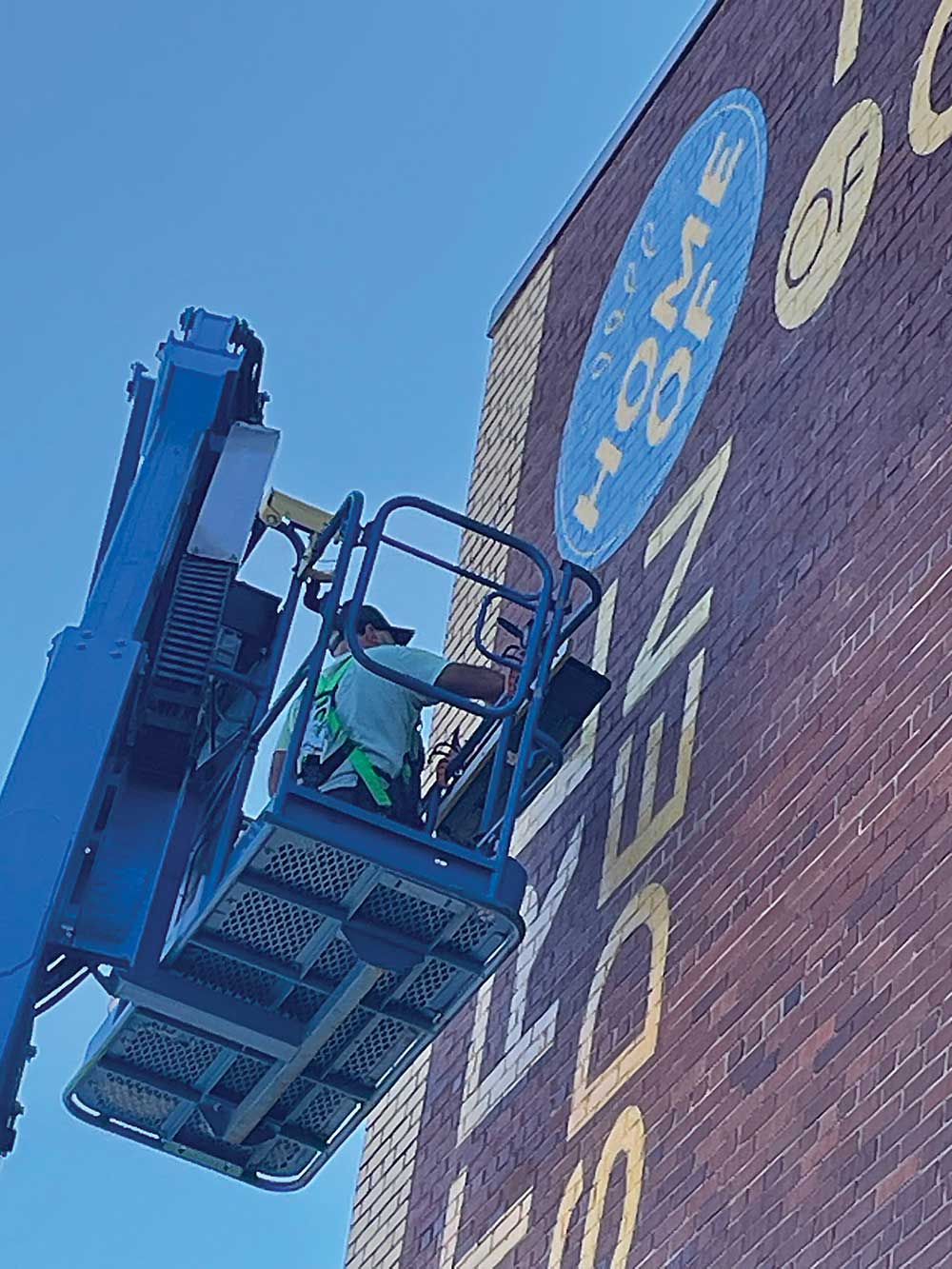
Under a blazing St. Clair County summer sun, Mallory Walls worked at her art, transforming a blank exterior wall at Small Town Blanks – a T-shirt shop – into an 11-foot brick canvas of patriotism, pride, military service and memory.
As Walls painted the work of art at the intersection of Cogswell Avenue and 20th Street North, motorists honked their horns or called out words of encouragement. Pedestrians came with ice cold lemonade or brownies. As she toiled on the orange scaffold, art became life in a small town.
Mallory at work
Some veterans stopped to say thanks. Others wept.
A country was celebrated.
Veterans were honored.
And with a single letter and two numbers, a local boy was remembered.
This story is about more than Pell City’s first downtown mural
The mural was commissioned by Michelle and Craig Tumlin to honor veterans, men and women close to their hearts. Their story is well known.
Their son, Houston Lee Tumlin served honorably in the United States Army. He was known to the wider world for his role as Walker Bobby in the Will Ferrell film, Talladega Nights: The Legend of Ricky Bobby. But to folks in Pell City, he was just Houston, a kid who “lit up a room,” his mother said.
But after his military service, Houston, plagued by CTE (Chronic Traumatic Encephalopathy), depression and post-traumatic stress disorder, Houston sadly became a heartbreaking statistic – one of the 22 veterans who each day take their own lives.
A decorated veteran, he died on March 23, 2021. He was 28.
Even as they walked through the valley of the shadow of grief, the Tumlins created Houston Project, a charity working to help veterans and their families.
Mallory Walls’ creation, funded by money raised at Houston Project’s recent gala, is just another way to honor veterans and their service and sacrifice.
The Artist and Her Art
Mallory Walls can’t remember a time when she wasn’t painting. She began art lessons in kindergarten. Her mother, Rachel Gilbreath, was also an artist who crafted murals.
Mallory got her first commission at 14. Her first mural, a casino-themed portrait for a Nashville, Tennessee, bed and breakfast came at 19. She’s painted more than 100 murals in her career.
“Ever since my first commissioned piece, I’ve painted a lot. I decided to go full time with art in 2024.”
Mallory signing her work
As for the Houston Project commission, Walls is a longtime friend of Craig and Michelle Tumlin and their family, attending Victory Christian School with their daughter, Hayden. As well as Pell City’s Victory Church.
“I got to know them through a small-group Zumba class at church,” she said of the Tumlins. “They commissioned a couple of pieces from me before, watercolor paintings.”
The process for the downtown mural began two years ago, to create a piece that honored vets. From the time she began painting, it took five days – 10 to 12 hours a day – to finish the 11 feet tall by 18 feet wide work of art. She completed it during one of the hottest weeks of the year, through rain and shine and off-the-charts humidity.
She had an umbrella to fend off the sun and rain and also got a helping hand from her cousin, Mia Holland, who helped her fill out the red and white stripes of Old Glory.
“I wouldn’t have been able to finish it in five days without her help. We really had to work to get in between the bricks coated. It paid off to be deliberate with it.”
The goal for the piece?
“We wanted to create a piece that was very timeless,” Walls said. “We wanted something that people could enjoy not just now, but for years to come. The message behind it was to honor our veterans who had done so much and the families of veterans. Most everybody knows a veteran or is related to a veteran. We wanted to let veterans know that they are seen and honored and that we are so thankful for them.”
More broadly, there is a deeper meaning. In the painting, a male and female soldier stand facing the Stars and Stripes with a smart salute, their backs to the viewer. It’s not known if the soldiers are Black, white, brown, yellow or red, Catholic or Protestant, Republican or Democrat. They are simply American soldiers.
“You can’t see their age. You can’t see their race. Everyone who knows or is a veteran can relate to it and be impacted by it on some level,” Walls said.
As she worked, townsfolk stopped to ask questions, or offer words of encouragement.
“Of all the murals I’ve done, I’d have to say this was the most community involved,” I got to meet so many people. I grew up around Pell City, but I met so many people and got to experience Pell City in a whole new way. Strangers were so kind, bringing me lemonade and brownies to keep me going. It was just amazing to see the community response. It was very special in that way.”
She added, “That’s one of the things I love about doing an outdoor mural is the community response. I love it … Even in the early days when it was in its ugly stage, people would come up, and I’d say, ‘You have to come see it when it’s done.’”
What does she hope townsfolk and visitors to Pell City take from the mural?
“I hope it tells veterans that we see them, we honor them, and we thank God for them.”
A Mom and H44
Michelle Tumlin has received a flood of messages – phone calls and social media posts –even the wife of a veteran who was moved to tears by the mural.
But she is quick to give thanks, to donors at the Houston Project gala, to Joanna Hagan and her son, Wayne, who own the building that’s home to the mural, to city officials like City Manager Brian Munger.
And she’s thankful for Mallory Walls, the artist.
Michelle Tumlin reflects for a moment at mural
“She’s very talented,” Tumlin said. “She’s done work for us over the years, and I knew there was no better artist to do this.”
The idea for the mural was an extension of the work of Houston Project.
“We’re a non-profit that helps veterans, but we also honor our son,” Tumlin said. “I’ve been brainstorming. I called Mallory and told her, ‘I see a flag. I see a male and female soldier saluting,’ and she made it happen.” Captioning the image were two words: “Never Forgotten.”
“It could not be more perfect,” Tumlin said. “I wanted it to be a mural that all veterans’ family members could go, think of their loved ones and have ‘that moment’ (of remembrance), you know. I think it has done that. Just the reaction of this town was … I felt like we were part of a patriotic Hallmark movie.”
Fittingly, the mural gives the Tumlins “that moment,” too. As Michelle remembers Houston, tears flow. And tucked in a spot on the mural are dog tags bearing a letter and a number. For the Tumlin family, every time the number comes up, it’s a message from their beloved son.
The letter on the dog tag is H for Houston. The number is 44, the number he wore on sports teams growing up.
“My heart is just beaming,” Tumlin said. “And I know Houston Tumlin is just smiling down from heaven. When I see that mural, I see my son.”
Story by Roxann Edsall Photos by Mackenzie Free Submitted Photos
To know him is to love him, say family and friends. They’re describing 15-year-old Caden Nelson, a young man with profound physical challenges but equally profound gifts. At first meeting, it will likely take a bit of effort to understand his speech, but his words pack such enthusiasm and joy, the effort is well spent.
Describing an encounter with Caden is like trying to describe light. He is both complex and simple. His thoughts are deep, but his activities are childlike. He is a beautiful combination of youthful exuberance and parental encouragement. He is both challenged and accomplished. He entered the world with a mountain of challenges before him, yet he describes the mountains with wonder and determination.
Caden patiently plays with little sister, Alyssa
Those who meet him are blessed by his ability to fill the room with joy. That joy comes from his appreciation for life and an intense gratitude for those who have encouraged him and who continue to support his journey. This is Caden’s story.
Caden was born prematurely at 30 weeks, weighing just over three pounds. His mother, Anna, was under the care of a maternal fetal specialist in Miami, Florida. Her prenatal testing had revealed that the baby was suffering from a bladder outlet obstruction, which required doctors to insert a shunt through the amniotic fluid to help his body flush fluids. A host of additional medical issues were discovered at birth.
“Caden was not expected to survive,” says Anna. “We were told when he was five days old and had gone for his first surgery that he would bankrupt us physically, emotionally, financially and spiritually. We knew about the bladder obstruction, but after he was born, we learned he had paper-thin abdominal muscles, neuronal intestinal dysplasia, prune-belly syndrome, scoliosis and kyphosis. The doctors said we should just let him pass away.” When Anna and Chad rejected that option, and Caden outlived the doctor’s expectations, doctors stopped issuing life expectancies.
Unlike most teenagers, Caden has never eaten a hamburger or grabbed a handful of cookies, never hung out with friends to share a pizza. In fact, he’s never taken a bite of anything. Neuronal intestinal dysplasia type B essentially means his intestinal system does not work. Because of that condition, he cannot digest food, so it is fed through a central line which goes through one of the veins near his heart.
All this, he takes in stride and doesn’t let it dampen his appetite for life. “Making people happy is a good day for me,” Caden says. He talks openly about his faith and his gratitude for life’s journey. “Jesus is like my first Dad before I met my Dad,” he adds. “He’s helped me all my life through all my surgeries on my back and with the halo surgery.”
It is difficult to imagine all the surgeries in Caden’s young life. They began with exploratory surgery at five days old, spinal fusion surgery at seven months old, more surgery at 10 years old to put rods in his back, which required a halo for six weeks to keep his back aligned so he could heal properly. After those rods broke, he required additional surgery to replace them.
In hospital with halo
“He can walk but has a walker and a wheelchair to help sometimes,” says dad Chad. “If we are going somewhere like the zoo or the mall, we take the wheelchair. If he just needs to walk from the house to the car, he can use the walker.” Anna adds that it is crucial that he not fall, so they must be very careful.
“He has some breathing issues because the scoliosis and kyphosis caused restrictive lung disease,” explains Anna. “If he gets sick with a cold or something, it’s harder for him to get over it.” You wouldn’t know it on a typical day, though, she says, other than he gets winded walking any distance.
Most days, he doesn’t walk far. School comes to him in the form of Anna’s cousin, Kyla Dunn. Everyday Lala, as he calls her, comes to the house to take care of him and his younger sister, three-year-old Alyssa, while Chad goes to work as a firefighter. Anna does contract work as a speech therapist.
When Alyssa goes down for her nap, Lala and Caden, who is in 9th grade, get to work. “Initially, I was just going to help a couple of days a week,” says Kyla. “But I was needed, and I believe with all my heart that this is the ministry God put me in. I’m grateful for every day we have.” Sitting on the arm of her chair and beaming at her, Caden says, “I love school, and I love Lala. We’ve been together almost 13 years.” He says he wants to be a caregiver like Lala when he grows up.
“We’re just happy to be celebrating another birthday with him,” Anna adds, talking about his summer birthday. “He still picks out what kind of cake or cupcakes he wants. He just can’t eat them.”
Usually given the choice to have a birthday party or to go on a trip to celebrate, most often he chooses to travel. He’s been on many trips that coincided with out-of-town specialist visits to New York City but has also taken the Christmas train out of Blue Ridge, Georgia, gone to both Disney World and Disneyland, and last year went to Branson, Missouri and rode the train to the Ozarks.
“We try really hard to give him all the experiences we can,” Chad explains. “His pediatrician asked him recently if there was anything else he wants to do that he hasn’t done already, and he couldn’t think of anything.”
One thing Caden checked off his list recently was being baptized. He’d never done it because, even though he had professed his faith, there was a problem, and its name was water. Because he receives his nutrition through the central line in his chest, known as a TPN (total parenteral nutrition), that line must stay dry to keep from getting an infection from bacteria. For that reason, he’s never been in a pool, a lake or a bathtub.
Paulina and Dan Gilliland and Caden’s dad, Chad, assist with baptism
Never shy of a challenge, Caden insisted on baptism by immersion. “I wanted to do it right, the way God wants it to be,” says Caden, adding, “Mama was terrified because me and water don’t mix well. But I took it like a pro.”
“It was definitely a challenge,” says Chad. “I used Tegaderm (a waterproof wound dressing) under his line, put gauze over it, then covered it again with the Tegaderm so it was double layered.” This milestone made for a perfect gift for Dad, as it occurred on Father’s Day. A photo of the special event shows a very proud Caden in a victory pose after coming out of the water.
Anna and Chad are intentional in doing their best to give him experiences like those available to their younger children, 11-year-old Luke, 7-year-old Jacob and 3-year-old Alyssa. They also hold him to the same rules. “He just got ungrounded yesterday and got his PlayStation back,” says Anna. “In the beginning, I was worried about getting on to him, but now he’s held to the same standards as the other children.”
Anna says he knows he is different and that there are things he cannot do. “Regardless of his situation,” she says, “he stays so positive.” Chad echoes the admiration for Caden’s positivity. “Caden has changed my life. With him sharing his positive attitude and love for Jesus, he’s definitely made me a better person.”
Another trip to New York for doctors’ visits
“He is just very sweet and rarely has anything negative to say,” says Anna. “He normally doesn’t complain of pain or anything like that.” Chad agrees. “When he comes in the room, everyone is excited to see him. He loves to laugh and has a great sense of humor.”
His favorite things are trains, video games, his dog, Cooper, and his family and friends. Caden also loves singing and dancing and has recently sung a solo in church. The chance for the family to be in church together is a recent joy for Chad and Anna. First Baptist Church Pell City added a special needs class to their offerings this past year, allowing the family time to worship together while making sure Caden had opportunities that fit his needs.
Going to his class makes Caden smile. Dan Gilliland is one of his teachers at church, and he can’t say enough about being with Caden.
“He always gives the other students the best markers and serves others first,” says Gilliland. “From the minute he joined the class, he changed the lives of everyone in this class and all who meet him. Aside from my mother, no one has impacted my life by showing the way Jesus wants us to live more than Caden Nelson.”
Gilliland has a message for others. “If you get a chance to meet him, do it. He’s a joy, and he will pass some joy to you!”
And you’ll likely get a hug.
Tina Stallings and Winford Hill work with Caden in class
Special Needs Class First Baptist Church Pell City
Story by Roxann Edsall Photos by Mackenzie Free
When Dan and Paulina Gilliland started attending First Baptist Church Pell City over four years ago, they knew they wanted to be a part of a ministry that benefitted families with special needs. Dan had 40 years of experience working with special needs youth and adults in Shelby County and in Mountain Brook schools and as program director at Easterseals Camp ASCCA. Paulina, a registered nurse, worked with him at Camp ASCCA for several years.
The church leadership had been working on putting together a team to offer a special needs class, and the fit was right for the Gillilands to help support that vision. For nearly a year now, special needs students have had a place where they fit in, a place focused on meeting the needs of individuals with varied abilities. The class is regularly attended by three to four students.
“My wife, Paulina, is the core, the lifeblood of the class,” says Gilliland. “She holds everything together, gives us all assignments for the week.” Four other dedicated teachers – Jennifer Jensen, Joe McGaha, Winford Hill and Tina Stallings – round out the volunteer staff.
Chad Nelson is parent to one of those students and he describes the challenge of attending church prior to this class offering. “When they started the class, it allowed Caden to have a place, a group of teachers and friends that he loves and is excited to see,” explains Chad. “It allows Anna and me to attend worship, just the two of us without kids.”
Anna Nelson adds that other churches never seemed to “fit” their family. “It just never felt like there was a place that fit all of us,” she adds. “But I don’t think that population is being overlooked intentionally. Unless people are in a situation where they have kids with physical or mental limitations, that group gets overlooked inadvertently. This program at First Baptist could be a great outreach program for the community.”
For more information or to enroll your student in the class, email Rev. Chris Dewaal, minister to children and families at cdewaal@fbcpellcity.org or call the church at 205-338-9444. The class is held each Sunday at 10:30 a.m.