Kayak fishing

Story by Roxann Edsall
Submitted photos

Sitting out on the dock sipping your first cup of coffee, you watch the morning sun begin to cast a pinkish-orange glow on the water. Absorbed in the majesty of the morning, you startle as you catch the movement of the boat as it silently glides by just yards away.

 Silent, that is, until the snap of the line as it is cast again, all the while drifting past the dock.  Almost immediately, he jerks the line and reels in the prize. After a moment to inspect and admire his catch, the angler releases the fish off the side of his kayak.

Kayak fishing has exploded in popularity in recent years, thanks to huge improvements in materials, technology and available accessories. Fishing tournament organizers have even created competitive tournament series specifically designed for kayak anglers. Since having no live well makes transporting live fish to a weigh-in problematic, new rules were created for kayakers.

Kayak-specific tournaments and most tournaments with kayak divisions use cumulative length, rather than weight, as the unit of measure. Competitors in kayaks are often governed by the CPR (Catch, Photograph, Release) Rule, which includes catching, photographing the fish on a special measuring “ketch” board, then immediately releasing the catch.

Allen Norris and his catch

The evolution of the kayak from simple shell to tricked out vessel, loaded with fish-finding tech and gear storage has helped to define the growth of the kayak fishing industry. Technology and electronics originally developed for bass boats have been redesigned, and in some cases, retrofitted for use in kayaks. Live scope electronics can be added to fishing kayaks, too.

Arguably, the biggest development propelling its popularity has been the application of pedal drives to the hull, allowing the kayak to be moved through the water without the need for a paddle. The hands-free option allows anglers to cast and reel without having to switch to a paddle to maneuver the kayak.  As anglers are known to say, it’s a numbers game. And more casts equate to more fish.

“There are so many options when choosing a kayak,” says Allen Norris, co-owner of Cropwell’s Yak Shak and veteran kayak angler. “When you see something labeled fishing kayak, lights should go off to let you know it’s going to be more comfortable, more stable, and be able to carry more gear.”

He and Jessica, his co-owner and wife, ask a lot of questions of potential buyers to make sure they get them into the right kayak. Buyers will likely need to do a bit of research to be prepared to answer those questions, which would likely begin with what you want to do in your kayak and whether you’re looking for a sit-in or a sit-on type design.

The sit-on design, according to Norris, is more stable and many models are large enough to allow stand-up fishing. Also, with sit-on designs, there is no worry of taking on water, as they are designed to allow water to flow over the top and to drain through scupper holes.

After having the pedal/paddle, sit-in/sit-on, stand up/sit down discussion, then comes the question of motor versus muscle. Fishing kayaks can be fitted with small trolling motors, if desired, although Norris admits to being a bit of a purist. “When I’m kayak fishing, I want to be as tactical and stealthy as possible,” he says. “I don’t want to put more in the water than I have to. If you’re into lots of vegetation and stumps, you can’t use the motor anyway.”

Jessica Norris’ catch of the day kayaking on the Coosa

In a sit-in kayak, be prepared to use a different set of muscles while casting, as opposed to those you’d use performing the same activity while standing. “Casting and aiming are very different when you are sitting,” says Norris.

 “It’s very strenuous.  A lot of people would describe kayak fishing as intense.” Being so close to the water and to the fish adds to the intensity of the fishing experience, Norris explains. “You can get close to the nooks and crannies that boats can’t, places where the fish really are.”

Adding to the excitement, he says, “You feel every movement on a catch in a kayak. You can also see the movement of wildlife and fish along the shore as you move through the shallow areas in coves and among boathouses and piers. Kayaks are perfect for wildlife photography, for exercise, and for just getting out and enjoying the water,” he adds. “The tranquility and therapy are very real.”

Josh Tidwell agrees wholeheartedly. He’s a huge fan of kayaking and fishing. He’s combined the two for more than 25 years and now runs a kayak rental and tour company at Big Wills Creek, a tributary to Neely Henry Lake. “It’s quite a bit of fun,” he says. “You get to be out in nature and even if you’re not catching, you’re still enjoying nature.”

Tidwell, an accomplished tournament fisherman, began fishing nearly three decades ago from creeks and riverbanks, either wading or by canoe. Kayak fishing made it easier for him to get to the tight places he wanted to fish. “Bass boats can’t get to where I go,” he says. “I like to fish smaller waters. I don’t want to look at the back of somebody’s house, when I could be looking at cliffs or waterfalls.”

Although he says he likes small water fishing, he says, kayaks are not just for lake fishing. He took his kayak to Gulf Shores a few years ago and hooked a 6-foot shark. His brother-in-law caught a 150–200-pound tarpon.  For reasons which seem obvious, they did not try to bring it aboard their kayaks. “We got dragged all over the place. That’s part of the appeal,” he laughed. “You just have to prepare for it. And don’t go alone!”

The Coosa River system offers a variety of fish, from crappie to catfish, to several species of bass, including the Alabama bass. “On Logan Martin, I’ve pulled in a 15-pound channel catfish in my kayak,” says Norris. “I’ve seen a 50-75-pound catfish pulled in, unfortunately not by me.”

Strategies for success in kayak fishing are somewhat different, Norris explains. “We attack fishing in a very different way. We don’t fish the open waters as much as we do the tighter places. Where the bass boat world is launch as fast as possible, get to your spots as fast as possible, and cover lots of water. We might launch and stay near that launch fishing the harder to get places and cover only a mile or two.”

No matter what type of vessel you use or how you fish, all nautical rules apply. Kayaks are no exception. Before sunrise and after sunset, kayaks must have a stern light. The same holds true for red and green navigation lights. These are especially important for kayaks, which sit lower in the water and are harder to see.

Equipment add-ons for safety and for convenience and comfort make kayaking an activity perfect for anyone ages 5 to 95. Your grandpa’s kayak may have given you the inspiration to learn, but it is definitely not the only design option anymore. Today’s kayaks are lighter and stronger. They offer options in how they are propelled, how you fit into it and how you maneuver it. They can be outfitted for whatever activity you want to do on the water.

A final reminder that whatever fun you’re having in a kayak, be sure to remember safety is paramount. Alabama law requires all boaters, including kayakers to have a personal floatation device onboard for each occupant.

While it’s not required that boaters wear them, it’s a good idea. It’s also a good idea to always include water, a hat, and sunscreen in your float plan.

You may catch a beautiful sunrise, too, so don’t forget your camera. And give a wave to the lady sipping coffee on the dock as you drift by.

Lighting the way for kayaking

Chad Watts knows all too well how hard kayaks are to see in the dark. Several years ago, while fishing in a tournament on Lake Jordan, he nearly ran over a kayaker.

They were fishing at what is considered “safe light,” just as it is getting light enough to see, but before the sun has risen. “I was running 75 miles an hour toward a wide cove. There was a piece of land that jutted out about 30 feet, so I couldn’t see around the other side of it until I got almost even with it,” said Watts.

“By that time, I was doing about 60. When I came around, there was a kayaker 20 yards from my boat. How I avoided running completely over the top of him, I don’t know. I was so rattled, I couldn’t fish.”

Watts went to check on the kayaker and wound up talking to him for 30 minutes (in the middle of the tournament). What came from the experience was a friendship and a product that makes kayak fishing safer.

Watts started Firefly Marine, a company out of Trussville, that produces the Firefly stern light. The difference in their product over what was available previously is both the height of the light (telescopes to over 9 feet) and the material of the light (refracting plastic to eliminate blinding light).

Pell City Rotary

As most pivotal moments in history have their roots, this one began with a ‘what if?’ What if a group of business and civic leaders formed an organization that would work as a team to serve their community?

The notion that these men could work together to give back to the community that had served them so well individually sparked the founding of Pell City Rotary Club, a story of service that has unfolded over the past 50 years.

Just take a look around, and Rotary’s good works are easy to spot. The new park benches throughout historic downtown are courtesy of Rotary. So is the cutting-edge recording studio for Museum of Pell City’s Living History program.

Dozens of students have furthered their education with college scholarship awarded by the club, and the Sheriffs Boys Ranch has a new home and more because of Rotary’s efforts. The Love Pantry’s shelves are stocked for feeding those in need, and the Children’s Place Child Advocacy Center comforts children at their most vulnerable moments in life.

Jingle Bell 5K Run at Lakeside Park

Those in need of health care but unable to afford it, find it at St. Clair Community Clinic, yet another entity supported by Rotary.

The list is seemingly endless. Good causes – large and small – have Rotary’s helping hand behind them. Echoing through the heart of it all is the club’s motto, “Service Above Self.”

“That’s why we do what we do,” said President Kelly Furgerson, who represents a continuation of a part of the club’s history herself. Rotary was once a ‘men only’ club. June Brascho broke the gender barrier as the first woman member and later president in the 1990s, and Furgerson follows in her footsteps as the sixth.

“It is an honor to serve in the community in which we live,” said Furgerson. “Each day, we have an opportunity to do good individually and together as a club. The Pell City Rotary Club is made up of people of action who want to make our amazing community better one project at a time.”

How do they do what they do?

Rotary works beyond its own boundaries, bringing the community together to further its good causes. The money raised through these events provides the foundation for so many worthwhile projects throughout the community.

The Father-Daughter Dance is one of the most anticipated events of the year with daddies and daughters making lifetime memories on their special ‘date night.’ Led by Rotarians Blair Goodgame and Meg Clements, the dance venue is magically transformed into its colorful, imaginative theme, whether it be Candyland, fairy tales or lighting up the festivities with Glow Crazy.

The club’s tennis tournament in October each year could be called ‘spooktacular.’ Just in time for Halloween volunteers and competitors dress up for the occasion, making it a fun time for all. Meg Clements leads the effort.

Rotary’s Ray Cox Memorial Golf Tournament brings golfers, sponsors and volunteers together in a fun, sporting event at Pell City Country Club that continues a longstanding tradition of 42 years of service. Joe Paul Abbott heads this major fundraiser that has made so many charitable projects possible.

New to Rotary is the Jingle Bell 5K Run and 1-Mile Fun Run/Walk. Led by Rotarian Bill Ellison, this event raised $65,000 in 2023 to help build a new home at St. Clair Sheriffs Boys Ranch. Set for Dec. 14, the run is through Pell City Lakeside Park and this year, it will set its sights on raising funds for Boys Ranch and a number of other charities throughout the community.

Why join?

Rotary continues to grow its membership roll, seeking business, government and civic representatives to join their movement to make their community a better place.

It’s all about community service – seeing a need, rolling up your sleeves and working to fill it. That’s Pell City Rotary Club, Where Leaders Meet. l

Editor’s Note: If you’re interested in learning more about Rotary or applying for membership, go to: pellcityrotary.org.

Partnership for success

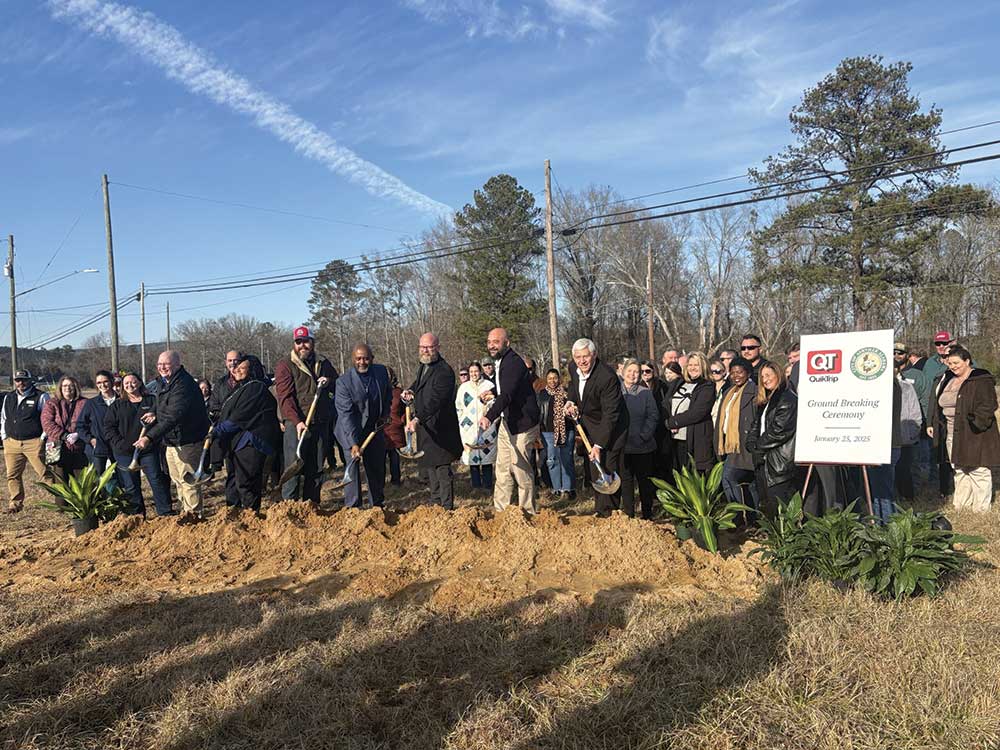
A partnership between the City of Springville and the St. Clair County Commission to buy 250 acres of land to use as a commerce park is expected to deliver a sizable return – $500 million in investments from new companies employing 1,500 people.

The planned commerce park is located east of Wal-Mart and will be accessed from the County 23/I-59 interchange. “This will minimize any traffic impact while providing a location for quality companies to build and employ people from the surrounding area,” said Don Smith, executive director of the St. Clair County Economic Development Council. “The less we must drive for good paying jobs the better it is on the overall traffic congestion in the region.”

Further along in the development process, Kelly Creek Commerce Park is also on the receiving end of SEEDS grant, which will help run sewerage service to the park.

The EDC and St. Clair County Industrial Development Board are working with both partners to obtain grants and outside funds.  “Our focus is to minimize the local funds being invested into the parks but at the same time, develop a park that will provide jobs and taxes for decades.” 

 This park will be the only rail-served park in St. Clair County for new companies to locate.  “There are fewer and fewer rail sites in Alabama, and this park will give the I-59 corridor a recruitment advantage,” Smith predicted.  “We target advanced manufacturers in food production, automotive supplier and advanced metals.”

Based on the acreage and target sectors, “We believe we will be able to recruit multiple companies into the park,” Smith said.

The initial effort was boosted by a SEEDS grant that provided $2.1 million for the purchase of the property. The remaining funds needed were split between the county and city.

The SEEDS program was launched in 2023 to provide state funds to purchase and develop competitive properties for the state’s target sectors in Alabama.  The funds have a 50 percent local match with smaller communities and distressed counties a lower local match. 

In addition to the Springville grant, the EDC was able to obtain roughly $400,000 to run sewer to the new Kelly Creek Commerce Park, a similar project in Moody.  “It was the only missing piece of infrastructure needed to make the park complete,” Smith said.

Officials in Moody cut the ribbon on that 170-acre park in early 2023, and it is expected to generate 1.5 million square feet of distribution facility space and $125 million in investments in good paying jobs.

Looking ahead, the economic forecast for the county continues to be bright, Smith said. “We are in the running for a few manufacturing projects in Moody and Pell City.  I also believe we will have several impactful retail projects to announce in the upcoming months throughout the county.”

He credited residential growth as the factor “now catching the eye of many retailers that just 10 years ago would have passed on us.  They see our growing household income and job creation numbers and are ready to invest in St. Clair County.”

A local look at new rules for Realtors

Story by Carol Pappas

There’s more to being a Realtor than opening a door and showing a home, and a settlement by the National Association of Realtors that took effect Aug. 17 is being viewed as a means of demonstrating just that.

The suit centered on the nondisclosure of a buyer’s agent commission when a house is sold. The commission for agents for the buyer and the seller was shared, averaging about a 6percent split. As part of the settlement, the commission for the buyer’s agent and the seller’s agent are no longer shared when a home is on the Multiple Listing Service

“This is not a bad thing,” said ERA King CEO Josh Wright. “It’s us being more transparent in dealing with the client.”

Basically, the seller’s price increased to cover the total commission, and it appeared the buyer’s agent was working for free.

Now Realtors disclose who is paying and how. “Commission was always negotiable, it’s just more transparent is all as an industry we’re doing,” Wright said. A real estate agent is not part of the contract. The agreement is between the buyer and seller, and the commission is part of that agreed upon price.

Since the requirements of the suit have gone into effect, “we haven’t seen much disruption,” he said. As the trainer for ERA’s sales force, he stresses that they need to understand their own value to the process and relate that to the client.

He pointed to the over 100 services Realtors provide to their clients. Some of the key services include property valuation, negotiating the contract, marketing the house – a sizable cost and undertaking – overseeing the inspection process to make sure it is done thoroughly and facilitating appraisals.

Wright, whose background is in finance, sees the outlook for the housing market in a positive light. The Federal Reserve cut interest rates by a half point in September, which will have a good impact on financial markets, but it’s not expected to impact mortgage rates significantly in the immediate future. A better indicator, he said, is the 10-year treasury bond. Mortgage rates follow that trend.

Over the next 12 months, he expects mortgage rates to slowly drop, probably into the 5.5 percent to 6.25percent range. In the fourth quarter of 2025 or into the first quarter of 2026, he anticipates mortgage rates to be in the high 4percent range.

Rates would need to get into the 5percent to 5.5percent range “before it starts booming again. It’s closer to a buyer’s market right now.” A buyer’s vs. seller’s market is determined by how long a house is on the market. When it’s less than six months, it’s a seller’s market.

“We’re closer to a buyer’s market,” Wright said. “We’re starting to see things getting more normal.”

During the COVID pandemic, new construction “went away,” he said. Now it’s coming back in significant ways. In St. Clair, much of the growth is due to large builders developing subdivisions with a high number of homes and having the ability to offer their own mortgage rates in the 5.5percent range.

It’s still good news, Wright reasoned. “Overall, it’s the sign of a healthy market and a great one for our local economy.”

Life is rarely predictable

In fact, it’s littered with so much uncertainty it’s really best not to form any preconceived ideas or make too bold of assumptions about what the future holds. Because the truth is…  You. have. no. idea. 

You will walk through things you never thought you would.  You will find yourself in situations for which you absolutely can’t prepare. You will be forced to make hard decisions you never thought you’d have to make. You will make false friends and feel the sting of their ulterior motives. You will be humbled and have your heart broken. You will try and fail and face unexpected consequences and disappointments.  You will lose people you love and thought you’d get to keep forever. 

But you will also find love and unshakable friends. The right people stay, and the wrong ones will go. You will find grace and forgiveness are the best gifts you can give and receive.  You will learn grit grows best in tough times, and trials really are the best teachers.  You will find light in dark places and compassion in the eyes of hard faces.  You may find your broken heart held together by unexpected hands and mended in ways you can’t really comprehend. 

And just as soon as you start to assume you’ve got a solid grip on your life … 

It will shift and surprise you all over again.

– Mackenzie Free –

Wife, mother, photographer & current resident of the unassumingly magical town of Steele, Alabama