Sewing Machine Mart

Story by Elaine Hobson Miller
Photos by Richard Rybka

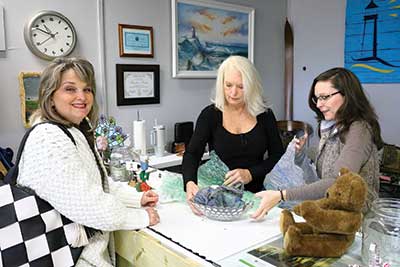
Kathy Hymer drives up from McCalla to Springville for computer classes. Sheila Lankford drives down from Attalla for quilting classes. Both say it’s worth the miles for what they learn at the Sewing Machine Mart, a relatively recent addition to the Springville Station strip shopping mall.

“I’ve taken jelly roll race-quilt classes (so-called because the quilts work up quickly), crazy-quilt classes and a three-yard quilt class there,” says Lankford. “I love the Sewing Machine Mart.”

Hymer echoes the sentiment. “They’re great. I can’t say enough about them. I’ve taken (sewing machine) computer classes and quilting classes. Every machine I own has been purchased there.”

Shawn and Heidi

The Sewing Machine Mart originated in Tarrant in 1950, then moved to Homewood, where it remained for almost 30 years. Shawn Jackson, who owns the store with his wife, Heidi, started there in 1994, while he was working as a Birmingham firefighter. “I went there as a technician,” Shawn says. “I knew nothing about working on sewing machines but had always been a Mr. FixIt.” When the original owners retired In 2002, he bought the store.

About five years ago, the Jacksons moved to Gallant, and drove back and forth to their store in Homewood. “I pay attention to things and kept my eyes open for a place for the shop after we moved up here,” Jackson says. Then they got word that the building they rented had been sold and was to be torn down to make way for a restaurant.

So, in January 2022, they moved their store to Springville. “My wife shopped at stores in this mall, and we ate in restaurants around here, and one day we spotted this place,” Shawn says. “It’s where the old ABC store used to be.”

Rows and rows of liquor bottles have been replaced by rows and rows of sewing machines that do everything but talk. And some may soon do that. There are more than 40 on display, including a long-arm quilting machine and a couple of multi-needle embroidery machines.

Prices for the four brands they carry — Pfaff, Husqvarna Viking, Baby Lock and Singer —- range from $180 to $24,000.  At least one machine is wi-fi enabled, so you can buy a design online and download it to the machine. It also has a built-in electronic tablet on one side.

“It’s amazing what technology is doing with sewing machines these days,” Shawn says. “I can remember when the first embroidery machine came out. It could do a 4 x 4-inch piece of fabric, and now we have machines that can do a 14 x14-inch piece. One of our Pfaffs has Artificial Intelligence. I’m not sure what that will mean, but I anticipate the customer being able to add new features to it, and AI will learn them. That machine also has a camera and built-in wi-fi.”

He doesn’t wince at some of the high prices, comparing them to the cost of hobbies such as golf and fishing. Women sometimes come in and tell him, “My husband just spent $50,000 on a boat, I think I can spend $20,000 on a sewing machine.” He does, however, advise potential customers to have a budget in mind before they come in. “We’ll help you find the most for your money,” he says. “You may still wind up with more than you can use, but you will grow into it.”

Most of the store’s customers are hobbyists that Jackson describes as “memory makers,” turning shirts, pants, ties and tees into quilts, for example. “Probably 20 to 25 percent of our customers, though, have some type of sewing or embroidery business, often in their homes.”

He believes sewing is more than a hobby now. It’s an art form. “It’s not just about making clothes for your kids,” he says. “Your imagination is your only limitation. We have some Cosplay customers, people who dress up in costumes to play video games and do other role playing.They’ll sometimes buy clothes at the thrift store and go home, take them apart and re-make them into a costume for Comicon.”

The Sewing Mart had no space for fabric in Homewood but started carrying some when it moved to Springville. They also carry storage cabinets, sewing machine tables, cutting tables made by a local man and notions (scissors, thread, needles, etc.). “We service all makes and models of sewing machines, with a one or two-day turn-around on repair jobs,” Jackson says. “We sharpen scissors, too.”

Some of their classes are machine or software specific, so a customer can get the most out of a new purchase. They offer several quilting and sewing classes that usually take four to seven hours on the same day, and cost from $25-$150. Some come with kits, others require a customer to bring her own materials. They offer summer classes for youth when there is a demand for them, although they didn’t materialize the summer of 2023 due to scheduling problems.

Courtnay’s quilt top

While Shawn teaches the get-to-know-your-machine classes, most others are taught by customers. Students make tote bags and cosmetic bags, learn how to bind quilts and how to do alterations. “We’re always looking for new teachers with new techniques,” Jackson says. 

Customers come from all over Alabama, including Prattville, Auburn, Wetumpka, north Alabama, and from the surrounding states of Mississippi, Georgia and Florida. “Some lived near Homewood, but moved away, while others heard by word of mouth that we work on machines,” he says.

Kathy Hymer of Bessemer bought a 10-needle embroidery machine, a serger and a Pfaff Icon from the Sewing Machine Mart. The Pfaff Icon has a built-in computer and computer tablet. “I can send patterns over the Internet directly or through my laptop, or I can use a USB stick to transfer patterns to the machine,” Hymer says.”

She uses a program called mySewnet that she purchased from Shawn and Heidi to turn designs into patterns for embroidery machines. “I’m in an RV club, and I’ve taken pictures of my friends’ RVs, put them into this program and turned them into embroidery designs that I put on garden flags for them,” Hymer says.

The three-yard quilting class was especially fun for Hymer. “We picked out three yards of fabric we liked, and the Jacksons did the cutting beforehand,” she says. “You use the same pattern as the other people in the class, but depending upon the fabric, each quilt turns out completely different. We did a quilt top, we held them up and compared them when we finished. It’s a lot of fun to see what each person has done.”  Hymer traded with The Sewing Machine Mart when it was in Homewood and doesn’t mind the drive to Springville. “I keep going because they’ve added fabric and because there’s so much more going on since they moved out there,” she says.

Lankford has made at least 10 jelly roll race quilts since taking the same class as Hymer. “I call them comfort quilts because I make them for friends and relatives who are sick,” she says. “They are about the size of a twin-bed quilt. I’ve also taken binding classes to learn how to bind a quilt after I put it together. “

A crazy-quilt class resulted in Lankford making a table runner, which her granddaughter is now enjoying while studying at the University of Alabama. “I’ve taken what’s called a three-yard quilt class, and I’ve made three of those. I’ve made jelly roll quilts for all my grandchildren, and I’ve just finished one for a friend who is special to me because he’s awaiting heart surgery. He’s a veteran, so I made it in red, white and blue and embroidered on it, ‘God Bless America.’ He told his wife it was his Linus quilt. It will be with him in the hospital.” Also, She worked on one for a giveaway on Attalla Heritage Day to benefit the Museum of Attalla.

She credits Shawn for taking care of her machines and Heidi for selling her beautiful fabric. “Sometimes Shawn tells me there’s nothing wrong with my machine, just with the ears of the operator.”

Polar Plunge

Story by Carol Pappas
Photos by David Smith

Whether it looked like a leap of faith or a deep dive, what clearly surfaced on Logan Martin Lake New Year’s Eve Day was a small, but enthusiastic group of Polar Plungers determined to raise awareness and support a good cause – helping veterans.

The invitation went out on social media for what was billed as the First Annual Yeti Plunge. “The event is dedicated to the remembrance of military members we have lost to suicide and to bring suicide awareness to the local populace.”

A couple of dozen brave souls navigated the icy cold waters in the first Polar Plunge while a group of onlookers – a bit too reluctant to even put a toe in the water – lent moral support, cheering them on. They splished. They splashed. And they seemed to emerge as one big, continuous smile stretching across all their faces.

Taking the plunge

With the plunge, it brought on a sense of accomplishment. “It was a challenge,” said Terry Harrell of Cropwell. “I thought this was a pretty good cause.”

Catrina Cedotal agreed. To her, it was a sense of understanding. “My husband is a Marine veteran. My son is medically retired from the Army.”

Their cause? Project Absolution, a nonprofit effort to help veterans transition through returning home by taking the path less traveled – offroad. The project is a part of a group of veterans called Absolution Offroad, which is now 1,500-strong from multiple states.

Chase Poland of Riverside, who founded the project, is an Iraq War veteran. “It took me years to get myself together” after the war, he said. A buddy got him interested in offroading, and he saw that experience as dealing with what came next in his life, “helping me get through stuff without medication.”

They wanted to turn that experience into helping others just like them. It earned the name when Poland was reading Sun Tsu’s The Art of War. In it, he came across the word, “absolution.” Its meaning was a perfect fit – “a form of relief from one’s past, forgiveness.”

He named his Jeep, a specially-rigged offroad vehicle, Absolution, and the offroad group that followed bears the same name. Now comes another evolution for the name – Project Absolution – which seeks to get veterans out into the woods, experiencing the outdoors and new adventures. Under the umbrella of a its pending nonprofit, they hope to expand the adventures into hunting and camping and paramotor excursions. All expenses are paid for by the donor-supported organization. 

The veteran community who rides calls it “a breath of fresh air to have something like this in Alabama,” Poland said. It is an effort to reverse the suicide rate among veterans, which has become alarmingly high – nearly 17 veterans take their own lives every day.

What Absolution Offroad finds is that getting them out of their homes and into these rides helps them deal with the aftermath of war. It’s as if they get home from service and retreat into themselves. “They build their own unit,” Poland said.

Absolution Offroad provides a bridge leading out from inside the walls they build around them. Riders and members now come from all over, from places like Alabama, Florida and Georgia to join the camaraderie and the challenge of offroading on trails from Stony Lonesome to Top Trails Cheaha and the Talladega National Forest to Chief Ladiga Trail.

Those who don’t have an offroad rig are equipped with one free of charge. The aim is to remove any obstacles en route to their offroad experience and along the way, the hurdles of life after war.

“We want to curb veteran suicide,” Poland said. “We want to make a difference in this world.”

Editor’s Note: To donate to Project Absolution, you may do so through Cash App. The account is $projectabsolution.

Healing hands of St. Clair

County has a long history of medical excellence

Story by Joe Whitten
Submitted photos

St. Clair County throughout its history had a thriving medical community with doctors practicing medicine in all parts of the region. Many of the names are familiar to this day, stemming from their descendants perhaps or a particular road or place in the county that bears their name.

They were pioneers in the county’s history, and a sampling of the details of their lives gives a glimpse into who tended to the medical needs of St. Clair’s early settlers.

DR. WILLIAM A. BEASON

Dr. Beason was born in 1867 to Rufus and Carrie Ann (Staton) Beason in St. Clair County and was the eldest sibling of Flora (Beason) Montgomery, George D. Beason, Charles W. Beason, Martin V. Beason, and Sidney L. Beason. He was also the great grandson of St. Clair County pioneer Curtis Grubb Beason and the great-great grandson of American Revolutionary patriot Capt. Edward Beason.

On Oct. 30, 1901, with Rev. Noah A. Hood officiating, Dr. Beason married Ms. Lillie Eugenia Phillips at her family home, known today as the Phillips-Cunningham House.

The bride was the daughter of James Madison and Elizabeth (Yarbrough) Phillips and the granddaughter of Littleton Yarbrough. The couple lived for many years in the Byers-Prickett House with Mrs. Beason being noted as a gracious, Southern hostess.

“Dr. Beason was loved and respected by all who knew him intimately and was a man of strong convictions and always outspoken for things he believed to be right.” He was known to never drive over 35 miles an hour. When asked why he didn’t drive faster, he would always reply, “At 35 miles per hour, a car is still cheaper to run than a horse.”

Of his beloved wife it was said, “No man ever had a nobler and more helpful companion. She knew his work and helped him in its performance in many ways.”

Mrs. Lillie Beason “was widely known over the state. She took great interest in educational affairs” and always remained active in supporting “many movements for the betterment of her people.”

For several years she held the office of chairman of the St. Clair County Board of Education, earning her the noteworthy recognition of being the first woman elected to office in St. Clair County. “She was also president of the Baptist Missionary Union and a leading member of the Ashville Chapter of the United Daughters of the Confederacy,” and “was a brilliant woman… (with) many cultivated talents.”

Both were laid to rest in Ashville City Cemetery.

DR. JAMES MADISON McLAUGHLIN

Dr. McLaughlin was born in Leeds in Jefferson County on March 22, 1838, to John and Margaret (Brinker) McLaughlin. The doctor’s father was an early settler of the State of Tennessee and was the son of Alexander Andrew McLaughlin, who had emigrated from Scotland to Tennessee.

James attended public schools and later read medicine with Doctors Robertson and Freeman in Springville. He later attended Atlanta Medical College, now the Emory University School of Medicine. During this time, he enlisted in Company C of 18th Alabama Regiment, CSA and was soon afterwards promoted to Captain. In 1864, he was promoted to lieutenant colonel and held that position until the close of the war.

Dr. James Madison McLaughlin

On Jan. 4, 1871, James married Isadora Forman, the daughter of James and Parthenia (Dean) Forman. The bride’s father was noted as taking a “… leading part in all matters and issues in which people were interested,” and being “… true and energetic in behalf of his friends…”

The bride’s mother was the daughter of Nathaniel and Parthenia (Edmundson) Dean, and the granddaughter of Benjamin Edmundson, a Virginian patriot who fought for independence as a lieutenant in the American Revolution. In her obituary, Mrs. Forman was remembered as “… always cheerful…” and “… a faithful and affectionate wife and mother,” who was “… thoughtful of every interest of her children…”

In 1875, the doctor opened a pharmacy and two years later welcomed his only child, Katherine, into the world on March 27, 1877. She would later marry Jacob Forney, a president of Jacksonville State University, who was the son of General John Horace Forney and nephew of Alabama U.S. Rep. William Henry Forney.

It could never be said that Dr. McLaughlin did not live a full life. During his 70 years, he was a member and elder of the Presbyterian Church, a Mason and Knight of Pythias, Mayor of Springville three times, examiner for the New York Life Insurance Company, the Penn Mutual Life Insurance Company, and for the Equitable Life Insurance Company; member of the board of pension examiners, county health officer, member and one of the organizers of the St. Clair Medical Society and counselor of the State Medical Society.

After declining in health for two years, Dr. McLaughlin passed away and was memorialized as being “… closely associated with all movements for growth and prosperity of our county,” and giving “… freely of his time, energy and guidance for its welfare.” Furthermore, “(h)e was beloved by all with whom he came in contact and held the respect and admiration of all his business and political associates.”

The magazine, Confederate Veteran, honored Dr. McLaughlin and observed that he was “… a loving husband and father, a good citizen, a brave soldier and a Christian Gentleman.” 

DR. FINIS E. PERKINS

Dr. Perkins was born on March 2, 1859, near Trussville to William Washington Perkins (1829-1910) and Elizabeth (Praytor) Perkins (1832-1886). Dr. Perkins financed his dental training by selling Bibles and began practicing dentistry about 1880. 

He had offices in Birmingham, Springville, Odenville and in other small towns in St. Clair County. One of his main interests was to teach dental care and health care to public school children. For at least 50 years, he was a regular visitor at many schools and always emphasized that every bite should be chewed 32 times.

Dr. Finis Perkins

A part of every lecture was a Biblical quotation from 1 Corinthians 6:19-20, “What? know ye not that your body is the temple of the Holy Ghost which is in you, which ye have of God, and ye are not your own? For ye are bought with a price: therefore glorify God in your body, and in your spirit, which are God’s.”

He cooked most of his own meals and used olive oil exclusively to cook with because he considered animal fats to be bad for the teeth, gums and the human body. Wherever he ate, private or public, he first asked God’s blessing on that meal.

He was an active member and financial supporter of the Cumberland Presbyterian Church of Norwood in Birmingham.

Dr. Perkins was attracted to St. Clair Springs because of the healing powers of the sulfur waters available and in 1896 built a cottage there. He also took annual trips to Pike’s Peak and maintained a summer home there for many years.

Dr. Perkins never married and practiced dentistry up to his death on June 21, 1950, at the age of 91.

As Hippocrates, the ancient Greek physician known as the Father of Medicine, once said, “Wherever the art of medicine is loved, there is a love of humanity.”

The same could be said for St. Clair County’s early hands of healing.

These paths …

Did you know it was once rumored that the streets of Boston were nothing more than paved cow paths? 

This was proved a myth, of course, but it’s still an interesting thought. 
And, giving consideration to the trajectories of our earliest transportation system, it does seem almost plausible.

Because that’s the thing about cow paths … they always lead somewhere beneficial to the cow …To shelter. To safety.  To water.  To greener grass … or the farmers feed lot.

They aren’t just mindlessly meandering. There is a means and method to these wayfaring passages.

The “cow path theory” in the modern business world has given these well-beaten paths a bad wrap by associating them with a mindless “follow the leader” approach to managing employees. 
But despite the negative connotations associated with these paths, they are actually inherently intelligent “maps.” 

These “paths of least resistance” aren’t aimless … they are instinctual. 
They follow the natural slope of the land to help the animal conserve energy. Through woods and tall grass these well-beaten paths offer an unobstructed view of what lies ahead to keep them safe.

They also give insight into their interdependent nature.  They trust the path the way we trust a map. They inherently trust that the trail carved out for them by generations before is good … so they follow it. However, if the map or path no longer agree with the ground, they adjust, and a new path is formed.

Personally, I think we can find a deeper understanding to the overall design for our lives, too, through these cow paths. 

Generally speaking, we can and should trust the rudimentary path our parents and future generations have charted out for us. Our lives are all different, but the same. They may look different, but they should be pointed in the same direction with the same eternal objective in the end. 
Their life journey will never be our journey, but they have left behind guides and signposts for us to follow to keep us from wandering too far off course.  They have carved out a preliminary path to keep us on solid ground and keep us pointed in the right direction. 

But as times change and the earth evolves, if we should ever find the map no longer agrees with the ground we’re on … don’t rewrite it entirely or abandon the map completely … just adjust it a bit and carry on so the next generation will know the way and can follow our path down the “narrow road.” 

(Which, in my mind, looks a lot like a cow 
path)

– Mackenzie Free –

Wife, mother, photographer & current resident of the unassumingly magical town of Steele, Alabama

Christmas in St. Clair

Story and photos by
Elaine Hobson Miller
Contributed photos

Christmas time’s a-comin’, and you can almost smell the aroma of holiday foods. Cakes, pies, scrumptious side dishes, standing rib roasts and turkeys take center stage, or should we say, center table, in homes throughout the world.

It’s not just homes that feature holiday dishes, though. Many restaurants, including several here in St. Clair County, also bring out holiday foods that add a touch of festiveness to their daily menus. Discover managed to gather up a few that their chefs were willing to share. Many of them, like those on our readers’ tables, were handed down from mothers and grandmothers, making them extra special at family holiday gatherings.

Special dishes The St. Clair’s signature

Chef de Cuisine Sean Fincher at The St. Clair in Pell City developed an amazing appetizer recipe called, “Spiced Red Wine Braised Sausage Rolls with Caramelized Onion Fig Jam.” In fact, it could be used a side dish, too. It takes a little work but is well worth the effort. Co-owner Rebecca Robinson says the item isn’t on the menu yet but may be during the holidays. Or, they may add it to their catering menu.

The restaurant and The Tavern at The St. Clair are the brainchild of Rebecca and Carson Robinson, business partners for nearly two decades. Their menu is a mix of steaks, seafood, game, chicken, lamb and pork and a variety of appetizers and salads. Offerings are upscale, but not pretentious. This white-tablecloth restaurant doesn’t care whether you dress up or wear jeans, and patrons can be seen in both.

Always something good at Greasy Cove

Greasy Cove General Store’s contribution, Cranberry Salad, is a recipe handed down from owner/manager Donald Reeves’ grandmother. “She made it at family gatherings,” Reeves said. He also said he may be serving it in his Gallant-area restaurant, affectionately known by customers as the Greasy Spoon, during the current holiday season.

Greasy Cove

 “The store building was in our family, but it was falling in, and I wanted to do something difficult,” Reeves said regarding the development of his business. “I always wanted a general store with a produce market and kitchen in it. We opened in 2019, but it took another year to get the restaurant open.” Prior to running a general store and restaurant, Reeves was a machinist. “I like hole-in-the-wall places with really good food,” he said.

Head to The Grill for palate pleasing dishes

Maple Bacon Brussels Sprouts will make a vegetable eater out of hard-core meat and potatoes folks. Contributed by The Grill at the Farm, in Cropwell, it is part of a menu 75 percent of which was created by owner Wade Reich, his son/manager Eakin Reich, and Chef Patrick.

Wade Reich says part of his reasoning for opening The Grill (formerly Louie’s) was a lack of properly functioning synapses in his brain. This may be attributed to his having grown up in his family’s hotel business, which started in 1894 in Gadsden, as well as in the food business, with chefs out of New Orleans and 100-year-old recipes. “You get the food business in your blood, and you can’t get it out,” Reich said.

He wouldn’t have done it by himself, but his son joined him. “This used to be Louie’s Grill at the Countryside Farm,” Reich said. “We have 62 acres, and we’re trying to figure out how to develop the rest of the property.”

Besides its 100-seat restaurant, The Grill offers a 140-seat party room and a 40-seat sports or oyster bar. “Then there’s the Residence Inn and a barn we’re trying to do something with,” Reich says. “I also own Butts To Go on May’s Drive. The Grill at the Farm is at 230 Hamby Road, off US 231, then the Dam Road.”

What’s for dessert?

For a sweet-salty ending to your holiday meal, try Peanut Butter Pie, contributed by Scott Holmes, owner of Charlie’s BBQ in Odenville. In 2016, Charlie’s beat out nine other barbecue joints across the state to be selected Best Barbecue in The Dives division during Alabama Tourism’s Year of Alabama Barbecue.

Holmes thinks his location at the corner of US 411 and Alabama 174 South, in front of the Piggly Wiggly grocery store and adjacent to a service station, probably placed him in the right category. “If you’re a barbecue place in Alabama attached to a service station, you’re probably a dive,” he said.

“Briskets are our signature dish,” he added. “We smoke six a week. A brisket is the chest muscle of a cow, and it’s hard to do. We cook them up to 16 hours to get them tender.” There’s a different special every Monday, such as the popular Soul Bowl, consisting of a bed of garlic cheese grits layered with turnip greens, pork and a cornbread muffin on top.

Look what’s cookin’ in Ragland

Anthony Soles and his business partner, longtime City Councilman Carl Byers, opened Chef T’s (for Tony) in Ragland in 2010, building on the success of their original Alexandria location. Chef T says he inherited his love of cooking from his mother, and he has used that “inheritance” for years as he worked his way up in the food industry.

For the holidays, Soles chose to share Apple Dumplings as the go-to favorite.

The mainstay of his everyday menu is the barbecue pork, and they offer a small-chopped pork sandwich for just $1.25.

The barbecue sauce is homemade and is described by Byers as a “sneaky heat, but not overpowering.” The signature Chef T’s burger is served with a steak knife holding it all together.

In addition to running a Southern, home-style eatery, catering is an aspect of the business and is supported by two food trucks. They cater for many of the large corporations and businesses in the surrounding areas.

If these recipes aren’t enough to inspire your holiday cooking, maybe you should pick up Christmas dinner at one of these St. Clair restaurants.


Holiday recipes

Spiced Red Wine Braised Sausage Rolls with Caramelized Onion Fig Jam
From Chef de Cuisine Sean Fincher at The Tavern at The St. Clair (Pell City)
Ingredients for the Braised Sausage:

  • 8 – 5” Lengths of Conecuh Mild Sausages (or your favorite link sausages)
  • 2 Tbs. olive oil
  • 2 cups dry red wine, such as a Cabernet Sauvignon or Pinot Noir
  • 1 cup beef broth
  • 1 stick of cinnamon, whole
  • 8 whole cloves
  • 1 sprig of fresh rosemary
  • 1 orange, peel only
  • Salt

Directions:
Add oil and sausages in a small braising pan (or other pan with 2” sides) heated on medium-high. Brown links on each side, then add cinnamon, cloves and rosemary and saute lightly for 2 minutes. Deglaze with wine, adding the beef broth and orange peel. Cover with a lid and braise for 1 hour. Remove sausages and allow to cool to room temperature, then chill thoroughly. Reduce braising liquid by half and strain through a fine mesh strainer. Reserve for jam preparation. While the sausages cool, begin making the jam.

Ingredients for the Jam:

  • 4 red onions, thinly sliced (Julienned)
  • 2 Tbs. olive oil
  • 4 cups fresh figs, chopped*
  • ¼ cup balsamic vinegar
  • 1 Tbs. sugar, or to taste if you prefer it sweeter
  • Reserved braising liquid

Directions:
In the braising pan after straining liquids out, add onions. Cook the onions on low heat, stirring often until they are caramelized. They should have a deep brown color to them. Deglaze with reserved braising liquid and scrape the bottom of the pan from all the fond (brown bits) that has developed. Add figs, balsamic vinegar, and sugar. Bring the mixture to a bare simmer for 1 hour and stir often. The mixture should have thickened with very little residual liquid left in the pan. Taste for salt and sweetness and adjust to your personal taste. Remove to a storage container and allow to cool to room temperature. Serve warm.

Bring it all together:
Ingredients:

  • 1 package of puff pastry, thawed
  • 1 egg + 1 tsp of water for egg wash

Cut puff pastry into 8 equal pieces with a sharp knife. Place each sausage in the center of the pastry horizontally. Lightly brush egg wash onto the back edge, furthest from you. Fold the pastry closest to you over the sausage and then onto the back edge, leaving the seam side down on the cutting board. After completing all the sausages, place them on a parchment-lined sheet tray. Brush each roll with the remainder of the egg wash. Bake at 400* F for 25 minutes or until the puff pastry has turned golden brown.
Enjoy the Sausage Rolls with the Jam
*When fresh figs aren’t available, replace with ¾ cup of fig preserves. Don’t add sugar to the jam because the preserves are going to have more than enough.


Clara’s Cranberry Salad
From Donald Reeves at Greasy Cove
General Store (Gallant)
Ingredients:

  • 2 small boxes raspberry Jello
  • 1 can whole-berry cranberry sauce
  • 1 small can crushed pineapple, drained
  • 1 pint sour cream
  • 1/2 cup chopped nuts
  • 2 cups boiling water

Directions:
Put 2 cups boiling water in a large bowl and add Jello. Stir until dissolved. Stir in cranberry sauce. Let set in refrigerator until syrupy. Add cranberry sauce, pineapple, sour cream and nuts, and fold in. Put in refrigerator until set.

Peanut Butter Pie
From Charlie’s BBQ (Odenville)
Ingredients:

  • 16 oz. jar of natural peanut butter
  • 8 oz. reduced-fat cream cheese, softened
  • ¾ cup of honey
  • 8 oz. Cool Whip
  • 6 oz. chocolate pie crust
  • 2 Tbs. semi-sweet chocolate chips
  • ½ Tsp. shortening

Directions:
Beat together cream cheese and honey until well blended.  Stir in peanut butter and mix well. Gently fold in Cool Whip. Spoon into crust. Heat chocolate chips and shortening over low heat until melted, drizzle over pie.  Chill overnight or freeze.
Serves 8.

Apple Dumplings
From Chef T’s (Ragland)
Ingredients:

  • 1 1/2 cups sugar
  • 2 cups water
  • 1/2 tsp ground cinnamon divided
  • 1/2 tsp ground nutmeg divided
  • 1/4 cup butter
  • 2/3  cup sugar
  • 2 (15 oz) packages refrigerated pie crusts
  • 8 med apples of your choice peeled and cored
  • 3 tbsp butter cut up

Directions:
Boil 2 cups water, 1 1/2 cup sugar, 1/4 tsp cinnamon and 1/4 tsp nutmeg in saucepan on med high heat stirring constantly.  Reduce heat to low simmering and stirring occasionally for 10 min. This will turn to syrup. Once it does add 1/4 cup sugar and set to the side. In a separate bowl mix your leftover cinnamon, nutmeg and 2/3 cup sugar.
Cut pie crusts quarters and roll out into circles. Place an apple in the middle of each circle sprinkling each evenly with your cinnamon sugar mixture. Dot each evenly with butter. Fold dough over apples, pinching each closed. Place in lightly greased baking dish. Drizzle with syrup. Bake dumplings at 375° for 45 minutes.
You can always find a way to cut corners and use canned fried apples for a sweeter simpler dish.
Serve hot or cold. Goes great with a scoop of vanilla ice cream!
Hope you enjoy this great dessert like we do.

Maple Bacon Brussels Sprouts
From The Grill at The Farm (Cropwell)
Ingredients:

  • 2 pounds Brussels sprouts, halved
  • 2 pieces thick-cut bacon, such as Nueske’s
  • Applewood smoked bacon
  • 3 Tbsp. maple syrup
  • 1/4 tsp. Kosher salt
  • 1/2 tsp. freshly ground black pepper

Directions:
Heat oven to 400 degrees. Line a large-rimmed baking sheet with aluminum foil. Place bacon on sheets and cook until beginning to crisp, about 7 minutes. 
Remove bacon from oven and transfer to a paper towel- lined plate; reserve 2 tablespoons of bacon drippings. Chop bacon into small strips. Discard aluminum foil and return rimmed baking sheet to hot oven.
Meanwhile, fill large stock pot with water and bring to a boil over medium high heat. Add Brussels sprouts and boil until leaves are dark green in color, about 4 minutes. Transfer Brussels and any loose leaves to a large bowl filled with ice water. Drain, pat dry and transfer to medium bowl. Add half of the chopped bacon, 2 tablespoons of maple syrup, reserved bacon drippings and salt and pepper to the bowl; toss to combine. Remove baking sheet from oven and evenly spread mixture over sheet; cook Brussels sprouts until caramelized and bacon is crisp, about 20 minutes, stirring halfway through. Transfer Brussels sprouts to a serving bowl and drizzle with remaining maple syrup and bacon.
Serves 6-8

Springville Community Theater

Story by Paul South
Submitted photos

For 47 years, the story of the Springville Community Theater has been stagecraft by “the seat of the pants,” according to founder June Mack.

Think a line from something like one of the classic Mickey Rooney-Judy Garland movies: “Hey gang, let’s put on a show.”

Everybody contributes. Everybody performs.

SCT is a small volunteer army of amateur actors, singers, dancers, set builders and ticket takers. The company has few rules: Check your ego at the stage door, no divas allowed and get ready to have fun and work hard.

That’s been the story of the theater troupe since Mack started it in 1976 after graduating from Hollins College, and her summer job fell through.

Oklahoma

Archie Jones, a neighbor at a nearby farm, suggested that Mack put on a show in Springville. She spent a month writing a children’s fantasy, filled with song, dance and dialogue.

“I put the word out that I needed help to put this thing on, and about 20 people – lifelong friends of all ages – stepped in to be a part of it. We had a blast,” Mack says.

The next year saw another original production that drew 70 cast and crew, including The Shake, Rattle and Roll Senior Citizens Band from Odenville.

 “I didn›t exactly know what to do with them so I created a scene with a birthday party so the band (about 25 senior citizens) became the entertainment at the party in the play. They were a real hit.”

Since those initial offerings, Mack, with degrees from Florida State and Harvard, has directed the SCT in a mix of original works and Broadway classics, like Oklahoma!, South Pacific, Beauty and the Beast and Peter Pan.

Mack describes the growing troupe with a single word – brave.

“They’re not afraid to take a risk. Especially if it’s funny or unusual – something that would delight a crowd,” Mack says. “When you describe something to them that you’re thinking of them doing, and it could be embarrassing or even dangerous, they get a glint in their eye like ‘bring it on.’” 

Risks, it seems, are part of life on the stage, from New York to community playhouses. But in Springville, the theater has no set script for success.

“No formula, just trying to see if we can do it,” Mack says. “It’s not that we decided we’re going renegade and not have a safety net. We just don’t have a net, or we’d definitely use it. We’ve done things that we knew could turn out catastrophic, but we just had to try — and it always turned out.”

Peter Pan wire work

For example, “we did an outdoor performance of Annie Get Your Gun at Homestead Hollow. One of our leads, Madison Forman, decided at age 80 that he’d like to try acting. He was great. To do this show, we braved mosquitoes, record temperatures and humidity plus horses, lots of kids, gunshots, fireworks and longhorn steers. Plus, we moved the audience from scene to scene instead of changing the scenery, which meant relocating sound, lights and orchestra as we moved to the settings around Homestead Hollow. Just had to try it.”

One of the foundations at Springville Community Theater is that everyone who auditions is cast. Locals from ages 4 to 85 have basked in the applause of joyful audiences. “It’s amazing what people can do when you tell them they can,” Mack says. 

“We’ve had 100 (exactly) people audition for several of our shows, and since we cast every person, that meant a cast of… yep, 100. We’re not trying to grow a theater program. We just want to do fun, creative things in front of our families and friends.

“Recently, we gathered old cast and crew lists to create a spreadsheet of everyone who had worked on our shows, and the number was 970 in 47 years. We were amazed because it’s a small town.”

Mack says that having a community theater isn’t really the important thing – it could be any kind of project that involves a lot of people working together.“The fact that it was theater just means there are a lot of different types of jobs for different kinds of people. So, it’s a very practical device for a community project. And then you present it to the community, and you’ve got participation on every level.” 

The seeds for what would become Springville Community Theater were planted in the 1970s at Springville United Methodist Church, where Mack, her mother and siblings created and performed church programs along with other members of the congregation. “It was the time of the hit musical, Godspell, and youth programs everywhere were experimenting with drama, music and movement. I was fortunate to work with a lot of really talented people, and this was the norm all over Springville — not just at the Methodist Church.  It’s still true today. It’s a very unusual place.” 

What do they think are the secrets behind keeping it going for almost five decades?

In the beginning – for about 10 years – we did a show every year. Now, with the size of our shows, the volunteer staff and crew need a longer break. Spacing the shows is our remedy for burn out. We go off and live our lives, and when we get the itch to do a show, we bring that life energy back to the next play.” 

She explains it like this: “The stage really isn’t our lives — it comes out of our lives. We just pretend it’s about the show (these characters, their stories), but it’s really about community, about our stories as we do this other thing called a show.” 

From the beginning, she adds, it was a teaching group. “We teach anyone to act, build, paint, run a box office, operate lighting and sound equipment, make costumes, find the right props, be a stagehand. Since nobody gets paid, anyone can volunteer to do anything. We’re sort of the “no rules” theater troupe.”

As for its staying power, she notes, “Incredibly talented people just keep showing up for sets, art, props, costumes, sound and lights. We couldn’t afford these people if we were paying them. But they’ll work for free because the creative atmosphere is super, and they are so appreciated – it just feels good to be a part of these shows.

“It’s incredibly hard work, but these people know that hard work and long hours come with quality art, and they pour themselves into it, teaching others along the way. That continuity of expertise sprinkled through all of the committees has been key to our ability to handle the hundreds of people who head our way now for every show.”

Mack points to other keys to their success. “We have no overhead because we don’t own a building or have a payroll, and this makes it possible for us to have a lot of freedom to do shows when we want to and take risks – risks that come with doing really big shows and a lot of crazy stunts.

“We keep ticket prices as low as we can to make the shows accessible to everyone. We just want to break even – we’re not interested in socking away any money. With donations from the City of Springville, St. Clair County and a few special friends, we’re able to mount extravagant shows with very low ticket prices.

They keep the spotlight trained where it should be, she says. “With less focus on money and sustaining a large organization, we’re able to keep our main goal in sight: process is more important than product. The cool part is that, by focusing on the process, the quality of the product is always amazing.

“We focus on the experience of the people who work on the shows. We want everyone to be proud of themselves, and this expands to the pride and love their families and friends feel for them when they see them on the stage. It’s a beautiful thing.”

Mack taught at UAB from 2001 to 2019, where she led the university’s film program. Before that, she taught at Ohio University, The Ringling School of Art and Design and at Florida State.

For the former college faculty member, Springville Community Theater teaches a powerful lesson. “Doing something that’s fun and wanting to give back to friends, family and community really works out in the long run.”

And after 47 years, how does Mack see the future Springville Community Theater? “More of the same, only, it’s never the same.”