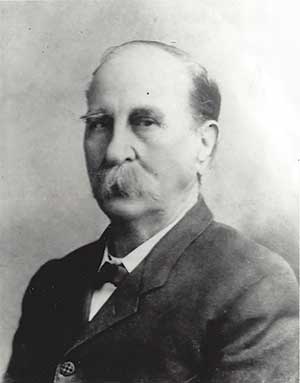
Ashville doctor leader in state mental health care
Story by Robert Debter Submitted Photos
artlow would become a leader in mental health care, making an impact across Alabama and be instrumental in service to those with intellectual disabilities with a facility named for him.
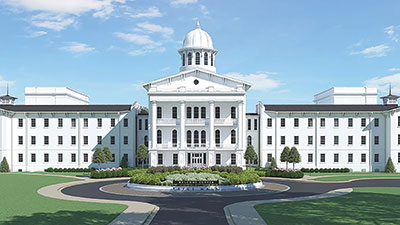
Long before there was an Alabama Department of Mental Health, Partlow Developmental Center was established in 1923 to allow individuals with intellectual disabilities to receive treatment in a state facility. It was located in Tuscaloosa, two miles from Bryce Hospital, and was the only one of its kind in the state until 1970.
Partlow was born on Feb. 4, 1877, in Ashville to David Alonzo and Modena Catherine (Beason) Partlow, who were married in St. Clair County on Sept. 13, 1866.
His grandfather, Dempsey Partlow, came from South Carolina to St. Clair County and was married on Feb. 26, 1839, to Mary Montgomery.
Through his mother, Dr. Partlow is the second great grandson of Edward Beason, a captain in the American Revolution and great grandson of Curtis Grubb Beason, who built the Beason House and the Teague Hotel.
David and Modena started their life together with very little, and they struggled for the first years of their marriage. But love, self-sacrifice and courage led David to open one of the first steam sawmills in northern Alabama.
David and Modena’s love story made a deep impression on their nine children, especially William. He perceived well the limitations of his family’s finances, but this only served to stimulate his determination. Educated with mother’s sound principles and encouraged by her love and devotion, he started making his own way at the age of 16. Deciding early on to pursue a career in medicine, he deprived himself of the usual teenage life and devoted his time to studying.
William graduated from St. Clair College, which became Ashville High School, in 1897. After graduation, he took the position of assistant to the principal at the college and used his earnings to finance his continuing education in the medical field. He studied at the State Normal School at Florence and in 1898, entered the School of Medicine of the University of Alabama at Mobile. On April 3, 1901, William graduated as valedictorian in his class and shortly after, became an intern at Bryce Hospital in Tuscaloosa.
Almost a year later, the young doctor accepted an appointment as a medical officer for the marine quarantine service in Mobile Bay. His chief duties were to visit the ports of Central America, study Yellow Fever and recommend methods of safeguarding Mobile’s port against the disease.
In October 1902, Dr. Partlow rejoined the staff of Bryce Hospital and ever since was associated with Alabama State Hospitals. Upon his return to Bryce, he served as Assistant Physician and devoted his time equally to Male and Female Wards. In 1908, Dr. Partlow was promoted to assistant superintendent of the Alabama State Hospitals and 11 years later was elected superintendent by the board of trustees of the various hospitals.
Bryce Hospital
In 1923, Dr. Partlow was honored for “his advocacy of the establishment of such a sorely needed institution, and his persistent efforts, which brought into being” the Partlow State School for Mental Deficients.
Dr. Partlow never ceased in his study of the care of his patients and was highly regarded among American psychiatrists. In 1922, his alma mater, the University of Alabama, bestowed him with the honorary degree of Doctor of Laws.
He was greatly noted in his lifetime for his intelligence and the humane care he showed. During World War I, Partlow was chairman of the Medical Advisory Board and since 1919, was a member of the State Board of Health. In his WWI Draft Card, Dr. Partlow is described as tall with a medium build, brown hair and blue eyes.
On April 26, 1905, he married Margaret Nixon in Jefferson County, Alabama. They would have 48 years and five children together. Mrs. Partlow was noted as being an inspiring and devoted wife and lady.
Throughout the 16-year period of 1919 – 1935, funding for mental health was not appropriated by the Legislature and through effective management of his administration, Dr. Partlow was able to keep the institution on self-sustaining basis. During this time, his effectiveness led the hospital to raising almost $2 million for modernization and expansion.
Partlow also championed a medical college in Birmingham and was often spoken of and seen as the father of the college.
The doctor passed away at the age of 76 at his home in Tuscaloosa on July 7, 1953, and was interred two days later at Tuscaloosa Memorial Park Cemetery. Margaret was reunited with him three years later on Dec. 14, 1956.
On Oct. 29, 1941, Dr. Partlow was honored in a ceremony at the Bryce Hospital Assembly Hall directed by the Board of Trustees of the Alabama State Hospitals. Dr. George Denny praised Partlow as a great man and credited his qualities of “rare executive ability, iron will, rugged determination, intellectual and moral courage and common sense.”
He also observed Dr. Partlow’s “human sympathy, human modesty, and sense of humor blending with a rich measure of patience.” Dr. Denny closed saying, “… Dr. Partlow has set a standard of public service in Alabama that merits the accolade of universal acclaim and appreciation … For he is indeed one of the select number of Alabama’s ‘tall men, sun-crowned, who live above the clouds, in public duty and private thinking.’”
I never knew I could feel so much affection for a house as I do this one. I’ll admit, I love it far more than I should.
Maybe it’s because of the splendid confluence of generations that gather here any given Sunday after church to share a meal. Maybe it’s the small gang of unruly cousins that can be found climbing the pear tree in the front yard or chasing one another through the grass at family gatherings. Maybe it’s because this is a place where people sit on the front porch in the mornings and wave at passing cars and retire to the back porch in the evenings to break beans or shell peas.
Maybe it’s because of the beautifully kept yard and garden and the wealth of knowledge that comes from those who tend to it.
Maybe it’s because the house always seems to smell of pound cake or cornbread and there is, most reliably, always sweet tea in the fridge. Maybe it’s because this isn’t a life I grew up with, but this house and the people who call it home have raised me in ways they will never fully understand. And they have given my children the most splendid, idealistic, memories of childhood.
They will look back on their time spent here as if it were a movie or a dream … the kind of memories that move in slow motion and seem to be bathed in golden light.
Or maybe it’s not really about the house at all. Maybe this house just represents a life that feels nostalgic … a life so many others remember from their past and have forgotten still exists in some places.
… It still exists here. This house is more than a house, it’s a life force. It almost has a heartbeat.
… And it is the place my heart will forever feel the most at home.
**Dedicated in loving memory to Coy Free, whom we miss dearly & called this house home.
And to Rubye, who loved him faithfully for 68 years … and lives there still.
– Mackenzie Free –
Wife, mother, photographer & current resident of the unassumingly magical town of Steele, Alabama
As the weather warms up, many of us start feeling that spring fever and want to head outdoors to one of Alabama’s many beautiful hiking areas.
From the new Big Canoe Creek Preserve – whose trails open soon in Springville – to neighboring Cheaha State Park, you won’t have to go far to find those opportunities to take in the natural world outdoors. And while you don’t have to be a seasoned pro to enjoy hiking in Alabama, thru-hiker and Pell City native Bennett Fisher offers some tips for the rest of us.
After all, he was a novice once himself. He jumped in as a hiker full-speed, hitting the Appalachian Trail (AT) on his first backpacking trip after graduating from Pell City High School in 2015.
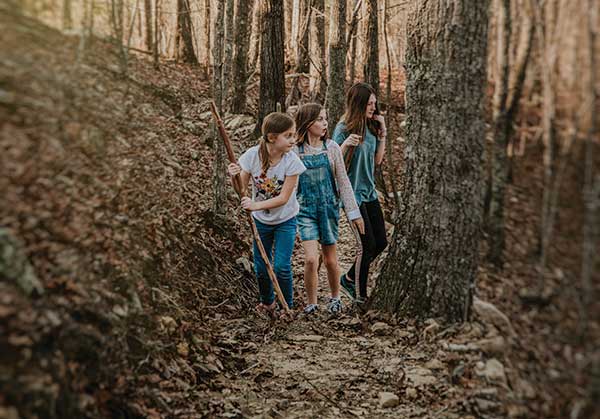
Hiking at Big Canoe Creek Preserve
Along with his dad, who was also a novice hiker, he completed the entire 2,190 miles of the AT from Springer Mountain, Georgia, to Katahdin, Maine. Since then, Jolly, as he is known on the trail, has also thru-hiked the Pacific Coast Trail (PCT) and about half of the Continental Divide Trail (CDT). He is still recovering from the foot injury that sidelined his CDT hike.
His first piece of advice for the beginner is to prepare, but take it easy on yourself. “There’s a lot of gear to choose from. Don’t get discouraged. Form your own opinions. Do your research and take advice, but then try it and form your own opinions.”
After the father-son duo set out on their quest to conquer the AT, it wasn’t long before they were questioning their choices. On subsequent hiking trips, they explored different gear options and weeded out what didn’t work for them and added what they missed.
Local hiking gives you many more options on items you may want to bring for comfort. “If taking a camp chair helps you get outside and enjoy yourself,” says Bennett, “then take it. It’s all about what you will use to make your experience better. But don’t weigh your pack down if you don’t need it. If you don’t use it, just don’t bring it next time.”
Next, he says, evaluate the same gear in different weight options. “On one of my first hikes, I brought sandals to wear around camp that were about a pound each. What I really needed were dollar store flip flops that weighed only a few ounces.”
Good hiking shoes, he adds, are an essential piece of equipment. “A lot can go wrong with shoes.” That sentiment is echoed by Trey Staples, manager of Gadsden Outfitters. “My number one tip is to be sure you have a good sock and a good shoe. You’ve got to keep your feet dry. Get help from an outfitter who will take the time to fit you for the shoe that’s right for your feet and your activity level.”
For easy cleanups, Staples recommends bringing wet wipes, which are easy to pack. He also recommends repacking items to bring less waste with you and be sure to pack out whatever trash you do have.
Getting a backpack that fits your body is important if you’re doing more than day hiking. “Get a pack that fits you,” says Staples, “and that means going somewhere where they’ll measure your torso to get it right.” For day hiking, a small pack is useful for storing your water, food, rain gear, first aid kit and snacks.
“It’s also a good idea, no matter how long a hike you’re on,” adds Staples, “to let someone know where you’re going and when you’re expecting to be back.”
Water is a critical safety component of any hike of any duration. “If you’re on a day hike,” says Fisher, “definitely bring your own water. But for multi-day hikes, you’ll want to bring along a water filter.” Also, he says, you don’t have to buy professionally packaged backpacker food. “It’s pretty expensive, and you don’t need it.
Just bring things you like to eat and will look forward to eating. I’ve brought food before that I thought I needed that was healthy, but it just lived in my backpack because it wasn’t appealing to me, so I didn’t eat it.”
Developing a passionwith each step
Fisher and his dad came back from their AT thru-hike having solidified their love of hiking. Fisher says he spent quite a bit of time hiking at Cheaha State Park before moving to Utah in 2018 and earning his degree in Outdoor Product Design from Utah State in 2020.
He has since launched his own outdoor clothing line with the tagline, “Where fun meets functional.” You can check out his products at Jollygear.com.
Unexpected bonus nets Springville couple a business on the water
Story by Scottie Vickery Submitted photos
When Beverly and Robert Shaffer started house hunting just over a year ago, their main goal was to find a place where they could raise some chickens. They ended up with a house on 19 acres in Springville, and at recent count, four goats, two tortoises, 19 rabbits, 23 chickens and 15 guinea fowl. Oh yeah, they also got a kayak rental business that came with the property, as well.
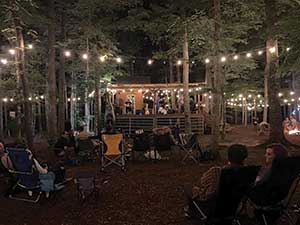
The perfect place for outdoor live music
That turned out to be a happy surprise, and operating Big Canoe Creek Kayaking has been as big an adventure for the family as it has been for the paddlers who come to enjoy some peaceful time on the water. “We ended up with much more than we were looking for, but we love it,” Beverly said.
Although they weren’t in the market for a new business, Beverly, who owns a childcare center in Birmingham, said they knew a good opportunity when they saw it. She and Robert have four children – Ashley, Hollis, Lyons and Thomas – and two of them were in need of summer jobs. Ashley works at the childcare center, and Hollis lives out of state, so Lyons and Thomas were the perfect candidates to run the kayak business.
Both students at Auburn University, the brothers weren’t exactly sure what they were getting themselves into last year, their first season. “It was definitely a lot more work than I expected, but it ended up being a ton of fun,” Thomas said. “Now that I know what to expect, I’m definitely more excited about this year.”
They open for the season on May 13, and the Shaffers expect to be even busier than last year. The owners of Yak Tha Creek in Ashville decided to close shop earlier this year, so Big Canoe Creek Kayaking is now the only kayak rental facility in St. Clair County. After purchasing half of the other business’ boats, the Shaffers now have a total of 50 kayaks, including seven doubles.
Kayaking is the most popular form of paddle sports, according to The Outdoor Foundation, and Big Canoe Creek is the perfect spot for all ages to get their feet wet. Lots of families and friends come to take advantage of the opportunity to unplug, get away from it all and enjoy nature.
“It’s really peaceful, and it’s very beginner-friendly,” Thomas said of the 3.85 mile stretch of the creek. It’s an easy float, and if visitors don’t want to do a lot of paddling, they can just sit back and enjoy the ride. “We have lots of kids doing it,” Thomas said, “and people take their dogs all the time. A lot of people go fishing, and they all seem to catch a lot.”
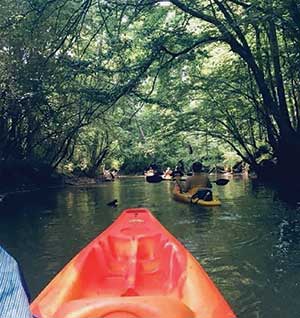
The scenery along the creek is breathtaking
The watershed is home to 50 species of fish and eight species of mussels, according to The Friends of Big Canoe Creek, which was founded in 2008 to protect and preserve the creek and its tributaries. The 246-mile watershed, which runs from northeast Jefferson County, flows through northern St. Clair County, eventually joins the Coosa River in southwest Etowah County. It is also a great place for bird watching. Owls, egrets and eagles are among the species that have been spotted.
The Shaffers’ animals are a big draw, as well, and children particularly love the goats and rabbits, Thomas said. There are picnic tables onsite, so visitors can pack a lunch and plan to stay for a while. “Everyone seems to really enjoy it,” he said. “It’s a fun way to spend time together, and it’s super relaxing.”
Big Canoe Creek Kayaking is open Friday through Sunday, although groups can be accommodated during the week. They open at 8:30 a.m. and the last kayaks go in the water at 3:30. Rentals are $40 for a single kayak and $50 for a double, and the cost includes paddles and life jackets. Visitors are shuttled to the drop-off point and picked up nearly four miles down the creek. The trip typically takes two to three hours, and paddlers with their own kayaks can have their boats shuttled for $20.
In addition, there are five campsites – each with a grill, picnic table and fire ring. The cost is $25 for the first tent and $10 for each additional tent. The campground is open 7 days a week.
For more information about Big Canoe Creek Kayaking, located at 6545 Alabama Highway 23 in Springville, call (205) 452-9553 or find them on Facebook at Big Canoe Creek Kayaking.
A sweeping driveway and parking lot lead one up to Rocky Zion Missionary Baptist Church’s brick sanctuary on 16th Street South in Pell City overlooking The Legacy Center and a community of interconnecting streets.
Before integration of schools, today’s Legacy Center was the location of the St. Clair County Training School, serving Black students locally as well as those from Moody, Margaret, and Ragland.
Today, no one knows how the name “Rocky Zion” was chosen, although one can speculate. In the Old Testament, “Zion” was another name for Jerusalem, the City of God. In the Christian era, Zion referred to the New Jerusalem, Heaven.
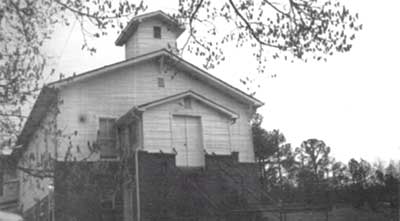
Historic church with rock foundation
The old hymn, Marching to Zion, speaks of “marching upward to Heaven, the beautiful City of God. But how does “Rocky” come in? There does not seem to be a definitive answer but considering that the church was organized by freed slaves during the last year of Reconstruction in Alabama and scarcely 11 years after The Emancipation Proclamation was signed freeing some slaves, it could refer to the difficulties slaves and freed slaves faced in worshiping together. Those were hard years, and the roadway to declared freedom was rocky.
The name of the first pastor is unrecorded, but three of the early pastors were Rev. Dave Forman, Rev. Chester Beavers and Rev. Markus.
From oral history passed down and put into writing, the church was organized in Cook Springs in 1874. At this writing, no record has been located to indicate where in Cook Spring the church met. Older people there remember that both races attended Cook Springs Baptist during the first half of the 20th Century. One of Esta McLaughlin’s sons recalled his mother’s comment when integration came, “We’ve gone to church together all our lives, what’s the problem?”
From Cook Springs, the church moved to the Whitesville-Harrisburg area. Samford University’s Davis Library has copies of the Rushing Springs Baptist Association minutes which list Rocky Zion as located in Eden in 1892, for Eden was the post office location.
The church is listed in the 1893 and 1894 minutes as well. Membership with an association has been inconsistent over the years, according to Deacon Terry Young. Therefore, historical data is rather sporadic. This Whitesville-Harrisburg building burned on an undocumented date. It is believed Rev. Conner pastored the congregation.
A third move
This tragedy resulted in the church being moved to a third location, 16th Street South, Pell City. A Mrs. Pryor and perhaps other Whitesville citizens would walk from their homes across town to the new location. During the construction, the church met for worship at First Baptist South and for Sunday School in the home of Rev. M.C. McCoy.
Written information regarding the church in Harrisburg has not been found. However, tombstones have been discovered near the church site. Some of the names that remain visible on the markers show the surnames, Willingham, Bradford, Shelton, Johnson, Murphy, Ware, Allen, Simmons and Foreman, who were possible ancestors of some members whose names are on the present church roll.
An old photograph shows this building’s foundation and basement being constructed of local rough fieldstone, perhaps in honor of the name “Rocky.” Traditionally, the stone was collected in a wagon with a loose board in the center. When the loaded wagon came up to the building site, men worked the loose board out and the rock fell to the ground. This type construction was used throughout the South in the early 20th Century.
We can perhaps establish that this third sanctuary was completed prior to 1917 because of a Birmingham News article, dateline “Pell City, Ala., June 2, [1917].” The article reports that the rally that the Pell City Black community held “…at Rocky Zion Baptist Church was a success Friday night. It was called by the Rev. A. J. Davis of the Baptist Church and supported by the Rev. L. J. Shelton, pastor of the Methodist Church. Both made addresses urging patriotic action and pledging the support in the prosecution of the war.” The United States entered World War I on April 4, 1917.
Throughout the years
When the wooden building was finished, Rocky Zion called Rev. Thomas to be the pastor. He served the church for approximately one year. After Rev. Thomas, the church called Rev. A.H. Lee, and under his 16 years of leadership, the membership increased, and the church flourished in the community.
Following Rev. Lee’s 16 years, Rev. Oscar Henry served approximately two years. However, the next pastor, Rev. S. L. Woods, served the church for 20 years. He shepherded his flock faithfully, and they responded to his leadership accordingly. The church’s brief written history states under Rev. Woods’ tenure, “The Church underwent major renovations. The membership greatly increased during this time. Members and friends enjoyed worship services on the first and third Sundays of the month.
Another brief, written history records that “Deacon Charles Crowe, Deacon Emmitt Brand, Deacon Johnnie Coleman, Deacon Roosevelt Shealey, Deacon Amos Avos and Deacon Joe Carter were ordained during Rev. Woods’ 20 years pastoring Rocky Zion Baptist Church.”
Those who remember Rev. Wood speak of him with great affection. “Rev. Woods baptized me, and he was the only pastor that I knew for years,” Peggy F. Threatt recalled. “We had an outside baptizing pool that was in the ground, and you walked down into the pool. It was made of cement blocks and painted blue.
Verhonda Embry, Peggy’s sister, added, “We all grew up under Rev. Woods – everybody 60 and older grew up under his ministry. He was from Ragland and had a big family.”
Floyd Waites was mentored by Rev. Woods who encouraged him in his piano playing. For Floyd, playing “by ear” came naturally. He would hear a tune on the radio, go to the piano and play it. Gradually, he became proficient and accompanied Rocky Zion’s Children’s Choir. “Rev. Woods,” Floyd recollected, “liked for the Junior Choir to go with him when he preached at other churches. And I would go to play for them when they sang. Rev. Wood was an inspiring minister.”
After graduating from the St. Clair County Training School, Waites moved to New York City and became an established pianist in the churches of the city. In one church there, he met gospel singer Marie Knight, who admired his piano style and hired him as her accompanist. Floyd traveled with her to Spain and other European countries, accompanying her in concert.
“However,” Floyd confessed, “my heart was always in Pell City and Rocky Zion.” When he retired from working in the education system of New York, Floyd returned to Pell City, where he and his wife had built a home for retirement. Floyd is still known for his beautiful singing voice as well as his artistry on the piano. Today, he ministers at Coosa Valley Baptist Church in Vincent and has no interest in retiring from music.
Church, school, community
During the years prior to integration, Rocky Zion had close connections with the St. Clair Training School, for church and school were community in those days. “The church stands as a beacon of light in the community,” Peggy said. “Due to overcrowding at the St. Clair County Training School, the church provided space for some classrooms during the late 1950s and the mid-1960s.”
“The St. Clair County Training School held the third grade class in the basement of our church,” Deacon Terry Young recalled. “I went to school here. My teacher was Miss Ida Wantana Baker. I never will forget her name!”
A school P.T.A. meeting was not just a school event, it was a community event with spiritual emphasis, as reported in The St. Clair News-Aegis of April 29, 1954. “The P.T.A. observed its 27th Anniversary Sunday, April 25, 1954, at the Rocky Zion Baptist Church. Rev. A. Clark, pastor of St. Peter’s Primitive Baptist Church, Bessemer, Alabama, delivered the message. A huge crowd attended. The P.T.A. and Principal are proud and grateful for the wonderful aid and co-operation the patrons have given the P.T.A.”
Mrs. Lillie B. Curry, pianist, was remembered in Rocky Zion’s 1988 Memory Booklet for their 114th anniversary: “From the early 1930s until the late 1950s, she studied and worked untiringly with the chorus (choir). When she needed assistance, she would have Prof. Banks, her instructor, come and work with the choir at her expense.”
The music program at the Training School contributed to Rocky Zion’s choir ministry. Professor Walter Kennedy is remembered as having trained a host of singers during his tenure as principal of the school. Sisters Peggy and Verhonda both recalled the fine choir of the Training School and Professor’s influence on students – especially students from the Waites family and the Moseley family. “Choir Day was a big event at Rocky Zion,” Embry added. “We had a youth choir, a male chorus, and then we had the combined choir.”
Rev. Woods enjoyed leading the singing during each summer’s Vacation Bible School week. Each church would have it a different week so that children and youth could attend all if they wished. Peggy and Verhonda especially remember his leading them in We are climbing Jacob’s ladder, and how he would gesture climbing higher and higher. “He had a very pleasant voice. Rev. Wood and his family had a special place in our hearts.”
Mrs. Mary Frances Embry, Mrs. Ora Mae Allen, Mrs. Rose Crowe and Mr. Charles Crowe were Sunday school teachers. Mr. Dave Allen was superintendent. Mrs. Crowe and Mrs. Embry instructed the Baptist Training Union. Mrs. Embry was director of the Youth Department for many years.
Peggy and Verhonda almost spoke in unison as they recalled that at her home, Mrs. Embry would have the youth over for homemade ice cream and hot dogs. “She lived right next door to the church,” said Verhonda.
Aiming for perfect attendance
As to Sunday school and church attendance, the sisters had no choice. They got up each Sunday morning, dressed in their church dresses and attended. Both sisters enjoy recalling those mornings. “We lived about three blocks from the church,” Peggy reminisced. “We had our little path up to Rocky Zion for Sunday school and church service. We had a lot of young people back then. We don’t have very many now.”
Verhonda, who was the baby of the family, added, “We knew that we had to get up and go to church and Sunday school. I tell people that on Sunday evening, we had Baptist Training Union, and I preferred being down at the park with my friends. And my Mama would ride to the park with one of our neighbors, because Mama didn’t drive, and I had to leave my friends and come to the church on Sunday evenings for BTU. It was just a part of life. We had to do it. We had no choice. But now, they let the kids make the choice.”
Deacon Young lamented the absence of youth in church today. “You know, the difference between now and then? Our parents didn’t ask us, ‘Are you going to church today?’ You knew the day was Sunday, and you knew to get up and start getting ready to go to church. My daddy got killed on his job when I was 7. My mama raised nine of us, and I was the baby of the nine, but she made sure that I had a way to Sunday school and church and BTU. She saw that I attended just about every function that went on in church. But things really changed over the years. Today, the youth are down at the park on Sunday.”
Revival Time
Summers brought revivals to Baptist churches throughout the South from the late 19th Century until about the 1970s. During revival week at Rocky Zion, there would be both morning and evening services. Recalling those days, Verhonda commented, “During the revivals, each day someone fed the pastors, and they came to your house and had dinner before revival. And so, Mother and others fed the pastors during revival.”
Peggy joined in, “You know, back in the day, I’ve often heard that when the pastors would go around to have a meal, the children couldn’t eat until the pastors ate.” She chuckled before adding, “Not at our house. Mother, Lizzie Forman, always made sure we ate first.”
Sunday preaching at Rocky Zion for many, many years was first and third Sundays of the month, for a pastor usually ministered to two congregations. On the second and fourth Sundays, Rocky Zion members would attend services at First Baptist South. The church moved to meet for worship every Sunday during the pastorate of Rev. Johnnie Whetstone, who came as pastor after Rev. Woods. For some it was difficult to adjust to that, for the fellowship between First Baptist South and Rocky Zion had existed for so long that, understandably, it left a void in some members’ lives.
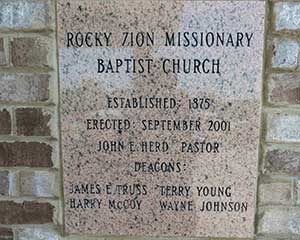
When Rev. James Adams was called as pastor, he ordained as deacons, Terry Young, Harry McCoy and James Truss Sr.
During a powerful storm on March 11, 1973, lightning struck the wooden sanctuary and severely damaged it. The church members worked together to repair the building and make it usable again. During the repairs, the congregation met for worship services at the Jacob Chapel C.M.E. church on Sunday afternoons.
In June 1996, the church called Rev. John E. Herd as pastor. Under his leadership, the church flourished. Choir membership increased, and worship services were enhanced by a praise team. The pastor reactivated Wednesday night prayer meeting and Bible study, organized New Year’s Eve Watch Night services, established Easter Sunrise services, and instituted programs for Black History Month so members could learn of their history. Rev. Herd ordained Deacon Ken Sheelton.
A new sanctuary
From the 2001 Church Dedication Booklet, we learn that Rev. Herd “…had a vision from the Lord,” and he “approached the congregation with the idea of building not just a fellowship hall but a church with a fellowship hall. The body agreed,” and a brick sanctuary was constructed.
In an article announcing the new sanctuary, The St. Clair Times of Sept. 13, 2001, Gary Hanner reported that to bring the wooden structure up to code would have cost more than to build a new church. He quoted Deacon Wayne Johnson, who said of the new sanctuary, “It is something that will stimulate their (the members’) spiritual growth and is something they can be proud of for years to come. … Having the new facility will be an asset to the community.”
The dedication of the new sanctuary occurred on Sept. 23, 2001, and was a gala occasion. The congregation met outside the church for responsive readings. Then the contractor presented the keys of the new building to Deacon Young, who presented them to Deacon Truss. Rev. Herd and Deacon Young cut the ribbon, and Deacon Johnson opened the doors to the sanctuary. Someone rang the old church bell, and the congregation entered the church to the processional hymn, “Alleluia.” Rev. Herd prayed the consecration prayer, and the afternoon was filled with a joyful worship/dedicatory service in the new building.
After Rev. Herd, Rev. Woodrow Johnson came as pastor, and the church continued to flourish. Rev. William O. Robinson was called as pastor after Rev. Johnson. Rev. Robinson ordained Deacon Willie J. Forman. Deacon Stanley Nobles moved back home to Pell City and rejoined Rocky Zion.
The COVID-19 pandemic, which required churches to have online services, had a lasting effect after it subsided. Rocky Zion’s Sunday attendance is low, for many still watch online, and the choir is now a praise team. “It’s only four members,” observed Young, “but they sound like a choir.”
Another milestone
In 2024, the church will observe its 150th anniversary, and with COVID causing the interruptions it did in community and church, memories have focused more on the past than on recent memories. However, throughout church history, the pendulum has swung toward “good years and lean years” of attendance, and church members hope for increased attendance in days to come.
Rev. William O. Robinson, pastor, shepherds his flock in the present and looks to the future. “I am now in my 10th year serving as pastor of Rocky Zion MBC,” he noted, “and I can honestly say it has been challenging – mainly because it’s my first pastorate. Yet through all of the tests and trials, I can truly say that I have enjoyed and continue to enjoy preaching, teaching, singing and serving in any other capacity the Lord has required and equipped me to do.”
For uncertain times in which we live, this positive attitude is a must for any pastor. Rev. Robinson observes, “I have seen spiritual growth but also recognize there’s much growth needed. I have learned as much because from my members, as I hope they have learned because of me. Being afforded the opportunity to grow together according to the guidance of the Holy Spirit is what I believe makes us more than a group of people that go to a church building. For we are truly “a family for Christ” that is dedicated to displaying the pure love, faith and obedience He has called us to do as the body of Christ.”
Rev. Robinson ascribes to the challenge of Matthew 28:19-20 to, “Go therefore and make disciples of all nations, baptizing them in the name of the Father and of the Son and of the Holy Spirit, teaching them to observe all things that I have commanded you; and lo, I am with you always, even to the end of the age. Amen.”
“Our mission is to be a Christ-centered family environment that effectively brings others into the household of faith through corporate worship and also evangelism and outreach.”
Empowerment for future
As pastor of the church, he sees his duty in preaching and teaching as building solid believers who are equipped for ministry in both church and community. From his heart, he comments, “We believe in the spiritual development and growth of the body of Christ through love, humility, unity and prayer which comes through salvation through Christ and an ever-growing relationship with Christ. I call it ‘Empowering People for Kingdom Building.’”
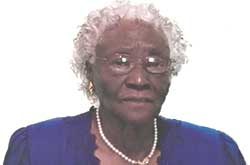
Ms. Posey, oldest member of Rocky Zion
The COVID-19 pandemic brought great changes to churches because of “sheltering in place” and not meeting together for worship along with absence of choirs and congregational singing. Rev. Robinson reflected, “Even though we have been challenged to serve and minister within our community and church in a variety of ways due to the COVID-19 pandemic, we are yet excited about the movement of God at Rocky Zion MBC.” And he asks that community and church pray “… that the Lord will look upon any and all threats designed to hinder Rocky Zion’s laboring for the kingdom of God. That He will continue to grant us all boldness to speak His Word, stretching out His hand to heal, and that signs and wonders may be done though the name of Jesus Christ.”
Rocky Zion Missionary Baptist Church has served God and community for 149 years and sits on the hill above school and community as a lighthouse of hope. Peggy F. Threatt observed that “Rocky Zion Baptist Church is definitely a foundation of faith,” and that faith gives the church’s members comfort and peace.
And as the old Isaac Watts’ hymn proclaims, may Rocky Zion MBC continue progressing and singing for another hundred years.
“We’re marching to Zion,
Beautiful, beautiful Zion,
We’re marching upward to Zion,
the beautiful City of God.”
Mrs. Rosey Posey, Rocky Zion’s most senior member at age 97, would give a witness to that with a resounding, “Amen!”
As city celebrates 200 years, a look back a century ago
Story by Robert Debter Submitted Photos
On the heels of observing the bicentennial of Ashville, memories and remembrances of the centennial celebration, April 26, 1923, emerge.
The event was conceived as a tribute to the soldiers of St. Clair County, both living and deceased, who had fought in the War Between the States, also known as the American Civil War. The event was spearheaded by Ashville Chapter 1488 of the United Daughters of the Confederacy, and great care was given over to the preparation of the event, which would culminate in the unveiling of a marvelous marble statue, procured from the McNeel Company in Georgia at the cost of almost $2,500.
In the Feb. 23 edition of the Southern Aegis, owner B.B. Cather, vowed “… to do all it can to help the U.D.C. women pay for their monument and at once wishes to state that any subscriber who loves this paper and wants to help these women can settle with them court week. One half of every dollar paid to them on subscription, new or old for the Southern Aegis, in the next 30 days will be given to this organization or the Monument fund.”
The March 29th edition printed the following notice:
Unveiling Confederate Monument
to St. Clair County Heroes
celebrating Ashville Centennial, April 26th
Public Cordially Invited
On the historic spot in Ashville where 62 years ago, the flower of St. Clair’s young manhood, marched forth to defend their homes and the sacred causes of the Confederacy, the Daughters of the Confederacy have erected a memorial to their loyalty, courage, and devotion.
They have selected April 26th, (Memorial Day), for the day of unveiling.
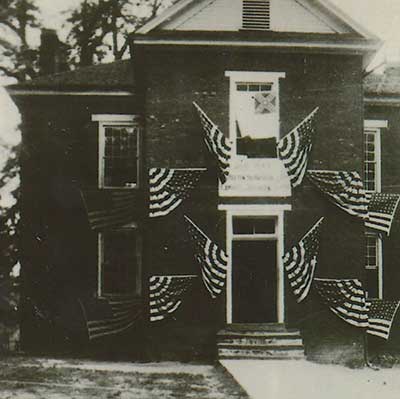
Ashville St. Clair Courthouse
Few towns can boast of 100 years of existence, such is Ashville’s Birthday. The Daughters have been asked by prominent and former citizens of Ashville to include a centennial program in the day’s celebration, which they are glad to help plan.
A parade headed by a Brass Band, composed of school children, Daughters, Veterans, and floats representing each business in town will take place in the morning, following this will be a Centennial program at which time, Hon. James A. Embry, a lifelong Ashvillian will preside.
The principal address will be delivered by Hon. O.R. Hood of Gadsden, a former son of Ashville.
The unveiling program will be held in the afternoon, at which time, Mrs. W.A. Beason, President of the Ashville Chapter U.D.C. and General Chairman of the day’s festivities will preside.
Principal address of the unveiling will be delivered by Mrs. E.L. Huey of Bessemer, State President U.D.C., gifted and beloved Alabamian.
The big event
Alongside the unveiling and celebrations, a grand homecoming was planned. Chairman Lillie (Phillips) Beason, wife of Dr W.A. Beason, and her publicity committee set to work and issued more than 500 invitations to reach veterans and their families, originally from Ashville, who had since relocated to other parts of Alabama and the country.
John Washington Inzer
On March 5, the Aegis reported, “The Monument Committee who has charge of the day’s program are to be congratulated upon securing Col. Oliver R. Hood of Gadsden, a former son of Ashville, of whom we are justly proud to deliver the Centennial address. Hon. James A. Embry, one of Ashville’s most brilliant and prominent attorneys, whose life has been spent in this peaceful city, has accepted the committee’s invitation to preside.”
As the day approached everyone was encouraged to “… greet every visitor with a smile and a welcome – leave that frown off your face for Ten days and be what God intended you to be, a booster for the Home Comers.”
Undoubtedly on that April morning the old veterans, such as Judge John W. Inzer of Ashville and John Washington Laster Jr., of Springville, recalled their days of service and those whom they marched and fought alongside, saw torn by war and perish from cannon, rifle and saber, and those they suffered with in prisoner of war camps in Illinois and Ohio.
To a crowd of over 2,000, the monument was unveiled by Misses Mattie Lou Teague and Sally V. Inzer. It was reported that the proceedings “… will be long remembered by every person who attended. Ashville was beautifully bedecked with flags and bunting.”
As for the veterans, they “… were treated royally and they seem to have appreciated to the fullest extent all that was done in honor of their dead comrades.”
Remembering the words of General Douglas MacArthur in his farewell address to the cadets as West Point in 1962, “… [T]he soldier above all other people prays for peace, for he must suffer and bear the deepest wounds and scars of war.”