Officials break ground on 18-acre campus in Odenville
Story and photos by Carol Pappas
On a hilltop above Odenville a vision is rising up to meet the needs of the community and well beyond the city’s borders.
ONEeighty Church, just as the name implies, represents the degree to which lives can be turned around, and that’s the purpose of the 18 acres that hilltop overlooks. Officials have broken ground on a massive new campus near Interstate 59 on Alabama 174 at Odenville.
The church began in a vacant Ace Hardware building in Springville as a ministry of Clear Branch United Methodist Church in 2009. Two years into it, it grew to become a standalone church. Cam Price was pastor for a year and a half before Gresh Harbuck became the pastor, and she named it ONEeighty – symbolic of turning lives around. Four years ago, it launched as non-denominational and has now grown well past its walls.
Leaders were led to build a new church and other buildings on the acreage and even though it began in Springville, Harbuck said they never viewed ONEeighty as a Springville church. “It’s a community church – one gigantic circle of owners. They take ownership in the Great Commission. Members pay dues. Owners have responsibilities and are on a mission, winning one more for Jesus Christ.”
Pastor Gresh Harbuck motions toward the hilltop where the church will grow its new home.
When they were first looking for a new home, Realtor Lyman Lovejoy envisioned the ideal place as a piece of property that wasn’t even for sale. “They won’t sell it to me, but they might sell it to you,” he remembers telling them. He is credited with approaching the owner with the idea of transforming the piece of land into a place of worship and life-changing experiences.
The owners understood the vision, too, noting that it would be the perfect legacy for their father. And the deal was done.
“Our goal is to really focus on people who never would walk into a normal church,” said Harbuck, describing it as “very contemporary,” welcoming “all walks of life” to venture through its doors.
The growth has been evident. Easter Sunday, apparently all roads led to ONEeighty Church with people attending from Argo, Odenville, Pinson, Gadsden and Springville. “We’re not an Odenville church,” Harbuck said. “We’re not a Springville church. We’re a community church. We want lukewarm Christians to turn into purpose-filled Christians who will be the hands and feet of Jesus. We want to help the hurting and the broken.”
Of the church’s approach, Harbuck explained, “This is a great place to fall in love with Jesus.” Small groups are how they disciple people, giving them a more intimate, close-knit experience. The youth group is packed with activities and is “growing by leaps and bounds.” Celebrate Recovery – one of the largest in the state – continues to make a sizable impact on addictions throughout the region. It partners with Lovelady Center, Brother Bryan and jail ministries in Ashville and Oneonta.
Celebrate Recovery, coordinated by Ministry Leader Joyce Simonson, was 300 strong before the COVID-19 pandemic hit. They still feed 200 there every Friday night. “We view ourselves as recovery ministries,” said Harbuck, who once served as CR Ministry Leader himself.
Looking ahead to what that Odenville hilltop will become, Harbuck said, the new church campus will house the worship center, a sanctuary that can seat 600, lobby and children’s area in the first phase on top of the site. Second phase will be a dining hall, small group rooms and offices, and the third phase is a courtyard outside the worship area.
Beyond that, “God gives us the next steps,” Harbuck said. “We will look at the needs of Odenville. If the needs in the community change, we’ll change.
Johnny Evans and James Barker, who are active in the church and have a background in contracting, will oversee the project. Cline Construction is the builder.
“Even though we’re moving the building, it doesn’t mean the DNA changes,” Harbuck stressed. “We want to be a light to the community, helping the outcast and broken,” he said at the groundbreaking ceremony.
Lay Leader John Rich called it “a big milestone for us. This is a community church – one group, all together. This means a lot.”
And it means much to the community that surrounds it. “Thank you for your vision,” Odenville Mayor Buck Christian told those in attendance at the groundbreaking. “We’re excited to see what the future holds. The campus will be explosive” in terms of growth. “Welcome to Odenville. We are extremely excited about what this will mean to Odenville. The growth potential is unlimited.”
Harbuck agreed. “God has been blessing us and growing us.”
County named for Revolutionary War soldier, American statesman
Story by Robert Debter Submitted Photos
On Nov. 20, 1818, the Second Alabama Territorial Legislature representing 20 counties, seven of which had been created by the Mississippi Territorial Legislature (Washington, Madison, Baldwin, Clarke, Mobile, Monroe and Montgomery) and the remaining 13 (Morgan*, Lawrence, Franklin, Limestone, Lauderdale, Blount, Tuscaloosa, Marengo, Shelby, Bibb**, Dallas, Marion and Conecuh) established by the First Alabama Territorial Legislature earlier that year.
The first county created by the Second Territorial Legislature was taken from the northern portion of Shelby County and would bear the name of St. Clair.
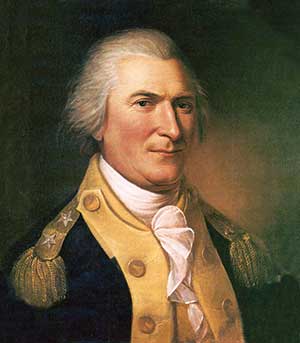
A county older than the state itself draws its name from far away roots in Scotland. On March 23, 1734, at at Thurso Castle, in Thurso, County Caithness, Scotland, William and Margaret St. Clair welcomed a newborn son and bestowed the name, Arthur. After completing his formal education, he studied medicine at the University of Edinburgh and was apprenticed with Dr. William Hunter in England for a time. But like so many of his warrior ancestors, he heard the call of adventure and could not deny it.
Arthur St. Clair
In 1757, just in his early 20s, the young St. Clair purchased an ensign’s commission in the British Army and came to America during the French and Indian War, also known as the Seven Years War. He served in Canada during this almost decade-long conflict and was present at the Siege of Louisbourg.
For his heroism, Arthur was promoted to the rank of lieutenant (originally known as leftenant). The year 1759 saw the young soldier at the Battle of the Plains of Abraham in Quebec, where Lt. St. Clair seized the colors, which had fallen from the hand of a dying soldier and bore them until the day was won. In May of 1760, he married Phoebe Bayard of Boston, whom he had met while his regiment had been stationed there. They were joined in holy matrimony at Trinity Church in Boston. They would have 58 years and seven children together.
Two years after marrying, Lt. St. Clair resigned his commission and moved to Bedford, Penn., to survey land for the Penn Family. In 1764, the St. Clairs settled in Ligonier Valley, Penn., and through the establishment of several mills, St. Clair would eventually manage to become the largest landowner in western Pennsylvania. The parlor of his home, “The Hermitage,” remains preserved at the Fort Ligonier Museum.
He became surveyor of the Cumberland District in 1770, a justice of the court of quarter sessions and common pleas, a member of the proprietary council and justice, clerk and recorder of the Orphans’ Court.
In 1771, Gov. John Penn appointed him first prothonotary of Bedford County and deputy register for the probate of wills. Three years later, he was appointed magistrate and prothonotary of the newly established Westmoreland County. Penn described him as “… a gentleman … and in every station of life has preserved the character of a very honest, worthy man …”
Soldier, hero
St. Clair, commissioned as a colonel of a Pennsylvania regiment in 1776, raised and trained his regiment in the dead of winter and then marched six companies north to reinforce the American Army in Quebec. Unfortunately, St. Clair arrived to find the army in full retreat upon the death of Gen. Richard Montgomery, for whom the capital of Alabama is named. Col. St. Clair, through familiarity of the terrain and British strategy, saved the army from certain capture.
For his bravery, he was promoted to brigadier general and ordered to join Gen. George Washington and help him raise a militia in New Jersey. On Christmas night, St. Clair’s troops, now under the command of Washington, crossed the Delaware into Trenton and attacked the Hessians at dawn on the 26th. The Continental forces were victorious with 22 Hessian mercenaries killed, 84 wounded and 918 captured.
The empire struck back on Jan. 2, 1777, attacking Princeton and routing the small garrison that escaped over the Assunpink Creek to where Washington had posted several cannons. These cannons, along with musket fire, managed to stalemate the British forces.
That night, a council of war was called and many of Washington’s generals advocated for retreat. St. Clair’s lone voice championed attack. He proposed a daring plan to outflank the enemy and take Princeton. For this, St. Clair’s brigade was given the honor of marching ahead of the advancing army, and his battle plan resulted in a resounding victory for the Continental Army.
It was here that Arthur St. Clair and George Washington formed a strong bond that would last for many years. Even when some would later contest and question the Scotsman’s abilities, Washington, with one exception, always remained supportive and faithful to his friend.
St. Clair was promoted to major general for his “fierce bravery and loyalty” and given command of Fort Ticonderoga in New York. Previously a British stronghold, the fort had been captured in 1775 by Gens. Ethan Allen and Benedict Arnold “in the name of the Great Jehovah and the Continental Congress.” St. Clair arrived in early June 1777 and found the fort in disrepair. Worse yet, it was ill supplied and manned by a garrison of only 2,500.
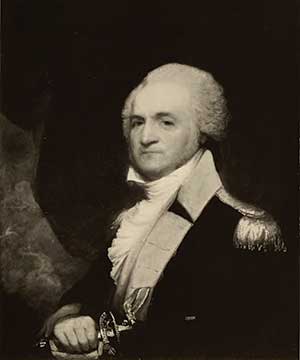
Winthrop Sargent
Gen. John Burgoyne, “known more for his baggage train than his battles,” according to local historian Joe Whitten, laid siege to the fort with an impressive force of 8,000 British regulars and 2,500 auxiliary members.
Not seeing for the needless waste of life, St. Clair ordered the fort evacuated and later recounted, “I know I could have saved my reputation by sacrificing the army; but were I to do so, I should forfeit that which the world could not restore, and which it cannot take away, the approbation of my own conscience.”
The same cabal who endeavored to replace Washington as commander in chief with Horatio Gates lobbied strongly against St. Clair, decrying him as a “coward” and “traitor.” A court martial was convened, and the trial concluded with St. Clair being acquitted, “with the highest honor, of the charges against him.” Afterwards, naval hero Capt. John Paul Jones wrote to him, “I pray you be assured that no man has more respect for your character, talents, and greatness of mind than, dear General, your most humble servant.”
A leader
Following his vindication, St. Clair continued his active leadership. He commanded at West Point, suppressed a mutiny, continued raising troops and sending them south to aid Washington and Lafayette and served on the court martial that condemned Maj. John Andre, the co-conspirator of turncoat Benedict Arnold. He joined Washington at Yorktown four days before the surrender of Lord Cornwallis. In November, he was given orders to reinforce Gen. Nathanael Greene in his campaign to expel the British from the Carolinas.
Lawmaker
The general returned to Pennsylvania following the war and was elected to Congress in 1785. The Pennsylvania Herald reported, “Quorum having been formed in Congress, they proceeded to the choice of President for the ensuing year, when his Excellency Arthur St. Clair, Esq., was elected.”
During his 1787 term, the Northwest Ordinance was adopted, and the U.S. Constitution was drafted. In 1789, he had the great joy of assisting in the inauguration of his friend as the first president of the United States and had once been named as a possible candidate for the vice presidency.
From 1788 to 1803, St. Clair served as first governor of the Northwest Territory and named the city, Cincinnati, Ohio. His second-in-command, Winthrop Sargent, would serve from 1798-1801 as the first governor of the Mississippi Territory, from which Alabama was carved in 1817.
Return to duty
In 1791, St. Clair was once again called into action. As major general, he was tasked with suppressing Native-American resistance, and his force, originally consisting of 2,000, eventually dwindled down through illness and desertion to less than 1,000.
The combined forces of the Miami, Shawnee and Delaware numbered over 1,000 and on Nov. 4, 1791, ambushed the American force. St. Clair, ill with gout, suffered a devastating defeat, and the cries of cowardice and incompetence were once again revived.
Arriving at Philadelphia, St. Clair immediately requested a court martial to clear his name. This was denied by President Washington who called him “worse than a murderer” and demanded his resignation as commander of the Army. Meanwhile, the House of Representatives began an investigation and sided with Gen. St. Clair. They found secretary of war, quartermaster general and other officials in the War Department had ill manned, equipped and supplied Gen. St. Clair’s expedition. The Congress voted against a resolution on the committee’s report, so St. Clair was never officially vindicated.
He was allowed to remain governor – a position he found increasingly difficult following his humiliating forced resignation as commander of the Army. St. Clair, a Federalist, believed that the Ohio Territory should be admitted as two states instead of one to increase the power of his party in the federal congress.
He delivered a speech at the Ohio Constitutional Convention that railed against the Convention and President Thomas Jefferson, “acting like a father betrayed by his son, he used a paternalistic tone and discussed his contributions to the territory, outlining what he had accomplished in fourteen years ….” Jefferson responded by removing St. Clair from office.
Returning home
At almost 70 years of age, the old soldier returned to the Hermitage and facing debts from loans he had given out during the Revolution, attempted to rebuild his wealth. However, the stars in their courses fought against all his attempts to replenish his life, and sheriffs began to sell his property for all the debts he had incurred.
St. Clair beseeched Congress for money he was believed owed to him for his services to his country. The Hermitage was sold, and the St. Clairs moved to a log house called “Chestnut Ridge,” situated near Youngstown, Penn. Several months later, the legislature of Pennsylvania finally granted St. Clair an annuity of $8,400, and shortly before his death, he received from Congress $2,000 in discharge of his claims and a pension of $60 a month.
On his way to Youngstown to purchase goods, St. Clair was thrown from his wagon and found unconscious on the side of the road. He was tenderly carried back to his home, where he passed away surrounded by his family on Aug. 31, 1818, after a departing message of peace forevermore. By November of that same year, St. Clair County, Ala., would be created and bear his name.
Patriot
He was buried at the St. Clair Cemetery in Greensburg, Westmoreland County, Penn., and his monument, a gift from his Masonic brethren reads: “The Earthly Remains Of Major-General Arthur St. Clair Are Deposited Beneath This Humble Monument, Which Is Erected To Supply The Place Of A Nobler One Due From His Country.”
Always the patriot, in his own words: “I hold that no man has a right to withhold his services when his country needs them. Be the sacrifice ever so great, it must be yielded upon the altar of patriotism.” l
Editor’s Note: Of Alabama’s 67 counties, more than a dozen are named in recognition of those who have some connection as leaders, statesmen or soldiers to the American Revolution. Arguably, none gave so much and received so little in return as Arthur St. Clair. But his name lives on in this Alabama county.
* Originally “Cotaco [co-take-oh]” until renamed in 1821 for American Revolutionary leader, Brig. Gen. Daniel Morgan of Virginia.
** Originally “Cahawba” until renamed in 1820 for William Wyatt Bibb, territorial governor and first governor of the state of Alabama, shortly after his untimely death.
When Spotlight took center stage five years ago at Pell City Center for Education and Performing Arts, it was simply an idea to nurture and grow love of theatre – in all its forms – among young people. Today, it is as its name implies – illuminating.
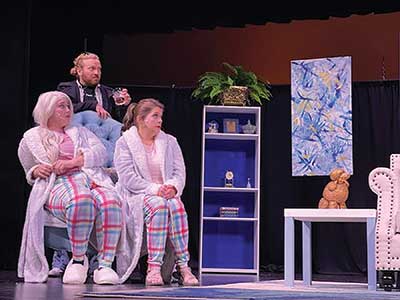
It casts its light on acting, set design, writing, podcasts, short film, directing, sound, lights, music and all that goes into a production as part of Spotlight’s successful script.
In addition to CEPA’s community theatre troupe, younger versions are now flourishing through Spotlight Clubs at Pell City, St. Clair County, Moody and Victory Christian high schools. A kids drama program has evolved, and the awards ceremony for all of it held each year is now an event tantamount to the Oscars.
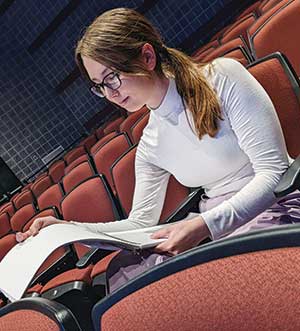
Shelby Duke, Spotlight coordinator
Born in 2015 in a collaboration with Jefferson State Community College, the CEPA program was gaining popularity for those interested in performing arts but was shuttered as a result of the COVID-19 shutdowns in 2020.
Shelby Duke, Spotlight program coordinator, said that the program had to get creative in order to keep the program’s momentum moving forward. “In 2020, when the pandemic hit, we began using digital means to keep people involved in Spotlight since we could not be in the theatre for a few months,” Duke said.
In September of 2020, Duke said, the program began cultivating a digital media platform and expanding into a podcast in Spotlight Studio called The Black Box. “In October of 2020, we released our first podcast and asked our clubs to write podcasts as well,” Duke noted. “We had several podcast scripts submitted, and we made a season out of it.”
Spotlight Studio is also a place where people can find videos of the various clubs involved with the program, short films and other projects within it. Building on its successes, the program is in the midst of transforming another podcast into a short film.
Perhaps one of the most creative outlets within the program, The Black Box Podcast, is a dramatic audio theatre experience where club members write their own scripts for the podcast and record them. Subjects last year included a wide variety of subjects from comedy pieces about Christmas to more serious subject matters.
Miss Christmas Business developed by the St. Clair County High School club debuted at the Sidewalk Film Festival in Birmingham in 2021.
“We are planning on releasing a podcast this month, Project SEM;COLON written by Pell City High School student Anna Claire Hawthorn. Project SEM;COLON is a podcast and future short film that shines light on suicide awareness,” Duke said. “Anna Claire and other PCHS students have worked so hard on this project, and I am extremely proud of them.”
A catalyst for all, regardless of age and performing arts experience, “this program brings people together who have an interest in theatre,” Duke said. “It has become a community of people who share that love or want to see what things are all about. It is open to anyone who wants to give theatre a try – on and off the stage.”
In addition to the program’s new digital platforms, Spotlight is still home to plays and musicals upon which it built its reputation. It also hosts a Summer Drama Camp for Spotlight Kids Club.
Now in its fifth year, Spotlight annually shines the light on its own through the Spotlight Awards, a way to recognize and celebrate the accomplishments of the program and its members over the year. “We have categories for everything from actors awards to the best in crew awards,” Duke said. “It is also a way for us to get donations that go to the Spotlight program as well. We have food and entertainment to continue to build the Spotlight Award community and celebrate our wonderful talent.”
Another face also joined the Spotlight team this year, Nicholas Fason, who will be serving as Spotlight Studio coordinator and will be overseeing digital productions like podcasts and Spotlight Films.
“I am very excited to be stepping into the Studio coordinator role,” Fason said. “I am very passionate about giving students and community members every opportunity to express themselves.”
Fason will be coordinating between students and community members. “I am honored to be given this opportunity to make sure that we can execute the vision of the students and their creative endeavors,” Fason said.
The potential for the future is not lost on CEPA Executive Director Jeff Thompson, who along with Jefferson State’s Leslie Warren and Nicholas Kin, founded the program five years ago and carefully laid the groundwork.
In an impassioned speech at the Spotlight Awards Ceremony, Thompson discarded his notes, stepped from behind the podium and delivered a dramatic rallying cry for the program.
Five years ago, he said, he, Warren and Kin “had an idea that there would be enough of you out here to show this community that theatre was important, to keep this thing running, to keep more people coming through these doors year after year, doing play after play, growing exponentially, making people realize your art is important. And you’ve done it for five years, letting this community know that what you love is important,” he told the capacity audience of young people.
“And that’s what I love. I love that you love it. I love that you want to do it. I love that it matters to you. I love it that you chose it. I love it when you try hard and succeed, and I love it when you try hard and don’t. I love you, and I appreciate you.”
For five years, he said, “you’ve shown me, you’ve shown this board, you’ve shown everybody in here that we matter, and that’s what I want you to know tonight is that you matter. The things that you love matter. Keep doing them. Keep trying. Keep working. Be better every year. Happy five years, St. Clair County!”
Leroy F. Box and Pleasant Riggs Crump, St. Clair’s witnesses to history
Story by Robert Debter Submitted Photos Photos by Graham Hadley
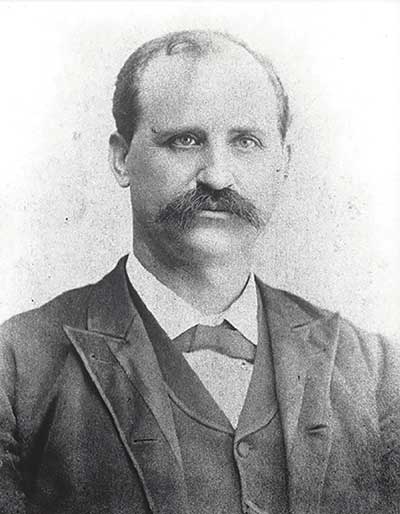
They both hailed from St. Clair County in the early 1800s. One returned home from the Civil War to live out his life there. The other resettled in nearby Talladega County after the war. But Leroy F. Box of Ashville and Pleasant Riggs Crump of Ragland crossed paths as Confederate soldiers on a fateful day at Appomattox, Va., as eyewitnesses to history.
Soldier, educator,judge, lawmaker
Leroy Franklin Box’s story does not begin in St. Clair County, but in Kent, England, where his family originated. The Box family had a long history of patriotic military service to America from the American Revolution to the War of 1812 and the Seminole War.
He was born at Trout Creek (now Ragland) on April 9, 1837, to Allen and Mary ‘Polly’ Box. Both were from South Carolina and of the Methodist faith. Mrs. Box was described as “true in all relations of life” and “a faithful, devoted Christian.” At the time of his birth, St. Clair County was not even 19 years old, and its boundaries extended farther north into present day Etowah County.
Many of the county’s first, founding and most prominent families, as with his, the Ash and Dean families, came from South Carolina, with many others coming from Georgia (Inzer), North Carolina (Yarbrough), Tennessee (Looney) and Virginia (the Chandler and Cobb). The young Leroy received his early education from Professor Law and Pope and would teach school for several years.
Leroy Franklin Box
In 1860, he became St Clair County’s first superintendent of education but also in 1860 came a very contentious and divisive presidential election in which the winner carried only 18 of 33 states (none were Southern) and received less than 40% percent of the popular vote. South Carolina seceded unanimously (169-0) on Dec. 20 and was followed by Mississippi (83-15) and Florida (62-7) on Jan. 9 and 10, 1861. Then, the hour of decision fell to Alabama and in Montgomery on Jan. 11, the Republic of Alabama was declared in a vote of 61-39.
Box joined Company A of the 10th Alabama Infantry, which had been organized at Montgomery and placed under command of Col. John Horace Forney. The regiment would see action beginning at the Battle of Dranesville in Fairfax County, Va., and continue to be engaged at many noteworthy battles, including: Gaines’ Mill, Frasier’s Farm, Second Manassas (Bull Run), Sharpsburg (Antietam), Fredericksburg, Gettysburg, the Wilderness, Spotsylvania and Petersburg.
All through the war, Lt. Box studied from law books which were always with him. He married Isabella Vandegrift on April 22, 1866, and journeyed to Calhoun County to continue his law education, all the while still teaching. After obtaining his license, Box returned to Ashville and entered into a partnership with Judge John W. Inzer.
He served one term in the Alabama Legislature, two terms as state superintendent of education and was later nominated, then elected, as judge of the Seventh District. Judge Box was a Mason and a member of Ashville Lodge 186.
His home, built in 1890 by his son-in-law, still stands proudly in Ashville on Box Hill. Its elegance and splendor are displayed and preserved by its owners Lavon and Pat Drake, who operate their business the Ashville House Quilt Shop, in the beautiful Victorian home.
On March 26, 1895, Judge Box passed from this life while holding court at Edwardsville, then the county seat of Cleburne County. The Southern Alliance newspaper eulogized him as “… one more good man gone on before to mansions in the skies.” His epitaph reads: “A just judge always dared to do right, a brave soldier, a true mason, a conscientious Christian devoted to his church and every worthy cause.”
‘The last Confederate veteran’
In October 1864, during the almost year-long Siege of Petersburg in Virginia, a 16-year-old boy from Greensport, who had been in Crawford’s Cove on Dec. 23, 1847, appeared and was placed in the ranks of Company A of the 10th Alabama.
The son of Robert and Martha (Hathcock) Crump had been inspired by a returning soldier in 1863 and had become determined to join the Army and take up the cause for which many Southerners, both high and low born, had fought and died.
After the War, Crump journeyed back to Alabama and began his new life in Talladega County.
Pleasant Riggs Crump
He married Mary Hall on Sept. 19, 1872, and built a home for them near Lincoln in the Acker’s Chapel Community. The honorary title of “colonel” was bestowed to Crump, a member of the United Confederate Veterans, by President Harry Truman, a member of the Sons of Confederate Veterans, and he would be addressed by this title for the remainder of his life. In an apparent show of respect for Confederate veterans, he bestowed the honorary title much like Alabama Gov. Lurleen Wallace appointed Bob Hope an honorary lieutenant colonel in the Alabama State Guard.
Crump was a deacon at Refuge Baptist Church for almost 80 years and read the Bible through several times.
On April 26, 1950, Crump enjoyed a surprise visit from James W. Moore of Selma, commander-in-chief of United Confederate Veterans. The old soldiers clasped hands tightly and held their grip as they talked. Throughout the day they looked over old photos and reminisced of days long ago and old friends now passed.
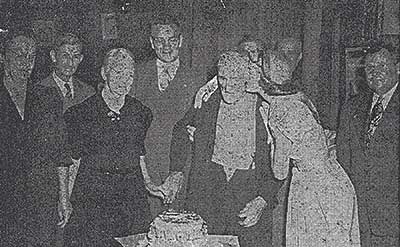
His final birthday was one of tremendous celebration as friends, neighbors and members of the local Civitan Club gathered around a cake festooned with 104 candles. Col. Crump was made the first honorary member of the club.
His favorite scripture was from St. John 14:1, “Let not your heart be troubled,” and he once confided to a reporter, “I have spent these last few years sitting in a rocking chair and talking with the Lord.”
On Dec. 31, 1951, the flags of the past fell still, and the bugle calls became silent. There would be no more dreams of battle, nor seeing friends fall from rifle, cannon or bayonet. Crump, known as the “Last Confederate Veteran,” had passed away.
The United States flag draped his coffin.
APPOMATTOX
On April 9, 1865, two soldiers, one a lieutenant and the other a private, watched the man who had led the Army of North Virginia ride to the Appomattox Courthouse, dismount his horse and enter. Private Pleasant Crump, uttered to his commanding officer, “… when Gen. Lee comes out after surrendering, he’ll come out without his sidearms, sword or anything else.” Lt. Leroy F. Box, replied, “That won’t happen. He’ll come out the same way he went in.”
About 15 minutes passed, and Lee emerged. He stood for a moment on the front porch and, looking out into the distance, placed a fisted hand into the open palm of another. True to his commander’s word, Pvt. Crump observed that Gen. Lee was still wearing his sword, as he mounted Traveller, and began his journey.
“How did you know it would happen that way?” Crump asked. Box replied, “Lee and Grant both graduated from the U.S. Military Academy. They saw service on the Mexican border together. When secession came, Lee chose the South, and Grant chose the North. There could not have possibly been ill feelings between them.” l
“Northern politicians do not appreciate the determination and pluck (bravery) of the South, and Southern politicians do not appreciate the numbers, resources, and patient perseverance of the North. Both sides forget we are all Americans.” – Gen. Robert E. Lee
“Look at that baby! What a beautiful baby!” the lady says as she watches the petite blonde across the table from her. “She’s so pretty! What a sweet baby!” Smiling, the small woman responds by lovingly wrapping her baby doll in the pink flowered blanket and gently laying her down on the table.
Whenever she comes to Friendship Place, Brenda’s “baby” will be waiting for her. Brenda’s family brings her to St. Simon Peter’s Friendship Place twice a week for stimulation, affirmation, encouragement and love. Brenda and her family are dealing with the effects of her dementia.
Friendship Place is a respite care facility in Pell City that offers services Tuesdays and Thursdays from 10 a.m. until 2 p.m., allowing full-time caregivers of dementia patients a chance to leave their loved one in a safe and loving environment for a few hours.
Volunteers lead friends in cognitive development activities.
The break is important to give caregivers a chance to do things alone that would be hard to accomplish with their family member along. “We’ve found this mission to be three-fold,” says Program Director Melinda Knepper. “It is an important respite time for family or caregivers to do errands or have personal time. It’s also a ministry to the dementia patient. It adds purpose and meaning to their lives. The third element is for the volunteer. They start helping so they can be a blessing to others, but more often than not, they end up leaving each day feeling blessed and fulfilled.”
Today’s theme is “Observe the Weather,” so the group is adjusting each activity to include cognitive enrichment associated with weather. The art activity includes painting an umbrella; the word bank for the word search is all weather-related, as is the bingo game board.
Each day is carefully structured to include both physical and cognitive stimulation. Today’s physical activity is balloon volleyball, played in chairs using pool noodles to hit the balloons over the net. Smiles and excited chatter fill the room as more balloons are added to the game.
Two years ago, the mission was conceived through a discovery process at St. Simon Peter Episcopal Church. The rector at the time began a process to figure out the most pressing community needs. As they neared the end of that process, the need to help families dealing with dementia topped their list.
Christian Love Pantry and Lakeside Hospice, two other thriving community missions also born at St. Simon Peter, quickly outgrew the church and began operating as nonprofits outside of the church walls. It was, in fact, a volunteer with Lakeside Hospice that helped to validate the need for the services Friendship Place offers.
“Elizabeth Thomaston – she goes by Bit – was involved in support groups for families dealing with Alzheimer’s in both Pell City and Leeds,” Knepper explains. “She helped us see the need and get on the right track.” With a grant in hand, they opened just two months before the pandemic hit.
“We had a ton of interest as soon as we opened,” says Knepper, “but then we had to shut down for COVID just a couple of months later. We kept up via Zoom meetings, but we were glad to be able to open back up for in-person care.” Currently, they serve four families a month, but hope the numbers will grow as people get more comfortable being together and COVID anxiety eases.
“We had one family that contacted the patient’s doctor to see if they were OK to come,” adds Knepper, “and she told me the doctor said the benefits of her being here outweigh any of the risks associated with COVID.”
Doctors define dementia as a syndrome that leads to the deterioration of cognitive function to the extent that it interferes with daily living tasks and abilities. It is the result of a variety of diseases and injuries, including stroke and Alzheimer’s.
Statistics from the World Health Organization show that 55 million people worldwide suffer from some form of dementia, with 10 million new cases each year. Alzheimer’s disease is the most common form of dementia, contributing to over 60% of cases. And since 66% of dementia patient care comes from live-in caregivers, the stress on those caregivers is often overwhelming.
Build it, and they will come
Joanna Pickett brings her mother, Dot, to Friendship Place every day it is open. “We were actually here learning about it before they opened. We’d been going to a place quite far from here but came to talk to Melinda when we heard they were thinking of opening a place here,” she says. “It’s hard to imagine how important it is. It gives me a chance to breathe. I enjoy being her full-time caregiver, but with a dementia patient 24/7, there are some things that are very difficult to do when I have her with me.”
With that, she tells of a trip to Hobby Lobby that ended in frustration after her mom, a former artist, insisted on filling the buggy with new brushes and art supplies. “She doesn’t need them anymore, but she believes she does, so it’s a struggle in the store.”
Pickett says that being able to bring her mom to Friendship Place gives her a sense of peace, knowing that the volunteers there genuinely love Dot. On days that she goes, Pickett says, she comes back “a different person. You wouldn’t think a person with dementia would need to be encouraged, but they do. When I pick her up, she’s happy. It stirs up her abilities, and she seems more attentive and calm.”
Even though she doesn’t understand what Friendship Place is when she’s told she’s going that day, Pickett says when she describes it as the place “where you sit at the round tables and play games with your friends,” Dot gets ready with purpose and excitement.
That’s exactly the reaction Knepper wants from the program. “We offer theme-based activities, lunch, games and laughs … lots of laughs. We help them express their independence and give them lots of love from our volunteers.”
Volunteers are key
Volunteers are trained in what memory loss means, the different types of dementia, and how to appropriately interact with those with memory loss. Knepper pairs each patient, whom they refer to as “friends,” with a volunteer for the day. Volunteers guide and encourage the friend and participate along with them throughout the day.
Those volunteers are not just from the church. They are looking for more, so anyone who is interested in serving is encouraged to contact Knepper at St. Simon Peter Episcopal Church.
A volunteer in the program from the first day, Mike Dikeman smiles as he describes his love for the mission. He’d recently retired from Time, Inc., and was looking for a place to volunteer his time.
His dad had suffered from Alzheimer’s dementia for more than a decade, so he knew the frustration associated with his care.
“He lived in Kansas and each time I went to visit, I could tell a difference in him. He would ask me if I’d gained weight. Then a few minutes later, he’d ask again. A few minutes later, the same.”
He enjoys the opportunity to help other families through the process. Is it tough? “No,” he says, “we just have so much fun! Melinda is amazing and it’s a very positive environment.”
They even tease him because one day he rescued a turtle from the road on the way to the church. When he came in, he jokingly asked if it was turtle day, since he had one in his truck.
Against all odds, it actually was World Turtle Day, and turtles were the theme of their activities. The friends got a chance to see a live turtle that day. “Now they ask me on Elephant Day if I have one in my truck,” he jokes. “It’s just a fun place to be.”
A trio of St. Clair anglers make a splash at Bassmaster Classic
Story by Paul South Submitted, staff photos
The PGA Tour has its FedEx Cup. NASCAR drivers put the pedal to the metal and trade paint gunning for The Chase.
And Matt Herren, Wes Logan and Joey Nania professional anglers with St. Clair County ties, hoped to make their mark at the 2022 Academy Sports + Outdoors Bassmaster Classic presented by Huk, where the best bass fishermen in the world gathered in hopes of reeling in the sport’s most prestigious prize, fishing’s Super Bowl.
Nania finished 13th with winnings of $15,000; Logan finished 23rd with $13,000 in winnings; and Herren finished 32nd with $10,000 in winnings.
Wes Logan reels one in.
The 2022 classic came to Lake Hartwell, a man-made body of water near Greenville, S.C., in early March. While St. Clair County has made a mark in the NFL – with San Francisco defensive end Dee Ford (Odenville) and Major League Baseball with Springville native and Detroit Tiger hurler Casey Mize, the county’s biggest pro sports splash may be in professional fishing, thanks in large part to Herren, Logan and Nania. Seven anglers who have competed on the pro circuit call the county home.
It’s not unusual in sports to see large metropolitan areas produce world-class competitors. But for a largely rural county like St. Clair that’s peppered with small towns, three world-class competitors from the county in a sport’s marquee event is worth cheering, regardless of the end results.
“It’s kind of a cool thing to think about,” said Springville’s Logan. “With our county being so small and three of us competing in it. I think it just shows the caliber of fishing in Alabama and especially in Central Alabama where our county’s located. It gives a testament to the lakes and rivers in the surrounding area about how good they are and how diverse they are.”
Located near the South Carolina-Georgia border, the 87.5-square-mile Lake Hartwell reservoir is comprised by waters from the Savannah, Tugaloo and Seneca rivers and is one of the Southeast’s largest lakes.
Hartwell’s deep waters presented a trophy-sized challenge for Classic competitors. In fact, the 2022 Classic was Logan’s first-ever tournament on Hartwell. The lake is known for its deep waters, similar to Northwest Alabama’s Smith Lake. By contrast, the lakes of the Coosa are stained and shallow.
Anglers call Hartwell a Blueback Herring lake, named for the small migratory fish that’s a favorite bite for the big bass of Hartwell. Because the herring are on the move, it makes anglers’ quest for a catch a bigger challenge. Bluebacks can be in one patch of water in the morning, another by the afternoon, taking the famished bigger fish with them.
“(The herring) roam around a lot,” Logan said. “They’re nomadic. “If you find fish on Tuesday. They’re liable to be gone by Tuesday afternoon. The fish just follow the bait.”
The 50,000-acre lake’s deep waters – a maximum of 185 feet – offers another challenge for anglers.
“It’s going to set up a little bit different than I’m used to, being from around the Coosa River, where it’s shallow fishing mostly. The baitfish and the way the fish act is going to be really different,” Logan said.
“Hartwell is a really good lake, just in general,” he added. “I got to free practice over there for a couple of days, and it seemed to have a really good population of fish in it … I know from past Classics there, it’s a really good lake.”
Joey Nania celebrates win at Bassmaster Elite Series
Herren is an Ashville resident who grew up fishing with his dad, Butch, on Neely Henry Lake. At 59, he’s one of the senior competitors on the B.A.S.S. circuit who didn’t become a full pro angler until 2003. Before that, he worked in his dad’s Birmingham body shop. He married his wife, Candy, and the couple raised two sons, Josh and Jacob.
But this year’s Bassmaster Classic will mark his 17th major championship tournament since 2003.
“To me, the tournament fishing was kind of an afterthought; I just always loved to fish. I’ve been competitive my whole life. I mean, I played sports in school … One thing led to another.”
The pro fishing game has changed since Herren was in high school and college, when tournament fishing “just wasn’t that big a deal.” Now, it’s a big money game, with tournament cash, television, endorsement deals, even video games. Hank Cherry Jr. took home a $300,000 first-prize check after winning last year’s Classic.
“I think I was 39 when I went full time. The sport has kind of evolved into something the younger guys are getting into. It’s growing by leaps and bounds,” Herren said.
But one of pro fishing’s graybeards isn’t intimidated by the young bucks he faces on tour.
“I’m still highly competitive now,” Herren said. “These young whippersnappers, I can still run with ‘em.”
Herren breaks down Lake Hartwell, much like a football or basketball coach breaks down an opponent. In fishing, the seasons, weather patterns and more are taken into account.
“Every body of water we fish will offer an angler areas that he likes to fish, styles, certain techniques. That’s how I try to go about doing my job,” Herren said. “I try to fish the techniques and patterns that are my strong suit and just see what happens … I just try to be consistent and do what I do.”
A St. Clair County transplant – Joey Nania – moved with his wife and kids to Cropwell from Washington state. In 2009, he competed in the Bassmaster Classic on Lay Lake. He met Rick Hughes, a Cropwell evangelist and “a really good fisherman.” The two became friends, and Nania visited the following summer. The combination of faith, family values and fishing lured Nania to settle in the county. He now calls Pell City home.
Nania accepted Christ at 19 after meeting Hughes. Later, Nania met his future wife, Jessica, and his career took off. He calls it “a string of blessings.” His newfound faith – belief he shares on tour, played a role in his decision to move south.
Along with his pro career, he is a fishing guide on the Coosa River system, Smith Lake and Lake Martin.
“It’s just such a great location, and it’s just the fact about Alabama. If you can learn to fish in Alabama, you can fish anywhere in the country because we have such diversity, Nania said.
Nania has fished Hartwell before, beginning with an episode of a fishing show he hosted for seven years called, Sweetwater. Hartwell is comparable to Smith Lake in Alabama, Nania said.
“I really like the size of the lake. It’s a big body of water; but it didn’t seem like overwhelmingly big. Having the mixture of spotted bass and largemouth and having multiple options that aren’t far apart, is great … If you can catch spots and have a largemouth pattern going, it’s a good way to go. And Lake Hartwell fits that bill.”
Regardless of how St. Clair’s three Bassmaster Classic competitors fared, Logan, Herren and Nania are proud to represent their home county in pro bass fishing’s Super Bowl. The trio are good friends. And all take pride in representing St. Clair County.
“It really just goes to show that fishing is deeply rooted in the South, especially this area of Alabama.” Nania said. “There’s just so many different lakes, and fishing is just sort of a way of life around here. It’s faith, family and then fishing is kind of the motto for people around here. I know Wes Logan and Matt are like that, too
“It’s really a cool thing to see all of us succeeding and has been awesome and just a total blessing.”