Story by Elaine Hobson Miller Photos by Wallace Bromberg Jr.
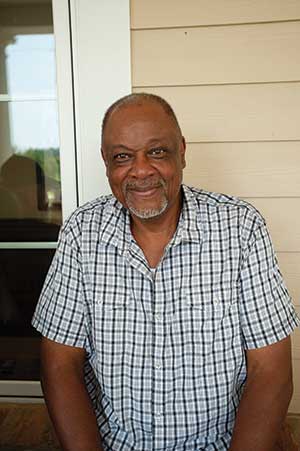
Wayne Johnson has thought a lot about his legacy and what he will leave behind when he has departed this earthly life. He wants it to be his work with veterans. Considering what he does for and with them every week, that shouldn’t be a problem.
Although he recently retired after five-and-a-half years as veterans outreach coordinator for the St. Clair County Extension office, Johnson still takes veterans to medical appointments, helps them access their government benefits and makes regular visits to the Col. Robert L. Howard State Veterans Home in Pell City. “I never considered it work because I enjoyed it so much,” he says of his time with the extension office.
Johnson was one of the first people Frank Veal met after moving into the veterans home, and the pair have been friends ever since. A Korean War vet who served in the Air Force for 26 years, Veal is a native of Troy. He owns a van with a ramp that he lets Johnson use to ferry other vets to various appointments. The veterans home takes care of its residents’ medical trips.
“Wayne was here to help Frank celebrate his 91st birthday in August,” says Reshina Pratt, administrative support assistant at the veterans home. “They are very close.”
Johnson also is close to Veal’s next-door-neighbor, Tom Kelly, who is originally from Maryland but raised his family in Alabama. Another Korean War veteran, Kelly has been at the home since 2014. “Wayne visits us weekly, more if we have a need,” says Kelly. “Sometimes he brings us lunch, like barbecued ribs, and he has made trips to Montgomery with us.”
“He’s a good guy, and we appreciate him,” says Veal. “He’s a handy man to have around.”
It’s Personal
One of the reasons Johnson has such an affinity for veterans is that he’s a veteran himself. He grew up in Portsmouth, Va., and joined the Air Force right out of high school. He retired after serving for 20 years, then worked for a government contractor 14 years. Later, he was employed as activities director at the veterans home. He retired from his job with the Extension Service in April to help take care of his one-year-old grandson, Jaxson, and as of late August, ACES still had not found a replacement.
From the beginning, Johnson’s vision was to get out into the community to find veterans and widows of veterans who needed assistance, according to Lee Ann Clark, the St. Clair County Extension Service coordinator. “He worked hard and successfully accomplished his goal of making veterans aware of the benefits that are available to them and helped many obtain these benefits,” Clark says. “Not only did he reach the elderly and middle-aged veterans, but he also assisted younger ones.”
Although his retirement plans originally included relaxation, fishing and spending time with his grandson, he continues to be an asset to the veterans in the community in some capacity.
Wayne Johnson
Johnson estimates that he probably takes vets to appointments and helps them run other errands three times a week. “Some live in their own homes but can’t get out and get their groceries by themselves,” Johnson says. That’s where Veal’s van comes in handy. “I let him keep it at his house,” Veal says.
Johnson met his wife, Cheryl, when both were in the military and stationed in Kansas. She spent 10 years in the Air Force in accounting. When he retired, they decided to come back to Pell City because it was her hometown. They have two daughters and three grandchildren. One daughter, Jaxson’s mother, lives in Pell City. The other daughter, who has two children, lives in the Netherlands, where Johnson was once stationed while in the Air Force.
“Wayne does an awesome job with local veterans,” says Cheryl Johnson, who has been married to Wayne for 30 years. “We need more people like him because there’s a huge need with veterans in this county. So many are here alone, with their children in different states. He works well with people, and he’s still helping with some he was attached to. He picks up people as needed for appointments for a few who still reach out to him, and Lee Ann still refers people to him from time to time. He tries to direct them to the right resources if he can’t help them.”
His motivation, she says, is that he just loves reaching out to veterans. “When the St. Clair Extension Office had that opening, they wanted a veteran, and he was in a position to take the job,” she says. “It was part time, and he took it to have something to do. Then it got bigger and bigger because there was so much need out there. A news article would post, and the calls would continue to come in.” Cheryl says her husband connects with people. “He loves war movies and the history of wars, and loves the stories the veterans tell him,” she says.
Prior to its recent COVID-19 lockdown, the Col. Robert L. Howard State Veterans Home saw Johnson drop by at least once a week to participate in activities with residents. “He’s a great resource for us,” says Reshina Pratt. “One day a homeless vet from out of town stopped by and we called Wayne, and he helped him get the assistance he needed. He’s a kind, caring, helpful man. Even though he has retired (from the county extension office), we still call on him for assistance. I know he’ll be back here after the restrictions are lifted.”
The Rev. Willie E. Crook met Johnson about 20 years ago when Crook was a contractor building community churches. Johnson helped get Rocky Zion Baptist Church in Pell City built, according to Crook.
“When I worked with him then, he had another job but came by and checked on the construction twice a day, before and after work,” says Crook.
“He’s a dedicated man. The Lord led me to build a ranch for underprivileged, inner-city kids. I talked to Wayne about helping me, and we started Gateway to Life Youth Ranch in Ohatchee 12 years ago. He’s president of the ranch, which hosts at-risk kids on weekends so they can enjoy the outdoors, fishing, woodworking and the animals at the ranch. We also mentor fourth- and fifth-grade boys’ classes at Saks Middle School in Anniston.”
Crook vouches for the fact that Johnson has befriended many veterans through the years. “Many times, he has come to the ranch to pick up or drop something, and he has had a vet with him,” Crook says. “He cares about them and would do anything in the world for them. He’s a giving man. We didn’t have any funds when we started that ranch, and he has gone into his pocket several times.”
A modest man, when asked why he continues to work with veterans, Johnson has a quick and simple reply: “It gives me a sense of satisfaction.”
It’s hard to miss the excitement building all around Leeds these days. From a flurry of business activity around the Interstate 20 interchanges to the commercial district on Ashville Road to the resurrection of downtown as a thriving center, the enthusiasm surrounding the growth is evident.
One of the best examples is found in historic downtown, where specialty shops, popular eateries, old favorites and professional services have found a home.
Leeds is a quaint, little city nestled just minutes from Birmingham and Anniston. Its historic downtown lends much charm with local shops, boutiques and architecture reminiscent of days gone by.
Visit the iconic Pants Store for clothing and shoe brands you know and love, a store that has been in business since 1950. For the past seven decades, shoppers from miles around have made it their destination point because of the selection, customer service and pricing.
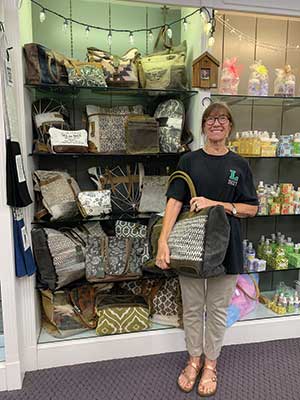
Neva Reardon shows off handbag collection at Mum & Me
This family-owned endeavor – still in the same family today – has expanded to Birmingham, Tuscaloosa, Huntsville and Trussville, crediting its longevity to founder Taylor Gee’s philosophy – “always put the customer first and make sure of their satisfaction.”
Then stroll over to Merch Boutique for boutique women’s clothing in sizes XS-3X along with baby up to tween sizes for the kiddos as well as accessories, home décor and more.
Head next door to Mum & Me Boutique for a shopping experience you won’t soon forget. Celebrating four years in business as a boutique specializing in local, Southern and American gifts and crafts, Mum & Me has a little something for anyone special in your life.
Gifts range from baby and infant wear, baby shower gifts and registry, to bath products made in Texas and Virginia, Sorrelli dazzling jewels and a wide selection of jewelry made by American hands. An expanded boutique features beautiful, “wearable” ladies clothing. “We have jeans that fit a lady’s body like she was still 18,” said owner Neva Reardon.
Mum’s Unique Consignment Boutique is the latest sister store to mum & me mercantile. A quaint shop specializing in finer consignments of jewelry, purses, shoes, children’s clothing birth to tween, adult women and menswear – all sporting finer boutique brands. Are you going to a formal or getting married? Mum’s Unique is a first-stop must. And their collectibles are quite a draw.
Hungry or need to satisfy a sweet tooth craving? Stop in at the Three Earred Rabbit for a delicious meal with choices of homemade soups and sandwiches made from scratch, salads and fresh baked goodies that will make your taste buds go wild.
One-of-a-kind cakes and other tasty desserts are made fresh every day.
Mills Pharmacies is your next stop with that hometown pharmacy feel, where everyone knows your name. But the features don’t end there. Mills carries a diverse collection of gift items and greeting cards in addition to filling all your pharmacy needs. Altogether, it’s just what the doctor ordered.
Overstock Mattress is growing in popularity, boasting the best prices around on quality bedding.
Your visit is not complete without a trip to Livery Square and the shop at LA Salon, Flowers & Boutique. This little shop has beautiful women’s clothing, accessories, home décor and gift items as well as offering tanning to keep you looking like you just returned from a well-earned vacation. You can also order floral arrangements for any occasion.
As you stroll these sidewalks throughout the downtown area, you will also find service organizations, a theater and art center, a dental center and all types of services needed in day-to-day life.
Nightlife is growing, too. Rails and Ales is fairly new to the roster, offering food and spirits at this craft beer and wine bar, featuring live music and games as part of its allure. Its entertainment line-up includes a number of local entertainers, and it hosts food trucks in its backyard on Thursdays, Fridays and Saturdays.
Besides being voted one of the top suburbs for young professionals, Leeds has countless amenities to attract from near and far.
“We have things happening on all sides of Leeds, and we want to keep people coming downtown,” said Dona Bonnett, past president of the Leeds Area Chamber of Commerce and a business owner herself. That’s why all sorts of activities are centered downtown, making Leeds more than a destination point at the interstate where Outlet Shops of Grand River, Buc-ee’s, Bass Pro Shops and Barber Motorsports naturally draw crowds.
“We want to introduce them to all Leeds has to offer,” said Sandra McGuire, executive director of the chamber. “We do that by offering all kinds of activities to generate the foot traffic needed to support our downtown businesses.”
She noted that every Monday is Food Truck Monday, attracting food trucks at the gazebo park that offer menus fit for any taste and rivaling traditional restaurant fare.
Every Thursday during harvest season, you’ll find 6th Street block just outside the chamber making way for fresh fruits, vegetables and homemade treats at the Leeds Farmers Market, a venue for local farmers and makers from 3 p.m. to 6 p.m.
In October, thousands come out for the trick or treat event for Halloween with games and candy for the kids, a movie and food trucks cooking up something special. And there’s a popular carnival in the fall, too.
On Nov. 13, thousands more are expected to turn out for a major car cruise-in by C&C Motor Co., “Cruising for Toys.” Admission is a toy for the cruise-in, which will provide Christmas gifts for kids in Leeds. Two hundred to 400 cars are expected. Food trucks, street vendors as well as a Christmas Open House with downtown retailers and other businesses open to greet visitors and shoppers to kick off the holiday season. A parade of cars is planned with Santa and the city’s tree lighting to round out the festivities.
It’s all aimed at bringing people and businesses together, Bonnett said. The chamber’s Retail Development Committee meets regularly to generate ideas and create projects that can cross promote and help one another.
“We’re all in it together,” she said, noting that they can pool advertising dollars and resources. “If we work together, we can achieve more. It’s about how we can move forward and grow. We have a wonderful little town. There is a lot going on. We invite everyone to visit Leeds and see for yourself what people are talking about.”
Story by Jackie Romine Walburn Discover staff photos
St. Clair County medical practices are partnering with specialists from larger municipal area to bring specialty medicine – from cardiology to surgery to dermatology – closer to home.
“Having the specialists here in our office offers continuity of care for patients, plus convenience and familiarity,” says Pell City Internal and Family Medicine (PCIFM) office manager Terri Woods. “The response from patients is always positive.”
The specialists now seeing patients through PCIFM lease offices at the practice’s facility at 41 Emience Way in Pell City. When needed, the internal and family medicine physicians refer patients to specialists who bring staff and see patients in Pell City on a regular basis.
The medical specialties often needed by patients of Pell City’s internal and family medicine practices include cardiology, orthopedics, general surgery, gastroenterology, nephrology (kidney care), podiatry and dermatology.
Currently PCIFM has five medical specialists who see patients on referrals from the local practice. Each specialist’s offices schedule appointments and have medical staff who come to the Pell City offices.
Medical specialists now seeing patients in Pell City through PCIFM include:
Dr. Karl E. Hofammann III, an orthopedic surgeon who specializes in sports medicine, total joint replacement, hand and wrist surgery and general orthopedics. He practices at Orthosports Associates offices at Citizen’s Baptist Medical Center, St. Vincent’s East and Pell City Internal and Family Medicine.
Dr. Vinh Nyguyen, a general surgeon who focuses on areas and organs of the abdomen and related organs, specializes in invasive or minimally invasive surgical techniques with the latter reducing recovery time and stress on the patient’s body. He has offices in Birmingham, Oneonta and Pell City.
Dr. Raj Patel, a board-certified dermatologist trained in micrographic surgery and cutaneous oncology. A native of Shelby County, Dr. Patel is the only ACMS (American College of Mohs Surgery) fellowship trained in Mohs and reconstructive surgeon in Shelby and Chilton counties. Working with Truye Dermatology, Dr. Patel has offices in Alabaster, Birmingham, Clanton and in Pell City at the PCIFM.
Dr. Alvaro A. Aldana, a cardiologist with Grandview Medical Group. He specializes in intervention with coronary, renal and peripheral vascular disease and is board certified in internal medicine, cardiovascular disease and interventional cardiology. A native of Columbia, he earned his medical degree from Javeriana in Bogotá and completed a fellowship in general and interventional cardiology at St. Francis Hospital in Evanston, Ill. In addition to office hours at Pell City, he sees patients at Alabama Cardiovascular Group in Birmingham and Grandview Medical Group Primary Care and Cardiology Trussville.
Dr. Jay Long, a general surgeon specializing in bariatrics, who sees patients at Birmingham Minimally Invasive Surgery (BMI.com) in Birmingham. Associated with St. Vincent’s East and St. Vincent’s St. Clair, Grandview and PCIFM in Pell City, he provides a one-on-one consultation with all patients to begin their weight-loss journey. He and a multidisciplinary team offers support before and after any surgery with monthly support meetings, nutrition classes and customized high-protein diets.
At Northside Medical Associates, which becomes “Complete Health – Pell City” at the end of August, having specialists on site “helps ensure that the care patients need is convenient, even when being sick is not,” says Clay Barnett, corporate communications manager for Complete Health. It is a primary care medical group Northside joined in October of 2020.
“We strive for easy access and having these groups on our campus certainly makes that a simpler task, especially for our patients who might not be comfortable driving into metro-Birmingham to an intimidating hospital setting,” Barnett adds.
He noted that since Northside joined forces with Birmingham Internal Medicine Associates (BIMA) and Complete Health the group has become the Birmingham area’s leading primary care group. The addition of medical specialists, who lease office space at Northside’s 80,000-square-foot campus on Plaza Drive, complements Northside’s existing state-of-the-art imaging, on-site pharmacy and a 365-day-per-year Urgent Care center serving the people of St. Clair County. The Northside medical practice, founded in 2001 with three physicians, has grown to more than 150 care providers and staff in four medical offices, including Moody, Springville and Trussville.
Northside has more than 12 specialist physicians and practices seeing patients at Pell City offices, says Shelley Gallup, clinical services manager for the practice. The specialist groups lease space within the Pell City facility and respond to referrals from Northside’s 12 physicians and 16 nurse practitioners but are not directly affiliated with Complete Health.
Offering expertise in medical specialties including obstetrics and gynecology, ear, nose and throat, oncology, cardiology, ophthalmology, general surgery, gastroenterology, orthopedics, dermatology, nephrology and podiatry.
Northside Medical Home, which becomes Complete Health-Pell City at the end of August, hosts a multitude of specialties
Now seeing patients in Pell City via Northside and Complete Health are specialists:
Dr. Lewis Schulman, an OB/GYN physician with Grandview Medical Group, who specializes in obstetrical and gynecological care, urinary incontinence management, contraceptive options and hormone therapy.
Dr. Julie Taylor, a board-certified physician in obstetrics and gynecology with Ob-Gyn South and on staff at Brookwood Medical Center and St. Vincent’s St. Clair. Specialties include adolescent medicine, high-risk obstetrics and robotic surgery.
Dr. Justin Aldred, an obstetrician and gynecologist with Ob-Gyn South, has specialties including high-risk obstetrics, laparoscopic/robotic surgery and urinary incontinence.
Dr. Stephen Favrot, an otologist with ENT Associates, treats otologic and general otolaryngologic disorders. His areas of interest include treatment of hearing loss and balance disorders and of tumors of the skull base. He treats children and adults, including cochlear implantation and the bone anchored hearing aid (BAHA).
Dr. E. Scott Elledge, an otolaryngologist with ENT Associates, specializes in head and neck surgery, pediatric ENT, nasal and sinus disorders and allergies.
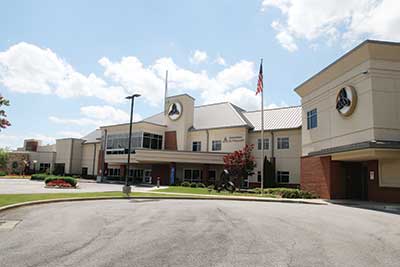
The campus of Ascension St. Vincent’s St. Clair
Cardiologists with Birmingham Heart Clinic in Birmingham specialize in treating coronary, carotid and peripheral disease with minimally invasive procedures to repair aortic aneurysms (PEVAR), replace aortic valves (TAVR) and transcarotid artery revascularization.
Surgeons from Eastern Surgical Associates of Birmingham specialize in minimally invasive laparoscopic and robotic surgery and operations in the areas of oncology, endocrinology, gastrointestinal disorders and vascular disorders.
Vision First Eye Center is a full-service eye care facility owned by Dr. Mark Bearman and Dr. Mark Mclintock. Vision First’s Pell City office at 74 Plaza Drive, specializes in laser cataract surgery and iDesign guided iLASIK surgery.
“Any person or persons who shall attempt to teach any free person of color, or slave, to spell, read, or write, shall upon conviction thereof of indictment be fined in a sum of two hundred and fifty dollars.”
This doleful Alabama law underscores the importance of education. Enacted in 1833, the law aligned with other Antebellum states’ laws which resulted from literate slave Nat Turner’s brief rebellion of 1831. Until then, slaves could be openly taught to read and write. Turner’s Rebellion ended in three days, and he was hanged.
Sometimes referred to as the “Black Moses,” Nat Turner was literate, preached from the Bible and influenced both races. From his rebellion, slave owners realized that educating slaves was dangerous. Therefore, soon after Turner’s execution, slave states began passing laws forbidding educating Blacks – slave or freedmen. Ex-slave Frederick Douglass would later write, “Knowledge makes a man unfit to be a slave.”
So, it’s no wonder that after the Civil War and toward the end of Reconstruction in Alabama (1874), freed slaves began organizing their own churches and schools. Established Dec. 17, 1868, the Alabama Black Baptist Convention urged their members to foster education through the local churches. In his history, Uplifting the People, Three Centuries of Black Baptist in Alabama, Wilson Fallin, Jr., records: “In 1870, the convention advised its churches ‘to build schoolhouses and churches in their own means, declining all union with others, unless absolutely necessary.’”
In St. Clair County, though, Ashville’s Black citizens had the “union” and support of White citizens in establishing the first school for children of former slaves. Old St. Clair County records show that on April 15, 1872, Pope Montgomery and wife deeded to the Methodist Episcopal Church a building to serve as a church and a school for “colored children.” That church was named St. Paul’s and continues today.
About 90 years later, this school evolved into Ashville Colored High School and in 1965 to Ruben High School.
According to Mrs. Bessie Byers’ valuable handwritten history of the school, the 1872 school began with two teachers who “were qualified to teach by having passed the teachers’ examination.” Attendance increased, and in a few years, more teachers were added, and both St. Paul’s Methodist Church and Mt. Zion Baptist Church served as classrooms for grades 1-7. Students sat on the church benches. Potbellied stoves supplied heat, and the men provided the wood and pine knots for starting the fires.
The school had no PTA, but parents and community came together to support education. Mrs. Byers writes, “The parents began having ‘Saturday Nights at the Hall.’ Admission was 25 cents, and every child who came was given 25 cents to spend on goodies, such as parched peanuts, cookies, and drinks. The money collected went to the teachers to purchase blackboards, chalk, erasers, and other necessities.”
These Saturday nights not only provided teachers with essentials but also brought the community together for fellowship. Those attending enjoyed spelling bees, poetry readings, games and singing. This community camaraderie has all but vanished in the whirlwind of today’s business.
As years progressed, music became part of the curriculum. Many of the students had natural musical gifts though they never had lessons. Mrs. Byers wrote of Ila and Eva Byers, “They could play any melody once they’d heard it, although they’d never taken piano lessons. Each day,” she recalled, “a time was set aside when lessons were put aside and every child sang, filling the building with the sound of beautiful old Spirituals.” She mentions that four graduates of Ashville Colored High School formed a quartet called The Happy Four and sang to groups as far away as Chattanooga. If they added a fifth member, they called themselves The Happy Five.
Margaret Bothwell LeFleur, class of 1963, recounted, “We had a little group of us girls called The Red Skirt Gang, and we used to sing the songs of the day – like Sincerely.” Gloria Williams, Gloria Woods, Pauline Mabry, Doris Turner and Margaret sang with the group.
By 1935, the school needed a new building. Mrs. Byers recorded that the County Board of Education, led by Superintendent of Education James Baswell purchased from Jim Beason three acres on the “hilltop known as Jim Beason’s pasture,” where the Board constructed a three-room frame building.
“It was a neat building,” she wrote, “painted white, with large classrooms and numerous windows. It was known as Ashville Colored High School, with grades one through 12.” The new school had running water but no lunchroom. Attendance grew quickly and the board added two more rooms. Five teachers gave instruction.
Earlier times
Let’s go back to1897 for a moment, for that year in Ashville was born to Wash and Sarah Yancy a baby boy they named Ruben. Sarah Yancy’s 1963 obituary lists Ruben’s siblings: Della Mostella, Gordan Yancy and Myrtis Noble. Ruben was the one destined to move Ashville’s Black school forward in the 1940s when he was known as “Professor Yancy,” principal of Ashville Colored High School.
Information about Professor Yancy remains scant. Where he attended college seems a mystery, although 91-year-old Boone Turner recalls that Professor had several college degrees and “When school was out for the summer, he would take off to Chicago and take up classes.”
He probably started at Millers Ferry, Wilcox County. He was teaching there when at age 21, he enlisted in the U.S. Army on Sept. 28, 1918. Teachers were exempt from registering, but he patriotically enlisted. However, the war ended less than two months later, and he received an honorable discharge on Dec. 26, 1918.
Just where he taught after the war and what year he arrived in Ashville to teach is elusive. By 1947, Professor Yancy had been appointed principal of Ashville Colored High School. Some local senior citizens recall him well. Joe Lee Bothwell recalled, “When he told you to do something, he meant it. He was all about you learning.” Boone Turner said, “I can tell you he was a good man. He was the principal of the school and taught classes.” His influence was on both Black and White communities, Boone said. When White parents whose children needed tutoring in math, they sent them to him for tutoring. Jay Richey, whose dad, J.W. “Shag” Richey, principal of Ashville High School and later St. Clair superintendent of education, recalls hearing stories of the math tutoring and how “extremely intelligent” Professor Yancy was.
As a well-educated, hometown man, Professor Yancy was respected throughout Ashville. Mrs. Byers observed that he “commanded the respect” of both students and parents. He also knew his students deserved a better school building with a lunchroom and library, and he set to work to bring that dream to fruition. “White citizens of Ashville,” Mrs. Byers wrote, “helped Mr. Yancy plan the new building,” which took several years.
When Professor Yancy’s health forced him to retire, Lloyd Newton took over as Principal. On Feb. 26, 1958, Professor Yancy died, never seeing the fruit of his labor.
The community’s love for him moved them to successfully petition the board of education to rename the school for him. Therefore, at the dedication of the new building, Dec. 15, 1965, they changed the name from Ashville Colored High School to Ruben Yancy High School.
Eloise Williams recalled that after integration there was a move to change the school’s name, but Brother Clifford Thomas led the way in gathering petition signatures to present to the board of education to keep the name Ruben Yancy. The board approved. The school served the middle school for some years and now serves alternative education students.
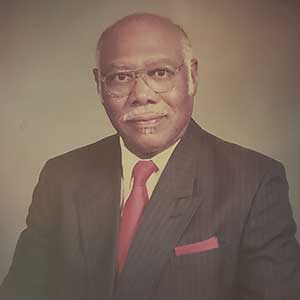
Under Professor Yancy’s photograph in the dedication day program appears these words: “The school is being renamed in honor of the late Prof. Ruben Yancy who was a native of Ashville and principal of Ashville Colored High School from 1947 to 1956. Because of his humanitarian efforts, the community has grown and become a better place to live. His life was an exemplification of all that is embodied in ‘The Teacher’s Creed.’”
Another legend
Professor Lloyd Newton’s education career in St. Clair County made him a legend not only in Ruben Yancy High School but also in the integrated Ashville Elementary School.
Lloyd’s father was a cotton farmer in Sumter County, according to a retirement article in The Anniston Star, Aug. 11, 1985. His mother died when he was three and his father married again.
Professor Lloyd Newton
Erroll Newton, Lloyd’s son, recalled that after his dad graduated from high school, he lived with relatives in Fairfield, where several other relatives lived and worked. One of his aunts recognized Lloyd’s scholastic aptitude and introduced him to the president of Miles College. He enrolled in Miles, lived with his aunt and worked his way through college.
The United States had entered World War II, and Lloyd joined the Navy where he was a first class motor machinist mate for four years. Erroll Newton says of his dad, “During WWII, the military was beginning to integrate all branches of service, and it was in the Navy that he developed his skill as an instructor.” According to the Anniston Star, “After working for Seaboard Railroad, the Navy, and (attending) Wayne State University in Michigan, he landed back in Alabama.” “It was after being discharged after WWII that he began his odyssey to further his career,” Erroll said. “He worked as railroad porter in the Ford Foundry and the Fairfield Foundry, and continuing college in Michigan.”
“Back in Alabama,” Erroll continued, “He ran a nightclub in Fairfield a while before Dr. Bell, president of Miles College, gave him a reference to teach veterans in St. Clair County. A St. Clair News-Aegis article of Nov. 14, 1991, states that Professor Newton returned to his home state in 1947 and that he spent 37 years in St. Clair County education.
Teaching veterans seems to be the beginning of his education career in St. Clair County, but at some point, he began teaching for Professor Yancy and taught until he became principal and was known as “Professor Newton.”
Thousands of children profited from his teaching and mentoring, and each has a memory, as does his son, Erroll, who spoke for himself and his deceased brothers Lloyd, Jr., and Paul when he said, “To me he was just ‘Dad.’ With me not having a mom, he played both roles, and he did a good job. When we came along, he kind of took the reins off, so to speak. It was like, ‘If you want to advance, I’m setting an example for you. You choose your own way, though.’ He was Dad; that was him to me.” And later he was Granddad to Terrell, Chery, Shawn (deceased) and Ryan and several great-grandchildren.
Margaret Bothwell LeFleur credits her teachers and Professor Lloyd Newton at Ashville Colored High School for much of her own success in teaching.
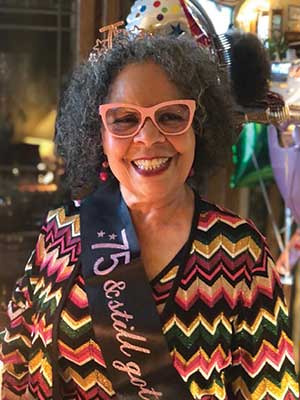
Margaret LeFleur at 75th birthday
“All of our teachers were dedicated,” Margaret recalled. “Mrs. Marcelline Bell taught seventh- through 12th-grade English. We had textbooks, but we didn’t have a library. But she taught us the Dewey Decimal System even though we had no library to use that knowledge in. However, when I went to Bethune Cookman College, I knew how to use that system in a real library! Our teachers knew what we needed, and they did their best to compensate for the deficiencies.”
Margaret’s dad drove her to Attalla twice a week for piano lessons for there was no Black piano teacher in Ashville. She progressed quickly, and as a seventh-grader played for high school graduation. She accompanied the school choir, which Professor Newton directed. In college she majored in music, which led to her career of teaching music in the schools of St. Paul, Minn.
After Margaret’s mom bought her a typewriter and instruction book, Professor Newton helped her learn typing, and she became an office assistant to him during her high school years.
Eloise Williams remembers Professor Newton as one who “set examples for the kids, and he and the teachers did a good job educating us.” She recalled that he disciplined when misbehavior called for it.
She also knew him as the principal of Ashville Elementary School where her son attended the integrated school. “When the law passed,” she said, “the school had to integrate. Our kids had a hard time. The Whites weren’t used to the Blacks, and the Blacks weren’t used to the Whites. It was new thing for all of them. It didn’t work for a while, but then it smoothed out, and they began to get along with each other.” Mrs. Williams is lovingly known as “Sister Ella” in Ashville today.
Most folk from the 1960s years agree that Professor Newton’s respect by both races, his professional demeanor, and his calm guidance helped ease tensions of integration in Ashville.
When Ruben Yancy ceased being a Black school in 1969, the County Board placed Professor Newton over the elementary grades at Ashville High School (grades K-12) where J. W. “Shag” Richey served as principal. When he moved to the central office of the county board, Mr. Keener became principal of Ashville High School and Professor Newton, principal of Ashville Elementary School, where he served until he retired in 1985.
Jay Richey said of Professor Newton, “He was first class, and a loyal school man to my daddy, and I loved him dearly. Whatever job needed to be done, Mr. Newton did it well.”
Recalling his father’s career, Erroll added that his “Dad considered Superintendent D.O. Langston a great asset to him” during his administration, and his “faculty members assisted him over the years.” He also mentioned the love of his “endless number of students.”
Professor Newton’s students and teachers hold his memory dear. Maurice Crim started teaching for Professor Newton in 1957 and described him as “a man of integrity who was very supportive of his teachers. There were no problems for we all got along well there.”
“He had a deep booming voice that made you automatically respect him,” student Joy Walker Raysaid. Others, too, recalled his voice and his love of singing.
Glorine Williams became his daughter-in-law when she married Erroll Newton. “Growing up, I remember Mr. Newton coming to my home, and he always talked about the importance of education, attending school and doing your best no matter what. He believed in helping students, and he didn’t show favoritism with anyone. Everyone was treated equal.”
His teachers at Ashville Elementary speak fondly of him. “Mr. J.W. Richey hired me,” recalls Beth Jones, “but Mr. Newton was my first principal. I remember ‘the Professor,’ as Mr. Richey affectionately called him, as a strict father to his teachers. He also had a firm but kind rapport with his students.
“My first year, I had 43 fourth-graders. That year, Mr. Newton reminded me of something very important. The two of us were standing in the hallway at dismissal time, trying to find ways to get poster projects home. There was one last poster with no way to get it home,” she said.
Margaret Jane Williams Bothwell
“As a new teacher and taking this lighter than I should, Mr. Newton chided me; for that last poster, even though not the best, demanded the same respect as any other. That poster was his work and important to the child. The child who made it was important. As a young, impressionable teacher, I never forgot Mr. Newton’s words to me, words that colored my entire career.”
Susan Kell also has memories of the professor. “When Mr. Newton came to Ashville elementary, I was teaching first grade. I later became librarian and worked with him until his retirement.
“Mr. Newton cared deeply for the Ashville community, especially the young children of Ashville Elementary. The 1970s were before school nurses, so he took care of the sick and all the playground ‘boo-boos.’ He once removed a tick from a child’s ear.
“This, however, is one of my favorite Mr. Newton stories. There was a disturbance in the lunchroom, so I walked to the table to investigate. I heard, ‘Is too.’ ‘Is not.’ ‘We do.’ ‘Do not.’ I asked, ‘What is the problem?’ and a child replied, ‘We do have a school doctor, and there he is,’ as Mr. Newton walked into the lunchroom.”
“He wore many hats other than principal – teacher, friend, counselor, singer, and yes, medical doctor!”
Professor Newton retired in 1986 and continued his influence in St. Clair County through the Alabama Retired Teachers Association, serving on the Committee for Protective Services, and in service to his church.
As a man of Christian faith, Professor Newton served as deacon and Sunday school teacher at Mt. Zion Baptist in Ashville. Well known for his basso profundo voice, he sang in the church choir and often sang solo.
Combining his love of singing with his love of children, one wonders if when he arrived at the empty school some mornings, he may have voiced the old children’s gospel refrain:
Jesus loves the little children,
All the children of the world,
Red and yellow, black and white
They are precious in His sight,
Jesus loves the children of the world.
“Children are the greatest thing in my life,” Professor Newton told Viveca Novak of The Anniston Star, and his loving influence continues in the multitude of lives that he touched in his lifetime.
Springville author pulls back curtain on untold stories of Civil Rights Movement
Story by Scottie Vickery Photos by Graham Hadley Submitted photos
Author T.K. Thorne was just a baby when her mother and grandmother attended secret meetings of White residents who were willing to drive Blacks to work during the bus boycott in Montgomery. It was a bold move – and a dangerous one – during a time when the Ku Klux Klan ruled with threats and violence.
“After one meeting, a cross was burned in my grandparents’ yard,” Thorne said. “My grandfather, who was a very gentle man, borrowed a shotgun and sat up all night. It was not until years later that I learned of my grandmother and mother’s courageous stance for civil rights.”
Although her family’s story didn’t make the pages of her newly released book, Behind the Magic Curtain: Secrets, Spies, and Unsung White Allies of Birmingham’s Civil Rights Days
(NewSouth Books), Thorne shares many little-known or untold stories of White citizens who quietly or boldly influenced social change.
“Much of the truth of Birmingham in the civil rights era is ugly, plain and simple. This book is not an attempt to revise that truth,” Thorne wrote in the book’s introduction. “The darkness, however, is always what allows the light. And in Birmingham’s darkness, individual lights grew – some from shades of gray that bloomed into sparks, some lanterns of courage.”
Thorne, who lives with her husband, Roger, on 40 acres on Straight Mountain just above Springville, said she was first approached via email by four Birmingham men – Bill Thomason, Karl Friedman, Doug Carpenter and former Birmingham News reporter and photographer Tom Lankford – about writing the book. They wanted to tell the stories “of those who worked for peace and racial progress under extraordinary circumstances in extraordinary times,” she wrote in the book’s preface.
That led to eight years of intense research, during which she interviewed 50 people, read numerous books, combed the archives of several newspapers and watched many video interviews in the Birmingham Civil Rights Museum’s collection. The process seemed overwhelming at times, and the book includes 682 footnotes, which, along with the bibliography, take up 32 pages.
“The research and writing were interwoven,” she said. “One would make me have to do the other. The biggest challenge was the time frame. I had all these vignettes, but I felt it was my responsibility to use them in a chronological way that made sense.”
During the writing process, Thorne said she realized just how much we can learn from history. “There were some power players who made a huge difference, and there were other players, like women who were not in powerful business positions, who found ways to make an impact,” she said. “The lesson to me is that it doesn’t matter who you are, you can make a real difference.”
Finding her voice
The path to author was a winding one for Thorne, who grew up as Teresa Katz in Montgomery. Her father, Warren Katz, taught her to question everything, and her mother, Jane Katz, was the state chairperson for the League of Women Voters. Her mother exemplified, among other things, the principle that “one’s primary responsibility in life is to make the world a better place,” according to Thorne.
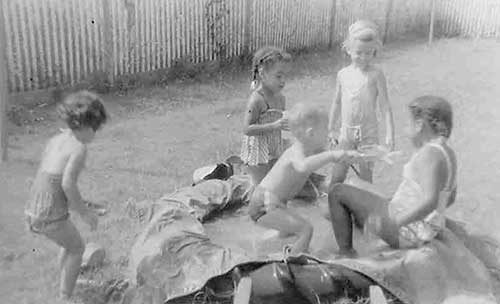
T.K. Thorne, far left, at 4 years old playing in a swimming pool made out of an old tire and tarp in 1958 at the home of Civil Rights leaders Bob and Jean Graetz. Bob Graetz was a White minister of a Black congregation and joked that this was “the first integrated swimming pool in Montgomery,” Thorne said.
After abandoning her childhood dream of becoming an astronaut in order to meet aliens, Thorne briefly considered a career as a writer after her grandmother, Dorothy Merz Lobman, helped her fall in love with books and stories. “By the time I was 15, I knew that was where my heart was, but I also knew making a living at that was a longshot,” she said.
Thorne, 67, eventually earned a master’s degree in social work from the University of Alabama, and after landing a job as a grant writer for the Birmingham Police Department in 1996, she was tasked with applying for funding for a computer-aided dispatch program. In order to better understand the need, she rode along with police officers. The grant was awarded, the department got its first computer, and Thorne applied for the police academy.
“I enjoyed not knowing what was going to happen next,” she said. “I just wanted to try it. I had no idea it would turn into a career.” She served more than 20 years with the department, working as a patrol officer and detective and climbing the ranks before retiring as captain of the North Precinct and becoming executive director of Birmingham’s City Action Partnership, a position she held for 17 years.
Through it all, she never stopped writing. Her first three books were published while she was still juggling the demands of a full-time career, which she left in 2016. She’s published two award-winning historical novels, Noah’s Wife and Angels at the Gate, and the first two books in a trilogy (House of Rose and House of Stone) are set in Birmingham and feature heroine Rose Brighton, a police detective who discovers she is a witch.
Her first nonfiction endeavor, Last Chance for Justice, focuses on the investigation of the 16th Street Baptist Church bombing in 1963. Thorne said she thought that book was the reason she was approached by the four men – three of whom died before the book was published – about writing Behind the Magic Curtain.
“I asked them if they were making the mistake to think that I was a civil rights expert because I wrote that book, because that wasn’t true,” she said. Instead, Bill Thomason told her it was her Noah’s Wife that convinced him she was author for the job. “He said, ‘Anybody who could write about a woman who has been dead for thousands of years and make me believe that’s how it happened can write this book,’” Thorne said with a laugh.
Pulling back the curtain
She wasn’t convinced she’d take on the project until she read some of the notes Lankford had written during his time covering the Civil Rights Movement. Lankford, who passed away in late 2020, was a controversial journalist who was embedded with law enforcement and worked with local police and FBI agents in secret wiretapping and intelligence operations.
In addition to his detailed notes and journals, he had an amazing memory, Thorne said, adding that the first notes he shared made the decision to write the book much easier. “I was hooked,” she said. “I was just so intrigued, and I realized this man was on the in-inside. That began the journey of researching this book.”
As captivated as she was, Thorne was also a little wary. “That I relied extensively on (Lankford’s) memories and notes does not mean that I endorse all his methods or actions,” she wrote in the book’s preface. Despite the controversy surrounding his methods, Thorne said Lankford’s unique perspective gave him the ability to document the events of the time in a way no one else could.
“I think the closest thing I could say about what motivated him is that he was driven by wanting to tell the truth,” Thorne said. “He admitted to me that he crossed the line as a journalist; he was too close to his subject matter. But he said, ‘I wouldn’t take a bit of it back.’”
While researching the book, Thorne relied on the skills she learned in the police department. “The job of a detective is to discover what the truth is and trying to tell it without bias,” she said. Many of the truths she discovered involved White leaders of the Jewish, Christian, business and education communities; others were just White citizens who followed their hearts. Regardless of their standing in the community, they all “quietly and moderately or openly and boldly” worked for change.
The following vignettes are among those she shared:
Karl Friedman, an attorney and one of the men who approached her about writing the book, “had many deep friendships across the color line,” Thorne said. One of those friends was J. Mason Davis, a young Black civil rights attorney. Friedman and attorney Jack Held often ate lunch out of the courthouse’s vending machine with Davis, who wasn’t allowed in a downtown restaurant. Later, all three became partners at Sirote & Permutt, of which Friedman was a founding partner. Friedman hosted many meetings of Black leaders at his home, and a bullet was shot through the front window as a result.
Eileen Walbert knocked on doors in the Black Rosedale community of Homewood to encourage the residents to help integrate the White schools. She picked the children up and took them to school and often brought them home with her so they could swim in her backyard pool. Having a cross burned in her yard and receiving threatening calls from KKK members did not deter her. “I was learning how to be brave,” she said in a 2014 interview with the Homewood Star. “A bully, if you let them know you’re not scared, they’ll back off.”
Paul Couch, a detective with the Mountain Brook Police Department, was moved to action on his day off when he heard about the murder of 13-year-old Virgil Ware, who was killed the afternoon of the 16th Street Baptist Church bombing that killed four young girls. Virgil was riding on the handlebars of his brother’s bicycle when two 16-year-old White boys on a red motorcycle shot him with a .22 pistol. Couch followed a hunch and drove around the Fultondale area to look for the shooters, Thorne said. After he copied down the motorcycle’s tag number, the case was solved in two days. The shooters received probation.
White people in a green car came to the aid of James Ware after his brother was shot. After seeing James on the road with Virgil’s body, they asked the teenager if there was anything they could do to help. James asked them to go find his mother and bring her to the scene, which they did. More than three decades later, James still remembered the act and said, “I would like to thank the White people in the green car – whoever they are, for helping me and my family that night.”
A quiet home
Thorne wrote the book from her mountaintop home, a beautiful place that reminds her of her childhood visits to Virginia and Clifford Durr’s farm at “Pea Level” on Corn Creek in Wetumpka. The Durrs were longtime family friends, and she has many special memories of the cabin there, including the time she sat on the front porch with Rosa Parks, whose refusal to give up her seat on the bus sparked the Montgomery bus boycott. Clifford Durr, an attorney, was one of the men who bailed Parks out of jail and later served as her counsel.
For the most part, though, Thorne remembers the fun she had playing in the creek and climbing on the nearby boulders. “That was my favorite place in the world,” she said. That’s why, when a real estate agent showed them the land and the nearby Locust Fork of the Black Warrior River, Thorne was sold. “We’re going to live here,” she told her husband.
It proved to be the perfect spot to quarantine, finish the book and reflect on the lessons she’s learned and the impact she hopes it will make.
“The main thing I learned is it’s complicated,” she said. “We are wired as human beings to want the simple story. We want heroes and bad guys. That simplified version of history is an illusion, though, and that is true of all history. We need to learn from that because if we can understand our history, we can better determine our present and our future.”
When Randy and Wendy Ryals built their cabin home high atop a bluff above historic Springville, overlooking a picturesque valley below, they counted themselves lucky. When their oldest daughter wanted to get married there, they already knew it was a blessing, not realizing it would spark a brand new business for the couple and their family.
But once the daughter posted her wedding photos on social media, the response was immediate. “Where is that venue?,” people asked. The answer soon turned from “Mom and Dad’s home” to an idea that grew into Weddings at Cabin Bluff.
When the next daughter was to be married, she wanted a barn wedding. So, they built a red barn in October 2016, and it and the field overlooking the valley have been the setting for dozens upon dozens of weddings and events ever since.
“It just took off,” Wendy Ryals said.
With 30 years of experience in the medical meetings industry, the couple translated their experience as meeting planners to planning weddings. “We transitioned from doctors to brides,” she said.
From all-inclusive packages to a-la-carte services, Weddings at Cabin Bluff caters to the makings of an unforgettable day for wedding celebrations, larger corporate and “milestone” events with stunning, panoramic views from the Red Barn to the expansive field with room for hundreds of guests. From the bluff, you can see for 50 miles.
While the business has grown exponentially, family remains as its centerpiece. “We still treat it like our family. It’s basically our daughters and their husbands. It’s very much a family affair,” and their clients get that sense as well. “They get to know us,” she said.
The barn at Cabin Bluff
Along the way, these Springville natives have many a story to tell about memorable events held there. One was a couple who lived in London, who came to Springville to say ‘I do,’ bringing 50-60 Londoners with her. The wedding party and guests were staying in Birmingham, and it was noted that in London, they don’t have school buses.
For a slice of Americana, the guests arrived by big yellow school bus. British traditions were incorporated as well, the U.S. flag and the flag of Great Britain flying high out front. “It felt like a royal wedding,” Wendy said.
There have been carriage rides, conventional arrivals and departures and even a performance with fire since this venture began, she said, and the memories made there have been special. “We’ve met so many great families through this process and look forward to meeting many more in the future.”
And she looks forward to the comment she hears most often: ‘This wedding is the most beautiful wedding I have ever attended.’
Her reply is always the same, “I know, it really is.” Until the next weekend, of course.