St. Clair Memorial Gardens serves as county’s only dedicated veteran burial ground
Story by Jackie Romine Walburn Photos by Graham Hadley Submitted Photos
When folks at St. Clair Memorial Gardens and Usrey Funeral Home decided to dedicate a section of the cemetery to U.S Armed Forces veterans, owner Steve Perry first consulted with local veterans.
“I actively got together with a group of veterans in town,” Perry says. “We wanted their input, to know what’s important to them.”
The veterans’ group with members who served in Korea, Vietnam and the first Gulf War supported the idea and helped Perry work up rules and regulations for the veterans’ section in Pell City, which opened in 2012.
The rules they decided on are pretty much the same as those used by the Dept. of Veterans Affairs’ official U.S. veterans cemeteries. The section is for veterans and spouses and dependent children. Official honorable discharge papers – known as DD214 – are required to qualify.
Alabama’s only official U.S. National Cemetery is the Alabama National Cemetery at Montevallo and is one of 148 national veteran cemeteries, 33 soldier lots and monument sites in 42 states, according to the VA.
The idea behind the Pell City veterans’ section was not to take away from Montevallo but to expand on it and to offer a nearby choice for St. Clair-area veterans.
“The vets were all behind the idea and wanted to see it happen,” Perry said. “They liked the idea of the burial ground being closer to home and wanted to make sure things were done right, and we didn’t just throw up a veterans’ section. That’s why we follow the strict rules and regulations.
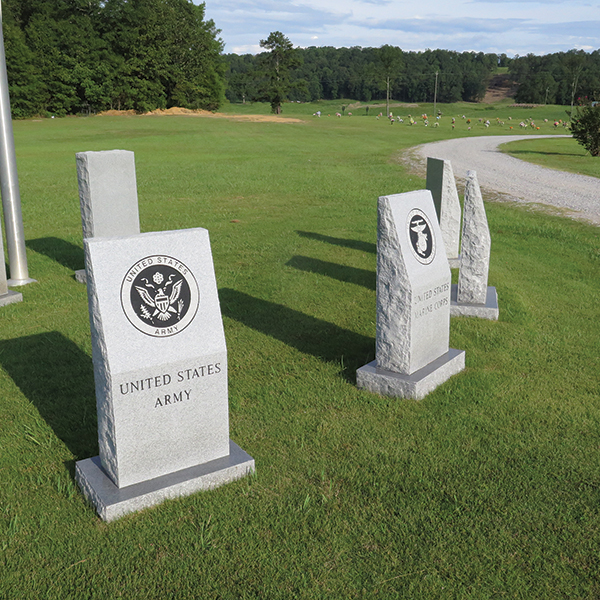
Stone markers represent each branch of the U.S. Armed Forces.
“We take comfort in knowing that vets had a part in putting this together,” said Perry, whose family has been the funeral home business since 1927, with Usrey’s Funeral Home in Talladega, which is now operated by Perry’s brother Mike. The Pell City location – funeral home and cemetery – were purchased one after the other in 2003 and 2004. St. Clair Memorial Garden’s veterans’ section is set off from the rest of the 14- acre cemetery by a U.S. flag and large granite markers for each division of the U.S. Armed Forces – the Army, Navy, Marine Corps, Air Force and Coast Guard. The first burial in the veterans’ section was in 2012 – the wife of one of the veterans Perry consulted early on.
The veterans’ section is laid out in lots of 16 grave spaces for a total of 352 spaces, which are filled in order – not by selection, the same way official veteran cemeteries are filled.
Spaces can be pre-purchased, but purchasers cannot pick the space location. This tradition of going in order, not pre-selected location, is the way the national cemeteries operate, Perry says. Burial spaces for a veteran and a spouse can be together with companion markers.
All honorably discharged veterans of active service are entitled to a free marker, a burial flag and military funeral honors, regardless of where they are buried. Usrey and cemetery officials help veterans apply for these benefits, including the bronze markers used at St. Clair Memorial Cemetery. No large family markers are used in the veterans’ section.
National VA cemeteries provide the burial space and opening and closing at no cost to the veteran’s family, according to www.va.gov. Families are still responsible for funeral home, cremation or other burial costs.
Because the St. Clair cemetery is not associated directly with the VA, spaces in the veterans’ section are purchased, in advance in a pre-purchase or at the time of burial planning.
However, Perry and staff handle the paperwork for veteran families, applying for the free grave marker, which are bronze as all markers are at the St. Clair cemetery. They also help arrange for military funeral honors at the family’s request.
Military funeral honors provided by the VA for qualifying veterans buried at veterans’ cemeteries or elsewhere include a presentation of a U.S. burial flag, folded and presented to the family and the playing of taps, according to www.va.gov. Federal law defines a military funeral honors detail as two or more uniformed military persons, with at least one being a member of the veteran’s parent service of the armed service.
Word is still spreading about Usrey’s services for veterans and the Pell City location’s veterans’ section, Perry says, noting that some veterans and families don’t know about the section just for veterans and others have family burial plots already purchased or family traditions of church cemetery burials.
“We just want veterans and their families to know this is here. We’ve always supported veterans, and this is a tribute to them,” Perry says.
The support takes on a personal meaning to the Perrys, too. Both of their grandfathers were World War II veterans, with the paternal grandfather serving as a paratrooper and the maternal grandfather serving as a medic in World War II, Perry says.
Story by Leigh Pritchett Photos courtesy of Jerry W. Garrett Jr. and John Bryant Submitted Photos
During the Christmas season this year, it will be a time to reflect on the gift of freedom and to pay tribute to those who secured it.
At 11 a.m. Dec. 19 at St. Clair Memorial Gardens, the second annual Wreaths Across America (WAA) observance will place wreaths at gravesites of veterans.
Hundreds of wreaths will be put on veteran graves at St. Clair Memorial Gardens, Valley Hill Cemetery, Oak Ridge Cemetery and elsewhere in the county, said Mindy and Keaton Manners and Julia Skelton, local WAA organizers.
The first WAA event in St. Clair County was Dec. 14, 2019. That morning, families, friends and volunteers placed 300 live, evergreen wreaths on veteran graves as part of a nationwide effort.
“Each year, millions of Americans come together to remember the fallen, honor those that serve and their families, and teach the next generation about the value of freedom,” notes the national WAA organization. “This gathering of volunteers and patriots takes place in local and national cemeteries in all 50 states” and some American cemeteries in Europe. “… In 2019, approximately 2.2 million veteran wreaths were placed on headstones at 2,158 participating locations around the country in honor of the service and sacrifices made for our freedoms.”
Broken Arrow Chapter of the Daughters of the American Revolution (DAR), along with Steve Perry and Usrey Funeral Home, worked to bring the local event together. Giving their assistance were St. Clair County High School JROTC, Canoe Creek Society of Children of the American Revolution (CAR), Henderson Builders Supply Co. in Pell City and numerous residents of Col. Robert L. Howard State Veterans Home.
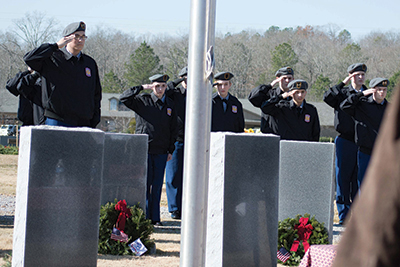
JROTC members salute during service at St. Clair Memorial Gardens.
Susan Bowman of Pell City was touched by the number of wreaths and the number of people who came to help place those wreaths.
This was her first time to be part of such an observance.
She got to place wreaths at the graves of her father, Jesse Hooks, and her sister, Kathy Lynn Hooks, both of whom had served in the Army.
“I was very proud and teary-eyed. I was very teary-eyed,” she said. “Just emotions running through me.”
Those same words would describe the writer of this article and her sisters as well. Only two months before WAA, our dad – retired Chief Master Sgt. Porter Bailey – had been buried with military honors.
Getting to place a WAA wreath at his gravesite stirred the pangs of grief. But it also filled our hearts with pride for the 37 years he served this nation in the Army, Air Force and Alabama Air National Guard.
The day brought emotional extremes for Lyle and Shelly Harmon, who are the parents of three sons.
Well in advance of the ceremony, Harmon – who is St. Clair County’s district attorney and chief warrant officer 4 with Alabama Army National Guard – had agreed to serve as master of ceremonies. Then, hardly a month before the observance, son Sloan (known as “Boo”) was fatally shot just off an I-20 exit.
An airman first class with the Air Force, Boo was a KC-135 crew chief at the Alabama Air National Guard’s 117th Air Refueling Wing in Birmingham. He had just turned 20 a few days before the murder.
Though serving as WAA master of ceremonies so soon after Boo’s death was difficult, “I felt I should,” Lyle Harmon said. “… I can’t even express how humbling that was to do that. … It was quite humbling.”
At the same time, it was “a huge honor,” Harmon added.
During the ceremony, veterans of the Army, Marines, Navy, Coast Guard and Merchant Marines each placed a wreath at the respective monuments that stand at St. Clair Memorial Gardens. Because the veteran who was to place the wreath at the Air Force monument could not attend, Shelly Harmon did it.
Lyle Harmon watched his wife – a grieving, heartbroken mother – place a wreath of tribute at the Air Force monument.
Thinking back on what Shelly did that day, Harmon recalled, “I’m just so proud of my wife. She is unbelievably faithful and strong.”
The origin
The simple request of another grieving mother was the catalyst for the local WAA observance.
In early summer of 2019, that mother contacted a DAR group in Birmingham, explaining that she was unable to place a wreath or flag for Memorial Day on her son’s grave in St. Clair Memorial Gardens. Mrs. Manners – a member of Broken Arrow DAR in Pell City – and her husband volunteered to lay the wreath.
When Mr. and Mrs. Manners went for that reason to St. Clair Memorial Gardens, which is the only cemetery in the county with a section specifically for the military, the couple were surprised by the number of veterans’ graves they saw.
In the two-mile trip from the cemetery back to their home, Manners – an Army veteran – and Mrs. Manners decided they must organize a tribute to veterans interred there.
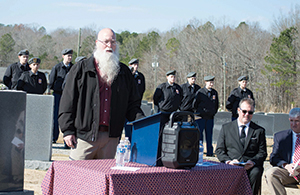
Honoring St. Clair veterans at the memorial service
For about six years, the couple had attended WAA observances at Alabama National Cemetery in Montevallo. Now, they felt it was time to bring that tribute to St. Clair County.
They set a goal of 300 wreaths, 260 of which would be for St. Clair Memorial Gardens. The remainder would go to graves in Valley Hill Cemetery, Oak Ridge Cemetery and Broken Arrow Cemetery at the request of various families.
St. Clair County High School JROTC joined the effort, raising funds for 100 wreaths and providing military color guard for the ceremony.
The JROTC leaders, Retired Maj. Channing McGee and Retired Sgt. 1st Class Vicki Glover, said participating in WAA “teaches cadets the importance of community service and instills patriotism by honoring these veterans and their sacrifice.”
For the 2020 event, the cadets plan to provide another 100 wreaths. (For information on how to help the cadets meet their goal, see the accompanying story, “Sponsor a wreath.”)
St. Clair debut
The first WAA event in St. Clair County was met with such support in the community that the entire ceremony was finalized within three months, the Manners said.
But the enthusiasm following the event brought the 2020 ceremony together even quicker.
“Two days after this past event, we had it all lined up for this year,” he said.
This year’s event will also feature a replica of the Tomb of the Unknown Soldier. (For more information, read the accompanying story, “Tomb of the Unknown Soldier replica to be on display.”)
After attending last year’s WAA, John Bryant of Alpine encouraged fellow members of the Knights of Columbus, Assembly 2972, Our Lady of the Lake to volunteer to lay wreaths of remembrance on graves of fallen heroes and to honor those who served the nation.
“I can’t think of anything that shows more patriotism than to honor and to show respect for our veterans,” Bryant said. “… I feel like we need more patriotism. We need to let this country know we love it, and we need to remember that the privileges we have today are because of our veterans.”
Skelton, who is also a member of Broken Arrow DAR, said volunteers will be needed to help place wreaths at St. Clair Memorial Gardens and possibly at Valley Hill Cemetery and Oak Ridge Cemetery.
Wreath placement generally is guided by military designations on headstones or footstones. However, Mrs. Manners said wreath-placement requests can be made for veterans whose grave markers have no military designation. A copy of the veteran’s DD-214 or a photo of the veteran in uniform will suffice as proof of military service.
Editor’s Note:To request wreath placement and provide documentation, email Mrs. Manners at mindy.manners@yahoo.com.
Local medical community rises to meet the challenge
Story by Scottie Vickery Photos by Graham Hadley Submitted photos
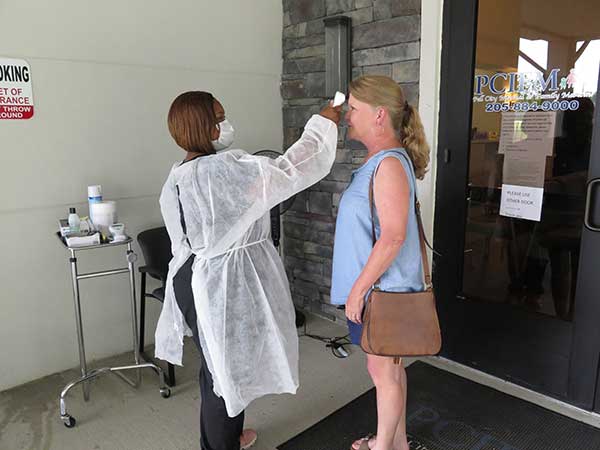
Anyone entering PCIFM in Pell City had to be screened, including a temperature check.
Long before COVID-19 found its way to St. Clair County, medical professionals in the area were preparing for its arrival. They had been monitoring the progression of the virus, which began in December 2019 in Wuhan, China, even before it first made its way to the United States in January.
Alabama got its first reported case on March 13, and the virus hit St. Clair County four days later. By mid-July, the state’s numbers had risen to well over 58,000 cases with nearly 1,200 deaths. At that time, St. Clair County had nearly 700 cases and four deaths.
“The biggest thing in the beginning was dealing with the panic and uncertainty,” said Dr. Michael Dupre’, who led the coronavirus response efforts for Northside Medical Associates. “When you use a word like pandemic, it gets people’s attention.”
The virus brought challenges that medical personnel had not faced before, and local healthcare officials raced to implement new procedures, alleviate concerns and remove obstacles for their staffs. At the same time, they had to treat existing patients while trying to diagnose and care for those with COVID-19.
Rapidly changing information was an initial challenge since much was still unknown. Lisa Nichols, administrator of St. Vincent’s St. Clair, said that by the time guidelines from sources such as the Centers for Disease Control and the Alabama Department of Public Health were communicated with the staff, new information and guidelines had been released.
“There were a lot of changes,” she said. “Our staff works in 12-hours shifts, and by the time we got information out to everyone, it had changed again. Our team was very resilient and did an excellent job of going with the flow.”
The immediate concern was keeping patients and medical personnel safe, according to Nichols, Dupre’ and Dr. Barry Collins of Pell City Internal and Family Medicine (PCIFM).
“This was like nothing I’ve ever experienced before,” Collins said. “To be honest, I was afraid when all this hit, the fear would deplete our staff. They hung in there fearlessly, though, because they knew they were essential to the community.”
Dupre’ said staff members were initially concerned that they would contract the virus and take it home to family members who were at risk for complications, such as aging parents or an immunocompromised child. Employees with chronic health issues or family members who were at-risk were reassigned to other areas where it was safer. The level of anxiety was unlike anything I’d ever seen before,” he said, “There were fears, but our duty and commitment to our community did not change one bit.”
Implementing safeguards
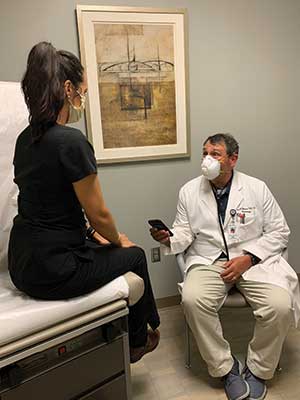
Because COVID-19 required limiting access, Birmingham Heart Clinic’s Dr. Jason Thompson uses a cell phone to get more information from a patient’s spouse.
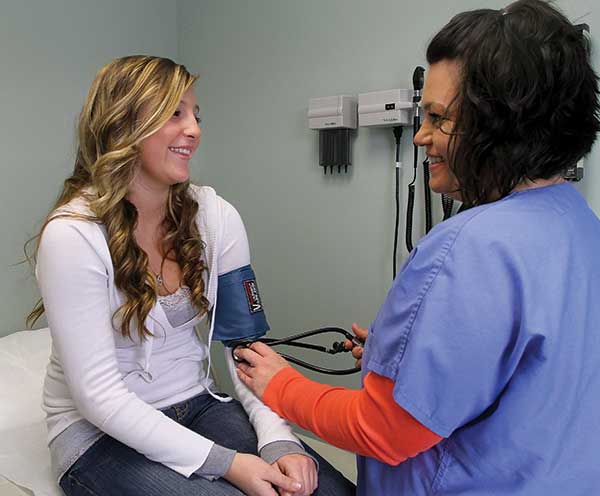
Once initial fears were addressed, the focus was on treating patients – those with COVID-19 and those without – while preventing the spread of the virus. The first step was to identify potential coronavirus cases before patients encountered anyone else.
“We have so many entry points to the facility, so we changed the way you come into our hospital,” Nichols said, adding that separate entrances and parking lots were designated for patients and associates. Door screeners at each entrance checked everyone for fever and symptoms of the virus, including cough or shortness of breath. Anyone who is identified as having symptoms of the virus is directed into a separate waiting area while waiting for the triage nurse.
At PCIFM, patients were initially screened over the telephone when they called to make appointments, and staff members conducted temperature screenings and checked oxygen levels and symptoms at the door. Anyone who was a potential positive, based on either check, was directed to the practice’s drive-thru testing lane. “We were able to do COVID testing without having the patient leave the car,” Collins said.
Northside patients were screened at the door of all four locations – Pell City, Moody, Springville and Trussville – and only one entrance and exit was used at each office, Dupre’ said. At the Pell City campus, the building housing the ACCEL Urgent Care Center was designated for respiratory illnesses and COVID-19 testing and treatment. Anyone with symptoms of the virus, or those who had been exposed, were directed there.
In addition, hospital and medical office personnel all over the county implemented additional cleaning processes to cut down on the spread of the virus. “We’re constantly changing scrubs and masks and rotating stethoscopes,” said Dr. Jason Thompson, a cardiologist with Birmingham Heart Clinic, which has an office at Northside’s Pell City campus. “Exam rooms are being sanitized between every visit, and it’s not just changing the paper on the table. We’re wiping walls down with Clorox and wiping the table down with Clorox.”
The virus brought additional hurdles, as well. Schools and day care centers closed, leaving medical personnel scrambling for child care. Northside and PCIFM set up day care programs at their offices so their employees could continue to focus on caring for the community.
“We called it Camp Northside,” Dupre’ said of the child care program that operated for three months. “If our employees didn’t have anyone to take care of their kids, we took care of them here,” he said.
Collins said their day care program was largely operated by family members of staff as well as volunteers. “The community really rallied around that idea,” he said. “They were donating lunches and teaching materials for the children.”
Hard decisions
There were other dilemmas, as well. “Probably one of the hardest things we had to do was go to a no-visitors policy,” Nichols said. At first, patients at the hospital were limited to two visitors, but as guidelines continued to change, it went down to one within a few days. Not long after, no visitors were allowed, except for end-of-life situations and patients that required caregivers.
“We struggled with how to get people information about their loved ones. We encouraged patients to connect with their families via social media,” Nichols said, adding that the hospital purchased tablets for patients without smartphones. They also implemented a process to ensure that the nursing staff contacted one family member or caregiver to provide updates, as long as the patient gave permission.
Even though that added more work for a nursing staff that was already stretched, the team didn’t balk at that or any other additional duties, according to Shiloh Swiney, director of nursing for the hospital. “They all chipped in and said, ‘We’re going to get this done. We’re going to get these patients taken care of,’” she said. “We have a strong nursing group, and the morale has been very high.”
The suspension of elective dental and medical procedures caused additional concerns. “Initially, we rescheduled all elective procedures and did Telehealth visits for routine checks of less acute patients,” Collins said. “Not everyone had access to the internet and some patients weren’t tech savvy and weren’t comfortable with talking on camera. We had to educate our patients.”
While some of Thompson’s patient appointments could be handled virtually, other cardiac patients needed to continue to be seen in person. In order to limit exposure in waiting rooms, Thompson said that his office asked those patients to come alone unless a caregiver was truly necessary. That sometimes limited the information he received.
“I’ve got some patients who, if their wives didn’t come with them, I wouldn’t know anything,” Thompson said. “The wife is who would tell me if he had been short of breath. Now, a lot of times I’ll pick up the phone, call the wife and put her on speaker. That’s how I’ve brought them back in the exam room without crowding the waiting room.”
Patients with chronic conditions who were concerned about catching the virus often delayed seeking treatment, which led to other problems. “Our ER volume was almost cut in half,” Nichols said. “Some of the patients we’re seeing now are sicker because they waited too long to get the care they need. We want everyone to know that we are a safe place, and we are absolutely taking steps to keep everyone safe.” High-touch areas are being cleaned many times throughout the day, and some chairs in waiting rooms are blocked off to ensure patients have plenty of room between them, she said.
Thompson, especially, saw the effects that fear and suspending elective procedures, like having a stent inserted, had on his patients. In some cases, patients had strokes that could have been prevented, or they lost heart function after a heart attack that might possibly have been restored if they had sought help faster.
“I’ve had patients who sat on their chest pains for fear of the ER,” he said. “With a heart attack, time is muscle. If we can get to you within 12 hours of chest pain, we can salvage heart muscle.” Although his patients’ cardiovascular disease makes them high risk for coronavirus complications, their heart issues still need to be addressed. “We have to be careful, but we cannot ignore their underlying disease,” Thompson said.
A community rallies together
Long before Gov. Kay Ivey issued a statewide mask order in mid-July, all patients and staff at St. Vincent’s, Northside, PCIFM and the Birmingham Heart Clinic were required to wear masks, which were provided for patients who didn’t have them. When supplies were low in the early days of the pandemic, employees at Northside got busy.
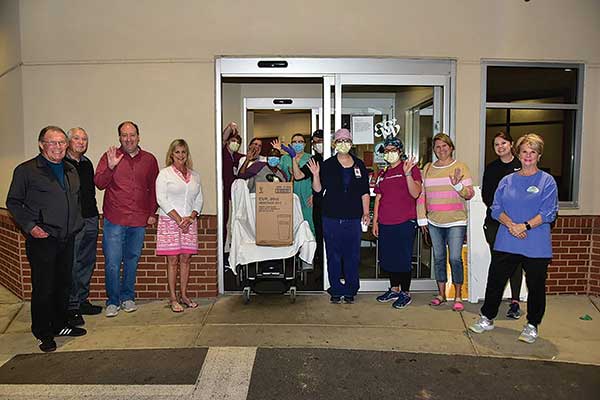
Pell City Rotary delivers food to St. Vincent’s St. Clair.
“Our staff made thousands and thousands of masks,” Dupre’ said. “We had hundreds of patients at home making masks with their own fabric and their own money. We’ve always thought the world of our patients, but so many went above and beyond.”
Patients weren’t the only ones offering support. Dupre’, Collins and Nichols all said they were overwhelmed by the love shown by the community as a whole. Individuals, churches and businesses from all over the county provided meals; offered masks, hand sanitizer and cleaning products; and prayed.
Several nights, Swiney said, individuals and church groups gathered in the back parking lot of the 40-bed hospital to pray. “There are so many people out there who wanted to help, and to know they were praying for each one of us here was amazing,” she said.
“The community was absolutely awesome,” Collins said, adding that donated meals meant the staff didn’t have to leave the building and could focus on the crisis at hand. “It reminds you about what is great about the human spirit,” Dupre’ added.
Moving forward
Early efforts to flatten the curve helped because, even though people continued to get sick, the cases were spread out over a period of weeks, so the hospital was not overwhelmed. “Fortunately for St. Clair County, we’re rural enough to spread out,” Dupre’ said. “That’s really helped, and we haven’t had the impact other counties have had.”
Early on, Dupre’ said, Northside looked at designating one of the buildings at the Pell City campus to house overflow patients from the hospital, if necessary. “Thank God it was never that bad,” he said.
It could still reach that point, however, if people relax too much. Alabama saw a resurgence in cases in late June and early July after the state began reopening, and Collins said he worries about the looming flu season. Although flu season is typically considered to be October to March or April, it’s not uncommon to see cases in September.
“There’s been a real spike in (COVID) cases, and now we’re almost back to square one,” Collins said. “The only way we can get this virus to go away is to starve the virus from the host.”
That’s why it’s critical that everyone continues to social distance, wash hands frequently, avoid group gatherings and wear face coverings to prevent the spread. “Wearing a mask can really protect the people you interact with,” Nichols said. “A lot of asymptomatic people are testing positive, even though they have no symptoms. If they’re wearing masks, the likelihood of spreading the virus is reduced.”
Dupre’ said masks are especially crucial for high-risk patients. “We know the masks work,” he said. “We’ve had staff here who have swabbed thousands and thousands of patients, and we haven’t had one catch COVID,” he said in early July. He added that people need to continue to isolate themselves if they are sick and wash hands frequently, especially when they have come in contact with surfaces outside their homes.
Although Thompson said masks have meant that he has had to dramatically slow down his speech so older patients who are hard of hearing can understand him, he agrees that wearing them and taking other precautions is imperative. “We have to take this seriously,” he said. “I think it has become apparent to us that this is not going away tomorrow. We will continue to deal with this for a year or more.”
He added that, while the growing death toll from the virus is tragic, it’s not the only tragedy of this pandemic. Thompson has seen widowed patients suffer depression after being isolated from friends and family for months on end. People haven’t been able to gather for funerals, which has had a negative effect on the grieving process. Couples looking forward to starting their lives together have had to postpone weddings.
“All of this is part of the human tragedy we’re all living through,” he said. “We are social animals, and it’s interesting how you begin to crave that interaction with family and friends. I’m not pretending this is going to be easy, but it can be done.”
Collins said he is hopeful that the newfound awareness among the public about how germs are transmitted will have lasting benefits even after COVID-19 goes away. “Right now, this virus is a curse, but if it changes behavior, it may mean a decrease in other communicable diseases, such as the flu,” he said. “It may be somewhat of a silver lining beyond this nightmare.”
It is no secret by now: 2020 has been met with great adversity and trial as a pandemic gripped the world.
Healthcare workers across the country and here at home have been working tirelessly to keep their skill sets sharp and to keep the community healthy during the COVID-19 pandemic.
Northside Medical is home to St. Clair County’s largest outpatient health care facility, serving over 5,000 patients throughout its six locations, and its innovations in the delivery of health care are widely known.
One of those innovations comes in the form of a six-member team inside Northside’s Health & Wellness department that stresses not only the importance of receiving proper medical attention when you are ill but also when you are healthy in order to stay healthy.
Working directly with each provider, the department serves as a convenient central hub for patients and provides the foundation to stay healthy – from flu shots to cancer screenings, wellness visits for women, depression screenings and everything in between.
The department was established as a part of the Northside team three years ago as the need for preventative health was on the rise. The idea, says Executive Director Dianna McCain, is to keep health care cost effective but also to do everything you possibly can to keep from being hospitalized.
“By the time a patient needs to be admitted to the hospital, it is almost a guarantee that they will also need to be treated for something completely different than for what they had to come for in the first place,” McCain said. “We want to do everything in our power to keep hospitalizations to a minimum.”
Nurse practitioners also can be found making house calls through the department. If a patient is unable to acquire transportation or cannot physically come into the facility for a visit, a member of the wellness team will come to them.
McCain said most lab work and X-rays can be done at the home. The visits have proven to be a great tool, not only during a pandemic, but also to several patients who would not otherwise receive care. Because individual providers don’t have the time to assess individual patient’s more in-depth needs, McCain says her department has been very successful in identifying these patients and serving them.
“We have seen instances when a diabetic patient’s blood sugar isn’t being maintained properly through medication and diet,” McCain said. “We can just touch base and see if we can come see them at home. Many times, it can be just as simple as a patient not drawing their insulin up correctly.”
In addition to running patient queries to call and schedule routine immunizations and screenings, McCain says the department has been able to extend monetary assistance when a need arises. McCain and her staff often work directly with other local organizations like the St. Clair County Coalition, The Christian Love Pantry, as well as several area churches to provide groceries, medication assistance and utility bill relief to some patients.
“It can be very bad if, for example, a diabetic doesn’t have adequate power or food available to them,” McCain said. We have been able to visit our patients at home, see what they need and even provide them with the right food they need to stay well.”
Northside patient and county native Andrea Nobles says she is beyond grateful for all the measures Northside Health & Wellness has done for her.
“When you get to be my age, things start coming up with your health,” Nobles said. “It is very assuring to know that I am not just a number but a person whose concerns are also my doctor’s concerns,” Nobles said. “I have lived here all my life, and I actually enjoy going to the doctor’s office now that we have Northside. We look out for each other.”
The majority of Alabamians who receive private health insurance can also qualify for incentives and breaks in premiums when they are proactive about their health. By receiving annual wellness checks and screenings, weight management, help with smoking cessation and women’s health screenings, for example, patients often see a discount in their monthly premiums and other incentives, like gift cards and entertainment vouchers.
“Health care costs are astronomical when you get into hospitalizations,” McCain said. “Ninety percent of costs come when a person goes to the hospital. We want to do everything in our power to keep a patient out of there, no matter what.”
PCIFM, Bedsole Eye Care, ATI Physical Therapy, Comfort Care Hospice expand to new facilities
Story by Leigh Pritchett
Photos by Graham Hadley
Submitted photos
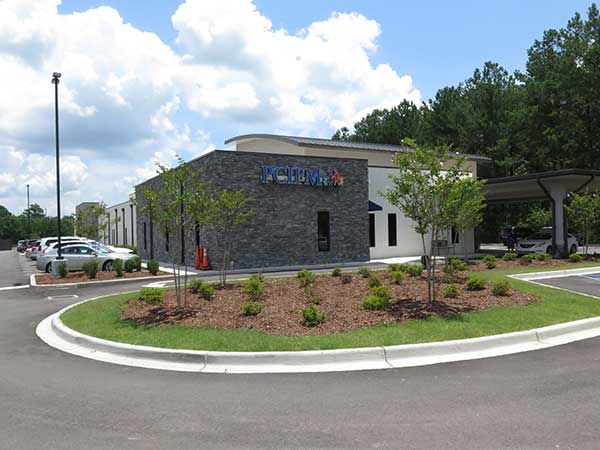
The new PCIFM building next to Publix in Pell City
Pell City is experiencing quite a boost in its growing medical community thanks to the expansions of Pell City Internal and Family Medicine, ATI Physical Therapy and Comfort Care Hospice expanding into new facilities.
Pell City Internal and Family Medicine
Dec. 26, 2019, was a second Christmas Day for Pell City Internal and Family Medicine: That was when the practice opened its new, freestanding clinic next to South Park Center.
The new construction has consolidated PCIFM’s main office in Physicians Plaza at St. Vincent’s St. Clair Hospital and its satellite office in South Park Center into one location.
Together, the two previous clinics totaled 15,000 square feet and had 23 examination rooms. The new building boasts 20,000 square feet, close to 40 examination rooms, a procedure room, laboratory and plenty of space for specialty care physicians.
“We have room for expansion,” said Dr. Barry Collins, a physician and partner in PCIFM. Some areas used for other purposes can easily convert to additional exam rooms if needed, he said.
PCIFM, which was established in 2012, provides primary, after-hours, women’s and pediatric care.
When its physician partners decided to construct a new building, they took note of the increase in retail and population in the southern part of the city.
This location placed the clinic in a rapid-growth sector of the city and in proximity to people in Vincent and Harpersville (both in neighboring Shelby County). Yet, it is still close to the hospital and Interstate 20, Collins said.
Doctors grab lunch in the new break area.
Because of the building’s “linear” design, all medical services are on one floor, which not only lessens the amount of walking for a patient, but also streamlines patient flow, Collins said.
This improves ease of care and speed of care, said Collins and Dr. Ilinca Prisacaru, also a partner.
Even the design of the parking lot limits the walking distance for patients, said Dr. Rick Jotani, partner and chief executive officer. “It’s a little more convenient for our folks.”
The array of on-site diagnostics, imaging and other services now available at PCIFM reduces the need for patients to commute to the hospital to receive them, Prisacaru said.
Having so many services at one location promotes cohesiveness and continuity of care, added Collins.
PCIFM – which was already offering space to several specialists before the new building was constructed – now has room for even more sub-specialties.
Currently, two cardiologists, two general surgeons, an orthopedic surgeon and two gastroenterologists see patients at the PCIFM facility. Jotani and Collins said the practice is “actively recruiting” specialists in dermatology and audiology as well.
Jotani also noted that physical therapy is available on campus through ATI Physical Therapy.
The partners said adding another physician to PCIFM’s primary and after-hours care may happen within the next 18 months. “As the community expands, so should our services,” said Collins.
Prisacaru and Jotani pointed out that the conference room allows on-site diabetes classes to be held on a regular basis. Led by a nurse practitioner, the classes are kept small for participants to receive personalized attention.
The spaciousness of the facility meant there was even room for daycare for employees’ children during the COVID-19 shutdown.
Ten to 15 children each day stayed in a designated area of the building while their parents attended to patients, Jotani said, adding that the community brought food and other items for the employees’ children.
“The community supported us immensely,” Collins said of those weeks of working when many essential services in the city were closed.
Another asset of the new building is a designated aesthetics suite. There, Jotani Aesthetics offers non-surgical cosmetic measures.
Since December 2019, PCIFM has seen a definite increase in patient load, Prisacaru said. One contributing factor is the addition of Saturday clinic hours, Collins said. Previously, the clinic was open Sunday through Friday.
Clinic hours are 8 a.m. to 7 p.m. Monday through Thursday, 8 a.m. to 5 p.m. Friday, 9 a.m. to 2 p.m. Saturday, and 1-5 p.m. Sunday. Two practitioners are always on duty during office hours.
Collins said visibility – being next to a retail center – has likewise contributed to an increase in patients. “Folks know we’re here,” Jotani said.
To meet increasing demand, another nurse practitioner was hired, as were more clinical and laboratory staff, Collins said. Jotani and Prisacaru estimated that employment has increased 10 to 12 percent since the building opened.
James W. Bedsole, O.D. Eye Care
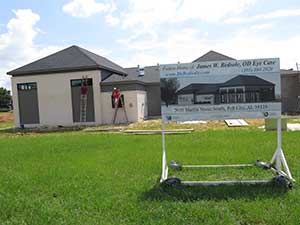
In August, James W. Bedsole, O.D. moves to a modern building, designed for Eye Care, situated just in front of South Park Center. Dr. Bedsole’s practice will relocate from downtown Pell City to 2020 Martin Street South.
Dr. Bedsole said that, of all the properties he considered for relocation, this particular location was the very best.
He provides primary eye care, vision correction and treatment of eye diseases, as well as pre-operative and post-operative care.
The new building, state-of-the-art, will allow greater comfort and efficiency for patient care. The new location is convenient – located in front of the South Park Shopping Center that includes Publix – and it’s more accessible.
The brick-and-mortar buildings are important for patient care, but even more important are people, Bedsole said, noting that he has a great staff who works hard and really cares for their patients.
The new building is an asset in continuing to deliver exceptional patient care.
ATI Physical Therapy
Situated at the Hardwick Road end of PCIFM’s building is the Pell City location of ATI Physical Therapy.
Based in Illinois, ATI operates stand-alone physical therapy sites, as well as units on high school and college campuses, said Chris Baker, director of physical therapy at ATI in Pell City. The Pell City site opened Feb. 17.
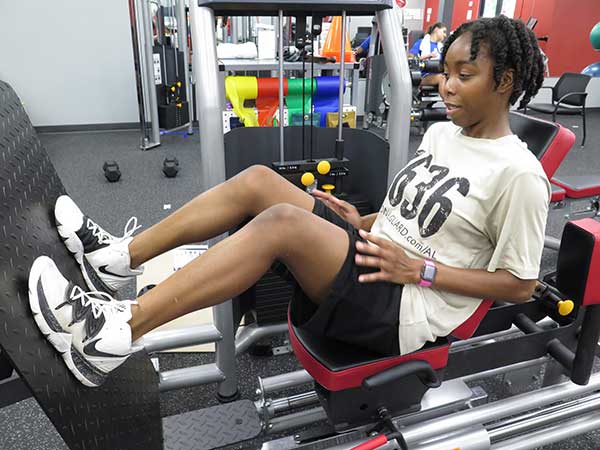
Student athlete Tion Wright of Vincent works to strenghthen her legs.
Encompassing more than 2,800 square feet, the local ATI provides physical therapy for a wide range of needs and specializes in therapy for orthopedic and cervical spine issues, Baker said.
Monday through Friday, ATI offers one-to-one care, using new equipment and a variety of treatments. Appointments are available 7 a.m. to 7 p.m.
The growth occurring in Pell City schools and in southern St. Clair County made this location particularly attractive to ATI, Baker said. Even though the location opened shortly before the COVID-19 shutdown, Pell City’s ATI has experienced a steady increase in clientele.
Future plans include hiring additional physical therapists, Baker said.
“We have been very blessed with the patients we have seen so far,” Baker said. “Pell City has been good to us. We look forward to growing with the community.”
Comfort Care Hospice
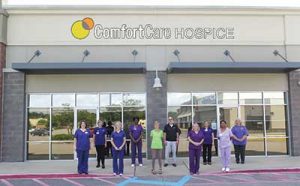
Comfort Care Hospice opened its Pell City office May 1 in South Park Center.
“The growth around here is just awesome,” said Clay Spencer, administrator and a registered nurse with Comfort Care Hospice. “I have wanted to come over here so long. … I can’t tell you how happy we are to be here.”
Spencer said the office relocated to Pell City to be more central to its coverage area, which includes St. Clair, Clay and Talladega counties.
The 10-plus employees at the Pell City location include nurses, aides, a social worker, a chaplain and office staff. The physicians are Dr. Rick Jotani of Pell City, who is medical director, and Dr. Jarod Speer of Childersburg.
Spencer said Comfort Care Hospice also has a corps of volunteers who call patients and offer short-term respite for caregivers.
Staff outside the new Comfort Care Hospice building next to Publix.
Hospice care, Spencer explained, is for patients with terminal diagnoses. “Our goal is to keep them home and keep them comfortable,” she said.
With hospice care, patients receive medical attention right at home. Nurses are available around the clock and also visit at least twice each week with patients. Aides make several visits each week in patient homes, as well.
The hospice mission allows patients, along with family members, to make their own decisions about care, Spencer said. “(Hospice) does elongate how much time they do have before they make that transition.”
Dr. Greg Tankersley, the chaplain, gives spiritual and emotional support to patients and families during the time of hospice care. After a patient passes, he offers grief support to family members for 13 months.
“We stay in touch with our families,” Spencer said.
Dry cleaner escaped Holocaust,
traveled storied route to Ashville
Story by Joe Whitten Submitted photos
For Bernie Echt, the journey from Gross Kuhren, Germany, to Ashville, Alabama, included stops in Africa, China, the Dominican Republic and sojourns in various cities in the United States.
Bernie’s parents, Solomon and Erna Czanitsky Echt, already had daughters Ruth and Eva when Bernie was born on Nov. 4, 1937. Sister Sarah would arrive Nov. 4, 1938.
His parents and grandparents owned a farm in Gross Kuhren and dealt in horses and cattle. Although Jewish, they conducted business with both locals and the German military before the war.
Relations seemed good with people in the area, for as Bernie recalled, “My parents and grandparents had lots of connections; that’s why we are still here. Otherwise we would be …,” he let those words hang, then added, “They helped us to get the hell out of there.”
Bernie wasn’t yet a year old when they fled the Nazis, so he recounts what he was told by relatives. In spite of the apparent good relationship, “At the end of 1937 or the beginning of 1938, one evening, they knocked on the door, and calling Solomon by his nickname, they said, ‘Sally, you need to go with us down to headquarters.’”
Solomon and Erna both asked for a reason, but the only answer they got was, “We can’t tell the reason; you just need to go with us. You don’t have to take nothing along.”
Erna asked where they were going, and they replied, “To town.”
“It was the Gestapo,” Bernie continued. “They took him to the concentration camp, Sachsenhausen, and put him to work in the stone quarry. He was in there until the end of ’38, or thereabout.”
Bernie is unsure of how this happened, but his mother and grandparents paid off certain Nazi officers to get Solomon out of Sachsenhausen. He believes they gave money and cattle, and that one of the officers was a close friend who used to visit on Sunday afternoons.
The officers warned that Solomon must disappear immediately, so within 24 hours of release, he was on a freighter to Shanghai, China. He lived in Shanghai a year before Erna and the children could journey there.
And what a journey Erna and the children had getting to Solomon in China. The grandparents hoped to emigrate to Palestine, but borders closed before they could leave. They never got out.
Along with other Jews, Erna and the children secured passage to China on an Italian freighter. Difficulties arose at the Suez Canal when authorities refused the freighter permission to proceed.
Low on fuel and food, the ship diverted to an African island where it languished for six months. A Jewish organization managed to get money to the captain so he could continue to China.
Finally, in 1939, Erna and children joined Solomon, where he worked on a missionary farm in Shanghai.
Because of the Sino-Japanese War (1937-1945), the Japanese occupied Shanghai. For the moment, things seemed peaceful. “The Japanese soldiers would come to the house,” Bernie remembered, “and my mother would cook them something. They had a good time.”
Concentration camp
All that ended Dec.7, 1941 – Pearl Harbor. “The Japanese came for us,” Bernie remembers, “put us up on a truck and took us to a camp. They took our passports. Everything. We had just the clothes we wore.”
There were 2,000 in this Japanese concentration camp with 16 people to a room. They devised privacy curtains with the bed blankets during the day, then took them down for cover at night.
The rabbis in the camp made sure Jewish boys received religious instructions. Going and coming from the place of instruction had its dangers, as Bernie recalls one night: “I remember rabbi took us one evening to the main building there, and the Japanese were shooting the guns with light-balls to light up the streets inside the camp, so they could see if anybody was walking around. And the rabbi said to us, ‘Just stand against the wall and don’t move.’ That’s what we did, and that’s how we always got through.”
The rabbis made sure that the kids who went to temple had kosher food for Passover, a sacred necessity for Orthodox Jews, such as the Echts.
World War II ended, and liberation finally followed. Bernie recalled, “McArthur came, and the streets were full of military. The Japanese commander who mistreated so many – he didn’t do it personally, but he had command over it – the teenage boys in the camp went to the Japanese headquarters, got the commander out, brought him to the camp and got sticks and hit him.”
Bernie didn’t participate in that. “That wasn’t my idea. I couldn’t join in beating him. He was only a man. I look at things a little bit different. I shouldn’t, maybe, but I do. A human being is a human being.”
The American nurses took the internees into the country, gave them food, and American military doctors gave physical exams.
The Americans taught them songs, Bernie recalled. “The first song we learned was ‘God Bless America,’ and then we learned the military songs – the Navy song and ‘This is the Army, Mr. Brown.’” He laughed and added, “We changed that one a little bit.”
Wanting to leave China, Bernie’s family went to the consulate and asked about being able to come to the United States. A Jewish organization (American Jewish Joint Distribution Committee) took over and organized the Echts’ and others’ exodus. They left for San Francisco on the Marine Lynx, an American transport ship. “We sailed under the Golden Gate Bridge, and it was wonderful,” Bernie said. “I was 9 or 10 years old.”
In San Francisco, the family stayed quarantined in a hotel for six weeks. Bernie recalls that the Jewish organization fed them and took them to a clothing store and bought them garments and shoes. He got his first pair of long pants and pair of shoes.
Dominican Republic
When the quarantine ended, the Jewish Distribution Committee came to tell the Echts the three countries available for relocation: Australia, Canada and the Dominican Republic. The family chose the Dominican Republic.
As early as 1938, General Truijillo of the Dominican Republic offered to the Jewish organization refuge to as many as 100,000 Jews fleeing Germany. On the north coast, now Sosua, General Trujillo set aside a large section of wooded land, and the Dominican Republic Settlement Association (DORSA), a Jewish group, cleared land and erected barracks. “It was similar to a Kibbutz,” Bernie said. “They all ate together, and the women did everybody’s laundry. There wasn’t that much that each one had separate.”
DORSA built houses on plots of land, families with kids got the first houses built, then couples without children. To get them started, for the father of the family, DORSA gave 10 cows; for the mother, six; and for each child, one. A family paid so much a month to DORSA until they had paid for the farm, house and livestock.
The Echts lived on one of the DORSA farms until Bernie’s mother died in 1949. After her death, Solomon left the farm and moved the family to the city. When Bernie turned 13, his father and sisters arranged his bar mitzvah. “I learned all the rituals,” he said. “I already knew a big part of it. I was very orthodox when I started out. Very orthodox until my mother died, then I slowly let it go.”
Home-life deteriorated for Bernie after his mother died, and a few months after his 13th birthday, he set out on his own. He had only the clothing he wore and no money.
He went to the Jewish organization in Sosua, met with the administrator, and told him about leaving home and needing a job. The administrator told Bernie he had no job for him because he lacked education and job skills.
Unsuccessful there but undaunted, he made his way to the farmers’ cooperative and told them his predicament. “I need a job. I need something to do to make a living.”
They listened to him, then, offered him the only available job, cleaning the animal intestines in the slaughterhouse, which paid $25 a month.
Bernie took the job. He lived in a barrack room for $3 a month, which included electricity and water. He commented, “I earned $25, paid $3 for lodging, and had $22 left. I didn’t need nothing.”
Work ethic rescues him
Although he started with a nasty job in the slaughterhouse, Bernie worked hard, and that served him well. The manager of the meatpacking plant soon took him out of the slaughterhouse and taught him about choppers and carvers. Mr. Meyerstein, who had worked for Armour and Swift in Chicago, taught him how to make sausage.
A careful observer and fast learner, Bernie said, “When I saw anybody doing something I wanted to learn. I caught it with my eyes and remembered it. I had no other choice. There was no Social Security, no unemployment, no insurance. Nothing. I had to learn.”
Management liked Bernie’s work ethic and raised his salary to $45 a month. He saved $10 a month until he had about $30 put aside. Then he went to a farmer to buy a calf. When the farmer found he had the money, he asked where he would keep the calf, and Bernie bargained with the farmer to pasture the calf for $1 a month.
They both agreed that when the calf became a milk producer, the milk belonged to the farmer, but calves born to those cows belonged to Bernie.
Next stop: USA
In 1957, when Bernie came to the United States, he was earning $85 a month and had 12 head of cattle, which he sold to finance his trip to the States and for Washington’s required $300 security deposit in case his job fell through.
Some Marines were the first who tried to help Bernie get to the United States. They said if he were willing to join the military, they would help him join the Marines. Bernie was willing, but the Marines weren’t – he was 2 inches too short at 5 feet, 5 inches tall.
Regulation height was 5 feet, 7 inches tall.
However, when a Mr. Weinberg came over from New York City, Bernie had success. He asked Weinberg if there was a newspaper in New York where he could run an ad for work in the United States. Yes, there was, the Aufbau, published in New York City for the German Jewish Club. Weinberg placed the ad: “Young butcher looking for a job in the U.S.”
Bernie waited. Then a letter from a Mr. Krucker arrived at the consulate in the Dominican Republic. Mr. Krucker owned a Swiss restaurant in Pagona, N.Y., and needed a butcher there by May 27, no later.
Bernie leapt into action. A visit to the consulate produced a list of “must do” things in order to leave. He took the list and returned in two days with everything else on the list.
Then he needed a “quota number,” but the consulate said that would take two weeks, and that would be too late to make it to New York by May 27.
Bernie tells it best. “It was hard to get out of the Dominican Republic at that time. Because of Nazi persecution, I was stateless – no passport. All I had was an ID from the Dominican government, like a driver’s license, but not a driver’s license.”
Bernie had to be in New York by May 27, so he begged the consulate to call Washington and get a quota number. “I will pay for the call,” Bernie said.
The consulate said, ‘Are you serious? We don’t do that normally.’ But with a little more pleading from Bernie, he said, ‘All right. Go outside and sit and wait. I’ll let you know. I can’t promise you.’
Bernie waited an hour and a half before the consulate came out and said, ‘I can’t believe it. I got you a quota number. Everything’s ready. Go to the airport and get yourself a ticket and you’re ready to go.’
Then, another problem loomed. Bernie had no passport, but he knew who could help. A German Jew named Kicheimer could work miracles almost. Bernie told Kicheimer why he was in a rush and gave him his paperwork.
Kicheimer returned the next day with the necessary documents, and Bernie was ready to leave. At the airport, Ruth and Eva were crying, afraid of what the police would do if they found out how he’d gotten his documentation. Bernie told them, “I did nothing; the man did everything. I’ve got a legal piece of paper.” He laughs and adds, “I was so glad when that plane went up and I looked down.” He was on his way to a new life that one day would land him in Ashville.
Bernie woking at Krucker’s Restaurant
When Bernie arrived at the restaurant, Mr. Krucker gave him a place to stay in his hunting shack, telling him to unpack, come to the restaurant and eat, then rest for the next day when they both would go to New York City to buy fish, meat and vegetables for the restaurant.
Bernie spoke of Mr. Krucker’s kindness to him, saying, “He treated me like I was his son. He was very good to me. When I bought my first business, he co-signed the loan for me.” Bernie’s respect for Mr. Krucker was evident when Krucker asked him not to wear his David Star because it made some German patrons uncomfortable. Bernie removed it, saying, “Mr. Krucker, I am Jewish in my heart, I don’t have to show it.”
Saying, ‘I do’
The restaurant’s head waitress, Pia, was a German gentile in an unhappy war-bride marriage that would end in a divorce. She was 10 years older than Bernie, but age presented no problem to him, and a few years later she became his wife. She converted to Judaism, going through the counseling sessions with the rabbis.
This was important to Orthodox Jews for descent is traced through the mother and gives both male and female children irrevocable Jewish status. It was a happy marriage that held strong until Pia died of brain cancer in 1979. The couple had three children: Bernhard “Bernie” Jr., Daniel and Katharina.
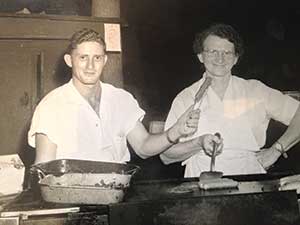
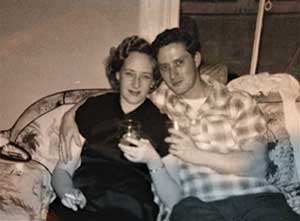
Bernie and Pia in the 1950s
Mr. Krucker had urged Bernie to ask Pia out. He was reluctant to do that because of lack of money. Pia knew this and said, “This time, I will buy you a root beer float and a hamburger. If you did have money, I don’t want you to spend it. You are new here, and you need to save your money.”
They didn’t go out again until Bernie had saved up some money. Mr. Krucker knew this and came to Bernie and gave him an envelope and said, “That’s for you.” It contained his $50 weekly pay, inside. “I was rich,” Bernie said.
Never afraid of hard work, Bernie worked in the restaurant through the summer and into the fall, and when the number of diners dropped, Bernie got a job in the meatpacking plant in Mazzolas, N.Y., earning $65 a week. When he got off work there, if an auction was being held, he would sell hamburgers at the auction house. “You know, a couple of bucks here and there, and I made money,” he said. On Saturday and Sunday, he worked at the restaurant.
Bernie and Pia were engaged now, and he wanted more income. One day he asked the man who picked up and delivered the restaurant’s laundry if there were money to be made in laundry work. He told him, “If you work hard you can make money. It’s on a percentage of what you collect.”
So, Bernie went to see the owner, Frank Senatores, who told him, “I don’t pay until you bring in work. You deliver it and collect, and I pay you a commission on that. You have to use your own car. I don’t supply no vans or anything.” Bernie accepted the job.
Making of an entrepreneur
He worked hard – and so did Pia. After working his dayshift at the meatpacking plant, he and Pia would run the laundry and dry cleaning routes until about 8 p.m. Pia would drive, and he ran to the houses delivering and picking up. “I’ve been doing that for 60 years,” Bernie said recently. “The same system. And it works. Believe me, it works.” They built up a good route and eventually bought the drop business.
In another village, he saw a laundry and dry cleaner that wasn’t doing well because of the lazy owner. Obtaining a bank loan, Bernie bought that company and gave up the restaurant job to concentrate on the laundry business.
Always the quick and thorough learner, Bernie learned the dry cleaning and laundry business hands-on. He bought a 1952 Chevrolet truck van, put hanging racks inside, and had a high school art student paint the truck white with a crown for Imperial Laundry and Drycleaners, with the address and phone number.
From the beginning, Bernie has never turned down a challenge, for he’s always assumed he could do it. Early on, a man came in with a wide lapel, double-breasted suit wanting Bernie to cut the lapels down to a narrower size. Although he had never done alterations before, Bernie said, “We can do that, but it will cost you.”
Pia thought he was crazy, but Bernie said, “Don’t get excited. We have a suit hanging here. I’ll lay it on top of the one to alter, mark all around the lapel but leave a half inch. Then we’ll cut the material off and turn the rest under and sew it.” They did, and the customer was so happy he gave them a generous tip. After that, Pia learned to do whatever alterations that were needed.
By the time Pia died of cancer, they were living in Florida, and Bernie had expanded into selling laundry and dry cleaning equipment.
Five years after Pia’s death, Bernie exhibited his machines at a convention in Atlanta. One evening after the exhibits closed for the night, Bernie went to eat a restaurant where there was dancing. There he met Doan, who was buying merchandise for her dress shop in Springville, Alabama.
The magic of dance
She and Bernie danced that evening, and that dance blossomed into a courtship that resulted in a wedding the next year, 1985. The love affair has lasted 35 years. Although Doan didn’t convert to Judaism, she attends temple with Bernie.
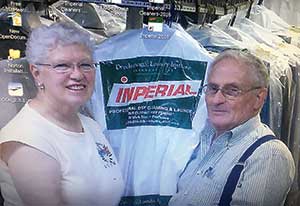
Doan and Bernie Echt in Ashville today
It was Doan’s St. Clair County roots that brought them to Ashville and the establishing of Imperial Laundry and Professional Drycleaners there in 1994. Their pickup and delivery routes extend into Jackson and Cherokee counties. Bernie’s original method of building a business by meeting and knowing his customers still holds him in good stead today.
Katharina Echt says of her father, “My brothers and I were raised with a strong foundation of what it means to work hard. We each have a keen understanding, by our father’s example, of what is possible with sheer will and determination. Ever present is his steadfast belief in our ability to achieve anything we set our minds to. And so we have.”
Bernie never lost hope or purpose in the face of hardship, adversity or tragedy. He has focused on the good of life rather than the bad and remains a cheerful man who is a delight to know.