Story by Linda Long Discover Archives photos Submitted photos
Each year thousands of people flock to one of the public parks on
Neely Henry and Logan Martin lakes. Alabama Power operates two of those parks,
Ten Islands at the Henry Neely Dam, and Logan Martin Park, now named Double
Cove, next to Logan Martin Dam.
But that’s not all to choose from. Lakeside Park, located adjacent
to the Pell City Civic Center and run by the city, is another popular spot.
Josh Yerby of Alabama Power explained that in addition to
providing hydroelectric power to its customers, the company also provides all
kind of opportunities for recreation, which is why it has begun a new
initiative called “The Preserves.”
“The nature of Alabama Power land holdings lend themselves
to extensive green and natural spaces that can play host to and offer a variety
of unique outdoor activities,” he said “The Preserves are core to the Alabama
Power ideal of merging nature with crafting special places. These lands allow
people to enjoy, learn and grow a deeper appreciation of our state’s ecology
and natural landscape.
“They allow our citizens to access and enjoy our lakes. They are
inclusive and open to all. The Preserves will be located throughout our service
territory with varying amenities, such as playgrounds, trails, boat ramps,
picnic areas and fishing piers.”
Those amenities are exactly what draw visitors to both Ten Islands
and Double Cove. Yerby says the newest addition at Ten Islands is an almost
2-mile nature trail complete with rustic designed gazebos sporting their tin
roofs.
“This park is a very popular place for people to go,” said Yerby.
“It’s part of the Alabama Birding Trail, which always draws a lot of visitors.”
Double Cove
Logan Martin Park, known as a mainstay of Alabama Power-operated
parks was renamed Double Cove by Alabama Power as part of The Preserves.
Yerby says the park offers a two-and-a-half mile hiking trail and
a new playground for the kids and is completely handicapped accessible. It’s
equipped with a boat launch, swimming area, picnic areas and fishing piers.
Both Alabama Power Parks are day use, free admission and are open
from dawn until dusk.
Yerby explained that while Alabama Power is required to provide
recreational opportunities for stakeholders, according to their license, “we go
above and beyond those requirements with additional facilities and by exceeding
the industry standard for recreation sites. Our mission is to create and
maintain amenities for people of all interests to enjoy while promoting healthy
lifestyles, economic development and adding positive contributions in each
community.”
Lakeside Park
Lakeside Park in Pell City is another favorite. Picnic areas and
pavilions are available along with an approximately one-mile, non-motorized
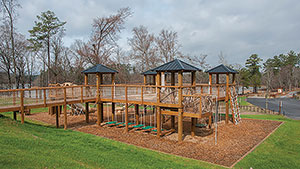
walking trail and Kids Kastle, an impressive and imaginative playground the
community built in a single weekend.
The park is a popular spot for fishing tournaments, including
national and state brands, like Bassmaster Classic, Crappie USA and Alabama
Bass Trail. It most recently hosted the inaugural Huk Bassmaster B.A.S.S.
Nation Kayak Series powered by Tourney X presented by Abu Garcia. It drew 243
boats and anglers from around the country.
The park itself is 67 acres fronting Logan Martin and features
dozens of ways for the entire family to enjoy the outdoors.
From picnics to swimming at the park’s beach to fishing from its
docks or launching your own boat, Lakeside Park is quite a destination point
for outdoor enthusiasts.
There are four pavilions for rent, an Alabama native plant walking
garden, the Wetlands Project with viewing platform, an amphitheater and outdoor
exercise equipment.
But arguably the most popular destination point of all is the
splash pad. With its 40-plus water features, there’s no mistaking the fun in
the sun for kids. It features pavilions for rent for events, like birthdays,
and it even has after-hours, private party opportunities.
It’s
closed on Mondays for maintenance, and it is open seasonally from May to Labor
Day.
Is anything better than a day on the lake? With a boat? How about
a day on the lake with 80 boats? That’s the plan from organizers and sponsors
of this year’s Logan Martin’s LakeFest and Boat Show, May 15-17, at Pell City’s
Lakeside Park.
Produced by the Logan Martin Charity Foundation, the popular event
marks its 10-year milestone with what is billed as the largest in-water boat
show in the Southeast.
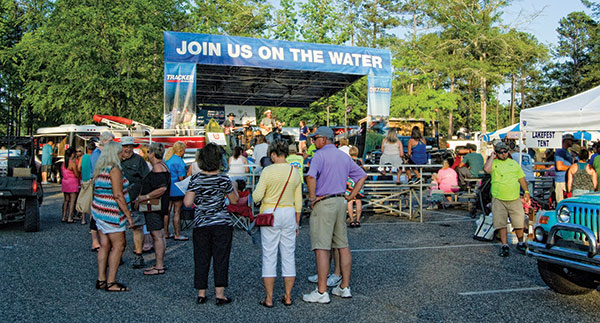
“It’s a lot of fun. We have vendors, crafts and music all weekend
long, said Eric Housh, event coordinator, “but the centerpiece of the whole
thing is the boat show. For this 10th anniversary, we’ve got some really
special things planned.”
Boat dealers will present over a dozen lines of boats with some 80
models, from pontoons to speed boats and personal watercraft and just about
everything in between. Those interested in buying a boat can get “up close and
personal.” They can even kick the wheels, so to speak.
“So, they get in the boat and take it out for a test drive,” said
Housh. “It’s a try it before you buy it sort of plan. It’s really a great
opportunity to try it out see how the boat feels while it’s actually on the
lake.”
Housh says he was brought on board as event organizer “back when
the thing was just an idea.” That was 10 years ago, which means he’s now been
planning, organizing, communicating and coordinating for the past decade.
“I think the first year we had maybe five to seven hundred people,
over the whole weekend,” Housh recalled. “In year three, we got flooded out.
Last year, we had close to 20,000 over the course of the weekend. We’ve grown
from meager beginnings of just a few hundred people to a great event.
We’re proud of it.”
No admission is charged, since the entire event is funded by
sponsorship dollars. America’s First Federal Credit Union is one of the lead
sponsors and does onsite financing for the boat show. Others are “local
businesses,” Housh explained. “Whatever we don’t use to produce event we donate
back to local charities,” he said. “Over the course of the event, we’ve donated
over a quarter of a million dollars. Last year, we gave $31,000. This year we
will probably double that. We’ve set aside funds for the past several years to
do some massive improvements to Lakeside Park.”
Those improvements include a new park pavilion and some
enhancements to one of the piers for public safety and to facilitate boat
parking.
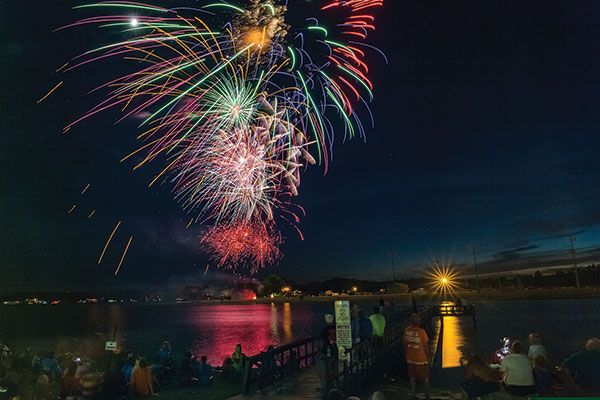
Housh said his favorite part of the three-day event is set for
Friday night when local veterans will be honored with a dinner and a fireworks
show.
And, as always, the event is “flush with giveaways,” including a
boat and an ATV, Housh said.
The winter chill is starting to wear off, and those sweet, sweet,
fleeting days of spring are upon us again. For outdoor lovers, there’s a new
game in town — pickleball. Combining tennis, badminton and ping-pong,
pickleball has become one of America’s fastest growing recreational sports.
The pickleball craze, which first began in the Sun Belt region
about a decade ago, has made its way to St. Clair County, and residents are
coming in droves to secure a court every day at the newly renovated Pell City
Civic Center.
Tennis pro of Pell City Sarah Stewart has taught tennis for over
20 years and played the sport her entire life. Her heart belongs to the sport,
as she has molded her career around her love for the game and the students she
coaches – and she is amazed at the turnout the Civic Center has had for pickleball.
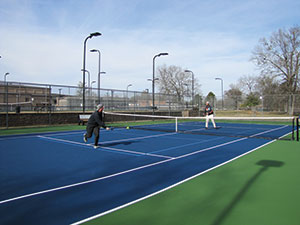
Stewart said several of the tennis courts have been taped off to
create special pickleball courts, which unlike their tennis counterparts — make
the court much shorter. “This game really isn’t your grandma’s sport, it gets
competitive and is definitely a great workout,” Stewart said. “There are a lot
of people who don’t enjoy tennis, but love pickleball.”
The game itself has a quirky set of rules — for example, players
need not find themselves in “the kitchen,” otherwise the rules of the game are quick
and easy to learn. Doubles are most popular, although singles are also popular.
An entire match usually lasts around 15 minutes. Players also do not have to
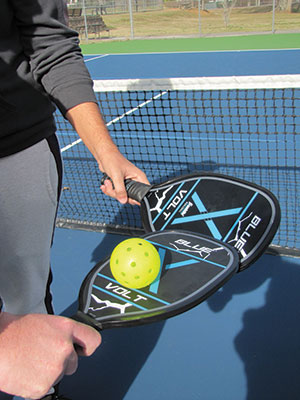
worry about expensive gear, the sport is played with an oversized ping pong
paddle and a whiffle ball, which according to Stewart is another attractive
feature about the game. “You can get a paddle and a package of whiffle balls at
any sporting goods store for less than $30 and be ready to go, where other
racqueted sports can become costly with equipment.”
The game is simple, keep hitting the ball back and forth until
someone makes a mistake. The game ends when the first team reaches 11 points
and is ahead of the opponent by two points.
There also is a seven-foot area directly on each side of the net,
which is considered a “no volley zone,” and in pickleball this is called “the
kitchen.” The reason for having this badminton spin, “the kitchen,” is to keep
players from making slam shots over the net, resulting in players making more
planned out shots. It also adds more margin for error for the opposing team.
Many teams will make up their own penalties for stepping into “the
kitchen,” from loss of point to forfeiting the match. Like tennis, both players
serve once before handing the serve to the other team.
A player must allow the whiffle ball to bounce at least once
before hitting it back on the first serve. The initial serve must be
under-handed, as well as all other contact with the ball, and the hit must be
no higher than the player’s bellybutton and clear the net and “kitchen.”
After the match’s initial serve and bounce, players can hit the
ball back and forth without allowing it to bounce again. A point can also only
be scored by the serving team.
For Smith, she enjoys watching some of the more advanced teams
making calculated decisions, with their partners. “It definitely is a mental
game,” she said. “Even though the court is much smaller than a tennis court,
you have to be ready and be just as quick.”
She also added that the health benefits are great. “One of my
regulars reserved a court, and they played for the longest time. When he was
finished playing several matches, he was surprised to see he had taken in over
7,000 steps.” But there is a less amount
of running, jarring and straining to big muscle groups, unlike in tennis. “I
can definitely see how it is so popular … because anyone can play. It is a
quick game, easy to pick up, and it is far less strenuous on the body than
other rec sports,” Smith said.
Pell City local Rodney White plays the sport with his neighbor as
his partner for doubles. White said they both enjoy the sport because it is low
impact, but also competitive. Holding the number 1 spot as reigning pickleball
champions of First United Methodist Churches of Greater Birmingham, the
Gherkins said they are so glad the city has updated its facilities to include
the sport, and are so happy to hear the upcoming news of an indoor court coming
to the Civic Center as well.
“An indoor court will be
just what we need in this Alabama heat,” White said. “We didn’t get near the
practice we needed last summer to get ready for tournament play due to the heat
and humidity—it was brutal.”
The Pell City City Council also approved funding to replace the
flooring in the multi-purpose room, which will allow for an inside pickleball
court. Civic Center Manager Valerie Painter said they are so excited about the
new flooring and the expansion of activities the Civic Center will be able to
offer. The new flooring is called Elasti-Plus, which according to Painter, is
much more conducive to indoor exercise, and still looks good.
“It has a cushioned feel and will give us the ability to expand
our class offerings to include higher impact classes that put more strain on
the knees or joints, such as dance classes or High Impact Aerobics,” Painter
said. In addition, a pickleball court
will be painted on the floor which will give the community access to indoor
play.
“We are thrilled to be able to offer the community two outdoor
courts at the Tennis Center and soon we will be able to offer an indoor court
as well,” Painter said.
“The addition of these three courts goes right along with the
City’s desire to make the Civic Center a more active space that offers a little
something for everyone at a very affordable price.”
Currently the Civic Center does not have any paddles or balls, so
players need to bring their own, and call and reserve a court for $5.
Pioneers settling here were generally people of the Christian
faith, and very soon they formed churches. First Baptist Springville (1817) and
Ashville United Methodist (1818) are documented as over 200 years old.
Two hundred years ago, St. Clair County’s forested mountains and
lush valleys had welcomed a number of pioneer families into its boundaries.
Early written accounts record that these hearty settlers established homes
among the Native Americans who populated the area until their removal by
President Andrew Jackson.
But oral history speaks of an older one. In the 1975 Some Early
Alabama Churches, published by The Alabama Society Daughters of the
American Revolution, is found written about today’s Macedonia Baptist in
Ragland, “… this church is said to be the oldest church in St. Clair County,
and it is thought [that] it was organized in 1812.” However, it gives no source
for this date, and so far, none has been found. One hopes that someday an old
diary or family Bible might establish the correct date of this church.
Presbyterian churches appeared later in the 19th century, and as the
century progressed, populations increased, and churches sprang up throughout
St. Clair County. Several of these will turn 200 years old in a few years, and
many have celebrated over 100 years of existence.
One of the loveliest places in St. Clair is Chandler Mountain’s
high plateau, which extends about 10 miles in northwest St. Clair County. Today
it is the county’s garden spot, but it lay a wooded wilderness when Joel
Chandler settled at its base in the early 1800s. Oral history states that
hunters had a trail up the mountain near Chandler’s home, and it came to be
called Chandler’s Mountain. Over time, the apostrophe “s” dropped off, and we
have today’s name.
Vivian Qualls, in her History of Steele Alabama, records
that in 1855 Cicero Johnson was the first brave soul to forge his way up the
mountain to settle. Gradually, other settlers followed, but it wasn’t until
1905 that the first church was established there. However, community worship
and revivals occurred before 1905, for people of faith have always worshiped together
in some fashion even when denominational churches had not organized.
Established churches existed at the foot of the mountain, but getting there
wasn’t easy, for the trip would have been by foot, horseback or wagon down a
mountain trail. Like any early settlement community, believers met together in
homes to worship as often they could.
One of the early settlers, Hezekiah McWaters, was a Methodist
preacher, and Mrs. Qualls writes that he preached and conducted revivals in
Greasy Cove at the foot of the mountain.
The roots of today’s Mt. Lebanon rest solidly in Ellijay, Ga., for
a large percentage of early Chandler Mountain settlers came from there. Among
those were the Robinson brothers, Bob, Jake and Dan. It was through the
influence of this family that the mountain’s first church came into being.
Another Robinson brother, William J., a Congregational minister,
would travel from Ellijay to Chandler and conduct revivals. It was a big event
when William visited, and the collective Robinson families would attend his
revival services. As a result of the 1905 revival, Mt. Lebanon Congregational
Church organized with 11 charter members: William Robinson, J.J. Robinson,
Elvina Robinson, Daniel Robinson, Elizabeth Robinson, Della Robinson, J.B.
“Bent” Engle, Lucy Engle, Hettie Hyatt, Delia Wood and Ollie Engle Wood. Bent
Engle sold the church two acres on which to build a sanctuary. Cost? $4.
William Robinson served as the first pastor of Mt. Lebanon from
1905-1911. He moved from the mountain, but in 1912, he returned to preach the
revival services, and during that revival fell ill and died. His remains were
interred in the cemetery across the road from Mt. Lebanon church.
The Congregational Church came to America through the English
Puritans who suffered persecution for their non-Anglican doctrines. Coming to
America, the Puritans established in 1620 the Parish Church, Plymouth, Mass.,
as the first Congregational Church in America. By 1640, 18 churches had been
established in Massachusetts.
Jonathan Edwards, considered America’s greatest theologian,
pastored a Congregation church when he preached the sermon, “Sinners in the
Hands of an Angry God.” A sermon documented as having a profound effect during
the 18th century revival movement known as the First Great Awaking.
We don’t know who brought the Congregational Church to Ellijay,
but we do know that members of that denomination moved to Chandler Mountain and
organized Mt. Lebanon Congregational Church.
Mt. Lebanon’s name has changed more than once over the years as
the original Congregational denomination became less traditionally biblical in
their theology. In the 1970s, the denomination’s name changed to United Church
of Christ, which changed the meaning of “congregational” church. Therefore, on
Oct. 24, 1981, Mt. Lebanon held a conference to discuss membership in the First
Congregational Methodist denomination. A month later, the church voted to make
the change, and on Dec. 18, 1981, Lebanon was accepted to full membership.
Today, the church’s name is Mt. Lebanon First Congregational Methodist Church.
The denomination’s headquarters is in Boaz.
Early minutes record interesting history. In the November 1928
business meeting, offerings received from members totaled $28.44. After paying
National Conference dues and other expenses, $6.95 was “cash turned over to
church treasurer.”
From August 1947 a penciled note in the record books states that
it was a wonderful year with nearly “100 conversions. Mary (Ma) Smith said,
‘the whole of Chandler Mountain got saved.’”
Unlike the United Methodist, the First Congregational Methodist
local church owns its own property, chooses its pastors, baptizes by emersion
and oversees itself rather than being presided over by bishops.
The church records contain the names of all who have served as
pastors. The pastor who served from 1933 to 1936, Annie Moats, is of interest,
for women pastors were not approved by most churches in those days. According
to Mt. Lebanon’s history booklet, Annie and Alley Mathis “Mac” Moats came to
Chandler Mountain in the early 1930s. Of German ancestry, Annie Struckmeyer
Moats was an ordained Congregational minister. Having pastored churches in
Cullman and Lawrence counties, she met and married Mac Moats in one of those
counties. Annie died in 1937 and was buried in the Mt. Lebanon Cemetery. The
Moats’ granddaughter, Barbara Robinson, was a member of Mt. Lebanon from 1959
until her death on April 13, 2019, age 92. Barbara’s husband, C.L., was a
church member from 1948 until his death on Sept. 27, 2018, age 91, and served
as a deacon until his death. He was a direct descendant of charter member Dan
Robinson.
In the 1940s, Mt. Lebanon replaced the original wooden church with
one of cement blocks painted white. This building had a covered porch at the
entrance and three new Sunday school rooms at the back. These rooms were fitted
with doors that folded so the space could also be used as a fellowship hall.
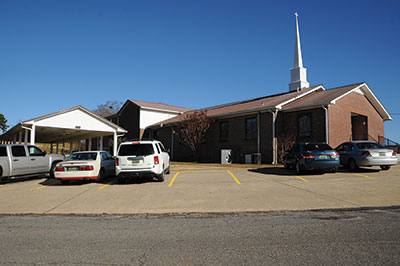
As years passed, the block church was bricked and a steeple added
in the mid-1980s. Around 1989, the church added a Fellowship Hall and in the
1990s installed a baptistry in the sanctuary and added more restrooms and a
pastor’s study. The 2000s saw the inside of the sanctuary refurbished with new
drywall, carpet and lighting in time for the 100th anniversary in
2005.
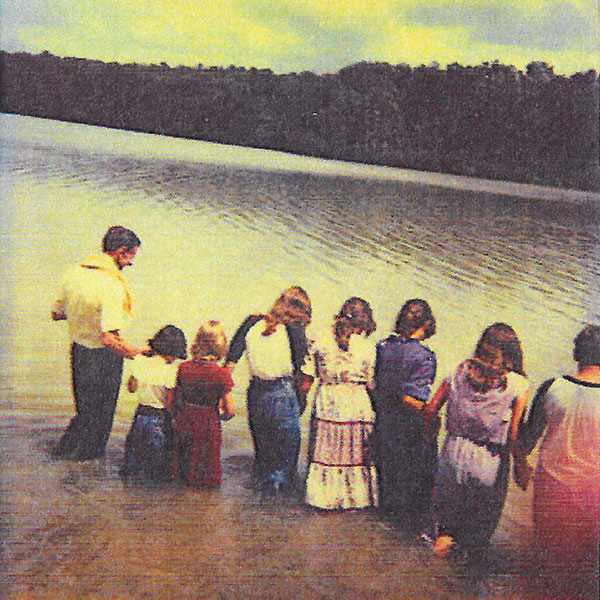
Prior to the baptistry being added, Susan Kell remembers when the
church baptized converts in the creek and later in Chandler Mountain Lake.
Karen Beasley recalls being baptized in the lake. “I was baptized in Chandler
Mountain Lake by Carl Gaskin and Wayne Deweese. It was so funny, because my
sister-in-law, Faye Beasley, was being baptized the same day, and her dog went
out into the lake, and we couldn’t get that dog to go back, and the preachers
finally said, ‘Well, just let him come on out.’ And they went ahead with the
baptizing.”
However, a building with all conveniences is not the church; the
individual members and the pastor who shepherds them are the church. So it has
been with Mt. Lebanon, and it has flourished through the years because of the
members’ faithfulness in serving God and in nurturing family and friends.
Caring for one another
The story is told of a teenage couple who wed and started married
life in relative’s home. This did not work out and the adolescent couple
suddenly found themselves without a place to live. Needing work, the husband
went to a member of Mt. Lebanon, told him his predicament, asked, “Could I farm
with you?”
This godly farmer and his wife took the couple under their
compassionate wings and provided the help needed. The farmer is now in Heaven,
but not forgotten, for the young man learned to farm well and successfully.
Recently, he saw the farmer’s widow and told her, “Your family has meant a lot
to me. Your husband put me on my first tractor, and told me, ‘Farm.’”
Yearly events at Mt. Lebanon include the Easter Sunrise Service;
Homecoming every fourth Sunday in May; Women’s Conference in August; an October
Fall Festival with soup, chili and desserts; then in December, participation in
Franklin Graham’s international Samaritan’s Purse ministry, a Christmas
program, and a fellowship meal. Of the Easter Sunrise Service, Susan Kell said,
“That is a beautiful service. It’s outside, right on the bluff overlooking the
distance.”
Many of Mt. Lebanon’s activities and events occur in cooperation
with Chandler Mt. Baptist and churches in the valley. Karen Beasley told of the
October Trunk-or-Treat event. “Our men always come together and cook the
hotdogs — we do 700 — and everybody helps wrap hotdogs. This event is sponsored
by all the area churches donating and working together.” No hotdogs remain when
the fun night ends.
Youth Night includes all churches. “We have Youth Service,” Karen
said, “where we do a community Youth Night with all the local churches —
Ashville First Baptist, Chandler Mt. Baptist, Steele Baptist, Deerman’s Chapel
and Reeves Grove. We do that on nearly every fourth Sunday night. The churches
rotate. Susan’s grandson, Garrett Spears, played the guitar at our last one at
Chandler Mt. Baptist.”
Four churches work together to prepare Backpack Buddies. This
local mission outreach provides nutritious food for families who need help in
providing for their families.
A nursing home visit each month is another local mission’s
outreach. “We go to the Attalla nursing home and Gadsden Healthcare,” Susan
Kell said. “Brother Alvin Turner, our pastor, brings a short sermon, and the
residents enjoy that spiritual contact — even the staff enjoys it. Our choir
members who are not working also go. We take a keyboard with us. The lady who
plays it is in her 80s, but you’d not know it. Afterwards, we go out to lunch.”
Mt. Lebanon has international missions outreach as well. For
several years, the church has partnered with New Desire Christian Ministries
Church and Mission in La Ermita, Honduras.
Bro. Alvin Turner has pastored Mt. Lebanon for 16 years, which is
a testimony to his ministry considering the fact that some churches change
ministers often. In an interview, he said that growth in numbers is good if it
is connected with spiritual growth. His heartfelt desire is for the church
members to continue to grow spiritually as the years progress.
In speaking of Mt. Lebanon’s missions’ work, Bro. Alvin’s voice
revealed the excitement. “Going on a mission trip will change your life.” He
feels blessed to have made several mission trips, for the church has worked a
number of years in Honduras at La Ermita with a mission and a church owned and
run by New Desire Christian Ministries. Mt. Lebanon has helped support them
financially and physically with constructing buildings there. By returning year
after year to the same place, the church has built a relationship with the
community. Bro. Turner sees these mission trips as obeying God’s command to “go
into all the world” and share the Gospel.
Current Mt. Lebanon deacons are Josh Kell, Jerrell Jordan, Jason
Ballard, Steve Bryant, Eddie Beasley and Johnny Beasley. Bro. Alvin said that
he and the deacons “have a wonderful relationship” working together in the
church. Brothers, Eddie and Johnny Beasley, are descended from early Chandler
Mountain settler Bob Robinson.
For the music of the church, Sandra Dobbins, pianist, and Bro.
Alvin, choir director, work together in selecting congregational songs and
choir specials.
When asked about the church’s senior member, Frances Kell, Bro.
Alvin spoke of her as “an amazing lady” who is a godly influence in the church
and community. He also spoke of Frances’ husband, Ernest, and of his work in
the church, recalling that “he didn’t like to spend money.” And that’s a good
thing since a church is using God’s money given by its members.
When asked about church members who are or were influential in the
church, Karen Beasley and Susan Kell both responded with these names: Aunt
Margaret Fore, Ernest Kell and Wayne Deweese. Both ladies talked of Deweese,
telling how people used to walk to Mt. Lebanon, and “… you’d see them coming
through the fields and hear the most beautiful singing as they sang all the way
to church.” Ernest Kell’s widow, 94-year-old Frances, is a sustaining influence
in the church today.
Of Ernest Kell, Susan said, “My father-in-law, Ernest, remembered
coming from Ellijay to the mountain in a wagon. He said he walked a lot of the
way, but when it would rain, he would get up in the wagon, and his mother would
cover him with her long dress. He said somebody had been here and came back to
Ellijay and said, ‘That’s where we need to go; there’s all sorts of farmland.’
He was 12 years old.”
An autumn drive up the mountain with the sunshine making a
stained-glass canopy of arching multi-colored trees ended at Frances Kell’s
home. Although in her 90s, she remains more active than many folks who are years
younger. She drives herself to church and Steele Nutrition Center during the
day, but confides, “I don’t drive at night.”
She and Ernest married right after he came home from World War II
and settled in to farming, first growing cotton and then tomatoes. She recalled
the early freeze of 1948 that caused enormous loss to the farmers. “We were
picking tomatoes in that field right over there, and somebody said, ‘We’d
better turn our buckets over, it’s gonna snow tonight.’ We turned the buckets
over, but we didn’t think it would. But boy did it come a big one.”
Interestingly she did not mention the financial loss, which gives evidence of
faith and courage in the face of adversity.
She spoke lovingly of her church and workers there, mentioning
Margaret Fore as having taught the Kell children in Sunday school. She told how
Ernest had been a deacon, a Sunday school teacher and the song leader for many
years. “He attended those old-timey singing schools,” she recalled, “and he
really learned music. I went, but I didn’t learn it. When he was getting to
where he’d forget which verse he should be on — that problem had started to set
in — they were trying to decide on a new song leader. They talked to one they
were interested in, and when they asked what he’d charge, he said, ‘Why, I’ll
not charge you anything.’ And Ernest spoke up and said, ‘That’s your man!’”
Declining in some ways, perhaps, but he was still thrifty with church monies.
That was Ernest Kell.
Revivals, fellowship kindle memories
When asked if she remembered any special church event, she told of
a revival conducted by Bro. Bean. “He tried to bring it to a close three times,
and it kept going — went on for three weeks. People were going to the altar and
getting saved. That was the revival that Ma (Mary) Smith said, ‘Everybody on
the mountain got saved.’ And all of her family did get saved, and they were
grown men. People prayed back then,” she said thoughtfully.
Every church-going person knows funny things sometimes happen in
church meetings, and Frances’ memories go down this path. “People would shout
back then,” she said. “Bellie Hyatt was shouting in a service one day, and she
looked out the window and saw their mules had got loose from the wagon. She
stopped shouting long enough to tell her husband, ‘Quinten, the mules are
loose!,’ then went back to shouting.”
Another memory came to mind. “Aunt Mollie Barnes shouted, too. She
had long hair that she rolled up in a knot on the back of her head, like women
did back then. She’d get to shouting and her hair would shake loose, and bobby
pins would go flying. Joe, her husband, would come behind her picking up the
pins off the floor and give them to her when her shouting was over.”
The subject of church fellowship dinners came up, and when asked
what special dishes she took, she replied, “I usually take cakes. I used to
take different ones, but now they like for me to bring my strawberry cake.”
This cake is famous at Mt. Lebanon for it is Frances’ own recipe. “My husband’s
favorite cake was coconut — you know, the old-fashioned kind with seven-minute
icing. Well, one year we had so many strawberries that I wondered why I
couldn’t use strawberries and sugar instead of coconut and sugar for the icing.
So, I tried it, and they loved it.
“I have a friend who’s been bedridden for years, and he loves that
cake. So, I made him one for his birthday. I enjoy doing that for people.”
Frances may never have given thought to this, but she has a ministry of baking
that is as useful in God’s work as any other area of service. Recently on the
PBS The Great British Baking Show, a contestant said this of her
cooking: “When I cook for family and friends I mix in love. If I’m kneading
dough, I knead in love; if I’m mixing cake batter, I mix in love. I bake with
love.” That seems to describe Frances Kell’s method as well.
When Frances’ great grandson, William “Will” Kell Spears, was
asked what he loved about his great-grandmother’s cooking, he said, “Her
biscuits! Nobody can make biscuits like she does. I’ve tried and mother has
tried, but we can’t make them as good.” When Frances heard this, she laughed
and said, “They just don’t try often enough. I’ve been making ‘em a long time.”
Will Spears is a sophomore at the University of Mobile majoring in
Special Education, and he bears the hallmarks of a godly heritage received from
great-grandparents, grandparents, parents and church. At age 12, he went on his
first mission trip to Honduras, and has returned seven more times. In January
2019, he wrote in an online article, “I truly have no words to describe how
grateful I am that God has allowed me to be a part of New Desire Honduras from
the very beginning, and has allowed me to experience His presence at work. …
This ministry … has challenged me to grow in my faith, to love more, to listen
and trust God’s will for my life, and to know that we serve a God who is good
and can make even the worst of situations display His majesty and sovereignty
over our lives.”
Of Will’s 2018 trip to Africa, Will told in an interview, “My Trip
to Kenya changed me in ways I could have never imagined. I went on this trip to
serve, love and share the Gospel with the people in a large village outside of
Nairobi. I didn’t expect, however, to be taught so much myself, about God’s
love, His faithfulness, and what true worship looks like from the amazing
people I met there. … It truly rocked my world. Join me in praying for the
believers in Africa, Honduras and America, and know that we are all called to
make disciples, whether it be across the sea or across the street.”
Near the end of his Honduras article, Will wrote, “The people who
make up the New Desire Christian Church are some of the most loving people you
will ever meet in this world.” These words seem to describe Mt. Lebanon First
Congregational Methodist Church as well. You’d be welcomed to worship with them
on a Sunday or to join them for Bible study on Wednesday evening.
Try
to visit on a day when they’re having fellowship lunch afterwards and Frances
Kell is there with her famous strawberry cake. You’ll find food for both soul
and body at this historic St. Clair County church.
Blair
Goodgame has been to 15 countries spanning four continents.
Though
she relishes traveling, she tends to share Dorothy’s sentiments in “The Wizard
of Oz”: “There’s no place like home! There’s no place like home!”
Enjoying
the place she calls home … and encouraging others to do so … is what
Goodgame does on a daily basis.
In
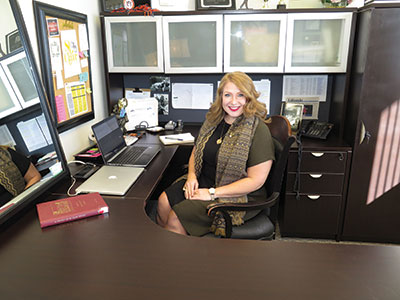
September 2019, she became tourism coordinator with St. Clair County Economic
Development Council (EDC). “It is a brand-new position and program, part of the
EDC’s five-year plan, Partnership for Tomorrow,” Goodgame said. “We are in year
one of that.” Hiring a tourism coordinator was one of the first-year goals.
As
tourism coordinator, Goodgame spends her days exploring and discovering
different aspects of St. Clair County and promoting them to potential visitors,
businesses and industries.
Tourism
“goes hand-in-hand with economic development,” Goodgame said. She called
tourism a “clean” industry that is indicative of a vibrant life within a
community. Such vitality is what business prospects want to see in a locale
they are considering.
In quick
succession, Goodgame enumerates one asset of the county after another, starting
with the resort areas Neely Henry Lake in northern St. Clair and Logan Martin
Lake in southern St. Clair. She adds to that Horse Pens 40 near Steele, Mustang
Museum in Odenville and the Forever Wild park near Springville. She points out
that the county has outfitters, outlets for kayaking, extreme sports parks,
bouldering destinations, competitive events, motorcycle racing, off-road
trails, aerobatics flight instruction, summer camps, national tournaments,
nature preserves and Moody’s Miracle League, a baseball league for people with
special needs.
As for
the arts, St. Clair has a prolific visual, musical and theatrical community,
Goodgame continues. A few examples would be galleries, concerts, entertainment,
songwriters and music festivals and stage productions. She also mentioned
learning opportunities, such as music schools and dance studios.
Plus,
there are wedding chapels and venues for parties, reunions, receptions,
conventions and conferences.
“We’re
learning more every day. … (There are) so many more things I didn’t realize
we have here … (and) other people in the county were not aware of also,” said
Goodgame.
In
addition to all that, Talladega Superspeedway to the east of St. Clair and
Barber Motorsports Park to the west bring visitors through the county, visitors
who may stop to eat, shop or refuel, Goodgame said.
“It is
also hoped that the more people who visit on a regular basis, some of them will
want to actually live and work in our community,” said Jason Roberts, EDC’s
director of industry and workforce development.
When
that happens, Roberts said, the county’s population increases, as does its
workforce, which naturally appeals to prospective businesses and industries.
Among
Goodgame’s responsibilities as tourism coordinator are compiling an
encompassing list of sites, venues, parks, events and opportunities countywide;
creating a calendar of events in the county; getting input from communities on
promoting what they have to offer; establishing a multimedia means for
disseminating information about St. Clair’s tourism aspects and using regional
and state resources to spread the information beyond the county’s borders.
Soon,
she will engage a branding company to create a slogan that captures the essence
of St. Clair in a few words.
“Blair
has really hit the ground running and has already begun cataloging and
identifying assets throughout the county, while also building relationships
statewide with other tourism organizations,” said Don Smith, EDC’s executive director. “She is preparing to begin a branding campaign the beginning
of 2020, as well as meeting with event organizers for a variety of events in
the spring. We had very high expectations for Blair after the extensive search
(for a tourism coordinator), and she continues to impress us all daily. She is
the perfect embodiment of our county’s tourism opportunities.”
Goodgame
grew up on marinas and in campgrounds in the Pell City area, enjoying St.
Clair’s warm climate and beautiful scenery. Logan Martin Lake and the great
outdoors were her playground.
“I’ve
always had a love of the outdoors, and the water still resonates with me,”
Goodgame said.
She
credits her mother, Cindy Goodgame, with nurturing that desire to be in nature.
“She is always supportive. She shares a love of the outdoors,” said Blair
Goodgame, who kayaks, camps, gardens and participates in community theater and
yoga classes. “… (She) made me the woman I am today.”
After
graduating from The Donoho School in Anniston, Goodgame majored in English at
Auburn University and minored in art history. Her plan was to become an attorney.
To prepare, she served as a congressional intern in the office of U.S. Rep.
Mike Rogers, R-AL.
Yet, at
law school orientation in 2009, she decided this was not the path her life
should take. She returned to Pell City and became operations assistant for
Goodley Corp., the family business.
“I love
Pell City. I love St. Clair County. It’s home,” said Goodgame, who lives in a
1902 farmhouse.
In 2011,
she became owner of Lakeside Package and Fine Spirits, which she operated
almost five years at her family’s Lakeside Landing RV Park & Marina.
Determined that Lakeside Package should be an “experience” rather than just a
store, Goodgame offered party supplies and events, such as wine tastings and an
appearance by Tim Smith from the television show, “Moonshiners.”
That
marketing strategy translated into a sales increase of at least 35 percent each
year. Pell City Chamber of Commerce selected hers as “emerging business of the
year” in 2013.
The
business venture, Alexandra Blair Calligraphy and Celebrations, has operated
concurrently with her other work endeavors. As an artist and event specialist,
Goodgame plans weddings, showers, birthdays and other memorable occasions and
produces the artistic elements and hand-lettered envelopes needed.
In the
community, Goodgame was president of Pell City Rotary Club and district Rotary
governor, a board member of Pell City Chamber of Commerce, a graduate of
Alabama Leadership Initiative, and a graduate and board member of Leadership
St. Clair (which is an EDC program). In 2014, the Rotary Club deemed her
“Rotarian of the Year” and a “Paul Harris Fellow.” She would receive the latter
award again in 2015 and 2018.
Recently,
Goodgame was selected to serve on the PARCA Roundtable of the Public Affairs
Research Council of Alabama.
To help
those in need, Goodgame serves as board of trustees secretary for Community
Foundation of Northeast Alabama and was chairwoman of the YWCA Purse and
Passion fundraising luncheon in St. Clair. During her four years as Purse and
Passion chairwoman, corporate and community support for the St. Clair luncheon
increased manifold, reaching $105,000 in 2017. In 2014, the Alabama Chapter of
Fundraising Professionals chose Goodgame “volunteer of the year.”
Candice Hill, EDC’s
retail/marketing specialist, sees Goodgame as the ideal fit for the tourism
coordinator position.
“Blair
has a vast knowledge of tourism assets in St. Clair County, as she has a
history here and has always been an explorer of things around her,” Hill said.
“In both her educational background and her personal experience, she has a host
of abilities to bring to the table for tourism in St. Clair County. I believe
that her spirit and energy, along with her love for St. Clair County, will make
her very successful in this position.”
Goodgame
finds that the more she discovers and learns about the county, the more
enthusiastic she is to call attention to those assets.
She
excitedly talks about one of her ideas, which is to establish “trails” through
St. Clair for things like barbecue tasting, birding, history, outlaws and
moonshiners, locally made items, you-pick farms. …
“Our options,” she said, “are endless right now.”
Editor’s Note: St. Clair County Economic Development
Council is funded through the St. Clair County Commission and private partners.
The EDC is housed on the campus of Jefferson State Community College in Pell
City.
If anyone is keeping score of late, St. Clair County’s tallies in
the economic development column looks enviable from most vantage points.
Calling activity in the investment and jobs creation arena
“robust” in 2019, St. Clair Economic Development Council Director of Industry
and Workforce Development Jason Roberts also hints at a just as lively start to
2020.
“We are working on two large projects with international companies
that we hope to be successful in recruiting in the very near future. One of
these projects could be potentially the largest private investment in St. Clair
County’s history.”
St. Clair EDC Executive Director Don Smith took it a step further,
saying that it underscores that St. Clair is not only competing statewide and
regionally, it is competing on a global stage. And, it’s doing quite well.
Like an accountant calculating record sales, Roberts recounts the
activity and announcements for year-to-date, where St. Clair has experienced
growth in existing industry – TCI, Ford Meter Box, WKW’s two expansions, Allied
Minerals, Benjamin Moore, Unipres, J&M Exotic Foods and Advanced Tank.
Investments amount to more than $103 million and approaching 150
newly created jobs over the past 18 months.
WKW, which is in the automotive sector, completed its second
expansion at the end of September and brought another business line from China.
The new line will begin production in 2020. WKW, already in St. Clair’s top
five employers, is adding another 30 jobs through its $13 million investment.
Allied Minerals represented a $12 million investment with
retention of 60 jobs plus 30 new ones created by consolidating a facility from
the east into the brand-new Pell City construction.
Unipres in Steele completed a large expansion at its stamping
facility for metal automotive parts. Add $40 million in investments and 70 new
employees to St. Clair’s economy in just that one project.
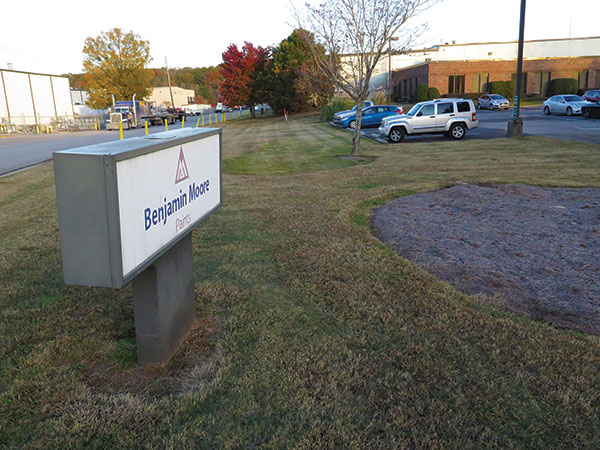
Benjamin Moore is adding a 10,000-gallon latex reactor to its
paint facility, generating eight new jobs, $33 million in investment and
illustrating the county’s successful venture into high tech competition. “The
last couple of years, the community has been able to flex its muscles when
competing domestically and internationally,” Smith said.
J&M Exotic Foods in Moody is doubling the size of its facility
that produces spices and herbs with custom blending and packaging. Figure in
another $2 million investment and 11 new jobs to St. Clair’s credit.
Roberts called Advanced Tank’s growth a “relatively small, but
important expansion. St. Clair competed with a site in Colorado, the base of
Advanced Tank’s operation, for the upgrading of its plate processing and
sandblasting.
Advanced Tank has had a presence in Pell City since 1978, and
while the $3.5 million investment and 12 new jobs created is impressive enough,
“that we got it to come here is pretty important. New investments in new
facilities usually are the last to suffer cuts” if there is a downturn, he
said. “New investment means viability in the future.”
In other economic news, Smith pointed to an improving housing
market, a new car dealership announced for Odenville and a half dozen or so
retail and restaurant projects as reasons to be optimistic about the future.
A major retail development is hoped at I-20 at the site of the old
county hospital, but there are no final plans or announcements to be made right
now.
“We have had good announcements in nearly every community in the
county in the past 18 months,” Smith said. And those without announcements thus
far, “we’re working on very large projects. Hopefully, it will be a
record-setting end of 2019 and beginning of 2020.”
Why all the focus on St. Clair? “We have all the amenities of a
large, urban area like Birmingham combined with safety and low cost of a rural
community and the close-knit family friendly aspects of a suburban community,”
Smith said. “We’re able to market all three of those.”
Geographically, St. Clair sits in an enviable spot with two major
thoroughfares – Interstate 20 and Interstate 59 running through it.
“Our leadership throughout the county works extremely well
together,” added Roberts. “It makes it easier to operate here. It is an
unparalleled level of collaboration and cooperation.”
Tally it all up, and it appears St. Clair County continues to be
in the economic driver’s seat.