Wrestler and more

wrestler-chief-thunderhorse

Wrestler, sawmill operator, Dad – Answering the call

Story by Elaine Hobson Miller
Photos by Michael Callahan

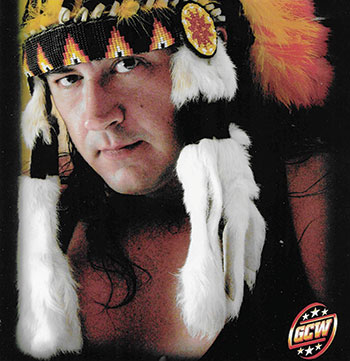
Cliff Horsley waits behind the curtain while the ring announcer pumps up the audience. He thinks about the wrestling matches he watched on television and at Birmingham’s Boutwell Auditorium when he was growing up. He thinks about his Mohawk/Cherokee heritage, and starts slipping into character as Chief Thunderhorse, the Silent Giant with the Hands of Stone, who stands for what’s right and good.

Wearing a headdress, arm bands and coordinating black-and-yellow tights, he listens to the fans chanting, “Chief! Chief! Chief!” and hears their whoops and war cries. He holds his head up high, stiffens his back, and slips into the role he will play tonight. Once the introductory music starts, and Horsley walks into the spotlight and crawls under the ring ropes, the transformation is complete. He is no longer Cliff Horsley, Springville resident, sawmill operator, single father of four. He is Chief Thunderhorse, Oklahoma native, representative of the Cherokee Nation, the Real American.

“In the ring, you get to step out and be the character you dreamed of being as a kid,” says Horsley. “It’s the satisfaction of knowing you’ve accomplished what you’ve always dreamed about growing up and watching it, saying, ‘One day I’ll do that.’ It’s knowing you’ve accomplished that, with a lot of hard work and perseverance.”

Being a wrestler was all Cliff Horsley ever wanted. He wrestled at Pinson High School, where he also played football, then turned professional at the age of 22. For the first few years, he used his own name as he wrestled for various entities at the Pell City Civic Center and other Southeastern venues. One day, the head of Global Championship Wrestling told him he needed an Indian and dubbed him Chief Thunderhorse, a part ready-made for Horsley, who fashions arrowhead necklaces for friends. So for the next 10 years, he played the part, while living a gypsy life in a motorhome that he could move any time he wanted to.
wrestler-chief-thunderhorse-2He pushed through his injuries, like the wrist that was broken twice and never healed, the ribs he popped out of his sternum, and the hernia he developed in his lower belly. “The match has to go on,” he says. But it wasn’t the body slams, the scorpion leg locks, the bad-guy punches or the cross-body drops as his opponents fell on him that finally took their toll and pulled him away from the wrestling ring. It was the kids he had never really known.

“In 1996, when they were one-and-a-half years old and newborn, their mom left with them,” he says of his oldest son and daughter. “For 15 years, I did not know their whereabouts. I had no money for a private detective.” To add insult to injury, the man their mother married took on Cliff’s identity, with the aid of one of Cliff’s old driver’s licenses that she had kept.

Then one day, out of the blue, the Chilton County Department of Human Resources (DHR) called. “They said here’s your kids, now you need a stable income,” Horsley says. “They started demanding structure and order.”

He didn’t have to think twice.

“My kids were teenagers, they demanded my time,” he says.

He was already supplementing his income with a portable sawmill, but he had to sell it to keep his head above water for a while. “I had to make child support payments, which went to DHR because the kids had been in their custody for two years.”

His grandfather had been a sawyer and cabinet maker, so working with wood was in his blood. It was something he knew he could do without his children having “a broke-up daddy and no paycheck,” he explains.

He admits that it was tough making the transition from his bachelor lifestyle and the role of Chief Thunderhorse to the role of Daddy and the restrictions that came with it. “But I knew what it was gonna take, me walking away from that business to focus on them, that’d I’d have to give my children the 110% I was giving to wrestling.”

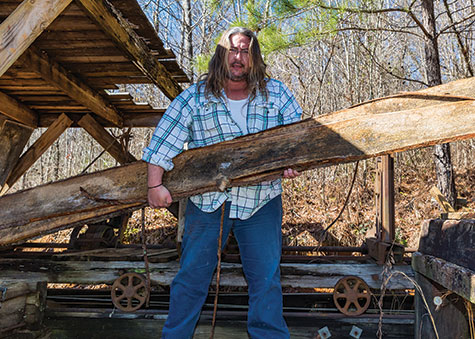
For the past five years, Cliff has spent his time cutting lumber and raising four children — he adopted his biological offsprings’ half-brother and later, a friend’s daughter. He started Cliff’s Mill, buying a 100-year-old sawmill from a retired teacher whose husband had built it, then died before using it. He moved it from Wattsville to its present site in Pell City one piece at a time. It took him about a year. The engine and other parts had rusted out, so he converted a 1968 Ford engine and gas tank to power the mill. “I hand-built everything down to the drive shaft,” he says. “I always was a jack-of-all-trades.”

It was a gasoline-powered mill, and as fuel costs rose, it became too expensive to operate. So he bought a more modern mill. “It got to the point that $20 would not have cut five logs, and the belts were expensive, too,” he says of the antique mill. “But $40 will last a week on the newer one.”

He still uses the old mill when someone wants a time-period cut, because it makes old-fashioned kerfs in the wood. People who are restoring an old house, for example, might prefer those circular grooves to the straight-line kerfs of modern saws. He turns pine and hardwood trees into 2x4s, 2x6s, framing lumber, siding, wood shingles, trailer blocks for mobile homes and occasionally flooring. In the winter, when business is normally slow, he sells firewood.

He will cut to any size, but believes in a true cut. “My 2x4s are 2x4s and not 1-5/8 x 3-1/2s,” he says. He charges by the board foot, averages 200,000 feet a year, and no job is too big or too small. “It’s a small, entry-level sawmill,” he says. “But it’s not a hobby mill. There’s lots of maintenance involved, too.” It’s a physically demanding job, wrestling 1,300-pound trees onto the mill’s conveyor belt. He has one helper, a man named Roy Odom.

Raising teenagers hasn’t been easy either, but Cliff doesn’t regret a minute of it. For the first few years after he got his kids back, he would take a match four or five times a year. That’s a far cry from the two or three per weekend he was accustomed to. His two oldest children grew up and moved out, but he still has a daughter and son at home. While he enjoys being a dad, he also looks forward to getting back into the ring on a regular basis.

“I miss the lifestyle, the physicality of it,” he says. “There’s more to it than just jumping out there and wrestling. You have to watch what you eat, work out between matches. I don’t watch what I eat as much and don’t get the cardio I used to, but I still work out.”

It has been two years since he last heard that intro music and the chanting of the crowds. He recently started eating right again, trying to lose some of the weight he gained during his time out of the ring, itching to get back to the business. But it’s tough.

Yet when asked what he finds tougher, wrestling 300-pound men, 1,300-pound logs or 100-pound teenagers, Cliff doesn’t miss a beat. “Wrestling children,” he shoots back.

The smile in his voice says they’re worth it.


Pell City’s Rachel Baribeau

rachel-baribeau-nashville

A legendary, lasting legacy, making her mark on air, world

Story by Paul South
Photos by Eric Adkins
Submitted photos

NASHVILLE, Tenn. — Not so long ago, Rachel Baribeau connected with a long-time friend from St. Clair County, the place Baribeau has called home since sixth grade.

“You’re a legend around here, you know,” the friend said.

“I was like, ‘Whaaat?,” Baribeau said. “It blew my mind.”

The 36-year-old broadcast journalist’s reaction may come as a bit of a surprise. After all, Baribeau hosts a sports talk show and has a regular gig on Sirius XM radio’s College Sports Nation and a weekly column on GridironNow.com, covering big-time college football for a national audience. She’s a Heisman voter. She was the first woman to fully participate in a professional football training camp, suiting up for the Columbus (Ga.) Lions of the American Indoor Football Association. She has a clothing line. She’s a life coach and a motivational speaker. In the temporal world, that’s heady stuff indeed.

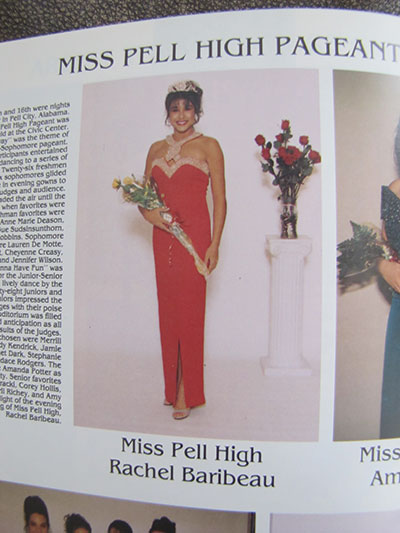
Miss-Pell-High-1997But in the tapestry that is Baribeau’s life, the real currency, the anchors of her life, are grounded in timeless values – a devout faith, hard work, putting others first and serving them and measuring life by the hearts she’s touched. As she tells it, she’s just “a grain in the hourglass.

“As I’ve gotten older, it’s really come full circle for me that people are my currency, and people are my richness,” the Auburn University alumnus said. “In that sense, I’m a millionaire because I’ve come to know so many wonderful people.”

To understand why Rachel Baribeau sees people, not material fame and fortune, as her source of wealth, it helps to know her family, especially her grandmother, Ophelia Maria Sifuentes Snow. For 60 years, “Opie” Snow served up cocktails and cold beer to unknown enlisted men and women and the world famous, like John Wayne, Paul “Bear” Bryant and Truman Capote at a watering hole on Victory Drive in Columbus, Ga.

Ophelia was a mix of humanity – a wondrous cocktail of Spanish, Mexican, Jewish and Mayan blood flowed through her veins. Today, that diverse DNA is visible in Baribeau’s dark hair and eyes and olive complexion.

“She really loved people and loved all sorts of people. She loved the soldier in Columbus and the politician and the movie star and the prostitute all the same. She just taught me that people matter and that life is about people.”

In Baribeau’s professional life, she sees stories of people that the herd of journalists may miss.

“I had a writing instructor tell me, ‘Rachel, when other people are looking one way, you look the other,’ ” Baribeau recalled.

One of her earliest broadcast partners, Max Howell, knows well Baribeau’s knack at finding stories off the beaten path. Howell has been a fixture in sports talk in the South, working in Atlanta, Memphis, Birmingham and other major markets. He recalled Baribeau’s concern over football-related concussions long before the NFL and the rest of the world took notice.

Baribeau offers a “unique voice” in covering the college football landscape, Howell said.

“She’s very compassionate and has a lot of empathy for the kids,” he added. “She was more concerned about the long-range people problems that evolved. To me, that was her strength. That’s what sets her apart from the other co-hosts I had.”

Lyn Scarbrough, a columnist and marketing director for Lindy’s Sports Annuals, has been a guest on Baribeau’s show over the years. Versatility is one of Baribeau’s strengths, Scarbrough said, both in her professional life and in her faith and charitable work.

“She can do radio. She can do television. She can do print. She is knowledgeable. She’s made journalism a passion. She’s willing to take a risk. She cares that it be right, and that it be professional,” he said. “In today’s culture, it’s not an everyday thing to find someone who has that combination of traits and beliefs and experiences. Not everyone has that combination.”

rachel-baribeau-saban-studioBaribeau, who has a deep religious faith, believes sweat, preparation and divine intervention help her find the stories she reports.

“My penchant for people has made people open up to me and to tell me these stories. I think there is a measure of divine intervention in that. The dots had to connect in a supernatural way,” she said.

One of those supernatural connections occurred two football seasons back, when Baribeau convinced her editors at Bleacher Report that Mississippi State University and its quarterback, Dak Prescott, were forces to watch in the 2014 season.

She traveled to Starkville a week after losing her father to cancer. Dak Prescott’s mother was waging her own battle with the disease. Before the interview, as Prescott opened up about his Mom’s condition, Baribeau began to cry, sharing her own story of her Dad’s passing. The two bonded, and Baribeau crafted a story larger than sport.

In January, Prescott was the MVP of the Senior Bowl. And Baribeau works with Prescott’s family to promote a foundation that helps cancer-stricken family members of student athletes travel to see their loved ones play, covering travel and medical costs associated with the trips

“Other than with Tom Rinaldi (of ESPN), Dak had never opened up like that before,” Baribeau said. “God really worked to orchestrate this meeting.”

There are so many layers to the Rachel Baribeau story. She was adopted at 18 months old by David Baribeau, a veteran of the first Gulf War. With her platform as a sports journalist, she is an advocate for adoption. She works with numerous charities, raising $90,000 for ALS research in the wake of her story on former University of Alabama great Kevin Turner, who now battles the disease. She climbed Mount Kilimanjaro for ALS research. The climb is the subject of a documentary, narrated by NFL Hall of Fame player and coach Mike Ditka.

And along with her work as a journalist, she and her mother partnered in early 2016 to form a clothing business. The Joyful Fashionista is crafting fashions for women, ages pre-teen to 85 and of every body type, sizes two to 26. A bricks and mortar shop – Pine Mountain Loft and Gallery in Pine Mountain, Ga., — and websites on Facebook and Instagram, feature the fashion line.

“What better thing than to be a partner with your Mom — your best friend — and help women feel beautiful and do it at a very reasonable cost. We’re not trying to break the bank for women who want to feel good about themselves.”

What shines through in Baribeau’s life is a boundless energy. Spencer Tillman, an analyst for Fox Sports, said Baribeau is “hardwired” for journalism.

“She pursues ‘the story’ because of her raw passion to win,” Tillman wrote on Baribeau’s web page. “She gets it right because she cares. She’s like that proverbial drip that can wear a hole in a rock. I’d want her on my team.”

That water of life has been passed across the years, from her grandmother to her Mom and adopted Dad. Powered by faith, the water is constantly flowing, methodically wearing away at the challenges of work and life.

And in an industry often driven by massive egos and major money, Baribeau’s life is defined by a desire to help others, a fire stoked by those who shaped her life from its earliest days.

Female sportscasters like Phyllis George, Jayne Kennedy, Linda Cohn and Lesley Visser may have shattered the glass ceiling. A new generation, including Baribeau, have followed in their path. And while like a gifted architect on a Starbucks bender, Baribeau has crafted a diverse portfolio in journalism, fashion and life coaching. And it appears she’s just getting warmed up.

But mileposts of accomplishment are secondary. Baribeau’s faith-based priorities are different.

“To move to act, to love, to forgive and to give. That’s what it’s all about,” Baribeau said. “You can have all the money in the world, all the accomplishments in the world. But at the end of the day, my eulogy is not going to be about the things I accomplished, but about the people I touched.”


Coyote Drive-In

Coming attractions: Drive-in, miniature golf heading to Leeds area

Story by Graham Hadley and Carol Pappas
Photos by Wallace Bromberg Jr.
Artwork from Coyote Drive-In

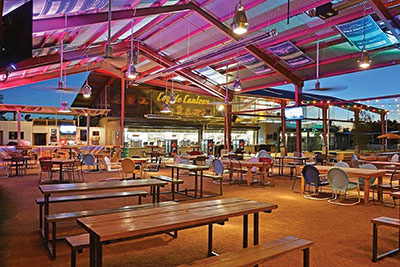
coyote-drive-in-leeds-2If you’re old enough to remember movie nights under the stars with plenty of popcorn devoured in the backseat of your parents’ car, prepare to reimagine those times as the Shops of Grand River in Leeds recreates the classic drive-in with plenty of new twists.

The four-screen theater complex aims its sights on being a recreational experience the entire family can enjoy — from the moment the gates open to the end credits of the last double-feature movie.

“We have been working with Christine Szalay, general manager for the Shops of Grand River, for about a year and a half — all the stars aligned and we are going to make it happen,” said Steve Wynn, chief operating officer for Coyote Drive-Ins. Wynn notes the company already has a successful, five-screen version in Forth Worth, Texas, which has been in operation since 2013.

The Leeds edition will have a restaurant with a full kitchen, a pizza bar where patrons can watch the pizza-making process from beginning to end, and a bar that serves beer, wine and margaritas. The restaurant will have air-conditioned indoor and outdoor seating and sits next to a controlled-entry, fenced playground. Parents can keep an eye on kids playing while dining with family and friends.

The restaurant’s pavilion will occupy about a 10,000 square-foot building that was part of the original Shops of Grand River complex but had never been occupied.

“It will be directly adjacent to the north end of the Shops,” Szalay said.

Along with the restaurant and playground, there will also be an 18-hole miniature golf course in the theater area.

As for the drive-in, there are four screens, with movies shown in high definition from top-of-the-line special projectors that are brighter and designed to throw high-quality images farther onto bigger screens. And, Coyote Drive-In shows are double features.

coyote-drive-in-leeds“There is a 30 minute intermission, then you can watch a second movie,” Wynn said.

Directly in front of the screens is a no-car, grassy park-like green space where families can have picnics, play football with friends or even walk with their dog. The drive-in is a pet-friendly theater. There is also outdoor seating for those who want to sit outside their cars and enjoy the movies out in the open.

“A lot of it is about the freedom. You can walk your dog, throw a Frisbee, and nobody is going to tell you to turn off your smart phone,” Wynn said.

Also planned on Fridays and Saturdays are musicians performing live music.

In Fort Worth, “people are coming about 90 minutes before the shows start,” Wynn said. “You can sit out in a lawn chair and watch the movie on a giant screen. It feels like an event – like movies in the park.

“I think it is a social element. This is what we see in Ft. Worth: People are reaching out on social media, saying, ‘We are all going out to a movie at Coyote.’ They come in large groups, bring the dog, move some picnic tables together, run and play, eat, then watch the movies. People like the social aspect,” Wynn said.

“The family crowd is our biggest pizza business. When a family film opens, it always outperforms our other genres, like more adult action-themed movies,” Wynn said. The drive-in is more open than a multiplex theater, but screens are set up to prevent line of sight from one viewing area to another. Even so, some movies will not be shown or will be shown later in the night.

“Some of the movies that are too risqué we will not play because a 5-year-old watching movies on one screen might see a movie on another screen. … In Ft. Worth, we did not play 50 Shades of Grey. It was a very popular movie, but the family-friendly environment is paramount,” Wynn said.

The theater will have room for a total of 1,100 cars.

The $6 million-plus project is expected to draw people to the Leeds area from possibly as far away as other states like Georgia and Tennessee, not to mention the surrounding Leeds community, Birmingham, Trussville, Pell City, Talladega, Anniston and the rest of north and central Alabama.

With the Shops of Grand River right next door, with stores generally open until 9 p.m., already drawing large crowds daily, the two ventures expect there to be lots of crossover business.

“Coyote Drive-Ins have thought of everything. It was one of the reasons when the discussions started we were enamored with their plan. It made such good sense for the Shops of Grand River,” Szalay said.

For the region, it means a recreation and tourism destination point, generating 100 new jobs.

“This makes the Shops of Grand River and Leeds more of a regional destination. People come from a large distance to shop here, and this works on a number of different levels, Szalay said. “We want that close connection to our customers from within the community, and this adds another reason for people who live farther away to come, shop and stay longer.”


Alabama Barbecue

When it comes to ‘cue, St. Clair joints are smoking hot

Story by Elaine Hobson Miller
Photos by Wallace Bromberg Jr.

It was the Year of Alabama Barbecue, a year that had the state’s Tourism Department asking, “Whose ‘cue is best?” Its online contest pitted barbecue joints from across the state against each other in five categories. When the smoke finally cleared, two St. Clair-area restaurants were among the victors. Charlie’s BBQ of Odenville won in The Dives division, and Rusty’s Bar-B-Q in Leeds came out on top of The Mom and Pops category.

Alabama has more barbecue joints per capita than any other state, according to the tourism department’s web site. Everyone has his favorite, and the contest proved to be a competition between the fans of each hickory-sweet restaurant.

“Three years ago, we invited barbecue fans to post on our website their favorite barbecue place,” says Lee Sentell, director of the Alabama Department of Tourism, explaining how they came up with the contest and categories. “We got about 300 suggestions. This past year, we decided to level the playing field between the different types of places so as not to have the single locations at a disadvantage versus the ones with multiple locations. We came up with five categories that ranged from Mom-and-Pops to the big boys, like Full Moon and Jim ’n Nick’s, and encouraged people to vote in each division. We were blown away with the number of fans who became engaged in the voting.”

Sentell says the competition demonstrated the depth of loyalty that each restaurant has. “Customers are so proud of their favorites and voted as often as allowed to show their support.”

Charlies-barbecueCharlie’s a fan favorite

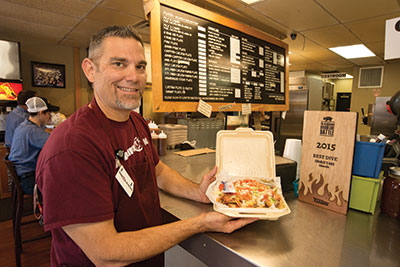
Scott Holmes didn’t even know Charlie’s was in the contest for several days. “We have a big Facebook and Twitter following,” he says. “The fans stepped up.” Charlie’s beat out nine other barbecue joints with 12,867 votes. The second-place winner had 9,644 votes, and the remaining eight garnered less than 4,500 each.

Holmes thinks his location at the corner of US 411 and Alabama 174 South, in front of the Piggly Wiggly grocery store and adjacent to a service station, probably placed him in the right category. “If you’re a barbecue place in Alabama attached to a service station, you’re probably a dive,” he says.

Charlie’s opened in November of 2008. Scott ate there twice a week, and tried to talk the original owner, Charlie Wiles, into teaming up for a barbecue venture in Moody. But Charlie was ready to retire. Both parties prayed about the situation, then Holmes bought the place and switched from painting buildings to cooking ‘cue.

“I like food,” he says, explaining why he made the move. “I was a commercial painting contractor, but when the economy tanked a few years ago, I wanted to open a barbecue joint.” Although Charlie taught him how to smoke ribs, he’s mostly a trial-and-error, self-taught chef who says he was fortunate to find an established restaurant with recipes, personnel and products already in place. The secret to his success, he says, is in the way he prepares his ‘cue. “We smoke our meats. Not everyone does. Others grill them. We don’t use rubs or injections on our pork butts.”

His biggest seller is the pork sandwich combo, which features meat, bread and two sides. Chicken tenders are a big deal, too. “Odenville is not big enough to support a barbecue restaurant,” he says. “So we also do ‘burgers and tenders. Thirty percent of our sales are in chicken tenders. We also do hamburger steaks and fried catfish. We have something for everybody, but we pour our heart and soul into barbecue.”

He features off-the-menu specials, too, such as briskets on Wednesdays and Saturdays, and the Saint Burger, a nine-ounce, hand-formed, greasy ground beef patty named for the county’s high school football team, on Thursdays. “Briskets are our signature dish,” he says. “We smoke six a week. A brisket is the chest muscle of a cow, and it’s hard to do. We cook them up to 16 hours to get them tender.” There’s a different special every Monday, such as the popular Soul Bowl, consisting of a bed of garlic cheese grits layered with turnip greens, pork and a cornbread muffin on top.

Part of his chef’s education was a trip to Texas he took four years ago, when he tasted at least a dozen different briskets from Houston to San Antonio. “We’re unique at Charlie’s, because we have a little bit of every style of barbecue,” he says. “We have Texas brisket, Kansas City burnt ends (from a brisket) and Memphis-style barbecue, which uses a dry rub and no sauce.”

Another specialty is the St. Clair Cyclone, a soft-serve ice cream treat with chopped Reese’s Cup, Oreos or Butterfinger candies. “Our Otis Burger has a huge following, too,” he says. It’s a double cheeseburger with sautéed onions and Otis Sauce, the latter being a gravy sauce.

A person’s taste preference for barbecue styles and sauce flavors depends on what he grew up eating, Holmes believes. He makes five different sauces: hot, medium, sweet, vinegar-based and a white sauce. His primary barbecue sauce is made with both vinegar and ketchup. He makes all sauces in-house. He does his major smoking during the night, removing the pork butts and briskets each morning and throwing on chicken and ribs.

Charlie’s is open Monday through Saturday from 10 a.m. until 8 p.m., and does catering as far away as Pelham to the south and Anniston to the north. Originally open weekdays only, he added Saturdays about three months after he took over, and now that’s his biggest day. “Iron Bowl Saturday we sold 120 pounds of chicken wings, which we marinate, smoke, then fry to order,” he says. “They were mostly to go.”

rustys-barbecueRusty’s builds barbecue following

Rusty’s Bar-B-Q gathered 28,637 votes to second-place’s 21,369 votes to win The Mom and Pops category in the Alabama Barbecue Battle. The remaining eight contestants had less than 3,000 votes each.

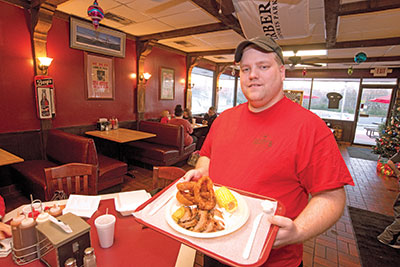
Rusty Tucker started his restaurant seven years ago in a 1970s Jack’s Hamburgers location on US 78 in Leeds. His decor, which could best be described as “continuing customer donations” because that’s what they are, includes concert posters for Hank Williams and the Drifting Cowboys, the Blues Brothers, Jimi Hendrix, Led Zeppelin, Elvis and the Allman Brothers Band. Vintage metal signs proclaim, “Fresh Eggs 10 cents” and “El Rancho Motel,” while others display a pin-up girl beside a bottle of Pepsi or advertise Mobilgas. Thermometers take their places on Barq’s Root Beer, Royal Crown Cola and Buffalo Rock signs, and an American League World Series poster from October 1903 has a place of prominence.

An autographed photo of professional race car driver Ryan Hunter-Reay, whom Rusty calls a good friend, and his pit crew, dominates one wall, while other walls display road signs advertising 7-Up, Nichol Kola and Uncle Sam. A trombone and trumpet flank the top of the doorway leading to a hallway and restrooms, while his most recent “gifts,” Honda, Suzuki and Kawasaki motorcycle gas cans, take up a countertop next to that doorway. “People bring them to me,” he says of all the vintage finds. He feels obliged to display them.

Tucker grew up cooking barbecue with his dad. He went to Johnson & Wales University’s College of Culinary Arts at its former Charleston, SC, campus, and gravitated toward fine dining in places like the Charleston Grill. Working his way back to down-home cooking, he was at Satterfield’s in Cahaba Heights before returning to his roots. “I love it,” he says of running his own business. He’s open from 10:30 a.m. to 8 p.m. Sundays through Thursdays,10:30 a.m. to 9 p.m. Fridays and Saturdays, serving lunch and dinner only. He does lots of catering as well, particularly for nearby Barber Motorsports Park events, UAB basketball and Regions Bank’s Traditions golf tournaments.

His most popular menu item, and his signature dish, is his ribs. He also does a lot of pulled pork and hamburgers, plus smoked chicken, turkey, briskets and sausage. “We do a more traditional style barbecue — open-brick pit instead of a smoker. We make four kinds of sauces, including a tangy vinegar that’s a variation of my granddad’s recipe, a sweet barbecue sauce, spicy and white barbecue sauces.” The white sauce is a mayonnaise and vinegar mixture that goes well with the turkey and chicken. “It’s a North Alabama specialty,” he says.

He also does chicken tenders, hamburger steaks and barbecue-topped baked potatoes.

“People come in and say they found us due to publicity from the tourism department contest,” Rusty says. “We were featured in its Delicious Road Trips documentary, and we’ve participated in events like the Atlanta Food & Wine Festival that promote Alabama tourism.”

He gets a lot of repeat customers, many of them in town for the annual Barber’s Vintage Festival, plus Indy car drivers. He has developed relationships with people from coast to coast, keeping up with them on social media. “There’s a group of about 10 guys from Japan that comes into town for Barber motorsports events,” he says. “I can’t talk to them, but they’re nice guys.” When he first opened seven years ago, he had a group of 25 guys from France, all Mustang enthusiasts.

What’s Rusty’s secret to attracting a following from across the globe to just around the corner? “We try to treat everyone like family.”

Always There

Always-There-Home-CareRecognized as one of the top female-owned businesses

Story by Graham Hadley

For the past several years, one Pell City business that prides itself in making life easier for its clients has consistently received top marks in the Alabama business world.

Always There In-Home Care, which specializes in providing medical care and assistance to people in the comfort of their own homes, has been ranked either No. 1 or in the top 10 female-owned businesses in the state.

Dee Harrell, the registered nurse who is the owner and founder of Always There, said she was surprised and “shocked might be the word” when she found out about the rankings.

Harrell said someone else had helped get them the recognition — she did not even know it was happening. Her focus is on the day-to-day operation of the business she built from the ground up.

“My husband said I should be proud, but it almost embarrasses me. I am proud, though. I give all the praise to God because I believe God has stood behind me all these years. I believe I had God’s graces behind me when I started the company,” Harrell said.

That’s not hard to believe given that Always There was born out of personal loss, the need to take care of her family and a strong desire to help others.

“We opened in 1999, just at the end of that year, December, and have been in business over 15 years now,” Harrell said.

“I worked in an adult day center for seniors in Birmingham. There was another company that provided private care and nursing services. I thought I could do a better job. I started doing research on what it would take to start a company. I was a nurse, and everything I read said do what you do best. I loved working with and taking care of seniors, talking with them,” she said.

“I took the plunge and started my company. I had recently lost my husband and had three small children. I thought, naively, that it would be simpler working for myself. I had no idea the commitment I would make. It ended up being twice the time.”

Though Always There may employ more than a thousand people in a year, with a steady payroll of around 300, in those early days, it was just Harrell.

“We were a hit from the beginning. I developed all our forms and procedures from the school of hard knocks. I really wanted to take care of a senior or family member (she stresses many of their patients are young, even children) when someone called — wanted to find the best way to get that done.

“I was the office manager, nurse. I did everything that first year. Then I hired one employee at a time until I was not the only one going out to make all the calls.”

As her business continued to grow, so did its reach. She opened another office in Tuscaloosa, which she later sold. Offices in Pell City and Huntsville soon followed.

After three years, Always There was so successful, she had the option to sell franchises in cities not in direct competition with her existing coverage area. Harrell said she has not really pushed that part of her business, but the option is always there.

“I have not pursued that because I enjoy running all the parts of the business in this area, but someone could buy one and open Always There in another city I am not in,” Harrell said.

And she remains a very hands-on owner involved in the day-to-day operations of her business.

“Most of the employees don’t know I am the owner. I am out there working with them,” Harrell said.

Currently, Always There serves right at 200 families in the Birmingham and Pell City areas and another 50 in Huntsville.

The services range from basic caregivers who do things like help with basic household tasks to skilled nurses who have the ability to go and administer medications, with many of their clients just needing a little extra help.

“Most people age pretty gracefully,” Harrell said. “The majority of people live to a ripe old age peacefully. To stay in their homes, they only need a little help. They can’t bend over to scrub the bathtub, or to go to the store, they may not be driving any more.

“Most of our clients are pretty sharp, pretty independent. They only need that little bit of help once a week or so.”

Other patients need more care, whether it is a child on a ventilator or someone who needs medications administered.

And that care extends not just to the patients, but to their families as well.

“We are there for the whole family. A caregiver can get physically sick if they are not getting sleep and rest, getting out of the house,” she said.

Equally important, Always There knows where to send families and patients to find any additional resources they may need. “When you need help, knowing where to turn for the best help is very important,” Harrell said.

One of the keys to the long-term success of Always There is that it is truly a family affair.

“All of my children are involved,” Harrell said. One son, who is a web and graphic designer has built their website and designed some of their brochures. Another son who is an attorney provides advice and counseling.

“My youngest daughter graduated from Alabama with an advertising degree. She is coming on board to do our marketing and advertising. She was at al.com and has grown up in the business and understands what I do,” Harrell said.

“My husband came to work for me about five years ago, he handles the billing, IT. I am the dreamer; he is the one who keeps it grounded.”

Marcus H. Pearson

marcus-pearson-inventor-plowTales of a Springville inventor, entrepreneur

Story by Leigh Pritchett
Photos by Wallace Bromberg Jr.
Submitted photos courtesy Carol Waid

Marcus H. Pearson was a small, quiet, humble man, with big ideas that made an impact on farmers, herdsmen and churchgoers.

Those big ideas netted two patents (one when he was just 26), made putting up wire fences a little easier and aided congregations with their building projects.

Oh … and his chicken house once held Auburn University’s live War Eagle mascot.

According to granddaughter Carol Pearson Waid of Springville, Pearson was quite the entrepreneur. “Granddaddy had several different businesses.” Among them were Pearson Lumber Co. and Sawmill, a grocery store and a gristmill.

All were on property situated at US 11 and Cross Street. Also on the site were Pearson’s home, workshop that was full of punches and patterns, and, of course, the famous chicken house.

“All of this was Pearson property,” Mrs. Waid said about the expanse that surrounds Pearson’s home, where she and husband Frank Waid now live. “This is the house Grandma and Granddaddy built.”

The 1931 home features original wood floors and cabinetry, four fireplaces, a telephone directory from 1956, Pearson’s accordion and a bed that belonged to his grandmother.

The yellow building at the corner of US 11 and Cross Street that currently houses Louise’s Style Shop and C.E. Floral Gifts and Novelties was the grocery store.

Mrs. Waid worked at the grocery store as a girl. “I worked there for a nickel a day,” she said.

The lumberyard was behind Pearson’s house, as is the current home of grandson Tommy Burttram.

As for the gristmill, Burttram’s parents – Ed and Willie Pearl Pearson Burttram – remodeled it for their home as newlyweds. When they decided to build another dwelling, they relocated the gristmill and incorporated it into the architecture.

Being enterprising seemed to be a family trait as Pearson’s father, W.R. Pearson, was also a business owner. He operated a blacksmith shop just across US 11 from where the Waids live. Working in the blacksmith shop, Marcus Pearson learned smithing, buggy repairing and woodworking.

Kathy Burttram, Tommy’s wife, has a ledger from the blacksmith shop chronicling the work done there daily.

Close to the blacksmith shop was the home of Pearson’s parents. They had the first telephone, first radio and first bathtub in Springville. Mrs. Waid said neighbors came to see the bathtub with their towels in hand.

Born in 1879, Marcus Pearson received from his mother, Frances Amelia Truss Pearson, the lineage of the Truss family for whom Trussville is named, Mrs. Waid said.

As a child, Pearson watched the creation of what became a tourist attraction in Springville until the 1960s. Mrs. Waid explained that Springville gets its name from a spring, which later was transformed into a lake. “Granddaddy saw them dig (the lake) with oxen,” she said.

In 1909, Marcus Pearson’s red, Pope-Hartford Model B became the first automobile recorded in Springville. His was only the fourth vehicle to be registered in all of St. Clair County.

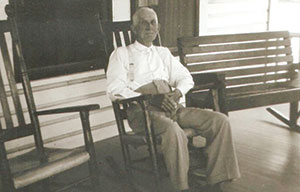
He married at age 41, played the accordion and harmonica, and did not believe in working on Sunday.

“He thought Sunday ought to be kept holy,” Mrs. Burttram said.

He was a disciplinarian, lived 95 years and enjoyed hearing Mrs. Waid play What a Friend We Have in Jesus on piano.

“Granddaddy was on the building committee of the ‘Rock School,’” Mrs. Waid said, referring to Springville’s historic hillside school constructed of rocks. “He wanted to build it on the level ground. But he was outvoted because people wanted it built on the hill so people from the train could see it.”

Mrs. Waid said one of Pearson’s friends was James Alexander Bryan, who was a noted minister and humanitarian in Birmingham. In fact, “Brother Bryan,” as he was called, officiated when Pearson married Opal Jones.

The Pearsons had three children, one of whom was Marcus M. Pearson. Son Marcus — Mrs. Waid’s father — assumed the lumber business in 1950, served on the board of education and was mayor of Springville in the 1960s, Mrs. Waid said.

When another son, Frank, decided to play baseball for Springville, the automobile that father Marcus H. Pearson had at that time served as the team “bus.” It was spacious enough to transport the whole team to the games, Burttram said.

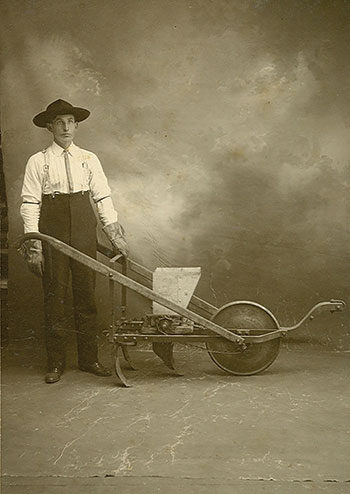
Marcus H. Pearson actually held patents on two different plow designs. The 1907 patent was for improvements to make the wooden plow more durable and easier to manufacture, according to his application to the U.S. Patent Office. This farm implement also had adjustable handles and a design that would “take the ground better and … not choke up as rapidly as the ordinary plow.”

That plow and his Pearson Fence Stretcher — to keep wire fencing from tangling during installation – received a blue ribbon at the 1907 Alabama State Fair.

In 1951, he received his second patent, this time for a “regulator for flow of material from a hopper” affixed to a plow.

The hopper, explained Burttram, distributed guano (fertilizer) simultaneously with tilling.

The patent application states that the design offered “lever control without stopping use of the hopper, adjustment without a ratchet or wrench, (and) locking in a fixed position without a tool.”

Burttram quite literally had a hand in the manufacture of this model when he was but a lad of 10 years old.

“Tommy’s first job was working for Granddaddy Pearson,” said Mrs. Burttram.

With a chuckle, Burttram recalled that his grandfather did not ask Burttram if he would like a paying job. Instead, Pearson asked the boy if he would like to have a Social Security number.

Having a Social Security number was something to be envied, so Burttram naturally wanted one. When he received it, his grandfather put him to work painting distributor boxes on plows.

Burttram said he was paid 10 cents for each box he painted.

“I thought I was really something,” Burttram said with a grin.

marcus-pearson-inventor-plow-1Mrs. Waid warmly recounts going with Pearson to sell and deliver his plows. Traveling to Oneonta or Blountsville or wherever made the preteen girl feel pretty special.

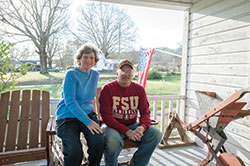
She and Burttram said Pearson’s blue Studebaker pickup served as the delivery truck. All these years later, Mrs. Waid parks her automobile under the same carport where Pearson kept his Studebaker.

Also, one of the 1951 plows has a place of prominence on Mrs. Waid’s front porch.

At one point, Sears & Roebuck asked Pearson to put a gasoline engine on his plow as a prototype. It also had additional wheels for stability, Mrs. Waid said.

Through his lumberyard, Pearson established a legacy in several churches in the area, Mrs. Waid said.

For example, Pearson assisted in 1926 with the manse of Springville Presbyterian Church, which is noted by an historical marker, Mrs. Burttram said. (Incidentally, Mrs. Waid is secretary at that church.)

For Burttram and Mrs. Waid, the lumberyard was not a place of business, but rather a land of adventure.

They explained that the freshly milled lumber was placed in triangular stacks to allow the wood to dry.

marcus-pearson-inventor-teaser“They made great, little playhouses,” Mrs. Waid said of the triangles. She and playmates also would get into them to picnic.

The imaginations of Burttram and his friends transformed the stacks into army bunkers.

And finally, we come to the story of how Pearson’s chicken house entered the annals of collegiate trivia.

In the mid-1960s, when Mr. and Mrs. Waid were married students attending Auburn University, Waid was a volunteer trainer and handler for the live War Eagle mascot. After a game in Birmingham between Auburn and its in-state rival, the University of Alabama, the couple spent the night with Mrs. Waid’s parents, who lived next door to the Pearsons.

Because the cage used for transporting the eagle was a little tight for an overnight stay, Waid decided to give the bird a place to spread its wings, so to speak. Thus, the little fowl guest was given accommodations out back in Pearson’s chicken house … minus the chickens, of course.