Pieces of history

Fort Strother is long gone, but efforts
continue to preserve the site and its story

Story by Jerry C. Smith
Contributed photos

George Washington never slept in St. Clair County, at least not as far as we know. But Andrew Jackson did, also Davy Crockett and Sam Houston. And, they all slept at a place that has virtually vanished from memory, Fort Strother.

Travelers along Alabama 144 may be familiar with a large stone monument, just west of Neely Henry Dam. It’s inscription reads:

FORT STROTHER
CREEK INDIAN WAR
HEADQUARTERS OF
GENERAL ANDREW JACKSON
1813-1814

It seems such a brief epitaph to represent Fort Strother, a key site in Alabama’s settlement. Incidentally, 2013 is the fort’s 200th anniversary.

Jackson was tasked with solving some rapidly escalating troubles arising from a massacre of Indians by whites at Burnt Corn in south Alabama, and its resulting retaliatory attack by the Red Sticks Creeks. He felt that the only solution was to totally defeat the Creek Nation and remove them from their Southern lands.

Established in 1813 as a military supply depot and operations center, Fort Strother headquartered Andrew Jackson’s Tennessee Militia during the Creek Indian Wars, a local theater of the War of 1812. Jackson had sent his head cartographer, Captain John Strother of the 12th U.S. Infantry, to find the best strategic fort site for conducting military operations against the Creek Indians in Alabama.

Captain Strother’s choice of locations was perfect for receiving supplies overland from the north, loading them onto flatboats built on-site, and floating them down the Coosa for various military operations. It also secured access to a strategic river crossing nearby.

Prior to its construction, the area already hosted a small trading post belonging to Chinnabee, a “friendly” Creek chief. There was also a small Creek village across the river known as Oti Palin (Ten Islands), named for 10 river islands jutting from the river north of the fort site. Ten Islands had become the fording place of choice on that part of the Coosa because of its shallow shoals.

Part of the Tennessee Militia cut a 50-mile road through north Alabama’s wilderness from Fort Deposit to Ten Islands in only six days, and began work on the new encampment. At first called Camp Strother, as the settlement grew and a stockade was built, it became known as Fort Strother.

On November 1, 1813, Jackson himself arrived from Fort Deposit, and promptly used his Militia to destroy the Creek village of Tallaseehatchee, a few miles across the river. But no sooner had he begun settling in than a call to action came from a most unusual messenger.

Fort Leslie, aka Fort Lashley, was a frontier stronghold of the Leslie family in what is now the city of Talladega. It was besieged by a large number of Red Sticks, a warlike faction of the Creek Nation who were waging vengeful raids against friendly Creeks and settlers that had begun with Fort Mims, a similar family fortress in south Alabama. All within Fort Lashley were surely doomed, awaiting an attack at sunrise the next day.

Among the friendly Creeks within its walls was Selocta Fixico Chinnabee, son of the chief who had begun the settlement at Ten Islands. Selocta knew of the troops at Fort Strother, and devised a clever plan to get their help. He donned the skin of a freshly-killed hog, snuck out of the gate, pretended to be rooting in the underbrush, broke clear undetected and raced to Fort Strother.

The Militia rallied, crossed the Coosa and attacked the unsuspecting Red Sticks at about four in the morning. Jackson’s casualties were minimal, but the Red Sticks were decimated.

Jackson returned to Fort Strother two days later, only to find that vital supplies had not arrived from Fort Deposit. Quoting professional archaeologist Robert Perry’s “LOCATING FORT STROTHER” paper, “With a force of 2,000 men and no food, Jackson’s situation at Fort Strother became desperate. By November 17, Jackson was forced to leave a small contingent of troops at Fort Strother, taking the majority of his force back toward Deposit in search of supplies.

“On December 5, 1813, Jackson had returned to Strother, and on December 9th was forced to put down a mutiny of his volunteers, who insisted that their contracted time had expired.”

By the middle of January 1814, Jackson had solved most of his supply and manpower problems and proceeded from Strother, intending to attack the Red Sticks stronghold at Horseshoe Bend on the Tallapoosa River. However, he was ambushed and nearly overrun in two separate engagements at Emuckfau Creek and Enitachopco Creek.

The mission was a complete failure, and Jackson was forced to retreat to Strother. Perry continues: “The official U.S. Army history of the Creek War characterizes the latter battle as a defeat for Jackson and states, ‘Jackson was compelled to entrench at Fort Strother and remain there for several months.’”

Between January and March of 1814, Jackson employed his troops building boats for transportation of supplies down the Coosa. During this period, the Fort Strother area would have steadily grown in size as the 39th Regiment arrived and Jackson began stockpiling supplies for a Spring offensive. The months of January and February 1814 mark the climax in the history of Fort Strother.

“… The fort had grown into a small city as supplies came in from Fort Deposit and Fort Armstrong. … By March 1814, Jackson had nearly 5,000 men, counting the Indian contingent, … and sufficient supplies for an offensive.”

In her History of St. Clair County, AL, Mattie Lou Teague Crow describes the encampment: “The fort, with its blockhouses, three large parade grounds, four separate camps — militia, infantry, cavalry, and at least 300 friendly Indians — was no small enterprise. The Indians — mostly Cherokees, some Creeks —  were kept in a group. They wore white feathers and white deer tails to distinguish them from the hostile red men.” Local author Charlotte Hood wrote a book called Jackson’s White Plumes that explores this relationship and the whole Creek campaign.

Crow continues: “At times there were as many as five thousand men at Fort Strother, … and as few as a hundred and fifty. But today, all that is left of the great camp that played such a vital part in Jackson’s campaign is the cemetery, the graves unmarked and forgotten. These men were American soldiers, and they deserve to have their last resting place marked and given the same care as other American military cemeteries.”

Various other writers have surmised there was a fort, blockhouses, blacksmith shops, cooperage, field hospital, corrals for hundreds of horses, quartermaster store, boat-building yard and several wharves along the riverfront.

All these preparations were soon put to use, as described in a National Register of Historic Places application form: “… Jackson had been informed that a large number of Creeks were concentrating at Horseshoe Bend, which they were resolved to defend to the last. Jackson determined to march down the Coosa, establish a new depot, and them march against the Creeks. … On March 14 he departed, leaving 480 men under Col. Steele to hold Fort Strother and keep open lines of communication.

“The subsequent battle … was the decisive battle of the war, breaking the power of the Creek nation, and opening up … two-fifths of what is now Georgia and three-fifths of Alabama for settlement. … Strother continued to be part of a strategic line of communications with the Gulf Coast and Florida, serving as a way-station for troops headed south. No mention of the fort has been found after 1815, when Gen. Coffee and several Indian chiefs conferred there.”

After Horseshoe Bend, Jackson headed southward to Mobile, thence to New Orleans to fight a more famous battle against the British, albeit a wasted one since they were unaware that the War of 1812 had already ended.

And so it also ended for Fort Strother. Folks later traveling the area were totally oblivious to what was there and how important it all was to our lives, and it remains mostly so today. Indeed, walking the overgrown land itself yields no clues of its former usage. But a determined group of St. Clair ladies decided to change all that.

Charlotte Hood, wife of Alabama Power Company hydro manager Jerry Hood; Patsy Hanvey, a Cherokee potter; and Gadsden Library archivist Betty Sue McElroy became known as the Ten Island Three. The APCO newsletter, Powergram, reported on their efforts: “… These three self-taught historians have synthesized information from hundreds of sources, including archives, libraries and fellow history buffs.”

“This information was jumping out at us from all directions,” Patsy says. “We feel just like someone reached out and took us by the hand and led us.”

Their energetic efforts soon bore fruit, and on March 30, 1999, the St. Clair County Commission and the Alabama Historical Commission offered $10,000 each in matching grants for the Fort Strother Survey and Registration Project. In May of that year, a newly formed Fort Strother Restoration Committee met to officially begin work.

Retired Alabama Power executive George Williams had been elected chairman. Project archaeologist Robert Perry was vice chairman, and County Commissioner Jimmy Roberts became project director. Both Roberts and then Congressman Bob Riley played vital roles in obtaining the two $10,000 grants.

Other committee members and newly elected officers were Charles Brannon, vice chairman, also retired from Alabama Power; Carol Maner, historical writer; Rubye Sisson; Harold Sisson; historian Ben Hestley; Calhoun County Commissioner Eli Henderson; Kay Perry, secretary; Adm. Dennis Brooks; Realtor Lyman Lovejoy; Randy Jinks; State Rep. Dave Thomas; newspaper reporter Hervey Folsom; Sherry Bowers; and of course, the indomitable Ten Island Three.

Much exploration was done in the Ten Island environs, including the cutting of fire lanes to simplify field operations. A University of Alabama team led by Carey Oakley and another from Jacksonville State University led by Dr. Harry Holstein located and identified more than 800 artifacts, including gun parts, rifle and musket balls, and iron grapeshot, all consistent with armaments of that era.

Also found were hundreds of wrought-iron spikes and cut nails, assumed to have been used mostly in flatboat-building. Other finds included knife-blade parts, broken iron kettles, various tools, and lots of by-products used in blacksmithing.

However, the finds that would be most dear to Mrs. Crow’s heart were disclosed in the old cemetery. Oakley and his crew used ground-penetrating radar and other modern technologies to locate and catalog some 76 graves adjacent to the assumed stockade site.

But alas, the restoration project ground to a halt when funds ran out. At one time, it was proposed that the old stockade be recreated and the cemetery restored to proper dignity, all in a park-like setting accessible to the public, but that too has fallen by the wayside.

The exact locations of work sites have purposely been left out of this narrative to discourage trespassers and artifact vandals. In fact, all the affected lands are signed and posted. To view the general area, look to the western shore of the Coosa from Alabama 77 near Ohatchee Creek, and let your imagination fill in the rest. One might even visualize Old Hickory himself, on horseback, left arm in a sling from a near-fatal bullet wound suffered in a duel just before coming to Alabama, gazing downriver while making plans for future battles.

It is hoped that someone, or some organization, will resume this important restoration project to bring one of Alabama’s most historic sites to light and make the fort a public part of the state’s heritage.

Some years ago, the Cropwell Historical Society, after great efforts by Mary Mays, George Williams and other members, installed the impressive marker, made from local marble, that is mentioned at the beginning of this story.

Fort Strother has also been honored by a much older, more elaborate marker placed by an Anniston DAR chapter in 1913, on the site’s 100th anniversary. The marker is no longer in sight, but we can still appreciate its words:

Here stood Fort Strother
A defense against the Indians
Built by General Andrew Jackson
And occupied by him and his
Brave men
During the Creek Campaign,
 November 3, 1813
Erected by the Frederick Wm. Gray
Chapter DAR of Anniston, Alabama
To preserve the memorial of
Faithful service.
November 13, 1913

Celebrating 37 years

Theater group is uniquely Springville

Story by Jane Newton Henry
Photos by Brandie Felice, Judy Shults
and Janet McBroom

It’s a true story that reads like the opening scene of a classic Broadway musical: June Morgan Mack returns home to Springville in 1976 with her college diploma, only to find that her summer job has fallen through. She talks with her neighbor, Archie Jones, about the problem, and he says, “Why don’t you do a show?”

So that’s what she did. She wrote a children’s musical titled, “Circus Magic,” and found about 25 people to produce and appear in the play. They built sets, made costumes, rehearsed and did one performance at Springville High School, now Springville Middle School. “Everybody got a charge out of it, so we decided to do it again the next year,” she said.

That production marked the beginning of Springville Children’s Theater. For five summers, Mack wrote and directed children’s musicals.  Thirty seven years later, the theater group in the St. Clair County town of about 4,000 people, is still going strong.

She credits the “incredibly talented” people of Springville for keeping the effort going.  In addition, the group’s unique operating philosophy has played a major role in its success.

Extraordinary talent

“When we started the theater group, there were so many talented people right here in Springville — all these incredible people who were singing in church choirs,” Mack said. “Since then, I’ve been in many other states and have done many other things, but I would still say that the talent in Springville is extraordinary.”

Mack recalled the performances in “Circus Magic.”  Twelve-year old Shawn Cushen worked as the stage manager and played the male lead in the play. Penny Burgess played opposite him. “They were terrific in the play. And they were brilliant kids. They were making all A’s in school, but to memorize all of those pages of the script and then to stand up and spit out their lines with gusto – that was something no one knew they could do.”

A unique philosophy

Our guiding principle is to cast every person who auditions, she said. “We believe that if it’s fun and interesting for people, and they learn a lot and are proud of themselves, the show takes care of itself.”

By 1981, the grown-ups wanted to do larger-scale shows requiring casts of all ages, Mack said.  That year, the group chose “Oklahoma!,” and it became the first in a long line of Broadway musicals that the newly named Springville Community Theater would produce.

“’Oklahoma!’ was expandable,” she said.  “We could put all the kids in it we could find, which is a big deal for us.”

The group has a particular interest in bringing first-timers to the stage – especially children. “We believe that a community theater not only fosters a positive community spirit, but builds confidence and forges lifetime friendships.”

The theater also plays an educational role. Mack explained that during the organization’s early years, there wasn’t any other live theater in the area, and children were growing up without it.

“They didn’t know the classical musical-theater literature, and that’s one reason I’ve been so dedicated to doing the classics,” she said. “We will do Rogers and Hammerstein forever.”

After the production of “Oklahoma!,” the theater has produced classic Broadway musicals every few years.  They performed “Oklahoma!” a second time in 2010, which was performed outdoors at nearby Homestead Hollow, and just this month, they performed South Pacific again — 30 years after their first production of that show.

June Mack

Mack, who founded the Springville theater group and has directed most of the shows, says that preparing for a production is difficult. “It’s not just for fun. It’s disciplined,” she said. “I’m regimented about people knowing their lines before I even see them.

“It’s hard work, but that raises the bar and makes people take it more seriously. People will always step up to the challenge. I expect great things; they surprise themselves — that’s how it works. So I keep upping the challenge; that’s my job.  As long as I can keep doing that, they will keep surpassing their expectations.”

She credits the people of Springville with helping her learn her craft. “They taught me to direct,” Mack said. “I am so grateful for the patience and devotion of these people for all of these years.

“We’ve hit obstacles and said, ‘That’s it. The show’s gonna be shut down. It’s never gonna work.’ But you give these people 30 minutes to regroup and think, and we’ll move forward again.”

Since Mack’s first summer with Springville Children’s Theater, she has worked on more than 50 theater productions and 70 films. In addition to her bachelor’s degree in composition for musical theater from Hollins College, she received master’s degrees in film and education from Florida State and Harvard University. Her films have garnered 22 international awards and have been seen on national television and at screenings here and in other countries.  She is a professor of film at the University of Alabama in Birmingham. Expect to hear about auditions for another summer musical in Springville in a couple more years. If you would like to get involved in Springville Community Theater, contact Mack at (205) 467-3105 or jmack@uab.edu.

Editor’s Note: If you have been involved in a production of Springville Children’s Theater or Springville Community Theater and have film or video footage from a show or shows, contact June Mack at (205) 467-3105 or jmack@uab.edu. She is collecting footage to have it digitally archived.

Dolores Hydock

Master storyteller gets ‘schooled’ on Chandler Mountain

Story by Carol Pappas
Photos by Jerry Martin

In 1974, Dolores Hydock was on a hunt for folklore for an in-depth paper she was researching for a college class at Yale University.

That unlikely journey from New Haven, Conn., led her up a winding mountain road in northeast Alabama and clear up on the top, she found what she was looking for and some things she never dreamed she would find.

As a student in American Studies, this city girl born and raised in the north, set her sights on the Deep South for a paper on Alabama folklore. Recounting her early planning efforts, she said she traveled across the state and “discovered everything from Mardi Gras to snake handling.”

Alabama’s folklore was so abundant and so diverse, she faced the dilemma of having to narrow her focus. Enter Warren Musgrove, who owned Horse Pens 40 on Chandler Mountain at the time. She had been encouraged to go and see him because of his gift for storytelling and his ability to recognize where the best folklore could be found — right where she was — on Chandler Mountain.

For four months, she lived among its people, developing special relationships that would draw her back to the state after college and put her on a road that led to her life as one of Alabama’s master storytellers.

On her CD, Footprint on the Sky: Memories of a Chandler Mountain Spring, Hydock vividly recounts the people and the places atop the mountain. On the CD and in person, she talks fondly of those months, especially centering around two special friends — Hazel Coffman and Dora Gilliland.

Dwight Rogers, whose parents owned Rogers Store, happens by while Hydock is on the mountain. He points out old school pictures of people she might know.

She talks of their impact — just like people who make a difference in your life, people who are “not powerful but are strong; not wealthy but are generous; not famous but are loved.”

They are, she said, people who “work hard, live simply, love their families and make strangers feel at home.” Just like Hazel and Dora did for a college girl from up north in 1974.

Hydock traveled the snaky road leading to the top of Chandler Mountain with Discover, revisiting some of the places and remembrances that helped shape the story performer and actress she is today.

Her wit, charm and an innate ability to turn a phrase in any direction she wants it to go are simply part of her signature style on stage, much to the delight of audiences large and small.

She is the most requested Road Scholar, a program of the Alabama Humanities Foundations that provides top-notch speakers for libraries and historical groups across the state.

And she is an award winning story performer with national accolades to her credit.

She has taken many an audience back in time to her Chandler Mountain spring, a time of seemingly endless learning for this Ivy Leaguer, the kind of lessons you just can’t get from books.

With a twang in an accent familiar around these parts, she lets audiences know some of the lighter lessons learned there: “Sand Mountain tomatoes are the most famous, but anyone who knew tomatoes knew Chandler Mountain tomatoes were the best.”

If you’re mountainfolks, it’s “on the mountain and off the mountain,” no going up or down.

That spring, she stayed at the Clarence House, a place used only in the summertime for tomato growing season. It had no electricity — only a fireplace to keep her warm.

There, she learned her first lesson. Those “long pointed sticks” piled behind the house were not kindling left by a thoughtful landlady, they were tomato stakes, which she learned after burning a whole stack of them her first week on the mountain.

At Rogers Bros. Store, whose sign advertised “feed, seed, hardware, groceries and gas,” she learned a little more. She had a ringside seat, a crate bench by a wood burning stove where people gathered to “tell stories and a lie or two,” she says.

She talks of their patience when a language barrier seemed to get in her way.

“You ever warm up?,” a woman asked her. Not knowing if she was referring to the weather or her demeanor, she was rescued when Hazel Coffman sensed her panic and stepped in to save the day. “She’s asking you do you ever eat leftovers, you know, warm up? She’s inviting you to dinner, honey, if you’ll eat what she has.”

With an obvious debt of gratitude, Hydock says, “Hazel and Dora Gilliland took me in — helped me understand you might come to Alabama looking for folklore but if you give it half a chance, odds were really good you’d end up finding a home.”

And that she did, moving to Alabama that same year after graduation.

She credits Hazel with unlocking her storytelling ability in later years with an iconic image of her — one leg shorter than the other making her “tilt” when she walked. Dressed in a bonnet, galoshes and overalls, she would scatter feed through the yard for dozens of chickens, calves, cows, a dog and a one-eyed cat. “Come on babies,” Hazel would call.

It didn’t matter that it wasn’t easy to get around, there are “plenty ways of doing things if you want to,” Hazel told her.

“Come on babies,” she calls as they scurry toward her. “I hold this picture of her in my heart,” says Hydock.

In her stories, Hydock talks about the old Chandler Mountain Community Center. It’s closed now, but it once was a thriving gathering place, especially for the women who came to quilt and visit every Tuesday and Thursday.

It was there she made it over another language barrier. What is afternoon to some is strictly evening up on the mountain. “When you’re up at first light and don’t know anything after 8 when you go to bed, anything after noon is evening,” she was told.

How did they learn to quilt so well? “Grow up in a house where you can see through the cracks in the floor, and you know it gets plenty cold in the wintertime.” With five or six kids in a house, “You learn to make them pretty quick.”

Hazel’s best friend was Dora, who Hydock describes as having a high, funny laugh. “Everything just tickles her to death.”

Dora would offer tales of her Aunt Bertie who used to tell scary stories. Dora admitted they did scare her in her early years but as she grew older, she learned not to be so afraid.

One time, Dora told her, Aunt Bertie started one of her stories, saying a man without a head got in bed with her and Uncle Carl.

A sensible Dora stopped her right there. “A man with no head may have gotten in bed where I had been, but not in bed where I was. Imagine a man with no head getting in the bed with you.”

Hazel sold bonnets every year at the bluegrass and crafts festivals held at Horse Pens every fall and spring. She had the first booth next to the music stage, selling the bonnets she made. “She sold hundreds every year. Dora sold handmade quilts.” They were part of what made those festivals a featured state attraction every year.

In later years, Hazel moved to the city, Gadsden, and lived there 14 years before she passed away. Dora stayed on the mountain — “canning and quilting,” Hydock says. She was 96 when she died.

Those two special ladies, Hydock tells her audiences, may be people you know or you know someone just like them. “They live on in the memories of people whose lives they touched and the people who love them.”

And they live on in the stories Hydock tells about a spring spent on a mountaintop and a place where she found a home.

Knapping

Cultivating stone-age techniques
Story by Jerry C. Smith
Photos by Jerry Martin

Longer ago than most folks can imagine, stone crafting gave humans mastery over a world filled with physically superior creatures. It’s also one of mankind’s oldest art forms, born of a need to stay alive and often linked to religious ceremony.

Stone blades were mounted on arrows, spears, atlatl darts, harpoons, daggers, tomahawks, skinning knives, axes, hoes, war clubs, drills, even fishhooks. Decorative and ritual pieces included gorgets, sacrificial cutlery, amulets, medallions, rings and various other pieces of jewelry.

Pell City’s Roger Pate, a 30-year veteran of local artifact collecting, owns thousands of such pieces. He explains that, over the 12,000 years, countless American aboriginal tribes settled anywhere there was a reliable source of fresh water. Their very lives depended on how well they made tools and weapons.

Before mankind learned to refine metal, stone was the key element in practically every hand tool used by most primitive cultures; hence, the term Stone Age which, for isolated American Indians, lasted until they began trading with Europeans for metal goods during early colonial days.

The skill of working stone into sharp implements is called knapping. Simply put, knapping is the act of breaking and chipping away at pieces of stone to produce desirable shapes with sharp edges. It’s become a modern-day hobby among history and craft enthusiasts. Avid knappers love to compete with each other for the most beautiful and authentic pieces. New London’s Gerald Hoyle and his brother, Wayne, have become masters of the craft.

Skilled artisans like the Hoyles are notorious for having cramped, cluttered workspaces. As long as enough stuff can be pushed aside to allow room for their gifted hands and a few simple tools, a properly finished product is all that matters. And Gerald’s work is superb — remarkably so, considering he’s only been doing it for about five years.

He works seated at a waist-high bench, with the piece cushioned on a thick square of leather, and cradled in an authentic nutting stone, a rounded sandstone with a depression chiseled into its flat side. They were traditionally used by Native Americans to hold nuts for cracking.

His knapping implements consist of sharpened deer antlers, rounded “hammer stones” picked up from creek bottoms, leather for protective padding, coarse sandstone blocks for treating edges, and special flaking tools he fabricates from thick copper wire and aluminum rods mounted in regular tool handles. Gerald explains that copper has exactly the same hardness as deer antler, but smells much better when he sharpens it on a grinder.

Gerald carries on a lively conversation as he deftly chips away at a chunk of black obsidian he had just hammered off the corner of a much larger piece. It was misshapen, bulged out in all the wrong places, and looked nothing like the business end of a weapon — more like something one might skip across a pond.

But Gerald’s keen eye had visualized a shape suitable for an atlatl point within this irregular hunk of shiny stone, and proceeded apace to extract it. As he worked, the piece began to take on an isosceles triangle shape with razor sharp point, serrated sides designed to slice flesh, and elegantly crafted barbs and notches at the large end. The end result was a precision, totally lethal weapon tip for hunting or warfare.

Obsidian is an extremely fine-grained form of volcanic glass, similar to quartz and can be shaped into edges sharper than the finest steel. In fact, obsidian is made into modern instruments for delicate eye surgery, with cutting edges approaching a single molecule in width. Its sharpness and crystalline nature were further evidenced by Gerald’s fingers, which began to bleed from several tiny cuts as he worked. Knapping is definitely a labor of love, reinforced with a tetanus shot and Band-Aids.

Other stones are almost as sharp as obsidian when properly tooled. Flint is actually a hard, fine-grained version of chert and was used extensively by local Indians who had no nearby source of obsidian other than trading with distant tribes. Also useful were dolomite, quartz, greenstone, jasper, quartzite, stromatolite, chalcedony, even a type of iron ore called hematite. More exotic-sounding materials include Horse Creek chert, novaculite, sugar slate, Hillabee greenstone and rainbow obsidian.

Modern hobbyists love to experiment with other materials, such as glassy slag from blast furnaces and even old drink bottles melted in trash fires. The Hoyle brothers have made scores of these experimental points, some almost indistinguishable from quartz or smoky obsidian.

Born in Pahokee, Florida, Gerald moved with his family to New London in 1952, and he’s been in the neighborhood ever since. A 1963 Pell City High graduate, he served in the Air Force for four years, then worked as a truck mechanic for 32 years at Ryder in Oxford.

Now retired and a robust 67 years of age, Gerald stays very busy. When he’s not emulating Paleo Tool-Man, he enjoys photography, paleontology, collecting rocks and artifacts from local tribal sites, demonstrating his crafts to school children and preaching the gospel at Mt. Olive Freewill Baptist in Dunnavant.

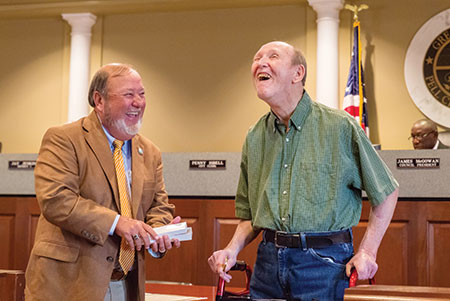
He also does volunteer work at the new State Veterans’ Home in Pell City, where he entertains residents with lively conversation, games of dominos, and reading to the visually impaired.

Gerald’s wife, Mary Margaret, tolerates his hobby because it provides so many large, multicolored stones for her flower beds. Her avocation is machine embroidery and quilting. Though not a flint-knapper herself, she often helps her husband make fine jewelry from his artifacts. However, his handiwork has caused her some concern at times.

For instance, she was not happy when a pile of flint rocks which he was trying to heat-temper in her kitchen oven, exploded, filling the whole cavity with tiny slivers of razor-sharp stone. Nor does she share his enthusiasm when he loads their car down with heavy stones he’s spotted and picked up while they travel.

It’s nothing new. The Hoyle brothers’ passion for paleo crafts goes all the way back to their childhood, when they spent countless hours searching fields and river banks for stone products. Both men have extensive collections of museum-quality goods. Before he retired, Gerald often knapped on his lunch break while others…well, napped.
Gerald explains that using primitive methods while working with stone helps him reach out and touch the past, when much hardier men depended on such skills to stay alive and prosper. He especially enjoys giving his craftworks to people he likes, free of charge, and eagerly shares his love of history with others.

Would you like to try your hand at knapping? The Hoyle brothers advise aspiring knappers to start out with good materials and tools, seek the advice of experts on basic technique, and practice, practice, practice. Because of the extreme sharpness and minute size of stone flakes, it’s also mandatory that you wear old clothes, gloves and safety glasses, and never allow bare feet anywhere near your work area.

Gerald has jump-started several local folks in this fascinating hobby, including this writer. His advice includes a warning that your first few hours of work will most likely consist of turning larger rocks into lots of smaller ones before you actually create a presentable result.

Most novices will eventually produce an acceptable piece, but it seems there are always a few who never really “get the point” of this fascinating pastime.

• For a special story on the bow and arrow precursor, the atlatl, see the digital or print edition of the June 2013 edition of Discover The Essence of St. Clair

Crazy Horse

Becoming an Argo eatery icon

Story by Elaine Miller
Photos by Jerry Martin

Butch Evans and his wife, Karen, were sitting in their den one evening, bored out of their minds, when the idea of starting a restaurant was born.

“My wife said, ‘Are we gonna sit sit here like this until we’re 80, falling asleep in the recliners?’ “I said, ‘I can fix that.’”

And that’s how Crazy Horse Restaurant was born.

“I had been in the food business all my life,” says Evans, who owns Evans Steaks and Seafood, a wholesale company, on Birmingham’s Finley Avenue. “I called on restaurants. I didn’t know whether people would accept fine dining in Argo, though.”

Apparently, he had no cause for worry. Since opening in the former Denise’s Country Diner location in October 2011, business has been steadily increasing. Hungry patrons looking for something besides meatloaf and mashed potatoes come from St. Clair, Etowah, Jefferson and Shelby Counties to sample the steak and seafood menu.

“The locals support breakfast and lunch, the dinner crowd comes from Trussville and beyond,” says Evans.

Trying to make a unique place in the middle of nowhere, Evans didn’t want a typical meat-and-three kind of place. “Anybody can slap a hamburger steak or beef tips and rice on a plate, but to have a good piece of meat is totally different,” says restaurant manager Tony Green. “Quality is the key, along with freshness.” Gulf Coast seafood is delivered daily and all steaks are cut fresh daily. “Nothing is frozen,” says Green, who is Evans’ brother-in-law.

Fried Large Buttermilk Breaded Shrimp and New Orleans-Style Shrimp & Grits are served daily, but the Catch of the Day, usually grouper, is served only on Thursday nights. Customers can get it blackened with lemon butter sauce or potato crusted. Also featured are grouper fingers. Seafood Saturday offers platters of fried oysters, grilled shrimp pasta with creme sauce and sautéed Gulf scallops in butter sauce.

On the menu Thursday, Friday and Saturday nights are the chargrilled steaks, with the 8-oz filet mignon being the most popular. It’s served with a baked sweet potato and fresh asparagus.

Dessert choices are simple. Strawberry cake (a local woman bakes and delivers) and bread pudding with whiskey sauce are the only meal-ender items on the menu. The popular orange rolls aren’t made on the premises, but customers buy them by the dozen to take home. Soup of the Day is either Beer Cheese (see recipe) or Seafood Chowder, each made fresh daily.

Breakfast consists of “just about anything a customer wants,” according to Evans. Favorites are the Crazy Horse Special and the Stable Hand Special. The former consists of two eggs, any style, with grits or gravy, hash browns or home fries, and a sampling of smoked sausage, ham and bacon, along with biscuits. The latter starts with two eggs, adding pancakes, grits and bacon or sausage. Denise Sims, former owner of Denise’s Country Diner, and Dustin Nelson prepare the breakfasts.

“Saturday morning breakfasts are packed to capacity,” says Green. Capacity is 104 seats, including the 24 on the screened-in patio added in February. Head chef Andrea Peagler, the Regions Bank chef in downtown Birmingham by day, oversees the kitchen at the Crazy Horse on Thursday, Friday and Saturday nights.

Lunch offerings include sandwiches filled with chargrilled burgers, chicken breasts and New York strip steaks, plus chicken salad, hot dogs and fried chicken tenders.

As for the name of the restaurant, that came from two sources: The Birmingham club where Butch and Karen had their first date in 1974, and the fact that Karen has horses. “I came home from work one day, and Karen said, ‘I thought of a name,’” Butch explains. “It seemed like a fit.”

Green grew up working in fast-food restaurants, but in his day job is advertising products manager at Progressive Farmer. When he started at the Crazy Horse, he was only going to be there Thursday nights, which quickly turned into a three-day weekend. “It’s tiring, but fun,” he says. “When it stops being fun, I’ll quit.”

The Crazy Horse Restaurant, located at 281 US Highway 11 in the Argo Village shopping strip, is open Tuesdays and Wednesdays from 6 a.m. until 2 p.m. On Thursdays and Fridays, it’s open from 6 a.m. until 2 p.m. and from 5:30 p.m. until 8:30 p.m. Saturday hours are 6 a.m. to 10:30 a.m. and 5:30 to 8:30 p.m. Reservations are taken only for Thursday nights. The Crazy Horse is closed Sundays and Mondays.

• For one of Crazy Horse’s recipes for their famous Beer Cheese Soup, check out the print or digital edition of the June 2013 edition of Discover The Essence of St. Clair

Spring in Springville


The lake that is no more

Story by Jerry C. Smith
Submitted photos

Water is an absolute necessity for any permanent settlement, be it an Indian village or a major city. An area in northern St. Clair County is blessed with five springs, arranged in a circle around a sixth major spring that provided early settlers a virtually unlimited supply of pure, cold water.

In Davis & Taylor’s History of Springville, AL, Margaret Forman Windham tells of Springville’s earliest days: “As the Indians had been attracted to good watering places, so were the early frontiersmen. The springs which bubble forth cold, clear water made this area a camping spot for families moving westward from the Carolinas, Virginia, Tennessee and Georgia.

“The first settlers were some of these voyagers who so admired the hills, streams and virgin forests that they decided this would be their home for all time. … Big Springs was the name the settlement went by prior to the establishment of the post office in 1833.”

It took little imagination for the town fathers to come up with another appropriate name — Springville. Windham relates that the first industry which made major use of these waters was a tannery. In no time at all, houses, churches, and businesses began to “spring” up near the basin.

Some prominent pioneer families were Thomason, Truss, King, McClendon, Woodall, Bradford, Laster, Forman, Osborn, Sprueill, Fuller and Keith. The area is still populated with their descendants.

As Springville grew, the city decided to build a lake in the center of town. Windham describes its construction: “With mules and scrapes, the area was dug out to a depth of about 3 feet, leaving an island on which a tree was growing in the center of the lake. About 1900, a concrete wall was built around the lake leaving openings for the five surrounding springs to empty their waters into the lake.” According to Windham, Dr. James McLaughlin, owner of the property and mayor of Springville, deeded the whole thing to the city. Once completed, McLaughlin himself introduced a large species of carp into its waters, eventually adding bass, bream and trout as well.

The carp flourished and quickly grew to enormous size. Various stories put their length at up to 4 feet and weight as much as 20 pounds. Feeding these gentle giants became a favorite leisure pastime for the townsfolk and their visitors, the fishes becoming so tame they would take food right from one’s hand.

The city augmented the fishes’ feeding with corn, which enticed the huge carp and other species to root for the kernels on the lake bottom, uprooting and destroying moss which had become a problem. Windham’s narrative also mentions the strange fact that all the bream stayed on one side of the lake while all the trout kept to the opposite side.

This pleasant ritual continued for decades. Your writer remembers feeding them in the 1950s during rest stops, as my family traveled from Birmingham to visit relatives in Etowah County. Springville native Margaret Cole remembers that, when her mother worked at Milner’s Cafe in the 1930s and 1940s, they would often give Margaret stale bread to feed the fish. Her daughter, Donna Cole Davis, also frequented the lake while her mother was at Mrs. King’s beauty parlor. Mrs. Cole also remembers baptismals in the lake, when she was 6 years old.

In earlier days, a bowling alley was built on a hill behind the lake, quickly becoming Springville’s social center, hosting square dances and other community events. The bowling alley was eventually replaced with a latticed summer house.

This new structure had a bench going around all four walls inside, a favorite place for young people to gather. Like its bowling alley predecessor, the summer house was a favorite place for weddings, Boy Scout programs and other group functions.

Easter Sunrise services were held on the hill behind the lake. Windham describes it thusly: “…the service was carried on over a loudspeaker which allowed the people the choice of staying in their cars or getting out. The beautiful natural setting and the opportunity for a rather private worship gave a very special meaning to the service.” Mrs. Cole also recalls these occasions, and the giant cross on the hillside made of white stones which were later taken up and stored for re-use the next year.

In the 1930s, tennis courts were added, built by the city and maintained by local young folks. These courts were replaced by a municipal swimming pool in 1960. Perhaps the pool was installed to curtail swimming in the spring lake itself, as described by Windham in her treatise:

“The lake always tempted the young people to come in for a swim, but the water was so cold the swimmers seldom stayed for long. …Two young men who were staying at the Herring Inn went to the lake at night for a brief swim in the nude. (Two local boys) found the secret of the bathers and decided to play a joke on them. One dressed up like a girl and after making sure the swimmers were in the water, he and the other boy strolled to the lake and took their seat on a bench close to the water.

“Being a bright moonlit night, the swimmers dared not leave the water, but soon became so cold that they called out to the couple to please leave so they could get out. The couple made no reply, and the shivering boys decided to climb up on the island. Realizing the one tree was insufficient cover, they again asked the young couple to leave.

“When nothing happened, the boys swam to the edge closest to their clothes and scrambled out. Only then did they discover it had been two boys sitting there all the time.”

Margaret Cole recalls another amusing incident, wherein a lady of her acquaintance who was a fanatic about housecleaning took umbrage when a local boy spotted some dust in her house. She chased him down the hill and threw him in the lake!

Springville installed a city water system in 1935, capping two of the largest springs to ensure a never-ending water supply. However, there was little chance of a shortage. According to Windham, Alabama Power Company estimated the total natural outflow from the lake at a million and a half gallons per day, its water so pure it needed almost no chlorine or treatments.

This municipal water came directly from the springs themselves, at least for the time being, what occurred in the lake had no effect on the water supply. It’s said the lake sometimes overflowed due to heavy rains and drainage, with fish occasionally washed out onto the banks, but the water was never muddy except following an earthquake in Alaska in 1964.

Springville Lake continued as a tourist attraction and local gathering place through the late 1960s. Mayor Pearson himself often officiated over raffles and other social events at the lake. But time and progress change things. New industries and residents in town required that an even more abundant water supply be furnished.

There are several other springs in the area, but the cheapest method was to simply fence in the lake to minimize surface contamination, and draw water from the lake itself as a multi-spring-fed reservoir. This move drew opposition from several prominent Springville residents, but the fence prevailed until 1972, when the State Health Department ruled that its open-air water supply was inherently unhealthy, despite the fact that other cities like Birmingham routinely use surface water supplies.

In a move that incensed people all over the county and beyond, the city filled in the lake with dirt, capped a couple of major springs, installed powerful pumps, and resumed drawing water from them just as before, except now Springville’s treasured lake was gone, never to be seen again.

Letters of protest and op-eds flew like autumn leaves, but to no avail. One such editorial was written by then-recent newcomer to St. Clair Springs, writer Carolynne Scott: “… The fact that Springville needs more water has my sympathy, but I sincerely feel burying Springville Lake is not the way to do it.

“Everywhere I go … people are asking about the Lake, reminiscing about the days when the garden clubs beautified it, and they all drove out to have picnics around it on Sunday afternoon.”

Frank Sikora of the Birmingham News wrote: “Springville Lake was a natural park. … You could hardly walk around the place through the crowds that came on July 4. Now it’s gone. Where the water was, there is now only red-yellow dirt … Nobody wanted it to happen, but it did.”

Today, the lake basin can be seen as a round clearing, directly behind the former House of Quilts on Main Street. A pristine, crystal-clear stream gushes out its overflow pipe, passes under US 11, thence onward to merge with effluence from other springs in Springville’s new Big Spring Park, the combined waters eventually finding their way into Canoe Creek and the Coosa River at Lake Neely Henry.

No doubt many old-timers still feel an occasional nostalgic twinge when recalling their childhood experiences of picnics, dances and watching gigantic carp take food right from their hand. Such simple pleasures are hard to come by anymore.

Lew Windham wrote some poignant verse as an epitaph for Springville lake. Here are a few stanzas:

I WILL COME BACK
I will come back to step on the worn yet worthy wooden bridge,
And recall the many times we dove into the cool clear water,
Plunging deeper to the bottom in hopes
Of finding handsome treasures thrust into it years before.
I will come back and sit at the picnic table under the elms,
And gaze into the circular body into which pounds of bread
Feed the ever-hungry carp which crowded about
To gulp down any small bite.
But the path, the bridge, the spillway, the fish
And the lake will be gone this year, and my coming back
Will only be a sad journey, I fear.