The Old Is New Again

Vintage-touchVintage Touch Making
Furniture Into Art

Story by Graham Hadley
Photos by Mike Callahan
and Jamie Parker

Where you see junk, they see a table, a chair, a bench, a lamp, even a work of art.

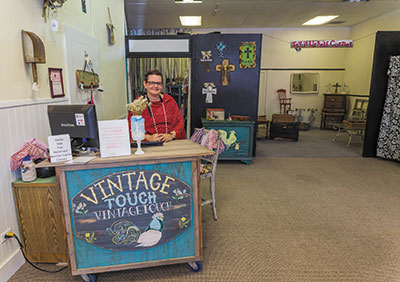
Jamie Parker and her fiancé, Travis Reed, run Vintage Touch in Pell City’s historic downtown area — a store that carries home furnishings and décor items that are truly unique.

And by “unique,” they really do mean absolutely one-of-a-kind.

“My fiancé and I create repurposed furniture. We just sold a sofa or entry table that was made out of an old porch column and part of a gate. We built around that, added some wood, made it look like old barn wood — look old and new at the same time,” Jamie said.

“We are a store of all things. You never know what you are going to find in here.”

Vintage Touch opened Dec. 21, 2014, in the building that once housed Pell City Grocery “years and years” ago.

And since then, business has been growing steadily as more people are rediscovering Pell City’s historic downtown district as a walking and shopping area.

The couple had run booths in other places around Birmingham, but picked Pell City for their first store.

“We decided to open here because we live here, and I love this downtown area,” Jamie said.

“We have truly been blessed. We were a little worried, coming from places like Vestavia to a little town, but sales have been increasing every month. Pell City has really showed us a lot of love. People are so friendly.

“Our customers want to see downtown make it; they want to see downtown rise back up, and I want to see that, too.”

That walking-and-shopping atmosphere is proving to be almost a perfect combination for the kind of business Vintage Touch does. Much of what is sold in the store is made in the store, and customers can see the process of turning junk into treasures firsthand.

“They see that we are in here doing the work. When people see you putting your time into something, it makes it that much more special to them,” she said.

Vintage-touch-1It’s a process Jamie and Travis love — all of it — from “picking” items from old barns and yards, combing flea markets and similar venues, even finding discarded furniture set by the street, to rebuilding it into something new.

Their designs cover the spread. They have an old tractor steering wheel made into a lamp hanging in the window and have made a bench they created from an old truck tailgate that was sold for more than they paid for the truck. It now sits in an office entrance at a firm in Birmingham.

“We can look at something that someone else thinks is trash and turn it into something that is so beautiful, so unique, that people just fall in love with it,” Jamie said.

“It’s something my fiancé and I can do together, he has a full time job, and this is a lot of hard work, but it is fun.”

Travis’ full-time job is as a farrier — a horseshoer — and a blacksmith (“He’s really good at it,” Jamie interjected), and along the way, working on farms, he has found all sorts of treasures for the shop, including old watering troughs that get repurposed into things like benches to chairs.

“Those are some of our most popular items. We have people waiting for furniture made from old watering troughs,” Jamie said.

The prices in the shop are as varied as their designs — you can always find something you can afford.

“We strive to be extremely affordable,” Jamie said. “We even sell to other stores to resell for more, and we all make money. We want people to be able to walk in here and see what we have that they want and be able to afford something,” Jamie said.

In addition to selling their artistic furniture, the store sells some accessories Jamie and Travis have found along the way, vintage items like lunch boxes and advertising signs and promotional materials.

The couple will also take on special-order jobs, but say things turn out the best when they still have some room to be creative with their designs.

Vintage Touch does sell merchandise for a few select vendors, but what they sell has to follow the business rules of being unique and special, just like the store.

Follow Vintage Touch on Facebook.

Northside Expanding

Northside-Medical-expanding-2Looking to create ‘Medical Home’

Story by Carol Pappas
Photos by Wallace Bromberg Jr.

In 2001, Dr. Rock Helms — not too far removed from medical school — founded a practice in his hometown of Pell City. By 2015, it is setting a new standard in health care for the entire region.

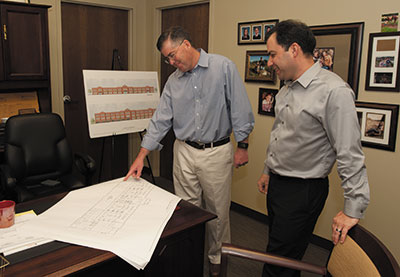
Construction crews are putting the finishing touches on Northside Medical Associates’ latest venture, a state-of-the-art imaging suite, and plans by Williams Blackstock Architects for another phase of the burgeoning practice is on the drawing board. It will be a 40,000-square-foot addition that is a joint venture with a diverse group of specialists.

The Northside partnership of Helms, Dr. Michael Dupre’ and Dr. Bob Whitmore is on the move to make Northside what Helms describes as a “medical home” for the region. The comprehensive services they offer can all be found on the same campus just south of Interstate 20 off U.S. 231.

It’s a new trend that has started in health care around the country, giving patients full access to their primary care, specialty physicians and diagnostic testing all in one place. It is spurred by a push from Medicare that has “naturally been progressing” — a concept that makes practical sense for the practice and patients alike.

Dupre’ is overseeing the imaging-suite project set to open soon. It is hard to conceal the excitement — and the pride — when he talks about it. A wide-bore, open MRI, Magnetic Resonance Imaging, is the centerpiece of it, the only one of its kind in St. Clair County. Before, Northside had to send its patients to larger, metropolitan areas to acquire these kinds of services. Now, it’s just a few steps from their doctor’s office in an 8,000-square-foot addition built by Goodgame Company.

What sets this cutting-edge diagnostic tool apart, Dupre’ explained, is not only its precise imaging capabilities but its openness, quietness and its quickness. No longer must patients endure a lengthy process in cramped and noisy conditions.

Toshiba’s unique technology puts the magnet in a vacuum container that doesn’t allow the transmission of sound. The patient and technician could carry on a conversation there is so little noise, which wasn’t possible with the old technology. “The imaging plane is wider so you don’t even have to have your head inside to get the scan most of the time,” Dupre’ said.

And it’s quicker. Most studies take 15 minutes or less. It has the ability to test 25 patients a day versus the 10 to 12 average with the older technology.

An added benefit, since it is done outside a hospital setting, is that the patient usually has much lower co-pays, similar to a doctor’s visit.

Dupre’ said the partners saw a “huge need” for this phase of their practice, especially in sports medicine, geriatrics and for the veteran population. “We want to keep our patients here. We felt like it fit well with our vision.”

The vision continues with a multi-specialty building planned for construction in the fall of 2015 with completion expected by summer 2016. While specialties are part of the practice already, this will enable specialty physicians to own part of the facility and be housed along with other physicians Northside is recruiting. Additional imaging will be included as well.

The newest phase of Northside’s medical home will include cardiology; ophthalmology; optometry; pulmonary; ear, nose and throat; orthopedic surgery; dermatology; urology and gastroenterology specialists.

Meanwhile, Northside has reached out to other areas to provide medical services in other communities where there is a need. In recent months, Northside clinics have opened in Vincent and Moody with full-time staff. The Moody location offers after care in the evenings and on Saturday as well. Northside’s main location has been offering after care for years, recognizing a need to become more accessible and more flexible in its hours of operation.

In today’s environment, it is “challenging to survive in a smaller practice,” Helms said. Demands on a one or two-doctor practice take their toll, and it gives larger practices an opportunity to look at multiple locations and expand services to areas of need.

A separate company, Northside Services, has been formed to assist other practices with tasks like billing, coding, quality measures and accounting — “all the things it takes to run a practice,” Helms said.

Its outreach has begun to focus on occupational medicine. “Employers are under pressure to keep insurance costs down,” so Northside is working with companies and industries to institute wellness programs and develop on-site clinics where the doctor conducts exams at the company, Helms said.

It is Northside’s way of seeing medical needs throughout the region and filling them, much like its in-house pharmacy, Northside Apothecary, fills prescriptions and even offers free delivery.

As Helms puts it: “We are trying to create, basically, a medical home where you can obtain all your healthcare needs in one place.”

Dancing With Our Stars 2015

dancing-candy-crushPell City charity event raises $10,000

Photos by Michael Callahan

You might call a ticket to it a hot commodity if you looked around the room with a capacity crowd of more than 500 to see the 2015 version of Dancing With Our Stars.

And you would be right.

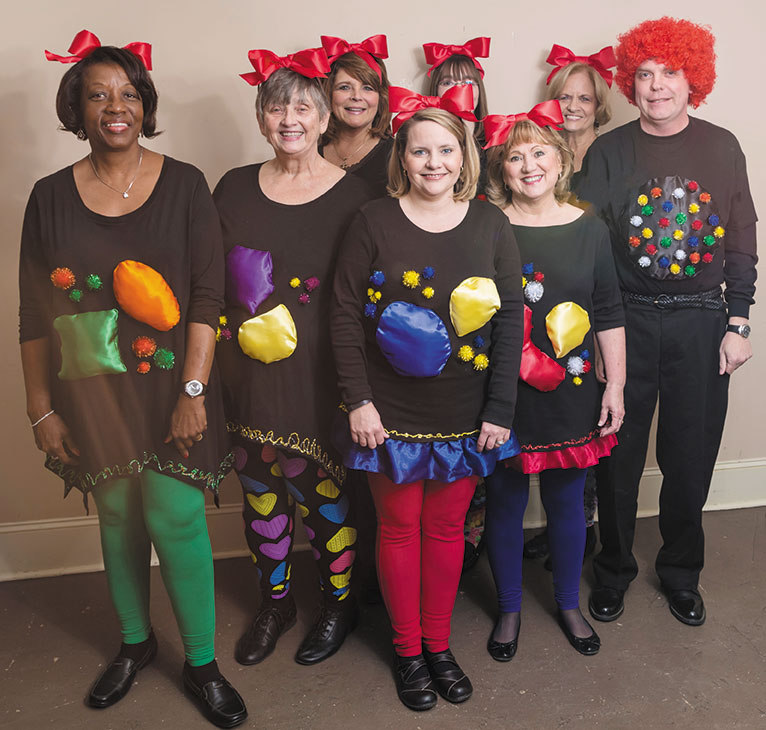
Thirteen groups and couples danced their way into raising more than $10,000 for the American Cancer Society, an evening that featured ordinary citizens who stepped onto the dance floor and wowed the crowd with an array of moves, shimmies and surprises.

An insurance salesman donned a polka dot dress and wig to keep up with “the girls.” Police officers showed their moves to the tune of Bad Boys, and what better song for firefighters than Disco Inferno? It was all in fun and all for a good cause.

When the evening concluded and trophies awarded, the real winner was evident — the American Cancer Society — and the real hero was Pell City Line Dancers, who started the event a year ago.

Doris Munkus, who heads the group, called it “great entertainment.” The money will go toward helping cancer patients with gasoline for trips to treatments, wigs, prostheses, makeup, lodging at Hope Lodge in Birmingham and research at UAB Cancer Research.

Munkus had high praise for all the dancers who donated “time and talent” to the event, making it yet another success story for the Pell City Line Dancers’ fundraising effort for the American Cancer Society.

The support of the community has made it one of the top events of the year. “I love Pell City,” she said. “It is a great place to raise a family.”

A Free Lunch

free-lunch-programBusinesses band together to help feed children

Story by Carol Pappas
Photos by Michael Callahan

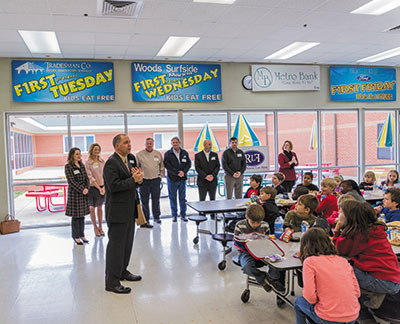
“On the count of three. One, two, three!,” beckoned Pell City Superintendent Michael Barber. Sixty young voices — in unison — rang out in an animated reply across the lunchroom of Walter M. Kennedy School.

“THANK YOU!,” they said, putting the perfect exclamation point on a good idea that has caught on across the school system.

The object of their gratitude stood in the front of the room, scarcely able to conceal their smiles. It was a group of business people who saw a need and filled it by filling the lunch plates of a school full of children — for free.

It’s a not-so-random act of kindness that plays out each week in schools throughout the school system. It’s lunch, courtesy of Town & Country Ford, Woods Surfside Marina, Tradesman Co., Robinson Law Firm and Metro Bank.

Doug Bailey, general manager of Town & Country, came up with the idea when he received an email about his own daughter’s lunch account being low. It sparked thoughts about the struggles of parents every day, trying to meet financial obligations that seemingly never end.

In turn, it became the catalyst for what Bailey called a “crazy idea” for his business to feed a school one day. The first month was in October. By November, five other businesses chipped in, and now the goal has become feeding one school one week each month en route to covering every elementary school twice per year.

Of course, if more businesses join the effort, the goal is within reach that much quicker.

“We want to support people who support us,” Bailey said of the program that helps parents with a financial obligation that really does make a difference.

Bailey said he took his inspiration of paying it forward from the late Curtis Capps, a successful businessman who was at the heart of scores of good works throughout the region. Capps had told him Pell City was a “community that takes care of its own.”

By the businesses feeding children in the school system for free, it takes that burden off of the parents. “Our families get a little reprieve at a time when there are so many demands on them financially,” Kennedy School Principal Dr. Leah Stover said. “These are hard-working families who take responsibility for their children. It really is a blessing.”

Charlie Robinson of the Robinson Law Firm couldn’t agree more. “It’s not about us. It’s about the kids and their families and giving back to a community that has been good to us. It hit home to me when I saw that a gallon of milk cost more than a gallon of gas. When parents are both working, they have bills and obligations that come along with family. That’s tough.”

Metro Bank’s vice president, Matthew Pope, talked of the relationship between good nutrition and learning. Children cannot focus when they are hungry.

“This gives them the opportunity to meet their fullest potential,” he said.

“The rewards of giving back have been so well received by the community,“ said Fred Casey of Tradesman. “We have received thank you notes from parents. I am thankful for the opportunity to give back to the community. It has just been a pleasure to us — phenomenal.”

Jerry Woods echoed the sentiment. “It is great to give back to our community,” he said. “These kids’ parents made my business the last nine years.”

“This is one of the most wonderful programs I’ve seen in my 28 years in the school business,” Barber said. “It is encouraging to see the community get behind these kids.” It forms a strong connection between business and schools. “It makes a difference. It’s good all the way around.”

Clean plates all around the lunchroom with smiles from adults and kids to match are a good indicator that Barber’s assessment is exactly right.

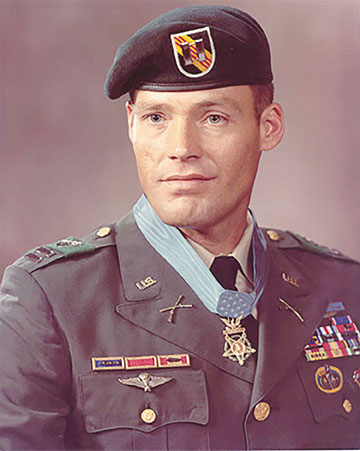
Col. Robert L. Howard

col-robert-howardThe legend behind name of veterans’ home

Story by Leigh Pritchett
Submitted Photos

The military heroics and achievements of Robert L. Howard are no secret.

They earned him the Congressional Medal of Honor, among many other medals and awards.

However, what may not be so well known about this man — who is the namesake of Col. Robert L. Howard State Veterans Home in Pell City — is that he appeared in two John Wayne movies, said his brother Steven Howard.

During his 36-year Army career, Robert completed multiple tours in Vietnam and received a commission from master sergeant to first lieutenant in 1969. He was a Ranger, Pathfinder, Paratrooper, Infantryman and a member of the Special Forces. Ultimately, he rose to command positions. He also was involved in Desert Shield/Desert Storm.

Information from the veterans’ home website reveals that he was an honor graduate as a Ranger, Pathfinder and parachute rigger and was deemed an “outstanding” Infantryman in his class. The site gives an extensive list of medals and awards Robert received, among them the Distinguished Service Cross, Silver Star, Bronze Star for Valor, eight Purple Hearts, Legion of Merit and four Vietnamese Crosses of Gallantry.

The awards and medals that Robert received during his military career are, in fact, too numerous to fit in the shadow box display at the veterans’ home.

In 1956, 17-year-old Robert entered the U.S. Army, continuing a family military tradition that dates back to the Spanish-American War, Steven said.

In between Robert’s enlistment in 1956 and his retirement in the fall of 1992, the Opelika native earned degrees from the University of Maryland, Texas Christian University and Central Michigan University and graduated from the National War College.

Robert was also named to the Military Hall of Fame of the Hoover Institute; Military Hall of Fame of the Veterans of Foreign Wars in Alabama; State of Texas War Memorial; Ranger Hall of Fame, and posthumously to the Army Aviation Association of America Hall of Fame.

Robert earned “every medal for combat courage in what is known as the military ‘pyramid of honor’ at least once and, in some instances, multiple times,” Steven said in a speech July 11, 2014, on “Colonel Howard Day” at the veterans’ home. That date was Robert’s birthday.

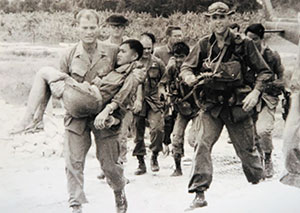
Col-Howard-carry“From rifleman in the Infantry, he rose to become a recon team leader … with the most elite of America’s special operations units, the Special Operations Group or SOG, as it is commonly known today,” Steven recounted in his speech. “Fifty-four months in Vietnam, 380 combat patrols, 1,683 parachute jumps and eight awards of the Purple Heart. It should have been at least 14 instead of just eight. But many incidents Robert just quietly shrugged off as insignificant and unworthy of another medal.”

Robert’s many acts of battlefield bravery and determination, especially in circumstances when the soldiers were surrounded or outnumbered, earned him nominations for the Congressional Medal of Honor. Oftentimes, Robert put himself in danger to rescue wounded soldiers, Steven said.

One time, Robert executed a daring mission in which he entered an enemy camp and captured a North Vietnamese Army colonel. During later interrogation, the enemy colonel gave vital information about troop placement that aided U.S. strategy and saved the lives of many American soldiers, his brother recounted.

As a result of the capture, the North Vietnamese Army and Viet Cong placed a bounty on Robert, said Steven, who, himself, is a two-time Purple Heart recipient in Vietnam.

Prior to that, Steven had served alongside Robert in Vietnam. After a price was put on Robert’s head, the Army separated the brothers out of security concerns, Steven said.

From battlefield to big screen

During one tour while Robert was a Ranger, he was wounded and sent to a hospital. President Lyndon Johnson and John Wayne visited the hospital. Johnson remarked to Wayne that Robert was a good-looking Green Beret. Wayne agreed and sought to have Robert take part in Wayne’s upcoming movie, Steven said.

Thus, Robert appeared in The Green Berets. He played the role of an Airborne instructor, according to the website, www.rlhtribute.com.

It was not long before World War II hero-turned-actor Audie Murphy joined Wayne in trying to convince Robert to become an actor, Steven said.

To tout the movie The Green Berets, Wayne, Murphy, Robert and Steven were seen going about New York City together for two nights.

“They were all so much alike,” Steven said of the two actors and Robert. “All of them were nice guys, the kind you’d like to hang out with.”

Steven was elated when he saw his brother on the movie screen the first time. “He was amazing!”

Robert also made a parachute jump in another John Wayne movie, The Longest Day.

Ultimately, Robert decided against a movie career in order to be involved in one of the most elite and covert of the Army’s Special Forces, Steven said.

“He had made the decision that the Army was for him,” said Steven.

Author John Plaster took note of Robert’s deeds and battlefield actions and has recorded them in two books, SOG: The Secret Wars of America’s Commandos in Vietnam and Secret Commandos: Behind Enemy Lines with the Elite Warriors of SOG, Steven said.

After Vietnam, Robert’s service concentrated greatly on teaching and training soldiers preparing for Airborne, Infantry, Ranger or Pathfinder assignments. He was also an instructor at the Special Warfare School, and Command and General Staff College.

“He loved his men,” Steven said.

Upon his retirement from the military, Robert settled in Texas and worked with the Department of Veteran Affairs. He retired in 2006.

“He was a straight-up guy. He was easygoing. You’d never know he was in the building, unless someone told you. My brother was the kind of guy I always wanted to be,” said Steven, who relocated to Pell City from Prattville to volunteer at the veterans’ home.

Robert – who was a husband, father and grandfather — died Dec. 23, 2009, and is buried at Arlington National Cemetery.

“Much has been written and said about Robert’s chest full of medals — both U.S. and foreign,” Steven said in his July speech. “But I will never forget one statement that he made to me, and it was profound indeed. Looking down briefly at the left side of his uniform, he said, ‘I would trade all of these to train one soldier.’

“To many, he will be remembered as a larger-than-life Green Beret,” Steven continued. “And this, he was. But to me, he will be simply Robert, my brother.”

Additional assistance with this article was provided by the staff of Col. Robert L. Howard State Veterans Home.

96 and going strong

willie-ike-murphree-2

Farmer once served as bodyguard for Gen. Eisenhower

Story by Linda Long
Photos by Jim Smothers
Submitted Photos

The old wooden farmhouse is typical of many found in rural St. Clair County. Surrounded by winter swept fields, a Black and Tan hound sits on its front porch poised to sound a welcoming bay to approaching visitors. Across the way, a patch of dark green turnip greens awaits, ready for the picking.

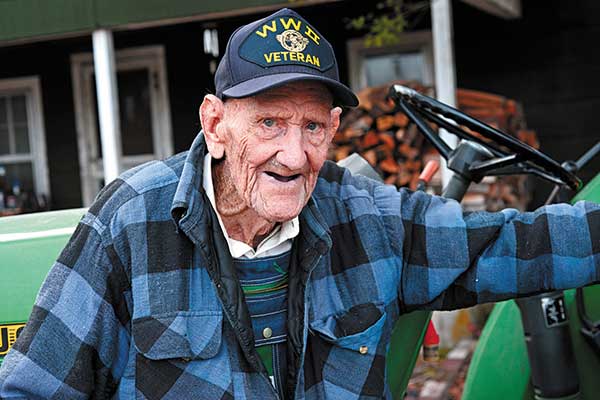
Yes, the old house may look typical, but the farmer who lives here is anything but. At 96 years old, W.M. (Ike) Murphree still works his 105-acre farm, the place where he is the happiest. “I was born to be a farmer and a gospel singer,” he says, but, fate and Uncle Sam had other plans for this quiet, unassuming gentleman. Back in 1943, Ike Murphree found himself on the front lines of history, an ocean away from his beloved country home.

Dressed in his usual starched denim overhauls and a plaid shirt, Murphree chuckled, “I’ve been accused of having a computer in my head.” That becomes obvious as the farmer turned story teller recalls memories of a life well lived. Sitting in his small living room centered by a braided rug and a blazing space heater, Murphree is surrounded by faded black and white photographs, family pictures which line the walls. An upright piano holds a hymnal open to one of the farmer’s favorite songs. And over it all, the American flag hangs proudly.

Reaching back in time to tell his story, Murphree’s steel blue eyes take on a faraway look as he remembers the day his life changed forever. It was 1943. The then 26 year-old young farmer walked slowly back from the mailbox that crisp fall morning, letter in hand containing news which he knew he must share with his beloved wife Alice Lucille. The letter announced his induction into the United States Army.

“One day I was working my farm, the next thing I knew I was packed and ready to head overseas. I had one son, Billy. We went down to the bus one morning. My wife was crying. Billy was saying ‘Daddy, don’t go. Don’t go.’ That was the hardest thing I’ve ever done. I didn’t know if I would ever see them again.”

Eventually, he did see his family again, but not before fighting in one of the bloodiest battles of World War II, narrowly avoiding disaster on the sea in the North Atlantic, being named a master marksman, serving as a member of the escort guard responsible for the repatriation of American held German prisoners of war and serving as a personal body guard to Gen. Dwight D. Eisenhower.

It was January 1944 when Murphree saw some of his toughest combat operations. He was one of the American troops to storm the beach head at Anzio, a signature battle of World War II. Those scenes are etched forever in his memory. “The first wave went in and about 1,700 soldiers and nurses lost their lives at that landing,” said Murphree.

Though he started the war as a member of the infantry, his commanding officers soon learned of the young country boy’s sharp shooting skills, skills honed back home on Chandler Mountain while hunting for rabbit and squirrel. “I shot 198 out of a possible 220,” said Murphree, “everything the army had…30 and 50 caliber machine guns, a grease gun, a pistol, a rifle, the M-1 rifle, a shotgun, and the tanks. I would hit it (my target) every time. I was the only one of 200 people that did that, and it went on my record as a master marksman.”
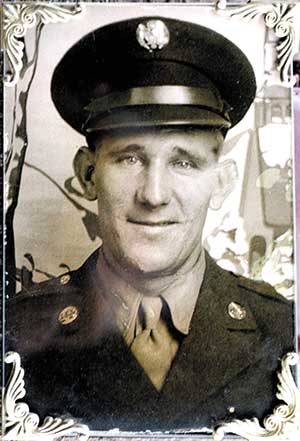
willie-ike-murphree-1Murphree’s job was to escort German prisoners captured on the battlefield to concentration camps, a dangerous and often deadly assignment. The old man is still haunted by some of his memories.

“We were climbing a mountain, German prisoners in tow. German snipers were in the trees, all around. I heard a gun go off. The bullet hit my buddy in the ankle. It tore his foot off, but I couldn’t stop and do anything for him. The next day I heard he bled to death. He had a wife and two little girls back home. I try not to think about that,” said Murphree in a soft voice, “ but I can’t help it sometimes. General Patton, one of the greatest military men ever to put on a uniform, said it best, ‘war is hell.’ You can’t make nothing else out of it.”

For most American soldiers in the European Theater that “hell” came to an end when — as Murphree explained — “the bombers were back on the ground, a peace treaty was signed and the guns were silent. Soldiers were loaded on the ships coming home. I said, ‘I want to go home,’” a simple request, but one that was not to be honored for almost one more year. “My company commander said, ‘No, you are still on special assignment. General Eisenhower needs you.”

That began the young soldier’s post war assignment as a member of the escort guard, whose duty was to protect General Eisenhower. One of his most memorable assignments in that role was to accompany the war hero on his first return visit to his hometown, Abilene, Kansas. It was on that trip that Murphree faced perhaps the most harrowing ordeal of his military career..

“The General flew to New York,” said Murphree. “Me and the other guards went by ship, the USS Sea Robin, a 55,000 ton battleship. About halfway there in the North Atlantic, we hit one of the worst storms in history. They told us we might have to abandon ship. We lost all our life boats and life lines. We were literally between the devil and the deep blue sea. The ship would rock up on its side and just hang there, and I would think well, it’s going over this time, but it would come back down and hit the water. It sounded like it was going to bust into a thousand pieces. Even the captain who had been sailing for 40 years said this was the worst storm in history.

“ Finally,” continued Murphree, “the USS Sea Robin limped into New York Harbor. Boy, it had taken a beating. I don’t see how in the world it made it through that storm.”

Then, pausing in his narrative, Murphree added, “well, actually, I guess I do see how it made it. I went down in the bow of that ship and I got serious with the Lord. I said, ‘Lord, there’s nothing I can do about it except for You. I’ve got a beautiful woman and a little boy back home, and I would like to go back to them.’ About half an hour later, it was announced on the intercom, that the storm had weakened. The captain said we had blown off our course, but he believed we would make it.”

By this time, Murphree just wanted to go home. “Each time I asked, all I was told was, ‘No, you are still needed here.’ I said, I don’t care nothing about being a big shot. I had been gone almost three years away from my wife and baby. All I wanted to do was get out of there, get this thing over and get back home. I wanted to get back on the farm, pick some cotton, grow some corn, smell some sorghum syrup a-cooking. That’s all I wanted to do.”

Finally, in 1946 , Murphree was discharged from the army. Once back home, he bought the farm where he now lives and where he and his wife raised their son William, Junior and three daughters Elizabeth (Mealer), Linda (Vaughan) and Alice (Cater). And, it was here where Murphree resumed his passion for gospel singing.

According to his daughter Elizabeth Mealer, “Daddy was into gospel singing from the time he was a small child.” As the story goes, one of his uncles took him to a gospel singing, and he actually got up there and directed a song.

Gospel singing was also on his mind in a fox hole in France. According to Mealer, “Daddy said he prayed if the Lord would get him home he would like to have a trio of girls that would sing. He always wanted a singing family, and that’s exactly what he got.”

“We had a wonderful life,” said Murphree, “Me and the Murphree sisters. We traveled around in a Greyhound bus singing the gospel all over the southeast from Montgomery to Georgia. That blood harmony. There’s no way you can beat it.” And his son sang bass in several gospel groups.

Murphree says about the only time he sings these days is when he’s out on his tractor. Neighbors listening closely might hear him bellowing out old favorites like, “What a Meeting in the Air,” That Heavenly Home will Surely Be Mine,” or Power in the Blood.”

Despite his age, Murphree lives alone, still drives a car, and works his farm along with some help from grandsons Wayne Mealer and David Murphree and great grandson Cody Mealer. He says he’s often asked what keeps him going at his age, and his answer is simple. “Hard work. If hard work would kill somebody, I would have been dead 35 years ago.”

“Somebody once told me ‘you don’t have a bit of business out here doing this at your age. When are you going to quit?’ Well, laughed Murphree. “I said I imagine when my toes are up.” Does he ever think about retiring? “Oh, sure. I think about it every year, and every year I say well, this will be the last one. But, then the wild onions put up and you can smell them; and the fruit trees bloom out, and the bees go to swarming. It just gets in my blood, and I have to get out there and go.”

Now, with a new John Deere tractor complete with power steering in the shed, Murphree may have even more reason to postpone his retirement. “Yeah, I’m proud of that tractor. When you get my age, it gets harder to steer but now that power steering has taken care of all that.”

“I can say I’ve had a good life,” said Murphree. “I was talking to my cousin the other night. She said, ‘I guess you realize how the Lord has blessed you.’ I do. He’s given me a good life. He shepherded me through one of the bloodiest wars in history and one of the worst storms ever on the sea. I have had a very good life. I don’t go around bragging about my life, but I am proud of it.”