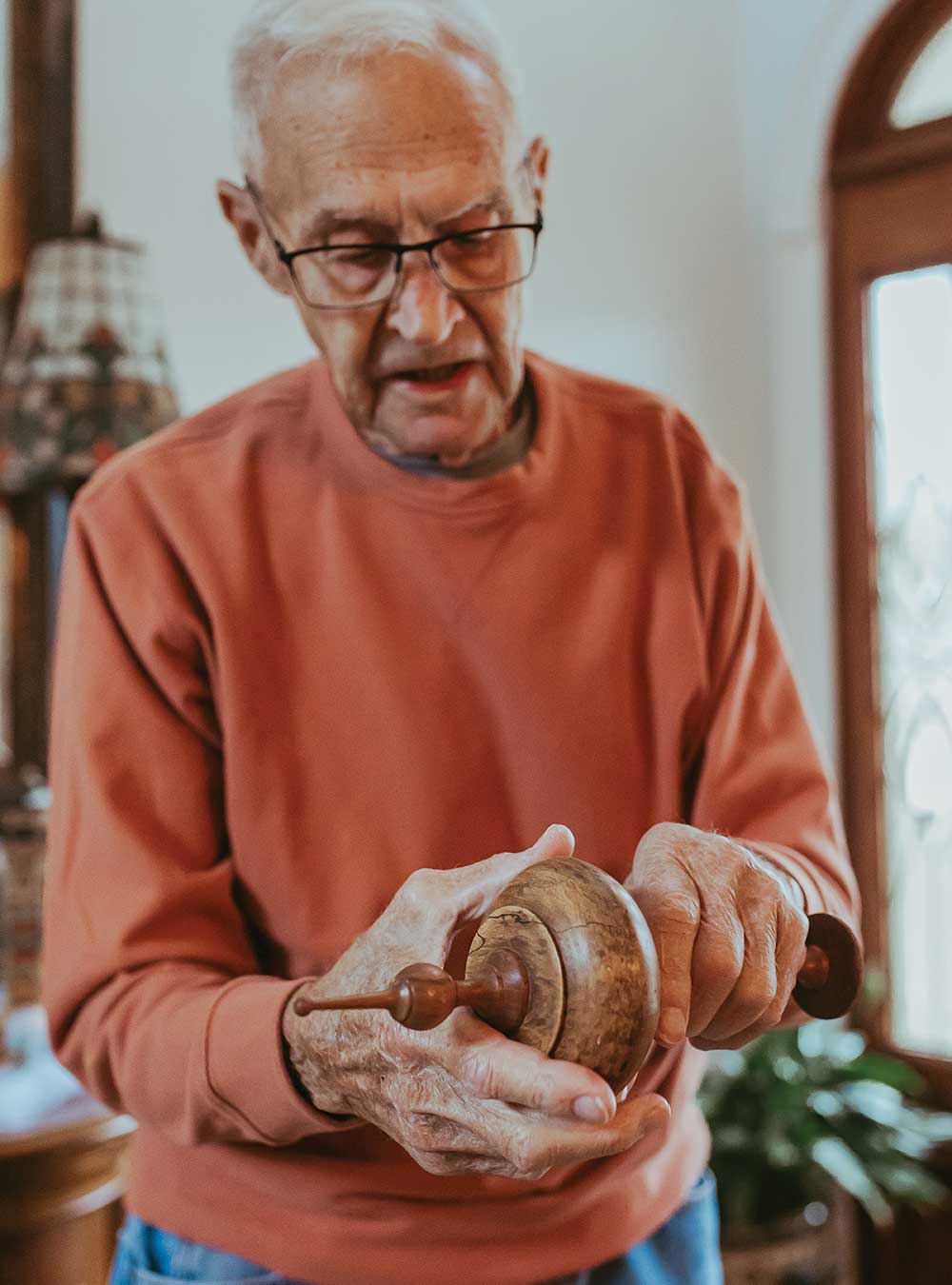
Eric Knepper doesn’t take credit for the beauty in his work. A profoundly spiritual man, he says he’s simply revealing the beauty that is already within the wood when he carves his one-of-a-kind pieces.
“You just get inside the piece of wood and see what God made,” says the artisan. “That’s what you want to show, all the beauty in the grains.”
Eric Knepper shows off some of his work
For nearly three decades, Knepper has been unveiling the natural beauty in the wood around him and crafting hundreds of pieces of original wood treasures. An old rotten maple tree found new life as a beautiful bowl. A red oak tree that had to be cut on his property was transformed into a rolltop desk, a credenza and a file cabinet.
His wife, Pat, smiles across the table as she talks about different items he has created over the years. The house is filled with them, from the dining room’s exquisitely carved grandfather clock with cabriole legs to the stunning freestanding cabinet in the living room made from pieces of an old fireplace screen. “He is so talented. I can’t think of anything I’ve asked Eric to do that he hasn’t been able to do,” she adds, her eyes filled with pride. “He will find a way to do anything.”
The son of a carpenter, and a very determined man himself, Knepper made furniture early in his marriage to meet the needs of his family. “When you get started, you have nothing. We built things then because you couldn’t afford them,” he explains. He even did all the millwork in the home that they built in 1997. But it wasn’t until after retirement at age 60 that his woodworking expanded into a new passion – wood carving.
On a camping trip the couple took to Florida, his interest in carving came alive. “People in the campsite next to us carved, and he took me to a carving club in Fort Myers.” When Knepper returned to Pell City, he met with Tom Goodwin, a carver from a local carving club, and the two became great friends.
Goodwin took Knepper under his wing, showing him how to work with different woods and specific tools. His friend has since passed, but Knepper still has the carving equipment that once belonged to Goodwin. After revealing that he was terminally ill, Goodwin asked Knepper to buy his carving tools so he could pass them on to someone with a passion for the art.
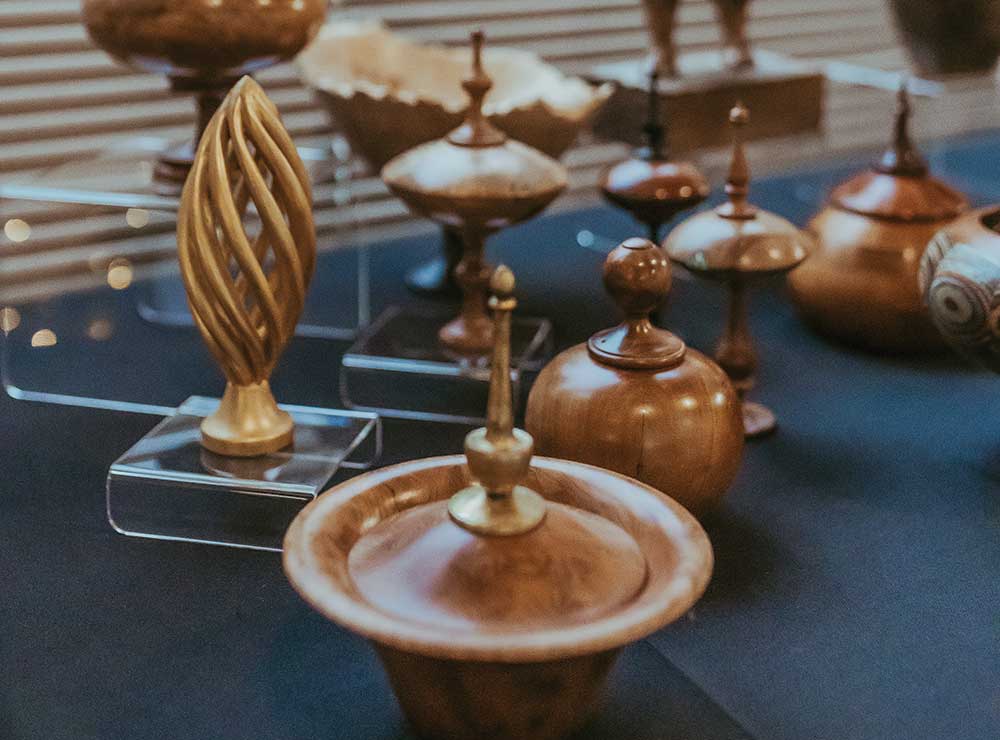
Creations on display at the Museum of Pell City
Those specialty tools, Knepper explains, are mostly different chisels and knives, with some power carving tools. “On a given project, you might use two or three tools primarily, or for furniture, (you might use) your whole shop,” Knepper says. He has a wood carving room within the house for smaller projects. Larger pieces are handled in his wood shop in the barn.
As any wood carver would tell you, keeping your tools sharp is essential. Keeping them sharp is important for precise cuts, but it can also create the need for some emergency care, as was the case for Knepper seven years ago. “I cut the end of my thumb off about 6 years ago,” he admits. “You don’t even notice it now. I don’t even remember what I was working on, but I did a dumb thing.”
“He just came in and said he needed a band aid,” tells Pat. He needed a bit more than that. “It was hard to get it to fit back together,” she adds, giving credit to “a wonderful nurse practitioner at Dr. Helms’ office.”
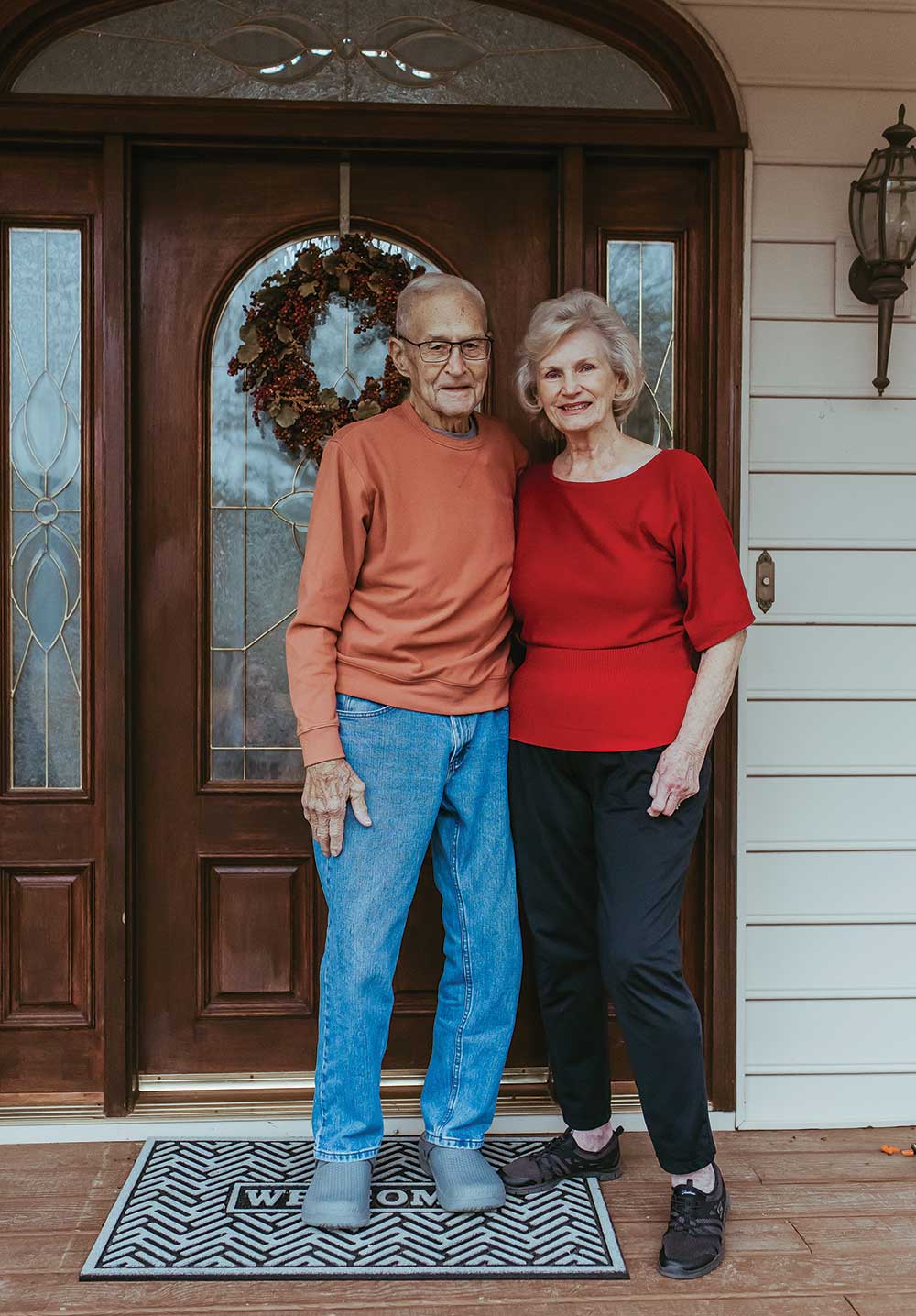
Eric and Pat Knepper
The Kneppers handled the crisis with the same grace and perseverance that has defined their 63 years of marriage. The two met while Eric was in the Navy in Virginia. Moves to Connecticut, Pennsylvania, Illinois and Indiana preceded their final landing in Pell City where he came to work at National Cement. He later left that company and bought Pell City Fabrication, which provided maintenance and support for steel fabrication and other industries.
The couple have three grown children (Shawn, Scott, and Ericka), eight grandchildren, and five great grandchildren. Knepper says he sees talent in each of them and potentially at least one future wood carver. Several family members were among the guests at a recent art exhibit at the Pell City Museum of Art featuring his wood carvings.
Knepper’s most challenging piece was among that collection of works. He describes it as a “gold spiral thing,” for lack of a more technical term. “I just saw a picture of it and decided to give it a try,” he says. “It was very difficult because it’s hollow. I had to work from the inside out.”
The art of carving is an ongoing lesson in patience and finesse. Knepper also stresses the importance of listening to the wood. “The wood will tell you what to do, basically.” He considers himself less of a designer and more of a collaborator, with each knot, grain and imperfection guiding his hands. The character of the wood, with its texture and color, add to the direction the project takes.
Knepper has done much of his work from wood that has fallen on his property or that others have brought to him. Oak and Cherry woods are favorites, but he also has done many projects with Cottonwood and other bark woods. “I really like the color and grain of cherry,” he adds. “Sometimes people bring me roots they’ve dug up. It looks terrible, but I cut it up and look inside and it’s beautiful. You just never know.”
Though he finds it difficult to choose a favorite, some pieces – like a beer bottle complete with a bear in a Paul “Bear” Bryant houndstooth hat – clearly delight Knepper. Throughout his home, bowls, spiral works, vases and boxes crafted by this modest woodcarver are on display.
His faith is evidenced in another of his masterpieces which sits on the table – an intricate chapel featuring a lectern with an open Bible. Knepper’s craftsmanship extends beyond his home and into the heart of the local faith community. Over the years, he has used his talent to create kneeling rails for the altars of three area churches.
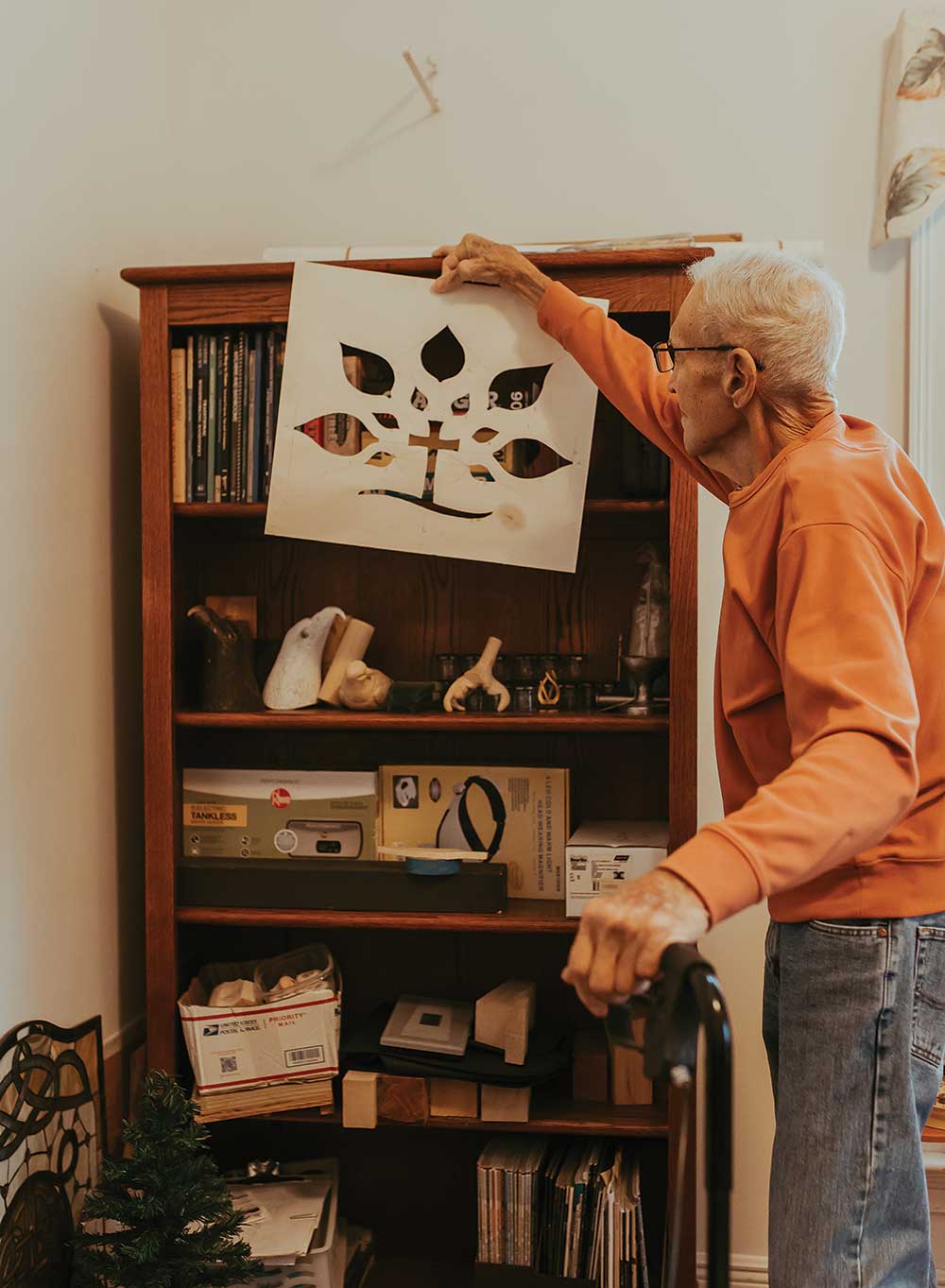
Template for a design of a kneeler at New Life Church in Pell City
The first kneeler was crafted for the Episcopal Church of the Resurrection in Rainbow City, designed specifically to complement an altar the church had received.
This careful attention to detail highlights Knepper’s ability to harmonize his work with existing elements, ensuring each piece feels at home in its setting. Later, he constructed a pair of kneelers for Pell City First Methodist, further demonstrating his commitment to supporting his community through his artistry.
Most recently, Knepper designed a folding, movable kneeler for New Life Church, which gathers at the Municipal Complex in Pell City while a new church is being built. This innovative design reflects his adaptability and practical approach, ensuring the kneeler could be easily moved and stored as needed. Form, function and beauty are hallmarks of Knepper’s work.
A quiet, serious man, Knepper is uncomfortable with attention. He shrugs off accolades, dismissing his own talent. “I’m always using other people’s design, not mine,” he says. “I just put my own spin on someone else’s design.” It gives him something to do, he says, adding that it keeps him from watching TV.
Knepper’s keen eye and ability to see what rough wood can become is what has defined him as an artist and wood carver. Hearing how a discarded root was crafted into a beautiful bowl certainly makes one pause for thought. Each gnarled root or discarded branch may still have a story to tell.
With patience, perseverance and careful listening, the wood carver reveals the beauty within.
Much more than the history of Pell City on display
As Museum of Pell City approaches its third birthday, it’s hard to imagine a ‘down time’ for this quickly growing museum.
On Feb. 5, the museum will present its third edition of the Breaking Barriers series focusing on the Black community and its place in the city’s history. Headed by Museum Board Member Tonya Forman, its popularity has grown right along with the program itself.
This year’s theme is Education: Foundation for Success and pays tribute to the early Black educators whose guidance and compassion transformed the lives of Pell City students.
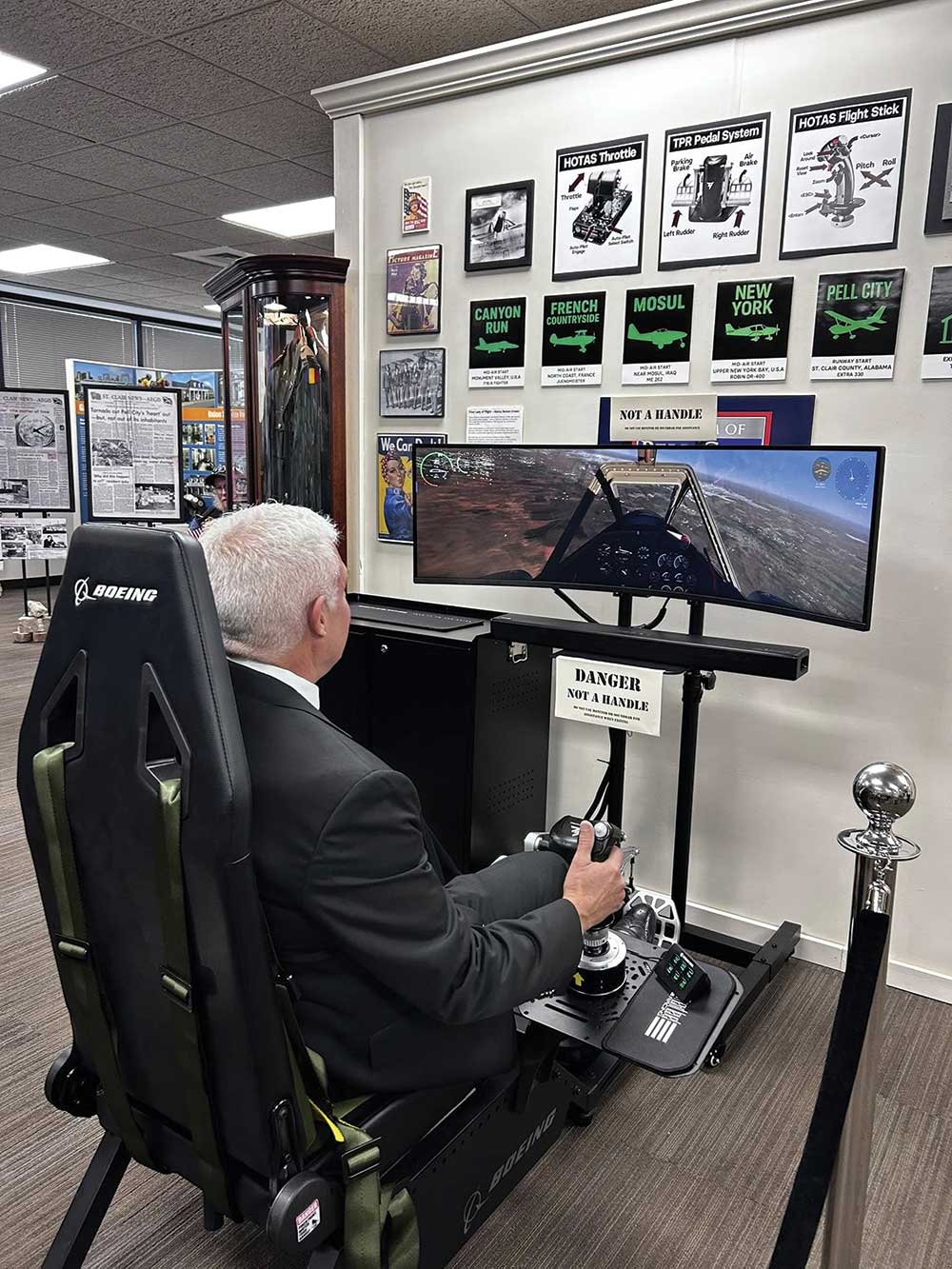
St. Clair District Attorney Lyle Harmon takes inaugural flight on simulator at opening
The day’s program, which begins at 11 a.m. features a reception and a film premiere of family and former students of these educators on the legacy of their impact. It will also mark the opening of an expanded Breaking Barriers exhibit.
Opening the next day, Feb. 6, and extending for two weeks until Feb. 21 is an art show by Sundi Hawkins. The show is a continuing series of the museum, giving the art community a home to display their works.
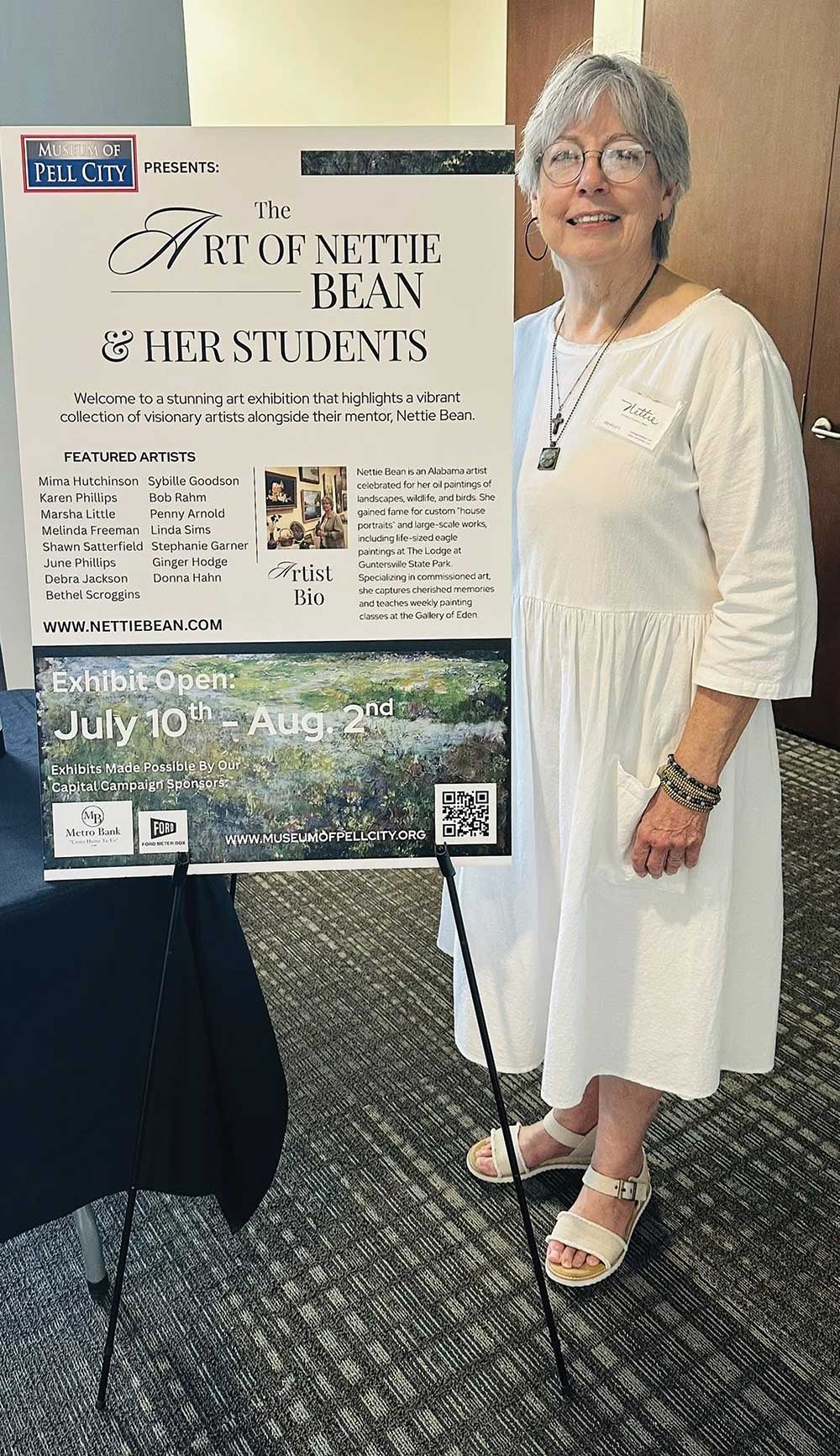
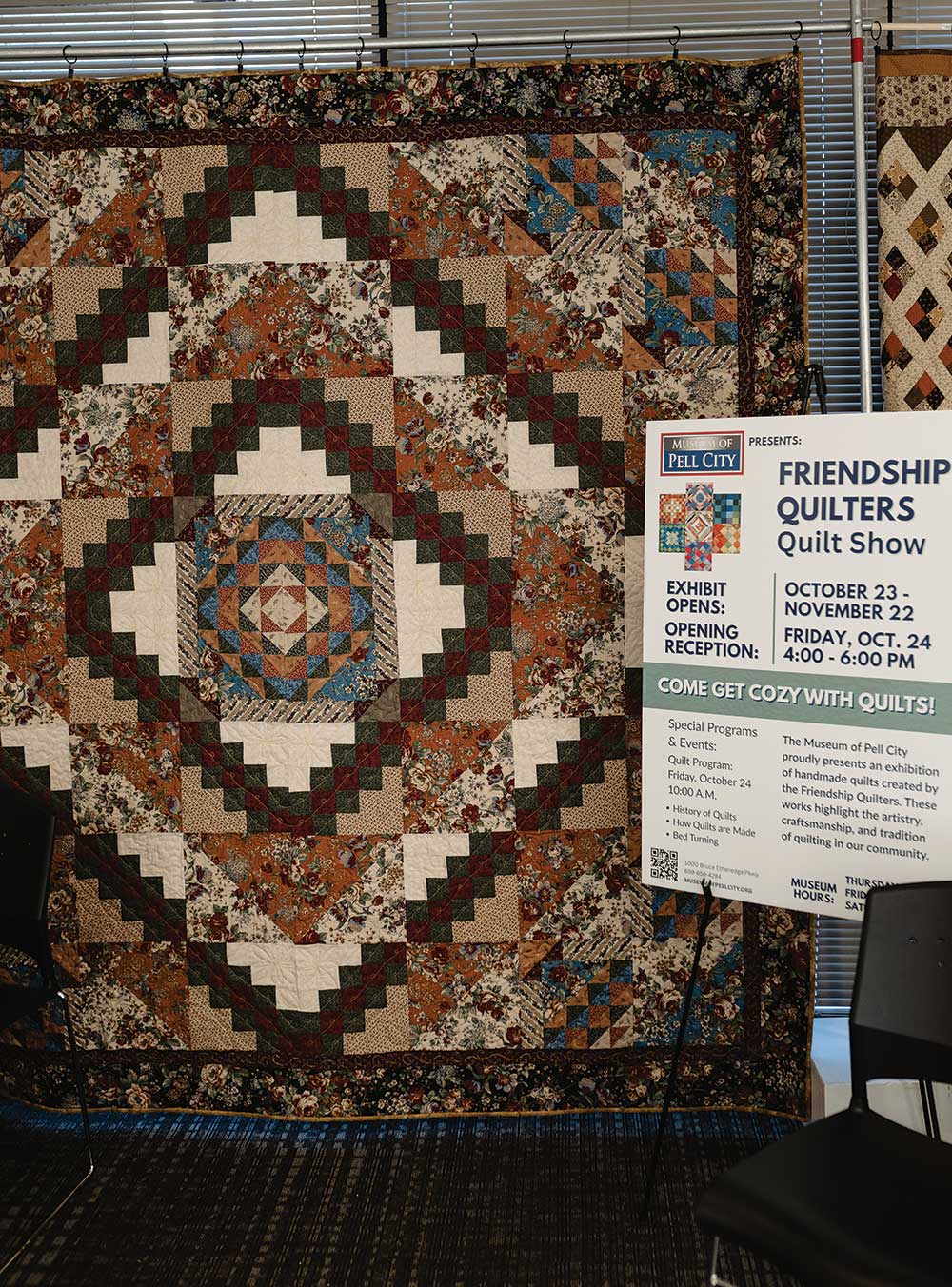
The museum board invested in a hanging system, and the exterior walls of the atrium just outside the museum have already displayed the creations of artist Nettie Bean and her students, a spectacular quilt show and Duran Jr. High’s art show. The quilt show will return in 2026, and more art shows are scheduled.
In December, the museum’s art gallery hosted the wood carvings of Eric Knepper, intricate, creative pieces of artwork crafted by the local artisan.
Upcoming are shows by Penny Arnold, Williams Intermediate students, a return of Nettie Bean and her students and the Helen Keller Foundation Art Show of Alabama.
In November, the museum opened an expansion of its military section and added a flight simulator, which is already drawing crowds of young and old alike. Designed by Jeremy Gossett, the simulator resembles the cockpit of a Boeing aircraft with a curved monitor that displays various flight patterns including Pell City and Logan Martin, Mosul and the French countryside.
The software is highly sophisticated and gives museum visitors a real feel of flight – from takeoff to landing. It was made possible by a special fundraiser providing nearly $7,000 to build and equip it.
In April, just a few days past its third anniversary, the museum is celebrating with the official opening of its long-anticipated model train exhibit – Where It All Began. Headed by retired architect Malcolm Sokol with a team of volunteers – David Smith, Max Jolley, Erik Grieve and Winston Greaves – it took a year to build.
The museum hosted artist Nettie Bean and her students
The 16-foot train runs through a replica of 1920s-30s Pell City and will be surrounded by artifacts, narratives and photos depicting the train’s history in Pell City. After all, that is where it all began – when founder Sumter Cogswell missed his train to Talladega in 1890 and spent the night in what is now Pell City.
Nationally known artist Dirk Walker has donated an original painting of a Pell City train depot that will be used as a fundraiser for the museum.
An evening reception is planned along with tributes to the museum’s volunteers and naming “Volunteer of the Year.”
“We are so humbled by the community support we have been given since our opening,” said President Carol Pappas. Our docents give their time every week to guide visitors through our museum. We could not operate without them, and we are so appreciative of their work.”
Pappas lauded the dedication of the team who built the train, which now will be a centerpiece of the museum’s exhibits. “They met every Monday night for an entire year to assemble each rail of the track, recreate historic buildings from scratch, hand paint and place miniature figures throughout the town and so much more. It is so realistic. It is a must see. We cannot thank them enough.”
She noted that the museum is in the midst of a capital campaign, and businesses and individuals have stepped forward with multi-year sustaining funds. “They are the very foundation of our museum,” Pappas said.
“Recognizing the importance of cultural arts in our community as educational, historical, an enhancement to quality of life and a boost to tourism, the City of Pell City and St. Clair County have been supportive with appropriations over the past three years. Without their support, we could not have come this far.”
When the museum opened in a 4,000 square foot space provided by the City of Pell City, its mission was to preserve and promote the rich history of the city. Billing itself as the “small city museum that thinks big,” in less than three years it has attracted over 5,000 visitors from all over the state, country and points around the world.
It has created innovative, interactive exhibits highlighting the people, places and events that have shaped the city’s history, and the momentum shows no signs of slowing down anytime soon.
In October, the museum will reach back to the city’s real roots – Avondale Mills – with an impressive, interactive exhibition to celebrate and pay tribute to its first industry. Never-before-displayed artifacts, photographs and exhibits will tell the story of those early days along with a special film of oral histories premiering at the opening.
“As they say, we’ve come a long way since then,” Pappas said, “and Museum of Pell City is honored to be able to share that story along with countless others.”
mphasis on preserving the history of Pell City and that of its families and community. One of its most recent exhibits perfectly blended that history with the art of quilting. The museum, on the second floor of the Municipal Complex, typically contains its exhibits to the interior of the museum, but recently has been expanding outside its doors to showcase the work of the area’s talented citizens.
“Hosting exhibits like the quilt show allows us to celebrate the incredible talent in our own community,” said Museum Coordinator Erica Grieve. “It reminds us that art isn’t just found in galleries far away. It’s being created right here at home.”
The quilt exhibit ran from late October through November and featured roughly 40 quilts created by members of the Friendship Quilters Guild of St Clair County. The opening featured a presentation by historian Joe Whitten, a quilt collector himself, who shared stories about the history of quilts and shared some of his quilts. There were also demonstrations showing the making of a quilt from start to finish.
Part of the history of quilting included the quilting bee, a social gathering of ladies whose focus was on finishing a quilt together. Such was the case in the making of Janet’s Double Wedding Ring quilt on display by her daughter Janet Jones.
A group at Pell City United Methodist Church got together to complete the quilt for a silent auction. When the silent auction did not meet the minimum bid to cover expenses, the ladies voted to give it to Janet’s mother, Janet Weldon.
Weldon had reportedly done much of the hand-stitching, including the stitching around each of the intertwined rings. Her daughter said quilting was so important to Weldon that when her mom passed, they elected to drape her casket in the Double Wedding Ring quilt, rather than having a funeral spray. “Because it was cold, we also took some of her other quilts to the graveside to cover our legs,” said Jones. “She would have liked that.”
Ken Kilgroe came to the exhibit to honor his now-deceased grandmother, Roxie Moore. One of her quilts, made more than 60 years ago, was on display. Moore, an Eden native, reportedly hosted quilting bees often in the 1950s.
The Museum of Pell City’s next special exhibit opens Dec. 4 and features the beautiful woodcarvings of local artisan Eric Knepper. A reception will be held on Dec. 5 from 4 p.m. to 6 p.m.
The museum is open to view other compelling pieces of the history of Pell City, St. Clair County and Alabama Thursdays and Fridays 10 a.m. to 4 p.m. and Saturdays 10 a.m. to 2 p.m.
Celebrating seven decades of building relationships
Story by Carol Pappas Photos by Mackenzie Free
It’s hard to miss a Goodgame Company truck crisscrossing Pell City and St. Clair County these days. Multiple projects across the community have those bright red trucks, emblazoned with the familiar, oval-shaped Goodgame logo, moving at as rapid a pace as the buildings they engineer going up.
It’s not an overnight success story by any means. It has been seven decades in the making. But in each of those seven decades, one principle has been the guide. Beyond the brick and mortar, it’s the relationships Goodgame Company has built that has more than 90 percent of its clients returning for more.
As the 70th birthday approached this year, President Jason Goodgame, his mother, Connie, and his sister, Janna Masters, wanted something special to commemorate the history of the company its patriarch, Adrick Goodgame, built.
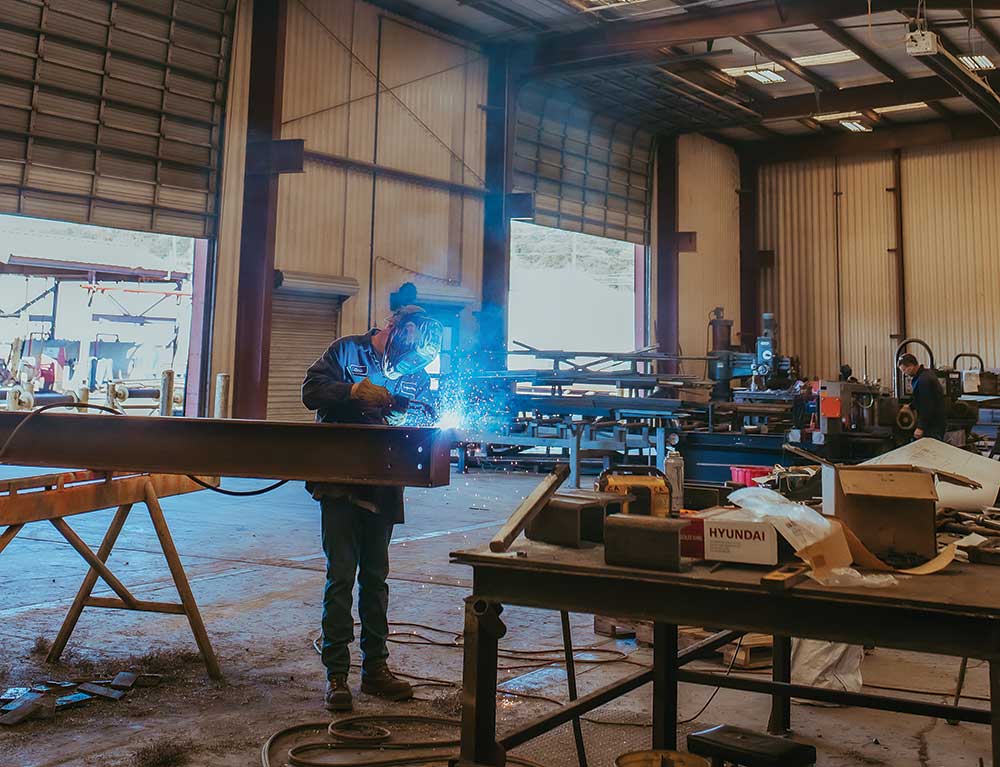
Welding in shop area of Goodgame Company’s headquarters
Jason was looking online for some hunting clothes, and he came across the artwork of Dirk Walker, whose hunting and fishing series was featured. He was naturally drawn to the work, so he contacted him about commissioning a painting, not knowing Walker’s studio was only two blocks away.
They met. They talked. Walker created a hand sketch. And what evolved as the portrait was a compelling mosaic of scenes that tell the Goodgame story, reflections of 70 years.
It now hangs as a focal point in the company’s lobby, a reminder of Adrick’s legacy. “It turned out to be perfect,” Goodgame said. “It’s something we will cherish and keep forever. Dad would be proud of it.”
Parallel to the portrait, the company created a video series that “symbolizes us,” he said. It was an opportunity to celebrate 70 years of what relationship building means to the clients and employees alike. “Pell City has been good to us. There are not many contractors who don’t have to travel out of town to work. There are not too many opportunities like this in our business.”
It all goes back to the relationships. Right now, you’ll find those red trucks at sites virtually around every corner – First Baptist Church of Pell City, Pell City Police Department’s new headquarters and Pell City Fire Department Station 2, to name a few.
Just completed was TC Customs at Town & Country Ford. Douglas Manufacturing Rulmeca Group, Ford Meter Box, Allied Mineral Products and Eissmann Automotive are among others completed in recent months.
On the drawing board for the future is Helms Healthcare and others. Those relationships just keep on building, and so does the Goodgame family legacy.
Before Adrick Goodgame died in 2023, his son said, “we talked about the transition and what it would look like. We talked about it, but we were not prepared” for the loss of the architect of their family business. His shadow still looms large over the company he built from a metal fabrication shop to a major player on the state stage in the construction industry.
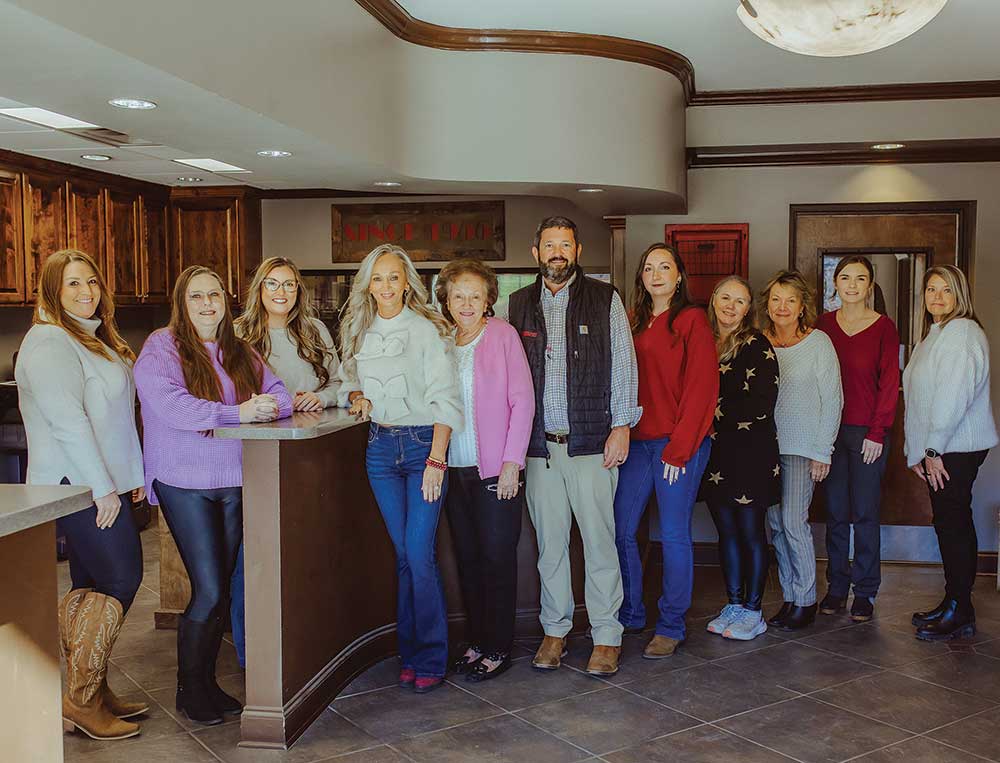
The Goodgame Company office team
“You have to understand, for 20 years, we spent six days a week together. We talked about goals and where we were headed,” but they daily discover the details Adrick simply “took care of.”
An adjustment? Yes. But with a page from his playbook, they have adapted, changed to meet the needs, and they’ve grown even more because of it.
It was Adrick’s signature ability – adapting and changing to meet the market’s needs. Whenever there was a major shift in the market, Adrick Goodgame was there to meet it with a new business plan, whether it was the Great Recession in 2008 or the post COVID years in 2019.
“We’ve changed how we do business and who we do business for. The company does design- build-negotiated work, which has brought their repeat business to well over 90 percent. One client called it “a one stop shop.”
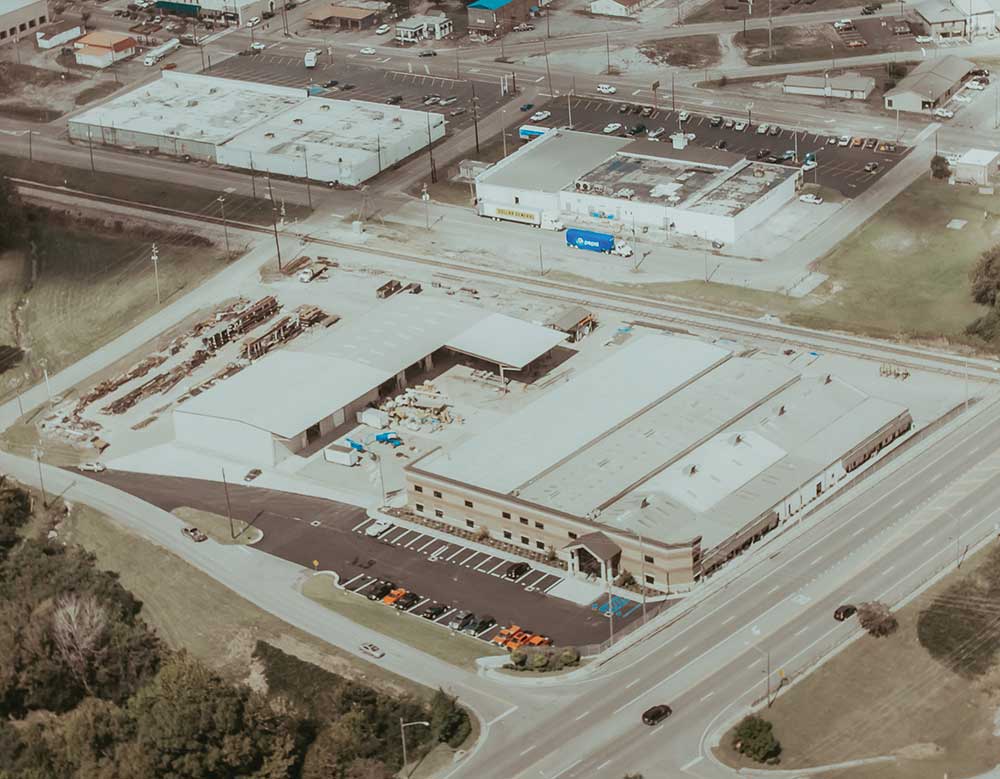
Headquarters near downtown Pell City
“It’s that relationships piece,” Goodgame explained. “If we grow, we still maintain our relationships. Through the years, we have maintained our base” in addition to the new business.
He credits the business retention to a continuing philosophy of community focus. They grow their own workforce, providing educational opportunities that earn employees certifications and management and supervision roles.
They invest in their employees and continue to treat them as family, honoring their years of service and providing perks like the recent “Boot Day,” where every employee was given a new pair of boots, a steak lunch and the afternoon off.
The mindset Adrick handed down to the next generation has not changed. He taught them well.
It’s family. It’s adapting to change. It’s relationships. “The loss,” Goodgame said, “is the hardest part.”
Story by Joe Whitten Photos by Wallace Bromberg Jr. Submitted photos
For a church to arise from Saturday nights of music and dancing is – without a doubt – a unique beginning, but that is the case of Mt. Moriah Missionary Baptist Church.
“A dirt road, a smattering of houses, friends, guitars, banjos, music and dances –God had a plan.” So begins Redena King’s 1975 handwritten two-page history as told to her by Essie Vaughan, the daughter of George “Doc” and Ada Tollison.
With that sentence in mind, relax in your recliner and let your mind drift back a hundred years to a place in St. Clair County called Sage Hill. Think of a field of russet-gold sage (sedge) grass rippling in an autumn afternoon breeze. As you daydream, listen for music floating on the breeze – stringed instruments joyfully filling the cool of the day. It’s Saturday night, and a family is hosting the weekly hoedown at a home in Sage Hill.
Choir and song leader Redena King
These weekly events brought banjo, guitar, mandolin and fiddle into happy harmony that soon had couples dancing, while for other folk it was background music for visiting with friends not seen since last week or perhaps a month or so ago.
Known today as Mt. Moriah, Sage Hill was sparsely populated in 1925. The nearest school was probably Stewart’s Schoolhouse, a few miles away where Mineral Springs Baptist Church sits today, and the nearest church was Broken Arrow Baptist, about five miles away in Wattsville. So, we can surmise that most of the Saturday night merrymakers didn’t get up early Sunday morning and walk five miles to church. And it’s possible that one or two men may have partaken too much from the “little brown jug” and slept late.
But, indeed, God had a plan that included George “Doc” and Ada Tollison at whose home many of these Saturday night hoedowns occurred.
“Mr. Tollison had a nephew, Oscar Tollison, who was a preacher,” the history records. “He began coming here [to Sage Hill] and preaching on the weekends.” Mrs. King quoted Essie Vaughan, Doc Tollison’s daughter, who said, “The dancing soon stopped, but the preaching continued.”
This spiritual awakening saw different families welcoming weekend church services at their homes. At one of these services, Doc Tollison was saved. As the weekly preaching continued, others were converted.
Attendance at the home services grew so large that the men constructed a brush arbor on the Tollisons’ land as a place of worship. Bernice Sweatt Voss in her 1975 memories of Mt. Moriah described it. “The brush arbor had posts of good size trees [at the corners] and [tree] limbs made a sort of frame on top. Then brush covered [the limbs] to make a shade.” Doc Tollison’s wife, Ada Tollison, was saved in one of the brush arbor meetings.”
Essie Vaughan recounted that soon the men constructed a church house “… alongside the road … It was a long building with a door and windows facing the road and a door facing the road where the [dinner-on-the-ground] tables …” once stood. Those tables were located to the right of today’s fellowship hall as you face the double doors downstairs.
Hazel Layton Morgan in her written memories referred to the building as “shotgun style’ and that it was lit by kerosene lamps in cast iron wall brackets.
Essie Vaughan recalled that preaching was usually two times a month, and “the singing during services were acapella – no piano – to begin with.”
In her recollections, Hazel Layton Morgan mentioned the church pump organ, and this may have been the same one Bernice Sweatt Voss mentioned in her memories when she wrote, “We didn’t have any music instrument, so Mother and Dad loaned a small ‘piano’ organ for a while. Mother would play it, and Eunice and I would stand and pump the peddles for her.” (A “piano organ” was a small portable reed organ.) Eunice and Bernice often sang duets, and one of their favorites was In the Garden.
Building a congregation
Bernice Sweatt Voss’ family started attending Mt. Moriah in 1937, and she described the sanctuary of that time. “The building was a small wooden one with [asphalt] ‘brick siding’ on it …” standing close to the road. She also recalled that attendance outgrew the building by the late 1930s so “… we’d put the benches outside by the side door … pull the piano close to the door inside, and we’d have service at night this way. The preacher would stand in the door, and we all heard well.” The outside worship service provided relief from the summer heat inside the building.
Around 1945, the congregation built the second sanctuary, a white-painted wooden building. Willie Ann May remembered that Summa Collette and Almos Sweatt collected $50 and gave it toward this new building.
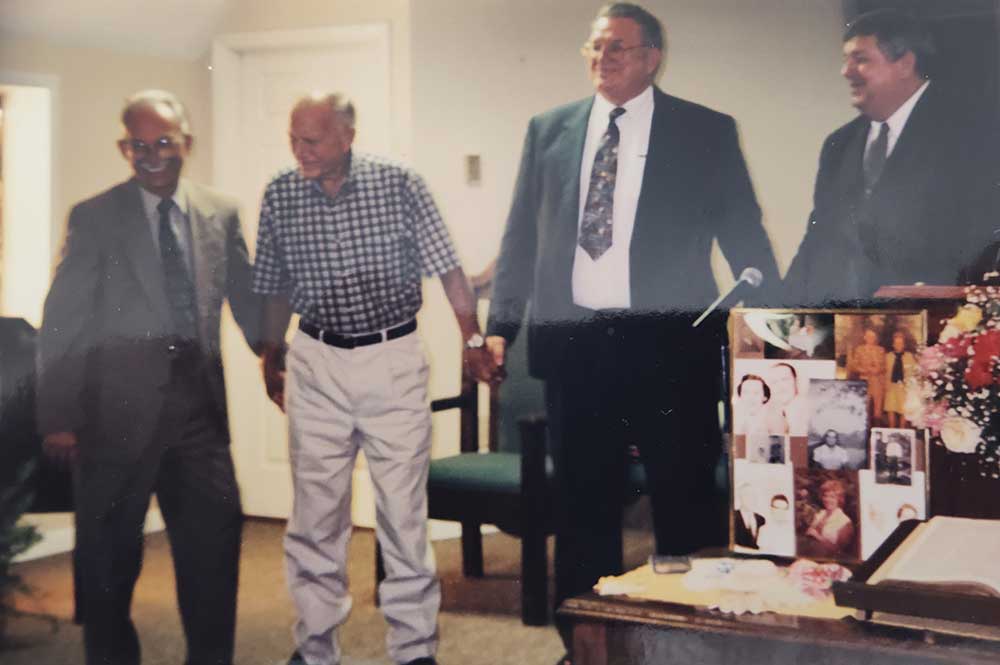
Former pastors Ted St. John, Vester ‘Buck’ Castleberry, Joe Isbell, and Ronnie Venable
In the early 1960s, the third church building was originally constructed of concrete blocks, then, some years later, faced with red bricks and crowned with a white steeple. From the parking lot, a sweep of steps led to a portico, protecting the double doors into the sanctuary.
This building was turned into Sunday school rooms when the fourth sanctuary was erected in 2002-2003 under the ministry of Rev. Ronnie Venable. This building extended over part of the parking lot and provided space for a downstairs Fellowship Hall.
The fellowship hall is named The Howard L. Savage Fellowship Hall. He and his wife, Juanita Savage, were faithful church members who were involved in the planning and building of the current sanctuary. Mr. and Mrs. Savage are remembered as always ready to participate in anything the church needed. And many other dedicated members of Mt. Moriah helped in all areas as well.
All four church buildings were constructed on land donated by Doc and Ada Tollison. Thus, their legacy lives on.
“Bro. Ronnie Venable was a faithful leader throughout the building process,” according to Redena King’s history. “Each of the churches were built by the help of the Lord and through the faithful dedication and service of men, women and youth who spent many hours working diligently to build a place of worship for all who would come and join in worship.”
Lifting up in song
In the “olden days,” to the right of today’s fellowship hall, there was a row of concrete “dinner on the grounds” tables where food was spread on special days, such as all-day singings and Homecoming celebrations.
Both Singing Schools and All-Day Sings were enjoyed by Mt. Moriah and the outlying communities. Willie Ann May recalled that Mr. and Mrs. Harden conducted Singing Schools every summer, which continued into the 1960s, teaching shape-note music, how to read it, sing it and play it. Then for several years, the yearly singing school was discontinued.
In 2021, Landon King, church pianist, reestablished the Singing School at Mt. Moriah. The school director, Tom Powell, is the grandson of G.T. “Dad” Speer, of The Speer Family gospel group. He is the director of the Alabama School of Gospel Music held the first two weeks of June each year at Snead State Community College in Boaz. His wife, Dr. Lisa Powell, also teaches in Mt. Moriah’s Singing School and at the Alabama School of Gospel Music.
Tracy Phillips, accompanist for the Mt. Moriah event, is an acclaimed pianist who has accompanied groups at Gaither Homecomings.
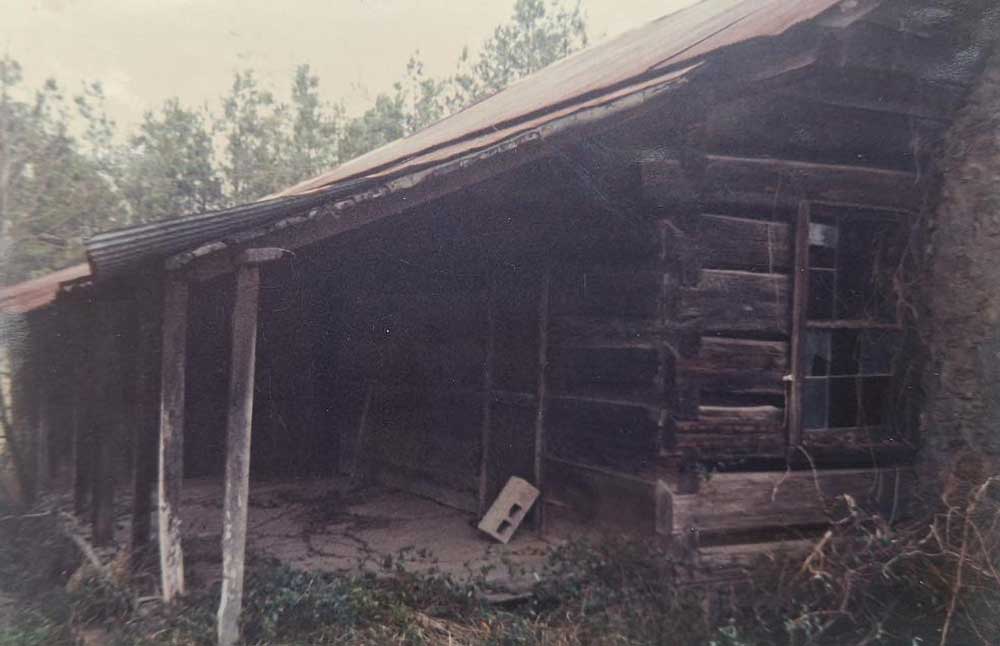
Doc Tollison’s log house
In her memories, Mrs. May recalled the joy of All-Day Singings: “…all we did was sing. Everybody was expected to get up and lead a song.”
Mrs. Voss has a vivid memory of an All-Day Singing in 1938. “We had an all- day singing and homecoming, and we had a great time. But after the singing was over, we kept talking and praying, and I found I was very much under conviction, and people began praying for me, and I was saved!”
Often, singings were announced in the local papers. In one church file are three announcements from undated and unidentified newspapers. One reads: “Singing at Mt. Moriah Saturday Night. There will be a benefit singing at Mt. Moriah Baptist Church Saturday night, January 12, beginning at 7 p.m. Special singers will be the Sonata and the Gospel Four. The proceeds from this singing will be to help pay for a singing school to be held in the county this spring. Everyone is invited to attend. Pastor Rev. Amos Sweatt, Vester “Buck” Castleberry, chairman.”
The second clipping announced the Crusaders Quartet of Anniston as special guest, and the third one reported the Lloyd Chapel Quartet as special singers.
Revival Time
Yearly revivals were standard, and Mrs. Voss recalled one in 1938. “This was the year men cut down trees and made a brush arbor for the revival in August or July … I think there was sawdust to keep the dust down. We had services day and night. At this revival, I joined the church and was baptized in Jones’ swimming hole in Coal City about where the Wattsville Post Office is now. Several others were also baptized. I think part or all of them were added to Broken Arrow [Baptist Church], including me.”
Mrs. Morgan recalled that evening revival services sometimes went on until 11 or 12 o’clock. She spoke of praying and shouting in these services. The shouting would be exclamations of “Hallelujah!” “Praise the Lord!” “Glory to God!” These joyful expressions were prevalent in both Baptist and Methodist revivals, back in the day.
Perhaps the best recollections of revival time from 50 plus years ago were those of Margie Smith Castleberry. She told of a prayer rock where the women of Mt. Moriah would meet to pray for the revival. Surely, as the women met at the prayer stone, they recalled God’s revival blessings of the past and prayed for God’s power in the current revival.
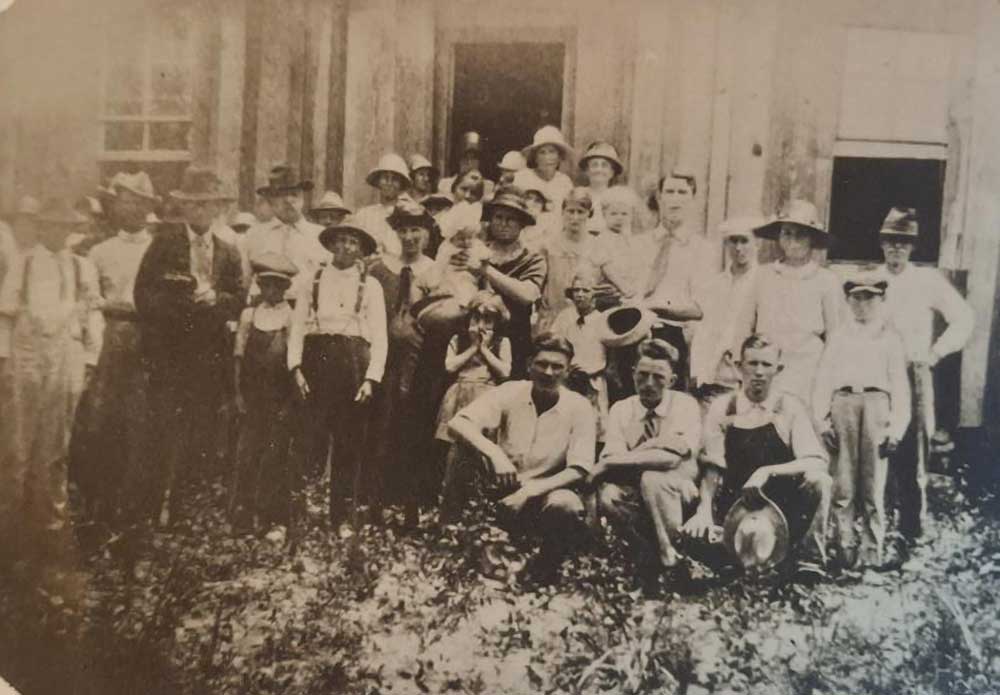
Original congregation from 1925
“The revivals would last two weeks sometimes,” Mrs. Castleberry wrote. “The women would fix lunch and dinner for the evangelist and the pastor. The revivals were always in July, when we would be in the middle of canning time, but we managed to attend every service. When we sacrificed our time, God really blessed,” she concluded.
Mrs. May recorded memories that were special to her. One occurred when Billy Walker was the pastor shortly after the second church construction. “He told all the young people that if they would come for a year without missing a Sunday, he would give them a brand-new Bible. Back then, they had a roll chart on the wall, and every Sunday you were present they put a star beside your name. I remember going every Sunday for a year, and I got a new Bible. I was so proud of it.”
Another special childhood memory for Mrs. May was the Easter egg hunt the year “Mrs. Flora Sweatt made Easter baskets out of oatmeal boxes for my sister Linda, my brother, Enis, and me.” Bought baskets were a luxury in those days when money was hard earned.
Easter and Christmas usually found Mt. Moriah’s musicians and choirs preparing to present special programs such as cantatas and musical plays and programs involving adult, youth and children’s choirs. Many church members have assisted the choirs through the years, including Joan Golden, Nora McNutt, Vicki Newton, Wanda Kelley, Redena King, Vickie Smith and other volunteers.
In their memories, two of the ladies mentioned the ordinance of “foot washing.” This was based on Jesus washing the disciples’ feet as an act of humility. In the churches who practiced this, the men and women met separately for the ceremony.
Maggie Smith Castleberry mentioned that the church observed this “ever-so-often.” Willie Ann May recalled how her daddy, Will Rowe, would participate in foot washing, told how her brothers, Jack and Buck Rowe, doctored their dad’s socks. “One time before foot washing service, they filled daddy’s socks up with soot…When he pulled off his socks to wash feet, they were black with soot.” She did admit that her daddy, “didn’t think it was very funny.”
The foot washing services Mrs. May remembered, eventually ended, but another event she remembered from the “olden days” continues today: Vacation Bible School. “I remember one summer that for Vacation Bible School Mt. Moriah got a Southern Baptist Home Missionary to come and teach our Bible School,” she wrote.
“She would go home with different members of the church each day for dinner and to spend the night.” The missionary must have been young, for she mentioned that some of the high school age boys would come to the crafts session and participate.
Mrs. King remembered Vacation Bible School lasting two weeks in the 1960s. As an adult, she participated in various areas of preparation and teaching during this community event, which today occurs in June shortly after regular school ends for the summer.
Jessie Garrison, Bro. Ronnie Venable’s aunt, taught, led and hosted Bible Drills at the church for several years. She also planned special WMU programs. Community outreach ministries occurred throughout the year – Vacation Bible School, Breakfast on 1st Saturdays, 5th Sunday night singings, Man Church on Tuesday nights, fall festival, and Youth night.
Reaching Out
Mt. Moriah’s membership in the Southern Baptist Convention’s WMU (Women’s Missionary Union) began in 1975 and remains active today. Mrs. King recalls a particular WMU meeting in 1998. “On a Tuesday night [April 7] we had WMU, and in our meeting, I asked the question, ‘How could we reach out into our community?’” She paused reflectively, and added, “I told them later that I didn’t know if I’d ever ask that question again! Because the next night [April 8], the tornado came through, and we were in this community for eight, nine, 10 weeks, ministering to the community.”
That community outreach was headed up by Bro. Ronnie Venable and his wife, Joan. The church accepted monetary donations which were later divided among community families who suffered loss in the storm. The Sunday school rooms were filled with clothing and supplies for those in need, and FEMA made Mt. Moriah Church building their headquarters.
Heather Sharp, writing for the St. Clair News-Aegis, Thursday, April 23, 1998, reported Bro. Ronnie Venable offered the church as headquarters for FEMA, the Red Cross and the St. Clair County EMA.
The article reported that Ellen Bain, the local EMA assistant, said all the agencies “…praised Ronnie and Joan for all their contributions,” and that Bro. Ronnie was “…the emergency manager. He knows how to match resources with those who need them.”
The article reported Joan as stating, “We just delegated,” but she worked right alongside the church women who cooked for the volunteers and the victims. Not only did the women serve lunches at the church, but they also delivered “go boxes” to homes and to disaster relief workers onsite. Mrs. Venable is quoted as saying, “It’s been marvelous to see everybody pull together.”
This 1998 community outreach continued when the fourth building was completed in 2003. Florence Kerr tells how the church is used today when tornado warnings are announced. “The building has below the ground space, and we open it up for the people who live in mobile homes – and I’m one of them – so, we come here. And one night, I think we had over 40 people. Different church members had brought food and stuff, and we fed them and had beverages.” Florence was recalling a tornado warning in the spring of 2025.
Celebrating Centennial
Sunday, August 10, 2025, dawned with clear skies and soon, sunshine baptized Mt. Moriah’s church building in a gilded glow, a radiant welcome to attendees who began arriving about 9:15.
Bro. Danny Wyatt, interim pastor, welcomed the congregation after which Candi Jones gave a brief power point history of the church.
Enthusiastic congregational singing included Glory to His Name, Majesty, It’s a Grand and Glorious Feeling, Getting Ready to Leave This World, The Sweet Forever, and If We Never Meet Again. The only accompanying instrument was the piano played by church pianist King and former church pianist Jason Vaughan. Their fingers danced over the keys, Southern Gospel style, more joyfully than any Saturday night stringed instruments event at Doc Tollison’s in 1925.
Bro. Zane Smith, former pastor, spoke of the church’s progress while he served Mt. Moriah. During his almost 11-year tenure, there were improvements to the sanctuary, and added outreach ministries encouraged the community. The oldest former pastor in attendance was 91-year-old Lloyd Golden, who commenedt, “I was saved in this church and was never lost again.” The church’s oldest member, 91-year-old Mona Scott, spoke about was a blessing Mt. Moriah had been to her.
The Doris Akers’ song, Sweet, Sweet Spirit, sung near the beginning of the service expressed the atmosphere in the church:
There’s a sweet, sweet Spirit in this place, And I know that it’s the Spirit of the Lord; There are sweet expressions on each face, And I know that it’s the presence of the Lord. Sweet Holy Spirit, Sweet heavenly dove, Stay right here with us, filling us with Your love; And for these blessings we lift our hearts in praise Without a doubt we know that we’ll have been revived, When we shall leave this place.
A ladies’ quartet, Nora McNutt, Vickie Smith, Redena King, and Linda Vaughan, sang I’m a Child of the King and I Claim the Blood. The church choir sang Mansion over the Hilltop and What a Great Savior Is He.
From Romans 12:1-2, Bro. Danny Wyatt preached: “I beseech you therefore, brethren, by the mercies of God, that ye present your bodies a living sacrifice, holy, acceptable unto God, which is your reasonable service.And be not conformed to this world: but be ye transformed by the renewing of your mind, that ye may prove what is that good, and acceptable, and perfect, will of God.”
Wyatt’s sobering point was that the forces of evil have a definite purpose to fill individuals’ minds with ungodly thoughts and desires – even the minds of professing Christians. Therefore, believers should focus their minds on Scripture and things of God.
After the sermon, a young lady who had accepted Christ as Savior during Mt. Moriah’s summer Vacation Bible School was baptized.
Before the closing prayer, Bro. Wyatt asked pianists King and Vaughan to play a duet. And what a duet! No doubt all 88 keys were played and replayed with chords and runs, with flourishes and crescendos of the joy of the Lord. Hands were clapping, and toes were tapping when the duet ended.
Bro Wyatt closed in prayer and a blessing over the meal to follow in the Fellowship Hall.
One can hope that God allowed those who organized the church a hundred years ago to look over the battlements of Heaven and rejoice over what God has accomplished with what He allowed them to begin when he turned their dancing into a prayer meeting and the prayer meeting into a revival and from the revival a church.
Education Foundation picks up where budgets leave off
Story by Elaine Hobson Miller Submitted Photos
Little girls dancing in butterfly costumes, their wings fluttering and their faces grinning. Children playing card games with their parents. High school students (boys and girls) using their new miter saw to cut lumber for a playhouse.
These are just some of the ways that grant money from the St. Clair County Education Foundation is helping school children, and in turn, their families. Established in 2003, it lay dormant for several years but has been revitalized by new management and new fundraising efforts. The Foundation tries to fill in the gaps when schools need more classroom money than their budgets provide.
“Our purpose is to make a difference for teachers so they can make a difference for their students,” says Foundation President Dr. Greg Cobb.
The Foundation was started by Marie Manning when she was superintendent of the St. Clair County School System. Manning now represents District Six on the Alabama Board of Education.
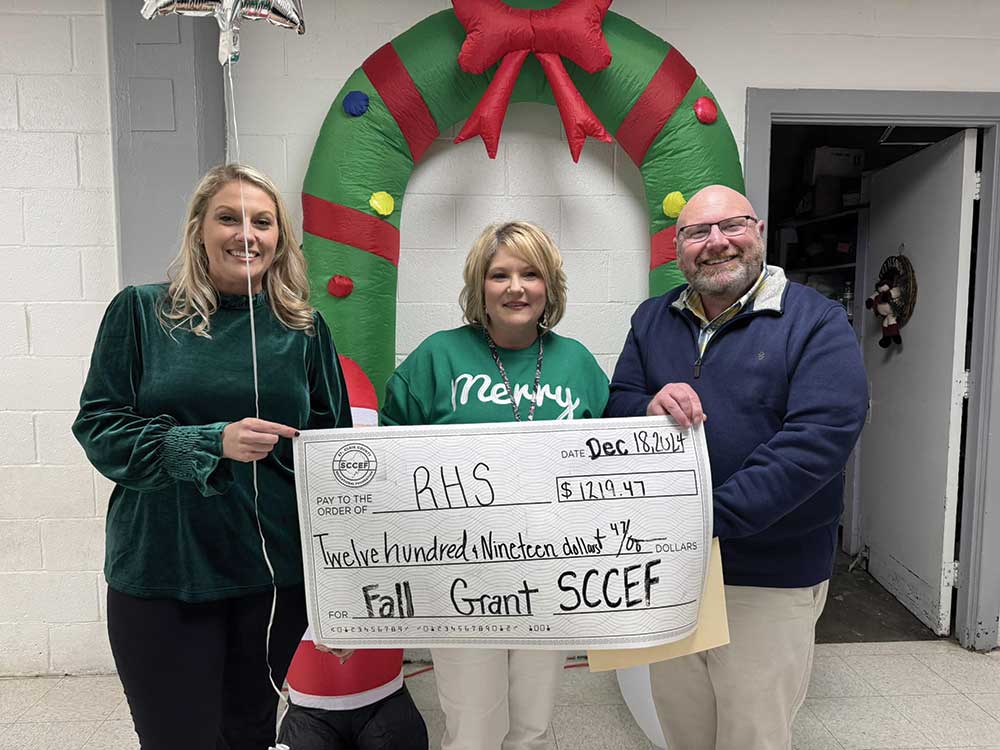
Ragland High School received one of 22 grants handed out
“We had a community education coordinator, Emily Davis, when I was superintendent,” recalls Manning, who also serves as president pro-tem of the state board. “When I hired her on, I asked her to get us an education foundation started, and she agreed, but it took a while.”
Manning retired in 2003 and believes the Foundation came to fruition in the fall of that year. “Emily called together a group of folks, including Joe Morton, past (state) superintendent, and Tom Sanders, who was (county) superintendent at the time. We chose a few officers and got incorporated.”
She says at that time funding for education was very low, the economy was not booming, and the group wanted to do something so classroom teachers could get much-needed materials in their classrooms.
After raising thousands of dollars and granting dozens of scholarships, the organization fizzled and lay dormant until 2024.
“It was stagnant for six or seven years, partially due to COVID and partially to people retiring or moving out of the county,” says Stephanie Deneke, vice president of the Foundation. “About two years ago, Superintendent (Justin) Burns wanted to get it going again.”
“I had a detailed list of things I wanted to accomplish as superintendent, and one was finding ways to help teachers in their classrooms and in being successful,” Dr. Burns says. “I noticed that the Foundation wasn’t active. When I started as a teacher in St. Clair County in 2005, it was flourishing. It provided an outlet for people who wanted to donate and know that their monies were going straight to the classrooms. So, I called Marie Manning and asked what’s going on with the Foundation. She said it had been dormant since 2017 or 2018.”
Manning gave Burns half a dozen names of people involved in the Foundation. She said Linda Crowe, a Moody City Council member and teacher at Moody HighSchool at that time, was a Foundation officer. So, Burns called her, too, and she told him she was still treasurer and was listed on the bank accounts. “We had a couple of meetings to change the names on accounts to access money,” Burns says. “There was $100,000 or so sitting there, so it took off from there. We’re still taking in money, and the Foundation is flourishing. It’s really an awesome thing to see it pick back up.”
When Dr. Burns and Assistant Superintendent Rusty St. John called community leaders together for that first meeting, they had about 30 people attending. That group elected four members to the board of directors, and Cobb as head of the organization. “Greg taught school in St. Clair County and was a principal here for years,” says Stephanie Deneke.
“We decided we needed to reboot the Foundation because its original mission of supporting teachers was still important,” says Cobb, who now works for HMH, a textbook company. “We started onrebranding the Foundation, recruiting more people and making it active again.”
With the seed money in the CDs and checking account, the new Foundation board was able to begin giving out grants immediately.
That was in the spring of 2024. “We did whole school or department grants,” says Cobb. “We were able to give $15,000 out that first go-around.”
Jaime Ragsdale, math coach at Margaret Elementary School, was one of the recipients of the first cycle. She used the money to buy math games for the 700-plus students in grades K-5 at her school. She bought zippered mesh bags and put math games in each one for the children to take home and play with their parents, then return to the school.
The bags contained decks of cards, six-sided and 10-sided dice, and foam “counters” or math manipulators. The latter are like bingo chips, flat, but made of foam. One side is yellow, the other red, and they can be tossed and counted according to how they fall.
“The whole purpose was for them to put away their electronic devices and have family times, and to encourage parents to get involved,” Ragsdale says. “We see lots of device time and less family time these days. Children are playing less and less games such as Candyland or card games, but playing games helps them with math skills, as well as teaches them how to win, how to lose and how to share.”
Dr. Cobb spoke to a group of teachers in August of 2024, explaining the Foundation’s purpose and goals, how it was being revived, and how all the money raised would be going back to them. “There are no overhead costs,” he says. “We’re all volunteers.”
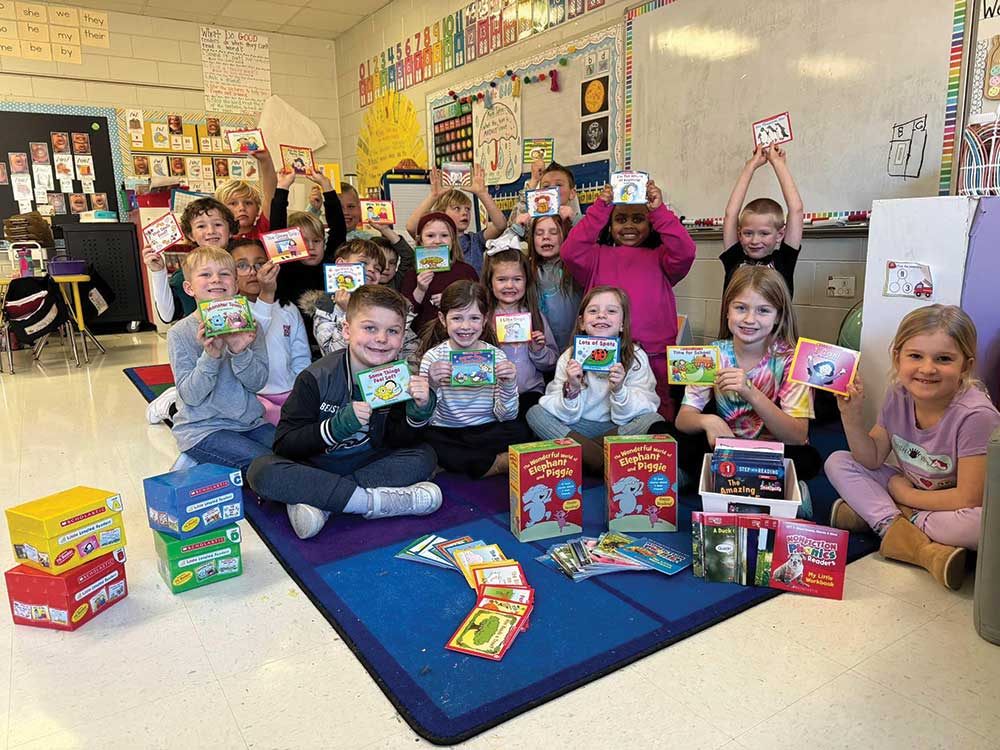
Mrs. Brasher’s class at SES showing off all the classroom materials from their grant
A few teachers started setting aside money to go to the Foundation each month, usually having it taken out of their paychecks. “That’s a little bit of a revenue stream, but not enough to count on,” Cobb says. “But we had enough from the original money raised to do a Fall 2024 grant cycle, too. We gave out $12,000 to 24 individual teachers that second round. Most of the teacher grants were for $500 each.”
A team of foundation members and educators from outside the foundation read all the 70 applications and scored them on a rubric, meaning they gave points from one to five according to need. “We call this team the readers,” Cobb says. “One teacher might ask for crayons, and that need might not be as great as a microscope for someone else, for example.”
In the Spring of 2024, officers of the Foundation presented members with the idea of an annual fundraiser. That’s how the Mardi Gras Gala, held at Mathews Manors in March of 2025, came about. Officers developed teams that put together the various parts of the Gala, such as a public relations team, a decorating team and a food team.
“We raised $30,000 at the Gala through ticket sales, sponsored tables and an auction,and we’re so proud of that,” Cobb says. “We still have some money from the original investments, too.
“We feel like our job is to make the Foundation solid enough that we can fund all the grants and not have to select certain ones,” Cobb continues. “We want to be able to grant what the teachers need.”
The Gala was such a success that the Foundation plans on holding one annually. Feedback from attendees indicated they were already excited about the next one. “We want them to put the date on their calendars,” Cobb says. “As I was selling tables for the Gala, I had several corporations say to get with them during the summer, when they are doing next year’s budget. So we learned a lot from the first Gala.”
According to Stephanie Deneke, the board hasn’t decided on the exact date for the 2026 Gala, but it will be in February. And yes, there will be another auction. “There were 45 items donated for the Gala auction this year, including Pandora jewelry, gift certificates, household items, a cooler, a tool set, Taste of St. Clair gift cards good at restaurants throughout the county, handmade knives and other jewelry,” she says.
Some 250 people attended that first Gala, and the Foundation is hoping for 325 next year. “They paid roughly $90 a ticket, a little less if it was for a couple,” says Cobb. “If someone bought a table, the bottom level was $1500. We had tables with enough seats to bring whomever they wanted. For example, I bought a President’s Table, filled it up with family and my folks. A few corporations bought tables, like Doster Construction, the company that’s working on Moody High School, and invited any employee from the school to sit there. There were eight-10 seats per table.”
Deneke says the Foundation used to “sell” chairs to raise money, wherein someone could sponsor a chair and get a plaque with his/her name on it for their business. But businesses seem to like the Gala idea better. “We may revive the chair donations anyway,” she says. “Teachers can contribute through payroll deductions, too.”
Cayla Brasher, a first-grade teacher at Springville Elementary School, received a $500 grant last Fall and used it to buy decodable readers for her class of 21 students. “A decodable reader is a phonics-based book that has words students are able to decode or sound out or figure out,” Brasher says. “It keeps them in what teachers call that ‘zone of proximal development,’ where they are having to work at reading, but don’t get so frustrated with it.”
She wanted a good variety of books that they could successfully read. “We want some times during the day when they’ll want to pick up a book and feel successful at reading it,” she says. “Decodable books follow that phonics progression. The student is able to figure out or decode words yet enjoy the reading.”
Marcus Graves, construction class instructor at Eden Career Technical Center, received a $599 grant, which he used to buy a new rigid slide miter saw with a stand. The tool is used to cut steep angles and wide boards for construction projects.
“Some of our unique projects are the oversized Adirondack chairs with multiple letters that we put on our hillside at our school,” Graves says. “The letters form words, like ‘love’ for February. We’ve turned a school bus into a camper, we’ve done a goat camper for a petting zoo at Greensport campground, tiny houses, small playhouses we’ll be selling in the Spring, and the floating duck island for Springville Park.”
Meg Lowry, of Odenville Elementary, used her Fall 2024 grant to purchase an insect unitfor her pre-K class. “The unit included live caterpillars, dress-up clothes like butterfly and bug catchers’ outfits with nets, lots of little plastic bug sets, and games like Memory, all based around the insect theme,” she says. “We actually started the unit in March, when we turned the classroom into an insect theme. We could not have done it to this extent without the grant, which was close to $700. This gave the kids hands-on activities to learn, which was very, very developmentally appropriate in pre-K.”
Deneke says the Foundation is always looking for new members from each community, especially Ashville, Springville and Ragland. “It would be great to get some members from those areas,” she says.
Editor’s Note: Anyone interested in joining the Foundation can contact them on its Facebook page. The Foundation generally meets once a month on Fridays at Odenville City Hall at 11:30 a.m. but is considering going to every other month.