Sewing Machine Mart

Story by Elaine Hobson Miller
Photos by Richard Rybka

Kathy Hymer drives up from McCalla to Springville for computer classes. Sheila Lankford drives down from Attalla for quilting classes. Both say it’s worth the miles for what they learn at the Sewing Machine Mart, a relatively recent addition to the Springville Station strip shopping mall.

“I’ve taken jelly roll race-quilt classes (so-called because the quilts work up quickly), crazy-quilt classes and a three-yard quilt class there,” says Lankford. “I love the Sewing Machine Mart.”

Hymer echoes the sentiment. “They’re great. I can’t say enough about them. I’ve taken (sewing machine) computer classes and quilting classes. Every machine I own has been purchased there.”
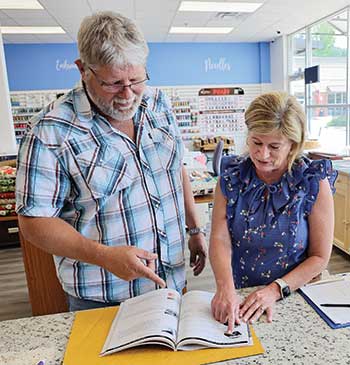
Shawn and Heidi

The Sewing Machine Mart originated in Tarrant in 1950, then moved to Homewood, where it remained for almost 30 years. Shawn Jackson, who owns the store with his wife, Heidi, started there in 1994, while he was working as a Birmingham firefighter. “I went there as a technician,” Shawn says. “I knew nothing about working on sewing machines but had always been a Mr. FixIt.” When the original owners retired In 2002, he bought the store.

About five years ago, the Jacksons moved to Gallant, and drove back and forth to their store in Homewood. “I pay attention to things and kept my eyes open for a place for the shop after we moved up here,” Jackson says. Then they got word that the building they rented had been sold and was to be torn down to make way for a restaurant.

So, in January 2022, they moved their store to Springville. “My wife shopped at stores in this mall, and we ate in restaurants around here, and one day we spotted this place,” Shawn says. “It’s where the old ABC store used to be.”

Rows and rows of liquor bottles have been replaced by rows and rows of sewing machines that do everything but talk. And some may soon do that. There are more than 40 on display, including a long-arm quilting machine and a couple of multi-needle embroidery machines.

Prices for the four brands they carry — Pfaff, Husqvarna Viking, Baby Lock and Singer —- range from $180 to $24,000.  At least one machine is wi-fi enabled, so you can buy a design online and download it to the machine. It also has a built-in electronic tablet on one side.

“It’s amazing what technology is doing with sewing machines these days,” Shawn says. “I can remember when the first embroidery machine came out. It could do a 4 x 4-inch piece of fabric, and now we have machines that can do a 14 x14-inch piece. One of our Pfaffs has Artificial Intelligence. I’m not sure what that will mean, but I anticipate the customer being able to add new features to it, and AI will learn them. That machine also has a camera and built-in wi-fi.”

He doesn’t wince at some of the high prices, comparing them to the cost of hobbies such as golf and fishing. Women sometimes come in and tell him, “My husband just spent $50,000 on a boat, I think I can spend $20,000 on a sewing machine.” He does, however, advise potential customers to have a budget in mind before they come in. “We’ll help you find the most for your money,” he says. “You may still wind up with more than you can use, but you will grow into it.”

Most of the store’s customers are hobbyists that Jackson describes as “memory makers,” turning shirts, pants, ties and tees into quilts, for example. “Probably 20 to 25 percent of our customers, though, have some type of sewing or embroidery business, often in their homes.”

He believes sewing is more than a hobby now. It’s an art form. “It’s not just about making clothes for your kids,” he says. “Your imagination is your only limitation. We have some Cosplay customers, people who dress up in costumes to play video games and do other role playing.They’ll sometimes buy clothes at the thrift store and go home, take them apart and re-make them into a costume for Comicon.”

The Sewing Mart had no space for fabric in Homewood but started carrying some when it moved to Springville. They also carry storage cabinets, sewing machine tables, cutting tables made by a local man and notions (scissors, thread, needles, etc.). “We service all makes and models of sewing machines, with a one or two-day turn-around on repair jobs,” Jackson says. “We sharpen scissors, too.”

Some of their classes are machine or software specific, so a customer can get the most out of a new purchase. They offer several quilting and sewing classes that usually take four to seven hours on the same day, and cost from $25-$150. Some come with kits, others require a customer to bring her own materials. They offer summer classes for youth when there is a demand for them, although they didn’t materialize the summer of 2023 due to scheduling problems.
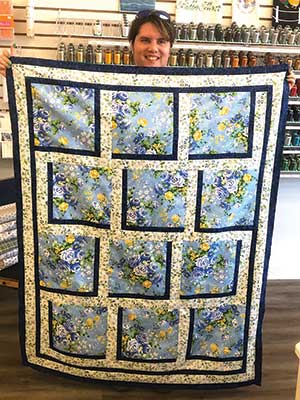
Courtnay’s quilt top

While Shawn teaches the get-to-know-your-machine classes, most others are taught by customers. Students make tote bags and cosmetic bags, learn how to bind quilts and how to do alterations. “We’re always looking for new teachers with new techniques,” Jackson says. 

Customers come from all over Alabama, including Prattville, Auburn, Wetumpka, north Alabama, and from the surrounding states of Mississippi, Georgia and Florida. “Some lived near Homewood, but moved away, while others heard by word of mouth that we work on machines,” he says.

Kathy Hymer of Bessemer bought a 10-needle embroidery machine, a serger and a Pfaff Icon from the Sewing Machine Mart. The Pfaff Icon has a built-in computer and computer tablet. “I can send patterns over the Internet directly or through my laptop, or I can use a USB stick to transfer patterns to the machine,” Hymer says.”

She uses a program called mySewnet that she purchased from Shawn and Heidi to turn designs into patterns for embroidery machines. “I’m in an RV club, and I’ve taken pictures of my friends’ RVs, put them into this program and turned them into embroidery designs that I put on garden flags for them,” Hymer says.

The three-yard quilting class was especially fun for Hymer. “We picked out three yards of fabric we liked, and the Jacksons did the cutting beforehand,” she says. “You use the same pattern as the other people in the class, but depending upon the fabric, each quilt turns out completely different. We did a quilt top, we held them up and compared them when we finished. It’s a lot of fun to see what each person has done.”  Hymer traded with The Sewing Machine Mart when it was in Homewood and doesn’t mind the drive to Springville. “I keep going because they’ve added fabric and because there’s so much more going on since they moved out there,” she says.

Lankford has made at least 10 jelly roll race quilts since taking the same class as Hymer. “I call them comfort quilts because I make them for friends and relatives who are sick,” she says. “They are about the size of a twin-bed quilt. I’ve also taken binding classes to learn how to bind a quilt after I put it together. “

A crazy-quilt class resulted in Lankford making a table runner, which her granddaughter is now enjoying while studying at the University of Alabama. “I’ve taken what’s called a three-yard quilt class, and I’ve made three of those. I’ve made jelly roll quilts for all my grandchildren, and I’ve just finished one for a friend who is special to me because he’s awaiting heart surgery. He’s a veteran, so I made it in red, white and blue and embroidered on it, ‘God Bless America.’ He told his wife it was his Linus quilt. It will be with him in the hospital.” Also, She worked on one for a giveaway on Attalla Heritage Day to benefit the Museum of Attalla.

She credits Shawn for taking care of her machines and Heidi for selling her beautiful fabric. “Sometimes Shawn tells me there’s nothing wrong with my machine, just with the ears of the operator.”


Seed + Sun

Mandy and son, Corbie, share a moment on a tractor

Story by Elaine Hobson Miller
Photos by Mandy Baughn

If you Google “poppies,” you’ll learn that poppies aren’t recommended for growing in this area (Zone 8), poppies don’t do well with root disruption, and poppies typically don’t bloom the first year they are planted.

Mandy Baughn’s poppy experiment defied all the odds and confirmed her idea to develop a flower shop by the side of the road.

That experiment began with a seed packet she picked up at a dollar store, planted in trays on her kitchen table, then transplanted into a garden bed. They survived transplantation, sent their roots deep during the winter of 2022-23, then bloomed beautifully their first season.

“I don’t know that I’ll ever be able to grow poppies to sell for many reasons, but for me, that first brave, pink poppy bloom was a sign and a confirmation that this is what I’m meant to do,” she says.

Seed + Sun Blooms, the name she gave her new flower business, involves growing a large variety of colorful flowers, arranging them into bouquets, placing them in Mason jars and selling them on the honor system in a little stand next to her house on Mays Bend Road. She charges from $5 to $40 for a bouquet, and purchasers leave the money in a lock box.

“They can take the flower jars home with them and keep or return them,” Baughn says. “Most folks return them, and some even bring me extra jars.”

She presented the idea for a flower stand to her husband, Scott, this past April. They had been on their 10-acre homestead for two years and had been tossing around ways to have it make some money. “I’ve always loved growing things,” Baughn says. “I come from a long line of green thumbs.”

She came up with this honor system, which, as she points out, isn’t the first in St. Clair County. “There are several in this area, including the Wadsworth Farm that sells blueberries and others who sell veggies. I’m a dreamer – it was my idea – my husband is the logical one. To my surprise, he said, ‘Let’s do it!’ ”

They had no tiller, no tractor and no experience in flowering farming. Then a friend explained the no-till method, where you lay a tarp down, and it kills the vegetation underneath, decomposing it and putting the nutrients back into the soil. So that’s what they did.

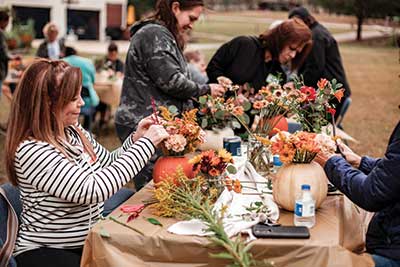
A workshop using pumpkins as vase

This growing season, the flower beds are covered with landscaping fabric, and she’s trying a gardening concept called the Cool Flower Method that a woman in Virginia named Lisa Mason Ziegler came up with. “You plant hardy annuals in the Fall, they over-winter, and do their thing in the Spring,” Baughn says. “Their roots are stronger because they survived the winter.”

In addition to the poppies, she grew sunflowers, zinnias, celosia, gomphrena, strawflowers, cosmos, marigolds, lots of Black-eyed Susans, Bachelor Buttons and more – all easy to grow, according to Baughn. “We hope to add tulips and daffodils this year,” she says. “We have 1,000 tulip bulbs and almost 500 daffodils already in the ground. We planted them during the first week of December.”

The “we” includes her husband and their two children. Son Corbie, 11, and daughter, Ellery, 9, help with the digging, planting and harvesting. “I have my own seed business, too,” Corbie says. They purchased a used tractor last November, which should help with developing the garden bed.

The whole affair has been trial and error, but has turned out even better than they had expected. “I have always grown things, but never from seeds,” she says. “I have been very surprised. I pictured people coming here just to get flowers, a destination, so to speak. But to my surprise, people in the neighborhood and passersby stop, some on their way home.”

Last year, after a late start, the stand opened in early July and closed in mid-December. Baughn estimates they sold 300-400 bouquets during that time. “Whew, that’s hard to think through and just a guess,” she says. They plan to open this year as soon as the bulbs start blooming, which could be as early as mid-February, weather permitting. “We’re hoping to have flowers at least through the end of October and maybe into November,” she says. Maybe we’ll establish a U-Pick patch with sunflowers and zinnias this summer. Obviously, everything is based on the weather.”

Mandy’s daughter, Ellery, takes her pick of flowers

The family wants to make enough money off the flower stand this year to fence their property. Then they can get some horses, sheep and chickens. “We love horses,” she says. “For three years, I taught riding lessons two days a week at RaeAnn Ranch in Moody. The kids, who are homeschooled, would go with me and had a ball roaming the ranch and taking riding lessons.”

She plans to set up a picnic table near the stand, a place for people to hang out, have a picnic, relax and enjoy the Spring and Summer breezes. “Our goal is to nurture community by building more of a community atmosphere so people can connect,” she says. “Young people are always on their phones, and older ones like to socialize. I want people to pass by and say, ‘How cute, let’s stop and sip our coffee at that picnic table.’ We may even offer coffee later. There’s a little bistro table out there now.”

It thrills her when people message her and say, “Someone gave me your flowers, and they made me feel so good. They cheered me up.” That cheers Baughn up, too.

“Flowers are a miracle of God, the way everything comes together to make them grow,” she says. “I go to the garden and know this is not a coincidence, and it strengthens my faith.” l

Editor’s Note: Follow them on Facebook

Innovation comes home

Story by Paul South
Photos by David Smith and submitted

“Businesses that grow by development and improvement do not die.”

— Henry Ford

Henry Ford, the innovator who brought us the assembly line process that produced automobiles in large numbers, knew a thing or two about development and improvement. Over the years, the company that bears his name brought America the Model A, the Mustang and the wildly popular pickup truck.

That spirit of innovation is now at work close to home at Pell City’s Town & Country Ford. A new customization facility, electric vehicle charging stations and an expanded service presence of 48 service bays mean a multimillion-dollar investment in the local economy, with more growth on the way.

In short, Town & Country – with locations in Pell City and Bessemer – has the pedal to the metal, with a new 36,000-square-foot building soon to be online.

Town & Country Dealer Principal and CEO Steve Watts calls the new facility, a customization operation and two EV charging stations, “the verification of our dream.”

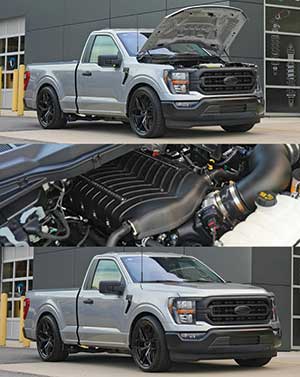
Ford truck customized all around

He and his partner, Bill Sain, brought Pell City Ford Lincoln Mercury in December 2009. It was something of a risk. The American economy was in the tank. But Watts saw something in the dealership, then in a 9,150-square-foot building.

“It was my vision that it one day could really become something. It had a lot of potential being off the interstate (I-20),” Watts said. “You know, back in 2009, the economy was going to hell in a handbasket, and we were glad that we could step in and purchase the business.”

The dealership had 19 employees back then and rented its property. Today, Town & Country  has a staff of 71 in its state-of-the art headquarters and now owns 13 acres on the blossoming Interstate 20/59 corridor.

“We’re planning to double our size and capacity and the number of people employed there in the coming weeks and months, once this new building comes online,” Watts said.

Customer demand fueled the new building, Watts said.

“Right now, we can’t get the work out,” Watts said. “Currently, we’ve got 22 service bays for our customers. When we get this thing completed by November, 2024, we’ll have 48 service bays … more than double the capacity of service.”

The customization facility will serve both electric, gasoline-powered and hybrid vehicles.

“This building is going to be a (Ford) Bronco building. It’s going to be an accessory and customization shop showroom, and it’s going to do everything commercial for emergency vehicles. It’s going to be for (internal combustion) vehicles and electric vehicles.

“I really believe Ford’s strategy for EV is appropriate because we’re not giving up on internal combustion vehicles. We’re going to continue to produce those, and for that, I’m eternally grateful.”

However, Watts is also sold on EVs. He drives a Lightning F-150, which he calls, ‘the best driving vehicle I’ve ever ridden in.”

The dealership is investing “seven figures” in dollars to construct two Level 3 EV charging stations, with more to come in order to accommodate the growing fleet of electric and hybrid cars and trucks on the nation’s highways.

These stations – with 24-hour, seven-day access – will be the first such facilities in Pell City and St. Clair County, Watts said.

The state and federal governments are providing funding to grow the number of charging stations around the country. In November 2023, for example, the state provided funding for the construction of three stations near Coosa Landing in Gadsden. Bipartisan infrastructure legislation passed by Congress provided $7.5 billion to construct more charging stations.

The new Pell City stations are expected to provide an additional economic boost to restaurants and other businesses eager to serve travelers and locals alike. The two stations were expected to go online this month (February), with plans to expand to as many as eight stations.

“If (motorists) stop to buy electricity, or stop to eat or spend the night, it drives more tax dollars. That’s a thing we’re really excited about,” Watts said. “It’s an opportunity, not only for my business and our associates, but  also for the city and the county.”

And just as Ford’s founder was an innovation pioneer at a global level, Town & Country is innovating locally, in the spirit of Henry Ford.

“We have a choice to invest in EV or not,” Watts said. “I think the strategy is going to include those as well as ICE (internal combustion engines), and I think you’re going to see a lot more hybrid.”

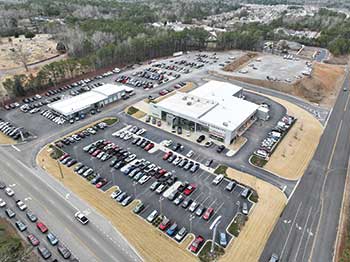
Aerial view of Town & Country’s campus

But even with the growth of EVs, Watts says they’re not for everybody.

“The more infrastructure we get – because people don’t have ‘range anxiety,’ they have ‘charging anxiety’ – the better it is. But you’d be surprised at the number of local people who’ve bought electric vehicles and love them.”

At the end of the day, even with the land, the sparkling new facility and its amenities, that’s not what’s most important, Watts said. He reflected on those early days in 2009.

“The most important thing is not the land. It’s not the building. It’s the people,” Watts said. “I’m just so honored that we’ve been able to go from 19 people to 71 and being able to double that by November of 2024,” Watts says. “That just creates a lot of opportunity for the people. We’re desperately looking for people in all areas.”

The dealership has an Asset Training Program to grow the number of automotive repair technicians. Four local high school graduates are currently enrolled in the program at Lawson State Community College. A fully trained, experienced  certified technician can earn up to $45 an hour.

“It’s really a great career path,” Watts said. “You have to work and you have to have the desire to get you there.”

He should know. The Alabama native began his automotive career as a high school student working on the assembly line at the Ford plant in Wayne, Mich., installing heater cords on Ford Granadas and moved on to auto finance and then to ownership. Two uncles owned dealerships in Talladega and Pensacola, Fla.

But Watts emphasized, it’s not about dollars or buildings or charging stations.

“My biggest and best investment is the people,” he said. “Every day, we’ve got 180 people in Bessemer and 71 in Pell City that clock out and go home. And I’m praying that they come back the next day, because without good people, we have nothing.”

Editor’s Note: For more information about Town & Country Ford, its Asset Training Program, inventory, service and employment opportunities, visit them online pellcityford.com and also visit tccustoms.com and on YouTube.

Modern Manufacturing Program takes shape

Story and photos
by Graham Hadley

Once again, St. Clair County is leading the way for the rest of Alabama when it comes to workforce development programs in public education – and Honda Manufacturing is already stepping in to help.

The John Pope Eden Career Technical Center in Ashville, working with the St. Clair Economic Development Council, is taking a lead role in the Modern Manufacturing Program, a partnership between the Alabama Works initiative and local school systems, as the state continues its efforts to boost the number of qualified manufacturing professionals.

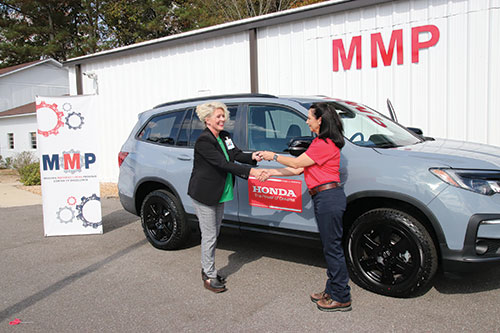
The program at is already well on its way to being another workforce development success story for the region. Now, Honda Manufacturing of Alabama has joined those efforts, donating a Honda Pilot SUV and more to MMP at Eden in late October.

“At the Honda Alabama Auto Plant we are excited about the opportunity that the Modern Manufacturing Program can provide for students and industry alike,” said Michael Gaines, division leader at Honda Alabama.

Handing over the keys

“Modern Manufacturing will provide the necessary skills for entry level manufacturing positions in our company, as well as other manufacturing companies in our region. Almost all industries in our area are experiencing manpower shortages, and this program will give students the basic skills they need before entering the workforce, helping to increase their career options, and hiring potential, while also helping local employers to fill open positions with individuals already advanced in work-based skills.”

Bob Johnson, who helms the program at Eden and a former HMA employee, expressed his gratitude to his former employer for its generosity. “The MMP program at Eden Career Technical Center is very thankful to Honda. This donation will contribute to ensuring that every student is prepared to meet future opportunities beyond high school.”

Students and guests attend the MMP presentation at Eden

And that generosity goes beyond just the Pilot. “Honda has contributed parts, materials and money and worked with the St. Clair County Board of Education to make this happen,” he said.

Jason Roberts, director of Industry and Workforce Development at St. Clair EDC, was credited with playing a key role in bringing everyone together. He said the partnership is essential to the success of the MMP program and was quick to point out that across the state, all of the major manufacturers, especially the big automotive companies – Honda, Mercedes, Toyota-Mazda and Hyundai – are stepping in to make sure the skillsets they need are being taught.

The donation is a first for Eden and for schools in the region, said Kristen Holder, executive director for Central Six AlabamaWorks. She, along with other officials, like Alabama School Board Member Marie Manning, EDC Director Don Smith and St. Clair Superintendent Justin Burns, attended the event.

“This is such an opportunity for our students,” Burns said. “I knew it would be a good opportunity when you partner with companies like Honda or Unipres, and Eden Career Tech is the perfect next step in the workforce development process. … I know this is just the beginning. Thank you for giving us the opportunity.”

Mariott TownePlace groundbreaking

Visitors staying in Pell City for so many different reasons will have another quality lodging option. Shivaay Hospitality LLC owners, Darshen Patel and Vishal Patel, broke ground on their newest Marriott TownePlace Suites at 265 Vaughan Lane today in front of a crowd of supporters Wednesday morning.

“We have been looking at the growing Pell City market for the right location and believe this is the perfect fit for our guests,” said co-owner Darshen Patel.

“Our 89-room hotel will be the first Marriott brand in St. Clair County and is located within view of Premiere Cinema’s movie theater, national brand eateries, and numerous retailers. Our guests can choose to visit those businesses or enjoy their entire stay without leaving our hotel,” added co-owner Vishal Patel.

All the rooms will have kitchenettes, and the hotel will have a bar in the lobby, free Wi-Fi, complimentary hot breakfast and a firepit and pool outside. 

“Pell City is always supportive of new investment, but this new hotel will give more people a chance to see and visit all the great things we are accomplishing here. It will also help support the numerous manufacturers we have by providing another place for their executives and team members from out of state a comfortable stay while on business in town,” said Bill Pruitt, mayor of Pell City.

“Planning, constructing and opening a new $12 million hotel is not an easy task. I want to thank Mayor Bill Pruitt, the City Council and City Manager Brian Muenger for being so supportive during this process. I believe they will be very happy with the location,” explained Darshen Patel.

Stan Batemon, chairman of the St. Clair County Commission, echoed his support, “As our county continues to market tourism events in and around our community it is important to have a variety of well-known hotel brands to offer. I believe the word is getting out on what our community offers, and these gentlemen have made a great decision in investing in St. Clair County. We look forward to continuing to support them.” 

The new hotel is expected to open in the beginning of 2025 and is expected to have 20 employees.

Union State Bank celebrates 120 years

Story and photos
by Carol Pappas
Submitted photos

When Emily Norris heads to work each day, it’s like returning to a home she never left. She grew up coming to Union State Bank, where her mother worked as a teller.  She held her first job there at age 15. In college, she worked there around her class schedule.

As Union State celebrates its 120th anniversary, Norris is now a vice president and represents a new generation at Union State, continuing the legacy of St. Clair County’s oldest community bank.

“It’s like family,” she said. “My great-great grandparents banked with Union State Bank as far back as the early 1920s, and my mother has worked here for the bank for 40 years, so it means a great deal to carry on the legacy here at Union State Bank.

“Union State hired me when I was in high school. I was able to come to work after I finished my classes for the day.”

After high school at Gadsden State Community College, she continued her work at the bank until graduation magna cum laude with a Business Marketing Degree. She went on to graduate from Alabama Banking School located at the University of South Alabama. “I feel as though I gained so much insight about the banking industry during those years,” she said. After working in the banking field at another institution in Birmingham for a few years, she returned ‘home’ – to Pell City and Union State Bank.

“I have so many fond memories of growing up and coming to this bank as a kid. I have enjoyed learning from and working for Mr. Reed,” she said, referring to Reed Alexander, the bank’s CEO. “I am thankful for the potential he saw in me as a teenager, investing in that potential and allowing me to grow as a banker through the years.

“It has just always been like a family here,” she added, citing a group of encouraging mentors over the years – Wayne Adams, David Jackson, Dorothy Golden and Chuck Truitt. But she credits her mother as her most valued teacher. “She has always instilled a good work ethic and to always have a passion to do my best at whatever I’m doing.”

She has apparently learned her mother’s lessons well, now serving in leadership at the bank she worked in as a teen.

And the bank’s deeply rooted history in the community makes her role even more special, she said. “It is an honor to work for a bank that has such a long history here in Pell City. I love working, living and serving in the community where I was raised. Knowing that you are investing back into your community makes you feel good about what you are doing and the lives you touch through it.”


Union State: A storied History

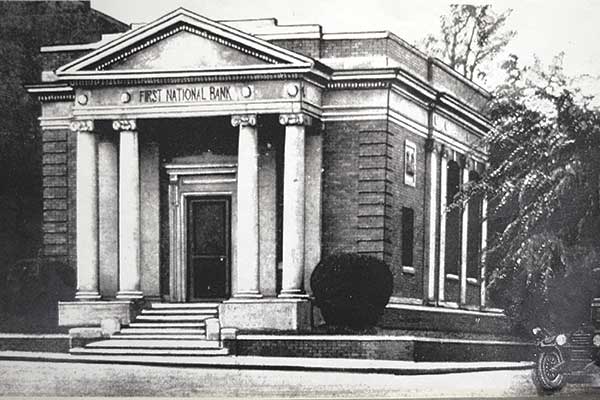
The year was 1903 when a group of businessmen, led by J. Fall Roberson Sr., joined forces to form a bank to serve future businesses and citizens of Pell City and St. Clair County. It formed under the name of Bank of St. Clair County and today, it is the county’s oldest successful bank – Union State Bank..

Sumter Cogswell, credited with founding Pell City, served as president with directors McLane Tilton, E.J. Mintz, Arthur Draper, J. Fall Roberson of Cropwell, J.H. Moore of Coal City, Frank Lothrop of Riverside, and Lafayette Cooke, the entrepreneur who built the Cook Springs Hotel and for whom Cook Springs is named.

In 1910, the bank received a charter to establish itself as a national bank and changed its name to First National Bank of Pell City.

The original bank was located on the corner of Cogswell Avenue and 20th Street and was built at a cost of $20,000. It was later demolished. The name changed again in 1918 to Union State Bank, and it operates under that name today.

A driving force in the bank’s success was Gloria V. Roberson, who served as chairman and CEO of the bank from 1964 until her death in 1999.

The family would continue in her footsteps. Her nephews, Reed and Rex Alexander, have been at the helm continuing the leadership. Reed Alexander is CEO and board chairman; Rex Alexander is president; Reed Alexander Jr., vice president, lender; David Alexander, vice president, lender; Chris Alexander, vice president, brokerage manager and Drew Alexander, president, Union State Insurance.

A dedicated corporate citizen, Union State has been involved in a number of civic endeavors, most notably providing “seed money” to help create the Pell City Schools Educational Foundation in 1992 and endowing the first “Chair of the Foundation,” which represented a gift of $10,000. The chair was dedicated in 1994.