
Mustang Museum of America

St. Clair celebrates an automotive icon

Story and photos by Graham Hadley

The Mustang Museum of America is celebrating the one-year anniversary of its opening in Odenville and cementing its place as a regional go-to attraction for automotive enthusiasts from around the country.

It joins the likes of the Barber Motorsports Park and museum in Leeds and the International Motorsports Hall of Fame in Talladega County.

For many automotive enthusiasts, two car lines have dominated the highways in America.

One of them, the Chevrolet Corvette, has had a museum all its own in Bowling Green, Ky., for years.

Now, thanks to the efforts of one family and backed by local businesses and the City of Odenville, that other car, the Ford Mustang, has a museum right here in St. Clair County.

Housed in a huge steel climate and humidity controlled building, the Mustang Museum of America opened March 17, 2019, on Forman Farm Road in Odenville, and since then, the expansive attraction had been drawing hundreds of fans of Lee Iacocca’s famous Pony Car from across the country.

The museum is the brainchild of Robert Powell, who says, “I had been thinking about a car museum for 15 years” and finally decided to make it a reality.

Powell, who had been working for Progress Rail, was nearing retirement — which he officially took Feb. 1 — and started putting the pieces in place about five years ago.

“With the collection of Mustangs I had put together, and the help of my two sons and their cars, we started to figure out what we were going to do,” Powell said.

It was a natural move for Powell — he had been the president of a local chapter of the Mustang Club of America in Tampa, Fla. Even back then, they were thinking about the possibility of a museum.

Powell grew up in Alabama. In fact, he saw his first Mustang at a gas station in Odenville as a teen. “I thought it was the most beautiful car ever put on the road. I was in high school, so of course I could not afford one. But I started following the line. Back then, I would get together on weekends with my friends in high school, and we would drive around looking at car dealerships to see what they had on the lots.”

When work brought him back home from Florida, he and his wife and sons only thought it would be natural to open the museum here.

“We think this could be an anchor attraction for North St. Clair County,” he said. “I moved here when I was 6. I grew up here, went to school here. St. Clair has been good to us. We feel a loyalty to this area.”

With the support of local civic leaders and business owners like Lyman Lovejoy, Powell unveiled his plans for the Mustang Museum of America during a special community meeting in mid-2016. They had already procured the necessary property, were starting on plans for the building, and between Powell, his wife, Carolyn, and sons Jonathon and Gary, already had upwards of 70 Mustangs in their personal collection.

Plans called for the museum to house between 100 and 120 Mustangs — a number they are already close to reaching with 102 cars on hand. “We want to have one of every model year through 2015, plus a police car version from every state that used them,” Powell said.

Thanks to the generosity of collectors and organizations dedicated to preserving Mustangs, who have either loaned the Mustang Museum cars or donated them outright, there are only a few gaps in the long rows of cars on display where they are still missing models.

And alongside the standard models are a number of specialty cars of historic note, including the Mustang test bed used to benchmark the SVO Mustangs. It is one of the compact, slant-fronted Fox bodies that marked the return of the Mustang as a dominant force in American automotive manufacturing in the late 1970s and early 1980s.

That car looks rough, but Powell says that is part of the history of the test vehicle. “I wanted it left this way. It is part of what makes the car unique. This is the standard Mustang that they ran against the SVOs in tests to see how they performed.”

They also have the Fox-body Mustang Ford sent to California to be used to test the viability of Mustangs as police — and much more commonly, state trooper — cars. That test eventually opened the door for states across the country to adopt the Mustang as a go-to law-enforcement interceptor vehicle.

Other cars that were limited runs to promote brands, pace cars and race cars are also part of the collection.

And though there was a time when many die-hard Mustang fans would not admit that Ford’s smaller Mustang IIs were part of the Mustang family, the museum boasts a large collection of those, too. And that includes some of the sporty models that were seen on TV shows, Charlie’s Angels in particular.

Times have changed, Powell said, and most Mustang enthusiasts now consider the Mustang IIs as part of the Pony Car family, with a number of people who specifically seek out and restore them, helping with the museum’s collection.

In addition to the cars, the walls of the museum are adorned with advertising, magazine articles and other art – even an original, full-size billboard – that tell the story of the Mustang.

“Lee Iacocca had to really fight to get the Mustang built,” Powell said. Ford had just taken a big hit with the failure of the Edsel, and when Iacocca said, “We need a new car line,” he was told he must be crazy. But Iacocca, who passed away in 2019, was known for his dogged determination, and the first Mustang was built — the 1964 1/2 model. The official launch of the 1965 Mustang would be Ford’s most successful roll-out since the Model A.

The museum is a non-profit effort overseen by a seven-member board of directors. Powell serves as the managing director. His son, Gary, is the manager, and his other son, Jonathon is the assistant manager.

Powell admits it has been a learning curve for him, his family and everyone else involved in the project, but their hard work is paying off.

Visitors from around the country are making their way to Odenville, some just go a little out of their way while passing through the area, others as parts of organized car clubs and similar events. They even had a Honda Goldwing motorcycle enthusiast club make it a point to put the museum on one of their routes.

That is exactly how Powell had originally envisioned the project – not just as a museum, but as a venue with large outdoor spaces and plenty of parking to host crowds and bring events to St. Clair County.

He also readily admits the business they are seeing now is just a small part of what the museum can mean to the community. They did a soft opening and have gradually been seeing business ramp up as word gets out about the museum, something Powell says will be key to its success.

And he was quick to point out that they are part of a much bigger picture – drawing motorsports enthusiasts to the region. Races at the Talladega Superspeedway and events at Barber Motorsports Park are part of that draw, especially since both of those tracks also have museums on site, with more on the way at Barber.

Powell said the people at Barber have been especially helpful.

“When I first started thinking seriously about doing this, I talked to the people at Barber, and they were very supportive,” he said. They have even talked about creating a regional motorsports museum pass to cover several of the museums on one ticket.

His sons have been bringing some of their cars to events at Barber and reached out to the venue for guidance and the possibility of cross promoting their attractions. The response and support have been more than Powell ever could have expected, he said, lauding them for taking the big-picture approach to making the museums and tracks regional and national attractions.

Other local businesses, like BEI Electronics and Graphics and SVP are also important parts of the community effort that have made the museum possible, helping with paint or custom decals to return even the most worn-out Mustang to original condition. Powell tries to keep cars in as close to original condition without restoration as possible, but some vehicles need a full bumper-to-bumper rebuild before they are suitable for display.

The Mustang Museum of America is open Thursday through Monday, 9 a.m. to 6 p.m., but Powell said they will open pretty much any time to accommodate visitors; they just need to call ahead and let them know they are coming. l

Keep up with the Mustang Museum of America online

mustangmuseumofamerica.com

and follow them on Facebook
Greasy Cove General Store

This is their grandfather’s store … and more

Story by Scottie Vickery
Photos by Kelsey Bain

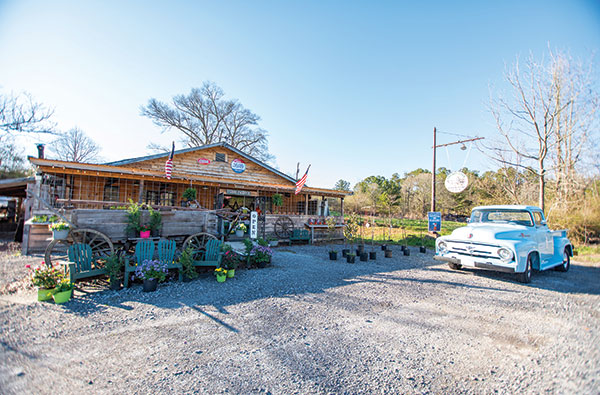
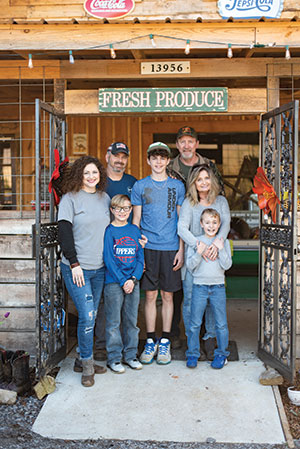
Andrea and Bubba Reeves grew tired of the rat race, so they decided to build their future on the past. The couple, who live in the Greasy Cove community of Gallant, recently reopened the store that her grandfather, Jesse “Junior” Smith, ran for decades.

In the six months it’s been open, Greasy Cove General Store has once again become the place where neighbors can catch up on news, buy milk or eggs and find a sense of belonging. 

“This doesn’t feel like a job to me, it just feels like home,” Andrea said. “We’re bringing family and community back together. We have a lot of people who come in and get teary-eyed and emotional because they have so many memories from when they were young and used to come in.”

Andrea knows how they feel. Her grandfather, who always gave her a cold drink in a glass bottle and a Zero candy bar, closed up shop in 2015, about a year before he died. Bringing his store back to life has been even more meaningful than she expected. “I can imagine him sitting here and me and my brother running around when we were kids. Everyone comes in and says, ‘Your granddaddy would be so proud of you,’” Andrea said and grinned. “I think he’d be mad I messed with his store.”

While there are many nods to the past – the original pine floors have been restored, the old checkout conveyor belt serves as the lunch counter, and old cash registers and oil cans are part of the décor – there have been many changes, as well. For starters, the Reeves changed the name from B&B Grocery, which it had been long before Andrea’s grandfather took it over, to better capture the eclectic mix of merchandise they’ve offered since opening last September. 

A little bit of everything

“We try to carry something for everyone,” Bubba said. There’s produce, including oranges, apples, tomatoes, cabbage, rutabagas and 3-pound bags of peanuts. They’ve got the basics covered, as well, stocking items like Amish butter, hoop cheese, bread, corn meal, sugar and coffee. There’s also a line of jams, jellies, syrups, salad dressings and pickled foods that carry the Greasy Cove General Store label.

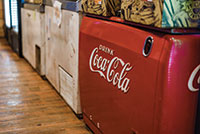
You’ll find gift items – many handmade – including jewelry, soaps, paintings, leather goods and wooden trays, puzzles and crosses. They carry typical convenience store items, like chips and candy bars, as well as a mix of the old, including Circus peanuts, wax bottle candies and old-fashioned stick candy. Antique coolers are filled with glass-bottle drinks, including Coca-Cola, Sprite, Pepsi, Dr. Pepper and Grapico, and there are canned drinks, orange juice, buttermilk and bottled water.

Merchandise in the parking lot changes with the seasons. Fall mums, hay bales and pumpkins gave way to fresh-cut Christmas trees, wreaths and garland that Bubba brought back from the “World’s Largest Christmas Tree Auction” in Pennsylvania. Spring bedding plants, hanging baskets and herb and vegetable plants are making an appearance, and furniture such as Adirondack chairs, rocking chairs, porch swings and Bubba’s handmade cedar tables have been a huge hit with customers.

“If we can save someone a trip into town, we want to do it,” Andrea said. “This has been a tremendous leap of faith. We just jumped in with both feet and haven’t looked back.”

The Reeves aren’t exactly sure how long the store, which changed hands several times before Junior took over, has been a fixture in the community. Some say the original store opened in 1939; others say it dates back later than that. It’s been part of Andrea’s family history, however, since 1980 when her father, Carl Smith, started working there part-time as a high schooler, pumping gas, changing oil and fixing brakes.

 A year later, the owners put it up for sale. “I talked to Mom and Dad about buying it, and they co-signed with me on the loan,” Carl said. He planned to run the place himself, but his parents wanted him to finish school. He continued to work there after school and during summers until college beckoned, and his dreams began to change. “I’m kind of a wanderer, and I like to go and do,” he said. “If you’ve got a store, that’s not going to happen. Dad was content being out there at the store, so I kind of left it with them.”

The store soon became Junior’s baby. After retiring from the Navy, he did some “truck farming,” growing produce and selling it in Birmingham-area farmer’s markets, so it was a natural fit for him. “My dad was the kind of person who didn’t meet a stranger,” Carl said. “You’d stop in the store and by the time you got ready to leave, you were one of his best friends.”

Under Junior’s care, the grocery quickly became a gathering place for the “old-timers,” who swapped stories and tall tales, Andrea said with a smile. “If Granddaddy didn’t know the whole story, he made up the rest of it. Before there was Facebook (and pages like) What’s Happening in Gallant and What’s Happening in Ashville, it was ‘What’s Junior got to say?’”

Chances are, he’d be proud that Andrea and Bubba chose a family-centered lifestyle for themselves and their three boys, Eli, 14; Casey, 12; and  Colton, 8. They weren’t thinking about the store until Carl broached the subject. “It had been sitting empty, and it needed to be torn down or fixed up before it fell down,” said Carl. “I asked them if they wanted it.”

Bubba, who grew up on a farm on Straight Mountain, was working full-time for Carl, who now owns a machining and fabricating company. He was also farming on the side, running his produce stand in Ashville and longing for a simpler routine. “My whole life was flying away, and I wasn’t getting to enjoy it,” he said. “People are in too big of a hurry nowadays, and sometimes you just need to slow down.”

Andrea, a registered nurse, had worked for a hospital and rehabilitation facility and felt like she was missing her sons’ childhoods. “By the time we’d get home, they’d already told someone else about their day and didn’t want to tell it again,” she said. While they’d planned for Bubba to run the store while she continued working, she quit her job two days before it reopened.

“We’re happiest when we’re here,” she explained. “My kids get off the school bus here just like my brother and I did. It’s one of those things you just hope God will make a way for you, and He did.”

Labor of love

The community shared their excitement. “We started cleaning it out by the truckloads and people were stopping by and saying, ‘What are you doing to Junior’s store?’” They also shared their memories with the family, recounting the store’s many lives. “It’s been here since my Dad was a kid,” Carl said. “It used to be right up the hill, but when they built Gallant Road, they rolled that building down on logs and turned it to face the new road.”

Although he eventually quit selling gas, Junior didn’t make many changes to the store. “It was in bad shape,” Andrea said. “We pretty much gutted it and took it to the studs.”

Bubba, who also has a background in cabinetry and custom woodworking, rebuilt the walls with wood from fallen trees and added the front porch that houses produce, furniture and sleds. He built the front counter and the bathroom vanity and covered the ceiling in old tin that came from the roof of Junior’s mother’s house.

Antique wagons are used to display merchandise both inside and out. The original bottle opener is attached to the new counter, and an old door featuring handwritten party line phone numbers of neighbors, the Post Office and the Sheriff’s Department is propped nearby. An old corn-husk hat made by Andrea’s great-grandmother is framed and hangs in a prominent spot. “There’s a lot of history in this place,” Bubba said.

While Andrea and Bubba are happy to honor the past, they want to create new memories, as well. After paintings by Andrea’s mother, Cindy Smith, flew off the shelves, she began offering painting classes a few times a month. “When the ladies leave here with their artwork, they feel so accomplished,” she said. “It gives them a good two hours to come and visit and forget their troubles.”

Andrea, who is also a licensed cosmetologist, has been known to give a haircut or two in the front yard, and now they plan to update Junior’s fishing shack to make it a regular offering. They’ve hosted community events like Christmas in the Cove, complete with Santa, bluegrass music, arts and crafts, cookies and hot apple cider. They also have plans to open the kitchen and start serving soups, deli sandwiches and burgers soon.

Although she and Bubba have been fighting over who gets to do the cooking, Andrea isn’t sweating the details.

“We’re just going to wing it like we’ve done since this whole thing started,” she said. “This has been such a blessing, and the community has been so supportive. We’re loving every minute of it.”

Attention: Women Working

St. Clair women blaze trails
in male-dominated fields

Story by Elaine Hobson Miller
Photos by Kelsey Bain

The year 2020 marks the 100th anniversary of the passage of the 19th Amendment to the U.S. Constitution, the one guaranteeing women’s right to vote. It could also be the year that the Equal Rights Amendment, which guarantees equal legal rights for all Americans regardless of sex, becomes the 28th amendment.

While legal experts debate the uncertainty of the consequences of Virginia’s ERA ratification years after the original deadlines, along with the recisions of five other states, a couple of trailblazing women here in St. Clair County continue doing their jobs in male-dominated fields without concern for equal treatment.

In fact, Stephanie Foster, St. Clair’s first certified female school bus mechanic, and Belinda Crapet, the City of Springville’s first female police chief, say they got where they are with the help and encouragement of their male counterparts. For them, equal rights have never been an issue.

“The mechanics here (at the Pell City Schools bus shop) encouraged me to take the certification test, and they keep telling me I can do this,” Foster says. “Other mechanics sometimes make derogatory remarks at conferences and mechanic classes, but no one at the shop does.”

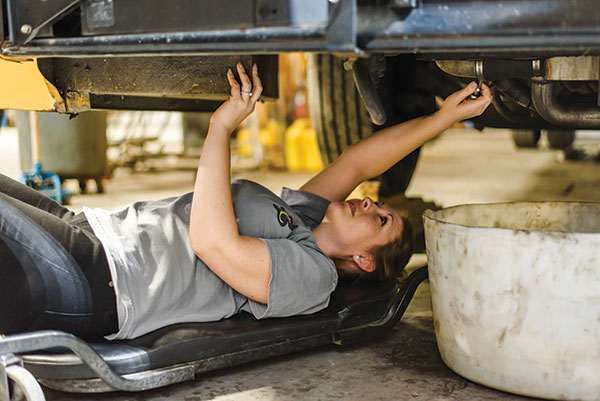
Foster, the second woman in the state to earn a school bus mechanic certification, is shop assistant for the Pell City Schools Transportation Department. Her primary job is behind a desk, where she handles morning dispatches and deals with parents calling about kids missing buses and drivers calling about fights among students.

She checks images that are captured from security cameras and sends digital copies to the Police Department when a video shows a driver not stopping while a school bus is loading or unloading. Occasionally, she fills in as a bus driver. A big part of her job is ordering parts, and being a certified mechanic comes in handy for that.

“Before, when a driverreported a problem, I had to get a work order to a mechanic, he would look at the bus, then a lot of times, I had to call a parts manufacturer for a diagram of the area where the problem was. Then the mechanic would identify which part was needed from the diagrams, and I would place the order,” she says. Now, she looks at the bus and diagrams, which she keeps on file, and determines herself which part to order. “It’s much more efficient this way,” she says. “The quicker we can get that bus back on the road, the better.”

She has been with the department since 2013 and was certified in January of last year. “You have to work in a shop five years before you can take the certification test,” she says. The three-part exam included an on-site, hands-on portion that involved a state instructor “bugging” a school bus. Foster found nine of the 10 changes the instructor made to the vehicle. “I missed the easiest one — the oil dipstick was missing,” she says.

Although she knows a piston ring from a push rod, shecan’t rebuild an engine. But she is familiar with all its parts. She helps with the state-required monthly bus inspections, hooking her laptop to the bus to find what’s causing engine lights to come on. She replaces fluids, light assemblies and switches. She is qualified to replace brake chambers, hazard and turn signal switches, and one of the most common problems in school buses — door switches. “They tend to break a lot on our new buses,” she says.

Drivers have to do safety pre-checks before each trip, mornings and after school. If they hear air escaping, or the air pressure gauge shows it isn’t building enough pressure, they know there is a leak. “I got certified because I wanted to be able to walk out to the bus and know what it is that’s leaking, not just say we have an air leak, but to tell them it’s the right rear brake chamber of a door that’s leaking air, for example,” says the 2010 graduate of Pell City High School. “Safety is important to me, and I wanted to make sure when I talk to our mechanics that I know what I’m talking about. I wanted to speak their language.”

The 27-year-old has always liked taking things apart to see what was inside and to learn how they worked. Her interest in mechanics developed as a teenager, when she hung out with her best friend, Patrick Ferguson, who worked on race cars, four-wheel drives and rock crawlers. “I was his sidekick, and he taught me a lot,” she says. She worked at Advance Auto Parts in Pell City and Leeds for two years, then as a painter’s prepper in a body shop.

Her husband, Joshua, paints vehicles for a living. The couple has two children. Their son, 7-year-old Tristan, thinks it’s cool to hang out at the shop with Mom each morning while awaiting his bus ride to school. Five-year-old Emma has shown no signs of following in Foster’s footsteps.

Kristy Lemley, shop secretary, was impressed when Foster did a road-side repair on a recent trip. “We were taking two buses to Transportation South, a bus dealer and repair shop, and the air line going to her seat busted,” Lemley said. “It made a loud noise, and Stephanie jumped. Then she hopped out of the bus, looked around and found the problem and fixed it. We went on with our trip.”

“They were air-ride seats, and mine dropped to the floor,” Foster recalls. “I couldn’t have driven the bus like that.”

 “She doesn’t give herself enough credit,” says Lemley. “She can do my job, her job, the supervisor’s job and most of the jobs of our mechanics.”

Justin Turner and Greg Davis, the other two shop mechanics, spent a lot of time helping her prepare for the state exams.

“Without those two, I would not have made it through the test,” Foster says.

Davis says he and Turner “think the world of her” and that she has been a definite asset to the shop. “If just any woman had come up to me and wanted to be trained, I would have had reservations, but I knew Stephanie’s character,” Davis says. “She has always been wise beyond her years and driven to be successful at things she does, so I had no qualms about showing her how to become a mechanic. She’s a bulldog, and when she gets something into her head, she does it. Those qualities are hard to find in any gender these days.”

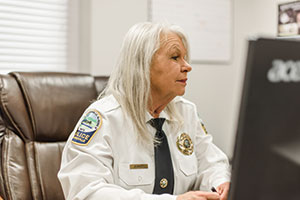
This woman answers to ‘Chief’

Belinda Crapet Johnson has those same “git-‘er-done” qualities. She didn’t grow up wanting to be a police officer. She stumbled into law enforcement for lack of something to do and discovered her true calling. “My youngest child was in kindergarten, and we lived across the street from Moody City Hall,” says Crapet, who uses her middle name professionally. “I walked over to see whether the city was hiring. I got a job as part-time dispatcher. I was trained on the job.”

As a dispatcher, she would take a call, then send an officer to investigate. “I often wondered what happened on those calls,” she says. That curiosity led her to attend the Reserve (Weekend) Police Academy in 1992. “They don’t change anything in the academy because you are female,” she says. “Physical agility, firearms, all of the requirements and tests are standardized.” She prepared herself for the physical demands of the academy by running to get into shape.

 Sometime during the early 1990s, central dispatch came into the county, eliminating her job with Moody. She went to work in the county probate office. She had already finished the academy by then, so when Moody had an opening for a police officer, she joined the force.

“I was was there six or eight years and was one of the first school resource officers in that city,” she says. “This was around the time of the Columbine (Colorado) school shooting.” She was a police officer in Odenville from 2001-2008, served briefly on the Ragland police force, then went to Springville in 2010. “I started as a patrol officer, was promoted to investigator, then I was appointed chief in 2018,” she says. “I had the rank of sergeant in Odenville but was hired as a patrol officer here.”

Although she’s the first female police chief for Springville, Crapet is quick to point out that she isn’t the first woman police chief in St. Clair County. “Branchville has had two women police chiefs, Wendy Long and the late Joann Lowe, and Argo has had one, Rebecca Downing,” she says.

According to a recent article by the Associated Press, only five of the nation’s 50 largest police departments are led by women. A 2013 survey by the National Association of Women Law Enforcement Executives showed only 169 women leading the more than 1,500 law enforcement agencies across the United States that responded to the survey. A 2018 survey reported by Statista, an online business data platform, said only 26.7% of law enforcement officers are female. Springville has two females out of 11 officers, including Chief Crapet.

Even though she’s the chief, Crapet doesn’t wear a full or Class A uniform all the time. “That’s for dress-up,” she says. She usually works in a Class B uniform, which consists of a Polo-type shirt and black or khaki pants. Her five children grew up seeing their mom in a police uniform, but her eight grandchildren and two great-grands are still getting used to the idea.

“The grandkids don’t usually see me with gun and badge,” she says. “One day I walked into the house of my 3-year-old grandson in full uniform and he said, ‘Nana, what are you doing?’ I said, ‘I’m a police officer.’ He just looked at me.’ Another grandchild had to do a history project and chose female law enforcement officers in Alabama as her topic.”

As for how she would feel about one of her grandchildren going into law enforcement, she says she would support her — or him. So far not one has expressed an interest in it. “I was school resource officer at Moody High School when my kids were there,” she says. “That was awkward for them.”

 Her job requires a lot of administrative work in her office at City Hall. That office could best be described as “executive unisex.” A four-month dry-erase calendar hangs on a wall behind her large desk. “A Policeman’s Prayer” banner hangs on another wall, alongside a painting of rocking chairs and an American flag on a country front porch. Facing the desk is a flat-screen television hanging next to a Back-the-Blue wreath. A vacuum cleaner sits next to a coffee pot.

Theoretically, Crapet only has to spend 40 hours per week in her office or in her unmarked patrol car. Realistically, she is on call 24 hours a day. She doesn’t get called out much in the middle of the night, though. “I had to go out more when I was an investigator,” she says. “My husband hardly knew when I was gone.”

She likes getting out of the office, talking with business owners, their employees and people on the street. She wants them to know she cares. “I go to school events, too,” she says. “I’m best at community relations. I love that and working with children.”

Frank Mathews, a police investigator for Springville, has known Crapet for 17 years. “She’s a great chief, she’s doing an excellent job,” he says. “It’s the experience she has behind her that makes her so good. She’s been there, done that. She has come up through the ranks. Blue is blue — male or female.”

Springville Mayor William Isley says he recommended Crapet to the City Council upon the recommendation of former Chief Bill Lyle when Lyle retired. “She wears the hat well,” he says. “She works hard to retain the officers we have and makes sure they stay up-to-date on all their certifications. I’m impressed with her. She’s in a male-dominated profession, but this lady has walked into it and stood tall. She demands the respect of all who work for her. I fully support her in all she does.” Crapet says she and Cathy Goodwin, a lieutenant with the St. Clair County Sheriff’s Department, have been around longer than any other female law enforcement officers in the county. “I’ve got 29 years of service, 25 of them on the street,” she says. In all that time, she has caught no flack about being female, neither from fellow officers nor from people in the communities in which she has served. “I’ve had a lot of good mentoring from male officers through the years,” she says. “I’ve seen a lot of women come and go. I’m still here because I’m just stubborn. When you come into this field, as long as you realize you are held to the same standard as male officers, you will be fine.”

St. Clair Tourism

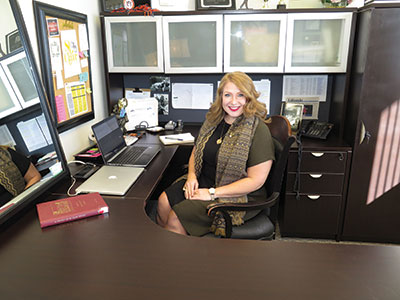
Blair Goodgame promoting county in new post

Story by Leigh Pritchett

Photos by Graham Hadley and submitted photos

Blair Goodgame has been to 15 countries spanning four continents.

Though she relishes traveling, she tends to share Dorothy’s sentiments in “The Wizard of Oz”: “There’s no place like home! There’s no place like home!”

Enjoying the place she calls home … and encouraging others to do so … is what Goodgame does on a daily basis.

In September 2019, she became tourism coordinator with St. Clair County Economic Development Council (EDC). “It is a brand-new position and program, part of the EDC’s five-year plan, Partnership for Tomorrow,” Goodgame said. “We are in year one of that.” Hiring a tourism coordinator was one of the first-year goals.

As tourism coordinator, Goodgame spends her days exploring and discovering different aspects of St. Clair County and promoting them to potential visitors, businesses and industries.

Tourism “goes hand-in-hand with economic development,” Goodgame said. She called tourism a “clean” industry that is indicative of a vibrant life within a community. Such vitality is what business prospects want to see in a locale they are considering.

In quick succession, Goodgame enumerates one asset of the county after another, starting with the resort areas Neely Henry Lake in northern St. Clair and Logan Martin Lake in southern St. Clair. She adds to that Horse Pens 40 near Steele, Mustang Museum in Odenville and the Forever Wild park near Springville. She points out that the county has outfitters, outlets for kayaking, extreme sports parks, bouldering destinations, competitive events, motorcycle racing, off-road trails, aerobatics flight instruction, summer camps, national tournaments, nature preserves and Moody’s Miracle League, a baseball league for people with special needs.

As for the arts, St. Clair has a prolific visual, musical and theatrical community, Goodgame continues. A few examples would be galleries, concerts, entertainment, songwriters and music festivals and stage productions. She also mentioned learning opportunities, such as music schools and dance studios.

Plus, there are wedding chapels and venues for parties, reunions, receptions, conventions and conferences.

“We’re learning more every day. … (There are) so many more things I didn’t realize we have here … (and) other people in the county were not aware of also,” said Goodgame.

In addition to all that, Talladega Superspeedway to the east of St. Clair and Barber Motorsports Park to the west bring visitors through the county, visitors who may stop to eat, shop or refuel, Goodgame said.

“It is also hoped that the more people who visit on a regular basis, some of them will want to actually live and work in our community,” said Jason Roberts, EDC’s director of industry and workforce development.

When that happens, Roberts said, the county’s population increases, as does its workforce, which naturally appeals to prospective businesses and industries.

Among Goodgame’s responsibilities as tourism coordinator are compiling an encompassing list of sites, venues, parks, events and opportunities countywide; creating a calendar of events in the county; getting input from communities on promoting what they have to offer; establishing a multimedia means for disseminating information about St. Clair’s tourism aspects and using regional and state resources to spread the information beyond the county’s borders.

Soon, she will engage a branding company to create a slogan that captures the essence of St. Clair in a few words.

“Blair has really hit the ground running and has already begun cataloging and identifying assets throughout the county, while also building relationships statewide with other tourism organizations,” said Don Smith, EDC’s executive director. “She is preparing to begin a branding campaign the beginning of 2020, as well as meeting with event organizers for a variety of events in the spring. We had very high expectations for Blair after the extensive search (for a tourism coordinator), and she continues to impress us all daily. She is the perfect embodiment of our county’s tourism opportunities.”

Goodgame grew up on marinas and in campgrounds in the Pell City area, enjoying St. Clair’s warm climate and beautiful scenery. Logan Martin Lake and the great outdoors were her playground.

“I’ve always had a love of the outdoors, and the water still resonates with me,” Goodgame said.

She credits her mother, Cindy Goodgame, with nurturing that desire to be in nature. “She is always supportive. She shares a love of the outdoors,” said Blair Goodgame, who kayaks, camps, gardens and participates in community theater and yoga classes. “… (She) made me the woman I am today.”

After graduating from The Donoho School in Anniston, Goodgame majored in English at Auburn University and minored in art history. Her plan was to become an attorney. To prepare, she served as a congressional intern in the office of U.S. Rep. Mike Rogers, R-AL.

Yet, at law school orientation in 2009, she decided this was not the path her life should take. She returned to Pell City and became operations assistant for Goodley Corp., the family business.

“I love Pell City. I love St. Clair County. It’s home,” said Goodgame, who lives in a 1902 farmhouse.

In 2011, she became owner of Lakeside Package and Fine Spirits, which she operated almost five years at her family’s Lakeside Landing RV Park & Marina. Determined that Lakeside Package should be an “experience” rather than just a store, Goodgame offered party supplies and events, such as wine tastings and an appearance by Tim Smith from the television show, “Moonshiners.”

That marketing strategy translated into a sales increase of at least 35 percent each year. Pell City Chamber of Commerce selected hers as “emerging business of the year” in 2013.

The business venture, Alexandra Blair Calligraphy and Celebrations, has operated concurrently with her other work endeavors. As an artist and event specialist, Goodgame plans weddings, showers, birthdays and other memorable occasions and produces the artistic elements and hand-lettered envelopes needed.

In the community, Goodgame was president of Pell City Rotary Club and district Rotary governor, a board member of Pell City Chamber of Commerce, a graduate of Alabama Leadership Initiative, and a graduate and board member of Leadership St. Clair (which is an EDC program). In 2014, the Rotary Club deemed her “Rotarian of the Year” and a “Paul Harris Fellow.” She would receive the latter award again in 2015 and 2018.

Recently, Goodgame was selected to serve on the PARCA Roundtable of the Public Affairs Research Council of Alabama.

To help those in need, Goodgame serves as board of trustees secretary for Community Foundation of Northeast Alabama and was chairwoman of the YWCA Purse and Passion fundraising luncheon in St. Clair. During her four years as Purse and Passion chairwoman, corporate and community support for the St. Clair luncheon increased manifold, reaching $105,000 in 2017. In 2014, the Alabama Chapter of Fundraising Professionals chose Goodgame “volunteer of the year.”

Candice Hill, EDC’s retail/marketing specialist, sees Goodgame as the ideal fit for the tourism coordinator position.

“Blair has a vast knowledge of tourism assets in St. Clair County, as she has a history here and has always been an explorer of things around her,” Hill said. “In both her educational background and her personal experience, she has a host of abilities to bring to the table for tourism in St. Clair County. I believe that her spirit and energy, along with her love for St. Clair County, will make her very successful in this position.”

Goodgame finds that the more she discovers and learns about the county, the more enthusiastic she is to call attention to those assets.

She excitedly talks about one of her ideas, which is to establish “trails” through St. Clair for things like barbecue tasting, birding, history, outlaws and moonshiners, locally made items, you-pick farms. …

“Our options,” she said, “are endless right now.”

Editor’s Note: St. Clair County Economic Development Council is funded through the St. Clair County Commission and private partners. The EDC is housed on the campus of Jefferson State Community College in Pell City.

St. Clair growth

Economic trend continues for county

Story by Carol Pappas
Photos by Graham Hadley

If anyone is keeping score of late, St. Clair County’s tallies in the economic development column looks enviable from most vantage points.

Calling activity in the investment and jobs creation arena “robust” in 2019, St. Clair Economic Development Council Director of Industry and Workforce Development Jason Roberts also hints at a just as lively start to 2020.

“We are working on two large projects with international companies that we hope to be successful in recruiting in the very near future. One of these projects could be potentially the largest private investment in St. Clair County’s history.”

St. Clair EDC Executive Director Don Smith took it a step further, saying that it underscores that St. Clair is not only competing statewide and regionally, it is competing on a global stage. And, it’s doing quite well.

Like an accountant calculating record sales, Roberts recounts the activity and announcements for year-to-date, where St. Clair has experienced growth in existing industry – TCI, Ford Meter Box, WKW’s two expansions, Allied Minerals, Benjamin Moore, Unipres, J&M Exotic Foods and Advanced Tank.

Investments amount to more than $103 million and approaching 150 newly created jobs over the past 18 months.

WKW, which is in the automotive sector, completed its second expansion at the end of September and brought another business line from China. The new line will begin production in 2020. WKW, already in St. Clair’s top five employers, is adding another 30 jobs through its $13 million investment.

Allied Minerals represented a $12 million investment with retention of 60 jobs plus 30 new ones created by consolidating a facility from the east into the brand-new Pell City construction.

Unipres in Steele completed a large expansion at its stamping facility for metal automotive parts. Add $40 million in investments and 70 new employees to St. Clair’s economy in just that one project.

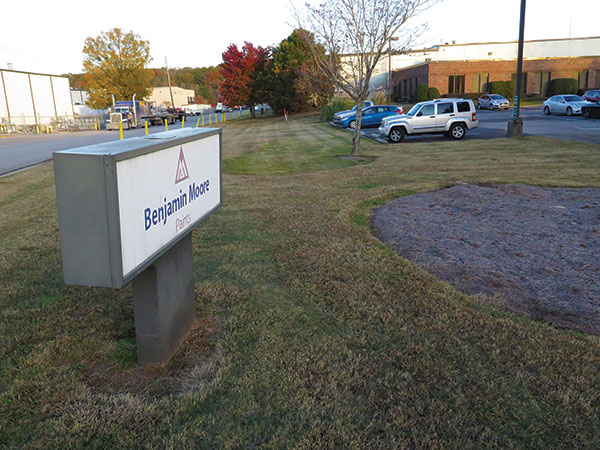
Benjamin Moore is adding a 10,000-gallon latex reactor to its paint facility, generating eight new jobs, $33 million in investment and illustrating the county’s successful venture into high tech competition. “The last couple of years, the community has been able to flex its muscles when competing domestically and internationally,” Smith said.

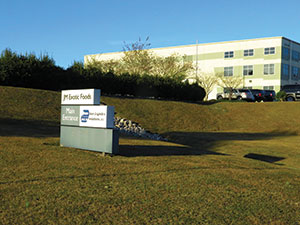
J&M Exotic Foods in Moody is doubling the size of its facility that produces spices and herbs with custom blending and packaging. Figure in another $2 million investment and 11 new jobs to St. Clair’s credit.

Roberts called Advanced Tank’s growth a “relatively small, but important expansion. St. Clair competed with a site in Colorado, the base of Advanced Tank’s operation, for the upgrading of its plate processing and sandblasting.

Advanced Tank has had a presence in Pell City since 1978, and while the $3.5 million investment and 12 new jobs created is impressive enough, “that we got it to come here is pretty important. New investments in new facilities usually are the last to suffer cuts” if there is a downturn, he said. “New investment means viability in the future.”

In other economic news, Smith pointed to an improving housing market, a new car dealership announced for Odenville and a half dozen or so retail and restaurant projects as reasons to be optimistic about the future.

A major retail development is hoped at I-20 at the site of the old county hospital, but there are no final plans or announcements to be made right now.

“We have had good announcements in nearly every community in the county in the past 18 months,” Smith said. And those without announcements thus far, “we’re working on very large projects. Hopefully, it will be a record-setting end of 2019 and beginning of 2020.”

Why all the focus on St. Clair? “We have all the amenities of a large, urban area like Birmingham combined with safety and low cost of a rural community and the close-knit family friendly aspects of a suburban community,” Smith said. “We’re able to market all three of those.”

Geographically, St. Clair sits in an enviable spot with two major thoroughfares – Interstate 20 and Interstate 59 running through it.

“Our leadership throughout the county works extremely well together,” added Roberts. “It makes it easier to operate here. It is an unparalleled level of collaboration and cooperation.”

Tally it all up, and it appears St. Clair County continues to be in the economic driver’s seat.

Good news in Moody

Economic trend continues with new openings

Story by Linda Long
Contributed photos

Ribbons may soon be in short supply in Moody thanks to a flurry of grand openings and ribbon cutting ceremonies. The old tradition of putting scissors to ribbon symbolizes a new start that says, “come on in, we’re open for business.” And Moody is definitely open for business. 

Proof lies in the sounds of the times: That annoying, but necessary, ‘beep-beep’ warning as a construction foreman lets folks know his heavy bulldozer is backing up. The nearby rat-a-tat-tat of a noisy jackhammer is heard playing its raucous tune. And the cement trucks maintain a steady drone as concrete is smoothed out for a new foundation. 

Some might call it noise. But for Moody Mayor Joe Lee, it’s music to his ears.

And, why not? Lee loves seeing the town grow from barely a blip on a map to the second largest city in St. Clair County. He has been in public service for the past 27 years, first as a member of the Moody City Council, then as mayor for the past 16 years.

Commenting on the number of building projects, both commercial and residential, under way right now, Lee said, “I’m real proud of what I see happening here. I’ve been part of the leadership of this city for a long time, now. I’ve put a lot of effort into making sure we have grown and grown in the right way.”

The new Metro Bank building, which opened its doors officially with a ribbon cutting in November, is testament to that growth. It’s the newest and, perhaps, brightest gem in Moody’s economic crown. 

“They were leasing a spot in the Professional Building, and people couldn’t find them,” said Lee. “Now, they’ve got their own brick-and-mortar store and the location is promoting new business. People drive by them every day. They say Moody has a Metro Bank that’s here to stay.”

Although the bank building is new, Metro Bank has been open in Moody for the past 10 years. Still, Metro Bank President and CEO Jason Dorough agrees with the mayor predicting new customers will come with the new location built by Goodgame Co.

“We really needed more exposure,” said Dorough. “We had people tell us they didn’t even know we were in Moody.”

That problem should be eliminated with the building’s new location, right on Moody Parkway and its 6,500 square feet. The bank’s lobby is graced with a stately cathedral ceiling with lots of cheerful windows to bring in the light.

“What can I say?” laughed Dorough. “We’re a newer, bigger, prettier facility.”

He was quick to point out that despite moving upscale, the one thing that will not change, is Metro Bank’s commitment to remain Moody’s only community bank. “All of our employees are Moody people.

“They live here, shop here, work here. They’re making a big commitment here,” Dorough said.

“Most of the other banks are larger, not headquartered in St Clair County. We try to leave the bank business to the people who run the branch. They are all good people, with a lot of experience. We let them make their own decisions. If they need our guidance, we’re here for them.”

One of the biggest pluses with the move is “we’ve got room to grow. In all of our other locations, we’ve wished we had more offices and things of that nature. Moody is a growing town, and we want to grow right along with it. We feel like there’s a lot of potential here in Moody.”

More growth ahead for city

Apparently, Metro Bank isn’t the only investor seeing potential in this St. Clair County community. According to Lee, several new businesses are in varying stages of completion.

A 95-room Holiday Inn Express is under construction fronting Interstate 20. According to Lee, “the same folks building the Holiday Inn are also building a new Exxon station with an additional two new store fronts for lease, though we don’t know yet what’s going in there.” Those structures are located on U.S. 411, across from Adesa Auto Auction.

Popeye’s Fried Chicken, located on U.S. 11 and Markeeta Spur Road was 90 days away from opening in November and according to Lee, another yet to be identified, retail store will be built on property located between Popeye’s and Bojangles.

“We’re expecting a real shopping hub to develop in the area around Popeye’s,” said Lee.  “We’ve got more property for sale around there and behind Bojangles, there’s eleven commercial acres for sale. We look for it to develop in the near future.”

Two other business developments that are expected to bring new jobs to Moody include a supermarket located in the shopping center at Moody Parkway and an expanding J.M. Exotic Foods, located in Industrial Park.

“We’re in negotiations right now with a supermarket to try to backfill the space left vacant when Fred’s went out of business. That’s going to create 55 new jobs, Lee said. “Also, Exotic Foods has a new packing contract that’s going to double the size of their operation.

That will bring in 11 more jobs.

The growth is seen well beyond retail and industrial, though. “All the commercial growth we’re having is pushing residential growth as well.” A 58-unit senior citizen complex is under construction for those 55 and up. Completion date is expected around the first of the year. “It’s a little village in itself,” said Lee.

“It has a clubhouse and common areas, and each unit is for rent.”

The mayor said some new subdivisions under construction include 120 new homes at The Reserve in the Highlands and 135 houses being built in Oak Hills. 

Population in Moody following the last census was 12,457. According to Lee, the projected population following the next census in 2020 is expected to be 15,000, underscoring the fact that Moody has long since shed its status as a blip on the map.