Mad Batter Cookie Co.

Cookie maker turns hobby into tasty business

Story by Scottie Vickery
Photos by Kelsey Bain
Submitted photos

Mandi King’s first attempt at decorating cookies was disastrous at best. The icing was runny, the colors were off and she had a big mess on her hands. Undaunted, she discovered that determination mixed with lots of practice turned out to be the perfect recipe for success.

These days, her cookie designs are nothing short of “a-dough-rable,” and King has started a thriving cottage business, Mad Batter Cookie Co., filling orders out of her home in Moody. It turns out that what seemed like a half-baked idea had some real merit, and King is one smart – and creative – cookie.

Her cookies come in all shapes and designs – everything from mittens to pencils to fish and trains. She has made edible versions of baby carriages, wine bottles, superheroes, sailboats, cartoon characters and ice cream cones. She’s even made cookies decorated like lipsticks, tubs of popcorn and the poop emoji.

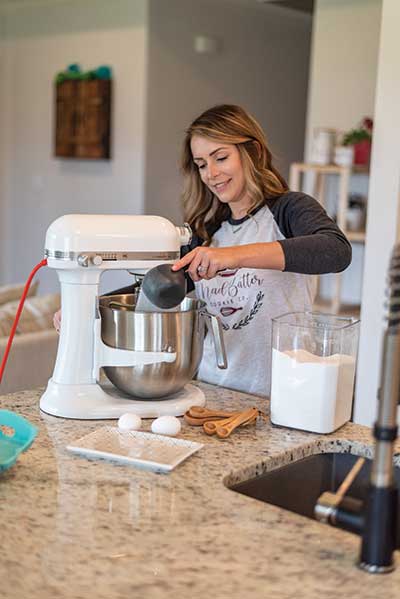
Mandi relies very heavily on her tool of the trade — a Kitchen Aid mixer.

“My absolute favorite thing is when someone gives me free rein,” King said. “I love that challenge of being able to design my own ideas.”

The 30-year-old King is one of a number of St. Clair County bakers who are turning sugar, butter and flour into tiny works of art. The decorated cookie craze has taken off and King, for one, loves the opportunity it provides to explore her artistic side. “I’ve always loved doodling and drawing, so this has been a lot of fun,” she said.

Starting from scratch

The first step, though, was to learn how to bake a batch of cookies, much less decorate them. “I love to cook, but I’d never been a great baker,” she said. “I don’t have a sweet tooth, so I’ve never really had the inclination.”

So why even bother? Chalk it up to boredom, King said. It was September 2019, and she and her husband, Anthony, had lived in their new home for about a month. Theirs was the first house in the neighborhood, and they didn’t have access to cable or internet yet. “I decided I needed a hobby,” she said. “I looked at my husband and said, ‘I’m going to do this.’”

The next day, they bought cookie cutters, icing and the ingredients for a cookie recipe she found online. A few hours later, she had botched her first batch. “It was the biggest blob,” King said. “The icing was too runny and all of it was just a big fail.”

King is nothing if not determined, though. “I can be a perfectionist, so I’m going to keep doing it over and over until I get it right,” she said. “They tasted good, so I thought surely I could get the decorating down.”

She kept at it, and a few weeks later when the couple threw a Halloween party, she wowed their friends with her culinary creations. After making some cookies for a friend’s baby shower, she started getting more requests. Strangers began to reach out to her via social media. “I wasn’t charging people for the longest time, but my friends convinced me to make it a business and to really grow it.”

King can bake and sell her cookies from home under Alabama’s Cottage Food Law, and she has business licenses from the state and city. She officially started her business in February 2020 and has made thousands of cookies since then. Her smallest order has been a dozen, and she once made more than 300 cookies for a corporate order.

In addition to iced cookies, she offers cookie cakes, hot cocoa bombs and macarons, which are meringue-based cookies. “Macarons are incredibly hard to make,” she said, adding that she likes to experiment with different flavors like cinnamon sugar and bacon. “They’re incredibly temperamental.”

Cutting up

The iced cookies are her main draw, though, and she’s made them for birthday parties, wedding showers, baby showers, gender reveals, “promposals” and other events. They start at $40 a dozen, which includes up to four colors of icing, and more complex designs cost extra. “Each cookie takes about 20 minutes to decorate, and some take upwards of 40,” she said. “I’m definitely getting faster at it, though.”

She’s also added lots of flavors to the mix. After tweaking her original recipe many times, she now offers cookie dough in 14 flavors (including sugar, blueberry, red velvet, key lime and rum) and icing in seven flavors, such as cream cheese, orange, coconut, vanilla and banana.

Her cookie cutter collection has grown, too. “I’ve got well over 400 cookie cutters now, and I recently bought a 3D printer, so I can design and print my own cookie cutters,” she said. “I can make any kind of shape anyone is thinking of, and any size, too.”

Now that King has turned pro, she’s happy to share some of her secrets. She’s offered a few cookie decorating classes at Rails and Ales in Leeds, and she said she hopes to have more in the future. She shares a variety of techniques during the 2-hour class, which costs $45, and participants decorate six cookies they get to take home.

Although King, a sales representative for a security company, is loving her new business venture, she said juggling a full-time job and a part-time business can be tricky. “This is my 5-to-9 and weekends job,” she said. “I try to limit myself to three orders a week. I had no idea it would take off like this.”

Overall, though, the experience has been a sweet one. “It’s so much fun,” King said. “And my husband loves it. He gets to be the taste tester and eat all the reject cookies.”

Polly Warren

A Greek bearing delicious gifts, a star-studded past

Story by Scottie Vickery
Submitted photos

When it comes to cooking, Polly Warren has trained with the best. As a young girl growing up in Greece, she learned the intricacies of meals and pastries from her mother and grandmother. After marrying an American and moving to Georgia as a young bride, she mastered Southern dishes in her mother-in-law’s kitchen.

The result is something she calls American Greek cooking – a delicious blend of both countries born from two families full of tradition and love. “I love the cooking,” she said, her Greek accent still heavy. “I love to learn and do new things. If I see something I like, I make it, add to it, and make the recipe my own.”

As a result, she’s bridged the divide between two cultures by introducing her favorite Greek dishes to her American family and friends and taking some Southern favorites home to her family. “I made them chili,” she said, laughing at the memory of the first American dish she shared with her loved ones in Greece. “They loved it. They thought it was great.”

A popular caterer in St. Clair County, Polly works out of the kitchen of the Pell City KFC, which her family has owned for nearly five decades. In addition to weekly meetings of the Rotary Club of Pell City, she caters everything from tailgate parties and luncheons to teas, rehearsal dinners and weddings. “Whatever anybody wants, I can cook it,” she said.

Growing up Greek

Born Polyltime Stavridis, the daughter of Dimitri and Kostantina, Polly grew up in Athens, Greece, with her brother, Costas, and her sister, Vaso. Whenever she thinks of her childhood, the first thing that comes to mind is the family kitchen. “I can still close my eyes and see myself there,” said Polly, now 72. “We’d always be in the kitchen. Always the girls served the men.” The main meal was served at 2 p.m., and after an afternoon siesta, the men would return to work. “Then they would come back, and we would eat leftovers,” she said.

Even as young girls, Polly and Vaso worked alongside their mother and grandmother, who lived with them. “We started when we were young, 5 or 6,” she said. ‘“They always gave us a little dough so we could participate. We would clean the potatoes, help with the dough, make cookies. When we were 10, 11 or 12, we would start participating completely.”

Family favorites included stifado, a Greek beef stew; spanakopita, a spinach pie; bifteki, which Polly describes as a stuffed hamburger; and keftedes, or Greek meatballs. “My mother used to make a big pan and leave it on the stove, and we’d eat it like popcorn,” she said.

There were plenty of pastries, too. Melomakarona, or honey cookies, were a staple, as well as tea cakes and baklava. Polly remembers her grandmother rolling out big sheets of homemade phyllo dough that was used for pastries and pie crusts. “Back in those days we made it homemade,” she said. “It took two people.”

Cooking for a crowd proved to be a challenge. “Back then, we had a little bitty oven, and our oven couldn’t bake all those cookies and big dishes like stuffed peppers and tomatoes,” Warren said. They took their dishes and pastries to a nearby baker, who cooked it for them in his industrial oven. “You tell him you want it ready for the family at 2, you give him $1 or $2, you pick your food up and carry it home,” she said.

A good student, Warren skipped the sixth-grade and graduated from high school at 16. “I started modeling and playing parts in movies,” she said, adding that her uncle was a producer. “Somebody didn’t show up one day, and he calls me and said, ‘Polly, do you want to do this?’ It was a commercial for shoes.”

After that, she had a “little part in a movie here, a little part there,” including a role as a party guest in the 1965 Italian movie, The Three Faces of a Woman. The movie starred Princess Soraya Esfandiary Bakhtiari, the ex-wife of an Iranian shah, and Richard Harris, who later played Albus Dumbledore in the Harry Potter and the Sorcerer’s Stone and Harry Potter and the Chamber of Secrets.

Young Polly’s acting and modeling career didn’t last long because she soon met her future husband – Wayne Warren, an American serviceman from Georgia who was stationed in Greece. “I have good memories of it, and I did it until I met Mr. Warren,” she said. “Mr. Warren, he says ‘no.’ He didn’t like all those guys hanging around.”

The two met when Polly’s friend, who was engaged to an American buddy of Wayne’s, invited her to a party. She was hesitant to go because she didn’t know what to tell her family. “Back in those days, you didn’t go off to a party,” she said. “I did a little white lying and said we were going to the movies.”

The two really did go to the movies a few weeks later, after Wayne had gotten permission from Polly’s father. “A commercial came on the big screen, and there I am big as life,” she said with a laugh. “I’m hiding under the seat, and he couldn’t believe it. It was a commercial for glassware for a wedding.”

After the two married, Polly left her beloved Greece in 1967 to move to the U.S. with Wayne. After a quick stint in Texas, they headed to Columbus, Ga., Wayne’s hometown. He was still in the Air Force, so Polly lived with his mother, Irene Warren, in her beautiful old house with a big wraparound porch. “It was very, very nice,” Polly said. “My mother-in-law, she loved me to death.”

Southern influences

Although she missed her family, cooking with Irene helped cure some of the homesickness. “We cooked together in this big kitchen, and you felt like it was home,” Polly said. “I learned how to do squash casserole, make creamed corn and snap peas.”

The dishes were different from anything she’d had before, but Polly appreciated good food when she tasted it. “Mac and cheese, I never ate it in my life, but once I tasted it, it was good. I learned to eat pork chops, and I learned to eat ribs and turnip greens. I loved it.”

As a new bride, she learned to fix some of her husband’s favorites, which quickly became hers as well. “I love a good steak and baked potato,” she said. “And vegetables with cornbread. I could sit and eat the whole skillet.”

Another Southern staple, fried chicken, soon became a big part of her life. After Wayne retired from the Air Force in 1970, they moved to Selma, where he worked with a dear friend who owned KFC franchises. He decided he wanted to open one himself. Although “we only had baked chicken in Greece, we never fried it,” Polly was on board.

Wayne started scouting locations, and while driving through central Alabama one day, he happened to stop at a gas station in St. Clair County. “An 18-wheeler driver told him to look at Pell City,” she said. “That’s what he did, and that’s where we are.”

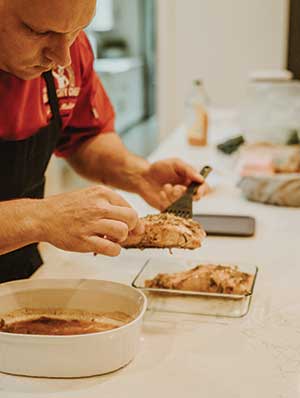
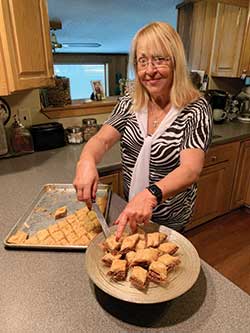
Polly Warren plating her famous baklava.

While raising their three sons – Michael, Jimmy and David – the Warrens spent lots of time at various ballfields and soon became fixtures in the community. Polly got her catering start while working in the concession stands, where she cooked plenty of hot dogs and hamburgers. That led to dishes for athletic banquets and other events, and things took off from there.

“Before you know it, they asked, ‘Do you mind doing a tea,’ so you do a tea. Then they said do, ‘Do you mind doing a wedding,’ so you do a wedding. I started with 100 people, and I have been up to 600. That’s how it all got started,” she said.

Although Wayne passed away 10 years ago, Polly still loves cooking for her family and especially enjoys time in the kitchen with her four grandchildren. She’s happy to share recipes, although at times that proves a little difficult. “I never measure anything,” she said. “I put a little bit of this, a little bit of that. So, when they ask, I have to figure it out and write it.”

Alabama has been home for most of Polly’s life, but she still gets homesick for Greece on occasion. Yearly trips to Athens help, and she loves to get back in the kitchen with her mother, now 90, and her sister while she’s there. She makes sure to bring back her favorite fresh spices. “It grows wild over there,” she said. “You see rosemary, you see basil. I bring all that back. The American spices, they do not taste the same.” 

Whether it’s the spices or the love she puts in each dish, Polly’s cooking is always a hit. “It’s good therapy,” she said. “I get in the kitchen and get busy cooking, and I never leave. I make a lot, and I give it away to neighbors and family and friends. I love it when people eat it and say how good it is. No one has complained yet.”

Chef Cory

Springville-bred food artist finds home in Birmingham’s noted culinary scene

Story by Scottie Vickery

Photos by Graham Hadley

Submitted Photos

Cory Bolton had barely started walking when his grandmother plopped him on the kitchen counter with a spoon and a mixing bowl full of corn meal. It was an easy way to keep the toddler entertained while she cooked, so she told him he was helping.

It turns out those early days in the kitchen with his grandmother, Sandra Bolton, were much more than a diversion. They were the first cooking lessons Cory, who grew up in Springville and is now the executive chef at Fancy’s on 5th in Avondale, ever had.

“I remember it like it was yesterday,” he said. “She made biscuits pretty much every day, and she’d put me on the counter with this big green glass bowl. By the time I was three or four, I was kneading the dough, and she would teach me as she went. That really set into motion for me a lifetime of enjoying food.”

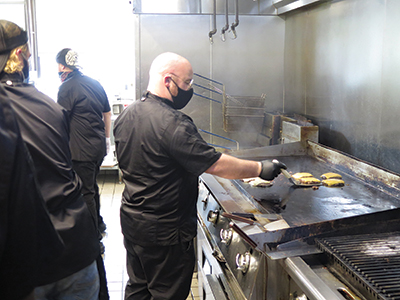
These days, the 32-year-old Bolton is giving guests at Fancy’s on 5th plenty of food to enjoy themselves. The restaurant, which bills itself as an oyster dive and burger bar, offers everything from seared ahi tuna and oysters served with golden kiwi strawberry mignonette to a fried flounder BLT, grilled octopus tacos, and a burger featuring chipotle aioli, pico de gallo, fried jalapenos and pepper jack cheese.

“I cook a little bit of everything, but my specialty is definitely seafood – Southern-style food and seafood,” he said. “I’ve cut about every fish in the Gulf of Mexico.”

Home cooking

Cory has been at a number of restaurants in Birmingham and Tuscaloosa over the years, working his way up from dishwasher to cook to sous-chef to head chef to the co-star in an online cooking show. His start in the restaurant business, though, came close to home when his parents, Mike and Beth Bolton, opened Big Bolton’s BBQ in Argo in 2009. Cory, 21 at the time, helped them run the place.

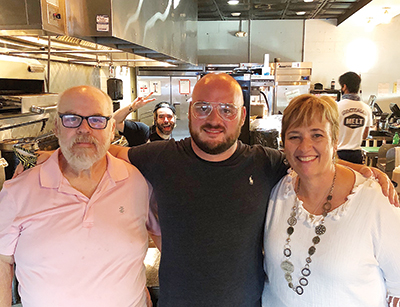
Mike, Cory and Beth Bolton in the kitchen

Mike, who had just retired after 25 years as an outdoor writer and columnist for The Birmingham News, definitely knew his way around a grill and a smoker. “The men in my family like to cook meat, smoke meat,” Cory said. “Dad was always doing the hunting and fishing stuff – cooking Boston butts or brisket at the hunting camp.”

Mike, the author of several books, including Preparing and Cooking Alabama’s Wild Game, is quick to declare his son the expert. “He’s a much better cook than I am,” Mike said. “I was pretty simple, but he was always trying different things. He came up with a marinade for grilled chicken that was incredible. People just loved it.”

After moving Big Bolton’s to a new location in Springville, the family closed the restaurant in 2011 during the economic downturn. “I tell people that saying, ‘You can cook good, you ought to open a restaurant’ is a lot like saying, ‘You put your seatbelt on good, you ought to be a NASCAR driver,’” said Mike, now the editor of Alabama Outdoor News and the owner of Victory Lane Catering.

While the experience led Mike to say “never again” to the restaurant business, the disappointment inspired Cory to work even harder to achieve his dream. “I’m definitely a person who, if I get knocked down, I’m going to get back up,” he said. “If Big Bolton’s goes out of business, then I’m going to show everyone that I can be a chef.”

He’s drawn on his St. Clair County upbringing throughout his career. Cory was especially involved in extracurricular activities and sports at Springville High School, and the lessons he learned on the field have helped him in his career.

“All of the team-building stuff, I use it every day,” said Cory, who was captain of the football team and helped with coaching after high school. “Trying to get an 18-year-old kid to focus, and not text girls, is a lot like a chef trying to get guys to focus intently for six hours. Sports taught me to lead a team and be part of a team.”

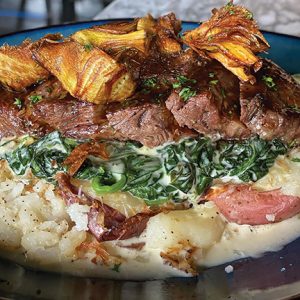
Flat iron steak with manchego smashed potatoes, creamed spinach and crispy artichokes

Growing up, Cory traveled to barbecue competitions, Bassmaster Classics, and trade shows with his father, and he got early exposure to some of the more exotic foods. “I’m eating rattlesnake, fried crappie, squirrel soup and all this crazy food most kids don’t get to experience,” he said.

At church, he found more than a spiritual foundation. His parents were the kitchen managers at Clearbranch United Methodist Church for about 12 years, and Cory and his sister, Lauren, could often be found helping with spaghetti dinners and other events. “Even as a 12-year-old, I’m learning how to use industrial kitchen equipment at my church,” he said. “I never knew I was in training.”

The real foundation, though, was set at the nearby Trussville home of his grandparents, Sandra and Clyde Bolton. “I have four grandchildren, and Cory is the only boy,” Sandra said. “The girls didn’t care much about being in the kitchen, but Cory always was. I’ve always had a love for cooking, and Cory is like me on that. It’s not work for us, it’s fun.”

Pursuing his dreams

Despite his love of cooking, Cory is self-taught and never attended culinary school. As a student at Jacksonville State University and Jefferson State Community College, he envisioned a career in public relations, or as a journalist or sports information director. The kitchen, however, kept calling his name.

He worked in a number of places over the years, including food trucks and Primeaux Cheese & Vino in Birmingham, and he enjoyed a stint as head chef at a sushi restaurant. His years at the award-winning Ocean, in Birmingham’s Five Points district, shaped him the most, however.

“That was a real turning point for me because I had a real mentor,” Cory said of the restaurant’s owner, George Reis. “George is a real live chef – intense, not accepting less than perfection. He helped me develop my cooking for sure, but he taught me how to be a chef.”

Reis allowed Bolton to change the menu and add his own flair to dishes, and he also taught him to trust himself in the kitchen. “He let me come into my own as a chef, and I really understood what we were doing,” said Cory, who also worked for Ocean’s sister restaurant, 26. “I didn’t have to read the music, I could just play by ear.”

Cooking burgers to go

That instinct is what makes him stand out from the crowd, Mike said. “Cory really gets that cooking is about 25 percent cooking and 75 percent science,” he said. “He’s really good at that.”

It’s something that came naturally, even as a child helping his father grill, Cory said. “Good barbecue is good but without great sauce, it’s just good barbecue,” he said. “The sauce has to have the right amount of sweet, spice and acidity. Good sauce isn’t just sweet or just spicy or just tangy, it’s a balance of all those things. At 10 years old, if you’re understanding the balance of flavors, you’re really understanding the science of cooking.”

He got to experiment a little in the three years he was executive chef at River in Tuscaloosa before moving back to Birmingham to be closer to home and family. Bolton’s friend and fellow chef Addison Porter followed him to River, and the duo got creative with steaks, seafood and dishes like pork rinds and queso cheese with black-eyed pea relish. “We were doing some really great stuff, complicated food,” Cory said. “It was crazy busy. After an Alabama-LSU game, you’re serving 500, 600 people.”

While at River, Cory and Addison started filming “Chunks,” a cooking show for Allrecipes.com, a food-focused social network featuring recipes, how-to videos and inspiration. They filmed four episodes before the pandemic, and Cory hopes to eventually do more. They made some over-the-top creations for the show, including a 10-pound egg roll stuffed with gameday foods, including burgers, buffalo chicken, chips and salsa.

“We are kind of flamboyant, crazy people, and we’ve had a lot of fun,” Cory said. “We’ve worked in the kitchen together for about seven years and everyone says we speak a different language. One of us will just point, and the other one knows exactly what he wants.”

That rapport comes in handy with Cory’s latest mission of doing the impossible and making his grandmother’s fried chicken recipe even better. “Fried chicken is my favorite food ever,” Cory said. “My ultimate goal is to open a fried chicken restaurant and let Addison run it.”

Green onion and a specially seasoned flour are the secret ingredients in Sandra’s recipe, and Cory and Addison have experimented with additional spices and seasonings. “We started with everything we loved about her recipe and have been adding different things and trying to perfect it,” Cory said. “We’ve worked on it, and I’m not kidding, for five years like mad scientists.”

So, what does Sandra think about his lofty goal? “I don’t know if I can even take it to her,” Cory said with a laugh. “If she knew I changed her recipe, I might not be able to go to Thanksgiving.”

He’s not really worried, though. While he loves being the “crazy, city boy chef,” Cory acknowledges his grandmother always welcomes him with open arms, and she’ll always be the best cook he knows. “You can take a recipe you loved as a child, add high level techniques and skill, but it’s still never going to be what your grandmother cooked,” he said.

For more, visit Fancy’s on Fifth’s website

or follow them on Facebook

Ultimate Tailgating

HLN-Tums-Tailgate-AuburnAuburn Style and on TV

Story by Carol Pappas
Photos by Mike Feline, CNN HLN
and Carol Pappas

When Pell City’s Sandra Murray talks about how an Auburn game day tailgate party turns into a CNN event, she laughs and says, “When you’re not there, you get nominated.”

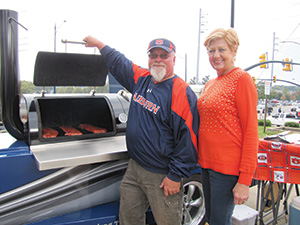
She and her husband, Dr. Ed Murray, have been hosting home-game weekend parties at their “Auburn House” for years. The house itself attracts plenty of attention. After all, it is appropriately painted orange and blue and sits conspicuously on a knoll overlooking campus and Jordan Hare Stadium.

In October, Ed’s aunt had passed away, and for only the second home game in 20 years, they were going to miss the party. So Sandra traveled to Auburn on Wednesday, set up everything for game day and asked friend Cindy Goodgame to host.

That weekend, she got a text from Cindy simply saying, “Call me when you can.” When she did, Cindy told her that someone from CNN tapped on the window and asked if they could film from the parking area of the house with the stadium for the backdrop. Oh, and they might film in the house.

Sandra said OK. Then another “oh” moment followed with Cindy adding, “And they need a woman to barbecue and compete in a cookoff, and I told him you would.”

“I said, What!,” And the rest, they say, is history.

Turns out CNN produces the HLN Tums Tailgate cookoff, which is set at various campuses across the nation during football season. The man at the window was producer Mike Phelan.

CNN Crews, as part of the cookoff series, have been at the Clemson-Notre Dame and Ohio State-Michigan State games. On this particular weekend, they came for Auburn-Ole Miss. The semi-finals will be in Atlanta for the SEC Championship game and the finals, in Glendale, Ariz., for the National Championship game.

Being a good sport, a good cook and enjoying the fanfare of a good tailgate party, Sandra obliged, cooking her original recipe, Cajun-fried chicken drumsticks with a Bulleit Bourbon sauce, for the competition. “It was only the second time I had cooked it,” she said. And it was only later that she learned famed chef Chris Hastings and Auburn’s Acre Restaurant use the same high-rye, award-winning whiskey in their own recipes.

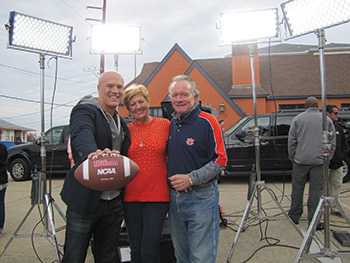
At 5 a.m. on Friday and 4:30 a.m. on Saturday of the game weekend, a CNN satellite truck and other vehicles pulled up to the house and started unloading – lights, cameras, monitors. “Watching them set up was a lot of fun,” she said.

CNN and HLN sports anchor and correspondent Coy Wire, a former Stanford and NFL player, went over his lines. Cheerleaders from Auburn and Ole Miss arrived. Auburn Tiger mascot, Aubie, joined the fun. So did the Auburn Band.  A crowd gathered. Lights, camera, action. “The whole progression was phenomenal,” Sandra said. “It was fun to work with them.”

HLN-Tums-Tailgate-Auburn-2She competed with Jeff and Jeremy Alexander of Athens, Ala., whom the Murrays have known for years. They own a game-day condominium behind their Auburn House. Coincidentally, they are professional barbeque cookoff competitors. They won the Sloss Furnace competition in recent months.

While Sandra’s drumsticks came in second, she wasn’t disappointed at all. “It was a lot of fun,” she said. “I’m tickled for them. It was good promotion for them.” The Alexanders’ winning dish cooked to order was a brisket. They also made a “Fatty” – Italian sausage taken out of the casing, flattened and topped with a mixture of peppers and onions, rolled up and wrapped in a bacon weave. It is smoked and then sliced into pinwheels. Hence, the perfect moniker.

“They’re serious,” Sandra said. For her, it was simply part of being a gracious hostess, even if her nomination came in absentia. The Murrays love to entertain, and the house they bought in 2004 underscores that notion.

It is the perfect game-day house. They completely redid the interior in 2005 – orange and blue motif and Auburn themed throughout. Mounted televisions are found in almost every room.

“When we found out Pella did navy-blue windows, we said, ‘Here we go!,’” she said, relating the story behind an orange and blue house. “When the crew was painting the house, people would pass by, blow their horn and yell, ‘War Eagle!’”

The house is comfortable and inviting – just like the Murrays. They have used the house for fundraisers and awards. The Pell City Cheerleaders were there for the Idaho game as part of an auction-winner event. “It’s for fun. That’s what it’s all about,” Sandra said.

And in typical, welcoming Murray fashion, she adds, “You know what we say: ‘One invitation lasts a lifetime.’”

Mulligan Stew

mulligan-stew-1A distinctly Skeeter Park tradition

Story by Jerry C. Smith
Submitted photos from Hazelwood Family

What’s Mulligan Stew? Well, it’s a big potful of boiling water, loaded with whatever meats and vegetables one has on hand, and cooked until safely edible. However, for St. Clair’s Skeeter Park folks, it’s always been a fine excuse to get together for a grand party on a creek bank somewhere near Eden, pig out on Mulligan and enjoy a tradition that’s occurred non-stop since the 1930s.

You won’t find Skeeter Park on any GPS, nor talked about in society columns, but hundreds of St. Clair folks will agree it’s a culinary and fellowship delight for lucky invitees. While the cuisine has varied over the decades, the camaraderie has remained.

There were actually two distinctly separate groups who held similar events in the same general area: one, a private annual reunion begun in the 1930s that’s still celebrated today, and the other a more frequent but less structured community affair that got together in the 1960s and 70s.

The original group was organized by two local residents, Frank Patterson and John Willingham. They were soon joined by Frank’s brother, Willard “Shanghai” Patterson, and their close friend, W.T. “Dubb” Hazelwood.

These fellows had hunted and fished around Wolf Creek as boys, often camping there overnight to rest and cook their prey. As the youngsters grew into men, their outdoor meals became well-known and, before long, friends started drifting in to share their rustic fare.

Dubb’s son, Ben Hazelwood, soon joined the fun, later taking an active role in food preparation, with help from his own son, Benjamin, then called Little Ben but now 36 years old. The elder Ben recently passed away, but younger Ben continues the Mulligan tradition in memory of good times with his father, and because it’s so much fun.

The official Skeeter Park venue is an unimproved clearing in the woods near Wolf Creek, on land always owned by the Jones family. The park is only about 40 yards wide and 50 yards long, but has a good spring for cooking and drinking water. Dubb’s daughter, Marion (Hazelwood) Hultgren, currently of Tucker, Ga., says the area was a wondrous place to visit any time of the year, abounding with wildflowers. Mulligan Stews became generally popular during the Depression, when roving bands of hobos and others seeking work would gather into camps, often alongside railroad tracks. They had little, but usually shared it for the common good.

Various campers might contribute a couple of onions or a few ears of corn “borrowed” from a nearby farm, a chicken of similar origin, maybe some potatoes and carrots. Separately, not much of a meal, but when cooked together, they became a nourishing sustenance for all.

The Skeeter Park guys found Mulligan easy to make and serve, universally accepted, and impossible to criticize because there is no official recipe. Cooked in 5-gallon steel lard cans which were bought new every year for the purpose, these versatile stews could contain anything edible, including squirrels, rabbits, chickens, turtles, even beavers, but they never added pork until later years when it became plentiful. Nor was venison used, as deer were quite scarce in those days.

Young Ben recalls camping out at the site overnight so he could clean out the spring and be ready the next morning to build a fire big enough to heat two kettles full of water. He says his father expected that water to be boiling when he showed up a few hours later to start the stew.

Ben remembers that, even in latter years, they sometimes used freshly-killed whole squirrels, including heads but without entrails or skins. Side dishes included Southern-reunion staples like cornbread, biscuits, white loaf bread, green beans, sliced tomatoes, and occasionally a potato salad and other party fare.

Dubb’s children, Marion (Hazelwood) Hultgren, Kent Beavers and Freddy Hazelwood, were quite specific about the way their father ran the proceedings. Everyone who handled raw food had to wash their hands vigorously and keep them clean during its preparation.

He was very particular about who handled food and stirred the pots, usually doing most of it himself. The pot had to be stirred in perfect figure-eights, lest it burn. Further, Dubb insisted that stirring sticks had to be hickory saplings of a certain diameter, with just the right size fork at the end.

The stew was boiled and stirred for hours, until all meat had fallen off the bones which, coincidentally, helped disguise the species of whatever animal was in the pot.

Kent said, “If you didn’t know what you were doing, you just sat over there in the shade and drank beer with the others.” Marion added, “If you really messed up and burned the stew, you got thrown into Wolf Creek.”

Attendance was widely variable — as few as a half dozen to more than a hundred, including several regional dignitaries whose names would be easily recognized. Mulligans drew visitors from the ranks of many noted St. Clair families, among them Beavers, Castleberrys, Bowmans, Footes, Bynums, Ginns, Hazelwoods, Robertsons and Cornetts.

For the first three decades or so, participation was limited to men and boys, but in the “liberated” 1970s, they occasionally allowed family ladies to attend. Marion, who was 25 at the time, recalls being among the first girls on the scene. She helped memorialize those days with her photos, some of which appear with this story.

Naturally, these fun-loving folks didn’t confine their activities to eating. According to Freddy and Kent, the guys played poker, took bets on football scoreboards, pitched horseshoes and washers, even shot a few dice. Singing and guitar playing was usually part of the festivities, although they didn’t bring instruments on very cold days, as it could make the strings break.

Alcohol was usually present, but didn’t cause the kind of problems one might think, because Dubb and Ben kept strict order. Lawmen occasionally showed up, but only for food and fellowship. Whether certain attendees fell into Wolf Creek or were actually thrown in to help sober them up is still open for debate.

It’s rumored that Shanghai once asked some poker players for a share of the pot to help finance their meal. If more than $30 was spent on supplies in the old days, it was considered an especially lavish party.

In later years, another group began meeting nearby, at first along the north bank of Wolf Creek, then under a pole shed that still stands behind a convenience store in Eden. This gathering was started in the late 1960s by the store’s owner, Troy Bannister. Longtime Pell City resident Fred Bunn recalls going there in the 1970s, and seeing the late Tootie Hare and both Ben Hazelwoods among others who frequented both gatherings.

mulligan-stew-2Fred says these events were held at random intervals, averaging about once a month, and usually ran all day long, averaging about 20 to 30 people at any one time, with others drifting in or out as opportunity allowed. Fred adds that they didn’t restrict themselves to Mulligan Stew, often substituting more basic country fare like chitterlings, barbecue or local game animals.

Under the leadership of young Ben, the Hazelwoods still follow the Mulligan tradition, usually every November at the old Skeeter Park site. They’ve been selling printed T-shirts and ball caps among their group since 1992 to help raise money for basic expenses, with the surplus going into a mutual aid fund to help members with unexpected hardship.

Ben mentions one fellow who got his hand chopped off in a work accident. The Mulligan fund helped this man’s family through some rough times.

The family says this year’s Skeeter Park Mulligan will be an especially poignant one, as they recently lost their beloved father and brother, Ben Hazelwood. Your writer has been invited, and I’m certainly looking forward to it.

No, I will NOT say when or where.

Wild Game Dinner

wild-game-dinnerEvent attracts
more than 350 men

Story by Elaine Hobson Miller
Photos by Jim Smothers

The menu could have come from a Montana hunting lodge: smoked venison; bacon-wrapped quail; venison cube steak; venison meatballs; elk spaghetti; wild game gumbo; brunswick stew made with moose, squirrel and wild turkey. But the Wild Game Dinner actually took place at the First Baptist Church of Ashville thanks to the contributions of several hunters from St. Clair County.

“It was a way to bring in guys in a friendly, fun atmosphere,” said Pastor Dr. Jay Stewart. “Sometimes people are not interested in going to church because of preconceived ideas, fair or unfair, but something like this, guys relate to it because of the outdoor nature of whole thing.”

The church sold 357 tickets at $10 each for the Feb. 21 evening event, which was far more than its Fellowship Hall could seat. Diners had to eat in shifts in order to accommodate the crowd. Each person got a sampler plate that included as many of the dishes as they wanted to try, plus baked beans, potato salad and pie.

Church and community volunteers began cooking at 7 that Saturday morning. By the time the event started at 6 p.m., outdoor writer and chef Mike Bolton had smoked 450 quail, and Marty Crews of Big Boyz Barbecue had cooked 500-600 pounds of venison.

“This was the brainchild of one of our members, Tom Watson, who came to me with the idea,” said Stewart, who has been at FBCA since July 2014. “We felt like men would have a chance to come with buddies, sit around and talk, swap hunting stories, laugh, eat some things we don’t ordinarily eat. We have lots of events for women, and we wanted to do something for the men in the community.”

wild-game-dinner-2Watson served as song leader, minister of music or associate pastor at seven Southern Baptist churches from Alaska to Alabama over a 42-year career. Recently retired and a relatively new member at FBCA, Watson said the dinner was designed to attract men who wouldn’t come to a Sunday church service but would come to dinner and experience wild game and try for a prize.

“We had a lot of big-time speakers, guys who had outdoor television shows, Christian guys who came in and gave their testimonies,” said Watson of the past events he organized.

Hank Hough of Texas-based Kingdom Dog Ministries was the featured speaker for the event. He used his dog, Preacher, to illustrate how God’s children should show obedience to Him.

“Our church guys didn’t know what to expect, being the first year,” said Watson. “I challenged them to make a donation, and 12 to 15 of them came through, so we had some money to buy nice prizes with. Some of the smaller prizes were donated, but we bought the four guns we gave away.” They also gave away an Auburn football helmet autographed by Pat Sullivan, a deer tree stand, deer feeder and a quail hunting trip.

“Alan Clayton, the baseball coach at St. Clair High School and an avid bird hunter, guides hunts in northeast Alabama at the Stick Lake Hunting Preserve near Fort Payne,” Watson said. Scott Duel, owner of the preserve and the physical therapist at Back in Motion in Springville, donated that hunt, according to Clayton, who will personally guide the winner with his own dogs.

Other sponsors, including businesses such as Central Seed & Supply and the St. Clair County Co-Op in Ashville, donated buck jam, deer cain, salt licks, deer sauce, T-shirts, turkey calls, a 50-pound bag of milo for deer feed plots, caps, Mike Bolton game cookbooks, BBs and targets.

Most of the men there either saw the notice about the dinner on the church’s marquee or were invited by a friend. Clint Vickery of Albertville, who attends Flow of the Spirit Church, saw the sign on the marquee. “You don’t often get to try elk,” he commented.

Ashville resident Jeremy Gidley brought his 7-year-old son, Isaac, whose favorite dish was the elk spaghetti. Mark Coupland of Odenville also saw the marquee notice. “I had deer at an Auburn game several years ago and wanted to try some more,” he said. Another Odenville resident, Jeremy Byers, was invited by a friend who attends FBCA. “I’ve been deer hunting since I was 10 years of age in Sumter County,” Byers said, but he liked the other wild offerings, too.

FBCA member Patsy Fouts, Ashville, was conspicuous as one of the few women present. Three others were in the kitchen, and one was shooting photos for the church directory. Fouts brought her two grandsons, Brett, 12, and Brady, 10.

As the diners finished their meal, they made their way to the church sanctuary, where singer and pianist Tim Lett of Chandler Mountain Baptist Church entertained with gospel songs. The sanctuary was almost packed with men of all ages, their arms around their sons, grandsons or nephews. Many were dressed in camo coats and hats. Ashville Mayor Robert McKay was there, and so was a Jefferson County game warden, Kerry Bradford, who took a lot of good-natured ribbing about the legality of the kills that furnished the meat for the menu.

After everyone was seated in the sanctuary, 13 youngsters took to the stage to participate in a coyote-call contest. Two young winners received brand new BB guns, and all contestants received hunting caps.

The dinner may become an annual event, according to Stewart, who said plans are already under way for next year. 