Rhythm of the Rails

Story by Roxann Edsall
Submitted Photos

Two little girls, laughter echoing in the Alabama moonlight, hurry alongside their mother toward the train station. It’s the late 1950s in Pell City, a time when the whistle and hiss of the train closing in on the station was as predictable as the sun set.

Carolyn Hall recalls, “It was exciting! Mother would tell us to hurry because the train would be here any minute.”

Her sister, Nancy Jordan Spradley, smiles as she adds to the story. “Our mother or grandmother would carry us down there every night, and we’d wait for the train to come through. We’d wave at the conductor, then wait for the caboose and wave to that man, too.” For these sisters, that nightly ritual became a cherished memory, a blend of excitement and comfort as the mighty trains passed through their small town.

The evolution of the project

Pell City’s history is inseparable from the railroad tracks that brought it to life. Founded in 1887 by a consortium of railroad investors, the city was named after financial backer, George H. Pell, president of the East and West Railroad. A short line was created by that railroad to connect three larger systems – Seaboard Air Line Railroad, Talladega & Coosa Valley Line and Georgia Pacific Railroad – and a shared depot was built.

Even so, the town had an uninspiring start, sluggish at best. That is, until the railroad brought to town the man who would save it not once, but twice. Sumter Cogswell, a 29-year-old insurance agent, had no thoughts of saving a town in Alabama when he boarded a train near his own Kentucky home in March of 1890. He was headed to Talladega on business and was scheduled to change trains in Pell City. A missed connection left him stranded for the night.

Rather than an inconvenience, this delay became a turning point, not only for Cogswell, but for the future of the sleepy town. After a night at the Cornett House Hotel, Cogswell awoke, looked outside, and was struck by the potential of the area, specifically the proximity of three converging railroads, the nearby Coosa River, and the beauty of the surrounding landscape.

Seizing the opportunity, Cogswell purchased an option on a significant parcel of land, then negotiated a sale to the Pell City Iron and Land Company. Presuming the town was now on good footing, Cogswell left to resume life elsewhere.

The Panic of 1893 was a time of severe financial depression across the country, and it had devastating effects on Pell City. The Pell City Iron and Land Company went bankrupt, and by the time Cogswell returned for a visit in 1901 with his wife, Lydia DeGaris Cogswell, the town was all but dead. The Cogswells arranged to purchase the dying city for $3,000 and began to nurse it back to health.

It took hours of work to create this level of detail

Now 135 years old, Pell City is a healthy, growing city. A city of more than 17,000 people, it covers 27 square miles of land and water, a far cry from the original 8 blocks on the incorporation papers. Pell City has changed a bit since those early days, and though passenger rail travel is no longer available to or from the city, its impact is irrefutable.

To celebrate those early days and how the tracks once carved Pell City’s landscape, a group of six volunteers dedicated over a year building a train exhibit for the Museum of Pell City. The exhibit, opening this month, features an early 1900s to 1930s-era landscape of Pell City with exquisite detail, completed using historic photos from that time. The project was headed up by retired architect and model builder Malcolm Sokol.

Sokol worked with museum designer Jeremy Gossett to clear space within the museum and determine how large the exhibit could be. From that information, Sokol was able to create a design. A team of volunteers, which included Winston Greaves, David Smith, Max Jolley, and Erik Grieve, worked at Sokol’s house the first month to build the benchwork (similar to a table top) and the cork roadbed for the track. Colder weather and space constraints forced the team to move their operations to the Municipal Center for the rest of the build.

“We had all built model cars and things, but those were kits, and we were just kids. But with this project, Malcolm gave us specific tasks with instructions,” said Jolley. “He taught us tricks of the trade.”

Jolley’s specialization was painting all the people in the exhibit. “These people are smaller than your finger,” he adds. “I painted each one of them and to do that, I had to hold it still with tweezers and paint with a very small paintbrush.”

Among the buildings that were custom built were the courthouse, city hall, train depot and Cornett and St. Charles hotels, the First National Bank building, the Jake Garry livery, and Martin’s store. Others began with kits and were customized to look like the historical structure.

“We had homework from Malcolm each week,” recalls David Smith. “He’d send us home with a model to build each week and when we brought it back, he’d make suggestions, and we’d refine it until it was just as it should be.”

Smith was also in charge of 3D printing all the horses and wagons. The piece Smith spent the most time on was the water tower by the courthouse. The tower, whose many guy wires each had to be glued in place and painted, took a month to complete. The Cornett Hotel, which was built by Sokol, took six weeks to build.

Erik works on terrain

Sokol also produced each of the cars on the layout. He bought several cars and made molds of those cars so he could produce multiple castings of each car. Each of the cars represents about two hours of work.

Winston Greaves is a fellow model railroader and a friend of Sokol. Originally from Trinidad, he is a professional electrician by trade. He served as the project’s electrical specialist, and got everything powered so the train moves around the town. He also helped build many of the buildings.

Erik Grieve used to work with his grandfather on model trains. He had the opportunity to relive some of those memories while working with the rest of the team on the project. “It was incredible to see all the different techniques that go into bringing these scaled-down versions of real pieces to life,” Grieve said. “Malcolm showed us a spray-painting method that made the buildings’ bricks look amazingly realistic. Seeing how all the tiny details come together to create one cohesive picture was truly impressive.”

The team had all but a handful of pieces glued down when it had to be taken apart to move into the museum for the final work. It was reassembled in the museum space, and the team continued work and tweaked it for three additional months before unveiling the completed project. In all, an estimated 1,000 hours of work went into the project.

While the project represents many hours of work, the volunteers involved echo the sentiment that working together and getting to know each other was the greatest reward. As Smith put it, “For five grown men to be together and never any derogatory words spoken is a blessing. It was a bunch of men coming together and playing with toys, but creating something that, hopefully, generations in the future will enjoy.”

Museum designer Jeremy Gossett observes. Around the table are Winston, Malcolm, Museum Coordinator Erica Grieve, Erik and David

“This model is such a beautiful example of what can happen when a community comes together,” said Museum of Pell City Coordinator Erica Grieve. “Because of their dedication, we can give visitors a realistic look at our town’s early days and show how the railroad helped shape who we are today. It’s exciting to see projects like this continue to grow and strengthen the way we share our history.”

Ronald Sumner loves remembering the history of the area. He’s been a resident since his family moved to Pell City as a young boy. He remembers planes flying overhead announcing the end of World War II. And he remembers riding the trains from Pell City to Birmingham and back with his parents.

Spend time looking closely at the intricate details of the buildings along the train tracks, then close your eyes. You can almost hear the rhythm of the rails and how that became the rhythm of life for Pell City and her people. l

Editor’s note: The Museum of Pell City is open Thursdays and Fridays 10 a.m. – 4 p.m. and Saturdays 10 a.m. – 2 p.m.

Dancing With Our Stars

Story by Cherith Glover Fluker
Submitted Photos

Looking for a high-energy evening that brings the community together while supporting a meaningful cause? Dancing With Our Stars, Pell City’s version of the popular television show Dancing With the Stars, returns for its 12th year this spring, continuing a beloved local tradition with a few thoughtful updates.

The event will take place on March 14 at 6 p.m. at the Center for Education and Performing Arts (CEPA).

For more than a decade, Dancing With Our Stars has showcased performers from Pell City and surrounding areas in a fun competition that celebrates creativity, connection and community pride. While the Pell City Line Dancers organized and headlined the event for its first 11 years, this marks the first year CEPA has taken on full responsibility for planning and hosting the event.

CEPA Executive Director Ash Arrington says the transition feels like a natural next step. “We’re excited to expand off the stage and get into the community planning this event,” Arrington said. “It’s always been our goal to reach more people, and having this under the CEPA brand adds a level of legitimacy to our desire to serve the community in new ways.”

CEPA Assistant Director Maci Johnsey acknowledged that taking on the event has been a big challenge for the organization’s small staff, but also a rewarding one. “It’s been a lot to take on, but that also makes it more personal,” Johnsey said. “We have a small committee, which makes communication easy, and everyone involved really cares about keeping the heart of the event intact.”

What is New This Year

This year’s program introduces expanded performance categories, with group sizes classified as Duo/Trio, Small Group (3–15 participants) and Large Group (16–30 participants). The number of participating groups will also be capped to keep the total runtime at approximately 2.5 hours.

The event is open to community members who want to participate. Groups perform a short routine of their choice.  Registration is free and open until capacity is reached. Participants can register at www.pellcitycepa.com, where full performance guidelines are available, or in person at the CEPA Box Office. Questions may be directed to Johnsey at maci@pellcitycepa.com.

“We want to keep the event fun while also keeping the audience engaged,” Arrington said.

Judging will include first-, second-, and third-place awards, along with several special recognitions. Winners will be selected by celebrity community judges, and awards will be given in each category.

Audiences can expect a diverse lineup of performers, including children, professional dancers, neighborhood groups, local schools and dance studios. Returning favorites include Red Apple Dance, an Asian dance group based in Birmingham, along with the Pell City Line Dancers. Both groups remain a cornerstone of the event.

Giving Back to the Community

In keeping with CEPA’s mission, proceeds from the event will benefit organizations whose work aligns with community enrichment. This year’s primary beneficiary is the Pell City Education Foundation, with a junior recipient, The Hartzog Foundation.

“We love spotlighting these organizations and bringing awareness to the incredible work they’re doing right here in our community,” Arrington said.

In addition to the dance performances, the evening will feature a silent auction, concessions and beer and wine available for purchase.

A Night That Brings People Together

For Johnsey and Arrington, the impact of Dancing With Our Stars goes beyond dance. “People show up year after year to support their family and friends,” Johnsey said. “It’s a tradition.”

Arrington agrees and says one of her favorite moments is greeting attendees as they arrive. “So much work happens behind the scenes,” she said. “Seeing people walk through the doors and watching the program come together makes it all worth it.”

In a time when connection feels especially important, Dancing With Our Stars continues to offer something simple and powerful: a reason for the community to come together, celebrate one another, and support causes that matter. lfluence generations to come. Hold fast to your dreams and keep on collecting history. Your dream has strong wings.

Literacy opening doors

Story by Paul South
Submitted Photos

Imagine the inability to read a sign, fill out a job application or even a check. Far too often, that scene plays out in Alabama, where one in four adults find those everyday tasks impossible.

They are functionally illiterate, shackled by an inability to read, but a growing number are reversing the challenges they face thanks to literacy programs like that of the Central Alabama Literacy Council.

Words like those of Helen Keller, who overcame profound disability to inspire the world, motivate retired pastor Ron DeThomas to meet the challenges head on. Keller once said, “More than at any other time, when I hold a beloved book in my hand, my limitations fall from me, my spirit is free.”

Tutors encouraged to volunteer in effort

DeThomas and the volunteers at the Central Alabama Literacy Council are working to help dozens of students overcome what has become their own disability.

The council serves St. Clair, Calhoun, Talladega, Etowah and Cleburne County in east Alabama, and DeThomas serves as county coordinator for the organization in those counties, which is funded through the United Way of Central Alabama.

Right now, the organization is working to help 25 individuals. To DeThomas, the former assistant pastor of Victory Christian Center, this is another type of ministry.

He was approached by Pell City leaders about taking the position. “I didn’t have any reason to say no. I have a lot of flexibility in the job.”

Surprisingly, some 90 percent of clients served by the council are high school graduates or higher. They have become victims of social promotion, the educational practice in which a student is moved to the next grade at the end of the academic year, regardless of whether they have mastered the material, with the objective of keeping students with their peers.

“Our average student might be somewhere in the area of 30 to 35 years old,” DeThomas said. “I think that’s pretty much it. Some years back we got off the old and strict standards of the school system, and they got lax in it.”

In 2019, at Alabama Gov. Kay Ivey’s urging, the legislature passed the Literacy Act, mandating that Alabama third graders must demonstrate reading proficiency on the Alabama Comprehensive Assessment Program to advance to the fourth grade.

“We needed this for a long time,” DeThomas said.

The first hurdle the council has to overcome in attracting new students is that stigma. “There aren’t many who we approach about literacy who just turn us down and don’t want to do it,” DeThomas sad. “Most of the reason they turn it down is because they are afraid someone is going to find out they can’t read at 42 years old or something. But I can assure them there are really not going to have that issue to face because the student, the tutor and myself are the only people who know they are being tutored.  We keep all the information confidential.”

Many of the tutors are retired teachers or reading specialists. But classroom experience isn’t required.

“You don’t have to be in the field of education,” DeThomas said. “When we find a person who wants to be a tutor, we put them through a one-day training course. But it’s pretty extensive stuff. When they get through (the training), they start teaching. We have had an abundance of retired teachers that are doing this. That’s hard to beat.”

 DeThomas has also tutored, working with a student at the St. Clair County Correctional Facility. For the retired pastor, tutoring is a different type of evangelism. But there is the joy that comes when the light of learning flips on.

“There are times like that in a lot of people’s situations, you just think, ‘’That’s what I’ve been waiting for,’ for the bell to come on, or something like that. But I think it does make a difference. I think it really does encourage the tutor as much as it does the student,” DeThomas said.

 “These teachers really get into this tutoring thing, because they see the importance of it. They can tell when a student is really on board.”

In his eight years of work with the organization, only one or two students dropped out early in the program. “That’s really more of an encouragement for both the student and the tutor,” DeThomas said.

Students invest an hour each week for anywhere from nine months to a year. There is an emphasis on phonics and comprehension. The one-on-one classes are offered at no cost.

“They’re learning the things we learned in first, second third and fourth grade that they didn’t learn for whatever reason,” DeThomas said. “A lot of the students think it’s their fault that they didn’t learn to read. But that’s not always the case,”

 For example, DeThomas told the story of one student who changed schools seven times in eight years. “He was a floating battleship out there,” DeThomas recalled. “He didn’t know what was going on. He got a different view of everything at every different school he attended.”

DeThomas believes parents who don’t place a priority on learning are a major issue in the struggles kids have in the classroom. “That’s sad, but it’s the truth,” he said.

He is hopeful about the future because of programs like this. Every encounter he has with students affirms he made the right decision when he chose to work in adult literacy.

“We’ve had students in the past who will tell you in a heartbeat their lives changed when they learned to read. They’ve become proficient in what they’ve been missing all these years. Their situation changed when they learned to read.”

That could mean the ability to read a beloved book, or the words of a hymn, or on a menu, or a driver’s license manual or job application. Some go on to get their GED. Think of it, as Helen Keller said, a mind and spirit freed.

“They feel comfortable reading now,” DeThomas said. “The light really comes on then. That happens with about every student that comes our way. Our commitment is, we’re going to make you a better family member, a better employee and help you be the person that you really want to be.” l

Editor’s Note: For more information about the Central Alabama Literacy Council, to become a student or tutor or to donate, or who knows someone who wants to learn to read, call 205-378-9072.

People from across the region take part in the Great Grown-up Spelling Bee at CEPA

THE GREAT GROWN-UP SPELLING BEE

The community has a chance to boost literacy by competing in or supporting the Great Grown-Up Spelling Bee at 7 p.m. on March 12 at the CEPA Center on the campus of Pell City High School. Doctors, lawyers, business and political leaders compete in three-member teams matching their spelling skills.

Proceeds from the Spelling Bee go to benefit the Literacy Council. For more information and for corporate sponsorship, call 205-378-9072.

The Bee helps build awareness of the Literacy Council and its work in bringing folks up to speed in their reading skills.

Jefferson State Community College

Story by Roxann Edsall
Submitted Photos

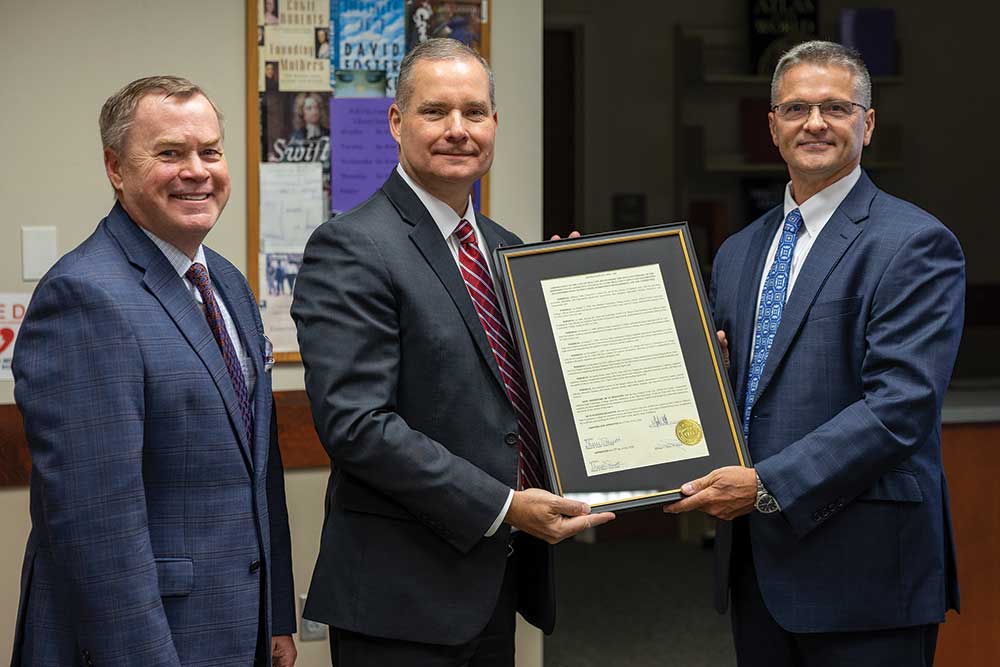
For the past six decades, Jefferson State Community College has been guided by a single principle – opportunity. Since it’s opening in 1965, it may look different – much bigger, in fact, but it hasn’t wavered in providing opportunities.

Celebrating its 60th anniversary this past fall, Jefferson State now has its highest enrollment ever – 10,400 and eclipsing its old record set in 2010 by 800 students. The Pell City-St. Clair Campus experienced enrollment gains as well.

Whether it’s opportunities for students to learn and find gainful employment or those doing the hiring having an opportunity to hire workers with the skills they need, its workforce development program has been making a sizable impact in both sectors.

Lineman, welding and construction programs are part of the offerings at Jeff State

Keeping pace with the needs of today’s industries, Jefferson State has unveiled a new milestone in its mission. The college opened a new Workforce Education Center building on the Jefferson Campus, which serves the entire system.

Housing industrial and craft skills training courses, it includes their existing line worker program and new electrical, HVAC and multi-craft maintenance technician programs. The 7,500 square-foot building features flexible classroom spaces and laboratories that can be adapted to a variety of needs within the college’s short certificate Fast Track program.

The Fast Track program is a credentials program offering 35 options within their portfolio of skills training, specifically focused on developing skills needed for high-demand entry level career opportunities. “The new building really represents opportunity for our community,” says Leah Bigbee, dean of Workforce Education for JSCC. “We’ve been strategically focused on industrial and craft skills training because business and industry have been asking for these programs.”

Bigbee says the Workforce Development Program relies on relationships with local businesses and industry to share their needs and help develop and refine the curriculum in each specialty. “Across the board, our programs are developed with actual jobs in mind – from developing the curriculum to having seasoned veterans teaching classes to mock interviews to actual job interview days,” said Bigbee.

“Our programs are really co-created with industry, which is especially helpful in teaching the specific, current skills needed by area businesses,” said Bigbee. “We have the ability to adapt and be flexible to meet those needs. Really, our north star is those companies who give us continuous feedback.”

CDL drivers are in high demand these days

Guin Robinson, Jefferson State’s dean of Economic Development, has a unique perspective and understanding of the workforce needs of area businesses, having served as mayor of Pell City for five years and at Avondale Mills in Pell City as manager of Human Resources.

“When I was mayor, it was all about community and connecting industry and business and recruiting through the Economic Development Council. It’s what I’ve always done and love doing, connecting community to, in this case, the college.” 

Jefferson State offers 116 transfer programs, 40 career and technical programs, and 35 non-credit, credentialed workforce education programs. They also offer online courses and 100 dual-enrollment course options.

“The credit classes that transfer to four-year institutions is still a lot of what we do,” Robinson says. “But not everyone has to have a four-year degree. As we came out of the COVID experience, that helped to highlight and better articulate what training and workforce needs we had. Our Fast Track program is playing a vital role in developing and training that workforce. Our new building, being the first completely new building on campus in years, speaks to the significance of the program.”

The short-term Fast Track programs include electrical, HVAC, lineworker, forklift operator, commercial driver (CDL), welding and a host of business and healthcare options. These credential programs help meet the needs of fresh high-school graduates beginning their careers, as well as those reentering the workforce or wanting to change career paths.

“We serve almost three thousand students in the Workforce Department,” says Bigbee. “Our data shows us that 80 percent complete the program and go on to find employment. Companies depend on us to create these customized training programs that really do give someone a leg up and give them a better chance to make it in an entry-level role and be retained, as opposed to someone who is just hired off the street.”

“At the end of the day,” adds Robinson, “it’s about providing economic opportunity for our students and marrying that with the needs of business and industry. It’s very rewarding.”

Some of the Jefferson State workforce development partner companies in St. Clair County include Goodgame Company, Ford Meter Box, Hubble Power and Gorbel. Jefferson State welcomes inquiries from other companies who might want to partner with their workforce development programs.

Several Fast-Track programs are offered at the Jefferson State St. Clair-Pell City Campus each year, including a clinical medical assistant class funded by the Community Foundation of Greater Birmingham.

In the spring, additional fast-track offerings such as welding, field engineering, and clinical medical assistant will be available.

Editor’s note: For more information, go to jeffersonstate.edu/fasttrack.

New Nature Center

Story and Photos
by Graham Hadley
Architectural renderings
Courtesy of Stewart Knox
Centercut Creative

Springville’s old Rock School has always been a cornerstone for education and community activities in the region. So it should be no surprise future plans for the historic structure continue that tradition.

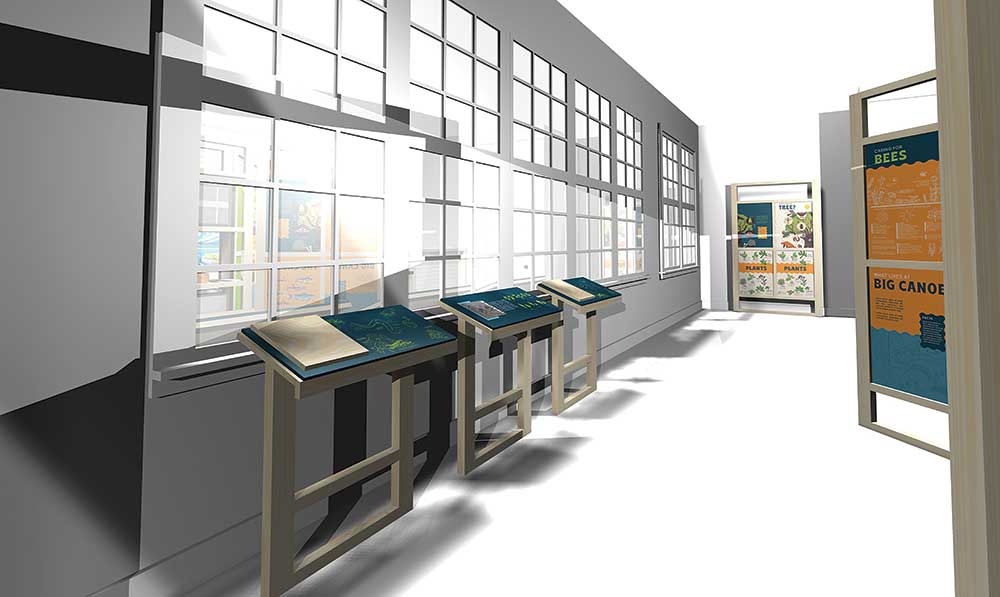
The Big Canoe Creek Preserve Partners will be developing parts of the building as an educational Nature Center – an immersive and interactive walk-through experience highlighting the natural wonders of the preserve and surrounding areas to help better educate people of all ages about the importance of the regional biome.

“The Nature Center will teach people about all the diverse animals and plants in the Big Canoe Creek Nature Preserve, all the biodiversity, the Big Canoe Creek watershed and what a watershed actually is,” said Preserve Manager Doug Morrison.

Concept designs from Centercut Creative on what the Nature Center will look like

The project will use between 1,200 to 1,900 square feet of space in the historic Springville building. Some of that space is already being put to use as office space for the Preserve staff, which was previously primarily operating out of a small building at the preserve.

The idea for the educational Nature Center came to Morrison a little over a year ago during a planning and zoning meeting.

“The Springville Preservation Society owns the building and has done a great job restoring it. They needed to rezone the property to properly make use of it. During one of the zoning meetings where that was being discussed, the idea for the center just came to me. The old school would be ideal for that,” Morrison said.

“It gives us room for the Nature Center, office space, handicapped parking and has a ramp for ADA compliance. It checks all the boxes. The Preservation Society remodeled it and were looking to lease it.” The Rock School has been a centerpiece of the community for decades. “My son used to do Scouts here years ago,” Morrison said.

Frank Waid, president of the Preservation Society, told Morrison they had the big room and some other space available for lease, and things started coming together.

Community support has been instrumental to the success of Big Canoe Creek Nature Preserve, and this latest project is no different.

Doug Morrison in front of the blackboard in the Rock School where organizers brainstormed ideas for the center

Morrison is quick to point out how much help he, Education Coordinator Lucy Cleaver, Maintenance Tech Jake Tucker and the others who work to make the preserve such an amazing place, receive from the non-profit Preserve Partners. It was organized to handle fundraising and similar activities for the preserve. From the Board of Directors to the individuals and businesses that donate, along with the City of Springville, none of what they are doing would be possible without that collective support.

Shortly after discussing the idea with Frank Waid, Morrison was sitting in Nichols Nook drinking coffee with Justen Burns when he shared the vision for the Nature Center. Burns immediately responded, “I might be interested in helping out with that.” His company, Peritus Wealth Management, quickly stepped up to cover a portion of the lease expenses.

Granger Waid and his company, Norris Paving, also jumped on board to cover the remaining portion of the lease, saying, “I believe in what they are doing here.”

“We have the first year of the lease taken care of thanks to these good folks in our community,” Morrison said. “And thanks to other donors in the community and the Alabama Power Foundation, we are already accumulating funds for next year’s lease. If anyone would like to contribute to the Nature Center and the Preserve, donations can be made through our website at bigcanoecreekpreserve.org. We are truly blessed to have such wonderful support in this community, and we are extremely grateful.”

Once they had the fundamental pieces in place, things started moving quickly. Morrison and Cleaver have already moved into their new offices, making use of much-needed space for managing the preserve and planning for its future.

Morrison, Cleaver, Granger and Jessica Waid sat down after discussing the project and, using one of the old blackboards in the school’s big room, Granger mapped out exactly what their vision was.

What they have come up with is something very special for the city and the region.

“We have a guy, Stewart Knox with Centercut Creative, doing the master plan for the Nature Center,” Morrison said.

“He was involved in parts of the Natureplex at the Alabama Nature Center in Millbrook. I really like their 3D and interactive displays, especially this giant beehive you can go into. I want to have displays like that here.”

The walk-in behive display at the Natureplex in Millbrook designed by Stewart Knox

Knox, an Auburn graduate with a degree in industrial design, said it is “all concept-based design.” His work has focused on special projects – like the beehive at the Natureplex. “I am very hands-on; you have to be with this. I am good at coming up with complex plans.”

According to the design proposal Knox has put together, “The design will highlight the mission of Big Canoe Creek through storytelling, visual engagement and hands-on learning, while maintaining flexibility for future growth and programming.”

It incorporates free-standing and wall-mounted displays, interactive 3D installations and more. Knox refers to it as “nature’s classroom.”

Morrison said that they would also like to possibly have live animals at the center – “fish and turtles, maybe snakes. People have already started donating fish tanks that I need to go pick up.”

They also want to include displays about how the local native people lived in the area and others about community involvement in the Preserve and the conservation process.

This display case was originally in Laster Sundries

“It goes to our core ideals: Preserve, Explore, Discover,” Morrison said. “When you educate people about everything that makes up the biome here, those are going to be the people who want to help preserve it.”

Morrison sees other parts of Springville and the county working with the center. “Lucy is already putting together plans with the Springville Library to collaborate on educational programs. And we have two other businesses leasing space in the school – a photographer and an artist. I can see both of those being very much resources we can collaborate with.”

The Nature Center and the Preserve are the sort of big-picture projects that benefit the area by attracting people to Springville from all across the region and the state, he said.

The Big Canoe Creek Nature Preserve is already doing just that. This past Christmas, more than 1,200 people came through the preserve to see the holiday light display called “Christmas in the Pines,” an event that Morrison expects to grow next year. 

“This was a great idea from Lucy and working with Jake, myself and our many volunteers, it turned out to be a huge success. People loved it!” And the Nature Center is only one of several projects attached to the Big Canoe Creek Nature Preserve that is in the works, including an education and multi-use pavilion. All of which, Morrison reiterated, are made possible through the support they receive from the city, Preserve Partners, grantors and many others who are working to make the preserve and center successful regional destination points.

Making a difference

Story by Elaine Hobson Miller
Submitted Photos

Little girls dancing in butterfly costumes, their wings fluttering and their faces grinning. Children playing card games with their parents. High school students (boys and girls) using their new miter saw to cut lumber for a playhouse.

These are just some of the ways that grant money from the St. Clair County Education Foundation is helping school children, and in turn, their families. Established in 2003, it lay dormant for several years but has been revitalized by new management and new fundraising efforts. The Foundation tries to fill in the gaps when schools need more classroom money than their budgets provide.

“Our purpose is to make a difference for teachers so they can make a difference for their students,” says Foundation President Dr. Greg Cobb.

The Foundation was started by Marie Manning when she was superintendent of the St. Clair County School System. Manning now represents District Six on the Alabama Board of Education.

Ragland High School received one of 22 grants handed out

“We had a community education coordinator, Emily Davis, when I was superintendent,” recalls Manning, who also serves as president pro-tem of the state board. “When I hired her on, I asked her to get us an education foundation started, and she agreed, but it took a while.”

Manning retired in 2003 and believes the Foundation came to fruition in the fall of that year. “Emily called together a group of folks, including Joe Morton, past (state) superintendent, and Tom Sanders, who was (county) superintendent at the time. We chose a few officers and got incorporated.”

She says at that time funding for education was very low, the economy was not booming, and the group wanted to do something so classroom teachers could get much-needed materials in their classrooms.

After raising thousands of dollars and granting dozens of scholarships, the organization fizzled and lay dormant until 2024.

“It was stagnant for six or seven years, partially due to COVID and partially to people retiring or moving out of the county,” says Stephanie Deneke, vice president of the Foundation. “About two years ago, Superintendent (Justin) Burns wanted to get it going again.”

“I had a detailed list of things I wanted to accomplish as superintendent, and one was finding ways to help teachers in their classrooms and in being successful,” Dr. Burns says. “I noticed that the Foundation wasn’t active. When I started as a teacher in St. Clair County in 2005, it was flourishing. It provided an outlet for people who wanted to donate and know that their monies were going straight to the classrooms. So, I called Marie Manning and asked what’s going on with the Foundation. She said it had been dormant since 2017 or 2018.”

Manning gave Burns half a dozen names of people involved in the Foundation. She said Linda Crowe, a Moody City Council member and teacher at Moody HighSchool at that time, was a Foundation officer. So, Burns called her, too, and she told him she was still treasurer and was listed on the bank accounts. “We had a couple of meetings to change the names on accounts to access money,” Burns says. “There was $100,000 or so sitting there, so it took off from there. We’re still taking in money, and the Foundation is flourishing. It’s really an awesome thing to see it pick back up.”

When Dr. Burns and Assistant Superintendent Rusty St. John called community leaders together for that first meeting, they had about 30 people attending. That group elected four members to the board of directors, and Cobb as head of the organization. “Greg taught school in St. Clair County and was a principal here for years,” says Stephanie Deneke.

“We decided we needed to reboot the Foundation because its original mission of supporting teachers was still important,” says Cobb, who now works for HMH, a textbook company. “We started onrebranding the Foundation, recruiting more people and making it active again.”

With the seed money in the CDs and checking account, the new Foundation board was able to begin giving out grants immediately.

That was in the spring of 2024. “We did whole school or department grants,” says Cobb. “We were able to give $15,000 out that first go-around.”

Jaime Ragsdale, math coach at Margaret Elementary School, was one of the recipients of the first cycle. She used the money to buy math games for the 700-plus students in grades K-5 at her school. She bought zippered mesh bags and put math games in each one for the children to take home and play with their parents, then return to the school.

The bags contained decks of cards, six-sided and 10-sided dice, and foam “counters” or math manipulators. The latter are like bingo chips, flat, but made of foam. One side is yellow, the other red, and they can be tossed and counted according to how they fall.

“The whole purpose was for them to put away their electronic devices and have family times, and to encourage parents to get involved,” Ragsdale says. “We see lots of device time and less family time these days. Children are playing less and less games such as Candyland or card games, but playing games helps them with math skills, as well as teaches them how to win, how to lose and how to share.”

Dr. Cobb spoke to a group of teachers in August of 2024, explaining the Foundation’s purpose and goals, how it was being revived, and how all the money raised would be going back to them. “There are no overhead costs,” he says. “We’re all volunteers.”

Mrs. Brasher’s class at SES showing off all the classroom materials from their grant

A few teachers started setting aside money to go to the Foundation each month, usually having it taken out of their paychecks. “That’s a little bit of a revenue stream, but not enough to count on,” Cobb says. “But we had enough from the original money raised to do a Fall 2024 grant cycle, too. We gave out $12,000 to 24 individual teachers that second round. Most of the teacher grants were for $500 each.”

A team of foundation members and educators from outside the foundation read all the 70 applications and scored them on a rubric, meaning they gave points from one to five according to need. “We call this team the readers,” Cobb says. “One teacher might ask for crayons, and that need might not be as great as a microscope for someone else, for example.”

In the Spring of 2024, officers of the Foundation presented members with the idea of an annual fundraiser. That’s how the Mardi Gras Gala, held at Mathews Manors in March of 2025, came about. Officers developed teams that put together the various parts of the Gala, such as a public relations team, a decorating team and a food team.

“We raised $30,000 at the Gala through ticket sales, sponsored tables and an auction,and we’re so proud of that,” Cobb says. “We still have some money from the original investments, too.

“We feel like our job is to make the Foundation solid enough that we can fund all the grants and not have to select certain ones,” Cobb continues. “We want to be able to grant what the teachers need.”

The Gala was such a success that the Foundation plans on holding one annually. Feedback from attendees indicated they were already excited about the next one. “We want them to put the date on their calendars,” Cobb says. “As I was selling tables for the Gala, I had several corporations say to get with them during the summer, when they are doing next year’s budget. So we learned a lot from the first Gala.”

According to Stephanie Deneke, the board hasn’t decided on the exact date for the 2026 Gala, but it will be in February. And yes, there will be another auction. “There were 45 items donated for the Gala auction this year, including Pandora jewelry, gift certificates, household items, a cooler, a tool set, Taste of St. Clair gift cards good at restaurants throughout the county, handmade knives and other jewelry,” she says.

Some 250 people attended that first Gala, and the Foundation is hoping for 325 next year. “They paid roughly $90 a ticket, a little less if it was for a couple,” says Cobb. “If someone bought a table, the bottom level was $1500. We had tables with enough seats to bring whomever they wanted. For example, I bought a President’s Table, filled it up with family and my folks. A few corporations bought tables, like Doster Construction, the company that’s working on Moody High School, and invited any employee from the school to sit there. There were eight-10 seats per table.”

Deneke says the Foundation used to “sell” chairs to raise money, wherein someone could sponsor a chair and get a plaque with his/her name on it for their business. But businesses seem to like the Gala idea better. “We may revive the chair donations anyway,” she says. “Teachers can contribute through payroll deductions, too.”

Cayla Brasher, a first-grade teacher at Springville Elementary School, received a $500 grant last Fall and used it to buy decodable readers for her class of 21 students. “A decodable reader is a phonics-based book that has words students are able to decode or sound out or figure out,” Brasher says. “It keeps them in what teachers call that ‘zone of proximal development,’ where they are having to work at reading, but don’t get so frustrated with it.”

She wanted a good variety of books that they could successfully read. “We want some times during the day when they’ll want to pick up a book and feel successful at reading it,” she says. “Decodable books follow that phonics progression. The student is able to figure out or decode words yet enjoy the reading.”

Marcus Graves, construction class instructor at Eden Career Technical Center, received a $599 grant, which he used to buy a new rigid slide miter saw with a stand. The tool is used to cut steep angles and wide boards for construction projects.

“Some of our unique projects are the oversized Adirondack chairs with multiple letters that we put on our hillside at our school,” Graves says. “The letters form words, like ‘love’ for February. We’ve turned a school bus into a camper, we’ve done a goat camper for a petting zoo at Greensport campground, tiny houses, small playhouses we’ll be selling in the Spring, and the floating duck island for Springville Park.”

Meg Lowry, of Odenville Elementary, used her Fall 2024 grant to purchase an insect unitfor her pre-K class. “The unit included live caterpillars, dress-up clothes like butterfly and bug catchers’ outfits with nets, lots of little plastic bug sets, and games like Memory, all based around the insect theme,” she says. “We actually started the unit in March, when we turned the classroom into an insect theme. We could not have done it to this extent without the grant, which was close to $700. This gave the kids hands-on activities to learn, which was very, very developmentally appropriate in pre-K.”

Deneke says the Foundation is always looking for new members from each community, especially Ashville, Springville and Ragland. “It would be great to get some members from those areas,” she says.

Editor’s Note: Anyone interested in joining the Foundation can contact them on its Facebook page. The Foundation generally meets once a month on Fridays at Odenville City Hall at 11:30 a.m. but is considering going to every other month.