Step into the ring

Professional boxing finds new arena in Pell City 

Story by Loyd McIntosh
Photos by Wallace Bromberg Jr.

On a sweltering hot Friday afternoon in late July, the parking lot of Total Body Fitness is so full, many cars have parked in the grass and mud in the vacant lot next door. Inside, the gym is just as packed as dozens of athletes, trainers and others mill about.

There is excitement and even a little tension in the air. All of this activity isn’t for a hot, new exercise class. No, excitement builds for the weigh-in for a boxing event taking place in a little over 24 hours at, of all places, the CEPA Building in Pell City. 

Organized by the Alabama-based boxing promotion company, One One Six Boxing, Saturday’s event, Logan Martin Rumble 2, is the second boxing “show” One One Six has held in Pell City, the first coming in December 2020. One One Six is also notable for being the state’s first and only boxing promotion owned and operated by a woman and St. Clair County native Brandi McClain. 

Anthony Stewart (right) stares down Jayvone Dafney (left) as referee Keith Hughes goes over the rules.

Since launching, One One Six has held close to 10 boxing events showcasing fighters from all over the country but with a concentration on boxers from the Southeast. Operating out of Gadsden, One One Six has hosted Money Powell IV, James De La Rosa and Michael Williams Jr., the undefeated prospect of Roy Jones Jr. This weekend, her focus is on a boxer named Anthony Stewart, who at age 40 is competing for the Alabama State Cruiserweight Title. 

“Anthony has a lot riding on him this weekend, but he’s a very talented fighter. He’s ready for this moment,” McCain says. “I think he has an opportunity to fight on TV, and I’m doing everything I can to make that happen for him. It’s my job to make my fighters’ dreams come true.”

At the weigh-in, Stewart is sitting at a table with his trainer, Dave Godber, a boxing lifer with extensive experience as a fighter and trainer. Currently, Gober owns Round 1 Boxing For Health, a gym in Vestavia where Stewart trains while he’s not busy with his full-time job as a welder for Ox Bodies in Tuscaloosa.

Since his last sparring session a little over a week ago, Stewart has geared down his activity to give his body the rest it needs for his title fight on Saturday. “My last week, really what I’m doing is I’m trying to focus my mind on rest, relaxation, how I can make my body 100 percent when I step in the ring,” says Stewart. 

His opponent is a little-known boxer named Jayvone Dafney, a 34-year-old cruiserweight fighting out of Los Angeles with a record of 2-3. Anthony and Godber have spent much of their preparation watching film and studying Gafney’s strengths and, more importantly, weaknesses. “Everybody has habits, and that’s what we want him to do. We want him to fight in his bad habits,” Godber says. “That’s what I’m really good at. In the first 30 seconds, I can tell you exactly how this man’s fighting.”

Godber is of the mindset that boxing is a 50-50 sport – 50 percent physical, 50 percent psychological. He’s been working tirelessly on Stewart’s mental approach to boxing, helping his protégé to think on his feet and react to whatever his opponent does in the ring. “Everybody’s got skill,” Godber says. “You can be the best fighter in the world, but you have to have the mental attitude to know how to survive and how to make good decisions.

“Everybody looks like a champion on the heavy bag,” he adds, “but when you get in that ring and the pressure’s on you, you have to overwhelm yourself with the mental aspect.”

“When I’m in there, I don’t just react,” adds Stewart. “I’m thinking to myself, ‘when I do this, what does he do? When I throw this punch, where does he move? When I throw this punch, where does he drop his hand? If he drops that hand, we’ll I’m going to come here.’”

Like many of today’s professional boxers, Stewart honed his fighting skills in the crazy world of ultimate fighting in what he calls “loosely organized” underground events in bars and joints in places like Jasper and Cullman. Stewart turned pro in June 2018, defeating a boxer named Andre Brewer. Leading into his title bout in Pell City, Stewart’s record stands at a healthy 5-1-2, four wins by knockout. Fit, mentally acute, and rested, Stewart is brimming with confidence just 24 hours before the bell rings in the biggest fight of his career in the heart of Pell City, the Main Event for Logan Martin Rumble 2. 

“I don’t like to say anything derogatory about anybody that I’m about to fight but …” he stops himself before finishing the statement and collects his thoughts before continuing. “It’s like this right here. I’m coming to handle business. Anybody that’s in my way of that title is going to get broken down. I want to see what kind of man he is. This is mano a mano. I want to see how he faces adversity because I’m going to touch him.”

Still, at the age of 40, one question Stewart is asked often is how much longer can he continue boxing? How will he know when it’s time to hang up the gloves? “Through all my amateur fights and most of my pro fights, I didn’t take many punches. There will be a time when I got to hang it up, but right now I’ve got a five-year plan, which takes me to 45,” explains Stewart. “We’re going to stay in shape and keep this going.”

Fight Night

It’s now Saturday evening and the gymnasium at the CEPA Building has been transformed for professional boxing. The ring sits at the center of the court with professional lights placed in opposite corners. There are 11 fights on the card with the Stewart-Dafney fight bringing the night to a close.

Most of the bouts are scheduled for four rounds, with three scheduled for six rounds, including the main event. The first three fights of the night ended in knockouts – two in the first round, one in the second round. However, one of the best fights of the night was the fourth on the card, the stunning debut of a young fighter named Nicholas Adams. 

A native of Pell City, Adams initially attended Pell City High School, transferred to Ashville High School, before eventually earning his GED. He worked as a corrections officer before recently devoting himself to boxing full time after deciding against pursuing mixed martial arts.

He signed on with One One Six Boxing but found himself in need of a new trainer and coach less than a week before his professional debut. He hooked up with Martin Juarez, owner and operator of Juarez Boxing in Irondale, who has been impressed with Nick in the short time he’s worked with him.

“I met Nick four days ago. He called me over the weekend and said he was without a trainer and needed some help,” Juarez explains. “Just the time we’ve spent in the gym, we’ve been able to build a rapport with one another, and I’ve taught him some stuff that he’s never known, this being his first professional fight.

“Nick shows a lot of great attitude and great effort and has come a long way in four days,” he adds. “I’m expecting only great things from him.”

Adams has a lot riding on this fight as well. He and his wife, Morganne, have a preschool-age daughter, Sophie. Not only is this Nick’s pro debut, but his primary source of income for his young family. At the weigh-in on Friday, Morganne was both excited and apprehensive about her husband’s bout. “I keep thinking I am ready for this, and we keep getting closer, and I don’t know. My stomach’s in a knot,” Morganne says. “I’m very nervous, but I know he’s going to win.”

Adams’ opponent Saturday evening is 32-year-old Keith Criddell, boxing out of Atlanta in a Super Middleweight bout scheduled for four rounds. Despite his record of 0-3, Criddell has almost a year of experience as a pro boxer, having made his debut in August 2020. Adams’ path to victory is clearly uphill.

From the opening bell brought through the end of the third round, the action was exciting and, to the general boxing fan, evenly matched. In reality, Adams was winded, having come out too hot in the first round throwing a flurry of punches and expending a lot of energy. By the end of the third round, Adams was in danger of losing the fight should it go the distance. Adams’ new trainer and cornerman, Juarez, was there to encourage his fighter, but also to give him the unvarnished truth.

“I was tired. He got in my face and told me ‘you can’t forget everything that we’ve done these last four days. You’ve been amazing. Don’t forget everything you’ve learned, and, oh, by the way, you’re losing this fight,’” Adams says. “That wasn’t something he didn’t have to tell me, I could tell. I was falling behind. But when he got up in my face, all the numbness that I had in my legs went away. I don’t know what that man said to me, but it was the way he said it. I knew I was going to lose the fight if I didn’t put him out in the fourth round.”

Adams regained his stamina and focus in the fourth round, connecting on a vicious right hook that sent Criddell to the canvas once and for all. “I took everything (Juarez) gave me and applied it as best I could. It took me four rounds, but I did it,” Adams says. “I put him down and pulled out the win for my debut.”

Back to the Main Event

After 10 fights, all but one ending in a knockouts or technical knockout, the crowd is ready for the main event. Dafney makes his entrance into the ring first to little more than polite applause.

It’s clear this crowd is here to see Stewart. He doesn’t disappoint. Following a light show and a short but loud pump-up performance by a Tuscaloosa-based hip-hop artist, Stewart makes his way into the arena. Wearing red and black trunks with his last name emblazoned across the front, Stewart enters the ring, his tattooed chest and arms already glistening with sweat, his jaw clenched, eyes staring straight at his opponent. Referee Keith Hughes goes over the rules and sends each man back to his corner to wait for the opening bell. 

One day prior at the weigh-in the question was posed to Godber, where does Stewart have the advantage over Dafney? “Anthony throws more punches,” says Godber.

“We’ve been working weight on six and seven punch combinations. I don’t think that young man’s ready for Anthony because he doesn’t throw much more than three,” Godber continues. “You won’t see Anthony on the ropes. You’ll see him in the center of the ring. It’s hard to fight going backward, and if (Dafney) goes to the ropes, he’s going down.”

The bell rings and the fight plays out exactly as Godber described. Stewart began the bout measured, even taking a couple of shots from the taller Dafney, before exploding into a fury of punches.

As Round 1 progressed, Stewart continued his onslaught of punches, pushing Dafney back on his heels and into the ropes. Finally, Stewart broke down his opponent’s defenses before connecting with a fierce right hook and sending Dafney to the canvas. No 10-count. Hughes jumps in and immediately stops the fight at 2:55 in the first round. It’s over. Hughes lifts Stewart’s arm in the air. McCain enters the ring to place the belt around the victor’s waist. 

Anthony Stewart is the new Alabama State Cruiserweight Champion.

A Night at the Opera

Summer-ending concert may become
yearly event on Logan Martin Lake

Jason Rogoff and Jeff Thompson found the cure for the quarantined summer blues: an outdoor rock concert … during Labor Day weekend.

But it cannot be your normal concert.

This one has to be arranged in less than eight weeks; it has to feature a sought-after performer who just happens to be available because of pandemic cancellations; it has to provide seating that socially distances audience members attending by land and huge video screens visible to those attending by boat; it has to raise funds for two entities, and it has to be full of energy.

That concert – which was on Sept. 4 at Pell City Sports Complex on the shores of Logan Martin Lake – fulfilled all the requirements and quite possibly began an annual event.

For the concert, the Black Jacket Symphony performed the songs from the Queen album, A Night at the Opera, and featured the vocal talent of Marc Martel.

The stage lights up the night

Martel provided some vocals for Bohemian Rhapsody, the biopic about Queen’s late lead singer Freddie Mercury, said Rogoff, director and producer of the Black Jacket Symphony.

Thompson, who is director of the Center for Education and Performing Arts (CEPA) in Pell City, said Rogoff approached him about an outdoor concert patterned after others that the Black Jacket Symphony had held in Birmingham.

For the Black Jacket Symphony, this would be a return visit to Pell City.

In February 2020, the Black Jacket Symphony performed Fleetwood Mac’s album, Rumours, in concert at CEPA and had scheduled Led Zeppelin IV for May. But COVID containment measures canceled Led Zeppelin IV.

Visit the Black Jacket Symphony online
at blackjacketsymphony.com

Marc Martel once again playing guitar during a BJS Queen show

Mustang Museum of America

St. Clair celebrates an automotive icon

Story and photos by Graham Hadley

The Mustang Museum of America is celebrating the one-year anniversary of its opening in Odenville and cementing its place as a regional go-to attraction for automotive enthusiasts from around the country.

It joins the likes of the Barber Motorsports Park and museum in Leeds and the International Motorsports Hall of Fame in Talladega County.

For many automotive enthusiasts, two car lines have dominated the highways in America.

One of them, the Chevrolet Corvette, has had a museum all its own in Bowling Green, Ky., for years.

Now, thanks to the efforts of one family and backed by local businesses and the City of Odenville, that other car, the Ford Mustang, has a museum right here in St. Clair County.

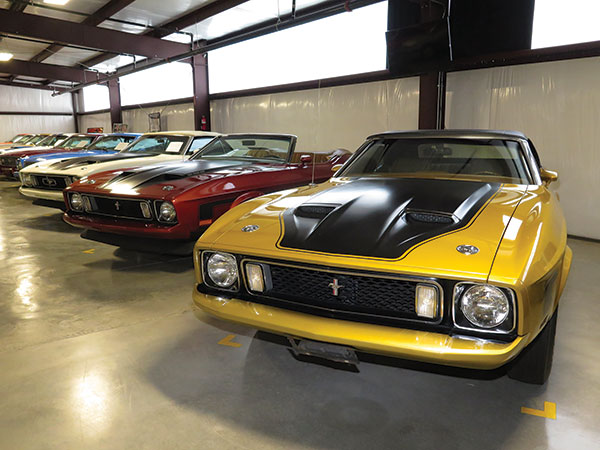
Housed in a huge steel climate and humidity controlled building, the Mustang Museum of America opened March 17, 2019, on Forman Farm Road in Odenville, and since then, the expansive attraction had been drawing hundreds of fans of Lee Iacocca’s famous Pony Car from across the country.

The museum is the brainchild of Robert Powell, who says, “I had been thinking about a car museum for 15 years” and finally decided to make it a reality.

Powell, who had been working for Progress Rail, was nearing retirement — which he officially took Feb. 1 — and started putting the pieces in place about five years ago.

“With the collection of Mustangs I had put together, and the help of my two sons and their cars, we started to figure out what we were going to do,” Powell said.

It was a natural move for Powell — he had been the president of a local chapter of the Mustang Club of America in Tampa, Fla. Even back then, they were thinking about the possibility of a museum.

Powell grew up in Alabama. In fact, he saw his first Mustang at a gas station in Odenville as a teen. “I thought it was the most beautiful car ever put on the road. I was in high school, so of course I could not afford one. But I started following the line. Back then, I would get together on weekends with my friends in high school, and we would drive around looking at car dealerships to see what they had on the lots.”

When work brought him back home from Florida, he and his wife and sons only thought it would be natural to open the museum here.

“We think this could be an anchor attraction for North St. Clair County,” he said. “I moved here when I was 6. I grew up here, went to school here. St. Clair has been good to us. We feel a loyalty to this area.”

With the support of local civic leaders and business owners like Lyman Lovejoy, Powell unveiled his plans for the Mustang Museum of America during a special community meeting in mid-2016. They had already procured the necessary property, were starting on plans for the building, and between Powell, his wife, Carolyn, and sons Jonathon and Gary, already had upwards of 70 Mustangs in their personal collection.

Plans called for the museum to house between 100 and 120 Mustangs — a number they are already close to reaching with 102 cars on hand. “We want to have one of every model year through 2015, plus a police car version from every state that used them,” Powell said.

Thanks to the generosity of collectors and organizations dedicated to preserving Mustangs, who have either loaned the Mustang Museum cars or donated them outright, there are only a few gaps in the long rows of cars on display where they are still missing models.

And alongside the standard models are a number of specialty cars of historic note, including the Mustang test bed used to benchmark the SVO Mustangs. It is one of the compact, slant-fronted Fox bodies that marked the return of the Mustang as a dominant force in American automotive manufacturing in the late 1970s and early 1980s.

That car looks rough, but Powell says that is part of the history of the test vehicle. “I wanted it left this way. It is part of what makes the car unique. This is the standard Mustang that they ran against the SVOs in tests to see how they performed.”

They also have the Fox-body Mustang Ford sent to California to be used to test the viability of Mustangs as police — and much more commonly, state trooper — cars. That test eventually opened the door for states across the country to adopt the Mustang as a go-to law-enforcement interceptor vehicle.

Other cars that were limited runs to promote brands, pace cars and race cars are also part of the collection.

And though there was a time when many die-hard Mustang fans would not admit that Ford’s smaller Mustang IIs were part of the Mustang family, the museum boasts a large collection of those, too. And that includes some of the sporty models that were seen on TV shows, Charlie’s Angels in particular.

Times have changed, Powell said, and most Mustang enthusiasts now consider the Mustang IIs as part of the Pony Car family, with a number of people who specifically seek out and restore them, helping with the museum’s collection.

In addition to the cars, the walls of the museum are adorned with advertising, magazine articles and other art – even an original, full-size billboard – that tell the story of the Mustang.

“Lee Iacocca had to really fight to get the Mustang built,” Powell said. Ford had just taken a big hit with the failure of the Edsel, and when Iacocca said, “We need a new car line,” he was told he must be crazy. But Iacocca, who passed away in 2019, was known for his dogged determination, and the first Mustang was built — the 1964 1/2 model. The official launch of the 1965 Mustang would be Ford’s most successful roll-out since the Model A.

The museum is a non-profit effort overseen by a seven-member board of directors. Powell serves as the managing director. His son, Gary, is the manager, and his other son, Jonathon is the assistant manager.

Powell admits it has been a learning curve for him, his family and everyone else involved in the project, but their hard work is paying off.

Visitors from around the country are making their way to Odenville, some just go a little out of their way while passing through the area, others as parts of organized car clubs and similar events. They even had a Honda Goldwing motorcycle enthusiast club make it a point to put the museum on one of their routes.

That is exactly how Powell had originally envisioned the project – not just as a museum, but as a venue with large outdoor spaces and plenty of parking to host crowds and bring events to St. Clair County.

He also readily admits the business they are seeing now is just a small part of what the museum can mean to the community. They did a soft opening and have gradually been seeing business ramp up as word gets out about the museum, something Powell says will be key to its success.

And he was quick to point out that they are part of a much bigger picture – drawing motorsports enthusiasts to the region. Races at the Talladega Superspeedway and events at Barber Motorsports Park are part of that draw, especially since both of those tracks also have museums on site, with more on the way at Barber.

Powell said the people at Barber have been especially helpful.

“When I first started thinking seriously about doing this, I talked to the people at Barber, and they were very supportive,” he said. They have even talked about creating a regional motorsports museum pass to cover several of the museums on one ticket.

His sons have been bringing some of their cars to events at Barber and reached out to the venue for guidance and the possibility of cross promoting their attractions. The response and support have been more than Powell ever could have expected, he said, lauding them for taking the big-picture approach to making the museums and tracks regional and national attractions.

Other local businesses, like BEI Electronics and Graphics and SVP are also important parts of the community effort that have made the museum possible, helping with paint or custom decals to return even the most worn-out Mustang to original condition. Powell tries to keep cars in as close to original condition without restoration as possible, but some vehicles need a full bumper-to-bumper rebuild before they are suitable for display.

The Mustang Museum of America is open Thursday through Monday, 9 a.m. to 6 p.m., but Powell said they will open pretty much any time to accommodate visitors; they just need to call ahead and let them know they are coming. l

Keep up with the Mustang Museum of America online

mustangmuseumofamerica.com

and follow them on Facebook

Cinertainment comes to Pell City

Story by Linda Long
Photos by Graham Hadley
and Wallace Bromberg Jr.

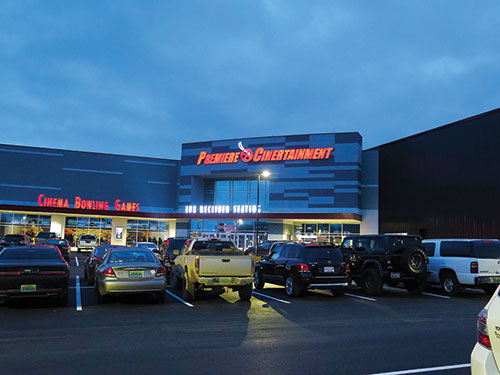
Heads up, Pell City and environs, Cinertainment has come to town, and there’s nothing else like it anywhere around. When people talk about the ‘wow factor,’ this place defines it.

Take it from Mark Vaughan, facility director of the 47,892-square-foot facility, which houses seven theatres with reclining seats, 12 bowling lanes, a café and bar, and an arcade complete with zip-line – all under one huge roof.

The name is a derivative of the words, cinema and entertainment, but that barely begins to describe the multiplex, multifaceted attraction. 

As Vaughan explained, the innovative concept is geared toward serving as a destination point, drawing patrons from Lincoln, Leeds, Anniston, Oxford and Talladega.

“Of course, we would love to draw from the Birmingham area as well, but those cities are where we expect to get our customers,” said Vaughn.

Ten years in the planning and construction phase, Cinertainment opened its doors in January to record crowds. As Vaughan points out, the facility was a long time coming but well worth the wait.

“We offer something for just about everybody,” he said.
Mayor Bill Pruitt, who cut the ribbon on opening night and took his turn on the zip line, echoed the sentiment, crediting multiple city administrations; St. Clair Economic Development Council; developer Bill Ellison, president of I-20 Development; and St. Clair County Commission. 

“This very well could be the single most important date in Pell City history,” Pruitt said, making a joke about Facebook and the years of discussions and comments from an impatient community. “This is the fourth administration to have this dream, he said, singling out former Mayors Adam Stocks, Bill Hereford and Joe Funderburg. “Joe worked diligently,” he said. Ground was broken on the complex just past the end of Funderburg’s term and the beginning of Pruitt’s.

“I deserve no credit for this,” Pruitt continued. “I am just honored to be a part of this and to be able to stand here tonight. After walking around inside and seeing this place, it was well worth the wait.”

The mayor also talked of Ellison’s role. He said Premier Cinema CEO Gary Moore told him how excited he was to finally meet Ellison a couple of years back. He remembered Moore telling him, “ ‘ Who in the heck is this Bill Ellison who keeps calling me about bringing this movie theater to Pell City?’ ”

Ellison, long known for his persistence in recruiting business to Pell City, recalled, “I stayed on him. I kept calling him and telling him about Pell City. We started building a relationship, and it progressed to the point that we could put the right people together to make it happen.”

Ellison noted that it indeed was a team effort of the city and county, noting that St. Clair EDC Executive Director Don Smith played a major role in “putting the package together.”

Moore agreed, saying Smith and City Manager Brian Muenger’s support for the project ensured its success. “Without their support and enthusiasm, this project would never have happened.” He added thanks to Funderburg as well.
So now the dream is finally reality. “It’s not only a great thing for Pell City,” said St. Clair Commissioner Tommy Bowers, “it’s a great thing for St. Clair County.”

Moore took it a step further. “This is a destination attraction. It will draw from counties from miles around. It is a lifestyle enhancement, we think, of great proportions.”

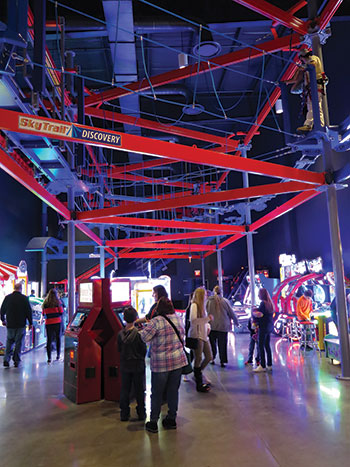
He’s right. From 12 state-of-the-art bowling lanes to seven “luxury experience” movie theaters, an indoor zip line and obstacle course, Cinertainment’s management take their night-out-on-the-town experience to a whole new level.

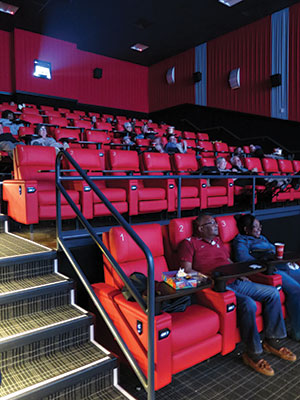
“We’re offering what we call the ultimate luxury in movie going,” said Vaughan.  “All the seats are reclining. The recliners are electrically powered in all auditoriums, complete with USB ports and swivel tables for dining. Movie goers may order their food. We’ll give you a buzzer. When your food is ready, we’ll buzz you and you go right to your theater door to get your meal.”

As Vaughan explained, “this way you can have your popcorn and Coke or a full meal right there at your own table.”

The expanded food and beverage options are expected to be a huge draw, with a full-service kitchen, a pub and full bar, offering four top drafts, four light beers and four craft beers from local breweries.

Food choices include pizza, hamburgers, grilled chicken, wings, onion rings, fried green tomatoes, chef salad and fried pickles.

For those who might want to work off some of those calories, Cinertainment offers a zip line and an obstacle course. And, of course let’s not forget the arcade.  “Our game room has about 46 different games. “You can redeem points here, then take them to the redemption center to see what you can buy,” said Vaughan. “We’ve got winnings ranging from trinkets to an Xbox.”

The facility also offers space for private events such as birthday parties and business meetings.

“We’ve even gotten a couple of churches interested in holding Sunday services here. Like I said, something for everybody,” said Vaughan. l


Cinertainment is located at 2200 Vaughan Lane in Pell City.
– Carol Pappas contributed to this story.


Ron Partain’s World of Music

Distilling a love and life of music into one store

Story and Photos by Graham Hadley

Window shopping on Cogswell Avenue in Pell City’s historic downtown, anyone with any interest in music will be drawn to Ron Partain’s store.

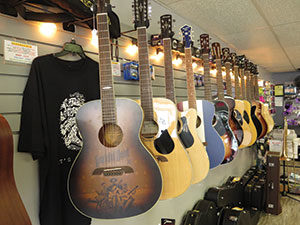
Following the sound of classic rock from the past four decades piped through speakers in the front of Ron Partain’s World of Music, visitors can look in and see guitars — electric and acoustic, mandolins, keyboards and electric pianos, banjos, amplifiers, drum sets, even a colorful row of ukuleles.

Plus everything else under the sun necessary for people to make music: effects pedals, sound mixing equipment, pics, microphones, speakers, strings, instrument straps and much more. Every inch of Ron Partain’s World of Music is a testament to his love of music.

And that is exactly the way he wants it — for Ron Partain, since his mid teenage years, his life has centered on music — and it’s a love that he wants to share with the world. So he, with the help of long-time employee Karen Poe, distill that love into the store that has been open on Cogswell for 41 years now.
The original store was located just down the street from its current location at 1914 Cogswell. Partain, who has spent his life as a music director for various church choirs in St. Clair and Talladega counties, knew he wanted and needed to do more with his life, and a music store seemed the perfect fit. “I loved the choir work, but I had two daughters to get through college. I had to do something — and here we are,” he said.

“I had no real money in 1977 when I decided to do this. I had maybe $1,000 and had to borrow three to four thousand more.”

Everything came together, and Ron Partain’s World of Music opened its doors for the first time across the street from the St. Clair County Courthouse in 1978. The original shop was much smaller than the current one — “a hole in the wall” he called it — and that was a particular issue because, back then, they sold full-size pianos and organs.

But it did the trick, cementing World of Music as a downtown staple for almost half a century.

It was also the beginning of a business relationship and friendship that has lasted almost as long as the business has been around. There were more than one business located in the building Partain bought all those years ago, and one of them was a Sneaky Pete’s restaurant. The owners were looking to sell their business, and Partain took the opportunity to expand his income. Within a few years, someone presented him with an offer to purchase the restaurant that was too good to refuse.

Karen, who was 19 at the time, was the cashier at the restaurant. “I figured I was out of a job,” she said.

Not so. “I handed her the keys to the music store and said, ‘You run the business for a while. I am going to play golf.’” And he did exactly that. Partain confessed he needed some relaxation time. Between his duties as a music director, running the music store and managing a restaurant, he admittedly needed to catch his breath.

“I had no idea what I was doing,” Karen joked. “I spent the first few weeks just stacking and sorting papers so I would look busy.” But she quickly grew into the job of managing the day-to-day operation of World of Music and is still doing so now, 38 years later, something Partain is quick to point out has been a key to the business’ long-term success.

That success should not surprise anyone who knows Partain. At 15, he, like most boys his age, was very focused on sports. Nothing could be further from his mind than music. All that changed when a gentleman named R.U. Green came into the locker room after football practice and announced he was looking for some young men to participate in a concert choir.

Hesitant at first, Partain and a few of the other players realized a choir might be a great place to meet some young ladies. So he joined up, and his life’s path was set.

“I had never sung before. By the third or fourth week, I was head of the vocal choir. Music set my heart on fire. I was still 15 when I took my first paying job directing a church choir,” he said, “and I have been doing it ever since. Music just speaks to me.”

And he did get to meet a girl — his wife, in one of the choirs he participated in.

Partain has made a name for himself over the years as a music director, taking choirs, usually groups of high-school students and young college-age adults, all around the globe to perform. They have sung the national anthem at the opening of sporting events in some of the most famous stadiums, like Wrigley Field and the Astro Dome, in the country.

And playing those sports venues has had the added bonus of feeding one of Partain’s other loves — sports. “I got to see Cal Ripken play,” he said.

They also have performed at national monuments, the United Nations, places like the Brooklyn Tabernacle, and been as far away as Hawaii, more than once.

Partain said one of the biggest challenges, other than getting ready to perform before huge crowds, is keeping track of all of the teens and young adults in his group, so they have shirts printed up before each trip that everyone has to wear.

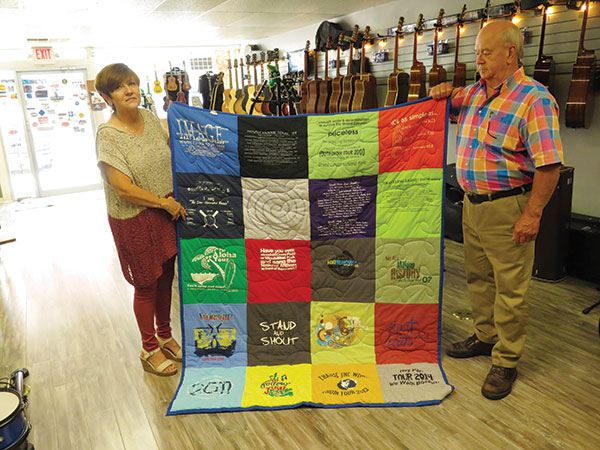
One of Partain’s prized possessions is a quilt made up of the different shirt designs they have used over the years.

“I have gotten to see and do things in my life that I would not have been able to do without music,” he said, adding that one of his proudest achievements is that he got to “sing with my daughters.”

It’s the life that his love of music has given him Partain wants to share with others through his store, which has been in its current location since 1986.

He readily admits, as does Karen, that they can’t play their instruments very well, but that is not the point. “I have a love of music, but I’m not a great musician myself. I love helping other people learn to love music.

“I wanted to give musicians a place in this area to shop,” he said. “I really get my personal fulfilment from watching people, adults and kids, come out here to make music.”

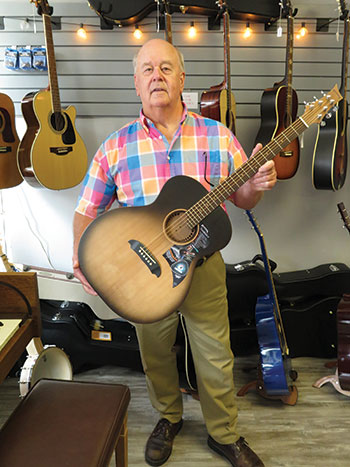
So he took a building and filled it with everything local musicians need. His personal favorites are acoustic guitars — Alvarez in particular. And though he keeps a broad inventory in his store, Partain realizes that to compete with big retailers and the Internet, he needs to have more than what he can fit in one building. He does that by keeping up a network with instrument distributors all over the country and beyond and can order pretty much anything his customers need or want.

But to keep a music store open in a small town, even in an area growing as fast as Pell City, means you have to have something for everyone, and do more than just sell instruments and sound equipment.

Partain says he is probably one of the oldest locally owned retail businesses in the area, and the key has been diversity. They repair instruments, help set up sound systems, even move pianos — if a customer needs an item or needs something done, they find a way to make it happen.

He estimates as many as 75 people a week have taken music lessons at World of Music — from guitar to horns, they can teach it all. They even work with local school bands to keep their instruments in top shape.

As he credits Karen with the success of running the business, Partain says Steven Begley is not only a fantastic music instructor, he can repair almost any instrument.

“We had a guy come in here with his father’s guitar that had gotten water on it. It was all bowed out and warped on the sides, all over.

“Steven took that guitar and worked on it. When the guy came back to pick it up and saw Steven coming out with the completely repaired guitar from the back of the shop, he stopped right here and started crying. He had thought the guitar his father had left him was ruined. Steven made it look like it had never been damaged.”

It is those types of experiences that bring it all home for Partain. “I love sharing music with people. I love everything about this business, talking to people as they come in, the purchasing, the selling — everything.”

And he will share that love with his customers even if you are not looking to buy that day, with people coming by the store just to talk, visit or listen to music.

The doors of Ron Partain’s World of Music are open to musicians and music lovers alike.

Local Color Redux

Keeping Springville’s ‘colorful’ music spot alive

Story by Paul South
Photos by
Michael Callahan, Susan Wall,
Jerry Martin and courtesy of Local Color

In the late fall of 2016, Merle Dollar and husband Garry Burttram announced that on New Year’s Eve, their iconic music venue, Local Color, would take its final bow.

But Bobby Horton, legendary fiddler of the equally iconic Alabama bluegrass trio, Three On A String, was skeptical. Three On A String would play that “final” performance.

“I wouldn’t be surprised a bit of Merle and Garry reopen,” he predicted. “They love it too much. I wish they wouldn’t close.”

It turns out, Horton, like a musical Jeremiah, was a prophet.

“Bobby got his wish – sort of,” Dollar says.

Local Color is back, but without Burttram’s delicious cornbread cooked in a hubcap-sized cast iron skillet and chicken and dumplings. The wildly popular stage opens a couple of times a month, not as a traditional business, charging only a cover to pay the bands.

Dollar reminisced about Local Color’s 2016 final curtain that wasn’t.

“The patrons were mourning and grieving and crying, and the musicians were so nostalgic already. Really gloom and doom.”

The building was up for sale, with a buyer on the horizon, but after two months, Erick Smith of the rockabilly band Cash Domino Killers approached Dollar with an idea – a house concert. No food or drink, save what patrons would bring themselves, sort of like a covered dish dinner, or an all-day singing and dinner on the grounds, but with furniture.

Dollar ran the idea by her sisters, who with her own the building.

The response: Why not?

The result? A packed house.

“Everybody came in and brought their own food and their own beverages and just paid a cover charge at the door for the musicians, and we had a grand night.”

Fast forward a few weeks after that grand night. The expected sale of the building fell through. And it looked as though Local Color had danced its last.

Dollar and her sisters decided that Local Color deserved one last send-off, a last waltz, if you will. They called on their old friends, The Martini Shakers, another rockabilly act that had played the place for years. The response from the joyous crowd ignited another idea. The girls decided to host house concerts once or twice a month, getting the word out to Local Color die-hard regulars.

“We’ve had some remarkable crowds,” Dollar says. “And we’re just doing it at our leisure.”

 Merle and Garry are retired now, traveling to Scotland and Disney World and keeping up with kids and grandkids.

And now, virtually every weekend, music again rings from Local Color. To be clear, it’s show business but no business.

“It’s strictly a house concert. I want to stress that it’s a non-business. The family is hosting different bands to come in. I get requests all the time from musicians to come in and play,” Dollar says. “We’re strictly a non-business.”

She added: “It’s just one of those magical things that just refuses to go away.”

Local Color looks and feels the same, except for the patrons who bring their own snacks, from popcorn and pop, to sacks of fast food, to gourmet munchies and bottles of Merlot.

But while the food brought from home varies with every patron, the reaction is universally the same to the Local Color house parties: “Why didn’t you do this sooner?”

“It’s been so heartwarming to know that people are so excited to come back again,” Dollar says. “It really was such a downer (when Local Color closed). Once it started buzzing through the musical community (about the house concerts) it was like, euphoria and ‘hallelujah’ and ‘Oh, boy!’ One person stopped me in the grocery store and said, ‘It’s about time.’”

 Along with the music dates, it’s also a gathering spot for Merle and Garry’s family get-togethers, holiday dinners, baby showers and the like. And the family – through Merle and her cousins, Sylvia Waid and Peggy Jones, who form the Andrews Sisters-style Something Else Trio – provides the musical heartbeat.

“There would be no Local Color without ‘Something Else,’ Burttram says.

Dates are booked through July, but the spot remains for sale. “Three months, who knows what can happen in three months.”


Encore performances

The acts, jubilant to return to  this intimate spot where the music seems all that matters, include The Cash Domino Killers – named for music legends Johnny Cash, “Fats” Domino and “The Killer” Jerry Lee Lewis, pay homage to the timeless tunes of the 1950’s. Through the, you’ll hear the sounds of The Million Dollar Quartet (Cash, Lewis, Elvis Presley and Carl Perkins), The Drifters, The Tams and others. The band has played Local Color for years. Like Three On A String, it has helped define the venue as one of Alabama’s great small music spots.

Another fan favorite, The Dill Pickers, a musical comedy ensemble, also draws packed houses.

“They’re like a comet,” Dollar says. “They show up once in a blue moon.”


No place like ‘home’

Thanks to the bands, Merle and Garry and their families and fans, Local Color lives on.

“Even while it’s sitting there empty, it still has that aura, that mystical feel about it. There’s something about that. I don’t know what it is. People walk in and say, ‘I’m home.’”

The place still has flawless acoustics, so perfect that folks swear you can hear smiles from the audience, that sits in rapt attention, drinking in the music.

“You can hear them smile,” Dollar says. “You can hear them cry. You can feel it. It’s palpable. The emotional connection that you have with your audience, you feel it, they feel it.”

Local Color, it seems, has indeed taken on a life of its own, past what even its owners expected. Like The Little Engine That Could from children’s literature, it chugs on. 

Says Dollar, “It’s a light that refuses to go out.”

As for the fiddling prophet, Bobby Horton, he’s overjoyed at Local Color’s revival. He compares the place to “a musical community center. Most people are so comfortable there, both players and people sitting there. It’s got that magic. You can’t build it. It just sort of happened because of Merle and Garry setting that atmosphere.”

Horton adds: “People are thrilled to be coming to that little ol’ place over there. It’s wonderful. It’s wonderful.”

And as for his prophecy?

“The blind hog found the acorn on that prediction,” he says. “I’m so glad it did.”