Rocket Man

Hydroflying comes to Logan Martin

Story by Carol Pappas
Photos by Susan Wall

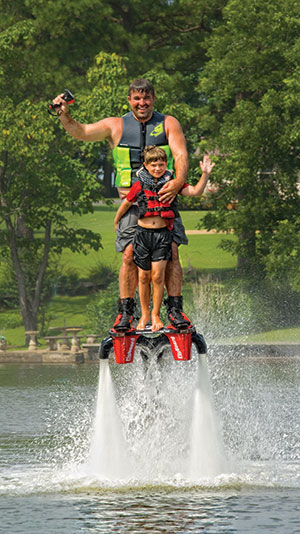
Jeremy Deason soars a good 40 feet in the air above Logan Martin Lake, and passersby can’t help but take notice. After all, his hydroflight is something to behold.

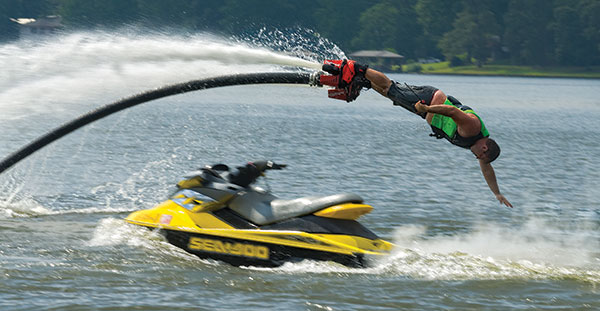
He is perfecting his hobby of hydroflying on a FlyBoard, which involves a personal watercraft he controls remotely with an 80-foot hose attached to it, propelling pressurized water through it to a pair of boots equipped with jet nozzles.

The nozzle provides the thrust. And Jeremy’s strong pair of ankles does the rest. “Holding yourself up is all in the ankles,” he explained. “It’s all within a couple of inches,” he said.  “You can either do it or you can’t. It’s not a middle kind of thing.”

Jeremy can definitely do it. He moves through the water at first, with only head and shoulders showing as the jetted water propels him. “It pushes you through the water like a boat in front of the SeaDoo.” Then, it’s up, up and away, with the pressurized water streaking beneath him like an aircraft or rocket’s contrail.

Constantly in motion, he goes straight up, darts to the left and circles to the right while the unmanned personal watercraft weaves in the water below him.

The pressure is enough to propel him 40 feet in the air. It’s also enough to provide the “dolphin dive,” where Deason dives headlong through the water as much as eight feet, emerging seconds later with head up and then submerging once again. The series of moves looks exactly like the movement of … well, a dolphin.

“If there’s anything out there, he’s going to try it,” said his grandmother, Margaret Weatherby of Leeds.

It used to be motocross. But as his buddies and he grew older, got married and “life got in the way,” he traded his dozen or so motorcycles in and “searched for something to do on my own.”

As she watched Jeremy perform his moves, his Mrs. Weatherby remarked, “He’s always been adventurous. That’s my boy,” she said, a hint of pride unmistakable in her voice.

And 30-year-old Jeremy, who owns and rents property as a career, doesn’t disappoint. He soars, he dives, he does a back flip. He even heads straight up like a rocket, thrusting both fists in the air as if he is on top of the world. From his vantage point, he probably is.

“When you’re up there, and you watch the sunset, that’s cool,” he said. It’s quite an experience to watch the fish from high above, too. Hydroflying “draws all the fish up, and you can see a bunch of fish on top of the water.”

But sunsets and fish aren’t the only things being watched. The sight of him jetting upward naturally draws onlookers from boats passing by. They tend to get a little too close, he warns, noting that the personal watercraft is unmanned, so there is no control except for his own going up and down and his speed. He doesn’t mind the attention, but for safety’s sake, he urges boaters to keep their distance.

Jeremy has no plans to try the sport competitively. It’s world cup caliber in Dubai and a huge sensation overseas.

But here at home, he is content to use it simply as a stress reliever. “I work a lot,” he explained. “I have to have something to play, relax and have a good time. This is my something.”

For more about happenings on Logan Martin, Neely Henry and other lakes, visit us at loganmartinlakelife.com and thelakelife.net and on Facebook


Star Gazing Chandler Mountain

stargazing-chandler-mountain

Chandler Mountain lures star gazers

Story and photos by Jim Smothers
Submitted photos

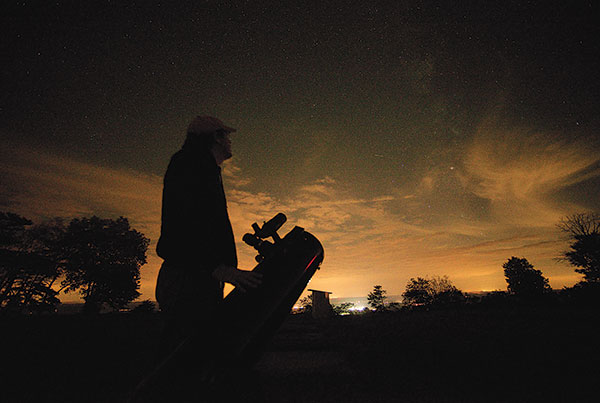
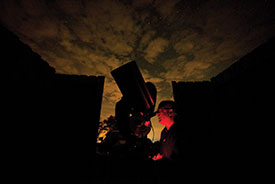
Every month members of the Birmingham Astronomical Society make their way up Chandler Mountain past Horse Pens 40 for a cliffside “Star Party” to enjoy their hobby and the company of other like-minded individuals.

Well, almost every month — if it’s cloudy, there’s always next month.

“Partly cloudy sounds like a nice forecast, but it can be an awful thing for our hobby,” said Preston Pendergraft, a club member and a security specialist with a regional banking group.

stargazing-chandler-mountain-2Members keep a close watch on weather forecasts and some of them use special-purpose apps that predict when the skies will be clear. They are helpful but not perfect.
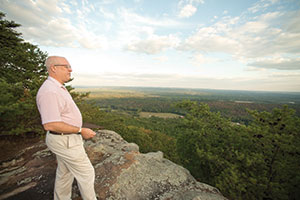
Saturday nights closest to new moons give the stargazers the opportunity they need to stay up late with the darkest skies of the month.

“There is lower humidity at the site, so that helps,” said Sterling Deramus, a Birmingham-based attorney and president of the club.

It also helps to get away from the light pollution in the metro-area that creates a haze they can’t see through very well.

“Dark sky is a big deal for us,” he said.

Even from Chandler Mountain, the number of security lights throughout the area is becoming more noticeable. Lights that shine into the sky collectively create a haze that makes it difficult to see objects in space, and clouds can spoil everything.

Deramus said that at some star parties there will be 20 or 30 people on the mountain with their telescopes. It’s hard to predict.

For the October outing there were only two members there. A partly cloudy sky and competition from college football may have kept others from making the trip, and Deramus’s “clear sky” app missed the mark this time — patchy clouds made for limited viewing.

Pendergraft said a public television program about the Voyager spacecraft piqued his interest in astronomy when he was a child, and he has been interested ever since. He collected golf balls from a water hazard on a golf course near his childhood home in Las Vegas and sold them to save money for his first telescope.

chandler-mountain-astronomyDeramus said he was interested as a kid, but it was a college class in astronomy that got him hooked.
It’s easy to see why. The stars, planets and other objects in space hold deep connections to mankind’s past, present and future. Throughout man’s time on the planet, objects in space have stirred his imagination, with impacts not only on the understanding of the sciences and mathematics, but also on the arts, history, mythology and more.

People can enjoy astronomy as a hobby today in a number of different ways, and not all of them even involve telescopes. A simple star chart and a clear sky can be enough to start learning where and when the different constellations and planets can be seen. A pair of binoculars and a steady hand can work very well for viewing.

Some hobbyists barely look at the skies at all — an organization with a website called Zooniverse offers computer-based opportunities for amateurs to assist professionals with real-world scientific research. In astronomy, the projects include time-intensive viewing and comparison of photographs of objects in space. One project in particular is Planet Four, which involves thousands of images of Mars, and there are other astronomical studies on that site as well.

The club is active with a lecture meeting each month and two scheduled star parties — one on Chandler Mountain and another on Oak Mountain — plus outreach opportunities. Sometimes they will set up telescopes in public areas in town and invite non-members to take a look, and some of the members recently participated in a school program to introduce students to the hobby.

Lectures each month at Samford University feature a variety of speakers. One recent program featured a University of Alabama professor who spoke about galactic research, and another program was given by the Jet Propulsion Laboratory. Sometimes the lecture will be a “how-to” program to help people get more out of the time using tips and tools more effectively.

It’s all about the camaraderie, about spending time with others who share a common interest.

Party time

At a typical star party, individuals set up telescopes and seek the objects they are particularly interested in seeing. One may be looking for a particular planet.

“Saturn is a good one to see,” Deramus said.

Someone else might be trying to find separation between two stars that appear in the sky to be a single star. Others may be using photography to record deep-space galaxies. There are different goals and methods to explore the skies.

“There are different things to see in each season,” Deramus said. “There are always good things to see, good star clusters…Andromeda is a good one to find.”

Some hobbyists get started by looking for the Messier Objects, a list of about 100 bodies compiled by French astronomer Charles Messier in the 18th Century. Messier was looking for comets, and made a list of objects that look like comets — but are not — so that he could avoid spending time on them in the future. Finding and keeping a log of their locations helps hobbyists get started with learning their way around the sky.

“None of them are really that challenging to find,” Pendergraft said. “You can see a lot of them with binoculars. A lot of people go from there to the Herschel 400, which is kind of like the intermediate list. It’s a list of 400 objects that were discovered by William Herschel in the 1700s in England, and some of them were actually discovered by his sister, Caroline, as well. She was an accomplished astronomer in her own right, and she discovered some comets, too.”

Deramus uses a camera-equipped telescope to help find objects that can’t otherwise be seen. Using a series of long exposures and specific computer programs, he is able to find galaxies that can’t be seen through a telescope with the eye.

“Galaxies are a challenge,” he said. “I’ve seen some really good ones from up here, but they are very, very faint. That’s why I’m doing photography now. That was my first challenge, finding all the galaxies I wanted to see. May is the time to see galaxies because you have what’s called the Virgo and Leo clusters, which we are actually a part of — our galaxy is part of the Virgo cluster, on the outer edges of it. There are hundreds and hundreds of galaxies, it’s just amazing how many.”

Pendergraft said there is a scale for the brightness of stars and space objects. Vega is rated at 0, with higher numbers assigned on a logarithmic scale for decreasing brightness. The unaided human eye can see down to about 6, depending on the individual. With binoculars, stars down to about 9, more or less, may be seen, depending on the binoculars and how steadily they are being held. Some telescopes can extend that to 14 or 15 on a good night, and telescopes with cameras can get to 15 or 16. The Hubble telescope, by comparison, gets to 22 or 23.

“That’s probably the limit,” Deramus said.

At a typical star party, members enjoy spending time with others who share the hobby and share the excitement of seeing parts of the universe for themselves.

Some even make the trek to larger star parties in other parts of the country.

“I’ve been to one in Texas a couple of times near the McDonald Observatory,” Pendergraft said. “It’s kind of like the ‘Woodstock of Astronomy.’ Everybody who is anybody in astronomy is there.”

More places in the West have the dark sky stargazers need, and that event draws hundreds each year. It’s partly a trade show and partly a social gathering, and is a key event for hobbyists.

But there’s plenty to see from atop Chandler Mountain.

“Some people try to see the ‘Pup’,” Pendergraft said. “Everyone knows Sirius is the brightest star in the sky, but right next to it is a dimmer star everyone calls the ‘Pup.’ It was discovered in the late 1800s, not far from here, through a telescope at the University of Mississippi…there are always challenges for people to see faint objects. There are galaxies and nebulae. There are bright objects, which people want to see features inside them.

“It’s a hobby that you can take as far as you want to go, from the naked eye to custom built scopes that cost as much as your car.” l

Learn more about the Birmingham Astronomical Society at www.bas-astro.com or on Facebook at The Birmingham Astronomical Society of Alabama.

Running

cross-country-st-clair-running

Cross Country in St. Clair

Story by Carol Pappas
Photos by Wallace Bromberg Jr.

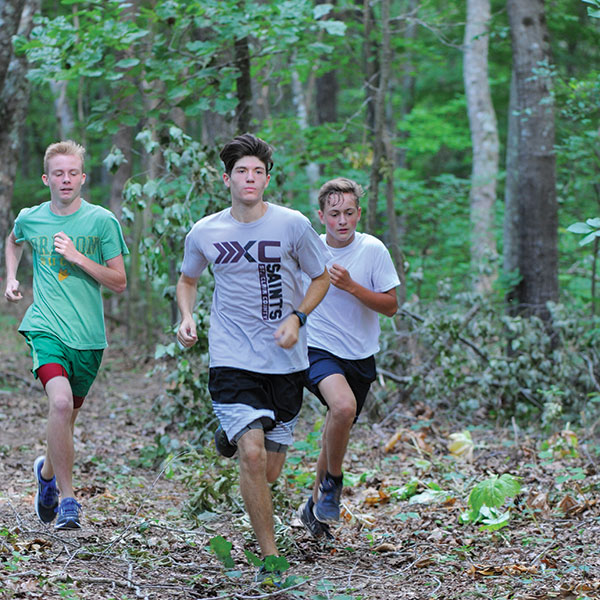
A methodical thud of a rubber sole hitting a dirt trail below – a dozen or more pair of them – emanate from the woods just beyond St. Clair County High School’s campus in Odenville.

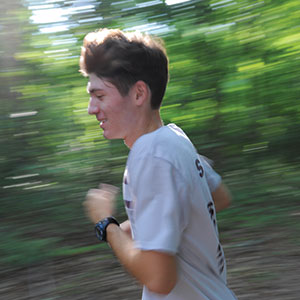
It is almost like a cadence, interrupted and punctuated by the distinct inhales and exhales of determined runners. It’s a sound heard all summer long as the high school’s cross country team prepared for battle across the state.

At home, their arena is a 3.1-mile path cut through woods, up hills, around bends and under the canopy of towering hardwoods and pines.

cross-country-st-clair-running-2“We’re proud of the hills,” said former Coach Mason Dye, who helped former Principal Brian Terry realize his dream of having a cross country track. “It’s a challenging course.”
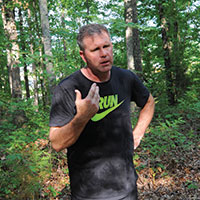
“It’s unique in the county,” added Terry. “It’s almost unique in the state.”

The course twists and winds all around the campus. There’s even a pond runners make their way around, and its diverse landscape is perfect for non-competitors, too, who just want to take a walk in the woods. The trail is open to the public.

Terry has since retired from St. Clair County High School but is working in Georgia. “I run it when I’m home on weekends…for nostalgia,” said Terry, a track athlete himself in his younger days at Samford University.

On a hot, summer day, surrounded by young, aspiring cross country runners when Terry was still principal, he and Dye talked of the genesis of the course. The cross country program is now in its fourth year. “I started working on it six or seven years ago,” Terry said. He had a “vision” of what it should be, and he set out to make it happen.

Two miles were laid out courtesy of a Soil and Water Conservation grant to build a nature trail. Scooter Dorsett helped in the project.

“Cross country to me is a sport that attracts a group of kids who don’t have another niche. They’re loners. They’re bright. They’re not football players,” he said, noting that it gives them an outlet in which they excel.

“It brings in a group of kids who need to do their thing,” Terry added. “The kids tend to unify.” It becomes a team sport.

“They become like family running together,” Dye said, adding that it is co-ed.

cross-country-st-clair-running-3When Dye, who also ran track in college, arrived on campus, the course was finished. “He put the vision into play,” Terry said of his young coach.
It has had a tremendous impact on athletics. Five students from St. Clair County High have already earned track scholarships. More than a dozen schools held a meet in the fall with more than 300 athletes participating.

And the Odenville course has been a catalyst for growth in other programs around the county. “Every school in the county now has a cross country team except Ragland,” Terry said. “Cross country is growing and evolving as a sport. It builds excitement.”

Parents and volunteers maintain the course, and the community is beginning to learn about its existence and about the sport itself. “The community as whole is unfamiliar with what cross country is,” Terry said.

But now, awareness is increasing and with it, there is heightened interest from middle school and high school students. “We don’t cut,” Dye said. “It is not limited to a set roster.”

By its very nature, it encourages more and more to become involved. And, like Dye and Terry, these runners see they can grow personally and physically, and they can compete for scholarships.

“Track and field paid my way through Samford,” Terry said, and he wanted to see other young people provided with the same opportunities he had. “It’s a great sport to be a part of.”


A Good Place

red-barn-st-clair-hippotherapy-1

Finding faith, hope and love at the Red Barn

Story by Jane Newton Henry
Photos by Mike Callahan

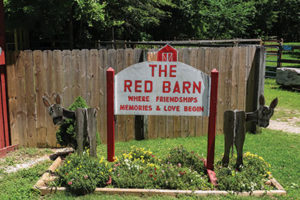
Located on the banks of the Little Cahaba River in Leeds, the Red Barn is a haven for children and adults with physical, cognitive and emotional disabilities or special circumstances.

According Joy O’Neal, executive director, this equine-assisted therapy center is a place where children can have a good time, and veterans can reconnect with their families.

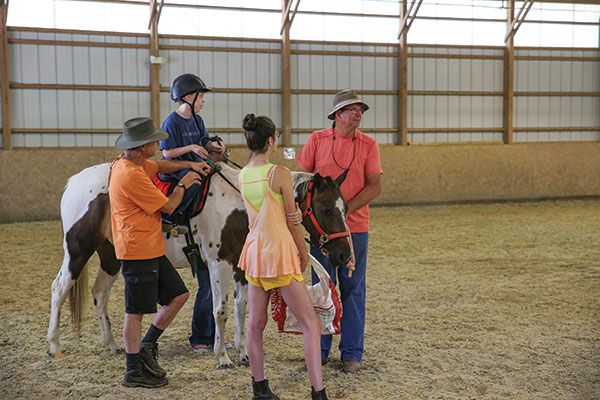
red-barn-st-clair-horse-therapy-3Before Randy came to the Red Barn, he had a difficult time talking, and other children at school made fun of him when he tried. He became embarrassed to speak, so he chose not to speak at all.
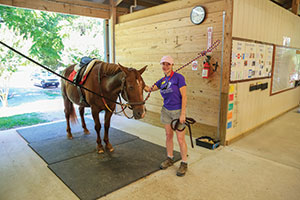
But as Randy began to ride horses, he learned to depend on his voice. He spoke commands to his horse, telling him to “Walk” and “Whoa.” Riding gave Randy the confidence he needed to speak more clearly.

“To me that’s the heart of what we’re trying to teach,” O’Neal said. “If learning to ride a horse makes your life better and gives you the skills that you need to get your words or your needs across, that’s what matters.

“When children with physical disabilities ride horses, their bodies become stronger. The movement of a horse improves muscular coordination and gives riders a fun activity they can talk about with friends. When they’re up on a horse, you can’t tell that they might have a hard time walking.”

Programs breed success stories

The Red Barn offers three main programs: Saddle Up, Horse Play and Take the Reins.

Saddle Up consists of weekly individualized therapeutic horseback-riding lessons.

Horse Play camps are held year-round for children with disabilities and their typically developing peers. These traditional day camps incorporate art, music and outdoor education with horses. The program also offers classes and other recreational and educational activities for individuals and groups from other non-profit agencies and schools.

Birmingham-area artist She She Vaughn teaches art classes and lessons as a part of the Horse Play program. “Art uses the creative process and allows children to communicate when they may be uncomfortable or less capable of expressing their thoughts aloud,” O’Neal said. “Art also aids the students in stress relief, social skills and developing a positive self-image.”

Take the Reins serves veterans, active and inactive military personnel and their families. It gives veterans time to reconnect with their families after deployment or just a place to be together.

red-barn-st-clair-hippotherapy-2All about the horses

The 11 horses at the Red Barn were given from the community. “We get retired show horses, and we get horses from people who are looking to re-home their horse,” O’Neal said. “Sometimes it’s because they can no longer care for them, or they are looking for a place where the horse can still have a useful life.

“Every day is different at the barn, so it’s important that our horses are sound and tolerate a lot of people,” O’Neal said. “With 70 riding lessons and 30 campers a week, along with parents and volunteers, you need a horse that really likes people, is adaptable and doesn’t mind change.”

Making good things happen

“We have the best folks in the world working here,” O’Neal said. “They are slobbered on and thrown up on. They put up with a lot, and it’s physically taxing work.”

In addition to employees and volunteers, the Red Barn hires about three interns a semester from local universities. Some interns have come from as far away as Missouri, Delaware and California.

The facility holds orientation and training programs for its staff, volunteers and interns, and trains others who want to work in a similar industry,

Funds that pay for programs and expenses at the Red Barn come from individual contributions, programs and grants. And the Red Barn holds two major fundraising events annually.

The Take the Reins 10K race was held for the second time on June 11 in Birmingham. “The race is run in memory of Cpl. Anthony Clay Ward, who died after returning from military service. He was the brother of Abbie, one of our first students,” O’Neal said. “Last year was the sixth anniversary of Clay’s death. His friends run in the 10K, and I am thankful to the Ward family for sharing their story.”

The second major fundraiser is Bluegrass and Burgers. “It’s more of an open house. We invite people out to see the place. They come to see what we do and how we do it.”

‘That changes you’

O’Neal expressed surprise about one aspect of working at the Red Barn: “You think it’s about changing others, but what it does instead is change you,” she said. “You think you are coming to be a side walker in a kid’s lesson, and you see the bravery of what they face. You see this kid who can’t speak, and other kids might make fun of him or maybe he doesn’t have friends. You watch the courage of that child every single day. And that changes you.

“You also see the goodness in the people who work here — out in the sun, cold and wind. You see them give of themselves, and you think about how many good people there are in the world. You see people come together and cry, and it becomes a community, and you think, wow, this is what God intended us to do.” l


Accredited by the Professional Association of Therapeutic Horsemanship and the Certified Horsemanship Association, the Red Barn is located at 2700 Bailey Road, Leeds, AL 35094. It is a 501(c)(3) organization, and all donations are tax-deductible. For more information about the Red Barn’s organization and services, go to: www.TheRedBarn.org.

Pirate’s Island

A day in the life of a
Logan Martin landmark

Story by Carol Pappas
Photos by Wallace Bromberg Jr.
Submitted photos
Drone Photo by
David Smith, Star Aerial

It’s a place that would make Jimmy Buffett proud. Surrounded by family and friends and scores more of adopted family and friends, this tiny island in the middle of Logan Martin Lake is like the star of the singer’s tune, Cheeseburger in Paradise – “heaven on earth with an onion slice.”

On this Saturday afternoon in late June, one of the hottest of the year, there are no complaints about the sweltering temperature, only laughter, music, children’s squeals and an unrivaled camaraderie of hundreds gathered around Pirate’s Island.

It has become THE place to meet, anchor your boat or personal watercraft, wade into the shallow water all around and greet friends – old and new.

It’s a recreational respite in an otherwise wide open waterway of boats darting to and fro.

Lincoln’s Kent Crumley has been coming to the island since 2012. Now joined by his son and grandchildren, the fun they have as a family is unmistakable. Brian Crumley and his children, Easton, Addie and Brynlee are there to celebrate Easton’s first birthday.

What makes this place so special? “Just the people,” Kent says. “The fellowship,” his son adds. “We came to hang out and have a great time,” Kent says, putting an exclamation point on the sentiment of the day.

And it’s precisely the purpose Jim Regan intended for the island when his wife, Laurie, bought it for him as a birthday present.

She had decorated it with crepe paper, but rain put a damper on the surprise impact it was supposed to have when approached by boat that evening. So, Laurie improvised. She grabbed a drink Koozie, wrote “Welcome to Your Island” on it, put a drink in it and handed it to Jim. He kept putting the drink down, never glancing at the message. Laurie said she finally – and strongly – urged him to look. He read it, and in that moment of realization, “he dove right off the boat!”

That was 2008. It took about a year to fulfill the vision they had in mind for the island – they cleared underbrush, built a beach, brought in palm trees, a hammock, a treasure chest and of course, a pirate flag.

They first named it Grand Island, but the throngs of boaters who found their own paradise there won out. Pirate Island, it became, and Pirate Island, it will stay. “We were outvoted by the people,” Laurie says.

And the people keep coming. On Memorial Day, 46 boats were counted anchored around the island. On this day, a typical Saturday afternoon, there were 29 boats full of people.

Logan-Martin-Pirate-IslandOn the 75 x 50-foot island itself, its palm trees leaning out over the water, the Regans’ family and friends gather around a fire pit, relaxing in chairs of all shapes and sizes.

A nearby grill, still smoldering, hints at noon day activities on the island. “It was Cheeseburger in Paradise Day,” says Jim. He cooked 36 hamburgers for his invited guests and boaters who happened to be there. It’s not unusual for Jim to cook on the weekends. He simply signals in boaters when the hotdogs or hamburgers are ready, according to Laurie.

All are welcome on Pirate’s Island. It’s a tradition that evolved when a boat load of 10 year olds asked if they needed help on the island. They helped clean it, and their pay came in hotdogs.

Of course there are other riches on the island. A treasure chest full of Mardi Beads and gold coins awaits, and children rush to see what’s inside. Down on their knees like a cannon shot, they surround the chest, combing through to pick just the right color. Giggles and shrieks tell the rest of that story.

“I get them from a Mardi Gras supplier in Mobile where I grew up,” Laurie says. The treasure chest is filled to the brim, and it is the island’s most popular destination point for kids. As a bonus, Jim sprinkles gold coins all around the water’s edge for children to ‘discover.’

Palm trees don faces and perhaps a pirate kerchief – “Palm Pirates,” they call them. A ‘pirate’ pontoon boat sits anchored on the main channel side of the island. It even has a gang plank. The customary island hammock hangs between palms, an inviting place for a summer’s day.

And a skull and cross bones pirate flag flaps in the summer breeze some 50 feet above on a pole made of bamboo courtesy of a neighbor, helping passersby pinpoint this Logan Martin landmark.

On Saturday mornings, Jim puts out an oversized float a few feet offshore – a Lilypad – for kids to launch themselves in innovative ways into the water. He doesn’t dare take it up until Sunday night. Too much fun would be missed, he and Laurie surmise.

“Everybody has taken responsibility for the island,” Laurie adds. “We’ll get calls if someone is not doing something right. They help clean it up. They love the island. Everyone takes ownership in it.”

Why do the Regans share their own bit of paradise? “We love our family and kids. This is our town. It’s our home,” Laurie says. “It just feels good.”

Perhaps this email Jim sent to his family in 2008 just after he became the proud owner of the island tells the evolution of the original vision best:

Laurie surprised the living daylights out of me for my birthday by purchasing the tiny island just 1/4 mile down the beach from us. I’ve been pining for it for over a decade, and Laurie thought it was a pretty worthwhile goal also. 

We have named it “Grand Island”…owing to its “massive” size (75 ft.X 50 ft. excluding beach & sandbar) and also to the original purchase price some years ago by our friends & the former owners-Randy & Sandy. The island is a popular place to park your boat and swim from its sandy little beach. It will remain open to the public. We’ve already heard some excellent ideas like: planting fruit & palm trees; placing a “Grand Island” plaque on it; mount a “Wilson” volleyball on a pole (from the movie “Castaway”); hanging a hammock between two trees; and the ideas just keep coming. Feel free to add your art to the picture.

 Whether you remember this little Corona commercial of an island or not, I happen to know that each of you have been there. We hope you’ll come to the island many times again in both mind and body. Once you’ve hacked your way through the jungle and pass the lost temple beyond the largest cave on the other side of Blue Lagoon, look for us…We’ll be right there in a hammock holding out your favorite cold beverage.

On any given weekend, it’s easy to see: Dream fulfilled.

Light Flight

ultralight-flight-1Daring men and their flying machines

Story and photos by Jerry C. Smith

A stand-up comic once joked, “If God had meant for people to fly, He would have given them a lot more money.” He got pained laughs from several private pilots in his audience who knew what it costs to get a license, buy a plane, fly it, hangar it and keep it in safe condition.

Whether you’re rich or poor, the sky shamelessly seduces those who envy the freedom of birds. Prior to the late 1970s, aviation was well out of reach to most folks who did not fly for a living, but a few entrepreneurs found a way to bring powered flight to practically anyone with the courage to try it.

Imagine a huge kite made of ripstop Dacron sailcloth, a frame and pilot seat resembling an elaborate lawn chair, a couple of lawn-mower wheels and a tiny engine scrounged from a snowmobile. Lace it all together with a maze of steel cables and, voila, you have an ultralight airplane – a true bird of ‘pray.’

Ultralights quickly became a poor man’s magic flying carpet, a dream come true for those without the means or desire to own a “regular” airplane. If you could afford a decent fishing boat and were fairly adept with hand tools, you could build your own plane in a few dozen hours from a mail-order kit, then fly it from a nearby pasture.

Best of all, you didn’t need a license to fly one, and still don’t even to this day, as long as the plane meets certain federal guidelines of construction and operation. Flight training, if any, was given in two-seater variants by licensed local dealers, but many were flown entirely on guts alone.

Since a true ultralight has only one seat, that first test flight was also the pilot’s first solo in that type of plane, which can intimidate even a trained private pilot.

Odenville resident Hoke Graham was one of the first to fly and sell such machines in the area. He tells of trying to foot-launch his Easy Riser, one of the first ultralights, which originally had no wheels. It was actually an Icarus biplane hang glider which had been fitted with a tiny, 10 horsepower, two-cycle motor made by Chrysler.

Hoke relates, “When we test-ran the engine in my motorcycle shop, the propeller blast blew papers all over the place and slung oil everywhere before we could get it shut off. We like to have never got it all cleaned up.”

Ultralights became so popular so fast that the Federal Aviation Administration (FAA) created a whole new category for them, outlined in Part 103 of Federal Aviation Regulations. In essence, ultralights were designed for a single pilot, flown locally for daytime recreational use only, and according to some stringent rules.

The plane could weigh no more than 254 pounds empty, carry a maximum of 5 gallons of fuel, and fly no faster than 55 knots at full power. It is illegal to fly an ultralight over an assemblage of people or settled area, after dark, or within controlled airspace where the big boys fly.

Because of weight and performance restrictions, ultralights have few if any spare parts. They’re shy on horsepower, creature comforts and redundant safety features found on more conventional aircraft.

It’s as minimalist as powered flight can possibly be, but for many, including your writer, they were the fulfillment of a boyhood dream. The Wright brothers would have loved them; indeed, their first Flyer would have qualified had it been made of lighter materials.

While there are still a few single-seaters around, sport aviation has shifted in more recent years to a two-seated variety, many of which look and handle almost identically to the standard version but aren’t true ultralights. You need a private pilot or light sport pilot license to fly one.

Besides all the various quasi-ultralight designs, the relatively-new light sport category includes home-builts, most experimentals and other small aircraft, such as Taylorcraft, Piper Cub and Breezy, which fall within a fully-loaded weight limit of 1,320 pounds.

Many two-seated derivatives use engines of as much as 100 hp, more than triple the power of older single-seaters, and can easily fly 90 mph. Because of a higher weight allowance, they can be outfitted with all kinds of instruments, safety equipment, redundant controls, etc that a Part 103 machine could never carry.

ultralight-flight-2Pell City’s Joe West owns such a plane. It’s a larger version of a Challenger ultralight, made in Moline, Ill., by Quad City Aircraft Ultralight Aircraft Corp. It has a much more powerful engine, two seats, larger fuel tank and is about double the weight of its ultralight sisters.

Joe spent more than two years building it and holds one of the first light sport licenses issued in the area. His superbly crafted plane sports a dazzling green and white paint job and mounts a 52-hp engine designed especially for light aircraft by an Austrian firm, Rotax, which also builds snow machine engines for Bombardier of Canada. It allows him to cruise smoothly at 60 to 70 mph.

Joe is a real craftsman who is not averse to improvisation. In fact, the sheet metal for his instrument panel was salvaged from an old octagonal city stop sign. Everything on his plane is neat, precise and by-the-book, including an emergency parachute that can be instantly activated from both seats.

The plane’s nose art reads TINKER TOY, a moniker inspired by a fellow firefighter in Birmingham who liked to tease him about all the small airplane parts he fiddled with while not on duty, saying the intricate components looked like Tinker Toys.

He’s a frequent flyer around Pell City and has flown his Challenger for about 15 years. But Joe doesn’t limit his range of operations to local “patch-flying.” He and several other Challenger owners once flew from Pell City to a sponsored aviation meet in the Great Lakes region, near the Quad City factory.

Another local light-flyer, Cropwell contractor Tommy Thompson, is also a highly skilled artisan, both on the job and as an experimental aircraft hobbyist. He has built and flown four kit planes over the years, each a finely crafted work of flying art.

His Loehle P5151 Mustang was a 3/4 scale replica of one of the world’s finest warplanes. Tommy painted it blue, white and orange; named it Miss War Eagle; and was granted a tail number ending in WE. It was always a hit at air shows and fly-in events held by the Experimental Aircraft Association, of which Tommy was president of local Chapter 1320 until its dissolution in recent years.

So what’s it like to fly an ultralight or experimental? Depends on the design. Back in the 1980’s, your writer owned an American Aerolights Eagle. It had a smaller wing, called a canard, mounted in front of the main airfoil. This made it nearly stall proof and very easy to fly, even for a novice pilot. The Eagle took off, flew, climbed, descended and landed at about the same speed, 25-30 mph. We joked that, like a Piper Cub, it flew just fast enough to kill you.

I flew mine while suspended in a child’s swing seat which hung by a slender strap from a main body tube. Below this seat was nothing but open sky, all the way to the ground. Needless to say, that strap was rigorously inspected before every flight, as were all other vital parts which, in reality, included EVERY part of the plane.

Other models look and handle more like conventional aircraft, with true three-axis controls and the familiar T-shaped fuselage. Most ultralight aircraft can virtually leap off a runway in 200 feet or less and land in almost any clearing. Indeed, on occasion, these pilots would take off across the old bomber runway at Talladega.

But there is a penalty for this feather-like agility. You should not fly unless the air is mostly calm. Flights are usually made in early morning or near sunset. Planes stayed in the hangar if treetops were spotted moving.

I’ve encountered sudden gusts in advance of unseen weather fronts that actually left me flying backwards, despite running full throttle. My only recourse was to drop behind a treeline at almost ground level and quickly land before the wind shifted.

An unwritten rule was observed by practically everyone: Never fly over anything you can’t land on. With no redundant parts and an engine that could fail at any time without notice, keeping a landing spot underneath was mandatory.

But all such hazards aside, the flight itself was exhilarating, possibly the most fun a dauntless bird-man could have in public. We usually flew lower than 500 feet, enjoying the sights, even the smells, as rural Alabama drifted leisurely beneath our dangling rumps.

Our flying grounds included the environs of Talladega Speedway in our earlier days and Washington Valley and Chandler Mountain after we moved to Cool Springs near Ashville. It’s one of the most scenic parts of St. Clair — even more so from the air.

The good people of Cool Springs and Caldwell gracefully tolerated our weekend noise, so we always invited them to our airfield cookouts and watermelon cuttings. Livestock in Washington Valley became so accustomed to our presence that they no longer stampeded or looked up in fear of a giant, raucous hawk passing overhead.

The group I flew with in the early 1980s was known as Four Seasons Aviation, a three-man corporation operated by Hoke Graham, Jack Porter and Mike Pair. They sold Eagle ultralights and provided flight training, first at Talladega Airport, later at the Cool Springs site.

Cool Springs Airdrome was laid out on an old horse farm on CR 31, between Ashville and Springville, near Canoe Creek at AL 23. A former stable was modified to serve as a hangar and business office. The airstrip was simply 1,500 feet of closely-mown pasture.

Because of the Eagle’s unique configuration, we were able to store all five resident planes in a hangar that would have barely contained one “regular” plane. We simply tilted them upright and stood them on their tail feathers.

Four Seasons was a beehive of activity on nice weekends, often hosting fly-in visitors and curious kibitzers. Because of the capricious nature of these aircraft, we had a map mounted on a steel panel, with little colored magnets for each pilot to indicate where he intended to fly. We often flew in pairs, for the same reason.

On one such junket, a friend and I were flying over Washington Valley when he spotted some lovely young women lounging beside their swimming pool. He landed in a nearby field, but I decided it was no place for a married man and flew back to the airport.

Apparently he had chosen wisely, as we didn’t see him again until a bit after sunset. In a scenario reminiscent of an old flying movie, we lit the runway with car headlights to allow our resident Romeo to land safely.

A couple of areas were off-limits. One of our flyers was a deputy sheriff who warned us to avoid flying anywhere near the new St. Clair Correctional Facility as well as a certain area called Sodom and Gomorrah because of various activities that the law preferred to contain in that one place rather than having to pursue them all over the county.

Were there accidents among our ultralight community? Yes, even a few fatalities. But like real flyers everywhere, we studied and discussed each case, resolving to never become an object lesson ourselves.

For many, the incident rate became too high for comfort, so they moved on to earn a private pilot license and bought “real” airplanes. No doubt some wives added input to these decisions. However, many have since admitted that they became much better pilots as a result of things they’d learned from light flight.

Joe and I recently flew his Challenger on a photo shoot around the Pell City locality. We flitted along at a leisurely 65 mph, snapping photos of Logan Martin, downtown Pell City and certain areas north of town.

While a pure ultralight must not fly over settled areas, a rated experimental like Joe’s can be operated under more lenient standards. The visibility is spectacular to say the least, making them an ideal photo platform equaled only by glass-pod styled helicopters, and they’re exponentially cheaper to own and operate.

Another endearing quality is its real feel for flight, like you are actually involved in a natural process rather than riding an armchair in a giant flying bus. You sense every rising thermal, every wind shift and “air bump,” and enjoy a fast-acting, sensitive control response that makes you feel like part of the plane itself – a true mechanical bird-man connection. There’s no autopilot. You fly them every second from takeoff through landing.

Joe quipped that his plane is so well-balanced and control-sensitive that he can actually make it turn by sticking his hand out one side, like giving a turn signal. To a true light flight enthusiast, a 20-minute ride is often more satisfying, and physically tiring, than a couple of hours in a “real” airplane.

Born in Haleyville and a long-time resident of Birmingham, Joe once advised folks to never allow a hobby to dictate where you live, but reneged on his own tenet while flying and hangaring his craft at Pell City Airport.

“After hanging out around the airport, I found out what a nice place Pell City was, and decided to live here,” he said. Indeed, his home is within easy walking distance of the main entrance at KPLR.

At age 67, Joe has seen a lot of light aircraft makers come and go. Dozens of companies jumped into the market when the category was first created, but most are long since expired, usually with good reason.

Those early years were fraught with accidents, mostly due to design faults and pilot error. He advises those interested in light sport aviation to research FAA files and thoroughly check out the accident records of any aircraft they plan to purchase or build from a kit.

“Look for companies like Quad City that have been in business the longest, preferably under original ownership,” he says. He also advises to seek skilled, licensed training before attempting any solo flight in any aircraft, whether ultralight or otherwise. Even though they fly relatively slowly, irreversible things can happen very quickly.

He remarked that the handling characteristics of his Challenger makes him feel connected to early pioneers such as the Wright brothers. Having flown several such machines myself, I heartily agree. It’s the real thing – a natural high.

Though he’s a quiet, unassuming man to casual acquaintances, Joe’s sincere enthusiasm for this genre of aviation becomes obvious once you get to know him, fly with him, and check out the workmanship and safety record of his plane. Retired from the Birmingham Fire Department, he now works part-time at a local hardware big-box to, in his words, “make some flying and eating-out money.”

Joe says, “Sport aviation is sort of winding down as a hobby because the ones who started it are getting old, and nobody is replacing them. We need for more kids to get involved with groups like Civil Air Patrol and the EAA.”

He adds a sentimental note: “If someone ever gets a chance to go flying, especially someone who has never gone up, I strongly urge them to go up and see the sights that are restricted to a fortunate few people and to be mesmerized by the wonders that they have missed all their life.”

The late Glenn Messer, world’s oldest living pilot, who passed away just days short of his 100th birthday in 1995, expressed to me that one of his biggest regrets was that he never flew an ultralight. He had been blinded by a failed eye surgery a few years before these aircraft became popular.

Mr. Messer used to sit in the lobby at Birmingham’s Southern Museum of Flight and chat with visitors about his long, colorful flying career, which included giving Charles Lindberg a check ride in his new Curtiss Jenny back in the 1920s.

He should know of what he spoke. The pilot license he proudly showed to visitors was signed by Orville Wright.