Pell City Museum salutes veterans

It has become an annual tradition at Museum of Pell City each November as it seeks to honor, preserve and promote its military history in Salute to Veterans Nov. 7.

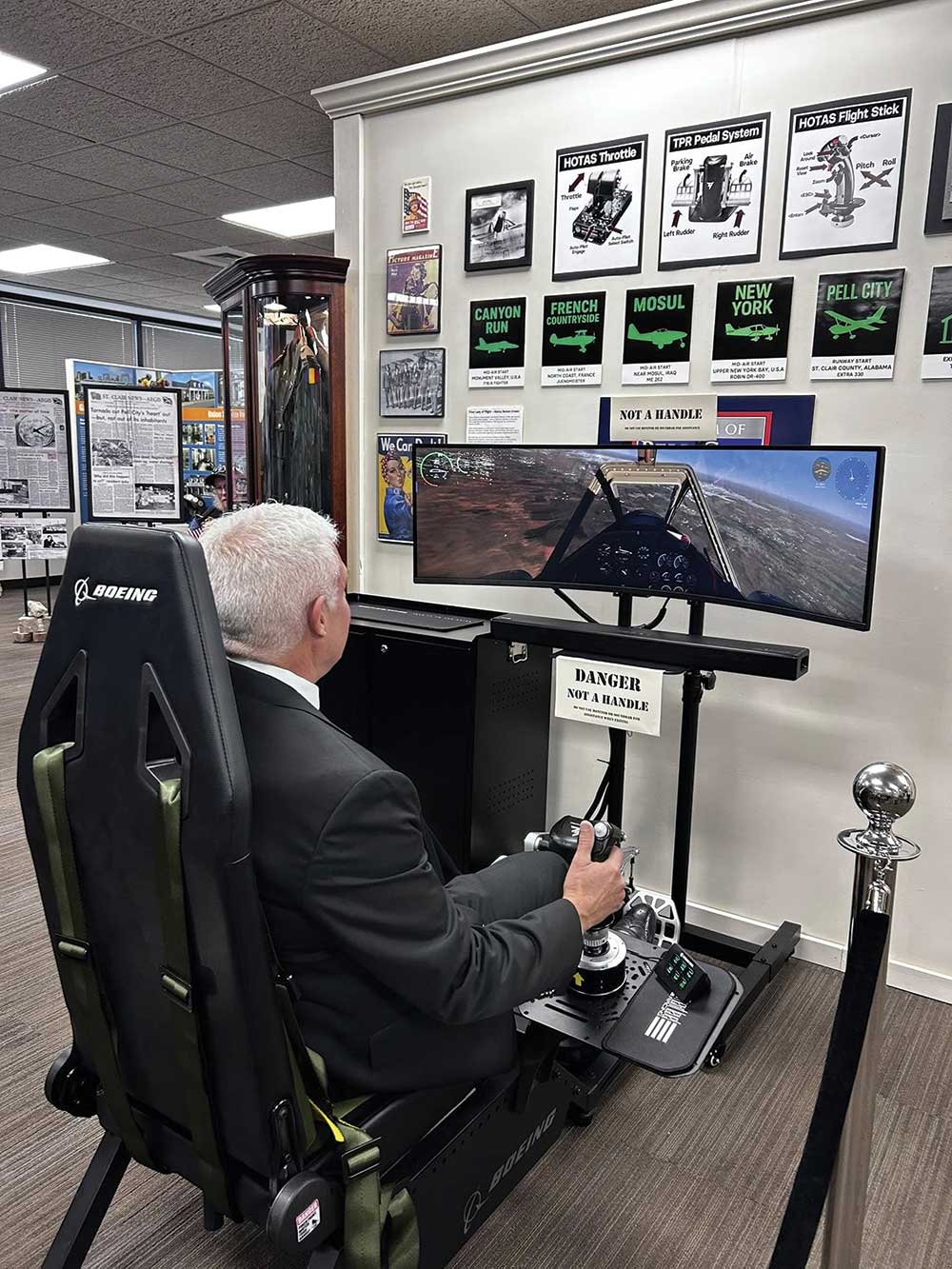
Now in its third year, the museum is redesigning and expanding its military exhibit space, increasing its focus on more modern-day wars and conflicts and adding an impressive interactive display – a fighter jet simulator. It will open Nov. 7, kicking off with a special reception at 10 a.m. in the banquet room of the Municipal Complex below the museum.

Existing military displays getting redesign

Headlining the event will be St. Clair County District Attorney Lyle Harmon, a veteran helicopter pilot in Iraq and Afghanistan.

“Much of our exhibit space to this point has been on earlier wars – World War I and II, Korean and Vietnam,” said President Carol Pappas. “What we wanted to do is provide a more comprehensive picture of our military history – bringing in more photographs and artifacts from the Persian Gulf War and the wars in Afghanistan and Iraq. We have so many veterans from those conflicts in our community, and we wanted a way to preserve and share their stories.” 

One of the centerpieces of the new exhibit will be photos and artifacts from the estate of Admiral Dennis Brooks, who served as Commander of the Joint Forces in the Persian Gulf. His long and storied career includes a visit aboard his ship from then President Ronald Reagan. His flight jacket as a fighter jet pilot in earlier days is on display among many other artifacts.

“We’ll have oral histories from his son, Mark Brooks, who also served as a fighter jet pilot and rose to the rank of …, who relates his father’s stories of achievement, sacrifice and the principles that guided him. We have other veterans of Iraq and Afghanistan, who share their own story, all of which will be presented in our own documentary,” Pappas said.

Challenge coin memento given to veterans at inaugural salute

“An examination of this era must also include the painful transition of coming home, and we will feature on film the story of a mother whose son took his own life, an all too familiar account, and her fight to help other veterans.”

Excitement is building as museum designer Jeremy Gossett and pilot consultant Donnie Todd put together the fighter jet simulator exhibit. “I won’t spoil the unveiling, but I can promise that it will be an attraction for all ages,” Pappas said.

This project could not have been possible without community support. “In an effort led by our treasurer, Zachary Gentile, and Museum Coordinator Erica Grieve, we were able to raise nearly $7,000 to bring this plan to fruition. We thank donors Glenda Harris, Paula Hereford, Inpac, St. Clair County Airport Authority, Dream Home Inspections, David Smith, Alan and Sandra Furr and Donnie and Ellen Todd. They stepped forward in a big way to make this project happen.”

As is the museum’s custom, a reception honoring all veterans with a keynote talk by Harmon will be held at 11 a.m., followed by the exhibit opening, tour and film showings.

“We invite everyone to this special tribute,” Pappas said. “It is truly a community event, and we are honored to present it.”

Downtown Pell City

Historic Downtown Pell City’s business district is growing of late with ribbon cuttings and grand openings becoming almost commonplace. In the past few months, four new businesses have opened, a fifth is relocating and expanding and a sixth and seventh say, “Coming Soon.”

 Already adding to diversity of what downtown has to offer are Lake House Antiques, Weeping Willow Books, The Grove and Studio on 1st. Gilreath Printing, a longtime downtown resident in a log cabin building on Cogswell Avenue, is moving to 1st Avenue behind Venue on 20th  into a much larger facility they are renovating. Gilreath plans to rent its existing building, paving the way for yet another business.

Studio on 1st is a cutting-edge hair salon located on First Avenue South between 16th and 17th streets. Just across the way in the next block facing the railroad tracks is a children’s embroidery shop called Little Stitches & Co. Abbye Grimes is the owner, and she is working toward an October opening.

Inside, beyond the French doors, will be a completely separate business operated by Grimes’ sister-in-law, Tina Dailey, who is planning to run her hair salon and real estate ventures.

Meanwhile, The Grove opened a café featuring acai bowls, smoothies and salads in September and is already garnering rave reviews. It is located on Cogswell Avenue in the former Dot Wood Appraisal building between 16th and 17th streets.

Just a couple of doors down is the new Lake House Antiques, an eclectic blend of antiques, vintage and home accessories.

And just beyond Lake House is Weeping Willow Books, the senior citizen on the block at nearly 120 days.

They all represent a shot of vitality for downtown, and residents and visitors alike are already showing their appreciation, following through on the demand for new and diverse shopping, dining and services options in a pedestrian friendly, downtown setting.

Samantha and Cody Herrington, Weeping Willow Books

Weeping Willow Books

 For Samantha Herrington, her Cogswell Avenue bookstore is a dream come true.

She loves to read, and combining her passion with business seemed a perfect fit. She renovated the space with a willow tree theme (hence the name). “I always loved weeping willow trees,” she said, so she gave it an enchanted forest look, and “the name kind of went with it.”

She has created an inviting space. “I really wanted a bookstore downtown that was nice, cozy and welcoming, a place where people could come and get away from everything else.” She achieved those goals basically from the start, opening in June with 21 different genres of books – “a little something for everybody.”

She has books for all ages, “zero to as old as you can get,” she said. She even has a novel approach to novels called “Blind Date With a Book,” which is a book in wrapping so you cannot see the title. On the wrapping are hints so that you can get to know the book without seeing it first. Surprises await inside along with the book – a bookmark, notepad and pen. And just like a blind date, she said, you can’t judge a book by its cover.

The reception has been phenomenal. “Everybody who comes in here is super excited we’re here.” Her biggest surprise? “More customers than I expected.”

She’s enjoyed meeting everyone. “They have been nice and friendly. There is a big book community here,” she said, noting that she discovered a growing local authors community and is featuring some of their work. Authors like Shawn Bailey, Cherith Fluker and Kyle Hannah’s book company clients are among the books she features.

Herrington is already eyeing the future with plans to offer book clubs for different genres, story time for the children, author signings and a café with coffee and pastries.

“I want to grow a place when the outside is too much, they can come in here, get away and read a book.”

Jacob and Adam Castleberry, curators

Lake House Antiques

Jacob and Adam Castleberry moved their year-old business from U.S. 231 South to downtown in August. Actually, it’s their second business. They own a thriving property management company that operates in Alabama, Tennessee, Arkansas and Florida. 

Antiques are a pastime-turned-business. “We’ve been curating and collecting for 10 years,” said Jacob. “Our goal was to open a shop.”

While the property management company was based in Trussville, they never found a spot that “caught our eye,” he said.

When they moved to Cropwell, they found space in Lake Plaza. But when space became available downtown, they knew that’s really where they wanted to be. And customers are showing they’re glad they came.

“It’s been overwhelming,” Adam said. “It’s been great,” echoed Jacob.

The business started from their own experience and abilities. Their former home in Trussville was an eclectic blend, and friends and family encouraged them over the years to design spaces for others or open a shop.

They describe their place as “Grandma’s house,” Adam said, noting that the paintings, quilts and other items blended with vintage and new make it look like Grandma’s. “It’s lived in comfortable.”

He’s right. Alongside an oil painting or a pair of newly upholstered French wing-backed chairs with brass nailheads, you might find a tiffany lamp, a mosaic-top table, a regal dining room suite, an urn, photo frames, china or a Victrola turned cocktail bar.

On Sundays and Mondays, Jacob and Adam are traveling to source new items to feature Tuesday through Saturday, their days of operation.

“We want something new every day or every week at least,” keeping the shop vibrant and fresh, Adam said. And customers are responding with a steady flow of traffic heading their way since opening.

With a nod to the recent growth of that part of the downtown area and the camaraderie that has followed, Jacob said, “We’re excited to be a part of the new business downtown. We hope more is coming. We’re excited to see the growth of downtown Pell City and be a part of it.”

Customers say the shop has an appealing vibe that brings them back. “Hopefully, we’re going to be successful,” Jacob added. “It gives them another spot to browse around on a Saturday afternoon.”

Briana Allen (right) and Shelby Dunaway

Studio on 1st

Studio on 1st is the city’s newest destination point for professional hair care and skin care. The salon offers services for men and women tailored to them.

Owned by Briana Allen, Studio on 1st could be seen as continuing a family tradition of locally owned business. Next door is her father and grandfather’s longtime business, Allen Service Co. “They played a big role in why I opened my own place,” she said.

She opened July 15, but celebrated a grand opening in late September. She had worked in Birmingham but wanted to return to her hometown so that she could become more involved in the community personally and through her business.

“I’m loving it so far. It’s more than I imagined it would be. I really do love it,” she said. Besides being able to locate next to her family’s business, she chose downtown because of its small town charm. “You can walk to all the places. They know me, and I know them.”

Business owners refer business to each other, she said. “We’re all like close together, helping each other. It’s the perfect spot to start this.”

Joining her is stylist Shelby Dunaway, whom she says shares the same goals for the business – offering quality services and being involved in the community.

Coming on board in October is esthetician Morgan Russell, who will be handling the skin care part of the salon with facials and waxes.

Plans call for one more stylist, “then we’ll have a full house,” Allen said. But the planning hasn’t stopped there. She hopes to extend the back of the building to include a nail technician and perhaps a massage therapist.

Studio on 1st, she said, is “committed to delivering exceptional service and an experience you’ll love coming back to.”

Whitney Gunnison

The Grove

It only took four months for an idea to spring into a full-fledged business. For Whitney Gunnison, the genesis of The Grove evolved from a need. She suffers from celiac disease, an immune reaction to gluten that prevents nutrients from being absorbed and requires a gluten-free diet.

There weren’t any good options locally, so she decided to create a restaurant that filled that need. She renovated the building on Cogswell Avenue and set out to create healthier options with fresh, whole ingredients.

Her story blends her food creations with nourishment for the soul, she said. “I am strong in my faith. I wanted to share the love of Jesus in this building so people could feel the joy, hope and love the Lord has given to us.”

While a traditional downtown may spark memories of yesteryear, there’s a new feeling up and down Cogswell and First Avenues these days.

With Acai, smoothies and fresh salads heading the menu at this café, it’s evident that it is more than just a place to grab a healthy bowl or a smoothie — it’s a place to be “rooted, refreshed and renewed,” she said.

It actually got its name from those ideals – and a sign. She and her husband had considered a few different names but couldn’t decide. The Grove was one of their choices, but they prayed for a sign. He was on a job site in Cullman when he spotted a huge white sign up ahead, proclaiming, “The Grove.” It was their sign – literally and spiritually.

They set out to create a menu by gathering her team together, and they would try different ingredients and “figured out what was great and not so great” through many evenings of taste tests.

Team members who helped with the renovation were paid in bowls and smoothies, she said.

The end result was a comprehensive menu of açaí bowls, smoothies and fresh salads. And it appears she landed on a winning recipe. Judging by the response in the opening days, it’s a hit. 

“The grand opening was super chaotic, but in the best way, she said. “We ran out of acai. We tripped a breaker. We had to close early because Pell City sold us out. After Friday (opening day), I hired four more people.”

But, she added, “everybody was rooting for me. Everybody has been so supportive. They’re excited to have a healthy spot.”

Big things for Big Canoe Creek

Story by Paul South
Photos by Graham Hadley
Submitted photos

“Come to the woods, for here is rest.”
— John Muir, American naturalist

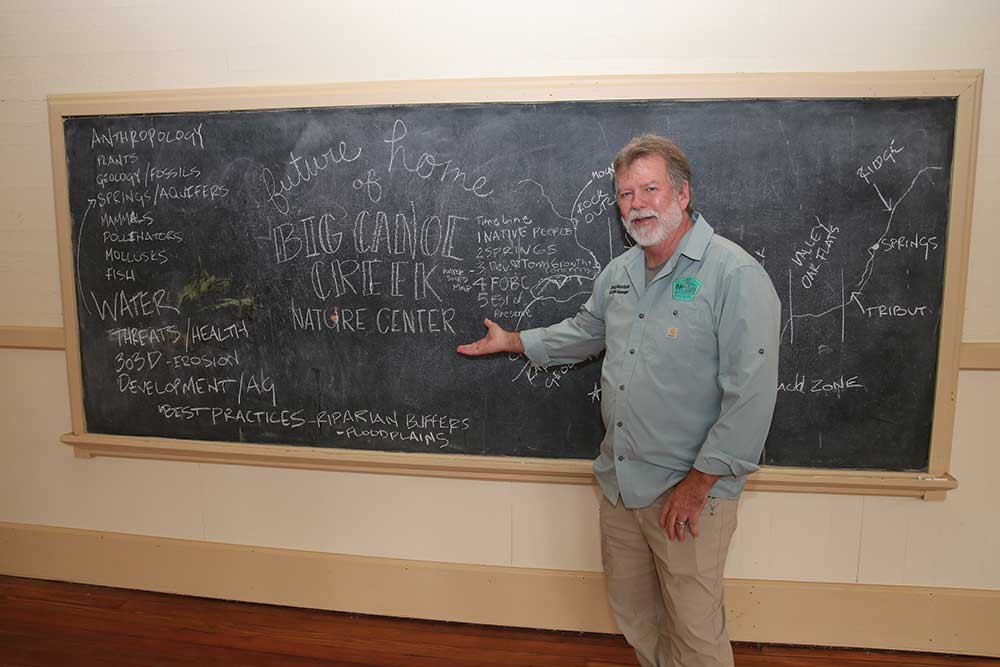
Even in late August on the banks of Big Canoe Creek, change was in the air. Doug Morrison can see it from his side porch as he sips his morning coffee.

 Leaves turned red, yellow and gold. Some even surrendered without a fight to the coming autumn. Soon, a crisp chill will be at home in the air, exciting stuff after months of heat and humidity.

But for Morrison, manager of Big Canoe Creek Nature Preserve, nature isn’t the only architect of transformation. There are exciting human changes coming this fall to the 422-acre preserve in Springville, part of Alabama’s Forever Wild lands.

The preserve, one of the most biodiverse parcels of land in the nation’s fourth-most biodiverse state, has a new education coordinator, Auburn University graduate Lucy Cleaver.

“We’ve got endangered species and threatened species in the Big Canoe Creek watershed,” Morrison said. “She will be working with different educational programs. We’re about to light it up and make it happen.”

Local students learning about the animals found in the Preserve

Cleaver, a native of Salem, Ala., holds a master’s degree in natural resource management from Auburn. She assumed her current role in August but has worked for the City of Springville for about three years.

Her work extends beyond the preserve and area schoolchildren, she said, even though she’s already conducted field trips for classes.

“When people think about outdoor education, they think it’s mostly about K-12 groups,” she said.

“But it’s also my goal to reach out to our landowners in St. Clair County. It’s equally important to me to educate them as to what they can do on their own property to help our entire watershed. It’s not just about what’s going on at the preserve. I want to make sure everybody has access to the knowledge that we have.”

Cleaver also plans to partner with entities like The Nature Conservancy, U.S. Fish & Wildlife Service, Geological Survey of Alabama, St. Clair County Soil Conservation District and the Alabama Cooperative Extension Service.

The preserve, which opened in 2024, boasts some eight miles of trails, including one hiking only trail (Creek Loop),  two combination hiking and biking trails  (the Fallen Oak and Slab Creek trails) and one combination hiking and horseback riding trail, called the Easy Rider trail.

Biodiversity on display

The magic of the preserve’s flora and fauna – even Creation’s s smallest treasures –  captures the imagination of visitors.

Some examples? Consider the Canoe Creek Clubshell, a freshwater mussel found only in the Big Canoe Creek Watershed and listed as endangered on the Endangered Species List. It’s an important barometer of the health of the creek, Morrison said.

“Mussels are important to the water system because they’re livers for the river because they filter the water,” Morrison said. “They are also good bio-indicators. If they are there, it means the water hasn’t been polluted enough to kill them. Their food source comes from the water and as they ingest the water, they filter the water, thereby cleaning turbid water of sediment.”

Lucy and Doug at the cabin and preserve office

The tri-spot darter, featured on the preserve’s logo, is a threatened species. It also calls the preserve home. The small fish features three dark saddle-like markings on its back. But during the mating season, males become brightly colored reddish orange and green.

Other aquatic species in the watershed found in a tributary of the Big Canoe Creek Nature Preserve are the Western Blacknose Dace, a creature not documented in the area since the 1980s. A new find, the Gold Striped Darter was recently discovered, which is a rare find above the Fall Line.

For plant lovers, there are an array of blossoms – Mountain Laurel in the spring and wild azaleas are plentiful. The oak leaf hydrangea has bloomed out for the season. There are stands of Woodland Spider lilies, similar to the Cahaba Lily and a variety of  irises and other wildflowers.

In the fall, Morrison said, the resplendent purple Beauty Berries are plentiful. The forest becomes more open as the leaves tumble to the ground.

“There are beautiful, big patches of old hardwoods,” Morrison said. “We have  persimmons, paw paw trees, Muscadine.”

The unique finds fit the preserve’s motto, “Explore and Discover.”

An exciting journey ahead

As far as future goals for the preserve, Morrison is excited.

“We’re wide open,” he said.

 An August grant of more than $335,000 from the Alabama Department of Economic and Community Affairs will help fund the construction of a new open-air educational pavilion. The project will also get a boost of nearly $84,000 in local matching funds.

The new facility will house restrooms, an area to host educational classes and general gathering space.

Initial design renderings of new pavilion

“One of our locals, Mike McCown worked diligently with me and (St. Clair Economic Development Council Grants and Leadership Director) Candice Hill on the grant application. Mike really put a lot of time and effort into this. As a matter of fact, he inserted many links to past articles in Discover (magazine)that I believe helped craft the story. Our journey speaks for itself, a journey of perseverance, faith and huge community involvement. We are beyond thrilled this will be underway soon,” Morrison said.

Also in its earliest phase, a Nature Playscape for kids crafted not from plastic, but from rock and other natural features is planned. It is hoped that the playscape will open in 18 to 24 months.

“We just got the concept plan for that created by Learning Landscapes Design,” Morrison said. “We’re waiting on the projected costs of that, and then we’ll go after grants to help build that. Hats off to donor, G.T. LaBorde, for funding the Concept Plan and coming up with the idea. This design is incredible and will be a big attraction once built. Again, more community involvement.”

Already, Cleaver has scheduled  fall  field trips with homeschool and other school groups from as far away as Birmingham.

When Cleaver talks about the preserve, she thinks of a spot in Slab Creek where stones like flat dominoes seem to provide a natural footbridge over the water.

“What makes (the preserve) special is there’s nothing else like it in this community,” she said. “We don’t have another nature preserve where people can go for free and go hiking or horseback riding or mountain biking. To me, it’s very special that we offer this to the community.”

With all the happenings at the preserve, Morrison and Cleaver are like kids at Christmas. Cleaver’s addition only adds to the excitement as the preserve charts a course into the future.

“It’s a great journey, and it’s a great job,” said Morrison. “We are beyond grateful for our community support.”

The Rock Bridge

Story by Paul South
Photos by Mackenzie Free

Sometimes nature’s miracles enter our hearts, souls and minds with a bang, like the colors of the Northern Lights, or the Hale-Bopp comet piercing a blue-black sky as it did late in the last century. Both phenomena are greeted by “ooohs” and “aaahhhs,” wows or wordless, wide-eyed wonder.

But more often, time and the elements combine quietly with nature to create something magnificent and mystical.

So, it is with the Chandler Natural Bridge, a place known simply as The Rock Bridge. Located near the base of Chandler Mountain that forms part of the St. Clair-Etowah County line, the natural bridge is one of six named natural bridges and two unnamed spans in Alabama, according to the Natural Arch and Bridge Society.

The Rock Bridge spans Little Canoe Creek. It’s 48 feet long, 54 feet wide and 17 feet thick. The top part of the span is made from Gaspar Limestone. Wind and water erosion sculpted the bridge over millions of years.

Since 2003, Save Chandler Mountain, a nonprofit advocacy group for the mountain, has worked to protect the Alabama’s third-largest peak, which is known as the “Tomato Capital of the World.”

Fran Summerlin, founder and president of the advocacy group, has a special place in her heart for the mountain and for the Rock Bridge. She holds dear childhood memories of her brother taking her to see the bridge when she was only five.

“It was fascinating, I’d never seen anything like it. It was wonderful.”

What made it fascinating?

“There was a big rock that looked like a bridge,” Summerlin said.

“When you think of natural bridges all over the country, they’re always revered,” she said. “People love going and seeing them. (The Rock Bridge) was formed by water, and it’s a fascinating place.”

She talks of Alabama Power Company’s unsuccessful plans two years ago to build a hydroelectric dam there, a move that drew vocal opposition from residents, environmentalists and Native American groups. “If the power company project had gone on, it (the bridge) would have been covered with water,” Summerlin said. “It would have been lost.”

In August 2023, Alabama Power withdrew its application to the Federal Energy Regulatory Commission to operate a Pumped Storage Hyrdro facility at Chandler Mountain.

Locals now have a heightened sense of the mountain’s importance. Darrell Hyatt, too, has precious memories of the bridge – picnics, swimming in the creek and exploring the area. “It should be a state park,” Hyatt said. “It’s beyond comprehension that anyone would consider destroying it.”

Summerlin said Save Chandler Mountain is continuing to research the area and work to find historical and archaeological treasures on the mountain. “We will continue to do that and continue to hope that (the utility) would come to some conclusion that the land needs to be preserved.”

Seth Penn is an environmental and political activist and enrolled citizen of the Cherokee Tribe of Northeast Alabama. While he couldn’t speak specifically about the significance of the Rock Bridge to indigenous peoples, generally speaking, natural arches and bridges often have sacred meaning for Native American tribes, who often see natural bridges as portals to the upper and lower spiritual worlds.

“I don’t know a lot of specifics about that specific natural bridge itself to really give you a lot of insight,” Penn said. “I can tell you that a lot of natural bridges … and special occurring rock features such as that which occur on the landscape are often seen as portal-type places, meaning they are significant to various indigenous tribes. And often, those are places where certain ceremonies or prayers will be conducted because they do believe sites like that have special spiritual significance.”

Rich Beckman, Knight Chair of Journalism Emeritus at the University of Miami (FL), is president of the nonprofit Natural Arch and Bridge Society. Formed in 1968, the 200-member organization works to protect natural arches and bridges and promote the study, appreciation and preservation of the natural structures.

While the NABS is small compared to other environmental groups like the Sierra Club, Beckman said the organization can “raise a ruckus” when natural treasures like the Rock Bridge are threatened.

“We don’t preserve natural arches, but we do try to help them live out their life cycle without abuse,” he wrote in an e-mail. “So, we are concerned about any planned or criminal destruction by man.”

The NABS joined locals and indigenous peoples to oppose an Alabama Power plan to build a hydroelectric power facility on Chandler Mountain, a proposal opponents of the plan argued would flood Chandler Mountain and leave the natural bridge underwater.

In the face of opposition, the utility withdrew its Federal Energy Regulatory Commission permit request and shelved the proposal, at least for now.

“We certainly let the utility know of our disapproval,” Beckman wrote. “(The Alabama Power proposal) would have been a disaster.”

The land where the bridge resides is fenced off by Alabama Power and closed to the public.

However, a portion of the utility-owned land on the mountain is open to hunters under Alabama Power’s hunting license program.

 In an email, company spokesman Joey Blackwell wrote, “Through this program, parcels of land across the state are awarded through a public auction program,” Blackwell wrote. “Once a hunting license is awarded to a particular hunting club, the property can only be hunted by its members and guests.”

The utility makes some of its land holdings available for public use, including public access points across 13 reservoirs in partnership with local and state agencies, Blackwell said. The hunting license program is one of those initiatives.

Blackwell defended Alabama Power’s land use practices. “Alabama Power manages its St. Clair and Etowah County property holdings in the same way we work to be good stewards of land across out state,” Blackwell wrote. “Alabama is one of the most biodiverse states in the country, and experts in forestry, biology and wetlands management work together to protect our natural resources.”

Meanwhile, Save Chandler Mountain’s preservation work continues. How can citizens get involved?

“There’s power in numbers,” Summerlin said. “They could join Save Chandler Mountain, get on our Facebook page. We continue to strive to preserve this land. Just get involved with us.”

Hyatt said the mountain and the Chandler Natural Bridge are important, not to be taken for granted. “I was in awe of it, even as a child,” he said. “I didn’t really appreciate this place then as much as I do now. The older I get, the more it means.”

What would Summerlin want people who had never seen the Chandler Natural Bridge to know about the span?

“It Is s magical place,” she said. “It deserves to be preserved. In fact, all of this community and this area deserve to be preserved because it is a holy place for the Cherokees. It has incredible historical significance, not just for the indigenous people, but with, for example President Andrew Jackson took the land and either sold it or granted deeds to people.”

Some descendants of those original recipients still have those deeds, Summerlin said.

“This is a very historically significant, culturally significant, and I would like to say, it’s a sacred place.” l

Editor’s Note: For more information about Save Chandler Mountain, contact Fran Summerlin at fransummerlin@att.net, or visit the Save Chandler Mountain Facebook page or on the organization’s website, savechandlermountain.com. Dues are $20 annually.m to keep our programming fresh, giving people a reason to come and come back again to discover our rich history.”

Beyond the Arena

Story by Elaine Hobson Miller
Photos by Mackenzie Free
Submitted Photos

The St. Clair County Arena in Odenville has been home to rodeos and agricultural shows for many years, but today, it is so much more. Over the past 12 months, it has hosted a dog show, a vintage market, a circus and a county fair.

The Event Center next door is a pickleball mecca to rival any courts in the county.

 In other words, the Arena ain’t just a place for agricultural shows anymore. The official title may give a hint to the depth of its overall scope: St. Clair Agriculture and Multi-Event Center.

“We wanted more than just an agricultural center,” says County Commissioner Jeff Brown. “And that’s what we have. We can do a dog show one day, a circus the next. I give (Arena Director) Ashley (Hay) a ton of credit. She’s easy to work with. The original board that ran it needs credit, too. It started from nothing.”

Dog agility show

 The county bought the Arena, 25.6 acres of land and an office building in 2010 from Randy and Michelle Spence for $551,197. For 11 years, it was used for rodeos and other horse-related events. During COVID, the county received a $1 million federal grant to build an emergency facility, called a Pandemic Center, that they could operate from in the event of a natural disaster. That grant changed everything.

“I came aboard in 2021, and the grant had already been awarded,” says Hay.

“The county commission looked for a way to use the grant to best help the entire county. Only the Arena was here then.”

Hay says that grant required a large, unobstructed space, restrooms, as well as storage to be utilized by EMA. The county commission looked for ways that the facility could be used for more than just emergencies, though. This led to the addition of a sport-court surface, bleachers, retractable basketball goals and equipment for volleyball and pickleball in the Event Center.

“This building was attached to an existing older building that had administrative offices and the cowboy church,” says Hay. “The concession stand with restrooms and showers was built a while ago.”

Both the Arena and the indoor, 12,000-square-foot Event Center are membership facilities available to anyone. “We have a lock box for daily use, or you can sign up online. We have about 100 members right now. The cost is $100 for an annual membership, but daily memberships are obtainable, too.”

Pickleball players have five days a week to play their favorite game. “They are pretty dedicated folks,” Hay says. “And they say ours is one of the nicest facilities within 100 miles. We have pickleball classes, but we don’t have programs, so we’re able to offer more open gym time.”

The Event Center offers summer membership for kids, too. The Center’s Facebook page is the best place to check out the schedules.

“We’re the only arena in our area that I know of that allows open rides as much as we do,” Hay says. “Horseback riders can come any time between 6 a.m. and 10 p.m. When they register, they get access to opening the gates. We have 80 horse-riding members. One woman comes with her baby at 6 a.m. because it’s the only time she can.”

Early history

Originally, the county created a parks and recreation board to run the facility, appointing Lude Mashburn of Odenville, the late Hershel Walker of Argo, Don Smith of Springville, Brad Sanders of Odenville and Kenny Womack of Riverside as  members. A couple of years later, Womack was replaced by Jimmy Hollander, also of Riverside. The board elected Mashburn as chairman.

Zebras and camels visit with circus

“The county had a vision, and they appointed the board to run it,” says Mashburn, who was an agricultural science teacher at St. Clair County High School at that time. “They turned everything over to us, and we ran it. We put in the dirt for the Arena floor, bought a tractor to keep it compacted during rodeos, all that. But the county never funded it for the 10 years we had it, except for building the restrooms and the bleachers. Then things kinda changed when the county got COVID money.”

The board was officially dissolved on February 10, 2022, and the property and facility are now funded and managed by the St. Clair County Commission, according to County Administrator Tina Morgan. Board members at the time of dissolution were Chairman Lude Mashburn, Jimmy Hollander, Brad Sanders, Candi Jones and Donnie Smith.

The county covered the bleachers and Arena, added lights and industrial overhead fans. The bleachers seat 800, with extra seating brought in for rodeos, pushing that total to 1,200 seats as needed. The Arena itself is 22,000 square feet. “In March, April and May, then again in September, October and November, there’s an event every weekend,” Ashley Hay says. “We have had car shows, a community yard sale, barrel racing, ranch sorting, a pig squeal and a county fair.”

Youth timed events such as barrel and pole races and goat tying are still held there. “We have more equine events than anything else at the Arena,” Hay says. “We also have lots of banquets in the Event Center. We’re working on grants for developing the 12-15 acres at the back of the property, including a multi-use trail for walking, horseback riding and bicycles. We also want to do RV hookups so folks can park for the time they are in a show.”

Local youths take part in Pickleball Events Group clinic

Hay’s background is in parks and recreation, having worked for the city of Springville before St. Clair County. Originally from Kansas, she moved here in 2018 because her husband is from Alabama. “I was a high school volleyball and basketball coach, then got into parks and recreation after that,” she says. “I really enjoy it. I started and grew the parks and recreation program in Springville. Then they asked me to do the same here.”

Under Hay’s management, the facility has added a wash bay, industrial fans, lighting, an uncovered, warm-up pen behind the Arena, and everything inside of the Event Center. It has improved parking and upgraded the PA system, too. Hay added a Facebook page and advertisements on Radio Station 94.1. “I feel like things are running well,” she says. “We’re trying to expand the types of programs we have.”

Besides all the public functions, the Arena and Event Center are available to rent by individuals for volleyball and basketball games, for wedding receptions, banquets and other private events. “We have had a wedding, and they brought horses,” Hay says. “The wedding was in the back pasture, and the Arena was where they held the reception. It’s a $750 fee for two days’ rental, and that’s dang cheap in comparison to other facilities of similar size.”

The Arena hosted a circus in February 2025, and the Gala of World Horses in the Fall of 2024. “The Gala had never been to Alabama before,” Hay says.

At least two dozen trailers were parked outside the Arena for a recent Buckle Series, a barrel racing event. Several horses stood tied to trailers, munching hay from their hanging bags. Riders walked their horses in circles, getting them ready for the event. One of those riders was Emmaline Puckett, 9, of Ashville. She has been racing since she was five or six, and like most of the other competitors, usually comes early to put her horse through its paces.

“We’re members here, so if the weather is bad, we come over here to practice barrels,” says Emmaline’s mom, Christina Puckett. “We’re very thankful for this place.”

Tyler and Jayclyn Cobb of Blount County came to watch the barrel race, even though Jayclyn couldn’t compete as usual because her mare has been bred. “We love coming here, Jayclyn says. “It’s covered, shaded, not as hot as other places.”

“A lot of people have really done a great job with the Arena from the get-go,” says Commissioner Brown. “The board members deserve a lot of the credit. We (the county) had the ideas, and they made it happen.

“That board served for free, put in a lot of hours, even parked cars during events. They deserve all the credit.”

Chandler Mountain

By Roxann Edsall
Photos by Mackenzine Free

For many, the mention of Chandler Mountain brings to mind images of big, beautiful, savory tomatoes.  But the roots of the mountain’s history run far deeper than those lovely fruits or even of those families that have farmed them for generations.  Archaeologists are now calling the mountain a place of profound Native American cultural significance, having documented several sites on and around the mountain.

Climbing the rock face on the mountain

These sites, formally verified by archaeologists over the last two years, include pictographs, which are paintings on stone using the pigment, called red ochre, found in the dirt.  There are at least eight documented sites containing pictographs, cairns, snake walls and other various rock formations attributed to the area’s Native American heritage.  Next month, archaeologists are planning to visit an additional five areas that may also contain significant indigenous findings.

Those culturally significant Native American findings were instrumental in saving Chandler Mountain residents from the fallout from a proposed Alabama Power dam project.  Alabama Power had planned to build a pumped storage hydroelectric facility that would have pumped water from Neely Henry Lake up the mountain to a reservoir and dam at the top, the intent of which was to created electricity by releasing water at peak use times to flow down the mountain to four dams below.

The building and operation of the project would have forever changed the landscape of the mountainside and residents banded together to fight.  They created Save Chandler Mountain, a 501c3 non-profit, and began working to build a case to oppose the dam project.  “The project was a net-negative program, meaning it would have used more energy than it created,” said Fran Summerlin, the organization’s president.  “It was going to get rid of so much farmland and so many houses.” 

 Summerlin explained that the organization reached out to archaeologists and cultural heritage people and found common ground with the people who originally lived on the land, members of the Cherokee Tribe of Northeast Alabama.  Both current residents and the Indigenous people of the area were desperate to save the land and protect its features. 

Seth Penn is a member of the Cherokee Tribe of Northeast Alabama and was, at the time of the proposed dam project, the southeastern coordinator for the Indian Nations Conservation Alliance (INCA).  Fighting to promote Native American culture and to protect sacred sites was his mission and that dovetailed well with Save Chandler Mountain’s mission.  Penn, who has degrees in both cultural anthropology and natural resource conservation management, with minors in Cherokee studies and language, lives in north Alabama, but has ancestral ties to both Etowah and St. Clair counties.

“Chandler Mountain and that area was a place where multiple tribal territories came together,” Penn explains.  “You had the Cherokee people, various branches of Muskogee, as well as Choctaws and Chickasaw too.  This was a special place where various tribes would come together to trade and to talk through things and to try to work things out peacefully.” 

A popular destination – Horse Pens 40 – for bouldering, entertainment, festivals and views

So, their work together began by inviting noted archaeologist David Johnson to visit the mountain.  Johnson, who is from Poughkeepsie, New York, had successfully documented Native American sacred and ceremonial landscapes along the lower Hudson Valley, which was instrumental in saving Split Rock Mountain, a land sacred to the Ramapo Munsee Lenape Nation. “We were having a ceremony celebrating the saving of Split Rock Mountain and Seth Penn and his mother came from northeast Alabama,” said Johnson.  “I walked him around that site and showed him the stone features.  He said I needed to come to Alabama.”

“I made the drive down to Huntsville and met with Seth’s tribe,” Johnson continued.  “Within the first two days, we found two ceremonial landscape sites that the Cherokee Tribe of Northeast Alabama knew nothing about.”    It was at the presentation he gave to the tribe about his findings that he met some visitors who came up from Chandler Mountain.  “They asked me to come look and I went down for two days for a quick look.  What I saw was enough that I went back and have documented eight major sites there.”

The shape of the mountain itself is unique in that, unlike typical mountains that rise to a peak, the top of Chandler Mountain is a plateau, flat at the top with a dip, or bowl in the middle.  The shape is a natural occurrence, formed during the creation of the Appalachian Mountains hundreds of millions of years ago.  The flat top made the mountain ideal for the ceremonial and tribal activities, according to Johnson, with plenty of room for tribes to meet, to trade, to work through disputes, and to pray.

The mountain is known as the tomato capital

“You don’t usually find a lot of artifacts at this type of site,” says Johnson.  “You don’t find a lot of broken arrows and firepits because that’s not what they did here.  This was a special place, a sacred place.”  Those types of artifacts, he explains, are found in habitation sites, archaeological sites where cultures lived and slept.

“There are ceremonially significant places on the mountain, as well as in the whole region,” Penn explains.  “There are places where you see the presence of that confirmed through various rock formations, art, and things along those lines that are centuries old.  It affirms the long-lasting presence of Indigenous people there.”  It’s a place that local Native Americans still go to pray.  “We go to these sacred places where we are able to stand in present time, but lock arms with our ancestors, the ancients, to pray.”

The land is sacred, too, to those who live and farm the land today.  “There are places there with history, with stories, with blood, sweat and tears that have been poured into that land,” Penn continues.  “If that dam project had happened, it would have erased the history of Indigenous people from thousands of years ago, but would also have erased a lot of history from the present inhabitants of that land and their families.” 

Charles Abercrombie’s family is deeply ingrained in the history of the area.  For more than 75 years, he has lived on land on the side of Chandler Mountain that was once part of the homestead of Joel Chandler, for whom the mountain is named.  Chandler received the land as payment for his work as a soldier in the Creek Indian War.  Abercrombie still has the land grant signed by Andrew Jackson.  The land has been owned by the Abercrombie family since 1894, and Abercrombie says he would fight to protect his land from any threat.  “When all this started, I went to an eminent domain attorney,” Abercrombie said.  “I was willing to go to the Supreme Court, if I had to.”

He did not have to go to the Supreme Court.  As a result of feedback from residents and pushback from Twinkle Cavanaugh, then Alabama Public Service Commission president, the application for the Alabama Power dam project on Chandler Mountain was withdrawn and the mountain, with its beautiful landscape and rich history was saved. 

“Bringing these potential cultural losses to the forefront may have contributed to the demise of the project, but important political opposition is probably what made the difference,” says Terry Henderson.  Henderson, whose family has been around the mountain and Canoe Creek since around 1850, has lived on the south brow of the mountain for two years.  He is married to Linda Derry, a professional historical archaeologist, and worries as much about “unrestrained and uncontrolled visitation” in the area.  “These properties, structures, and vistas should be protected through legal, enforceable, verifiable development and access restraints,” says Henderson.

Ben Lyon agrees.  He was drawn to the mountain as a rock climber 20 years ago and has lived there for the past 12 years.  His property contains red ochre drawings and other findings important to Native American culture.  “I believe it’s as important as anything to preserve these,” says Lyons.  “It’s one of the few examples of pre-Woodlands depictions in the Coosa River Valley.”

Lyon says saving the mountain and its cultural history is important for the future of the children and for the families who make their living on the land.  “There’s a way of life on Chandler Mountain that would have been lost, and about a third of the mountain would have been lost,” said Lyon. 

Chandler Mountain is a place of tranquil beauty, a place where families live off the land and spend time in the outdoors.  It’s a land of history, of promise, and carries with it the burden of conserving it for future generations.  Conservationist Aldo Leopold stressed the importance of that responsibility when he wrote, “The oldest task in human history is to live on a piece of land without spoiling it.”  Together, the mountain’s current residents and those representing their Indigenous predecessors have made sure this sacred mountain will not be spoiled.