But for 50 years at Springville Community Theater – no matter if it’s iconic works like Rodgers and Hammerstein’s Oklahoma, P.L. Travers Mary Poppins or the stage adaptation of E.M. Barrie’s Peter Pan – the people, not the play, matter most.
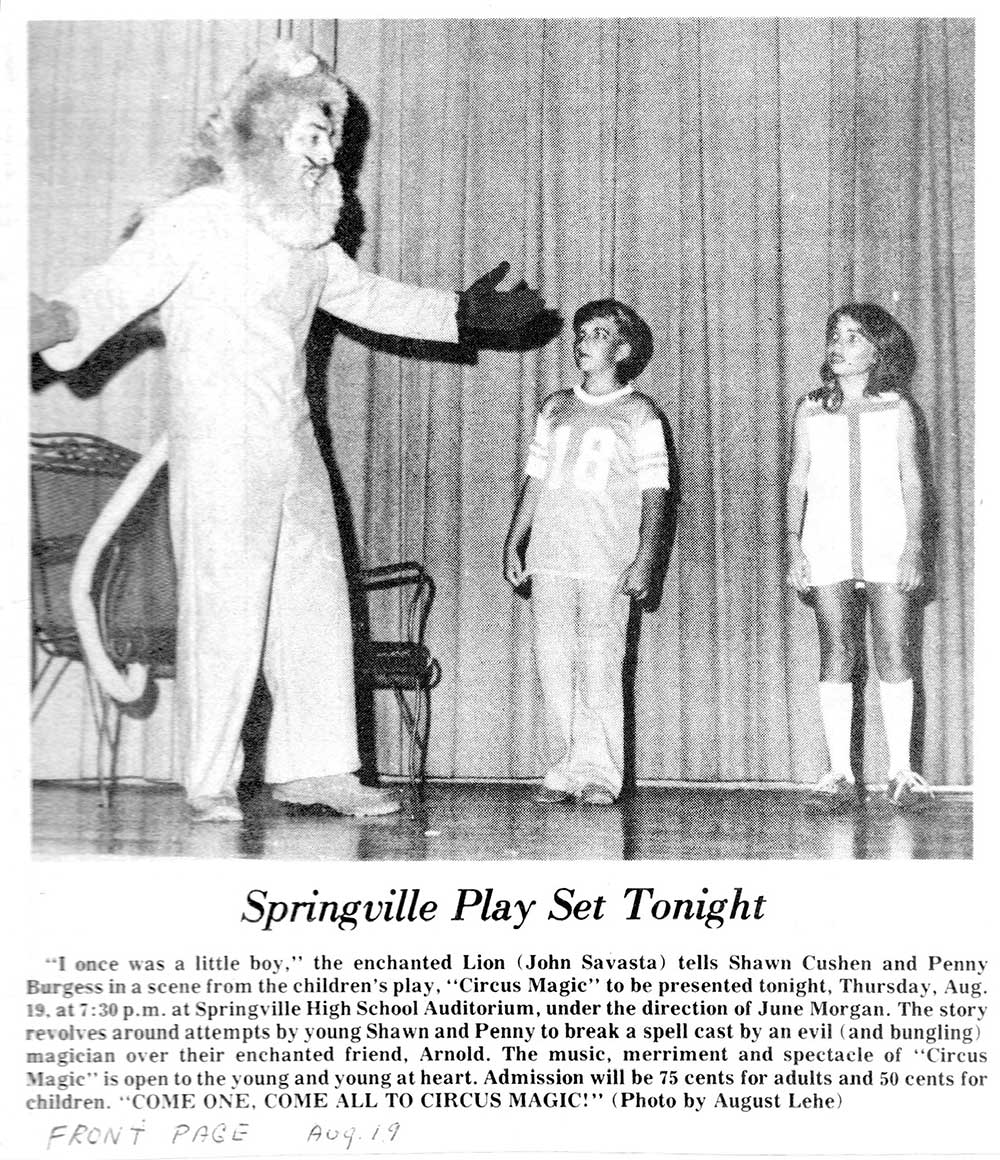
It’s been that way since June Mack founded the theater, where everyone who auditions gets a part – beginning with that inaugural play in 1976 – a one-night production of her work, Circus Magic, a joyous musical fantasy for kids of all ages.
Circus Magic
Tucked away in a drawer in Mack’s Springville home are handwritten notes to the new cast at its first post-audition meeting.
Fifty years ago, she told them, “If this troupe continues in future summers – it has to be easier at any time than it will be for us this summer. But that’s half the fun of it – We’re the troupe that has a chance to make something out of nothing – absolutely thin air.”
The freedom and adventure continue.
In the beginning, sets were crafted from cardboard. Now, muslin stretched over wood framessets the scene. In 1976, Mack and two others crafted sets. Now a small volunteer army does the work.
Mack, a UAB professor, recalled the early days. The first cast had 18members, the next, 60, with ages ranging from 7 to 75.
“It was really fun, because I got to do everything. And when I needed help, I would send someone a handwritten note asking them to do this job. And I had in my head (that) I would never ask the same person to do the same job two shows in a row.”
After bursting out of the gate with four Mack-written shows, the company now produces a new show every three years.
“Now, there are so many people, directing the actors is more than a full-time job,” Mack said. “I really rely on people in all these other positions. They’re so brilliant. I can never say enough about the amazing creative power and devotion of the crew who handle the sets, art, sound and lights, costumes, props, box office… All of that has been a steady group of incredible people.”
What if someone had told her 50 years ago this thing would take off? “I can’t even think past tomorrow, so I couldn’t have fathomed 2026,” she said. “I probably would have said something crazy like that. But back then, it did cross my mind. If it did happen, what a birth moment we were experiencing.”
From the beginning, Mack, a graduate of Hollins College, Florida State University and Harvard University, had a simple mission – to make people feel appreciated.
“I made it clear from the very beginning that what we wanted to do was to give children, particularly, a chance for their parents to be proud of them and that might carry over to home life. That was the goal then and still is,” Mack said.
Mary Poppins
The actors and crew at the heart of Springville Community Theater are energized by the work, so much so that there’s talk of producing shows more often, like they did in the beginning. It’s all part of what has become after 50 years “an amazing thing.”
Mack sees the energy and excitement before, during and after every production as the cast navigates the treacherous waters of stage fright and fear, and the crew figures out how to create near-impossible stage magic. And after some time to recharge their batteries, they’re ready to roll again. Through it all, they bond.
“You get very nostalgic and retrospective on something like a 50th,” Mack said. “These crew people are saying, ‘People don’t understand, but we love the hard work’.”
She adds, “It makes you really proud of it when it’s over. I see the actors go through that. They learn how to work and memorize and come every day and do the hard work. At first they think, ‘We can squeeze this into our busy lives.’ Then, they realize they have to squeeze their busy lives into something smaller because this is really demanding. I think it’s because of that, when it’s over,that they are enormously proud of what they’ve done … That’s when they say they want to do this again.”
Longtime SCT performer Merle Dollar has known Mack since childhood at Springville Methodist Church. Dollar compares work to having a baby.
“You forget about the labor pains,” she said. “After two or three months, it’s ‘Let’s do another play.’”
For Mack, a Springville native, it’s all about opening doors for people to create and for the audience to watch their friends “do something really outrageous that I can’t imagine them doing. That’s a great feeling.
“To me, the entire thing is about making an opportunity for people to create,” she said. “We don’t get enough of that. It’s a sanity thing. People have to have self-expression somewhere in their lives or they’ll go crazy.”
Two of SCT’s seasoned performers, Dollar and Charline Harbison, credit Mack for SCT’s success. Dollar was in the cast for Oklahoma, South Pacific, The Wizard of Oz and others. Mack has a simple formula that has fueled the theater for all these years. That formula sometimes involves writing extra scenes to include more cast.
Oklahoma! performed outdoors
“She never turns anyone away,” Dollar said. “If you audition, whatever part you audition for, even if you don’t get the part you wanted, she will find a place for you in the play … She goes the extra mile to do that. It’s fun.”
A recent revival of that first play, Circus Magic, marked the theater’s landmark anniversary. Some of the original cast were in the audience.
What is it about Mack that keeps people coming back? “Boundless enthusiasm,” Dollar said. “It’s like she doesn’t age. She’s like this little pixie person. She has this enthusiasm and energy like Tinkerbelle. (It’s like) ‘Come play with me. Let’s have a good time. Let’s create this magical thing, this magical world.’ And once you are into the rehearsals, it never stops. She’s constantly uplifting.”
Dollar added, “She’s the ultimate teacher.”
Harbison has been part of the company since 2007. She’s performed in Beauty and the Beast, Oklahoma, South Pacific and other productions. She’s even served behind the scenes as assistant director and acted in another troupe, the Canoe Creek Players.
South Pacific
Why are theater and other arts organizations important, especially in a small town?
“It’s a way of bringing folks together,” Harbison said. “And maybe if they need a little escape from things that maybe aren’t so great in their life at a particular time, it gives them a moment of enjoyment and letting those cares and concerns go for a while. June’s plays are always fun.”
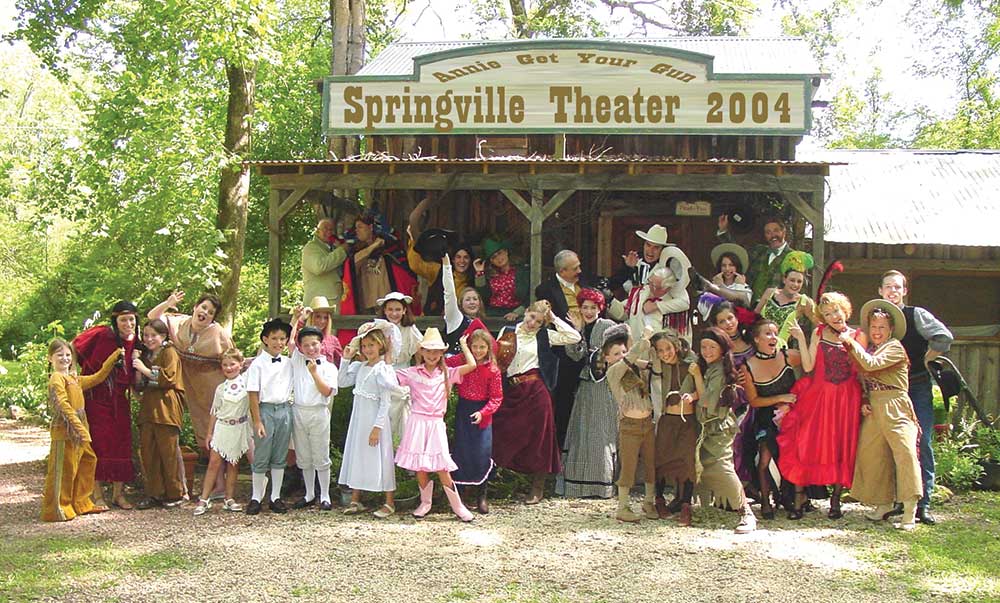
Now, 50 years on, the theater is attracting actors and crew from across St. Clair County and as far away as Birmingham. For Mack, that’s a daily surprise. For the theater group that performs mostly at Springville Middle School, a venue with no backstage and where classrooms are dressing rooms. The group also performed Oklahoma and Annie Get Your Gun outdoors at Homestead Hollow.
But wherever the venue, every type of person has a part to play on stage and behind the scenes in this complicated thing called a show.
“That’s why I talk about human nature, as opposed to ‘We’re doing this theater thing in Springville’,” she said. “Because we’re really not doing this theater thing in Springville … We do people. Theater is the vehicle. It works perfectly because there are so many facets. Every type of person can find a place where they belong.”
Mack recounts a story from a cast member in SCT’s 1981 production of Oklahoma that illustrates the point. The cast member – then a teenager – was faced with a tricky home life.
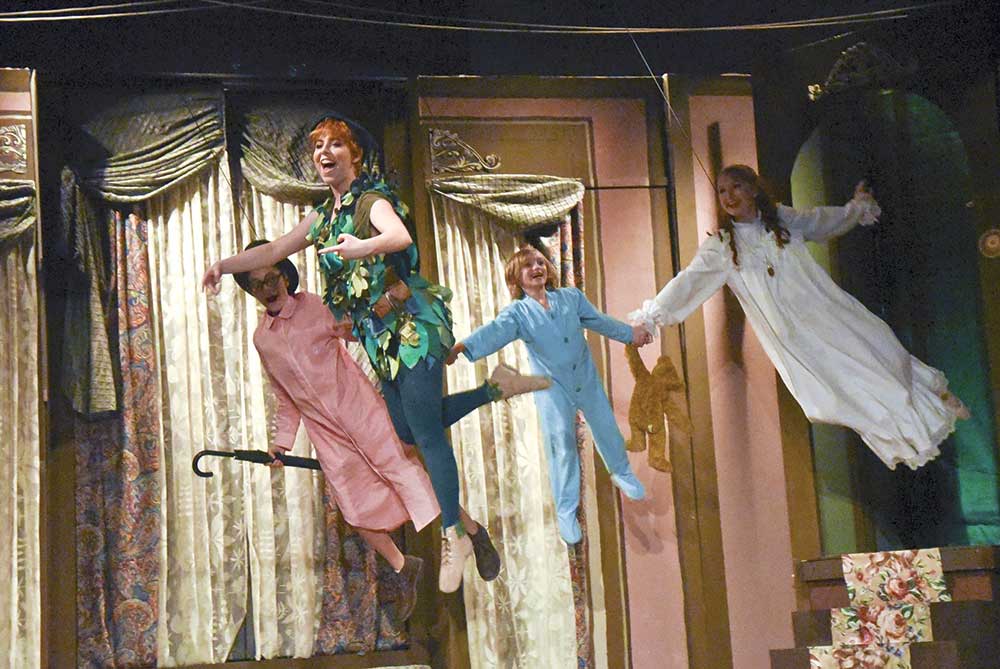
Peter Pan
“She said, ‘That changed my life because that was when I could do something that I could be proud of, and my parents could see it, and everything changed.’ She stepped into a space where she could express herself and be valued.”
“All I do is set up a frame. I say all of you can step into it and see what happens,” Mack said. “People show up. They do stuff, and their lives change. It’s been that way for 50 years. We’re not doing theater. We’re just setting up an opportunity for people to come and play like we know what we’re doing, which is really fun.”
The fun continues after the final curtain. It’s a 50-year legacy of unbridled joy.
“That’s when the magic happens. (The actors) come off the stage, and people tell them how great they were, or how funny they were. They’re signing autographs. It’s so cute,” Mack said.
“This has just been a feel-good thing from the start.”
Story by Elaine Hobson Miller Photos by Mackenzie Free
In January of 1969, a freight train derailed in Springville, hitting propane tanks and triggering massive explosions that created a fire that scared the heebie-jeebies out of local residents and destroyed the train depot.
In 2023, that explosion triggered the imagination of a local non-fiction author who loves to read mysteries and wondered whether he could write one. “What if that train wreck covered up a murder no one knew about,” Joel Dison’s thought process began. “And what if that murder was connected to a current murder and the investigator had to solve the old one to solve new one?”
That’s how the “conflict series” was born, and how Dison, an ordained Southern Baptist minister, went from daily technical writing and inspirational writing to the world of fiction. The series began in July 2024 with Conflict of Interest, followed by Moral Conflict (November 2024), Final Conflict (March 2025) and The Bookkeeper (July 2025). The latter was supposed to be the finale, but Dison says a fifth book is rolling around in his brain.
“When I finished the first book, I realized there was more to the story,” he says. “It stuck in my head and I had to get it out. I probably have one more to do only because I don’t like leaving certain things in the books unresolved.”
Raised in Chalkville, Dison is a 2011 graduate of New Orleans Baptist Theological Seminary. Although he actually wrote his first novella in a long-lost notebook while in junior high, he started writing books a little after seminary graduation. “I did a lot of technical writing for work before that,” says Dison, a bivocational minister until 2023 when he moved to Springville to help take care of his ailing parents. By day, he’s an electrical engineer for PowerGem, LLC., having worked for Southern Company for 34 years before taking an early severance. He says hewas always good at tech writing. “There was a lot of writing in the seminary, too, and that re-ignited the spark that began in junior high,” he says.
All of his books are self-published. The first three were non-fiction, inspirational books. “The first was a study on the Book of James, and it was published on Amazon and Barnes & Nobles,” Dison says. “I didn’t get many bites on B&N, although I did sell some in the United Kingdom.”
Of the four murder mysteries, he has sold somewhere in the 600 range. “Not great but not bad,” he says. “The nonfiction books did okay, almost 2000 in the 2010-2014 time frame, but some of those may have been free giveaways. I was actually surprised to see the number that high when I checked it. I don’t do a lot of marketing.”
Dison holds up the book that started it all
Dison never thought he had the imagination for an entire book of fiction, much less four, but he surprised himself. “I really wanted to do fiction,” he says. “I love mysteries, and writing one became a personal challenge.”
At one point while writing that series, he asked himself why a pastor would write a murder mystery and whether he should.He came to a conclusion that satisfied him and enabled him to moved forward with the mysteries. “Evil is a reality in this world, and as believers (in Christ), how do we deal with that evil?,” he asked himself. “And how as believers do we approach it? I wanted this to be clean, without cursing or gratuitous sex and not too much grotesque violence.”
Book One ends and Book Two begins with a moral dilemma. The first dealt with a lot of internal doubts and overcoming one’s own failures. The second opens with the main character still dealing with some of those failures. The third deals with how all of those things create internal conflicts, although the story is about external ones.
Dison says he could have ended the murder mystery series at three books, but Book Four re-opens that over-arching theme of conflict between the main character and his nemesis. “It deals with concepts of justice, which does not always look like what you think it does,” Dison says. “There’s a possible fifth one in progress.”
His “conflict” books were written in the third-person. Then a prompt from his Springville writing group made him ask himself whether he could write sci-fi, and write it in the first person present. The latter proved to be more difficult than Dison thought it would be. “I kept switching to the past tense in the sci-fi book, the Cymbrian Protocol,” he says. “But some people think first-person is more engaging to the reader because it makes them feel they are present.”
His writing group, which has no name, often comes up with a topic, and each member writes 2,000 words in three weeks or more on that same topic. “Then we read, compare and critique,” he says. “In January, for example, the topic was a fairy tale.” The group is several years old, and Dison has been a member for about a year.
Dison self-publishes all of his books, a process that no longer carries the stigma it used to. “Self-publishing is becoming as viable and credible as traditional publishing,” he says. “But I would love to have an agent who could find me a publisher to edit and distribute my works. I’m not writing to be a best seller, but for the personal enjoyment and the hope that someone will read my books and enjoy them.”
Electronic publishing costs nothing, except for whatever an author decides to spend for editing and marketing. “So even with paperback it’s just my own printing costs,” Dison says. “It’s a low threshold, which is why so many people do it.”
He makes a couple of dollars on each book he sells, but says he’s not writing for money or fame. “I enjoy writing. It’s cathartic and calming, and exercises my brain. It’ a way of dealing with all the stress I’m going through, a coping mechanism. You lose yourself in your writing.”
Dison designed each of his covers himself, using a graphics editing tool called Canva, with a little help from ChatGPT. “Some images are AI generated,” he says, but he doesn’t use AI in writing his books. “That would be deplorable.” Readers can find his books by searching his name on Amazon, or by checking with Nichols Nook in Springville.
He hasn’t decided whether his sci-fi novel needs a follow-up. The first one came directly from one of his writing group’s prompts, which called for writing a short sci-fi scene. That led to the full book. “I want to find a good way to wrap up the Springville murders, then I’ll decide what’s next,” he says. He has thoroughly enjoyed the locally-set writing and would seriously consider that again in a different format, perhaps a historical fiction or maybe a ghost story.
Readers always wonder where a writer gets his inspiration. For Joel, who has always loved reading mysteries and sci-fi, it’s more about the challenge than the inspiration. “For the first book, the challenge was, ‘Can I write a murder mystery,’” he says. “For the sci-fi, it was, ‘Can I write a sci-fi and write it in the first person?’ I like to challenge myself.”
He has no aspirations of getting rich from his writing, but hopes people will read his books and enjoy them. “I want to provide the option of clean, enjoyable reading for those who like to read, but are bothered by the foul language, sex and violence in lot of popular literature,” he says.
Johnnie Mae Beavers Green may be 95 years old, but her dignified demeanor and perfect posture would make the biblical Queen Esther proud were she still around.
Having lived in the Pell City area for most of her life, Johnnie Mae’s memory is an encyclopedia of local Black history. Tonya Forman expresses loving gratitude for her help in assimilating local history for the Breaking Barriers section of the Museum of Pell City. “Mrs. Johnnie Mae is a treasured source of wisdom and history in our community,” Tonya said.
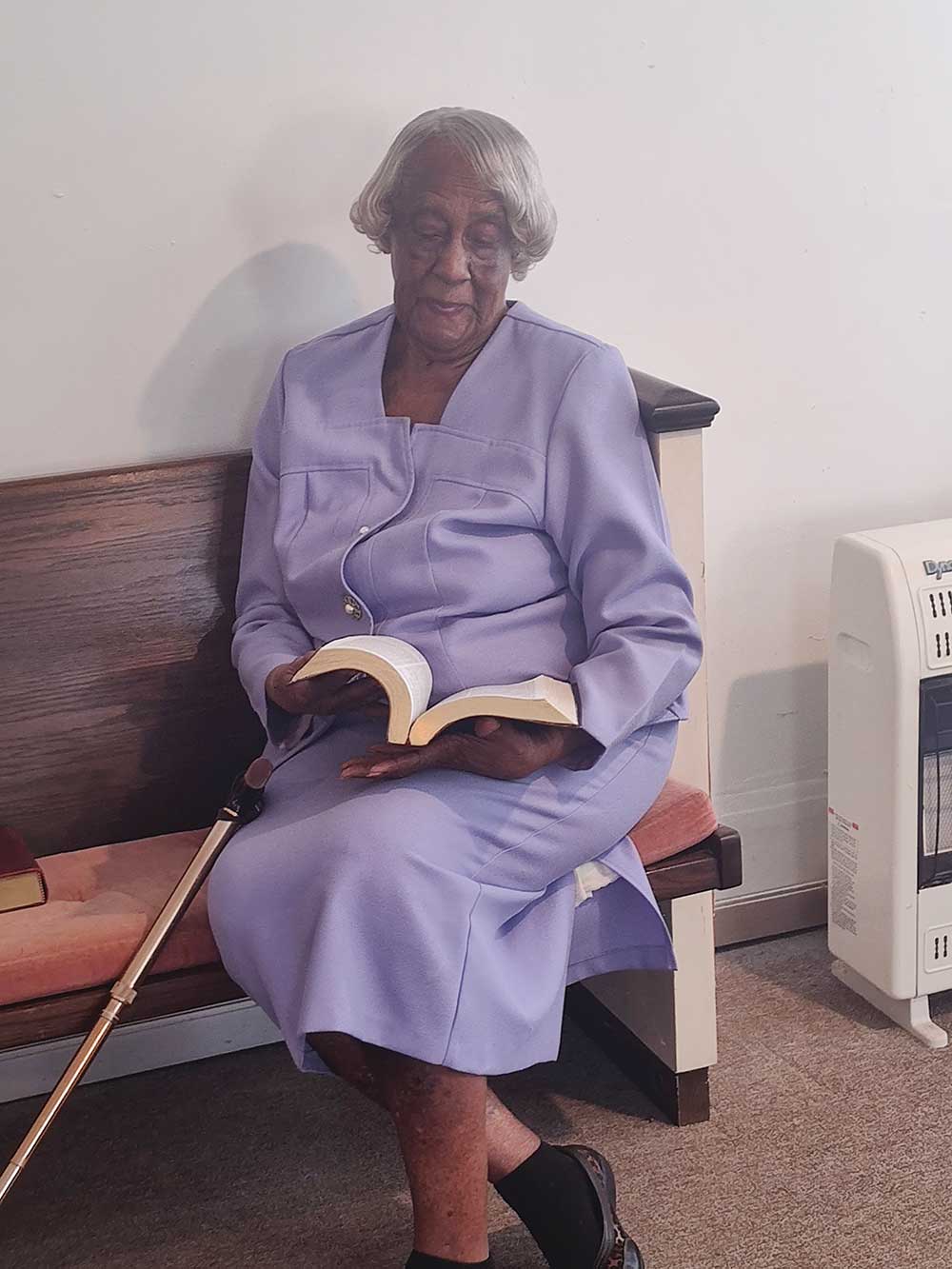
Johnnie Mae Green reading her Bible at Mt. Hillary Church
“Her memories and stories preserve the legacy of our families, churches and neighborhoods, helping to connect past generations with the present. She’s my personal historian. I can sit and listen to her talk and sing all day.”
Guided by faith
Known for her faith in God, Johnnie Mae’s life has been guided by the Holy Bible and her faith in the God of the Bible. She has a godly heritage reaching back 200 years in St. Clair County’s African American church history. In the 1895, A History of Colored Baptist in Alabama and North Carolina, Charles Octavius Boothe records a brief biography of her great-great grandfather, Rev. Jasper Beavers.
Born a slave in 1825 in Easonville, Beavers learned to read and to write and became a minister of the Gospel of Jesus Christ. According to family history, Rev. Beavers preached the inaugural sermon at Blooming Light Missionary Baptist Church when it was organized on the first Sunday of July 1884.
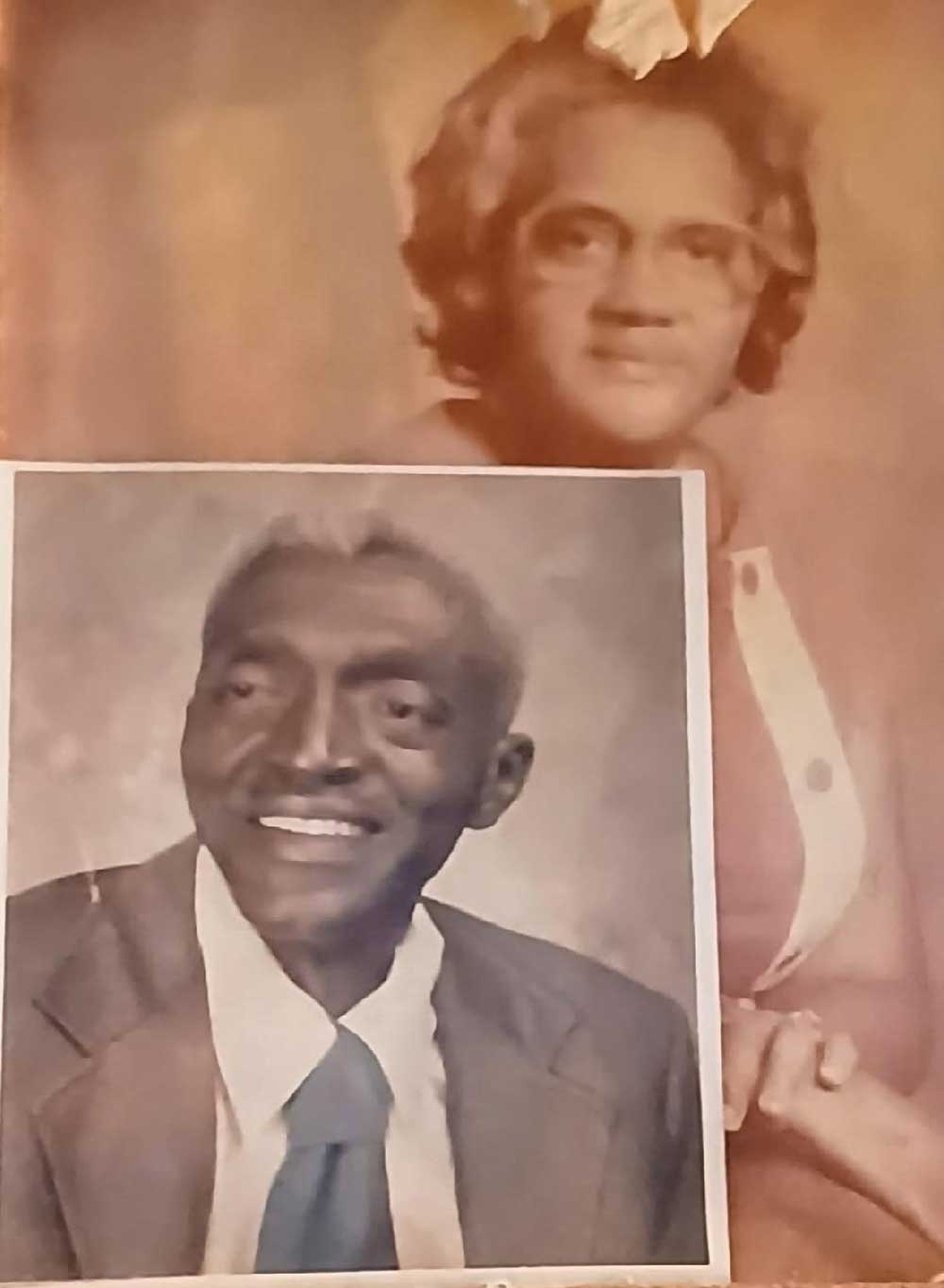
Born July 18, 1930, to Herbert and Elizabeth Gibson Beavers, Johnnie Mae grew up in Tuscaloosa County until she was 13 years old. Her mother was native to Tuscaloosa County while her dad was native to St. Clair County. On Dec. 29, 1942, the family moved to the Crossroads community, south of Pell City.
‘Life was good’
“There were two boys and two girls in our family. I was the third child,” Johnnie Mae recounted recently. “We were share-croppers. We farmed. We raised pigs. We had a good milk cow. And life was good.”
A summer garden produced fresh vegetables as well as produce for canning for the winter months. “You know what we grew it with — fertilized it with? The manure from when they cleaned out the mule stables every year. And that’s how we fertilized the garden.” When a listening friend commented, “You had the best fertilizer in the world,” Johnnie Mae replied, “It grew a lot of grass! The animals ate the grass,” she laughed, “and we had to get it up.”
Charlie and Johnnie Mae Green
When asked about the best dish her mother cooked, she quickly replied, “apple cobbler. She could just naturally cook. No recipes.” Then she laughed and confessed, “And I’m gonna tell you the best thing she ever cooked, and that was opossum,” and she told how they prepared it.
“My dad would go hunting at night, and he would catch croaker sacks full. And he had a great big barrel he would put them in and keep them there about a week and feed them until they were fat enough. Then he would kill one. They burnt the hair off and then scraped it down so the skin was clean and pretty.”
After her mother had dressed all the innards out, she boiled it for a while before baking it in the oven with sweet potatoes.
Johnnie Mae declared her mother’s baked possum to be “Good eating,” then laughed and said, “One day me and my sister came home from school, and we ate the whole possum!”
She learned from her mom how to cook them, but by the time she had a home of her own, eating possum was out of style. “I don’t think any of my children ever tasted possum,” she said.
Continuing to reminisce about her mom’s cooking, she said, “Mom could cook almost anything because we had to make do with whatever they had.” One make-do vegetable growing wild in Alabama is the pokeweed that when cooked is called poke sallet. The Beavers family enjoyed it. “Poke sallet was a basic food,” Johnnie Mae recalled. “You could just go and gather that. Mom would clean it. Boil it good. Squeeze it out and rinse it, and then she put it in a skillet with onions. My daddy liked it with onions. Or you could mix it with turnips or other greens. That was a good dish.”
Quilting legacy
Mrs. Beavers also made quilts for winter warmth. And there was some make-do with that as well. When a garment was no longer wearable, Mrs. Beavers would use the garment areas that were still good. Nothing went to waste.
Mrs. Beavers made the girls’ clothes. Many dresses were sewn from colorful feed sack fabric. The girls would go with their dad when he bought feed and choose the sack they wanted for a dress. When enough feed sacks of the same pattern were accumulated, they would have a new dress.
Those vintage feed sacks from the 1940s today sell for between $20 and $45 per sack, depending on the design.
“Mom was a quilter,” Johnnie Mae reflected. “And she used every little scrap she could find. You know we had to find little strings of cloth about an inch or two wide. She would cut a newspaper square and sew the little strips. And when you made a block, you tore the paper off.” Those were called String Quilts and were quite colorful with a kaleidoscope of different fabrics.
Johnnie Mae quilted all her life until she was 90. Then other things took up her time, and “I filled my little quilting room up with junk,” she said. “And I just got it cleaned out so I’m quilting again, and I’m not stopping anymore until the Lord stops me. I can do one a week.”
Growing up
She still lives in the same community and has good memories of growing up there. “It’s a funny thing, but it’s true. All the Blacks were on the Mt. Hillary Church side of Blue Spring Road. And the white families were across over here in their neighborhood. And it was just like one big family. We borrowed, and we visited, and we played together. We didn’t have any problems. So, we named it the Black Crossroads and the White Crossroads,” she laughed, then added, “And the funny thing, we thought we had a little more than they did. And they thought they had more.”
The Crossroads children played games that are now memories to folk of Johnnie Mae’s generation. “We played Auntie Over—throw the ball over a building. We played hopscotch. And jump rope, but I never could jump rope. We played Dropping the Handkerchief. And the number one game was Hide and Go Seek.”
Crossroads was a peaceful community, but when feelings got hurt or a misunderstanding arose, there was a solution. “If you had a falling-out with your neighbor,” Johnnie Mae reflected, “before you went to bed, you had to go and beg pardon of that person. And I thank God for that.” This principle is based on the Bible verse Ephesians 4:26, “Do not let the sun go down upon your anger.”
Such a rule kept harmony among the members of the communities, and Johnnie Mae was oblivious of color differences until one day in Pell City. “Back in the day,” she reminisced, “my daddy would carry us up to town [Pell City] in the wagon. It was summertime, and I got thirsty. I said, ‘I want a drink of water.’ So, we went to where the fountains were, and it said White and Black. Daddy said, ‘Get over there and get you a drink,’ and pointed to the Black fountain. I said, ‘I don’t want no black water, I want clear water. I will never forget that,” she laughed. “I didn’t know anything about segregation until that day.”
After a pause, Johnnie Mae recalled a friend’s deprecating comment about another person’s ethnic background. Then she made a singular observation that deserves contemplation.
“I said, wait. Let’s talk for one minute. Do you think that when God spoke the earth into existence, and then he decided on making man, do you think He went and found brown dirt, red dirt and yellow dirt and made everybody?” Her speech tone was pulpit worthy. “No. He made every single one out of the same dirt. So, how can we put a separation between each other.”
There is silence as she ponders a few seconds and then she laughs, “I’m not gonna lie. There are some good people that are hard to deal with, but I love them … and love is what God teaches.” Again, she reasons from her knowledge of Scripture.
Education
When the Beavers family settled at Crossroads, the children attended The St. Clair County Training School in Pell City, and Johnnie Mae was in the 1947 graduating class. “It was the biggest class that had ever graduated from there,” she recalled. “There were 27 that graduated. What made our class big was that we had kids from Margaret and Acmar in our class.”
She was athletic and played on the Training School’s girls’ basketball team. “We had a great basketball team,” she recounted. “We won all of the little districts’ games. Maxine Jones was our coach. She was the principal’s wife.”
She remembered two of her principals. One was of short stature and without a strong personality. He could not control the students — especially the male students. If a student needed paddling, he would send for his wife who taught at Cropwell at the Greenfield school, and she would hitch up her one-horse wagon, come to the Training School, paddle the student and return to Cropwell.
To solve that problem, the Board of Education sent Professor Ruben Yancey to be principal of the Training School. “When Mr. Ruben Yancey came,” Johnnie Mae recounted, “he grabbed those boys by the collar, and it made a brand-new school. He taught them respect.”
Professor Ruben Yancey ended his career as principal of Ashville Colored High School. Professor Lloyd Newton and the Black community petitioned the St. Clair County Board of Education to rename the school Ruben Yancey High School, which they did in 1965. Sadly, Professor Yancey died shortly before the name change, but he lived and died well-respected by both races.
Life after high school
After graduating high school, Johnnie Mae attended Stillman College in Tuscaloosa for a year-and-a-half. However, she reflected, “The only reason I didn’t stay in college, I knew my parents were not able to send me. There were no student loans. I knew they didn’t have the money, and I came out.”
Determined and courageous young woman that she was, however, she enrolled at Ruth’s Poro School of Beauty in Birmingham and took the six-months course to become a licensed cosmetologist. “It was hard, but God knows I enjoyed it. Cutting and pressing and curling hair.” When she started, that process earned her about $3 per person.
When asked about the location of her shop, Johnnie Mae replied, “I went. I travelled. I did a lot of invalid people — the ones that couldn’t get around.” She paused a moment, then laughing, said, “A friend came to the house yesterday and said, ‘Well, you’re 95 years old, and you’ll soon be up there in heaven fixing mother’s hair.’ And I said, ‘I’m not gonna work when I get up there. I’m gonna sit down and praise the King.” Among the laughter, somebody said, “Amen!”
Kimberly Moore said of Johnnie Mae’s skillful work, “She was excellent with hairdressing. Just about everybody I knew growing up, she pressed and curled their hair!”
In addition to hairdressing, Johnnie Mae worked the looms in two cotton mills. She worked for two months at Avondale Mill in Pell City, then took a job in Talladega at Crown’s Textile. “I had about five less looms to run than I had at Avondale, and I made $5 more an hour. I retired from there.”
Then she explained why she retired. “I drove by myself for seven years. Just me. There wasn’t very much traffic on Highway 34 then. But one night I had a flat tire, and over here at what we call the Twin Bridges, there was an invalid white man lived right on the road. And he heard me out there with my flat tire. He was feeble and on a stick, and he had a big dog and came to where I was.
“Finally some Black folks stopped, and he said, ‘If you all will change the tire, I’m going back to the house.’ But he left his dog there, and he told the dog to lay by my door. Bless his heart! I’m telling you,” she said, with thanksgiving in her voice, “every time I went to work, I stopped and hollered at him. He was dynamic. And that’s why I quit work, cause I thought next time it might be worse.”
She retired from the cotton mill, but she didn’t retire from working. She worked in the kitchen at the Black and White Nursing Home for a while and then at the Rosewood Manor for about four years. She left Rosewood Manor and worked briefly at an assisted living facility on Dry Creek Road; however, that facility had a short life. “They closed down,” she said, “and after tha,t I came home. I stopped working.”
But not really, for she continued to go to women who were confined to their home and dress their hair beautifully. And in that ministry, she spread sunshine and the love of God to the women.
Marriage, family and faith
In 1950, Johnnie Mae married Charlie Darnelle Green from Perry County. They were parents to four children — three boys and one girl. The Greens also took sisters Linda and Wandra Beavers into their home when their mother went to New York to work. Jobs were scarce back in that day.
At home, Johnnie Mae taught her children about God and his love, and they grew up in Mt. Hillary being nurtured by godly ministers there. “I’m so thankful,” she testifies, “that I had good children. They may have fallen out, but they made up and got along.”
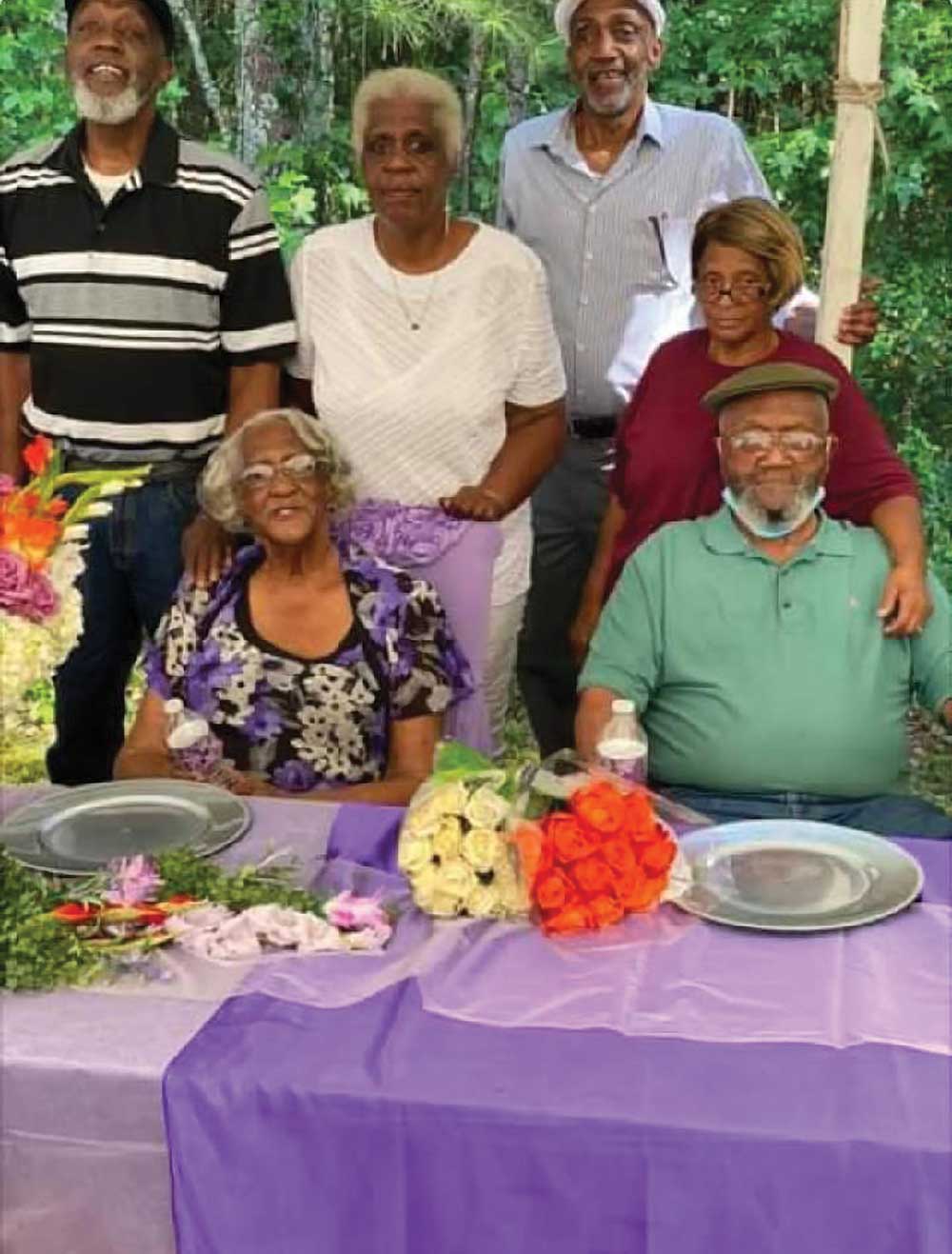
Celebrating 90th birthday with family
About rearing children, she commented, “I tell you, it don’t cost but just a little to train a child the way you should train ’em. And when they’re old, they won’t depart from it,” quoting from the Bible. Then, reflecting of current troublesome times, she added, “I don’t know about that now. But I don’t think they depart, they just were never trained. Maybe God will fix it one day.”
It is worth noting that the Perry County Green family knew Coretta Scott King, and Johnnie Mae knew her as well. Furthermore, Rev. T. D. Jakes has genealogical connections to the Green family.
Charlie Green was a miner. When he stopped working in the mines, he took a job at Anniston Army Depot, where he worked until he retired. “It’s been a good life,” Johnnie Mae reflected, “and I don’t regret any of it.”
Mt. Hillary Missionary Baptist Church became her home church about the same time the family moved to Crossroads. Having already been baptized in Tuscaloosa County, Johnnie Mae joined Mt. Hillary in 1944. She told of her baptism as a 7-year-old. “I was baptized in a creek. I was scared of the turtles, and there was a terrapin coming towards me. They had to catch me and put me back in the water!”
When asked if she had sung in the church choir, she replied, “Yes, I did. And we had a little quartet. A little group, The Rose of Sharron Gospel Singers. There were six of us — Mertis Truss — O’Neal was her maiden name — was our musician. Her sister Josie sang with us. I was one of them. Then we had Livi Threatt, Flora Threatt and Nellie Mae Threatt.”
The Rose of Sharron Singers would pray before they went somewhere to sing, for they felt like they were worshiping the Lord through singing.
As she approaches year 96, Johnnie Mae’s faith in God is strong. How has her faith sustained her all these years? “It’s the song I sing all the time, Amazing Grace.” Then she quotes in a strong voice, “Through many dangers, toils and snares, I have already come, God’s grace has brought me safe this far, and grace will lead me home.”
A quietness settles over the room as she comments on her faith. “I told my church the other Sunday, ‘I have one thing to work on.’ They say, ‘What?’ And I say,’ My faith.’ I said, ‘The Scripture says if you have faith the size of a mustard seed, you can tell the mountain, ‘Be ye removed,’ well, I can’t move a stick. But I’m working on I,t and I trust Him. When I get up or when I go to the store, I say, ‘Lord carry me and bring me back.’ He is the only One I have.”
Although she may think her faith is small, her unwavering faith in God inspires many of her family members and friends. And the words of Andrae Crouch‘s hymn “Through It All,” fits her perfectly.
Through it all Through it all I’ve learned to trust in Jesus I’ve learned to trust in God Through it all Through it all I’ve learned to depend upon His word Oh, I’ve learned to depend upon His word.
Many lives have been blessed by Johnnie Mae’s life and faith and would say, “Amen!” to Kimberly Moore’s loving comments. “For as long as I can remember, my Aunt Johnnie Mae has always been a woman of faith and highly involved in the church. She is the rock of our extended family, and her strong belief in God is what I use as a model for my own life. She has taught me that no matter what happens God is in control … she often says that we have to lean and depend on Him and His word … her unwavering FAITH is a true testament of his AMAZING GRACE.”
Johnnie Mae Beavers Green. Keep on keeping on in your journey of faith. You are an inspiration to your family, your church and your hometown, for through it all you have learned to depend upon God’s Word.
It’s a tradition whose roots run deep in history, culture and the church. Some might think it’s simply fashion, but for generations of Black women, donning beautiful, often elaborate hats, it’s an expression of identity, dignity and faith.
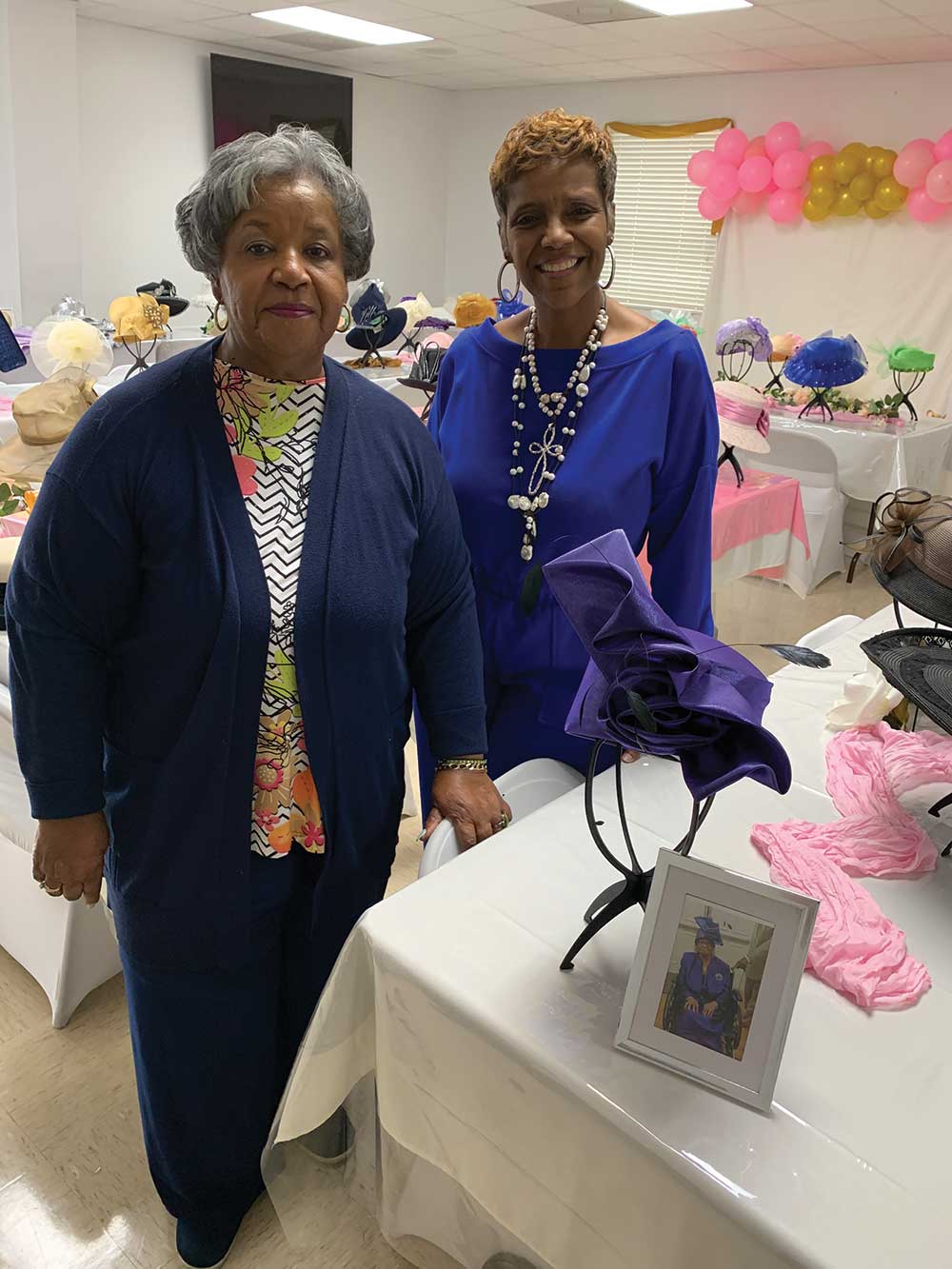
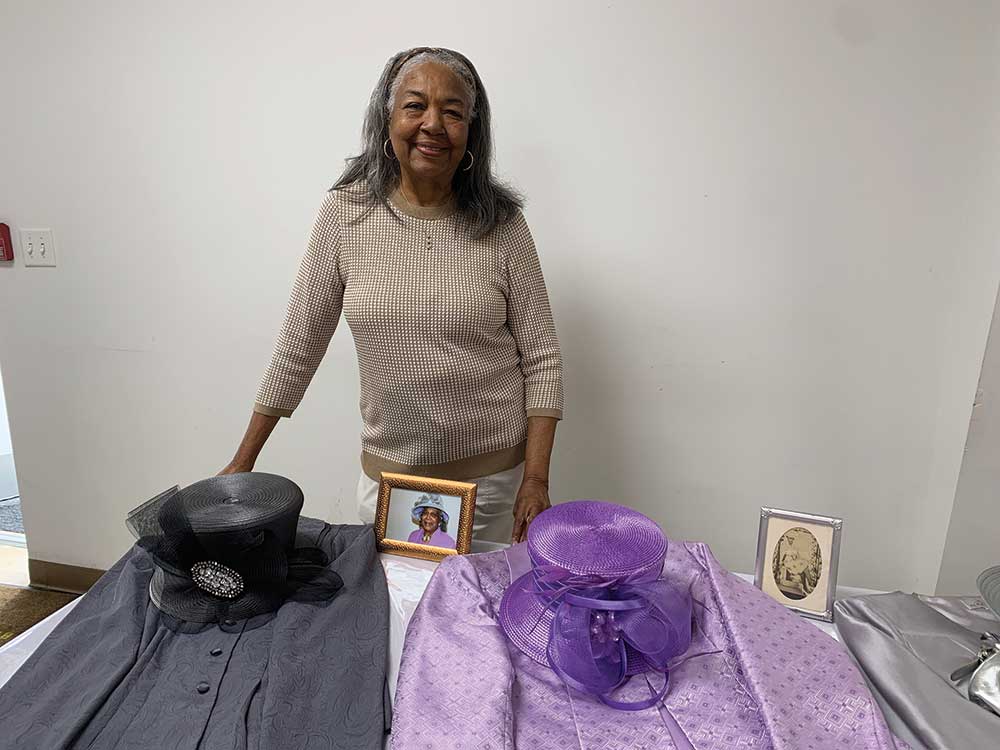
Ernestine O’Neal and her niece, Sherrell O’Neal, posing with the hat and photo of Ernestine’s mother and Sherrell’s grandmother, Annie O’Neal
The hats they wore to church on Sundays were a reflection of who they were – their personality – and each was distinctive, just like the women who wore them.
At First Baptist Church South in Pell City, members of the church wanted to capture the essence of that tradition in their own church and planned to have some of the women wear their ‘crowns’ on Mother’s Day. It was an idea church member Paula Jackson had, and the Women’s Ministry followed through with an impressive exhibit.
Illness caused the church’s original plan to change, and Women’s Ministry Leader Jennifer Gover decided to expand the reach, contacting women throughout the community to recruit for its “Women Who Wear Hats” exhibit. With the help of her niece, Chrissa Posey, the momentum grew into an exhibit on May 2, May 3 and Mother’s Day, May 10, to pay tribute to these women and their hats with 91 hats displayed from the women of 14 different churches.
“My lifesaver is my niece, Chrissa Posey, who has artistic inclinations and decided placement of the hats and suits,” Gover said. “She even prepared and set up refreshments for the exhibit.” Her behind the scenes work contributed greatly to the success of the event.
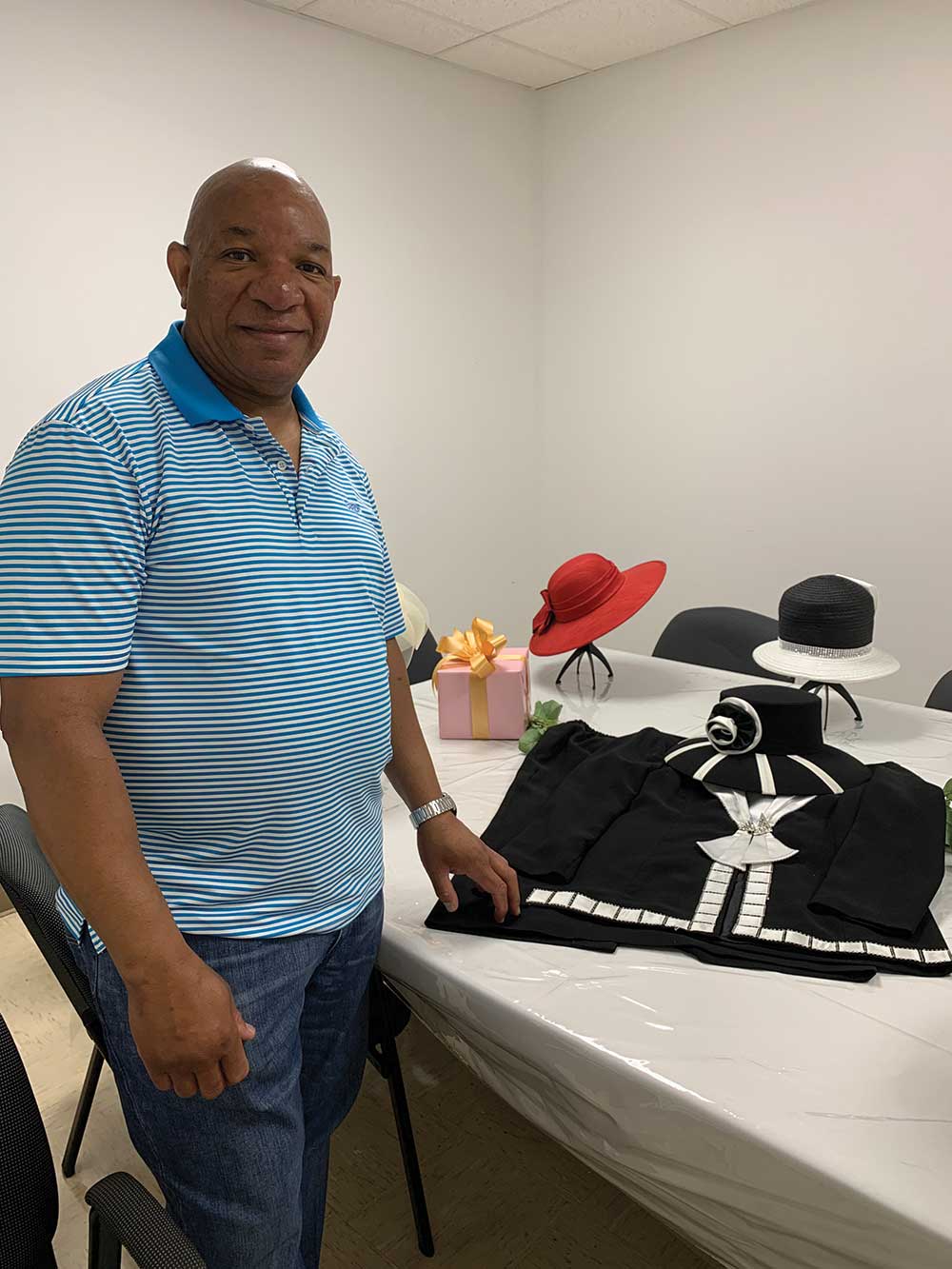
Elic Smith with the stunning suit and hat of his mother, Blossie Smith
From feathers to jewels to embroidery and lace, the hats ranged from simple, but elegant to elaborate and billowy. “We thought it was impressive,” said Gover. “It shows how the personalities are different. It wasn’t just something they wear on their head, but something from the heart.”
Nearby, a table of framed photos of the featured women – most in their signature hats – seemed to watch over the room as if surveying the handiwork that brought the event to fruition.
Elic Smith displayed the hat and stunning, matching suit worn by his 86-year-old mother, Blossie Smith. He couldn’t disguise the smile as he recounted his mother’s Sunday attire. “Miss B – You would have thought she would have been first lady.”
It’s a tradition that spans generations from slavery to present day, explained Charlotte Crawford. It was an outward expression of who they were within – “a classy, dignified lady. Each hat represents how they carried themselves. Ruby Sawyer Fomby always wore hats,” she said of her own mother.
Janice Carter echoed the recollections of others as she talked about her mother, Elnora Carter. “Mama wasn’t going to church without a hat or a suit.” Her grandmother, Mary Singleton, would buy two suits just alike and take a cuff or a piece from one and fix the other “just the way she wanted it.”
Elnora was a singer with B.J. and the Countryettes. “When she was singing, she had her hat, too.” It was like her personal signature for every performance.
“I grew up in a church where older women wore hats,” recalled Ernestine O’Neal. “You never wore pants to church.” The hats of Ernestine’s mother, Annie O’Neal, were a part of the exhibit. Annie was Sherrell O’Neal’s grandmother, and she noted that hats only came in one size, so women would sew or fasten material inside to make it fit tight.
Charlotte Crawford, daughter of Ruby Sawyer Fomby
To demonstrate, Sherrell tried on one such hat – a dainty, circular piece covered in blue feathers with a piece of felt placed inside – a perfect fit!
Bobbie Jo Swain of First Baptist Cropwell had the largest collection in the exhibit. Some in the overall display were vintage – 50 to 60 years old. Estelle Forman pointed to the hats of her mother, Bernice Joiner, and mother-in-law, Lizzie Forman, whose hats were featured in the display. Like the others, they were perfect fits for the way they carried themselves, she said.
An opening reception attended by 50 ladies – some of whom donated hats along with family, friends and others – shared precious memories the exhibit evoked.
One of the women asked if she could peek inside a straw hat with pink flowers. The label said Jack McConnell, a well-known milliner active in the mid to late 20th century. The hat’s owner was Caroline Gover’s mother, Della Jordan Gover. Caroline recalled it was bought 25 to 30 years ago at a small hat shop in Birmingham.
These women were serious about their hats, and they invested to get just the right one. They often shopped at a store in Ensley called Cotton’s. Later, they bought their hats locally from Kenwin’s or Mays and Jones with prices ranging from $50 to well over $200.
“They were willing to spend money on these hats,” Jennifer Gover said, and with good reason. It was as much a part of their personality as their smile, a laugh or a word of advice remembered long after they are gone.
“Today, women do not wear hats to church services as they did in the past,” Gover said. “We dress more casual, except for special occasions. But there are still a few who hold on to the tradition of bold and beautiful hats to complement exquisite suits or dresses.”
Remember, she said, “a hat is an expression of a black woman’s soul. It is something she wears on her head but belongs to her heart. It is the keynote of her personality – the finishing touch.”
A self-described “military brat,” Bill Beebe plunged into art at a young age, painting his first mural on his Fredericksburg, Va., bedroom wall while listening to Nirvana’s Nevermind album. The seminal work by Dave Grohl and the late Kurt Cobain featured the hit, Smells Like Teen Spirit.
For Beebe, that spirit smelled like a plastic, even comforting aroma of acrylic paint as he found his place what for military families is an ever-changing world. “I’m not sure what initially drew me to large format painting. Maybe just the fact that people knew I could paint and asked me to,” he said.
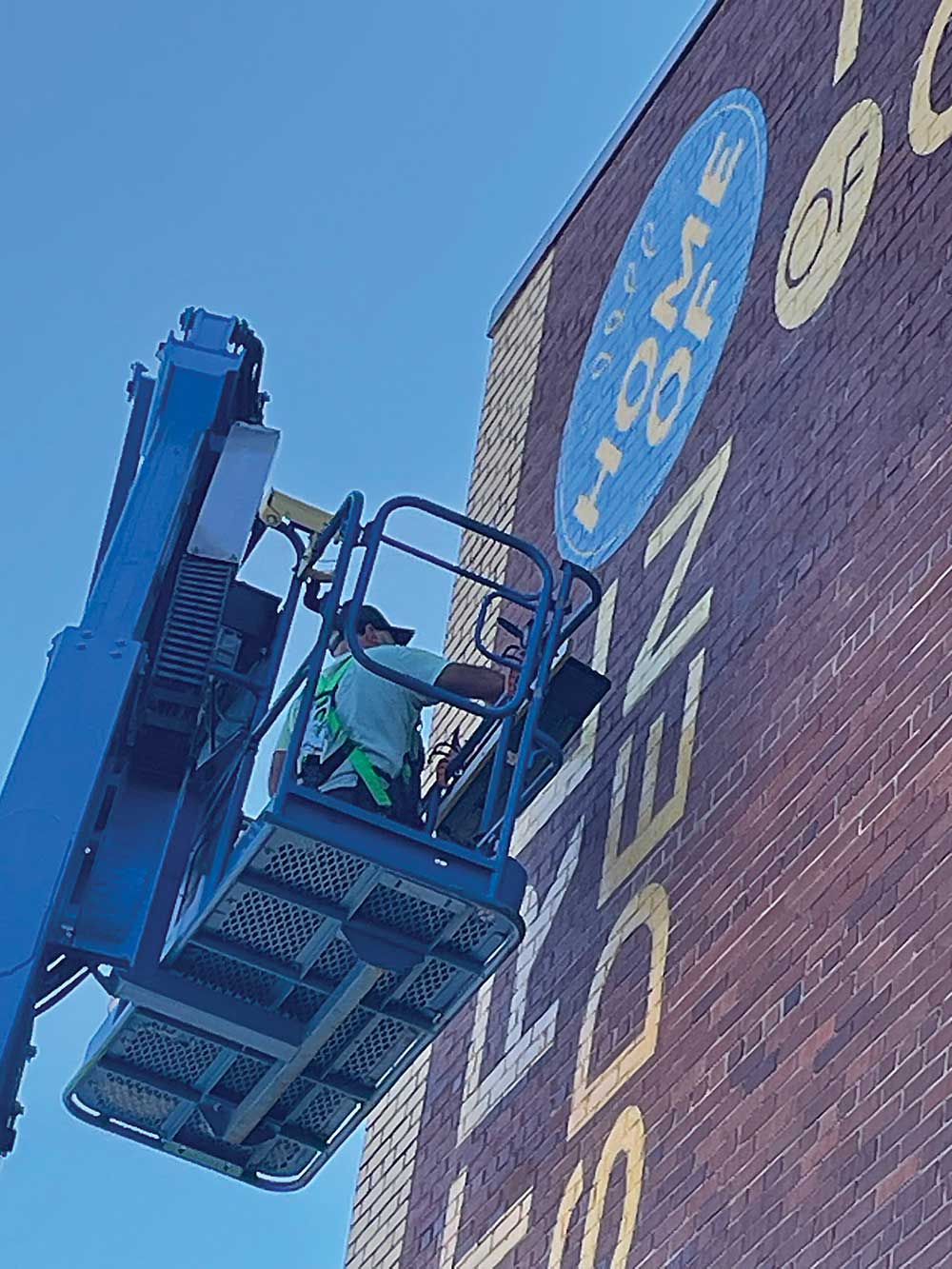
“I started painting for friends and family in the late 1990s, then more as side work in the 2000s.” That side hustle is now a full-time job for Beebe. His company, Art for the Wall, has brightened once-empty walls and storefronts in northeast Alabama with large-format murals and eye-catching signage.
Bill Beebe painting a mural for the Theatre of Gadsden
Beebe spent a few of his teen years in Ashville and spent his early professional life as an electrical apprentice and later as a journeyman electrician. He went on to earn an associate’s degree in commercial graphic design.
Art for the Wall began in Charleston, S.C., but is now based in Ashville. “I’m still relatively new to Northeast Alabama after transferring my business from Charleston,” he said. “But I’ve done a couple (murals) in St. Clair County – the Historic Ashville, Alabama mural and for Gilrearth Printing & Signs’ new facility in Pell City…Most of my work can be seen in Gadsden – Downtown Gadsden, Inc., the Gadsden Museum of Art, the Ritz Theatre and my latest was the “You Belong In Gadsden” sign/mural I did next to the new Alabama Department of Rehabilitation Services building in East Gadsden.”
Kay Moore, executive director of Downtown Gadsden, Inc., called Beebe and his work, “a huge asset” to the organization and to downtown Gadsden as a whole. “We have several wonderful murals that he has created in the historic district,” she said.
“I think the most notable one is located on the west side of the Pitman Theatre. When I talked to Beebe about my vision, he immediately took it and turned it into reality.” The mural’s message? Unity. And the background words focused on the downtown area’s message.
Other murals highlight Beebe’s other talents, Moore said. “He is very gifted and very easy to work with,” Moore said. He often gets feedback from townsfolk who stop to watch the artist at work.
Beebe often can’t hear their comments because of traffic or the music he listens to while painting. “I’d imagine people think I’m rude if I don’t engage in conversation,” he said. Ninety percent of the time, I can’t hear what people are saying due to traffic, being up high on a lift, listening to music, or simply in the zone, concentrating on what I’m working on.”
Outdoor and indoor designs match the clients’ business theme
As for projects in the pipeline or in progress, there is a small sign for the Gilbert Cummans Greenroom behind the Pitman Theatre in Gadsden, as well as signage in Ashville, window graphics and murals to come in Oneonta and more.
As for all outdoor muralists, weather is a never-ending challenge. “Definitely the weather,” Beebe said. “Wind, rain, heat and cold. Occasionally, lift logistics if I’m working up high. Time is sometimes a factor with rentals since there’s typically a certain amount of days I can have with the equipment.”
For Beebe, the rewards for his work are many. “I’m usually creating something that is timeless,” he said. “Painted signs in particular – they look good when they’re freshly painted, and they look good when they’re old and faded.”
He also gets satisfaction when his work comes out clean, even after being painted on a rough surface. Too, there’s joy in seeing a work come together after working so closely to a surface or seeing a design take root on a computer and then blossoming into a large format mural.
And, when the day’s work is done, Beebe enjoys a simple pleasure –“a delicious cold beer after painting all day.”
The positive feedback he’s received from clients across 16 years as an artist is what keeps him painting and making signs. And while he enjoys the ease of most projects, he takes joy in challenge as well.
Had life taken a different path, architecture or engineering might have been Beebe’s calling. “I love details from start to finish in projects,” he said. “Designing, scaling, measuring, leveling and organizing are definitely my favorite aspects of every project.”
Beebe hopes his work influences others who may want to take a similar path. “Being an artist has its challenges, but so does everything else,” he said. “It’s a rewarding and legitimate career path. If you take time to learn the processes and techniques and mold that into a business model, you can make some pretty decent money and have a fulfilling career as an artist.”
Beebe finds it hard to explain his work, either as a storefront sign or massive mural. “I aim for precision, but I always want the viewer to know it’s a painting and not just some print on vinyl that has been stuck on the wall and heated up,” he said.
“Most of my stuff is logo painting, so it has to be spot on to the renderings I provide my customers. On a more personal level, I enjoy typography, so you’ll most likely see some kind of text in many of my paintings,” he added.
“I really appreciate simplicity in my work. I try to stick to the ‘less is more’ concept as much as I can.” If he could write a letter to his younger self, to that kid painting his first mural while jamming to Nirvana, what would Beebe advise? “Start your art career earlier (rather) than later,” he said. “Take more risks when you’re younger. It’s just paint. Everything is rushed when you’re an adult. Take your time and enjoy the process of every project. There are no failures in anything you do, just lessons.”
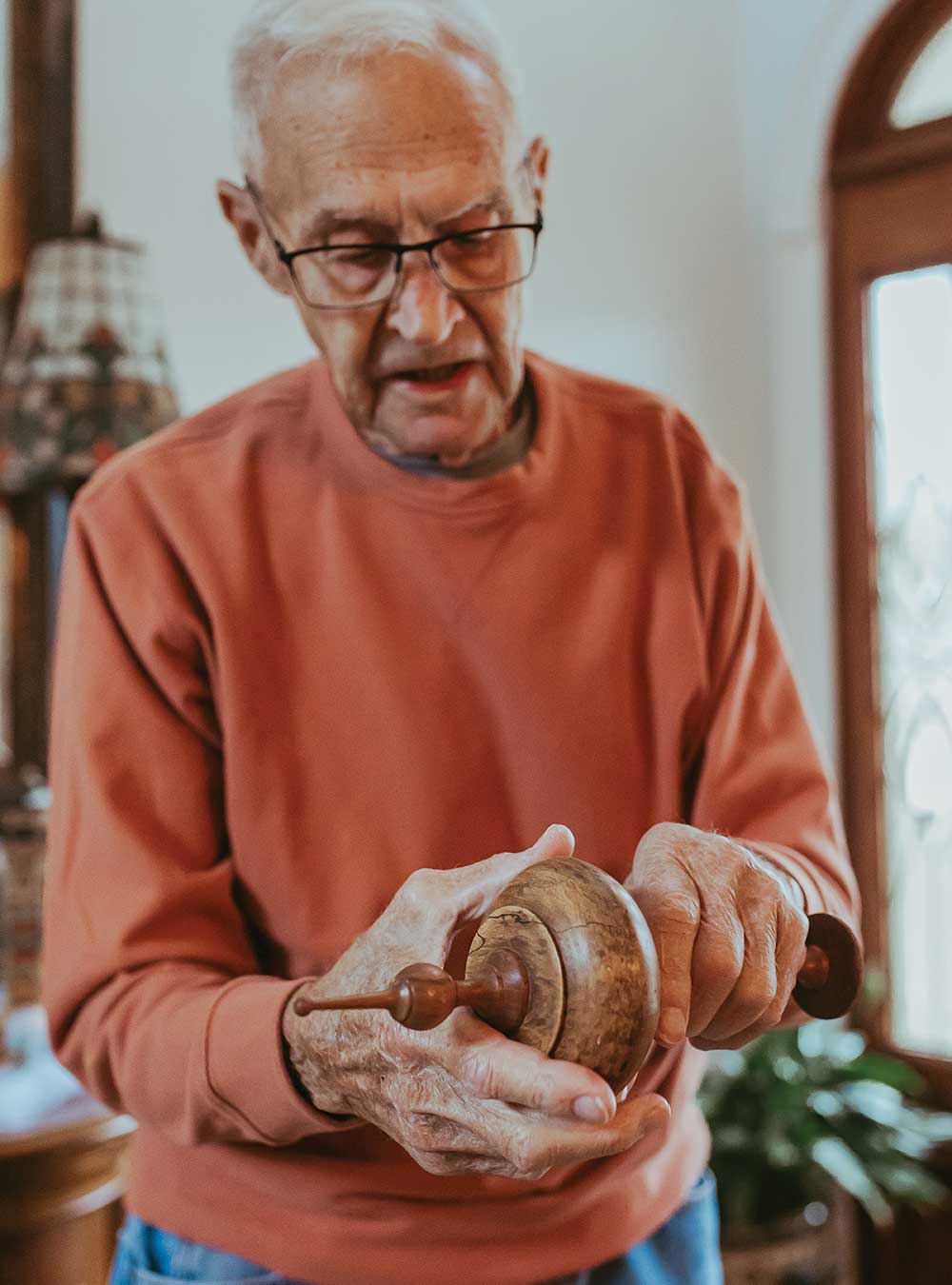
Eric Knepper doesn’t take credit for the beauty in his work. A profoundly spiritual man, he says he’s simply revealing the beauty that is already within the wood when he carves his one-of-a-kind pieces.
“You just get inside the piece of wood and see what God made,” says the artisan. “That’s what you want to show, all the beauty in the grains.”
Eric Knepper shows off some of his work
For nearly three decades, Knepper has been unveiling the natural beauty in the wood around him and crafting hundreds of pieces of original wood treasures. An old rotten maple tree found new life as a beautiful bowl. A red oak tree that had to be cut on his property was transformed into a rolltop desk, a credenza and a file cabinet.
His wife, Pat, smiles across the table as she talks about different items he has created over the years. The house is filled with them, from the dining room’s exquisitely carved grandfather clock with cabriole legs to the stunning freestanding cabinet in the living room made from pieces of an old fireplace screen. “He is so talented. I can’t think of anything I’ve asked Eric to do that he hasn’t been able to do,” she adds, her eyes filled with pride. “He will find a way to do anything.”
The son of a carpenter, and a very determined man himself, Knepper made furniture early in his marriage to meet the needs of his family. “When you get started, you have nothing. We built things then because you couldn’t afford them,” he explains. He even did all the millwork in the home that they built in 1997. But it wasn’t until after retirement at age 60 that his woodworking expanded into a new passion – wood carving.
On a camping trip the couple took to Florida, his interest in carving came alive. “People in the campsite next to us carved, and he took me to a carving club in Fort Myers.” When Knepper returned to Pell City, he met with Tom Goodwin, a carver from a local carving club, and the two became great friends.
Goodwin took Knepper under his wing, showing him how to work with different woods and specific tools. His friend has since passed, but Knepper still has the carving equipment that once belonged to Goodwin. After revealing that he was terminally ill, Goodwin asked Knepper to buy his carving tools so he could pass them on to someone with a passion for the art.
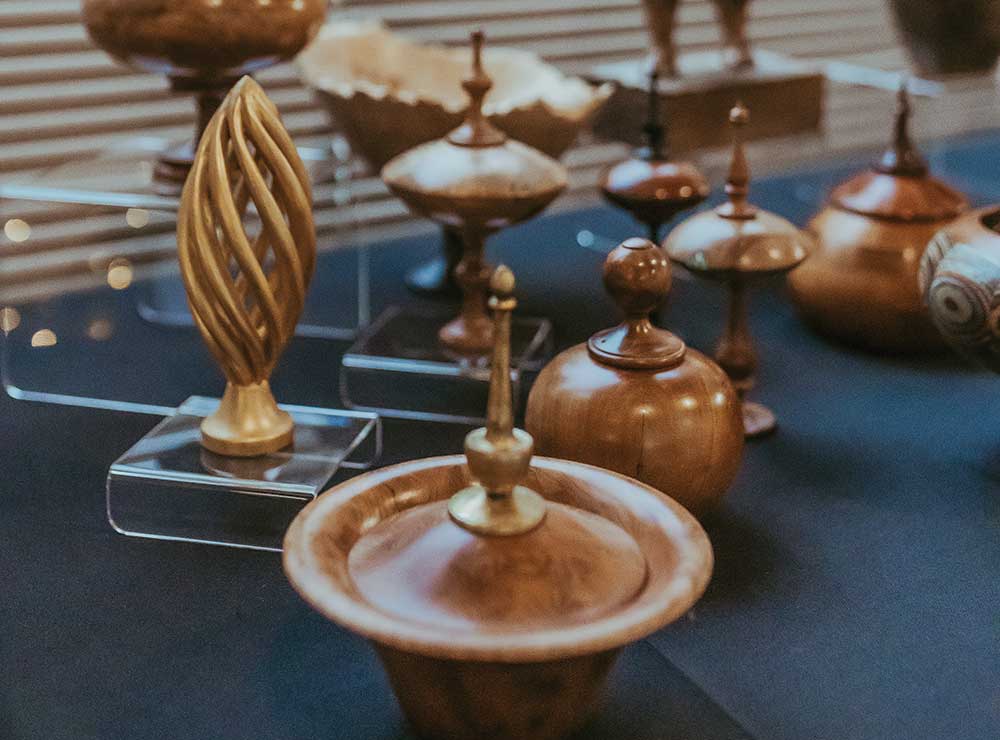
Creations on display at the Museum of Pell City
Those specialty tools, Knepper explains, are mostly different chisels and knives, with some power carving tools. “On a given project, you might use two or three tools primarily, or for furniture, (you might use) your whole shop,” Knepper says. He has a wood carving room within the house for smaller projects. Larger pieces are handled in his wood shop in the barn.
As any wood carver would tell you, keeping your tools sharp is essential. Keeping them sharp is important for precise cuts, but it can also create the need for some emergency care, as was the case for Knepper seven years ago. “I cut the end of my thumb off about 6 years ago,” he admits. “You don’t even notice it now. I don’t even remember what I was working on, but I did a dumb thing.”
“He just came in and said he needed a band aid,” tells Pat. He needed a bit more than that. “It was hard to get it to fit back together,” she adds, giving credit to “a wonderful nurse practitioner at Dr. Helms’ office.”
Eric and Pat Knepper
The Kneppers handled the crisis with the same grace and perseverance that has defined their 63 years of marriage. The two met while Eric was in the Navy in Virginia. Moves to Connecticut, Pennsylvania, Illinois and Indiana preceded their final landing in Pell City where he came to work at National Cement. He later left that company and bought Pell City Fabrication, which provided maintenance and support for steel fabrication and other industries.
The couple have three grown children (Shawn, Scott, and Ericka), eight grandchildren, and five great grandchildren. Knepper says he sees talent in each of them and potentially at least one future wood carver. Several family members were among the guests at a recent art exhibit at the Pell City Museum of Art featuring his wood carvings.
Knepper’s most challenging piece was among that collection of works. He describes it as a “gold spiral thing,” for lack of a more technical term. “I just saw a picture of it and decided to give it a try,” he says. “It was very difficult because it’s hollow. I had to work from the inside out.”
The art of carving is an ongoing lesson in patience and finesse. Knepper also stresses the importance of listening to the wood. “The wood will tell you what to do, basically.” He considers himself less of a designer and more of a collaborator, with each knot, grain and imperfection guiding his hands. The character of the wood, with its texture and color, add to the direction the project takes.
Knepper has done much of his work from wood that has fallen on his property or that others have brought to him. Oak and Cherry woods are favorites, but he also has done many projects with Cottonwood and other bark woods. “I really like the color and grain of cherry,” he adds. “Sometimes people bring me roots they’ve dug up. It looks terrible, but I cut it up and look inside and it’s beautiful. You just never know.”
Though he finds it difficult to choose a favorite, some pieces – like a beer bottle complete with a bear in a Paul “Bear” Bryant houndstooth hat – clearly delight Knepper. Throughout his home, bowls, spiral works, vases and boxes crafted by this modest woodcarver are on display.
His faith is evidenced in another of his masterpieces which sits on the table – an intricate chapel featuring a lectern with an open Bible. Knepper’s craftsmanship extends beyond his home and into the heart of the local faith community. Over the years, he has used his talent to create kneeling rails for the altars of three area churches.
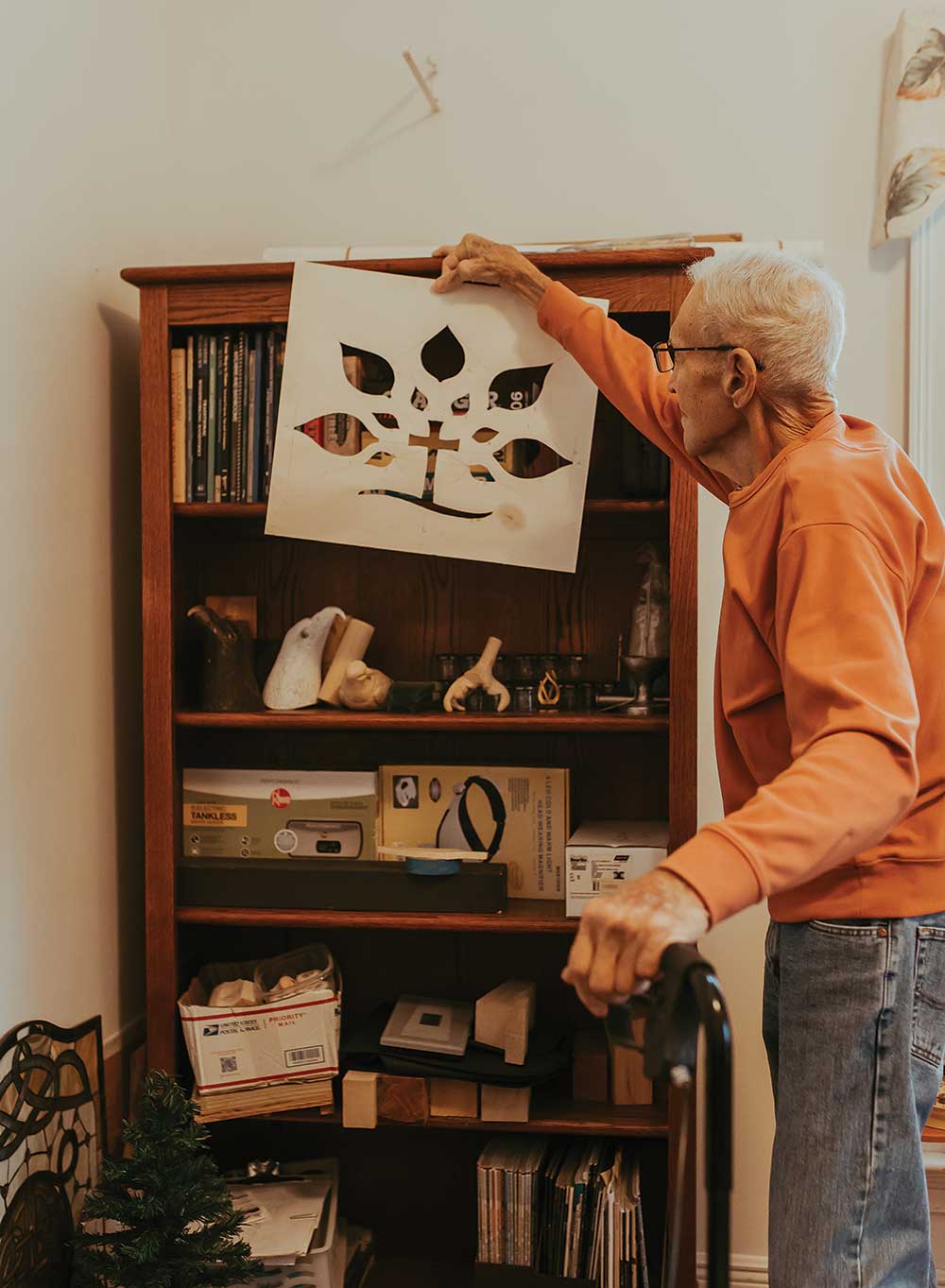
Template for a design of a kneeler at New Life Church in Pell City
The first kneeler was crafted for the Episcopal Church of the Resurrection in Rainbow City, designed specifically to complement an altar the church had received.
This careful attention to detail highlights Knepper’s ability to harmonize his work with existing elements, ensuring each piece feels at home in its setting. Later, he constructed a pair of kneelers for Pell City First Methodist, further demonstrating his commitment to supporting his community through his artistry.
Most recently, Knepper designed a folding, movable kneeler for New Life Church, which gathers at the Municipal Complex in Pell City while a new church is being built. This innovative design reflects his adaptability and practical approach, ensuring the kneeler could be easily moved and stored as needed. Form, function and beauty are hallmarks of Knepper’s work.
A quiet, serious man, Knepper is uncomfortable with attention. He shrugs off accolades, dismissing his own talent. “I’m always using other people’s design, not mine,” he says. “I just put my own spin on someone else’s design.” It gives him something to do, he says, adding that it keeps him from watching TV.
Knepper’s keen eye and ability to see what rough wood can become is what has defined him as an artist and wood carver. Hearing how a discarded root was crafted into a beautiful bowl certainly makes one pause for thought. Each gnarled root or discarded branch may still have a story to tell.
With patience, perseverance and careful listening, the wood carver reveals the beauty within.