Museum Exhibit Perfectly Blends History and Art

Story by Roxann Edsall
Photos by Mackenzie Free

mphasis on preserving the history of Pell City and that of its families and community.  One of its most recent exhibits perfectly blended that history with the art of quilting.  The museum, on the second floor of the Municipal Complex, typically contains its exhibits to the interior of the museum, but recently has been expanding outside its doors to showcase the work of the area’s talented citizens.

“Hosting exhibits like the quilt show allows us to celebrate the incredible talent in our own community,” said Museum Coordinator Erica Grieve.  “It reminds us that art isn’t just found in galleries far away.  It’s being created right here at home.”

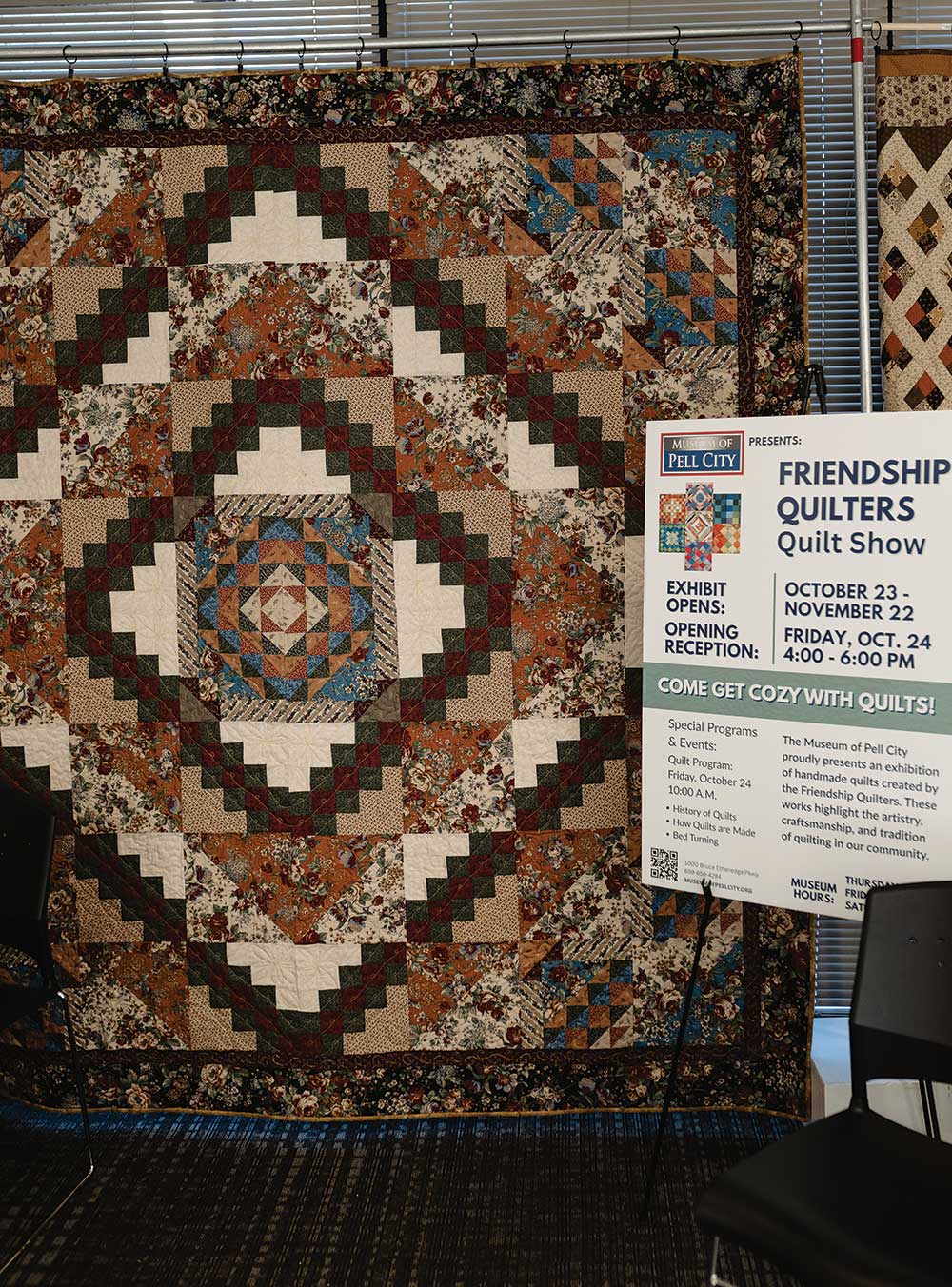
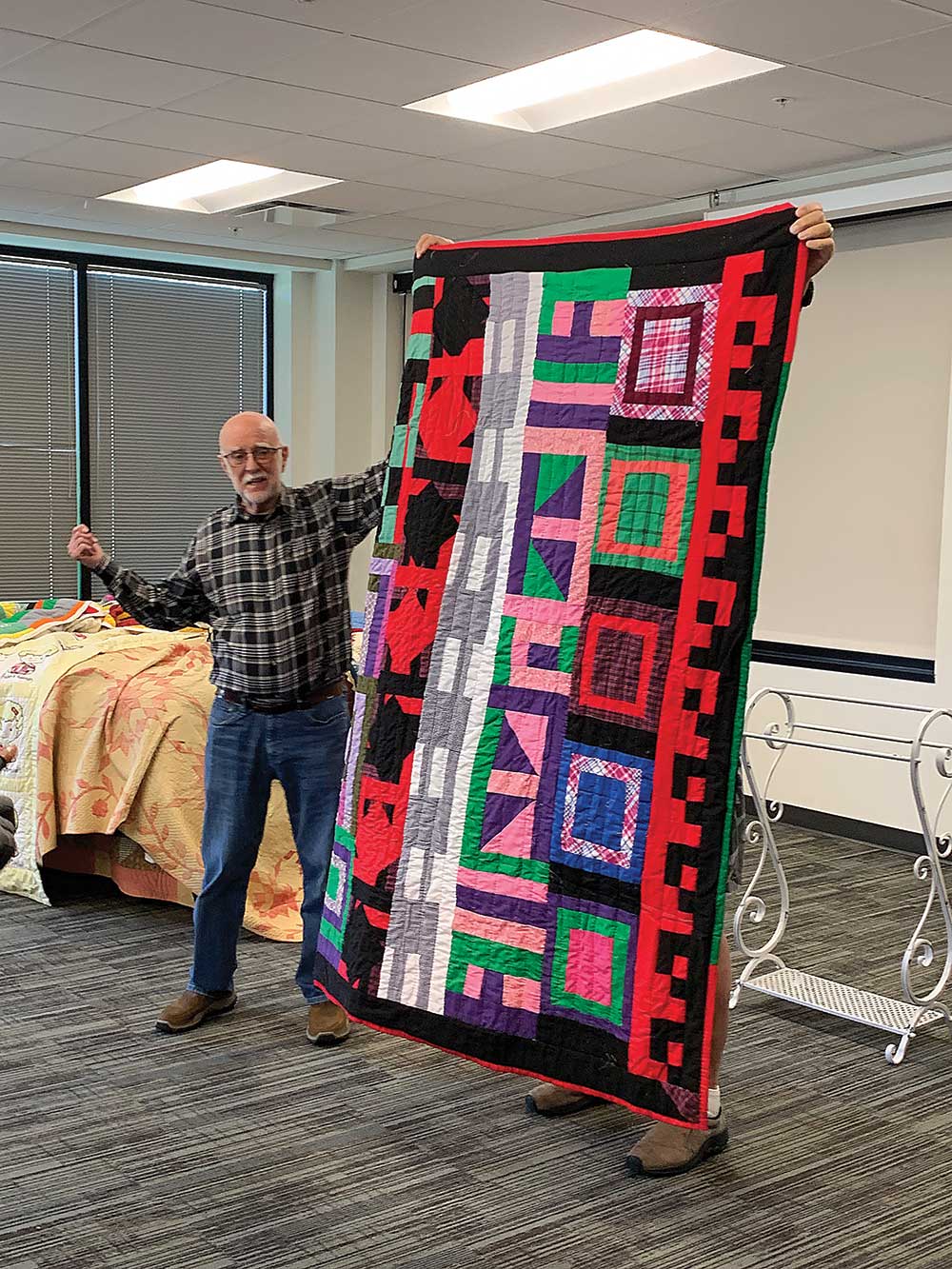
The quilt exhibit ran from late October through November and featured roughly 40 quilts created by members of the Friendship Quilters Guild of St Clair County.  The opening featured a presentation by historian Joe Whitten, a quilt collector himself, who shared stories about the history of quilts and shared some of his quilts.  There were also demonstrations showing the making of a quilt from start to finish. 

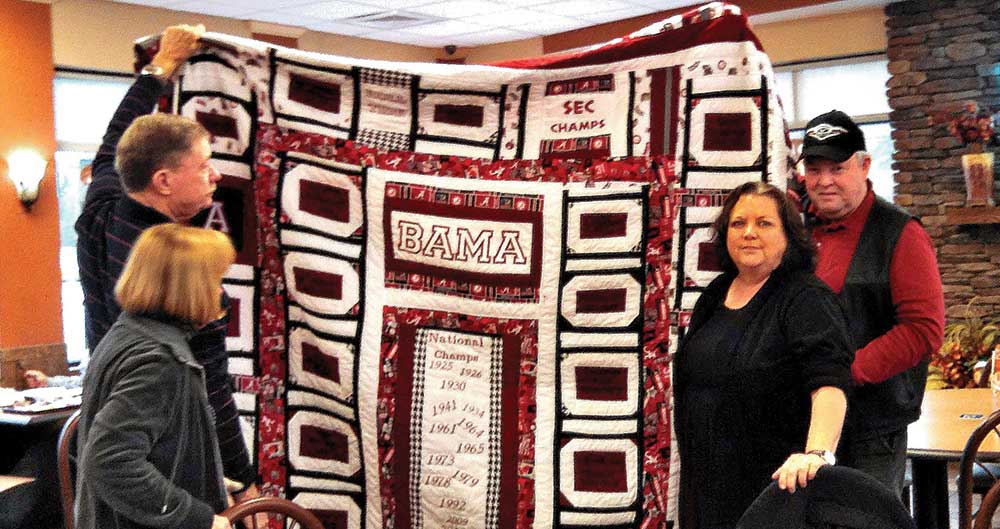
Part of the history of quilting included the quilting bee, a social gathering of ladies whose focus was on finishing a quilt together.  Such was the case in the making of Janet’s Double Wedding Ring quilt on display by her daughter Janet Jones. 

A group at Pell City United Methodist Church got together to complete the quilt for a silent auction.  When the silent auction did not meet the minimum bid to cover expenses, the ladies voted to give it to Janet’s mother, Janet Weldon. 

Weldon had reportedly done much of the hand-stitching, including the stitching around each of the intertwined rings.  Her daughter said quilting was so important to Weldon that when her mom passed, they elected to drape her casket in the Double Wedding Ring quilt, rather than having a funeral spray.  “Because it was cold, we also took some of her other quilts to the graveside to cover our legs,” said Jones.  “She would have liked that.”

Ken Kilgroe came to the exhibit to honor his now-deceased grandmother, Roxie Moore.  One of her quilts, made more than 60 years ago, was on display.  Moore, an Eden native, reportedly hosted quilting bees often in the 1950s.

The Museum of Pell City’s next special exhibit opens Dec. 4 and features the beautiful woodcarvings of local artisan Eric Knepper.  A reception will be held on Dec. 5 from 4 p.m. to 6 p.m.

The museum is open to view other compelling pieces of the history of Pell City, St. Clair County and Alabama Thursdays and Fridays 10 a.m. to 4 p.m. and Saturdays 10 a.m. to 2 p.m.

Piecing together a story

Story by Roxann Edsall
Photos by Mackenzie Free

It was 1863, and America was imploding, ravaged by the effects of the Civil War. Brother met brother in battle, homes were burned and cities destroyed.

In Bennington County, Vermont, 46-year-old Jane A. Stickle channeled her energy, creativity and wartime grief into creating what is now one of the most famous quilts in the world. She stitched into one corner of her masterpiece the simple, yet haunting words – “In War Time 1863.”

Stickle’s quilt, now called the “Dear Jane” quilt, is a sampler, meaning that each of the squares is unique. Unlike most sampler quilts which typically use blocks created by different quilters, Stickle created each of the elements herself. She created most of the patterns for the blocks herself, utilizing established patterns for less than a third of her quilt. She also did not repeat a patterned fabric in any of the blocks.

The Dear Jane quilt has been housed in the Bennington Museum in Bennington, Vermont, for nearly seven decades. To protect the integrity of the fragile fabrics, the quilt is only displayed for one month each year, with thousands of quilters making the pilgrimage from as far away as Europe and Australia to view the piece.

County historian Joe Whitten talks history of quilts in special presentation

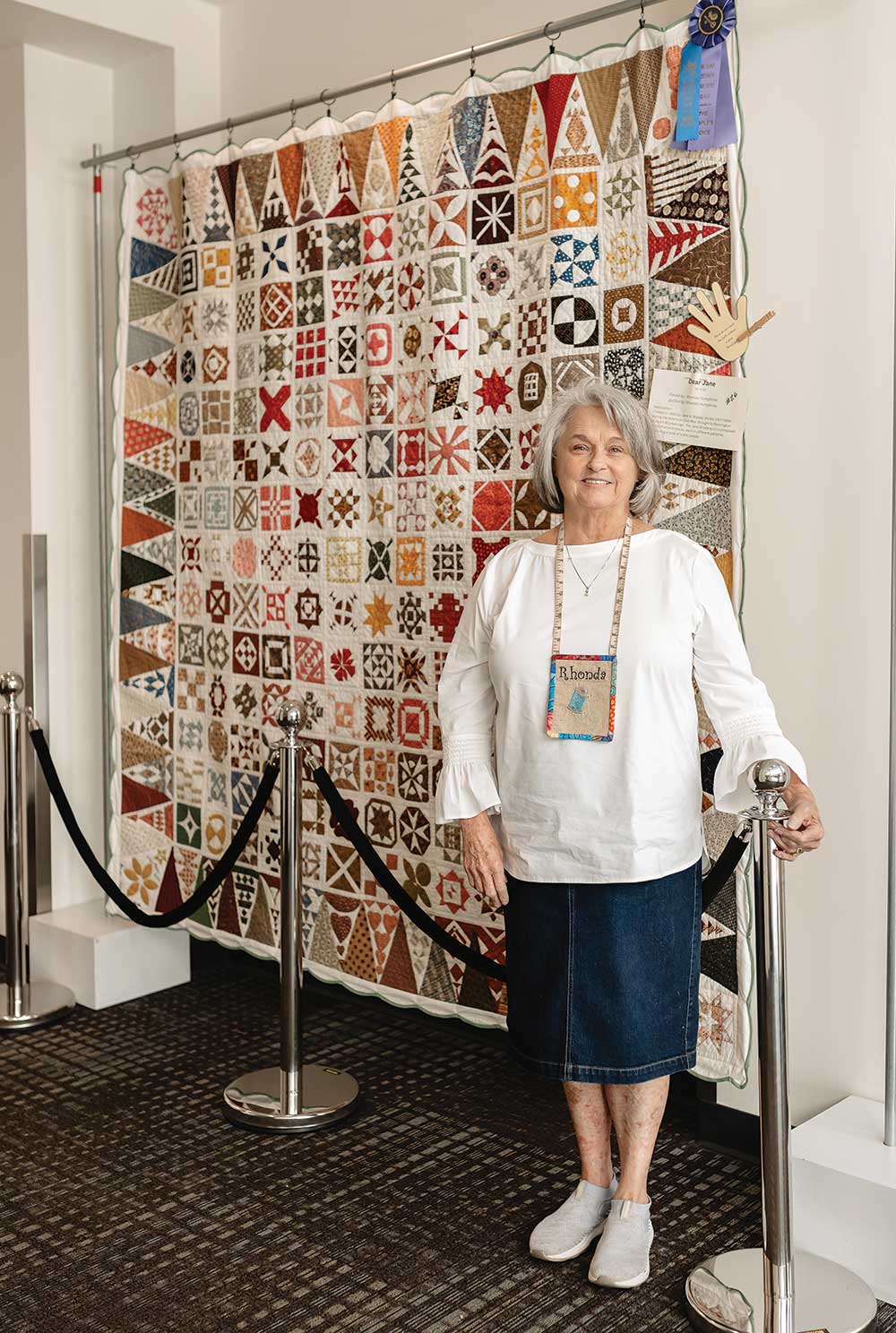
Rhonda Humphries has not yet been to see Stickle’s Dear Jane quilt but has spent thousands of hours on her own replica. Humphries, a member of the Friendship Quilters Guild of St. Clair County, was encouraged in the project by other guild members and her friend and mentor, Brenda Franklin.

Undaunted by the 5,602 individual pieces it takes to make the project, Humphries worked for two and a half years until the 169 five-inch blocks, 52 triangles, and four corner kites came together in her own finished masterpiece.

Humphries used Civil War era reproduction fabric and followed patterns created by Brenda Manges Papadakis, who viewed Jane’s original quilt in the museum in 1992 and meticulously traced each piece.

Papadakis so admired Stickle’s work that she was inspired to write a book published four years later called The Two Hundred Twenty-Five Patterns from the 1863 Jane A. Stickle Quilt, which included the patterns quilters could use to reproduce the quilt. Many quilters are inspired by the Dear Jane Quilt, and many bring their finished pieces when they make the trip to the Bennington Museum to view the original.

Like the Dear Jane Quilt, Humphries’ quilt is hand-pieced and hand-stitched, an effort that took incredible patience, perseverance and precision. “The most difficult part,” says Humphries, “was one block with a star inside. It’s made up of 30 pieces and, by itself, took three days to complete.” She has been quilting for eight years and has made 40-50 quilts but hadn’t done many quilts at the time she took on this challenge.

“Most people who start this quilt do not finish. It’s pretty involved,” admits Humphries. The blue ribbon and people’s choice awards from her recent entry in a quilt show pinned to the top say the effort has been well appreciated.

Humphries’ quilt was on display recently in a special exhibit at the Museum of Pell City, along with dozens of other quilts made by members of the Friendship Quilters Guild. Looking at each quilt is like looking at fine art in a gallery. Each quilt tells a story, whether one of whimsey or of more important historical matters.

Naomi Kircus is the creator of The Underground Railroad quilt. Its blocks relate the story of the freedom seekers during abolition. Created with Civil War replica fabric, the quilt is made up of 16 blocks, each a reproduction of one that would hang in the windows of safe houses. “When the slaves were running for their freedom, people would have safe places for them to stay,” explained Kircus. “They would display quilts [in the windows] where each of the squares was a message they were communicating to those they were helping.”

The personal narratives and messages communicated through quilting continue to be a source of pride and precious history for families and communities today. Quilts are handed down from generation to generation, becoming treasured heirlooms.

The Friendship Quilters Guild occasionally offers classes in quilting for those wanting to learn the skills and process. The guild has been together for more than 25 years and meets on the second Saturday of each month at Mt. Moriah Baptist Church in Pell City.

Rhonda Humphries and her Dear Jane Quilt

Organizer of the quilt exhibit and guild member Deb Cearley adds that the group has a passion for service. They make covers for cancer ports, fidget quilts, hospital bedrail bags and full-size quilts that they donate to area hospitals, cancer centers and hospice groups. 

“Service is the main thing we do,” said Cearley. “I came to a program here for Veterans and saw many of them come in with their blankets on their laps in their wheelchairs, and that just inspired us to make more.” They also provide placemats for Meals on Wheels and pet beds for Pell City’s animal shelter.

Florence Kerr, one of the oldest standing members of the organization, adds one more benefit to quilting, beyond its artistic and storytelling value. “Quilting is therapy,” she says. “It’s therapy because you have to be in a quiet place and really focus on the process.”

Perhaps the process really is the heart of the matter for the quilt’s creator, though it is the product that inspires the rest of us.

Discover writer wins state award

Ashville’s Elaine Hobson Miller has been named the 2025 Communicator of Achievement of Alabama Media Professionals.

The St. Clair County resident won the award previously in 2017. That year, she went on to be runner-up in the National Federation of Press Women’s COA race when NFPW held its Communications Conference in Birmingham that year.

 As the Alabama winner, Hobson Miller again vied for the national award when NFPW held its 2025 conference in Golden, Colorado.

The Alabama honoree has been writing since elementary school, when she penned a piece for her school’s newsletter. Throughout high school, she worked on her school’s newspaper staff and served as news editor during her senior year.

 Hobson Miller began her lifelong career as a professional journalist and freelance writer in1968, the summer before her senior year at Samford University. She accepted an internship at the Birmingham Post-Herald, that city’s former morning newspaper.

 The following year, she received a Bachelor of Arts degree in journalism with a minor in Spanish. Hobson Miller accepted a full-time position at the Post-Herald. Within a year, she became that newspaper’s first woman to cover the Birmingham city government beat.

 She left the Post Herald in 1972 when her first child was born and freelanced for several years. She was a full-time features writer for Birmingham Magazine from 1978-1980, returning to the Post-Herald in 1980, working first as a copy editor and then as food editor and features writer.

 As a freelancer, she was editor of PrimeLife, a Birmingham-based magazine for people over 55, during the four months of its existence in 1988. She wrote a twice-monthly house column for the Birmingham News, 1992-1997, and was a regular contributor to Southern Lumberman from 1990 to 2001. She also wrote content for various local corporate and government newsletters, brochures and pamphlets, including Jefferson County, Shelby Medical Center (now Baptist Health Shelby Hospital), First National Bank and Vulcan Materials. She edited Birmingham Home & Garden magazine in 2002.

 Hobson Miller took a brief sabbatical from journalism in 1996 following the death of her husband, who owned an independent pharmacy. She did enough freelance writing during that time “to keep my fingers nimble and my brain active,” she said. She sold the pharmacy in 2012 and resumed her focus on writing.

 Although the honoree considers herself semi-retired, her work has appeared regularly in the magazine, Discover the Essence of St. Clair, since it was launched 15 years ago. She also writes for its sister magazine, LakeLife 24/7, both published by the Pell City-based multimedia marketing firm, Partners by Design.

 Active in mission work, Hobson Miller has made four medical mission trips to Peru with Dawson Memorial Baptist Church in Homewood and Texas-based E-3 Partners, plus an independent mission trip to Peru. She did one mission trip to Spain and continues to participate in mission trips to Zacapa, Guatemala, where three Alabama churches have an ongoing relationship with the small village of Conevisa.

More at the Museum of Pell City

From the work of budding student artists to seasoned professionals, a burgeoning art community is finding a home at Museum of Pell City.

The museum has already hosted the Helen Keller Foundation of Alabama Art Show twice with plans to bring it back in September. Featuring the creations of students across the state with visual impairments, blindness, and/or deaf-blindness, this show is growing in popularity in Pell City because of these inspirational works.

The museum has presented the annual Duran Junior High School Art Show as well, giving students a home to display their works for the public to see.

Now comes the next level – providing a home for the entire art community.

“Our community is so blessed with talented artists of all mediums, but artists have long lacked a place they could call their own in terms of shows,” said Museum President Carol Pappas. “Before we even opened our doors in 2022, we talked of an eventual evolution to cultural arts center. Yes, we are a history museum, but we recognized the need to expand our reach and become a center for the art community, too.”

The museum’s board invested in infrastructure to create gallery space leading into the museum with a hanging wall system, ideal for shows and art displays. Because of the mezzanine-type venue, it is prominently visible to museum goers, but it is also piquing interest from the heavily traveled lobby of the municipal complex.

“It gives us an opportunity to reach more people – more opportunities to expose these creative works to the public,” Pappas said. “We’re excited about the potential.”

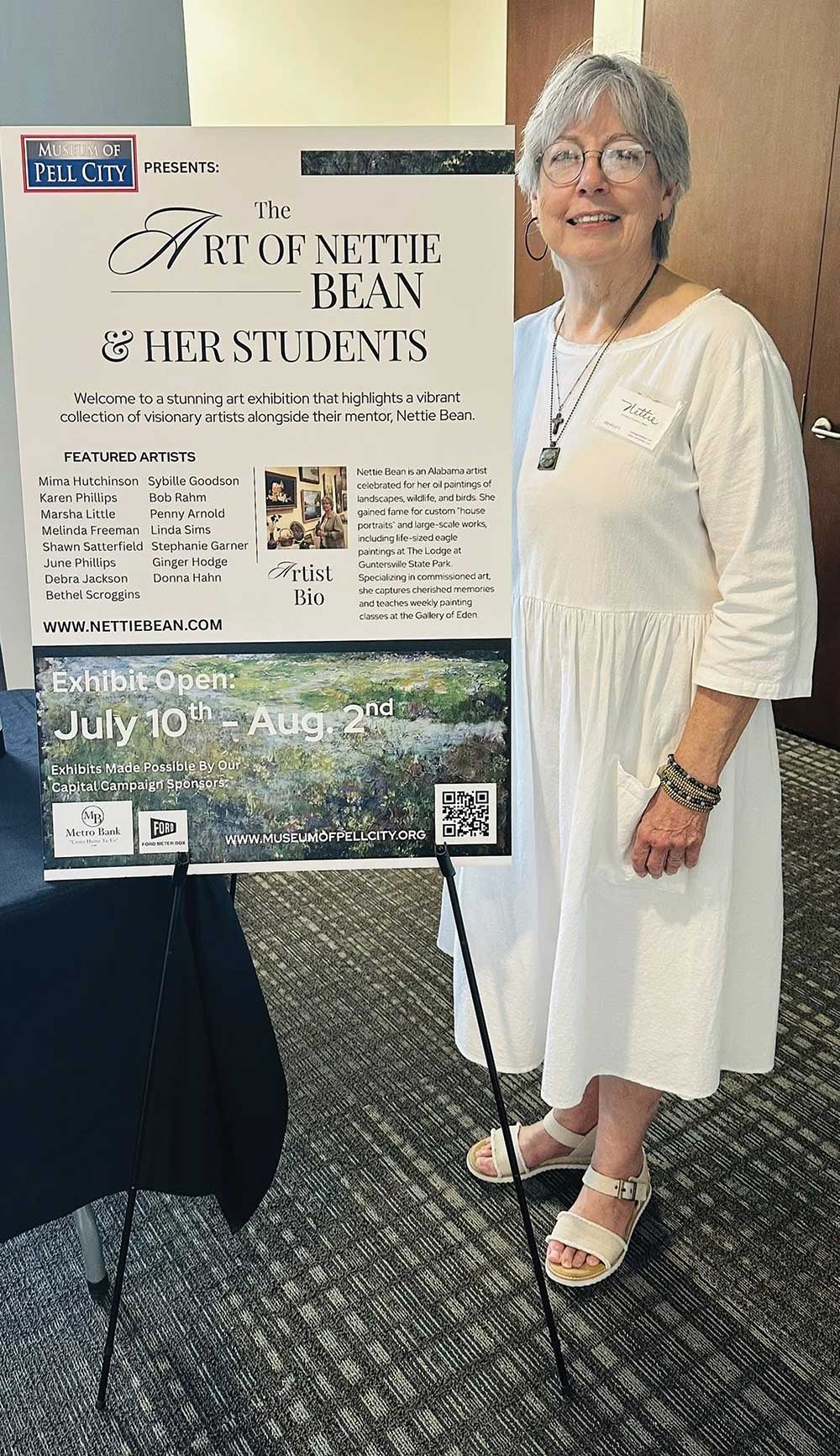
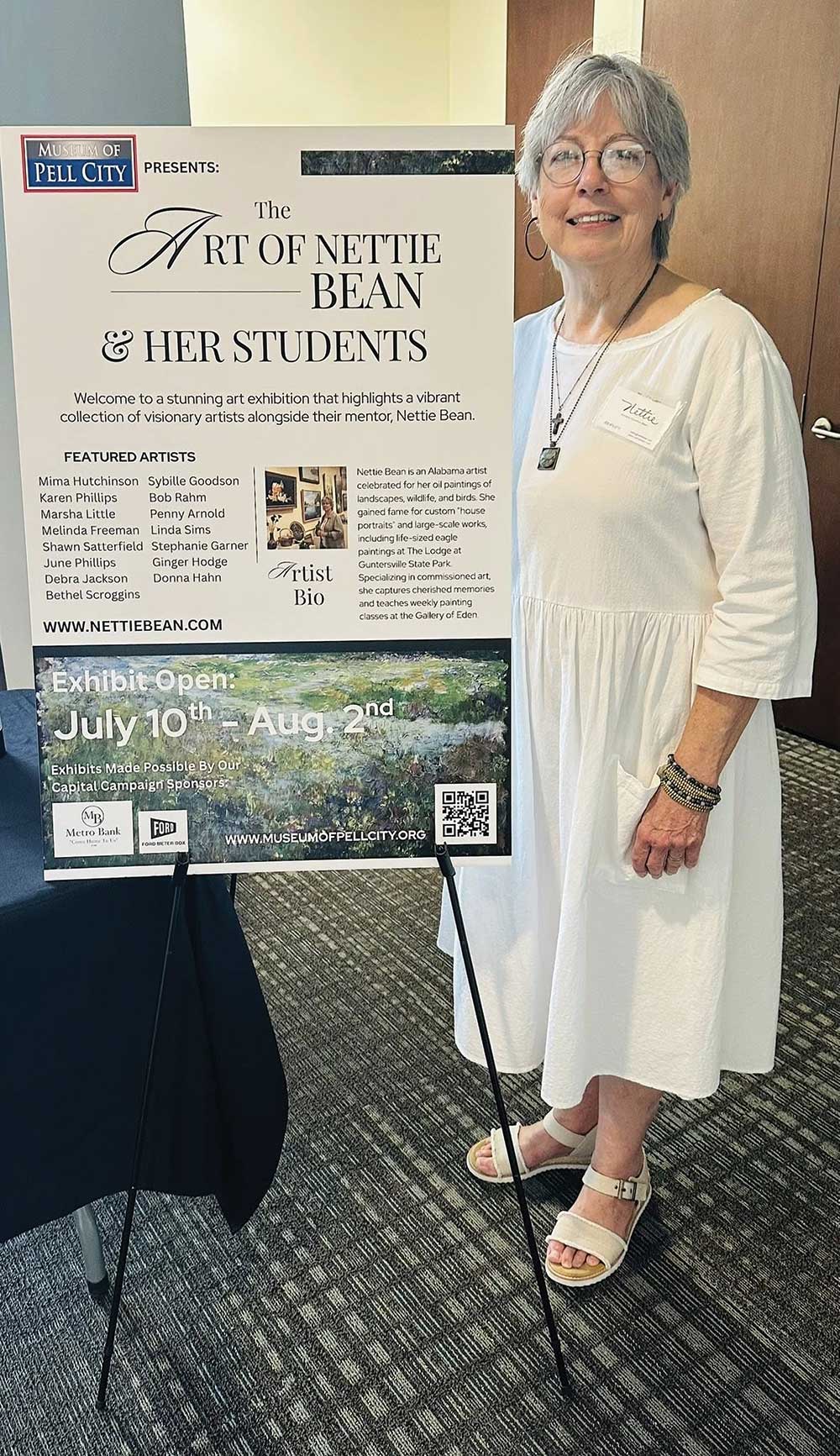
To kick of what the board hopes will be a regular event, noted artist Nettie Bean of Gallery of Eden and her students were the inaugural show, which opened in July and continued through early August.

Bean is an Alabama-based artist who creates stunning oil paintings of landscapes, wildlife and birds. After college, she became known for her “house portraits,” painting door-to-door for clients.

Her life-size eagle paintings are displayed at The Lodge at Guntersville State Park.

She is passionate about teaching and conducts weekly painting classes at the gallery she owns with husband Wally Bromberg.

Bean said she believes that art is a gift meant to be shared, and she strives to make original art accessible to all. “That’s precisely what we’re trying to do through this new program to showcase our art community at the museum, one we hope will grow and thrive for years to come.”

The Helen Keller Foundation of Alabama Art Show is slated for Sept. 11-27.

More exhibits on the way

In addition to its latest venture into art, the museum is planning even more events in the months to come.

It will unveil an outreach program this month that puts mini-exhibits in public places like schools, city hall and county courthouse. “The idea is to give the public a glimpse at what they might find at our 4,000 square foot museum,” Pappas said. “People just don’t realize the depth and scope of our museum, so we want to take it to them – at least a little part of it.”

The outreach exhibits’ theme is Find it at Museum of Pell City, and it shares nuggets of the historic stories, photos and artifacts we have to offer through compelling, custom-designed displays.

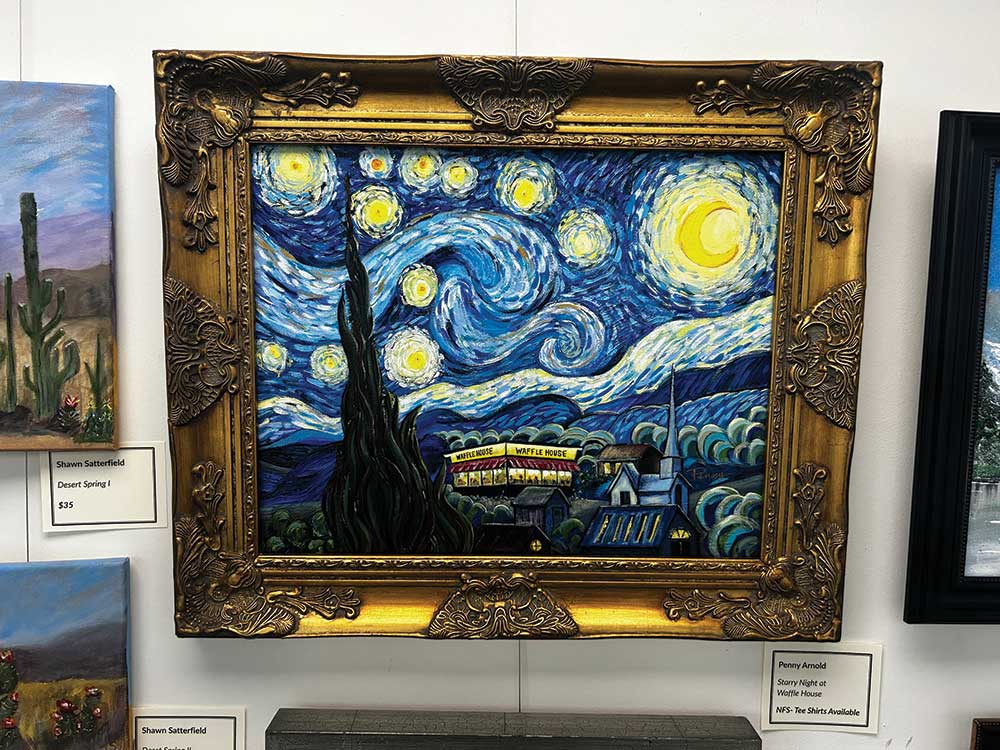
Starry Night at Waffle House in the style of Van Gogh by Penny Arnold a crowd favorite

They encourage people to find out more at the museum, which is open Thursdays and Fridays, 10 a.m. to 4 p.m. and Saturdays, 10 a.m. to 2 p.m. Admission is always free.

Coming soon is a model train exhibit that has been built by a team of volunteers over the past several months. The 17-foot display with a running train depicts the 1920s version of Pell City.

“It all began with a train,” Pappas noted, referring to the ‘first’ founding of the town in 1890 when Sumter Cogswell missed his train to Talladega, spent the night in Pell City and envisioned a town.

Nationally known artist Dirk Walker has donated his original painting of one of the train depots, and the board will be using it as a fundraiser for the museum along with selling numbered, matted prints of the original.

“We owe Dirk a debt of thanks for his generosity,” Pappas said. “He and his wife, Debbie, have been so supportive of our efforts. You can see all about him and his work in our museum, which features Pell Citians who have made a national name through their talents in art, music, sports and film.”

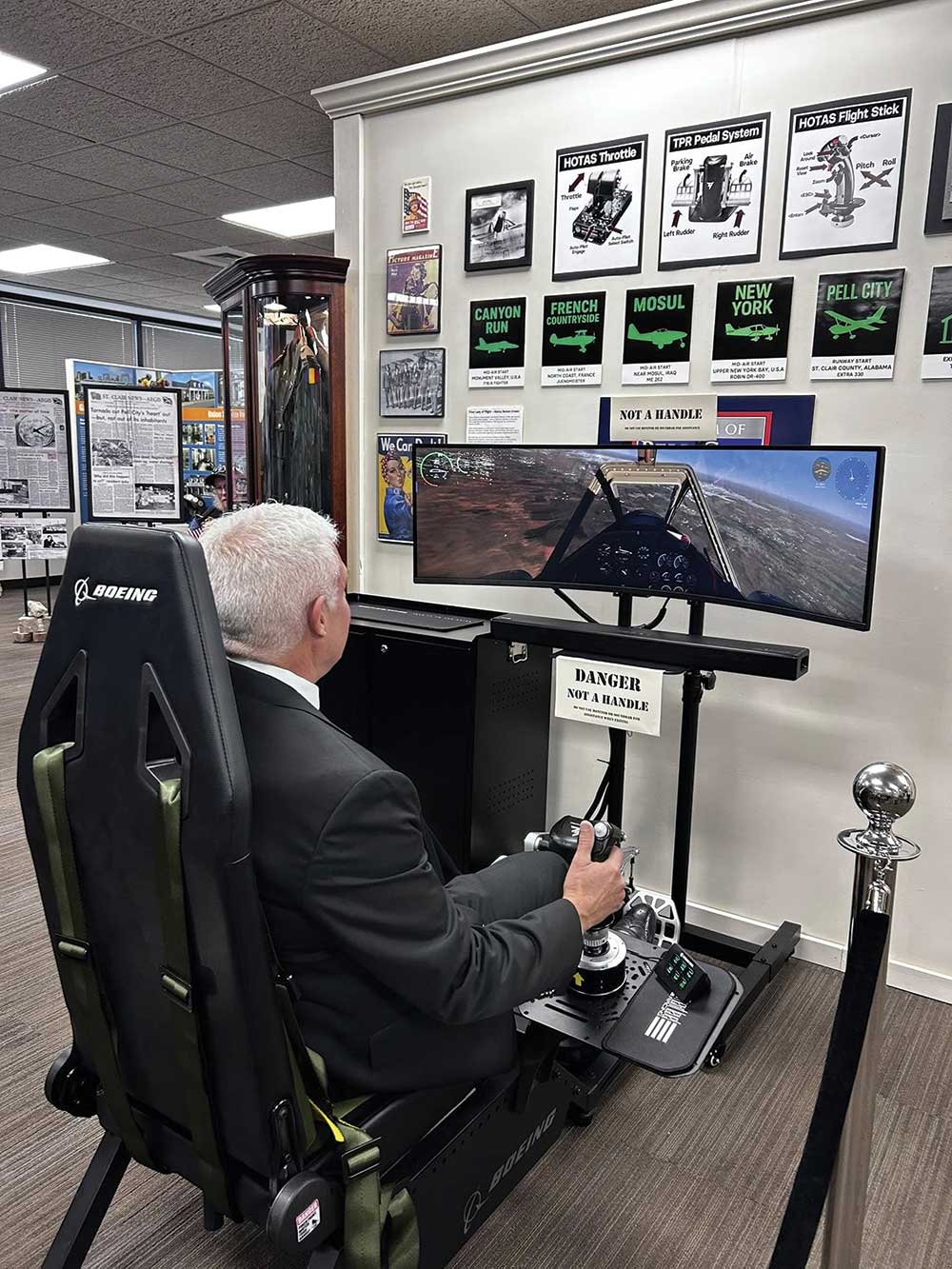
In November, the museum presents its annual Salute to Service, which will see its military section redesigned and expanded to better cover modern days wars in the Persian Gulf, Iraq and Afghanistan.

It also will feature oral history videos from local veterans and St. Clair County District Attorney Lyle Harmon as keynote speaker at the Nov. 7 special program. He is a veteran of the second invasion of Iraq in the101st Airborne Division, 217th Calvary. He was a helicopter pilot flying reconnaissance missions.

“As you can see, we have lots in store for museum goers,” Pappas said. “Like history, it evolves. We aim to keep our programming fresh, giving people a reason to come and come back again to discover our rich history.”

The Quiltwright of Pell City

Story and photos
by Jerry C. Smith

All artists have their favorite tools. Michelangelo fared well with a hammer and chisel. Isaac Stern worked wonders with his violin bow. For Pell City’s Dale Griffith, the implement of choice is … needles.

Dale is a prima quilter. She produces bed covers fit for a king – or a queen or twin or whatever size bed you own. For more than 40 years, scores of happy sleepers have enjoyed her meticulously crafted bed-wares.

Born and raised in the sea islands district around Brunswick, Georgia, she moved to Pell City in 1987, where she married Bill in 1990.

She sets a very high standard for her quilts, throws, spreads, comforters, shams, duvets, baby coverlets and many other embroidered and crocheted wares. For instance, Dale never uses anything but pure cotton for her quilt liners and bottom backing sheets. All woven materials must be between 300 and 400 thread count.

Custom Alabama quilt

The inner layer is always cotton, never the fluffy plastic froth found in most store-bought products. Nor will ordinary thread suffice; she uses a rather expensive, tough, permanent variety that’s been waxed for easy penetration of three layers of heavy material.

Dale takes a deep personal interest in her work. “I want my quilts to produce warmth, and peace of mind,” she says. “Only the best will do.”

As one might imagine, such standards require much time and concentration. Dale only works on her quilts when she is feeling good, with no outside conflicts to diminish her focus.

She can pursue her craft with all kinds of extraneous background noise, such as conversation, TV, etc., but that’s not her ideal work environment. “My favorite way to quilt is on a nice day, with the windows open and nothing but fresh air and the sounds of nature.”

There are so many technical considerations when making even the simplest of quilts – even more so for some of her special custom designs.

Dale shops relentlessly for the finest materials, traveling all over our part of the state to search for topping fabrics, inner liners, bottom sheets and specialty items. She takes quality very seriously and refuses to skimp on any part of her creations and designs. “I need to actually feel the fabric before I buy it,” she adds.

One of her favorite quilts is in daily use in Scotland. It’s a custom design showing the colors of that country along with one of their native plants, the thistle. Dale made another quilt for an East Coaster, with embroidered squares featuring fish, lighthouses, nautical implements and edged with real rope. She’s also made special Roll Tide spreads, as well as others whose tops are made up of copied photographs, ink-jet printed onto special fabrics.

Dale makes everything from baby quilts to throws, twin, full, queen, king and California king sizes. There is no easy way to create such things, nor are their components inexpensive. Each one involves interminable hours of delicate, tedious, exacting hand work. For instance, a regular queen size pattern quilt can involve as long as two months of daily labor!

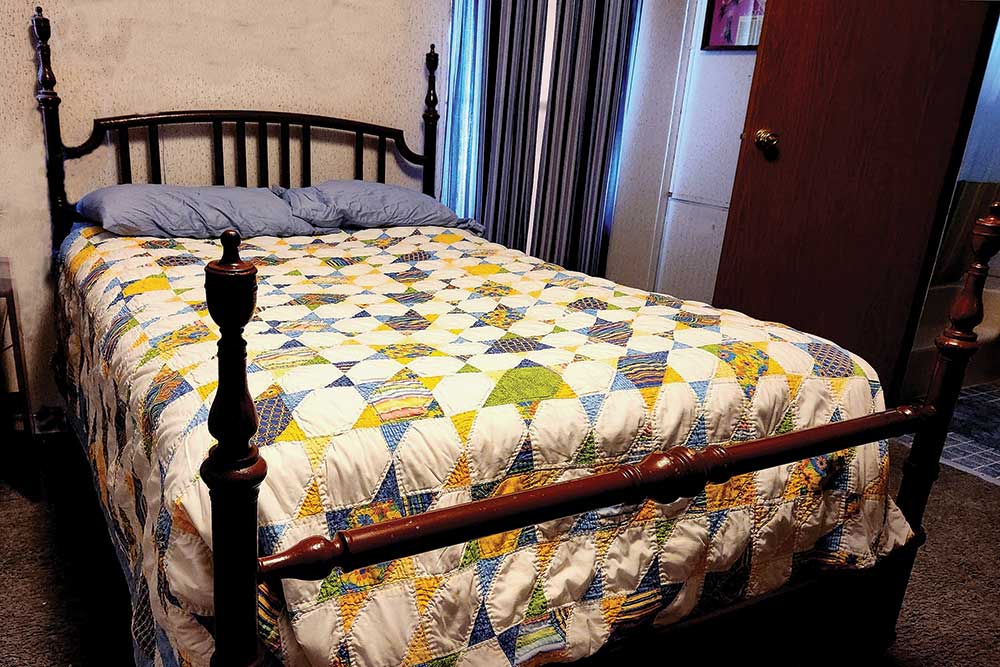
Dale Griffith quilt on writer’s 4-poster bed

When asked how many yards of thread are needed for a queen size, Dale estimated three large spools with 10 bobbins for the top, and at least six spools for the final assembly. Each spool is 255 yards. This comes to some 2, 295 yards, or roughly 1.3 miles!

And those nine spools can be as much as six dollars apiece. There is scarcely a square inch of quilt that doesn’t have a stitch running through it. That’s what keeps the liner from bunching up inside.

So, how is a quilt made? First, all the tiny pattern pieces for the top must be cut from various fabrics or produced from printed cloth or even old souvenir T-shirts. These must be accurately sewn together into a number of pattern squares of equal size.

In olden times, every part of a quilt was sewn by hand, but nowadays the tops are usually sewn with a special machine. Dale uses a Baby Lock designed for that purpose. When enough squares have been created (sometimes as many as 88), they are then stitched together into a single piece the size of the quilt.

Once the top has been assembled, the real work begins. Every part of the quilt must be hand-stitched together as a unit, with a needle pulling thread through the combined thicknesses of top, liner and backing sheet. This is usually done on a quilting frame, of which there are many designs. Dale’s husband, Bill, made her a rather ingenious one, using PVC pipe.

Dale says that most buyers balk at the asking price but, when given the actual materials cost as well as a couple months of tedious labor, her products would be a steal at double her prices. Anyone who has ever actually made a quilt will gladly accept, especially after examining the superior quality and durability of the finished product.

Dale loves chit-chatting with other quilters. She can be searched on Facebook as D Dale Griffith.

Besides looking great on one’s bed, there is another factor that makes her quilt special – the almost instant warmth experienced a few seconds after crawling under the covers. Because of the choice of fabrics, her quilts do not draw away body heat. They simply capture it and give it back all night long, thus fulfilling Dale’s mission of providing warmth.

The peace of mind part of her wish list comes every night, as one experiences that warmth as well as reminiscence of the heirloom quilts that comforted many of us in our earlier years. Little in life is better than a good night’s sleep, especially under such fine bedding.

A good quilt is made to last and be treasured for several generations. Dale has successfully repaired worn bed covers that were hand made in the 1800s.

Your writer is the proud owner of a Dale Griffith patchwork bed cover that is the perfect complement for my old steel and brass four-poster that’s been in my family for several generations. For me, at age 82, it’s like a sort of time machine that provides comfort on several levels.

“ I want my quilts to be used, not stored away,” she declares. “They are household items, not keepsakes. I make them to last, so there’s no reason not to use them.”

Dirk Walker Fine Art

Story by Scottie Vickery
Photos by Mackenzie Free

Dirk Walker’s artwork has found homes all over the world. His paintings hang in houses, churches, businesses, corporate headquarters and sports stadiums. They grace walls all over the country and faraway places like Germany, Denmark, Australia, and the United Kingdom.

It all started with his own bare walls.

“I wanted to buy art for our home,” said Walker, who lived in Birmingham at the time.  His search took him to the Loretta Goodwin Gallery, and by the time he left, Walker, who worked in banking at the time, couldn’t shake the feeling that he was meant to be an artist.

“I don’t know why I thought I could do it, but something appealed to me about trying to learn how to paint,” said Walker, who has had a studio in downtown Pell City for 11 years.

Fans of his work are awfully glad he did. Walker’s paintings, both oils and watercolors, are known for their bold colors, rich texture and loose brushstrokes. His subject matters are varied: he has collections ranging from landscapes and city scenes to his spiritual series. He also paints sporting and hunting scenes, art focusing on the growing bourbon culture, and whimsical subjects like Santa Claus.

“The variety of things I like to do just keeps me fresh in all of them,” he said. “I’m not doing the same thing all the time – that would drive me bonkers. A lot of people can’t say they love what they do, but I get a lot of gratification from it. Once I get in to doing a painting, everything else just sort of goes away.”

Finding purpose

There were signs early on that Walker had the makings to be a great artist. Growing up in Birmingham, he watched his father dabble in watercolor, and his own high school work caught the attention of his art teacher. She encouraged him to pursue it, but his interest and talent lay dormant for years.

After graduating from Vestavia Hills High School, Walker earned a degree in industrial design at Auburn University and that helped provide a foundation in drawing and perspective. “I did a little design work right out of college, but I had the opportunity to go with the bank, and it was a better option for raising a family at the time,” he said.

Debbie and Dirk Walker in the Pell City studio

After the visit to the gallery, however, Walker decided to give in to the pull. His first painting was a still life. “It was horrible, looking back on it now,” he said with a laugh.

Still, he took it to back to the gallery to be framed, and Loretta Goodwin, who would become a dear friend and mentor, saw something he didn’t. She asked him who had painted the piece. “I said, ‘I did,’ and she said, ‘Can you do it again?’”

It took him about two years to create something he wanted to show her. “It was the most nerve-wracking experience,” said Walker, who started painting with oils. “I circled the block two or three times because I wanted to throw up I was so nervous.”

The first few times he showed Goodwin his work, she told him, “You’re not quite there, keep trying,” Walker remembered. “I’d tuck tail and go back home and stay at it. Eventually, I got to the point where she thought she could do something with it.”

Goodwin was a tremendous influence on Walker. “She loved the arts, she loved local artists, and she did so much to promote the arts in Birmingham. We formed a deep friendship where we talked as much about the business of art as we did the painting process. It instilled in me a love of both.”

She wasn’t his only influence. Hungry to learn, Walker sought guidance and inspiration from Alabama artists John Lonergan, who taught art at Pell City High School for 25 years, and Tom Black, who grew up in Gadsden and lived in Pell City before moving to Arizona. “I would go up to Tom’s studio and just watch him mix color and see what he’d do. I was too nervous to paint around anyone,” he said.

Walker later met and took workshops from David Leffel and Sherrie McGraw, both artists who taught at the Art Students League of New York. His early style was similar to those who had influenced him – “very much the Old Masters, very much the old Renaissance look,” Walker said. “It was the play of shadows and light, light flowing over objects.”

Still working at the bank while pursuing his art, Walker didn’t have the luxury of painting outside during the day and taking advantage of the natural light. “At night, I’d go down to my studio and set up a still life so I could control the light,” he said.

Walker’s work soon grew a following, and in addition to the Loretta Goodwin Gallery, his art has been featured in eight galleries across the country. When his job went away after a bank merger, Walker bought Goodwin’s gallery, which he owned for 20 years before becoming a full-time artist.

Changing times

Walker, who now lives in Cropwell with Debbie, his wife of eight years, has said that painting “is a lifelong struggle, but one that is well worth the journey.” He said he loves the fact that he continues to grow and change as an artist.

“It’s something you never completely learn,” he said. “I think that’s one of the big appeals for me. Forty years later, I’m still learning and experimenting and making mistakes.”

The artist’s spiritual series stems from his personal faith

In fact, Walker said his willingness to continue to explore techniques and subjects and experiment with color has been a big part of his success. “So many artists just kind of get stuck and they wonder why their art isn’t being accepted the way it was maybe years earlier,” he said. “I learned how to watch what people responded to, and through the years, it impacted how my style changed.”

Walker’s portfolio soon expanded to iconic landmarks. His work includes Alabama landmarks like Sloss Furnaces, the Alabama Theatre, Vulcan, the Pell City Depot and the Mobile Bay Lighthouse. He eventually added scenes from Atlanta, as well as places like the Lincoln Memorial, the Brooklyn Bridge and the Eiffel Tower.

“I started off painting very tight, very traditional, and then I wanted to go a little more abstract, a little more impressionistic,” he said, adding that one of the first steps was adding nondescript figures to some of his landmark paintings. “Through the years, I kept pushing in that vein.”

Walker started experimenting with sporting and hunting scenes after his son, Geoffrey, who works in the sporting goods industry, showed his artwork to Kevin and Kathleen Kelly, owners of Kevin’s Fine Outdoor Gear & Apparel. Based in Thomasville, Geogia, it is one of several retailers who represent his work.

“They asked if I ever did hunting scenes, and Geoffrey said, ‘I don’t know; I’ll check,’” Walker said. “He called me that night and said, ‘Dad, I think you need to try doing some hunting scenes.’”

Walker took his son’s advice, and the collection has been wildly popular, thanks in part to his abstract realism style. “I think my style was a really fresh approach,” he said. “Most of the wildlife art you see is very tight, very realistic, very static. Mine was loose and colorful, and I think it caught people at the right time. There’s been a tremendous response to it. It’s just kind of blown my world up.”

Walker, who lived on Logan Martin Lake for years before he and Debbie moved to their gentleman’s farm in Cropwell, has fond memories of fishing and hunting growing up and eventually fishing with his own kids. “We’ve got so many great memories of being on the water,” he said. “That’s one of the really neat things about that genre of work. People connect to it on an emotional level. They want a painting of a dog like they had, or they hunted with their kids. It evokes a lot of memories.”

About four years ago, Kelly approached Walker about doing limited edition prints of some of his paintings. He was reluctant at first, but he realized that people who couldn’t or wouldn’t invest in original art might spend $300 or $400 on a print.

They began offering a line of collector’s closed edition prints, and “we get orders almost every day,” he said. Debbie handles that side of the business, and “it has really broadened our exposure,” Walker said. “Now I get calls to do commissions from all over the country and from other countries, as well.”

Higher calling

Another series that has been personal for Walker is his spiritual collection, which includes depictions of Jesus’ baptism, the Last Supper, the feeding of the 5,000, and the crucifixion. The series was born of his own personal faith and struggles.

Raised in the church, Walker said “if the doors were open, we were there.” As an adult, he went through a period where he floundered a bit, but “something was calling me back to the church.” Not long after he returned, he felt ta strong desire to paint scenes from the Bible.

“Being a person of faith, I think everyone is given gifts on some level, whether it’s music, art, writing, whatever,” he said. “This is something that’s He’s given me, and it’s a way for me to kind of give back and witness a little about my faith. I try to portray something in a way that might cause someone to want to sit and think, and if it also helps someone else find the Lord or deal with issues, that’s a blessing for both parties.”

Walker spent a lot of time on his spiritual art the past two years after being commissioned by Vestavia Hills Methodist Church to paint a series of scenes portraying the life of Christ according to the Gospel of John. Baptist Health also commissioned artwork for all of its hospitals in Alabama.

He also was commissioned to do several large pieces, including a portrayal of Christ in the Garden of Gethsemane, for collectors in Australia and Germany. The connection was largely the result of his online presence. 

“Without the internet, that never would have happened,” he said. “It’s kind of a God thing. He’s using this voice of mine to reach people literally around the globe. It really makes me very humble and proud.”

A new medium

While he has painted with oils for most of his career, Walker was moved to study a new medium about six years ago when he introduced his bourbon series. “Bourbon is such a collectible thing right now, and they’re a lot of fun to do,” he said of the paintings. “Watercolor is sort of the perfect medium for that subject.”

Walker said he strives to create the same kind of look as his oil paintings – the boldness of color, for example – so his approach is a little different than that of traditional watercolorists. While most watercolors tend to have a lot of transparency, he often uses gouache, which is similar to watercolor, but more opaque. The result is paintings with more dimension and vibrancy. “My technique is a little different in that regard,” he said.

The challenge is part of the allure. “Watercolor is a hard medium,” he said. “I enjoy it equally as much as oil, but I’m still kind of learning as I go.”

Walker, his own toughest critic, has a stack of watercolors in his studio that he has discarded. “You’re never completely satisfied no matter how good a painting might turn out,” he said. “I can go back and look at a painting I did yesterday or 10 years ago and see things I wish I’d done differently. Even to this day I’m frustrated by why one painting works and one doesn’t.”

Finding balance

At 70, Walker has no plans to stop painting. “Debbie and I work really hard at this, and I’m up in the studio almost every day,” he said. “I enjoy it, though, and it’s something I hope I can do for years to come.”

Vintage Pell City train depot, an original painting Walker donated to Museum of Pell City as a fundraiser

They do make time for other pursuits, however. Debbie, who traveled the world in her younger years is trying her best to help Walker catch the travel bug, and being with family will always be a priority for both of them.

Their combined family is a big one. Walker has four children, Debbie has two, and there are nine grandchildren and three great-grandchildren with another on the way. One of his greatest joys has been creating scenes that mean something to them and will be around for generations.

“I’m so proud that my kids have been able to see me develop, although they give me grief about it,” he said. “If they ever think my ego is out of check, they bring me back down to earth. But it’s so cool because they’ve all told me, ‘Dad, you want to give us something for Christmas, give us a piece of your art.’ That, as a parent, is awesome.”

Chances are, there are a lot more Christmas gifts in their future. Walker, who said he can’t see ever retiring, will never get too far from his red Craftsman tool cabinet that holds brushes and paint and other tools of his trade.

“I once read, ‘Art is a delicate balance between the visual concept and each artist’s technique,’” Walker has said. “After years of chasing that artistic balance, it is the anticipation of the struggle that keeps me coming back to the canvas.” l