
Making magic with needles and thread
Story and photos
by Jerry C. Smith
All artists have their favorite tools. Michelangelo fared well with a hammer and chisel. Isaac Stern worked wonders with his violin bow. For Pell City’s Dale Griffith, the implement of choice is … needles.
Dale is a prima quilter. She produces bed covers fit for a king – or a queen or twin or whatever size bed you own. For more than 40 years, scores of happy sleepers have enjoyed her meticulously crafted bed-wares.
Born and raised in the sea islands district around Brunswick, Georgia, she moved to Pell City in 1987, where she married Bill in 1990.
She sets a very high standard for her quilts, throws, spreads, comforters, shams, duvets, baby coverlets and many other embroidered and crocheted wares. For instance, Dale never uses anything but pure cotton for her quilt liners and bottom backing sheets. All woven materials must be between 300 and 400 thread count.
The inner layer is always cotton, never the fluffy plastic froth found in most store-bought products. Nor will ordinary thread suffice; she uses a rather expensive, tough, permanent variety that’s been waxed for easy penetration of three layers of heavy material.
Dale takes a deep personal interest in her work. “I want my quilts to produce warmth, and peace of mind,” she says. “Only the best will do.”
As one might imagine, such standards require much time and concentration. Dale only works on her quilts when she is feeling good, with no outside conflicts to diminish her focus.
She can pursue her craft with all kinds of extraneous background noise, such as conversation, TV, etc., but that’s not her ideal work environment. “My favorite way to quilt is on a nice day, with the windows open and nothing but fresh air and the sounds of nature.”
There are so many technical considerations when making even the simplest of quilts – even more so for some of her special custom designs.
Dale shops relentlessly for the finest materials, traveling all over our part of the state to search for topping fabrics, inner liners, bottom sheets and specialty items. She takes quality very seriously and refuses to skimp on any part of her creations and designs. “I need to actually feel the fabric before I buy it,” she adds.
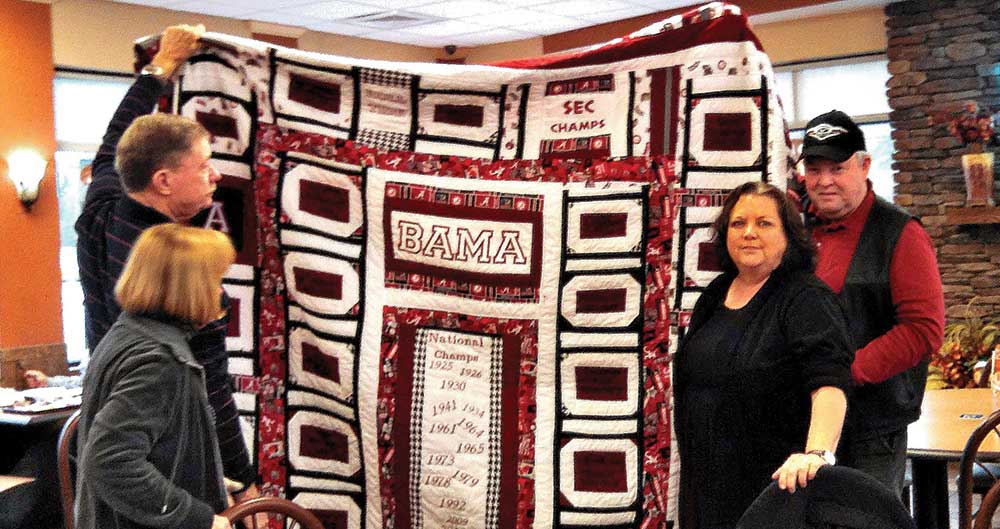
One of her favorite quilts is in daily use in Scotland. It’s a custom design showing the colors of that country along with one of their native plants, the thistle. Dale made another quilt for an East Coaster, with embroidered squares featuring fish, lighthouses, nautical implements and edged with real rope. She’s also made special Roll Tide spreads, as well as others whose tops are made up of copied photographs, ink-jet printed onto special fabrics.
Dale makes everything from baby quilts to throws, twin, full, queen, king and California king sizes. There is no easy way to create such things, nor are their components inexpensive. Each one involves interminable hours of delicate, tedious, exacting hand work. For instance, a regular queen size pattern quilt can involve as long as two months of daily labor!
When asked how many yards of thread are needed for a queen size, Dale estimated three large spools with 10 bobbins for the top, and at least six spools for the final assembly. Each spool is 255 yards. This comes to some 2, 295 yards, or roughly 1.3 miles!
And those nine spools can be as much as six dollars apiece. There is scarcely a square inch of quilt that doesn’t have a stitch running through it. That’s what keeps the liner from bunching up inside.
So, how is a quilt made? First, all the tiny pattern pieces for the top must be cut from various fabrics or produced from printed cloth or even old souvenir T-shirts. These must be accurately sewn together into a number of pattern squares of equal size.
In olden times, every part of a quilt was sewn by hand, but nowadays the tops are usually sewn with a special machine. Dale uses a Baby Lock designed for that purpose. When enough squares have been created (sometimes as many as 88), they are then stitched together into a single piece the size of the quilt.
Once the top has been assembled, the real work begins. Every part of the quilt must be hand-stitched together as a unit, with a needle pulling thread through the combined thicknesses of top, liner and backing sheet. This is usually done on a quilting frame, of which there are many designs. Dale’s husband, Bill, made her a rather ingenious one, using PVC pipe.
Dale says that most buyers balk at the asking price but, when given the actual materials cost as well as a couple months of tedious labor, her products would be a steal at double her prices. Anyone who has ever actually made a quilt will gladly accept, especially after examining the superior quality and durability of the finished product.
Dale loves chit-chatting with other quilters. She can be searched on Facebook as D Dale Griffith.
Besides looking great on one’s bed, there is another factor that makes her quilt special – the almost instant warmth experienced a few seconds after crawling under the covers. Because of the choice of fabrics, her quilts do not draw away body heat. They simply capture it and give it back all night long, thus fulfilling Dale’s mission of providing warmth.
The peace of mind part of her wish list comes every night, as one experiences that warmth as well as reminiscence of the heirloom quilts that comforted many of us in our earlier years. Little in life is better than a good night’s sleep, especially under such fine bedding.
A good quilt is made to last and be treasured for several generations. Dale has successfully repaired worn bed covers that were hand made in the 1800s.
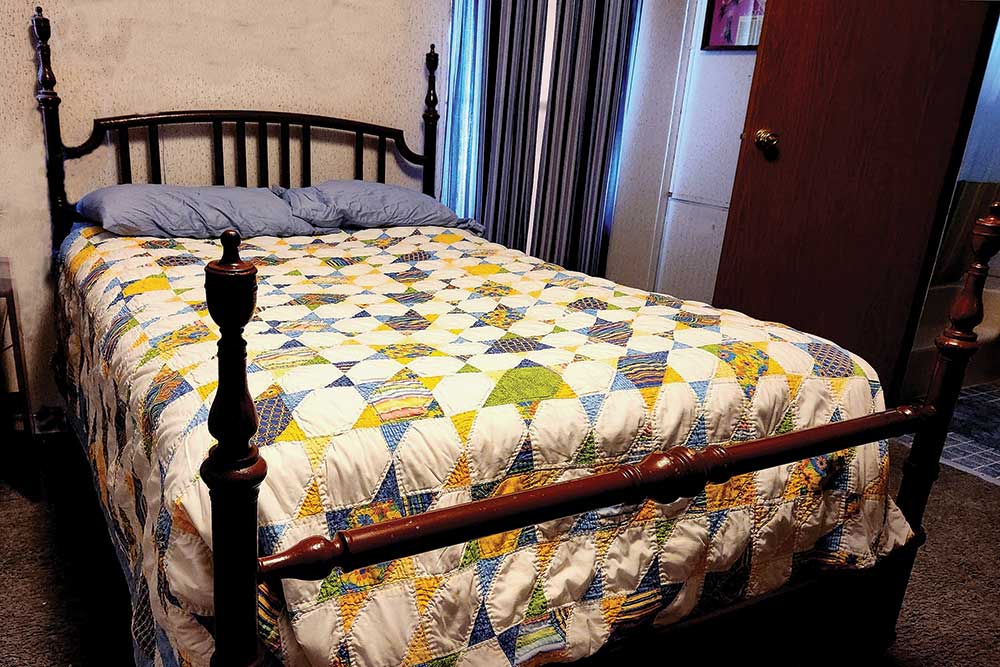
Your writer is the proud owner of a Dale Griffith patchwork bed cover that is the perfect complement for my old steel and brass four-poster that’s been in my family for several generations. For me, at age 82, it’s like a sort of time machine that provides comfort on several levels.
“ I want my quilts to be used, not stored away,” she declares. “They are household items, not keepsakes. I make them to last, so there’s no reason not to use them.”