Elaine Hobson Miller adds to extensive list of honors
Ashville’s Elaine Hobson Miller has been named the 2025 Communicator of Achievement of Alabama Media Professionals.
The St. Clair County resident won the award previously in 2017. That year, she went on to be runner-up in the National Federation of Press Women’s COA race when NFPW held its Communications Conference in Birmingham that year.
As the Alabama winner, Hobson Miller again vied for the national award when NFPW held its 2025 conference in Golden, Colorado.
The Alabama honoree has been writing since elementary school, when she penned a piece for her school’s newsletter. Throughout high school, she worked on her school’s newspaper staff and served as news editor during her senior year.
Hobson Miller began her lifelong career as a professional journalist and freelance writer in1968, the summer before her senior year at Samford University. She accepted an internship at the Birmingham Post-Herald, that city’s former morning newspaper.
The following year, she received a Bachelor of Arts degree in journalism with a minor in Spanish. Hobson Miller accepted a full-time position at the Post-Herald. Within a year, she became that newspaper’s first woman to cover the Birmingham city government beat.
She left the Post Herald in 1972 when her first child was born and freelanced for several years. She was a full-time features writer for Birmingham Magazine from 1978-1980, returning to the Post-Herald in 1980, working first as a copy editor and then as food editor and features writer.
As a freelancer, she was editor of PrimeLife, a Birmingham-based magazine for people over 55, during the four months of its existence in 1988. She wrote a twice-monthly house column for the Birmingham News, 1992-1997, and was a regular contributor to Southern Lumberman from 1990 to 2001. She also wrote content for various local corporate and government newsletters, brochures and pamphlets, including Jefferson County, Shelby Medical Center (now Baptist Health Shelby Hospital), First National Bank and Vulcan Materials. She edited Birmingham Home & Garden magazine in 2002.
Hobson Miller took a brief sabbatical from journalism in 1996 following the death of her husband, who owned an independent pharmacy. She did enough freelance writing during that time “to keep my fingers nimble and my brain active,” she said. She sold the pharmacy in 2012 and resumed her focus on writing.
Although the honoree considers herself semi-retired, her work has appeared regularly in the magazine, Discover the Essence of St. Clair, since it was launched 15 years ago. She also writes for its sister magazine, LakeLife 24/7, both published by the Pell City-based multimedia marketing firm, Partners by Design.
Active in mission work, Hobson Miller has made four medical mission trips to Peru with Dawson Memorial Baptist Church in Homewood and Texas-based E-3 Partners, plus an independent mission trip to Peru. She did one mission trip to Spain and continues to participate in mission trips to Zacapa, Guatemala, where three Alabama churches have an ongoing relationship with the small village of Conevisa.
If all goes as planned, Moody will begin seeing the beginning of a $100 million retail development along U.S. 411 and the Little Cahaba River.
Proposed by noted developer Stan Pate of Tuscaloosa, city officials are hailing it as a “real win” for the city, according to Moody Mayor Bill Lee.
The 200,000 to 250,00 square foot retail space is targeting property between 7 Brew and Joey Adkins Drive on Moody Parkway.
It took some incentives to land the deal, but Lee and the city council believe it to be a wise investment. The property has had its challenges because of the environmental concerns about the creek running through it, but the incentives will help overcome what had been financial roadblocks in the past.
According to the incentive agreement the council approved, worth about $65 million in incentives, it involves abatement of selected sales and property taxes, fees and permits, for up to 40 years or until the total it is paid. Pate has five years to begin the incentive process after his company invests a minimum of $10 million.
The 30-acre site will be mixed use of shopping and dining options. Clearing has already begun on the property. Existing property owners sold their land to Pate and businesses on that property now will be demolished after their leases are up.
Not every season of life will look productive on the surface. Some years are meant for planting, others for harvesting … but the fallow season – the one where the soil rests – often feels the longest and hardest.
But in that rest, unseen forces are still at work. The ground is regenerating and restoring itself and what looks like emptiness now is actually preparation for future abundance.
Our lives often follow the same rhythm. There are seasons where we strive, create, and flourish. And there are seasons where we’re called to pause, recover, and be still.
This time may look and feel unproductive, even wasted. But the fallow season is not for nought – it’s a period of necessary preparation.
It’s a season of hidden and holy work, preparing the soil … and our soul … for the future fruits of our labor.
– Mackenzie Free –
Wife, mother, photographer & current resident of the unassumingly magical town of Steele, Alabama
Key part of Chandler Mountain’s rare natural beauty
Story by Paul South Photos by Mackenzie Free
Sometimes nature’s miracles enter our hearts, souls and minds with a bang, like the colors of the Northern Lights, or the Hale-Bopp comet piercing a blue-black sky as it did late in the last century. Both phenomena are greeted by “ooohs” and “aaahhhs,” wows or wordless, wide-eyed wonder.
But more often, time and the elements combine quietly with nature to create something magnificent and mystical.
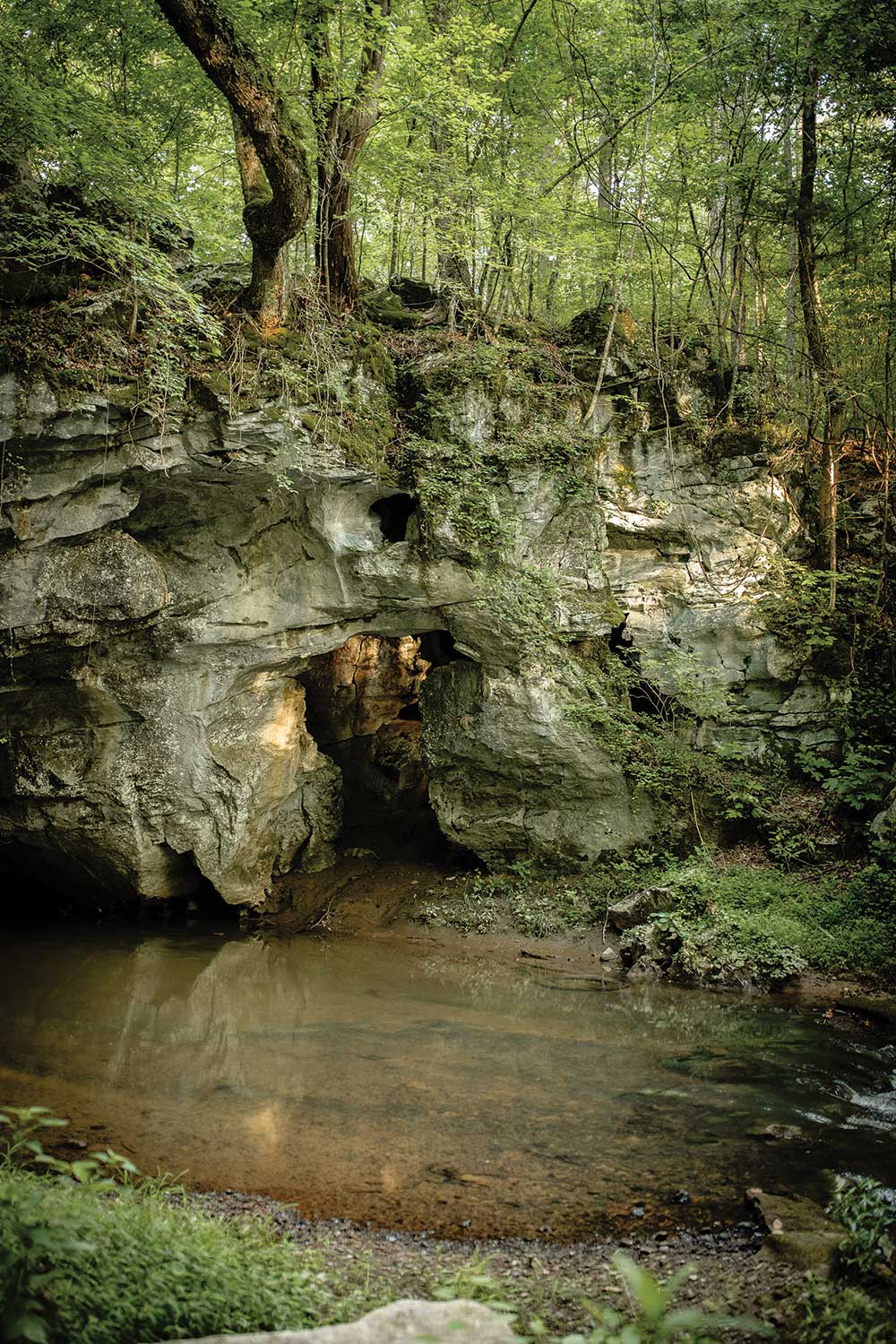
So, it is with the Chandler Natural Bridge, a place known simply as The Rock Bridge. Located near the base of Chandler Mountain that forms part of the St. Clair-Etowah County line, the natural bridge is one of six named natural bridges and two unnamed spans in Alabama, according to the Natural Arch and Bridge Society.
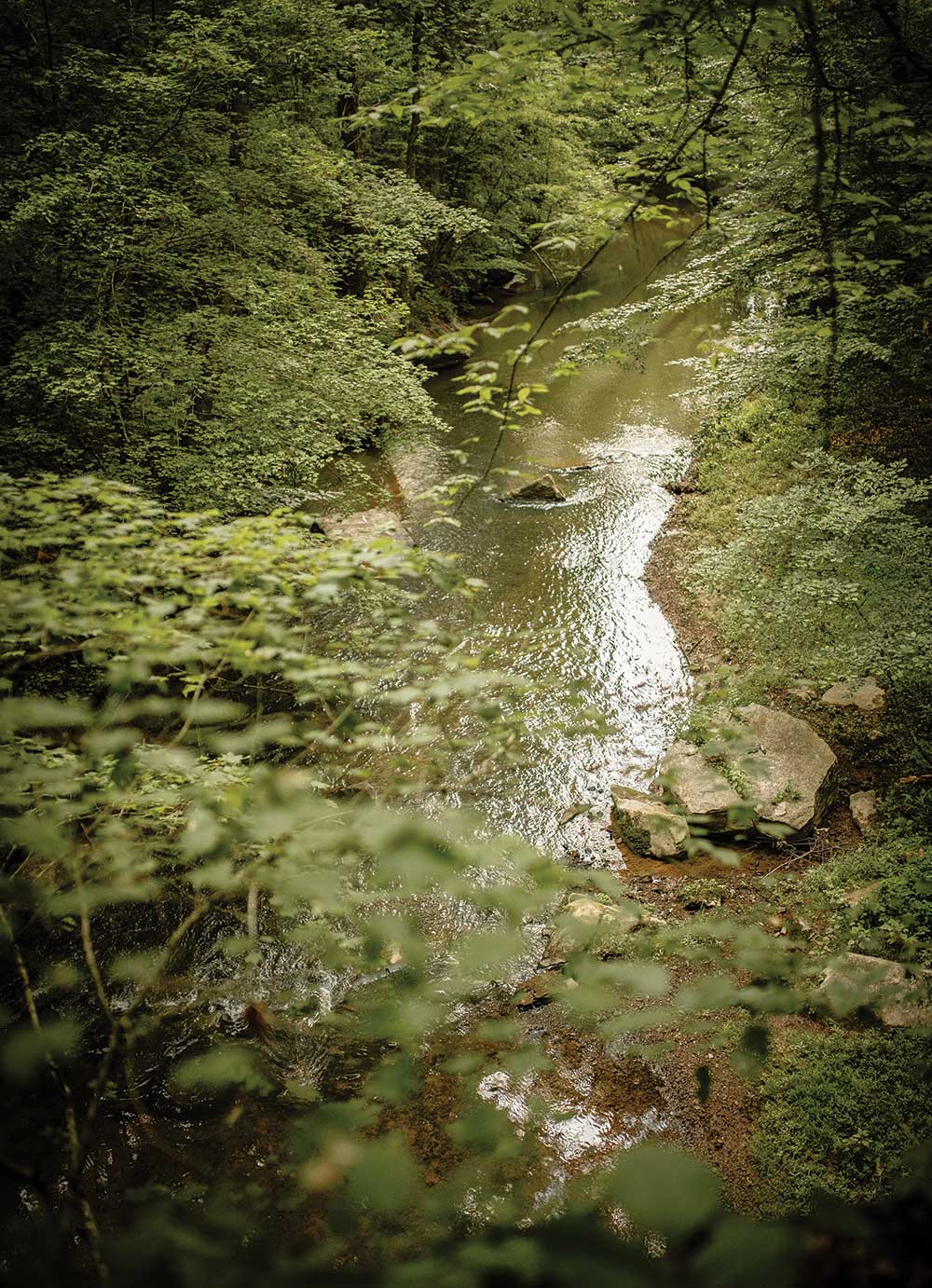
The Rock Bridge spans Little Canoe Creek. It’s 48 feet long, 54 feet wide and 17 feet thick. The top part of the span is made from Gaspar Limestone. Wind and water erosion sculpted the bridge over millions of years.
Since 2003, Save Chandler Mountain, a nonprofit advocacy group for the mountain, has worked to protect the Alabama’s third-largest peak, which is known as the “Tomato Capital of the World.”
Fran Summerlin, founder and president of the advocacy group, has a special place in her heart for the mountain and for the Rock Bridge. She holds dear childhood memories of her brother taking her to see the bridge when she was only five.
“It was fascinating, I’d never seen anything like it. It was wonderful.”
What made it fascinating?
“There was a big rock that looked like a bridge,” Summerlin said.
“When you think of natural bridges all over the country, they’re always revered,” she said. “People love going and seeing them. (The Rock Bridge) was formed by water, and it’s a fascinating place.”
She talks of Alabama Power Company’s unsuccessful plans two years ago to build a hydroelectric dam there, a move that drew vocal opposition from residents, environmentalists and Native American groups. “If the power company project had gone on, it (the bridge) would have been covered with water,” Summerlin said. “It would have been lost.”
In August 2023, Alabama Power withdrew its application to the Federal Energy Regulatory Commission to operate a Pumped Storage Hyrdro facility at Chandler Mountain.
Locals now have a heightened sense of the mountain’s importance. Darrell Hyatt, too, has precious memories of the bridge – picnics, swimming in the creek and exploring the area. “It should be a state park,” Hyatt said. “It’s beyond comprehension that anyone would consider destroying it.”
Summerlin said Save Chandler Mountain is continuing to research the area and work to find historical and archaeological treasures on the mountain. “We will continue to do that and continue to hope that (the utility) would come to some conclusion that the land needs to be preserved.”
Seth Penn is an environmental and political activist and enrolled citizen of the Cherokee Tribe of Northeast Alabama. While he couldn’t speak specifically about the significance of the Rock Bridge to indigenous peoples, generally speaking, natural arches and bridges often have sacred meaning for Native American tribes, who often see natural bridges as portals to the upper and lower spiritual worlds.
“I don’t know a lot of specifics about that specific natural bridge itself to really give you a lot of insight,” Penn said. “I can tell you that a lot of natural bridges … and special occurring rock features such as that which occur on the landscape are often seen as portal-type places, meaning they are significant to various indigenous tribes. And often, those are places where certain ceremonies or prayers will be conducted because they do believe sites like that have special spiritual significance.”
Rich Beckman, Knight Chair of Journalism Emeritus at the University of Miami (FL), is president of the nonprofit Natural Arch and Bridge Society. Formed in 1968, the 200-member organization works to protect natural arches and bridges and promote the study, appreciation and preservation of the natural structures.
While the NABS is small compared to other environmental groups like the Sierra Club, Beckman said the organization can “raise a ruckus” when natural treasures like the Rock Bridge are threatened.
“We don’t preserve natural arches, but we do try to help them live out their life cycle without abuse,” he wrote in an e-mail. “So, we are concerned about any planned or criminal destruction by man.”
The NABS joined locals and indigenous peoples to oppose an Alabama Power plan to build a hydroelectric power facility on Chandler Mountain, a proposal opponents of the plan argued would flood Chandler Mountain and leave the natural bridge underwater.
In the face of opposition, the utility withdrew its Federal Energy Regulatory Commission permit request and shelved the proposal, at least for now.
“We certainly let the utility know of our disapproval,” Beckman wrote. “(The Alabama Power proposal) would have been a disaster.”
The land where the bridge resides is fenced off by Alabama Power and closed to the public.
However, a portion of the utility-owned land on the mountain is open to hunters under Alabama Power’s hunting license program.
In an email, company spokesman Joey Blackwell wrote, “Through this program, parcels of land across the state are awarded through a public auction program,” Blackwell wrote. “Once a hunting license is awarded to a particular hunting club, the property can only be hunted by its members and guests.”
The utility makes some of its land holdings available for public use, including public access points across 13 reservoirs in partnership with local and state agencies, Blackwell said. The hunting license program is one of those initiatives.
Blackwell defended Alabama Power’s land use practices. “Alabama Power manages its St. Clair and Etowah County property holdings in the same way we work to be good stewards of land across out state,” Blackwell wrote. “Alabama is one of the most biodiverse states in the country, and experts in forestry, biology and wetlands management work together to protect our natural resources.”
Meanwhile, Save Chandler Mountain’s preservation work continues. How can citizens get involved?
“There’s power in numbers,” Summerlin said. “They could join Save Chandler Mountain, get on our Facebook page. We continue to strive to preserve this land. Just get involved with us.”
Hyatt said the mountain and the Chandler Natural Bridge are important, not to be taken for granted. “I was in awe of it, even as a child,” he said. “I didn’t really appreciate this place then as much as I do now. The older I get, the more it means.”
What would Summerlin want people who had never seen the Chandler Natural Bridge to know about the span?
“It Is s magical place,” she said. “It deserves to be preserved. In fact, all of this community and this area deserve to be preserved because it is a holy place for the Cherokees. It has incredible historical significance, not just for the indigenous people, but with, for example President Andrew Jackson took the land and either sold it or granted deeds to people.”
Some descendants of those original recipients still have those deeds, Summerlin said.
“This is a very historically significant, culturally significant, and I would like to say, it’s a sacred place.” l
Editor’s Note:For more information about Save Chandler Mountain, contact Fran Summerlin at fransummerlin@att.net, or visit the Save Chandler Mountain Facebook page or on the organization’s website, savechandlermountain.com. Dues are $20 annually.m to keep our programming fresh, giving people a reason to come and come back again to discover our rich history.”
Art of Nettie Bean and students kicks off new program at Museum of Pell City
From the work of budding student artists to seasoned professionals, a burgeoning art community is finding a home at Museum of Pell City.
The museum has already hosted the Helen Keller Foundation of Alabama Art Show twice with plans to bring it back in September. Featuring the creations of students across the state with visual impairments, blindness, and/or deaf-blindness, this show is growing in popularity in Pell City because of these inspirational works.
The museum has presented the annual Duran Junior High School Art Show as well, giving students a home to display their works for the public to see.
Now comes the next level – providing a home for the entire art community.
“Our community is so blessed with talented artists of all mediums, but artists have long lacked a place they could call their own in terms of shows,” said Museum President Carol Pappas. “Before we even opened our doors in 2022, we talked of an eventual evolution to cultural arts center. Yes, we are a history museum, but we recognized the need to expand our reach and become a center for the art community, too.”
The museum’s board invested in infrastructure to create gallery space leading into the museum with a hanging wall system, ideal for shows and art displays. Because of the mezzanine-type venue, it is prominently visible to museum goers, but it is also piquing interest from the heavily traveled lobby of the municipal complex.
“It gives us an opportunity to reach more people – more opportunities to expose these creative works to the public,” Pappas said. “We’re excited about the potential.”
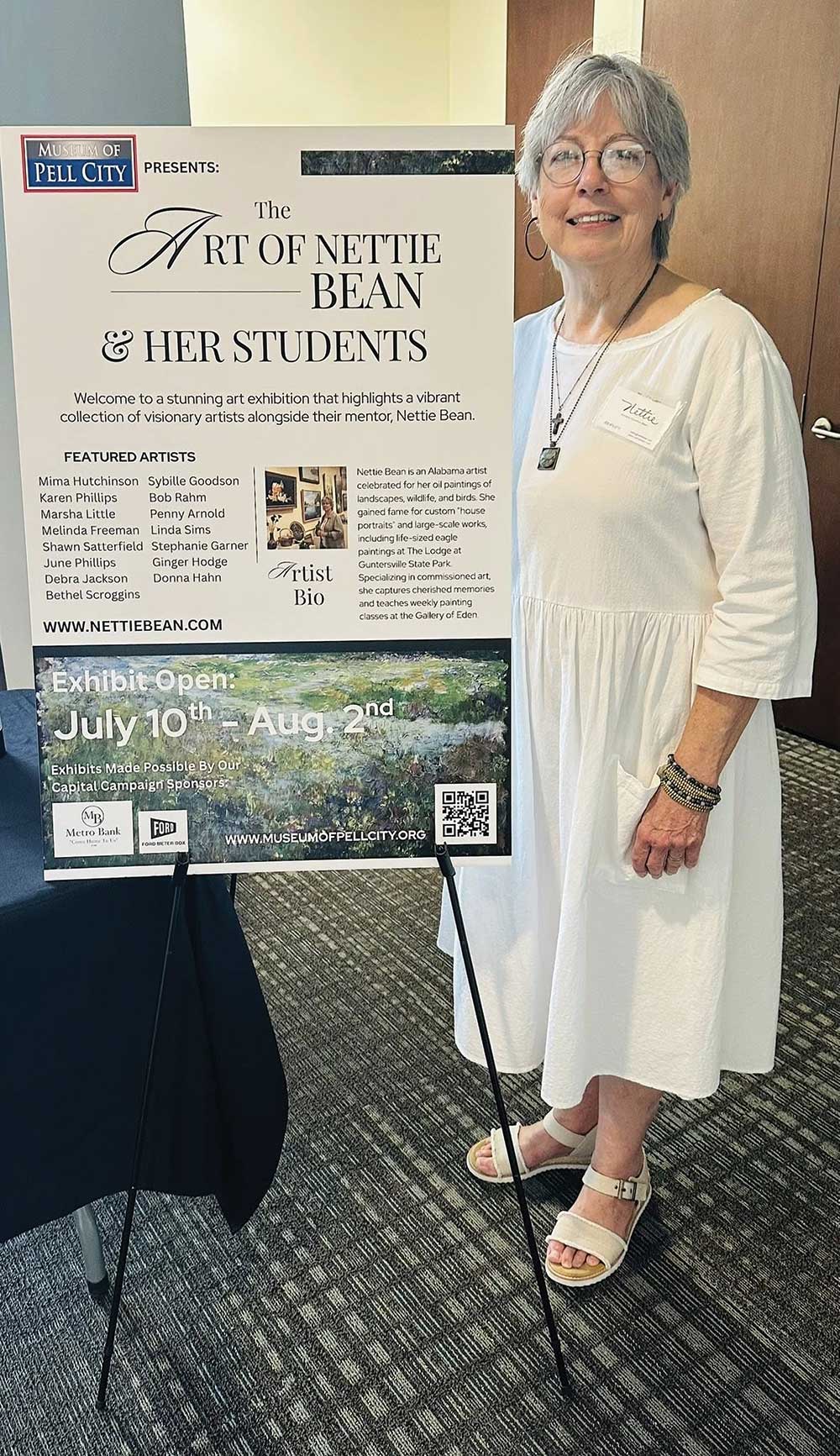
To kick of what the board hopes will be a regular event, noted artist Nettie Bean of Gallery of Eden and her students were the inaugural show, which opened in July and continued through early August.
Bean is an Alabama-based artist who creates stunning oil paintings of landscapes, wildlife and birds. After college, she became known for her “house portraits,” painting door-to-door for clients.
Her life-size eagle paintings are displayed at The Lodge at Guntersville State Park.
She is passionate about teaching and conducts weekly painting classes at the gallery she owns with husband Wally Bromberg.
Bean said she believes that art is a gift meant to be shared, and she strives to make original art accessible to all. “That’s precisely what we’re trying to do through this new program to showcase our art community at the museum, one we hope will grow and thrive for years to come.”
The Helen Keller Foundation of Alabama Art Show is slated for Sept. 11-27.
More exhibits on the way
In addition to its latest venture into art, the museum is planning even more events in the months to come.
It will unveil an outreach program this month that puts mini-exhibits in public places like schools, city hall and county courthouse. “The idea is to give the public a glimpse at what they might find at our 4,000 square foot museum,” Pappas said. “People just don’t realize the depth and scope of our museum, so we want to take it to them – at least a little part of it.”
The outreach exhibits’ theme is Find it at Museum of Pell City, and it shares nuggets of the historic stories, photos and artifacts we have to offer through compelling, custom-designed displays.
Starry Night at Waffle House in the style of Van Gogh by Penny Arnold a crowd favorite
They encourage people to find out more at the museum, which is open Thursdays and Fridays, 10 a.m. to 4 p.m. and Saturdays, 10 a.m. to 2 p.m. Admission is always free.
Coming soon is a model train exhibit that has been built by a team of volunteers over the past several months. The 17-foot display with a running train depicts the 1920s version of Pell City.
“It all began with a train,” Pappas noted, referring to the ‘first’ founding of the town in 1890 when Sumter Cogswell missed his train to Talladega, spent the night in Pell City and envisioned a town.
Nationally known artist Dirk Walker has donated his original painting of one of the train depots, and the board will be using it as a fundraiser for the museum along with selling numbered, matted prints of the original.
“We owe Dirk a debt of thanks for his generosity,” Pappas said. “He and his wife, Debbie, have been so supportive of our efforts. You can see all about him and his work in our museum, which features Pell Citians who have made a national name through their talents in art, music, sports and film.”
In November, the museum presents its annual Salute to Service, which will see its military section redesigned and expanded to better cover modern days wars in the Persian Gulf, Iraq and Afghanistan.
It also will feature oral history videos from local veterans and St. Clair County District Attorney Lyle Harmon as keynote speaker at the Nov. 7 special program. He is a veteran of the second invasion of Iraq in the101st Airborne Division, 217th Calvary. He was a helicopter pilot flying reconnaissance missions.
“As you can see, we have lots in store for museum goers,” Pappas said. “Like history, it evolves. We aim to keep our programming fresh, giving people a reason to come and come back again to discover our rich history.”
Story by Joe Whitten Photos by Wallace Bromberg Jr. Submitted Photos
Eden. What a lovely name for a town. It calls to mind the biblical Garden of Eden with visions of fertile soil, lush gardens, exotic flowers and green groves of sheltering trees.
One wonders if, in the first quarter of the 19th Century, the settlers to this area saw it like that. Probably not, for trees must be felled, new ground cleared and cultivated, houses and barns built, but it was a place of promise.
It’s uncertain when settlers first began migrating to today’s Eden, but family by family, a community formed. As the 19th Century progressed, businessmen opened stores and shops, and by 1900, it had become the town of Eden.
New Hope Baptist
An April 4, 1906, Pell City Times article records that “…Eden…first bore the name of ‘Manchester,’ but there being another Manchester in the state, it was changed to Eden.”
Personal help with knowing the history towns and churches. In June 1970, Lailah Harris, in a letter to Mrs. E. N. Vandegrift of Oneonta, AL, wrote that although Eden eventually became a part of Pell City, it was a town “before the Civil War.” She also wrote that family tradition says Eden “…was so named by the Inzer family who came from Georgia to Alabama.” The Inzer family’s English ancestral roots were in Edensor, England, implying they left off “sor” and kept Eden as the town’s name. The online link letsgopeakdistrict.co.uk/listing/edensor states that “Edensor” is pronounced “Enzer.”
Mrs. Harris’ great grandfather, Henry Inzer, and his siblings, LaFayette, Mark, Jim, John and Cathrine all settled in St. Clair County. “They lived on Wolf Creek and made their living mostly from the land, although my great grandfather Henry was a preacher, blacksmith and worker in wood and metal.” He served as New Hope’s pastor in 1877.
New Hope Baptist Established
Early settlers needed fellowship, and churches fulfilled that need. By 1824, enough families had settled in today’s Eden to organize New Hope Baptist Church as the only Baptist church in St. Clair County’s Coosa Valley.
It was the second documented Baptist church established in the county. Mt. Zion Baptist (now Springville First Baptist) was established earlier in 1817. In the 1820s, to go from Eden over Bald Rock Mountain to worship at Big Springs (Springville) would have been difficult and dangerous.
New Hope is a grand name for a church in a new land, for it expresses the hope of God’s blessings in the years to come. The organizational date of 1824 comes from the 1853 Coosa River Baptist Association which met at Spring Creek Baptist Church in Shelby County. That year for the first time, the association asked for member churches to record the year their church was established, and New Hope’s date was listed 1824.
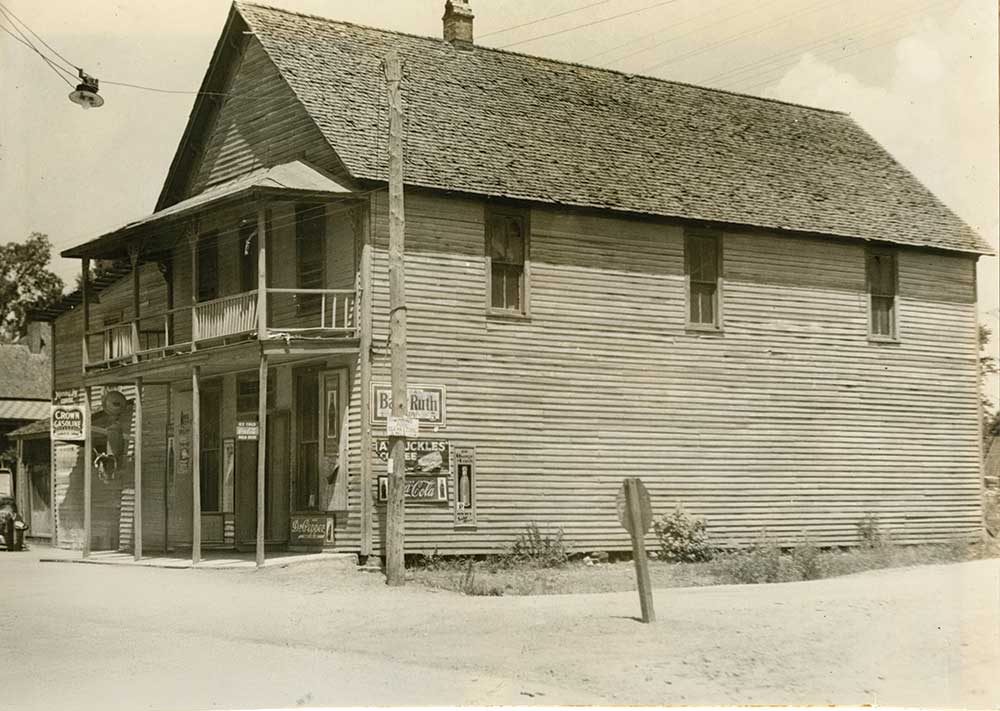
Laney-Barber-Gossett Store in Eden
Hosea Holcomb, in his 1840 History of the Rise and Progress of Baptists in Alabama, gives some early history of the church: “New Hope in St. Clair County was formerly in Mount Zion Association, but united with the Coosa River (Association) in 1834. They have always, until recently, been a small band. Their number has increased considerably … Elder William McCain labors with them in word and in doctrine.”
Rev. William McCain was the first recorded pastor of New Hope, and we know much about him from his obituary written by Samuel Henderson and published in the March 11, 1883, issue of The Alabama Baptist.
Here are highlights: “Among all the ministers who have lived in the bounds of the old Coosa River Association … none have surpassed William McCain in effectiveness of ministerial labors. With scarcely education enough to read English correctly, he achieved a position in his calling that opened every pulpit in the region. … Learned and unlearned, lawyers, doctors, and merchants, mechanics and farmers, rich and poor, all flocked to hear him. …Although he never pronounced a grammatical sentence in his life, knowing it to be such, yet behind his broken English and awkward phrases, there was an unction and power that lifted his hearers above all his imperfections of style and delivery. …His thoughts would glow with a brilliancy and come with a power … entrancing and overpowering. He would sway vast congregations like fields of waving grain in a brisk wind … The salvation of souls was his passion of his life, and to this he consecrated his whole life.”
Houses of worship
For church building locations, oral history provides clues.
In his History of the New Hope Baptist Church, 1824-1972, Curtis Rush quoted information about the first building provided by Pauline Baker from an April 14, 1964, letter written by Rev. B.W. Inzer. “The oldest thing I ever heard about a church at Eden, Uncle Fealy Stewart told me about 1935. He said, ‘I used to walk down here when I was 7 years old and older with my Grandma Mullins. She told me about the only church anywhere in this area was about where Jim Stevens built. It was (of) logs, and split logs and boards made the seats, windows and doors.” The exact location of this building remains uncertain.
In the same letter, B.W. Inzer wrote about the second building, relating what Andrew Ginn told him about it. “He (Ginn) said when he was a small boy, he attended the First Baptist Church, which was later called New Hope, as we know it. It was at the foot of the mountain in front of the Jim Kilgroe place.
He said he would never forget seeing all the men stand their shotguns up in the corners of the church. They brought them for two reasons: There had been rowdy fellows molesting the services, and that must stop. Then after the services on Saturday, they would go out and kill deer which they would barbecue, and all had a feast.”
For Rush’s history, New Hope’s oldest member at that time, C.S. Alverson, wrote down his recollections of the third building. “I remember attending New Hope Baptist Church when I was just a boy (1880s). The building was on the site where the pastorium is now. (Today, the church gym is in that location.) There was one road called ‘Mud Street’ now Wolf Creek Road and the church building faced this road … The windows had no glass panes but only wooden board shutters and board doors. The floor was dirt.”
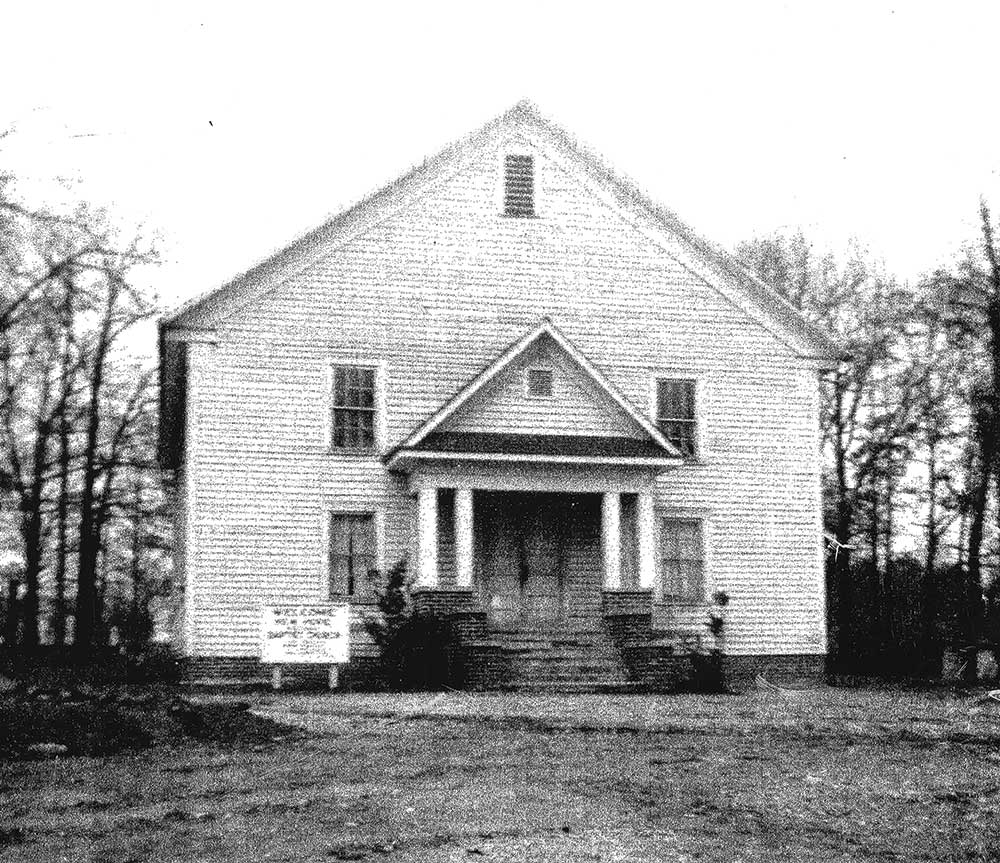
The fourth church building was constructed in 1888 and had two front doors and a back door. It was well-built, for a tornado in April 1929 twisted and damaged the church, but it was so sturdy that it did not collapse and, as recorded by Rush, “Miraculously, the building was straightened up and put back in good repair.” This was completed by the men of the church under the guidance of “Mr. Coach, a carpenter from Pell City.”
In 1937, the church gave the 1888 structure “a complete face-lifting.” They added a balcony with two Sunday school rooms, and on the first floor, a vestibule and two more Sunday school rooms. This fine old building served New Hope until the church erected a new brick sanctuary in 1949.
Memories of the 1888 building are found in the Oct. 17, 1996, St. Clair News-Aegis article by Ann Boone. Olivia Vick, then 85 years old, told Boone how she had attended New Hope for 81 years. “We went to church in the morning and had Sunday school in the afternoon … There were two front doors, one for the men and one for the women, and no one ever went through the other’s door.”
Recalling the 1929 tornado, Mrs. Vick said, “My mother always took flowers every Sunday, and when we looked in the church (after the tornado), we saw that her flowers and the vase they were in on the Communion Table were still there and unharmed.”
Mrs. Vick’s favorite New Hope memory was her salvation. “Newt Butterworth explained the plan of salvation to me … This was when I was 16, and we went down to Barber’s Creek (for my baptizing). I wore a light blue dress. It was August, so the water wasn’t cold. Afterwards we went up and had church.”
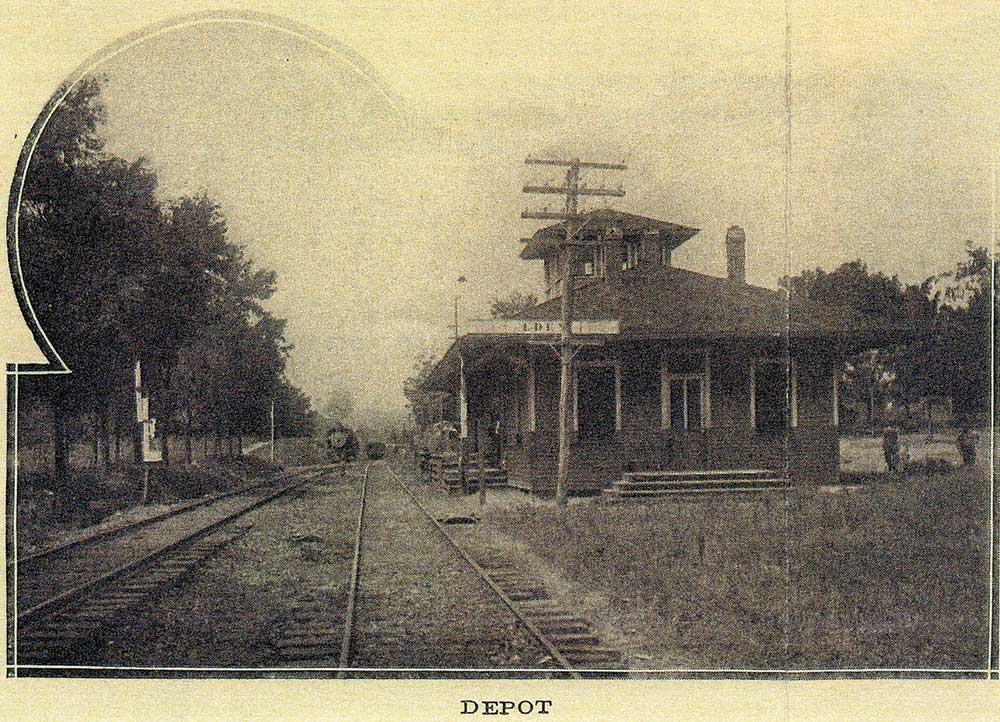
Eden Depot
Newton “Newt” Butterworth’s death remains an intriguing part of New Hope’s history, as recorded in his obituary published July 25, 1935, in The Pell City News. “N. A. Butterworth Dies while Testifying. Mr. N. A. Butterworth died suddenly in the New Hope Baptist Church at Eden yesterday (Wednesday) while testifying in a revival service. Mr. Butterworth was 77 years old and was one of the oldest members of that church of which he was also a deacon. His last words were “I never felt happier in my life than I do this morning” and fell to the floor. … Burial will be at Mt. Carmel Cemetery.”
Included in the New Hope Baptist file at the Ashville Museum and Archives is a photocopied article titled, Pioneer Passes while Talking for the Lord, by Eloise Bowman. It noted that Butterworth prayed many times, “…‘Lord, let me die in the harness.’ (i.e. active until the moment of death) … (T)he Lord answered his prayer … when with his Bible under his arm, God called him home. He fell dead in the church.”
For a man to die in front of a congregation during a service would be a frightening object lesson that life is uncertain, and death is sure.
Revival week
Weeklong revivals were standard events in Baptist churches until about the 1970s or ’80s, when weekend and four-day revivals came into vogue. These yearly revivals usually resulted in conversions, baptisms and additions to church membership rolls.
In Rush’s history, he records that in 1864 during the Civil War, there were 41 baptisms and in 1866, a year after the war ended, there were 49 baptisms. These numbers are above average, for national conflicts and tragedies often draw people toward God and the church.
Churches ran revival announcements in local papers such as the one for New Hope in the April 7, 1955, St. Clair News-Aegis, “The revival at the New Hope Baptist Church will begin April 10th and continue through April 17th. Rev. Douglas Dexter will bring inspiring messages.” The announcement lists the titles of nine sermons, including the concluding one, Alibies, Lullabyes [sic], and Bye-byes.
Often in the 1950s and ‘60s, a traveling evangelist would hold a citywide tent revival with local churches promoting the event. Curtis Rush’s daughter, Margaret Rush, recalls one conducted by Evangelist C.J. Daniels from Orlando, Florida.
A May 16, 1965, Anniston Star article, Crusade Is Slated, reported about Daniels’ tent: “A unique poleless canvass cathedral with a seating capacity of 2,000 and auxiliary seating for another 2,000 has been erected on a lot just north of downtown Pell City on Highway 231 across from the dairy Queen … Dr. Daniels will be preaching with music directed by Dr. Lowell Leistner with John Roe at the organ.”
Margaret Rush recently recalled that Daniel’s promotional man, who came ahead to get things organized drove “…a Karmann Ghia car, and I had never seen one before. I thought it was very special.”
Daniels didn’t leave attendance to chance but promoted his revival wherever he went. Margaret remembered, “He had a plane – just a small plane – and he would take people up and show them the county from the plane. I went up with him… That was the first time that I’d flown in a plane.”
Daniels’ revivals were attended by throngs of worshipers as well as sight-seekers.
Homecoming and All-Day Singing.
Two other annual events were also observed on the same Sunday at New Hope in days gone by – the All-day Singing and Homecoming. No record exists stating when this second Sunday June event began. The June 7, 1945, announcement in The Pell City News reported, “Even the oldest of the old-timers are unable to say when the Eden Annual Homecoming started – 50 or 75 years ago, perhaps longer, most of them guess. No one seems to know, and no one cares much as long as the ‘Second Sunday’ celebration continues.”
In 1920, The Birmingham News reported the event in their June 14 edition. “Many citizens of Birmingham, Bessemer, Anniston, and other points who were formerly residents of St. Clair County attended the annual singing and homecoming at the Baptist church at Eden Sunday. Fully 2,000 persons were on hand. James Garrett, Circuit Court Clerk of St. Clair County, presided. Austen Hazelwood of Eden, one of Alabama’s sacred songwriters and singers, assisted in directing the music.
“Mrs. Lloyd Garrett, James Ragland of Pell City and Marvin Truitt of Anniston were among the leaders in the music. Rev. R.F. Funderberg of Cropwell, pastor of the church, was in charge of the devotional services. The affair this year proved one of the most enthusiastic ever held at Eden.”
The 1954 New Hope singing-homecoming announcement in the June 10 issue of St. Clair Times, reported that on Sunday, June 13, “…The Bama Boys will be guest singers. Also, local groups will be featured … Lunch will be served at noon. All attending are urged to bring a well-filled basket (of food).
In the May 25, 1951, issue of the Southern Aegis, Editor Edmund Blair reminisced about Homecoming at New Hope. “They come from far and near and from various states for this event.” He noted that folk would come in automobiles, but in the past “…mules and horses hitched to wagons, buggies, and in some cases, shiny black surreys were the chief method of transportation.”
These events were church and community reunions and were anticipated with excitement because attendees would see friends they had not visited with since last year’s homecoming and singing.
The folk found spiritual food in the church building and baskets of food at lunch with “dinner on the grounds” of the church. So, newspaper announcements encouraged women to bring “well-filled baskets of food.”
A June 7, 1945, announcement in The Pell City News mentioned the gas and food rationing of World War II. “Because of the transportation limitations, the crowd won’t likely be as big as in pre-war years, but every friend of Eden will make every effort to be present, and many have no doubt been saving their gas rations for this special day. Likewise, because of food rationing, many items that have in the past graced the bords at the dinner hour won’t be served, but there will be plenty to eat.”
Progressing through the years.
Population growth in the Eden-Pell City area necessitated additional construction. A new worship center was completed in 1997, and a Family Life Center and Gym in 2007. The 1949 structure serves as the Youth Room and the Senior Adult Sunday school room. As New Hope enters the beginning of its third century, plans have been laid for further expansion of the church campus.
200th Celebration
On Sunday, October 20, 2024, New Hope celebrated its 200th birthday. As the 10 o’clock hour approached, a sense of excitement permeated the sanctuary. Church members greeted one another and made sure non-member attendees felt welcomed as well. No one was excluded.
Proclamations from Pell City mayor and council were read, and a video proclamation by Dr. Lance from the Alabama Baptist Convention were presented prior to the beginning of the worship service.
After Scripture reading of Psalm 100, the Celebration Choir sang the Call to Worship hymn, Great is Thy Faithfulness, directed by Joseph Smith with Hanna Stough at the piano. Especially effective was Dr. Michael Averett’s trumpet obbligato, which underscored the hymn’s proclamation of God’s faithfulness. The concluding crescendo of choir, piano and trumpet brought approving applause and exclamations of praise.
After Greg Davis, chairman of the Bicentennial Committee, welcomed the congregation, Joseph Smith led the packed house in singing How Great Thou Art and To God Be the Glory. The singing of those well-loved hymns “raised the roof,” as old-timers would describe it. The male quartet with Greg “Skeet” Davis, Joseph Smith, Matthew Pope and Brandon Haynes harmonized the old hymn Brethren, We Have Met to Worship. Their rendition resulted in applause and vocal affirmation throughout the sanctuary.
After the congregation sang three praise and worship songs, St. Clair County Baptist Association Missionary Dr. Danny Courson gave greetings from the association member churches before reading from Joshua 4:4-9, the Scripture for transitional pastor Dr. Bob Weber’s sermon, Memories, Markers, Mission.
The Joshua passage recounts the Israelites crossing the Jordan River on dry land as they enter the Promised Land, and God instructing them to gather stones and build a memorial of that event. Dr. Weber spoke of the importance of memories and memorials in the lives of Christians, and that they should honor God’s blessings in their lives, the most important one being when they came to a saving knowledge of Christ. These blessings from God should be recounted to children and grandchildren and memorialized by parents and grandparents.
At this point in the service, 12 families brought stones to make a symbolic memorial to what God has accomplished through New Hope Baptist. Taylor Funderburg and children, Everett, Hadley and Findley, representing a first-generation family, laid the first stone. Husband Tyler missed because of his work. The Pope family of four generations laid the 12th stone. They are, from oldest to youngest, Gilbert Stuart, John Pope, Matthew Pope, and Glover Pope. This element of the bicentennial worship was modeled after the memorial stones recorded in Joshua 4:20-24. This memorial will be placed on the church campus in days to come.
The service continued with Dr. Weber admonishing the congregation that the church doesn’t rest on memories and memorials, for the membership is involved in New Hope’s stated mission – “To Worship Christ, Serve Others, Share the Gospel, and Disciple Believers.”
The service closed with the singing of Victory in Jesus, joyfully accompanied by piano and trumpet. Afterward, Johnny Gregg prayed the benediction and thanks before “dinner on the grounds” served in the FLC.
The history of a church is a history of God’s providence over a people whom He brings together to accomplish His purpose in a community.
As members die or move their membership for various reasons, God brings others to take their places, and the church continues to progress.
For a church to continue for 200 years is evidence of God’s blessings on those who organized New Hope in 1824. And although To God Be the Glory was not composed until 1872, every generation before and after would affirm its words:
Praise the Lord, Praise the Lord
Let the earth hear His voice,
Praise the Lord, praise the Lord,
Let the people rejoice
Oh, come to the Father through Jesus the Son,
And give Him the glory, great things He has done.
And by God’s gracious providence, the church will sing that hymn 100 years from now when they celebrate their tricentennial.
To God be the glory, for indeed great things He has done at Eden New Hope Baptist Church.