Richey’s Grocery

richeys-grocery

Everything under one roof

Story by Leigh Pritchett
Photos by Wallace Bromberg Jr.

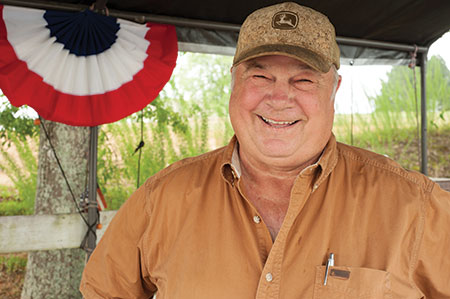
Debbie Crump recounted some of the goings-on at Richey’s Grocery and then just had to chuckle.

“There’s a story every day. We could write a book, and it would be a best-seller,” said Crump, who with her husband, Jimmy, owns Richey’s Grocery.

According to her, Richey’s Grocery is “just a small-town grocery store.”

But a few hours spent observing activity and listening to conversation there reveals it to be plenty more than that.

The store is a quick stop, a fuel stop, a grocery store, a coffee shop, a meat market, a general store, a think tank, a curb market, a community meeting place, a springtime plant nursery, a social network and the fiscal accountability watchdog headquarters for all levels of government.

In addition, it is the first call for help in various life situations, such as rounding up wayward cattle or repairing a leaky roof.

As to what one might encounter at Richey’s Grocery, customer Kim Thweatt of Cropwell remarked, “There’s no telling.”

The store, located between the Pell City limit and the Shelby County line on U.S. 231 South, enjoys proximity to several lakeside communities, as well as Cropwell, New London and Mount Pisgah. Few are the hours that it is closed, even in snow. The store opens each morning at 5 a.m., closing at 9 p.m. Sunday through Thursday and at 10 p.m. Friday and Saturday.

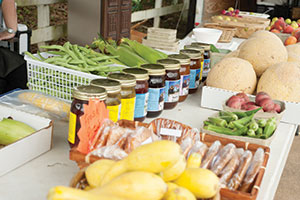
richeys-store-crumpIt is a general store with a one-stop shopping concept and an old-fashioned atmosphere. Customers can find kindling, firewood, regular gasoline, non-ethanol gasoline, propane, kerosene, live bait, fishing tackle, grocery items, produce (some of it from local sources), automotive and pet supplies, health and beauty aids, meat cut fresh daily, poultry, fish and seafood, marinades, rubs, spices, candy, a quick snack or drink and a newspaper.

Then, there is the host of specialty items, such as muscadine hot sauce, rhubarb preserves, squash relish, moonshine jelly (which, by the way, does not have alcohol listed as an ingredient), Priester’s pecan pies, locally made cheese straws and fudge, hoop cheese (both red and black rind), local honey and Chilton County peaches, when in season.

Plus, the store carries many Amish products, for example, chow-chow, peach salsa, candied jalapenos, pickled mushrooms, Christmas jam, pickled baby beets, red sweet pepper relish and tomato basil noodles.

Anyone wanting another of Richey’s unique items – pickled quail eggs – has to be swift about it because those have a way of vanishing, said cashier Debbie Thompson.

“It’s a good place to stop by because you never know what you’ll find,” said Greg Crump, who co-manages his mother’s store with his sister, Jamie McLean.

Greg Crump mused that Richey’s sits right between the old and the new: Old U.S. 231 runs at the back of the store, while the newer U.S. 231 spans the front.

In a way, that does depict the store. It is a business functioning in modern day on principles from yesteryear.

Richey’s Grocery is a place where American flags fly prominently and six-year employee Wil Holmes describes as “home.” It is where Lisa Hardy, one of 11 employees, has chosen to work for two decades. The prices of items are keyed by hand into the cash register, and customers are called by name.

That latter was a practice Debbie Crump’s father, Donald Richey (now deceased), used from the day he opened the store in 1967 and instilled in his daughter.

“That was Pawpaw’s big thing, to call everybody by name,” said McLean.

Establishing relationships and giving good customer service are two other practices that Debbie Crump strives to uphold.

“We try to be friendly to everybody,” said Greg Crump.

Debbie Crump noted that customers are loyal if they are treated properly. “You treat them right, they’re going to treat you right.”

Tymarcus Simmons of the Surfside area said he appreciates that Richey’s treats customers with kindness and dignity. He said that is a rare quality to find these days. The father of three – Tamichial, Jacoby and Tymarcus Jr. – said Debbie Crump is known for the way she relates to and treats people.

In the years after opening the store, Richey and his wife, Sally, also established two nearby businesses. Richey’s Barbeque, right next door, is now run by Debbie Crump’s sister, Martha Price. Across a street, in a building currently occupied by Bullet’s Mini Storage, the Richeys operated Surfside Restaurant about 15 years.

Since 1967, the family has run Richey’s Grocery, with the exception of 10 years that it was under lease, explained Greg Crump. Debbie Crump took over the store at the end of the lease.

That was 20 years ago this past October, said McLean.

When Debbie Crump assumed the business, her dad urged her never to sell to an outside entity. As a result, buyout offers – like the recent one from someone in Atlanta  – get turned down flat.

“There’s no way,” Debbie Crump said.

Crump would not dream of parting with the store, where her mother Sally Richey comes to visit each afternoon.

“She loves this place,” Crump said.

Moreover, Crump’s grandchildren — McLean’s sons, Luke and Colt, and Greg Crump’s daughters, Bailey and Allie – already feel like they are part of the business.

McLean said she and her brother will run it until they are just too feeble.

One of the major draws of the store is its meat market. Greg Crump oversees it, selecting and cutting the meat himself.

“We buy nothing other than the best grade you can get,” Debbie Crump said.

Ribeye, sirloin, New York strip, ribs, Boston butt, ground chuck, pork chops and chicken are among the cuts available. “It’s hand-cut and fresh,” said Greg Crump. “Nothing sits around.”

The meat market definitely appeals to Paul Graves of Pell City. “I get all my steaks there. They’ve got filet mignon.”

Some people even drive from other areas to purchase meat at Richey’s, said McLean.

Meat sales, Debbie Crump said, constitute probably 50-60 percent of the store’s business. Richey’s also fills bulk orders for large gatherings, as many as 200 or 300 steaks at a time.

All in a day’s work

On a recent Saturday morning, the store was teeming with activity long before 7:45 a.m.

The aroma of boiled peanuts in their warmer filled the air. Cindy’s cinnamon rolls from the Galleria tempted anyone who approached the checkout counter.

Martha Price busily gathered what she needed for that day’s barbecue business, as a nearly steady stream of customers came and went. At times, there was scarcely a place to park.

Bobby Jones and Harold Hoyle were already well settled in their daily routine at Richey’s.

These two regulars arrive before the store opens. Each morning, one unlocks the bathrooms and the coolers out front, while the other brews the first pot of coffee for the day.

Then, the duo takes a perch behind the counter to “shoot the breeze” and pick at customers.

One regular customer after another — many holding coffee cups from home — came for some joe and a dose of “intellectual stimulation,” as Randy Bearden of Shelby County put it.

Though the morning was chilly and overcast, some took a seat anyway on the back porch, where a sign proclaims, “What happens on the porch, stays on the porch.”

Considering the amount of activity that transpires there each and every day, that vow of secrecy covers a lot.

That famous back porch is yet another attraction at the store.

“When it’s warm enough, (there are) six or eight guys on the porch in the morning,” said Pell City Councilman Terry Templin.

Sitting in the most comfy of the rockers, Templin casually explained to a newcomer that there is an “early” group and a “late” group on the porch. Most of the time, he is part of the early group, but likes to stay for the late one, too.

“We’ve been doing this for 15 to 20 years,” Templin continued. “We solve all kinds of problems, local, federal. …”

Pointing at Templin, Ren Wheeler of Cropwell gave his reason for being part of the porch patrol. “I have to bend his ear every now and then. I like to find out where he’s wasting my tax money.”

Soon, Rusty Hunter of Cropwell joined the group, offering lighthearted observations.

After, Greg Crump settled into another rocker, Jones and Hoyle migrated to the porch from behind the checkout counter.

The group’s discussions ranged from humorous recollections, the golf course and the local geese population to progress reports on porch sitters who were sick or had surgery.

The men would wave at passersby and yell comments at people exiting their vehicles.

Crump noted that the porch has a strange effect on some people: It causes them to alter their stories. “If you catch a 4-pound bass, when you step on the porch, it’s 8 pounds.”

Generally, the porch banter is jovial in nature. Nonetheless, the discussions sometimes give Templin valuable insight. Through some of them, he is able to know what the citizenry thinks about various issues, which he said helps him as a councilman.

It was not long before McLean came onto the veranda with her cell phone in hand. One of the regulars, she announced, had texted her to say he could not make it that day; he was hauling cows in Alexandria.

This morning like most mornings, the porch was male dominated. Yet on warm evenings, the porch belongs to the female folk, said Debbie Crump.

It is also a family gathering place for the Crumps and McLeans. “This is where we hold birthday parties,” said McLean. “This is where we live.”

The Painter

Lonergan’s story, life’s work an inspiration

Jon-Lonergan-1Story by Carol Pappas
Photos by Wallace Bromberg Jr.

He has been described as “the boy who lived to draw.” Sitting in an easy chair at his home in Chula Vista, surrounded by a couple of Shelties, a black Lab and a lifetime of his works, John Lonergan pauses a moment and reflects. “If I had known in high school the level where I am now, I would have been impressed.”

But the inherent perfectionist in him quickly adds, “You never get to the level you want to be.”

With an impressive career as an art teacher to his credit — both in public school and in the private sector — gallery showings, commissioned work and his art hanging in private and corporate collections virtually around the world, one might be tempted to call it the pinnacle.

But add a book about his life and work, more shows and commissions up ahead, and it is easy to see that Lonergan isn’t done yet.

The latest triumph for the St. Clair County-born Lonergan, who was inspired by a teacher when he was growing up in the village shadow of Avondale Mills, is a book, John Longergan, The Painter. Published by Birmingham-based Red Camel Press, the book is a rare opportunity to see the world through an artist’s eyes.

It is dedicated to his parents, John L. Sr. and Jennie S. Lonergan, “who gave me confidence and support to follow my dream to become a painter;” his wife, Sandra, a gifted and noted photographer, who is “my best critic and treasured lifelong sweetheart;” and Doe, his black lab, “my life’s best friend.”

Through paintings and commentary, it deftly weaves the story of a young country boy from a small Southern town, who builds a life as a master painter and inspiring teacher. The gift his parents and teachers recognized early in his life is a gift he continues to give others through his painting and teaching.

His students call him the master. And it was one of those students who was so inspired by his teaching and his work that she suggested the book. She happened to be a book publisher, and three years later the collaborative effort evolved into: John Lonergan, The Painter.

When Liza Elliott first broached the idea of a book, Lonergan recalled it as an “interesting” proposition. “But I didn’t think much about it. When I found out she was serious, we went to work on it.”

They selected paintings and visited about 50 homes to photograph from private collections over the next three years. Still life, figures, landscapes and portraits are the sections of the book.

They, alone, could tell the story of a gifted painter who talks to us through his canvas. But there is something extra about this book, something personal that immediately draws you into it.

It is the self portrait, circa 1958, pastel on newsprint. The chiseled detail of the face, the light, the eyes gazing straight at you immediately capture you. And it is the photographs he includes under “Portrait of the Artist as a Young Man” that endear you to this life story through words, pictures and of course, the center of it all — the art.

Jon-Lonergan-bookThere is a picture of his perfectly, hand drawn “Redbird” sitting on the branch of a tree. His canvas then was composition paper, now yellowed with age. Under the redbird drawing is the simplicity retold: “One of my favorite subjects in the second-grade.” Underneath is a photograph of him in the second-grade. In parentheses, he adds the moniker, “the Redbird artist.”

The next few pages are peppered with photographs and drawings from his childhood and teen-age years, parenthetical humor enhancing each nostalgic look. The photograph of a toddler all dressed up in cowboy suit riding on a pony explains, “A photographer traveling with a pony shot this. (I wanted to be in a Roy Rogers and Dale Evans movie. It didn’t happen)

There are photographs of his parents, a drawing of a horse with calf “Matted and displayed by my 4th grade teacher, Mrs. Betty Cosper.” It was fitting that he included that particular photo. Teachers would have a great influence on his life, and he never fails to give them credit. He speaks of Mrs. Cosper in reverent terms. “She was a big influence. She really took an interest in my artwork.”

He includes a photo of his high school art teacher, Mrs. Dorothy Mays, noting that she “inspired me.” He talks of Iola Roberts, the principal at the old Avondale Mills School, who was a strict disciplinarian but gave her students an appreciation for the arts. “She had a real passion for Avondale Mills kids.”

In light of a perceived divide between “town” kids and mill village youngsters, she would tell them, “ ‘Remember, you are as good as anybody.’ You know, I didn’t know I wasn’t,” he said. “She would definitely get my vote for best educator in Pell City ever. O.D. Duran was good, too.” Perhaps that is why their names now don two of Pell City’s elementary schools.

After a brief career in commercial art, Lonergan, himself, would become art teacher at the same high school where Mrs. Mays mentored him. After he was hired, he expressed doubt to her that he could handle it. “I don’t know what I’m going to do,” he said he told her. “ ‘All you have to do is stay one day ahead of them,’ ” she replied. And that he did for the next 25 years.

Past the pages of Lonergan’s childhood comes present day, where he passes along his gift and his inspiration to others — The Atelier, the French term for workshop of a master painter and his students. It is this studio in Birmingham, where they have trained for more than two decades.

In her narrative of that particular section, Elliott writes, “For those who collect John Lonergan’s paintings, he is an inspiration. For those who study with John Lonergan, he is the master.”

For the section on Teaching, she describes it thusly: “That is the Lonergan method. Teach and inspire. They are better painters for it.”

In Still Life, she says, “Like a magician, with a paint brush as a wand, his paint strokes cast the spell, conjuring up gorgeous pictures that never cease to amaze.”

For Figures, “What matters to Lonergan is the light, the shapes, the colors of the people and the location around him. The challenge is to convey the emotion of the moment through a fully realized painting, giving voice to the people through the medium of oil paint.”

Portraits, as the other works, tell a story. “The faces project personality,” Elliott writes. “The settings provide context. Taken together, he reveals an episode in that person’s life, at that moment in time.”

His rural roots obviously influence Landscapes.

“John Lonergan shares his private world with us and we, too, can bask in the brilliant moments of nature’s beauty.”

And his love of animals is evident in the inclusion of the pictures of Molly and Doe, his Sheltie and Lab, on the final page with a note, “We show our love of God by our love for all people, friends, family, and of course, our pets. That’s all that counts.”

Although spoken years before Lonergan was born, a quote from Edgar Degas, the French artist believed to be among the founders of Impressionism, seems to capture the very essence of Lonergan. “Art is not what you see, but what you make others see.”

And through his life and his works, the eyes of the beholder see plenty.

Historic Vision

Eye doctor preserves old Ashville bank building

ashville-bank-restorationStory by Carol Pappas
Photos by Wallace Bromberg Jr.

When Dr. Shonda Wood was looking for a place to open her eye care office, she found the perfect location inside a piece of Ashville’s history.

Wood Family Eye Care is the newest occupant of the old Ashville Savings Bank, built in 1906.

“We refinished the inside and made it ours,” Wood said. “Terry Marcrum, the previous owner, gave us a really good start, and Brian Sparks Construction helped with the finishing touches.”  It is a complementary blend of old and new, featuring state-of-the-art eye care with the unmistakable signs of history all around. A photo on the wall is from 1908. The walls themselves, are original brick and plaster. “We tried not to touch what was still in good condition,” Wood said.

The original brickwork is there. So is the door and window. There is a new version of tin tiles on the ceiling to bring back the feel of what it was once like.

Even the front of the bank vault door is still intact — a focal point on the facing wall as you walk in. An old Ashville Savings Bank sign was found during renovations of the building, and that has its place, as does a 1910 stove. “Kids like to hide crayons in there,” Wood said.

Since the renovation, remembrances of the old building have been abundant, she said. One person identified loan papers of his grandfather found in the vault. Others have recounted when the bank president shot a robber in the doorway. “There have been a lot of stories,” she said.

Her wish was to be “true to history,” and she wanted to be a part of bringing it back to life and preserving it. She has restored the old and added new. A modern addition is in the rear of the office, enabling her to deliver comprehensive eye care — from babies to seniors.

“We treat the overall patient,” she said, noting that she monitors for diabetes, cataracts and other eye issues. “We don’t want this to be just an eye exam. We want them to be a friend, not just a patient.”

It’s why she opened her practice in Ashville in the first place. Originally from Fayette, she was looking for another small town in which to live and to practice. “We wanted a small town feel and a close knit community for our children.”

She found all of what she was looking for in St. Clair County. She, her husband, Jonathan, and five children live in nearby Springville, and her office is centrally located in downtown Ashville.

It all has been an ideal match, she said. She was looking for a building “with character,” and the old Ashville Savings Bank was in need of a revival.

“I think more people should do that,” Wood said. “Our grandkids aren’t going to see many buildings like this if we keep tearing them down or letting them fall.”

The Peanut Man

bill-seals-peanut-man

Bill Seals’ way
in the world

Story by Leigh Pritchett
Photos by Mike Callahan

For almost half a century, Bill Seals has sold bag upon bag of parched or boiled peanuts.

This is why he is affectionately known about town as “Peanut Bill.”

Sometimes, he could be seen walking – basket of peanuts in hand — to the businesses in town. Sometimes, he was a pedaling peddler, riding his three-wheeled cycle along the city streets. Sometimes, he set up his stand at a grocery store.

To many, he has become a symbol of this city and of what is right and good.

“He’s just part of Pell City,” observed Tina Ailor, manager of Food Outlet, where he sometimes sells his signature goods.

Seals started selling peanuts when he was 17. And with a laugh, he said he did not plan for it to be long term.

Now, Seals — who will be 66 in March — never intends to retire from it.

“I like it too much,” he said.

Selling peanuts, he explained, has allowed him to meet many people and establish strong friendships.

“I’ve got real good friends in Pell City,” Seals said. “I love selling peanuts, and I love my friends.”

Just moments after birth, Seals suffered two strokes that left him with physical challenges. Yet, he decided as a young boy that he would not allow this to hold him back. Instead, Seals resolved, “I’m going to go forward, if it kills me.”

He spent his formative years in Chicago, Ill., and in Leeds, where his dad was a saw-miller. He credits his father, the late Clyde Seals, for instilling a strong work ethic.

“He put the want-to (in me),” Seals said.

“I’ve always wanted to work,” Seals continued. “The Bible says, ‘Work.’ It never hurt me!”

As a boy, Seals looked to adulthood with the aspiration of owning a car and a home and having food to eat. He was determined to meet those goals.

“When I was a boy, the man of the house was the provider,” responsible for his home and family, Seals said.

As a teenager, Seals cleaned chicken houses in Leeds. At one point, he was to be laid off for two months. For that reason, he came to Pell City to stay with his grandmother, Ruby Wright, who is now deceased.

Wright encouraged him to sell peanuts and even helped him to get started with the endeavor.

Geneva Bannister of Pell City, Wright’s daughter and Seals’ aunt, recalled that her mother parched peanuts in her oven and put them in “penny candy bags” purchased from A&P food store, where Food Outlet is now.

Wright placed the bags in a market basket, which Seals took to town. He sold the peanuts and has been “Peanut Bill” ever since, said Bannister.

“I would walk to town, walk all over town and walk back home,” Seals said, noting that his grandmother lived on Florida Road.

It would take about half a day to do this.

In those days, Seals’ peanuts sold for a dime a bag or three bags for a quarter.

What Seals discovered in those two months was that he was earning more selling peanuts than he did cleaning chicken houses.

So he continued.

About four years later, he got a three-wheeled cycle. His daily travels took him as far as Sutherlin Chevrolet (where Jack’s restaurant is now) on one end of town to a hamburger place beside Henderson’s Builders Supply at another end.

Prior to Seals, there had actually been another peanut peddler in town. Upon that man’s retirement, Seals purchased a peanut parcher from him.

Later, local businessmen bought Seals another parcher. That one served Seals until it was no longer usable. Thus, Seals returned to the first parcher.

“It runs on propane and me,” he said with a laugh.

Indeed, a significant amount of Seals’ energy and perseverance is required to complete the parching process. Once the peanuts are loaded into a drum that fits inside the parcher, Seals must spend an hour continually turning the handle that rotates the drum in order to keep the peanuts from burning.

In addition to parching peanuts, Seals prepares the boiled peanuts he sells. “I do the whole deal.”

The current price for a bag of peanuts is $1.50, while boiled peanuts are $2.50.

As Peanut Bill, he would work from 9 a.m. to 5 p.m., every day except Sunday. Those hours did not include the time required to parch, boil and bag the peanuts. Even in the sweltering heat of July and August, he was diligently at work.

Seals believes selling peanuts kept him active through the years.

“If I hadn’t been peddling peanuts and going and doing, I’d be dead,” he said. “If you don’t get busy doing something, you won’t make it.”

Though preparing and selling peanuts did require a lot of time, there was still room in his schedule for walking two miles every other day, lifting weights, fishing, watching wrestling or just going for a leisurely ride in the car.

For about seven years, Seals was a familiar face at Food World, where he sold his peanuts out front.

Shortly before the Food World location closed permanently, Seals approached Ailor about setting up a stand at Food Outlet.

“We just hit it off right then,” Ailor said gleefully.

Wherever Seals is, it is not uncommon to find him talking to or joking with those he encounters. Even people who have chosen to be unkind to him found that Seals responded in goodness.

“Billy is friends with everybody in Pell City,” Bannister said. “He always smiles. He never meets a stranger, and he loves everybody. I mean that from the bottom of my heart: He loves everybody.”

Others feel the same about him, it seems.

“There’s not words to tell you how much I love Billy,” Bannister said. “I would do anything in this world in my power for him.”

Ailor called Seals “the apple of everybody’s eye. He makes our day brighter.” When he is not at the store, people ask about him, Ailor continued. “Everybody misses him.”

To see just how much Seals is missed when he is not at Food Outlet, one needs to look no further than the store’s entrance: An empty chair sits at “his place,” expectantly awaiting his return.

By being the individual that he is, Seals’ character and personality seem to be an inspiration to others.

One bit of evidence is the fact that the Greater Pell City Chamber of Commerce named him “Citizen of the Year” in 1985. More proof would be excerpts from a note that holds a place of prominence on Seals’ refrigerator:

Dec. 20, 2013

Dear Bill,
For many, many years I have admired you and all that you have done to brighten the lives of others. I am proud and thankful to have you as a friend. … Thanks for being you.
Merry Christmas from your greatest admirer!
Bill

The note’s author — former Pell City Mayor Bill Hereford — simply put into writing what others are thinking.

“He’s a wonderful guy,” Ailor said about Seals. “He’s got a good soul. He helps everybody he can. He’s just a sweetheart.”

Hereford said every conversation with Seals is uplifting.

“If he’s down, he won’t let you know it,” observed Hereford. “You just don’t find people like Bill. (He’s) just a special guy.”

Seals’ cousin, Alice Kennedy of Pell City, agrees completely.

“He’s my hero,” said Kennedy. “And I think he is a hero to a lot of people in Pell City. I think he should be an inspiration to a lot of people. I just think the whole world needs to know him.”

Discover photographer Mike Callahan has witnessed the magnitude of admiration for Seals. Late in 2013, Callahan posted on his Facebook page Mike Callahan Photography an image he had taken of Seals.

That photo has become, beyond comparison, the most popular of all the images Callahan has posted. The previous record for an image on Callahan’s page was around 500 viewings. But the one of Seals was viewed 7,028 times in a month and received 42 comments.

“I promised myself, I would never get emotional about any assignment,” said the visibly moved Callahan. But I’ve “got to tell you, this one touched me deeply. This is one special human being, to say the least.”

While the story of Bill Seals is one of determination and compassion, it is also a love story.

It began one day while he was swimming at the lake. There, he met Karen Garrett of Birmingham, a woman with physical challenges of her own. The two married and bought a house.

“He thought she was grand,” Bannister said.

For more than 20 years, they were kindred spirits. When she could not care for herself completely anymore, he did.

During the day, Seals sold peanuts, then went home to do for his wife what she could not do for herself, Kennedy said.

“He was very committed to her,” remarked Kennedy.

For two years, Seals was his wife’s steadfast caregiver. “He took good care of her,” said Bannister.

All those years ago, Seals had made a commitment to his wife. It was a vow he took very seriously, one that he was determined to uphold, no matter what.

“When you say, ‘I do till death do us part,’ you’ve got to stay with it,” Seals said.

Ultimately, though, the time came when he no longer could give the level of care she needed, even with the assistance of home health. She had to go into a long-term care facility.

During his visits, she would ask him to take her home. “It was hard because I knew I couldn’t do it,” Seals said, sadness crossing his face.

Six years ago, when the couple had been married 27 years, she passed away. Yet, the memory of their union is ever present around him — in the home decor that conveys the soft touches of a woman and the photographs that chronicle their life together.

And two wedding bands — hers and his — grace the chain that encircles his neck.

Wood Carver

Creator of many; master of all

coosa-wood-carverStory by Carol Pappas
Photography by Mike Callahan

When lightning struck a tree in Bill Golden’s yard, the natural instinct was to grab a chainsaw. But as quickly as that bolt shot through the tree, an idea struck Golden.

So with chainsaw in hand and a makeshift scaffold surrounding the tree, he masterfully turned the 12 feet of its remnants into an Indian carving that now stands watch like a sentry over the shoreline that fronts his Logan Martin Lake property.

Take a look around outside and inside his home, and one can’t help but conclude that just as he carved an impressive sculpture out of nothing more than a tree stump, Golden makes a habit out of turning challenges into opportunities.

“I do a lot of different things,” Golden said. “God has given me the abilities, and I’m not afraid to use them.”

Fear is not a word — or an emotion — Golden knows well. Why else would he try to create a stained glass window without so much as a moment’s lesson? But step up on his front porch and come face to face with a stained glass work of art.

He had been encouraged to take a class, but he told the woman where he bought his equipment that he “read a book.” When he returned for more equipment, she again encouraged him to take a class. “I’m doing OK,” he told her.

In the third week of his project, the notion of a class was dangled in front of him once again. “No, I’m doing fine,” he assured her.

By the end of the fourth week, the window was finished. He took a picture to show her, and she was “flabbergasted. ‘You could enter this in a contest,’” he recalled her telling him. And adding the ultimate compliment, she said, “‘I’ve got a door I’d like you to do for me.’”

“That’s where I messed up,” he chuckled at the memory. “I could have made a little money at it.”

Dollars don’t drive him, though, challenge does. “He is very talented,” his wife, Beth, said. “I have never asked him to do anything he couldn’t do, and it’s always better than I describe it — and always bigger.”

A retired supervisor from Hayes Aircraft and once a senior designer at SMI Steel and a project engineer at Connor Steel, his resume also includes an animated film — not because it was in his job description. It was simply a need at the time, and he accepted the challenge.

Hayes was vying for a NASA contract. “My boss called me from Houston and said he told NASA that I was an animation expert. I told him I knew nothing about animation, that I had seen animations about Donald Duck and Mickey Mouse. He told me to go downtown and buy any books you need. I bought three books.”

Three months later and with an animation film to his credit, Golden said his boss called him into his office and said they won the NASA contract. Another hurdle; another challenge met by Golden.

coosa-water-wheelInside his Logan Martin Lake home today, you’ll find plenty of evidence of Golden’s handiwork. In the foyer is a framed, pen and ink drawing that looks as though it could be on display in an art gallery. The signature on it? Golden’s, of course.

Nearby hangs a three dimensional music sheet he created with actual piano keys from the family’s century-old piano forming the notes of doxology, “Praise God, from whom all blessings flow.”

Then there is the 300-pound roll top desk he fashioned out of red oak, various paintings and carvings of toys, figures and dolls, the table he built from an oak tree and the room-sized Christmas village display complete with a mountain landscape overlooking it. The snow-capped peaks he painted stretch across two walls of the room, the natural light coming through a window behind it following the natural path of the sun setting. Oh, and it’s not a canvas, it’s an old sail he turned into one.

These and more are all Golden originals, but he takes particular pride in the 7-foot “Chief Coosaloosa,” dressed in leather, holding a hatchet in one hand with the other hand over his heart. The inspiration came from the trunk itself. A growth on it looked like an arm stretching across a chest, Golden said. “I felt obligated to carve that Indian.”

Its history didn’t begin with the lightning strike, though, it was one of three trees he bought 40 years ago from Sears and Roebuck and planted on the property that lies across the road from present day Pine Harbor golf course. When he bought the lakefront property, Pine Harbor was merely a cotton field, he said.

When lightning struck his prized tree, he decided to save at least a piece of it. He told the tree cutting company to leave him a 12-foot stump. Golden built a 12-by-12-foot platform around it about 3 feet off the ground and over the next four weeks, Chief Coosaloosa began to emerge. “I started at the top and came down with an electric chainsaw.” Feathers, leather jacket and pants, moccasins, the hatchet, the chiseled look of his face — all are lifelike. It took Golden a week to stain it, and it now stands as a landmark for anglers and boaters alike who have discovered it.

Another landmark stands — or turns — just a few feet away. It is a waterwheel he built that serves as the end of his heating and cooling system and also produces enough water for doves he raises in a former greenhouse, a pen and a pond. And, “It’s more efficient air conditioning than the unit outside,” he said.

Where does all that ability come from? Perhaps it’s in the genes. “My dad had a reputation for fixing anything,” he said. Or perhaps it’s simply drive. “I’ve still got a lot of things to do before I check out. Everything you see (even the house itself), I did. I’ve still got more to do. I haven’t gotten to the end of that list yet. I enjoy retirement as retirement is supposed to be enjoyed.”

So what’s next? Well, there is that cedar log that could be turned into a football player with a leather helmet. …

Unusual Art

A great inspiration

Story by Carol Pappas
Photos by Matthew Pope
Past photos courtesy of Jamie Truitt

Perhaps it’s the honk of a car horn accompanied by a neighborly wave and a smiling face behind the wheel. Perhaps it’s a stranger’s knock at the door to say, “Thank you.” Or the note tucked inside the ear of a bunny rabbit fashioned from hay, spray paint and water noodles.

Whatever the motivation, the seasonal work of art using a hay bale as the canvas on U.S. 231 South in Cropwell has become a source of inspiration — not only for those passing by, but for the artist herself.

The tradition began three years ago, when Jamie Truitt’s mother moved into her Cropwell home with husband Don. The wide-open field out front, facing the heavily traveled U.S. 231, seemed the perfect spot for a decorated hay bale, traditionally a fall custom.

“I always wanted a hay bale decorated,” said Ann Arnett. She asked her artistic daughter if she could decorate it. “She took off with that.”

The first was at Halloween, and it was not planned beyond that. But the reaction from people was so great, it continued. Christmas, Easter, back to school, Jamie’s daughter Katie-Ann’s birthday and, of course, the holiday that started it all — Halloween — all find thousands of passersby turning their heads toward the open field. And their smiles aren’t far behind.

The creativity behind it starts with a simple pencil sketch. By the end, water noodles become ears for an Easter bunny or birthday candles on a cupcake. Landscaping fabric turns into the wings of a giant bat. Chicken wire and mesh become the tools of her work.

Pumpkins, a spider, a Christmas present, a clown and countless other ideas go from paper to straw courtesy of imagination, artistic ability and a generous gift of the hay bale itself from Jacob Mitchell.

“Tons of spray paint” transform her hay bale canvas into whimsical works of art and a gift to strangers and neighbors passing by each day.

“People have stopped,” Jamie said. “They get out of their car and walk over. They say it makes them smile. It brightens up their dreary ride going to work.”

Two little boys whose mother is a friend of Jamie’s were overheard betting on what the next hay bale would include. One predicted a smiley face. Imagine the excitement of those little boys on their ride to school when that smiley face actually appeared.

Stories of that hay bale and its impact abound. One passerby left a note saying they were very thankful for her doing it. “They were going through a rough situation, passed by (and spotted the Easter bunny), and it elevated their mood.”

People have left donations, had their photo made there or pulled up just to say thank you.

“I’ve seen parents and kids pictures with it on Facebook,” Jamie said. One person even offered her a job doing a portrait.

But when times grew tough for Jamie, who was hospitalized for eight weeks, the familiar source of inspiration faded, much to the disappointment of her growing community of followers. Suddenly, it appeared decorated one day as a rainbow with a sign and a simple message, “Praying for Ms. Jamie.”

It was the handiwork of neighbors Jeannette and Anthony Harmon.

“I just cried over that one,” Arnett said. They took a picture of it, made a copy and taped it up in Jamie’s hospital room.

It became a symbol of inspiration to her, brightening what had become an especially bad day for her. And the inspiration to get better continued. As she moved from hospital to hospital, the constant was that picture and the sentiment behind it.

After her recovery, when people met her and realized she was the source of the hay bale and the prayers, they would tell her, “You’re the Ms. Jamie we’ve been praying for!” Or, “Because of that hay bale, you’re on our prayer list.”

For Jamie, the hay bale is a reciprocal gift.

“It is good to have a reason to do the hay bale. It’s more our pleasure of doing it. Being sick, it gives me an area to focus on other than my health problems. In the way it brightens their day, their comments brighten my day back.”

And the smiles it inevitably evokes simply add to the magic of the gift.

Just ask Katie-Ann: “It’s all good.”