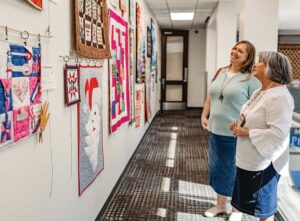

Celebrating 100 years of God’s faithfulness
Story by Joe Whitten
Photos by Wallace Bromberg Jr.
Submitted photos
For a church to arise from Saturday nights of music and dancing is – without a doubt – a unique beginning, but that is the case of Mt. Moriah Missionary Baptist Church.
“A dirt road, a smattering of houses, friends, guitars, banjos, music and dances –God had a plan.” So begins Redena King’s 1975 handwritten two-page history as told to her by Essie Vaughan, the daughter of George “Doc” and Ada Tollison.
With that sentence in mind, relax in your recliner and let your mind drift back a hundred years to a place in St. Clair County called Sage Hill. Think of a field of russet-gold sage (sedge) grass rippling in an autumn afternoon breeze. As you daydream, listen for music floating on the breeze – stringed instruments joyfully filling the cool of the day. It’s Saturday night, and a family is hosting the weekly hoedown at a home in Sage Hill.

These weekly events brought banjo, guitar, mandolin and fiddle into happy harmony that soon had couples dancing, while for other folk it was background music for visiting with friends not seen since last week or perhaps a month or so ago.
Known today as Mt. Moriah, Sage Hill was sparsely populated in 1925. The nearest school was probably Stewart’s Schoolhouse, a few miles away where Mineral Springs Baptist Church sits today, and the nearest church was Broken Arrow Baptist, about five miles away in Wattsville. So, we can surmise that most of the Saturday night merrymakers didn’t get up early Sunday morning and walk five miles to church. And it’s possible that one or two men may have partaken too much from the “little brown jug” and slept late.
But, indeed, God had a plan that included George “Doc” and Ada Tollison at whose home many of these Saturday night hoedowns occurred.
“Mr. Tollison had a nephew, Oscar Tollison, who was a preacher,” the history records. “He began coming here [to Sage Hill] and preaching on the weekends.” Mrs. King quoted Essie Vaughan, Doc Tollison’s daughter, who said, “The dancing soon stopped, but the preaching continued.”
This spiritual awakening saw different families welcoming weekend church services at their homes. At one of these services, Doc Tollison was saved. As the weekly preaching continued, others were converted.
Attendance at the home services grew so large that the men constructed a brush arbor on the Tollisons’ land as a place of worship. Bernice Sweatt Voss in her 1975 memories of Mt. Moriah described it. “The brush arbor had posts of good size trees [at the corners] and [tree] limbs made a sort of frame on top. Then brush covered [the limbs] to make a shade.” Doc Tollison’s wife, Ada Tollison, was saved in one of the brush arbor meetings.”
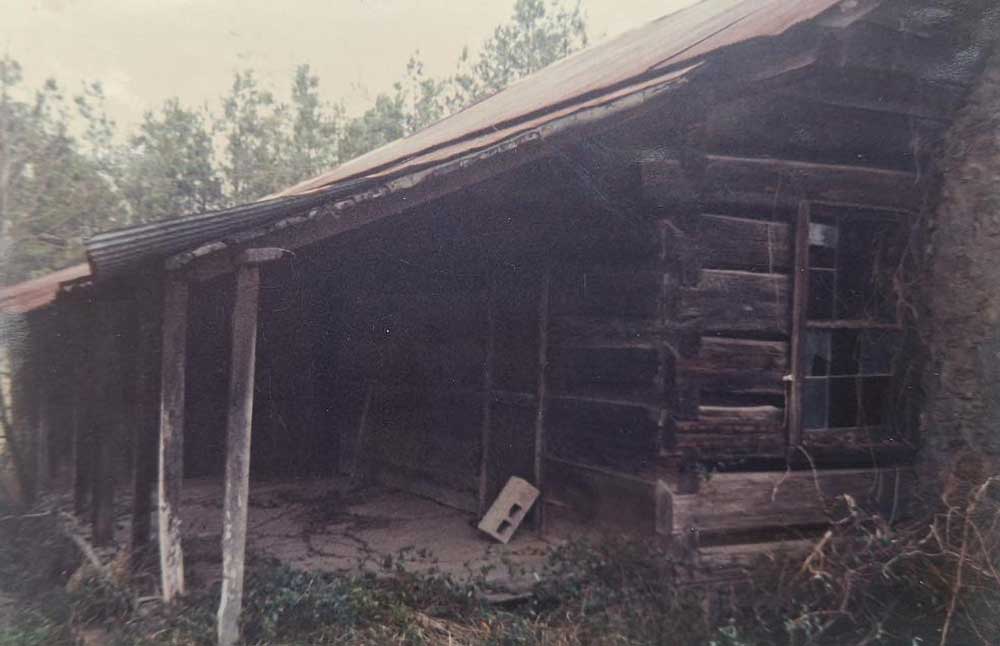
Essie Vaughan recounted that soon the men constructed a church house “… alongside the road … It was a long building with a door and windows facing the road and a door facing the road where the [dinner-on-the-ground] tables …” once stood. Those tables were located to the right of today’s fellowship hall as you face the double doors downstairs.
Hazel Layton Morgan in her written memories referred to the building as “shotgun style’ and that it was lit by kerosene lamps in cast iron wall brackets.
Essie Vaughan recalled that preaching was usually two times a month, and “the singing during services were acapella – no piano – to begin with.”
In her recollections, Hazel Layton Morgan mentioned the church pump organ, and this may have been the same one Bernice Sweatt Voss mentioned in her memories when she wrote, “We didn’t have any music instrument, so Mother and Dad loaned a small ‘piano’ organ for a while. Mother would play it, and Eunice and I would stand and pump the peddles for her.” (A “piano organ” was a small portable reed organ.) Eunice and Bernice often sang duets, and one of their favorites was In the Garden.
Building a congregation
Bernice Sweatt Voss’ family started attending Mt. Moriah in 1937, and she described the sanctuary of that time. “The building was a small wooden one with [asphalt] ‘brick siding’ on it …” standing close to the road. She also recalled that attendance outgrew the building by the late 1930s so “… we’d put the benches outside by the side door … pull the piano close to the door inside, and we’d have service at night this way. The preacher would stand in the door, and we all heard well.” The outside worship service provided relief from the summer heat inside the building.
Around 1945, the congregation built the second sanctuary, a white-painted wooden building. Willie Ann May remembered that Summa Collette and Almos Sweatt collected $50 and gave it toward this new building.
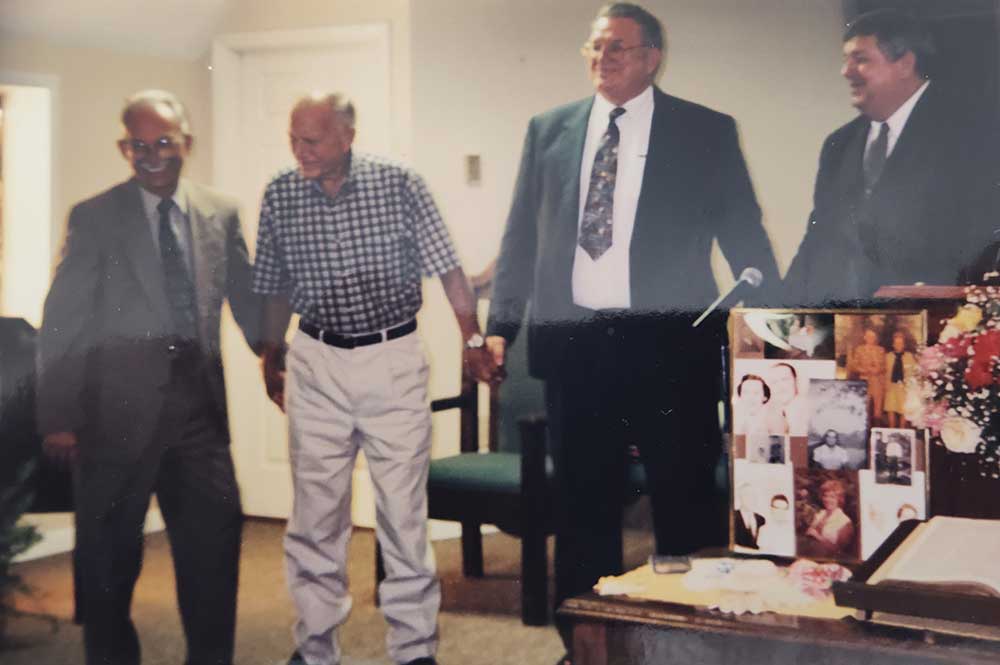
In the early 1960s, the third church building was originally constructed of concrete blocks, then, some years later, faced with red bricks and crowned with a white steeple. From the parking lot, a sweep of steps led to a portico, protecting the double doors into the sanctuary.
This building was turned into Sunday school rooms when the fourth sanctuary was erected in 2002-2003 under the ministry of Rev. Ronnie Venable. This building extended over part of the parking lot and provided space for a downstairs Fellowship Hall.
The fellowship hall is named The Howard L. Savage Fellowship Hall. He and his wife, Juanita Savage, were faithful church members who were involved in the planning and building of the current sanctuary. Mr. and Mrs. Savage are remembered as always ready to participate in anything the church needed. And many other dedicated members of Mt. Moriah helped in all areas as well.
All four church buildings were constructed on land donated by Doc and Ada Tollison. Thus, their legacy lives on.
“Bro. Ronnie Venable was a faithful leader throughout the building process,” according to Redena King’s history. “Each of the churches were built by the help of the Lord and through the faithful dedication and service of men, women and youth who spent many hours working diligently to build a place of worship for all who would come and join in worship.”
Lifting up in song
In the “olden days,” to the right of today’s fellowship hall, there was a row of concrete “dinner on the grounds” tables where food was spread on special days, such as all-day singings and Homecoming celebrations.
Both Singing Schools and All-Day Sings were enjoyed by Mt. Moriah and the outlying communities. Willie Ann May recalled that Mr. and Mrs. Harden conducted Singing Schools every summer, which continued into the 1960s, teaching shape-note music, how to read it, sing it and play it. Then for several years, the yearly singing school was discontinued.
In 2021, Landon King, church pianist, reestablished the Singing School at Mt. Moriah. The school director, Tom Powell, is the grandson of G.T. “Dad” Speer, of The Speer Family gospel group. He is the director of the Alabama School of Gospel Music held the first two weeks of June each year at Snead State Community College in Boaz. His wife, Dr. Lisa Powell, also teaches in Mt. Moriah’s Singing School and at the Alabama School of Gospel Music.
Tracy Phillips, accompanist for the Mt. Moriah event, is an acclaimed pianist who has accompanied groups at Gaither Homecomings.
In her memories, Mrs. May recalled the joy of All-Day Singings: “…all we did was sing. Everybody was expected to get up and lead a song.”
Mrs. Voss has a vivid memory of an All-Day Singing in 1938. “We had an all- day singing and homecoming, and we had a great time. But after the singing was over, we kept talking and praying, and I found I was very much under conviction, and people began praying for me, and I was saved!”
Often, singings were announced in the local papers. In one church file are three announcements from undated and unidentified newspapers. One reads: “Singing at Mt. Moriah Saturday Night. There will be a benefit singing at Mt. Moriah Baptist Church Saturday night, January 12, beginning at 7 p.m. Special singers will be the Sonata and the Gospel Four. The proceeds from this singing will be to help pay for a singing school to be held in the county this spring. Everyone is invited to attend. Pastor Rev. Amos Sweatt, Vester “Buck” Castleberry, chairman.”
The second clipping announced the Crusaders Quartet of Anniston as special guest, and the third one reported the Lloyd Chapel Quartet as special singers.
Revival Time
Yearly revivals were standard, and Mrs. Voss recalled one in 1938. “This was the year men cut down trees and made a brush arbor for the revival in August or July … I think there was sawdust to keep the dust down. We had services day and night. At this revival, I joined the church and was baptized in Jones’ swimming hole in Coal City about where the Wattsville Post Office is now. Several others were also baptized. I think part or all of them were added to Broken Arrow [Baptist Church], including me.”
Mrs. Morgan recalled that evening revival services sometimes went on until 11 or 12 o’clock. She spoke of praying and shouting in these services. The shouting would be exclamations of “Hallelujah!” “Praise the Lord!” “Glory to God!” These joyful expressions were prevalent in both Baptist and Methodist revivals, back in the day.
Perhaps the best recollections of revival time from 50 plus years ago were those of Margie Smith Castleberry. She told of a prayer rock where the women of Mt. Moriah would meet to pray for the revival. Surely, as the women met at the prayer stone, they recalled God’s revival blessings of the past and prayed for God’s power in the current revival.
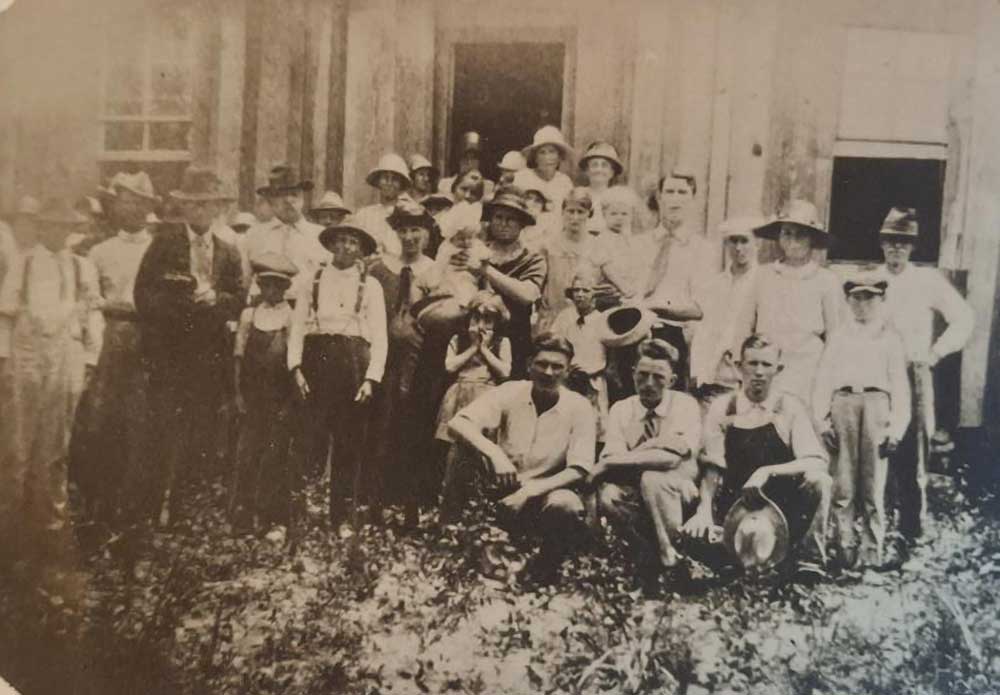
“The revivals would last two weeks sometimes,” Mrs. Castleberry wrote. “The women would fix lunch and dinner for the evangelist and the pastor. The revivals were always in July, when we would be in the middle of canning time, but we managed to attend every service. When we sacrificed our time, God really blessed,” she concluded.
Mrs. May recorded memories that were special to her. One occurred when Billy Walker was the pastor shortly after the second church construction. “He told all the young people that if they would come for a year without missing a Sunday, he would give them a brand-new Bible. Back then, they had a roll chart on the wall, and every Sunday you were present they put a star beside your name. I remember going every Sunday for a year, and I got a new Bible. I was so proud of it.”
Another special childhood memory for Mrs. May was the Easter egg hunt the year “Mrs. Flora Sweatt made Easter baskets out of oatmeal boxes for my sister Linda, my brother, Enis, and me.” Bought baskets were a luxury in those days when money was hard earned.
Easter and Christmas usually found Mt. Moriah’s musicians and choirs preparing to present special programs such as cantatas and musical plays and programs involving adult, youth and children’s choirs. Many church members have assisted the choirs through the years, including Joan Golden, Nora McNutt, Vicki Newton, Wanda Kelley, Redena King, Vickie Smith and other volunteers.
In their memories, two of the ladies mentioned the ordinance of “foot washing.” This was based on Jesus washing the disciples’ feet as an act of humility. In the churches who practiced this, the men and women met separately for the ceremony.
Maggie Smith Castleberry mentioned that the church observed this “ever-so-often.” Willie Ann May recalled how her daddy, Will Rowe, would participate in foot washing, told how her brothers, Jack and Buck Rowe, doctored their dad’s socks. “One time before foot washing service, they filled daddy’s socks up with soot…When he pulled off his socks to wash feet, they were black with soot.” She did admit that her daddy, “didn’t think it was very funny.”
The foot washing services Mrs. May remembered, eventually ended, but another event she remembered from the “olden days” continues today: Vacation Bible School. “I remember one summer that for Vacation Bible School Mt. Moriah got a Southern Baptist Home Missionary to come and teach our Bible School,” she wrote.
“She would go home with different members of the church each day for dinner and to spend the night.” The missionary must have been young, for she mentioned that some of the high school age boys would come to the crafts session and participate.
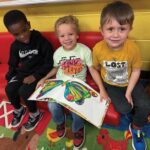
Mrs. King remembered Vacation Bible School lasting two weeks in the 1960s. As an adult, she participated in various areas of preparation and teaching during this community event, which today occurs in June shortly after regular school ends for the summer.
Jessie Garrison, Bro. Ronnie Venable’s aunt, taught, led and hosted Bible Drills at the church for several years. She also planned special WMU programs. Community outreach ministries occurred throughout the year – Vacation Bible School, Breakfast on 1st Saturdays, 5th Sunday night singings, Man Church on Tuesday nights, fall festival, and Youth night.
Reaching Out
Mt. Moriah’s membership in the Southern Baptist Convention’s WMU (Women’s Missionary Union) began in 1975 and remains active today. Mrs. King recalls a particular WMU meeting in 1998. “On a Tuesday night [April 7] we had WMU, and in our meeting, I asked the question, ‘How could we reach out into our community?’” She paused reflectively, and added, “I told them later that I didn’t know if I’d ever ask that question again! Because the next night [April 8], the tornado came through, and we were in this community for eight, nine, 10 weeks, ministering to the community.”
That community outreach was headed up by Bro. Ronnie Venable and his wife, Joan. The church accepted monetary donations which were later divided among community families who suffered loss in the storm. The Sunday school rooms were filled with clothing and supplies for those in need, and FEMA made Mt. Moriah Church building their headquarters.
Heather Sharp, writing for the St. Clair News-Aegis, Thursday, April 23, 1998, reported Bro. Ronnie Venable offered the church as headquarters for FEMA, the Red Cross and the St. Clair County EMA.
The article reported that Ellen Bain, the local EMA assistant, said all the agencies “…praised Ronnie and Joan for all their contributions,” and that Bro. Ronnie was “…the emergency manager. He knows how to match resources with those who need them.”
The article reported Joan as stating, “We just delegated,” but she worked right alongside the church women who cooked for the volunteers and the victims. Not only did the women serve lunches at the church, but they also delivered “go boxes” to homes and to disaster relief workers onsite. Mrs. Venable is quoted as saying, “It’s been marvelous to see everybody pull together.”
This 1998 community outreach continued when the fourth building was completed in 2003. Florence Kerr tells how the church is used today when tornado warnings are announced. “The building has below the ground space, and we open it up for the people who live in mobile homes – and I’m one of them – so, we come here. And one night, I think we had over 40 people. Different church members had brought food and stuff, and we fed them and had beverages.” Florence was recalling a tornado warning in the spring of 2025.
Celebrating Centennial
Sunday, August 10, 2025, dawned with clear skies and soon, sunshine baptized Mt. Moriah’s church building in a gilded glow, a radiant welcome to attendees who began arriving about 9:15.
Bro. Danny Wyatt, interim pastor, welcomed the congregation after which Candi Jones gave a brief power point history of the church.
Enthusiastic congregational singing included Glory to His Name, Majesty, It’s a Grand and Glorious Feeling, Getting Ready to Leave This World, The Sweet Forever, and If We Never Meet Again. The only accompanying instrument was the piano played by church pianist King and former church pianist Jason Vaughan. Their fingers danced over the keys, Southern Gospel style, more joyfully than any Saturday night stringed instruments event at Doc Tollison’s in 1925.
Bro. Zane Smith, former pastor, spoke of the church’s progress while he served Mt. Moriah. During his almost 11-year tenure, there were improvements to the sanctuary, and added outreach ministries encouraged the community. The oldest former pastor in attendance was 91-year-old Lloyd Golden, who commenedt, “I was saved in this church and was never lost again.” The church’s oldest member, 91-year-old Mona Scott, spoke about was a blessing Mt. Moriah had been to her.
The Doris Akers’ song, Sweet, Sweet Spirit, sung near the beginning of the service expressed the atmosphere in the church:
There’s a sweet, sweet Spirit in this place,
And I know that it’s the Spirit of the Lord;
There are sweet expressions on each face,
And I know that it’s the presence of the Lord. Sweet Holy Spirit, Sweet heavenly dove,
Stay right here with us, filling us with Your love;
And for these blessings we lift our hearts in praise
Without a doubt we know that we’ll have been revived,
When we shall leave this place.
A ladies’ quartet, Nora McNutt, Vickie Smith, Redena King, and Linda Vaughan, sang I’m a Child of the King and I Claim the Blood. The church choir sang Mansion over the Hilltop and What a Great Savior Is He.
From Romans 12:1-2, Bro. Danny Wyatt preached: “I beseech you therefore, brethren, by the mercies of God, that ye present your bodies a living sacrifice, holy, acceptable unto God, which is your reasonable service.And be not conformed to this world: but be ye transformed by the renewing of your mind, that ye may prove what is that good, and acceptable, and perfect, will of God.”
Wyatt’s sobering point was that the forces of evil have a definite purpose to fill individuals’ minds with ungodly thoughts and desires – even the minds of professing Christians. Therefore, believers should focus their minds on Scripture and things of God.
After the sermon, a young lady who had accepted Christ as Savior during Mt. Moriah’s summer Vacation Bible School was baptized.
Before the closing prayer, Bro. Wyatt asked pianists King and Vaughan to play a duet. And what a duet! No doubt all 88 keys were played and replayed with chords and runs, with flourishes and crescendos of the joy of the Lord. Hands were clapping, and toes were tapping when the duet ended.
Bro Wyatt closed in prayer and a blessing over the meal to follow in the Fellowship Hall.
One can hope that God allowed those who organized the church a hundred years ago to look over the battlements of Heaven and rejoice over what God has accomplished with what He allowed them to begin when he turned their dancing into a prayer meeting and the prayer meeting into a revival and from the revival a church.
To God be the Glory. Amen.