Eleanor Shirley Isbell

Story by Joe Whitten
Submitted Photos

Come, travel the backroads to meet a 92-year-old lady whose life has exhibited the love, joy and peace of God throughout the years.

Eleanor Shirley Isbell always has a ready smile and a chuckle or laugh as she reminisces about her life.

Although born in Acmar on August 18, 1934, her birth certificate lists Atmore, Alabama, as her place of birth.

“Mamas didn’t go to the hospital to have babies in those days,” she explained. “So, on my birth certificate, they’ve got Atmore because in Montgomery, they had never heard of Acmar.”

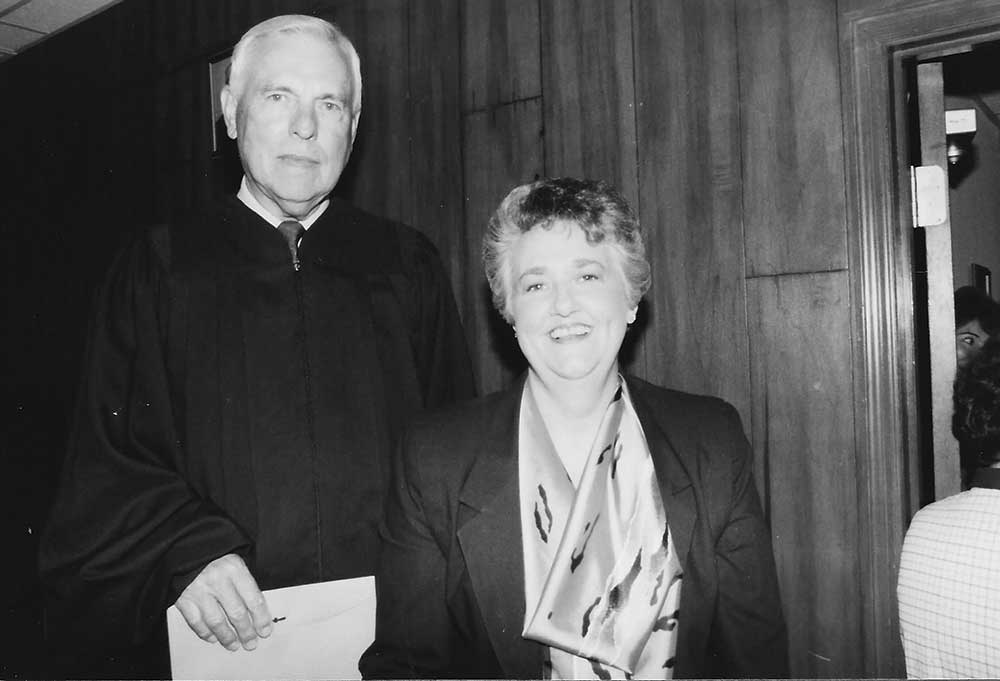
Eleanor sworn in as first woman on Moody City Council Judge Edwin Holladay

Clyde and Edith Bishop Shirley lived in the St. Clair County coal mining community of Acmar when Eleanor was born, and Clyde worked the mines. Sisters Linda, Margaret and Mary arrived at regular intervals.

From Acmar, the family moved to a house in today’s city of Moody. She remembers well living there. “In one side of the house was mama and daddy and us kids, and in the other side was my grandmother and grandfather Bishop. I spent a lot of time running back and forth,” she chuckled. “And I remember grandmother had this wood cookstove. It had a warmer on it above the stovetop, and after breakfast, she would put the leftover biscuits in the warmer. So, when I was going through there, she would take a biscuit and put some sugar in the biscuit for me,” she smiled, relishing the memory. “It’s a wonder somebody didn’t give us a whipping for running through there!”

The Shirley family moved a few times, and then Clyde built a house on today’s U.S. 411, a dirt road in those days. Eleanor described Clyde’s method of construction. “When my daddy built something, he just built it. No measurements. No nothing,” she said. “At this house he built, it had a grocery store in front, and we lived in the back. But, again, not a professional builder,” she emphasized.

Her sister Margaret’s room was next to the store, and the plank wall had knotholes. The flickering shadows that came from the store through the knotholes frightened Margaret every night.

It seems Clyde enjoyed building because Eleanor remembers living in other houses he built with his “saw it and nail it” method. He may have been a little like the self-taught country carpenter whose policy was, “It may be a little cattywampus, but it’ll all come out in the wash.”

She attended Moody Elementary and Middle School, graduating from the ninth grade there. For high school, she rode the bus to St. Clair County High School in Odenville, where she graduated in 1953.

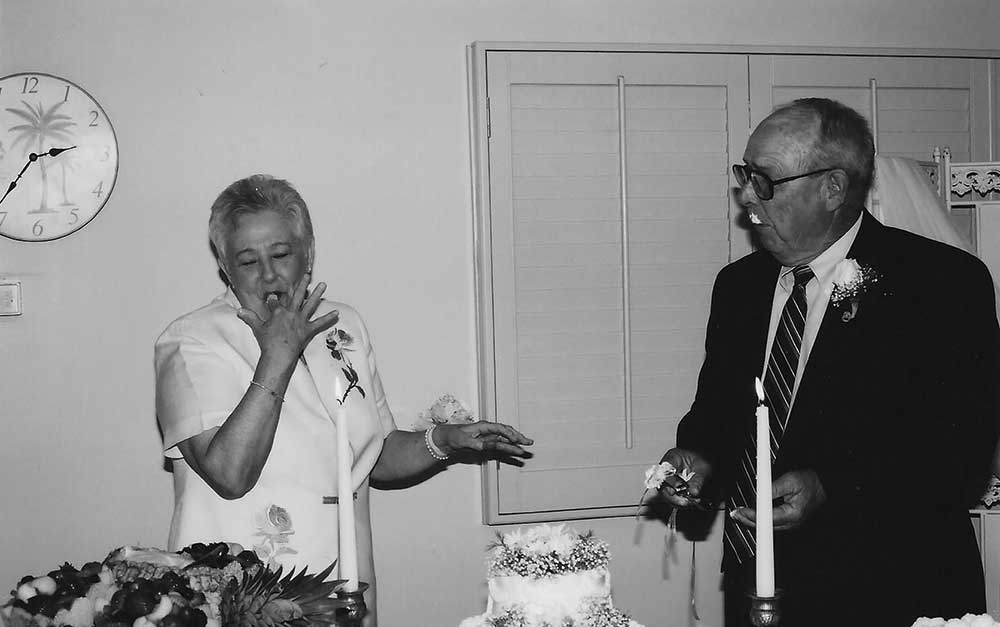
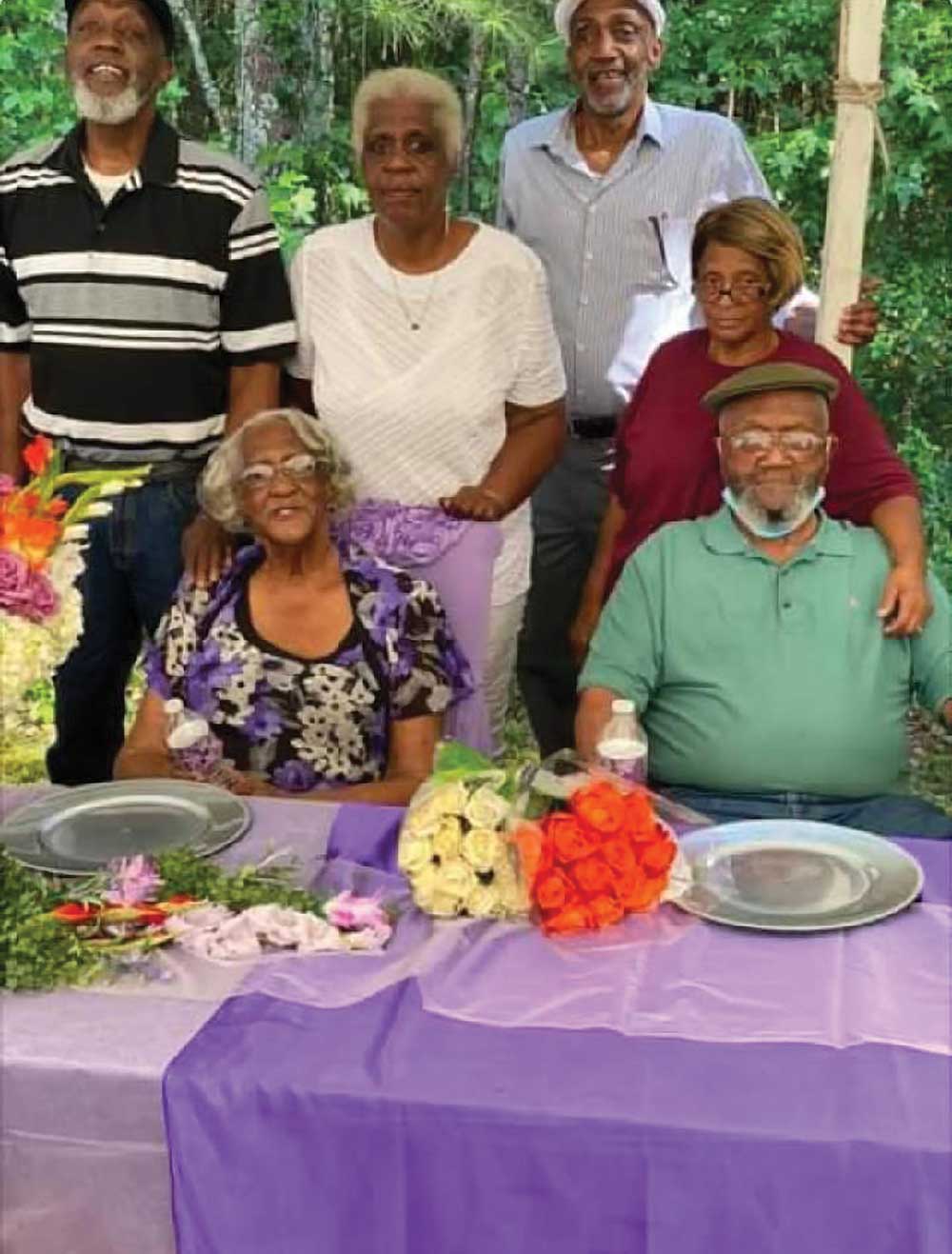
Eleanor and Milton’s 50th wedding anniversary

In 1954, she married Milton Isbell – and that’s a story of its own.

“You know how in Junior High there’s always one male student that all the girls are in love with,” she began. “There was no way that I was ever gonna get to date that one because his father made whiskey.”

With eyes still twinkling, she continued. “Here’s the deal. Milton was friends with the boy that all the girls were in love with, so my first date with Milton was a double date with the whiskey maker’s son – who was the driver – and his girlfriend. Me and Milton were in the back, and I dated him because the other boy was in the front seat.

“We dated a few more times – and Milton used to say I chased him, but I don’t remember chasing him. Anyway, we got married after he joined the Navy.” And the marriage lasted until Milton’s death, August 28, 2018 – 64 years.

Milton was in the Navy when they married and stationed in Alameda, California, so Eleanor bought a one-way ticket to San Francisco.

Crossing the US to California, she recalled, “I didn’t think much about it until I got that one-way ticket, and I thought, ‘Oh, no! I may never be coming back to Alabama!’”

Her fear was unfounded, though. About a year later, Milton was reassigned to Pensacola, Florida, where he worked in the print shop. He worked at that job until he was discharged from the Navy, and he kept the same print shop job as a civilian when he was discharged from the Navy.

Their son, Tim, was born in 1955 in Pensacola, and the Isbells lived there until he was about a year-and-a-half old. On the weekends, they would head back to Moody.

“One time when we were going back from Moody to Pensacola, and we hit a mule. I was in the front seat holding Tim – back then babies didn’t have to be in the back seat like they do today. We hit the mule, and it went up in the air, and it came back down, through the windshield the side I was on. And that mule got up, shook itself and ran off.”

Trying to locate the owner of the mule was a lost cause. “Nobody owned that mule,” she laughed. “Nobody claimed it, and of course we had to have a lot of work done on the car.”

The weekends traveling back and forth grew old, so the family moved to Leeds. Later, they moved in with Milton’s mom and stepfather. That house was right up the hill from the new Civic Center in Moody. Eleanor and Milton had two rooms at the back of the house and daughter Susan was born there in 1958.

Their next house was built by a company who just put up the outside walls. “So, that’s what we got,” Eleanor recalled. “We moved into that house and wasn’t anything done inside but studders. Not anything, and Milton gradually got it fixed, and we lived there 49 years.”

Father knows best

Pop, Clyde Shirley, could give good, blunt advice. Eleanor told of a time he kept her and Milton focused. “Daddy gave us a lot next door to them. So, we got the foundation built, and somebody was going to Florida, and we wanted to go. We didn’t have any money, so I went to my daddy to ask for money to go to Florida, and he said, ‘Do you want to go to Florida, or do you want to build a house?’” After a hearty laugh, she added, “So, we didn’t go to Florida.”

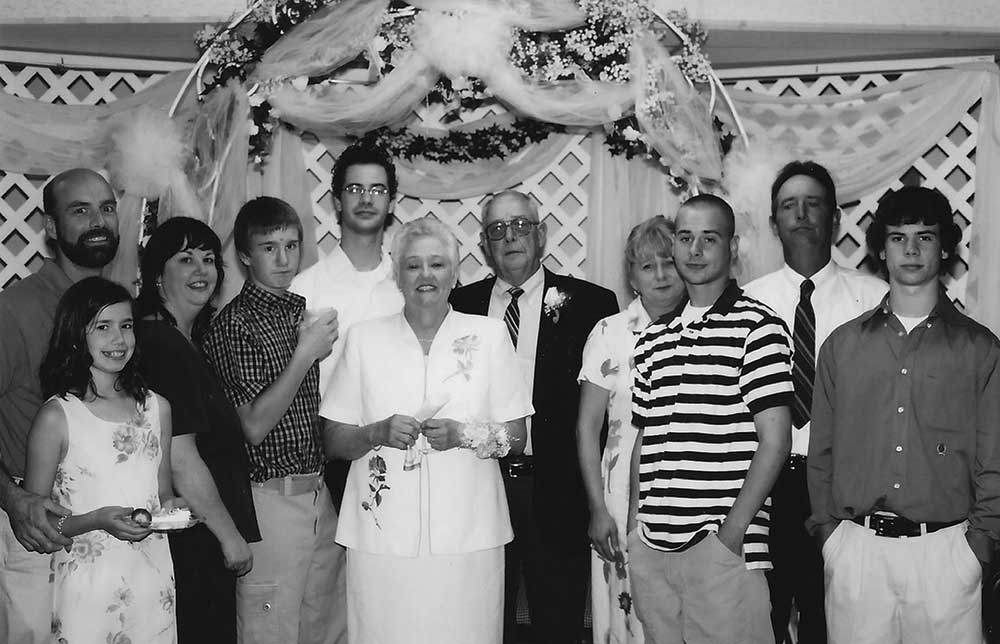
The Isbell family

Career paths

Including the Navy, Milton held down several different jobs. He worked for a little while at Ft. McClellan until they had a huge layoff. He was a milkman for a while and then he worked at Murry’s Garage. Then he went to work at Greystone Golf Course. Eleanor enjoyed several tournaments and met some famous golfers while Milton worked there. That ended one day when Milton had a confrontation with his boss, picked up his toolbox and said, “I’m going home.”

The very next day, Milton went to work at the Cahaba Country Club golf course, where his son Tim was employed. Tim had started working there when he was 14 years old. Milton worked there until he retired.

Eleanor also held several jobs during her working years. She spent 20 years with Dun and Bradstreet. “I worked a little while in every department,” she said. “Over the years, I must have been private secretary for eight or nine men at Dun and Bradstreet.” When she asked to be in sales because she knew those men earned the most, they refused her request, and she left the firm.

From there she spent 15 years in real estate. Then she tried retail sales for a while but quickly grew tired of that job. But that led to work she probably enjoyed the most.

The family was members of Leeds Assembly of God where Dan Ronsisvalle was pastor. One day she was at the church with others to go visit the sick and shut-ins of the church. The pastor pulled her aside and asked her if she would be his secretary. The secretary, his wife, wanted to give up the job. Eleanor agreed to take that church position

After she had been there for some months, she had surgery. As she recuperated at home, Pastor Ronsisvalle called and said, “I don’t like bookkeeping. I want you to be the church bookkeeper.” Eleanor said, “Well, I’ll have to pray about that.” Ronsisvalle replied, “You don’t need to pray about that.”

She became the bookkeeper, but it wasn’t long until the church needed a treasurer, and he asked her to take that job, and she did.

“At Leeds Assembly of God,” she reminisced, “I was secretary, I was bookkeeper and treasurer – and I did everything but sweep the floors,” she said. “I really enjoyed working for Ronsisvalle. I would go dragging in some days, and he’d come bouncing in, singing and carrying on, and say, ‘Good morning, Sunshine!’ And here I was with my head on my desk. He was always so happy.”

She paused and added quietly, “And I miss him, I miss him. I worked for my church for over 20 years. I worked until I was 81. My last day was July 4, and I turned 81 in August.”

Chronicling history

Eleanor wrote an article titled, “Moody, Alabama, “Then and Now,” which was published in Cherish, The Quarterly Journal of the St. Clair County Historical Society in October 1993. In it, she told how Benjamin Epps Moody arrived in St. Clair County. “He came with his family from the hills of North Carolina in 1820 to homestead a section of land granted to him when James Monroe was the country’s president.

“Mr. Moody built a one-room log cabin with a chimney at one end. He worked many long hours at building his chimney, digging the clay from his own land and molding the bricks by hand and baking them in an open fire. Years later, when the growth of his family demanded more room, the log cabin was torn down from around the chimney and a new house was built in its place.” The house has been reworked several times, but it and the chimney still stand in 2026.

Other families came to the area. “The good news had spread to North Carolina,” Eleanor wrote. “Soon there were homes belonging to the Moores, Kerrs, Lamberts, Taylors, Spruiells, Kirks, Adkins, Hawkins and Fulmers. Many of these family descendants live in Moody presently… These [early] folks were hardworking and loved liberty and opposed slavery. Not a single family owned slaves.”

People on foot, horses and wagons wore trails in four directions from the Moody home, and the community began to be called Moody’s Cross Roads.

Eleanor herself has lived and remembers a great deal of Moody’s history, since her dad, Clyde, rallied forces to found the town of Moody. Eleanor calls it “Pop’s last adventure.”

In 1962, Moody citizens learned that Leeds was interested in annexing the Moody area into the city of Leeds. Clyde went into action. He chose a group of men, one of them an attorney, who went to Montgomery and had the City of Moody incorporated.

“You’ll laugh at this,” Eleanor chuckled, “Pop hand-picked the first mayor and five counselors, and the election was without opposition. Mayor, A. E. Moore, and as counselors, he was counselor number one. Then, Hermon Waid, Hubert Adkins, Rodney Miles, and Jimmy DeShazo.” Milton Isbell was the first City Clerk, but that only lasted about two meetings, and he knew that job was not for him.

The first Town Hall was an addition to Clyde Shirley’s Swap Shop. “Remember, Daddy was not a good carpenter,” Eleanor laughed. “He just threw things up, you know. No measuring tape or anything. Well, that’s what the Swap Shop was – just thrown up. So, for the first Town Hall, Daddy just added a little more to the Swap Shop.” She paused and added nostalgically, “My daddy was something else!”

Living history

In 1980, Eleanor herself made Moody history for being the first woman elected to the Moody City Council. She recalled that she was preparing peanut butter and jelly sandwiches when “a still small voice said, ‘Run for Moody City Council.’ ‘Why would I do that,’ I wondered, but I knew my Pop would love me serving on City Council.” She got her name on the ballot with two others who were campaigning for the office. The general election ended in a runoff. Eleanor won the runoff.

After winning, she had a lot to learn. She spent many hours reading legal papers and learning laws and procedures. She credits then City Attorney Jim Hill as helping her the most in learning the ropes.

She ran for re-election, losing by 35 votes in a run-off. During that election, she recollected, “My mom said, ‘I will vote for you, but I pray that you lose.’” She laughed, and added, “God delivered me from politics!”

In her Cherish article, Eleanor pondered the future of Moody. “Who knows,” she wrote, “where the [present] growth will end? My dad paid $300 for seven plus acres in 1948. A couple of years ago, an acre of that same land sold for nearly one hundred thousand dollars. No one can be certain how much bigger Moody will get. There are rumors of a large discount store such as Wal-Mart or K-Mart coming to Moody. The rumors come and go. However, no matter how big it grows or how busy it gets (thousands of cars traveling daily on Highway 411), I still can close my eyes and picture two dirt roads known as Moody’s Cross Roads, where there was little traffic and only two stores, Hannon’s and Forman’s groceries, and a few friendly folks. It was home then, and come what may, Moody will probably always be home sweet home to me.”

In God’s providence, Eleanor has lived to see and know how the City of Moody has grown. She recently expressed her joy, by saying, “In thinking back to the add-on first Town Hall, I stand in awe of our lovely City Hall today, the great library and Civic Center.”

Although she deals with several health issues, Eleanor is the same cheerful Eleanor she has always been. Retired St. Clair County Judge and current State Rep. Jim Hill’s observations about her suit her well.

“When I think of Eleanor Isbell, it makes me smile, because every time I saw her, she had a smile on her face. She had a great outlook on life and was a pleasure to see and to be with.

“I met Eleanor probably 40 years ago. She was a Realtor in the Leeds/Moody area. I was a young lawyer, and a fair amount of my practice was real estate. Many times in church, we talk about the fruits of the Spirit – love, joy, peace, etc. Eleanor not only knew what they were, she exhibited them and lived them.

“I would be remiss if I did not mention Eleanor’s husband, Milton, who was just like her. They were a wonderful couple and perfectly matched.

“They say everyone makes you happy. Some people when you see them coming, and some when you see them going. Eleanor always made you happy when you saw her coming. She is truly a special person. If the world were full of Eleanor Isbells, it would have a lot less problems than it has now and be a much better place to live.”

And all who know her agree. Thank you, Eleanor, for your 92 years of blessing the lives of others.

Johnnie Mae Green

Story by Joe Whitten
Submitted Photos

Johnnie Mae Beavers Green may be 95 years old, but her dignified demeanor and perfect posture would make the biblical Queen Esther proud were she still around.

Having lived in the Pell City area for most of her life, Johnnie Mae’s memory is an encyclopedia of local Black history. Tonya Forman expresses loving gratitude for her help in assimilating local history for the Breaking Barriers section of the Museum of Pell City. “Mrs. Johnnie Mae is a treasured source of wisdom and history in our community,” Tonya said.

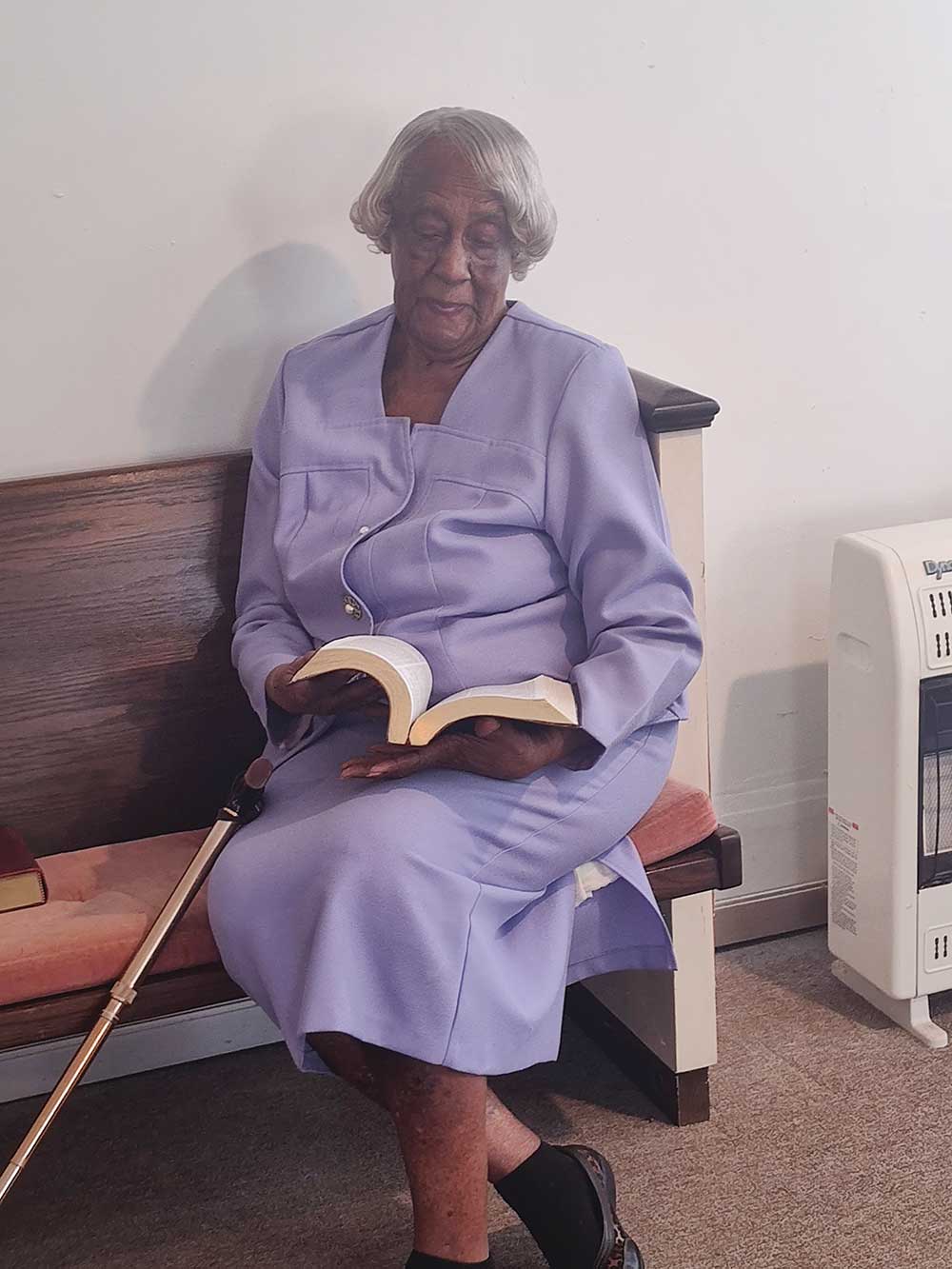
Johnnie Mae Green reading her Bible at Mt. Hillary Church

“Her memories and stories preserve the legacy of our families, churches and neighborhoods, helping to connect past generations with the present. She’s my personal historian. I can sit and listen to her talk and sing all day.”

Guided by faith

Known for her faith in God, Johnnie Mae’s life has been guided by the Holy Bible and her faith in the God of the Bible. She has a godly heritage reaching back 200 years in St. Clair County’s African American church history. In the 1895, A History of Colored Baptist in Alabama and North Carolina, Charles Octavius Boothe records a brief biography of her great-great grandfather, Rev. Jasper Beavers.

Born a slave in 1825 in Easonville, Beavers learned to read and to write and became a minister of the Gospel of Jesus Christ. According to family history, Rev. Beavers preached the inaugural sermon at Blooming Light Missionary Baptist Church when it was organized on the first Sunday of July 1884.

Born July 18, 1930, to Herbert and Elizabeth Gibson Beavers, Johnnie Mae grew up in Tuscaloosa County until she was 13 years old. Her mother was native to Tuscaloosa County while her dad was native to St. Clair County. On Dec. 29, 1942, the family moved to the Crossroads community, south of Pell City.

‘Life was good’

“There were two boys and two girls in our family. I was the third child,” Johnnie Mae recounted recently. “We were share-croppers. We farmed. We raised pigs. We had a good milk cow. And life was good.”

A summer garden produced fresh vegetables as well as produce for canning for the winter months. “You know what we grew it with — fertilized it with? The manure from when they cleaned out the mule stables every year. And that’s how we fertilized the garden.” When a listening friend commented, “You had the best fertilizer in the world,” Johnnie Mae replied, “It grew a lot of grass! The animals ate the grass,” she laughed, “and we had to get it up.”

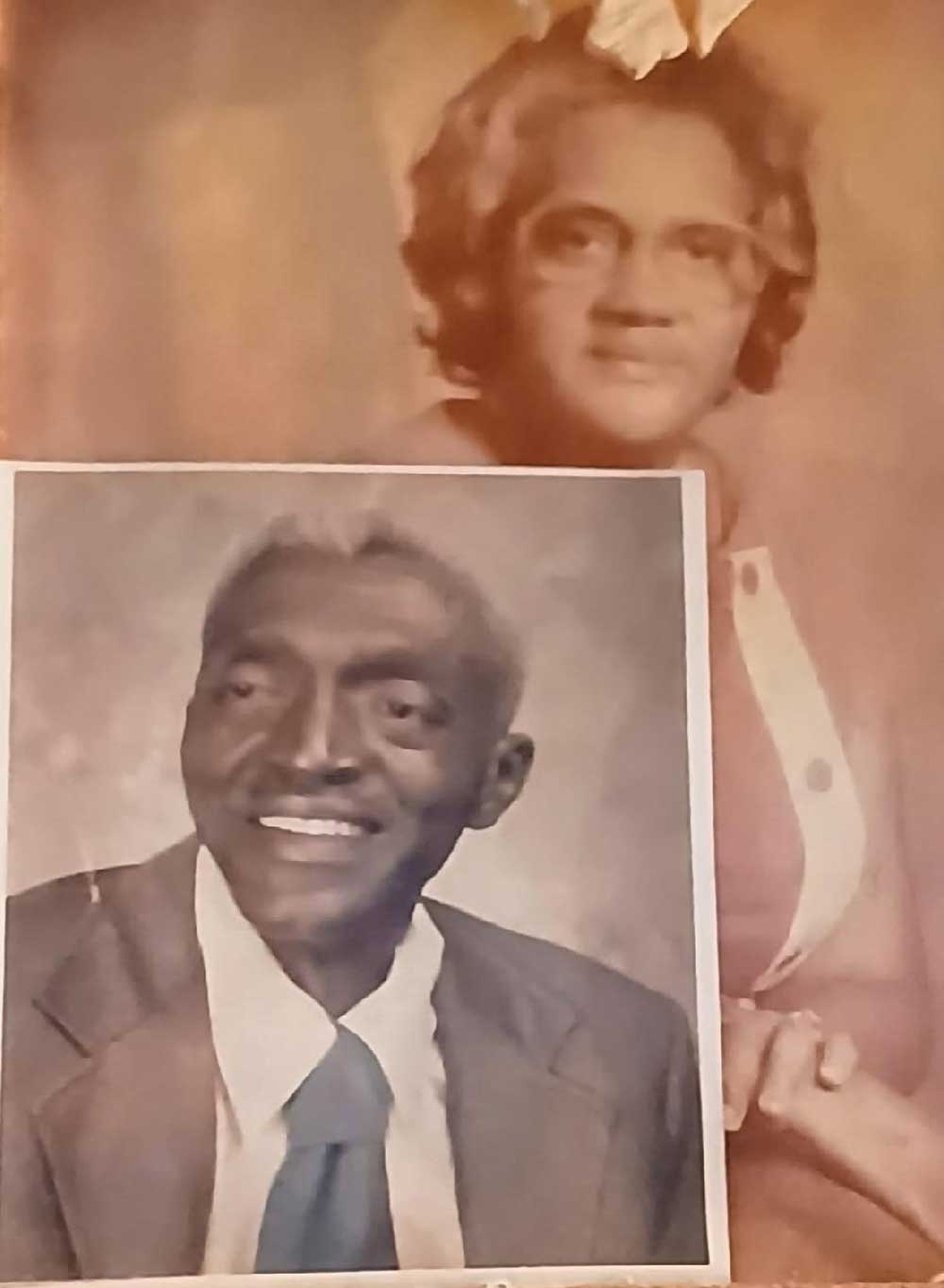
Charlie and Johnnie Mae Green

When asked about the best dish her mother cooked, she quickly replied, “apple cobbler. She could just naturally cook. No recipes.” Then she laughed and confessed, “And I’m gonna tell you the best thing she ever cooked, and that was opossum,” and she told how they prepared it.

“My dad would go hunting at night, and he would catch croaker sacks full. And he had a great big barrel he would put them in and keep them there about a week and feed them until they were fat enough. Then he would kill one. They burnt the hair off and then scraped it down so the skin was clean and pretty.”

After her mother had dressed all the innards out, she boiled it for a while before baking it in the oven with sweet potatoes.

Johnnie Mae declared her mother’s baked possum to be “Good eating,” then laughed and said, “One day me and my sister came home from school, and we ate the whole possum!”

She learned from her mom how to cook them, but by the time she had a home of her own, eating possum was out of style. “I don’t think any of my children ever tasted possum,” she said.

Continuing to reminisce about her mom’s cooking, she said, “Mom could cook almost anything because we had to make do with whatever they had.” One make-do vegetable growing wild in Alabama is the pokeweed that when cooked is called poke sallet. The Beavers family enjoyed it. “Poke sallet was a basic food,” Johnnie Mae recalled. “You could just go and gather that. Mom would clean it. Boil it good. Squeeze it out and rinse it, and then she put it in a skillet with onions. My daddy liked it with onions. Or you could mix it with turnips or other greens. That was a good dish.”

Quilting legacy

Mrs. Beavers also made quilts for winter warmth. And there was some make-do with that as well. When a garment was no longer wearable, Mrs. Beavers would use the garment areas that were still good. Nothing went to waste.

Mrs. Beavers made the girls’ clothes. Many dresses were sewn from colorful feed sack fabric. The girls would go with their dad when he bought feed and choose the sack they wanted for a dress. When enough feed sacks of the same pattern were accumulated, they would have a new dress.

Those vintage feed sacks from the 1940s today sell for between $20 and $45 per sack, depending on the design.

“Mom was a quilter,” Johnnie Mae reflected.  “And she used every little scrap she could find. You know we had to find little strings of cloth about an inch or two wide. She would cut a newspaper square and sew the little strips. And when you made a block, you tore the paper off.” Those were called String Quilts and were quite colorful with a kaleidoscope of different fabrics.

Johnnie Mae quilted all her life until she was 90. Then other things took up her time, and “I filled my little quilting room up with junk,” she said. “And I just got it cleaned out so I’m quilting again, and I’m not stopping anymore until the Lord stops me. I can do one a week.”

Growing up

She still lives in the same community and has good memories of growing up there. “It’s a funny thing, but it’s true. All the Blacks were on the Mt. Hillary Church side of Blue Spring Road. And the white families were across over here in their neighborhood. And it was just like one big family. We borrowed, and we visited, and we played together. We didn’t have any problems. So, we named it the Black Crossroads and the White Crossroads,” she laughed, then added, “And the funny thing, we thought we had a little more than they did. And they thought they had more.”

The Crossroads children played games that are now memories to folk of Johnnie Mae’s generation. “We played Auntie Over—throw the ball over a building. We played hopscotch. And jump rope, but I never could jump rope. We played Dropping the Handkerchief. And the number one game was Hide and Go Seek.”

Crossroads was a peaceful community, but when feelings got hurt or a misunderstanding arose, there was a solution. “If you had a falling-out with your neighbor,” Johnnie Mae reflected, “before you went to bed, you had to go and beg pardon of that person. And I thank God for that.” This principle is based on the Bible verse Ephesians 4:26, “Do not let the sun go down upon your anger.”

Such a rule kept harmony among the members of the communities, and Johnnie Mae was oblivious of color differences until one day in Pell City. “Back in the day,” she reminisced, “my daddy would carry us up to town [Pell City] in the wagon. It was summertime, and I got thirsty. I said, ‘I want a drink of water.’ So, we went to where the fountains were, and it said White and Black.  Daddy said, ‘Get over there and get you a drink,’ and pointed to the Black fountain. I said, ‘I don’t want no black water, I want clear water. I will never forget that,” she laughed. “I didn’t know anything about segregation until that day.”

After a pause, Johnnie Mae recalled a friend’s deprecating comment about another person’s ethnic background. Then she made a singular observation that deserves contemplation.

“I said, wait. Let’s talk for one minute. Do you think that when God spoke the earth into existence, and then he decided on making man, do you think He went and found brown dirt, red dirt and yellow dirt and made everybody?” Her speech tone was pulpit worthy. “No. He made every single one out of the same dirt. So, how can we put a separation between each other.”

There is silence as she ponders a few seconds and then she laughs, “I’m not gonna lie. There are some good people that are hard to deal with, but I love them … and love is what God teaches.” Again, she reasons from her knowledge of Scripture.

Education

When the Beavers family settled at Crossroads, the children attended The St. Clair County Training School in Pell City, and Johnnie Mae was in the 1947 graduating class. “It was the biggest class that had ever graduated from there,” she recalled. “There were 27 that graduated. What made our class big was that we had kids from Margaret and Acmar in our class.”

She was athletic and played on the Training School’s girls’ basketball team. “We had a great basketball team,” she recounted. “We won all of the little districts’ games. Maxine Jones was our coach. She was the principal’s wife.”

She remembered two of her principals. One was of short stature and without a strong personality. He could not control the students — especially the male students. If a student needed paddling, he would send for his wife who taught at Cropwell at the Greenfield school, and she would hitch up her one-horse wagon, come to the Training School, paddle the student and return to Cropwell.

To solve that problem, the Board of Education sent Professor Ruben Yancey to be principal of the Training School. “When Mr. Ruben Yancey came,” Johnnie Mae recounted, “he grabbed those boys by the collar, and it made a brand-new school. He taught them respect.”

Professor Ruben Yancey ended his career as principal of Ashville Colored High School. Professor Lloyd Newton and the Black community petitioned the St. Clair County Board of Education to rename the school Ruben Yancey High School, which they did in 1965. Sadly, Professor Yancey died shortly before the name change, but he lived and died well-respected by both races.

Life after high school

After graduating high school, Johnnie Mae attended Stillman College in Tuscaloosa for a year-and-a-half. However, she reflected, “The only reason I didn’t stay in college, I knew my parents were not able to send me. There were no student loans.  I knew they didn’t have the money, and I came out.”

Determined and courageous young woman that she was, however, she enrolled at Ruth’s Poro School of Beauty in Birmingham and took the six-months course to become a licensed cosmetologist. “It was hard, but God knows I enjoyed it. Cutting and pressing and curling hair.” When she started, that process earned her about $3 per person.

When asked about the location of her shop, Johnnie Mae replied, “I went. I travelled. I did a lot of invalid people — the ones that couldn’t get around.” She paused a moment, then laughing, said, “A friend came to the house yesterday and said, ‘Well, you’re 95 years old, and you’ll soon be up there in heaven fixing mother’s hair.’ And I said, ‘I’m not gonna work when I get up there. I’m gonna sit down and praise the King.” Among the laughter, somebody said, “Amen!”

Kimberly Moore said of Johnnie Mae’s skillful work, “She was excellent with hairdressing. Just about everybody I knew growing up, she pressed and curled their hair!”

In addition to hairdressing, Johnnie Mae worked the looms in two cotton mills. She worked for two months at Avondale Mill in Pell City, then took a job in Talladega at Crown’s Textile. “I had about five less looms to run than I had at Avondale, and I made $5 more an hour. I retired from there.”

Then she explained why she retired. “I drove by myself for seven years. Just me. There wasn’t very much traffic on Highway 34 then. But one night I had a flat tire, and over here at what we call the Twin Bridges, there was an invalid white man lived right on the road. And he heard me out there with my flat tire. He was feeble and on a stick, and he had a big dog and came to where I was.

“Finally some Black folks stopped, and he said, ‘If you all will change the tire, I’m going back to the house.’ But he left his dog there, and he told the dog to lay by my door. Bless his heart! I’m telling you,” she said, with thanksgiving in her voice, “every time I went to work, I stopped and hollered at him. He was dynamic. And that’s why I quit work, cause I thought next time it might be worse.”

She retired from the cotton mill, but she didn’t retire from working. She worked in the kitchen at the Black and White Nursing Home for a while and then at the Rosewood Manor for about four years. She left Rosewood Manor and worked briefly at an assisted living facility on Dry Creek Road; however, that facility had a short life. “They closed down,” she said, “and after tha,t I came home. I stopped working.”

But not really, for she continued to go to women who were confined to their home and dress their hair beautifully. And in that ministry, she spread sunshine and the love of God to the women.

Marriage, family and faith

In 1950, Johnnie Mae married Charlie Darnelle Green from Perry County. They were parents to four children — three boys and one girl. The Greens also took sisters Linda and Wandra Beavers into their home when their mother went to New York to work. Jobs were scarce back in that day.

At home, Johnnie Mae taught her children about God and his love, and they grew up in Mt. Hillary being nurtured by godly ministers there. “I’m so thankful,” she testifies, “that I had good children. They may have fallen out, but they made up and got along.”

Celebrating 90th birthday with family

About rearing children, she commented, “I tell you, it don’t cost but just a little to train a child the way you should train ’em. And when they’re old, they won’t depart from it,” quoting from the Bible. Then, reflecting of current troublesome times, she added, “I don’t know about that now. But I don’t think they depart, they just were never trained. Maybe God will fix it one day.”

It is worth noting that the Perry County Green family knew Coretta Scott King, and Johnnie Mae knew her as well. Furthermore, Rev. T. D. Jakes has genealogical connections to the Green family.

Charlie Green was a miner. When he stopped working in the mines, he took a job at Anniston Army Depot, where he worked until he retired. “It’s been a good life,” Johnnie Mae reflected, “and I don’t regret any of it.”

Mt. Hillary Missionary Baptist Church became her home church about the same time the family moved to Crossroads. Having already been baptized in Tuscaloosa County, Johnnie Mae joined Mt. Hillary in 1944. She told of her baptism as a 7-year-old. “I was baptized in a creek. I was scared of the turtles, and there was a terrapin coming towards me. They had to catch me and put me back in the water!”

When asked if she had sung in the church choir, she replied, “Yes, I did. And we had a little quartet. A little group, The Rose of Sharron Gospel Singers. There were six of us — Mertis Truss — O’Neal was her maiden name — was our musician. Her sister Josie sang with us. I was one of them. Then we had Livi Threatt, Flora Threatt and Nellie Mae Threatt.”

The Rose of Sharron Singers would pray before they went somewhere to sing, for they felt like they were worshiping the Lord through singing.

As she approaches year 96, Johnnie Mae’s faith in God is strong. How has her faith sustained her all these years? “It’s the song I sing all the time, Amazing Grace.” Then she quotes in a strong voice, “Through many dangers, toils and snares, I have already come, God’s grace has brought me safe this far, and grace will lead me home.”

A quietness settles over the room as she comments on her faith. “I told my church the other Sunday, ‘I have one thing to work on.’ They say, ‘What?’ And I say,’ My faith.’ I said, ‘The Scripture says if you have faith the size of a mustard seed, you can tell the mountain, ‘Be ye removed,’ well, I can’t move a stick. But I’m working on I,t and I trust Him. When I get up or when I go to the store, I say, ‘Lord carry me and bring me back.’ He is the only One I have.”

Although she may think her faith is small, her unwavering faith in God inspires many of her family members and friends. And the words of Andrae Crouch‘s hymn “Through It All,” fits her perfectly.

Through it all
Through it all
I’ve learned to trust in Jesus
I’ve learned to trust in God
Through it all
Through it all
I’ve learned to depend upon His word
Oh, I’ve learned to depend upon His word.

Many lives have been blessed by Johnnie Mae’s life and faith and would say, “Amen!” to Kimberly Moore’s loving comments. “For as long as I can remember, my Aunt Johnnie Mae has always been a woman of faith and highly involved in the church. She is the rock of our extended family, and her strong belief in God is what I  use as a model for my own life. She has taught me that no matter what happens God is in control … she often says that we have to lean and depend on Him and His word … her unwavering FAITH is a true testament of his AMAZING GRACE.”

Johnnie Mae Beavers Green. Keep on keeping on in your journey of faith. You are an inspiration to your family, your church and your hometown, for through it all you have learned to depend upon God’s Word.

Christ in Me Family Church

Story by Joe Whitten
Submitted photos

Christ in Me Family, a church organized in the 21st Century, does not have the years of community ministry as do those churches organized in the 19th and early 20th Centuries, but it has a strong and active spiritual influence in the community.

Located on Hardwick Road in the church building originally built by Seddon Baptist, the church was established Jan. 30, 2007, by Rev. Robert L. Orr, founding pastor, Sister Erica Orr, and Rev. Orlando Chandler.

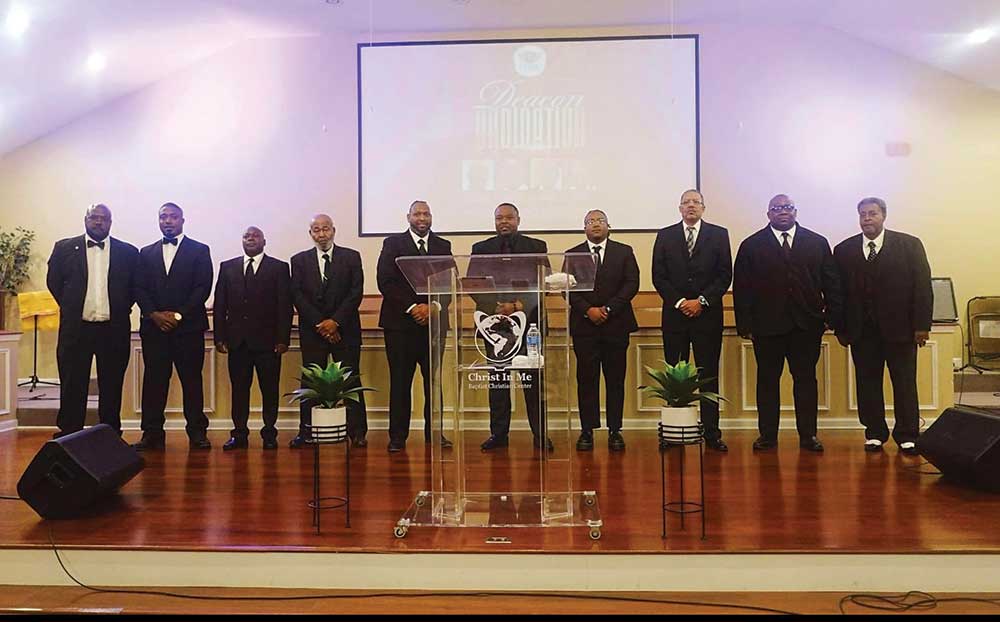
Christ in Me Family deacons

Much time was spent in prayer, for the three desired that the new church be spirit-filled and inclusive. The first service was held in the Pell City Community Center, Feb. 4, 2007, with 100 persons attending and 62 joining the church.

Rev. Orr, in a 2025 interview, expressed his vision for the church. “It was laid on my heart to build a church where everybody was somebody. That was our main motto at the time: Everybody Is Somebody. That was the focus, and we wanted to make sure to build a culture where everybody felt important.”

To establish member involvement, Rev. Orr’s plan was for every member to participate in some area of church ministry. Involvement like this would create a feeling of “this is our church” as members worked together to bring in new congregants as the church would grow over the years.

Rev. Orr estimates that today, 80% of Christ in Me Family members are involved in a ministry. “We don’t have members who just come and are not connected. They are working in one of the ministries that we have.” The ministries are: Bereavement, Board of Directors, Children’s Church, Couples, Culinary, Deacons, Greeters, Media, Music, Prayer, Security, Strategic Team, Senior Citizens and Ushers.

No matter how young a church is, death and sorrow are nearby, and a Bereavement Ministry exists to give comfort and support to families suffering the death of a loved one. Jimmie Lou Sanders leads this ministry assisted by Linda McCoy, sharing the love of Jesus and His comfort in difficult seasons.

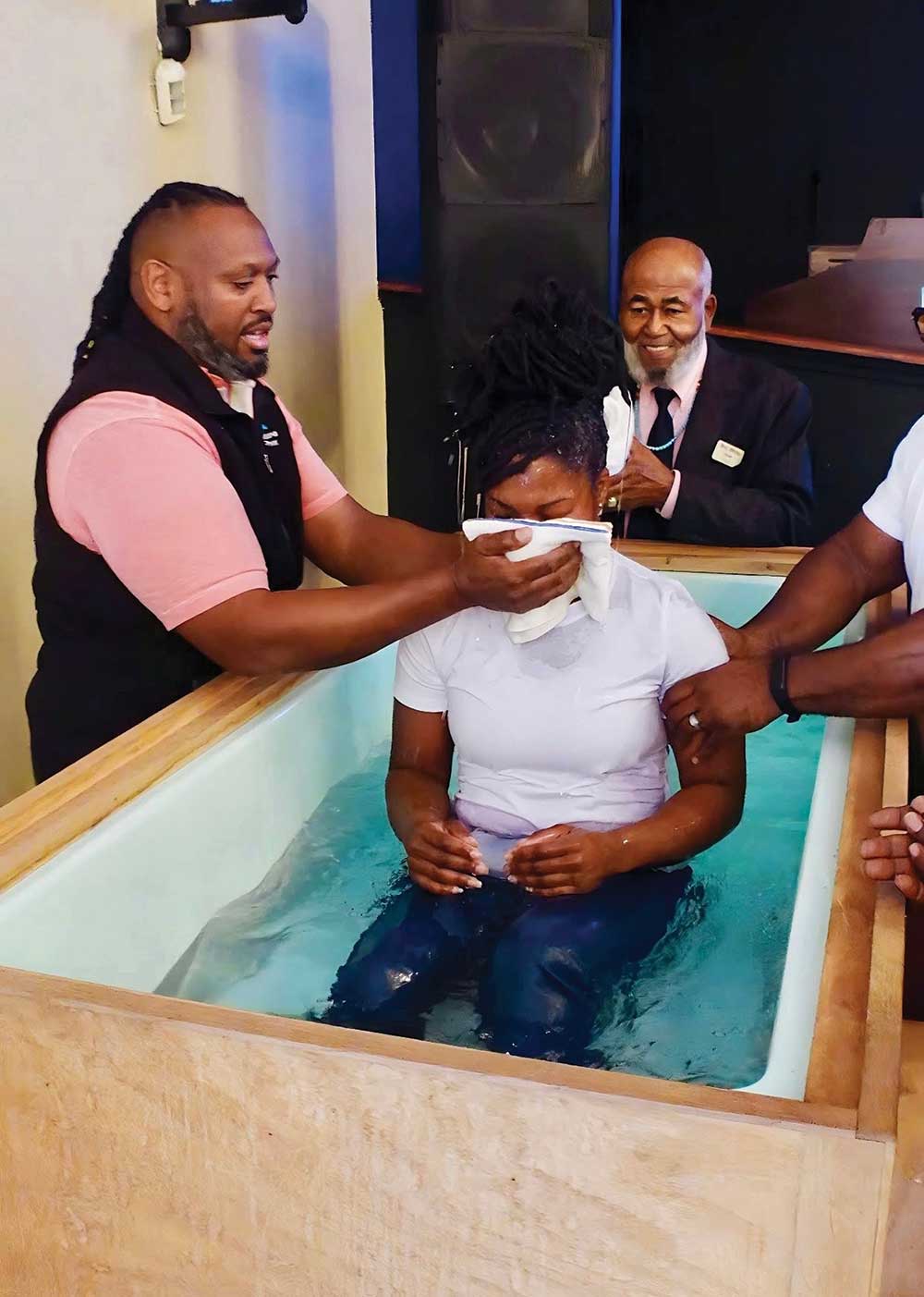
Celebration of Baptism

 The Board of Directors ministers in directing the church. “Our church is not a congregational-ruled church,” Rev. Orr explained. “Our Board of Directors plays a special part because they make decisions for the church.” Members are Amelia Beavers, Laverne Beavers, Cheryl Collins, Tangela Orr, Victoria Hill, Lonnie Orr, Nicole Beavers and Carl Hill. The focus of the Board is to see that the church operates in unity.

Children’s Church was established when Christ in Me Family first organized and serves children up to 12 years old. It is a vital church ministry led by Cheryl Collins. “This has been a very important part of the church,” observed Rev. Orr, “because when families come, we want to reach the whole family – children, youth and teens.” A church needs children and youth in order to progress in growth.

The Couples Ministry, led by Nicole Beavers and Freida Sanders, has blossomed into a vigorous ministry. This ministry has a lot of outings such as bowling, movie nights, dinners, and workshops. Its events provide quality time for couples to fellowship together and develop camaraderie.

The Culinary Ministry is led by Shirley Jean Posey and Elaine Sanders, who prepared delicious food at the Pell City Steakhouse for many years. Shirley Jean started cooking there in 1969 and Elaine in the 1970s. “These two families have been a blessing for the Posey / Thomas family joined the church, and about 30 family members came with them,” Rev. Orr said.

When the church has dinners, luncheon, or conferences, Shirley Jean and Elaine are there organizing, planning and getting the job done. “With any kind of catering, they volunteered the majority of the food to the church over the years,” Rev. Orr said. “So, the church has never really been out much, cause Miss Posey and her family have served many events over the last 18 years.”

The Deacon Ministry is a service ministry. The first deacon was Cicero Hill, who served until his death at 86 years old. The deacon body grew in number, and part of their responsibilities is to oversee the church edifice. “These men assist me where there is a need,” said Rev. Orr. “In the Scripture, Acts, Chapter 6, talks about serving those that were being neglected. So, when we have a need, as far as the edifice is concerned or the grounds, all of these gentlemen have helped, and they have been a blessing.”

The men who serve the church today are Marvin White, Carl Hill, Laveran Beavers, Dino McCoy, Tim Fortner, Charles McCoy, Bruce Campbell, Khalil Pope, Kenyatti Sanders and Stevie D. Calhoun.

The Greeters Ministry, led by Victoria Hill, welcomes attendees on Sunday mornings. Other members assist the leaders in welcoming people as they arrive and serving them coffee and donuts. These refreshments offer relaxed Christian fellowship before worship services.

Christ in Me Family is blessed to have a Media Ministry led by young college grads who have joined the church in the past couple of years. Tori Hill and Khalil Pope lead this ministry.

First Lady Tangela Orr and Rev. Robert L. Orr

The Music Ministry is under the leadership of First Lady Tangela Orr. The church has moved from the choir music tradition to a praise team experience on Sunday mornings.

The Ministry of Prayer is led by Prayer Warrior Linda White. Rev. Orr spoke of her power in prayer. “She’s an intercessor. She’s awesome when it comes to interceding for me and interceding for the Board of Directors.” For any church, faithfulness in prayer is a proven way of supporting and strengthening a church, its pastor and its people.

The Security Team is led by Steve D. Calhoon and Kevin Ellis.

Christ in Me Family’s Strategic Team is led by Lashanna Hollingsworth McKinney, Kenyetta McGraw Thomas, Shay Carter and Chandra Shepard.

Serving all ages

 With people living longer, a Senior Citizen Ministry is vital to any church. No matter how old or young a church is, there’s always a group of older folks to minister. The Senior Citizens Ministry is under the leadership of Victoria Hill along with Freda Sanders and Cheryl Collins. “We want to reach every part of our church life,” observed Pastor Orr. “You may have a mother and father with children, but what about the grandmother or grandfather?” Activities for seniors include a luncheon for them at the church every third Friday. Christ in Me Family Wants to show their older members that they are loved and that they are cared about. Their experiences and wisdom are assets to the church.

The Ushers Ministry welcomes everyone and provides information to first-time visitors. Brenda McCoy and Freida Sanders lead this ministry.

Evolution of today’s church

After the organizational meeting in January 2007, the church met in the Pell City Community Center for a few months and then moved to a facility in Cropwell. A few years later when Seddon Baptist relocated from their Hardwick Road building to a larger complex on Hwy 78, Christ in Me Family was able to acquire Seddon’s brick church building for their own. They celebrated their 2014 Founder’s Day in the Hardwick Road location.

Pastor Orr spoke highly of Pastor Dale Foote and the Seddon Baptist leadership and their cooperation with Christ in Me Family’s purchasing the property. “They were very good to us and very kind. I want to say the first four years we paid the principal to them, until we were able to get a loan.”

The two pastors became friends during this process, and Pastor Foote recently commented, “Pastor Orr has a heart to lead the church. He’s a great man of faith and vision. It’s hard to find pastors in this day and time that will stay the course. Pastor Orr has stood firm and faithful. I’m glad our ministry paths have crossed. We learn so much by those God places in our path. Wonderful man of God!”

Christ in Me Family is a congregation of believers serving God and one another. A traditional praise song they sing expresses their joy of serving God:

What a mighty God we serve,

What a mighty God we serve.

Angels bow before him,

Heaven and earth adore him,

What a mighty God we serve.

If you are looking for a church where families of all ages are welcomed and where there is praise and worship of Jesus Christ, make a visit to Christ in Me Family. You may discover that you have found the church just right for you and your family.and influence generations to come. Hold fast to your dreams and keep on collecting history. Your dream has strong wings.

Rotunda ‘Tonya’ Forman

Story Joe Whitten
Submitted photos

Spend time talking with Tonya Forman, and you’ll soon realize you have found a person who loves Pell City, Alabama, and is focused on advancing the city and preserving the history of its citizens.

Born to Lesley Sr. and Fannie Forman were Tonya and her siblings, Sharod, Lesley Jr., and Diane. Tonya grew up in Pell City and was an active member of Rocky Zion Missionary Baptist Church. She graduated from Pell City High School in 1987. After graduation, she attended Central Alabama Community College in Childersburg.

Accepting a job with AT&T, she began commuting to Birmingham every workday. Before long, co-workers in the city began encouraging her to move to Birmingham rather than commute. Her response, she recently confided, was always, “There’s no place like Pell City! I can safely sit on my porch without a concern, and I’m not gonna leave that for a 30-minute drive down the interstate.”

Those conversations and her responses seem to be what urged her on to know her hometown better and to work for its upbuilding. “I realized what a blessing I had here in Pell city.”

CITIZENS IN ACTION

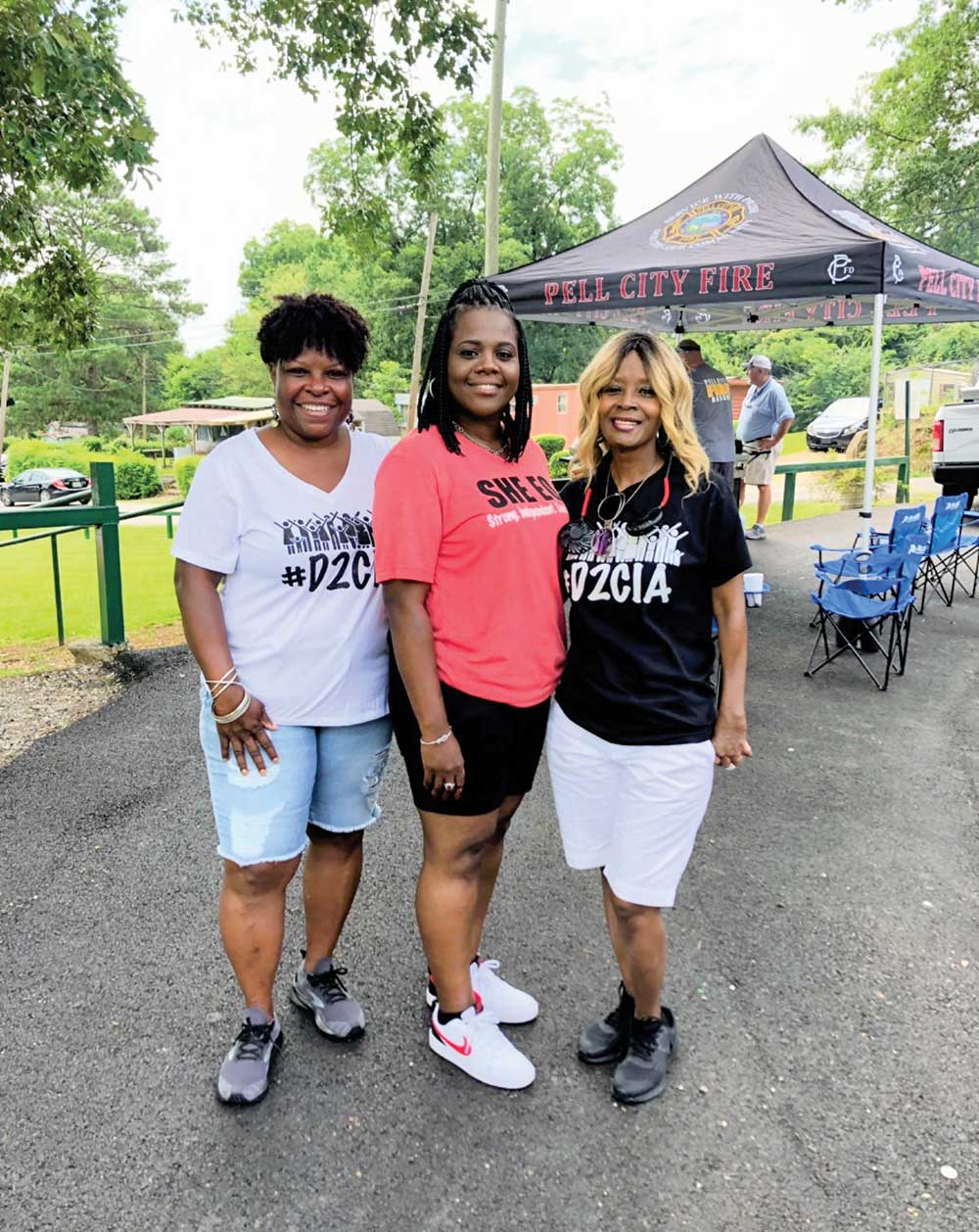
Forman at 2021 event with District 2 Councilwoman Ivi Wilson and Siri Truss

Tonya is a founding member of District 2 Citizens in Action, serving District 2 of Pell City. Established in 2021, the citizenship partnership is designed to achieve improved communication, understanding, and cooperation between citizens and city officials through increased personal contact between City Hall, neighborhoods and communities throughout the city. President of Citizens in Action is Bishop Donald Gover.

PELL CITY BLOCK PARTIES

One Pell City event Tonya devotes time to is the yearly Block Party. This event started in 1999 as an initiative to celebrate and bring the community together. For the past 26 years, it has brought citizens of Pell City and surrounding communities to the historic downtown for live music, kids’ rides, vendors, and food. 

Tonya’s involvement in the Block Party began because at one event attendees began asking her questions to which they thought she should know the answers. Specifically, they asked about Greg White’s R&B Set which had occurred at 3:00 pm.

“A lot of people didn’t come to the Block Party until after the sun went down,” Tonya explained. “So, about 4:30 or 5:00 people were asking about Greg and Keith White.”

When they asked Tonya, she had to tell them his set was over. “It was amazing,” she laughed, “at how many were asking me, and I didn’t have anything to do with it.”

That would soon change, however, for a visit to Urainah Glidewell at the Pell City Chamber of Commerce office got results thatTonya hadn’t planned for or expected.

In the meeting with Urainah, Tonya explained how a lot of people avoided the heat of the day and came to the event when the day cooled down a bit. She asked that Greg White’s Set be moved to 5:00 instead of 3:00.

As they talked, Urainah said, “Why don’t you become an ambassador?” Which brought Tonya’s response, “What’s that and what does it involve?”

To that, Urainah responded, “Just do what you’re already doing. You’ve got a love for the city, promoting it and getting people involved.”

Ambassadors of the Pell City Chamber of Commerce are volunteers who help with events, welcome new chamber members, and support local Pell City businesses.

Never one to be uninvolved, Tonya filled out the Ambassador Application and was soon accepted.

Urainah Glidewell, Executive Director of the Chamber recently said of Tonya, who is now on the Chamber Board, “Rotunda ‘Tonya’ Forman has been a wonderful addition to the Pell City Chamber Board of Directors. From her tireless involvement with the community and her willingness to help with chamber events, to her generosity of time and spirit, we are so blessed to have Tonya as part of the team.” Tonya currently serves as Vice President of the Pell City Board of Directors.”

In her work with the Block Party, Tonya recognized that involving church musical groups would increase attendance as well as be a way churches could promote their ministries. So, church choirs, praise teams, and musicians became sets at the Block Parties.

When emergencies arise, as they will, Tonya can help assess the situation and bring resolution. One of these emergencies occurred at the 2025 Block Party. For the sponsors of the event, there is a VIP section where refreshments are served. As the day progressed, a storm rolled in, not only disrupting the event, but also blowing a tree across the driveway to Blue Eye Eatery, the caterer for the VIP section. “She had everything ready to bring out,” Tonya recalled, “but they were waiting to see if the power company was going to come out and cut the tree up.”

The power company didn’t come, and the caterer realized the only solution was a boat. “So, they communicated back and forth with Urainah Glidewell and Chamber members,” Tonya continued, “and they got on the boat with all the food and got it to the Civic Center where chamber members were there to unload, put it in a truck and get it here to the VIP area.”

 Although delayed an hour or so by the storm, the VIP refreshments were ready by 5:30 or so. The early performers missed out, but the groups that came in at 5:00 and 6:00 were able to come in and enjoy the food.

ARCHIVING BLACK HISTORY

Tonya has accomplished a major success in the work of collecting and preserving the history of Pell City’s Black communities, schools, churches, and citizens.

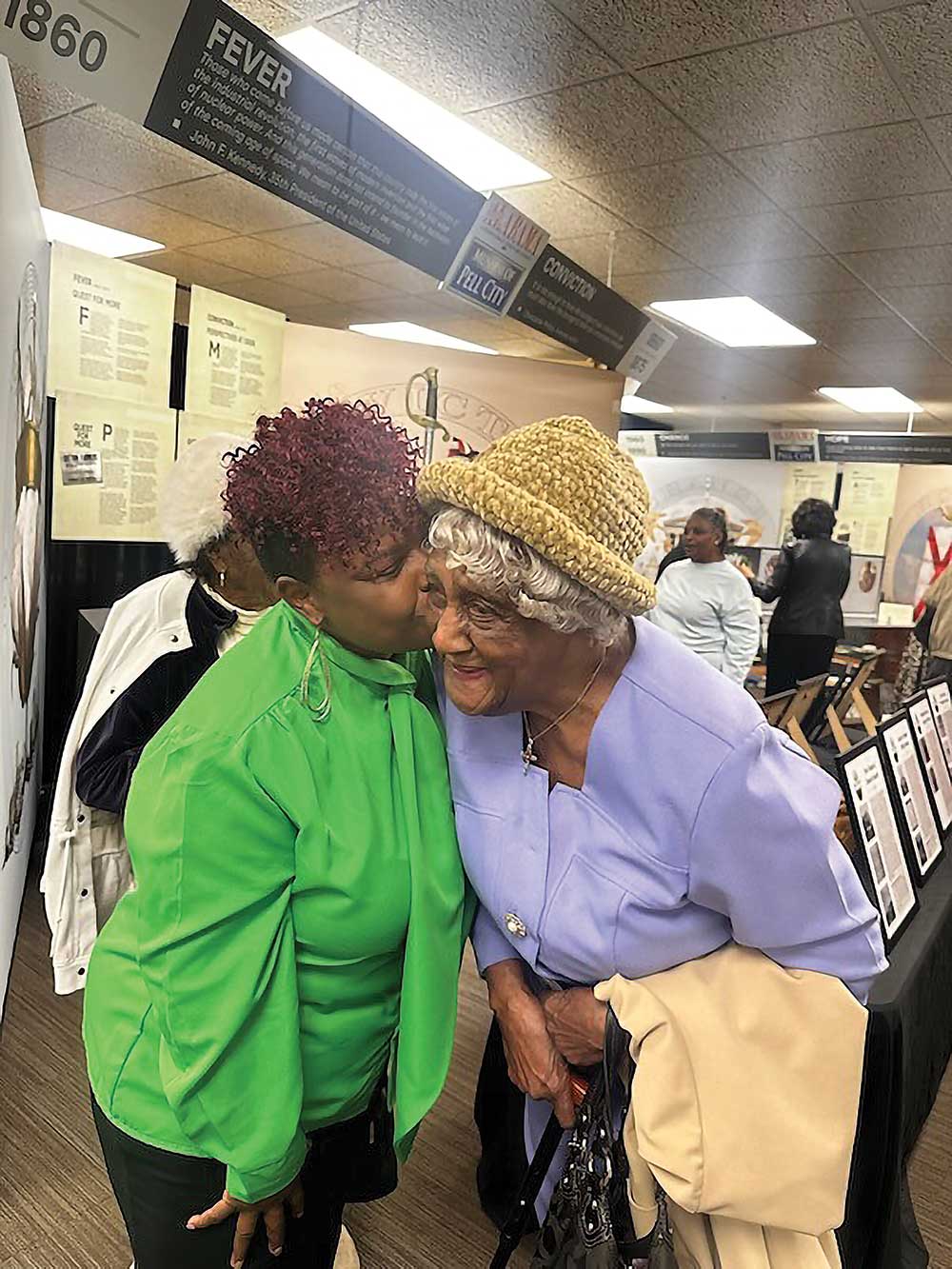
Forman and Johnnie Mae Green at the museum

Erica Grieve, Museum of Pell City Coordinator, recently said this about Tonya’s work. “Rotunda’s passion for preserving Pell City’s Black history has been nothing short of inspiring. She has spent countless hours collecting stories, photographs, and artifacts that ensure the experiences and achievements of our Black community are never forgotten. Her dedication and heart have shaped the Museum’s Breaking Barriers Exhibits and continue to bring our shared history to life for future generations.”

When the museum director and board approached Tonya about collecting Black history, she told them, “Black people don’t have a lot of [recorded] history because they were either burned out, ran off, or left because of work.” She also pointed out fires and floods had damaged or destroyed photographs and treasured history recorded in family Bibles, etc. It would not be an easy task.

However, never one to be daunted by difficulty, she acknowledged it and set about collecting history of churches, communities, and citizens. A significantly rewarding part of the collection occurred with the taping of community members: those who had lived long lives; those who had helped integrate Pell City schools; and those who had excelled in professions once unavailable to our Black citizens. These people broke the barriers of segregation and blazed the way for those coming afterwards.

The first Breaking Barriers event was announced in the Anniston Star, February 6, 2024, in an article by Laura Nation. “The Museum of Pell City opens its locally produced Black History Month exhibit Feb. 8, featuring the people of this community as they experienced events of the times in which they lived. Their stories reflect decades of a changing community through the years as well.

‘This particular focus of the city’s history was actually born early in the development of the Museum of Pell City, said director Carol Pappas.’ Carol Papas is President of the Museum of Pell City.”

Nation’s article continued: “There are 15 profiles among the videos, some of these are Thelma O’Neal Jones, the first Black female elementary school principal; Don Allen, a member of the first integrated football team; Bob McGowan, first Black Avondale Mills supervisor; and Keith White, the first Black art teacher in Pell City Schools.” Terry Young and Tom Ham were also on the first integrated football team.

Carol Pappa recently spoke of Tonya, saying, “In the time that I have worked with Tonya on our museum board, I discovered that she’s not just a member in name only. She goes to work, ensuring that any project she’s associated with becomes a success story.”

Ninety-five-year-old Johnnie Mae Green gives high praise to Tonya and her work of collecting Black history. “For a person in her generation to reach back and to think about the times that we had in our young days and to get interested in our history]is just amazing. I’m telling you: she is one to be complemented.” Johnnie Mae further stated, “Now, God had to have given Tonya the inspiration to do this. Because, without our history recorded, we will never know our background. And I thank God for her. She’s just a dynamic person.” She paused, then added, “She’s a God-fearing young lady. That’s the ticket to life. She’s one in a thousand.”

Tonya’s journey of faith began at Rocky Zion Missionary Baptist Church where she grew up learning of God. She was baptized by Pastor James Adams who served the church for eleven years. As she matured, she sang in the choir and on occasion led the singing. She was youth director at a time when the youth program flourished. “At that time the church published a small youth newspaper,” she recalled, “and the “the youth would write about a topic we had studied in Sunday School or about events and trips that were upcoming. They highlighted achievements of a youth member.”

WREATHS ACROSS AMERICA

Wreaths across America became another focus of Tonya’s as soon as she learned of this yearly event.

Wreaths across America, a non-profit organization, coordinates the placing of Christmas wreaths on the graves of veterans. The motto of the organization is “Remember, Honor, and Teach. Remember our veterans that served and are serving America, Honor the fallen veterans, and Teach our youth about the service and sacrifice of our veterans and families.”

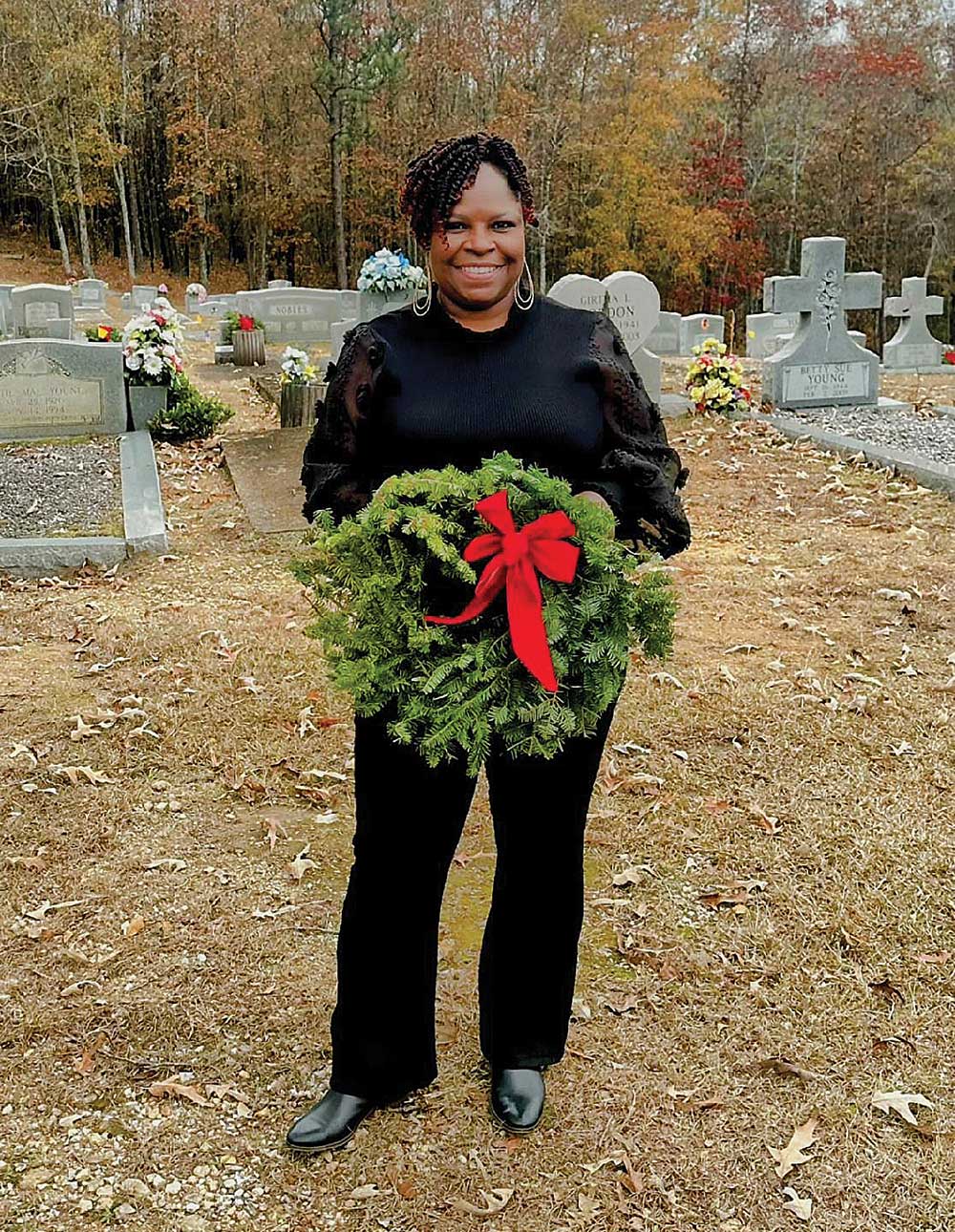
Forman helping with Wreaths Across America

Tonya learned of the project in a conversation with Mindy Manners at the Museum of Pell City. “I knew about Wreaths across America, nationally, but I didn’t think of it as locally involved,” she confided recently.

So, when Mindy started talking about it, I thought, I do remember flags, but I didn’t recall seeing wreaths, and I didn’t realize that it was a program doing it versus individual families or churches doing it.” In their conversation, Mindy told Tonya about the cemeteries she helped with, and Tonya realized they were traditional white church cemeteries. When Tonya commented, “We have Black veterans in our cemeteries,” Mindy’s response was, “Would you be interested in doing it for them?”. Tonya’s immediate response was “What do I have to do? How do we get this started?

The answer to that question was that Mindy Manners was getting ready to have a meeting at Pell City First Baptist Church. Tonya immediately called her Aunt Verhonda Embery, and good friend Jennifer Gover. These women travel together and always find cemeteries to explore, and they attended Manners’ meeting.

“We got the information we needed ,” Tonya recalled, “and Mindy told us how to get started—the website that we could communicate with.”

Tonya gives much credit to Jennifer Gover for getting Wreaths across America successful in the Black cemeteries of Pell City. “Jennifer took the lead. I like to work in the background, and I’m good with that.”

They began researching cemeteries and the veterans buried in each, and ended up with six cemeteries: Mt. Zion, Rocky Zion (Pell City Community), Coleman, First Baptist Cropwell, Greenfield, and Bloominglight (which used to be called Robinson).

Tonya and Jennifer had difficulty locating graves that didn’t have markers, and family members had to show where they were. Dirt had obscured some markers and they removed the dirt from those. “We involved the community,” Tonya reminisced, “and told them you’re gonna have to help us find where they’re buried.

Tonya and Jennifer got gas line marker flags to mark graves they located. The churches got involved, and the person in charge of individual cemeteries made sure they were spruced up for the wreath placing ceremony.

Wreaths cost $17.00 each Family members paid for some, and others who had no veteran to honor gave donations—some for more than one wreath, and the money came in to pay for the wreaths.

That first year, 2023, the wreaths arrived and were stored at Rocky Zion Baptist Church and some at Jennifer Gover’s home, and the two ladies organized up the program. “We got ROTC involved.” Tonya recently recalled. “We couldn’t get Pell City ROTC involved that first year, so Jennifer found veterans in Bessemer who had a program, and they came out and did the salute for us at the church, and we had singing. So, we had a small program. “

Volunteers distributed wreaths to each church, and the ladies had someone at each cemetery to meet the families and place the wreaths on the family graves. As each wreath was placed, a family member would say the names out into the atmosphere. A proclamation that here we honor one who served the United States of America, and we are proud of their service.

Writing of the premiere event, Laura Nation wrote in the December 14 issues of The St. Clair Times, “Excitement for the Wreaths Across America program has been building as two Pell City women, Jennifer Gover and Rotunda Forman, noted the need to honor the veterans and set out to develop a way to do so earlier this year.”

After mentioning the excitement of the project, Nation speaks of Gover and Forman’s labor of love in the wreaths. “Preparation for the 2023 event involved much research, contacting family members and friends, and spreading out into the community to locate as many veterans as possible. The women said they were met with much interest and help in the effort, and now, in the first year of their plan, the program is in place.”

Tonya recounts an interesting 2023 event at one of the cemeteries. “Coleman is a split cemetery—there’s a Black side and a white side. The person in charge of the white side saw what we were doing and wanted to participate; so Jennifer was able to get enough wreaths to cover the graves of the white veterans also.” What a beautiful cooperation that calls to mind the lyrics from the 60s which are as true today as then: Black and white together someday/ Deep in my heart I do believe / We shall overcome someday.

Having known Tonya for a long time and having worked with her on this project, Jennifer Gover observes, “Tonya and I have served together for the past three years as Location Coordinator and Coordinator Assistant for Wreaths Across America. During that time, she has been an invaluable asset in sharing with others the mission of WAA while convincing individuals  to sponsor wreaths for our veterans resting in six local cemeteries.

“She has a strong sense of purpose and is always able to provide additional options while giving that beautiful smile. She has a heart for service and sometimes overextends herself . I think she does that because of the willingness to serve rather than be served. She’s always ready for the next adventure.”

The wreaths are removed before they turn brown and ugly. “We get our volunteers to go back and remove them,” Tonya explains. “If available, we get Greg Gossett of the Pell City Maintenance and Street Department to get someone to come out and pick them up. We bagged them up and they came and removed them.”

The success of the first year of participation in Wreaths across America has continued. In 2025, more than 200 wreaths were placed on graves.

HOLD FAST TO DREAMS

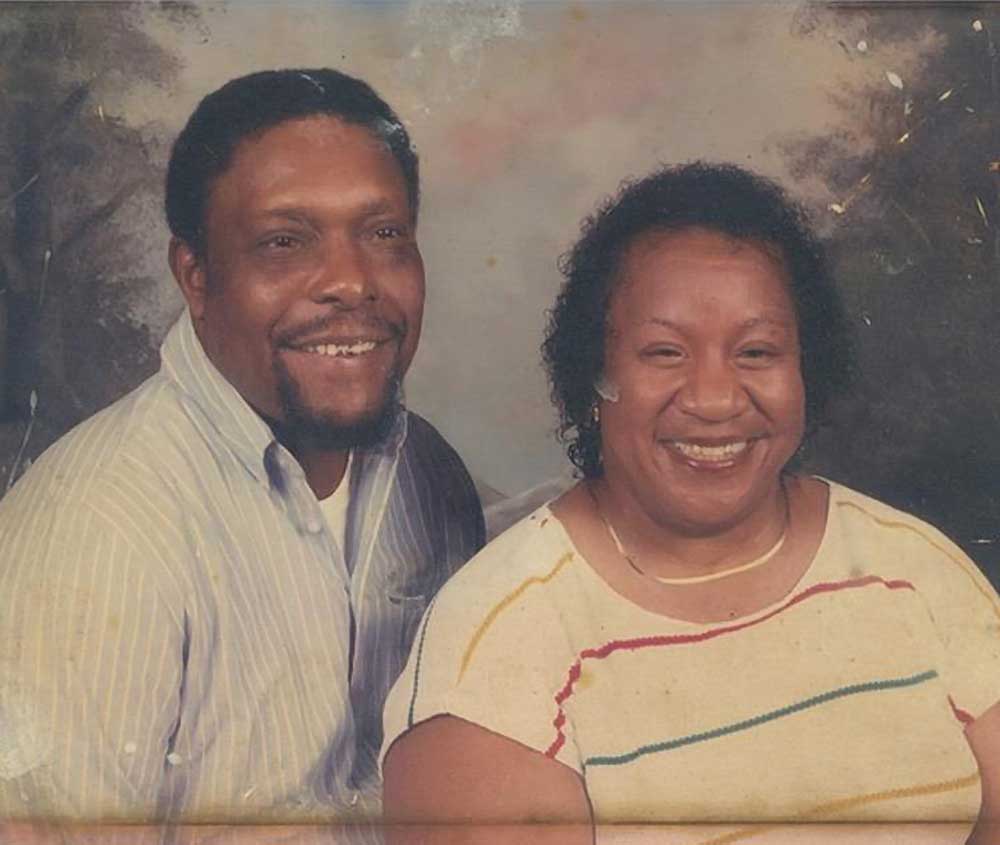
Parents Lesley Sr. and Fannie Forman

Of Tonya’s devotion to collecting and preserving Pell City’s Black history and the Breaking Barriers project, Johnnie Mae Green says, “She should be as famous as Harriet Tubman,” for Tubman collected and preserved the stories of those she helped escape slavery. Carol Pappas, President of the Museum of Pell City, praises her work as well. “Breaking Barriers, our celebration of Black history in our community, resulted from Tonya’s work, her creativity and her vision to make it happen. We are now in our third year in the series, which has focused on the first to break barriers in their respective fields, reflections of faith and family, and this year, foundations of education – a salute to educators who made a difference.

“Tonya is that rare soul who can see a need and doesn’t stop working until that need is filled. We could never have come this far in bridging our community together without her efforts.”

Langston Hughes, Black poet of the mid-twentieth century, wrote,

Hold fast to dreams
For if dreams die
Life is a broken-winged bird
That cannot fly.

Supported by her faith, Tonya pursued her dreams of preserving the history of a city and its people, and in fulfilling that dream she put love into action.

Tonya, your work will continue to benefit and influence generations to come. Hold fast to your dreams and keep on collecting history. Your dream has strong wings.

Mt. Moriah Missionary Baptist Church

Story by Joe Whitten
Photos by Wallace Bromberg Jr.
Submitted photos

For a church to arise from Saturday nights of music and dancing is – without a doubt – a unique beginning, but that is the case of Mt. Moriah Missionary Baptist Church.

“A dirt road, a smattering of houses, friends, guitars, banjos, music and dances –God had a plan.” So begins Redena King’s 1975 handwritten two-page history as told to her by Essie Vaughan, the daughter of George “Doc” and Ada Tollison.

With that sentence in mind, relax in your recliner and let your mind drift back a hundred years to a place in St. Clair County called Sage Hill. Think of a field of russet-gold sage (sedge) grass rippling in an autumn afternoon breeze. As you daydream, listen for music floating on the breeze – stringed instruments joyfully filling the cool of the day. It’s Saturday night, and a family is hosting the weekly hoedown at a home in Sage Hill.

Choir and song leader Redena King

These weekly events brought banjo, guitar, mandolin and fiddle into happy harmony that soon had couples dancing, while for other folk it was background music for visiting  with friends not seen since last week or perhaps a month or so ago.

Known today as Mt. Moriah, Sage Hill was sparsely populated in 1925. The nearest school was probably Stewart’s Schoolhouse, a few miles away where Mineral Springs Baptist Church sits today, and the nearest church was Broken Arrow Baptist, about five miles away in Wattsville. So, we can surmise that most of the Saturday night merrymakers didn’t get up early Sunday morning and walk five miles to church. And it’s possible that one or two men may have partaken too much from the “little brown jug” and slept late.

But, indeed, God had a plan that included George “Doc” and Ada Tollison at whose home many of these Saturday night hoedowns occurred.

“Mr. Tollison had a nephew, Oscar Tollison, who was a preacher,” the history records. “He began coming here [to Sage Hill] and preaching on the weekends.” Mrs. King quoted Essie Vaughan, Doc Tollison’s daughter, who said, “The dancing soon stopped, but the preaching continued.”

This spiritual awakening saw different families welcoming weekend church services at their homes. At one of these services, Doc Tollison was saved. As the weekly preaching continued, others were converted.

Attendance at the home services grew so large that the men constructed a brush arbor on the Tollisons’ land as a place of worship. Bernice Sweatt Voss in her 1975 memories of Mt. Moriah described it. “The brush arbor had posts of good size trees [at the corners] and [tree] limbs made a sort of frame on top. Then brush covered [the limbs] to make a shade.” Doc Tollison’s wife, Ada Tollison, was saved in one of the brush arbor meetings.”

Essie Vaughan recounted that soon the men constructed a church house “… alongside the road … It was a long building with a door and windows facing the road and a door facing the road where the [dinner-on-the-ground] tables …” once stood. Those tables were located to the right of today’s fellowship hall as you face the double doors downstairs.

Hazel Layton Morgan in her written memories referred to the building as “shotgun style’ and that it was lit by kerosene lamps in cast iron wall brackets.

Essie Vaughan recalled that preaching was usually two times a month, and “the singing during services were acapella – no piano – to begin with.”

In her recollections, Hazel Layton Morgan mentioned the church pump organ, and this may have been the same one Bernice Sweatt Voss mentioned in her memories when she wrote, “We didn’t have any music instrument, so Mother and Dad loaned a small ‘piano’ organ for a while. Mother would play it, and Eunice and I would stand and pump the peddles for her.” (A “piano organ” was a small portable reed organ.) Eunice and Bernice often sang duets, and one of their favorites was In the Garden.

Building a congregation

Bernice Sweatt Voss’ family started attending Mt. Moriah in 1937, and she described the sanctuary of that time. “The building was a small wooden one with [asphalt] ‘brick siding’ on it …” standing close to the road. She also recalled that attendance outgrew the building by the late 1930s so “… we’d put the benches outside by the side door … pull the piano close to the door inside, and we’d have service at night this way. The preacher would stand in the door, and we all heard well.” The outside worship service provided relief from the summer heat inside the building.

 Around 1945, the congregation built the second sanctuary, a white-painted wooden building. Willie Ann May remembered that Summa Collette and Almos Sweatt collected $50 and gave it toward this new building.

Former pastors Ted St. John, Vester ‘Buck’ Castleberry, Joe Isbell, and Ronnie Venable

In the early 1960s, the third church building was originally constructed of concrete blocks, then, some years later, faced with red bricks and crowned with a white steeple. From the parking lot, a sweep of steps led to a portico, protecting the double doors into the sanctuary.

This building was turned into Sunday school rooms when the fourth sanctuary was erected in 2002-2003 under the ministry of Rev. Ronnie Venable. This building extended over part of the parking lot and provided space for a downstairs Fellowship Hall.

The fellowship hall is named The Howard L. Savage Fellowship Hall. He and his wife, Juanita Savage, were faithful church members who were involved in the planning and building of the current sanctuary. Mr. and Mrs. Savage are remembered as always ready to participate in anything the church needed. And many other dedicated members of Mt. Moriah helped in all areas as well.

All four church buildings were constructed on land donated by Doc and Ada Tollison. Thus, their legacy lives on.

 “Bro. Ronnie Venable was a faithful leader throughout the building process,” according to Redena King’s history. “Each of the churches were built by the help of the Lord and through the faithful dedication and service of men, women and youth who spent many hours working diligently to build a place of worship for all who would come and join in worship.”

Lifting up in song

In the “olden days,” to the right of today’s fellowship hall, there was a row of concrete “dinner on the grounds” tables where food was spread on special days, such as all-day singings and Homecoming celebrations.

Both Singing Schools and All-Day Sings were enjoyed by Mt. Moriah and the outlying communities. Willie Ann May recalled that Mr. and Mrs. Harden conducted Singing Schools every summer, which continued into the 1960s, teaching shape-note music, how to read it, sing it and play it. Then for several years, the yearly singing school was discontinued.

In 2021, Landon King, church pianist, reestablished the Singing School at Mt. Moriah. The school director, Tom Powell, is the grandson of G.T. “Dad” Speer, of The Speer Family gospel group. He is the director of the Alabama School of Gospel Music held the first two weeks of June each year at Snead State Community College in Boaz.  His wife, Dr. Lisa Powell, also teaches in Mt. Moriah’s Singing School and at the Alabama School of Gospel Music.

Tracy Phillips, accompanist for the Mt. Moriah event, is an acclaimed pianist who has accompanied groups at Gaither Homecomings.  

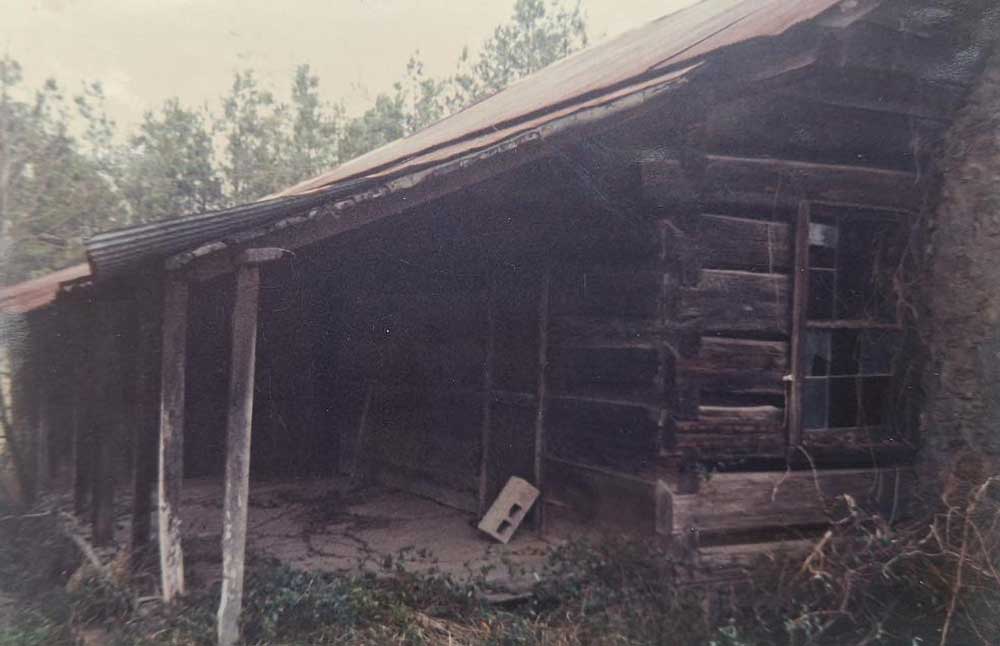
Doc Tollison’s log house

In her memories, Mrs. May recalled the joy of All-Day Singings: “…all we did was sing. Everybody was expected to get up and lead a song.”

Mrs. Voss has a vivid memory of an All-Day Singing in 1938. “We had an all- day singing and homecoming, and we had a great time. But after the singing was over, we kept talking and praying, and I found I was very much under conviction, and people began praying for me, and I was saved!”

Often, singings were announced in the local papers. In one church file are three announcements from undated and unidentified newspapers. One reads: “Singing at Mt. Moriah Saturday Night. There will be a benefit singing at Mt. Moriah Baptist Church Saturday night, January 12, beginning at 7 p.m. Special singers will be the Sonata and the Gospel Four. The proceeds from this singing will be to help pay for a singing school to be held in the county this spring. Everyone is invited to attend. Pastor Rev. Amos Sweatt, Vester “Buck” Castleberry, chairman.”

The second clipping announced the Crusaders Quartet of Anniston as special guest, and the third one reported the Lloyd Chapel Quartet as special singers.

Revival Time

Yearly revivals were standard, and Mrs. Voss recalled one in 1938. “This was the year men cut down trees and made a brush arbor for the revival in August or July … I think there was sawdust to keep the dust down. We had services day and night. At this revival, I joined the church and was baptized in Jones’ swimming hole in Coal City about where the Wattsville Post Office is now. Several others were also baptized. I think part or all of them were added to Broken Arrow [Baptist Church], including me.”

Mrs. Morgan recalled that evening revival services sometimes went on until 11 or 12 o’clock. She spoke of praying and shouting in these services. The shouting would be exclamations of “Hallelujah!” “Praise the Lord!” “Glory to God!” These joyful expressions were prevalent in both Baptist and Methodist revivals, back in the day.

Perhaps the best recollections of revival time from 50 plus years ago were those of Margie Smith Castleberry. She told of a prayer rock where the women of Mt. Moriah would meet to pray for the revival. Surely, as the women met at the prayer stone, they recalled God’s revival blessings of the past and prayed for God’s power in the current revival.

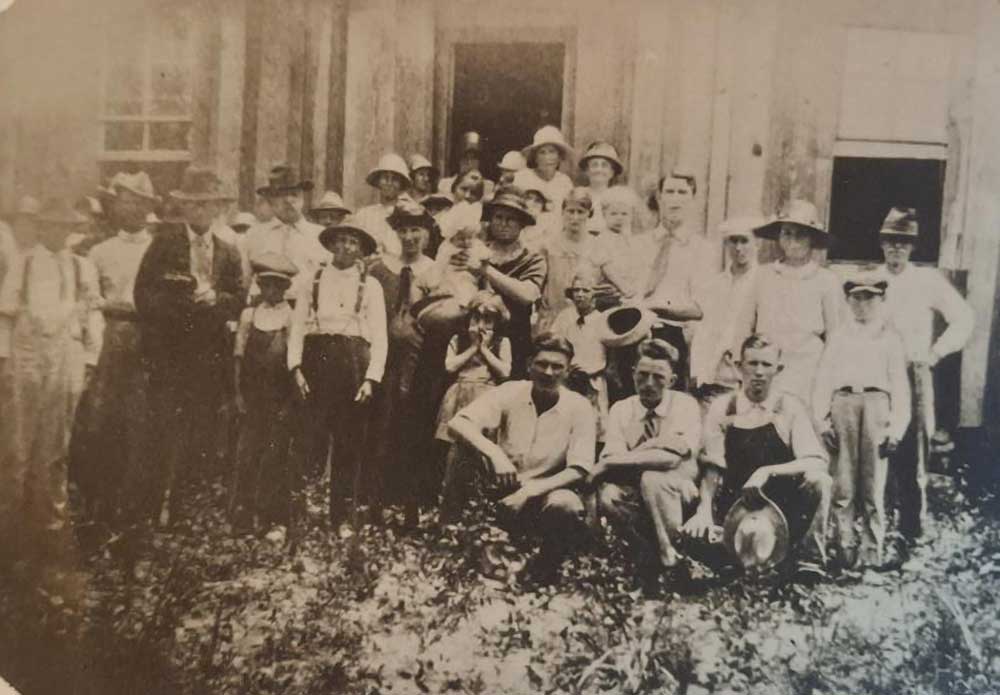
Original congregation from 1925

“The revivals would last two weeks sometimes,” Mrs. Castleberry wrote. “The women would fix lunch and dinner for the evangelist and the pastor. The revivals were always in July, when we would be in the middle of canning time, but we managed to attend every service. When we sacrificed our time, God really blessed,” she concluded.

Mrs. May recorded memories that were special to her. One occurred when Billy Walker was the pastor shortly after the second church construction. “He told all the young people that if they would come for a year without missing a Sunday, he would give them a brand-new Bible. Back then, they had a roll chart on the wall, and every Sunday you were present they put a star beside your name. I remember going every Sunday for a year, and I got a new Bible. I was so proud of it.”

Another special childhood memory for Mrs. May was the Easter egg hunt the year “Mrs. Flora Sweatt made Easter baskets out of oatmeal boxes for my sister Linda, my brother, Enis, and me.” Bought baskets were a luxury in those days when money was hard earned.

Easter and Christmas usually found Mt. Moriah’s musicians and choirs preparing to present special programs such as cantatas and musical plays and programs involving adult, youth and children’s choirs. Many church members have assisted the choirs through the years, including Joan Golden, Nora McNutt, Vicki Newton, Wanda Kelley, Redena King, Vickie Smith and other volunteers.   

In their memories, two of the ladies mentioned the ordinance of “foot washing.” This was based on Jesus washing the disciples’ feet as an act of humility. In the churches who practiced this, the men and women met separately for the ceremony.

Maggie Smith Castleberry mentioned that the church observed this “ever-so-often.” Willie Ann May recalled how her daddy, Will Rowe, would participate in foot washing, told how her brothers, Jack and Buck Rowe, doctored their dad’s socks. “One time before foot washing service, they filled daddy’s socks up with soot…When he pulled off his socks to wash feet, they were black with soot.” She did admit that her daddy, “didn’t think it was very funny.”

The foot washing services Mrs. May remembered, eventually ended, but another event she remembered from the “olden days” continues today: Vacation Bible School. “I remember one summer that for Vacation Bible School Mt. Moriah got a Southern Baptist Home Missionary to come and teach our Bible School,” she wrote.

“She would go home with different members of the church each day for dinner and to spend the night.” The missionary must have been young, for she mentioned that some of the high school age boys would come to the crafts session and participate.

Mrs. King remembered Vacation Bible School lasting two weeks in the 1960s. As an adult, she participated in various areas of preparation and teaching during this community event, which today occurs in June shortly after regular school ends for the summer.

Jessie Garrison, Bro. Ronnie Venable’s aunt, taught, led and hosted Bible Drills at the church for several years.  She also planned special WMU programs. Community outreach ministries occurred throughout the year – Vacation Bible School, Breakfast on 1st Saturdays, 5th Sunday night singings, Man Church on Tuesday nights, fall festival, and Youth night.

 Reaching Out

Mt. Moriah’s membership in the Southern Baptist Convention’s WMU (Women’s Missionary Union) began in 1975 and remains active today. Mrs. King recalls a particular WMU meeting in 1998. “On a Tuesday night [April 7] we had WMU, and  in our meeting, I asked the question, ‘How could we reach out into our community?’” She paused reflectively, and added, “I told them later that I didn’t know if I’d ever ask that question again! Because the next night [April 8], the tornado came through, and we were in this community for eight, nine, 10 weeks, ministering to the community.”

That community outreach was headed up by Bro. Ronnie Venable and his wife, Joan. The church accepted monetary donations which were later divided among community families who suffered loss in the storm. The Sunday school rooms were filled with clothing and supplies for those in need, and FEMA made Mt. Moriah Church building their headquarters. 

Heather Sharp, writing for the St. Clair News-Aegis, Thursday, April 23, 1998, reported Bro. Ronnie Venable offered the church as headquarters for FEMA, the Red Cross and the St. Clair County EMA.

The article reported that Ellen Bain, the local EMA assistant, said all the agencies “…praised Ronnie and Joan for all their contributions,” and that Bro. Ronnie was “…the emergency manager. He knows how to match resources with those who need them.”

The article reported Joan as stating, “We just delegated,” but she worked right alongside the church women who cooked for the volunteers and the victims. Not only did the women serve lunches at the church, but they also delivered “go boxes” to homes and to disaster relief workers onsite.  Mrs. Venable is quoted as saying, “It’s been marvelous to see everybody pull together.”

This 1998 community outreach continued when the fourth building was completed in 2003. Florence Kerr tells how the church is used today when tornado warnings are announced. “The building has below the ground space, and we open it up for the people who live in mobile homes – and I’m one of them – so, we come here. And one night, I think we had over 40 people. Different church members had brought food and stuff, and we fed them and had beverages.” Florence was recalling a tornado warning in the spring of 2025.

Celebrating Centennial

Sunday, August 10, 2025, dawned with clear skies and soon, sunshine baptized Mt. Moriah’s church building in a gilded glow, a radiant welcome to attendees who began arriving about 9:15.

Bro. Danny Wyatt, interim pastor, welcomed the congregation after which Candi Jones gave a brief power point history of the church.

Enthusiastic congregational singing included Glory to His Name, Majesty, It’s a Grand and Glorious Feeling, Getting Ready to Leave This World, The Sweet Forever, and If We Never Meet Again. The only accompanying instrument was the piano played by church pianist King and former church pianist Jason Vaughan. Their fingers danced over the keys, Southern Gospel style, more joyfully than any Saturday night stringed instruments event at Doc Tollison’s in 1925.

Bro. Zane Smith, former pastor, spoke of the church’s progress while he served Mt. Moriah. During his almost 11-year tenure, there were improvements to the sanctuary, and added outreach ministries encouraged the community. The oldest former pastor in attendance was 91-year-old Lloyd Golden, who commenedt, “I was saved in this church and was never lost again.” The church’s oldest member, 91-year-old Mona Scott, spoke about was a blessing Mt. Moriah had been to her.

The Doris Akers’ song, Sweet, Sweet Spirit, sung near the beginning of the service expressed the atmosphere in the church:

There’s a sweet, sweet Spirit in this place,
And I know that it’s the Spirit of the Lord;
There are sweet expressions on each face,

And I know that it’s the presence of the Lord. Sweet Holy Spirit, Sweet heavenly dove,
Stay right here with us, filling us with Your love;
And for these blessings we lift our hearts in praise
Without a doubt we know that we’ll have been revived,
When we shall leave this place.

A ladies’ quartet, Nora McNutt, Vickie Smith, Redena King, and Linda Vaughan, sang I’m a Child of the King and I Claim the Blood. The church choir sang Mansion over the Hilltop and What a Great Savior Is He.

From Romans 12:1-2, Bro. Danny Wyatt preached: “I beseech you therefore, brethren, by the mercies of God, that ye present your bodies a living sacrifice, holy, acceptable unto God, which is your reasonable service.And be not conformed to this world: but be ye transformed by the renewing of your mind, that ye may prove what is that good, and acceptable, and perfect, will of God.”

Wyatt’s sobering point was that the forces of evil have a definite purpose to fill individuals’ minds with ungodly thoughts and desires – even the minds of professing Christians. Therefore, believers should focus their minds on Scripture and things of God.

After the sermon, a young lady who had accepted Christ as Savior during Mt. Moriah’s summer Vacation Bible School was baptized.

Before the closing prayer, Bro. Wyatt asked pianists King and Vaughan to play a duet. And what a duet! No doubt all 88 keys were played and replayed with chords and runs, with flourishes and crescendos of the joy of the Lord. Hands were clapping, and toes were tapping when the duet ended.

Bro Wyatt closed in prayer and a blessing over the meal to follow in the Fellowship Hall.

One can hope that God allowed those who organized the church a hundred years ago to look over the battlements of Heaven and rejoice over what God has accomplished with what He allowed them to begin when he turned their dancing into a prayer meeting and the prayer meeting into a revival and from the revival a church.

To God be the Glory. Amen.

Willie Mae ‘Snookie’ Turner Beavers

Story by Joe Whitten
Submitted Photos

If you should travel a St. Clair County backroad some afternoon and arrive at Willie Mae “Snookie” Beavers’ home for a visit, she might respond to a question by saying, “Now, back in them days …”

If she does, sit up and listen, for she has lived almost a century of Pell City history. She will converse with you in her Southern dialect that is as soft and melodious as Mahalia Jackson singing, “Precious Lord Take My Hand.”

Both Pell City and St. Clair County need to know what she can tell us about how it used to be with farming, gardening, killing hogs, preserving vegetables and fruits, playing the church piano and sewing old-timey quilts. She is one-of-a-kind, as all treasures are.

Born Jan. 9, 1927, to James and Bessie Moore Turner, Willie Mae was the first of the 10 Turner children. The family farmed Turner land in the Coosa Valley, south of Seddon, and she began working in the fields as soon as she was big enough to work.

“We farmed, raising cotton and corn and sugar cane. My parents worked in the fields, and I worked right there beside them,” Willie Mae says matter-of-factly. “I think I worked harder than any of the others cause I was the first one. And I didn’t just work in our fields, I worked in other folk fields, too. If they needed somebody, I went. Whatever was in the field, I was in there, and I did it. What the plow couldn’t do, we did with a hoe,” she laughed. “And after I got married, I still went to other folk fields and worked. Back in them days, that’s the way I had to make my money.”

Willie Mae married William Beavers on June 18, 1948, and they were parents to six children: Shirley, Connie, Wilma, William (BeBop) Jr., Bennie and Rodrick. All seven are still living. As the babies arrived and grew up, Willie Mae continued “working in fields” until she took a job with Pell City Cleaners.

She started working at the cleaners before she was 62 years old, but doesn’t remember the exact date. She started drawing her Social Security at age 62 but didn’t retire until she was 96. When asked why she retired, she laughed and said that one of her daughters told her she was too old to keep working, that she needed to retire. Willie Mae told her, “Well, the bossman said I was doing the work …. But she told me that if I didn’t come out, she’s gonna tell ‘em to fire me, and I believed she would’ve, so I come out.”

Her hardy laugh showed she was enjoying telling this. “I don’t know if he’d a-fired me or not, if she would-a told him to.”       

Other than a brief time as a teenager washing dishes at the St. Clair County Training School, the Pell City Cleaners job was the only work she did other than farm work.

Gathered produce had to be preserved for the winter months. Willie Mae helped her mother can vegetables as they came in. As to fruit, they canned peaches for they were too juicy to dry, but they dried apples by the peck. “That’s where I learned how to can,” Willie Mae recalled. “I did what my mama done, I just couldn’t do it as good as she did.” What cucumbers they didn’t eat they pickled. She spoke of smokehouse pickles as quite delicious.

When the sorghum cane was mature, it was time to make syrup. Her dad set up the syrup mill and the boiling pan. Willie Mae and sisters stripped the cane and cut it in pieces ready to be fed to the mill as the mule walked round and round turning the mill, squeezing the juice from the cane into buckets. Poured into a boiling pan, the juice cooked down to syrup. “We poured the syrup in cans,” Willie Mae recalled, “and we ate biscuits and syrup.” She didn’t say it, but that was some good eating.

Willie Mae’s Trip Around the World quilt in a local collector’s home

When asked about wild game for food, she said, “We loved rabbit and squirrel. That was good eating.” She paused, then laughing, said, “And possum. Mama did all the cooking, and everything she made was good.” Obviously enjoying remembering, she continued, “She made good dressing, good cakes, good custard, good biscuits.”

When hog killing weather came, Willie Mae learned from her mama about sausage, souse meat, and chitlins.

They used some less desirable cuts of pork to grind up for sausage, adding pepper and sage to the mixture. Willie Mae’s dad had a smokehouse where they hung the sausage, but the other cuts of meat they salted down in a wooden saltbox.

Asked about old-timey head cheese or souse meat, Willie Mae smiled, “I always made the souse meat. Made it out-a the head, and out-a the feet, and out-a the ears. We had a big pot, and I’d put it all in a pot and boil it till it got done, I’d pick all the bones out of it, and start mashing up the meat with my hands. Then I’d grind that all up with the sausage grinder. And that’s when I’d put different spices in it.” They formed the meat into a loaf shape to let it set until it was firm. Some call souse meat the original deli meat, for it makes delicious sandwiches.

Nothing about the hog went to waste, not even the intestines. They cut them into short pieces and washed them over and over until they were clean. “We’d get as much fat off as we could,” Willie Mae said. “We cooked ’em in a boiler for several hours with salt and pepper. Some folks fry ’em, but we didn’t, we just boiled ours till they got done. To me, that was some good eating.”

Willie Mae’s baby photo

Today chitlins are regarded as solely a Black culture soul food, but Rev. Larry Adams of Mt. Zion Baptist Church in Springville can attest that chitlins are served in restaurants in France. Rev. Adams was on a teaching mission trip in Paris with Pastor Chipley Thornton and Pastor David DuPre from Springville First Baptist Church. For lunch one day, the three went to a Paris restaurant. Unable to read French, Pastor DuPre pointed to a picture and ordered it. When their meals were served, Rev. Adams looked at his friend and said, “You’re eating chitlins.” His friend said, “No.” Rev. Adams said, “I know chitlins, and you’re eating chitlins.” Sure enough, when they translated the menu offering it was chitterlings, or in Alabama, chitlins.

What Willie Mae learned growing up, she continues today, which includes growing vegetables. “Folks need to raise stuff,” she vows decisively. “If they don’t, they not gonna have anything to eat. The stores ain’t gonna have it. If you don’t raise it, you ain’t gonna have nothing to eat.”

She now gardens with baby brother, Larry Turner, and their garden is weed and grass free. When asked what they grew, she laughed, “We grow everything that can be raised – turnip greens, mustard, onions, green beans, tomatoes, cucumbers and all such stuff as that. Anything that can be raised. We always had a good garden. Larry had a jam-up garden. Me and him been raising a garden.” She paused, then said, “They say I’m lazy, but I just done got old.”

 She may have slowed down, but “lazy” is not a word that fits Willie Mae Beavers. No lazy person on God’s green earth sews quilt tops and quilts them by hand. Willie Mae does, and her quilts are treasured by family, friends and folks she’s never met. A commendation from the Alabama House of Representatives read by Representative Hall on May 16, 2017, records that “…her magnificent quilts are displayed in homes across the United States,” and that “…many have received one of her famous quilts in celebration of a significant life milestone.”

Willie Mae’s love of quilts perhaps started with her grandmother, Henrietta Turner, whose house was a short walk through the woods from Willie Mae’s. “We walked over there to her house every day. She never acted like she got tired of us. She was a good grandmama.” And her love of quilts may have started with her grandmama, for she recently reminisced, “I used to enjoy looking at her quilts. She used to have these frames that you hang up in the house from the ceiling, and you had to hang ’em by their four corners. She hung it up and let it down to quilt on it. She used what she had to make ‘em: old clothes, pants and things.” Then, laughing, she said, “You know what, I went to the library the other day and saw these cotton carders, and I said, “Oh, my mama had some of these.” Carders were used to separate cotton from the seeds so the cotton could be used as the inner batting (padding) for the quilt.

Willie Mae enjoys talking about quilts. “I treasure quilts, but young folks …” she paused and shook her head, leaving the “don’t” unsaid, then continued on a happier note. “Mama always quilted. She made pretty quilts. My quilting’s not as pretty as hers.” She used cloth flour sacks, feed sacks and fertilizer sacks, when she began learning to quilt.

Bought fabric in quilts was unheard of among rural folk in the 1930s and ‘40s.

“I’d get the empty ones,” she said recently, “and wash ’em and I started making quilts from them.” Then came the phrase, “Back in them days, you didn’t buy anything. You had to use what you had. So, I would quilt, and I didn’t really have patterns then, it would just be blocks that they called the Nine Diamond.”

She still makes the Nine Diamond, but other quilt patterns she likes include Trip Around the World, Monkey Wrench, Stars and  Bow Tie. “Nothing fancy. These real fancy quilts with a whole lot-a pretty little bitty pieces – I don’t do that,” she laughed. “I don’t know how old I was when I started quilting. But I been doing that all my life. I’m 98 years old, but I’ve been quilting – piecing and quilting all my life. My mama did it, and what I did, I tried to do it like her.”

An ear for piano

One thing Willie Mae does that she didn’t learn from her mother is playing the piano. Knowing her daughter wanted a piano, Mrs. Turner went to a piano store in Anniston and bought one. “I know she got tired of me playing, but she never told me to stop.” Willie Mae pauses to reflect, “If somebody ask me to play in the key of C or F sharp, I wouldn’t know what they was talking about. The Preacher one time asked me to play ‘Precious Lord’ in C. I played if for him, but I didn’t know if I played it in C,” she laughed.

She never took piano lessons, but she could play on the piano whatever she heard sung or played on the radio. At age 14, she began playing piano for Blooming Light Church, and she recalled how that happened. “I’m sure they had other players, but Mr. McHugh came to Papa and said, ‘I heard your daughter played the piano.’ And I started from there.” She couldn’t remember what month and year she started, but she continued as pianist and music director until in her 90s when COVID kept her and the congregation away from church services. “The first song I played at church,” she recalled fondly, “was ‘The Old Account Was Settled Long Ago.’” The last song she plays in church is yet to come.

Willie Mae and good friend Johnnie Mae Green

Willie Mae’s baby brother, Larry Turner, says folks need to know that she was not only the pianist at Blooming Light but that she was also the Minister of Music there and was Minister of Music for Riverside and for Rocky Zion for a while as well.

“I played for Rocky Zion,’ Willie Mae reflected, “and I played for Riverside, and for Peace and Goodwill.” Her dad, Rev. James R. Turner, was pastor at Peace and Goodwill at Riverside.

Asked if she played piano for her dad, she answered, “I played for him. Mama told me, ‘You got to.’ I went to all the revivals. That was fun.” She pauses a few seconds and adds sadly, “But church ain’t like what it used to be back in them days. We never sung anything but the old songs. ‘The Old Account Was Settled.’ ‘Oh How I Love Jesus.’ ‘Precious Lord.’ Old songs.” She laughed and said, “Now, I can play for old folks, but I can’t play for teenagers.” Lots of people agree with Willie Mae that the old songs are the best songs.

Larry Turner is proud of his sister and fondly affirms, “She’s legendary. Everybody knows her. Everybody loves her.”

Recently someone asked her, “What would you tell young people about your secret to living almost a hundred years?

“Now, you’re not the first one to ask me that,” she laughed. “And I tell ’em, well, ‘I can’t tell you, cause I do not know.’ She pauses, then says, “I tell ‘em, ‘I come up poor; I worked in the fields … I’ve worked in the fields all my life. I worked in my daddy’s field, and after I got grown, I worked in other folks’ fields. And I’m still here for some reason.”

You’re still here, Willie Mae “Snookie” Beavers, because you’re a St. Clair County and Pell City, Alabama, treasure and we need you. We need the harmony of your music, the beauty of your quilts, and your example of “work hard and live long.”

Most of all we need to hear you telling us how it was “back in them days” so we don’t forget the stamina and character of our ancestors and how they lived and worked and reared families.

You are one-of-a-kind, as all treasures are, and we thank God you’re still here.