Building on a legacy of care in Pell City and region
When Dr. Rock Helms returned home to Pell City in 1999 after his residency, he was joining the physician who had cared for him as a child. That physician was Dr. Bill McClanahan, whose decades of faithful service helped shape healthcare in Pell City.
“Dr. McClanahan taught me that medicine is ultimately about people,” Helms said. “He loved this community, loved his patients, and modeled what it means to care with compassion.”
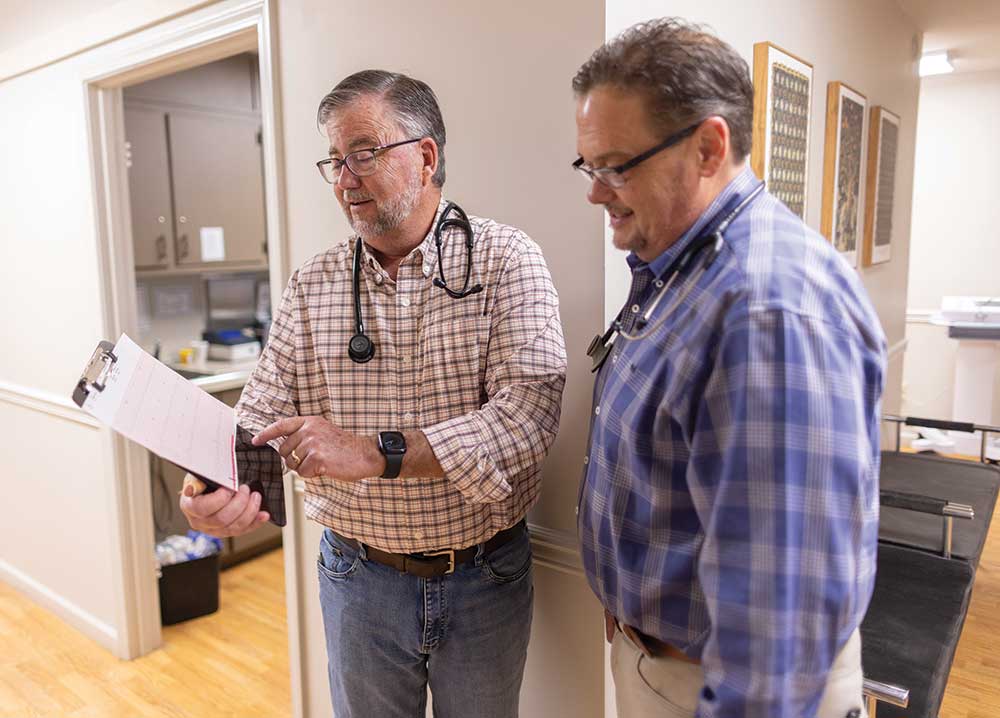
Helms confers with fellow provider, Jonathan Windham, CRNP
In 2001, Helms, McClanahan, Dr. Carl Frosina and others founded Northside Medical Associates. What began as a small, independent practice grew over the next two decades into one of the region’s largest physician-led groups, eventually serving the community with around 20 providers and more than 200 employees before being sold in 2020.
Following the sale, contractual obligations required Helms to establish his next practice in nearby Vincent. Helms Healthcare quickly became a thriving clinic there, and after one year, he was able to return to the community he had always hoped to serve.
“My goal was always to come back,” Helms said. “Pell City is home. Vincent has become a wonderful practice that continues to grow, but returning here, feels like coming full circle.”
Today, Helms Healthcare operates from a new 8,000-square-foot facility designed around one simple philosophy: healthcare should be personal, accessible, compassionate, and centered on the patient. The practice offers comprehensive primary care, seven-day urgent care, digital X-ray, a hospital-grade laboratory, advanced vascular ultrasound, and plans to add one of the region’s most advanced CT scanners, capable of high-quality cardiac CT imaging.
When patients call, they speak with a real person, not an automated system, and every member of the team is trained to create an environment where patients feel welcomed, respected, and heard.
“Technology matters,” Helms said. “But people never stop needing kindness. We want every interaction, from the first phone call to the front desk to the exam room, to communicate that every patient matters.”
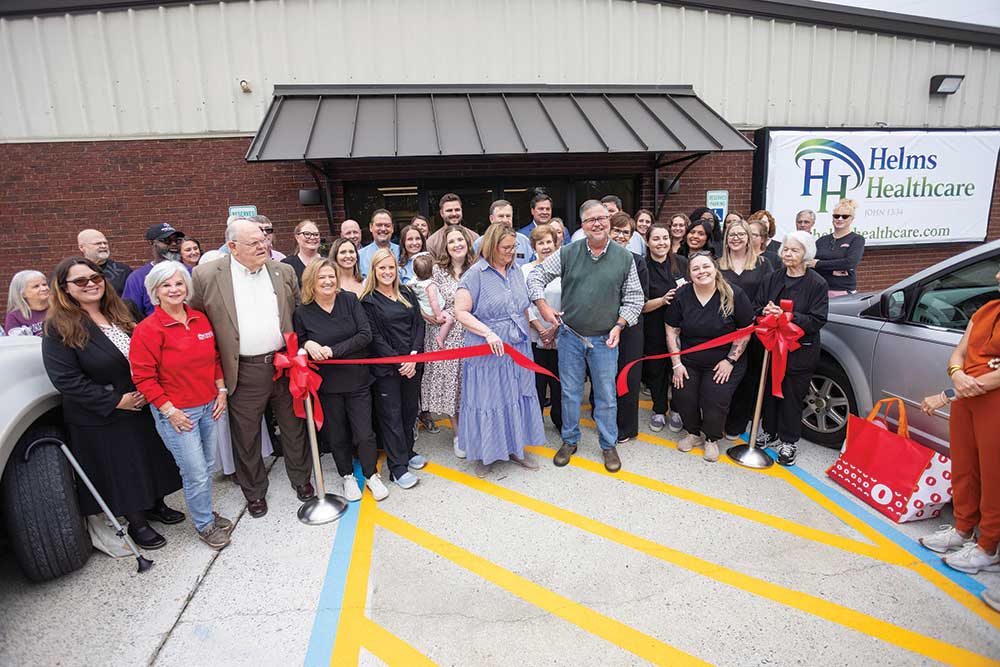
Dr. Rock and Jennifer Helms cut the ribbon on new Pell City clinic
He also believes the future of primary care is physician-led team care, built around relationships, accessibility, and patient choice. He works closely with exceptional nurse practitioners and physician assistants, building strong relationships and continually discussing cases throughout the day.
“Even when I’m not physically in the exam room, I’m often involved behind the scenes, reviewing complex cases, discussing treatment plans, and helping guide patient care.” Each patient develops an ongoing relationship with a primary provider who knows them well, while Helms serves as the physician leader of the team.
Patients who would like Dr. Helms personally involved in a visit are always welcome to request that, whether as a new patient, during an annual visit, or anytime they want another set of eyes on their care. “The choice belongs to the patient,” Helms said.
He credits UAB St. Vincent’s St. Clair, along with generations of nurses, specialists, and primary care physicians for helping create a community where patients increasingly receive excellent care close to home.
He names longtime colleagues with genuine gratitude. “One of the things I’m most grateful for is the physicians who have invested their lives in serving this community,” he said. “I’m thankful for mentors like Dr. Bill McClanahan, Dr. Carl Frosina, for my longtime partner Dr. Michael Dupre, and for colleagues, such as Dr. Rick Jotani, Dr. Barry Collins, Dr. Ilinca Prisacaru, Dr. Hunter Russell, Dr. Steve Fortson, Dr. Laura Johnson, and many others. We’ve taken different paths, but we’ve always shared the same purpose, caring for the people of Pell City.”
Over the years, Helms says another part of his life has grown just as much as his practice – his faith. “My relationship with Christ has changed the way I see medicine,” he said. “Today, my deepest desire is to honor God by serving the people He places in front of me each day.”
He emphasizes that those conversations are always patient-led. “I never want anyone to feel uncomfortable or pressured,” he said. “But when a patient asks me to pray with them or wants to talk about faith, it’s one of the greatest privileges of being their physician.”
Looking ahead, he hopes to see continued growth and collaboration across the entire medical community. “If people remember anything about my career,” he said, “I hope it isn’t a building or a piece of equipment. I hope they remember that I loved this community, respected my colleagues, cared for people with compassion, and tried to honor God in the way I served.”
Time was in St. Clair County when patients seeking medical care had to travel great distances to get the care they needed. That time has passed.
St. Clair is now a regional medical hub offering primary, specialty and urgent care. Throughout the St. Clair County region, comprehensive medical services are often found just a few minutes away.
Here’s a glance at what the region’s major medical providers offer:
UAB
St. Vincents St. Clair
7063 Veterans Parkway
Pell City
Advanced wound care center
Emergency care
Gynecology
Lab
Nuclear medicine
Neurological services
Orthopaedics
Pain management
Physical therapy
Radiology (MRI, CT, mammography, bone density, and ultrasound scans)
Respiratory care
Sleep disorders center
Speech therapy
Sports medicine
St. Vincents East
50 Medical Park Dr. E.
Birmingham (Trussville)
Behavioral health
Cancer care
Cardiovascular services
Diabetes care
Digestive disorder care
Endoscopy procedures
Emergency services
Orthopaedics
Primary care
Pulmonology
Same-day surgery
Sleep disorder care
Surgical weight loss
Thoracic surgery
UAB Medicine Leeds
1141 Payton Way
Leeds
Primary Care- for adults and children
Dermatology
Endocrinology
GI Surgery
Nephrology
Neurology
OB/GYN
Orthopaedics
Lab and Imaging
UAB Leeds Outpatient Imaging & Laboratory
3D mammography, MRI, and bone density scanning
Ultrasound
Low radiation dose CT scanner
Digital X-ray units
Radiologist review of all exams, with same-day reporting
UAB Family Medicine East
48 Medical Park Dr. E., Ste 154
Birmingham (Trussville)
Annual health evaluations
Physical exams
Preventive care, including health screenings and physical exams, for patients of all ages
Routine care for women, including Pap smears and pelvic and breast exams
Well-child care
Obstetrics & gynecologic care
Management of chronic conditions such as hypertension, diabetes, asthma
In the St. Clair County region’s medical community, pediatric services play a prominent role. From birth to adolescence to young adulthood, the region is home to four clinics specializing in the care of younger patients. They are:
Ensuring healthcare is affordable and accessible, St. Clair County residents can benefit from services at the St. Clair County Community Health Clinic and the St. Clair County Health Department.
St. Clair Community Health Clinic
Established in 2018, the St. Clair Community Health Clinic (SCCHC) is a 501(c)(3) nonprofit organization providing charitable primary healthcare to low-income, uninsured St. Clair County residents between ages 19 and 64.
Its work is made possible through grants, donations, and “most importantly – the time and talent of community volunteers,” according to its website.
Those who qualify are able to receive care for a co-pay not exceeding $20, which enables the clinic to provide affordable access to essential health services.
The clinic is located at 205 Edwin Holladay Place in Pell City.
St. Clair County Health Department
In the Northeastern Division of Alabama Department of Public Health, St. Clair County Health Department offers to the public:
WIC (Women, Infants and Children) services
Environmental
Home care
Clinical services to the public.
Clinical services include STD (sexually transmitted disease) testing and treatment, family planning, childhood and other vaccines, and breast and cervical cancer screening.
The health department is located at 1175 23rd N. in Pell City.
WIC Satellite Clinic
In addition to the main clinic location in Pell City, 1175 23rd St N,, a satellite clinic is open on Thursdays for WIC services. Call 205-594-4919 to make an appointment.
The satellite clinic is located at 31675 U.S. Highway 411 in Ashville.
“You can’t always get what you want… but if you try sometime, you just might find you get what you need.”
It was the late ‘90s, and I was entering my teenage years when I finally realized this piece of sage advice my father repeatedly offered me wasn’t his at all… it was Mick Jagger’s.
My dad, perpetually cool, was, of course, borrowing his wisdom from the Rolling Stones. I was just too young to know the difference.
But that’s the thing about words of wisdom … it doesn’t really matter whether they came from a song or sermon, a movie or a magazine.
The best words, if strung together just right, take on a life of their own. Eventually, they stop belonging to the people who first wrote them. They get absorbed into everyday life. They become mottos and mantras. They become advice fathers give their children, phrases we share on social media or scribble down in journals, words we repeat to ourselves & carry with us so long we often forget where they even came from. That’s what good words do. They settle into you.
They become part of the lens you see the world through. Over the years, I’ve realized that, thanks to my dad & an aging rock star in impossibly tight pants, that lyrical line has become just that for me— an anthem of sorts.
Not because life has handed me everything I wanted… there’s certainly a lot that I don’t have and probably never will … but, time and time again, life has given me exactly what I need.
– Mackenzie Free –
Wife, mother, photographer & current resident of the unassumingly magical town of Steele, Alabama
Local beekeepers are helping boost St. Clair County’s reputation while protecting pollinators, building healthy hives and turning hard work into a sweeter agricultural story
Story by Paul South Photos by Ben Orvis Submitted photos
The sweetest agriculture story in St. Clair County is flying under the radar – literally.
Just ask Bill McTyeire, Daniel Kirby and Nikkie Posey. The trio are part of a buzzing business – beekeeping and honey production.
“I’m passionate about bees,” McTyeire said.
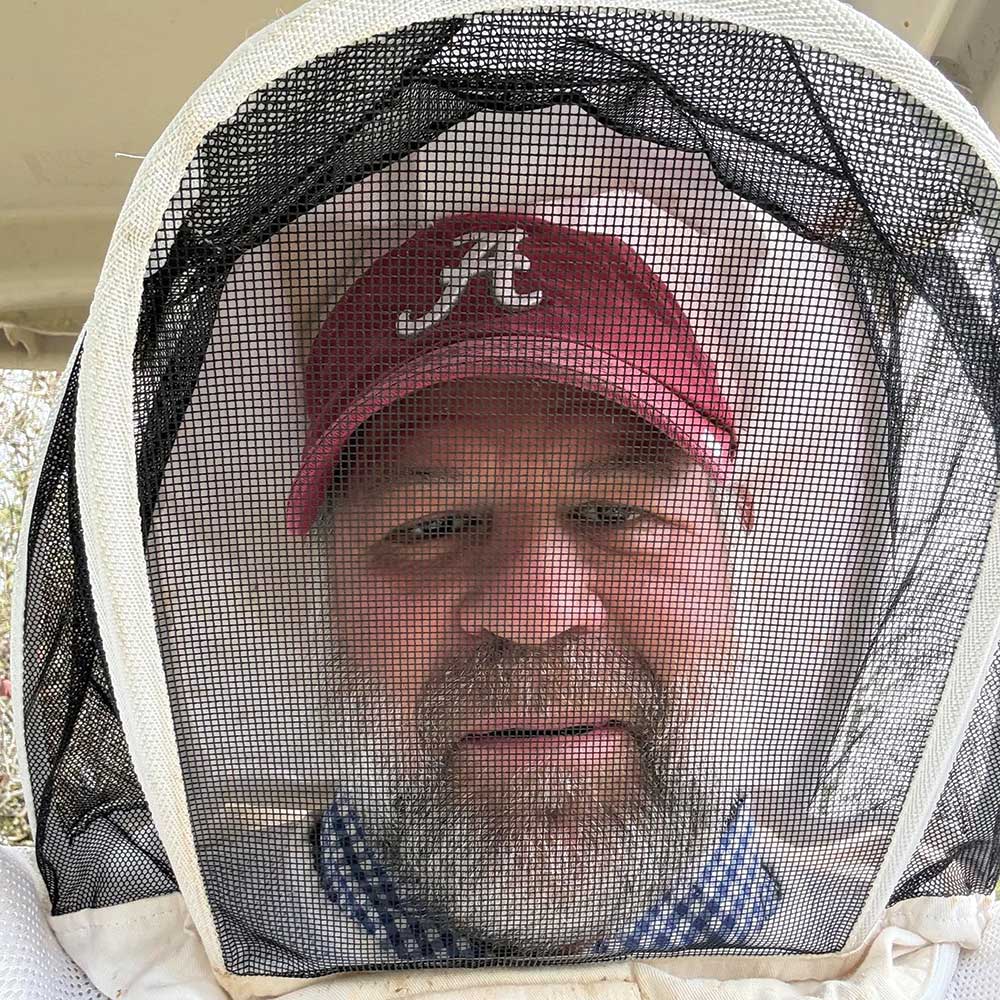
Bill McTyeire
That’s the story, it seems, for McTyeire, Kirby, Posey and beekeepers and researchers across the country. The bee population is critical to food production. So, by extension, the small insects are vital to humanity’s survival.
And the sweet amber liquid they produce is a popular product, found on and in everything from hot breakfast biscuits to bourbon.
Honey bees themselves are under siege, thanks to the Varroa mite, herbicides and pesticides, climate change and human development.
Nosh Crockette, the Honey Bee Outreach and Development Coordinator at Auburn University, spelled out the impact if bee populations and pollinating plants disappear.
“If pollinators disappeared, we’d be at risk of losing many of the crops we rely on, and our produce options could become extremely limited,” Crockette said.
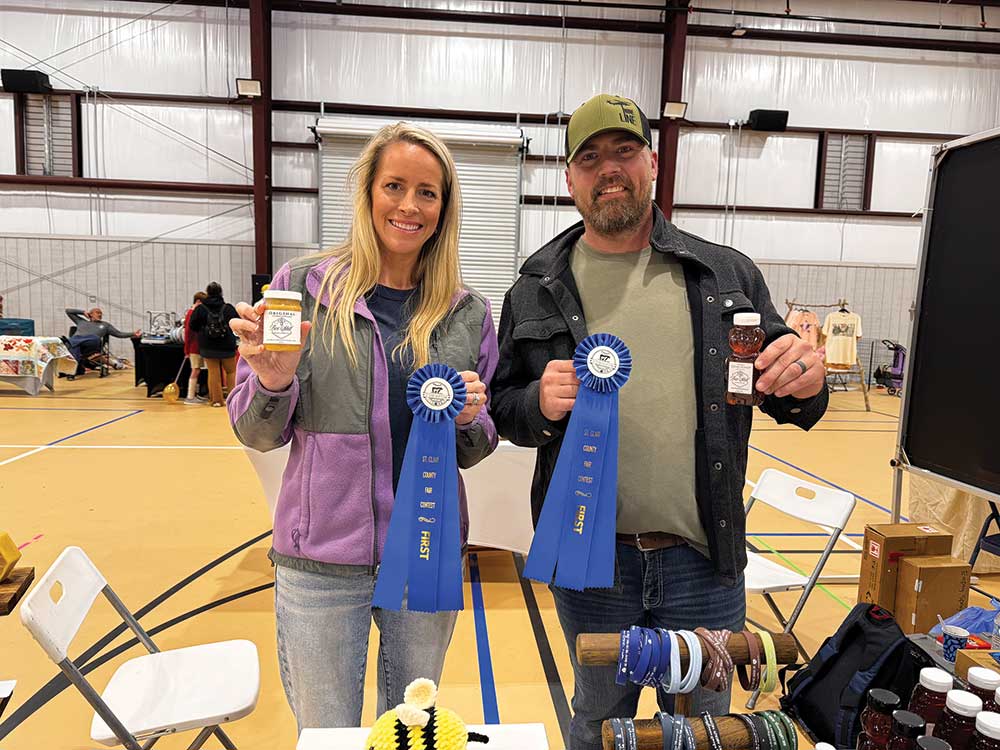
Deanna and Daniel Kirby with their prize-winning honey
There are more than 400 species of native bees in Alabama and some 2,000 beekeepers registered in the state, Crockette said. Auburn researchers collaborate with beekeepers to help minimize the impact of the mites on honey bees.
The honey bee doesn’t only produce the thick, sweet amber liquid used in American kitchens. Nor is it just about beeswax, candles, lotions and balms.
“Honey bees help pollinate many fruit, nut and vegetable crops, with some crops such as almonds being reliant on the bee population to produce fruit,” Crockette said.
McTyeire, Kirby and Posey are on the front lines of the quiet battle to save bee populations.
Bees as a Passion
Bill McTyeire spent more than 34 years as a landscape contractor. Now, bees are his focus. He travels throughout the region capturing swarms of the insects when local landowners call.
“Bees are my passion now,” he said. “I love dealing with bees.”
That’s seemingly the story of the growing beekeeping industry.
McTyeire has been keeping bees since 2020. His bee and honey production has been up and down. Early on, he bought packages of bees. Then he switched to purchasing “nucs,” a nucleus of bees. Nucs are five or six frames of bees – a queen, honey, pollen, drones and babies, everything needed for a successful start. In central Alabama, beekeepers have only about a two-month window in summer for developing hives.
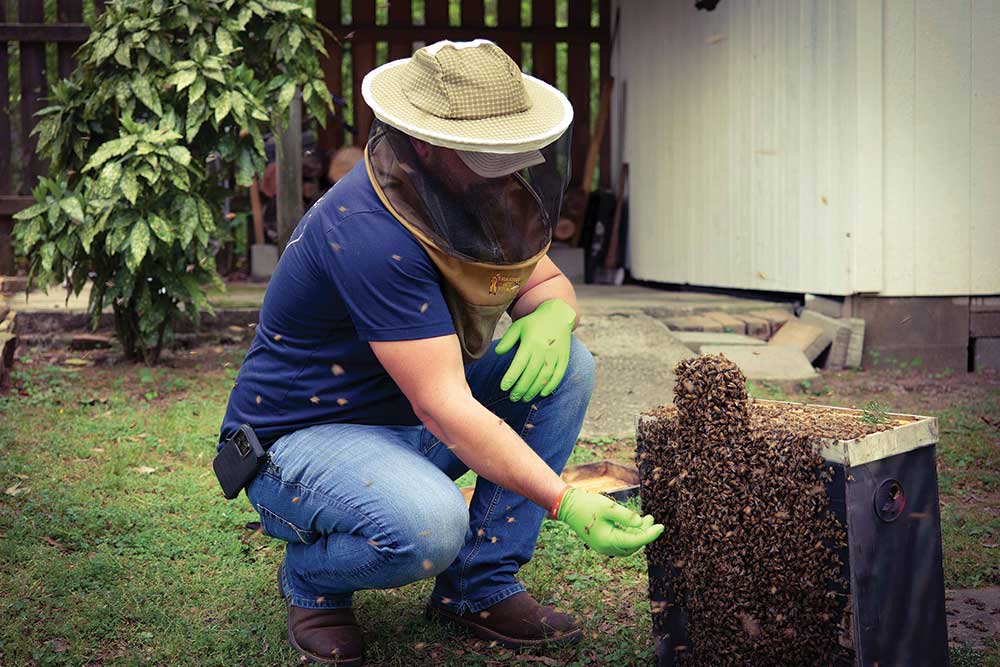
But McTyeire is “really into” capturing wild swarms of bees that attach their colonies to tree limbs and the like.
“If you’re a deer hunter, you like to go out and get the biggest buck. If you’re a beekeeper, for me, catching a wild swarm of bees. Or someone calls me and says, ‘Hey, I’ve got a wild swarm of bees in a tree in my yard. Are you interested?’ If I can get ‘em to the ground, I’m interested. I’ll put on my bee suit, and I’ll go. I’ll take ‘em home and put them in the bee yard.”
Right now, the hobbyist has 35 hives, up from 11 last winter. In peak season, from May through July, there are an estimated 100,000 bees per brood box.
“My ultimate target is probably going to be 50 (hives). I’ve grown so fast,” he said.
Though small, bees are some of the most intelligent members of the animal kingdom, flying up to five miles looking for pollinators. Most return to the hive. It’s baked into their DNA.
“They’ll visit like 5,500 flowers and produce like a 12th of a teaspoon of honey in their lifetime,” he said. “That’s each individual bee.”
The Allure
What drew McTyeire to beekeeping?
“I do it for the love of the bees,” he said. “I’ve never been a patient person at all. I’m very impatient. When I get into a hive working with bees, you have to be patient. You can’t get in a hurry. You have to be very methodical when going through a hive box.”
Hive management is critical, especially when battling the honey bee’s public enemy number one.
Kirby during swarm removal process
“If you do good, proper hive management and then you treat your bees for Varroa mites – I don’t treat them for anything else. The mites are the number one killer,” he said.
According to a survey led by Auburn in collaboration with Oregon State University and the Apiary Inspectors of America, beekeepers lost 39.9 percent of their colonies in 2025-26. Keepers saw record losses in 2023-24 (55.1 percent) and 2024-25 (55.6 percent).
Failure to maintain a healthy bee population can devastate the food chain.
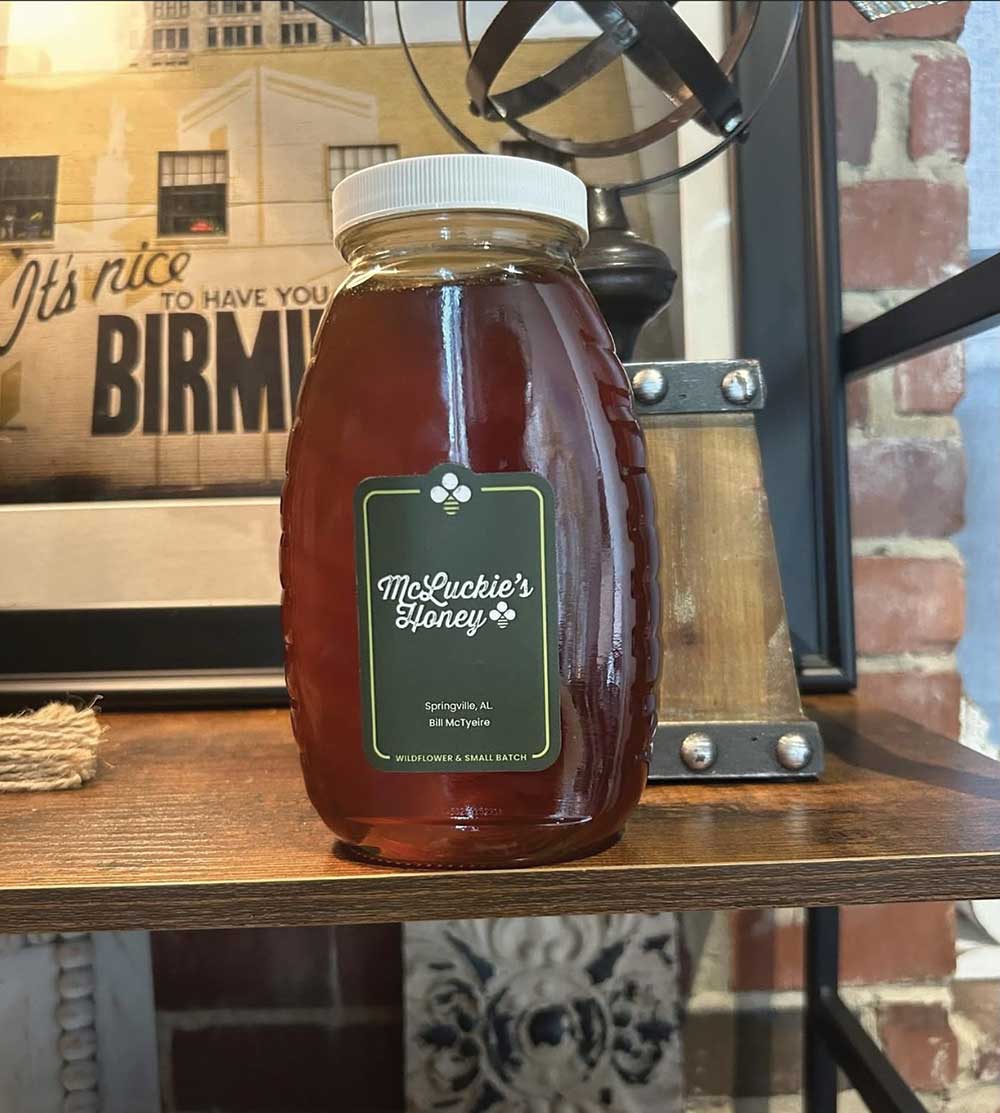
In terms of honey production, 2025 was a good year for McTyeire’s company, McLuckie’s Honey, that he and his “sidekick,” Laura Niemann, sell.
He sold 60 two-pound jars and 120 one-pound jars of his wildflower small batch honey last year. He’s also seen his smooth, not-too-sweet honey, with a pleasing floral aftertaste become a barter currency.
Neighbors will trade their offerings for a jar of his honey.
“It’s like money,” he said. “Every year is kind of a yo-yo. I do small-batch honey. I don’t want to be a bigwig. I want to sell what I have and try to grow my bee yard and to help other people learn about bees.”
The bottom-line lesson?
“Without the bees, we’re all goners,” he said. “I’m passionate about bees. I’m passionate about honey. But that’s not my main goal. It’s about building a healthy population of bees. We’ve got to do a better job as Americans and humans to save the bees,” McTyeire said. “When they’re gone, so are we.”
The Sweet Taste of Success
Daniel Kirby of Odenville serves with McTyeire and Nikkie Posey on Springville’s Bee City, U.S.A. board. His honey of a story began in 2015 as a hobby that’s now a flourishing family business, Bee Still Honey Company, LLC. It’s built on feral bees caught in the wild. Unlike packages of bees, the wild, hardy creatures have already adapted to the colder winter weather in east central Alabama.
For Kirby, the life of the bee is a source of boundless fascination.
“Just the life of a honey bee, the way they interact and communicate and live their lives,” Kirby said. “They work as one organism. It takes all of them working together to make it. Just the way they communicate with each other to complete what they have to do.”
He added, “If humanity was like honey bees, we wouldn’t have any problems whatsoever.”
A native of Rome, Georgia, Kirby worked a variety of jobs from pipefitting and welding to law enforcement before discovering the bee business.
“God has really blessed us,” Kirby said. “Last year, we grew like 200 percent.”
Bee Still had 100 colonies in 2025, 200 this year. But like McTyeire, the number is constantly changing.
Echoing McTyeire, Kirby’s biggest challenge is fighting off the Varroa destructor mite and pesticides.
Worker Bees
The bees are brilliant. Like homing pigeons, many will return home after searching two to five miles, even in harsh conditions, for food and water.
“Could you imagine flying five miles for food and water and by the time you get home you’ve used half of it? They work themselves to death. They don’t sleep,” Kirby said.
Divine providence brought Kirby and his wife to St. Clair County. “We think it was a God thing, honestly,” he said. “There were a ton of little things that brought us here.” Those “little things” included Springville’s “Bee City” designation.
Small-batch honey from Bill McTyeire in Springville
Like McTyeire and Crockette, Kirby paints a dire picture for humanity if honey bees were to disappear. However, he believes increased awareness has helped bee populations turn the corner.
People have really started paying attention to honey bees in the past few years in trying to keep them alive, Kirby said. “The Varroa was the main threat, but we’ve got that pretty much under control.”
The bee business is blossoming, not only in St. Clair County, but across the country. And honey is fast becoming a big boost for the human immune system. One note: Heating honey, or adding it to hot coffee or tea, kills the healthy enzymes and bacteria in the natural sweetener.
“I predict that in a few years there’s going to be a honey shortage … unless there are more beekeepers. The youth are not getting interested in beekeeping. We teach classes to 4H and to school classes,” Kirby said. “But all the wellness and health stuff has really taken off in the past five years. Everybody is wanting healthier products and they want honey.”
Bee Healthy
Posey’s beekeeping and her store, Pinkhill Organics in Springville, came together in 2019. Health was the big draw.
“The medicinal qualities of honey first and wanting to have that for myself and my family. But I also make Elderberry syrup for my store and having good honey to make it with was also important,” Posey said.
She has 10 hives and more than 1 million bees. The insects provide a big challenge, Posey said.
“Bees are curious creatures, and some years you lose hives and they abscond. This past winter, I lost five hives. You can catch swarms and do everything right. But sometimes, the little Airbnb you’ve set up for them, they just don’t like. The bees themselves are most frustrating.”
For example, when Posey and her family were starting their apiary, they bought packages of bees, costing $300 a pop. All flew away. Since then, the focus is on feral bees. It takes 18 months to two years to establish honey-producing hives.
Posey produced more than 10 gallons of honey last year. She expects to produce 25 gallons this year.
Posey made a key point about bees.
“They are the only insects that give us a product we can eat,” she said. “Honey bees aren’t the only pollinators. But people are more and more understanding of the role (of bees). When it’s swarming season in March, I see a lot more posts (on social media). ‘Does anyone know a beekeeper?’ It seems a lot of people are trying to save the bees.”
For those who want to increase the bee population, delay spring yardwork. “Let the dandelions come up. Let little flowers come up and let clover grow,” Posey said.
“The bees are going to work that and use that as their initial sources of nectar and pollen. If people would delay mowing for that pristine yard. But if you have some property, let it grow up. Those wild things are important to the bees as well. Let the natural things grow.”
Beekeepers are popping up across St. Clair County, from Washington Valley to Chandler Mountain. There are also beekeeping groups. A local elementary school promoted beekeeping in its summer reading program.
“More and more people come into my store are interested in beekeeping,” Posey said.
While honey can seemingly be used in countless ways, one simple way to eat the sweet treat seems most popular, at least for Niemann and Posey.
“By the spoonful.”
Lessons From the Bees
And as for a last piece of advice to potential beekeepers, Posey said, “The frustration is absolutely worth it. A piece of advice my mentor gave me when we bought packaged bees and they flew away, he said, don’t give up. And I would encourage people to support local beekeepers and buy their honey. Be mindful of the honey you’re buying. If you see honey in the store with a label that says, ‘USDA Certified Organic,’ there’s no such thing.”
What’s the bee lesson for humanity?
“Teamwork is important for the success of society,” she said. “If you think of each colony of bees as its own society, it takes their teamwork aside from personalities. If we can take that lesson of teamwork and how successful that is and how successful that can be for our community – even here in Springville – that it takes all of us to have a successful community.” l