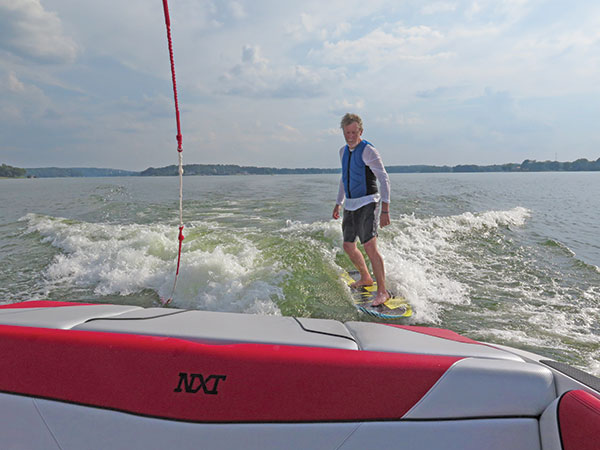
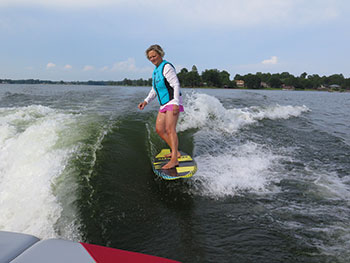
Rock & Rolling, high flying, surfer judge hits the waves
Story by Carol Pappas Photos by Graham Hadley
Most weekdays, you’ll find him donning a black robe, gavel in
hand, poised to rule in a court case. In those somber surroundings, it’s
difficult to imagine what the judge might do for a little R&R.
But after the day’s work is complete, it’s as if Superman has
just stepped into that iconic phone booth. He transforms into one rockin’ and
rollin,’ high flyin,’ lake surfin,’ incredibly cool dude.
Pick your passion. St. Clair County District Judge Alan Furr
does, although you’re never quite sure which one it will be.
Electric guitar in hand, that’s him on a Saturday night, a
natural at leading the band, The Wingnuts. The band got its start in an
airplane hangar in 2010, its members mostly pilots, including Furr. Since then,
they’ve built quite a following, playing oldies and Rock & Roll for
audiences across the region.
That might be enough to keep most busy, but not Furr. He’s
made the cockpit selfie with wife Sandra locally famous on Facebook. It’s not
uncommon to see the Furr’s take to the skies for short hops and long treks.
His
newest past-time adventure puts him and Sandra out on their beloved Logan
Martin Lake, a stone’s throw from their home on Cropwell Creek. They’re not
quite hanging 10, they admit, but to them, it’s close. At 60-something, they’re
nothing short of inspiring with their wake surfing prowess.
“Sandra
and I bought our first board and started learning to wake surf around 2010, but
we didn’t have a good surf boat, so the learning was difficult,” Furr said.
“Consequently, we both primarily stayed with slalom skiing, and I also rode a
wakeboard. Now that we are in our mid-60s, we figured we needed to concentrate
on a ‘milder’ form of water sport.”
In
2015, they bought a MasterCraft NXT20, which is designed for wake surfing. “So, for the past couple of years we’ve been
surfing on Logan Martin,” he said. It requires a boat that is set up with a
“surf system” and ballast, a wake-surf board, and “the willingness to give it a
try.”
How it works
So
what does it take to wake surf? When a boat moves through the water, it creates
a wake. When the hull of the boat displaces the water, it goes back to where it
previously was.
That
constant flow of water creates a constant wave, and the surfer trails behind
the boat on its wake without actually being pulled by the boat.
You
get up on the wake with a special board and tow rope, similar to skiing, but
that’s where the similarity stops. When the rope gives some slack, it’s time to
drop the rope and go wake surfin’ with the Furrs.
Let’s go surFin’ now…
Sandra
goes first. With the board parallel, and her heels atop the side, she waits for
the start. He throttles the boat, and up she pops, giving a twist and allowing
the board to get perpendicular with the back of the boat.
Once
the driver tightens the rope and gives it a little bit of throttle, the water
behind the board pushes the board up, and you just stand up.
Only
a few feet behind the boat, she concentrates on the wake, her balance and
finding the “sweet spot.”
“You’re
trying to get a speed on the board that matches the speed of the boat,” Furr
explains. “You find that sweet spot that matches the speed with the boat.”
“And
when you can feel it,” Sandra adds, “you can actually feel the wave pushing
you. It’s the coolest feeling, and when you feel it, you know it.”
She
hits the sweet spot, and she drops the rope. Then, it’s like watching the old
Beach Boys tune, Surfin’ Safari, in motion.
Everybody’s learning how…
Before
getting a special boat, “we fooled around for a year or two,” learning what to
do, Furr said. “We could get up and hold the rope, but we couldn’t get slack.
This boat is what really made the difference, and also that board.”
They
transitioned to the new boat, and that’s when it all started coming together
for them. “I always thought I’d like to surf, but this is as close as I’ll ever
get to it,” he said.
He
went a step further, pointing out the benefits of his brand of surfing. “First,
there are no sharks.” In ocean surfing, you must swim out on your board. “With
this one, you just start the motor.”
The
Furrs haven’t tried those fancy moves yet, like the Fire Hydrant and 360s, but
there are plenty on Logan Martin who do, he said.
To
which, Sandra quickly retorted, “Yeah, but they’re not 63 and 64.” For the time being the Furr’s will stick to
“carving” the wake, although conquering the 360 is on their bucket list.
“A
lot of people are getting into it. We just chose it because we’re getting older
and wanted something to do – a little more low impact,” Furr said.
“There are several wake surfers here in Cropwell Creek,” he
added, “and I’m sure there are many all over the lake. We are by no means the
best…but we’re probably the oldest.”
Story by Elaine Hobson Miller Photos by Mike Callahan Submitted photos
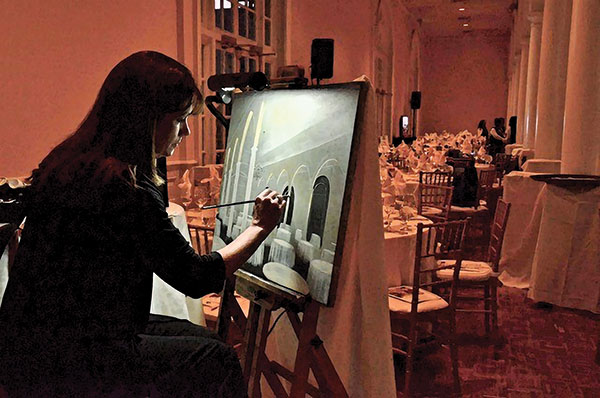
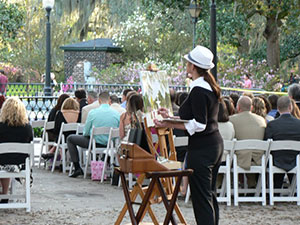
One night, artist
Joy Varnell was up late watching television when she stumbled upon a show about
beach weddings. As the camera panned the California venue, she spotted an
artist among the guests, paint brush in hand and canvas on easel. Intrigued,
she recorded the show, then played it several more times. Realizing he was
painting the wedding scene, she said to herself, “I think I can do that.”
The problem was,
she didn’t know how to get started.
That issue was
soon resolved when she walked into the home of a friend/client and spotted a
wedding invitation on her kitchen counter. “The client mentioned that she
wanted to give the wedding couple something unique, and I suggested that I go
to the wedding and paint a picture,” Joy said. “She agreed, and when I got back
to my car, I thought, ‘What have I done?’ ”
What she did was
create a new twist in her artistic career, one that eventually caused her to
dump her day job and paint 40 hours a week. She attends weddings and
receptions, capturing special moments on canvas. After eight years, that twist
has resulted in more than 300 paintings, taken her and her husband all over the
United States, and made a lot of brides happy.
Joy started
drawing as a child and painting as a teenager. She studied interior designat
Southern Institute (which later became Phillips College) and worked as a
kitchen designer for 16 years before striking out on her own to do interior
design and faux finishes — a lot of faux finishes.
During all those
years, she was painting in her spare time and selling her work. Her husband,
Tim, kept encouraging her to spend more hours at her easel. Then came that
first wedding, a huge event at the Birmingham Museum of Art. She painted the
bridal couple descending the stairs for the reception, and in a newspaper
article about the wedding, the bridegroom mentioned that her painting was his
favorite gift. From there, her new venture took wings.
“This got bigger and bigger and just took over, and I quit
doing interior design,” she said. The transition from landscapes, pet portraits
and still life to painting people was a struggle at first, but Joy has a knack
for looking at something and being able to paint it. Soon, she was painting
weekdays and attending one or two weddings on the weekends. Now, it’s a full-time
business. “I did 48 paintings in 2018,” said Joy, who calls herself a
“live-event artist.”
Her modus operandi is to show up about three hours before the
event, usually wearing a black dress or pants, to start painting the
background. “The vendors usually dress in black, so I do, too,” she explained.
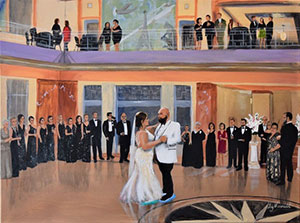
The most popular request is to capture the bride and groom’s first dance, so
she usually sets up at the reception. When the guests come in, she’s ready to
paint them into the scene. When the wedding couple appears, she adds them to
the painting.
She tries to get a good likeness of the bride and groom, but
not the people in the background. Most of them can be recognized by what
they’re wearing. She uses the term, “most,” but brides and their mothers are
much more specific than that. “The details of the people in the painting
are amazing,” said Pamela Rhodes, mother of a bride who married in Addis,
Louisiana. “Joy painted my daughter and son-in-law’s first dance as husband and
wife (Peyton and Sean Forestier). We are able to identify every person painted,
even the guy singing on the stage (my brother-in-law).”
“The Creator of the Universe certainly shines through Joy’s
hand,” gushed Jurrita Williams Louie of Dallas, Texas, who got
married in Tuscaloosa, her and her husband’s hometown. “She captured our first
dance as Mr. and Mrs. Calvin Louie as if God came down from heaven to earth to
do it. I can’t quite get over the detail and thoughtfulness with each stroke.”
Joy’s medium is acrylicsbecause they have no odor and
dry quickly. “I have to work very fast, so at least the couple can see
themselves before they leave,” she said. “People come up and say, ‘It looks
just like them,’ as if they are surprised. Well, that’s the point.” As for
mistakes, she just paints over them.
At the time she started, she found only four artists doing
what she does. Three were in California, one in New York. There are many more
now, but she believes the examples on her website, joyvarnellart.com, and her willingness to travel make her stand out. Her new business
has taken her to California, New York, Indiana, Florida, Louisiana and along
the Gulf Coast, Georgia and up and down the East Coast as well.
“I average about 12-15 weddings around the New Orleans area
and south Louisiana each year,” she said. One such event took place at the
restored art deco Lakefront Airport terminal in New Orleans. “It was my
daughter, Celeste’s, wedding to Don Jude,” said Claudine Hope’Perret. “It was
their first dance, and the painting shows amazing work and detail, even down to
their lit-up tennis shoes.”
No one has ever expressed a dislike of her paintings, though
she did have a girl ask her to re-do the groom’s hair once. “I strive very hard
to get what they want,” she said.
Tim, who is retired from the Norfolk Southern Railroad, goes
to the weddings with Joy and does most of the driving. Anything over 500 miles,
they fly. He packs up her paints and tools at home, unpacks and sets up at the
venue, then repacks. “He calls himself my roadie,” she said. “He’s my public
relations man, too. He mingles.”
Some of the brides are nervous, and others just very excited
and enjoying their day. The grooms are always nervous, and usually say, “Where
do you want me?” Kids just stand and stare.
The most common request she gets while painting is, “Will you
take 10 (or 20) pounds off me?” That often comes from the mother of the bride.
“Sometimes a woman will come up and talk to me because she’s afraid to talk to
Joy,” Tim said. “One woman asked if Joy would take off her stomach and give her
some boobs.” A man might ask her to cover a bald spot.
Sometimes Joy adds details that represent something
meaningful to the couple. Once, she painted a map rolled out to represent a
treasure hunt, because that’s how the groom led the bride to her ring and his
proposal. She has painted favorite dogs, relatives who couldn’t attend, even
dead relatives into the paintings. She has put cats in, too. “Very often the
venue will have one, and I’ll paint it peeping through a window,” she said.
Occasionally she’ll give the bride a brush and let her paint a few strokes of
her own.
She has painted outdoors in all types of weather, from
35-degree temperatures on New Year’s Eve to 95-degrees in the sun. She prefers
the reception to the ceremony because it’s less structured, and she gets to
interact with the people. “That’s part of what makes it fun,” she said.
One of her most memorable events was a Hindu wedding in
Indiana. The bride wanted her to paint the Seven Vows, but she didn’t know what
they were or where they occurred in the ceremony, which was four hours long.
She kept asking people, and no one seemed to know. Parts of the ceremony were
in English, parts in Hindi, and it turned out that the Seven Vows were at the
end. Tim found out and clued her in.
An outdoor wedding in Biloxi,Mississippi, was notable
because a storm came up and sent many guests inside. The bridal party remained
outside, and at the end of ceremony, the couple was framed by a rainbow.
There was one in Fort Deposit they’ll never forget, either,
but for a very different reason. “When we got out of the car there, we realized
we had left my paints at home,” Joy recalled. They carry an emergency set,
which has been upgraded as a result of that trip.
She hates having to tell people she is already booked for
their special date, and has painted two events in one day, as much as 90 miles
apart. One time, she got two separate bookings for the same wedding, at
Aldridge Gardens in Hoover. “The bride’s mother had contacted me and asked for
a painting of the couple’s first dance,” she said. “Then I got another request
for the same wedding. The bride wanted one of the father-daughter dance to give
to her parents. Neither knew about the other’s request.” She had two canvases
on her easel throughout the reception and kept swapping them back and forth so
neither party would know about the other. The backgrounds were the same. “The
bride’s mother began to catch on, but the dad never did,” Joy said. “I presented
both paintings at the end.”
Sometimes she finishes a painting on site but brings home
most of them so she can apply an art varnish as a protective sealer. Her studio
is a sunny 11’ x1 2’ room of her house, with a huge front-facing window. She
and Tim have lived in that house on a mountain top in Springville for 12 years,
surrounded by rock formations, trees and lots of wildlife. Deer and turkey
wander around the property, along with a family of foxes that they feed daily.
The house is filled with Joy’s still-life paintings, such as wine bottles so
real you want to grab one and pour a drink.
Jessica Silvers Posey of Maryland, who married Aaron Posey in
Laurel, Delaware, said Joy painted the most beautiful picture of the couple’s
first dance. “The details are phenomenal,” she said. “I relive that moment
every time I look at the painting. Everyone who walks past this painting in our
house can’t help but stop and stare.”
While mothers, parents, bridesmaids, co-workers and grooms
hire her to paint as a gift, most of the time it’s the brides who engage her
services.
She offers three standard sizes, 18” x 24”, 24” x 30” and 30”
x 36”. Clients may choose something larger but cannot choose whether the
finished product will be vertical or horizontal. “I decide that, depending upon
the venue and what I want to get in the painting,” Joy said. The largest one
she has done was 42” x 48”. Her prices start at $1,000, plus travel expenses if
she goes outside the Birmingham Metro area.
Although 99 percent of her business comes from weddings, she
has painted at Christmas parties, company anniversaries and fundraisers. One of
her corporate events was the opening of Nick Saban’s Mercedes-Benz dealership
on I-459. And yes, the coach was there.
Even though she doesn’t normally turn down an event unless
she is already booked, she did refuse to paint at one recent wedding. Her own
daughter was the bride, the wedding took place at Joy and Tim’s house, and Joy
wanted to relax as much as possible and enjoy it.
“I
will paint it later from photographs,” she said.
“This got bigger and bigger and just took
over, and I quit doing interior design,” she said. The transition from landscapes,
pet portraits and still life to painting people was a struggle at first, but
Joy has a knack for looking at something and being able to paint it. Soon, she
was painting weekdays and attending one or two weddings on the weekends. Now,
it’s a full-time
business. “I did 48
paintings in 2018,” said Joy, who
calls herself a “live-event
artist.”
Her modus operandi is to show up
about three hours before the event, usually wearing a black dress or pants, to
start painting the background. “The vendors usually dress in black, so I do, too,” she explained. The most popular
request is to capture the bride and groom’s first dance, so she usually
sets up at the reception. When the guests come in, she’s ready to paint them into the
scene. When the wedding couple appears, she adds them to the painting.
She tries to get a good likeness
of the bride and groom, but not the people in the background. Most of them can
be recognized by what they’re wearing. She uses the term, “most,” but brides and their mothers
are much more specific than that. “The details of the people in the
painting are amazing,” said Pamela Rhodes, mother of a bride who married in
Addis, Louisiana. “Joy painted my daughter and son-in-law’s first dance as husband and
wife (Peyton and Sean Forestier). We are able to identify every person painted,
even the guy singing on the stage (my brother-in-law).”
“The Creator of the Universe
certainly shines through Joy’s hand,” gushed Jurrita Williams Louie of Dallas, Texas, who got
married in Tuscaloosa, her and her husband’s hometown. “She captured our first dance as
Mr. and Mrs. Calvin Louie as if God came down from heaven to earth to do it. I
can’t
quite get over the detail and thoughtfulness with each stroke.”
Joy’s medium is acrylicsbecause
they have no odor and dry quickly. “I have to work very fast, so at
least the couple can see themselves before they leave,” she said. “People come up and say, ‘It looks just like them,’ as if they are surprised. Well,
that’s
the point.”
As for mistakes, she just paints over them.
At the time she started, she
found only four artists doing what she does. Three were in California, one in
New York. There are many more now, but she believes the examples on her
website, joyvarnellart.com, and her willingness to travel make her stand out. Her new business
has taken her to California, New York, Indiana, Florida, Louisiana and along
the Gulf Coast, Georgia and up and down the East Coast as well.
“I average about 12-15 weddings
around the New Orleans area and south Louisiana each year,” she said. One such event took place at the restored
art deco Lakefront Airport terminal in New Orleans. “It was my daughter, Celeste’s, wedding to Don Jude,” said Claudine Hope’Perret. “It was their first dance, and
the painting shows amazing work and detail, even down to their lit-up tennis
shoes.”
No one has ever expressed a
dislike of her paintings, though she did have a girl ask her to re-do the groom’s hair once. “I strive very hard to get what
they want,” she said.
Tim, who is retired from the
Norfolk Southern Railroad, goes to the weddings with Joy and does most of the
driving. Anything over 500 miles, they fly. He packs up her paints and tools at
home, unpacks and sets up at the venue, then repacks. “He calls himself my roadie,” she said. “He’s my public relations man, too. He mingles.”
Some of the brides are nervous,
and others just very excited and enjoying their day. The grooms are always
nervous, and usually say, “Where do you want me?” Kids just stand and stare.
The most common request she gets
while painting is, “Will you take 10 (or 20) pounds
off me?” That often comes from the
mother of the bride. “Sometimes a woman will come up
and talk to me because she’s afraid to talk to Joy,” Tim said. “One woman asked if Joy would
take off her stomach and give her some boobs.” A man might ask her to cover a
bald spot.
Sometimes Joy adds details that
represent something meaningful to the couple. Once, she painted a map rolled
out to represent a treasure hunt, because that’s how the groom led the bride to
her ring and his proposal. She has painted favorite dogs, relatives who couldn’t attend, even dead relatives into the paintings. She
has put cats in, too. “Very often the venue will have
one, and I’ll paint it peeping through a
window,” she said. Occasionally she’ll give the bride a brush and let her paint a few
strokes of her own.
She has painted outdoors in all
types of weather, from 35-degree temperatures on New Year’s Eve to 95-degrees in the sun. She prefers the
reception to the ceremony because it’s less structured, and she gets
to interact with the people. “That’s part of what makes it fun,” she said.
One of her most memorable events
was a Hindu wedding in Indiana. The bride wanted her to paint the Seven Vows,
but she didn’t know what they were or where
they occurred in the ceremony, which was four hours long. She kept asking
people, and no one seemed to know. Parts of the ceremony were in English, parts
in Hindi, and it turned out that the Seven Vows were at the end. Tim found out
and clued her in.
An outdoor wedding in Biloxi,Mississippi, was notable because a storm came up and sent many guests
inside. The bridal party remained outside, and at the end of ceremony, the
couple was framed by a rainbow.
There was one in Fort Deposit
they’ll never forget, either, but for
a very different reason. “When we got out of the car
there, we realized we had left my paints at home,” Joy recalled. They carry an emergency set, which has
been upgraded as a result of that trip.
She hates having to tell people
she is already booked for their special date, and has painted two events in one
day, as much as 90 miles apart. One time, she got two separate bookings for the
same wedding, at Aldridge Gardens in Hoover. “The bride’s mother had contacted me and asked for a painting of
the couple’s first dance,” she said. “Then I got another request for
the same wedding. The bride wanted one of the father-daughter dance to give to
her parents. Neither knew about the other’s request.” She had two canvases on her easel throughout the
reception and kept swapping them back and forth so neither party would know
about the other. The backgrounds were the same. “The bride’s mother began to catch on, but the dad never did,” Joy said. “I presented both paintings at
the end.”
Sometimes she finishes a
painting on site but brings home most of them so she can apply an art varnish
as a protective sealer. Her studio is a sunny 11’ x1 2’ room of her house, with a huge front-facing window.
She and Tim have lived in that house on a mountain top in Springville for 12
years, surrounded by rock formations, trees and lots of wildlife. Deer and
turkey wander around the property, along with a family of foxes that they feed
daily. The house is filled with Joy’s still-life paintings, such as
wine bottles so real you want to grab one and pour a drink.
Jessica Silvers Posey of Maryland,
who married Aaron Posey in Laurel, Delaware, said Joy painted the most
beautiful picture of the couple’s first dance. “The details are phenomenal,” she said. “I relive that moment every time
I look at the painting. Everyone who walks past this painting in our house can’t help but stop and stare.”
While mothers, parents,
bridesmaids, co-workers and grooms hire her to paint as a gift, most of the
time it’s the brides who engage her
services.
She offers three standard sizes,
18” x 24”, 24” x 30” and 30” x 36”. Clients may choose something larger but cannot
choose whether the finished product will be vertical or horizontal. “I decide that, depending upon the venue and what I
want to get in the painting,” Joy said. The largest one she
has done was 42” x 48”. Her prices start at $1,000, plus travel expenses if
she goes outside the Birmingham Metro area.
Although 99 percent of her
business comes from weddings, she has painted at Christmas parties, company
anniversaries and fundraisers. One of her corporate events was the opening of
Nick Saban’s Mercedes-Benz dealership on
I-459. And yes, the coach was there.
Even though she doesn’t normally turn down an event unless she is already
booked, she did refuse to paint at one recent wedding. Her own daughter was the
bride, the wedding took place at Joy and Tim’s house, and Joy wanted to relax
as much as possible and enjoy it.
“I will paint it later from photographs,” she said.
Impact on state and St. Clair continues upward climb
Story and Photos by Carol Pappas Photos contributed from Honda
Its Alabama beginnings came in a code word: “Bingo.” That was the
name of the secret project that brought five counties together in an
unparalleled partnership to locate Honda Manufacturing of Alabama in the tiny
town of Lincoln.
While the leaders of any one of those counties would have
celebrated its location within their own borders, they realized the potential
impact on the entire region – their constituencies readily included.
So, they went to work to lure the Japanese automobile manufacturer
to a land where ‘y’all’ eventually became ‘us.’ And 20 years later, that impact
those counties dreamed of is unmistakably real.
In a five-county ‘thank you’ tour of Calhoun, Etowah, Jefferson,
St. Clair and Talladega counties, Honda Manufacturing of Alabama and the Economic Development
Partnership of Alabama unveiled the latest economic impact results from the
plant itself and its Key Tier 1 Suppliers.
By the numbers, that’s a $12 billion annual economic impact on
Alabama, providing 45,000 jobs and amounting to 5.4 percent of the Gross State
Product of Alabama.
How does that stack up in St. Clair County? Just add it up: 2,069
total jobs generated; $145.4 million in total earnings and $2.8 million in
local sales taxes.
“There is no doubt about Honda’s impact on St. Clair County,” said
St. Clair Economic Development Council Executive Director Don Smith. He points
to real life examples, like the Honda suppliers who have expanded – and
expanded again.
“The Honda location has been an incredible project for this area
but not just in the thousands of high paying jobs or the billions in economic
impact,” Smith added. “The project brought the communities in this region
together and showed the impact of regional cooperation. The success of
this project helped provide the leaders in St. Clair County the blueprint for the
EDC on communities working together countywide for the benefit of all their
citizens. It’s been a great success story.”
The employment figures underscore the successes felt in St. Clair
County. Honda employs more than 600 St. Clair Countians, making it the largest
employer in the county that isn’t actually located in the county.
Jason Goodgame, vice president of Goodgame Co., tells his own
real-life example. Goodgame Co. is now in the top 20 of largest general
contractors in Alabama. He once likened it to the centerpiece of a commercial
for Honda. “Honda took a small, family-owned company and made us into what we
are today.”
Similar success stories have played out all over the region and
state, said Steve Sewell, executive vice president of EDPA, who worked with efforts
to bring Honda to Alabama from the beginning.
Projections back then versus reality now:
6,800
jobs projected statewide – 45,000 actual jobs created so far
$186
million payroll projected – $1.3 billion in actual earnings to Alabama
households
$2.1 billion
direct and indirect impact income – $12 billion actual impact
Bringing the numbers closer to home, Sewell cited projections
versus reality for St. Clair County:
760 jobs
forecast – more than 2,000 filled
$5.9
million in earnings predicted – more than $145 million earned
$164,000
expected in new tax revenue – more than $2.8 million collected
Eighteen years after production began, Sewell said, “It has been a
phenomenal success story beyond anyone’s expectations.”
A primary care clinic with a holistic
approach, the Easterseals’ Community Health Clinic in Pell City, began and
continues as a collaborative community effort to serve St. Clair adults without
health insurance.
A year after its July 2018 opening,
the volunteer-staffed clinic serves 380 patients and has logged more than 1,600
office visits. Located at 205 Edwin Holladay Place in downtown Pell City, the
clinic shares building space with a Community Action agency, a mental health
clinic and Christian Love Food pantry, agencies that help each other serve
clients’ “mind, body and spirit.
“Ten months after we got serious about
it, we opened the doors to the clinic,” says David Higgins, executive director
of Easterseals of Birmingham, which also operates a Pediatric Therapy clinic in
Springville.
Because of the success of the
Springville Pediatric Therapy clinic and the known need for services in St.
Clair County, where some 12 percent of adults have no health insurance, the
community clinic “seemed a logical next step as an Easterseals endeavor,” said
Higgins.
He credits support and enthusiasm from
Jefferson State Community College, Samford University and University of Alabama
at Birmingham nursing programs, the town of Pell City, St. Vincent’s St. Clair
Hospital – plus a long list of civic, church and community groups – for
supporting the clinic.
Volunteers key
Volunteers, including three physicians
and three nurse practitioners, staff the clinic, which is open from 8 a.m. to 4
p.m. Monday through Thursday. Two part-time administrators – Pam Thornburg, who
manages the administrative front end of the clinic, and Letisha Crow, who
administers the clinical end – were hired recently. “We have good volunteers,
and we want to be respectful of their time,” Higgins says.
But volunteers – including Frances
Burnete, Ruth Pope and the team of medical professionals who donate their time
– remain key to day-to-day operations.
A belief in the need for the clinic prompted
volunteer Burnete, who is retired after 50 years in the insurance business, to
volunteer and keep volunteering at the clinic, where she is referred to as
“Aunt Frances.” She says she feels “a kindness and understanding for the people
who are our patients,” and believes in the work being done.
Volunteer and retired nurse Ruth Pope
handles intake for new clinic patients. “This clinic was so needed,” she says,
and now so appreciated. Encouraged to volunteer by friend and fellow volunteer
Dr. Christy Daffron, department chair for the nursing program at Pell City’s
Jefferson State Community College campus, Pope’s volunteer job is to sign up
new patients.
The clinic charges $20 a visit for
established patients and $30 for walk-ins, who are seen on Monday mornings.
Patients are adults ages 19 to 64 without health insurance or Medicaid whose
income falls within federal poverty level guidelines. Because Alabama is one of
14 states that have not expanded Medicaid, the state has a population of
adults, many who work, who fall into a “coverage gap” and do not have health
insurance coverage.
The doctor is in
Pell City native Dr. James Tuck is one
of three physicians who volunteer and regularly see patients at the clinic.
“The people we see are in desperate need of
this service,” says Dr. Tuck, who grew up across the street from the clinic
location. “It’s easy to see the need and the appreciation.”
Tuck’s family roots are in St. Clair
County, and he has been in medical practice in his hometown for 36 years, now
working with a local urgent care clinic. His first job out of medical school
was in the current clinic building, he recalls, when the building housed the
St. Clair County Health Department’s obstetrics clinic. “This is kind of
bringing the past and present together for me.”
Mind, body and spirit
The clinic targets overall wellness
with a holistic approach, Higgins says. “It’s primary medical care, but we look
at root causes and what we can do to make life better for every patient,”
New patient intake includes a complete
health assessment covering medical, social psychological, family, work, diet
and living environment. “All these things help get a good handle on what’s going
on with patients,” Higgins says, and may identify other needs patients have.
The clinic offers physical therapy,
health and wellness education classes, chronic disease management for things
like diabetes and COPD, as well as high blood pressure, and high cholesterol.
The clinic also works with a
volunteer pharmacist, Elaine Hagler, who provides a discount list for many
maintenance medicines, including access to insulin and other expensive
maintenance medicines. While it helps patients
find affordable maintenance medications, the clinic does not stock or prescribe
controlled medications or narcotic painkillers.
Preventing disabling conditions
Easterseals, which celebrates its
100th anniversary this year, has always emphasized services to people with disabilities
of all kinds. And, Higgins says holistic and preventative medical care through
clinics like the one in Pell City can prevent medical conditions from becoming
a debilitating disability.
“Some medical conditions, left undiagnosed or
untreated, can result in complications that lead to disabilities,” says
Higgins. Diabetes is a good example and is listed among conditions recognized
by the ADA, the 1990 Americans with Disabilities Act.
Untreated diabetes can affect all
major organs and result in blindness, kidney problems and increased risk of
stroke and heart attack.
“Diabetes is something that can be
regulated, but keeping it regulated can be expensive,” Higgins notes.
“That’s where our patient
assessments come in,” and where the clinic’s efforts to help patients with
access to affordable maintenance medicine, including insulin, are making a
difference in many patients’ lives.
Clinical training, too
Teaching is also a part of the clinic
mission, as nursing and nurse practitioner students from colleges, including
Jefferson State Community College and Jacksonville State University, volunteer
and complete nursing clinical training at the clinic.
Higgins says it was conversations with
Dr. Daffron at Jeff State and Debbie Duke, Congregational Health Program
director at Samford University, both nurses and nursing professors, that helped
spark the clinic’s formation. Providing healthcare in St. Clair County was
something they wanted to do.
Both schools and others continue
support. And, Project Access at the University of Alabama at Birmingham
partners with the clinic when patients need referrals and appointments with
specialists.
Coming together for worthy cause
As the clinic begins its second year
in operation, Higgins says one of the most rewarding aspects of the new effort
was “seeing how people came together to make change happen with a goal of being
able to serve people who need help.”
A plaque listing the names of clinic
founders and supporters is crowded with names of people and organizations that
helped Easterseals Birmingham bring its first community health clinic to St.
Clair County.
The list of 2018 Foundational donors
“who believed in us when we were only a vision” includes: Area Health Education
Center, Benjamin Moore Paints, Bill Hereford, City of Pell City, Cropwell
Baptist Church, Dispensary of Hope, Empowered Church Health Outreach, H2H
Golden Design, Hattie Lee’s, Home Depot, Jefferson State Community College,
Jerry’s Carpet Service, Ken Knight, Morning Star Storage, Rick’s Custom
Painting and Wallpaper, Room by Room, Samford University, Scotty Gray Flooring,
St. Clair County Baptist Association, St. Vincent’s St. Clair, Susan Bush, UAB
Project Access and Wally Bromberg Photography.
Perfect location prepped by volunteers
The clinic’s location in downtown Pell
City, in a city-owned building, came about through “graciousness” and hard work
by volunteers, says Higgins, a retired Moody police officer who lives in St.
Clair County.
The worse-for-wear offices needed
painting and new flooring, all provided by volunteers with donated supplies.
The volunteer workers converted the offices into three exam rooms, several
offices and a providers’ room and meeting area that the volunteer medical
professionals use when needed.
With community resources just next
door, the location proved perfect for the clinic with accessibility and a
history as a former county health department site.
Easterseals: Taking On Disability Together
Clinic sponsor, Easterseals of the
Birmingham area, is one of eight rehabilitation facilities owned and operated
under the Easterseals Alabama, Inc, according to its website at
eastersealsbham.org.
Easterseals has served metro
Birmingham and the state since 1950 when the program Alacrafts began
vocational training for disabled individuals. That program grew into the Spain
Rehabilitation Facility near UAB that focused on physical medicine,
rehabilitation research and education.
Higgins notes that the Pell City
clinic is a first community clinic for Easterseals’ Birmingham area
organization, and he hopes that it can be “a model to be replicated” elsewhere.
In addition to the new clinic,
services offered and managed through Easterseals of the Birmingham area
include:
Camp ASCCA, Alabama’s Special Camp for Children and Adults, a
year-round camp on Lake Martin that offers rehabilitation and recreation for
more than 7,000 people annually.
Two pediatric clinics – one in Pelham and the newest in Springville
– providing speech, occupational and physical therapies, including early
intervention, for patients up to 21 years old.
An adult program at the Birmingham headquarters on Beacon Parkway
that provides evaluations, vocational training, job readiness and placement,
computer skills training for adults, in addition to transition services for
high school graduates.
A medical assistance grant program that helps individuals and
families purchase medical equipment and make needed home modifications.
100 years of service
Nationally, Easterseals celebrates 100
years of service in 2019 and is America’s largest nonprofit health care
organization, serving some 1.5 million people annually. In addition to serving
children and adults living with disabilities, Easterseals also serves
transitioning military disabled and other veterans since World War II.
Easterseals was founded in 1919 as the
National Society for Crippled Children, the first organization of its kind.
Founder Ohio businessman Edgar Allen, who lost a son in a streetcar accident
and helped build a hospital in the child’s honor in his hometown, founded the
organization to address the lack of services for children with disabilities who
were then often hidden from public view.
An annual Easterseals fundraising campaign initiated by the
society in 1934 introduced specially designed “Easter Seal” stamps that donors
used on envelopes and letters. By 1967, the group’s work was so associated with
Easterseals that the national society officially adopted Easterseals as its
name. Today, the organization headquartered in Chicago with 69 affiliates
nationwide.
Just five months after Northside
Medical Associates opened its ACCEL Urgent Care Clinic, Pell City veterinarian
Ken McMillan had a potentially lifesaving visit there in April.
He’d had eye surgery for a detached
retina in Birmingham the week before and wasn’t feeling well. Since his primary
care doctor at Northside was out of the office, McMillan saw Dr. Jeremy Allen,
medical director at ACCEL. When McMillan’s lab work was abnormal, Allen ordered
a CT scan at the facility’s onsite imaging center. That’s when he discovered
the blood clot in McMillan’s lungs.
“We were lucky he was as diligent as
he was and had the technology available to do that,” said McMillan, who
received treatment and is on the mend. “It could have ended up saving my life.”
The story is one example of how St.
Clair County residents are taking advantage of the first-class medical services
being offered close to home. All over Pell City, practices are growing, offices
are expanding, and technology is being added and utilized at a rapid pace as
local health care providers continue to invest in their patients’ well-being.
“We want our patients to be confident
that the care they’re getting here is as good or better than anywhere else,”
said Dr. Rock Helms, CEO and president of Northside. “I’m proud to say that, in
this rural area, we’re providing state-of-the-art care.”
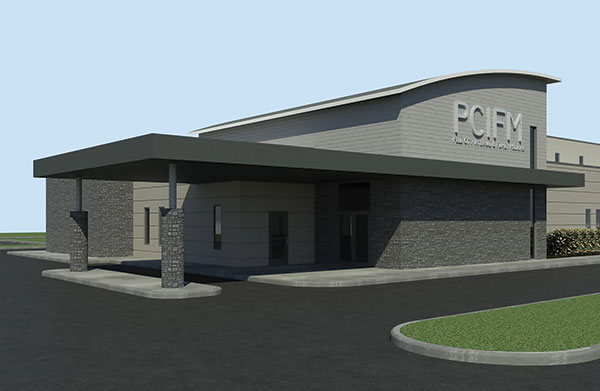
PCIFM expanding
Providing better and more convenient
care for their patients is also the driving force behind Pell City Internal and
Family Medicine’s expansion, according to Dr. Rick Jotani. The practice, which
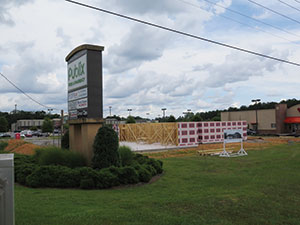
has a main office in St. Vincent St. Clair’s Physicians Plaza, is building a
much larger facility on property adjacent to the site of its satellite office
next to Publix on U.S. 231 in Pell City. “This will allow us to consolidate our
two locations under one roof, making things more convenient for our patients,”
he said. “Every service they need, whether it be labs or imaging, will be
there.”
The new office, which should be
completed by the end of the year, will be double the size of the two current
locations combined, Jotani said. The new facility will allow the practice,
which currently offers family and internal medicine, women’s health and
wellness, sports medicine, pediatrics and aesthetic procedures, to expand.
ATI Physical Therapy will be part of
the new building, and Jotani and his partners, Dr. Barry Collins and Dr. Ilinca
Prisacaru, have plans to add more primary care physicians and sub-specialists
over time.
“This will give us the space and
flexibility to be able to do that,” he said. “Dr. Collins and I started the
practice in 2012, and we’ve been very well-received by the community. This is a
reflection of that. We’ve continued to grow and get better and will hopefully
continue to do that for many years to come.”
Northside setting pace for growth
Northside has been growing since
opening its doors in 2001 with four physicians. The practice now has four
locations and a staff of more than 150, including 12 doctors and 13 nurse
practitioners, Helms said. Patients can receive primary, specialty and
emergency care, get lab work and advanced diagnostics, and pick up
prescriptions all under one roof.
Over the past year, they’ve added 3D
mammography, the urgent care component and have formed an independent lab,
expanding the menu of screenings they offer, not only to their own patients but
to those with other doctors, as well. “If you see a primary care physician or a
specialist somewhere else, you can come here and get labs, and we’ll send them
to your doctor,” Helms said.
Additions like the urgent care and 3D
mammography have made a significant impact on patient health, he said. “With
the 3D method, you get multiple images that are so much more detailed,” Helms
said, adding that the technology is especially helpful for patients with dense
breast tissue, a history of cancer or implants. “If you put the images side by
side, you can see a tremendous difference. It’s much easier to pick up
cancers.”
Urgent Care a new component of primary care
In a new trend in health care,
Northside opened an urgent care center on its campus. The ACCEL center is open
seven days a week and allows patients to quickly see a physician for things
like strep throat, bronchial infections, abdominal pain and sprains.
Patients who see a primary care
physician at Northside have the added benefit of knowing the urgent care staff
has access to their charts and medical histories.
“It provides a much more seamless
transition,” Helms said. “We saw an opportunity to better serve our patients,
and it has been well-received. We’ve had patients come and thank us for doing
this.”
More growth, more services
Here’s a look at how other providers
are striving to meet the growing demand for health care in St. Clair County:
St. Vincent’s St. Clair recently
earned a 5-star rating for hospital quality from the Centers for Medicare and
Medicaid Services. The 40-bed facility, which opened in 2011, is the only
hospital in the county and one of only five in Alabama to earn the distinction.
The rating is based on 57 different
benchmarks in six areas, including patient experience, effectiveness and
timeliness of care, and efficient use of medical imaging.
Lisa Nichols, a registered nurse and
the hospital’s administrator, said the distinction is the result of the staff’s
commitment to providing quality, compassionate care.
“I’m so very proud of the work of our
leadership and of our associates to ensure that quality and patient safety
remains at the forefront of everything we do,” she said.
You don’t need 20/20 vision to see
that the new home for James W. Bedsole Eye Care building, currently under
construction on an outparcel site in front of Publix, promises to be
state-of-the-art. “We want to be a destination for eye care,” said Bedsole,
adding that the building should be finished by year’s end. “It’s going to be
unique,” he said.
The new facility will be about twice
the size of Bedsole’s current office downtown and is designed to accommodate
new technology and an expanded optical gallery. The building will be
handicapped accessible and easier for older patients to navigate. In addition,
Bedsole will be hiring more staff and will eventually add another doctor to the
practice.
“Hopefully, we’ll be able to provide a
better experience for our patients,” Bedsole said. “We offer a full scope of
services now, but this will give us the ability to deliver those services in a
more efficient manner,” he said.
UAB Callahan Eye located a satellite
in Physicians Plaza in 2017 next to St. Vincent’s St. Clair, and it continues
to thrive as a regional source for ophthalmology and optometry services in its
Suite 240 location.
The clinic offers comprehensive adult
and pediatric ophthalmology and optometry, plus an in-house optical store
featuring a wide selection of designer eyeglasses and sunglasses from brands
such as Ray-Ban, Coach, Maui Jim, Tom Ford, Costa del Mar, Burberry and Vera
Bradley. Specialty eye services include glaucoma and cataract evaluations and
screenings.
Duff Morrison’s life a story of blessings, hard work and “The Bear”
Story by Paul South
Photos by Wallace Bromberg Jr.
Three
words course through Duff Morrison’s 80 years: “lucky, fortunate, blessed.”
Chat with him, and clearly, he has been. A
member of legendary Coach Paul “Bear” Bryant’s first Alabama team and first
national championship team, Morrison excelled in engineering and business,
working for some of American business’ best-known companies.
In his
50s, despite a body battered by his years as a multi-sport prep and college
athlete, the Memphis native and St. Clair County resident was an
internationally competitive racquetball player. Shoot, Duff Morrison was even a
championship duck caller in Tennessee.
You name
it, it seems, and Duff Morrison, the adopted son of Leonard Duff Morrison, one of
the South’s most successful painting contractors, and a homemaker Mom, Bernice
Turner Morrison, has done it – and done it well.
And no
matter what he did, even today, the voices of his father, and of his “second
Daddy” Bryant, echo in Morrison’s head and heart.
“My Daddy
and Coach Bryant told me the same thing. ‘I don’t care what you do. But
whatever you do, do it the best you can every time.’ That was the teaching that
I grew up in.”
Three
words course through Duff Morrison’s 80 years: “lucky, fortunate, blessed.”
Chat with him, and clearly, he has been. A
member of legendary Coach Paul “Bear” Bryant’s first Alabama team and first
national championship team, Morrison excelled in engineering and business,
working for some of American business’ best-known companies.
In
his 50s, despite a body battered by his years as a multi-sport prep and college
athlete, the Memphis native and St. Clair County resident was an
internationally competitive racquetball player. Shoot, Duff Morrison was even a
championship duck caller in Tennessee.
You
name it, it seems, and Duff Morrison, the adopted son of Leonard Duff Morrison,
one of the South’s most successful painting contractors, and a homemaker Mom,
Bernice Turner Morrison, has done it – and done it well.
And
no matter what he did, even today, the voices of his father, and of his “second
Daddy” Bryant, echo in Morrison’s head and heart.
“My
Daddy and Coach Bryant told me the same thing. ‘I don’t care what you do. But
whatever you do, do it the best you can every time.’ That was the teaching that
I grew up in.”
Morrison
followed the teaching to the letter, graduating from Treadwell High in Memphis
at 16. He attracted the attention of college and pro scouts. The New York
Yankees, New York baseball Giants and St. Louis Cardinals tried to hook
Morrison with the lure of what then were considered big-money contracts. But
Morrison – who neighbor kids called Duff Lujack after the Notre Dame great,
Johnny Lujack – went to Alabama not only to play baseball and football, but to
do more.
“I
wanted to be an engineer,” Morrison says plainly.
A Drive to Excel
There’s
a backstory here worth telling, a story Morrison didn’t hear until he was 38.
His biological father was a Memphis police officer, and his birth mother was a
Native American woman. The couple put the baby up for adoption.
Some
folks may have been shaken by the news but not Morrison.
“There’s
never been a luckier little boy than me,” he says.
Indeed,
his father, who would employ more than 100 in a painting firm with clients from
the Carolinas to Louisiana and his mother made sure their boy had a comfortable
life. But he also learned the value of work and faith.
“On
Saturdays, if I didn’t have a ball game, I was up and in the car by six in the
morning going to work. I was baptized when I was 10, and my folks had me in
church every Sunday.”
Things
didn’t change at Alabama. Morrison was recruited to the Capstone by Coach J.B.
“Ears” Whitworth, a good man, Morrison recalls, who never won at Alabama.
In
1958, a new coach with a new way of doing things, arrived in Tuscaloosa from
Texas A&M. Alabama football would be forever transformed.
Marlin
“Scooter” Dyess, an Alabama star who was also part of the same 1956 signing
class as Morrison, recalls the impact of Bryant’s arrival. Dyess is now a
Montgomery businessman.
“When
he came in, it was like going from darkness into the light,” Dyess says. “When
he came there, he pretty well established an attitude. As he told us one time,
‘I don’t want to ever hear about a past coaching regime. The problem with this
program is sitting right here in this room. Those that stay will be part of
rebuilding.’ He was absolutely right. He demanded respect and he got respect.”
Morrison
recalls one of his first practices in the Bryant era. In the days before the
NCAA restricted the number of players, some 300 were on the practice field for
Alabama.
“Twenty-five
boys quit that day,” Morrison recalls. “I went from 179 pounds to 163 that day.
Coach Bryant tried to work you to death.”
“We
thought he (Bryant) was crazy, trying to run everybody off,” Dyess said. “When
we played LSU mine and Duff’s junior year, we only had 33 players because we
had so many to quit. But he stuck to his plan, and it worked.”
Comparing
Alabama’s fourth-quarter conditioning, Morrison described Alabama’s opponents
by panting like a St. Bernard in a steam room.
“Every
time that we played a ball game and got in the fourth quarter, the other team
would be panting real hard. And we haven’t started to break a sweat. We were in
better shape than anybody we ever played against. Coach Bryant worked your butt
off.”
Like
Dyess, Morrison never forgot that first meeting with Bryant, more than 60 years
on.
“The very first meeting with Coach Bryant, he
says, ‘Every time that ball moves on the football field, you do everything you
can legally to help your team to win. Two, you go to every class and study as
hard as you can because you’re not going to play football for the rest of your
life. And number three, I don’t want any cheating in school, I don’t want any
breaking rules or laws. If you can’t stand up to these things, get the hell out
of here now.’
Keep in mind, the Crimson Tide’s previous
three seasons were a collective nightmare, with a combined four wins from
1956-58, including a 40-0 loss to archrival Auburn in 1957.
But
1958 offered a glimpse of the glory to come for the Crimson Tide. Bryant’s
first team beat 19th-ranked Mississippi State, defeated Georgia Tech
and tied a ranked Vanderbilt team. Alabama almost upset Heisman winner Billy
Cannon and LSU at Ladd Stadium in Mobile. In that game, a bleacher collapsed,
injuring several fans.
Morrison
had a big defensive play against the Bayou Bengals. Some remember it as an
interception, others as a fumble plucked out of the air.
“Billy
Cannon went around the right end and cut back,” Morrison remembers. “I hit that
son of a gun so hard, that the ball flew up in the air, and I caught it at the
45 and ran back to the LSU 4.”
Dyess
remembered the play as an interception that Morrison plucked from the air after
it bounced off his helmet.
“We
kidded Duff, that’d we had never seen anyone intercept a ball with his helmet.
But it was a big play in the game. Duff is a great guy.”
Alabama
would lose to the eventual national champs. But Dyess saw a change in the Tide
that day.
“It
was amazing,” Dyess recalls. “That’s what Coach Bryant turned around. We didn’t
know we were no good. He made you feel like you were just as good as the team
you were up against. In your mind, you sincerely believed that.”
And
in 1959, Alabama, thanks in part to a sterling defensive effort by Morrison,
the Tide upset Georgia Tech, 9-7. The previous Saturday, the Ramblin’ Wreck had
upset nationally ranked Notre Dame in South Bend. Alabama was on the rise.
Bryant called the ’59 squad his “turnaround team” that ended the season
nationally ranked. The Tech game was pivotal.
“I
had nine tackles in the first quarter,” Morrison remembers. “Coach Bryant gave
me the game ball. But somebody stole it from my dorm room after the game.”
Dyess
says Morrison was an important part of the 1959 squad, playing both offense and
defense.
“Duff
was probably our best defensive back in the secondary. He was a guy who was a
real leader. Nobody outworked him. Coach Bryant would take hard work over
ability any day. Duff was an important cog in our ’58 and ’59 teams.
In
an injury-plagued career, including a broken back in 1961, Morrison missed most
of the national championship campaign in 1961. But Bryant never forgot the kid
from Memphis.
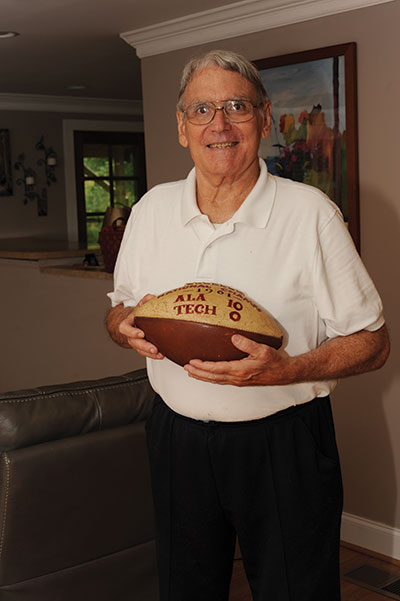
“After
we beat Georgia Tech in 1961, he gave me a game ball,” Morrison remembers. “He
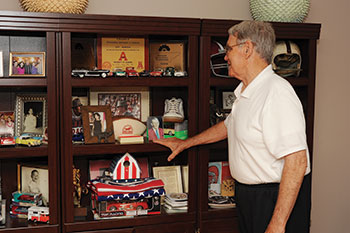
knew mine had been stolen. I still have the ball on my shelf.”
Bryant
is never far away from Morrison. A treasured photo of the two, taken weeks
before the legendary coach’s death in 1983, is prized. Morrison keeps extra
copies of the photo to give to friends and fans who love to hear his stories.
But
Bryant had an impact off the field as well. Morrison, juggling two sports as
well as a demanding engineering course load, was having trouble in a course in
the midst of baseball season. Worried, he called Bryant at home and explained
his problem.
“He
had a tutor in my room in 30 minutes,” Morrison recalls. “Hey, he cared about
the ballplayers. He didn’t cheat. He wanted you to learn how to win and pay the
price to win and do it the right way.”
He
adds: “He felt like his job was to teach you to do the right thing in all
aspects of life, not just on the football field.”
Morrison
still holds the boys of Bryant’s first teams in his heart. Like Morrison, many
went on to success in business, others in medicine and the law. While many have
passed away, they are not forgotten.
“Those
guys were about as good men as I’ve ever seen. It’s like you win World War II
or something like that, and these were the members of your company. They went
through all the battles and everything. I feel honored to have been with those
boys.”
Dyess
agrees. “There were some good people in that crowd, there really were.”
Of
Morrison, one of his closest friends at Alabama, Dyess describes him as “one of
those hard-working guys who was important to the team. He was a great teammate
and friend.”
Off the Field
Morrison’s
life after Alabama had its beginning in his last semester, when an advisor
asked what he wanted to do after graduation.
“I
want to be an engineer,” he says. “And I want to be the boss.”
The
advisor directed him to Alabama’s School of Commerce. But engineering was
always part of his professional life. In his first job, as a management trainee
for American Brake Shoe, Co., he ascended to become a supervising engineer in
less than a year.
He designed electronics plants for Emerson and
poultry plants for Pillsbury. He was the top vacuum packaging salesman in the
world for W.R. Grace for two years running and worked closely with companies
like the Winn Dixie grocery chain and Bryan Foods.
“It
was a grand life,” he says. “Two years in a row, that’s pretty good.”
He
excelled in selling insurance, working for firms like Equitable Life. He also
ran restaurants, like the Birmingham area mall locations of Sbarro’s Italian
eateries.
While
working full time during the day, he was a racquetball teaching pro at night.
He helped design duck calls. And he supported and helped rear his family.
“I’ve
had some real good jobs,” he says. “I got a good education and when you know
the skills of engineering and management and you’re fair with people, and you
do people right, they want to do good for you.”
If
there is a dark cloud that lingers over Morrison’s blessed life, it’s the death
of his son, Tim. Like his Dad, Tim
Morrison played for Alabama, but was killed in a tragic auto accident in 2012.
He was 44.
Duff
Morrison calls his son’s passing, “the only bad thing” in his life. He holds
fast to the belief that he will see his boy again.
“At
least he didn’t suffer,” Morrison says.
Now
at 80, Duff Morrison tries to stay busy, helping neighbors, building
birdhouses, telling stories of Bryant and Alabama to anyone who will listen. He
wrestles with aches and pains related to athletics and doesn’t go to games like
he used to; stadium seats are too painful.
But he’s always quick to remind how fortunate
his life has been. Many folks his age, he’s quick to remind, are in a wheelchair
or shut in. As he looks back on life, gratitude flows. He looks forward to the
day he will see his son again.
“God
has played an important part in my life. I don’t take credit for any of this. I
was blessed. Most people haven’t had the blessings I’ve had.”
As
he would like to say, his years have been a grand time. He hopes he will be
remembered for his dedication to doing a job well.
“I
enjoyed it. I liked to work hard. My Daddy taught me a long time ago to do the
job, do it right and work as hard as you can. If you’re going to go through
life (halfway) doing stuff, why bother?”