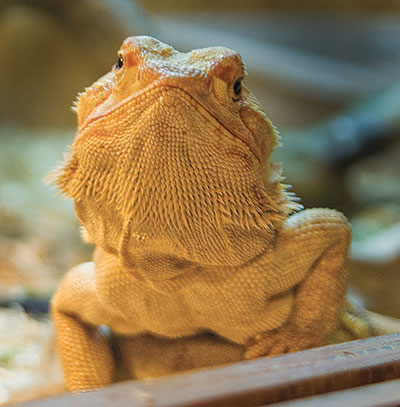
ROOdy, Springville Kangaroo

Story by Scottie Vickery
Submitted photos

Thanks to an ever-growing assortment of goats, pigs, chickens and horses, there’s always a lot going on at Caren and Danny Davidson’s Springville farm. These days, however, the place is really hopping.

That’s because the newest addition to the family, a red kangaroo named ROOdy, has stolen the hearts of all who have met him. “He makes people happy,” Caren said. “He’s got a great temperament.” Couple that with the fact that ROOdy loves to cuddle, still enjoys a good bottle and rocks the diapers he wears around the house, and there’s no doubt about it. ROOdy is definitely a cutie.

So why did the Davidsons, who host farm day experiences and goat yoga classes at CareDan Farm, decide to jump in with both feet and get a kangaroo? The credit – or blame, depending on when you ask – is all Danny’s. “He’s always trying to come up with something different,” Caren said.
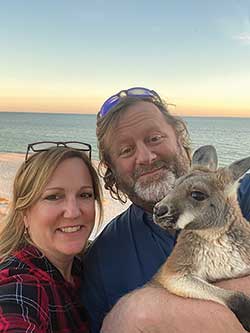
Caren and Danny Davidson on vacation with ROOdy

ROOdy, who has grown by leaps and bounds in the six months he’s lived with the Davidsons, was a surprise Christmas present to Caren from Danny. A mere 11 pounds when the 7-month-old arrived at the farm, ROOdy tops the scales at about 25 pounds now. He won’t be fully grown until he’s 2 years old, though, and by then the Davidsons expect he’ll weigh about 200 pounds and stand about 4 feet tall.

“Red kangaroos are the largest kind of kangaroos – and of course, we needed the largest kangaroo,” Caren said with a laugh. In fact, red kangaroos are also the largest of all marsupials, which are mammals that continue to develop in the mother’s pouch after birth.

A soon-to-be giant marsupial was the last thing Caren expected as a gift, which she received on Christmas Eve. “It was a total surprise,” she said. Danny handed her what looked like a red duffel bag and said it was her present. “I thought it was going to be a trip or something,” she said. “I started opening the bag, those ears popped up, and I screamed.”

Her first thought was that Danny had gotten her a rabbit. “Keep opening,” he told her, a huge grin on his face. When she realized she was now the proud owner of a baby kangaroo, also known as a joey, “it took me a couple of days to wrap my mind around it,” Caren said.


One busy kangaroo

He may be a marsupial, but make no mistake, ROOdy is no pouch potato. In his first year of life he’s worn a lot of hats – or at least he would have if it weren’t for those ears. Since coming to CareDan Farm, he’s served as a social worker, human resources assistant, teaching assistant, wrestling team mascot and television personality.

His foray into social work came a few weeks into the COVID-19 pandemic. “I was watching the news and saw how people weren’t able to visit their loved ones at nursing homes,” Caren said. “ROOdy makes everyone so happy, I wondered if we could take him to a nursing home and wave to people from outside the windows to lift some spirits.”

Friends who had contacts at nursing homes quickly made it happen, and ROOdy was an instant hit, earning him a spot on a local television news program. “They loved it, and we loved it,” Caren said of the visit. “It was a happy thing to do in a time of isolation and sadness.”

Caren, human resources director for a Birmingham law firm, and Danny, an algebra teacher and assistant wrestling coach at Moody High School, both worked from home during the pandemic, which gave them plenty of time to bond with ROOdy and watch him try out his other roles. He was quickly fired from his human resources position after he started tearing up papers, but he had better success in the virtual classroom.

After all, Danny’s students had loved hearing about the kangaroo’s exploits well before Alabama schools adopted distance learning for the remainder of the year. “They kept asking me to bring him to school,” he said. “They even started a petition, ‘Educate ROOdy at Moody.’ “An unofficial mascot for the wrestling team, ROOdy even traveled to Huntsville to cheer on the athletes during a February tournament.

Once coronavirus hit, though, the kids were thrilled to watch him online. Danny hosted three to four 45-minute Skype sessions each day to answer students’ math questions and to see how they were progressing with their assignments. “I got a lot of participation because they knew they’d get to see ROOdy,” he said. “They got to watch him grow up, and it was a lot of fun for them. The parents’ reactions were hysterical. ROOdy’s a great teaching assistant.”


Kangaroo care

Since ROOdy joined the family, Caren and Danny have turned into students themselves, learning everything they can about caring for him.
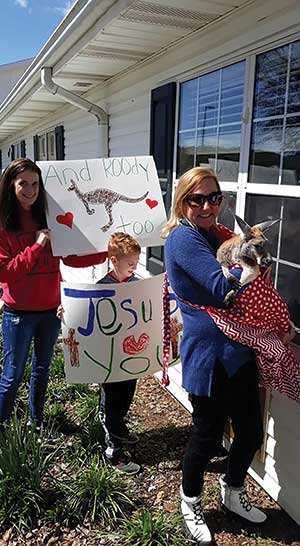
ROOdy lifting spirits at a nursing home

“I’ve always been fascinated with kangaroos,” said Danny, who got ROOdy from a petting zoo in Louisiana. “When they’re born, they’re about the size of a jelly bean. They aren’t fully formed when they get to the pouch, and they’re there for about six months,” he said.

ROOdy was seven months old when he came to the farm and was in the “in and out phase,” spending much of the time in one of his manmade pouches and the rest of the time exploring his surroundings. He came from the zoo with two cotton knapsack-like pouches, and a friend of the Davidsons later made him some larger ones.

“At first, he stayed in his pouch the majority of the day and got out for playtime for three to four hours,” Caren said. “Since then, he’s been transitioning from the pouch and mostly sleeps there at night.” These days, ROOdy hops around the house and yard pretty freely. “He loves to follow us around,” Danny said.

ROOdy took three bottles a day when he first arrived and was down to a nightly bottle and cuddle on the couch by spring. The Davidsons order a special milk that’s formulated for kangaroos and is made in Australia, and ROOdy also enjoys timothy grass and a dry kangaroo food that’s similar to dog food.

His sense of adventure is as big as his appetite. A week after arriving, ROOdy joined the Davidsons for a planned beach trip with Danny’s family. “We had rented a beach house, and they didn’t list kangaroos as a problem,” Caren said with a laugh. “He stayed in his pouch and our nieces and nephews loved feeding him bottles. We put a harness on him one day so we could let him hop around the sand. He liked the sand, but he did not like the harness.”

The Davidsons knew ROOdy needed to be neutered early so he wouldn’t be aggressive, and they were shocked and relieved to find the solution just a few miles away. They learned that Dr. Paul Taylor, an associate at Branchville Animal Hospital, had a little experience with kangaroos, helping to provide dental treatment to one when he was at a clinic in another state.

Neutering a kangaroo was a skill he had yet to master, however. “I always say you should do something every day that scares you,” Taylor quipped, adding that he consulted with veterinarians in Texas and Maryland, both of whom own kangaroos, before performing the procedure, which went off without a hitch. Taylor said he will continue to see ROOdy at least once a year for a check-up and shots, and he’ll do all he can to help the Davidsons care for him.

While ROOdy seems right at home in the Davidson’s house, he’ll soon have a bigger place to call home. The couple, with the help of friends, fenced off two acres for him to share with the goats. “Kangaroos are actually very heat and cold tolerant,” Caren said. “In the winter, they just need a covered shelter and straw for bedding, and in the summer, they need shade.”

Danny, especially, is looking forward to introducing ROOdy to those visiting the farm. “If people love feeding horses, goats and chickens, I know they’re going to love feeding a kangaroo,” he said.

“Our animals are our family, and we get joy out of sharing them with others,” added Caren, who admits she fell in love with the best gift she never knew she wanted. “Who knows, once ROOdy has been in his habitat for a while, and we know that he’s happy there, I could see getting one more kangaroo.”

You can find more info at myfarmday.com

6th Day Creatures

Springville family turns passion into business, teachable moments
Story by Jackie Romine Walburn
Photos by Susan Wall

It’s hard to say exactly when 6th Day Creatures, an exotic animal education and entertainment venture headquartered in St. Clair County, really began for Jamie Hacker, his family and their collection of exotic pets.

The obvious start was when Jamie was asked to do a devotion at a children’s church event seven years ago, and he brought along a couple of small, friendly snakes and a black and white ferret with him “to illustrate how God created and loves all of us – even funny-looking animals and snakes.”

That impromptu devotion quickly morphed into more. “By Monday at school, our seven-year-old had volunteered us to do another program, and another.”

So officially began 6th Day Creatures, a business and mission that brings exotic animals and life lessons to children and adults at church, school and community events across Alabama and beyond.

The name 6th Day Creatures is based on when the Bible says God created all the creeping and crawling land creatures. As noted in Genesis 1:24. “And God said, ‘Let the earth bring forth the living creatures after his kind, cattle, and creeping things and the beast of the earth after his kind,’ and it was so.”

But, the true beginning for 6th Day Creatures can also be traced to Jamie and his wife’s family traditions of unusual pets and their family’s ongoing love, knowledge and care for exotic animals.

Both Jamie Hacker, who works as registered nurse at St. Vincent’s Hospital in downtown Birmingham, and his wife, Trussville native Leigh Fox Hacker, a nurse who works at St. Vincent’s East, grew up around unusual pets.

The couple’s passion for exotic pets was honed during their childhoods and passed on to their children, daughter Lauren, 18, now a freshman at Jacksonville State University, and son Brady, 14, who is a freshman in high school.

Jamie’s father raised show pigs, modern bantam chickens and cattle in Oklahoma, where Jamie stayed when not with his mom in Mississippi. Leigh’s grandparents bred and raised chinchillas, the rodent native to Peru and Chile that are prized for their dense, soft fur.

They both love animals and value exotic species, but it was Leigh who first bought the children their own exotic pets. For son Brady, she purchased one of the family’s first corn snakes, and daughter Lauren’s got a chinchilla named CeCe. Lauren also around this time adopted a rescue Maltese Yorkie (Morkie) named Sebastian, who became a family pet, too.

As the number and variety of exotic pets grew, the family sometimes raised exotic animals for the pet store market. “At one time, there were 100 snakes being raised in our son’s bedroom,” Jamie recalls. Their pet count got up to about 400 when they bred for pet stores. Now the pet count is about one-tenth of that. Also, they used to breed several kinds of cockroaches, mainly for food for pets. “We have bred Red Runner Cockroaches, Dubia Cockroaches and mealworms in the past.”

Now they have only Madagascar hissing cockroaches, one of the largest cockroach species that can reach two to three inches long. “We only have hissing cockroaches now just for fun since they are really big flightless roaches that gross people out,” Jamie says.

The pet lizards get live insects because they will only eat food if it is moving, he says. However, the Bearded Dragons sometimes get dried meal worms on their greens – “like you put croutons on a salad.”

Live food is never fed to the snakes or other carnivores. They do not feed any live rodents, he says, to keep the snakes from having the instinct to strike and be aggressive. Instead, they purchase frozen rodents, Jamie says, remembering how the UPS man commented “ya’ll must eat really good,” about delivering packages of what he assumed were frozen steaks or other expensive people food. Then they explained that the boxes were actually frozen rodents.

Through their days as pet owners, then breeders and now with an animal adventure business, their veterinarian has been Dr. Carl Grimmett of Grayson Valley Pet Clinic. Knowledgeable about exotic pet care, which is a shared interest, Dr. Grimmett usually makes house calls for the Hacker family pets.


The family business

Since 6th Day Creatures came to life, it’s been a family project, with Jamie up front as the animal adventure master of ceremonies and either Leigh, Lauren or Brady assisting.

“I love animals and kids,” says Jamie. His ease with both is plain to see as Jamie and Brady brought 6th Day Creature’s Animal Adventures to a Clearbranch United Methodist Church’s Wednesday night children’s service.

Like an exotic pet pied piper, children follow as Jamie walks around before the show, with Dewey the Bearded Dragon, an Australian lizard, clinging to his back or head or shoulder. “Put him on my head,” one child says. “Put him on my sister’s head,” another offers.
As Jamie introduces Dewey and then brings out Zelda, a colorful corn snake, he explains the 6th Day rules. If you don’t want to pet, see up close or interact with whatever creature Jamie offers, “just put your palm up, no thank you.” Even though you might make friends with 6th Day creatures, he tells the children, never touch a wild animal – like these or others – when you are outside in their territory. He also explains that audience members should consider it an “anointing” if a pet takes the opportunity to ‘relieve himself’ and reminds the kids that most of the exotic pets are not housetrained, so anything could happen.

After safety – 6th Day has never had an escape or incident with the exotic pets interacting with people – the main message this day is that God created us and all the creatures for a reason and that He loves us and all creatures of his creation.

“God has a reason for everything He does,” Jamie says, using the nonvenomous corn snake as an example. “The craziest thing is, without snakes, we wouldn’t survive,” he explains. Snakes eat rats and mice and keep the vermin’s population down and protect us from diseases they carry.

When Lucy the hedgehog makes an appearance, children see how God equipped hedgehogs to protect themselves – with their quill-covered skin and the ability to fold up into a ball.

When the so-ugly-it’s-cute hairless guinea pig is introduced, Jamie explains that the hybrid is called a skinny pig and reminds him of how God made us all different. “Some of us are tall, some small, some prettier than others,” he says. Telling a story about children teasing a boy in a wheelchair, Jamie encourages the young audience to appreciate the differences in all of us and never make fun of someone who is different. Instead, he urged, “use the way God made you special to do good and spread love.”

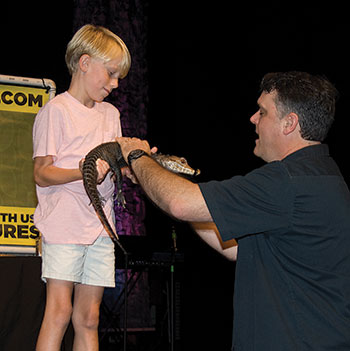
When Taco, the Chaco Golden Knee Tarantula, was introduced, the giant spider prompted squeals from the children, who could look but not touch. Ditto for the dwarf Caiman, an alligator relative from Central and South America whose jaws are taped shut for all outings. With 80 razor-sharp teeth, Caimans are generally more aggressive than their north American cousins who grow much bigger. Jamie points out its two sets of eyelids, so the amphibious carnivore appears to be asleep while he is actually watching for prey.

Up next is the African Spur Thigh Tortoise, slow and steady with temperature control built into its spurred feet. As a finale, 6th Day features its largest Burmese Python, named Sonnie, a male who is almost 11 feet long.

Big, little, scary or sweet, Jamie explains, God’s creatures are gifts and responsibilities and serve as testimony that God loves us all.


A growing family

Back at home, Jamie sits cuddling Pikachu, a Kinkajou that looks like a ferret-monkey mix. Pikachu is named for a Pokemon character. “We call him Pika because saying Pikachu the Kinkajou is a mouthful.”

Pika travels with 6th Day Creatures often. “He likes to snuggle and go hide in our shirts. A shy nocturnal animal like its cousin, the raccoon, the Kinkajou curls up inside his shirt as Jamie recites a list of animals that now live with the family in St. Clair County.

In addition to the family’s six dogs, the “regular” pets, the Hackers, and 6th Day currently have about 60 pets, including 25 snakes, all non-venomous, mostly colorful corn snakes and three Burmese Pythons, who often steal the show.

6th Day Creatures is a licensed and insured educational company. The business has an exotic animal exhibitor license with the USDA, which conducts annual inspections of the pets’ quarters in the Hacker’s home and yard in Springville.

Fees for the shows go to help feed and take care of the pets. The cost of a party or show varies according to how many miles the eight to 10 creatures need to be transported from the Hacker’s home in the 35146 zip code. The starting amount is $225, for up to 25 miles of travel, for an animal adventure of about an hour.

To count them down, 6th Day Creatures include the animals that starred in the show at Clearbranch plus: two pot belly pigs, two ferrets, several guinea pigs, two skinny pigs, more than 20 additional snakes, two more tortoises and several rabbits, including Rebunzal, the long-eared, 30-pound rabbit with 16-inch ears. They also have families of chinchilla which do not travel to shows because they cannot tolerate being hot or wet.

Seven years into 6th Day Creatures, with a daughter in college and son in high school, Jamie says they are working through a transition period with his key animal adventure helpers not available nearly as often as before. Feeding and caring for scores of unconventional pets is time consuming, especially after days of he and Leigh working 12-hour shifts as nurses.

But, the shows, the children and the chance to share his passion for animals while sharing beliefs in God’s love and wisdom prove to be worth the work.

Learn more about 6th Day Creatures – including how to book an animal adventure show – at www.6thdaycreatures.com.

Welding to Work

Jefferson State
creating new opportunities for
single mothers

Story and photos by Graham Hadley

Jefferson State Community College is stepping up its workforce-development efforts with new classes to help train single mothers to become welders.

Over the past few years, Jeff State in Pell City, working with organizations like the St. Clair Economic Development Council, Pell City and St. Clair school systems, and businesses like Garrison Steel, Ford Meterbox and Goodgame Company, has been focusing on workforce development.

Their efforts are helping to train people in skill sets like welding, plumbing and metal fabrication, giving students greater career and earning potential while meeting the critical needs for those skills by businesses.

These classes are not only helping meet the growing demand for those skills, but also dramatically increasing the job options for local residents of all ages.

Their latest classes are no exception.

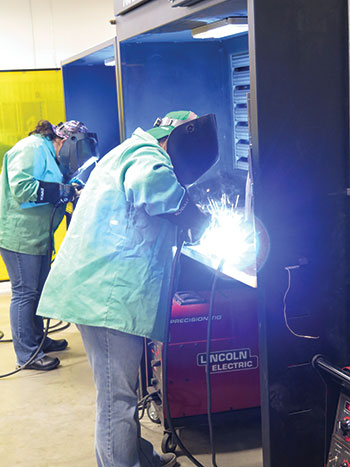
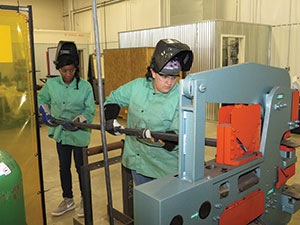
Students who take the class are eligible to receive their entry-level certification in welding and combines both hands-on training with traditional instruction that cover everything from math to how to use the technical measuring equipment necessary for their new careers, said Danny Taylor, the welding instructor for the program.

For local industries and businesses considering locating in St. Clair, it means a better-trained workforce. For the single mothers, it means a whole new world of employment opportunities.

Several of the 10 students in the class said they first heard about the opportunity through their children’s daycare or school.

“My daughter goes to Head Start. They had a newsletter up for moms who are single to take these classes,” said Sherry Johnson during a break in welding training.

“I was in the Army, and loved it,” she said, but found her employment options limited when she got out. “I saw this as a reboot. I am one of those types, I think anything a man can do, I can do. I am loving this class — it is challenging and not without its issues, but I love it.”

She has two children and sees that the skill set she is receiving now will allow her to better provide for them.

“My own personal plan is to start at an entry-level position, then I want to go back to take more classes to get more certification.”
Amber Moten, who says she is the only left-handed welder in the class, also learned about it through St. Clair Head Start and saw the classes as a good opportunity and a good fit for her.

“My Dad is a welder, and you don’t hear about many girl welders. I wanted to show my girls we could do this. It’s a career as opposed to a job. I love it and look forward to class every day.

“It can be challenging and frustrating — and I love that. I like a challenge,” she said.

Moten, who is currently working as a waitress, said there is a big difference between her current job and what she is learning to do: “I wake up every morning and have to force myself to go to work. I wake up Tuesdays, Wednesdays and Thursdays when we have class; I have my coffee and am ready to go.”

Looking out at the working world, Moten said she sees a career in welding as proving more opportunities for steady employment.

“As a waiter, you are living day-to-day. As a welder, you are not just living, it’s a career. … I want to go as high as I can go. I want to be able to obtain the best career I can.”

Balancing classes, work and family is a challenge, but the students said it is well worth it, and not just for them.

“It’s empowering. … It has helped me be a better mother, to teach my girls not to doubt themselves. It has made me feel better about myself in all ways,” Moten said.

Krystin Whidden said she learned about the class through her child’s preschool, and like the others, she sees this as a path to a long-term career and a better life for herself and her family.

She currently works part time baby-sitting, but has no full-time job, and is quick to point out that the income level for welders is significantly better than what most entry-level minimum-wage jobs pay.

And like the others, she says she is not the only one directly benefitting from the classes.

“It’s a big challenge keeping family time and class time — you have a lot of homework when you would normally spend time with your kids,” she said, but added that between the example she is setting for her family and the improvement in quality of life down the road, it is well worth the effort.

“My kids have seen me struggle with homework and still stick with it. It shows them you can make it happen if you truly try. Before this, I never thought they would see me as a role model. It was a shock to me to be able to do this,” she said.

“This is a dream come true for me.”


A Unified Vision

Pell City schools setting example with workforce development

Story by Graham Hadley
Photos courtesy of Pell City School System

When it comes to preparing high school students for entry into the workforce, the Pell City School System is doing everything it can to stack the odds in its students’ favor.

Part of that process is the system’s continuing partnership with the St. Clair Economic Development Council, Jefferson State Community College and local businesses in a regional workforce development initiative, but a large part of it is the result of the system taking internal measures to embrace a broader view of the role of education in students’ lives.

“The key to it is having a team of people who can get information to the students because they hear about college and they hear about jobs, but they do not have a working knowledge of the steps they need to take to get a good job or a career,” said Pell City Schools Curriculum Coordinator Kim Williams.

“The second part of it is the training opportunities that go along with those jobs. Just having a team that can provide the knowledge to those students is essential.”

The efforts have paid off, not just for students and the school system, but for the community, especially for businesses and industries hungry for a well-trained workforce.

Danielle Pope, one of the Pell City High School teachers focusing on workforce training, said the success of the program did not happen overnight — it was a steady progression over the past few years.

“We went from what was originally called co-op classes to paid internships, and the process continues to progress,” she said. “The community has really gotten behind what we are trying to do. We have about 60 community partners between apprenticeships and internships.

“And we keep getting better quality internships that are more career-track based. It lets the students look at more long-term options.”

Many schools have some form of career prep, with a later focus on admission to a four-year college.

“Most schools do career prep in the eighth- and ninth-grade — but it is not very relevant to students at that age. Then for juniors, the focus is on college, looking at things like the ACT test and how to get their scores up,” Pope said.

And both Pope and Williams said college prep is still a very important part of the curriculum at Pell City, but they also are making career prep a priority to provide options for all students post graduation.

“We have AP and online classes – we have a strong core academic offering for that. The classes we have do a good job preparing students for four-year college. And we have a plethora of students following that path,” Williams said.

“But our data points to 40 to 45 percent of our students will finish their first year of college – that’s on track with data for the rest of the state. That leaves 55 percent of students who need a viable pathway to a career. They need to find a good career, and that happens through two-year colleges, career centers or workforce development.”

According to the other partners in the training programs, Pell City’s efforts have been an unqualified success, with students placed in every branch of the regional workforce, from medical offices to major construction and industrial companies.

Williams said their program worked because of the level of commitment from everyone involved as the system implemented and continues to implement more and more job-training options into the curriculum.

“Success comes from the top. Superintendent Dr. Michael Barber has been completely supportive in these programs. … Dr. Barber and the school board have been very supportive in letting us explore ways students not going into formal post-secondary academic settings can get jobs,” she said.

“There was a big push in Alabama for workforce development, with big bond issues from the state focusing on that. … Then, as far as the Pell City community goes, we have had business leaders all saying we need a skilled workforce, skilled training programs in our area to meet workforce demands.”

And those leaders have been more than willing to help put Pell City students to work.

“Then we have the EDC recognizing that need and working with David Felton, program coordinator and advisor at Jefferson State’s Manufacturing Center,” someone Williams and EDC Assistant Director Jason Roberts credit as being a key player in coordinating the community college’s role with all the other participants.

“We have all these entities in the community recognizing this need, and the school board and superintendent recognizing the need. If you don’t have key leadership positions buying in behind the program, it won’t be a success,” she said.

The other side of that are the hands-on educators and staff in the system like Williams and Pope who make the classes and programs work and continue to grow. 

“We have a career coach this year, Shelley Kaler. Our counselors have a lot on them administratively – testing, college applications and all the other essential ways they help our students every day. So, Shelley is devoted to helping students figure out what they want to do — especially students who do not know what they want to do,” Pope said.

“She is singularly focused. I think having someone on board who can help students in that one way is very important,” Williams agreed.

Pope added that Kaler’s position is particularly helpful for students who may not be on a four-year college path.

“She has taken a lot of those kids and said, ‘Let’s get you in a place that has benefits and good pay, where they can start building a career.’ Those are often places that also have tuition assistance for students who may want to explore post-secondary education options while they work,” Pope said.

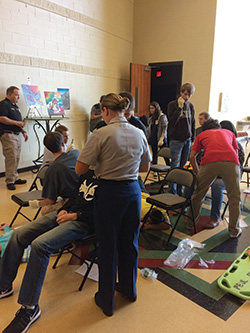
In addition to that guidance and classes that can help students graduate with certification in everything from welding to medical fields, the school system also goes the extra mile to put the students together with the people who will eventually be hiring and training them.

Pope has spent years attending meetings and conferences, making the connections with business leaders, getting their feedback on what they expect from graduates looking for work and also convincing those leaders to take a more hands-on role in the education process.

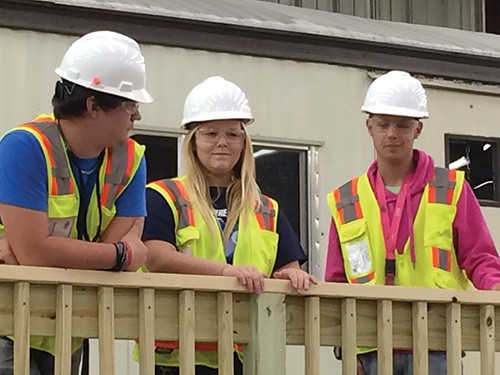
“This year we are trying to figure out a way for students to get in contact with people in different industries. We did do a traditional job fair for seniors, but we also had career discussions in the medical, construction, industrial, city government and public safety fields with those leaders, including the city manager, police and fire chiefs,” Pope said.

“Partners would come in and have a panel, tell how they got where they are. Students could ask questions — and our students did a really good job asking questions, and they could stay after and talk to the panel participants.”

The students also got the opportunity to do mock interviews with the employers who might be doing the real interview one day. That was so successful that the school actually had one student hired from a mock interview.

Pope said the response from the students has been positive. But, just as important, the partners have also been impressed with the students and the efforts the school is making.

“The feedback from the representatives who came was positive. They kept saying, ‘I did not have anything like this when I was in high school,’” and they wished they did, she said.

“Between 20 to 30 business reps took part this year, with juniors and seniors taking part from the school. We got a lot of good feedback from people in the community — people who want to do this.”

The school system has been focusing in the highest demand areas: industry and manufacturing, construction and medicine. But they are continually adding classes, with pharmacy tech, information technology and other areas becoming more in demand.

And because of partnerships with Jeff State and local businesses and a program initiated by the state that allows people like firefighters or accountants to become educators certified to teach their specific areas of expertise, many of the classes being taught can lead to some level of skills certification at graduation.

“We had six students pass their pharmacy tech certification at the end of the year this year,” Williams said.

“It has been a team effort,” Williams said. “Jeff State has the resources to supply the training. Businesses have the need. The EDC looks after the overall economic health of the community. The superintendent and the board support our programs,” she said.

“Everyone is on the same page, sharing the same vision.”

Alabama Bicentennial

Alabama Humanities launches Bicentennial exhibit in Moody

Story by Jackie Romine Walburn
Photos by Michael Callahan

Forward thinking and a prompt application helped St. Clair County become the first stop for the 18-month tour of Making Alabama. A Bicentennial Traveling Exhibit, an impressive blend of state history, culture and humanities.

After its debut in Montgomery in March 2018 at the state’s capitol, it begins in April of 2018 in the City of Moody and Lee and Wilcox counties and continues through November of 2019 en route to all 67 Alabama counties and the official 200th anniversary month of Alabama’s statehood.
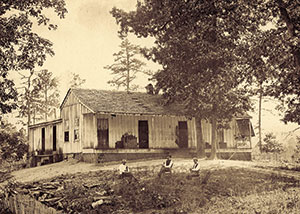
That St. Clair County is a year older than the state – having been created as a county by the Alabama territorial general assembly on Nov. 20, 1818 – is a happy coincidence that local planners had in mind when they quickly applied to host the traveling exhibit “as early in 2018 as possible,” says St. Clair County Bicentennial chairman, District Judge Alan Furr.

The timing means that the county will be celebrating its bicentennial as it hosts the state’s first 200th birthday party. Alabama officially became a state on Dec. 4, 1819.

“Because St. Clair County was formed prior to statehood, we believe our hosting of the state exhibit as it begins its trek throughout the state is significant,” the judge says. “And, because we are celebrating our county bicentennial during 2018, being able to host the state exhibit during 2018 enhances our own local celebratory efforts.”

The new Moody Civic Complex met all the venue requirements and will be the site for the exhibit. It is being presented by the Alabama Humanities Foundation with support from the Alabama Department of Archives and History, the Alabama Bicentennial Commission, corporate sponsors, individuals and organizations across the state.

Making Alabama will travel to each of the state’s 67 counties, where local exhibits created by host communities will showcase each county’s role in their own story of Making Alabama.
Planners in St. Clair County anticipate that the St. Clair story will include information and artifacts relating to Andrew Jackson’s residence at Ft. Strother, an 1813 fort – now a series of archeological sites west of Neely Henry Dam near the Ten Islands Historical Park in Ragland.

The fort near the banks of the Coosa River was used as a military supply depot and operations center for Andrew Jackson’s Tennessee Militia during the Creek Indian Wars and as a local theater of the War of 1812. Other aspects of the St. Clair local exhibit may include construction of the first brick courthouse in Ashville, the county’s mining operations and the importance of the Coosa River to the county and its communities.

“St. Clair County has a rich and diverse history,” Furr says. A subcommittee including Furr and Ashville Archives Director Robert Debter, representing the county, plus Councilwoman Linda Crowe of Moody, Sherry Bowers of Pell City, Dr. Robert Harris of Springville and Nancy Sansing of Ashville is already working on locating materials and artifacts to tell the story of St. Clair County, an early Alabama county named for General Arthur St. Clair, who was president of the Continental Congress.

Created from a portion of Shelby County when it was founded in 1818, St. Clair would eventually be divided several more times to create surrounding counties, first Jefferson in 1820 and Cherokee and DeKalb counties in 1836. Then Etowah County was born of a northeast section after the Civil War.

In announcing the order of the bicentennial exhibit, the Alabama Humanities Foundation noted St. Clair as the first stop, followed by Wilcox County in the Alabama Blackbelt, then Lee County in east Alabama, a triangle of counties in distinct sections of Alabama.

“These three communities stepped forward early to become part of this historic event, and we thank them for their eagerness to get involved in the celebration of our becoming a state,” said AHF Executive Director Armand DeKeyser.

As a partner in the Smithsonian Museum on Main Street Program, AHF recognizes the value of exhibits like this coming to communities in Alabama, DeKeyser says. “It’s an opportunity they and their citizens won’t soon forget.”

In addition to developing the local exhibit, the St. Clair Bicentennial committee that Judge Furr chairs has a list of tasks to make sure the exhibit’s up to three-week engagement in St. Clair runs smoothly and is staffed by local volunteers to serve as exhibit docents.

Plus, committee members – representing St. Clair’s towns and communities – have related tasks and projects to complete in the next year. These include documenting historic markers, local festivals and historic tours, developing a local speaker’s bureau and bicentennial T-shirts, planning a gospel sing and establishing and publicizing a calendar of events surrounding the county and state celebrations.

A cross section of residents in St. Clair County make up the Bicentennial Committee in addition to the subcommittee. They are: Shirley Phillips of Argo, Charlene Simpson, Rena Brown, Loretta Moore, committee secretary Elizabeth Sorrell and Eloise Williams, all of Ashville; Gaye Austin and Patsy Spradley of Moody; Joe Whitten, Brenda Riddle, Ann Coupland and Jennifer Forman, all of Odenville; Danny Stewart, Deanna Lawley, vice chair Gaston Williamson, Latoya Orr and Andy Eden, all of Pell City; Marie Manning, Pat Ford, Gerri Bunt, Sandi Maroney and Jerry Sue Brannon, all of Ragland. Gary Hanner of Riverside; Nancy Tucker and Carol Waid of Springville and Rosemary Hyatt and Sharon Ingle of Steele.

Making Alabama: A Bicentennial Traveling Exhibit will feature eight periods of history that defined Alabama as a state and the decisions and turning points that shaped what the state would become and will be, according to the websites promoting the Bicentennial celebration.

They are:

Pre-history to 1700, natural environment and an introduction to the exhibit.
1700-1815: The Creek War and Statehood
1815-1860: Settlement and Slavery
1860-1875: Secession, Civil War and Reconstruction
1875-1940: Political Power and the Constitution of 1901
1940-1965: World War and Civil Rights
1965-1990: Economic and Social Adjustment
1990-2020: Our Alabama

On May 5, the three-year Bicentennial celebration kicked off in Mobile, near the site of Alabama’s first state capital, St. Stevens, with another historic first – an introduction by Gov. Kay Ivey, Alabama’s first Republican female governor. “Why is it Alabama is sweet home?,” she asked the crowd. “Because of the innovation and fortitude of our people.”

That innovation and fortitude will be honored and celebrated throughout Alabama over the next two and half years. In 2017, the theme will be “Exploring Our Places.” In 2018, Alabama will “Honor Our People,” and in 2019, the state will “Share Our Stories.”

Alabama Humanities Foundation and St. Clair County will follow suit with celebrations of their own through this traveling exhibit.

Through interactive displays, historic photographs, art and narratives that delve deep into Alabama’s history and the people – some known, some not-so-famous – Alabamians and St. Clair Countians alike who helped shape that history.

The state exhibit is expected to tell the stories behind the stories about the people, places and cultures that made a difference in Making Alabama.

“St. Clair, a county older than the state, is an integral part of that story,” Furr said, “and we are proud to be a part of launching this historic exhibit.”

Editor’s note: For more information and resources associated with the exhibit, go to www.makingalabama.org. For more on the Bicentennial celebration activities throughout the state as well as resources, go to www.alabama200.org.

O Canada

canada-trip-education-pell-city-1

Wonder of Canadian Rockies fulfills ‘bucket list’ for Pell City group

Story and photos by Carol Pappas
Submitted photos from Friends Bound for New Horizons

I heard the phrase so often along the way, the name just stuck. It was indeed a “bucket list” trip, the descriptor made famous by the 2007 Rob Reiner film starring Jack Nicholson and Morgan Freeman – a list of things you need to do before you ‘kick the bucket.’

As we made our way through the Canadian Rockies, it was almost as if you could hear the sound of each member of our group – pencil in hand — crossing it off of their own list.

canada-trip-education-pell-city-2The trip was part of an annual trek by Friends Bound for New Horizons, a group formed to travel the world while helping raise money for the Pell City Schools Educational Foundation and the Pell City Library. What an intriguing concept. Through travel, we learned our own lessons about the world, which in turn, will in myriad ways provide resources for children and adults alike to learn about the world.
These ‘friends’ came from Pell City, Atlanta, Jasper, Trussville, Talladega, Calera, Charleston, S.C. and Centre. They were friends of friends and strangers who all became friends in the end, brought together by their bucket list bond.

Pell City’s Deanna Lawley, a member of the education foundation board, captained the trip. A retired teacher, her passion for learning – and teaching – cannot be disguised. Her unmistakably well-researched anecdotes punctuated the narrative of our German-born guide, Karina. Together through the miles, they painted a story of this land, its mountains, glacier-fed lakes and its people that came to life for all of us at every stop along the way.

As Deanna puts it, Collette Travel, the company she partnered with to organize the trip, puts the “fun” in fundraising. In 2016, the trips had earned $25,000 for the community – teacher grants, enhanced library programs and support for the YWCA’s Our Place shelter for abused women.

We began our journey in Calgary, Alberta Province, Canada. Mounties stationed at the airport were our first hint that something special was about to unfold before our very eyes. Looking in virtually any direction from then on, and a sea of cowboy hats met your glance. It was the eve of the Calgary Stampede, the world famous rodeo billed as “The greatest outdoor show on earth.”

The Stampede had its beginnings in 1912, when Vaudeville performer and trick roper Guy Weadick pitched a six-day event to would-be investors called the “Frontier Day Celebration and Championship.” According to the Stampede’s history, he envisioned “a world-class rodeo competition that would celebrate the romance and culture of the “disappearing” Old West.”

In July 2016, this world championship rodeo, extravaganza of events, entertainment, shows and a nightly explosion of fireworks, arguably second to none in the world, drew a cumulative 1,088,039 people over its 17 days.

We anticipated we were about to experience something special early on our first morning when the Calgary Stampede opening day parade marched through the immaculate streets of downtown Calgary. The pageantry, the impressive floats, the music and the pride of a country in its heritage were unmistakable as tens of thousands lined the sidewalks to get a closer look.

We were among them, wide-eyed as the rest.

Donning our own white cowboy hats, our group then headed to the Stampede, joining the opening day chorus of ‘oohs and ahhs’ from attendees, mesmerized by everything from world class bucking competitions to barrel racing to name brand musical entertainment under the stars. A fireworks show like no other shot across the Canadian sky that night, offering its own exclamation point to an unforgettable day.


Movin’ on up

Early the next morning, it was time to move on to higher ground, but not before a breakfast spread worthy of even the hungriest of cowboys and a shot size sampling of a Bloody Caesar, a Clamato juice cocktail concoction invented in 1969 at our very hotel, the Calgary Inn, now the Westin. It was originally created as the hotel’s signature drink in celebration of its new Italian restaurant at the time.

Aboard the motor coach with everyone accounted for, we were off on our adventure. Next stop: Head-Smashed-In Buffalo Jump, located where the foothills of the Rocky Mountains begin their rise from the prairie.

The name and the subject matter are none too palatable, but their historic value in how First Nations (akin to our Native Americans) hunted its game is nonetheless interesting. It involves the stampeding of a herd of buffalo to the edge of a cliff, but I don’t think I need to finish the story for you.

High atop, though, the scenery is spectacular and illustrates some modern day applications along with the storied history. A mule deer wanders nearby as you take in the panoramic view of prairie land, an iridescent blend of green and gold plants that will eventually become canola oil. A contraction of Canada and ola, meaning oil, it is the world’s only Made in Canada crop.

Wind turbines off in the distance tell the story of the push for clean energy.

According to the Canada Wind Energy Association, the country has 259 wind farms and 6,066 wind turbines. They produce 5 percent of Canada’s domestic electricity demand, which is equivalent to 3 million Canadian homes powered by wind.

Back down the mountainside and into the town of Fort McLeod for lunch, a noon time march of mounted police through its main street was an ideal dessert.


Scenic drive

We headed toward Waterton Lakes National Park. Parks Canada describes it as the place where “the prairies of Alberta meet the peaks of the Rocky Mountains…Clear lakes, thundering waterfalls, rainbow-coloured streams, colourful rocks and mountain vistas await hikers and sightseers. With an exceptional diversity of wildlife and wildflowers and a cozy little waterfront town to serve as a home base, Waterton packs a big natural punch into a relatively small and accessible area.”

Postcard perfect views there and along the way were nothing short of awe inspiring. At Waterton, where we would spend the night at the Prince of Wales Hotel, snow-capped mountain peaks towered over deep blue water. The multi-story glass windows overlooking it all from our lodge framed the entire scene perfectly.

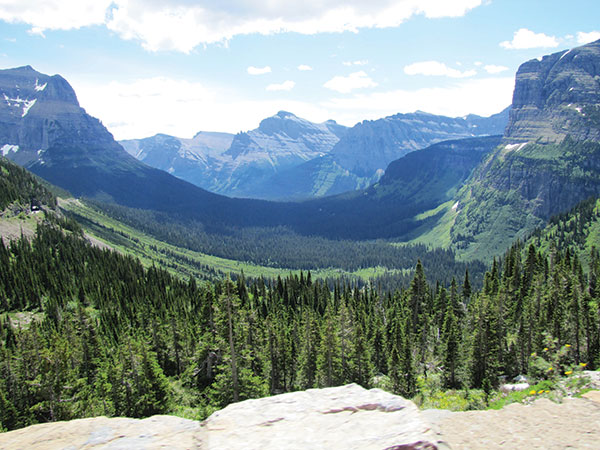
Waterton Lakes is the Canadian side of Glacier National Park in Montana, and we ventured back to America the next day to see it. We made our way to Logan Pass, elevation 6,646 feet, along the Continental Divide and at the summit of the Going-to-the-Sun Road. It is the highest point at which you can drive a vehicle.

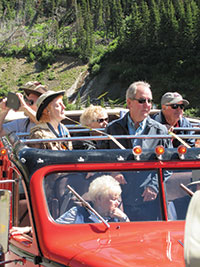
canada-trip-jammers-pell-city-2Our mode of transportation was in Red Jammers. These are specially designed vintage 1930s buses with four rows of seats. The fabric tops can be rolled back on pleasant days for passengers to gain a better vantage point of the views as they head up to the pass. That day was a pleasant day in more ways than just the weather as we climbed higher and higher in our Red Jammers with incredible views all around.
Actually, the buses are called reds, and the bus drivers are called jammers because of the sound the gears would make when shifted on the steep roads. The “jamming” sound came from double clutching. The drivers would pause now and then at scenic overlooks and other points of interest like glaciers, waterfalls and wildlife. You could actually stand with your head above the open roof to snap a photo or two. “Prairie dogs up!,” shouted by your driver, meant you could stand up in the vehicle, much like the prairie dog stands on his hind legs. “Prairie dogs down” warned you it was time to sit.

It became a running joke among our group when you wanted someone to stand up or sit down the rest of the trip.

On the way back as we talked over the majestic sights, we crossed the continental divide, thankful for what we had seen. It seemed the perfect spiritual moment for a blessing by fellow traveler Linda Prewitt and an inspiring acapella rendition of “Amazing Grace” by Donna Watkins. And it was.


On to Banff and Lake Louise

Up and out of the Prince of Wales Hotel early the next morning, we headed to Banff. I had seen photos of the Banff Springs Hotel, where we would be staying for the next three days, and the beauty of Lake Louise. A photograph simply cannot do those sights justice, but we all tried just the same.

Banff is a mountain town, quaint but bustling. The Fairmont Banff Springs Hotel sits high above, like a European castle carved into the mountainside. In fact, they call it “Castle in the Rockies.” From the window of our hotel room, we overlooked the picturesque Bow River flowing between two mountain ranges with a dusting of snow on scattered peaks in the center.

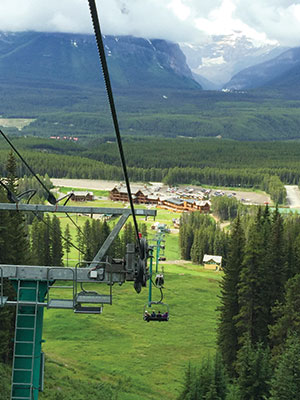
The Banff Springs Hotel is a magical place. Built more than 125 years ago, its architecture inside and out is grand, luxurious and stunning. The next morning we were on our way to Lake Louise, but not before a stop at Ski Louise Lodge, where we rode a gondola – an open or enclosed ski lift – to the top of a mountain to get a bird’s eye view of Lake Louise. The top was 6,850 feet above sea level. My sense of adventure kicked in unexpectedly, and I chose the open ski lift.

On the way up, we had a view of a different sort – a grizzly bear who seemed unfazed by the pairs of legs dangling overhead from the lifts. He seemed a bit more interested in foraging. We had a contest to see who got the best photo of the grizzly. Mine, of course, was the wrong end of the bear, and Jackie Reinheimer and Carolyn Hall emerged with award winning, full-faced grizzlies.

The stop at Lake Louise was as promised – breathtaking. Shimmering, turquoise water flanked by snow-covered mountains and a glacier that feeds into it, creating that precise color. It is hard to imagine a more impressive backdrop or a water’s hue more vivid.

But in that same day, we visited Peyto Lake, seeing it from a perch high above. The turquoise color was as unbelievable as Karina, our guide, had said. She described it as looking as though someone had created that distinctly beautiful color of paint and poured it right into the lake below.


Walking on a glacier

Our final day of excursions was the perfect ending. Not much could top it. We walked on a glacier. There was no fear of falling through, though. It was 1,000 feet thick, the largest accumulation of ice south of the Arctic Circle.

canada-trip-education-pell-city-3We started our trip early that morning, traveling on the Icefields Parkway. Along the way was a kaleidoscope of cliffs, waterfalls, rushing rivers, glacial peaks and snow covered mountain ranges. In short, all were sights to behold in awe.

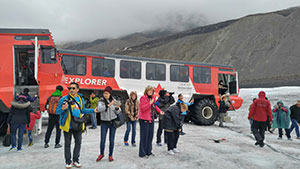
We boarded Ice Explorers, bus-like vehicles with tractor-type tires as tall as we are. We inched our way down a steep incline of ice and slush and then up again to the glacier.

The Ice Explorer stopped, the door opened, and we descended, precariously making our way across the ice. Exhilarating, giddy, inspired…those are the first few feelings that come to mind as I recount the experience.

Karina waited at the top near a glacier stream, where you could fill a bottle with pure glacier water, the turquoise color its unmistakable signature. When we were on the motor coach, she had told us of her tradition – a shot of Crown Royal Canadian Rye on the glacier – “because I can’t think of any place cooler to drink rye on the rocks.”

A few of us, admittedly, found our way to Karina and had the most memorable toast in the most unforgettable place.

The next day we headed home, full of memories to last a lifetime and a bucket list wish fulfilled. l


Editor’s note: To learn more about or join Friends Bound for New Horizons, contact Deanna Lawley or the Pell City Library.

Special thanks to fellow travelers: Steve and Judy Hager, Gayle Wood, Cherry Bass, Pam Foote, Barnett and Deanna Lawley, Lois Harris, Michal Hopson, Mike and Marion Lowe, Nan Strickland, Jackie Reinheimer, Carolyn Hall, Debbie Jordan, Billy and Kaye Cloud, Hilda Moon, Diane Ray, Randy and Donna Watkins, Bill and Judy Hardwick, Bill and Sandra Norton, Bill and Linda Prewitt, Steve and Donna Prewitt, Lewis and Ann Freedman, Dianne Cleveland, Barbara Money, Darlene Norris.