
Pell City’s Rachel Baribeau

rachel-baribeau-nashville

A legendary, lasting legacy, making her mark on air, world

Story by Paul South
Photos by Eric Adkins
Submitted photos

NASHVILLE, Tenn. — Not so long ago, Rachel Baribeau connected with a long-time friend from St. Clair County, the place Baribeau has called home since sixth grade.

“You’re a legend around here, you know,” the friend said.

“I was like, ‘Whaaat?,” Baribeau said. “It blew my mind.”

The 36-year-old broadcast journalist’s reaction may come as a bit of a surprise. After all, Baribeau hosts a sports talk show and has a regular gig on Sirius XM radio’s College Sports Nation and a weekly column on GridironNow.com, covering big-time college football for a national audience. She’s a Heisman voter. She was the first woman to fully participate in a professional football training camp, suiting up for the Columbus (Ga.) Lions of the American Indoor Football Association. She has a clothing line. She’s a life coach and a motivational speaker. In the temporal world, that’s heady stuff indeed.
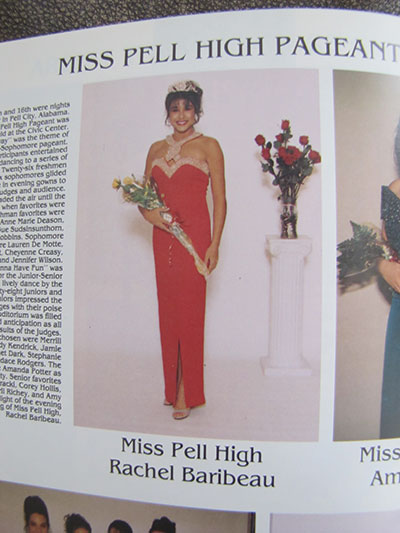
Miss-Pell-High-1997But in the tapestry that is Baribeau’s life, the real currency, the anchors of her life, are grounded in timeless values – a devout faith, hard work, putting others first and serving them and measuring life by the hearts she’s touched. As she tells it, she’s just “a grain in the hourglass.

“As I’ve gotten older, it’s really come full circle for me that people are my currency, and people are my richness,” the Auburn University alumnus said. “In that sense, I’m a millionaire because I’ve come to know so many wonderful people.”

To understand why Rachel Baribeau sees people, not material fame and fortune, as her source of wealth, it helps to know her family, especially her grandmother, Ophelia Maria Sifuentes Snow. For 60 years, “Opie” Snow served up cocktails and cold beer to unknown enlisted men and women and the world famous, like John Wayne, Paul “Bear” Bryant and Truman Capote at a watering hole on Victory Drive in Columbus, Ga.

Ophelia was a mix of humanity – a wondrous cocktail of Spanish, Mexican, Jewish and Mayan blood flowed through her veins. Today, that diverse DNA is visible in Baribeau’s dark hair and eyes and olive complexion.

“She really loved people and loved all sorts of people. She loved the soldier in Columbus and the politician and the movie star and the prostitute all the same. She just taught me that people matter and that life is about people.”

In Baribeau’s professional life, she sees stories of people that the herd of journalists may miss.

“I had a writing instructor tell me, ‘Rachel, when other people are looking one way, you look the other,’ ” Baribeau recalled.

One of her earliest broadcast partners, Max Howell, knows well Baribeau’s knack at finding stories off the beaten path. Howell has been a fixture in sports talk in the South, working in Atlanta, Memphis, Birmingham and other major markets. He recalled Baribeau’s concern over football-related concussions long before the NFL and the rest of the world took notice.

Baribeau offers a “unique voice” in covering the college football landscape, Howell said.

“She’s very compassionate and has a lot of empathy for the kids,” he added. “She was more concerned about the long-range people problems that evolved. To me, that was her strength. That’s what sets her apart from the other co-hosts I had.”

Lyn Scarbrough, a columnist and marketing director for Lindy’s Sports Annuals, has been a guest on Baribeau’s show over the years. Versatility is one of Baribeau’s strengths, Scarbrough said, both in her professional life and in her faith and charitable work.

“She can do radio. She can do television. She can do print. She is knowledgeable. She’s made journalism a passion. She’s willing to take a risk. She cares that it be right, and that it be professional,” he said. “In today’s culture, it’s not an everyday thing to find someone who has that combination of traits and beliefs and experiences. Not everyone has that combination.”

rachel-baribeau-saban-studioBaribeau, who has a deep religious faith, believes sweat, preparation and divine intervention help her find the stories she reports.

“My penchant for people has made people open up to me and to tell me these stories. I think there is a measure of divine intervention in that. The dots had to connect in a supernatural way,” she said.

One of those supernatural connections occurred two football seasons back, when Baribeau convinced her editors at Bleacher Report that Mississippi State University and its quarterback, Dak Prescott, were forces to watch in the 2014 season.

She traveled to Starkville a week after losing her father to cancer. Dak Prescott’s mother was waging her own battle with the disease. Before the interview, as Prescott opened up about his Mom’s condition, Baribeau began to cry, sharing her own story of her Dad’s passing. The two bonded, and Baribeau crafted a story larger than sport.

In January, Prescott was the MVP of the Senior Bowl. And Baribeau works with Prescott’s family to promote a foundation that helps cancer-stricken family members of student athletes travel to see their loved ones play, covering travel and medical costs associated with the trips

“Other than with Tom Rinaldi (of ESPN), Dak had never opened up like that before,” Baribeau said. “God really worked to orchestrate this meeting.”

There are so many layers to the Rachel Baribeau story. She was adopted at 18 months old by David Baribeau, a veteran of the first Gulf War. With her platform as a sports journalist, she is an advocate for adoption. She works with numerous charities, raising $90,000 for ALS research in the wake of her story on former University of Alabama great Kevin Turner, who now battles the disease. She climbed Mount Kilimanjaro for ALS research. The climb is the subject of a documentary, narrated by NFL Hall of Fame player and coach Mike Ditka.

And along with her work as a journalist, she and her mother partnered in early 2016 to form a clothing business. The Joyful Fashionista is crafting fashions for women, ages pre-teen to 85 and of every body type, sizes two to 26. A bricks and mortar shop – Pine Mountain Loft and Gallery in Pine Mountain, Ga., — and websites on Facebook and Instagram, feature the fashion line.

“What better thing than to be a partner with your Mom — your best friend — and help women feel beautiful and do it at a very reasonable cost. We’re not trying to break the bank for women who want to feel good about themselves.”

What shines through in Baribeau’s life is a boundless energy. Spencer Tillman, an analyst for Fox Sports, said Baribeau is “hardwired” for journalism.

“She pursues ‘the story’ because of her raw passion to win,” Tillman wrote on Baribeau’s web page. “She gets it right because she cares. She’s like that proverbial drip that can wear a hole in a rock. I’d want her on my team.”

That water of life has been passed across the years, from her grandmother to her Mom and adopted Dad. Powered by faith, the water is constantly flowing, methodically wearing away at the challenges of work and life.

And in an industry often driven by massive egos and major money, Baribeau’s life is defined by a desire to help others, a fire stoked by those who shaped her life from its earliest days.

Female sportscasters like Phyllis George, Jayne Kennedy, Linda Cohn and Lesley Visser may have shattered the glass ceiling. A new generation, including Baribeau, have followed in their path. And while like a gifted architect on a Starbucks bender, Baribeau has crafted a diverse portfolio in journalism, fashion and life coaching. And it appears she’s just getting warmed up.

But mileposts of accomplishment are secondary. Baribeau’s faith-based priorities are different.

“To move to act, to love, to forgive and to give. That’s what it’s all about,” Baribeau said. “You can have all the money in the world, all the accomplishments in the world. But at the end of the day, my eulogy is not going to be about the things I accomplished, but about the people I touched.”


 

Coyote Drive-In

Coming attractions: Drive-in, miniature golf heading to Leeds area

Story by Graham Hadley and Carol Pappas
Photos by Wallace Bromberg Jr.
Artwork from Coyote Drive-In

coyote-drive-in-leeds-2If you’re old enough to remember movie nights under the stars with plenty of popcorn devoured in the backseat of your parents’ car, prepare to reimagine those times as the Shops of Grand River in Leeds recreates the classic drive-in with plenty of new twists.

The four-screen theater complex aims its sights on being a recreational experience the entire family can enjoy — from the moment the gates open to the end credits of the last double-feature movie.

“We have been working with Christine Szalay, general manager for the Shops of Grand River, for about a year and a half — all the stars aligned and we are going to make it happen,” said Steve Wynn, chief operating officer for Coyote Drive-Ins. Wynn notes the company already has a successful, five-screen version in Forth Worth, Texas, which has been in operation since 2013.

The Leeds edition will have a restaurant with a full kitchen, a pizza bar where patrons can watch the pizza-making process from beginning to end, and a bar that serves beer, wine and margaritas. The restaurant will have air-conditioned indoor and outdoor seating and sits next to a controlled-entry, fenced playground. Parents can keep an eye on kids playing while dining with family and friends.

The restaurant’s pavilion will occupy about a 10,000 square-foot building that was part of the original Shops of Grand River complex but had never been occupied.

“It will be directly adjacent to the north end of the Shops,” Szalay said.

Along with the restaurant and playground, there will also be an 18-hole miniature golf course in the theater area.

As for the drive-in, there are four screens, with movies shown in high definition from top-of-the-line special projectors that are brighter and designed to throw high-quality images farther onto bigger screens. And, Coyote Drive-In shows are double features.

coyote-drive-in-leeds“There is a 30 minute intermission, then you can watch a second movie,” Wynn said.

Directly in front of the screens is a no-car, grassy park-like green space where families can have picnics, play football with friends or even walk with their dog. The drive-in is a pet-friendly theater. There is also outdoor seating for those who want to sit outside their cars and enjoy the movies out in the open.

“A lot of it is about the freedom. You can walk your dog, throw a Frisbee, and nobody is going to tell you to turn off your smart phone,” Wynn said.

Also planned on Fridays and Saturdays are musicians performing live music.

In Fort Worth, “people are coming about 90 minutes before the shows start,” Wynn said. “You can sit out in a lawn chair and watch the movie on a giant screen. It feels like an event – like movies in the park.

“I think it is a social element. This is what we see in Ft. Worth: People are reaching out on social media, saying, ‘We are all going out to a movie at Coyote.’ They come in large groups, bring the dog, move some picnic tables together, run and play, eat, then watch the movies. People like the social aspect,” Wynn said.

“The family crowd is our biggest pizza business. When a family film opens, it always outperforms our other genres, like more adult action-themed movies,” Wynn said. The drive-in is more open than a multiplex theater, but screens are set up to prevent line of sight from one viewing area to another. Even so, some movies will not be shown or will be shown later in the night.

“Some of the movies that are too risqué we will not play because a 5-year-old watching movies on one screen might see a movie on another screen. … In Ft. Worth, we did not play 50 Shades of Grey. It was a very popular movie, but the family-friendly environment is paramount,” Wynn said.

The theater will have room for a total of 1,100 cars.

The $6 million-plus project is expected to draw people to the Leeds area from possibly as far away as other states like Georgia and Tennessee, not to mention the surrounding Leeds community, Birmingham, Trussville, Pell City, Talladega, Anniston and the rest of north and central Alabama.

With the Shops of Grand River right next door, with stores generally open until 9 p.m., already drawing large crowds daily, the two ventures expect there to be lots of crossover business.

“Coyote Drive-Ins have thought of everything. It was one of the reasons when the discussions started we were enamored with their plan. It made such good sense for the Shops of Grand River,” Szalay said.

For the region, it means a recreation and tourism destination point, generating 100 new jobs.

“This makes the Shops of Grand River and Leeds more of a regional destination. People come from a large distance to shop here, and this works on a number of different levels, Szalay said. “We want that close connection to our customers from within the community, and this adds another reason for people who live farther away to come, shop and stay longer.”


Terresa Horn

terresa-Horn-musician-1

A song to sing, a story to tell

Story by Linda Long
Photos by Susan Wall
Submitted photos

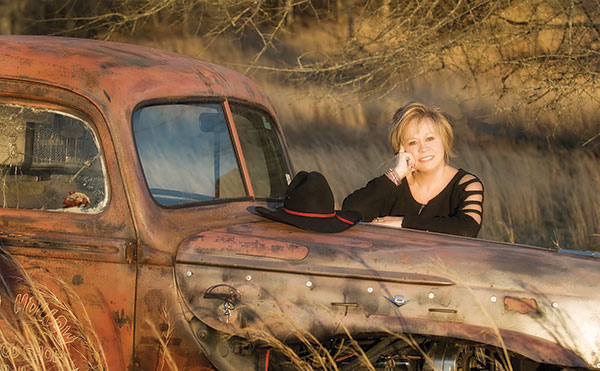
Terresa Horn was born to sing. No doubt about that on this Saturday night at the Dega Brewhouse in Talladega. The cowboy-booted, country music singing grandma belts out a rousing rendition of Ode to Billy Joe, a crowd favorite. Other requests come fast and furious, and Horn is happy to comply. She knows them all.

Horn stays busy singing at local clubs and special events in and around St. Clair County these days, but there was a time when her voice took her to the brink of the big time, a journey that started years ago from her from her home high atop Sand Mountain.

“I guess if there is any such thing as a music gene, I came by it honest,” she laughs. “My daddy could play just about anything there was – from the fiddle to the mandolin – and he had his own band. My brothers played bass and the drums and my mom? Well, she yodeled. Somebody was always making music at our house. It got pretty loud,” Horn recalled.

“People would ask my Mom how can you take this? She would just smile and say, ‘I know where my kids are.’ ”

terresa-Horn-band-gary-blaylockOne of Horn’s fondest memories growing up was Charlie B.’s Hootenanny, named for her father, Charlie B. Lang, and held every summer on a flatbed truck in her backyard.

“People came from all over the county,” said Horn. “It was an annual tradition.

Campers rolled in and stayed the whole weekend. My band would play and other musicians that we knew. We always had gospel quartets, and oh, my gosh, the food! Mom would cook dish pans full of chicken and dumplings and banana pudding. I remember one time daddy and them fried 300 pounds of catfish, not counting all the other food. Police officers would drop by and fix a plate, and politicians came to ask for votes. Everybody brought their lounge chairs and just had a real good time.”

As Horn recalls, her singing got its start in the family church. She was just four years old, but already familiar with gospel favorites. “I was nine when my Daddy put a microphone in my hand and got me up on stage for the first time,” she said. “We were at a square dance. I sang Silver Threads and Golden Needles, and I was hooked.”

That microphone was in her hand to stay. By the time she was 12, Horn and her brother had a weekly radio show. “It was live music, and we were on every Saturday morning,” she remembered. By the time she was 16, Horn was playing nightclubs from Birmingham to Atlanta. “I remember I even sang in one in Pell City back then.”

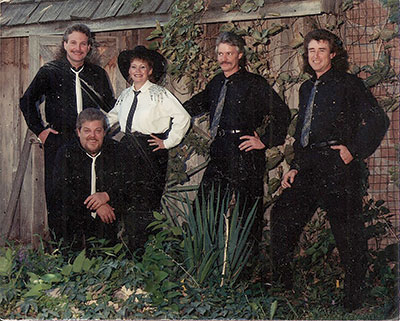
After a few years of life ‘on the road,’ Horn made her way to the mecca of country music, Nashville and historic Printer’s Alley, where country music stars are born. “Everything was going real good for me,” said Horn. “I did all the clubs along there (Printer’s Alley), including Tootsies. I sang with some really good people – Mickey Gilley, Marty Stuart. Tanya Tucker used to come by and sing with us, and I did one outdoor show that had some really big names. Willie Nelson played that one. I shared a tent with him, and that was pretty cool.”

Folks in Nashville began to sit up and take notice. As one promotional flier read, “Terresa Jhene (her stage name at the time), country gal, with super talent, debuts.” She signed a recording contract with C.B.F. Records and cut her first album, If This is Dreaming, which made the charts.

For Horn, it was “a dream come true…like a storybook. It just didn’t seem real. I went to the studio to cut a single, but when the producer heard me, he said, ‘Oh, no. This girl’s too good.’ He got the musicians in there, and we cut an album right there on the spot.”

In the meantime, another single, Sooner or Later, had climbed to number three on charts in Europe. “We were all set to do a European tour – radio shows, TV shows. They were all scheduled, and tour dates had been set.”

That’s when fate dealt a cruel blow with a phone call that put an abrupt halt to the tour and almost derailed her career. Her beloved Dad had suffered a heart attack and died a few days later.

terresa-Horn-band-nightshift“I came back home and thought I would just postpone the tour, but I kept putting it off,” said Horn, and just never went back. Instead, I stayed home to take care of my mother. I would do it over again because it was the right thing to do. My mom and dad were my biggest inspiration and my biggest fans. I don’t know. It seems like when my parents died, the music went out of  me. It was a long time before I could sing again.”

Today, the music’s back. Horn says she is “really enjoying singing without all the pressures associated with the entertainment business. It was demanding, but I wouldn’t trade any of the memories. I did get to do a lot of fun things that other people don’t get to do. Still,” she said, somewhat wistfully, “you do look back, sometimes, and wonder what if, but I have no regrets.”

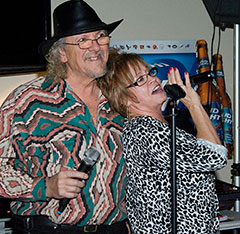
Horn sings with the Memories Band and as one half of the Just Two duo partnered with local entertainer Gary Blalock. When Horn isn’t singing, she can be found at her second career as secretary at Cropwell Small Animal Hospital.

These days, family means husband Bobby Horn and their blended family of four children and eight grandchildren. Their log cabin home by Logan Martin Lake sees a lot of music and a lot of parties – maybe not as big as Charlie B.’s Hootenanny, she said, but “we’re getting there.” l


Cecil’s Music

Mandolin maker’s special creations

Story by Jerry C. Smith
Photos by Wallace Bromberg Jr.

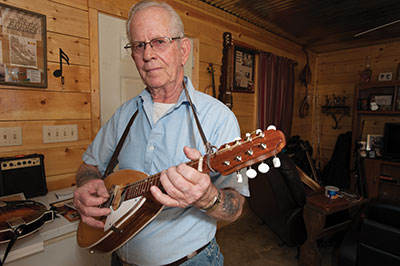
Cecil-Blount-mandolinBreakfast time at Jack’s Family Restaurant in Pell City is a busy, noisy affair, as dozens of loquacious locals begin their day with tater tots, sausage biscuits, cinnamon buns, and currently relevant chitchat. But 85-year-old Cecil Blount of New London can easily squelch the din with a few strokes of his fingertips.

Recently, he sat down among friends at one of the large center round tables, which are notoriously noisy, and unobtrusively began picking out a simple tune he calls “Spanish Two-Step,” on a mandolin he’d made for himself.

At first, only those around his table piped down to listen, but by the time he was halfway through his number, the quietness had spread in expanding circles until the whole room was mostly silent save for Cecil’s music. When the number ended, he was treated to a round of applause as various folks marveled at Cecil’s skills, as both musician and craftsman.

He’s made at least a dozen instruments, including several mandolins, a dobro, fiddle, steel guitar, and will occasionally build one to order.

Cecil doesn’t work in an elaborate shop like some of those craftsmen you see on TV, but rather uses simple hand and power tools and homemade wood-bending forms while working in fresh air under an outdoor lean-to shed he built himself. Rather than relying upon complex formulas and a fancy shop full of exotic tools, his emphasis is on skill, a feel for carefully-selected materials and a natural ear for music.

All his instruments have that certain home-crafted look about them, but also a precision that’s readily apparent to the eyes of other craftsmen. Each piece is unique, as only Cecil can make them.

A lifelong native of Delta, Mississippi, he moved to St. Clair County about two years ago to be near his kinfolks. Cecil lives in a house he and his son, Mike, designed and built on a lot near Coosa Island Marina. Mike lives next door.

It’s the perfect man cave, built for the needs and pleasures of a single man who claims that, “five wives was enough.” The decor is simple and easy to maintain, with certain masculine touches many women would not tolerate, such as a corrugated steel ceiling and polished concrete floor. The walls are hung with stringed instruments, many of which he made.

Cecil admits his home is a bit on the small side, but adds with a wink, “there’s always room for an occasional visitor.”

A painter by trade but musician by avocation since age 15, he’s played with several local and regional bands and stars, including Big River and Jack Curtis in Mississippi. He also plays in monthly sessions at a local senior center, the State Veterans Home, various nursing facilities and his church, Friendship Freewill Baptist in Pell City, where he sometimes jams with Mayor Joe Funderburg, Judge Alan Furr and the church’s pastor, Dr. Michael Barber.

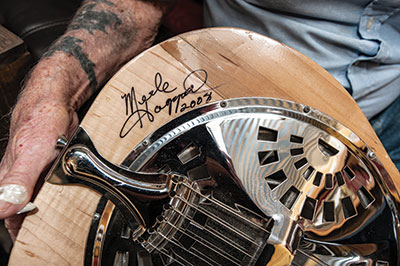
Cecil-Blount-merle-Haggard-dobroCecil’s most prized possession is a dobro he made that bears Merle Haggard’s autograph. Merle was playing a concert in Sturgis, Mississippi, when Cecil handed his dobro over the fence to a secretary, who asked the country and western superstar to autograph it during a session break.

If confused by all the various stringed instruments, and what makes each one unique to its type, Cecil helped cut the fog. For instance, a dobro and a regular guitar have the same number and size of strings, but they are tuned to different scale notes.

Also, a dobro has a special sound box, usually a circular affair of metal or wood, that produces the twangy, shrill notes peculiar to that instrument, whereas an acoustic guitar relies on the body of the instrument itself to develop its deeper, richer sound.

Mandolins have four pairs of strings, with both strings of each pair tuned to precisely the same note. The pick hits both strings in a pair with every stroke, giving a characteristic mandolin “pli-plink” sound.

What’s the difference between a fiddle and a violin? Cecil said that a violin might be a bit larger than a fiddle, but if someone asked him to make either, his product would be the same.

Discover photographer Wally Bromberg, who is no slouch on stringed instruments himself and jammed a bit with Cecil during the interview session, added, “You carry a violin in a case, and tote a fiddle in a sack.”

Cecil loves fishing, and lives within rock-throwing distance of Logan Martin Lake. In fact, he discovered his bit of heaven while visiting his son, liked the lake and neighborhood, and quickly settled in.

If one word could describe Cecil, it’s “imaginative.” His keen perception and active mind is reflected in everything around him. He has a small metal fishing boat that he converted to inboard style by mounting a five-horsepower lawn mower engine amidships, connected through a go-kart clutch and waterproof housing to a propeller underneath. It also has a yard tractor seat and steering wheel. It’s a poor man’s Chris-Craft.

Additionally, he’s built and sold several bicycles which he had converted to gasoline engine power, almost identical to the old Whizzer bikes familiar to any boy over 70.

Everything in sight is absolutely Cecil Blount. l

Hiram Premiere

Hank-Williams-Hiram-1

Young Hank Williams world premiere coming to CEPA

Story by Carol Pappas
Photos by Wallace Bromberg Jr.

At age 29, it hardly seemed enough time to become a legend. But Hiram King Williams, known to most as Hank, possessed an innate musical genius that propelled him to superstardom by the time he was 25.

For the man who garnered number one hits, Grammy Awards and the Pulitzer Prize, it was plenty of time to set the music world on fire, melt more than a few cold, cold hearts along the way and set the standard for country music to this day.

While much has been written about his life as a young man and celebrity, little has been penned about the boy born in Mt. Olive, Alabama, who grew up in Georgianna and Montgomery. Until now.

Nationally syndicated columnist Rheta Grimsley Johnson and playwright John M. Williams collaborated to bring Williams to life on stage once again, but not as the country music legend he would become. It’s simply Hiram, the boy from rural Alabama who grew up during the Depression, picked up a guitar at the age of 8 and created music and lyrics that still touch the soul 60 years after his death in 1953.

The world premiere of Hiram, Becoming Hank Williams, comes to center stage at Pell City Center for Education and the Performing Arts, CEPA, Feb. 26-28. Its arrival in St. Clair County perhaps has as many twists and turns as Williams’ life.

Hank-Williams-Hiram-3The play was first going to be booked at a theatre in Georgianna, home of Hank Williams’ Birthplace Museum and where a festival takes place every year. Johnson, who wrote the book, Hank Hung the Moon and Warmed Our Cold, Cold, Hearts, had a book signing there. Museum Director Margaret Gaston wanted to take it further. “She envisioned a short play at the theatre in Georgianna,” Johnson said, and Johnson was encouraged to write it.

Johnson called her playwright friend, John M. Williams, and they agreed to collaborate. “I knew Hank lore, and he knew playwrights.”

But, the theatre closed, and Gaston mentioned CEPA Artistic Director Kathy McCoy, who had been a director in nearby Monroeville. “I give her (Gaston) a lot of credit for the idea – “What was the genius? Where did it come from? I am disappointed that Georgianna fell through for her.”

Georgianna’s loss became Pell City’s gain. McCoy agreed to direct, and CEPA’s board of directors welcomed the world premiere to its theatre.

Along the way, there has been a lot of work to craft the final version. “It went back and forth,” writing and rewriting, said Williams. “We spent lots of time listening to good music,” he noted, adding how that music had influenced Hank – Hillbilly, Blues, country.

“We wanted to recreate the South he was in,” Williams said.

“Adapting the original play to stage was a challenge,” McCoy added. “Music was involved, so we had to bring it all together.”

Jett Williams no longer in the wings

Jett Williams, Hank’s daughter, co-wrote a song especially for the play. Appropriately called, Hiram, the song will make its debut opening night – and Williams will be there. In a telephone interview from her Green Grove, Tennessee, home, Williams talked about the song, Johnson, her father’s life and his influence that is still felt decades after his death.

She co-wrote the song with friend Kelly Zumwalt, and Corey Kirby, who plays Hiram, will be premiering the song.

Hank-Williams-Hiram-2Jet Williams has a longtime friendship with Johnson, who first began writing in her syndicated newspaper columns about Williams’ years-long battle to be recognized as Hank Williams’ daughter. She devotes a chapter in her book about Hank to Jett Williams.

Jett was born to Bobbie Jett, with whom Williams had a relationship. Hank died months before her birth, but he had made arrangements for his own mother to adopt her. She did, but she died two years after the adoption. Jett went into a foster home and then was adopted again by a couple from Mobile and grew up as Cathy Deupree.

Jett said she met Johnson many years ago when her legal battles began. “She’s a fabulous writer. She included me in one of her columns. From the first time I talked to her, she made no secret that she was a huge fan in love with Hank Williams. Other than loving Auburn (Johnson is an AU graduate), that would be it.”

Jett talked about Johnson’s book and how she was “always a champion for my dad – his music and his memory.”

“We started out as reporter and subject. Now, we’re friends,” Johnson said.

Jett likes the angle of the story for this play, she said. “This is a different approach to Hank Williams,” she said. “It’s his childhood, discovering his talents and setting forth to live his dream.”

So much has been written about his death or the Grand Ole Opry. “More has been written about that time of life,” Jett explained. “This goes back to the beginning.” Someone of his stature and genius “doesn’t just wake up at 21 and say this is something I want to do.”

After reading the script, she said, “I am proud of Rheta and Johnny. They did a great job. But reading the play and actually seeing it come to life – that’s why I’m coming to Pell City. I want to see it jump off the paper and come to life. I am excited to see it on stage.”

Johnson and Williams share the excitement of being able to tell this story. “He was born with this great gift, but there were influences,” Johnson said. There was a blues influence, a spiritual influence and a honky tonk influence.

The blues influence on him was “enormous,” Williams said. “He had this air all around him, a lot of influences on him.”

“He put it all together,” Johnson said, citing lyrics from Your Cheatin’ Heart. “That’s not unlike what the bluesman wrote about: ‘Another mule kicking in my stall.’ Nothing requires a footnote to explain what was happening in 1952” in his life.

Jett, who is a country music entertainer on her own and a producer of Unreleased Recordings of Hank Williams, earned a Grammy nomination for it.

She accepted the Pulitzer Prize for him. Take the lines from her favorite song, I’m so Lonesome I could Cry, and the genius is evident:

The silence of a falling star
Lights up a purple sky
And as I wonder where you are
I’m so lonesome I could cry

“Even with no melody,” Jett said, “it shows you genius. The highest journalist award shows the greatness of the man from Alabama.”

“Good music is good music,” Johnson said. “The lyrics are so poetic, it’s going to last. He’s lasted. It’s Alabama’s best story.”


Ticket information

Feb. 26 at 7 p.m.
Tickets, $22.50
$15, Students and Seniors

Feb. 27 at 7 p.m.
Tickets, $22.50
$15, Students and Seniors

Feb. 28 at 2 p.m.
Tickets, $22.50
$15, Students and Seniors (62+)

Buy online @ pellcitycenter.com.
Or call to reserve @205-338-1974

Feb. 25 at noon at CEPA
Book signing, program by Jett Williams and Rheta Grimsley Johnson
Reception to follow

Making Beautiful Music

musician-teachers-1St. Clair teachers’ latest
recording topping charts

Story by Jim Smothers
Photos by Jim Smothers,
Wallace Bromberg Jr.
and Graham Hadley

Their students may have noticed Shannon and Heather Slaughter were in an especially happy mood in mid-May, and it wasn’t just because the last day of school was approaching. This bluegrass performing couple just got word that their independent CD, Never Just a Song, had reached No. 1 on the National Roots Music Report for the week of May 13.

In their Facebook message to fans, the Slaughters said, “It’s our first number 1 on any chart, and we are really excited and feel really blessed.”

The traditional bluegrass song, Moonshiner, was the first single to be released after the album’s January release, and it’s gotten a lot of attention and airplay in the genre. But they’ll tell you quickly their favorite song on the disc is one they wrote together, The Best Thing We Ever Did.

It’s about their daughter, 2-year-old Rae Carroll Slaughter, who has changed their outlook on life and what’s really important in this world.

And it’s easy to see why. The adorable little girl inspired the lyric “She makes my day without saying a word,” and she is the center of their life together and their plans for the future.

About her

Shannon Slaughter was already a veteran performer and songwriter in traditional country and bluegrass music while Heather Sanders was playing electric bass with the youth band at her church in Argo in western St. Clair County.

She had a musical tradition in her family going back at least three generations. Her grandmother Ramona Carroll was part of a female vocal group that performed locally, and she hosted regular music nights in the basement of her store, Buckeye Grocery, near Argo.

Heather’s mom Robin was also a singer and bass player. She met Heather’s dad, Terry Sanders, when he came with his guitar to make some music with the people at the Carroll family store.

So it was no surprise that Heather could sing, but performing didn’t come naturally to her at first.

“My grandmother used to make me get up and sing at church,” she said, “and I was the shyest human being of all time.”

Her dad taught her to play guitar and mandolin, and she eventually conquered her shyness.

She made connections with Mike Toppins in Nashville and began work on her solo CD, I Meant It, and that’s what led to her first contact with Shannon.

A moderator with an Internet music site, Worldwide Bluegrass, knew Heather was ready to record, and wanted to help her along. The station had a message board, and the moderator sent Shannon a private message asking him if he had written any songs that would be good for a female singer, and he told him a little about Heather.

As any modern male would do, he looked her up on the Internet and found her photos on MySpace.

“She was really good-looking, so I replied, ‘Yeah, I think I have some songs for her,’ ” he said.

Heather recorded two of his songs on that CD, In My Heart, and Dying to Live Again.

The two communicated by email and telephone and really hit it off, but didn’t meet face-to-face at the time. Shannon was based in North Carolina where he was networked with a number of professionals in the industry. But Heather’s dad wasn’t sold on the idea of letting his daughter go out of state to meet a guitar-playing singer. The Internet station moderator didn’t like the idea, either. “She’s too young and innocent for the likes of you,” the moderator told Shannon when he asked for Heather’s phone number.

They didn’t have any more contact for two years.

“He left me high and dry,” Heather said. “Then I got home from a vacation, and there was an email waiting saying he wanted to see me.”

Meanwhile she joined the Gadsden-based band, Acoustic Rain, and played a number of shows across central Alabama. Shannon came down for a weekend to see her perform at Moonsong near Noccalula Falls in Gadsden.

“By the time I heard her sing five notes, I knew she was as good as anyone I had ever heard,” Shannon said. He sat in with the group for a couple of songs that night and stayed up all night singing with Heather. They hit it off so well in person, he extended his stay to spend more time with her, and they’ve been together ever since.

They swap lead vocals and support each other with silky smooth harmonies sure to please.

About him

Shannon is one of the better-known performers in bluegrass and classic country music today. Fans are quick to say he is “the real deal,” with his solid songwriting and guitar playing and friendly, soothing voice. He was raised in Chiefland, Fla., where he started performing while he was still in grade school. He started playing guitar when he was 8, and within two or three years he was singing at churches and livestock fairs and anywhere else people would listen.

As a teenager he met professional player Booie Beach at a Tony Rice concert and asked him if he would help him improve his playing. Beach taught Slaughter a lot of techniques and guitar licks that helped him on his way.

“We became lifelong friends,” Shannon said. He had played professionally already five to 10 years by that time.

“Two years later, Beach left the Larry Stephenson Band, and I took his place. Since he was my teacher, I already knew his licks, and I played my first two gigs with them without a rehearsal, and they told me, ‘You’ve got the job.’

During more than two decades of performing and recording, Shannon also played with Lost and Found, and for two years, he was the lead vocalist and guitarist for The Lonesome River Band. He was part of the Lou Reid and Caroline band, performed with Grasstowne and with Melonie Cannon, and he is also an award-winning songwriter.

But with all his experience and stature in the music industry, Shannon has kept his feet on the ground.

“There aren’t really any stars in this kind of music,” he said. “We’re just regular people.”

And they don’t have any intentions of quitting their day jobs. Both are school teachers. Heather is a special education teacher at Walter M. Kennedy Elementary School in Pell City and Shannon, a history teacher at St. Clair County High School in Odenville. He recently resigned from his additional duties as a football coach to be able to spend more time with his family.

“We want to keep on doing music, and we would like to have about 15 gigs a year,” he said.

Together

Alabama influences are making their way into the couple’s music, as reflected on their newest CD, Never Just a Song.

Back to Birmingham most obviously touches on Shannon’s new home state. Co-written with Heather and Dale Felts, they sing, “When I need to find out who I am, I go back to Birmingham.”

Less obvious is the Alabama connection in the song, Company Town. It’s about the lifestyle of a coal mining community in Margaret, where Heather’s grandfather once lived, the poverty the people endured, and how they lived together.

The sight of a farmer in bib overalls on Sanie Road between Argo and Odenville inspired the song, That’s What’s Good in America. It’s about “doing honest work for honest pay,” football, God and family.

The CD has 14 tracks, half of them written or co-written by Shannon.

You can find more about their music and CD online at shannonandheatherslaughter.com