Beaver Creek gristmills, cornbread and memories

Story by Joe Whitten
Photos by Mackenzie Free
and submitted Photos

Some of our readers are of an age to remember a family farmhouse with a wood-burning cookstove in the kitchen. As memory pulls them into distant reveries, the smell of cornbread browning in the oven is so real that mouths begin to water. On the table sits the fresh-churned butter that will crown a slice cut steaming from the cast iron skillet.

Then, as memory fades into 2023 reality, they realize a skillet of cornbread baking in a gas or electric oven smells just as good.

Two hundred years ago in St. Clair County, the meal for that “bread of memory” came from a local gristmill that had ground the farmer’s homegrown, dried and shelled corn.
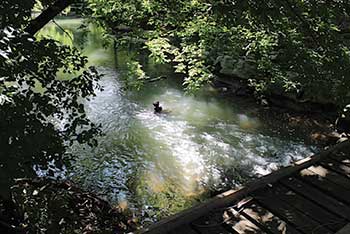
Yarbrough waterwheel attached to wooden frame, submerged in Beaver Creek

In the book, Anthology of People – Places – Events of St. Clair County, Mattie Lou Teague Crow (1903-1999) in her article, “Mills in the Valley,” records that before the construction of local gristmills, “The man of the family often traveled all the way back to Georgia or Tennessee to have corn ground into meal. In time, each community had its own gristmill.”

Later in the article she laments that “Today we buy … a box of corn muffin mix, which (Tennessee) Ernie Ford assures us is ‘pea-picking good.’ But it’s a sad thing that today’s generation will never know what real cornbread was like. Corn pone. Egg bread. Spoon bread. Johnny cake. Crackling bread. Corn dodgers. Hush puppies. Today’s variety is a pale imitation of the bread our grandparents made from that wonderful water-ground meal.”

Yarbrough Mills

Manoah Yarbrough no doubt built the first gristmill on Beaver Creek c1823. He moved his family from North Carolina to St. Clair County in 1822. His original destination was Choccolocco Valley in Calhoun County, but after learning of the Indian unrest in that area, he settled in St. Clair County.

According to an article written by Fitzgerald Yarbrough for The Heritage of St. Clair County, Manoah, having run corn and flour mills in North Carolina, had “brought his mill, including the mill rocks, with him,” and soon after getting “the family settled, he began constructing a dam across Beaver Creek to furnish power for his grist and flour mills. The dam is approximately 450 feet long and is built of mountain rock and dirt.”

Fitzgerald was proud of the fact that “The original dam is still used today as a roadbed leading to a bridge which crosses Beaver Creek. … The bridge foundation is the original dam where the water gates were.” Fitzgerald and his two sons, Fitz and Burk, constructed the bridge in 1985.

In the fall after the harvest and through the winter months, the family and farm workers added height to the dam “… to give a greater head of water so more machinery could be added.” Manoah died in 1840, and his son, Littleton, continued running the mill and making improvements.

In addition to corn and flour mills, over time, the Yarbrough mills included a sawmill, a shingle mill and a wool carding mill. Fitzgerald wrote of Littleton’s son, “My grandfather, John Yarbrough, Sr., ran the wool carding mill to make wool yarn for the Confederate Army during the Civil War. He was only 13 years old when the war began.” John Yarbrough, Sr., added a cotton gin, which operated until about the time WWI began.

The traditional waterwheel powered the mill until the 1880s. By then, Littleton had died and his son, John Yarbrough, mentioned above, operated the mills and continued making improvements to them.

“The turbine water wheel (that John purchased) was known as Morris Wheel,” Fitzgerald wrote, “because it was constructed at Morrisville, Alabama, and sold to my grandfather by John and Elbert Morris.”

When John and Elbert Morris came to Beaver Valley to install the Morris Wheel, romance blossomed between them and two of Fitzgerald’s aunts, for “A few years later, John Morris married my aunt Mae,” he wrote, “and Elbert Morris married Aunt Jennie.”

At the location of the mill, Beaver Creek flows wide and sparkling in the sun. The mill dam allowed a large lake to form above it which became a place local folk enjoyed for fishing, camping, swimming, fish fries and picnics.

With the passing decades, sediment built up behind the dam, thus reducing the volume of water in the lake. The Yarbroughs estimated that between the years 1823 and 1925, eight feet of sediment accumulated. Then in 1925, an exceptional flood washed out the water gate and swept the waterwheel downstream about 50 feet from its original location in the water house, which was also damaged by the flood waters and never rebuilt.

The waterwheel, still attached to its wooden frame, lies today in the waters of Beaver Creek and has not been removed for two reasons recorded by Fitzgerald: “(1) Its weight. It is very heavy, and (2) It is better preserved under water than if it was raised and exposed to the elements.”

The Yarbrough mill functioned for more than 100 years. The corn and flour mill stones carted here from North Carolina remain in the family. And from the sawmill, several 19th century homes constructed by Littleton Yarbrough, with lumber sawn in his mill and dried in his kiln, remain in the Beaver Valley today. The kiln lay east of the dam and the outline of the rock foundation and sides remain visible today. In addition to these Beaver Valley homes, the Ashville Courthouse and the second Ashville Baptist Church building were constructed with lumber from the Yarbrough mill.

Abernathy Grist Mill

In the previously mentioned book, Anthology of People – Places – Events of St. Clair County, Larry McCullough wrote the article, “History of the Abernathy Grist Mill,” from history he collected from L.E. Abernathy and V. Ray Thompson. Larry wrote, “The Abernathy Grist Mill once located in Beaver Valley was purchased in 1918 by M.R. Abernathy after the sawmill he operated in Ashville was destroyed by fire. The mill was previously known as the Gilchrist Mill, though it is unclear who actually built the mill or when it was built.”
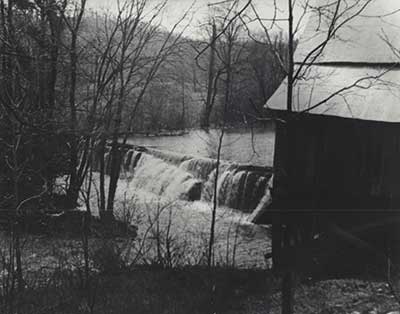
Gilchrist-Abernathy Grist Mill and pond

However, in the same Anthology, Lura Jean Cobb Smith, a Gilchrist descendant, has an article titled “Who Built the Mill?,” wherein she stated, “My Great-Grandfather, Truss Vann Gilchrist brought his family from Calhoun County to St. Clair County, bought farmland in the valley of Beaver Creek, on October 28, 1879. He and my grandfather, John Dudley Gilchrist, built the Mill now known as Abernathy Mill.” The rest of the article relates Gilchrist genealogy and family history.

In a recent interview, Judith Ramsey Abernathy recalled information her husband, Bob Abernathy, had gleaned about his grandfather, Marion R. Abernathy, who bought and ran the mill. “The Abernathy family lived in Cherokee County where, as carpenters and millers, they designed mills, dams and raceways – flumes for carrying water. The family mills there included a gristmill, sawmill and cotton gin.”

Marion was five years old when his father died. In those days, children in large families grew up learning how to work, and so did Marion. In the 1880 US Census, he is listed as a farm hand and living with his cousin in Cherokee County, Alabama. Then in later censuses, he is in St. Clair County.

The Abernathy family were related to the St. Clair County Lindsey family who “… had a mill on Canoe Creek northeast of Ashville,” said Judith, “and we believe that is why Marion came to St. Clair County.”

“The mill sat on a large lake created by dams on the creek,” she related. “Bob’s mother recalled seeing large trout in the lake. They built a big farmhouse on the Beaver Creek property. It had a dogtrot through the center and many large rooms.”

Larry McCollough describes the remains of the mill. “The dam is still intact except for a 20-foot section on the south side of the creek. The dam stretches 80 feet from end to end, stands 15 feet tall and is 10 feet thick at the base. Some of the rocks making up the dam are half as large as automobiles.”
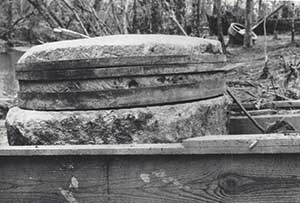
Abernathy Grist Mill stones

According to Larry’s article, the millhouse was a wood frame structure that stood two stories high and sat “…atop the dam on the northside of the creek. …A cotton gin occupied the top floor, though the gin machinery was never used by Mr. Abernathy.”

The Abernathy mill never had the traditional waterwheel, so when time came to grind corn, the miller raised a sluice gate in the dam to release the water. “The water was directed through a water turbine. …The turbine converted the rushing water into power that turned various gears and shafts, finally setting into motion one of the 800-pound millstones. One stone turned in a circular motion (this one had to be balanced) while the other remained stationary during the grinding.” The ground corn meal fell into a hopper under which the miller had placed a sack into which he released the meal.

Margaret Franklin Berry, who grew up in Slasham Valley, remembers this process from the mid-to-late-1940s.  “When we needed corn meal, my parents would send my brother and me out there to shell corn. I remember we shelled gallon buckets of corn. My daddy would take it to the mill to have it ground, and I’d go with him. I just thought that was fascinating to watch that man pour that corn into that hopper, and it come out cornmeal.” She couldn’t remember the name of the mill, but her description seems to indicate the Abernathy Gristmill.

Larry also pointed out that the millstones’ grooves would wear down from the grinding and required regrooving periodically. The miller used a hammer and chisel for this job. This chiseling left grit in the grooves for several days afterward, and during those days, the miller ground only chicken feed until the grit was gone.

Just as at the Yarbrough mill, the Abernathy millpond was a social gathering place where people could swim and fish in the cool water and then picnic on the bank.

In the early 1940s, unusually heavy spring rains caused Beaver Creek flooding, which swept the Abernathy millhouse off its foundations. At the time Larry wrote the article in 1985, “Boards, rafters and heart pine logs can still be seen beneath the clear waters, looking like the wreckage of a Spanish galleon.”

Time no doubt has taken its toll on those timbers the passing years. The millstones were retrieved by Larry and remain preserved at his home today.

According to Judith Abernathy, after the storm washed the Beaver Creek mill away, “Marion purchased land in Ashville and built a new home. He also began operating a heading mill, making wooden barrelheads. This mill was located at the corner of Highway 23 and 7th Avenue in Ashville. Every day at noon, a steam whistle would blow at the mill.”

The Cox Mill

In an article on file at the Ashville Museum and Archives, Margaret Coker wrote of the Cox Gristmill in a paper titled, “Childhood Memories of an Old Gristmill.” Henry Cox operated this mill in Beaver Valley. According to Mr. Cox’s obituary in The Southern Aegis, Nov. 8, 1928, he became blind at the age of 12, and in spite of his blindness, as an adult he delivered mail in Beaver Valley for 15 years.

The Cox gristmill had the traditional waterwheel, and the dam across the creek formed a millpond. When the miller opened the water gate, the rushing water turned the waterwheel to power the mill.

“I remember helping my father by turning the handle of the corn sheller while he fed the ears into it,” Mrs. Coker wrote. “Then the corn was sacked and taken to the Cox Gristmill.” Folk could have their corn ground fine, medium or coarse.

“I remember as a small child going to the mill with my father in a wagon,” she wrote, “and then later in an early model Ford car. Some customers came bringing their sacks of corn across the backs of the horses or mules they were riding. Others came in buggies or wagons.”

She drew a word picture with this recollection from the past. “One of the pleasant memories of my childhood was walking into my mother’s kitchen and smelling the enticing aroma of hot cornbread just out of the oven of the wood burning stove. Even better was the taste of the bread when a slice of it was filled with home churned butter.”

The wonderful thing is a wood burning stove is not required for making family memories of your own. So, go to the store and purchase some self-rising corn meal – and a pound of real butter. For dinner tonight, open a jar of the vegetable soup you canned this past summer. Turn your oven – gas or electric – to 425 degrees and put the oiled iron skillet in the oven while it heats. A sizzling hot skillet gives a good crust to the cornbread. If you don’t have a recipe, there will be one on the bag of cornmeal you bought, or you can call your mother, your grandmother, an aunt, or a friend for their recipe.

Over the past 100 years, sugar has crept into cornbread recipes in the South, but for true, old-timey Southern cornbread, cooks don’t add sugar to the batter. Beloved storyteller, Sean of the South, addressed this in his Nov. 2, 2022, online blog titled, “For the Love of Cornbread,” when he wrote:

“Only a few days ago, I visited a restaurant in Franklin, Tennessee. It was one of those fancy joints where waiters and waitresses walk like they’re in need of fiber supplementation. The waitress brought me a hot basket of sweet cornbread.

“ ‘Excuse me, ma’am,’ I said to the waitress. ‘There’s something wrong with my cornbread.’

“‘What’s wrong?’ she said.

“ ‘Well, I think the chef spilled a box of Duncan Hines into the batter.’

“No, sir, we put sugar in our cornbread.”

“ ‘Why would you do such a thing?’

“Because our chef is from Chicago.”

And cornbread lovers all over the South murmured commiserations along with Tennessee Ernie Ford, “Well bless his pea-picking heart!”

Salute to service

Story and photos by
Carol Pappas

In its first community outreach program since opening in March, Museum of Pell City presented Salute to Service Nov. 2, hosting a crowd of over 80 veterans and community and governmental leaders.

The event included lunch, speaker, a state senate resolution, a special presentation to veterans, a new military service exhibit and premier of a short film produced by the museum.

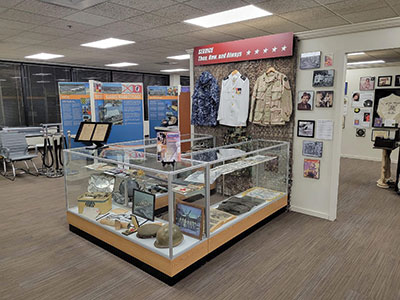
A section of the expanded Salute to Service exhibits at the museum

“We chose this as our very first community outreach program for a reason – veterans form the very foundation of all of our communities across our country,” Museum President Carol Pappas said in opening remarks. “Their history is what our history is built upon, and we truly thank them for their service.”

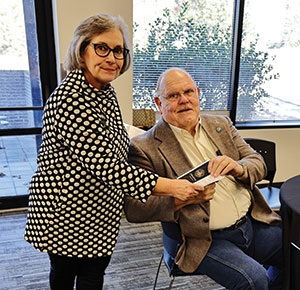
Salute to Service hosted a group of veterans and staff from Col. Robert L. Howard State Veterans Home as special guests, and veterans throughout the audience were recognized for their service. The museum presented each with a special memento – a commemorative challenge coin thanking them for their service.

The museum presented its coin with a specially designed card saying: “Historically, military commanders presented challenge coins to members of their units in recognition of special achievements. Today, we respectfully present it to you for the ultimate achievement – your service and sacrifice in defense of our country, our freedoms and our way of life.”

Museum First Vice President Deanna Lawley directed the day’s program, noting her own roots in a military family. “Veterans are men and women who have put others before self to guarantee the security of our community and country. The sacrifices were also made by your families who often had an empty chair at the head of the table. I know this because for the first 15 years of my life, I watched my mother move four daughters from the dust blown plains of Ft. Sill Field Artillery School, Oklahoma, to Newnan, Georgia, where family took us in as Daddy was deployed to join Patton’s 3rd Army.”

She detailed the family’s moves during her father’s service after World War II – Panama Canal and Boston. Then, he was called to Korea. When the war ended, she and her sisters thought he would be home soon, but duty called again. “He remained to negotiate prisoner of war exchanges and saw the harsh sacrifices made by those who had been captured.”

He was home for a time, then orders sent him with family in tow to Verona, Italy, where he’d work to establish SETAF relationships and find a home for us on the Italian economy,” she said, noting that she went to school in a converted shoe factory with a potbelly stove for heat.

“Military families learned to be resilient and independent. I don’t know the length of service each of you gave, but I know it involved many sacrifices from you and your loved ones. My father will always be my hero, Col. Neil Nolen of Alexander City, Alabama, just as you surely are to your family.  Freedom is never free, and we thank each veteran here today for all you gave.”

Salute to Service Program

“This event was made possible through the efforts of so many,” Pappas said, noting the work of the board of directors, the museum docents and volunteers. Union State Bank sponsored the lunch. Pell City Flower and Gifts donated centerpieces for each table. Metro Bank, through a five-year financial commitment, is making special programs like this and traveling exhibits possible.

“Col. Robert L. Howard Veterans Home and Director Hiliary Hardwick were instrumental in the success of this event, loaning many of the artifacts, uniforms and photographs we have on display, greatly expanding the exhibit we were able to create. Jeremy Gossett, who designed the museum, created our new exhibit, which triples the size of the military portion of the museum’s “For Their Service” displays.

“Jeremy’s talent in bringing this together in such a special way shows the pride in which we all take in saluting our veterans and their sacrifice,” Pappas said.

Docent Annette Manning presents veteran Jay Jenkins with challenge coin

“We thank Dr. Marty Olliff, professor, author and historian for his presentation on Alabama’s role in World War I,” she added. “His talk reminds us of how our own story fits into the bigger picture of Alabama and U.S. history.”

The living history studio where oral histories are videoed was turned into a screening room for the event and throughout the rest of the year, where they are showing the museum produced-film, War and Remembrance. The video features local veterans and others from the state veterans home, who represent World War II, Korea and Vietnam, who share their own experiences of conflict.

“This is a powerfully moving video, helping us better understand the sacrifices of war,” Pappas said. The video is the first in a series of such videos made possible through grants from Alabama Humanities Alliance and the Greater Pell City Rotary Community Foundation.

She commended videographers Ed Tyler and David Smith, volunteers who filmed these interviews, and Larry Krantz, who put it all together as video editor. “They did a tremendous job in bringing the battlefield home to us so that we have an even deeper appreciation for our veterans.”

State Sen. Lance Bell presented a resolution proclaiming the month of November as Veterans Month at the Museum, underscoring that “Veterans have earned and deserve such recognition and deep gratitude for their service and sacrifice.”

The exhibit and film are featured through the end of the year. The museum is open Thursdays and Fridays, 10 a.m. to 4 p.m. and Saturdays, 10 a.m. to 2 p.m. but will be closed for holidays Dec. 22 and 23.

Any veteran visiting will receive the special challenge coin and card as a special gift from the museum. Admission is always free.

Springville Preservation Society

A labor of love for the past

Story by Paul South
Photos by Richard Rybka

Love comes in many forms.
A dozen roses.
A whispered lullaby
A perfumed letter.
Driving a nail or sweating over a grant application.

But the love the Springville Preservation Society holds for its historic hometown can be seen in preserving the iconic Rock School, restoring the Presbyterian Church, the Springville Museum and historic homes dotting the city’s landscape.

It can even be seen in celebrating the life of Springville natives Hank Patterson and St. Clair County native Pat Buttram, stars of the zany 1960s sitcom, Green Acres.

Patterson and Buttram have passed on, but their lives and the TV show are celebrated in Springville with “Green Acres Day”, featuring a doppelganger of the precocious porker pet Arnold Ziffel, the “son” of Patterson’s character.

The society, about 100 members strong, raises money for its all-volunteer labor through grants and membership fees, ice cream socials and appropriate for this season, a festival of Christmas trees.

For Carol Waid, the reason for the tireless work is simple. She serves on the society board, and her husband Frank, an Air Force veteran, is its chairman.

After his military service ended, the couple came home.

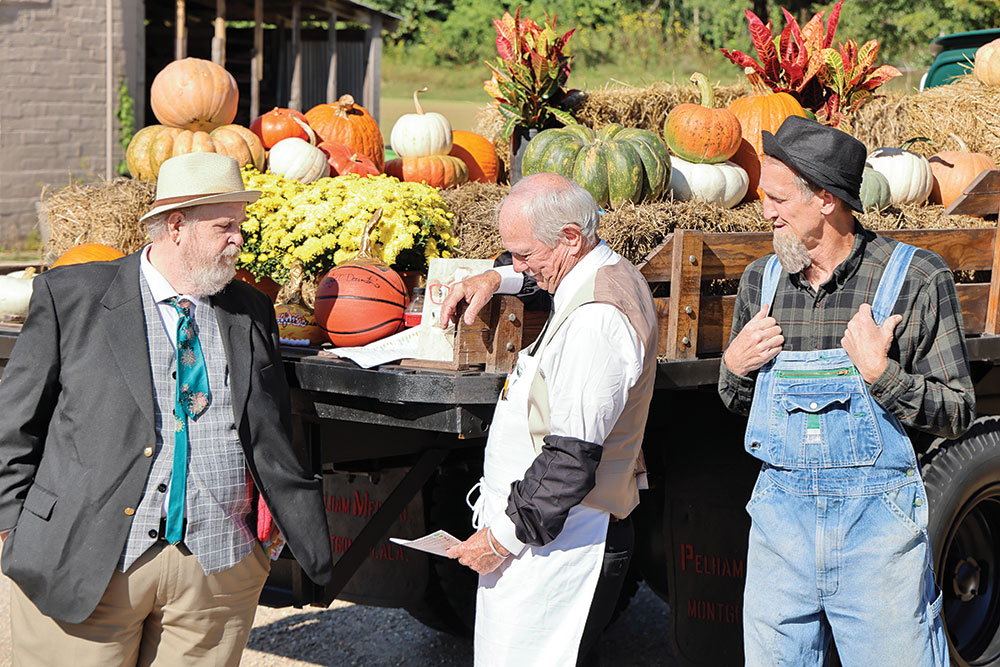
Clay Allison and others take part in the skit

“We were born and raised here,” Carol Waid says. “We love this little town. It’s just a wonderful community.”

The Preservation Society has poured its heart into restoring the Old Rock School. Built in 1902 as a general store, it became a center of learning for generations of Springville children.  The Preservation Society’s efforts to restore the school have earned recognition from the State of Alabama. The building was added to the National Register of Historic Places in 1983.

The Preservation Society started in 1992. Carol’s father, Marcus Pearson, was among its founders.

The school, the preserved church and other projects are far more than bricks and mortar, sweat and maybe a few tears for members of the organization. They speak volumes about the people who call Springville home, whether those folks are newcomers, or part of a long lineage of local families.

“It’s a real hometown feel,” she says. “Neighbors helping neighbors. You always have a friend.”

While it works to preserve the city’s cherished heritage, the society also strives to help Springville strike a balance between growth and preserving the past.

“That’s one of the appeals of Springville is its history,” she adds. “People love the history of the town, and the old buildings are just full of history. We want to preserve that.”

Frank Waid says that while growth is inevitable, they want residents –  old and new – to celebrate and preserve the past.

“You can’t stop growth,” he says. “But we want people coming into the town to know about the town and its history. That’s why we have things like the home tour. We have tour guides who tell the stories of the old homes.

“As people come into town, we want them to know about the town so that they feel like they’re a part of it, and they’re not just moving in. They feel right at home.”

Not only is the society restoring buildings, but it’s building relationships. Ice Cream Sundays at the Rock School are popular events where friendships form.

Organizers Carol Waid, Brad Waid and Kathy Burttram

It’s easy to think that only older people are in love with the older buildings in town. But when Frank Waid strolls downtown to grab a cup of coffee at Nichols Nook, he sees a different, diverse demographic.

“It’s full of people and it’s full of people of all ages,” Waid says. “There are a lot of young people and families – mothers pushing strollers coming in, and you just feel at home right off the bat.”

And younger people are embracing the Springville Preservation Society’s efforts. In October, local fourth graders from Springville Elementary flocked to the museum – some with their parents in tow – to explore and find joy in small things, like pecking on an antique manual typewriter.

By the way, the school was designated a “School of Excellence” by the state of Alabama in the state’s bicentennial year.

Students from Springville Elementary restored a first-grade classroom at the Rock School, where teacher Nina Crandall taught for generations.

Board member Tami Spires, a counselor at Springville Elementary and a member of the society board, spearheaded the school’s efforts, not only at the Rock School, but in other winning efforts, like the Blue-Ribbon designation.

The society is also converting the manse at the old Presbyterian Church into a city archive, known as the Springville Heritage Center, where genealogy and family histories can be researched. The society also hopes to create a digital oral history archive.

As committed as it is to history, the Springville Preservation Society also makes new memories for this and future generations. Remember Arnold, Jr., the star of Green Acres Day?

“We had a huge crowd, and it was a lot of fun,” Frank Waid says. “People are going to say, ‘I saw Arnold run wild.’”

Fittingly, Spires looked back to the construction of the Rock School when early 20th century residents hauled wagonloads of rock to the top of the city’s highest point to build a beacon of learning for future generations. Their ethic survives in Springville to this day.

“They spent a lot of their own money so that the town could have something that they were proud of,” Spires says. “We need to keep that to teach people that this is the way we do things. Friends help friends.

“That’s what a community does,” she adds. “We come together for a common good and do what needs to be done for one another.”

But at the end of the day, the Preservation Society’s driving force hasn’t changed from that of their forbearers, who mined rocks to build a school for future generations. Spires put it simply:

“We just love Springville.”

Editor’s Note: Individual memberships for the Springville Preservation Society are $10 and $15 for families. Contributions can be sent to P.O. Box 92, Springville, AL 35146. The society meets on the fourth Thursday of each month at 6:30 p.m. on the second floor of the Masonic Lodge on Main Street. For more information, write info@springvillepreservation.org.

Those who came before

Searching for treasures in our past

Story by Roxann Edsall
Photos by Richard Rybka
Submitted photos

“It’s like finding a box of buried jewels,” says Tom Mottlau, describing the hunt that has become his happy obsession. He’s spent countless hours over the past three years researching his genealogy. For him, each discovery is a treasured connection to his family tree.

For Mottlau, it all started when he found himself cooped up at home during the 2020 COVID-19 pandemic lockdown. An executive with LG Electronics, Mottlau typically spent most of his time flying internationally, but suddenly found himself grounded at home with loads of time on his hands.

He had always been interested in history, particularly his own family history. With time to work on it, he subscribed to the online ancestry database, ancestry.com, and began populating his family tree with things he already knew about his genealogy.

Further research landed him in St. Clair County. Using information found on billiongraves.com and findagrave.com, he found that he had family buried at Coosa Valley Baptist Church in Cropwell. So, he headed to the cemetery, where he found the graves of two sets of great-great-great-grandparents, John James and Purlina Abbott and Samuel Patton and Margaret McClellan. Along with many others originally laid to rest at Easonville Methodist Church, their caskets were moved to the Cropwell land before the flooding of Easonville when Alabama Power impounded the Coosa River in 1964 to create Logan Martin Lake.

He’s also located many of his ancestors’ graves at Elmwood Cemetery in Birmingham and has made it his mission to replace those grave markers that were broken or missing.

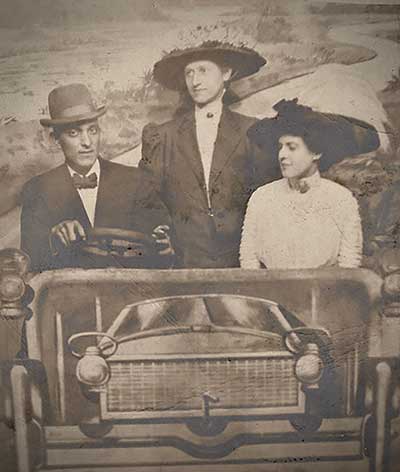
T. Jones Abbott, Idora Abbott and Margaret Abbott

Locating information about ancestors can be a daunting process because America is truly a melting pot of nationalities. Going back several generations, many Americans find that, like Mottlau’s family, their ancestors immigrated from many different countries.

For him, those people came from Denmark, Ireland, Costa Rica, Portugal and Jamaica. He has discovered that some of his distant relatives worked to help build the Panama Canal. Others worked in the steel industry, which is what eventually led them to Birmingham.

Mottlau grew up in Miami, Florida, but now resides in Sugar Hill, Georgia. He has a son in school at Ole Miss, and the drive to visit him takes him over Logan Martin Lake. Each time he crosses over the water, he wonders about his ancestors who called this place their home.

On several such trips, he’s made a slight detour to Ashville, where he spent time at the St. Clair County Archives, digging deeper into information he’s found on ancestry websites. Originally an extension of the library in Ashville, the archives were moved to the current location in the former Ashville Savings Bank in 2007 and offer numerous resources for people researching their ancestry.

Archive director Robert Debter says the first step he always recommends in tracking down information on family histories is to check the heritage book for your county. “Every county has one,” he explains as he grabs a book off the shelf. “All the families that have connections to St. Clair County since it was established in 1818 are included in the St. Clair book.” These books include records on adoptions, wills, estates, as well as probate, civil and circuit court records.

After that, Debter recommends looking online in one of several ancestry databases, websites like ancestry.com, newspapers.com, or, for military records, fold3.com.

History buff and Ashville resident Billy Price has used these databases extensively to find out more about his own family. He spends at least one day a week at the archives and has learned that his family included two Revolutionary War veterans, two dozen Confederate soldiers and two Union solders.

Use of these databases on a personal computer requires a membership fee, but the St. Clair County archives and the Pell City library offer ancestry searches under their memberships for free. Patrons can get on one of the library computers and search their family histories on newspapers.com, which has information from American newspapers from as far back as the 1600s. Another available resource is familysearch.org.

“When I started fine-tuning my own family genealogy,” says Pell City Library Director Danny Stewart, “I started by asking my oldest family members to verify the stories that had been passed down. I would also search obituaries, deed records, titles and tax records.”

Mottlau has done all that. He can’t put a number on how many hours he’s spent on the computer running down leads. “My wife says I should have been a detective,” he says. “I’ve uncovered a lot, but just keep going deeper. I really want to find out enough to create an archive and make copies for all my other cousins.”

Mottlau also wants to find pictures of everyone in his direct line up to his great-great-great-grandparents. Addressing that goal, Stewart recommends regular searches on newspapers.com. As a frequent visitor to that website himself, he has recently discovered a picture of his mother’s great-uncle from 1906 that had just been digitized and uploaded to the website.

Sometimes, though, the actual story behind the picture is not the one passed down from generation to generation. Mottlau tells the story his grandmother told him about a picture of her dad. The story was that he was an attorney and was shot on the courthouse steps in Birmingham. After extensive research, Mottlau learned that his great grandfather was, indeed, shot in 1912, but not on the courthouse steps. He died in a pistol duel across the street from the courthouse, on the steps of the Stag Saloon. That information has been one of the biggest surprises to date on Mottlau’s ancestry quest.

On a recent trip to Pell City, Mottlau again stopped by the familiar grave sites at the Coosa Valley Baptist Church cemetery. He questions whether the burial plot of John James and Purlina Abbott might also include the remains of their son and daughter-in-law, John Henry and Idora Abbott, beneath a marker that simply reads “Abbott.” There are no records that he has been able to find that list the events or location of their burial site. It’s just another mystery that he continues to work to unravel.

After more than three years of searching, Mottlau has made progress, confirming some things he knew about his family and dispelling some as fiction. It’s a painstaking process, but he says finding out more about the family who are part of his past has been a labor of love. “I just really want to know the people they were,” he says.

Every now and then he finds another jewel. Some are rough and take some polishing. In the end, they are all part of his treasured past. And they’ll become part of the legacy that he will, one day, pass down to his own children.

Slasham Valley

Meandering through time

Story by Joe Whitten
Submitted photos

Several lovely valleys run through St. Clair County and bear the name of the streams meandering through them: Coosa Valley, Cahaba Valley, Beaver Valley, and Shoal Creek Valley. 

And then there’s Slasham Valley. Why name any place Slasham? A local fellow recently commented that he hoped it had nothing to do with slashing somebody. And it doesn’t.

The name’s origin rests in folklore passed down from the 19th Century. The story has been recorded in Mildred Wright’s book, Josiah W. Wilson and Lydia Melinda Wilson and Slasham Valley, St. Clair County, Alabama Kinfolk. “Tradition holds that in the early days of the settling of the valley, a house-raising was in progress. An Irishman with a heavy brogue stopped and offered to do work for a meal. After being served once, he said, ‘May I have another slosh o’ ham?’” Folk had fun mimicking his heavy Irish brogue in the retelling, and thus was the valley named.

When in the 19th century this occurred, we have no record. However, the earliest obituary mentioning Slasham Valley is found in Pell City Library’s online copy of By Murder, Accident, and Natural Causes. It reads: “Jun. 27, 1883, Southern Aegis: Died. Odom. On June 23, 1883, in Slasham community, this county, John Odom, about 22 years old.” The name no doubt predates this obituary by a number of years, for the north end of the valley consisted of enough families by 1830 to organize Hopewell Baptist Church.

Alsoin Josiah W. Wilson and Lydia Melinda Wilson and Slasham Valley, St. Clair County, Alabama Kinfolk, Mildred Wright gives the location of Slasham Valley, writing, “Slasham Valley lies east of the town of Ashville, between Canoe Creek Mountain and Beaver Creek Mountain. The primary watercourse is Permeter Creek. ‘Permeter’ is the colloquial name for palmetto (U.S. Government geological survey map, Steele quadrangle). Highway 33 runs the course of the valley.”

Lelias Kirby, born 1895, included the town of Steele in his sweeping description of the valley. His parents L. S. and Nannie Lee Spradley Kirby were married February 7, 1884, and settled in Slasham Valley near the Etowah County line above Hopewell Church on today’s Rainbow Drive. In the introduction to Lelias’ booklet, How Me and Amos Won WWI, Lou Harper states, “Although Slasham does not appear on any map of Alabama, Dr. Kirby claims it does exist somewhere in a circle taking in… Steele and Ashville.” In the book, Lelias writes that the community was “…located between Greasy Cove and Smoke Neck. …It was 10 miles to the nearest little village, Ashville.” Smoke Neck seems too expansive because it was in Etowah County. Today Smoke Neck is Southside, Alabama.

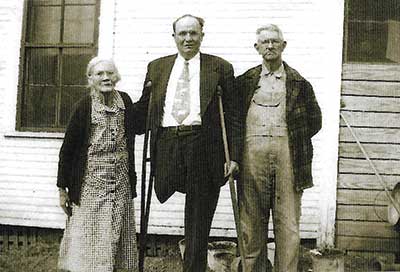
Aunt Cattie (herb doctor),Curtis Franklin, Marshall Jester

Today, Slasham Road begins in Ashville at 10th Street and Greensport Road and runs from there to County Road 33 near Gum Springs Baptist Church. It is a peaceful valley of farms and homes.

Stewart and Nannie Kirby’s family consisted of daughters: Elsie, May, Geneva, and Anna; sons: Joe, Amos, Lelias, Otis and Taylor.

Lelias became a well-known physician in Birmingham and authored 3 booklets: How Me and Amos Won WWI, Corncobs, Cockleburs and Country Boys, and Cotton Picking’ Coon Huntin’ Country Boys. Otis became a Methodist Minister, serving in the North Alabama Conference for many years. He authored It All Started in Slash-Ham. In these books, the Kirbys recorded their growing up in Slasham, St. Clair County Alabama.

In How Me and Amos Won WWI, Lilias told how the family “…walked two miles to Mount Hope Methodist,” and said, “I could see the lizards playing races across the rafters.” He told how their pastor, J. M. Wigley was encouraged as he preached his long sermons “…by a chorus of ‘Amens!’ from the ‘Amen Corner.’”

J. M. Wigley, a college student, lived in Steele and “…walked five miles through the flat woods” once a month to preach at Mount Hope. This was November 1913, and “…the log road was very muddy, but he arrived on time—11:00 A.M.”

Lelias recalled a non-religious family in Slasham that “never attended church.” However, at Bro. Wigley’s encouragement, the whole family attended a service. Two of the younger boys went to sleep on a pallet with other children. The Methodist in the South in those days were called “Shouting Methodist.” This was not “speaking in tongues,” but understandable shouts of praise to God. Therefore, as the service and preaching progressed, the saints of the Lord began rejoicing by shouting “Hallelujah!” “Praise the Lord!” “Glory to God!” As these praises reverberated from wall-to-wall, one of the boys awoke, grabbed his brother and said, “Quick, let’s head to the barn; Ma and Pa are fighting a-gin.”

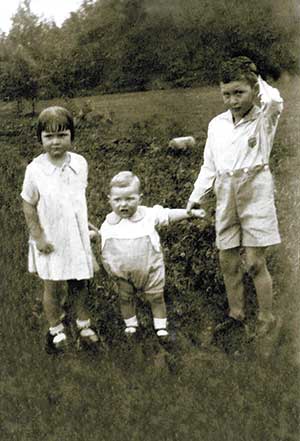
Maragret, J. C., & Hubert Franklin

In his section on church life, Otis Kirby, in It All Started in Slash-Ham, writes “Mt. Hope [Methodist] Church was a large, unpainted frame building. I remember sitting on rough-hewn benches and reading my little Olivet picture card… The church stood on the banks of Big Canoe Creek in the northeastern corner of St. Clair County where Auberry Bridge spanned the creek.”

In her History of Steele, Alabama, Vivian Qualls records that “Bro. Wigley” was J. M. Wigley who pastored the Steele Circuit in 1913 and 1914. And in History of Methodism in Alabama and West Florida by Marion Elias Lazenby, Rev. James Milton Wigley is mentioned six times. The last reference is in 1929 when the Methodist Conference appointed him “Financial Agent” to Athens College.

The Kirby children attended Ford Schoolhouse. As related by Otis in It All Started in Slash-Ham, the school was named after “Uncle John and Aunt Jeff” Ford because they lived close to the school and “the teacher always boarded with them.” Constructed of boards, the school had one unpainted room. The teacher’s desk sat on a raised section that ran the width of the room. Being on the stage gave the teacher “…better oversight of the student body and indicated who was boss.”

“The water bucket,” Otis continued, “was placed on a shelf on the wall outside the front door. Everybody drank from the same dipper. We ‘toted’ water from the wet-weather spring down in Uncle John’s pasture.”

According to both the Kirby brothers’ memories, one end of the Ford Schoolhouse rested on the ground while the other end stood about three feet off the ground and was partially underpinned.  Otis related that “…on rainy days goats and hogs would move out of the flatwoods and shelter themselves under the schoolhouse.” The animal noises sometimes drowned out the human voices. There were cracks and holes in the floor, and Otis recalled one winter when his brother “Amos quite accidentally (?) let a few red-hot coals drop through the holes onto the backs of the hogs.” This caused a pandemonium of grunts and squeals as the hogs fled the shelter and headed to the woods—for a few days.

In the April 1997 issue of Cherish: The Quarterly Journal of the St. Clair Historical Society, Ada Wilson Sulser (b1897-d1988) wrote memories titled “Zion Hill Schoolhouse.” She attended there beginning in 1903 and recalled that the school located next to Zion Hill Church held “…classes from November to April, weather permitting.” She also mentioned classmates: “Homer Waldrop , Clem Lowery, Claudie Wilson , Dora Putman, Houston Cobb, Clara Wilson, Wakely Wilson and Vivian Palmer.”

“The schoolhouse burned twice,” she recalled and added, “It was a standing joke that when a member of a certain family was expelled, the schoolhouse would burn.

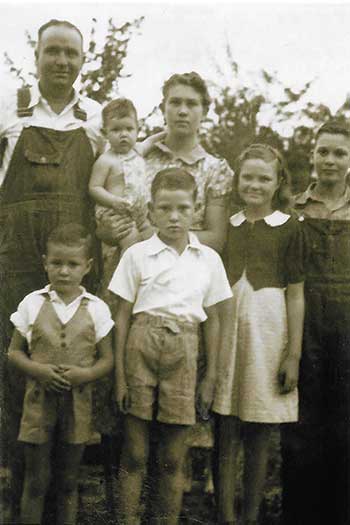
Curtis and Lurla Fail Franklin set up housekeeping in Slasham Valley around 1925. In time the family grew to include five children: Hubert, Margaret, J. C., and Billy. All three boys became Church of God ministers and evangelists. Billy Franklin’s son is Jentezen Franklin, internationally known evangelist and pastor of a mega-church in Gainesville, Georgia. In 2008 his book Fasting was on the New York Times Best Seller list.

Today, 95-year-old Margaret Franklin Berry cherishes memories of living in Slasham Valley and attending Ashville elementary school. Her best friend at school was Betty Jean Hodges. “The family lived right in the middle of Ashville,” she recalled. “In fact, the first time I ever saw an electric refrigerator was at their house. She and I were in school together, and I went home with her for lunch one day. Her mother had frozen some little popsicles for us. I’ll never forget that.”

After the third grade, the family moved to Birmingham. Margaret’s father, John Curtis Franklin, had a job in Avondale. “He was a paint sprayer. And that’s when they used lead in the paint,” she told the interviewer. “Well, daddy got really sick. He had ‘paint poison,’ and ended up having to have his leg amputated. It was a terrible time. He was crippled and walked on crutches the rest of his life after the amputation. So, we moved back and forth from the farm to Birmingham several times.”

It was the Great Depression years, and the Franklin family would live in Birmingham for a while and then back to Slasham for a while during those Depression years.

“When we first moved back from Birmingham to Slasham,” Margaret reminisced, “the farm had been leased out to a sharecropper, and we couldn’t move into that house that daddy owned. So, we rented a house. We had no electricity in the area at that time, and I am positive they had no running water. Everybody had wells. But there was a spring on the place that daddy rented, and that’s where we kept our milk to keep it cold. I guess the milk was ice cold, for the spring water certainly was. Every night for dinner, mother would send me and my brother Hubert down there to get the milk out of the spring.”

Although it was hard times during the depression, Margaret recalled that Pawpa J. G. Baswell, her step-grandfather,  “…had six sons and they all had houses all down Slasham… All you had to do was to let somebody know you needed help and help was there.” She thought a moment, then spoke of God’s goodness. “I can hardly ever think about all those years and what we went through, without knowing that we were so blessed, and that God took care of us. All of us.”

After commenting, “I’ve not thought of some of this in years,” Margaret recounted things she and Hubert enjoyed as children.

“On one of our returns to Slasham, we lived in an old house that had a porch, and when they picked cotton, they made one end of the porch, the cotton spot. I don’t remember how they enclosed it, but they would just pile that cotton up there, on and on and on until the day they took it to the cotton gin. Hubert and I used to play in that cotton. We’d jump around in it just like kids today jump on a trampoline. That was so much fun!”

Then another memory came to mind. “When we needed cornmeal, they would send Hubert and me out to the corn crib to shell corn. I remember gallon buckets of shelled corn, and I’d go with my daddy when he’d take it to the mill to have it ground. It was so fascinating to watch that miller pour the corn into that hopper, and it come out cornmeal.” She couldn’t remember the name of the grist mill her dad used.

A community event Margaret recalled was Box Suppers. In the 1930s and ‘40s, schools and churches would raise money by sponsoring “Box Suppers.” Girls would prepare a picnic lunch to place in a decorated box for this community event where the “box suppers” were auctioned, with the money going to the sponsoring school or church. These events were announced in the papers as seen in the Southern Aegis of January 29, 1920. “Box Supper at Zion Hill Saturday night Jan. 31st. Bring boxes and have a good time.”

Margaret remembered participating as a young girl. “You would just spend days and days decorating a beautiful box with ribbons and all kinds of decorations. And you’d think up something really enticing that you hoped would tempt the guys, you know. And they would bid on the box, and whoever bought it was who you ate with. Of course, you hoped that one of the guys you liked would be the one who bid on it! I must have had a sweetheart who I was wanting to bid on it.”

 Margaret’s family attended Gum Springs Baptist Church in the old building and in the current building. The first sanctuary was across the street from today’s Gum Springs and located near the cemetery on that side of the road. There seems to be no photo of that first building.

An annual special occasion was “Decoration Day” (Memorial Day) each year on Mothers’ Day at Gum Springs. In olden days, the week before Mothers’ Day, community folk would clean the cemetery so graves would look nice for flower decorations on Sunday. On that Sunday, folk recalled old memories, enjoyed good preaching, joyful singing, and “dinner on the ground” after morning service. In truth, this event was a community reunion.

All day singings and singing schools occurred at Gum Springs Baptist and at Zion Hill Methodist. Margaret recalled them, saying, “They had Sacred Harp singing at Gum Springs. And they had special people come who taught us.” They called those events “singing schools.” Sacred Harp singing had no musical instruments, for the voice was the “sacred harp.”

County newspapers announced these singing Sundays, as in this September 28, 1922, issue of the Southern Aegis “Slasham News” column: “There will be a singing next Sunday at Zion Hill. Everyone come and bring your books.” Sacred Harp singers used special books which used fa sol la musical notations.

All Day Singings was another type musical event. They were also announced in the Southern Aegis, as in this October 17, 1917 issue. “All Day Singing at Gum Springs. Joe Baswell will sing at Gum Springs the third Sunday in this month, beginning about nine o’clock a.m. and sing all day. Everybody have [sic] an invitation to go and especially the singers, and still more especially those who will carry DINNER out for we may go, and if we do, it will take a lot of it, you bet.” You can’t have an “All Day Singing” without “Dinner on the Ground.” These were social as well as spiritual events.

Bo Davis, a 5th generation Davis living on the Slasham Valley Davis Farm, recounted interesting information in a recent interview.

The original Davis house burned and Bo’s great granddad, James Davis, rebuilt it. It still stands today on Davis Drive. “My Granddaddy, Robert Ely Davis, was born in 1878,” Bo said, “and the house burnt when he was two weeks old. His sister grabbed him up, pillow, mattress, and all, and carried him to the smokehouse.” Later, when the excitement of the fire came to an end, Jim asked, “Where’s the baby?” “He’s out there in the smokehouse,” they told him. And there they found him, sound asleep.

From the burned home, “They saved some of the sills and used them when they rebuilt the house,” Bo told the interviewer. “In that old house—my granddaddy’s house—the lumber on the walls are boards 25 inches wide. That lumber was sawed in 1878 when they built the house. They had a sawmill, and they sawed the planks and built the house back around the chimney of the old house.”

 Bo was born in this house on December 21, 1943, and the valley was blanketed in ten inches of snow.

After Zion Hill Methodist Church burned, the Methodist Conference decided not to rebuild and all that remained was the cemetery. However, Bo remembered two preachers who came and held revivals on Zion Hill property.

One evangelist held services under a “brush arbor.”  An online article, “The history of Brush Arbors,” gives this description: “Rural folk built a brush arbor by putting poles in the ground for the sides and then poles across these uprights. For the roof covering, they cut bushes and branches and laid them across the roof poles for a covering.”

Bo recalled that a “Rev. A. E. Jones would come from Gadsden and hold a week or two brush arbor revival on Zion Hill. He’d come down to my grandmother and get permission to run power lines down to my grandaddy’s house so they could have lights at night.”

“There was another preacher who ran a tent revival,” Bo recollected. “I think his last name was Bowlen who lived down around Margaret. He had tent revivals there back in the ‘50s.”

Slasham Valley has been a place called home for almost 200 years now. Settled year-by-year by families relocating from other states, it became a sweeping valley of farms and homes, schools and churches, and cemeteries, for with living comes dying. Folk who live, or have lived, in the valley speak of it with affection and love, and for all of those who have called it home, the lyrics of a song as old as Slasham hums in their hearts:

Mid pleasures and palaces, though we may roam,

Be it ever so humble, there’s no place like home.

Home, home sweet home

There’s no place like home.

Dr. William Dempsey Partlow

Ashville doctor leader in state mental health care

Story by Robert Debter
Submitted Photos

artlow would become a leader in mental health care, making an impact across Alabama and be instrumental in service to those with intellectual disabilities with a facility named for him. 

Long before there was an Alabama Department of Mental Health, Partlow Developmental Center was established in 1923 to allow individuals with intellectual disabilities to receive treatment in a state facility. It was located in Tuscaloosa, two miles from Bryce Hospital, and was the only one of its kind in the state until 1970.

Partlow was born on Feb. 4, 1877, in Ashville to David Alonzo and Modena Catherine (Beason) Partlow, who were married in St. Clair County on Sept. 13, 1866.

His grandfather, Dempsey Partlow, came from South Carolina to St. Clair County and was married on Feb. 26, 1839, to Mary Montgomery.

Through his mother, Dr. Partlow is the second great grandson of Edward Beason, a captain in the American Revolution and great grandson of Curtis Grubb Beason, who built the Beason House and the Teague Hotel.

David and Modena started their life together with very little, and they struggled for the first years of their marriage. But love, self-sacrifice and courage led David to open one of the first steam sawmills in northern Alabama.

David and Modena’s love story made a deep impression on their nine children, especially William. He perceived well the limitations of his family’s finances, but this only served to stimulate his determination. Educated with mother’s sound principles and encouraged by her love and devotion, he started making his own way at the age of 16. Deciding early on to pursue a career in medicine, he deprived himself of the usual teenage life and devoted his time to studying.

William graduated from St. Clair College, which became Ashville High School, in 1897. After graduation, he took the position of assistant to the principal at the college and used his earnings to finance his continuing education in the medical field. He studied at the State Normal School at Florence and in 1898, entered the School of Medicine of the University of Alabama at Mobile. On April 3, 1901, William graduated as valedictorian in his class and shortly after, became an intern at Bryce Hospital in Tuscaloosa.

Almost a year later, the young doctor accepted an appointment as a medical officer for the marine quarantine service in Mobile Bay. His chief duties were to visit the ports of Central America, study Yellow Fever and recommend methods of safeguarding Mobile’s port against the disease.

In October 1902, Dr. Partlow rejoined the staff of Bryce Hospital and ever since was associated with Alabama State Hospitals. Upon his return to Bryce, he served as Assistant Physician and devoted his time equally to Male and Female Wards. In 1908, Dr. Partlow was promoted to assistant superintendent of the Alabama State Hospitals and 11 years later was elected superintendent by the board of trustees of the various hospitals.

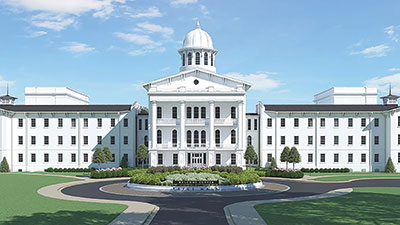
Bryce Hospital

In 1923, Dr. Partlow was honored for “his advocacy of the establishment of such a sorely needed institution, and his persistent efforts, which brought into being” the Partlow State School for Mental Deficients.

Dr. Partlow never ceased in his study of the care of his patients and was highly regarded among American psychiatrists. In 1922, his alma mater, the University of Alabama, bestowed him with the honorary degree of Doctor of Laws.

He was greatly noted in his lifetime for his intelligence and the humane care he showed. During World War I, Partlow was chairman of the Medical Advisory Board and since 1919, was a member of the State Board of Health. In his WWI Draft Card, Dr. Partlow is described as tall with a medium build, brown hair and blue eyes.

On April 26, 1905, he married Margaret Nixon in Jefferson County, Alabama. They would have 48 years and five children together. Mrs. Partlow was noted as being an inspiring and devoted wife and lady.

Throughout the 16-year period of 1919 – 1935, funding for mental health was not appropriated by the Legislature and through effective management of his administration, Dr. Partlow was able to keep the institution on self-sustaining basis. During this time, his effectiveness led the hospital to raising almost $2 million for modernization and expansion.

Partlow also championed a medical college in Birmingham and was often spoken of and seen as the father of the college. 

The doctor passed away at the age of 76 at his home in Tuscaloosa on July 7, 1953, and was interred two days later at Tuscaloosa Memorial Park Cemetery. Margaret was reunited with him three years later on Dec. 14, 1956.

On Oct. 29, 1941, Dr. Partlow was honored in a ceremony at the Bryce Hospital Assembly Hall directed by the Board of Trustees of the Alabama State Hospitals. Dr. George Denny praised Partlow as a great man and credited his qualities of “rare executive ability, iron will, rugged determination, intellectual and moral courage and common sense.”

He also observed Dr. Partlow’s “human sympathy, human modesty, and sense of humor blending with a rich measure of patience.” Dr. Denny closed saying, “… Dr. Partlow has set a standard of public service in Alabama that merits the accolade of universal acclaim and appreciation … For he is indeed one of the select number of Alabama’s ‘tall men, sun-crowned, who live above the clouds, in public duty and private thinking.’”