Rocky Zion Missionary Baptist Church

More than 100 years of worship, community

Story by Joe Whitten
Submitted Photos

A sweeping driveway and parking lot lead one up to Rocky Zion Missionary Baptist Church’s brick sanctuary on 16th Street South in Pell City overlooking The Legacy Center and a community of interconnecting streets.

Before integration of schools, today’s Legacy Center was the location of the St. Clair County Training School, serving Black students locally as well as those from Moody, Margaret, and Ragland.

Today, no one knows how the name “Rocky Zion” was chosen, although one can speculate. In the Old Testament, “Zion” was another name for Jerusalem, the City of God. In the Christian era, Zion referred to the New Jerusalem, Heaven.
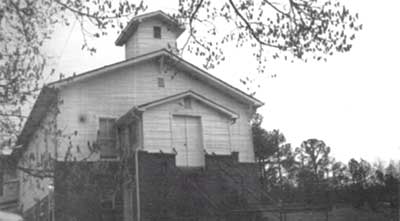
Historic church with rock foundation

The old hymn, Marching to Zion, speaks of “marching upward to Heaven, the beautiful City of God. But how does “Rocky” come in? There does not seem to be a definitive answer but considering that the church was organized by freed slaves during the last year of Reconstruction in Alabama and scarcely 11 years after The Emancipation Proclamation was signed freeing some slaves, it could refer to the difficulties slaves and freed slaves faced in worshiping together. Those were hard years, and the roadway to declared freedom was rocky.

The name of the first pastor is unrecorded, but three of the early pastors were Rev. Dave Forman, Rev. Chester Beavers and Rev. Markus.

From oral history passed down and put into writing, the church was organized in Cook Springs in 1874. At this writing, no record has been located to indicate where in Cook Spring the church met. Older people there remember that both races attended Cook Springs Baptist during the first half of the 20th Century. One of Esta McLaughlin’s sons recalled his mother’s comment when integration came, “We’ve gone to church together all our lives, what’s the problem?”

From Cook Springs, the church moved to the Whitesville-Harrisburg area. Samford University’s Davis Library has copies of the Rushing Springs Baptist Association minutes which list Rocky Zion as located in Eden in 1892, for Eden was the post office location.

The church is listed in the 1893 and 1894 minutes as well. Membership with an association has been inconsistent over the years, according to Deacon Terry Young. Therefore, historical data is rather sporadic. This Whitesville-Harrisburg building burned on an undocumented date. It is believed Rev. Conner pastored the congregation.

A third move

This tragedy resulted in the church being moved to a third location, 16th Street South, Pell City. A Mrs. Pryor and perhaps other Whitesville citizens would walk from their homes across town to the new location. During the construction, the church met for worship at First Baptist South and for Sunday School in the home of Rev. M.C. McCoy.

Written information regarding the church in Harrisburg has not been found. However, tombstones have been discovered near the church site. Some of the names that remain visible on the markers show the surnames, Willingham, Bradford, Shelton, Johnson, Murphy, Ware, Allen, Simmons and Foreman, who were possible ancestors of some members whose names are on the present church roll.

   An old photograph shows this building’s foundation and basement being constructed of local rough fieldstone, perhaps in honor of the name “Rocky.” Traditionally, the stone was collected in a wagon with a loose board in the center. When the loaded wagon came up to the building site, men worked the loose board out and the rock fell to the ground. This type construction was used throughout the South in the early 20th Century.

We can perhaps establish that this third sanctuary was completed prior to 1917 because of a Birmingham News article, dateline “Pell City, Ala., June 2, [1917].” The article reports that the rally that the Pell City Black community held “…at Rocky Zion Baptist Church was a success Friday night. It was called by the Rev. A. J. Davis of the Baptist Church and supported by the Rev. L. J. Shelton, pastor of the Methodist Church. Both made addresses urging patriotic action and pledging the support in the prosecution of the war.” The United States entered World War I on April 4, 1917.

Throughout the years

When the wooden building was finished, Rocky Zion called Rev. Thomas to be the pastor. He served the church for approximately one year. After Rev. Thomas, the church called Rev. A.H. Lee, and under his 16 years of leadership, the membership increased, and the church flourished in the community.

Following Rev. Lee’s 16 years, Rev. Oscar Henry served approximately two years. However, the next pastor, Rev. S. L. Woods, served the church for 20 years. He shepherded his flock faithfully, and they responded to his leadership accordingly. The church’s brief written history states under Rev. Woods’ tenure, “The Church underwent major renovations. The membership greatly increased during this time. Members and friends enjoyed worship services on the first and third Sundays of the month.

Another brief, written history records that “Deacon Charles Crowe, Deacon Emmitt Brand, Deacon Johnnie Coleman, Deacon Roosevelt Shealey, Deacon Amos Avos and Deacon Joe Carter were ordained during Rev. Woods’ 20 years pastoring Rocky Zion Baptist Church.”

Those who remember Rev. Wood speak of him with great affection. “Rev. Woods baptized me, and he was the only pastor that I knew for years,” Peggy F. Threatt recalled. “We had an outside baptizing pool that was in the ground, and you walked down into the pool. It was made of cement blocks and painted blue.

Verhonda Embry, Peggy’s sister, added, “We all grew up under Rev. Woods – everybody 60 and older grew up under his ministry. He was from Ragland and had a big family.”

Floyd Waites was mentored by Rev. Woods who encouraged him in his piano playing. For Floyd, playing “by ear” came naturally. He would hear a tune on the radio, go to the piano and play it. Gradually, he became proficient and accompanied Rocky Zion’s Children’s Choir. “Rev. Woods,” Floyd recollected, “liked for the Junior Choir to go with him when he preached at other churches. And I would go to play for them when they sang. Rev. Wood was an inspiring minister.”

After graduating from the St. Clair County Training School, Waites moved to New York City and became an established pianist in the churches of the city. In one church there, he met gospel singer Marie Knight, who admired his piano style and hired him as her accompanist. Floyd traveled with her to Spain and other European countries, accompanying her in concert.

“However,” Floyd confessed, “my heart was always in Pell City and Rocky Zion.” When he retired from working in the education system of New York, Floyd returned to Pell City, where he and his wife had built a home for retirement. Floyd is still known for his beautiful singing voice as well as his artistry on the piano. Today, he ministers at Coosa Valley Baptist Church in Vincent and has no interest in retiring from music.

Church, school, community

 During the years prior to integration, Rocky Zion had close connections with the St. Clair Training School, for church and school were community in those days. “The church stands as a beacon of light in the community,” Peggy said. “Due to overcrowding at the St. Clair County Training School, the church provided space for some classrooms during the late 1950s and the mid-1960s.”

“The St. Clair County Training School held the third grade class in the basement of our church,” Deacon Terry Young recalled. “I went to school here. My teacher was Miss Ida Wantana Baker. I never will forget her name!”

A school P.T.A. meeting was not just a school event, it was a community event with spiritual emphasis, as reported in The St. Clair News-Aegis of April 29, 1954. “The P.T.A. observed its 27th Anniversary Sunday, April 25, 1954, at the Rocky Zion Baptist Church. Rev. A. Clark, pastor of St. Peter’s Primitive Baptist Church, Bessemer, Alabama, delivered the message. A huge crowd attended. The P.T.A. and Principal are proud and grateful for the wonderful aid and co-operation the patrons have given the P.T.A.”
Mrs. Lillie B. Curry, pianist, was remembered in Rocky Zion’s 1988 Memory Booklet for their 114th anniversary: “From the early 1930s until the late 1950s, she studied and worked untiringly with the chorus (choir). When she needed assistance, she would have Prof. Banks, her instructor, come and work with the choir at her expense.”

The music program at the Training School contributed to Rocky Zion’s choir ministry. Professor Walter Kennedy is remembered as having trained a host of singers during his tenure as principal of the school. Sisters Peggy and Verhonda both recalled the fine choir of the Training School and Professor’s influence on students – especially students from the Waites family and the Moseley family. “Choir Day was a big event at Rocky Zion,” Embry added. “We had a youth choir, a male chorus, and then we had the combined choir.”

Rev. Woods enjoyed leading the singing during each summer’s Vacation Bible School week. Each church would have it a different week so that children and youth could attend all if they wished. Peggy and Verhonda especially remember his leading them in We are climbing Jacob’s ladder, and how he would gesture climbing higher and higher. “He had a very pleasant voice. Rev. Wood and his family had a special place in our hearts.” 

Mrs. Mary Frances Embry, Mrs. Ora Mae Allen, Mrs. Rose Crowe and Mr. Charles Crowe were Sunday school teachers. Mr. Dave Allen was superintendent. Mrs. Crowe and Mrs. Embry instructed the Baptist Training Union. Mrs. Embry was director of the Youth Department for many years.

Peggy and Verhonda almost spoke in unison as they recalled that at her home, Mrs. Embry would have the youth over for homemade ice cream and hot dogs. “She lived right next door to the church,” said Verhonda.

Aiming for perfect attendance

As to Sunday school and church attendance, the sisters had no choice. They got up each Sunday morning, dressed in their church dresses and attended. Both sisters enjoy recalling those mornings. “We lived about three blocks from the church,” Peggy reminisced. “We had our little path up to Rocky Zion for Sunday school and church service. We had a lot of young people back then. We don’t have very many now.”

Verhonda, who was the baby of the family, added, “We knew that we had to get up and go to church and Sunday school. I tell people that on Sunday evening, we had Baptist Training Union, and I preferred being down at the park with my friends. And my Mama would ride to the park with one of our neighbors, because Mama didn’t drive, and I had to leave my friends and come to the church on Sunday evenings for BTU. It was just a part of life. We had to do it. We had no choice. But now, they let the kids make the choice.”

Deacon Young lamented the absence of youth in church today. “You know, the difference between now and then? Our parents didn’t ask us, ‘Are you going to church today?’ You knew the day was Sunday, and you knew to get up and start getting ready to go to church. My daddy got killed on his job when I was 7. My mama raised nine of us, and I was the baby of the nine, but she made sure that I had a way to Sunday school and church and BTU. She saw that I attended just about every function that went on in church. But things really changed over the years. Today, the youth are down at the park on Sunday.”

Revival Time

Summers brought revivals to Baptist churches throughout the South from the late 19th Century until about the 1970s. During revival week at Rocky Zion, there would be both morning and evening services. Recalling those days, Verhonda commented, “During the revivals, each day someone fed the pastors, and they came to your house and had dinner before revival. And so, Mother and others fed the pastors during revival.”

Peggy joined in, “You know, back in the day, I’ve often heard that when the pastors would go around to have a meal, the children couldn’t eat until the pastors ate.” She chuckled before adding, “Not at our house. Mother, Lizzie Forman, always made sure we ate first.”

Sunday preaching at Rocky Zion for many, many years was first and third Sundays of the month, for a pastor usually ministered to two congregations. On the second and fourth Sundays, Rocky Zion members would attend services at First Baptist South. The church moved to meet for worship every Sunday during the pastorate of Rev. Johnnie Whetstone, who came as pastor after Rev. Woods. For some it was difficult to adjust to that, for the fellowship between First Baptist South and Rocky Zion had existed for so long that, understandably, it left a void in some members’ lives.

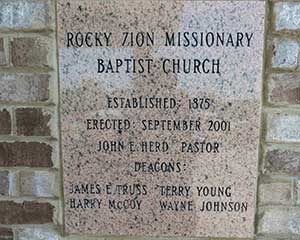
When Rev. James Adams was called as pastor, he ordained as deacons, Terry Young, Harry McCoy and James Truss Sr.

During a powerful storm on March 11, 1973, lightning struck the wooden sanctuary and severely damaged it. The church members worked together to repair the building and make it usable again. During the repairs, the congregation met for worship services at the Jacob Chapel C.M.E. church on Sunday afternoons.

In June 1996, the church called Rev. John E. Herd as pastor. Under his leadership, the church flourished. Choir membership increased, and worship services were enhanced by a praise team. The pastor reactivated Wednesday night prayer meeting and Bible study, organized New Year’s Eve Watch Night services, established Easter Sunrise services, and instituted programs for Black History Month so members could learn of their history. Rev. Herd ordained Deacon Ken Sheelton.

A new sanctuary

From the 2001 Church Dedication Booklet, we learn that Rev. Herd “…had a vision from the Lord,” and he “approached the congregation with the idea of building not just a fellowship hall but a church with a fellowship hall. The body agreed,” and a brick sanctuary was constructed.

In an article announcing the new sanctuary, The St. Clair Times of Sept. 13, 2001, Gary Hanner reported that to bring the wooden structure up to code would have cost more than to build a new church. He quoted Deacon Wayne Johnson, who said of the new sanctuary, “It is something that will stimulate their (the members’) spiritual growth and is something they can be proud of for years to come. … Having the new facility will be an asset to the community.”

The dedication of the new sanctuary occurred on Sept. 23, 2001, and was a gala occasion. The congregation met outside the church for responsive readings. Then the contractor presented the keys of the new building to Deacon Young, who presented them to Deacon Truss. Rev. Herd and Deacon Young cut the ribbon, and Deacon Johnson opened the doors to the sanctuary. Someone rang the old church bell, and the congregation entered the church to the processional hymn, “Alleluia.” Rev. Herd prayed the consecration prayer, and the afternoon was filled with a joyful worship/dedicatory service in the new building.

After Rev. Herd, Rev. Woodrow Johnson came as pastor, and the church continued to flourish. Rev. William O. Robinson was called as pastor after Rev. Johnson. Rev. Robinson ordained Deacon Willie J. Forman. Deacon Stanley Nobles moved back home to Pell City and rejoined Rocky Zion.

The COVID-19 pandemic, which required churches to have online services, had a lasting effect after it subsided. Rocky Zion’s Sunday attendance is low, for many still watch online, and the choir is now a praise team. “It’s only four members,” observed Young, “but they sound like a choir.”

Another milestone

In 2024, the church will observe its 150th anniversary, and with COVID causing the interruptions it did in community and church, memories have focused more on the past than on recent memories. However, throughout church history, the pendulum has swung toward “good years and lean years” of attendance, and church members hope for increased attendance in days to come.

Rev. William O. Robinson, pastor, shepherds his flock in the present and looks to the future. “I am now in my 10th year serving as pastor of Rocky Zion MBC,” he noted, “and I can honestly say it has been challenging – mainly because it’s my first pastorate. Yet through all of the tests and trials, I can truly say that I have enjoyed and continue to enjoy preaching, teaching, singing and serving in any other capacity the Lord has required and equipped me to do.”

For uncertain times in which we live, this positive attitude is a must for any pastor. Rev. Robinson observes, “I have seen spiritual growth but also recognize there’s much growth needed. I have learned as much because from my members, as I hope they have learned because of me. Being afforded the opportunity to grow together according to the guidance of the Holy Spirit is what I believe makes us more than a group of people that go to a church building. For we are truly “a family for Christ” that is dedicated to displaying the pure love, faith and obedience He has called us to do as the body of Christ.”

Rev. Robinson ascribes to the challenge of Matthew 28:19-20 to, “Go therefore and make disciples of all nations, baptizing them in the name of the Father and of the Son and of the Holy Spirit, teaching them to observe all things that I have commanded you; and lo, I am with you always, even to the end of the age. Amen.”

“Our mission is to be a Christ-centered family environment that effectively brings others into the household of faith through corporate worship and also evangelism and outreach.”

Empowerment for future

As pastor of the church, he sees his duty in preaching and teaching as building solid believers who are equipped for ministry in both church and community. From his heart, he comments, “We believe in the spiritual development and growth of the body of Christ through love, humility, unity and prayer which comes through salvation through Christ and an ever-growing relationship with Christ. I call it ‘Empowering People for Kingdom Building.’”
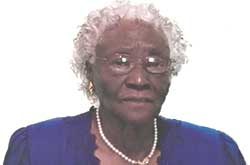
Ms. Posey, oldest member of Rocky Zion

The COVID-19 pandemic brought great changes to churches because of “sheltering in place” and not meeting together for worship along with absence of choirs and congregational singing. Rev. Robinson reflected, “Even though we have been challenged to serve and minister within our community and church in a variety of ways due to the COVID-19 pandemic, we are yet excited about the movement of God at Rocky Zion MBC.” And he asks that community and church pray “… that the Lord will look upon any and all threats designed to hinder Rocky Zion’s laboring for the kingdom of God. That He will continue to grant us all boldness to speak His Word, stretching out His hand to heal, and that signs and wonders may be done though the name of Jesus Christ.”

Rocky Zion Missionary Baptist Church has served God and community for 149 years and sits on the hill above school and community as a lighthouse of hope. Peggy F. Threatt observed that “Rocky Zion Baptist Church is definitely a foundation of faith,” and that faith gives the church’s members comfort and peace. 

And as the old Isaac Watts’ hymn proclaims, may Rocky Zion MBC continue progressing and singing for another hundred years.

“We’re marching to Zion,

Beautiful, beautiful Zion,

We’re marching upward to Zion,

the beautiful City of God.”

Mrs. Rosey Posey, Rocky Zion’s most senior member at age 97, would give a witness to that with a resounding, “Amen!”

Ashville centennial

As city celebrates 200 years, a look back a century ago

Story by Robert Debter
Submitted Photos

On the heels of observing the bicentennial of Ashville, memories and remembrances of the centennial celebration, April 26, 1923, emerge.

The event was conceived as a tribute to the soldiers of St. Clair County, both living and deceased, who had fought in the War Between the States, also known as the American Civil War. The event was spearheaded by Ashville Chapter 1488 of the United Daughters of the Confederacy, and great care was given over to the preparation of the event, which would culminate in the unveiling of a marvelous marble statue, procured from the McNeel Company in Georgia at the cost of almost $2,500.

In the Feb. 23 edition of the Southern Aegis, owner B.B. Cather, vowed “… to do all it can to help the U.D.C. women pay for their monument and at once wishes to state that any subscriber who loves this paper and wants to help these women can settle with them court week. One half of every dollar paid to them on subscription, new or old for the Southern Aegis, in the next 30 days will be given to this organization or the Monument fund.”

The March 29th edition printed the following notice:

Unveiling Confederate Monument

to St. Clair County Heroes

celebrating Ashville Centennial, April 26th

Public Cordially Invited

On the historic spot in Ashville where 62 years ago, the flower of St. Clair’s young manhood, marched forth to defend their homes and the sacred causes of the Confederacy, the Daughters of the Confederacy have erected a memorial to their loyalty, courage, and devotion.

They have selected April 26th, (Memorial Day), for the day of unveiling.

Ashville St. Clair Courthouse

Few towns can boast of 100 years of existence, such is Ashville’s Birthday. The Daughters have been asked by prominent and former citizens of Ashville to include a centennial program in the day’s celebration, which they are glad to help plan.

A parade headed by a Brass Band, composed of school children, Daughters, Veterans, and floats representing each business in town will take place in the morning, following this will be a Centennial program at which time, Hon. James A. Embry, a lifelong Ashvillian will preside.

The principal address will be delivered by Hon. O.R. Hood of Gadsden, a former son of Ashville.

The unveiling program will be held in the afternoon, at which time, Mrs. W.A. Beason, President of the Ashville Chapter U.D.C. and General Chairman of the day’s festivities will preside.

Principal address of the unveiling will be delivered by Mrs. E.L. Huey of Bessemer, State President U.D.C., gifted and beloved Alabamian.

The big event

Alongside the unveiling and celebrations, a grand homecoming was planned. Chairman Lillie (Phillips) Beason, wife of Dr W.A. Beason, and her publicity committee set to work and issued more than 500 invitations to reach veterans and their families, originally from Ashville, who had since relocated to other parts of Alabama and the country.

John Washington Inzer

On March 5, the Aegis reported, “The Monument Committee who has charge of the day’s program are to be congratulated upon securing Col. Oliver R. Hood of Gadsden, a former son of Ashville, of whom we are justly proud to deliver the Centennial address. Hon. James A. Embry, one of Ashville’s most brilliant and prominent attorneys, whose life has been spent in this peaceful city, has accepted the committee’s invitation to preside.”

As the day approached everyone was encouraged to “… greet every visitor with a smile and a welcome – leave that frown off your face for Ten days and be what God intended you to be, a booster for the Home Comers.”

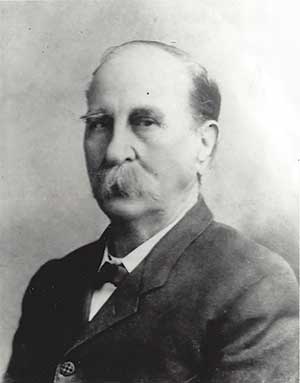
Undoubtedly on that April morning the old veterans, such as Judge John W. Inzer of Ashville and John Washington Laster Jr., of Springville, recalled their days of service and those whom they marched and fought alongside, saw torn by war and perish from cannon, rifle and saber, and those they suffered with in prisoner of war camps in Illinois and Ohio.

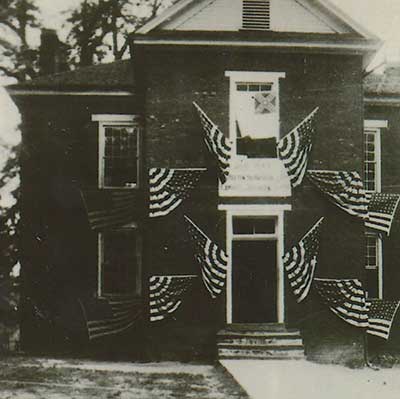
To a crowd of over 2,000, the monument was unveiled by Misses Mattie Lou Teague and Sally V. Inzer. It was reported that the proceedings “… will be long remembered by every person who attended. Ashville was beautifully bedecked with flags and bunting.”

As for the veterans, they “… were treated royally and they seem to have appreciated to the fullest extent all that was done in honor of their dead comrades.”

Remembering the words of General Douglas MacArthur in his farewell address to the cadets as West Point in 1962, “… [T]he soldier above all other people prays for peace, for he must suffer and bear the deepest wounds and scars of war.”

Finding adventure on the track

The pioneers who paved the way for Alabama stock car racing

Story by John Garrison Jr.
Submitted Photos

World War II had just ended, and America emerged victorious. The economic engine turned from war production to consumer production. People who, during wartime rationing of everything from rubber, gasoline, meat and butter, suddenly had plentiful supplies of everything.

American auto manufacturing had quit producing cars from 1943 to 1945 to support the war effort. American ingenuity, however, came alive after 1945. People felt good about America, and new inventions abounded and by that same year, Americans were saving on average 21percent of their earnings.

In a good economy, hard-working people like to enjoy some of the fruits of their labor with social activities, and many turned to sports events.

Couple all that with a re-emerged automobile industry, and the everyday American, blue-collar guy looked for ways to continue the good feeling that competition and another chance to win brought about.

Enter the thrilling stock car racing industry where an old family jalopy dragged from the barnyard would get a new lease on life as a racecar.

Imagine a group of guys coming together as a ragtag team to build a racecar. One might have mechanic’s skills, another as a body and fender/painter/welder type and yet another ex-soldier with courage enough to drive at breakneck speeds.

This is how a whole new enthusiasm for motorsports began in Alabama and across the nation. Despite automobile racing existing prior to this period, it was reserved primarily to a small population and cars built specifically for racing and not your typical old family coupe or sedan, thus the term “stock car.”

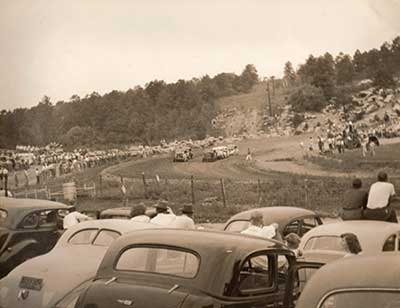
Around Birmingham, circa 1948, there was a track carved out of an old field near Roebuck called the lronbowl Speedway. The track was a dirt oval and on Sunday afternoons, crowds would gather to see the daredevil field of drivers and their home-built machines compete to be the first to the checkered flag. The hill above the track would be filled with wives, kids and neighbors with picnic baskets sitting on the hoods of their family cars taking in the spectacle. Everybody came home covered in dust.

As the early days of stock car racing in Alabama was forming, the fairgrounds at Birmingham had a 1-mile oval horse racing track built in 1906 that sometimes held an occasional motorcycle race or a car race of specially built open-wheel racecars.

During the same period as the old lronbowl Speedway, Birmingham Fairgrounds began running stock car races, as well. Then in 1958, NASCAR (National Association of Stock Car Auto Racing) brought sanctioned racing to Birmingham and other tracks in Alabama.

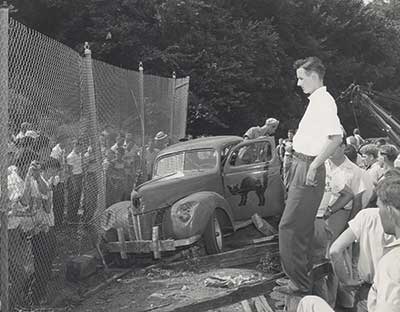
Checking out a wreck that was stopped by the fence

Stock car racing was being born from the crude beginnings of low-budget, home­built cars to a commercial industry that brought higher levels of engineering talent and corporate sponsor dollars emerging into the highly refined sport of stock car racing today. Racing was financially out of reach for the regular guy. The old days and ways were changing quickly.

There is still a group of traditionalists that have a love and devotion to the old days where it all began. Beginning days that produced such greats as Bobby and Donnie Allison, Red Farmer, still making racing appearances at 90 years old, and Neil Bonnet, who died racing stock cars in 1994 at 47 years old.

Although those became household names in the sport because of the entry into corporate racing, there were great racers that will forever have places in the hearts of the “purists” of the sport. People like Nero Stepto, Sonny Black, Fletcher Ford, Alton Jones, Fred Thompson, “Paddlefoot” Wales and those who went by aliases – drivers who changed their names so their employer wouldn’t fire them for engaging in such a dangerous sport.

There is an organization dedicated to the preservation of racing history in Alabama named the Alabama Auto Racing Pioneers (aarpinc.org) where hundreds of old photographs and stories abound on the history of racing here.

At the Talladega Motor Sports Hall of Fame, the Alabama Racing Pioneers room features photos and memorabilia from that bygone era.

Membership in the organization is only $35 a year to join. Current membership is 320 across the state and there are gatherings and banquets for those interested in preserving the history. l

Ashville, Alabama

A time to celebrate 200 years of history

Story by Robert Debter
Photos by Becky Staples
Submitted Photos

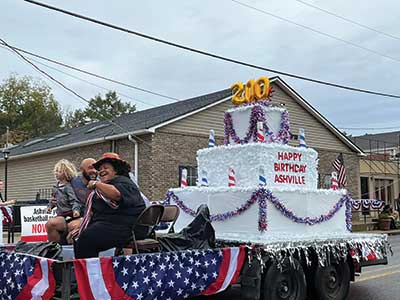
Hometown parade a big draw for event

It is 1822 in Alabama: statehood is still a recent memory – achieved in 1819 following two years under a territorial government after separating from the State of Mississippi. There are 32 counties, the state capital is located in Cahaba, near Selma, Israel Pickens is the newly elected governor, and the population is over 125,000.

These were the days when great men and leaders, such as Thomas Jefferson, still walked and wrote, and those who would become great leaders and better men, like John C. Calhoun, learned from them.

In St. Clair County, established in 1818, many of the distinguished and proud names, their descendants still living here, have created new lives and started families in this virgin land, hewn from the wilderness by the hands of heroes.

The Alabama Fever Land Rush and the War of 1812 had brought them here. From Georgia, North Carolina, South Carolina, Tennessee and Virginia they came: Ash, Battles, Beason, Chandler, Cobb, Cox, Cunningham, Green, Hodges, Jones, Looney, Newton, Phillips, Thomason, Yarbrough and more.

These families and others settled in and around the center of the young county, which was known then as “St. Clairsville.”

On Nov. 28, 1822, this thriving town was incorporated, and on Dec. 12, it was made the county seat. Shortly after these events, the name was changed to “Ashville” in honor of John Ash, a pioneer, early settler, and leader who became St. Clair County’s first elected judge and would later serve in the state legislature.

Celebrating 200 years

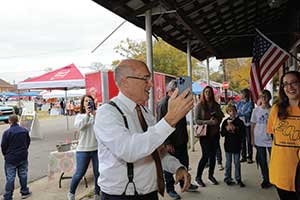
These stories of struggle and sacrifice, journeys and new life, muskets and covered wagons, and the triumphs of resting one’s boots and putting down roots in a fresh, new God-given land, were celebrated by citizens of Ashville, descendants and friends from near and far on Saturday, Nov. 5, 2022, in an impressive bicentennial event.

Great care in preparation was evident. Ashville Mayor Derrick Mostella took charge and established a bicentennial committee, co-chaired by Ashville City Councilwoman and Mayor Pro Tempore Sue Price and Becky Staples.

Working with Ashville City Clerk Chrystal St. John, they made sure the day of celebration would be nothing short of the honor deserved by those who paved this path 200 years ago. Joining them were members of the Bicentennial Committee: Robin Bowlin, Rena Brown, Jeanna Gossett, Susan Kell, Billy Price, Janice Price, Nancy Sansing, Ricky Saruse, Chad and Esther Smith, Rick and Liz Sorrell, Dr. Jay Stewart, Renna Turner, Denise Williams and Nick Wilson.

Other events became part of the celebration. In the weeks leading up to the day, a 5-K run was held, and Ashville High School seniors Joe Stevens and Rachel St. John earned the titles of “Mr. and Miss Ashville Bicentennial,” awarded to them by the Bicentennial Committee for winning the high school essay contest.  

The events of the city’s celebration began at ten o’clock on the steps of the oldest working courthouse in the state of Alabama. Mostella welcomed the crowd by thanking everyone for coming out to the “greatest city in the greatest county in the greatest state.” William “Bill” Watkins, a naval veteran who served during the Korean War and is commander of St. Clair SCV Camp 308, who led the Pledge of Allegiance.

Newly elected St. Clair County Commission Chairman Stan Batemon offered prayer, followed by commencement speech by director of the Ashville Museum & Archives, who began by asking all veterans from all branches of the U.S. Military to be recognized.

Guest of honor and grand marshal James Spann

A concise history of the founding and naming of Ashville followed with a recognition of several other historic and noteworthy family names: Ashcraft, Bothwell, Box, Byers, Cason, Crow, Hood, Inzer, Montgomery, Nunnally, Partlow, Robinson, Sheffield, Teague and dozens more.

“Ashville is the type of town that Americans treasure,” he quoted from author, historian and leader Mattie Lou (Teague) Crow. “Our old homes are beautifully kept. The courthouse, built in 1844 to replace the original log building, serves well the people of St. Clair County. The natural beauty of the location of our churches and other old buildings that here for a century give the town the looks of a safe place to live, a place where people share in meaningful work and play.”

Others joined the celebration with performances by saxophonist Kevin Moore playing the Star Spangled Banner, and Chris Cash singing America the Beautiful.

Bunting adorned buildings and streets throughout the city. Patrons toured its three museums: the Ashville Museum & Archives, the John W. Inzer Museum and the Historic Ashville Masonic Lodge and Mattie Lou Teague (Crow) Museum. Reenactors gathered between the Inzer Museum and the Historic Masonic Lodge, joined by a historic fife and drum band from Rome, Georgia.

The county seat’s historic courthouse square was alive with activity, from hand forged knives display to face painting for the children to special offerings by the St. Clair Historical Society, Springville VFW Post 3229, Ashville Masonic Lodge 186, Ashville High School and Pine Forest Baptist Church.

Carriage rides and a petting zoo highlighted the day’s events as did live music performed by the Martini Shakers, and Berritt Hayne, a native of St. Clair County who contended as a finalist on The Voice.

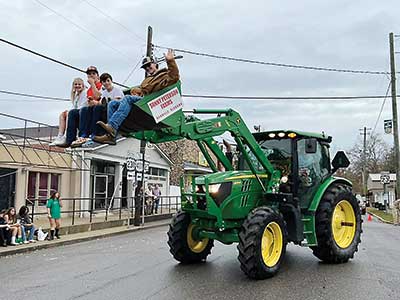
Guest of honor and grand marshal for a grand parade had historic ties himself. James Spann, the noted broadcast meteorologist, is a grandson of former St. Clair County political leader and businessman, Judge Curtis Adkins. His uncle, Joe Adkins, followed his father into the banking world and also served as mayor of Ashville.

In the beginning

Fats and the flag man: Two pioneers with St. Clair ties helped plant the seeds for modern stock car racing

Story by Paul South
Submitted Photos

Before Bill France Sr. saw his dream of big-time, big money stock car racing take root in little towns like Daytona Beach, Darlington and Talladega and big cities like Atlanta and Charlotte, seeds were being planted.

Two men – Perry Edgar “Fats” Layfield and Johnny Garrison Sr., both hard working, blue-collar husbands and fathers who made a living with their hands, were two of those planters.

Layfield, the patriarch of a racing clan that drove dirt and asphalt tracks for three generations, and Garrison, who became a respected official as a flagman, didn’t know it then. But they, like the more famous Allisons, Pettys, Earnhardts and Waltrips, helped build the glitz and glamor of modern stock car racing.

“Fats” Layfield’s son, James, himself a short track driver, said it best. “All the little tracks are what made NASCAR.”

A brief history

 In the beginning, bootleggers and their sons ran booze through the mountains, hills and hollows of Appalachia, from West Virginia to Alabama. Trying to outrun Prohibition and feed their families, the daring drivers tried to satisfy thirsty customers.

 Then, after World War II, a booming American middle class – freed from the shackles of gas and tire rationing – pulled their old jalopies from barns and sheds and off blocks and souped them up.

The flag man

The vets who returned home from war were hungry for excitement. Automakers transitioned from a war footing to a consumer culture. America became a car culture that spilled over into movies like Rebel Without A Cause and songs that went like this:

“Son, you’re gonna drive me to drinkin’

if you don’t stop driving that hot rod Lincoln.”

To satisfy the public’s need for speed, dirt and asphalt tracks sprung up – Iron Bowl between Roebuck and Tarrant City, east of Birmingham, Birmingham International Raceway at the State Fairgrounds, Sayre Speedway and Dixie Speedway in Midfield.

At Sayre, James Layfield remembered, “Go up there and fight and hope a car race would break out.”

In black and white photos, the multitudes surrounded the tracks despite the blistering sun. There were farmers in overalls and straw hats, men in heat-wilted white shirts and sweaty felt fedoras, wives and children and seemingly enough picnic baskets to feed the 5,000.

Layfield and Garrison were there in the center of it.

James Layfield never saw his Dad race. He was a big man who looked like “Hoss” Cartwright from the TV series, Bonanza. After his son came into the world, “Fats” raffled off his race car, the Number 13 “Black Cat” Ford. When he tried to give the proceeds to a local church for a new floor, he was turned away.

“They said it was like gambling. He gave it to the preacher and told him to buy himself a new suit,” James recalled.

Tears come quickly when he talks about his Dad. He still remembers that once he took up the sport, his Dad never missed a race, even after work-related back injuries confined “Fats” to a wheelchair.

“He worked hard all his life, and age just caught up with him,” the younger Layfield remembered.

The elder Layfield could tell if an engine was right just by the sound. “I’d be out there working, and he’d yell from the house, ‘You better go back to where you was at. It sounded better before.’ He was my pit crew and my crew chief.”

“Fats” was a big man with a big heart, his son recalled. He checked on his neighbors, giving rides when needed.

“If there was somebody broke down on the side of the road, he’d stop to help them,” James said. “He’d either help ‘em fix it or tell them how to fix it. Or, if they could get it pulled to the house, he’d have the car waiting on me, so I could fix it for the folks.”

 His voice quivered as he talked about his Dad. “He could be kind, and he could be rough,” James said. “He was at the race track every time I went. He was crippled up, but every time I’d go to the track, he was there. He’d say, ‘Boy, you need to quit this. But he was always there.

“After he passed away, and my son started racing, I’d look up to see (Dad’s) truck, and it wasn’t there. It just wasn’t the same.”

Fats and daughter, Mary, in 1956

Racing was in the family’s blood. Before Fats’ grandson, Eric, was old enough for a driver’s license, he started working on his Dad’s race car. Soon, Eric Layfield was behind the wheel. Eric and James Layfield worked on each other’s cars.

“He was 15 on a Saturday night and turned 16 on a Sunday and ran his first race,” James said of his son. Needless to say, the Layfields were nervous.

“He had a little trouble getting his mother (Peggy) to sign the release form for him. But he had a level head on him and knew what he was doing. I think he finished third in his first race. The next year, he won the (season) championship.”

Peggy Layfield was a racing veteran of a sort. For years, as many as four race cars were worked on in the family shop at one time.

“We’d have the engines going, and the windows and dishes would rattle,” James said. “Peggy put up with that for 45 years, and we’ve been married 52.”

And when she was 15 or 16, James Layfield recalls, even his daughter Keri got into the driver’s seat – sort of.

At the Talladega short track, she joined her Dad in a specially created, two-driver cruiser class. James steered and handled the brakes and Keri, the gas pedal.

“We were three or four laps in, and she got the stiff leg and had the gas on the floor,” James says. “We spun out between turns one and two and blew the engine. I was done.”

As for what drew him to racing, James, who also built his own engines, wanted to show the other drivers what he could do. He raced dirt and asphalt. And he had a favorite: “Asphalt is for getting there; dirt is for racing.”

 He always remembered his Dad’s advice. “I’d get out in front, and he’d tell me to slow down,” James recalled. “He wanted me to let them pass, then me pass ‘em back to put on a show. But I worked hard to get in front, and I wanted to stay in front.”

James had stretches when he was out in front often. “You get out in front, and you win every weekend there for six or eight weekends, it makes you feel good to know that you’re the one they hate the most or get cussed the most. But you just keep on going.”

The flagman

John Garrison Sr. kept racers going – safely – through hundreds of races. A veteran of World War II who served on Okinawa as part of the Army Air Corps, Garrison flagged his first race after volunteering on a dare at a California short track after the war. He had flagged informal drag races on Okinawa after the allies took the island from the Japanese.

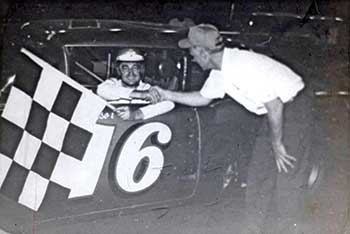
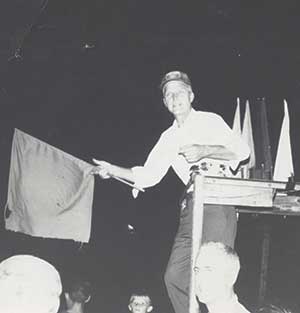
He was a master of the flags – every color was racing’s code. But Garrison brought a color all his own to the track, waving each flag with a flourish, like a ballet against the roar of an eight-cylinder symphony. One photo shows him dressed all in white, smiling and clutching a checkered flag and wearing a tam that matched the flag.

And the fans loved it.

“It was a big thing back then,” John Garrison Jr., said. “Dad saw life as an adventure. My Dad and that generation of people were just unique in the way that they were raised. My Dad was the 13th and youngest kid in his family … In the early days, they didn’t have much. Dad was a colorful character all of his life. He didn’t take life very seriously. He always found a reason to laugh.”

Many like Garrison, had never left their hometowns before they went off to war. Survivors returned home “full of vim and vigor” and looking for excitement.

Racing at the Iron Bowl dirt track

“By and large, that was the fuel for the sport of racing,” Garrison said. “Those guys were daredevils. They were adventurers. Some were pilots, many were infantry. You had a generation that didn’t want to sit on the front porch in abject safety. They lived by risk, and they wanted adventure.”

The elder Garrison, a mechanic, taught his son to work hard and risk as well. Lessons were learned not by talking, but by doing. And though he loved to laugh, flagging was serious business for his father. It could be the difference between life and death on the track.

 “As a boy, I remember walking the track with my Dad at BIR (Birmingham International Raceway). Two hours before the race, he would walk the entire track, looking for pieces of metal that had come off the cars or were lying on the track. His concern was a piece of metal flying up. A lot of these cars didn’t have windshields. He didn’t want the drivers to be injured.”

Garrison Jr., who started his own structural steel firm at 40, remembered when at 16, his Dad gave him a crash course in flagging at Dixie Speedway. “Dad said, ‘Get up here. You’re going to flag this race.’

When his son pleaded that he didn’t know how. His Dad responded, “You’ll learn how. That’s the thing that he did that gave me confidence in myself. He didn’t spend a lot of time instructing me. But when he was involved, it was like that time at Dixie Speedway. Without knowing it, he was teaching me independence.”

Garrison Sr. is a member the Alabama Auto Racing Pioneers (aarpinc.org) Hall of Fame, joining the likes of Bobby, Donnie, Davey and Clifford Allison, Neil Bonnett, “Red” Farmer, Hut Stricklin, Don Naman and legendary racing writer, Clyde Bolton. In the future, “Fats” Layfield should join them.

Life’s lessons learned

The lessons learned from their fathers was like a gift handed down from generation to generation. While walking the track with his Dad looking for shards of metal may have quietly taught John Garrison Jr. independence and attention to detail so important in his future business efforts, “Fats” Layfield taught his son the power of possibility.

James Layfield was stricken with polio as a toddler. While a patient at the old Crippled Children’s Clinic in Birmingham, he would clutch his Dad’s finger and walk with him up and down the long tables where young patients were eating.

“The nurse would say, ‘You can’t do that,’” James remembered. My Dad would say, “My boy’s gonna walk out of here.”

And he did. No checkered flag win was as sweet.

The stories of St. Clair

Joy found in old county newspapers

Story by Joe Whitten
Submitted Photos

Our digital age gives access to newspapers without holding a copy in hand or sporting the ink smudges they leave behind. Although they can be read online, St. Clair County still has two newspapers one can hold, read and have ink-stained fingers if you want them.

Ashville published the first newspapers in the county, and the earliest was the Democratic Farmer, started by John Hambright in 1848, according to Mattie Lou Teague Crow in her History of St. Clair County. Mrs. Crow also documents The St. Clair Diamond, published by Thomas and W. J. Managham from 1859 until 1861, and then the Ashville Vidette published in the mid-1860s before and during part of the Civil War. After the war, in November 1868, S.J. Fowler published the St. Clair County Eagle for a while.

St. Clair’s first newspaper that continued publication began in 1873 as The Southern Aegis under the direction of George R. Cather, who moved from Maryland to Ashville with the expressed purpose to establish a newspaper. The Cather family owned the paper until 1944 when they sold it to Edmond Blair of Pell City. That paper is still published under the name of The St. Clair News-Aegis. Our other county paper is The St. Clair Times, published by The Anniston Star.

Since 1872, quite a number of newspapers were published in St. Clair County towns – Ragland, Odenville, Springville and Pell City. From 1873 when The Southern Aegis began, until the early 1920s, those towns published 12 different newspapers.

There is reference to one published in Cropwell in the 1890s, The Cropwell Enterprise, but there seems to be no copy existing today. However, a one-page photocopy from this paper dated Oct. 31, 1895, records some early history of Cropwell.

One paragraph tells of the difficulty of getting supplies to merchants in Cropwell and Coosa Valley in the first half of the 19th Century. It reads, “In this day of railways, it is hard for us to realize the inconveniences incident to business in Coosa Valley during the 1850’s and early 1860’s. Prior to 1866, all the merchandise for Coosa Valley was shipped to Greensport and carted thence to the points of distribution. When the river above Greensport was too low for navigation, the merchants were forced to haul their goods on wagons from Rome, Georgia.”

It further states that before the Civil War, the goods for Coosa Valley “… were purchased in Charleston, S. C., and no item was sold by the retailer for less than 100 per cent profit.”

Every newspaper had news from all communities, some of which no longer exist, such as Round Pond which was below Bethel Baptist Church on U.S. 411.

Interesting events caused by interesting people occurred in every community. The local news columns reported on who was visiting whom or who was “stepping out” (courting) someone. Church events and school events took first place many times. Sometimes feuds made the news and even murder. However, tidbits are often more interesting.

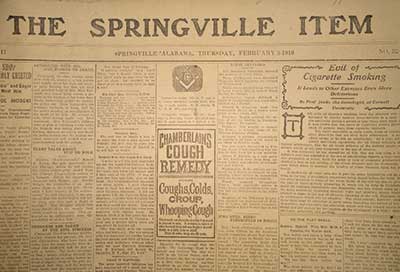
Liquor and religion combined in one brief report in the Springville Item’s, “Odenville News” on June 11, 1903: “Two fights Saturday at the church house. The Grand Jury should look after the boys. Young men, please leave your bottles at home when you start to church.” One wonders how the Grand Jury could “look after” the miscreants on a Sunday morning.

During the years of laying the railroad through Odenville, The Springville Item gave almost weekly updates of the construction progress. However, two reports had nothing to do with work.

On March 26, 1903, “Odenville News” in the Springville Item included with the railroad report, this comment, “Preaching was a failure in the [railroad workers’] camps Sunday.” Then three weeks later, April 16, the Item printed this: “Several of our railroad men joined the Odd Fellows Saturday night. Hope they felt like working Monday.” Preaching was a failure was followed by what must have been “A good time was had by all” weekend for the men later.

A reported suicide in Beaver Valley causes one to reread and speculate. As written Feb. 9, 1899, in The Southern Alliance, “Mr. Richmond Steed, of Beaver Valley, aged 70, killed himself at the residence of his son-in-law, Mr. Crow Harden, on last Monday morning. He used an old pistol which he brought home with him from the army in 1865. He fired three shots into his head.”

This was reported in several county newspapers with more information in each. The Southern Aegis of Feb. 9, 1899, gave specifics of the pistol. “During the war he had been a soldier in the federal army, and the weapon used in his own death was an army revolver he brought home at the close of the war and had preserved ever since as a relic of the war.”

Shooting himself in the head three times causes the inquiring mind to desire to question further.

The big news in April 1891 was electricity lighting the county seat of St. Clair. “Ashville Illuminated,” heralded The Southern Aegis, of Thursday, April 23, 1891.

‘Scott, Wells, and Lindsey’ [no surnames or company given] who installed the system, encountered several problems along the way, but finally they set the time and date, Saturday night at 7 p.m., April 18, 1891. The local steam whistle blasted on the hour, and 8-year-old Marcia Ney Cather quickly reached and pulled the switch.

The townspeople roared approval, guns were fired, and the band played as “Instantly … all Ashville was wrapt in a glorious brilliancy, magical, as it were, and wonderful to the expectant crowd watching the display. Ashville, for the first time in its history, could be seen in the light of one of the greatest inventions of the age.”

The invention of the automobile fascinated the citizens of St. Clair County, and when county folk began buying them, the excitement increased.

No one was more excited than Delia Smith, who wrote of day-to-day Ashville events in a diary she kept from June to November 1907. The Southern Aegis published the diary in 1932.

Delia expressed uncertainty about automobiles at first, writing, “Dr. J.B. Bass is having an automobile stable built to put his motor buggy in when it gets here. Give me old Dobbin. He may kick, (one kicked Andrew Cooley last Sunday), but at least they don’t sputter so.” June 26, 1907 [Southern Aegis, June 24, 1932]

Her attitude had changed by July when she wrote, “Ashville is getting bigger and better every day. We have three automobiles now. One for every 125 people. That’s more per population than any other town in the state. And folks thinking about buying more. I’m going automobile riding next week. I’m going to borrow Aunt Emma’s riding veil.” July 10, 1907 [Southern Aegis, July 15, 1932]

Then she went to the Alabama State Fair in October 1907 and wrote, that at the fair “… Walter Christie the great automobile racer was there. And you never saw such driving and heard such popping. I’ll bet he went every bit of 35 miles an hour. He simply flew, burning the wind as he went.” October 9, 1907 [Southern Aegis, October 8, 1932]

Delia Smith was not hopeful about hot air balloons and “air ships.” In the same diary entry as above, she wrote, “All Birmingham [at the fair] is talking of nothing else but Baldwin’s daring flight. [Thomas Scott Baldwin, 1853-1923] There were just heaps and heaps of balloons going up and down. I don’t believe that I’d feel particularly safe in that little basket swinging at the bottom of the balloon. I believe I feel safer riding a broom handle like the woman who sweeps the cobwebs out of the sky.”

And of air flight she observed, “I’ve been reading about these Wright brothers trying to invent a flying machine. One that will be run by a motor just like an automobile. The picture that they had in the paper looked to me like a couple of orange crates put together with a flutter wheel in front.”

One can hope that Delia flew in an airplane sometime during her life.

This headline from The Pell City News spurs curiosity, “Moving Van from St. Clair Raided Near Leeds” The Aug. 30, 1922, article begins, “Riley Jones is in the Hillman hospital with a bullet wound in his hip. Jas. Summerville and Mrs.BettisMary BettisMaryBettisMaryMary Bettis are in the county jail charged with violating the prohibition law, and Lee Bettis is a fugitive from justice, according to officers, as the result of an encounter with Deputy Sheriff J.E. Taylor and his assistant, BollingO. E.O.E. Bolling of Leeds, which occurred Thursday night … just outside the city limits of Leeds.”

Having been informed by long-distance telephone about erratic movements of the truck, Deputy Sheriff Taylor had secured search warrants and was ready when he stopped the truck. Riley foolishly made a grab at Taylor’s pistol, and Taylor shot him. Lee Bettis made a run for it and was still at large the next day.

When authorities searched it, “The truck contained a complete copper still, five hound dogs, two shotguns, one pistol, two kegs, one containing three gallons of whiskey and another two gallons; a jug and a quart bottle of whiskey, and a large cardboard box with many holes in it containing a “pet coon … The truck, dogs, coon and other articles are being held at the county jail.”

Elopements often made the news. Sometime the report used the old British phrase, “They went to Gretna Green,” a location in Scotland for secret marriages, like Rising Fawn, Ga., used to be for Alabama eloping couples.

The Aug. 4, 1897, issue of The Springville News in its “Brompton Paragraphs” column, reported an elopement intermingled with watermelon stealing.

“It is reported that a few nights since, somebody went over to Mr. Riley Moody’s to steal his daughter, but through carelessness … they got his watermelons. But foul play always comes when night is chosen rather than day. Mr. Moody himself chose day rather than night (to steal), so he came out all right with one of Mr. Taylor’s girls…. He chose for himself a Miss Mecie, one that he can call his own. Happy may you be, old friend, with your young bride.”

According to Rubye Sisson’s transcribed St. Clair County Marriage Records 1818-189, Riley Moody married Mercy Taylor July 29, 1897.

Wedding announcements should be standard – describing the bride’s dress, bridesmaids, flowers and music. However, one could ponder a while on this May 21, 1937, announcement in The Southern Aegis (names omitted to avoid embarrassment). “The many friends of Mrs. ___ ___ will read with interest the marriage of her daughter Miss ___ ___. The wedding was consummated in Houston, Texas, last week.”

Wrong choice of word or too much information? No matter, it just adds to the joy of reading old St. Clair County newspapers.