The Railroad Auction House

Story by Elaine Hobson Miller
Photos by Mackenzie Free

“Hey, well, alright sir.
Here we go there and what are ya’ gonna give for ‘em?
I have a 600 dollar down here now ten and now 25 and
Now 35 and now there 50 now 60 will ya’ give me 60?
Now 75, 75 another 85 dollars and buy ‘em there.

It’s Saturday night at the Railroad Auction House in Steele.

General merchandise – thermal socks, gloves, cookware, purses and makeup bags, speakers and phone chargers, are displayed in boxes and packages on and around tables on one side of the room.

In front of the raised auctioneer’s booth, more tables display toys and tool sets, pet beds, jewelry and glassware. Others hold a pile of blankets, a heater, a drone, an espresso machine and more.

It’s like a going-out-of-business sale at Big Lots, except there are no price tags, and people bid on the items, hoping to get them at a price they want to pay.
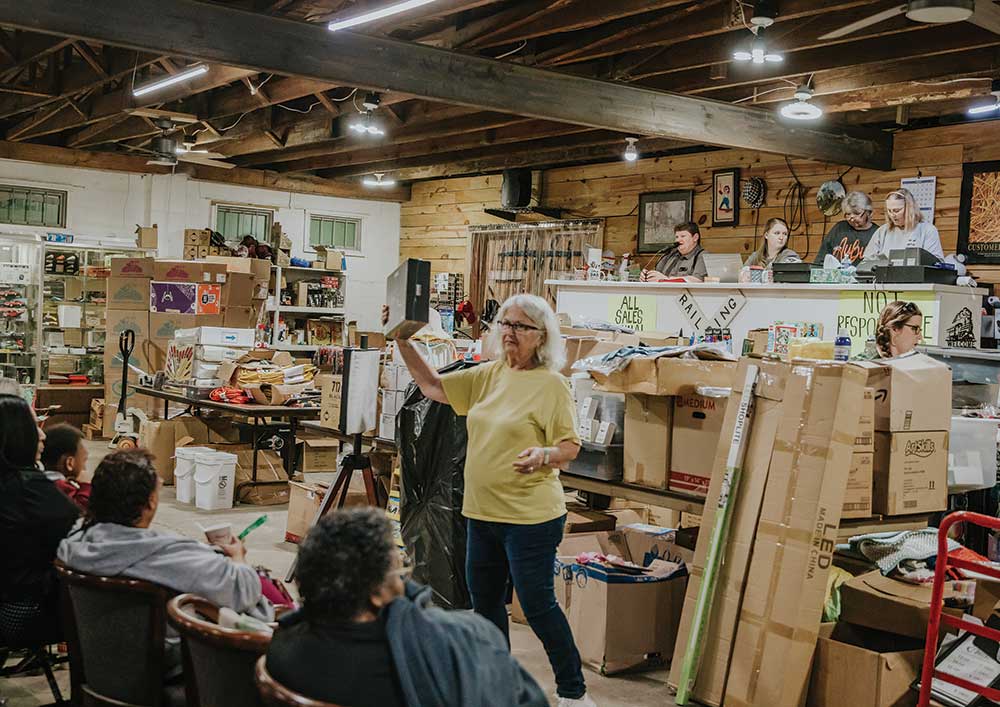
Seller Linda Robbins holds up a drone from her stock of merchandise

 Many of those people are regulars here, bringing their canvas shopping bags and their registered bid cards each week. Most of them leave with their bags full. But it’s not just the merchandise that attracts them. The whole affair is sheer entertainment, which suits the auction house just fine.

“I want everybody to have a good time,” says owner/auctioneer Henry Whisenant. “That’s my goal, to make it entertaining and fun to be here. We’re family-oriented, and we give people things to laugh about.”

Henry knows most of the regulars, calling them out by name. “You want two of these, Bernice?,” he asks one patron regarding aprons that go for $5 each. Speaking about another woman who places a bid on ear muffs, he jokes, “She says she wants ‘em so she can’t hear hubby snore at night.”

Tim Abernathy and his wife, Teresa, frequently drive from Sand Rock to shop and have fun. “We bought all our Christmas gifts here last year, spent about $600-plus,” Teresa says.

“We come here every weekend,” says Christina Lynn, the other half of the “we” being husband Charles. “We like the people who own it, and it’s a good place to buy stuff you need. I buy food, things that I want like home decorations. You never know what you will find. They have good products, and it’s a fun environment.”

25 dollar bid it now, 30 dollar 30
Will you gimmie 30 make it 30
Bid it on a 30 dollar will you gimmie 30
Who’ll bid a 30 dollar bid?
30 dollar bid it now, 35, will you gimmie 35
To make it 35 to bid at 30
Who would a-bid it at a 35 dollar bid?

Each person who wants to bid has anassignednumber, one that he keeps from week to week. Numbers are recorded alongside names so the house can collect payments at the end. The house makes its money by taking a percentage of the sales.
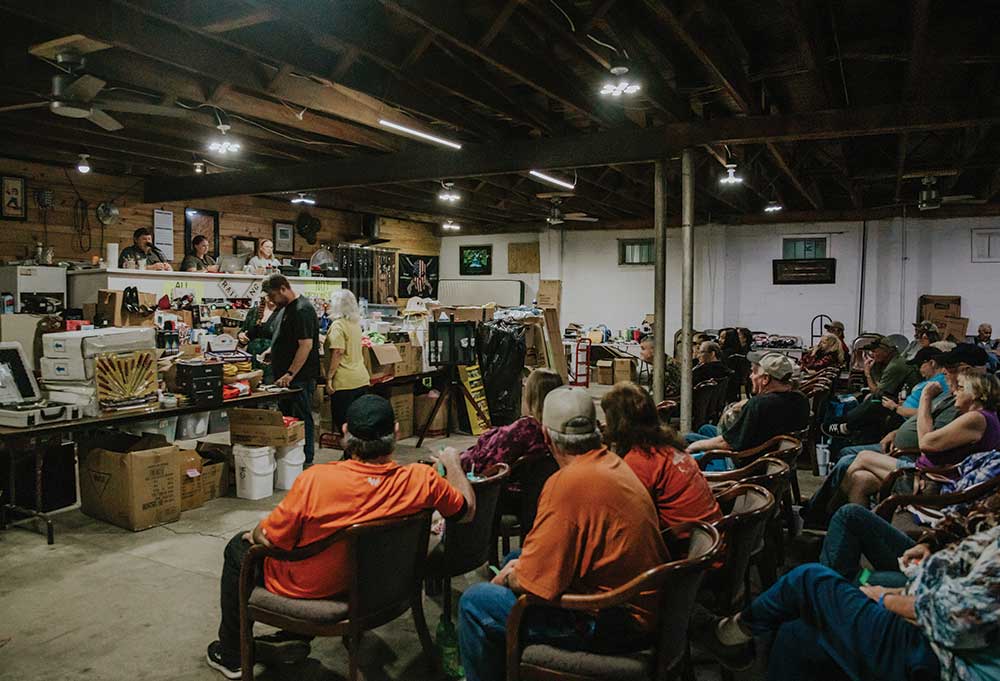
“We have different sellers each week,” Henry says. “Most of the time we have what we call a main hauler, who brings in most of the items for sale that night. They buy in bulk at other locations and sell individually here.”

Tonight’s “main hauler” is Linda Robbins, who brought a lot of personal-use and gift items. “Our prices are cheaper than the box stores,” she says. “It’s one avenue to get out surplus merchandise, and it’s lots of fun.”

John Whisenant (Henry’s son) acts as a sort of runner, going up and down the aisles holding up small goods as his dad goes through the bidding, which includes a description of the product. Carol Ditto or Corey Whisenant, John’s wife, type it into the computer. Once the bid closes, the high bidder gets as many of the items as he or she wants, then other bidders get a chance at what’s left.

 “Say the seller wants $10 each for certain items, and the winning bid was $8,” Henry explains. “They will take care of the winning bidder and if there are multiples, high bidder gets what he wants first. Then they go back to second highest for next choice at $10 each. First comes the high bidder, then the backup bidder, then all who bid on it, then seller opens up what’s left to the floor.”

35 dollar bid it now a 40 dollar 40
Will you gimmie 40 make it 40
Bidin’ it on a 40 dollar will you gimmie 40
Who’ll bid a 40 dollar bid?
40 dollar bid it now, 45, will you gimmie 45
To make it a 45 to bid it a 45
Who would a-bid it at a 45 dollar bid?

While Henry is doing his selling chant, John will call out “821 for 3,” etc., referring to the number of the bidder and how many he wants to buy. As John holds up Bluetooth speakers shaped like toy cars with built-in AM/FM radios and headlights that actually light up, his dad tries to start the bidding at $35 each. He has to keep coming down before he finally gets a bid of $20. Then he gets it up to $22.50, then $25, then SOLD!
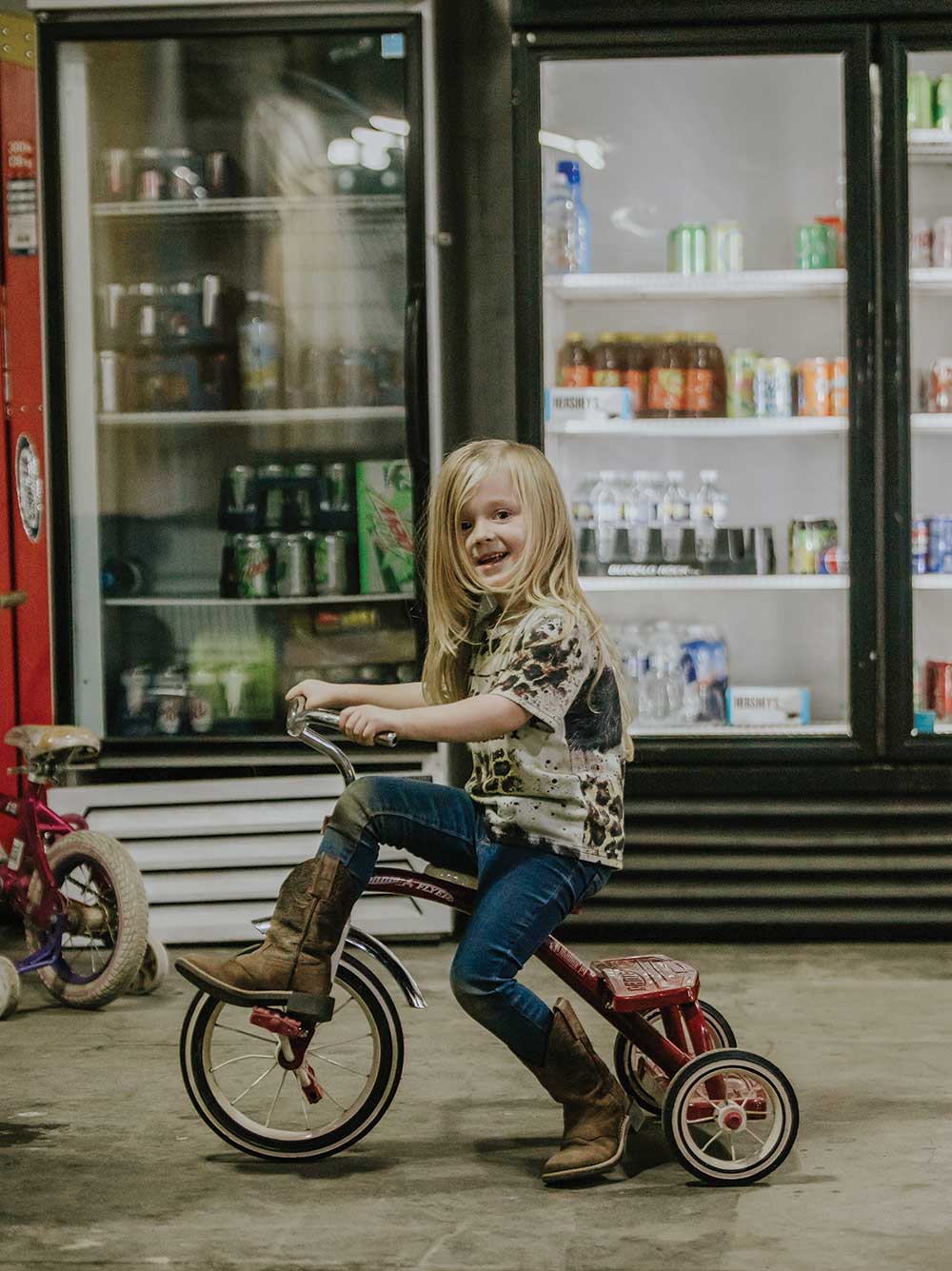
Allison Whisenant, Henry’s granddaughter and John and Corey’s daughter, entertains herself

Outside, a train roars by about the time Whisenant ends his

auctioneer’s chant, reminding folks of how the auction house got its name. Henry started this business in May of 2003, and now has a second building for his antiques and vintage collectibles auctions up the road at Steele Wholesale Auction.

“I grew up going to auctions and always wanted to be an auctioneer,” he says. “I’ve been one about 10 years. It took me a long time to get up in front of people. I’ve done different things in the meanwhile, such as mechanic, maintenance man, steel construction and truck driving.”

He went to an auction school to get some training. “The only reason I went was it was out of town and no one knew what I was doing,” he says, laughing. “At that time, I was driving a semi, and it just worked out.”

Henry says he got into auctioneering at an older age than most, so he isn’t as good as some of the younger folks. “We didn’t work a lot on chants in school,” he says of the famous way auctioneers carry on the process of bidding. “It was a nine-day course, and you learn more about how to put on an auction and the business side of it. As for the chant, you gotta run it together, so that, ‘What do you bid?’  becomes, Whattaya bid, whatta gone bid.”

45 dollar bid it now a 50 dollar 50
Will you gimmie 50 make it 50
Bidin’ it on a 50 dollar will you gimmie 50
Who’ll bid a 50 dollar bid?
50 dollar bid it now, 55, will you gimmie 55
To make it a 55 to bid at 55
Sold that hog for a 50 dollar bill

Jeanette Green of Centre, Brenda Leek and grandson Keem of Rome, GA,  and Edith Taylor of Gadsden came to the auction together tonight. “They have good sales and some good people here,” says Green. “I bought a lighted bar for the back of my husband’s truck once. I also bought large speakers for cell phone music.”

Leek doesn’t have to worry about entertaining her grandson while at the auction. A child-sized table with games and crayons is set up in one corner, along with a couple of tricycles. So, the little tykes pedal up and down the side lanes during the auction, ignoring the chanting and the bidding.

In the fall, as Christmas nears, some of the regulars buy toys and clothes at the auction and put them in the house’s “Toy Box.” Some folks from Church of the Nazarene in Steele (pastor James and wife DeeDee Kilgore, and Rodney and Brenda Free) take them to the elementary school in Steele, where the faculty distributes them to needy kids at Christmas. If an abundance is left after Christmas, the teachers will award points for good grades, and the kids can use their points to buy what’s left. “The auction house also donates to the Toy Box, and some of the haulers, too,” Henry says.

The aroma of popcorn permeates the air during the auction, temporarily taking a person’s mind off the bidding. Donna Bellew, also from Steele, handles the concession stand, selling snacks such as hot dogs, cheesy nachos, popcorn and canned sodas.

Roy Phillips, Steele, comes for fun, and buys an item or two every now and then. “We sit over here and laugh and carry on,” he says, motioning toward the other two or three people who are on the “old-timers’ bench” with him. The bench alongside one wall was so-named by Henry, the auctioneer, probably because his dad, Henry Sr., of Steele, sits there. Often, they are joined by Ellen Jenkins of Chandler Mountain.

“We come every Saturday for the entertainment,” Phillips says. They talk about how old the building is, how it was a hardware store for many years with a post office in one corner. Paul Pope owned the building back then, and had a gas pump, sold tires, meat, and general merchandise.

Bidder No. 846, Gaynelle Sweatt of Ragland, says this is her first time at the auction. She learned about it on Facebook.

“We’ll be back,” she says.

 Editor’s Note: The paragraphs in italics throughout this article are from the 1956 Leroy Van Dyke version of the song, “The Auctioneer,” which was written by Van Dyke and Buddy Black.

Remembering the Revolution

Story by Joe Whitten
Photos by Mackenzie Free

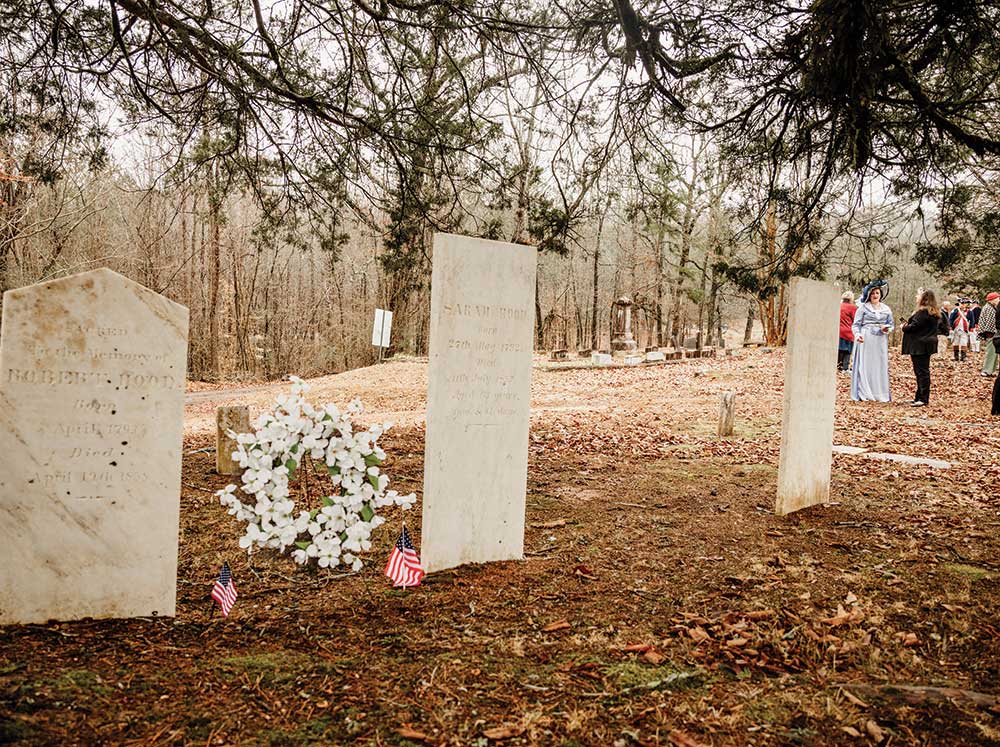
All through the night, clouds took turns sobbing over Hopewell Cemetery’s tombstones, cedar trees, and leafless dogwoods, and dawn broke dank and damp. In stark contrast in the older section, the recently cleaned tombstones of Jacob Green, Robert Hood, Sarah Hood and John Hood stood white against the gloom, and a new gray granite marker at Jacob Green’s grave glistened from the rain.

The marker drew members of the Broken Arrow Chapter of the Daughters of the American Revolution (DAR) to New Hopewell Baptist Church Fellowship Hall on a Saturday morning in January to honor the tribute.

Event preparation began in 2024 when Washington’s DAR National Headquarters announced available grants of $500 to local chapters to celebrate the Semiquincentennial (250th) celebration of the United States. The grant guidelines stipulated that not only must the Revolutionary War veteran’s grave be in the cemetery, but that some of his descendants must also be entombed there, for the marker is in memory of the veteran’s descendants in the same cemetery.

Broken Arrow member Ann Coupland suggested Jacob Green because she knew he was buried at Hopewell Cemetery, and that the Gadsden DAR chapter had placed a tombstone at his grave in 1937. Further, Ann also knew that his name and John Hood’s were not on the Revolutionary War Veterans marker behind the Inzer House.

Joseph and Miranda Wyatt

Choosing John Hood was almost serendipitous. One day, Mindy Manners, Regent of Broken Arrow Chapter, was walking in Hopewell Cemetery near Jacob Green’s resting place. Just a few graves away from Green’s, she saw the tombstone for Robert Hood, “Born April 1793, Died April 12, 1858.” The 1793 date caused her to think Robert had Revolutionary War connections. Back home, she researched Robert’s ancestry and found his father, John Hood, and his service record.

Buried next to Robert is his wife, Sarah (1792-1855); and next to her is their son, Rev. John Hood (1820-1851); however, there’s no stone for John Hood there. Where is he buried?

John Hood lies in an unmarked grave which some writers and researchers have speculated is in the Ashville Cemetery. However, Hopewell Cemetery is more likely for three reasons. First, his son, daughter-in-law, and grandson are interred there. Second, Daniel Hood in his paper titled, “The Noah Hood Family,” states, “The Hood family has been associated with the Hopewell Baptist Church since its construction (organization) in July 1830. Five Hoods were charter members.

Indeed, in the Hopewell Cemetery, Hoods account for some of the earliest residents.” Third, from 19th century obituaries that the community of Hood’s existed, for it is recorded as place of residence, as in Roland Hood’s obituary, Aug. 29, 1889, in The Southern Aegis. “Died on Aug. 25, 1889, at his residence near Hood’s this county, Roland Hood, age 71 years. He had lived in the neighborhood where he breathed his last all his life, except for two years.” So, there exists a strong connection with the Hood family, the church, the cemetery and the community.

Broken Arrow members were busy in the Fellowship Hall, where some decorated tables with patriotic colors, miniature stars and stripes, and flower arrangements, while others set out refreshments. One of those members is especially noteworthy, Emma Scott Milam. She is the only surviving charter member of the Broken Arrow Chapter which was established a little over 70 years ago. As soon as she turned 18, her aunt had her sign the papers to come in as a charter member.

Members of the Green and Hood families and other visitors gradually filled the room as the Fellowship Hall program hour arrived.

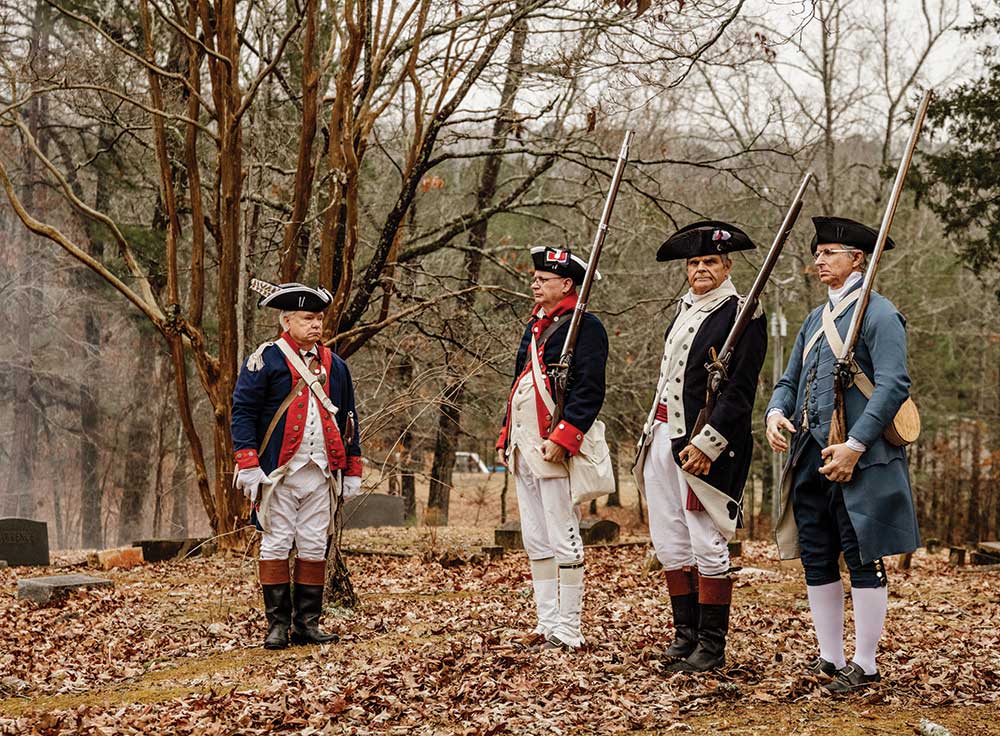
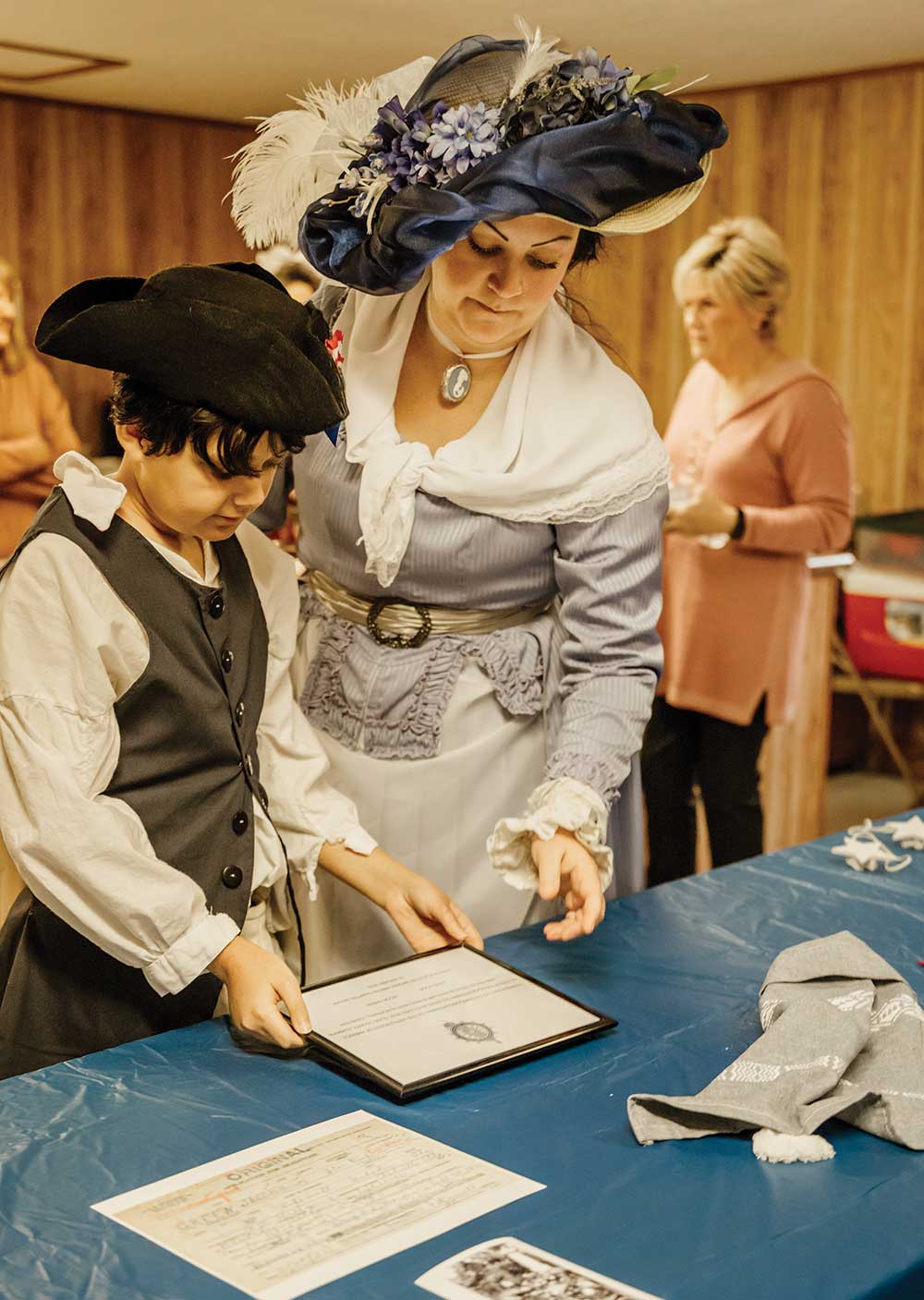
Following the opening prayer by Chaplain Emma Milam, the Alabama Society of the Sons of American Revolution Color Guard, in 18th Century military attire, brought the flag to the front for the Pledge of Allegiance, then they placed the flag in its holder.

Next, the assembly read in unison The American’s Creed. Mindy introduced special guests: Rev. Johnny Wilson, host and pastor of New Hopewell; Joe Barker, commander of the SAR Color Guard; Kristi Averette, The Flag of the United States American State Committee Chair, Alabama Society Daughters of the American Revolution; and attending journalist.

Regent Manners related interesting facts about Alabama and St. Clair County Revolutionary War veterans, many of whom moved their families here, and records indicate that more than 700 are buried in Alabama.

Many of the grave markers have been weathered away or destroyed by the passing years, and it is believed that the last veteran to die was William Speer, who lived to be 101. He died in 1859 and is buried in Bivens Chapel Cemetery in Jefferson County.

After the Regent’s remarks, members of Jacob Green’s family were recognized and 8th generation Josiah Jacob Evans, eight years old, read Jacob’s brief history written by his Aunt Beth Evans-Smith.

Jacob Green’s history resonates with America’s and St. Clair County’s early history. He was born in North Carolina in 1767 and was only nine years old when the Declaration of Independence was signed July 4, 1776. Official records show that an 18-year-old Private Jacob Green was “…paid with interest, on 21 June 1785 for duty done in the Militia in 1782.”

In 1787, 20-year-old Jacob married Frances “Fannie” Baker in North Carolina. Over the years, 10 children blessed their home.

Family records state that Jacob also fought in the War of 1812, and that at the end of the war, perhaps around 1815, Jacob and other men journeyed to Alabama to explore land along the Coosa River. Then in 1818, Jacob and Fannie, now living in South Carolina, resigned their membership in the Buffalo Baptist Church and began the tedious trek to Alabama.

Although the date they arrived in St. Clair County with their six younger children is unclear, Green family researchers believe the family arrived here between 1818 and 1820. The 1820 census records show that Jacob Green owned land in St. Clair County and that he formerly resided in South Carolina.

Jacob built the family’s first home on today’s Greensport Road, a little south of Canoe Creek where U.S. 411 crosses into Etowah County. This spacious home also served for many years as a stop on the Montevallo stagecoach route.

Mary Ellen Sparks wrote in an article, Stagecoach Stop, published Aug. 7, 2019, in the St. Clair Times, “Springer and Pollard Stagecoach Lines ran between Pulaski, Tenn., and Montevallo for a total of 133 miles. The mail was delivered semi-weekly at $25 per trip. There were 13 mail stops along this route. It traveled through six Alabama counties. The stagecoach would leave Ashville at 4 a.m. and arrive in Montevallo the next day at 9 a.m. It was a 29-hour ride amidst wild animals, inclement weather and probably hostile Indians and Outlaws.”

By the 1830s, there was a need for a ferryboat on the Coosa River to connect St. Clair County with Calhoun County. When the federal government approached Jacob about operating the ferry, he accepted the challenge. Therefore, he left the Stagecoach house and built another spacious house by the river at what came to be called Greensport.

Jacob successfully operated the ferry for some years as age crept up on him. The 1840 census records list a man about Jacob’s age living with Jacob’s daughter, Nannie Green Dill, and her husband. Jacob’s wife, Fannie, must have predeceased him. His name does not appear in the 1850 census.

 When Alabama Power constructed Neeley Henry` Dam and Lake, the house was torn down and lake waters soon flooded over where it once stood. Today on Jacob Green’s Coosa River land is the Greensport RV Park and Campground, and the Greensport Marina, a beautiful and peaceful St. Clair County recreational center on Lake Neely Henry, operated by Jacob’s descendants.

John Hood

When the John Hood family was recognized, Anthony Hood read John’s brief history.

His birth date remains a mystery, but researchers think it occurred in the area of 1745 to 1750. He was the eldest son of Tunis and Elizabeth Harrison Hood of Frederick County, Virginia, now a part of Berkeley County, West Verginia.

The Hood families seemed restless, for in 1772 John was in Burk County, North Carolina, then c1775 they moved to Mecklenburg County, North Carolina. Tunis Hood, John’s father, and other members of the family relocated to Mecklenburg County around 1775, as well.

John’s American Revolution service was with the North Carolina Militia, Salisbury district, made up from Mecklenburg and other counties. Records also show that Tunis Hood gave material aid to Revolutionary forces. John’s brothers, Tunis Jr., Solomon and Robert, served with Mecklenburg County forces as well.

After the war, John moved his family to Greene County, Georgia, around 1792 and stayed there about 24 years before migrating to Alabama c1816. Hood descendants believe John died in 1835 and Sarah in 1837.

John married Sarah “Sallie” Austin in 1777, and they were parents to eight children: Austin, James, Amos, Isaac, Robert, William, Osborn and daughter Lovina. Robert is buried at Hopewell Cemetery.

There is a possible John Hood and Abraham Lincon connection as recorded by Anthony Hood. “John Hood’s mother was Elizabeth Harrison, daughter of John Harrison and granddaughter of Isaiah and Elizabeth Wright Harrison. Elizabeth Wright Harrison died soon after the birth of their fifth child. Isaiah married second to Abigail Smith, and they had three children, with Abigail Harrison being [their] daughter who married Alexander Herring. Abigail Harrison Herring is strongly speculated to be the great-grandmother of Abraham Lincoln, making John Hood a distant cousin to Abraham Lincoln.”

Of special note on other family ties, Elvis Presley is a direct descendant of John Hood. Elvis’s grandmother, Minnie Mae Hood Presley, is John Hood’s great-great-granddaughter. At the Tunis Hood plantation site at Hood’s Crossroads in Mint Hill, North Carolina, there is a plaque commemorating the Elvis connection. Minnie Mae Hood Presley is buried at Graceland.

Tombstones of Robert Hood, Sarah Hood, and Rev. John Hood

When the biographical sketches ended, the DAR ladies served finger foods, hot chocolate and coffee, after which the group reassembled at Jacob Green’s gravesite for the dedication of the memorial:

“COMMEMORATING THE SEMIQUINCENTENNIAL OF / THE UNITED STATES OF AMERICA / WE HONOR THE REVOLUTIONARY SOLDIERS WHO LIVED IN / ST. CLAIR COUNTY, ALABAMA / AND WHOSE DESCENDANTS ARE BURIED HERE / IN HOPEWELL CEMETERY / JOHN HOOD / JACOB GREEN / MARKER PLACED BY BROKEN ARROW CHAPTER NSDAR / 18 JANUARY 2025.”

Regent Manners dedicatory remarks were thought provoking. “It is fitting that we praise especially here today no famous men. We come instead to honor those who fought and died without recognition.

“Their names and deeds are known only to those who were their comrades, families, and of course, known to God… These ordinary soldiers best symbolize such acts of quiet courage by ordinary people whose reward is that their nation and their freedoms remain secure for future generations.”

She ended her remarks with these words from General George Washington, who knew war and its conquests of exposure, wounds and death: “To be prepared for war is one of the most effectual means of preserving peace.”

Chaplain Milam prayed the dedicatory prayer, followed by the SAR Color Guard firing three rounds with their muskets, much to the delight of the children in attendance.

As the musket smoke wafted away, Rev. Johnny Wilson read the lyrics of Taps, of which the poignant last stanza was a fitting end to the ceremony.

All is well… Fare thee well
Day has gone, night is on.
Thanks and praise, for our days,
‘Neath the sun, ‘Neath the stars, ‘Neath the sky,
As we go, this we know, God is nigh.

As folk began drifting back to the Fellowship Hall or the parking lot, clouds drifted apart enough to reveal bits of blue sky above the gray, and feeble sunrays touched the tops of tombstones old and new.

And there in the silent quietness, one might think he heard from far away, the notes of Taps, echoing through the years, “All is well. All is well.”

Countdown begins for LakeFest 2025

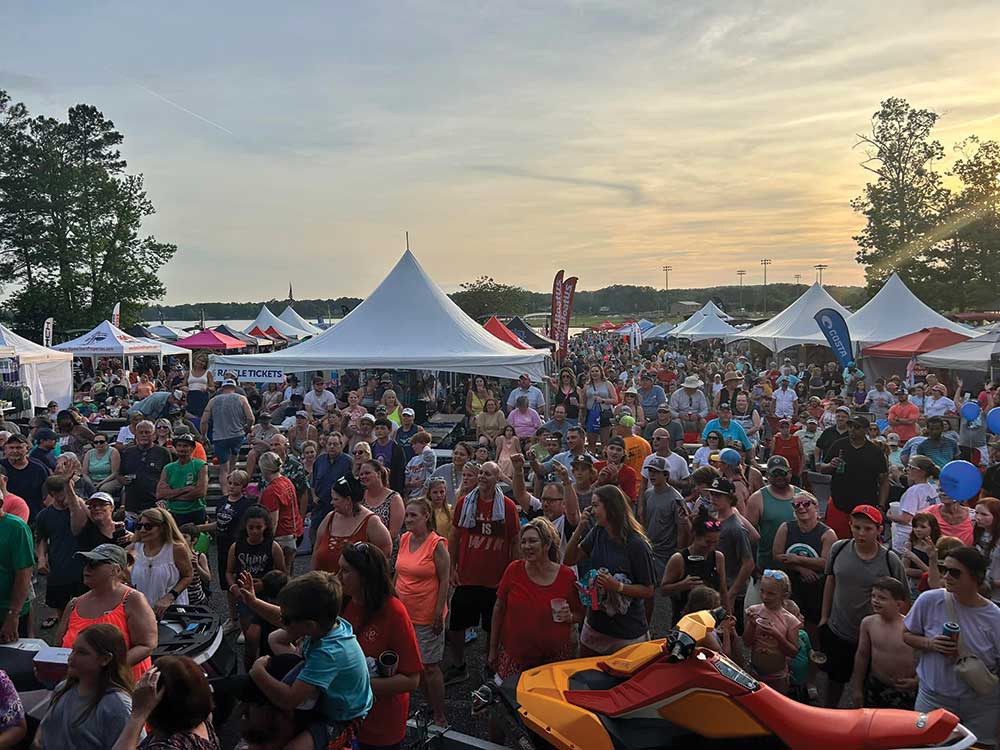
It won’t be long now. Logan Martin LakeFest & Boat Show makes its 15th return engagement to Pell City Lakeside Park May 9-11. There’s always something for the whole family, and it’s nonstop fun the entire weekend.

Lake lifestyle vendors, entertainment, food to satisfy every palate, giveaways and more mark the event from beginning to end.

If you’ve got boat fever, LakeFest certainly has the cure. Boats and watercrafts of all kinds – with discounted pricing – are on display and ready for a test drive. 

It opens Friday, May 9 from 3 p.m.-9 p.m. A fireworks show saluting veterans is a highlight that evening. On Saturday, May 10, hours are from 10 a.m. to 9 p.m. And on Sunday – Mother’s Day – festivities get underway at noon with free Mimosas for all the Moms in the crowd.

Admission is free.

New restaurants coming to St. Clair

Pell City is set to become a premier dining destination as Darden Restaurants, a global leader in full-service dining, officially broke ground on a new Olive Garden and LongHorn Steakhouse on May 18, 2025.

This highly anticipated project, valued at over $6 million, is the result of a dynamic partnership between Darden Restaurants, I-20 Development, the City of Pell City, and the St. Clair County Commission. The spirit of collaboration was present at today’s groundbreaking ceremony, held on the development site located at the intersection of US Highway 231 and Hazelwood Drive, adjacent to the I-20 West ramp.

“This is a ‘we thing,’ not a ‘me thing,’” said Bill Ellison, President of I-20 Development, who spearheaded the project. “It’s been a total team effort, and I want to compliment the City and County for their commitment and cooperation. As long as we can keep these relationships in place, there are limitless possibilities for what comes next.”

The new restaurants are projected to generate a combined $10 million in annual sales for Pell City, significantly boosting the local economy. Moreover, they will create numerous job opportunities for area residents and enrich the city’s dining scene with diverse culinary options, attracting visitors from across the region.

Darden Restaurants, renowned for its commitment to exceptional dining experiences, operates over 2,100 locations worldwide. In Alabama alone, the company employs more than 3,300 team members across its 38 existing locations.

“It’s a tremendous feeling to know that these businesses that have so many choices on where to locate choose make their investment in our community,” said Bill Pruitt, Mayor of Pell City. They recognize that this is a special place to be. We’re grateful for the work of Bill Ellison and for the County Commission’s partnership, and we’re honored to welcome Olive Garden and LongHorn into the Pell City family.”

The Pell City restaurants will uphold Darden’s high standards, offering the beloved menus and inviting atmospheres that have made Olive Garden and LongHorn Steakhouse favorites. Guests can look forward to indulging in Olive Garden’s signature pasta dishes, soups, salads, and breadsticks, or savoring LongHorn Steakhouse’s expertly grilled steaks, sides, and appetizers. Both locations will also feature full-service bars and delectable desserts.

“This entire project is exciting,” St. Clair County Commission Chairman Stan Batemon said. “Bill Ellison saw a vision over here, and myself and the other Commissioners are grateful for his and the City’s work in bringing these restaurants to St. Clair County.”

The Pell City locations are expected to open in 2026.

Big Canoe Creek

Story by Carol Pappas
Submitted and staff photos

It’s hard to imagine that Big Canoe Creek Nature Preserve is celebrating its first birthday already. It was more than a decade in the making, and it sometimes seemed that opening day would never arrive.

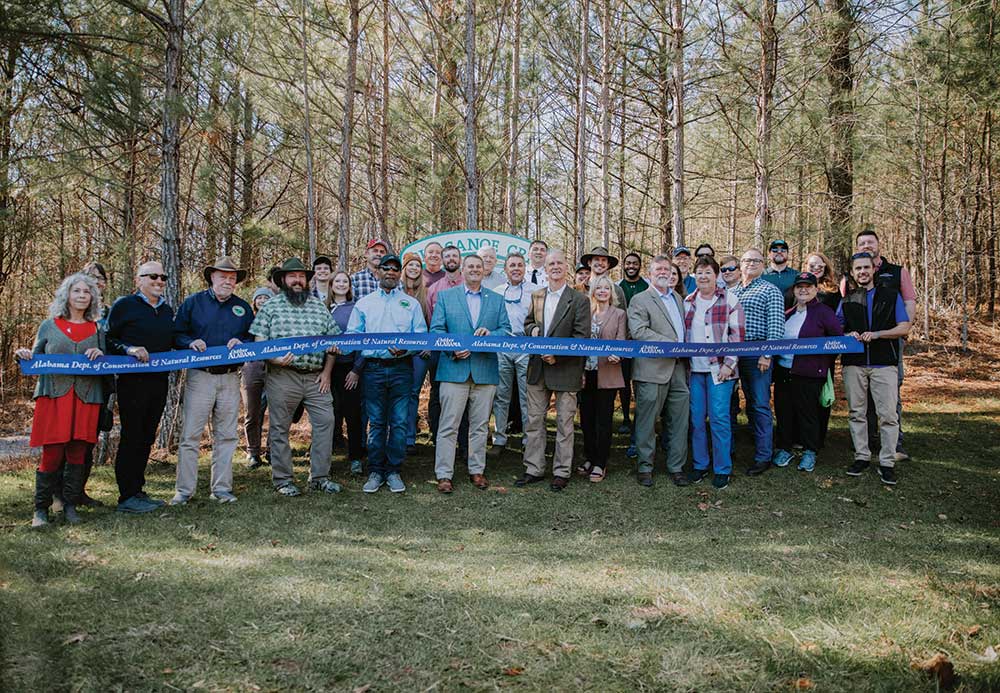
But it did. On Feb. 3, 2024, 731 people streamed in, and the crowds haven’t stopped. Over 400 attended the grand opening, ribbon cutting ceremony the day before. And the numbers since that time have not only climbed, they show no signs of slowing.

Ribbon cutting, opening ceremony a year ago draws huge crowd

In the first year of operation, 13,000 people, an average of 1,100 a month, have visited the preserve – 422 acres of nature nestled in the city of Springville, whose population is just a little over 5,000, according to the latest census.

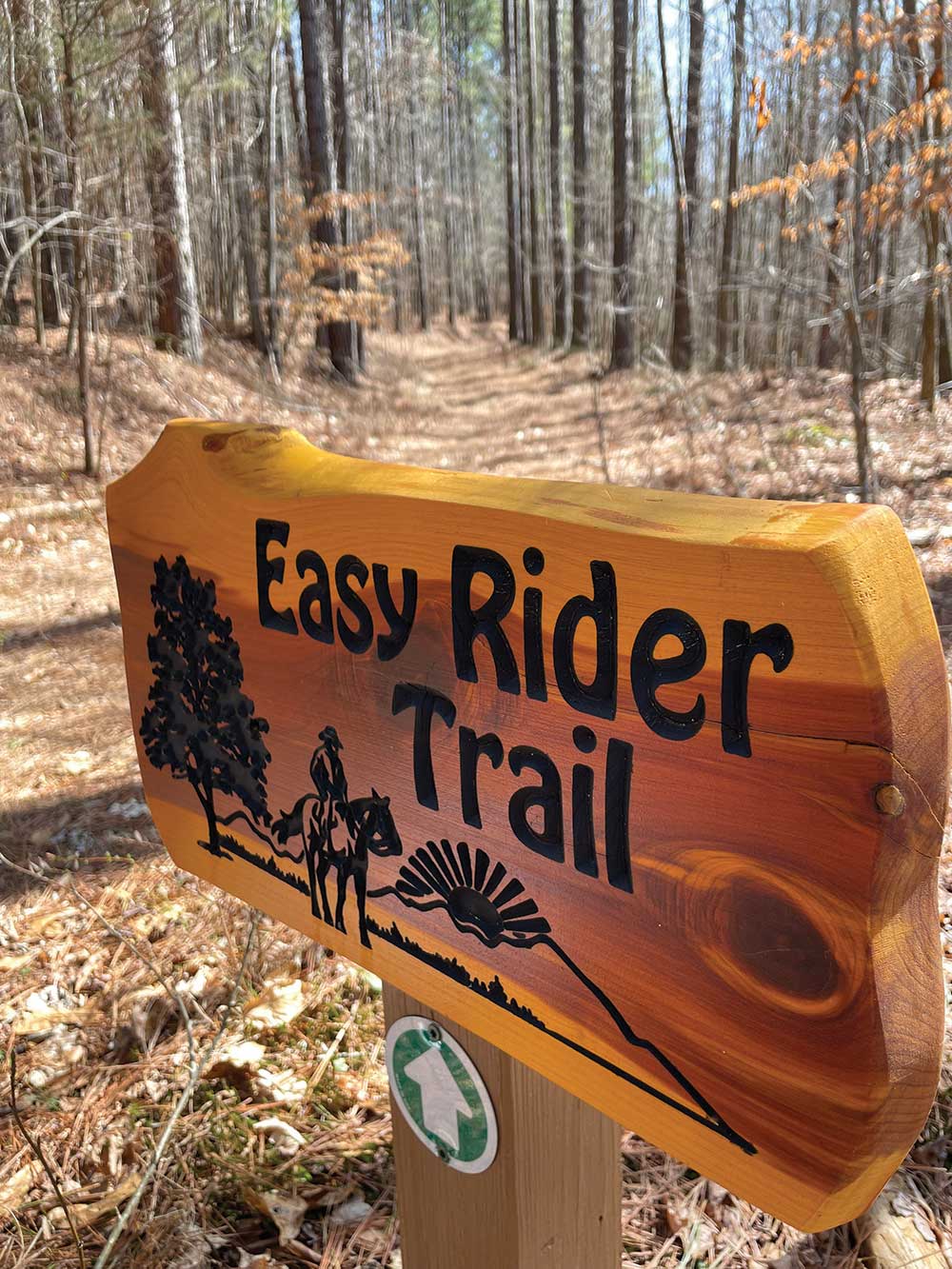
Its hiking, biking, birding and horseback riding trails wind their way beneath towering canopies of hardwoods, pine and maple trees with colorful palettes of flowers and diverse native plants marking the paths as if guiding the way.

A meandering creek, pristine as it flows through the heart of it all, is the ideal centerpiece – home to aquatic species – some not found anywhere else.

As Big Canoe Creek Nature Preserve Manager Doug Morrison says, it’s the perfect place to “get your nature on.”

Early days

On an unseasonably warm day in late February, Morrison sits on the porch of the preserve office – a tiny wooden building, almost cabin-like in its appearance. He reminisces as he motions to the trails, bioswale and parking, surrounded by dense woods forming a picturesque backdrop.

Much of what you see was absent the year before. Trails were being built. A bioswale was being created to remove pollutants from stormwater runoff and let it settle in the soil to decompose rather than polluting the preserve below.

Entrance roads and parking lots were constructed. Signs erected. Benches were strategically placed throughout as a welcome respites along a hike or a placid place just to enjoy the scenery. 

Activity was at a fevered pitch as work was tireless in its efforts to open. It had been long awaited to fulfill a longtime dream by Morrison and others.

For a decade or so, they waged a passionate campaign to have the land preserved and protected so that generations from now, the preserve can still be experienced and enjoyed. Forever Wild Land Trust bought the acreage and set wheels in motion to do just that – preserve it forever.

These days

These days you’ll find Morrison and company planning, visioning, working toward improvements to the experience and enhancing its awareness and education programs to take it to the next level.

Lucy Cleaver has joined the team as education coordinator. Jake Tucker is maintenance technician. With Morrison, the trio keeps the preserve running on a daily basis.

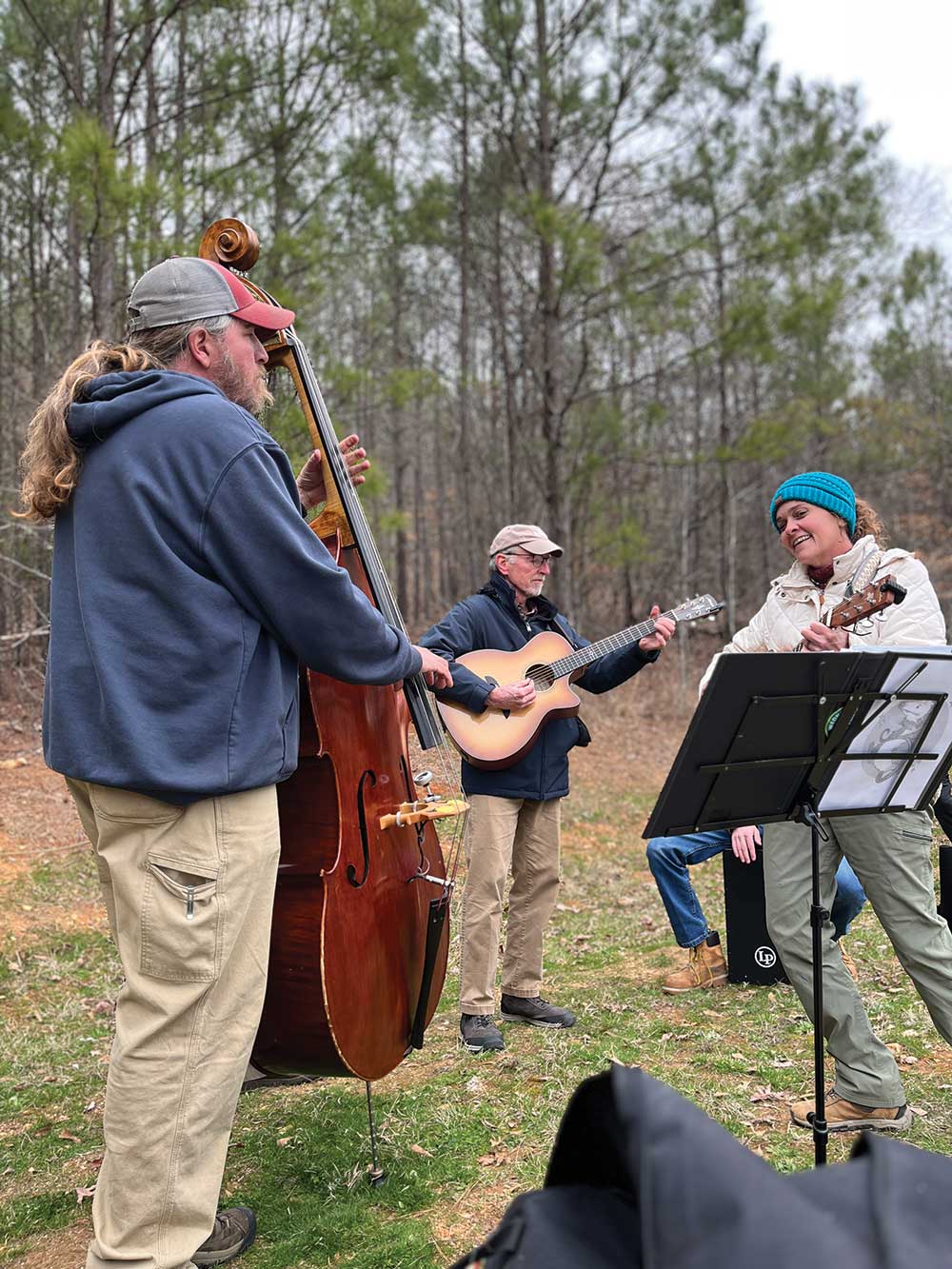
Entertainment at first birthday celebration cookout

Education has long been a central focus of the preserve. It is key to its future to facilitate not only an understanding of the importance of nature, but a passion for preserving it.

Cleaver enters the picture with an impressive resume with a bachelor’s degree in Agriscience Education and a master’s in Natural Resource Management from Auburn University. She taught high school Agriscience classes before joining the Park and Rec Department of the City of Springville.

Already, she has the education calendar full of activities. 

On March 8, it held its second Youth Turkey Calling Expo, getting youngsters up and out on a Saturday morning at the preserve to learn all about wild turkeys. They learned how to make turkey calls and all about turkey hunting and the outdoors. The free event had a multitude of sponsors and the value of items given away to the kids totaled over $5,000.

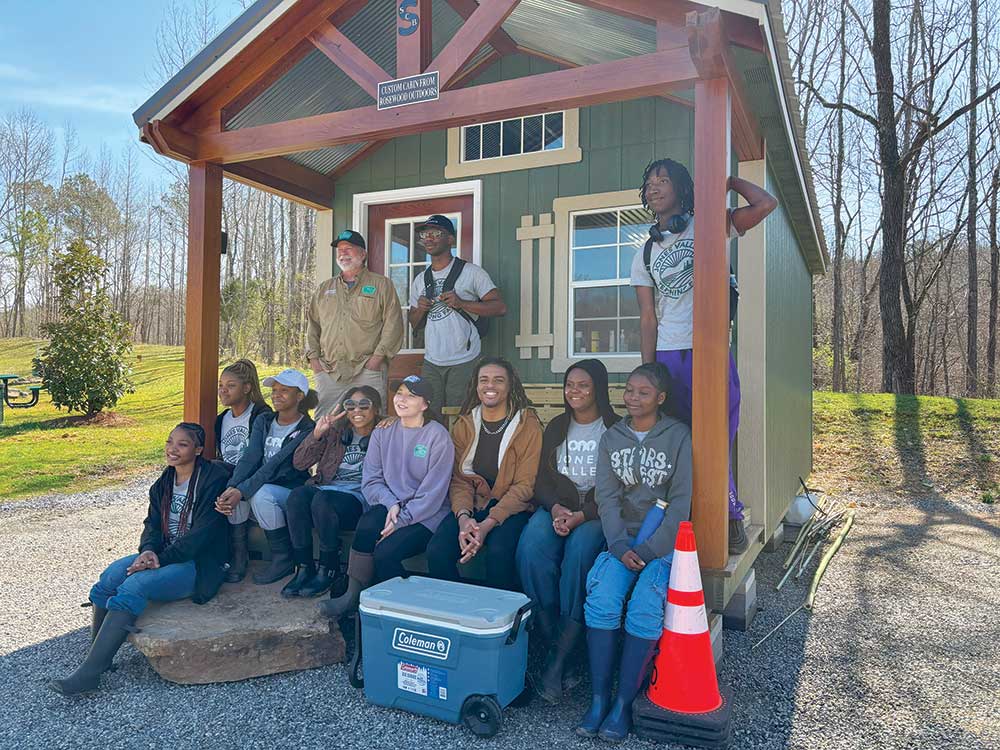
On March 10, Jones Valley teaching farm interns and students went for a hike at the preserve and learned all about its features.

April 5 will see the preserve partnering with Alabama Cooperative Extension for a native tree workshop. June 7 is set for an invasive species seminar, and Sept. 26-27, it will be the site of Forest Her, a workshop for women on how to read deeds, bank documents and wills and how to manage land. It is a joint effort with the U.S. Soil Conservation Service for Women in Agriculture, necessitated by a growing number of women inheriting the family farm and needing such guidance.

She is networking with educators in the Alabama Environmental Association to help develop more programs.

Rounding out the year, Creek Jam, the popular outdoor music festival at Homestead Hollow to benefit the preserve, is set to return Oct. 25.

Future plans

While the early chapters of this success story have already been written for the preserve, officials have no intention of stopping there. Innovation, accessibility and more education are its guides.

Immediate plans call for making a section of the lower trail more accessible by paving a 1-mile section to allow wheelchairs. This will be made possible as the result of funding from grants secured by the Big Canoe Creek Preserve Partners, announcements forthcoming.

Tucker is working on a ram pump, which employs a set of valves working together to provide pressure enough to move 14,000 gallons of water from a spring through 350 feet of line up an 80-foot elevation without electricity.

Morrison discovered the ram pump idea from Randy Moody, a friend who had previously lived on the property in a rental house. “I asked him, how did you get water because I knew no water lines were run up here,” Morrison said.

Moody explained that the remnants of an old spring house had a gathering reservoir that fed into a pipe and there used to be a ram pump there. Morrison had never heard of a ram pump before, but he and Tucker researched. Tucker found a ram pump kit online and installed it.

“Jake can do anything I throw at him,” Morrison said. As long as the water collected into the pipe flows downhill, a ram pump inserted inline on the pipe could gather and push water uphill. For every 1 foot of fall on the pipe, it could push 7 feet uphill.

The end result? “We collect water through the pipe, the ram pump pushes it uphill, and we can collect it in a reservoir. Right now, we have a small 250-gallon tote, but plans are for a much bigger reservoir to collect the water and send the overflow back to the stream, thus providing water for irrigation and possibly flushing future toilets.”

Eventually, this off the grid creation will become an education model.

Meanwhile, pollinator gardens planted in the fall will be in full swing in spring and summer.

They are hopeful that an open-air pavilion with restrooms is on the horizon, made possible by a $400,000 grant from the Alabama Department of Economic and Community Affairs as part of its Recreational Trails Program. It was written by Mike McCown with assistance from Morrison and Candice Hill, director of St. Clair County’s new grant resource center.

There, they will be able to hold education and other events, and restroom facilities will now be available.

Why they do what they do

“This watershed is very, very special,” Morrison said as he talks of the protected species there, especially the Canoe Creek Clubshell Mussel, which had nearly become extinct. In 2022, they were placed on the endangered species list.

He points to the ecological potential for the future and a 2013 project on the creek.

Students from Jones Valley Teaching Farm schooled in features of preserve

In November 2013, The Nature Conservancy, U.S. Fish & Wildlife Service, river conservationists, The Friends of Big Canoe Creek, Coosa Riverkeeper and the Geological Survey of Alabama, DCNR and Alabama Power united to remove Goodwin’s Mill Dam. The former grist mill dam was built in the 1880s, and it was abandoned in the 1940s. At the time above the dam site, 15 different fish species, but no mussels, were found. Below it, twice that as more than 30 species of fish, were found, signaling that the dam had been obstructing the free flow of the fish.

“The fish passage was hindered by the dam. Fish have a symbiotic relationship with mussels. You see the female mussel releases glochidia (mussel larvae if you will) that latch onto the fishes’ gills. They feed off the blood of the fish for a few weeks, then drop off. And that’s where their life journey begins,”  Morrison explained.  Ten years later, they found mussels there, Canoe Creek Clubshells at that. Once the fish passage was unobstructed, the mussels were returning, and their role as a natural water filter will be vital to keeping the creek pristine.

After USFWS folks discovered the Clubshell there in 2023, they worked with Paul Johnson and Michael Buntin at Alabama Aquatic Center in Marion where they raise mussels. They released over 120 Clubshells and about the same number of Coosa Mocassinshell mussels in early 2024 into Big Canoe Creek, Morrison said, and they have high hopes for what it means for the future.

Through the preserve and the environmental and conservation work being done, “We want to teach people more about our watershed, how important the critters are that live here and how to take better care of our waterways so these special critters can exist. We must do what we can to prevent further extinctions,” Morrison said.

“All of God’s creatures have a right to exist to live a full life. We can tune in more to nature, explore more and discover more. Who knows what is still undiscovered? Bottom line, we all need to ‘get our nature on’, and maybe your existence will be rewarded tenfold.”

Dirk Walker Fine Art

Story by Scottie Vickery
Photos by Mackenzie Free

Dirk Walker’s artwork has found homes all over the world. His paintings hang in houses, churches, businesses, corporate headquarters and sports stadiums. They grace walls all over the country and faraway places like Germany, Denmark, Australia, and the United Kingdom.

It all started with his own bare walls.

“I wanted to buy art for our home,” said Walker, who lived in Birmingham at the time.  His search took him to the Loretta Goodwin Gallery, and by the time he left, Walker, who worked in banking at the time, couldn’t shake the feeling that he was meant to be an artist.

“I don’t know why I thought I could do it, but something appealed to me about trying to learn how to paint,” said Walker, who has had a studio in downtown Pell City for 11 years.

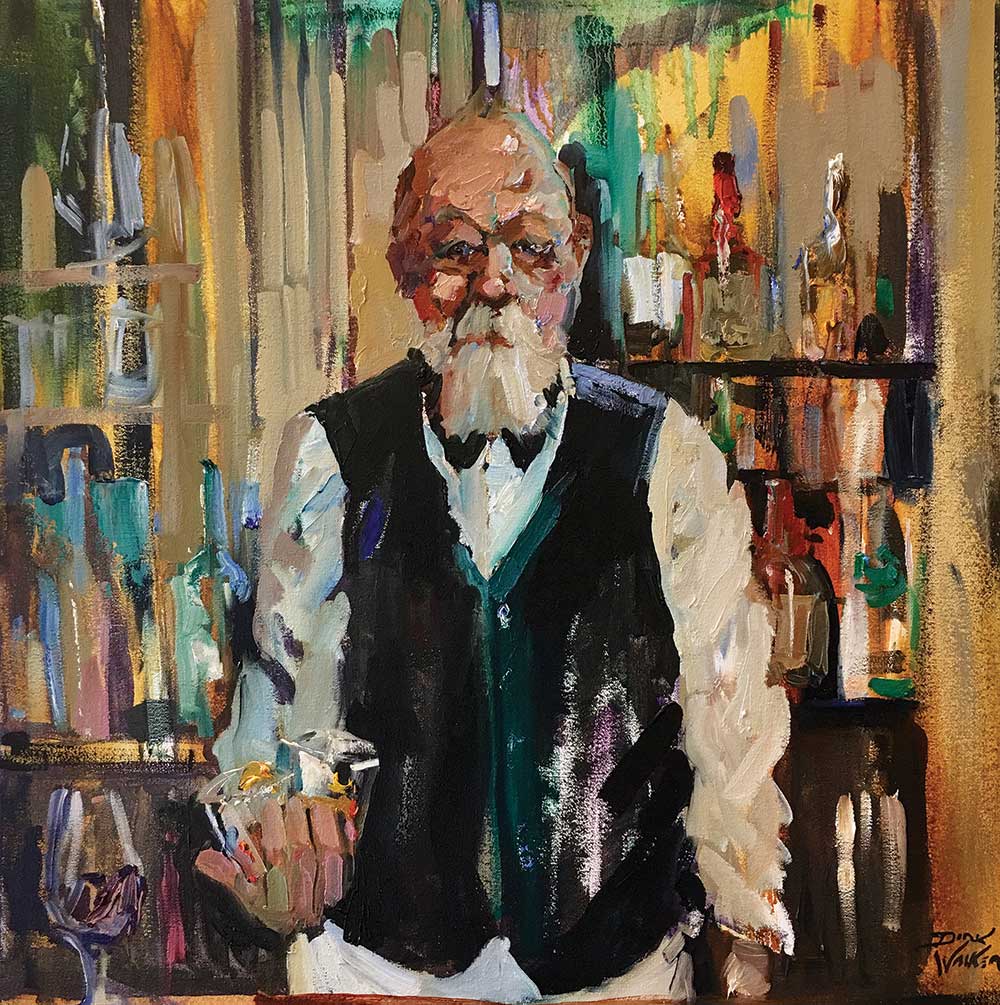
Fans of his work are awfully glad he did. Walker’s paintings, both oils and watercolors, are known for their bold colors, rich texture and loose brushstrokes. His subject matters are varied: he has collections ranging from landscapes and city scenes to his spiritual series. He also paints sporting and hunting scenes, art focusing on the growing bourbon culture, and whimsical subjects like Santa Claus.

“The variety of things I like to do just keeps me fresh in all of them,” he said. “I’m not doing the same thing all the time – that would drive me bonkers. A lot of people can’t say they love what they do, but I get a lot of gratification from it. Once I get in to doing a painting, everything else just sort of goes away.”

Finding purpose

There were signs early on that Walker had the makings to be a great artist. Growing up in Birmingham, he watched his father dabble in watercolor, and his own high school work caught the attention of his art teacher. She encouraged him to pursue it, but his interest and talent lay dormant for years.

After graduating from Vestavia Hills High School, Walker earned a degree in industrial design at Auburn University and that helped provide a foundation in drawing and perspective. “I did a little design work right out of college, but I had the opportunity to go with the bank, and it was a better option for raising a family at the time,” he said.

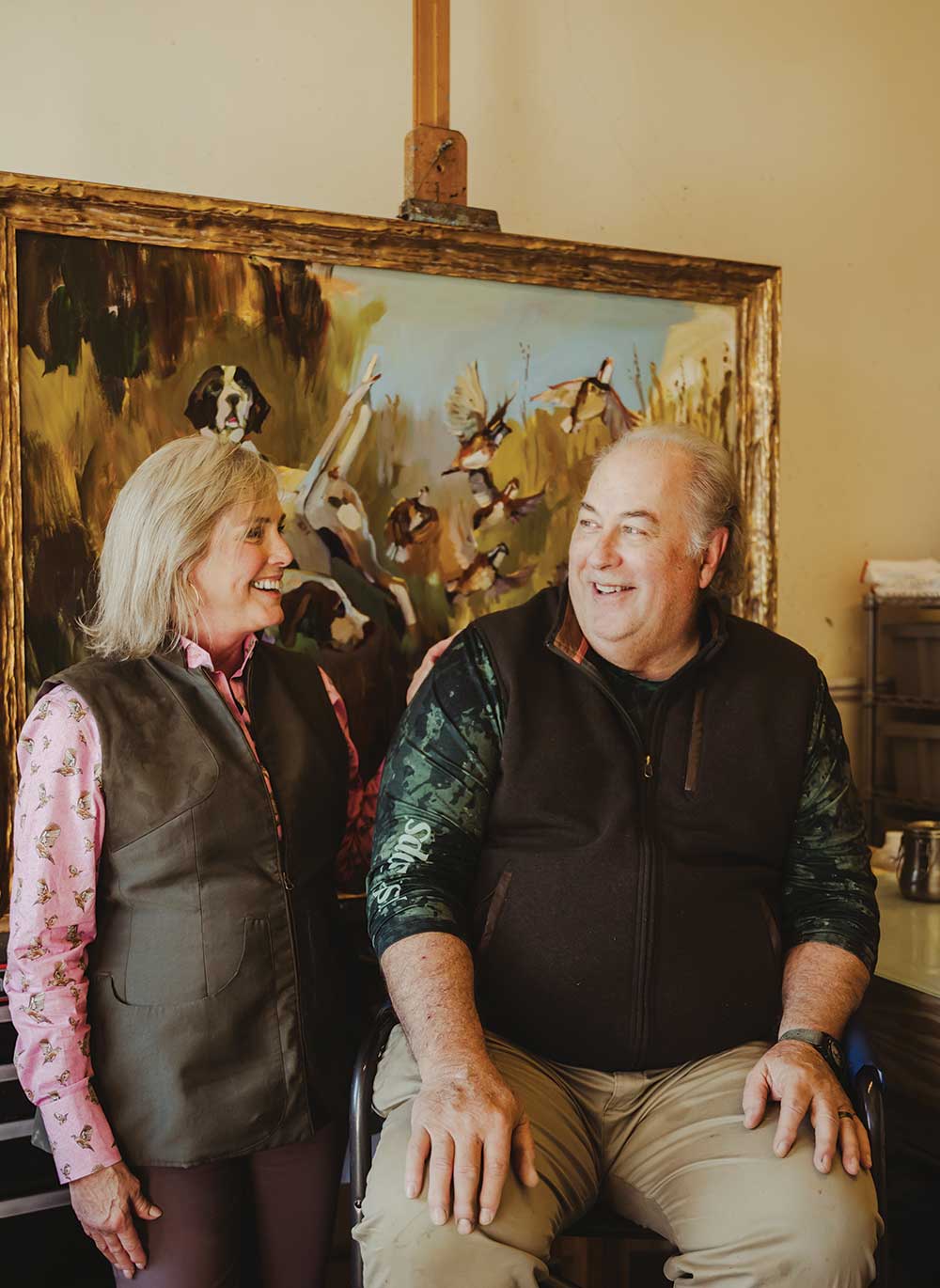
Debbie and Dirk Walker in the Pell City studio

After the visit to the gallery, however, Walker decided to give in to the pull. His first painting was a still life. “It was horrible, looking back on it now,” he said with a laugh.

Still, he took it to back to the gallery to be framed, and Loretta Goodwin, who would become a dear friend and mentor, saw something he didn’t. She asked him who had painted the piece. “I said, ‘I did,’ and she said, ‘Can you do it again?’”

It took him about two years to create something he wanted to show her. “It was the most nerve-wracking experience,” said Walker, who started painting with oils. “I circled the block two or three times because I wanted to throw up I was so nervous.”

The first few times he showed Goodwin his work, she told him, “You’re not quite there, keep trying,” Walker remembered. “I’d tuck tail and go back home and stay at it. Eventually, I got to the point where she thought she could do something with it.”

Goodwin was a tremendous influence on Walker. “She loved the arts, she loved local artists, and she did so much to promote the arts in Birmingham. We formed a deep friendship where we talked as much about the business of art as we did the painting process. It instilled in me a love of both.”

She wasn’t his only influence. Hungry to learn, Walker sought guidance and inspiration from Alabama artists John Lonergan, who taught art at Pell City High School for 25 years, and Tom Black, who grew up in Gadsden and lived in Pell City before moving to Arizona. “I would go up to Tom’s studio and just watch him mix color and see what he’d do. I was too nervous to paint around anyone,” he said.

Walker later met and took workshops from David Leffel and Sherrie McGraw, both artists who taught at the Art Students League of New York. His early style was similar to those who had influenced him – “very much the Old Masters, very much the old Renaissance look,” Walker said. “It was the play of shadows and light, light flowing over objects.”

Still working at the bank while pursuing his art, Walker didn’t have the luxury of painting outside during the day and taking advantage of the natural light. “At night, I’d go down to my studio and set up a still life so I could control the light,” he said.

Walker’s work soon grew a following, and in addition to the Loretta Goodwin Gallery, his art has been featured in eight galleries across the country. When his job went away after a bank merger, Walker bought Goodwin’s gallery, which he owned for 20 years before becoming a full-time artist.

Changing times

Walker, who now lives in Cropwell with Debbie, his wife of eight years, has said that painting “is a lifelong struggle, but one that is well worth the journey.” He said he loves the fact that he continues to grow and change as an artist.

“It’s something you never completely learn,” he said. “I think that’s one of the big appeals for me. Forty years later, I’m still learning and experimenting and making mistakes.”

The artist’s spiritual series stems from his personal faith

In fact, Walker said his willingness to continue to explore techniques and subjects and experiment with color has been a big part of his success. “So many artists just kind of get stuck and they wonder why their art isn’t being accepted the way it was maybe years earlier,” he said. “I learned how to watch what people responded to, and through the years, it impacted how my style changed.”

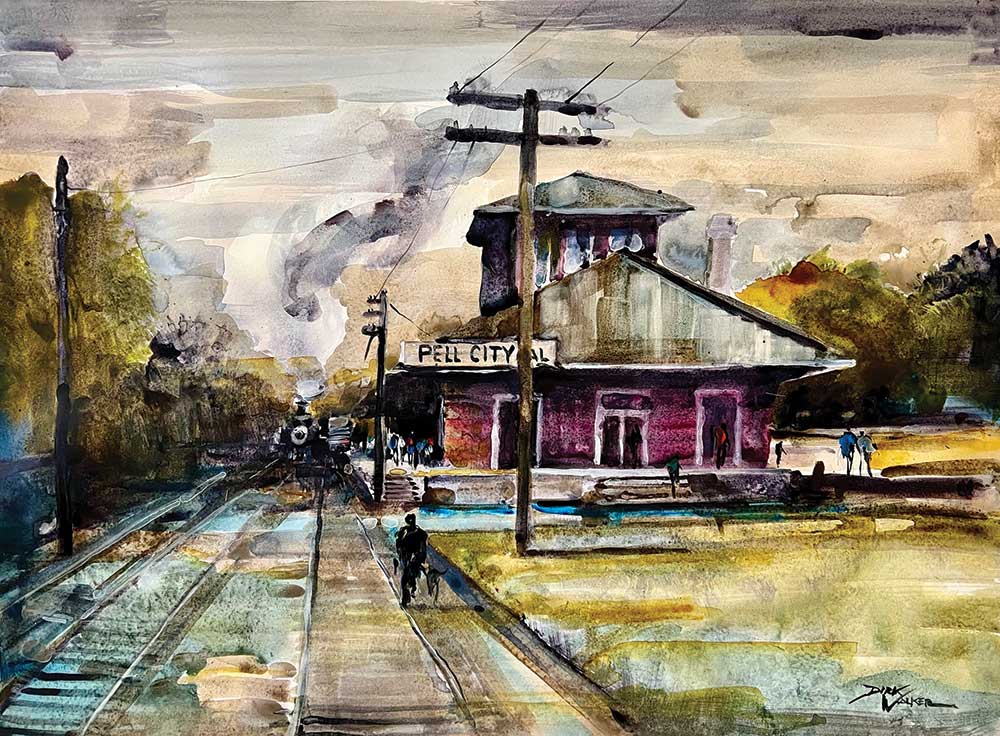
Walker’s portfolio soon expanded to iconic landmarks. His work includes Alabama landmarks like Sloss Furnaces, the Alabama Theatre, Vulcan, the Pell City Depot and the Mobile Bay Lighthouse. He eventually added scenes from Atlanta, as well as places like the Lincoln Memorial, the Brooklyn Bridge and the Eiffel Tower.

“I started off painting very tight, very traditional, and then I wanted to go a little more abstract, a little more impressionistic,” he said, adding that one of the first steps was adding nondescript figures to some of his landmark paintings. “Through the years, I kept pushing in that vein.”

Walker started experimenting with sporting and hunting scenes after his son, Geoffrey, who works in the sporting goods industry, showed his artwork to Kevin and Kathleen Kelly, owners of Kevin’s Fine Outdoor Gear & Apparel. Based in Thomasville, Geogia, it is one of several retailers who represent his work.

“They asked if I ever did hunting scenes, and Geoffrey said, ‘I don’t know; I’ll check,’” Walker said. “He called me that night and said, ‘Dad, I think you need to try doing some hunting scenes.’”

Walker took his son’s advice, and the collection has been wildly popular, thanks in part to his abstract realism style. “I think my style was a really fresh approach,” he said. “Most of the wildlife art you see is very tight, very realistic, very static. Mine was loose and colorful, and I think it caught people at the right time. There’s been a tremendous response to it. It’s just kind of blown my world up.”

Walker, who lived on Logan Martin Lake for years before he and Debbie moved to their gentleman’s farm in Cropwell, has fond memories of fishing and hunting growing up and eventually fishing with his own kids. “We’ve got so many great memories of being on the water,” he said. “That’s one of the really neat things about that genre of work. People connect to it on an emotional level. They want a painting of a dog like they had, or they hunted with their kids. It evokes a lot of memories.”

About four years ago, Kelly approached Walker about doing limited edition prints of some of his paintings. He was reluctant at first, but he realized that people who couldn’t or wouldn’t invest in original art might spend $300 or $400 on a print.

They began offering a line of collector’s closed edition prints, and “we get orders almost every day,” he said. Debbie handles that side of the business, and “it has really broadened our exposure,” Walker said. “Now I get calls to do commissions from all over the country and from other countries, as well.”

Higher calling

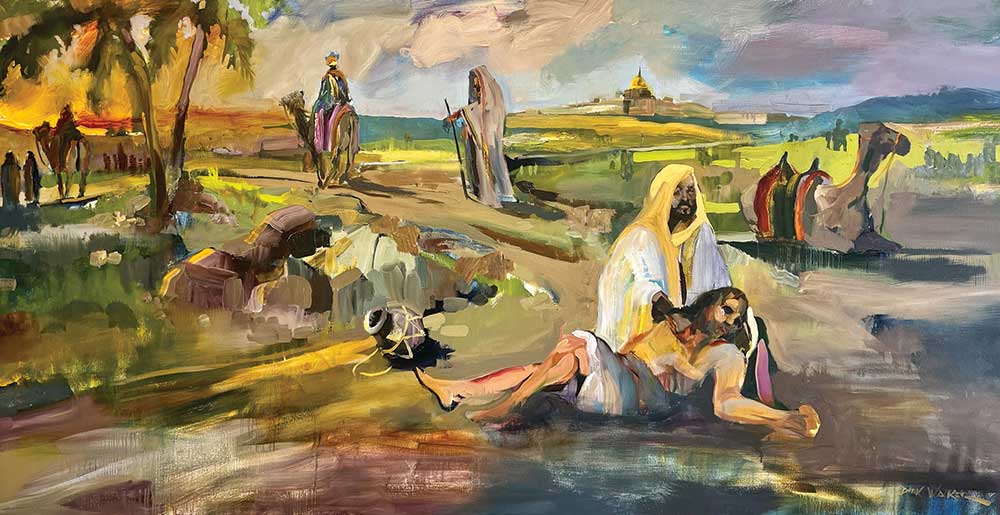
Another series that has been personal for Walker is his spiritual collection, which includes depictions of Jesus’ baptism, the Last Supper, the feeding of the 5,000, and the crucifixion. The series was born of his own personal faith and struggles.

Raised in the church, Walker said “if the doors were open, we were there.” As an adult, he went through a period where he floundered a bit, but “something was calling me back to the church.” Not long after he returned, he felt ta strong desire to paint scenes from the Bible.

“Being a person of faith, I think everyone is given gifts on some level, whether it’s music, art, writing, whatever,” he said. “This is something that’s He’s given me, and it’s a way for me to kind of give back and witness a little about my faith. I try to portray something in a way that might cause someone to want to sit and think, and if it also helps someone else find the Lord or deal with issues, that’s a blessing for both parties.”

Walker spent a lot of time on his spiritual art the past two years after being commissioned by Vestavia Hills Methodist Church to paint a series of scenes portraying the life of Christ according to the Gospel of John. Baptist Health also commissioned artwork for all of its hospitals in Alabama.

He also was commissioned to do several large pieces, including a portrayal of Christ in the Garden of Gethsemane, for collectors in Australia and Germany. The connection was largely the result of his online presence. 

“Without the internet, that never would have happened,” he said. “It’s kind of a God thing. He’s using this voice of mine to reach people literally around the globe. It really makes me very humble and proud.”

A new medium

While he has painted with oils for most of his career, Walker was moved to study a new medium about six years ago when he introduced his bourbon series. “Bourbon is such a collectible thing right now, and they’re a lot of fun to do,” he said of the paintings. “Watercolor is sort of the perfect medium for that subject.”

Walker said he strives to create the same kind of look as his oil paintings – the boldness of color, for example – so his approach is a little different than that of traditional watercolorists. While most watercolors tend to have a lot of transparency, he often uses gouache, which is similar to watercolor, but more opaque. The result is paintings with more dimension and vibrancy. “My technique is a little different in that regard,” he said.

The challenge is part of the allure. “Watercolor is a hard medium,” he said. “I enjoy it equally as much as oil, but I’m still kind of learning as I go.”

Walker, his own toughest critic, has a stack of watercolors in his studio that he has discarded. “You’re never completely satisfied no matter how good a painting might turn out,” he said. “I can go back and look at a painting I did yesterday or 10 years ago and see things I wish I’d done differently. Even to this day I’m frustrated by why one painting works and one doesn’t.”

Finding balance

At 70, Walker has no plans to stop painting. “Debbie and I work really hard at this, and I’m up in the studio almost every day,” he said. “I enjoy it, though, and it’s something I hope I can do for years to come.”

Vintage Pell City train depot, an original painting Walker donated to Museum of Pell City as a fundraiser

They do make time for other pursuits, however. Debbie, who traveled the world in her younger years is trying her best to help Walker catch the travel bug, and being with family will always be a priority for both of them.

Their combined family is a big one. Walker has four children, Debbie has two, and there are nine grandchildren and three great-grandchildren with another on the way. One of his greatest joys has been creating scenes that mean something to them and will be around for generations.

“I’m so proud that my kids have been able to see me develop, although they give me grief about it,” he said. “If they ever think my ego is out of check, they bring me back down to earth. But it’s so cool because they’ve all told me, ‘Dad, you want to give us something for Christmas, give us a piece of your art.’ That, as a parent, is awesome.”

Chances are, there are a lot more Christmas gifts in their future. Walker, who said he can’t see ever retiring, will never get too far from his red Craftsman tool cabinet that holds brushes and paint and other tools of his trade.

“I once read, ‘Art is a delicate balance between the visual concept and each artist’s technique,’” Walker has said. “After years of chasing that artistic balance, it is the anticipation of the struggle that keeps me coming back to the canvas.” l