
A woman of courage and faith
Story by Joe Whitten
Submitted Photos
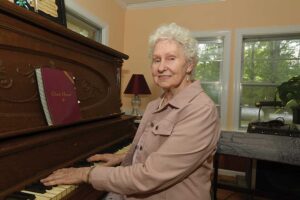
Johnnie Mae Beavers Green may be 95 years old, but her dignified demeanor and perfect posture would make the biblical Queen Esther proud were she still around.
Having lived in the Pell City area for most of her life, Johnnie Mae’s memory is an encyclopedia of local Black history. Tonya Forman expresses loving gratitude for her help in assimilating local history for the Breaking Barriers section of the Museum of Pell City. “Mrs. Johnnie Mae is a treasured source of wisdom and history in our community,” Tonya said.
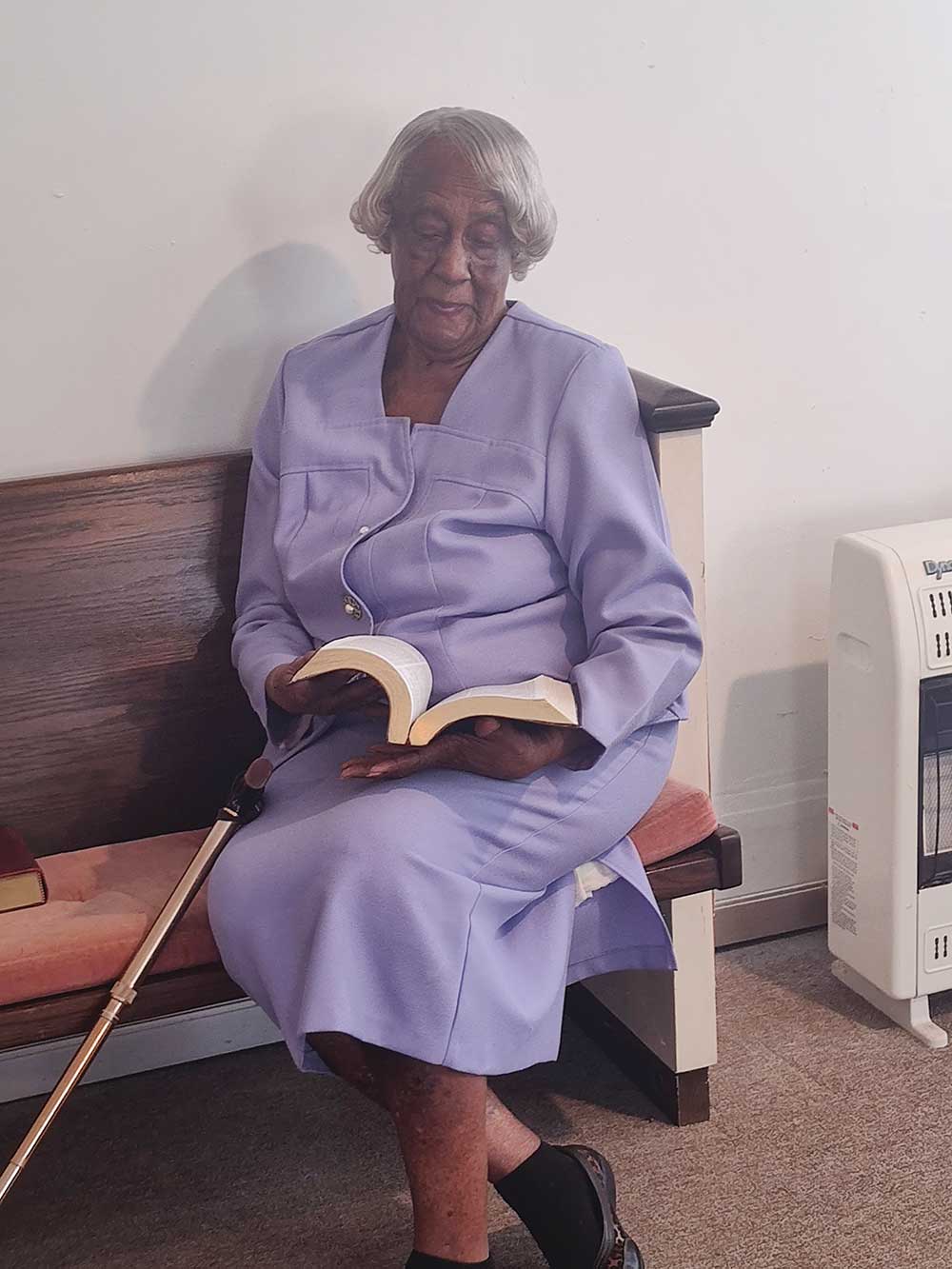
“Her memories and stories preserve the legacy of our families, churches and neighborhoods, helping to connect past generations with the present. She’s my personal historian. I can sit and listen to her talk and sing all day.”
Guided by faith
Known for her faith in God, Johnnie Mae’s life has been guided by the Holy Bible and her faith in the God of the Bible. She has a godly heritage reaching back 200 years in St. Clair County’s African American church history. In the 1895, A History of Colored Baptist in Alabama and North Carolina, Charles Octavius Boothe records a brief biography of her great-great grandfather, Rev. Jasper Beavers.
Born a slave in 1825 in Easonville, Beavers learned to read and to write and became a minister of the Gospel of Jesus Christ. According to family history, Rev. Beavers preached the inaugural sermon at Blooming Light Missionary Baptist Church when it was organized on the first Sunday of July 1884.
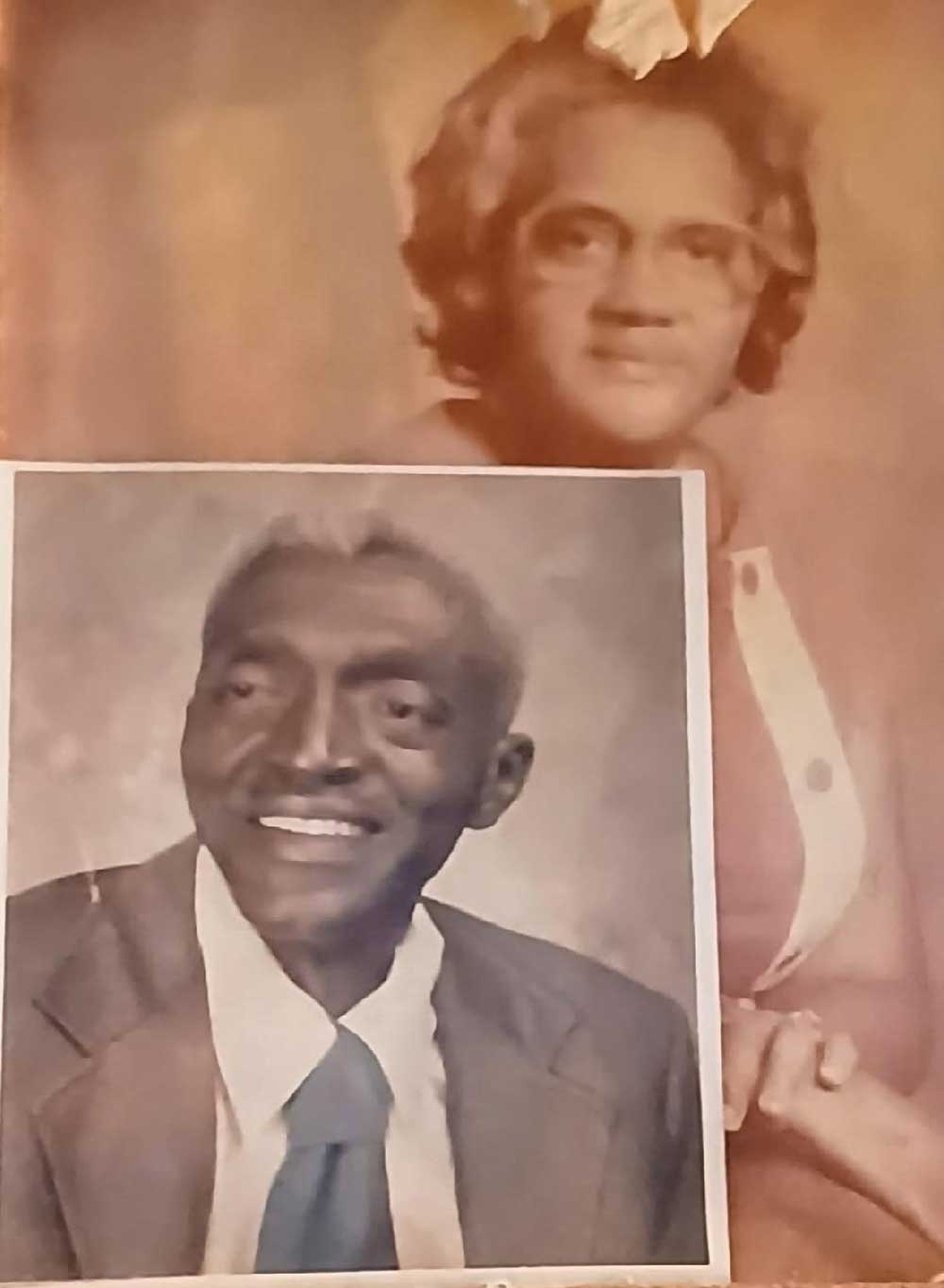
Born July 18, 1930, to Herbert and Elizabeth Gibson Beavers, Johnnie Mae grew up in Tuscaloosa County until she was 13 years old. Her mother was native to Tuscaloosa County while her dad was native to St. Clair County. On Dec. 29, 1942, the family moved to the Crossroads community, south of Pell City.
‘Life was good’
“There were two boys and two girls in our family. I was the third child,” Johnnie Mae recounted recently. “We were share-croppers. We farmed. We raised pigs. We had a good milk cow. And life was good.”
A summer garden produced fresh vegetables as well as produce for canning for the winter months. “You know what we grew it with — fertilized it with? The manure from when they cleaned out the mule stables every year. And that’s how we fertilized the garden.” When a listening friend commented, “You had the best fertilizer in the world,” Johnnie Mae replied, “It grew a lot of grass! The animals ate the grass,” she laughed, “and we had to get it up.”
When asked about the best dish her mother cooked, she quickly replied, “apple cobbler. She could just naturally cook. No recipes.” Then she laughed and confessed, “And I’m gonna tell you the best thing she ever cooked, and that was opossum,” and she told how they prepared it.
“My dad would go hunting at night, and he would catch croaker sacks full. And he had a great big barrel he would put them in and keep them there about a week and feed them until they were fat enough. Then he would kill one. They burnt the hair off and then scraped it down so the skin was clean and pretty.”
After her mother had dressed all the innards out, she boiled it for a while before baking it in the oven with sweet potatoes.
Johnnie Mae declared her mother’s baked possum to be “Good eating,” then laughed and said, “One day me and my sister came home from school, and we ate the whole possum!”
She learned from her mom how to cook them, but by the time she had a home of her own, eating possum was out of style. “I don’t think any of my children ever tasted possum,” she said.
Continuing to reminisce about her mom’s cooking, she said, “Mom could cook almost anything because we had to make do with whatever they had.” One make-do vegetable growing wild in Alabama is the pokeweed that when cooked is called poke sallet. The Beavers family enjoyed it. “Poke sallet was a basic food,” Johnnie Mae recalled. “You could just go and gather that. Mom would clean it. Boil it good. Squeeze it out and rinse it, and then she put it in a skillet with onions. My daddy liked it with onions. Or you could mix it with turnips or other greens. That was a good dish.”
Quilting legacy
Mrs. Beavers also made quilts for winter warmth. And there was some make-do with that as well. When a garment was no longer wearable, Mrs. Beavers would use the garment areas that were still good. Nothing went to waste.
Mrs. Beavers made the girls’ clothes. Many dresses were sewn from colorful feed sack fabric. The girls would go with their dad when he bought feed and choose the sack they wanted for a dress. When enough feed sacks of the same pattern were accumulated, they would have a new dress.
Those vintage feed sacks from the 1940s today sell for between $20 and $45 per sack, depending on the design.
“Mom was a quilter,” Johnnie Mae reflected. “And she used every little scrap she could find. You know we had to find little strings of cloth about an inch or two wide. She would cut a newspaper square and sew the little strips. And when you made a block, you tore the paper off.” Those were called String Quilts and were quite colorful with a kaleidoscope of different fabrics.
Johnnie Mae quilted all her life until she was 90. Then other things took up her time, and “I filled my little quilting room up with junk,” she said. “And I just got it cleaned out so I’m quilting again, and I’m not stopping anymore until the Lord stops me. I can do one a week.”
Growing up
She still lives in the same community and has good memories of growing up there. “It’s a funny thing, but it’s true. All the Blacks were on the Mt. Hillary Church side of Blue Spring Road. And the white families were across over here in their neighborhood. And it was just like one big family. We borrowed, and we visited, and we played together. We didn’t have any problems. So, we named it the Black Crossroads and the White Crossroads,” she laughed, then added, “And the funny thing, we thought we had a little more than they did. And they thought they had more.”
The Crossroads children played games that are now memories to folk of Johnnie Mae’s generation. “We played Auntie Over—throw the ball over a building. We played hopscotch. And jump rope, but I never could jump rope. We played Dropping the Handkerchief. And the number one game was Hide and Go Seek.”
Crossroads was a peaceful community, but when feelings got hurt or a misunderstanding arose, there was a solution. “If you had a falling-out with your neighbor,” Johnnie Mae reflected, “before you went to bed, you had to go and beg pardon of that person. And I thank God for that.” This principle is based on the Bible verse Ephesians 4:26, “Do not let the sun go down upon your anger.”
Such a rule kept harmony among the members of the communities, and Johnnie Mae was oblivious of color differences until one day in Pell City. “Back in the day,” she reminisced, “my daddy would carry us up to town [Pell City] in the wagon. It was summertime, and I got thirsty. I said, ‘I want a drink of water.’ So, we went to where the fountains were, and it said White and Black. Daddy said, ‘Get over there and get you a drink,’ and pointed to the Black fountain. I said, ‘I don’t want no black water, I want clear water. I will never forget that,” she laughed. “I didn’t know anything about segregation until that day.”
After a pause, Johnnie Mae recalled a friend’s deprecating comment about another person’s ethnic background. Then she made a singular observation that deserves contemplation.
“I said, wait. Let’s talk for one minute. Do you think that when God spoke the earth into existence, and then he decided on making man, do you think He went and found brown dirt, red dirt and yellow dirt and made everybody?” Her speech tone was pulpit worthy. “No. He made every single one out of the same dirt. So, how can we put a separation between each other.”
There is silence as she ponders a few seconds and then she laughs, “I’m not gonna lie. There are some good people that are hard to deal with, but I love them … and love is what God teaches.” Again, she reasons from her knowledge of Scripture.
Education
When the Beavers family settled at Crossroads, the children attended The St. Clair County Training School in Pell City, and Johnnie Mae was in the 1947 graduating class. “It was the biggest class that had ever graduated from there,” she recalled. “There were 27 that graduated. What made our class big was that we had kids from Margaret and Acmar in our class.”
She was athletic and played on the Training School’s girls’ basketball team. “We had a great basketball team,” she recounted. “We won all of the little districts’ games. Maxine Jones was our coach. She was the principal’s wife.”
She remembered two of her principals. One was of short stature and without a strong personality. He could not control the students — especially the male students. If a student needed paddling, he would send for his wife who taught at Cropwell at the Greenfield school, and she would hitch up her one-horse wagon, come to the Training School, paddle the student and return to Cropwell.
To solve that problem, the Board of Education sent Professor Ruben Yancey to be principal of the Training School. “When Mr. Ruben Yancey came,” Johnnie Mae recounted, “he grabbed those boys by the collar, and it made a brand-new school. He taught them respect.”
Professor Ruben Yancey ended his career as principal of Ashville Colored High School. Professor Lloyd Newton and the Black community petitioned the St. Clair County Board of Education to rename the school Ruben Yancey High School, which they did in 1965. Sadly, Professor Yancey died shortly before the name change, but he lived and died well-respected by both races.
Life after high school
After graduating high school, Johnnie Mae attended Stillman College in Tuscaloosa for a year-and-a-half. However, she reflected, “The only reason I didn’t stay in college, I knew my parents were not able to send me. There were no student loans. I knew they didn’t have the money, and I came out.”
Determined and courageous young woman that she was, however, she enrolled at Ruth’s Poro School of Beauty in Birmingham and took the six-months course to become a licensed cosmetologist. “It was hard, but God knows I enjoyed it. Cutting and pressing and curling hair.” When she started, that process earned her about $3 per person.
When asked about the location of her shop, Johnnie Mae replied, “I went. I travelled. I did a lot of invalid people — the ones that couldn’t get around.” She paused a moment, then laughing, said, “A friend came to the house yesterday and said, ‘Well, you’re 95 years old, and you’ll soon be up there in heaven fixing mother’s hair.’ And I said, ‘I’m not gonna work when I get up there. I’m gonna sit down and praise the King.” Among the laughter, somebody said, “Amen!”
Kimberly Moore said of Johnnie Mae’s skillful work, “She was excellent with hairdressing. Just about everybody I knew growing up, she pressed and curled their hair!”
In addition to hairdressing, Johnnie Mae worked the looms in two cotton mills. She worked for two months at Avondale Mill in Pell City, then took a job in Talladega at Crown’s Textile. “I had about five less looms to run than I had at Avondale, and I made $5 more an hour. I retired from there.”
Then she explained why she retired. “I drove by myself for seven years. Just me. There wasn’t very much traffic on Highway 34 then. But one night I had a flat tire, and over here at what we call the Twin Bridges, there was an invalid white man lived right on the road. And he heard me out there with my flat tire. He was feeble and on a stick, and he had a big dog and came to where I was.
“Finally some Black folks stopped, and he said, ‘If you all will change the tire, I’m going back to the house.’ But he left his dog there, and he told the dog to lay by my door. Bless his heart! I’m telling you,” she said, with thanksgiving in her voice, “every time I went to work, I stopped and hollered at him. He was dynamic. And that’s why I quit work, cause I thought next time it might be worse.”
She retired from the cotton mill, but she didn’t retire from working. She worked in the kitchen at the Black and White Nursing Home for a while and then at the Rosewood Manor for about four years. She left Rosewood Manor and worked briefly at an assisted living facility on Dry Creek Road; however, that facility had a short life. “They closed down,” she said, “and after tha,t I came home. I stopped working.”
But not really, for she continued to go to women who were confined to their home and dress their hair beautifully. And in that ministry, she spread sunshine and the love of God to the women.
Marriage, family and faith
In 1950, Johnnie Mae married Charlie Darnelle Green from Perry County. They were parents to four children — three boys and one girl. The Greens also took sisters Linda and Wandra Beavers into their home when their mother went to New York to work. Jobs were scarce back in that day.
At home, Johnnie Mae taught her children about God and his love, and they grew up in Mt. Hillary being nurtured by godly ministers there. “I’m so thankful,” she testifies, “that I had good children. They may have fallen out, but they made up and got along.”
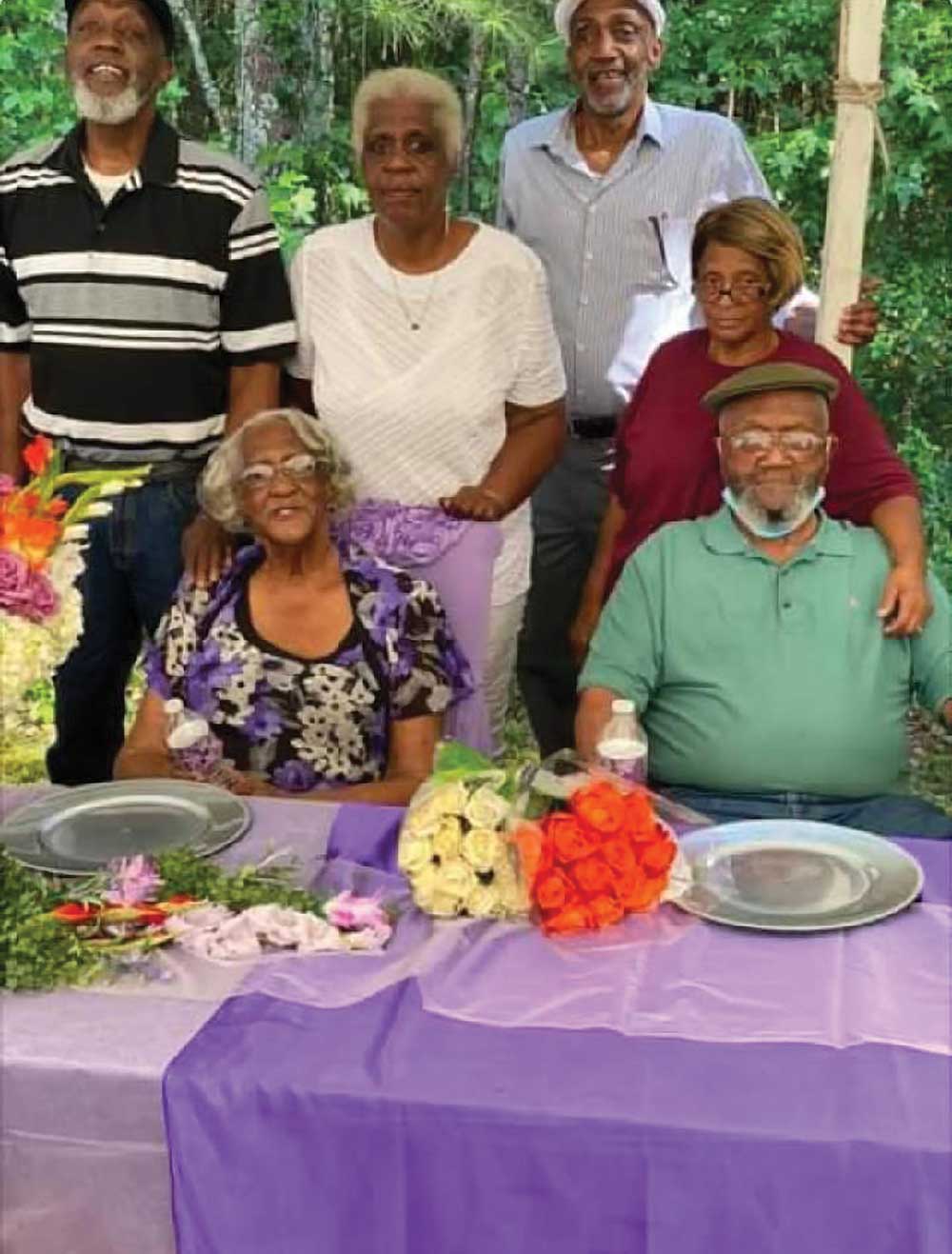
About rearing children, she commented, “I tell you, it don’t cost but just a little to train a child the way you should train ’em. And when they’re old, they won’t depart from it,” quoting from the Bible. Then, reflecting of current troublesome times, she added, “I don’t know about that now. But I don’t think they depart, they just were never trained. Maybe God will fix it one day.”
It is worth noting that the Perry County Green family knew Coretta Scott King, and Johnnie Mae knew her as well. Furthermore, Rev. T. D. Jakes has genealogical connections to the Green family.
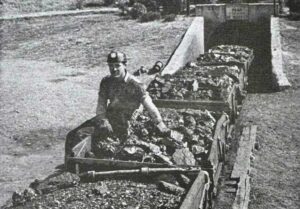
Charlie Green was a miner. When he stopped working in the mines, he took a job at Anniston Army Depot, where he worked until he retired. “It’s been a good life,” Johnnie Mae reflected, “and I don’t regret any of it.”
Mt. Hillary Missionary Baptist Church became her home church about the same time the family moved to Crossroads. Having already been baptized in Tuscaloosa County, Johnnie Mae joined Mt. Hillary in 1944. She told of her baptism as a 7-year-old. “I was baptized in a creek. I was scared of the turtles, and there was a terrapin coming towards me. They had to catch me and put me back in the water!”
When asked if she had sung in the church choir, she replied, “Yes, I did. And we had a little quartet. A little group, The Rose of Sharron Gospel Singers. There were six of us — Mertis Truss — O’Neal was her maiden name — was our musician. Her sister Josie sang with us. I was one of them. Then we had Livi Threatt, Flora Threatt and Nellie Mae Threatt.”
The Rose of Sharron Singers would pray before they went somewhere to sing, for they felt like they were worshiping the Lord through singing.
As she approaches year 96, Johnnie Mae’s faith in God is strong. How has her faith sustained her all these years? “It’s the song I sing all the time, Amazing Grace.” Then she quotes in a strong voice, “Through many dangers, toils and snares, I have already come, God’s grace has brought me safe this far, and grace will lead me home.”
A quietness settles over the room as she comments on her faith. “I told my church the other Sunday, ‘I have one thing to work on.’ They say, ‘What?’ And I say,’ My faith.’ I said, ‘The Scripture says if you have faith the size of a mustard seed, you can tell the mountain, ‘Be ye removed,’ well, I can’t move a stick. But I’m working on I,t and I trust Him. When I get up or when I go to the store, I say, ‘Lord carry me and bring me back.’ He is the only One I have.”
Although she may think her faith is small, her unwavering faith in God inspires many of her family members and friends. And the words of Andrae Crouch‘s hymn “Through It All,” fits her perfectly.
Through it all
Through it all
I’ve learned to trust in Jesus
I’ve learned to trust in God
Through it all
Through it all
I’ve learned to depend upon His word
Oh, I’ve learned to depend upon His word.
Many lives have been blessed by Johnnie Mae’s life and faith and would say, “Amen!” to Kimberly Moore’s loving comments. “For as long as I can remember, my Aunt Johnnie Mae has always been a woman of faith and highly involved in the church. She is the rock of our extended family, and her strong belief in God is what I use as a model for my own life. She has taught me that no matter what happens God is in control … she often says that we have to lean and depend on Him and His word … her unwavering FAITH is a true testament of his AMAZING GRACE.”
Johnnie Mae Beavers Green. Keep on keeping on in your journey of faith. You are an inspiration to your family, your church and your hometown, for through it all you have learned to depend upon God’s Word.