
The music of the Mealer Family Gospel Singers
Story by Joe Whitten
Photos by Wally Bromberg
and Submitted photos
Music sings to all of us, although some genres sing more melodiously than others. This is true with both secular and sacred music. Today’s generation enjoys a different style of church song from that of their parents and grandparents. However, many folks from all generations enjoy Southern Gospel – which originated long before Bill and Gloria Gaither made it an international staple.
The roots of gospel music can be traced to the spirituals composed and sung by 19th Century Southern slaves. For instance, “Swing Low, Sweet Chariot, coming for to carry me home” speaks of the slaves’ longing for freedom from bondage, which seemed to be possible only in eternity with God.
This same theme of escape inspired a farm worker to write “I’ll Fly Away.” In 1928, Albert Brumbley worked on his father’s sharecropping farmland and, according to his son, longed to be somewhere other than picking cotton. (Sharecropper farmers often lived at the mercy of the landowner.)
So, in 1929, the first year of the Great Depression, he wrote “I’ll Fly Away.” It was first recorded in 1932 and became an instant favorite. The slaves sang “I looked over Jordan and what did I see, a band of angels coming after me, coming for to carry me home.” Brumbley sang, “Some glad morning when this life is ‘o’er, I’ll fly away to a home on God’s celestial shore,” expressing the same longing to be free of the troubles of life.
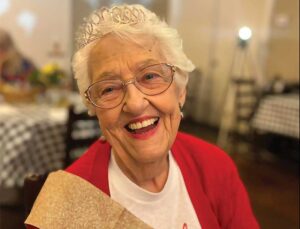
When it comes to “I’ll Fly Away,” Elizabeth “Liz” Mealer’s piano version of the song will have your hands clapping and your feet tapping.
Liz’s musical history begins with her grandparents. The Murphrees moved from Blount County to St. Clair County, and the Wyatts moved from Georgia to St. Clair County, and both families attended Cool Springs Missionary Baptist Church just off Highway 23 between Springville and Ashville. Grandfather Wyatt knew music and taught singing schools.
At Cool Springs Church Willie Mace Murphree met Alice Lucille Wyatt, and Liz described their courtship. “Most everybody walked to church back then or drove a wagon. When my mother and daddy started dating, he would come to her house, and they would walk to church. And my grandmother and granddaddy wouldn’t let them walk by themselves. They had to have the younger sisters and brothers walking with them.”
On those walks to and from church, love budded and blossomed, and on Sept. 10, 1940, the couple went to Rev. George Williams’ home, where they became husband and wife.
Liz recalled a family story: “After they married, they went to tell Daddy’s family. Daddy’s brother said he knew something was different when they drove up, because they were smooching in the car, and that didn’t happen while they were dating.” The marriage lasted for almost 65 years.
To the Murphrees were born Billy, Elizabeth, Linda and Alice, and they all grew up being nurtured by their parents and Cool Springs Baptist Church.
Church is where the three sisters learned to sing and began singing as a trio. Liz reminisced, “We just kinda picked up singing. From singing at church, we learned harmony from people showing us what alto and tenor and the lead, or soprano, was.” So, when Liz was 14, Linda 10, and Alice, 6, they began singing as a trio.
“My granddaddy Wyatt,” Liz recalled, “had always said he wanted a female trio, and he didn’t have three girls. So, he was very proud of my sisters and me when we sang.”
She also recalled when she and her sisters sang and entertained the community when they rode home after gathering vegetables. “My Uncle D.C. Murphree owned land through the woods from Daddy’s. One day he came up to borrow Daddy’s trailer to go and gather vegetables and corn at his field through the woods. So, we three girls got in the trailer and went with him and helped him. On the way back, we started singing. And when we got to the house, my uncle said, ‘Boy, I felt like a King sitting up there driving and you girls singing.’ ”
They later found out that people in the community who lived about a quarter of a mile from each direction had heard them singing and had enjoyed the concert as the vegetable trailer rolled along.
How Liz taught herself to play the piano and read music makes an interesting story. “My Granddaddy Wyatt taught singing schools, and when I was about eight years old, I was at my grandparents’ house one day, and I was picking around on the piano. So, he wrote down the music scales for me and showed me the notes on the piano. That’s when I started trying to learn to play the piano.”
Did she teach herself to read music? “I did. When I had a question, I would ask Granddaddy. He taught me the flats and sharps. Also, my Uncle Ray Wyatt had a piano in his garage that he was not using, so he had it sent up to my mother and daddy’s house for me to practice on. I would practice one thing over and over. I would work on one thing for so long, trying to get it right,” she chuckled, “that sometimes my mother would say, ‘Go find something else to do. I’ve heard that all day long.’”
Those hours of practice made Liz a skillful pianist, a talent she continued to perfect. She recalled playing for Convention Singing, which is a Southern gospel genre unto itself. “Brother T.D. Scott was involved in the Convention style singing at that time, along with Curtis Lee and V.L. Bailey. Around 1971 or ’72, the St. Clair County Singing Convention sponsored a singing school – one week in Pell City and one week down at Moody at the Church of the Valley, and they asked me to be the pianist for that school. That was a really good experience for me, because I learned a lot. There was a lot about music that I didn’t know – and I still don’t,” she laughed, “but it was good for me to learn the techniques pertaining to Convention singing.”
The Murphree Sisters Trio continued through their high school years and for some time afterward. However, when the sisters married and had families of their own, it became more difficult to get together. The named changed to The Murphree Family when sister Linda dropped out and brother Billy Murphree started with the group.
Liz married Paul Mealer, and he also sang with The Murphree Family. Eventually Billy dropped out and the Sunrise Trio evolved with Paul, Liz and son-in-law C.T. Watters. This group continued until COVID brought about C.T.’s death. The Mealer children and Liz then formed The Mealer Family gospel group. Paul sang until his death in 2012.
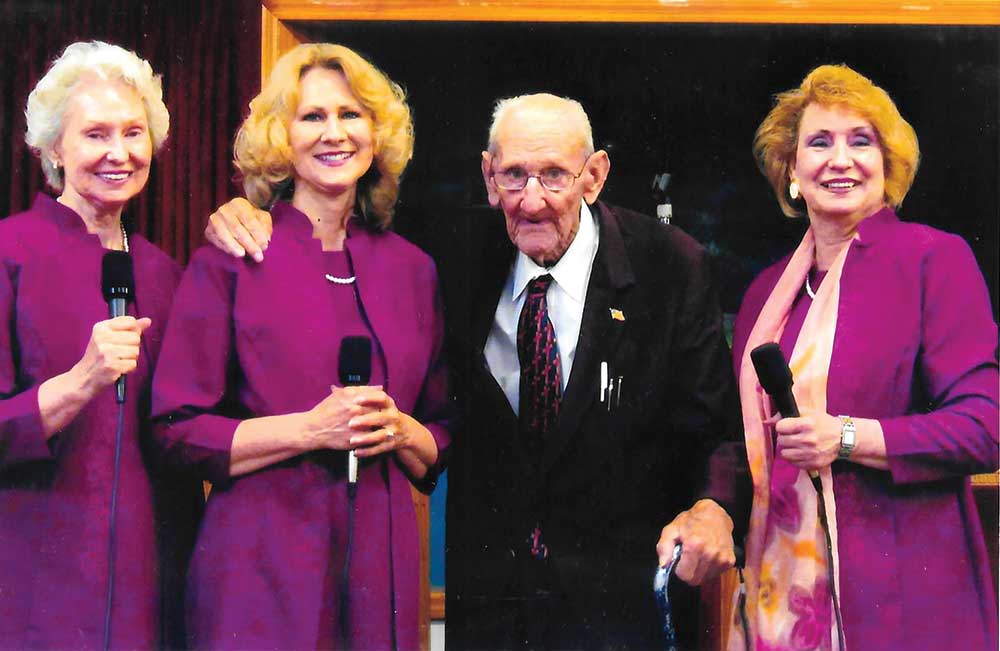
The Murphree Family and the Sunrise Trio sang not only in St. Clair County but also in surrounding counties as they became well-known.
“We traveled some, when my husband was alive,” she said. “God blessed us with obtaining a bus, and we traveled to Georgia, Tennessee and some in North Carolina and a lot in Alabama.” Since Paul’s death, the Mealer Family has sung locally.
Paul usually drove the bus and was given the nickname “Possum Killer” because so many possums were frozen in place by the glare of the bus’ headlights.
Whatever the name of the group, their mission was to sing the gospel of Jesus Christ wherever they were invited. Many rural churches had a yearly Homecoming Sunday, and the group became regulars at these events. They also enjoyed singing for revival meetings.
Liz recalls a special revival. “We were singing for a revival at Bethany on County Road 22 in Shoal Creek Valley. We had sung, and the preaching was finished, and they had given the altar call. I was playing the piano with my back toward the congregation.” (At an altar call, those who desire to pray or those seeking salvation come to the front and kneel in prayer in front of the pulpit.) “I was playing softly while people were praying,” Liz continued, “and one of our group came up to me and said, ‘You know who they’re praying for, don’t you?’ I said, ‘No, I don’t.’ And he said, ‘It’s your granddaughter.’ So, Wayne’s daughter had come up to the altar for salvation, and I didn’t know it.” That was a happy occasion and happy memory for all the family.
Even in church services or revival meetings funny things can happen – sometimes proving that God has a sense of humor.
“We were at a small church one time in another county. It was their Homecoming, and we were on stage singing, and we kept seeing a head popping up and down behind a bench. They had spotted a mouse, and the preacher, who was very short, was trying to kill the mouse, and his head bobbed up and down as he chased it.” When asked if she remembered what they were singing, Liz laughed and said, “No. In fact, I think we got so tickled that we had to stop.”
The recollections continue. “Once at a church in north Alabama, there were two wicker containers beside the pulpit. And our guys shook them to make sure they didn’t have any rattlesnakes in them. They agreed that if the baskets rattled, we would not participate in that service,” Liz concluded with a laugh.
And children can cause spontaneous laughter. Wayne Mealer, being a guitarist, had given his little son a little guitar which he took along to singings with his dad and family. “We were singing at St. Clair Springs Baptist Church this time,” Liz reminisced, “and my grandson, Cody, about 4 or 5 years old, had a toy guitar and a harmonica. Of course, he wanted to play his guitar as we sang. So, he just stood up there, you know, and he was really getting into it with his guitar; he was going back and forth, when all of a sudden, he pulled that harmonica out of his pocket and started playing it.”
Laughing at the memory, Liz admitted, “There was just no way the Holy Spirit could move then, because everybody in the church was just doubled over laughing.”
However, let’s not forget that Jesus said, “Let the little children come to me, for of such is the Kingdom of Heaven.” It is quite likely that God was smiling down at her grandson.
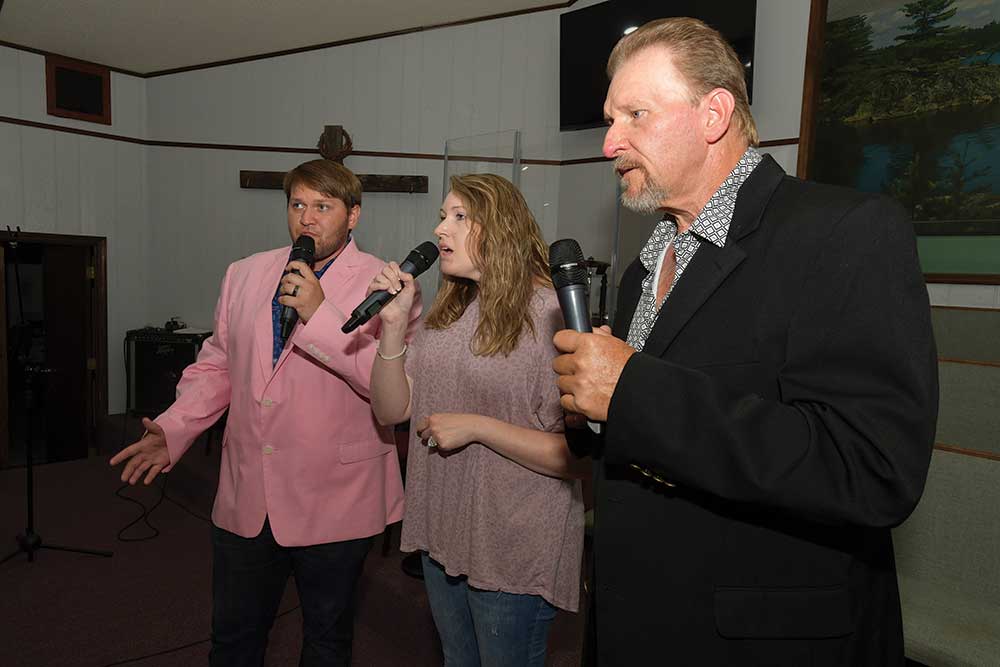
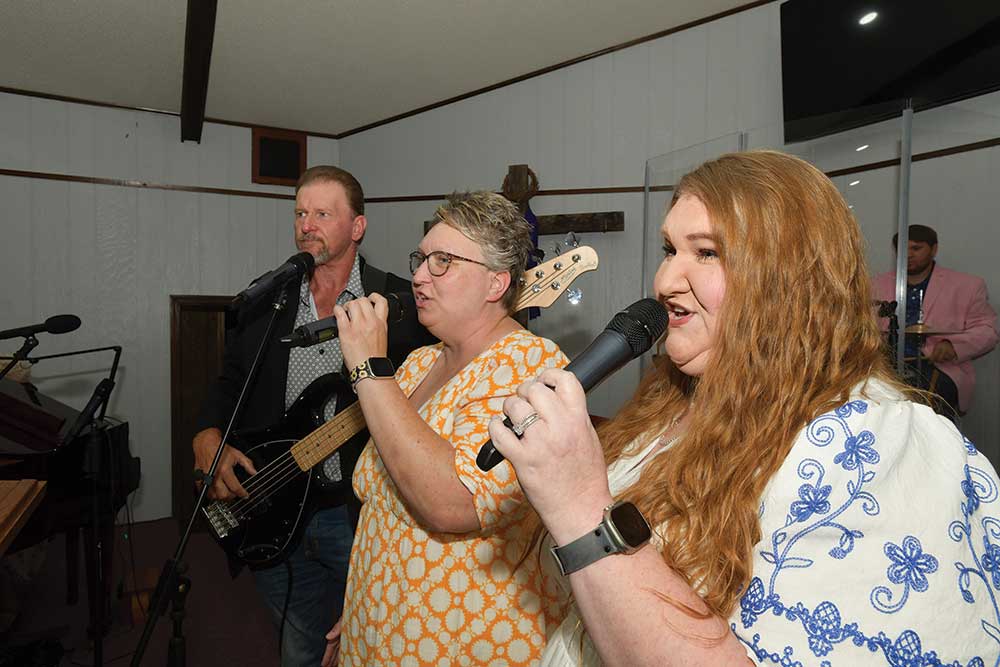
The current group consists of the Mealer children: Wayne, Sharon and Christie who sing. Terry Chapman plays bass guitar, Wayne’s son, Cody – who got his start with a toy guitar and harmonica – plays drums. Terry and Cody also sing occasionally as does Wayne’s daughter, Amber. A faithful friend, Brandon Jones, often goes with the group to help with sound equipment.
Where career paths lead
After graduating from St. Clair County High School in 1965, Liz attended a business college in Birmingham, which eventually resulted in her working in the two St. Clair County courthouses. However, her first job was with Baggett Transportation Company in Birmingham. And on a lunch break from this job, she and Paul Mealer had their first date.
Liz recounts how this came about. “My daddy worked at United Chair in Leeds, and Paul’s cousin worked there with my daddy. They wanted me to meet his cousin who had just moved here from California. So, he called me and we talked, and then we met one day for lunch at Shoney’s, which was close to where I worked. And that’s how we started dating.” They married in 1967 and the marriage lasted until Paul’s death in 2012. They had three children: Paul Wayne, Sharon Elizabeth and Christina “Christie” Lynn.
Working in Ashville, courthouses
In the winter of 1975, an attorney who had recently moved to Ashville needed an office worker. Liz applied and got the job. In filing documents and doing research at the courthouse, Liz got to know those working there. And although she stopped working for the attorney in 1977 to be a stay-at-home mom, it was this job that eventually led to Liz’s courthouse work.
She took care of home and family until daughter Christie was in the third grade, and not until then did she feel free to return to outside work.
Liz knew Circuit Clerk Jean Browning from local singing events as well as from the years she worked in the Ashville attorney’s office. Knowing that Liz was interested in returning to work, Jean encouraged her to take the state test to qualify to work in the courthouse.
She took the test, passed it, and was on the official list of available workers. In 1991, Jean had an opening in the Circuit Clerk’s office. Liz applied and was hired.
Stories unfold there, too. A friend of hers was doing research in the Probate Judge’s office where old newspapers, estate records, etc., were housed until they were moved to the Ashville Museum and Archives.
The friend showed up in the Clerk’s office and said, “Liz, I had to tell this to somebody and you’re it. I was copying newspaper articles and a researcher from out-of-state turned to me and said, ‘Where is the town of Crapwell?’ Without cracking a grin, I managed to tell her, ‘That’s Cropwell, and it’s below Pell City,’ but I had to tell somebody so I could laugh out loud.” Liz confessed the two still laugh about it today.
Liz worked in the Circuit Clerk’s office until 2003. In that year, she began working in the Revenue Commissioner’s office where she worked until she retired in 2017. During her time there, she was elected Revenue Commissioner.
She divided her time between Ashville and Pell City and was fortunate to be in Ashville when a sudden weather event occurred in February 2010. This was after Paul had become incapacitated and homebound. Liz hired someone to stay with him in the daytime while she worked, and then she took care of him at night and on weekends.
This February morning seemed to go well. “They had not predicted any severe weather,” Liz recalled. “But then, all of a sudden, it began to freeze, I told those who lived furthest away from the courthouse to go on home. The bad weather got closer to us, and I told everybody to go home.”
Liz herself made it home to Paul safely, but she admits “It was treacherous. “I just crept along. It was about eight and a half miles from my house to the Ashville Courthouse, and I drove about 25 miles an hour all the way home.” Other courthouse workers that day got home by firetruck or police car.
A woman of faith
The care and concern for her work staff reveals Liz’s character formed at home, at church, and through her Christian faith. When asked about her faith in God, she told how it began. “I was saved when I was six years old. Brother George Williams was preaching the revival at Cool Springs that year, and we had daytime and nighttime services, and in the morning service on Friday of the revival, Brother Williams gave the invitation to accept Christ as Savior. I felt the drawing of the Holy Spirit. He must have said, ‘If anyone feels like they needed to be saved, raise your hand,’ because I remember raising my hand, and my mother saying, ‘Raise it high.’ I went up to the altar and was saved at six years old.”
However, she wasn’t baptized until three years later at the Cool Springs Baptist Church’s baptizing pool in Canoe Creek on John Ramsey’s property.
Liz described baptizing day at the creek. “The day before baptizing, Brother John Ramsey, a deacon, would build steps to go down into the creek. Then on Sunday before baptizing began, he would go into the creek and slash around and scare the snakes away.” Those reading this account will agree that this was an act of Christian compassion and love.
Other deacons would gather in the creek behind the pastor during the baptism. Liz’s father was one of those deacons when she was baptized.
“Baptizing was usually in August after revival,” Liz reminisced, “and usually there were several people saved in the services, so we would have a big baptizing. We would all gather down at the creek – and it was so pretty there. We would sing a song or two acapella. Nearly always we sang ‘Shall We Gather at the River,’ and maybe another one or two.”
As far as anyone knows, the Canoe Creek snakes were non-religious and never participated in a Cool Springs baptism.
Through all the changes that have come through the years, Liz’s faith has sustained her. And as a gospel singer, she loves many songs, such as “Who am I that a King would bleed and die for,” or “Hold to God’s unchanging hand,” or “The Old Rugged Cross.”
One that is especially meaningful to her is “The Unseen Hand,” referencing that although we cannot see God, He is leading His children through the joyful days and sorrowful days of this world.
There is an unseen hand to me
That leads through ways I cannot see.
While going through this world of woe,
This hand still leads me as I go.
I’m trusting to the unseen hand
That guides me through this weary land,
And some sweet day, I’ll reach the strand,
Still guided by God’s unseen hand.
One who rests in such a faith, faces life with a steadfast confidence in God. l