
Key part of Chandler Mountain’s rare natural beauty
Story by Paul South
Photos by Mackenzie Free
Sometimes nature’s miracles enter our hearts, souls and minds with a bang, like the colors of the Northern Lights, or the Hale-Bopp comet piercing a blue-black sky as it did late in the last century. Both phenomena are greeted by “ooohs” and “aaahhhs,” wows or wordless, wide-eyed wonder.
But more often, time and the elements combine quietly with nature to create something magnificent and mystical.
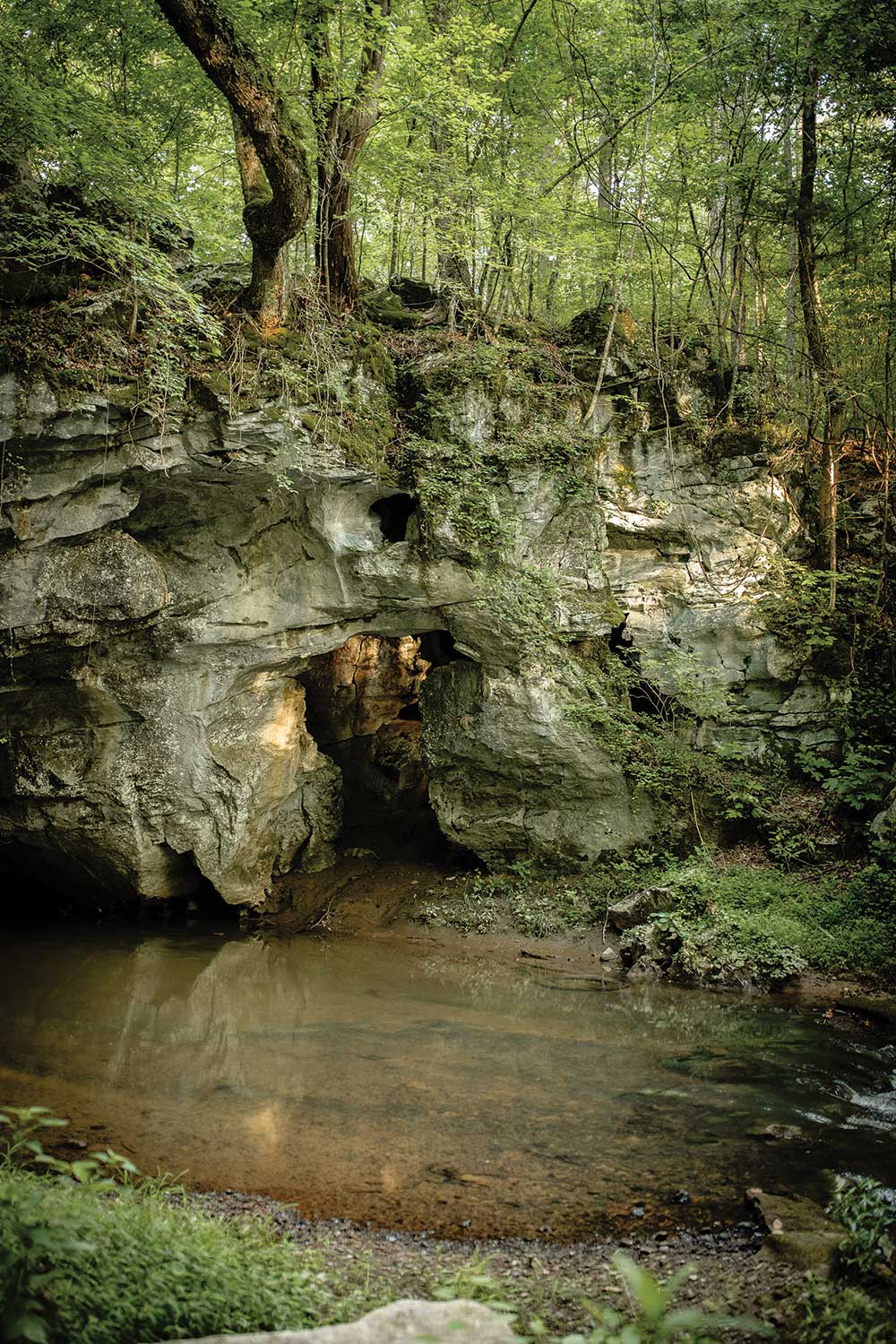
So, it is with the Chandler Natural Bridge, a place known simply as The Rock Bridge. Located near the base of Chandler Mountain that forms part of the St. Clair-Etowah County line, the natural bridge is one of six named natural bridges and two unnamed spans in Alabama, according to the Natural Arch and Bridge Society.
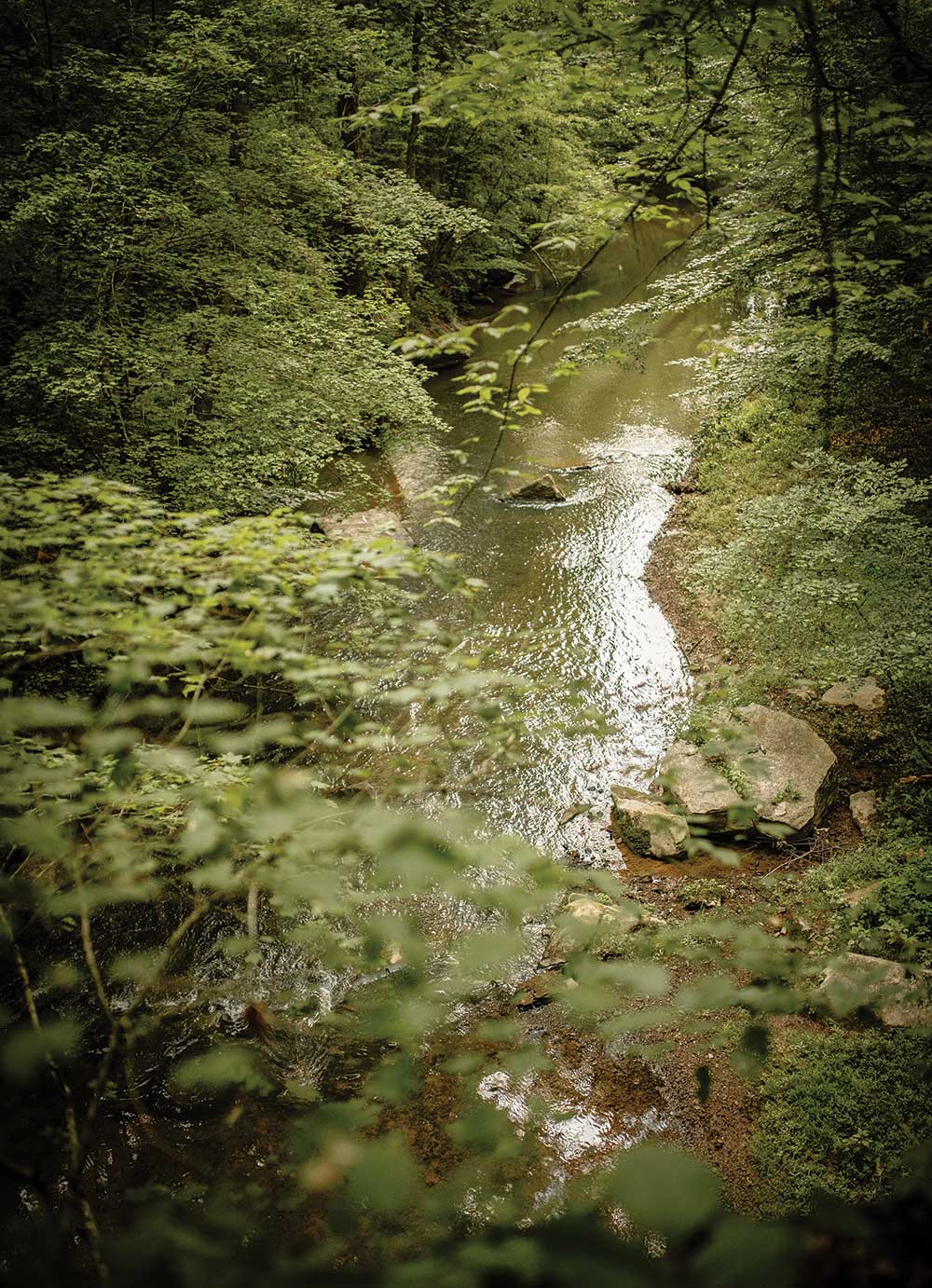
The Rock Bridge spans Little Canoe Creek. It’s 48 feet long, 54 feet wide and 17 feet thick. The top part of the span is made from Gaspar Limestone. Wind and water erosion sculpted the bridge over millions of years.
Since 2003, Save Chandler Mountain, a nonprofit advocacy group for the mountain, has worked to protect the Alabama’s third-largest peak, which is known as the “Tomato Capital of the World.”
Fran Summerlin, founder and president of the advocacy group, has a special place in her heart for the mountain and for the Rock Bridge. She holds dear childhood memories of her brother taking her to see the bridge when she was only five.
“It was fascinating, I’d never seen anything like it. It was wonderful.”
What made it fascinating?
“There was a big rock that looked like a bridge,” Summerlin said.
“When you think of natural bridges all over the country, they’re always revered,” she said. “People love going and seeing them. (The Rock Bridge) was formed by water, and it’s a fascinating place.”
She talks of Alabama Power Company’s unsuccessful plans two years ago to build a hydroelectric dam there, a move that drew vocal opposition from residents, environmentalists and Native American groups. “If the power company project had gone on, it (the bridge) would have been covered with water,” Summerlin said. “It would have been lost.”
In August 2023, Alabama Power withdrew its application to the Federal Energy Regulatory Commission to operate a Pumped Storage Hyrdro facility at Chandler Mountain.
Locals now have a heightened sense of the mountain’s importance. Darrell Hyatt, too, has precious memories of the bridge – picnics, swimming in the creek and exploring the area. “It should be a state park,” Hyatt said. “It’s beyond comprehension that anyone would consider destroying it.”
Summerlin said Save Chandler Mountain is continuing to research the area and work to find historical and archaeological treasures on the mountain. “We will continue to do that and continue to hope that (the utility) would come to some conclusion that the land needs to be preserved.”
Seth Penn is an environmental and political activist and enrolled citizen of the Cherokee Tribe of Northeast Alabama. While he couldn’t speak specifically about the significance of the Rock Bridge to indigenous peoples, generally speaking, natural arches and bridges often have sacred meaning for Native American tribes, who often see natural bridges as portals to the upper and lower spiritual worlds.
“I don’t know a lot of specifics about that specific natural bridge itself to really give you a lot of insight,” Penn said. “I can tell you that a lot of natural bridges … and special occurring rock features such as that which occur on the landscape are often seen as portal-type places, meaning they are significant to various indigenous tribes. And often, those are places where certain ceremonies or prayers will be conducted because they do believe sites like that have special spiritual significance.”
Rich Beckman, Knight Chair of Journalism Emeritus at the University of Miami (FL), is president of the nonprofit Natural Arch and Bridge Society. Formed in 1968, the 200-member organization works to protect natural arches and bridges and promote the study, appreciation and preservation of the natural structures.
While the NABS is small compared to other environmental groups like the Sierra Club, Beckman said the organization can “raise a ruckus” when natural treasures like the Rock Bridge are threatened.
“We don’t preserve natural arches, but we do try to help them live out their life cycle without abuse,” he wrote in an e-mail. “So, we are concerned about any planned or criminal destruction by man.”
The NABS joined locals and indigenous peoples to oppose an Alabama Power plan to build a hydroelectric power facility on Chandler Mountain, a proposal opponents of the plan argued would flood Chandler Mountain and leave the natural bridge underwater.
In the face of opposition, the utility withdrew its Federal Energy Regulatory Commission permit request and shelved the proposal, at least for now.
“We certainly let the utility know of our disapproval,” Beckman wrote. “(The Alabama Power proposal) would have been a disaster.”
The land where the bridge resides is fenced off by Alabama Power and closed to the public.
However, a portion of the utility-owned land on the mountain is open to hunters under Alabama Power’s hunting license program.
In an email, company spokesman Joey Blackwell wrote, “Through this program, parcels of land across the state are awarded through a public auction program,” Blackwell wrote. “Once a hunting license is awarded to a particular hunting club, the property can only be hunted by its members and guests.”
The utility makes some of its land holdings available for public use, including public access points across 13 reservoirs in partnership with local and state agencies, Blackwell said. The hunting license program is one of those initiatives.
Blackwell defended Alabama Power’s land use practices. “Alabama Power manages its St. Clair and Etowah County property holdings in the same way we work to be good stewards of land across out state,” Blackwell wrote. “Alabama is one of the most biodiverse states in the country, and experts in forestry, biology and wetlands management work together to protect our natural resources.”
Meanwhile, Save Chandler Mountain’s preservation work continues. How can citizens get involved?
“There’s power in numbers,” Summerlin said. “They could join Save Chandler Mountain, get on our Facebook page. We continue to strive to preserve this land. Just get involved with us.”
Hyatt said the mountain and the Chandler Natural Bridge are important, not to be taken for granted. “I was in awe of it, even as a child,” he said. “I didn’t really appreciate this place then as much as I do now. The older I get, the more it means.”
What would Summerlin want people who had never seen the Chandler Natural Bridge to know about the span?
“It Is s magical place,” she said. “It deserves to be preserved. In fact, all of this community and this area deserve to be preserved because it is a holy place for the Cherokees. It has incredible historical significance, not just for the indigenous people, but with, for example President Andrew Jackson took the land and either sold it or granted deeds to people.”
Some descendants of those original recipients still have those deeds, Summerlin said.
“This is a very historically significant, culturally significant, and I would like to say, it’s a sacred place.” l
Editor’s Note: For more information about Save Chandler Mountain, contact Fran Summerlin at fransummerlin@att.net, or visit the Save Chandler Mountain Facebook page or on the organization’s website, savechandlermountain.com. Dues are $20 annually.m to keep our programming fresh, giving people a reason to come and come back again to discover our rich history.”