Generations of Business

Harbison’s Tire and Auto Service
Sylvia’s Birdbath and Beyond

Story by Elaine Hobson Miller
Photos by Graham Hadley

On the surface, automobile tires and motor oil have absolutely nothing in common with bird baths and concrete statuary. In Argo, however, they are the products of two independent, family-owned shops that share a similar history.

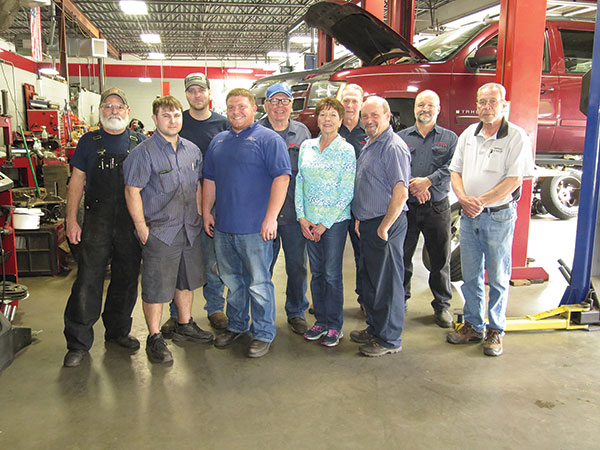
Harbison’s Tire & Auto Service is owned and operated by the Harbison brothers, who brought their dad’s 46-year-old shop to Argo from Roebuck in 2006.

Sylvia’s Birdbath & Beyond is owned and operated by Sylvia Johnson, who sold her grandfather’s concrete statuary at the Mini Market she and husband Jerry ran near Trussville before opening at her current Argo location.

Each business represents three generations of family involvement. Combined, they’ve been serving the people of east Birmingham and St. Clair County for almost 100 years.

The late Jack Harbison, a former airline mechanic, founded Harbison Automotive Service in 1960 in a two-bay Texaco service station in the Birmingham community of East Lake. He pumped gas for his customers and did small automotive repair services. He also washed cars, repaired flat tires and handled local road service duties.

Each of his four sons was introduced into the business during his teenage years, and three still run the place today. Their only sister, Charlotte, joined them in 1997 when she retired from a real estate career.

The business moved two times while in Birmingham, its last location being a six-bay repair shop in Roebuck. The Argo facility, located at 769 Highway 11, is a full-service, eight-bay auto repair shop and retail tire center operated like Jack Harbison taught his family.

“We care about our customers,” says Brandon Harbison, the oldest brother. “We take care of our customers’ cars as if they were our own.”

The Harbisons left Roebuck because their customers were moving toward Trussville and Springville, and business was going down. After the move, many of those customers began drifting back. “Some of them had died, but their kids are coming in now,” Brandon says.

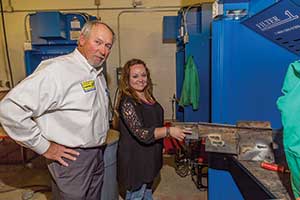
He and his brothers, Frankie and Kim, are proud of the fact that Harbison’s was the fourth independent auto repair shop in the state to get a computerized tire machine, called a Hunter Revolution, that does not touch the wheel while removing or mounting a tire. “We got it two or three years ago,” Brandon says.

Ricky Harbison is the only brother who didn’t stay in the automotive business. A third generation is involved and may take over when his dad and uncles retire.

“My son, Brady, has worked with us for 13 years, since he finished automotive school at Walker State Technical College,” Brandon says. “His wife, Candace, will be taking over administrative duties when Charlotte leaves this Spring. She’s retiring to live near her grandchildren in North Carolina.”

Harbison’s waiting area doesn’t smell of oil and grease, and the seats aren’t torn from old automobiles. “We provide an attractive and comfortable waiting area for customers with television and free WiFi,” says Charlotte. “We always have coffee and doughnuts, too.”

One of the perks of working for Harbison’s is a home-cooked breakfast and lunch each day. When matriarch Juanita Harbison was alive, she cooked them in the shop’s full-size kitchen and break room, wearing a red apron embroidered with her nickname, “Ettamomma.” (The name was the result of a grandson who couldn’t pronounce “Juanita.”) It wasn’t unusual for customers in the waiting room to be invited to these meals. Since Mrs. Harbison died in 2015, Frankie has taken over breakfast duties, and Charlotte prepares the lunches. It’s up-in-the air as to who will take over lunch duties when Charlotte leaves.

“I’ve been trading here since they came to Argo,” says customer Bob Norcross, who sweeps the shop each morning to “earn” his breakfast. “They have a real combination of old school and new school, and they live by the first rule of retail, ‘Treat everybody like you would like to be treated.’ It’s the only place I’d let my wife take her car by herself.”

Harbison’s is open Monday through Friday from 7 a.m. until 6 p.m., but has a key drop-box so customers can leave their cars after hours. Envelopes for the keys provide a place for customers to describe the service needed.

Another family legacy in Argo

Just as the center of Harbison’s business is family, the same holds true for another Argo mainstay – Sylvia’s Birdbath and Beyond. Sylvia Johnson’s sister, Hazel Harper, swears that if you were to cut Sylvia, the owner, she would bleed concrete. It’s because the material has been in her bloodline since her grandparents made concrete yard art in Maryville, Tennessee.
She and her husband, Jerry, ran Egg-A-Day, which became the Mini Market, on U.S. 11 between Trussville and Argo for 28 years. They sold the concrete yard art her parents made in a chicken house behind the convenience store. They shut that store down in 2004, then opened Sylvia’s Birdbath & Beyond at the intersection of the Argo-Margaret Road and Farm Lake Road. The name of her business was the suggestion of a customer.

“I bought my mom and dad’s molds, but I don’t cast anymore,” Sylvia says. “I buy from family members in Tennessee that still cast them and during road trips around the country. Casting is a hard job because of the weight, even though the pieces are cast in sections.” Jerry found some of the old molds in their basement, however, and may start casting ducks, pigeons and other small birds himself.

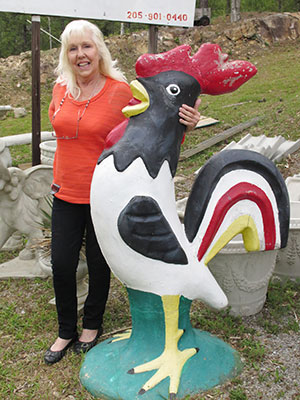
The giant painted, concrete rooster standing guard near one of her entrances has been Sylvia’s trademark for 40 years. Her aunt and uncle in Tennessee made him and two others. Sylvia sold one and gave the third to Hazel, who has cast a few pieces of concrete herself. “I’ve mixed it, poured it, took it out of molds,” she says.

Sylvia and Hazel painted the rooster, whose likeness appears on Sylvia’s business cards. “People stop and want to buy him, but he’s not for sale,” she says. “I have had two or three people say their mom has a photo of them on that rooster from when they were kids.”

The statuaries are displayed by theme, so the fairies, gargoyles and dragons are in one area, bunnies occupy another area, planters, picnic tables and fountains still another. You’ll also find a dog land, and a section devoted to elephants, tigers and other college team mascots. Her western section has steer skulls, horses and cowboys, while an occupational section features men in military uniforms, coal miners, pilots and police.

Scattered throughout the yard and spilling onto the driveway to her house (she lives next door) are gnomes, benches, crosses, stepping stones, concrete cacti, a small T-Rex, pet stones (for graves), a pink elephant and a 5’5” tall statue of Jesus. There’s also a small replica of Michael Angelo’s “David,” with a battered cloth fig leaf Sylvia added so customers won’t blush at the statue’s nakedness. “Everybody has to peek under that fig leaf, though,” Sylvia says, laughing heartily. Of course, there are several bird baths, and two shops of gifts and decor for inside the home.

Interspersed among the concrete yard art are plants in repurposed sinks and teapots, as well as traditional clay pots. The soft sounds of trickling water emanate from several fountains, and water plants thrive in the gaily-painted galvanized tubs Sylvia formerly used for live bait. “I was known as the ‘bait woman’ at the Mini Market and here, too, until 2015,” Sylvia says. “I stopped selling bait because my hours weren’t good for fishermen, who like to get up early.”

Sylvia’s Birdbath & Beyond is open from 10 a.m. until 5 p.m. Tuesday through Saturday, but people often stop and browse when she’s closed, Sylvia says. “The only time we’re open on Sunday is during our annual Mother’s Day sale.”

New Movie Theater and More

Buffalo Wild Wings & Theater Just the Beginning

Story by Graham Hadley
Contributed art

When it comes to the local economy, growth builds growth.

That is exactly what is happening along the I-20 corridor in Pell City. What started with a simple gas station at the I-20 and US 231 interchange has grown into something of a retail and dining mecca, now boasting big box stores like Wal Mart and Home Depot, a full shopping center and a number of restaurants.

The most recent of which, Buffalo Wild Wings, opened its doors in November and has continued to see a steady stream of business ever since.

According to developer Bill Ellison, that is exactly the kind of restaurant Pell City residents have been asking for — something he, along with the city, the EDC, county and other agencies have been working years to make happen.

And aside from giving people living in Pell City and surrounding areas one more quality dining option, Ellison said it is important in another way.

“This is a very big deal,” he said. When restaurants like Buffalo Wild Wings locate in an area and succeed, it is a bellwether of the economic health of a region that other companies look at when considering places to locate.

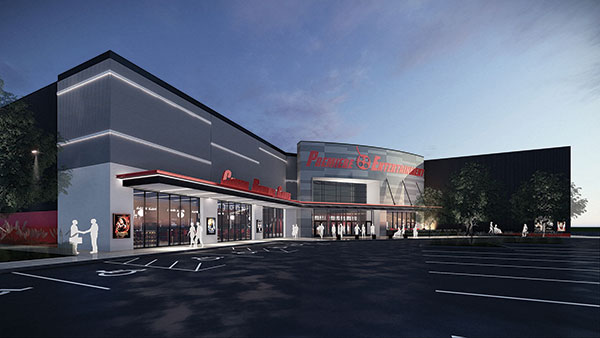
When businesses like that come to an area, it puts it on the map for other businesses, like the movie theater and bowling alley under construction right around the corner from Buffalo Wild Wings.

“The fact that Buffalo Wild Wings was coming said something about the community, that there was enough business here to support that. It all works together,” Ellison said.

Following closely on the heels of Buffalo Wild Wings, Premiere Cinemas is in the process of building a massive entertainment complex consisting of a movie theater, bowling alley and arcade, entertainment space, café and concessions.

The multi-million-dollar project has been years in the making and is something that Ellison and others involved say the Pell City community had been hoping for over the past decade or more.

“This is going to be huge,” Ellison said. “I have seen the plans, and they far exceed anything we expected to be able to do for Pell City.”

It will not only stand as a major quality-of-life improvement for Pell City residents, “it is going to bring more people to Pell City; it is going to bring more people to spend their money in Pell City.

“It will keep people here. Kids won’t have to drive on Interstate 20 to go to movies or eat out. People can stay in Pell City on weekends to have fun.”

Premiere Cinemas is an excellent company to be working with, he added, and they are cutting no corners with this project.

“We are fortunate to have a company like this coming to Pell City. This theater is going to be as nice any anything around, any theater in Birmingham,” Ellison said.
And just like Buffalo Wild Wings, the theater and entertainment complex is expected to be another big indicator that Pell City is ripe for new business growth.

“I think there are at least 100,000 people out there who will come to the cinema and bowling lanes,” he said.

“Not every town gets a movie theater and bowling lanes. Getting that in here means there is a large enough population to support it. People will drive long distances to come to something like this.”

Ellison was quick to point out that neither of these projects would have been a reality if it weren’t for the receptive atmosphere of the economic environment in Pell City, from the cooperative efforts with local government to the passing of the seven-day liquor sales.

“This has been a three or four-year project. Everyone has worked hard … then it all came together. We all worked to bring it in. It is something the community has been asking for for years, and we all made it happen,” Ellison said. “Everybody is really excited, the whole community is. It’s fantastic.

Workforce Development

workforce-development

Programs changing lives, building business

Story by Graham Hadley
Photos by Michael Callahan and Graham Hadley

A decade ago, if you were a high school student in Alabama, chances are, all eyes were on what was touted as the ultimate prize – a four-year college degree.

But about that same time, employers across the state and the country started noticing how lean the labor pool was for skilled workers, whether it was a metal fabricator, carpenter, certified nursing assistant, pharmacy tech or paralegal.

We were literally “running out of skilled labor,” said Garrison Steel owner John Garrison.

An immediate response was needed, particularly in Alabama, if we were going to remain economically competitive.

“As we were getting graduating seniors, we could not get students who needed to do what we needed them to do. They were worried about graduating students who were going to college and not about students who needed a job,” said Jason Goodgame, vice president at Goodgame Company. “Some students don’t need to go straight to college. They need to work.”

St. Clair County and Pell City were particularly in a prime position to address the problem — all the pieces were already in place. Goodgame, Garrison and other businesses like Ford Meter Box, working with the Economic Development Council, the Pell City School System and Jefferson State Community College, began to develop a plan, actually a series of initiatives, to help identify and train students starting in high school or immediately after graduation to fill the ever-growing gaps in the workforce.

“We need brick masons, electricians, plumbers, and really, for us, people who can be a jack-of-all-trades: put down a foundation, frame out a door, a bit of everything,” Goodgame said.

“So we passed a measure to tax ourselves, the businesses that needed the employees, to educate these students that we need.”

The initial results, spurred on by the growing demand for workers as the economy recovered, were varied. From training schools in Birmingham to the iCademy next to Jefferson State Community College in Pell City to new initiatives and classes in the school system — often involving spending part of the school day doing on-the-job training.

“We want students who are coming out of high school to have entry-level skills,” Garrison said. “… Beyond high school, we want them to come into our companies and continue training with post-secondary schools and with on-site training at our facility by skilled instructors.”

As business owners from all areas of the Pell City economy — heavy manufacturing to medical, food, legal and other professional services — stepped up to the plate to help with training and hiring the students, the Pell City School System responded in kind.

“We just have students who are being matched up with specific career interests. The program gives them the opportunity to try out career fields before committing to study through two- and four-year schools,” said Kim Williams, curriculum coordinator for Pell City schools.

“And we are getting the students partnered with people who are passionate about what they are teaching – places like Garrsion Steel, Goodgame, Ford Meter Box,” Superintendent Michael Barber added. “… It is one generation of workers training the next. Whether it is health care, business, construction, kids are getting excited. It’s very meaningful.”

The original varied workforce-training programs are starting to work together under a more unified structure, with coordination coming from both the state and local levels.

“Where we are headed is merging these programs back together,” Goodgame said.

That means better coordination between the school system and the business community and better job placement for students and recent graduates. Williams even serves on the Industrial Development Board, a sign of the close partnership between schools and the business community.

According to all involved, it is a win-win proposition: The businesses get job-ready workers, and students have the ability to go right into the workforce, earn a real living wage, receive training with room for upward mobility and, if they want, continue their education, often without incurring the heavy debt loads students going straight to college do.

Good Job, Good Life


Blake

Blake White, a member of the 2015 graduating class at Pell City High School, is in his second year at Ford Meter Box. The first year he worked there was during his senior year of high school.

And according to Blake, things could not be going better. He has a good job that he likes, he is training and has already moved up the ladder, he is still attending college, and he is earning more money than he dreamed possible right out of high school.

“If I work here full time, they will pay for college — tuition, books, the whole nine yards.”

He already had a scholarship to Jeff State, but that does not cover everything, especially living expenses. Blake always knew he would have to work after graduation to pay those expenses, but before doing co-op at Ford Meter Box, he expected to go to school full time and work fast food or some similar job like many of his friends.

Instead, he works full time and goes to school part time, opening multiple options for his future.

“It was an easy choice, college for two years and have all those expenses, or work, earn money and have someone pay for school,” Blake said.

“I really like working with my hands. I started at the bottom as a flange washer, but now I am in maintenance — I fix things,” he said.

Along the way, he is learning a wide range of skills. Already a natural mechanic, he is picking up electrical skills along the way, something he says may help if he pursues a degree in electrical engineering or similar field.

And starting as the low man on the totem pole was no problem for Blake — it means he gets to train under people who know the business and to work with people he likes.

“Never settle for where you are at. Do whatever needs doing. You can make it to the top, but you have got to pay your dues,” he said. He is working on his core classes for his two-year degree, and the jury is still out on where he goes from there, whether he stays in the business or starts on some kind of engineering degree.

“In a place like this, you can go as far as you want to go if you are willing to put in the time and work hard for it,” he said.


C.C.

From his first day on the job at Garrison Steel, Charles Clellon “C.C.” Watson was getting training from one of the best. Now he helps estimate the cost for putting up the buildings. He has only been there two and a half years.

C.C. graduated with a degree in communication from Mississippi State in 2013 — a time when the communication industry was lean on jobs.

At first “I wanted to do physical therapy school. My father-in-law was a project manager here and said they were looking for another erector estimator. John Garrison hired me on a 60-to-90-day trial to see if I was the right person for the job, plus training for about a year.

“My family has always been in the construction industry, but not the steel industry. I came in here pretty much blind and had to learn from scratch,” he said.

“All the training was on the site. From the first day, John opened up a set of drawings. He taught me what everything was, from what each piece of steel costs to sizing construction cranes. And then I went out into the field to do more training there.”

Quick to point out he is making much more money than he probably would have with his communication degree, C.C. says despite the change in professional direction, he is very happy with where he has landed.

“After I got out of college, this was the last thing I thought I would be doing, but I love what I am doing. I have always been really good at math, so this is right up my alley. This is a very competitive industry, so your numbers have to be spot-on to get the contract.

“This has opened up a ton of new doors to new successes for me. Garrison is a great place to work. It has given me options for new jobs here — or anywhere — in the future in the construction industry.”

And though he could go elsewhere with his new training, C.C. is happy where he is now.

“I will stay here as long as they let me. I live in Oxford. It’s an easy drive. John is a great boss. Everyone here is great, and the company is moving in a great direction.”


Cody

Like many of his co-workers at Garrison, Ragland graduate Cody Poe first heard about a job through a friend who already worked there.

“A buddy of mine who was a welder called and told me they were looking for a burn-table operator — it’s a CNC plasma machine that burns parts out of plates. That takes training and skill to operate,” he said.

He had originally wanted to be a State Trooper, but things have worked out well at Garrison.

“When I started out, Mr. Garrison was impressed with my work ethic. He pulled me off the floor and is training me to do steel purchasing for the company.

“I came in and proved myself, and doors opened for me. They are talking about sending me to class, but there is also lots of hands-on training from the guy who has been doing it all his life. He took me under his wing, showing me the ins and outs.

That training is an essential part of what has made the whole process such a success.

“Garrison believes in training. When you are first hired, they stick you with an experienced person. You stick with that person until they say you have enough experience to be working by yourself,” he said.

For Cody, that has helped lay the foundation for the rest of his life.

“It has given me financial security. I moved out on my own. I got to buy a vehicle on my own. It’s a jump start on my future. I live about 5 miles from here. It is really great. I don’t ever plan on leaving. I plan on staying here as long as I can.

“You have got to come in and prove yourself, come in and want to work. Give it all you have got to get the job done.

“I came in, gave it my all, and it paid off,” he said.


Lauren

Pre-med Auburn student Lauren Luker already had a good idea what she wanted to do with her life when she graduated from Pell City High School in 2015, thanks in part to workforce training at Pell City Internal and Family Medicine her senior year and during the summers after graduation.

“I heard about it from other students who had jobs or who were interning for things like physical therapy. I asked the teacher. I had to fill out a lot of forms and get permission,” she said.

The initial work fit nicely with her senior schedule, leaving plenty of time for school, extracurricular activities and a social life.

“Dr. (Rick) Jotani was the one who gave me the chance and let me do this. I left every day about 2 and stayed until around 4 p.m. It was really good because it started during school,” Lauren said.

The initial school training program was unpaid, but that soon changed.

“I was not paid during the first internship. Then in May, right before I stopped, they asked if I was interested in continuing over the summer. That was paid. So was this summer.

“It’s been really nice. They have been so good to me. They really want me to learn. They have taken a chance on me, always asking if I want to learn to do new things. I have been in the business office, checking people in,” she said, pointing out those are sides of a medical practice usually not covered in medical school.

“This lets me see how a practice works, lets me see that side of things. This reinforced what I wanted to do. When you are in college, everything is so hard, it is difficult to see the big picture. When you get back here, you see what the end goal is.”


Good workers, Good business

Jim Ford, human resources manager for Ford Meter Box in Pell City, believes everything they are doing in workforce development is an investment, not only in his business, but in the local economy as well.

“We are doing anything we can to help get the idea out that education is important – not just four-year, but technical training, too — something that gets them a good-paying job,” he said. “We pay 100 percent if our people will commit their time to school as long as they pass. It grows our workforce and our community.

“That is a tenet of Ford Meter Box as a whole.

“It means a sustainable workforce for us in the long run. We think it makes our community better. It brings in jobs and keeps jobs here,” he said.

And an educated and skilled workforce helps people like St. Clair Economic Development Council Executive Director Don Smith bring in better-paying jobs.

“It’s a cooperative effort. We are glad to do it and hope it continues,” Ford said.

Smith agreed, pointing out the beginnings of workforce development go back years, first with the iCademy, now with new classes at Jeff State and Pell City High School and on-the-job training at businesses across the area.

“At the end of the day, companies are going to come where the people have the skillsets they need. Whether it is high school, a two-year or four-year college, if you are producing students, giving them the opportunities to learn those skillsets, then those companies are going to come,” he said.

In fact, that is one of the first questions a prospective business asks about when considering locating somewhere. Having a skilled and trained workforce and a training program in place is essential.

“It’s a great recruitment tool,” said Jason Roberts, assistant director with the St. Clair EDC and someone Smith credits with much of the success of the workforce training program.

The workforce development effort could not have come soon enough for Roberts.

“In the recent past, schools did their own thing, and their objective was usually four-year college or bust. But the reality is, in our community, we have many jobs and fields where the skilled working population is retiring, getting older, and there is no one ready to backfill those positions,” he said.

Some fields, like truck driving, are so in demand that employees willing to put in the time can earn six figures a year.

“You can get those truck driving jobs all day long. The same is true for welders, plumbers and electricians,” he said.

Now, with everyone working together, the workforce development program is helping the EDC take St. Clair County business recruitment to the next level.

“Now everyone is trying to connect. We have let education know companies and businesses are buyers of their products — educated students – and there is a big push to get people trained to fill these gaps in the workforce,” Roberts said.

“It’s essential to business recruiting, especially here, because we have proof of product — students in place at businesses here. It’s the No. 1 driving force when companies are looking at an area,” he said.

“They know their employees are going to make their company successful.”

Hazelwood’s Greenhouses & Nursery

hazelwood-staff

A quarter century
of growing nature’s
beauty in St. Clair

Story by Carol Pappas
Photos by Susan Wall

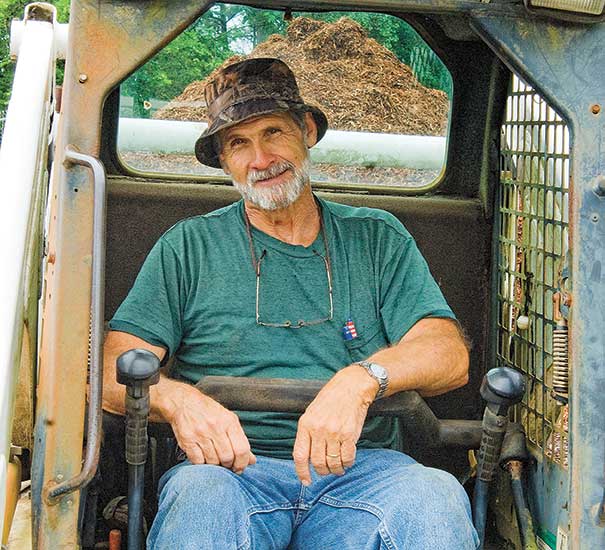
John Hazelwood squinted as a streak of sunlight parted cloudy skies above, accentuating the creases in his face – the unmistakable signature of a man whose earned them in a lifetime spent outdoors.

It is outside at Hazelwood’s Greenhouses and Nursery where he feels comfortable, fulfilled, surrounded by the flowers, plants, shrubs and trees he has grown. And all the while, he has nurtured a business others can enjoy, too.

Hazelwood-Nursery-OwnerFor more than a quarter of a century, Hazelwood has been doing what came natural to him – digging in the dirt, planting a seed and watching his creations grow. He grew up on a nearby farm of his family’s, and his chores including gardening. Was he always interested in growing? Not necessarily. “My daddy took an interest in me growing things,” Hazelwood mused. “I had seven brothers and two sisters. He made sure we had plenty of work to do.”

The farm where he once labored as a boy has now become growing fields for the business he built a greenhouse at a time.

Atop a hillside in Pell City, almost hidden from view of passersby, is Hazelwood’s, the business that has become a tradition around these parts. His colorful handiwork at Mt. Zion Church is a hint you’re getting close. With a chuckle, he calls it his billboard, but it really is a ministry of his.

After high school, he enlisted in the U.S. Navy, intending to be an X-ray technician. But after four years, he figured he could pursue his future education on the GI Bill rather than re-enlist for another four years. “I figured out what I liked and what I didn’t like,” and as life has its usual twists and turns, he wound up at Auburn University, majoring in Agribusiness Education instead.

He taught in Lee County and in Odenville and eventually made his way to what is now John Pope Eden Career Technical School. He was principal his last 13 years before retiring in 2001.

Throughout his education career, he dabbled in growing. “I thought I would do a little on the side and raise some ferns,” he recalls. He bought an 80 x 25-foot, used tomato greenhouse and grew 400 ferns that year – 1985.

The manager at TG & Y, an old department store in Pell City, told him he would take them all at wholesale, but the deal fell through. He managed to sell them all, though, and people started asking if he could grow other plants. “It started snowballing,” he said.

In a couple of years, he bought another used tomato greenhouse, then another, and the business just kept coming…and growing.

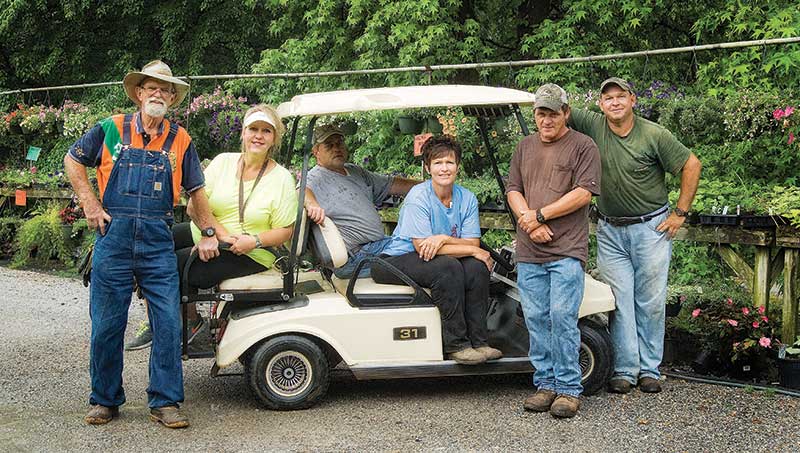
In the early 1990s, he hired Harold Fairchilds, who was in the high school cooperative program. That was 25 years ago. He has been with Hazelwood ever since. So has Harold’s sister, Becky. Gayla, another sister, started a couple of years after that.

The Fairchilds siblings make up most of Hazelwood’s greenhouses and nursery ‘family,’ and he credits them significantly with the business’ success. “I can’t replace those three,” said Hazelwood. “I’d have to close up. I don’t know how I’d do it.”

The Fairchilds moved to Pell City from Missouri and a farming background, according to Becky. “At the time, it was a job. I didn’t know I would fall in love with it.”

The same holds true for Harold. “I guess I’m just comfortable here. I like being outside doing something I enjoy daily.”

And Gayla’s assessment isn’t far from her brother’s and sister’s. “Obviously, I love it, or I wouldn’t keep doing it,” she said. “I like the outdoors. I love flowers, and I love color.” It was a perfect match for her family and for Hazelwood’s. “It was the closest we could get to farming,” she said.

Harold clarified: “It’s farming in pots.”

Changing with times

Over the years, as the Hazelwood hillside landscape changed – more greenhouses and cold frame houses and rows and rows of plants, flowers and trees – the business has changed as well. Choices grew quickly. “There are so many new plants,” Hazelwood said. “There are hundreds of new varieties every year. There are new colors, new Hazelwoods-nurseryeverything. There are a couple of thousand petunias.”

Where people used to prune hedges, they now want landscape that is low or no maintenance. They pick dwarf plants. “They just don’t have time like they used to.”

But fortunately, he added, “people still like to plant trees, shrubs and flowers.” And their one constant is Hazelwood’s.

As for competition from big box stores, “we just decided to do a better job, have more quality plants at a good price and try to keep customers happy and satisfied.”

You’ll get no argument there from John and Helen Golden. They’ve been shopping at Hazelwood’s from nearly the beginning. “We’ve been buying plants here for our garden for years and years,” Golden recalls. Their favorite? “Roses,” they say, almost in unison, much like the way they talk about their shared experience at Hazelwood’s.

It’s like family serving family. It’s a trust factor, an ever ready smile and a helping hand, and one would be hard-pressed to replicate the chemistry they have with each other and with their customers. “They have good plants, and they are good people,” Golden said. “Becky is really good.”

Becky is easy to spot. She is always moving, whether it’s on foot or in a golf cart. You’ll see her toting a bag of potting soil, a plant or a cartful of essentials for the garden, all the while greeting customers with a deep South charm that belies her Missouri roots. Her attentiveness to customer service is unmistakable.

Gayla is much the same way, chattering away to customers as she creates beautiful container gardens. “I’m happiest when I’m creating,” she says. Even a work in progress seems to be good enough to buy. Her work table sign warns customers: “Please do not take plants off the table.” They seem to snatch them up as if they were a finished product, and the perfectionist in Gayla isn’t about to let them go too early.

Down in the lower part of the property, you’ll find Harold watering and watching over plants, trees and shrubs as if they were his children. “We just had a handful of shrubs when I started,” he says. Now they stretch as far as the eye can see on the property. “If you don’t like the heat, this is not the job for you. If you don’t like to get dirty, this isn’t the job for you,” he says. As for him, it’s definitely the job he loves. “I guess I’m just comfortable.”

In addition to Hazelwood’s extended family, his daughters, Shelly Martin and Kelly Staples, grew up working at the nursery. Shelly even pursued a career in landscape design after graduation from Auburn and does design work in Birmingham communities like Liberty Park as well as Pell City and surrounding areas.

Hazelwood does some landscape design work himself and is quick to offer advice to customers when needed. “Fall is the time to do landscaping,” he says. Like the Goldens, he has his favorites, too: Podacarpus for shrub; any variety of begonias for bloom; and “the old Magnolia” for a tree.

As Hazelwood looks around at the bustle of activity on this spring afternoon, recounting the journey that led him to a thriving business, he notes, “It’s something that just kind of happened. I didn’t intend to do it at all. It just grew out of starting something. I’ve been blessed. The Lord had something to do with it.”

A new generation

welding-pell-city-high-school-1

Cooperative effort key to training skilled labor force

Story by Graham Hadley
Photos by Michael Callahan and Graham Hadley

In this technological and professional age, it is easy for students — and parents and teachers — to focus heavily on high-profile skills involving computers, programming, electronics and web design or to place students on narrow education tracks with the ultimate goal of receiving at least a four-year college degree.

But as the baby-boomer generation retires, so will a large portion of the industrial- and construction-skilled workforce.

And that poses a huge problem, not just for Alabama, but for the rest of the United States as well.

It’s a problem business owners, working in conjunction with educators in Alabama at the high school and post-secondary levels, are hoping to reverse — and to do so in such a way that helps retain students in school and make sure they have a solid foundation to succeed after graduation.

Changing workforce needs

Pell City’s Garrison Steel owner John Garrison speculates his is the last generation of workers trained by previous masters in such essential skills as welding, fitting, plumbing, electrical work and similar fields.

A combination of factors has steered the country away from the kind of apprentice-style training that Garrison and other construction and industrial leaders say is so essential to key economic sectors of the workforce.

When he was first starting out in the business, training in industrial construction, unions were strong and Americans tended to buy American.

skilled-jobs-training-pell-city-garrison“By and large, the unions to a large degree as far as construction, trained the generation I represent,” Garrison said. That was in the late 1960s.

But soon the unions started to lose traction to non-union businesses.

Today, he estimates the unions — and their highly skilled multi-generational employees — only represent 10, maybe 11 percent of the industrial workforce in the United States.

And then there was the image of working in construction or factories. Before the government, through organizations like OSHA, started putting a premium on safe working conditions, construction and manufacturing jobs were dangerous. Those workers wanted something better and safer for their children and often pushed them to pursue a college education.

Garrison said that attitude, combined with a similar government view with initiatives like No Child Left Behind, have gutted the skilled labor force.

“We are going to run out of skilled workers — they predicted that in the 1990s,” Garrison said. “And we are seeing that now.”

The shortage actually caught something of a break during the recent spate of recessions because the demand for those employees was low.

But as the economy continues to turn the corner, the demand for welders, electricians, plumbers and their skilled coworkers is on the rise.

And companies are finding it increasingly difficult to fill those positions, Garrison said.

Multifaceted Problem;
Multifaceted Solution

At the same time the skilled labor gap was growing, so were dropout rates in public schools. The new one-size-fits-all approach to education was not working for many students — teens who were capable of succeeding but who had no interest in pursuing a four-year degree right out of high school.

The solution to both problems lies in working together, agreed Garrison and Pell City Schools Superintendent Dr. Michael Barber.

“We are working to redefine what a successful student is,” Barber said. “What we have to be is very careful to look at all careers, all professions.

“College is important, but there are students who don’t want to go to a four-year college. That’s not where their talent and skills are and not where they want to go. But they can still go out into the workforce and make a great living.

“We want to bring comprehensiveness to their educational experiences. Pull back the curtain and let them see what is out there,” he said.

To do that, the high school, businesses like Garrison Steel and Goodgame Company, and community colleges like Jefferson State are working hand-in-hand to give exactly those students the job experience, the training and exposure to the real-world work environment to put them on the path to success.

What started with industry-backed programs, like the construction-focused Go Build Alabama, has expanded exponentially to include a wide variety of needed skill sets. Students can start earning certification and training toward jobs in everything from medicine — certified nursing assistants and pharmacy assistants — to police and firefighters through the Bridge School and other programs while still in high school.

Students on the construction side of things are able to dual enroll at Jefferson State and other colleges and work on-the-job at companies like Garrison Steel and Goodgame Company. They can begin receiving accreditation with the National Center for Construction Education and Research — the industry performance standard for workers in building-related fields.

“NCCER was developed in the mid 1990s for construction only. … Over 79 trades are covered — things like welding, crane operation, plumbing,” Garrison said. Students who graduate high school with some of that certification in place, proving they have taken the core curriculum needed for that skill, are much more likely to land a well-paying job right out of school.

“If I see a student has some NCCER and says they have been through the core curriculum, now we have the door cracked open. We have a student who knows about our industry. That gives them a big leg up,” he said.

That training certification is nationally, and in some cases internationally, recognized.

“They might work in Alabama, West Texas, Oklahoma — anywhere in the U.S. — or some place like Dubai,” Garrison said.

A Two-Way Street

Students who take part in the training, who go to the job sites, are not only gaining invaluable training and experience for themselves — the idea is contagious as they share what they have seen with other students, said PCHS Principal Dr. Tony Dowdy.

“I have seen our students go out to these work places and bring that work mentality back to their high school. Before this, we had students who might not have been able to finish with a diploma. Seeing the workplace requirements, they want that diploma so they can go back and get hired at those places they visited or trained at.

“I have heard conversations between students, students telling other students that poor performance won’t cut it at places like Goodgame and Garrison or the Fire Department,” he said.

Pell City High School has gradually been phasing in this new approach to education over the past few years, said Dr. Kim Williams, system curriculum coordinator.

“We wanted to have a consistency in message. We took students to the steam plant in Wilsonville two or three years ago. That was our first big move in workforce development. We make sure we have something every quarter for the students that won’t let go of that. We are staying with this message,” she said.

Reinforcing that, Williams has been appointed to the Pell City Industrial Development Board.

“Three years ago, the school system joined the EDC (St. Clair Economic Development Council). We needed to be sitting at that table. That has allowed us to be part of what is going on and to look at trends in hiring needs,” Barber said.

Everyone came back from that first trip excited, and the ball has never stopped rolling since.

“We have done an exceptional job of identifying students who want to be in construction or welding. Getting them together in a classroom and seeing them feed off each other’s enthusiasm in a positive way, that, as their teacher, has been very cool,” said Brittany Beasley, an agriscience teacher at PCHS.

As students gain valuable work experience and skills, so do their mentors. They can actually earn teaching certificates by training students in their respective specialties.

“Through the Alabama Department of Education, there is a mentoring program where the professionals can earn certification as teachers. … They have to complete a year-long program, then they can earn their certification,” Williams said.

Already, Pell City Fire Chief Mike Burdett and firefighter Jeff Parrish have completed their certifications. “And we have two more on track to earn theirs,” she said.

Two police officers have received training on their certification, something that Principal Dowdy pointed out is available to any skilled field, “electrician, HVAC, etc. It’s another way to get skilled trainers into the classroom.”

“The advantage is, they bring real-life experience to the table. They don’t have to come in and sell themselves. They capture the attention of the students,” Williams added.

For the employers, it means ready-made workers already familiar with their jobs and with the work ethic that is expected of them. Garrison pointed out he has two students, Matthew Gunter McCrory and Karl David Graves, who graduated in 2015, working for his company. And they are following in the footsteps of other PCHS grads at Garrison Steel.

“These young guys can turn out to be very desirable employees because of the work ethic they learned,” he said.

Win-win Situation
is Just the Beginning

The program is too new for there to be hard numbers, but Williams says the school system has definitely started to see positive results, from more students entering the workplace to a decrease in dropouts.

“There is a large number of students who are positively placed, employed in an industry or in construction in fields like welding. Because of what I teach, I tend to stay in touch with my old students — it is easier to do in these types of classes. We have a vested interest in our students after graduation,” Beasley said, adding that it helps them keep track of workforce demands and which businesses are needing specific skills filled.

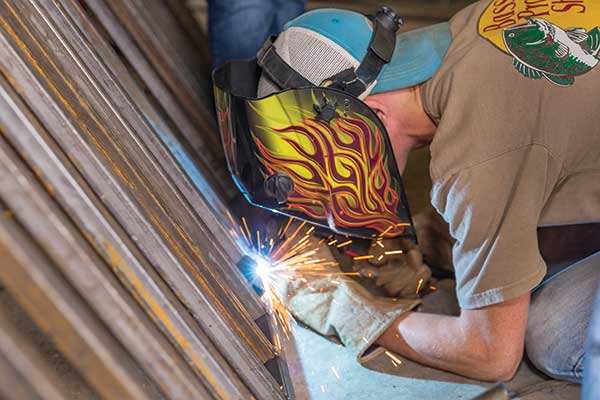
Though she is an agriscience teacher, she saw these programs as a way for “us to stay relevant. I now teach welding, intro to metal fabrication, intro to MIG welding, inert gas and flux cored arc welding” in addition to more traditional agricultural classes. That means her students can not only work as farmers, they can also find jobs repairing farm and other heavy equipment.

And while many students are taking advantage of the new opportunities afforded them, just as many students are still on track for four-year degrees.

“We still have the same number of students receiving scholarships, the same number of students going on to four-year degrees, but we have a lot of students going into the workforce, too,” Barber said.

The school system has hired a workforce coordinator, Danielle Pope, whose job it is to communicate with local businesses and industries about their needs.

“Then, during the students’ senior year, she matches students with employers,” Williams said.

“It’s about making the school system relevant to the community beyond education. We are asking what are the needs of the community and how can we tailor our program to meet those needs,” Barber said.

Coyote Drive-In

Coming attractions: Drive-in, miniature golf heading to Leeds area

Story by Graham Hadley and Carol Pappas
Photos by Wallace Bromberg Jr.
Artwork from Coyote Drive-In

coyote-drive-in-leeds-2If you’re old enough to remember movie nights under the stars with plenty of popcorn devoured in the backseat of your parents’ car, prepare to reimagine those times as the Shops of Grand River in Leeds recreates the classic drive-in with plenty of new twists.

The four-screen theater complex aims its sights on being a recreational experience the entire family can enjoy — from the moment the gates open to the end credits of the last double-feature movie.

“We have been working with Christine Szalay, general manager for the Shops of Grand River, for about a year and a half — all the stars aligned and we are going to make it happen,” said Steve Wynn, chief operating officer for Coyote Drive-Ins. Wynn notes the company already has a successful, five-screen version in Forth Worth, Texas, which has been in operation since 2013.

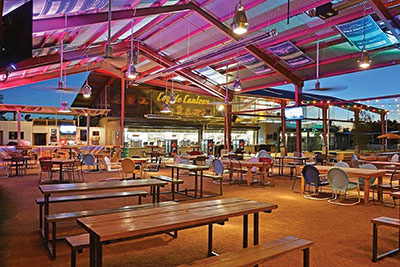
The Leeds edition will have a restaurant with a full kitchen, a pizza bar where patrons can watch the pizza-making process from beginning to end, and a bar that serves beer, wine and margaritas. The restaurant will have air-conditioned indoor and outdoor seating and sits next to a controlled-entry, fenced playground. Parents can keep an eye on kids playing while dining with family and friends.

The restaurant’s pavilion will occupy about a 10,000 square-foot building that was part of the original Shops of Grand River complex but had never been occupied.

“It will be directly adjacent to the north end of the Shops,” Szalay said.

Along with the restaurant and playground, there will also be an 18-hole miniature golf course in the theater area.

As for the drive-in, there are four screens, with movies shown in high definition from top-of-the-line special projectors that are brighter and designed to throw high-quality images farther onto bigger screens. And, Coyote Drive-In shows are double features.

coyote-drive-in-leeds“There is a 30 minute intermission, then you can watch a second movie,” Wynn said.

Directly in front of the screens is a no-car, grassy park-like green space where families can have picnics, play football with friends or even walk with their dog. The drive-in is a pet-friendly theater. There is also outdoor seating for those who want to sit outside their cars and enjoy the movies out in the open.

“A lot of it is about the freedom. You can walk your dog, throw a Frisbee, and nobody is going to tell you to turn off your smart phone,” Wynn said.

Also planned on Fridays and Saturdays are musicians performing live music.

In Fort Worth, “people are coming about 90 minutes before the shows start,” Wynn said. “You can sit out in a lawn chair and watch the movie on a giant screen. It feels like an event – like movies in the park.

“I think it is a social element. This is what we see in Ft. Worth: People are reaching out on social media, saying, ‘We are all going out to a movie at Coyote.’ They come in large groups, bring the dog, move some picnic tables together, run and play, eat, then watch the movies. People like the social aspect,” Wynn said.

“The family crowd is our biggest pizza business. When a family film opens, it always outperforms our other genres, like more adult action-themed movies,” Wynn said. The drive-in is more open than a multiplex theater, but screens are set up to prevent line of sight from one viewing area to another. Even so, some movies will not be shown or will be shown later in the night.

“Some of the movies that are too risqué we will not play because a 5-year-old watching movies on one screen might see a movie on another screen. … In Ft. Worth, we did not play 50 Shades of Grey. It was a very popular movie, but the family-friendly environment is paramount,” Wynn said.

The theater will have room for a total of 1,100 cars.

The $6 million-plus project is expected to draw people to the Leeds area from possibly as far away as other states like Georgia and Tennessee, not to mention the surrounding Leeds community, Birmingham, Trussville, Pell City, Talladega, Anniston and the rest of north and central Alabama.

With the Shops of Grand River right next door, with stores generally open until 9 p.m., already drawing large crowds daily, the two ventures expect there to be lots of crossover business.

“Coyote Drive-Ins have thought of everything. It was one of the reasons when the discussions started we were enamored with their plan. It made such good sense for the Shops of Grand River,” Szalay said.

For the region, it means a recreation and tourism destination point, generating 100 new jobs.

“This makes the Shops of Grand River and Leeds more of a regional destination. People come from a large distance to shop here, and this works on a number of different levels, Szalay said. “We want that close connection to our customers from within the community, and this adds another reason for people who live farther away to come, shop and stay longer.”