Joy Varnell

Capturing the living
moment on her canvas

Story by Elaine Hobson Miller
Photos by Mike Callahan
Submitted photos

One night, artist Joy Varnell was up late watching television when she stumbled upon a show about beach weddings. As the camera panned the California venue, she spotted an artist among the guests, paint brush in hand and canvas on easel. Intrigued, she recorded the show, then played it several more times. Realizing he was painting the wedding scene, she said to herself, “I think I can do that.”

The problem was, she didn’t know how to get started.

That issue was soon resolved when she walked into the home of a friend/client and spotted a wedding invitation on her kitchen counter. “The client mentioned that she wanted to give the wedding couple something unique, and I suggested that I go to the wedding and paint a picture,” Joy said. “She agreed, and when I got back to my car, I thought, ‘What have I done?’ ”

What she did was create a new twist in her artistic career, one that eventually caused her to dump her day job and paint 40 hours a week. She attends weddings and receptions, capturing special moments on canvas. After eight years, that twist has resulted in more than 300 paintings, taken her and her husband all over the United States, and made a lot of brides happy.

Joy started drawing as a child and painting as a teenager. She studied interior designat Southern Institute (which later became Phillips College) and worked as a kitchen designer for 16 years before striking out on her own to do interior design and faux finishes — a lot of faux finishes.

During all those years, she was painting in her spare time and selling her work. Her husband, Tim, kept encouraging her to spend more hours at her easel. Then came that first wedding, a huge event at the Birmingham Museum of Art. She painted the bridal couple descending the stairs for the reception, and in a newspaper article about the wedding, the bridegroom mentioned that her painting was his favorite gift. From there, her new venture took wings.

“This got bigger and bigger and just took over, and I quit doing interior design,” she said. The transition from landscapes, pet portraits and still life to painting people was a struggle at first, but Joy has a knack for looking at something and being able to paint it. Soon, she was painting weekdays and attending one or two weddings on the weekends. Now, it’s a full-time business. “I did 48 paintings in 2018,” said Joy, who calls herself a “live-event artist.”

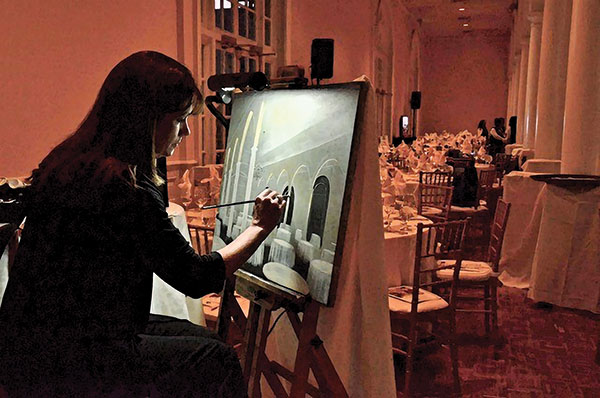
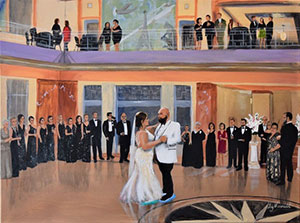
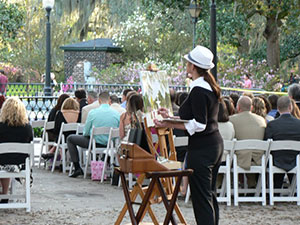
Her modus operandi is to show up about three hours before the event, usually wearing a black dress or pants, to start painting the background. “The vendors usually dress in black, so I do, too,” she explained. The most popular request is to capture the bride and groom’s first dance, so she usually sets up at the reception. When the guests come in, she’s ready to paint them into the scene. When the wedding couple appears, she adds them to the painting.

She tries to get a good likeness of the bride and groom, but not the people in the background. Most of them can be recognized by what they’re wearing. She uses the term, “most,” but brides and their mothers are much more specific than that. “The details of the people in the painting are amazing,” said Pamela Rhodes, mother of a bride who married in Addis, Louisiana. “Joy painted my daughter and son-in-law’s first dance as husband and wife (Peyton and Sean Forestier). We are able to identify every person painted, even the guy singing on the stage (my brother-in-law).”

“The Creator of the Universe certainly shines through Joy’s hand,” gushed Jurrita Williams Louie of Dallas, Texas, who got married in Tuscaloosa, her and her husband’s hometown. “She captured our first dance as Mr. and Mrs. Calvin Louie as if God came down from heaven to earth to do it. I can’t quite get over the detail and thoughtfulness with each stroke.”

Joy’s medium is acrylicsbecause they have no odor and dry quickly. “I have to work very fast, so at least the couple can see themselves before they leave,” she said. “People come up and say, ‘It looks just like them,’ as if they are surprised. Well, that’s the point.” As for mistakes, she just paints over them.

At the time she started, she found only four artists doing what she does. Three were in California, one in New York. There are many more now, but she believes the examples on her website, joyvarnellart.com, and her willingness to travel make her stand out. Her new business has taken her to California, New York, Indiana, Florida, Louisiana and along the Gulf Coast, Georgia and up and down the East Coast as well.

“I average about 12-15 weddings around the New Orleans area and south Louisiana each year,” she said. One such event took place at the restored art deco Lakefront Airport terminal in New Orleans. “It was my daughter, Celeste’s, wedding to Don Jude,” said Claudine Hope’Perret. “It was their first dance, and the painting shows amazing work and detail, even down to their lit-up tennis shoes.”

No one has ever expressed a dislike of her paintings, though she did have a girl ask her to re-do the groom’s hair once. “I strive very hard to get what they want,” she said.

Tim, who is retired from the Norfolk Southern Railroad, goes to the weddings with Joy and does most of the driving. Anything over 500 miles, they fly. He packs up her paints and tools at home, unpacks and sets up at the venue, then repacks. “He calls himself my roadie,” she said. “He’s my public relations man, too. He mingles.”

Some of the brides are nervous, and others just very excited and enjoying their day. The grooms are always nervous, and usually say, “Where do you want me?” Kids just stand and stare.

The most common request she gets while painting is, “Will you take 10 (or 20) pounds off me?” That often comes from the mother of the bride. “Sometimes a woman will come up and talk to me because she’s afraid to talk to Joy,” Tim said. “One woman asked if Joy would take off her stomach and give her some boobs.” A man might ask her to cover a bald spot.

Sometimes Joy adds details that represent something meaningful to the couple. Once, she painted a map rolled out to represent a treasure hunt, because that’s how the groom led the bride to her ring and his proposal. She has painted favorite dogs, relatives who couldn’t attend, even dead relatives into the paintings. She has put cats in, too. “Very often the venue will have one, and I’ll paint it peeping through a window,” she said. Occasionally she’ll give the bride a brush and let her paint a few strokes of her own.

She has painted outdoors in all types of weather, from 35-degree temperatures on New Year’s Eve to 95-degrees in the sun. She prefers the reception to the ceremony because it’s less structured, and she gets to interact with the people. “That’s part of what makes it fun,” she said.

One of her most memorable events was a Hindu wedding in Indiana. The bride wanted her to paint the Seven Vows, but she didn’t know what they were or where they occurred in the ceremony, which was four hours long. She kept asking people, and no one seemed to know. Parts of the ceremony were in English, parts in Hindi, and it turned out that the Seven Vows were at the end. Tim found out and clued her in.

An outdoor wedding in Biloxi,Mississippi, was notable because a storm came up and sent many guests inside. The bridal party remained outside, and at the end of ceremony, the couple was framed by a rainbow.

There was one in Fort Deposit they’ll never forget, either, but for a very different reason. “When we got out of the car there, we realized we had left my paints at home,” Joy recalled. They carry an emergency set, which has been upgraded as a result of that trip.

She hates having to tell people she is already booked for their special date, and has painted two events in one day, as much as 90 miles apart. One time, she got two separate bookings for the same wedding, at Aldridge Gardens in Hoover. “The bride’s mother had contacted me and asked for a painting of the couple’s first dance,” she said. “Then I got another request for the same wedding. The bride wanted one of the father-daughter dance to give to her parents. Neither knew about the other’s request.” She had two canvases on her easel throughout the reception and kept swapping them back and forth so neither party would know about the other. The backgrounds were the same. “The bride’s mother began to catch on, but the dad never did,” Joy said. “I presented both paintings at the end.”

Sometimes she finishes a painting on site but brings home most of them so she can apply an art varnish as a protective sealer. Her studio is a sunny 11’ x1 2’ room of her house, with a huge front-facing window. She and Tim have lived in that house on a mountain top in Springville for 12 years, surrounded by rock formations, trees and lots of wildlife. Deer and turkey wander around the property, along with a family of foxes that they feed daily. The house is filled with Joy’s still-life paintings, such as wine bottles so real you want to grab one and pour a drink.

Jessica Silvers Posey of Maryland, who married Aaron Posey in Laurel, Delaware, said Joy painted the most beautiful picture of the couple’s first dance. “The details are phenomenal,” she said. “I relive that moment every time I look at the painting. Everyone who walks past this painting in our house can’t help but stop and stare.”

While mothers, parents, bridesmaids, co-workers and grooms hire her to paint as a gift, most of the time it’s the brides who engage her services.

She offers three standard sizes, 18” x 24”, 24” x 30” and 30” x 36”. Clients may choose something larger but cannot choose whether the finished product will be vertical or horizontal. “I decide that, depending upon the venue and what I want to get in the painting,” Joy said. The largest one she has done was 42” x 48”. Her prices start at $1,000, plus travel expenses if she goes outside the Birmingham Metro area.

Although 99 percent of her business comes from weddings, she has painted at Christmas parties, company anniversaries and fundraisers. One of her corporate events was the opening of Nick Saban’s Mercedes-Benz dealership on I-459. And yes, the coach was there.

Even though she doesn’t normally turn down an event unless she is already booked, she did refuse to paint at one recent wedding. Her own daughter was the bride, the wedding took place at Joy and Tim’s house, and Joy wanted to relax as much as possible and enjoy it.

“I will paint it later from photographs,” she said.

“This got bigger and bigger and just took over, and I quit doing interior design,” she said. The transition from landscapes, pet portraits and still life to painting people was a struggle at first, but Joy has a knack for looking at something and being able to paint it. Soon, she was painting weekdays and attending one or two weddings on the weekends. Now, it’s a full-time business. “I did 48 paintings in 2018,” said Joy, who calls herself a “live-event artist.”

Her modus operandi is to show up about three hours before the event, usually wearing a black dress or pants, to start painting the background. “The vendors usually dress in black, so I do, too,” she explained. The most popular request is to capture the bride and groom’s first dance, so she usually sets up at the reception. When the guests come in, she’s ready to paint them into the scene. When the wedding couple appears, she adds them to the painting.

She tries to get a good likeness of the bride and groom, but not the people in the background. Most of them can be recognized by what they’re wearing. She uses the term, “most,” but brides and their mothers are much more specific than that. “The details of the people in the painting are amazing,” said Pamela Rhodes, mother of a bride who married in Addis, Louisiana. “Joy painted my daughter and son-in-law’s first dance as husband and wife (Peyton and Sean Forestier). We are able to identify every person painted, even the guy singing on the stage (my brother-in-law).”

“The Creator of the Universe certainly shines through Joy’s hand,” gushed Jurrita Williams Louie of Dallas, Texas, who got married in Tuscaloosa, her and her husband’s hometown. “She captured our first dance as Mr. and Mrs. Calvin Louie as if God came down from heaven to earth to do it. I can’t quite get over the detail and thoughtfulness with each stroke.”

Joy’s medium is acrylicsbecause they have no odor and dry quickly. “I have to work very fast, so at least the couple can see themselves before they leave,” she said. “People come up and say, ‘It looks just like them,’ as if they are surprised. Well, that’s the point.” As for mistakes, she just paints over them.

At the time she started, she found only four artists doing what she does. Three were in California, one in New York. There are many more now, but she believes the examples on her website, joyvarnellart.com, and her willingness to travel make her stand out. Her new business has taken her to California, New York, Indiana, Florida, Louisiana and along the Gulf Coast, Georgia and up and down the East Coast as well.

“I average about 12-15 weddings around the New Orleans area and south Louisiana each year,” she said. One such event took place at the restored art deco Lakefront Airport terminal in New Orleans. “It was my daughter, Celeste’s, wedding to Don Jude,” said Claudine Hope’Perret. “It was their first dance, and the painting shows amazing work and detail, even down to their lit-up tennis shoes.”

No one has ever expressed a dislike of her paintings, though she did have a girl ask her to re-do the groom’s hair once. “I strive very hard to get what they want,” she said.

Tim, who is retired from the Norfolk Southern Railroad, goes to the weddings with Joy and does most of the driving. Anything over 500 miles, they fly. He packs up her paints and tools at home, unpacks and sets up at the venue, then repacks. “He calls himself my roadie,” she said. “He’s my public relations man, too. He mingles.”

Some of the brides are nervous, and others just very excited and enjoying their day. The grooms are always nervous, and usually say, “Where do you want me?” Kids just stand and stare.

The most common request she gets while painting is, “Will you take 10 (or 20) pounds off me?” That often comes from the mother of the bride. “Sometimes a woman will come up and talk to me because she’s afraid to talk to Joy,” Tim said. “One woman asked if Joy would take off her stomach and give her some boobs.” A man might ask her to cover a bald spot.

Sometimes Joy adds details that represent something meaningful to the couple. Once, she painted a map rolled out to represent a treasure hunt, because that’s how the groom led the bride to her ring and his proposal. She has painted favorite dogs, relatives who couldn’t attend, even dead relatives into the paintings. She has put cats in, too. “Very often the venue will have one, and I’ll paint it peeping through a window,” she said. Occasionally she’ll give the bride a brush and let her paint a few strokes of her own.

She has painted outdoors in all types of weather, from 35-degree temperatures on New Year’s Eve to 95-degrees in the sun. She prefers the reception to the ceremony because it’s less structured, and she gets to interact with the people. “That’s part of what makes it fun,” she said.

One of her most memorable events was a Hindu wedding in Indiana. The bride wanted her to paint the Seven Vows, but she didn’t know what they were or where they occurred in the ceremony, which was four hours long. She kept asking people, and no one seemed to know. Parts of the ceremony were in English, parts in Hindi, and it turned out that the Seven Vows were at the end. Tim found out and clued her in.

An outdoor wedding in Biloxi,Mississippi, was notable because a storm came up and sent many guests inside. The bridal party remained outside, and at the end of ceremony, the couple was framed by a rainbow.

There was one in Fort Deposit they’ll never forget, either, but for a very different reason. “When we got out of the car there, we realized we had left my paints at home,” Joy recalled. They carry an emergency set, which has been upgraded as a result of that trip.

She hates having to tell people she is already booked for their special date, and has painted two events in one day, as much as 90 miles apart. One time, she got two separate bookings for the same wedding, at Aldridge Gardens in Hoover. “The bride’s mother had contacted me and asked for a painting of the couple’s first dance,” she said. “Then I got another request for the same wedding. The bride wanted one of the father-daughter dance to give to her parents. Neither knew about the other’s request.” She had two canvases on her easel throughout the reception and kept swapping them back and forth so neither party would know about the other. The backgrounds were the same. “The bride’s mother began to catch on, but the dad never did,” Joy said. “I presented both paintings at the end.”

Sometimes she finishes a painting on site but brings home most of them so she can apply an art varnish as a protective sealer. Her studio is a sunny 11’ x1 2’ room of her house, with a huge front-facing window. She and Tim have lived in that house on a mountain top in Springville for 12 years, surrounded by rock formations, trees and lots of wildlife. Deer and turkey wander around the property, along with a family of foxes that they feed daily. The house is filled with Joy’s still-life paintings, such as wine bottles so real you want to grab one and pour a drink.

Jessica Silvers Posey of Maryland, who married Aaron Posey in Laurel, Delaware, said Joy painted the most beautiful picture of the couple’s first dance. “The details are phenomenal,” she said. “I relive that moment every time I look at the painting. Everyone who walks past this painting in our house can’t help but stop and stare.”

While mothers, parents, bridesmaids, co-workers and grooms hire her to paint as a gift, most of the time it’s the brides who engage her services.

She offers three standard sizes, 18” x 24”, 24” x 30” and 30” x 36”. Clients may choose something larger but cannot choose whether the finished product will be vertical or horizontal. “I decide that, depending upon the venue and what I want to get in the painting,” Joy said. The largest one she has done was 42” x 48”. Her prices start at $1,000, plus travel expenses if she goes outside the Birmingham Metro area.

Although 99 percent of her business comes from weddings, she has painted at Christmas parties, company anniversaries and fundraisers. One of her corporate events was the opening of Nick Saban’s Mercedes-Benz dealership on I-459. And yes, the coach was there.

Even though she doesn’t normally turn down an event unless she is already booked, she did refuse to paint at one recent wedding. Her own daughter was the bride, the wedding took place at Joy and Tim’s house, and Joy wanted to relax as much as possible and enjoy it. “I will paint it later from photographs,” she said.

Doris Munkus

Organizer extraordinaire puts skills,
compassion to work for good causes

Story by Elaine Hobson Miller
Photos by Michael Callahan
Submitted Photos

Doris Munkus likes to organize. When she’s not organizing line dancers, senior citizens and fundraisers, she turns to her own household.

“I color-code everything,” she confesses, not the least bit sheepishly. “I have five grandchildren, and I color-code their towels, their bedding, their chairs, even their toothbrushes and drink cups. They can’t change them, either. I don’t have to buy name tags at Christmas, I just wrap their gifts in their colors.”

Freud might call her anal about organizing, but folks around Pell City call her genius. Over the past six years, her organizational skills have helped raise more than $150,000 for various charities and first responders in her community. Her main claim to fame is Dancing With Our Stars. This annual competition mimics television’s Dancing With The Stars, pairing experienced dancers with local bankers, professionals, business owners, elected and school officials, firefighters, police officers and others.

But Doris’ organizational skills go back much further than the 2014 debut of DWOS, however. “I organized a float to represent Dallas County for former Gov. Guy Hunt’s inauguration parade,” says Doris, who taught art in that county’s school system when she lived in Selma. “I staged an Invention Convention for the school children, too. I like to organize big things.”

In 2001 former Pell City Councilwoman and fellow church member Betty Turner picked up on Doris’ organizational abilities and asked her to start an exercise class at their church, Cropwell Baptist. “I couldn’t then because my mom lived with me and I was taking care of her,” Doris recounts. “She died in 2002, so in 2003 I started that class. It was free and open to anyone.”

 After seven or eight years, the exercising hour got a little too long. Doris had taught line dancing as activities director at the Pell City Senior Citizen Center in the late 1990s, so she suggested adding that to the mix. Everyone involved agreed.

“We did a half hour of exercise, half hour of line dancing for several years, then we dropped the exercise portion and just did line dancing,” Doris explains. In 2009, the classmoved to Celebrations, and Doris added a$4 charge per class to cover the expenses of renting Celebrations, buying the music, the signage, the DVD player and other incidentals. The rolls show 50 people, but the average attendance is about 30.

While the class was still at Cropwell, the late Kathy Patterson was on the board of the St. Clair County Relay for Life and asked whether Doris’ line dancers might want to raise money for cancer research. “That first year we raised $2,000, and dancing wasn’t even involved,” Doris says. True to form, shestarted thinking bigger, and the class held sock hops the next year. People responded well, so Melinda Williams, the American Cancer Society representative for St. Clair and several other counties, suggested the dancers hold a Dancing With Our Stars as another fundraiser.

“Our first was February 14, 2014,” Doris says. “February seems to be best month, but we have done it in March and April. In February of this year, we raised $23,111 and those numbers are still climbing because we’re selling DVDs from the show.”

Deserved rave reviews

Tim Kurzejeski is a battalion chief and one of four members of the Pell City Fire Department who line-danced to the 1977 Bee Gees hit, Stayin’ Alive, at the first DWOS – in full protective gear. He has nothing but praise for Doris and the DWOS event.

“Thefire department here in Pell City has had a dance team at Dancing With Our Stars every year since that first year,” Kurzejeski says. “Doris is great. She’s very energetic, she just tries to do the best and most she can to give back to the community. She’s very easy to work with, and it’s actually fun.”

Dancing With Our Stars no longer raises funds for Relay for Life. Instead, the money goes to a different organization each year. In 2016 it benefitted Children’s Hospital of Alabama, in 2017, it was the Pell City Fire Department, in 2018 the Pell City Police Department, and this year, it was for the St. Clair County Sheriff’s Department. Next year, DWOS will raise money for the St. Clair County Children’s Advocacy Center. “The dancers and people who buy tickets respond well to local charities,” Doris says. “People call us and ask us to raise money for their charity, and we put them on a list. We check them out, and the entire committee must agree on them. We’ll never do it for an individual, though.”

She has a committee of eight line dancers who do much of the planning for the event. “We already have the menu for next year,” she says. “Vickie Potter, who’s in charge of the food, already has next year’s food court and theme. It will be a hobo theme in 2020.”

Other committee members include Donna McAlister, photo and technical coordinator; Kathie Dunn; Kathy Hunter; Lavelle Willingham, treasurer; Martha Hill; Paulette Israel and Sue Nickens, Silent Auction coordinators. Jeremy Gossett has been emcee, and Jamison Taylor has been the disc jockey for the event since its inception. Griffin Harris is the tech guru who sets up the text line the audience uses to vote for favorites. “It’s all run by volunteers,” Doris says.

Recruiting dancers was hard the first year, but it’s much easier now. In fact, people often call Doris asking to participate. “It’s amazing how much talent we have in this area,” she says. This year, 600 people paid $25 each to eat dinner and watch the show at Celebrations, where all but one DWOS has been held. Next year, it will move to the CEPA building, on the gym side, which holds 2,000 people. “There’s more parking space there, too,” Doris says.

St. Clair County Sheriff Billy J.Murray readily admits that Doris is one of two people he just can’t say “no” to. (The other is his wife.) “Doris has a tremendous work ethic, and she’s very organized,” he says. “There’s always a lot of stuff that comes up that someone has to handle in preparing for the show, and she steps up to the role of managing the chaos.”

Although dancing is out of his comfort zone, he has already signed up for next year because Doris makes it so much fun. “I know how to be sheriff, but I don’t know how to dance,” Murray says. “We (the sheriff’s department) had nearly 30 people helping in some capacity this year, dancing, building props, helping with costumes and makeup. I wouldn’t hesitate to partner with Doris and her line dancers again.”

Joanna Murphree, the executive assistant to the administrator of St. Vincent’s St. Clair, has worked with Doris on DWOS for the past three years, and she, too, has high praise for this wonder woman. “The hospital has had a team in the group division, the Dance Fevers team,” she says. “Doris’s organizational skills are phenomenal. She’s pleasant to work with, too, and very thorough.”

Destination: Worthy cause

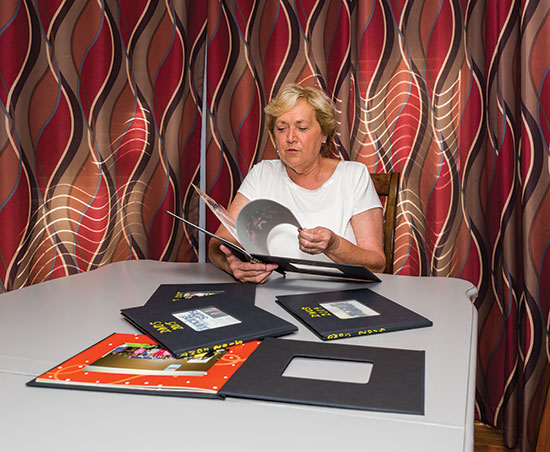
When she’s not working on DWOS, Dorisorganizes short, one day or overnight trips for the St. Clair County Baptist Association as a volunteer, as well as cruises and one- and two-week bus trips under the banner of her Pell City Cruisers. This sideline began in 1998, when she worked at the senior center. She charters the buses, plans the itineraries and the meals, books the hotels, the whole shebang. “I did one 14-day bus trip where we flew into Las Vegas and toured 12-14 national parks in nine states,” she says. She has done tours to Canada, Colorado, Montana, Utah, the Ark in Kentucky and the Panama Canal Zone. She makes photo books of each trip, just like she does with each DWOS event. “All of these trips and cruises are open to anyone of any age or denomination,” she says.

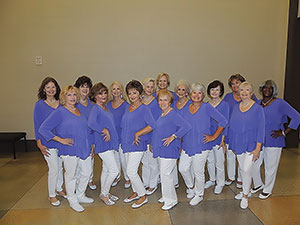
In addition, she and the Pell City Line Dancers perform at community events, such as the Halloween Festival at Old Baker’s Farm in Shelby County, Homestead Hollow in Springville and the Pell City Block Party. They dance monthly at the Colonel Robert L. Howard State Veterans Home in Pell City, at the Village at Cook Springs, and at Danbury in Inverness in Shelby County.

When she isn’t traveling or organizing something, she helps her husband, Victor, who is retired from National Cement in Ragland, with Munk’s Renovations. They remodel apartments, refurbish the cabinets they remove and resell them. The couple has been married for 22 years, and yes, she organizes his life, too. But he doesn’t mind at all.

“She’s a wonderful lady, she’s sweet, lovable, real thoughtful,” he gushes. Victor says she organizes his closet, too. “I have a section for work shirts, for dress shirts, for shoes, socks, pants and underwear,” he says. “She has tags, so I’ll know where everything’s supposed to go. She doesn’t like for me to leave my shoes or clothes lying around, and she’ll come behind me and pick them up. I’ve been living with her for almost 23 years, and I guess neither of us is going to change.”

Editor’s Note: For a video or DVD of still pictures of the 2019 Dancing With Our Stars, call Doris at 205-473-4063. They are $10 each.

You may also call her for more information about her trips.

Line dancing classes meet at 9 a.m. on Wednesdays and Fridays, with beginner classes following at 10 a.m. on the same days. Payment is on the honor system, with a box set out to collect the $4 per person charge. l

David Foote

A master woodcarver at his craft

Story by Scottie Vickery
Photos by Wallace Bromberg Jr.

David Foote peered intently through the lighted magnifier attached to his kitchen table and carefully cut a miniscule section of a duck’s feather with a small knife. It’s that attention to detail that makes the woodcarver’s art come alive, whether he’s recreating feathers, a beak or the shell of a turtle.

“You’ll never find anybody who has put more love and consideration into a piece than I have,” said Foote, who has been carving wildlife – mostly birds – for 38 years. “You’re looking at somebody who no doubt loves what he does.”

Foote’s creations have been featured at the White House, the Smithsonian Institution, the headquarters of the National Audubon Society in Manhattan, and in homes and offices in 11 countries. He’s taking commissions two years out, and his carvings can fetch thousands of dollars. Despite the acclaim, the Pell City artist is always honing his craft.

“I’m just an old country boy,” he said. “I’ve gotten to go to a lot of places and meet a lot of people because of my artwork, but I never feel like I’ve reached a pinnacle. It’s a continual learning process.”

Foote has learned a lot about himself in recent years, largely because of health issues that have plagued him. Ten years ago, while in the hospital with double pneumonia, he had a heart attack at age 47. In 2015, he battled squamous cell cancer in his throat and very nearly lost his life. The experiences helped him grow as a person and an artist.

“I was on life support for three weeks and in intensive care for a few more,” Foote said of his cancer fight. “I left the hospital in a wheelchair because I couldn’t walk. The doctor said, ‘I can’t tell you what to expect, because I’ve never seen anybody come back from the dead.’ I thought I’d never carve again.”

Instead of feeling sorry for himself, Foote thanked God for healing him and for every bird he’d had the opportunity to create. “Even if I didn’t carve another one, that was fine,” he said. “I was at peace with it.”

Slowly but surely, however, he began to regain his strength. As he graduated to a walker and then a cane, he began to think about once again pursuing his passion. “Finally, one day I picked up a knife and took a piece of wood and just started carving,” he said. “I realized I could do a little more each day.” 

Foote, 57, first fell in love with carving at 18. The son of Wayne and Wanda Foote, he grew up on the river with his sister and two brothers, including an identical twin. His mother was a primitive antiques dealer, and his father, who had a long career in the iron industry, also built and restored furniture and log houses.

“My dad taught me a wonderful respect and reverence for wood,” Foote said, adding that he learned the different properties of wood make some types better for creating baskets and others best for making furniture. “He looked at wood like we look at different people.”

Foote also developed his love of nature and wildlife as a child. On fishing trips with his father, he spent more time feeding ducks than he did baiting his hook. “People ask me all the time why birds and why wood,” he said. “I’m a bird person; I notice them everywhere. And I like the unforgiveness of wood. You’ve got one shot. If you take something away, you can’t put it back.”

Not long after graduating from Pell City High School in 1980, Foote stumbled upon a craft show at a Birmingham mall and was mesmerized with one artist’s wood carvings. “We got to talking and he said, ‘You know a lot about wood, and you know a lot about birds. Have you ever thought about carving?’”

The man, Don Mitchell of Leeds, gave him his card and invited the teenager to visit his workshop. “I wanted to go the next day, but I waited two weeks,” Foote said. “He had an old garage he’d converted to a shop. When we walked in that door, that was it. Before I left there, he gave me my first carving knife and said, ‘Go carve a bird and when you get done, I want to see it.’”

Mitchell mentored Foote for about two years before he passed away. Later, Foote read everything he could get his hands on about birds and the art of wood carving, and he said he is largely self-taught. “My mother still has the first bird I ever carved,” he said. “My stuff was very crude back then, but my father gave me some good advice. He told me that there are no straight lines and nothing flat in nature.”

Foote’s art allows him to use another one of his talents and loves – painting. “I have always been artistic,” he said. “I was just always able to draw from first-grade on. The teacher would say, ‘Draw a bird, draw a house,’ and mine always got hung up on the board.”

He took art in middle and high school and said he was blessed to have accomplished artist John Lonergan, who lives in Pell City and is well known for his paintings and pottery, as his teacher. “He kind of took me under his wing,” Foote said.

For much of his career, Foote’s brush strokes provided the exquisite detail on the figures he carved mostly from bass wood. His recovery from cancer and brush with death, however, gave him the incentive he needed to try what he had wanted to do for a long time – take his skill to the next level and provide most of the detail through woodburning and carving rather than just paint.

Foote had experimented with the technique before cancer, but was afraid the extra work and time required would make his pieces too costly. “Everything back then was smooth and slick and didn’t have the intricate details,” Foote said. “When I got through cancer and saw I was going to be able to carve again, my whole attitude changed. I decided I don’t care if anyone buys it. I’m going to do it like I want.”

Foote, who now creates full-size, half-size and miniature works of art mostly from Tupelo gum wood, needn’t have worried. His customers pay anywhere from $1,000 for a small songbird to $5,000 for a full-size waterfowl. “What used to take 20-40 hours to complete now takes 400 or 500, so I’m averaging $8 or $10 an hour,” he said with a laugh. “I do what I do because I love it. I have never seen the face of a wood carver on the cover of a Fortune 500 magazine.”


Early career

Foote got his start in craft shows in his 20s and quickly began to win awards. The resident wood carver at Springville’s Homestead Hollow for 20 years, he shared his love with kids, many of whom were inspired to carve their own pieces. Perhaps the biggest surprise of his career, though, was when officials from the Alabama State Council on the Arts asked him to carve a yellowhammer for the White House Christmas tree in 2002. First Lady Laura Bush had selected a theme of “All Creatures Great and Small,” and the tree featured ornaments of each state’s bird handcrafted by local artists. The works were later exhibited at the Smithsonian.

Not long after, Foote was one of two artists worldwide selected to provide sculptures of endangered birds for the Audubon Society headquarters. “I consider that to be my claim to fame because they are the bird people of the world,” said Foote, who carved a pair of Virginia rails. “The other artist was a 10th-generation porcelain bird sculptor from Germany.”

While he appreciates the recognition he has received, Foote mostly enjoys doing what he loves for people who love it.

“It gives me great satisfaction when someone who gets up early every morning and works hard to put food on the table calls and says he wants one of my pieces,” he said. “This is a passion. I don’t know any other way to say it. As long as God gives me the strength in my hands and sight in my eyes, I’ll continue to do it.”


A decoration for the nation

Pell City artist paints ornament for
national Christmas tree display

Story by Leigh Pritchett
Photos by Wallace Bromberg Jr.
Submitted photos

When the 95th annual National Christmas Tree Lighting display opened in Washington, D.C., in December, a little piece of Pell City was among the decorations.

That is because local artist Buddy Spradley had painted one of the ornaments.

Spradley’s work and that of 13 other artists from North and Central Alabama were selected to help decorate the state’s tree in President’s Park. According to the National Park Service, 56 Christmas trees – one for each of the 50 states, the District of Columbia and the U.S. territories – showed their splendor in President’s Park from Dec. 1, 2017, through Jan. 1, 2018.

The effort to provide the dozen ornaments for the Alabama tree was coordinated by the Alabama State Council on the Arts and locally by Heritage Hall Museum in Talladega.

“It is our honor to decorate our home state tree and help the nation celebrate the holidays in one of our most recognizable parks,” said Valerie White, director of Heritage Hall Museum. “We are all excited to be part of the ‘America Celebrates’ display. It gives us an opportunity to show our pride in our state’s artistic talent, stunning natural wonders and vibrant cultural heritage.”

Spradley was excited too, in addition to “speechless, nervous, … thankful, honored.” He said he is “proud to represent Alabama to the U.S. in that way, through art.”

Spradley’s ornament depicts two waterfalls at Little River Canyon in Fort Payne. He chose Grace Falls as the main focus, with another Little River waterfall on the opposite side of the ornament.

Little River Canyon “has a special feeling to me,” he said. “(I’ve) always had a personal closeness to that area.”

Many times through the years, he has gone to Little River Canyon with his dad, nationally known watercolor artist Wayne Spradley of Pell City. The elder Spradley has painted Grace Falls in the past, a fact that influenced his son’s decision to feature it on the ornament.

“Now, he and I both have done Grace Falls,” said Buddy Spradley.

Although Spradley had not previously painted a spherical piece, he was able to complete the acrylic project in about two weeks during September 2017. He did confess, however, that holding the ornament and painting it at the same time presented quite a challenge. But duct tape saved the day. Spradley found that the center hole of a roll of duct tape made the perfect cradle for holding the ornament steady while he painted on it.


An artist’s early start

Spradley’s chance to help decorate a national Christmas tree through art really can be traced back 45 years when he won his first art competition at age 8. That piece was an abstract.

He grew up around art, watching his dad create wildlife scenes and landscapes that would gain national acclaim. In the early 1980s, his dad produced the artwork for the Alabama Waterfowl Stamp.

After Buddy Spradley graduated from Pell City High School, he put art aside and instead earned a mortuary science and forensics degree. For eight years, he worked at Kilgroe Funeral Home, with his uncle and aunt, Sonny (now deceased) and Jane Kilgroe. From the couple, Spradley learned much about respecting, serving and helping people. “That job did teach me compassion,” he said.

It was also during those years that he felt a calling to teach. To prepare for the career change, he studied graphic art and anthropology at Jacksonville State University, and then art education at the University of Alabama.

For two years in Anniston, followed by 18-plus years in Pell City Schools, Spradley taught art to “thousands of kids.”

During the years of teaching, his art mostly consisted of pieces he painted as classroom demonstrations for the students. His focus was on educating and encouraging his students, rather than producing his own pieces.

He called the job a “blessing,” saying he went to school each day with a smile and left with a smile. The time in between was spent trying to instill in every child a sense of success and accomplishment.

Dr. Micheal Barber, superintendent of Pell City Schools, described Spradley as a “wonderful artist and wonderful teacher. … He brings life into art.”

Barber said Spradley incorporated into art class what the students were learning in history, science and other subjects.

Spradley is retired from the classroom now and greatly misses teaching students. He still feels a deep sense of responsibility toward them.

“Teaching school was such an important, big part of my life. … You’ve got to behave yourself and be a good role model … in and out of school,” Spradley said. “Even though I’m retired, I feel like I’m still responsible for making a good impression.”

The Christmas tree in his living room at the time of Discover’s visit with Spradley gave evidence of the impact he has had upon many young lives. Decorations given by past students adorned the tree from top to bottom.

It is not uncommon for former students who are now adults to tell him, “I’ve still got the Christmas tree we did in art, and I put it up on the mantle every year.”

His own heritage of art has become one of his treasures. In fact, the art table he uses is the very first one that his father had … back in 1954. He also has, as a keepsake, a sizable stack of his dad’s art demonstration pieces.

Prior to retirement, Spradley’s life journey already had taken several significant turns. Among them were an emergency triple bypass at age 38 and the death of his mother, Pat, from complications related to Alzheimer’s disease. Then, in September 2015, his journey took a path that made retiring necessary. Spradley was told he had gastric and esophageal cancer that was stage 3 – bordering on stage 4.

“I had less than a 9 percent chance of survival,” Spradley said. “… But I knew I was (going to make it). … Thank God, I had some of the most professional, caring doctors. They saved my life. My surgeon prayed with me before surgery. … They cared about my wellbeing and I am so thankful for that. I never would have survived without my family and my friends. Never.”

Spradley said his dad had always been “my rock,” but was even more so during that time. Also, aunts Jane Kilgroe and Jean Phillips were very caring and continue to be.

The chemotherapy treatment, which lasted a year, caused nausea, fatigue, neuropathy in his hands and loss of appetite. The neuropathy prevented Spradley from holding a paintbrush.

His determined dad devised a means for his son to return to painting. It involved inserting the brush handle into a small tube and taping the tube to his son’s finger. With such a setup, Buddy Spradley did not have to hold the brush, he only had to point his finger to paint.

It worked well and Buddy Spradley again was creating wildlife and landscape scenes and an occasional abstract. Painting, he discovered, helped to overcome the neuropathy.

On one particular day during the battle with cancer, Spradley stood at his kitchen window, looked out and prayed. He said he was about to start the next part of his life and asked God what He wanted Spradley to do.

Very soon, things started happening.

Almost overnight, Spradley felt a stronger commitment to art. He became “completely engulfed in my painting.”

Also, his skill reached a new level.

Wayne Spradley noticed a marked difference in his son’s artwork, especially in draftsmanship and execution. He saw his son’s abilities draw ever so close to perfection.

Then, came the invitation for Buddy Spradley to paint an ornament for a Christmas tree in the nation’s capitol.

“It was so unexpected,” Spradley said. “And it all goes back to when I was standing in that window and was asking for guidance for the second half of my life.” When God opens doors, Spradley said, “(you get) to do things you didn’t think you could do.”

Wayne Spradley was thrilled that his son was chosen for the honor. “I was proud of him,” he said. “I encouraged him as much as I could.”

Buddy Spradley could also imagine his mom’s voice telling him she is proud of him, too, just as she had done so often during his life.

In early 2018, Spradley embarked on another project – that of submitting an entry to the Alabama Waterfowl Stamp art contest. The painting he has in mind to do will be painstaking, considering that each feather of the ducks will have to be done individually. Yet, he looks to the challenge with the hope of being listed among the winners, just like his father is.

At times, Spradley still struggles with residual effects of cancer treatment. “It’s something you learn to live with and not let it stop you. (You) have faith that the Good Lord is with you, (and you) try to make a difference in every day.”

He said that experiencing cancer has changed life entirely. He has learned to see God’s miracles in everything. “ ‘Only the Good Lord can make beautiful things,’ ” Spradley remarked, recalling what he had heard his mother say so frequently. “I carry that quote with me daily.”

He cherishes family, enjoys friendships, studies with an insatiable hunger for knowledge, paints with conviction and appreciates the preciousness of life.

“I’m thankful for every day.”

Buddy Spradley’s artwork is available through his Facebook page and at Pell City Coffee Company. Visit www.heritagehallmuseum.org/community to see Buddy Spradley’s ornament, as well as those produced by the other 13 North and Central Alabama artists. (A note of interest: Three of the other 13 artists are current students of Wayne Spradley.)

Praised Colors

From Sweden to Ragland, artist’s life takes many a turn

Story by Leigh Pritchett
Photos by Michael Callahan

Marie Barber shooed chickens and a guinea to welcome a visitor one bitterly cold day.

Once inside her woodsy home with warm Gulf Coast decor, she smiled and said, “It does feel like Sweden out there.”

Living near Ragland and the Coosa River, this Swedish native quietly creates designs and artwork that are nationally known and have been featured in many books, magazines and retail outlets.

Her resume is extensive: she has been an illustrator for the magazines Paula Deen, Victoria, Tea Time and Southern Lady; a designer for Chapelle Ltd. of Ogden, Utah, and creator of cross-stitch designs that filled six or more books for Sterling Publishing Co. of New York. In addition, she illustrated leisure, etiquette and decor books.

During her 15 years as designer with Hoffman Media, she did “hundreds and hundreds of cross-stitch leaflets and cross-stitch designs for magazines,” and all cross-stitch chart conversions from the Disney movie, Pocahontas. Also through Hoffman Media, she fashioned fabric designs for the former Hancock Fabrics and worked on Hancock’s Paula Deen Collection.

A count even commissioned Mrs. Barber to replicate in his mansion some paintings of the Sistine Chapel.

Mrs. Barber spent three weeks on eight-foot scaffolds in Count Albert von Oldenburg’s living room to paint the scenes on a 37-foot tray ceiling. The palatial estate in Eastaboga in Talladega County was like a museum and a history book, Mrs. Barber said.

“When you went to his home, it was like you were in a fairy tale. You were not in Alabama,” she continued.

During those weeks, the count taught her etiquette in the presence of nobility and gave her keepsakes from all over the world.

That, Mrs. Barber said, “was probably the most memorable experience” she has had with her art.

Now working in the decorative art of needlepoint, Mrs. Barber produces “fun” designs and projects. She designs belts, pillows, eyeglass cases, phone cases, lampshade covers, jewelry, purses and bags, rugs and tapestries, and has done custom orders for dining room chairs.

The formative years

Marie Olsson spent her early years in Skåne (pronounced skone-neh) on the southern tip of Sweden. Skåne is about 20 minutes from the Baltic Sea. The region is flat and experiences snow four months a year.

“Sometimes, your eyelashes iced up,” she recalled.

Marie and her parents lived with grandparents in the countryside in a home without indoor plumbing.

When she was six years old, she and her parents moved to Tollarp to what she described as an elaborate home with an indoor sauna.

Each Christmas, she wanted art paper and markers. By second grade, she was an acclaimed artist, at least to her classmates who would ask her to draw Donald Duck, Goofy and Mickey Mouse for them.

Her father passed when Marie was 10, and her mother, three years ago.

Although Marie has no siblings, she does have 40 first cousins living around the world. One of them — Anna Steed — lives in St. Clair County not very far at all from Marie.

As a teenager, Marie applied to the American Scandinavian Student Exchange program to become an exchange student.

Interestingly, while in a music class in ninth grade in Sweden, she had sung the lyrics, “I come from Alabama with a banjo on my knee.” But, Marie confessed, “I had no idea Alabama was a state.”

Nonetheless, that is exactly where she was placed as an exchange student. The girl from the southern tip of Sweden with a southern Swedish dialect found herself in the southern region of the United States.

Even though she was to be in Alabama only for Pell City High School’s 1983-1984 school year, Marie found she just could not stay away. One reason was Kinsman Barber, a Pell City native and Jacksonville State University student she met four months into her sojourn in the United States.

After completing the exchange program, Marie returned to Sweden, finished junior college and worked for a while in Stockholm. Then, at 19, she decided to attend art school either in Australia or the U.S. She chose the U.S., going first to California and then to Alabama by bus.

Marie traveled to Auburn University to stay with friend Wendy Bradshaw Weathers (who now lives in Ozark). Through an outreach ministry to foreign students, Marie heard about Jesus Christ, His love and the forgiveness He gives to all who will receive it.

“I utterly broke down and couldn’t believe anyone would love me in spite of all my unrighteousness,” said Marie. She asked Jesus Christ to save her.

A “long, winding road” brought her and Kinsman back into contact.

She enrolled in the Art Institute of Atlanta to study visual communication and, a week after earning her associate’s degree, she and Kinsman wed.

Marie, the artist, and Kinsman, the teacher and coach at Victory Christian School, have been married 27 years and have four children — Malin, 21; Peyton, 19; Daniel, 17, and Magdalena, 16.

They also have 18 chickens, three dogs, two cats, one guinea and an herb garden.

“I enjoy the simplicity of life,” said Mrs. Barber. To her, it is reminiscent of the childhood experiences she cherishes most. The years of living in the Swedish countryside as a child were simple and meager. But, “my best memories were in the country.”

In her Alabama country home nestled in the woods, she creates her art while listening to sermons by David Platt, president of the International Mission Board of the Southern Baptist Convention and best-selling author.

“God has allowed me to work at home,” Mrs. Barber said.

A diverse talent

Mrs. Barber’s art spans many genres.

“I used to do Christian art — cards and prints,” she said. “I did that for a little while.”

One of her pieces hangs in her church, which is Hardin Chapel in Ragland.

From the large floral acrylic on canvas that accents her dining room to the vibrant needlepoint pillow she had just finished, all her pieces show her penchant and flare for color.

“I’m all about pink leopard with some fur,” she said with a laugh. “… I like color. I’m not traditional.”

When she formed her own art design company, it was appropriately named Colors of Praise.

“Most designers use their name for their design,” she said. She chose, however, to use the name Colors of Praise because its gives her opportunity to tell others who Jesus Christ is. She said all her accomplishments are small in comparison to what Jesus has done for her.

Getting to where she is now in her art was the result of another “winding road” in life that started with an economic recession.

In February 2009, downsizing at Hoffman Media claimed her position as illustrator and cross-stitch designer. Because of that, she sought a new direction for her art.

Mrs. Barber had seen Kaffe Fassett’s color schemes in his decorative arts designs and noticed that they resemble her own use of color. When her love of color was paired with her appreciation for the tapestries of Europe, Mrs. Barber found a new direction for her art – needlepoint designs.

That April, she sent her application to The National NeedleArts Association and was accepted to a trade show in Columbus, Ohio. Her first show was in June, during which she received $15,000 in orders.

Since then, she has shown her wares in trade shows in Los Angeles and San Diego, Calif.; Phoenix, Ariz.; Dallas, Texas, and many other cities. The majority of her creations are marketed in Florida, California and the northeastern states. Locally, they can be found at Needleworks LLC in Birmingham.

Kinsman said his wife frequently gets ideas for needlepoint designs from sources like magazines and record covers.

And the designs are not “your grandmother’s needlepoint,” Mrs. Barber said.

“Her work truly is an original style,” said Judith Carter, owner of Needleworks LLC. “To me, she has captured the essence of a younger generation of needlepoint stitchers…She has been an exciting addition to our industry.”

One of the needlepoint belts Mrs. Barber recently completed boasts a spectrum of colors, flosses, textures, patterns and accents. Retail is estimated between $160 and $200.

She develops 200-250 designs for each January’s needle arts trade show and another 100 for the summer show.

“I like to design a lot of new patterns every year,” she said. “… I want it to be more of what they would have fun with.”

Plus, she has monthly trunk shows. “I sell to a lot of stores in California,” she said.

Her venture into needlepoint designs followed a different path from the norm, she explained.

“I am an illustrator coming in as a designer (who had to learn needlepoint),” she said. “Most are needlepointers becoming designers.”

To be able to do what she does, she had to become accomplished in the various needlepoint stitches and learn the difference in flosses and other aspects of the art.

Actually, her needlepoint enterprise has grown into a family endeavor.

“The girls are very creative,” Mrs. Barber said. “There are times I ask them for advice. Malin could run my business. She has done trade shows without me.”

The family sometimes travels to shows with her and, together, they see sights and tour landmarks. “That has been a fun, fun part of it,” she said.

Mrs. Barber is in an almost constant state of creativity, whether painting a canvas, stitching a needlepoint project or using seashells washed ashore by Hurricane Wilma to turn an accent mirror into a conversation piece.

“Taking away paint from me would be devastating.” She said it would be like telling her husband — who happened to be playing guitar in the background — to give up his music.

“… It’s my crazy world!” 


For more about Marie Barber and Colors of Praise,

visit www.colorsofpraiseart.com

Looking to the future

Pell-City-CEPA-1

Curtain goes up on new director, new energy at CEPA

Story by Linda Long
Photos by Michael Callahan

Jeff Thompson is fitting right in to his new role as executive director of the Pell City Center for Education and the Performing Arts (CEPA), but at four years old, Thompson was on a totally different career path.

“At my preschool graduation, I told the whole class that I was going to be an aeronautical engineer. Well, that brought a whole bevy of laughs,” recalled Thompson, “but I loved planes and as a child, that’s all I wanted to do. That is, until I found out the engineers get paid by contract work. I didn’t see much stability in that. So, suddenly, aeronautical engineering didn’t seem like such a good idea anymore.”

The intrepid young Thompson then turned to “Plan B.” Architecture.

Though foiled again, he was not the least chagrined. “I could not pass Physics. I failed it twice. I do not understand the concept – never have, never will, and you can’t be an architect if you don’t get Physics. I can draw just fine,” laughed Thompson. “I just wasn’t able to do those high level equations.”

Those two early career misdirections are clearly St. Clair County’s gain. Thompson, who has been in his new role as CEPA director for only two months, already has a clear vision for leading the top notch 2,000 plus-seat sports arena and a state-of-the-art, 400-seat theater into the future. That vision is clearly spelled community.

An Auburn University graduate in Journalism, Thompson comes to CEPA with a 10-year background in newspapers, most recently as editor and general manager of the St. Clair News Aegis. 

“My formal training is newspapers,” said Thompson, “and certainly one of the things newspapers gives you is intimate access and understanding on how to build identity. And that’s what we’re looking to do with CEPA at the moment is to take this phenomenal product which is here and really does benefit the community and build it around that.”

Already finalizing the 2016 fall season, Thompson said, “We’re looking to create programming that attaches itself to numerous demographics in the community. We don’t want to follow a show with another show that attracts an identical audience. We want to make sure that everybody across St. Clair County feels like they have a home at CEPA. This facility was built, created and conceptualized on that bedrock. There shouldn’t be anyone who doesn’t have access to this facility. It was built for this community.”

Pell-City-CEPA-2To that end, CEPA is kicking off a fall line-up which should indeed include something for everyone. The season begins in September with an amazing magic show followed just days later by a performance of the full Alabama Symphony Orchestra, a first for Pell City.

The “top tier” magic show features Brian Reaves, and the Alabama Symphony Orchestra is seen as a major coup for the theatre. Next up will be country music band, Confederate Railroad, another major act, with Two Halos Shy as opening group.

Confederate Railroad, a country rock, southern rock band, is a multi-platinum recording group. It has been nominated for a Grammy Award, and it won an American Country Music award. In May, the group appeared in Nashville with Willie Nelson, John Anderson, Colt Ford and former NFL Coach Jerry Glanville for the 20th anniversary version of its signature smash hit, “Trashy Women.”

Two Halos Shy features Madibeth Morgan and Anna Tamburello. When their vocal harmony hits an audience’s ear, you would swear the halos were there as the vocals sound almost angelic. Very little sounds better than a pair of voices in perfect harmony, and this talented duo fits the bill. Although still teenagers, they have been writing music and singing since before they could legally drive a car. They are working on their first album.

Capping the season is a multi-faceted arts festival featuring Alabama’s top storyteller, Dolores Hydock, and bluegrass group, Whitney Junction.

“This event is all about St. Clair County,” said Thompson. “It will feature local artists of all kinds.” Hydock is an award winning, premiere storyteller based in Birmingham, who has entertained audiences large and small around the country. She will be performing, Footprints on the Sky, a story about the time she spent on St. Clair County’s Chandler Mountain. Sharing the stage with her, providing music for her words, is Whitney Junction.

This bluegrass group formed as a ministry of First Baptist Church of Ashville and while its primary musical focus is a unique brand of bluegrass gospel, the band also performs old time bluegrass music at festivals, rallies and other events. “We want to wrangle in as many people as we possibly can and get them tied into this,” said Thompson.

Built nearly 10 years ago as a partnership among the Pell City School System, City of Pell City and the community, Thompson said, “community builders came together to support this facility.” A huge granite marker hangs in the lobby, telling the story of the people who built this facility. It is not just for Pell City, but for everybody. “We want to make sure every bit of our programming educates, inspires or entertains and gives them a reason for coming back.”

CEPA has already established many ongoing traditions, such as its annual summer drama camps, performances by many artists from local schools and the Pell City Players, a local drama troupe created as part of its community theater offerings.

But Thompson is hoping the facility will soon have some new programs making new traditions.

“We want to maximize the availability of the facility as much as possible. One of the main activities we’re looking at now using some captive audience around football games to open up the center and let folks come and be entertained prior to or following a football game. “According to Thompson, “Whatever legacy we can create with it, I want it to be something that includes the idea that we build community off of it. II think it fits in with the chamber of commerce, the city, and the school system. I think there are ties for to almost every aspect of generating a positive image for Pell City and St. Clair County. I know community, and I love community and when I look at this building, I know it can be what my definitions are for it.”