House of Treasures

Frank-Phillips-collectionInside a collector’s collection

Story by Leigh Pritchett
Photos by Michael Callahan
and Wallace Bromberg Jr.

It has long been said that a man’s home is his castle.

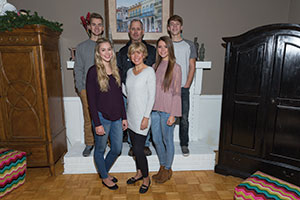
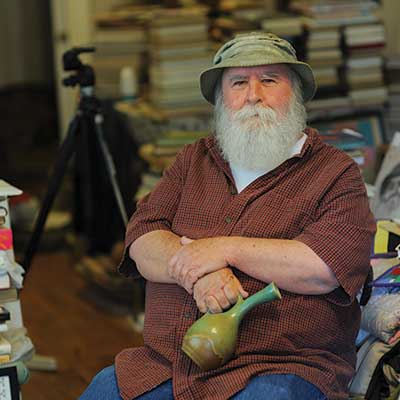
While that surely is true for Frank Phillips of Pell City, his dwelling is also a cache of artistic, literary and photographic treasures.

Surrounding him everyday are hundreds of volumes and artwork in various media, as well as photographs of historical figures and moments in life.

“I don’t just collect this stuff,” Phillips said. “I live with it. … I look at it everyday. You might see something new in it.”

Much of the artwork is considered “outsider art,” having been produced by individuals with no formal training. Mose Tolliver, known as Mose T, was one of those.

In fact, Phillips’ collection started in 1986 with a Mose T watermelon painting he purchased directly from the artist.

“I gave him every dime I had in my pocket that day,” Phillips said.

Phillips’ art collection now boasts about 20 names. Among them are Dr. Art Bacon, Charles Lucas, Lonnie B. Holley, Fred Nall Hollis, David Driskell, Bernice Sims and Jimmy Lee Sudduth.

A few acquisitions in the Phillips coffer were rare, thrift-store finds. A sculpture by Frank Fleming was one of those, as was a pottery piece by Bill Gordy.

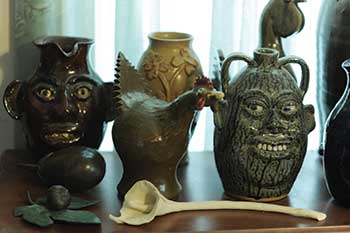
Phillips added to his pottery collection numerous “jug faces” by Burlon B. Craig and items from the Meaders family of artisans. One of Phillips’ favorite pieces is a 1938 Gordy bowl adorned with the state flower.

The expansive inventory of books Phillips has amassed includes many first editions signed by such noted authors as Truman Capote, James Dickey and Harper Lee.

Phillips’ assemblage also features a handmade quilt from Gee’s Bend and memorabilia marking historical and special events. One piece of memorabilia is a paper fan autographed by Phillip Alford and Mary Badham, the child actors who played “Jem” and “Scout” in the 1962 movie, To Kill a Mockingbird.

Phillips said several pieces in his trove are rather valuable.

Yet, that is not why he acquired them.

“I’d like it even if it didn’t have value,” he said. “… You don’t have to have a reason to collect.”

Selected pieces from his collection have been on display in the past at Gadsden Museum of Art, Heritage Hall Museum in Talladega and, most recently, Pell City Library.

The exhibit at the library generated much interest and conversation among visitors, said Susan Mann, assistant library director.

“Frank’s collection was very well received at the library,” Mrs. Mann said. “… It was a great opportunity for people to see Southern folk art at its best. Frank graciously shared a pleasing mix of paintings, pottery, photographs and a primitive, handcrafted stringed instrument from his extensive and diverse collection. Most patrons were fascinated by the exhibit and were drawn to it, opting for an ‘up close’ view.”

Early influences

Phillips grew up in St. Clair County in a family of nine children. When he earned his English degree from Jacksonville State University, he became the first in his family to graduate from college.

He is drawn to magnolia paintings and Southern cuisine and says that putting sugar in cornbread “is a sin.” He prefers to read the works of authors Rick Bragg, Eudora Welty and Robert Penn Warren, who all have Southern roots.

Frank-Phillips-pottery-collectionHe listens to the blues, likes to travel, and serves on the executive committee of St. Clair Democratic Party.

Nonetheless, he feels an attraction to New York, Chicago, London and Paris.

“I rode a Greyhound to New York just to see a (Picasso) painting,” Phillips said.

As a young man, he went to Paris to view the gravesite of poet Gertrude Stein. “I was 20 years old in Paris by myself,” Phillips said.

Once, he saw artist Andy Warhol in Manhattan at the Museum of Modern Art. Warhol asked to autograph Phillips’ shirt, and Phillips said, “Sure!”

Even so, Phillips does not own a piece of Warhol’s art. “Who could afford that?” questions Phillips.

His recounting of that meeting with Warhol is one representation of the final piece in Phillips’ treasury. That piece is not tangible, however. It consists of details and memories about places, events and encounters with noted figures.

His conversation flows easily from one recollection to another and is peppered with observations about talents and personality traits.

With the certainty that comes from first-hand knowledge, Phillips speaks of Capote’s flamboyance and gives an account of Watergate figure G. Gordon Liddy. Phillips tells of attending JSU at the same time as Jim Folsom, Jr., who would later become Alabama’s governor; seeing Gov. Lurleen Wallace in Ragland, where she was accompanied by Hank Williams Jr. before he was a famous singer; meeting President Jimmy Carter; attending the funerals of author Kathryn Tucker Windham and civil rights leader Fred Shuttlesworth, and getting an autograph from actress Butterfly McQueen.

“I’m writing my memoirs now,” Phillips said.

If the opportunity arises, Phillips wants to add to his collection of memories – seeing the Hope Diamond and the painting, Whistler’s Mother, and attending a snake-handling service at a church. “Not to handle (a snake),” he said with a chuckle. “Just to observe. My faith is not that strong.”

Jamie Merrymon

jamie-merrymon-painting

Artist’s work making television appearance

Story by Carol Pappas
Photos by Wallace Bromberg Jr.

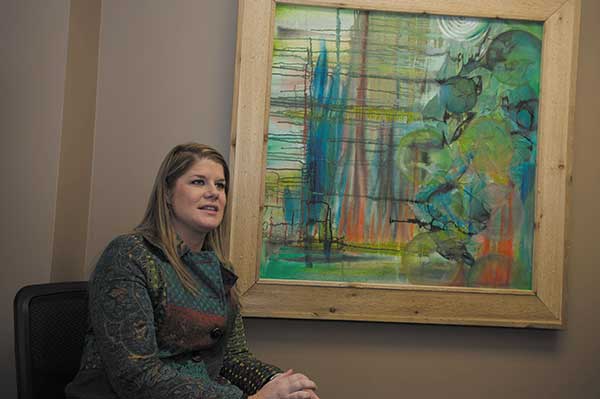
Jamie Merrymon sees possibilities when others simply see the object in front of them. Evidence of it hangs behind her mother’s desk in the Pell City courthouse – “a painting without painting.”

Fashioned from frame corners that don’t meet and scores of mismatched buttons from her great grandmother’s button tin, it is a work of art others would never have thought to create.

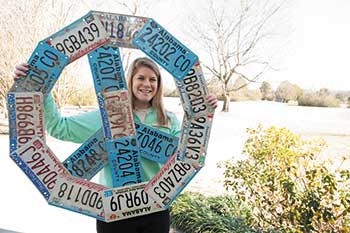
“I have an eye for it,” she said. That, she does. Jamie sees art in just about everything around her. A wine cork. Newsprint. Bullets. A stack of old license plates found in the courthouse basement. They all are possibilities in a Jamie Merrymon original.

She once carved a self portrait from a block of linoleum. It took her three months to finish, but when she was done, it earned her the Dean’s Merit Award at Auburn University and a cash prize.

She sees color as her greatest ally, and she isn’t afraid to use bright hues and bold strokes to tell her story on canvas. “Colorful makes me happy,” she said. Nor does she shy away from texture, using tissue and paint to create a three dimensional work of art.

Working in the garage of her parents’ Pell City home, she said, “When I get in the mood to paint, I get in and paint.” It is not unusual for her to spread materials on the ground, circling it as she works. Her professor once told her the best abstract looks good from any angle, words that drive her approach. It’s why she signs the back of her work. There is no true bottom or top. It is in the eyes of the beholder.

“Art to me is the freedom to be creative. There is no right way or wrong way,” she said.

It is that same eye for creativity that landed her a TV gig behind the scenes on the show of professional organizers, The Amandas, after graduating from Auburn in Fine Arts. And it is that same flair for creativity that moved her work in front of the cameras on that show as well as on Fix It and Finish It with Antonio Sabato Jr.

jamie-merrymon-art-peace“I wanted to be a decorator, but I couldn’t get out of Chemistry,” she mused. That put her on course for a Fine Arts degree and a stint as a “starving artist.” She shotgunned 60 resumes and found The Amandas willing to take a chance on her. “I lived in Atlanta a month, New Orleans a month and Birmingham for a month,” helping behind the scenes with reorganizing rooms and making over houses for use on the TV show.

In New Orleans, after Hurricane Katrina struck, the owner of the house to be redone for the cameras mentioned she loved original art. “We have an artist right here,” Jamie recalled Amanda Le Blanc saying. And with that, she plopped down on the driveway and painted herself right into the show. It was a 5 x 5 foot abstract featured in a room makeover.

Although that show was later cancelled, she got a second chance when Le Blanc sent her a message about creating artwork for Fix It and Finish It. Yet another of her works appeared in that show. It gave her the opportunity to work with Orlando-based Pink Sneakers producers Craig Campbell and Trish Gold, who helped produce such reality shows as Project Runway and The Kardashians.

These days she spends her time crisscrossing the county as a court referral officer, carrying on what has become a family tradition of serving St. Clair County. Her mother is judicial assistant to Circuit Judge Bill Weathington. Her grandmother, Sara Bell, was chief clerk of the Probate Office.

“I love my job. I love people,” Jamie said. “I’m a good people person.”

You’ll get no argument from attorney Van Davis, who serves as municipal judge in several St. Clair County cities where Jamie works. “She’s amazing,” he said when he learned she would be the subject of a magazine piece.

There’s no argument from District Judge Alan Furr about her artistic talent, either.

He offered her mother $500 on the spot for her Painting Without Painting, she said. But it’s not for sale. Vicki counts it among her most prized possessions, a Mother’s Day gift from Jamie.

Other pieces are for sale, and Jamie continues to spend her off time producing them in an unlikely sanctuary – her parents’ garage she calls her ‘studio.’ There among the stacks of boxes and usual occupants of a garage, she has carved out her creative corner of the world. “I don’t have to answer to anybody but myself when I’m in my creative zone. I do what I want to do. It’s my zone.”

And as she works toward some of the same goals as other 20-somethings – a house, perhaps a family – her art is never out of the picture for her life. “If I could afford it, I would just retire and paint.”

Celebrating CEPA

EDUCATION & PERFORMING ARTS
‘What If’ played big role for CEPA

2014+CEPA+Drama+Camp-125-3347103446-OStory by Leigh Pritchett
Photography by Wallace Bromberg
Submitted photos

Once there was a city that needed an auditorium.

Once there was a school that needed a better gymnasium.

The city and the school system decided to join together to do what neither could do alone.

When even the combined efforts were not quite enough, the citizens, businesses, industries and other government entities pooled their resources to make it happen.

And thus, our tale comes to its happy beginning eight years ago with the opening of the Center for Education and Performing Arts (CEPA).

Since then, CEPA has been the site of community theater productions, recitals, conferences, symposiums, private events, a host of school functions, concerts and performances by nationally known artists, basketball games, high school wrestling matches, archery tournaments, JROTC competitions, graduations, church services, and – right now – a Smithsonian exhibit with local flavor.

“CEPA has brought a whole new dimension to Pell City,” said Kathy McCoy, who was executive director for seven years and is the current artistic director. “We are the gathering place for Pell City.”

Also called Pell City Center, CEPA features a 399-seat theater-concert hall and a 2,100-seat sports arena.

Plus, it boasts the only movie theater in the area, McCoy said.

CEPA, however, does not sit silently, waiting for a concert here and a theatrical performance there. Rather, activity at the building is nearly constant.

During the school year, for example, the theater is used daily for drama classes, said Kelly Wilkerson, CEPA’s executive director.

Much of the time, especially during December, the center is in use every day of the week, Wilkerson said. Sometimes, two events are happening simultaneously.

“It definitely gets a lot of use,” he said.

That is part of the beauty of a performing arts center, said Barbara Reed, public information officer of Alabama State Council on the Arts in Montgomery.

“Community arts centers provide access to a wide range of art and performance opportunities, which bring many people together,” Reed said. “These centers are often the heartbeat of smaller cities. Its programming inspires children, adults and families alike, creating a vibrant and connected community.”

Reed said any community is blessed to have a performing arts center.

“It put us on the cultural map of Alabama,” said Bill Hereford, who was mayor from 2008 to 2012.

Dr. Michael Barber, superintendent of Pell City Schools, said the center has had a significant impact on the school system.

“It has transformed our school system in several ways,” Barber said.

Having the center has helped to revive the high school drama department; provided a venue to bring shows to the students instead of having to transport them elsewhere to see productions; has given students stage performance opportunities; has accommodated the entire high school student body for assemblies, and has offered space for teacher training during in-service meetings, Barber said.

The school system, he continued, even got to host a State Board of Education meeting at CEPA, “which was a great honor.”

2014+CEPA+Drama+Camp-105-3347097399-OBesides benefiting the students and residents, programs and functions at the center stand to boost the local economy, said McCoy.

A significant percentage of audience members come from outside Pell City, she said. While in Pell City, those patrons dine, refuel and maybe even stay in a hotel.

The chance to seek out and promote local talent is yet another advantage of the center, McCoy said. A group of 30 or so actors and actresses have been brought together to form the community theater group, Pell City Players.

“I can’t say enough about Pell City Players. We have some really good actors here. I’ve kind of been amazed,” McCoy said of the award-winning group. McCoy came to CEPA from Monroeville, where she led the Mockingbird Players, who performed both nationally and internationally.

In 2007, Pell City Players presented their first production, which was Cat on a Hot Tin Roof. Since then, they have done two or three productions a year – some comedy, some drama, some musicals. Among the group’s list of presentations in the past seven years are Dearly Departed, To Kill a Mockingbird, Crimes of the Heart and It’s a Wonderful Life.

At the opening of the Smithsonian exhibit, The Way We Worked, the players used performing arts to augment visual arts. The thespians dressed as figures in Pell City’s history to tell their stories, said McCoy.

Having a community theater has naturally led to summer drama camps for children, preening them to take a future place in Pell City Players, said McCoy.

Ginger McCurry of Pell City is the instructor. During the camps, students learn the crafts of acting and staging a production. A show at the end of the two weeks allows them to demonstrate what they have learned.

This summer, their production was Snow White and the Seven Dwarfs, said Wilkerson.

McCurry has staged shows at the center since it opened. She presented students in concerts when she was music teacher at Coosa Valley Elementary and choir teacher at Duran Junior High North and Duran Junior High South and has staged productions as theater teacher at Pell City High School.

“I’m very pleased with this theater,” she said. “It was designed for everyone to be able to hear and to see. The setup is excellent, in my opinion.”

Wilkerson said the “flying system” of stage rigging lets scenes be lowered into place or lifted out of sight when not needed. He noted there is also an orchestra pit for live accompaniment.

When the orchestra pit is not in use, a safety covering makes it part of the stage, Hereford added.

McCurry is just as complimentary of the potential of the area’s residents.

“Pell City is covered up with talent,” McCurry continued. There is more of it represented in the schools and in the community “than I can imagine.”

She would like to see the formation of a civic chorale to showcase some of those abilities.

This summer, the center also worked to groom another kind of artist – those gifted in visual arts. The center hosted an art camp for the first time.

Act I, Scene I
The center’s beginning dates back more than 14 years.

Former Mayor Guin Robinson said that after he moved to Pell City in 1989, he heard time and again about the need for an arts center. After he was elected mayor some 10 years later, the city government conducted a needs assessment and found the desire for such a facility.

In May 2000, the mayor and Council appointed an “auditorium feasibility committee.” The group consisted of Elizabeth Parsons, Ronnie White, Harold Williams, Jason Goodgame, Terry Wilson, Brenda Fields, Gaston Williamson, Suellen Brown, Carol Pappas and Bob Barnett, who would serve as chairman.

Along the way, Dr. Bobby Hathcock, then-superintendent of Pell City Schools, expressed the need for a new gymnasium for Pell City High School, Robinson said.

By March 2003, the City Council and school system were considering combining efforts to build an auditorium and gymnasium, Council records show.

In November of that year, Robinson’s state-of-the-city address referenced the venture as being a $4.5 million project, with the city’s portion coming from a multipurpose bond issue. The State of Alabama and the St. Clair County Commission also provided some funding. Yet, still more was needed.

Robinson asked Hereford, who was presiding circuit judge at the time, to head a committee to raise funds from local individuals, businesses and industry.

Hereford said approximately $350,000 was given through that fundraising campaign.

“That’s a lot of money to come in from a community our size,” Hereford said. “(The center) wasn’t that hard to sell. People were ready for it. If you’ve got a good project and a real need, the people of this city will step up.”

Groundbreaking for the center occurred in 2004 before Robinson’s administration ended. The center opened in 2006.

By 2008 when Hereford became mayor, the center was taking on a larger and larger role in the life of the community, and Pell City Players had come into existence. The community theater and the high school drama department were “doing absolutely amazing things,” Hereford said.

During Hereford’s tenure as mayor, a governing board for the center was created. Charter members were Ed Gardner, the late Carole Barnett, Don Perry, Carol Pappas and Judge Charles Robinson, president. Matthew Pope and Henry Fisher replaced Perry and Robinson on the board, and Pappas is president. New members are expected to replace Gardner and Barnett in the next few weeks.

Managing the facility and programming events is now done by CEPA Management Corp., which operates independently of the city and school system, McCoy and Wilkerson said. It is a 501(c)3 entity.

Recently, the center added a movie screen and projector system, giving the community another outlet for entertainment. The theater-concert hall easily transforms into a movie theater as the movie screen is lowered into place by the “flying” stage rigging.

The movie theater comes courtesy of allocations in the amount of $6,200 from the city for the projector and electronics upgrades at the building; $7,500 from the Arthur Smith Estate for the movie screen and sound reinforcement upgrades and $1,000 from Congressman Mike Rogers for a new popcorn popper and concession supplies, Wilkerson said.

Already, the center has presented the movies Frozen and Steel Magnolias.

Wilkerson noted that special showings are possible for people with particular needs, such as sensory challenges. Private screenings are available, too.

The goal for the movies is the same as it is with the other presentations at the center – to provide quality entertainment at an affordable price, said McCoy and Wilkerson.

The center continues to receive funds through “Support the Arts” specialty vehicle tags; from businesses, industry and state arts council grants to bring certain groups or performances to Pell City, to decrease the price of student tickets for school-related productions or to provide tickets for students who cannot afford to pay, said Wilkerson.

Robinson said the story of Pell City Center is that “some things just come together at the right time. I think that project was worth waiting on.”

A lot of work and dedication from all involved and much support from the citizens went into this project, said Robinson, who now lives in Birmingham.

“It was definitely a labor of love,” he said.

Additional assistance with this story was provided by Penny Isbell
and Anna Hardy of the City of Pell City.

Huckleberry Pond

huckleberry-pond-1

A place deep with memories

Story by Leigh Pritchett
Photography by Michael Callahan

Huckleberry Pond sits quietly between Sugar Farm Road and Riddle Road in Riverside.

Hardwoods and other trees knit a canopy as they stand in the shallow water near shore.

In the greater depths, tall and jagged trunks of dead trees jut toward the sky.

huckleberry-pond-wayne-spradleyThe chirp of frogs breaks the silence and some unseen creature ripples the water.

The pond has been described as spooky, eerie, mysterious and, at the same time, beautiful.

It has different personalities, depending on time of day and season.

Daybreak is the favorite of Lance Bell, who owns 17 acres of the pond and 110 acres adjoining it. Wayne Spradley likes it best in early spring and late fall. Bobby Parker prefers winter.

One of its many moods is that “it looks like the Florida Everglades sometimes,” said Parker, who lives in Pell City.

“It’s a mystical-looking place with the dead trees,” added Greg Ensley of Pell City. “It’s a pretty place, a good place to go sit and watch animals.”

The stillness of the pond tends to shroud the fact that the place is actually teeming with memories.

huckleberry-pond-3“In high school, we’d sneak over there and fish, (go) frog-gigging and kill a snake here and there,” said Bell, who grew up in Cook Springs and now lives in Riverside. “I think generations and generations before me did the same thing.”

Frank Finch of Cropwell can attest to that. “We used to hang out over there when I was young.”

He and his cousins would ride a mule-drawn wagon to get there. That was in the early 1950s, when life was simpler.

“That was when kids knew how to use a weapon,” Finch said. “We killed things to eat; we’d fish on Huckleberry Pond. We knew how to take care of ourselves in the woods.”

The pond and the surrounding land just seemed to beckon those who wanted to explore, play, fish and hunt.

“It was a wild place. It was a place that was basically untouched,” Finch said. “It was a place to go back in time. We fought Indian battles. We fought World War II there, all the things that young boys do. Back then, it was a time of innocence. We didn’t have much. We enjoyed what we had.”

huckleberry-pond-2The memories of Wes Guthrie of Pell City go back more than 40 years. As a young boy, he went to the pond with his grandparents, Hob and Iantha Guthrie (both deceased). They would fish or his grandmother would pick huckleberries and blackberries.

“When we were young, we’d go there about once a month on a flat-bottom boat,” Guthrie said. “No trolling motor. Just a paddle and boat and your cane poles.”

Moss spanned much of the water’s surface, so it was necessary to put the fishing line down through a break in vegetation.

“It was good bream fishing and good bass fishing in the holes,” Guthrie said.

Huckleberry Pond held so much intrigue for Spradley when he was a boy that he would walk all the way from North Pell City to get to it.

“We went up there pretty often,” Spradley said. “We’d stay gone all day long.”

The fascination lasted right into adulthood, when Spradley – a renowned artist – chose Huckleberry Pond as the subject of his first wildlife print.

“(The pond) brought a lot of inspiration to me to do paintings,” Spradley said.

Through the years, Spradley has captured the pond, its mystery and its wildlife in several pieces of artwork.

Earlier this summer, he worked on several pencil sketches in preparation for his next Huckleberry Pond piece. Two sketches feature the pond’s familiar treescape. Another is of bluebirds flitting and diving.

The bluebird idea came to him from a fly-fishing experience about 15 years ago. Spradley saw bluebirds at the pond behaving in a manner he had not seen previously.

The birds would take flight, then dive down like kingfishers, Spradley said. “I didn’t have any idea bluebirds would do that. (They were) hitting the water, getting something to eat and carrying it back to the stump and eating it.”

For Dale Sullivan of Pell City, talking about Huckleberry Pond is somewhat of a sentimental journey.

“It’ll always hold a special place for me because I grew up there in its heyday. It was somewhere you wanted to go,” said Sullivan.

Many were the times he and his dad, Ernest Sullivan (now deceased) fished or hunted on pond property.

On occasions when the pond was frozen, Sullivan — as a youth — skated or rode bicycles on it.

One time while a teen, Sullivan borrowed his dad’s truck — without permission – to haul a boat to the pond. Once there, he decided to back the truck to the water’s edge to unload the boat.

By accident, he backed the truck into the pond. In the process of trying to get the truck out of the water, he nearly burned up the clutch.

Realizing he was in trouble, Sullivan begged a neighbor to use his tractor to free the truck.

The neighbor obliged and came with his tractor, which subsequently got stuck.

With the predicament now doubled in size, Sullivan called in the cavalry — which in this case was Riverside service station owner Frank Riddle.

Riddle brought his wrecker and extracted both the tractor and the pickup.

Then, Sullivan had to go home to tell his dad all that had transpired, as well as explain why the truck’s clutch would not function exactly right anymore.

“That’s one of my most vivid memories” about the pond, Sullivan said.

Just as the pond has been a natural source of human adventure, it has also been a haven that attracted animal life.

Those who frequented the pond through the years have seen quite an array of creatures, including chain pickerel, frogs, beavers, muskrats, deer, loggerhead and soft shell turtles, blue herons, snipes, whippoorwills, woodpeckers, numerous species of ducks and so very many other winged creations.

“You’ve never seen the like of birds there in all your life,” Ensley said.

In recent months, Bell has caught images on his game cameras of coyotes, bobcats and wild turkeys.

People also say the pond is fed by a spring and that the water is rather chilly in spots.

“It’s a unique place,” said Sullivan.

Protecting that uniqueness is one of the many reasons Bell purchased some pond property when it became available.

Bell said it is nice to own property that holds such a legacy of memories for so many people. He wants to preserve it and pass the legacy and the love of nature to his sons, Hudson and Holden.

The pond, which encompasses about 40 acres, is divided into three sections of ownership. Sonny and Jane Kilgroe of Pell City own another portion of the pond and bordering land. The third section belongs to Headwaters Investments Corp. of Atlanta, Ga.

Standing along the shore in an area not visible from Sugar Farm Road, Bell watched as his sons chatted and tossed sticks into the water.

“I enjoy watching them play out here,” Bell said.

Gazing out toward the middle of the pond, he said, “It’s beautiful, absolutely beautiful.”

His screensaver, he confessed, is an image of Huckleberry Pond.

Holly, his wife, said she wants to live on the expanse.

“I would like to build a house out here,” she said. “I like being out in nowhere, the slower pace.”

If it had been a snake …
Almost no tale of Huckleberry Pond, it seems, is complete without a snake story.

As a matter of fact, in enumerating some of the pond’s traits, Gordon Smith of Pell City listed snakes first.

“You would see them swim by,” Guthrie said.

Ensley said he has seen them, after dark, hanging from tree limbs close to the water, just waiting for a meal.

Sullivan has had several snakes in the boat with him, thanks to his dad. He said his dad would run the boat under a bush to make non-poisonous snakes fall into it, just to see the reaction of the occupants.

Spradley had the particular experience of falling out of a boat one time on Huckleberry Pond. “I don’t think I got wet getting back into the boat!”

Sometimes, Finch and his cousins camped overnight at the pond. But they were certain to sleep inside the wagon instead of on the ground to avoid any uninvited guests.

“There were some big snakes over there,” Finch said. “In the eyes of a child, every snake is pretty big.”

Then, there is the story of a teen-aged Dana Merrymon. He lived in the Center Star area at the time, and Sugar Farm Road was unpaved.

Merrymon and a buddy went fishing in a flat-bottom, aluminum boat. With them, they had a .410 shotgun, just in case of a serpent sighting.

The two guys had caught six or seven fish, which they put in the front of the boat. Merrymon sat in the middle of the boat, and his buddy was in the back.

It was growing dark as they rowed toward shore, but they stopped to fish one last time.

That is when Merrymon saw a head pop up out of the water. Then, the head and the rest of the body came right over into the boat to get the fish.

Merrymon yelled, “Snake!”

Almost instantaneously, he heard a deafening “boom” from behind him and realized that his buddy had shot at the snake.

The slithering visitor swam away unscathed.

But the boat was not so fortunate.

It started taking on water.

Although the water was only about thigh-deep where they were, neither fisherman wanted to be in it.

The two paddled with all their might to reach shore before the boat sank.

More than 40 years later, Merrymon, who lives in Pell City, tells that story with laughter and animation.

But at the time it happened, “it wasn’t funny,” Merrymon said. “I was scared to death!”

Additional assistance with this article provided by Realtors Bill Gossett and Carl Howard; Riverside Mayor Rusty Jessup; Porter Bailey; Julia Skelton; Vicki Merrymon; Jesse Hooks; David Murphy; Glenn Evans; John Pritchett; Jerry Smith; Bill Hereford; and April Bagwell of the county mapping department.

Liberty House Guitars — Update

Scooter-Oi-Guitar-FundraiserSPECIAL UPDATE — Fundraiser for Scooter Oi

On July 5, 2014, a benefit concert was held at The Beacon for Skooter Oi. Skooter and his wife Carolyn Jones own and operate Liberty House Guitar Shop.

Skooter suffers from non-alcohol related cirrhosis of the liver. His prognosis is unpredictable, and his condition is managed largely through diet. 

The benefit concert, which was organized by Skooter’s friend, Jamison Taylor featured singers and songwriters.  The plan is to make this an annual event to help musicians with health problems offset their medical bills.

Contributions can be made to:
Alabama Musicians Care
℅ Metro Bank
800 Martin Street South
Pell City, Alabama  35128

For more information, go to www.alabamamc.org


liberty-house-guitarsStory and Photos by Wallace Bromberg Jr.

When the house lights dim, and the stage lights come up, anticipation sweeps through an audience like wind blowing through a stand of pine trees.

Unnoticed and unknown are those backstage, in the wings and on the catwalks. The artist is the focal point, and the performance is everything. Those who are hidden are the technicians and gaffers who make up the production crew.

Their job is to make the show great. The lights, sound, timing and even the performance itself is driven by the crew.

Nothing happens by chance. On the stage is a clock, seen by everyone in the crew as well as the performers. When the stage lights come up, every sound and move is carefully planned, timed and executed with precision.

Stage right and stage left hide instrument technicians, ready to spring into action should any instrument slide out of tune, lose a string or have some other electronic or technical difficulty. In the back of the auditorium are sound and lighting technicians ready to make instant adjustments to overcome any anomaly that may arise.

If a drummer drops a drum stick, one magically appears in his hand. If a guitar loses a string , slips out of tune or suffers some electronic malfunction, another guitar is slipped into place, plugged in and turned on so that not a beat is missed. Being in tune is a given.

Each instrument is carefully set up to eliminate variation and to suit the playing artist. Perfect. There is no room for error.

Hard work, long hours and intense pressure on both a professional and personal level are the hallmarks of top venue concert production. The impromptu atmosphere is an act. It is a facade that conceals a tough, professionally executed schedule that lasts from 60 to 180 minutes or more.

Overruns are costly. The union workers go on overtime. Casino venues have show curfews. They want the audience back on the casino floor. The clock is everything. Precision and perfection are demanded. One mistake or miscue can cascade into a disaster.

This is the crucible where Pell City’s Liberty House Guitar Shop was forged.

A testimony to the meticulous nature of concert production is the stage clock over the passageway to the back room of the shop on U.S. 78 East. Scooter’s Clock hangs as a reminder that everyone has to work together to get it done right.

It is the same Scooter Oi Carolyn Jones met when Scooter was doing lights for Lynyrd Skynyrd and writing a backstage newsletter for the band. What started as a ploy by Carolyn’s brother to use her as “blonde bait” to get backstage grew into a successful professional and personal partnership that has lasted almost 20 years. Carolyn did not get a backstage pass for her brother, but Scooter did get her phone number, and she got his.

Two weeks after they met, Scooter was doing lights for Peter Frampton in Las Vegas, where Carolyn was working for a company that supplied uniforms and linens to the hotel industry. She went to the concert in hopes of seeing Scooter. When Scooter saw her, he said, “Look, if you want to hang out with us, you either have to be real entertaining, or you have to work.”

Work she did. Wearing high heels, business suit, makeup and puffy blonde hair, Carolyn pushed loaded equipment boxes out to the trucks as if she were one of the crew. She never looked back.

For 10 years, Scooter was Peter Frampton’s production manager, and Carolyn worked as his guitar technician. Life on the road is hard, and a 10-year run with an artist like Frampton is unheard of. Yet they did it.

Scooter, with his Dark Places, Inc. production company, was able to administer a crew and manage Frampton’s concerts successfully. During the off seasons, Scooter worked the rodeo circuit doing light and sound production. When the concert season came back, it was on the road again, primarily with Frampton.

Little more than four years ago, Scooter and Carolyn decided to come off the road. Carolyn wanted to settle close to her mother, and the concert production business was beginning to change. Scooter was interested in starting a live venue, “but the more I looked into it, the less attractive it became.” Instead, when he saw the owner putting up a for rent sign on their location, Scooter “put skid marks on the road in front of the building,” and decided to open their shop.

Scooter’s understanding of sound and lighting equipment, combined with Carolyn’s technical expertise with guitars has made The Liberty House Guitar shop a key asset for serious musicians.

Carolyn carefully inspects and adjusts every guitar that comes through Liberty House Guitar Shop. When setting up an instrument, Carolyn provides the owner with a specification sheet showing the exact settings, and the changes she has made. Using the data she provides, meaningful changes can be made to fit the artist’s preferences. “When something changes, this makes it much easier to identify what it is, and set it right.”

Jazz guitarist Reggie Stokes from Birmingham said, “Since I found this shop, I don’t take my instruments anywhere else. The work Carolyn does is awesome, and word is spreading fast. It is unusual to find a shop where the people really know what they are looking at, and know how to meet my needs. You don’t find this in the large music stores, and it is worth the drive.” According to Stokes, he and his close friend, Keith “Cashmere” Williams, are sold on the work done at Liberty House Guitar Shop.

Scooter is equally meticulous when it comes to audio visual and sound equipment. “We are about sales, service, installation and education.” When setting up a system for a church or business, Scooter and Carolyn take time to learn exactly what the customer wants the system to do.

They specify the appropriate equipment based on the customer’s objectives, then set the system up accordingly. Their strength lies in simplifying the system and training the customer.

“We label everything to eliminate any guesswork. It takes time, but it is worth it.”

Two years ago, Liberty House Guitar Shop set up in-house recording capability, so musicians could make demo CDs and collaborate with one another in a studio environment. Though in its infancy, Scooter thinks it has promise. Recording is an integral part of learning how to play on a higher level. Collaboration builds skill quickly. In addition, Carolyn’s daughter, Pink, is teaching guitar, violin and mandolin in the shop.

Long hours and years on the road set a firm foundation for Carolyn and Scooter. Liberty House Guitar Shop is, for them, more than a business. It represents a transition in life, coming home, settling down and letting the roots grow.

Editor’s Note: For a glimpse at the work of some of Liberty House Guitar clients, check out reggiesstokesmusic.com and cashmerewilliams.com.

A Character

Meet Clayton Garner

clayton-garner-porchStory by Elaine Hobson Miller
Photos by Wallace Bromberg Jr.

Clayton Garner sees things.

Neither ghosts nor drug-induced revelations, his visions are of projects yet-to-be constructed. His hallucinogen is creativity, and it often keeps him awake at night.

“I can see things that aren’t there,” he says. “I can see things finished before they’re started.”

A former florist, a historian and storyteller, 82-year-old Garner is a true Southern original. Some people call him, “quirky,” which in the South is just a polite term for “eccentric.” What else would you call a man who saves the cuttings from his white hair, draping them over outdoor wall decor so the fox wrens will have nest material? “I can’t stand my hair going to a landfill,” he explains.

But if Clayton Garner is eccentric, it’s because he chooses to be. He thrives on his eccentricity, wearing it as proudly as the homemade baubles and oversized turquoise necklaces that drape his neck when he goes out for Sunday dinner. He doesn’t care what people think of him. But like a larger-than-life character from a Tennessee Williams play, he does love the attention.

“I make tacky jewelry,” he readily admits. “If I’m not going to get attention, why bother?”

During his 40 years as a florist, Garner created floral arrangements for weddings and funerals. He also tore down, moved and rebuilt old houses and barns that were destined to be covered by the flood waters of a dam or eaten by vines and mildew. Now, his projects are in his own two acres of heaven in Cropwell, where he tends to his flowers and collects Garner genealogy and Avondale Mills memorabilia. He also raises purebred Nubian goats.

“I’ve been raising goats for 50 years,” he says. “I showed them at the State Fair and other shows. I’m a member of the American Dairy Goat Association.”

The man who sometimes wears a glass Jesus pin on a black vest doesn’t go to church, but has religious shrines all over his house. He believes in God and Jesus and miracles. He prays before a picture of Jesus he says turned from black and white to color overnight. He has a maple tree that was barren of buds one day, covered in its signature purple leaves the next. “I’ve learned to accept these things because I live with them,” he says.

That’s why a metal sign at the front of his yard proclaims, “Water garden plants, Miracle Acres.” Another, an historical marker, testifies that his main house was built in 1826. Confederate soldiers mustered there, and Cherokee Indians passed it during the Trail of Tears to Oklahoma territory. The house had been empty for 12 years when he got it 39 years ago. “It had three bare light bulbs, and the electricity was still on and the furniture was still in it,” he says. Built by Caleb Capps, originally it was just a one-room cabin with no windows but three doors. “In 1844, Capps sold it to John W. Jones from Virginia,” Garner says, as he begins the first of many historical recitations on an early spring tour of his property. “Jones had 10 children so he added another room and a dog trot. Several rooms have been added through the years.”

He used hired help when he first moved there in 1975, to take off the tin roof, build the porch back, to install drywall, wiring and plumbing. He put in a bath, and later tore it out and rebuilt it with marine-grade flooring and a cast-iron tub.

The chimney in wife Dean’s bedroom is original, but vines were growing from its red-clay chinking when the Garners took possession. When Garner pulled out the vines, the chinking came out. With the patience he exhibits during the hours of beading, barbed-wire bending and sewing that go into his costumes and decor, he rebuilt the chimney stone by stone, replacing mud with mortar.

His flair as a florist comes out in decor such as the barbed wire, dried okra pods and miniature wooden quail concoction hanging in Dean’s bedroom, and in the crosses of driftwood or wire and shells. Everywhere there are photographs: Of he and Dean, their daughter, their grandchildren and their ancestors. Early photos show a clean-shaven Garner with short hair, while in later ones he’s decked out in one of his costumes, or “outfits,” as he calls them, wearing a cowboy or farmer’s hat. And beads. Always the beads. They are draped over photo frames, deer antlers and crosses. They dangle from chandeliers and bed posts.

Garner points to a small, framed Christmas ornament. He made 30 just like it while recuperating from a broken leg five years ago, cutting pineapples from an antique, crocheted bedspread and sewing beads around the edges. “I’ve been doing this bead stuff a long time,” he says.

A pathway made of decorative cement tiles winds among the oxalis, English dogwoods, lenten roses, jonquils, yellow Oriental irises, bamboo, dwarf buckeye, narcissus and buttercups. Where they lead over a small stone-and-concrete bridge, Clayton tells new visitors, “Go look at those kittens and see if you can run them out from under the bridge.” He can barely contain his glee as the unsuspecting take a peak. Then he pulls a string that sets a tiny plastic-and-fake-fur troll to waving its hands and dancing from side to side. Clayton points to a spindly tree with twisted branches that stick out in every direction, like something from a surrealist painting. “This is the biggest Harry Lauder walking stick tree you’ll ever see,” he says.

In the midst of the shrubs and flowers stands a 15-foot stone bell tower Garner built a few years ago. One of its stones stands out because it’s black, charred from the fire it endured when Hall Hill School, in the former Avondale Mills village, burned down.

He doesn’t throw anything away, and sooner or later he finds a place for everything. Half-buried earthen jugs stick out of stone and mortar walls, colorful tin fish and green cactus stand silent and motionless behind a still-life “aquarium” made of boxed-in window panes, and an iron bell post flies a faded Confederate flag. It’s one of several posts someone gave him. “People give me stuff,” he says. “I don’t refuse it. I deserve it. I give away a lot, too.”

At the back of the property are two ponds, where he grows floating plants, water irises and spider lilies. “You can’t compare this place to nowhere else in this state,” he says.

Bits and pieces of St. Clair and Garner history are woven into the tapestry of the 22 rooms that make up the main house, grounds and outbuildings. The spindles in his kitchen doorway came from the Mays house that used to stand beside Cropwell Baptist Church. A chestnut bed has been in his family for 200 years. “A lot of Garners and Pearsons were born in this bed,” he says.

In 1979, he built an 8-foot-by-8-foot cabin playhouse for daughter, Michelle. The foundation stones came from his Grandfather Pence’s place on Will Creek near Attalla. Later, Clayton raised the cabin and dug out under it to build a wine cellar, which is stocked with empty bottles in a wine rack built into a wall. The rack is made from lightening rods out of Miss Iola Roberts’s house. “She was principal at Avondale Mills school,” he says. “She taught me. I was one of her pets.”

He has always salvaged old structures to make new ones. After 20 years at his own shop in Pell City and 10 with Norton’s Florist, he operated Clayton Florist for 10 more years out of a building behind his home that he refers to as “the barn house.” Framed with 2-by-6s that came from the former Tom Tucker Horse Arena in nearby Lakeside Park, it has seals of 12 x 12-foot heart pine from the old Possum Trot Church at Riverside near Huckleberry Pond. The logs in the addition to the house were salvaged from a dilapidated barn in Easonville that had to be moved to build Logan Martin Lake. Other parts came from a two-story log house on the Watson farm in Lincoln, which originally served as a post office for the Pony Express in the town of Chachotta on Choccolocco Creek. The inside walls of the barn house are lined with the last of the lumber sawed at Snead Lumber Company in Snead, Alabama.

“I have the doors to the butler’s pantry of Iola Roberts’s house, as well as its weather vanes,” Clayton says. “They are built into the barn house, too.”

The house is deceptively large, with three bedrooms, a bath, a kitchen and a hallway connecting one side to the other. Two of the rooms are upstairs, on opposites of the house. Each has its own stairway. There are photos of Marilyn Monroe and Queen Elizabeth II, because they are distant cousins, he says, and of Elvis and Larry Gatlin, because he likes Elvis and The Gatlin Brothers, a former country music group.

This is where he keeps the genealogy booklets family members have given him. He can quote the name of each person in his lineage for 47 generations, all the way back to 534. “Ten of those generations were in America,” he says. “The first cotton mill in Alabama, at Piedmont, was built by my great grandfather, William Marion Pearson of Glasgow, Scotland. He lived to be 106.” His other great grandfather, Thomas Jefferson Garner, who settled from Virginia, started the first Baptist Church in Alabama, he said.

Asked how he knows so much about history, familial and otherwise, he attempts to explain. “I’m a nut. I know a little about everything,” he says. “Trouble is I don’t ever forget. It just stacks up. If I told all I knew. …” His voice trails off, and he winks, hinting that he could get lots of folks around Pell City in trouble if he were to keep talking. “People tell their florist everything,” he says.

He has a collection of memorabilia from Avondale Mills, including signs and photos of the children who swept the floor of the mill 12 hours a day, six days a week, for the silver dollar paid to their parents weekly. An upstairs bedroom displays several manually-operated office machines from the mill. “My mother worked there,” he says. “I went to school there. I knew everyone in the mill houses. They’re all gone now, the houses and the people.”

Two hexagon-shaped, colored-glass windows in an upstairs parlor inspired him to build an addition to the barn house. “The windows came from an old cathedral in New Orleans, and they change colors as the light of the day changes,” Garner says. “The colors were sprayed on them. It’s a lost art.”

He built the 19-foot rock-and-cement chimney that is connected to an old Imperial Beaver wood-burning stove that he used to cook on. Now, the stove’s oven and warming box hold more of his beaded trinkets.

Some of his trinkets and costumes are seasonal, like the cape he made from a Christmas tree skirt and a fox-fur collar he found at a local thrift shop. When he wears one of his outfits, he accompanies it with a shiny, twisted, wooden walking stick, again draped with his signature beads. He also carries a tiny flask that he dramatically lifts to his lips from time to time, although it’s always empty. “I don’t dress like this all the time,” he confesses. “Only when I’m on stage.” One of his stages is the Cracker Barrel in Pell City, where he has lunch every Sunday. “I walk among the tables so everyone can see me,” he says. “The people love it.”

He says he can’t take credit for all of the decor in his buildings, though. “Dean crocheted the coverlets on five of the beds in our house and the barn house,” he points out. “She made most of the curtains, including the set that she made from striped overalls denim made at Avondale Mills here in Pell City.”

Come July, he and Dean will celebrate their 47th wedding anniversary. His wife says he is always doing something and can hardly stand the winter because he can’t get outside to putter.

“I keep this house clean, he keeps his clean,” she says, referring first to their living quarters and then to the barn house. “He goes down there and reads. Sometimes in the summer he takes a nap there because it’s so cool. He cleans it every spring.”

She says he’ll get an idea for a new project and will stay awake at night figuring out how to do it. Garner says when he can’t sleep, he gets up and heats a cup of low-sodium chicken broth, a guaranteed sleeping potion.

On the front porch of his main house, Garner has a stack of nine cedar boards from the old pavilion at Lakeside Park. Each is 2 inches thick and more than a foot wide. He plans to use them to build a curb for the well in his front yard. He wants to run a pipe into the well so he can draw water for his gardens. Where will he get the plans for that curb? He’s already seen them inside his head, of course. It’s just a matter of staying awake a few nights to work out the details.