
How a train wreck inspired series of stories
Story by Elaine Hobson Miller
Photos by Mackenzie Free
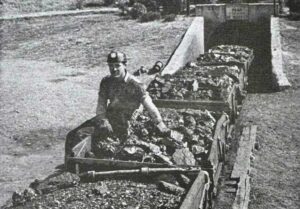
In January of 1969, a freight train derailed in Springville, hitting propane tanks and triggering massive explosions that created a fire that scared the heebie-jeebies out of local residents and destroyed the train depot.
In 2023, that explosion triggered the imagination of a local non-fiction author who loves to read mysteries and wondered whether he could write one. “What if that train wreck covered up a murder no one knew about,” Joel Dison’s thought process began. “And what if that murder was connected to a current murder and the investigator had to solve the old one to solve new one?”

That’s how the “conflict series” was born, and how Dison, an ordained Southern Baptist minister, went from daily technical writing and inspirational writing to the world of fiction. The series began in July 2024 with Conflict of Interest, followed by Moral Conflict (November 2024), Final Conflict (March 2025) and The Bookkeeper (July 2025). The latter was supposed to be the finale, but Dison says a fifth book is rolling around in his brain.
“When I finished the first book, I realized there was more to the story,” he says. “It stuck in my head and I had to get it out. I probably have one more to do only because I don’t like leaving certain things in the books unresolved.”
Raised in Chalkville, Dison is a 2011 graduate of New Orleans Baptist Theological Seminary. Although he actually wrote his first novella in a long-lost notebook while in junior high, he started writing books a little after seminary graduation. “I did a lot of technical writing for work before that,” says Dison, a bivocational minister until 2023 when he moved to Springville to help take care of his ailing parents. By day, he’s an electrical engineer for PowerGem, LLC., having worked for Southern Company for 34 years before taking an early severance. He says hewas always good at tech writing. “There was a lot of writing in the seminary, too, and that re-ignited the spark that began in junior high,” he says.
All of his books are self-published. The first three were non-fiction, inspirational books. “The first was a study on the Book of James, and it was published on Amazon and Barnes & Nobles,” Dison says. “I didn’t get many bites on B&N, although I did sell some in the United Kingdom.”
Of the four murder mysteries, he has sold somewhere in the 600 range. “Not great but not bad,” he says. “The nonfiction books did okay, almost 2000 in the 2010-2014 time frame, but some of those may have been free giveaways. I was actually surprised to see the number that high when I checked it. I don’t do a lot of marketing.”
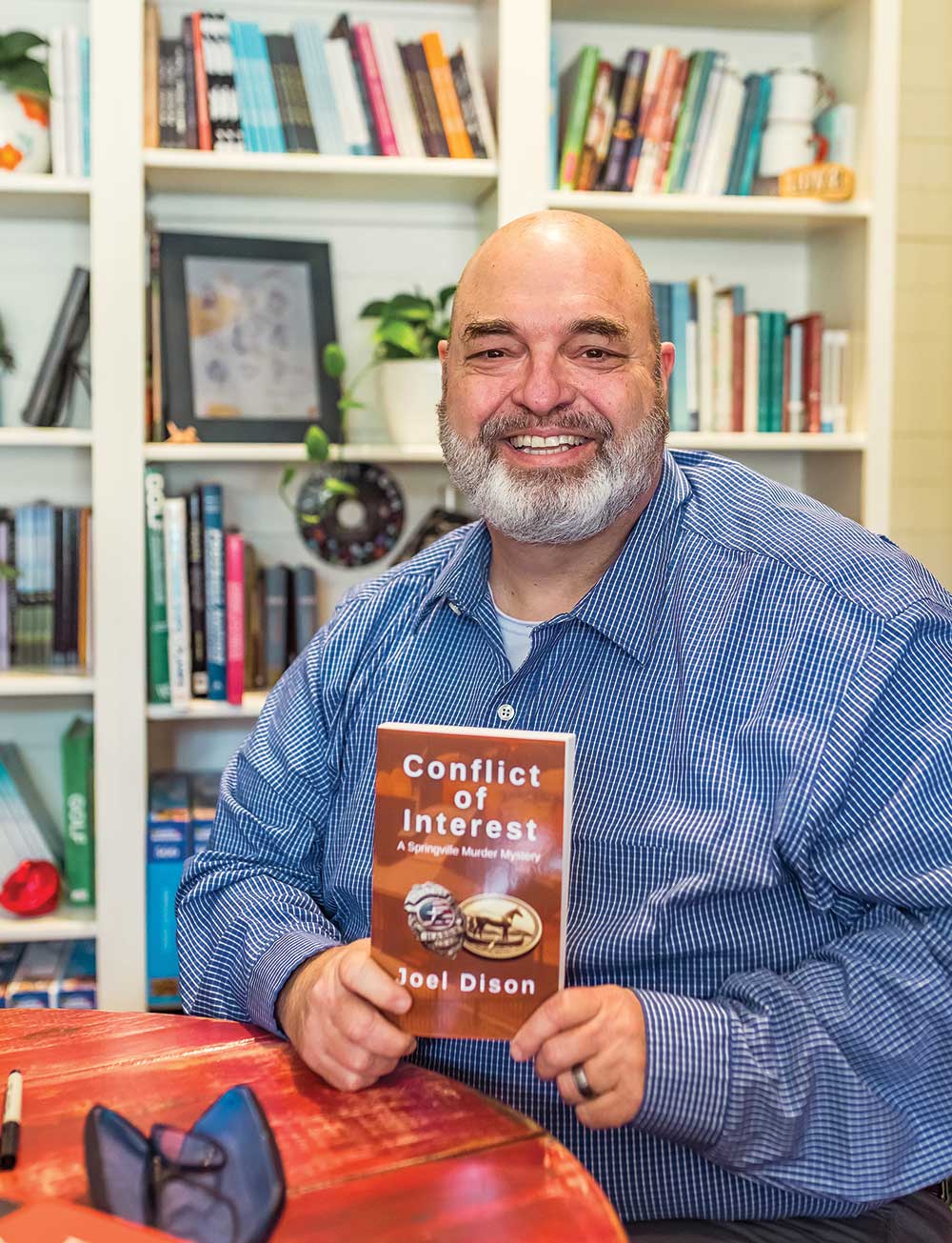
Dison never thought he had the imagination for an entire book of fiction, much less four, but he surprised himself. “I really wanted to do fiction,” he says. “I love mysteries, and writing one became a personal challenge.”
At one point while writing that series, he asked himself why a pastor would write a murder mystery and whether he should.He came to a conclusion that satisfied him and enabled him to moved forward with the mysteries. “Evil is a reality in this world, and as believers (in Christ), how do we deal with that evil?,” he asked himself. “And how as believers do we approach it? I wanted this to be clean, without cursing or gratuitous sex and not too much grotesque violence.”
Book One ends and Book Two begins with a moral dilemma. The first dealt with a lot of internal doubts and overcoming one’s own failures. The second opens with the main character still dealing with some of those failures. The third deals with how all of those things create internal conflicts, although the story is about external ones.
Dison says he could have ended the murder mystery series at three books, but Book Four re-opens that over-arching theme of conflict between the main character and his nemesis. “It deals with concepts of justice, which does not always look like what you think it does,” Dison says. “There’s a possible fifth one in progress.”
His “conflict” books were written in the third-person. Then a prompt from his Springville writing group made him ask himself whether he could write sci-fi, and write it in the first person present. The latter proved to be more difficult than Dison thought it would be. “I kept switching to the past tense in the sci-fi book, the Cymbrian Protocol,” he says. “But some people think first-person is more engaging to the reader because it makes them feel they are present.”
His writing group, which has no name, often comes up with a topic, and each member writes 2,000 words in three weeks or more on that same topic. “Then we read, compare and critique,” he says. “In January, for example, the topic was a fairy tale.” The group is several years old, and Dison has been a member for about a year.
Dison self-publishes all of his books, a process that no longer carries the stigma it used to. “Self-publishing is becoming as viable and credible as traditional publishing,” he says. “But I would love to have an agent who could find me a publisher to edit and distribute my works. I’m not writing to be a best seller, but for the personal enjoyment and the hope that someone will read my books and enjoy them.”
Electronic publishing costs nothing, except for whatever an author decides to spend for editing and marketing. “So even with paperback it’s just my own printing costs,” Dison says. “It’s a low threshold, which is why so many people do it.”
He makes a couple of dollars on each book he sells, but says he’s not writing for money or fame. “I enjoy writing. It’s cathartic and calming, and exercises my brain. It’ a way of dealing with all the stress I’m going through, a coping mechanism. You lose yourself in your writing.”
Dison designed each of his covers himself, using a graphics editing tool called Canva, with a little help from ChatGPT. “Some images are AI generated,” he says, but he doesn’t use AI in writing his books. “That would be deplorable.” Readers can find his books by searching his name on Amazon, or by checking with Nichols Nook in Springville.
He hasn’t decided whether his sci-fi novel needs a follow-up. The first one came directly from one of his writing group’s prompts, which called for writing a short sci-fi scene. That led to the full book. “I want to find a good way to wrap up the Springville murders, then I’ll decide what’s next,” he says. He has thoroughly enjoyed the locally-set writing and would seriously consider that again in a different format, perhaps a historical fiction or maybe a ghost story.
Readers always wonder where a writer gets his inspiration. For Joel, who has always loved reading mysteries and sci-fi, it’s more about the challenge than the inspiration. “For the first book, the challenge was, ‘Can I write a murder mystery,’” he says. “For the sci-fi, it was, ‘Can I write a sci-fi and write it in the first person?’ I like to challenge myself.”
He has no aspirations of getting rich from his writing, but hopes people will read his books and enjoy them. “I want to provide the option of clean, enjoyable reading for those who like to read, but are bothered by the foul language, sex and violence in lot of popular literature,” he says.